
Judge, 1931-05-16 · page 20 of 36
Judge — May 16, 1931 — page 20: what you’re looking at
A restored page from Judge, 1931-05-16. Page through the whole issue in the reader above.
📄 Transcribed text from this page (OCR, searchable)
Machine-transcribed from the original scan — historical spelling and the odd misread are preserved.
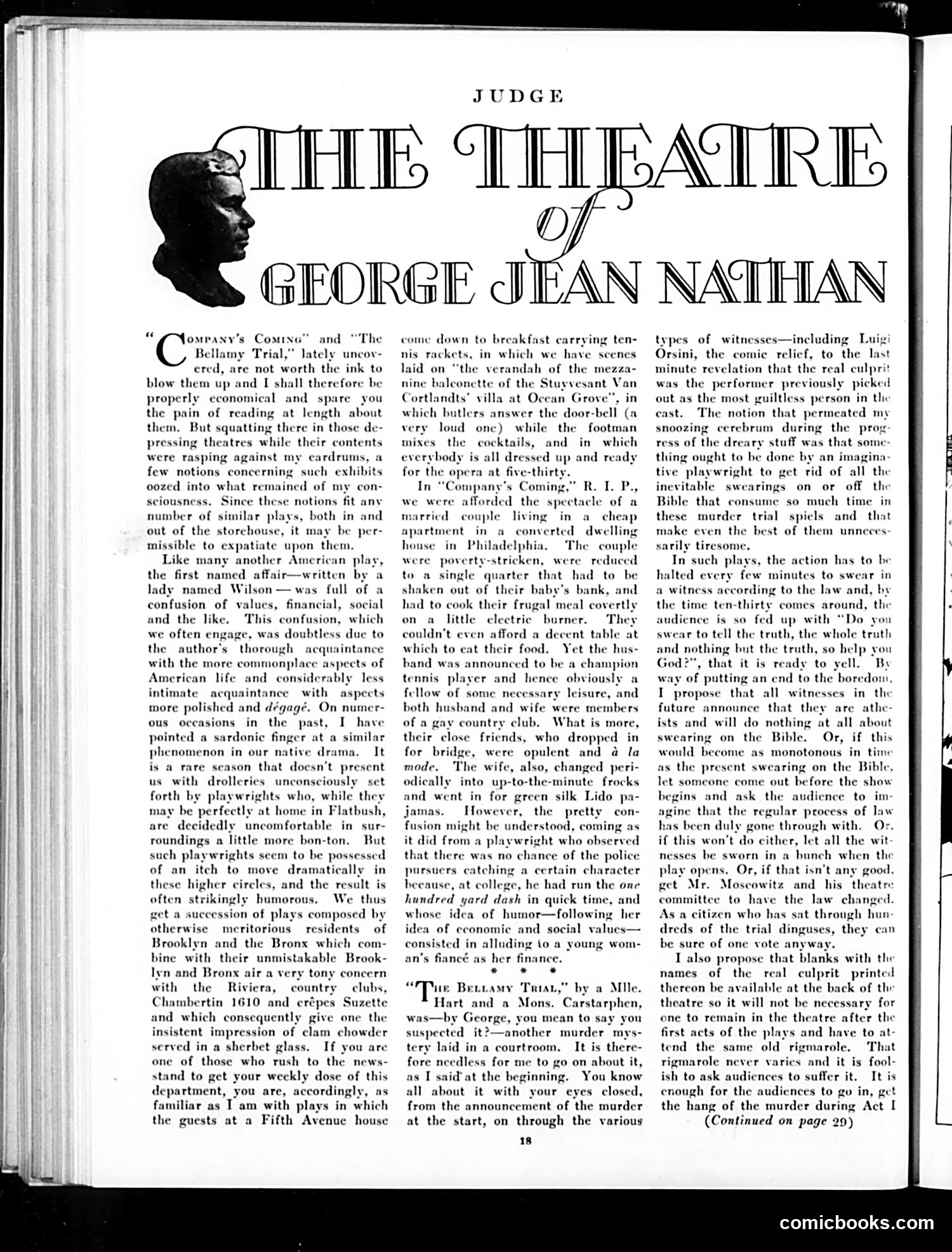
JUDGE Is UADRACIIRE: 0 GEORGE J ompany’s Comina” and “The Bellamy Trial,” lately uncov- ered, are not worth the ink to blow them up and I shall therefore be properly economical and spare you the pain of reading at length about them. But squatting there in those de- pressing theatres while their contents were rasping against my eardrums, a few notions concerning such exhibits oozed into what remained of my con- sciousness. Since these notions fit anv number of similar plays, both in and out of the storehouse, it may be per- missible to expatiate upon them. Like many another American p the first named affair—written by a lady named Wilson — was full of a confusion of values, financial, social and the like. his confusion, which we often € ve, was doubtless due to the author's thorough with the more commonp American life and consid intimate acquaintance with aspects more polished and dégagé. On numer- ous occasions in the past, I have pointed a sardonic finger at a similar phenomenon in our native drama, It is a rare season that doesn’t present us with drolleries unconsciously set forth by playwrights who, while they may be perfectly at home in Flatbush, are decidedly uncomfortable in’ sur- roundings a little more bon-ton. But such playwrights seem to be possessed of an itch to move dramatically in these higher circles, and the result is often strikingly humorous. We thus get a succession of plays composed by otherwise meritorious residents of Brooklyn and the Bronx which com- bine with their unmistakable Brook- lyn and Bronx air a very tony concern with the Riviera, country clubs, Chambertin 1610 and crépes Suzette nd which consequently give one the insistent impression of clam chowder served in a sherbet glass. If you are one of those who rush to the news- stand to get your weekly dose of this department, you are, accordingly, as familiar as T am with plays in which the guests at a Fifth Avenue house acquaintance pects of bly less come down to breakfast carrying ten- nis rackets, in which we have scenes ‘the verandah of the mezza- nine baleonette of the Stuyvesant Van Cortlandts’ villa at Ocean Grove”, i which butlers answer the door-bell (a very loud one) while the footman mixes the cocktails, and in’ which I dressed up and ready t five-thirty “Company's Coming, we were afforded the spec married couple living in « tment in a converted dwelling in Philadelphia, ‘The couple were poverty-stricken, were reduced to a single quarter that had to be shaken out of their baby’s bank, and had to cook their frugal meal covertly on a little electric burner. couldn't even afford a dec which to eat their food, Yet the hus- band was announced to be a champion tennis player and hence obviously a fellow of some necessary leisure, and both husband and wife were members of a gay country club, What is more, their close friends, who dropped in for brid, were opulent and @ la mode. The wife, also, changed peri- odically into up-to-the-minute frocks d went in for green silk Lido p jamas. However, the pretty con- fusion might be understood, coming as it did from a playwright who observed that there was no chance of the police pursuers catching a certain character because, at college, he had run the one hundred yard dash in quick time, and whose idea of humor—following her idea of economic and social values— consisted in alluding to a young wom- an’s fiancé as her finance. . * «* “Tur Betramy Tria,” by a Mlle. Hart and a Mons. Carstarphen, was—by George, you mean to say you suspected it?—another murder mys- tery laid in a courtroom. It is there- fore ncedless for me to go on about it, as I said’at the beginning. You know all about it with your eyes closed, from the announcement of the murder at the start, on through the various 18 cheap NATHAN types of witnesses—including Lui Orsini, the comic relief, to the minute revelation that the real culprit was the performer previously picked out as the most guiltless person in the The notion that permeated my snoozing cerebrum during the pre ress of the dreary stuff was that some- thing ought to be done by an imagin tive playwright to get rid of all the inevitable swearings on or off thi Bible that consume so much time in these murder trial spiels and. that make even the best of them unneces sarily tiresome. In such plays, the action has to bv halted every few minutes to swear in a witness according to the law and, by the time ten-thirty comes around, the audience is so fed up with “Do you swear to tell the truth, the whole truth and nothing but the truth, so help you God?", that it is ready to yell. By way of putting an end to the boredom, I propose that all witnesses in th future announce that they are athe- ists and will do nothing at all about swearing on the Bible. Or, if. this would become as monotonous in time as the present swearing on the Bible, let someone come out before the show begins and ask the audience to im ne that the regular process of law has been duly gone through with. Or. if this won't do cither, let all the wit nesses be sworn in a bunch when the y opens. Or, if that isn’t any good, get Mr. Moscowitz and his theatre committee to have the law changed. As a citizen who has sat through hun dreds of the trial dinguses, they can be sure of one vote any I also propose that blanks with the names of the real culprit printed thereon be available at the back of th: theatre so it will not be necessary for one to remain in the theatre after the first acts of the plays and have to at- tend the same old rigmarole. T rigmarole never varies and it is fool- ish to ask audiences to suffer it. It is cnough for the audiences to go in, get the hang of the murder during Act I (Continued on page 29) cast. comicbooks.com