
A complete issue · 37 pages · 1928
Judge — December 29, 1928
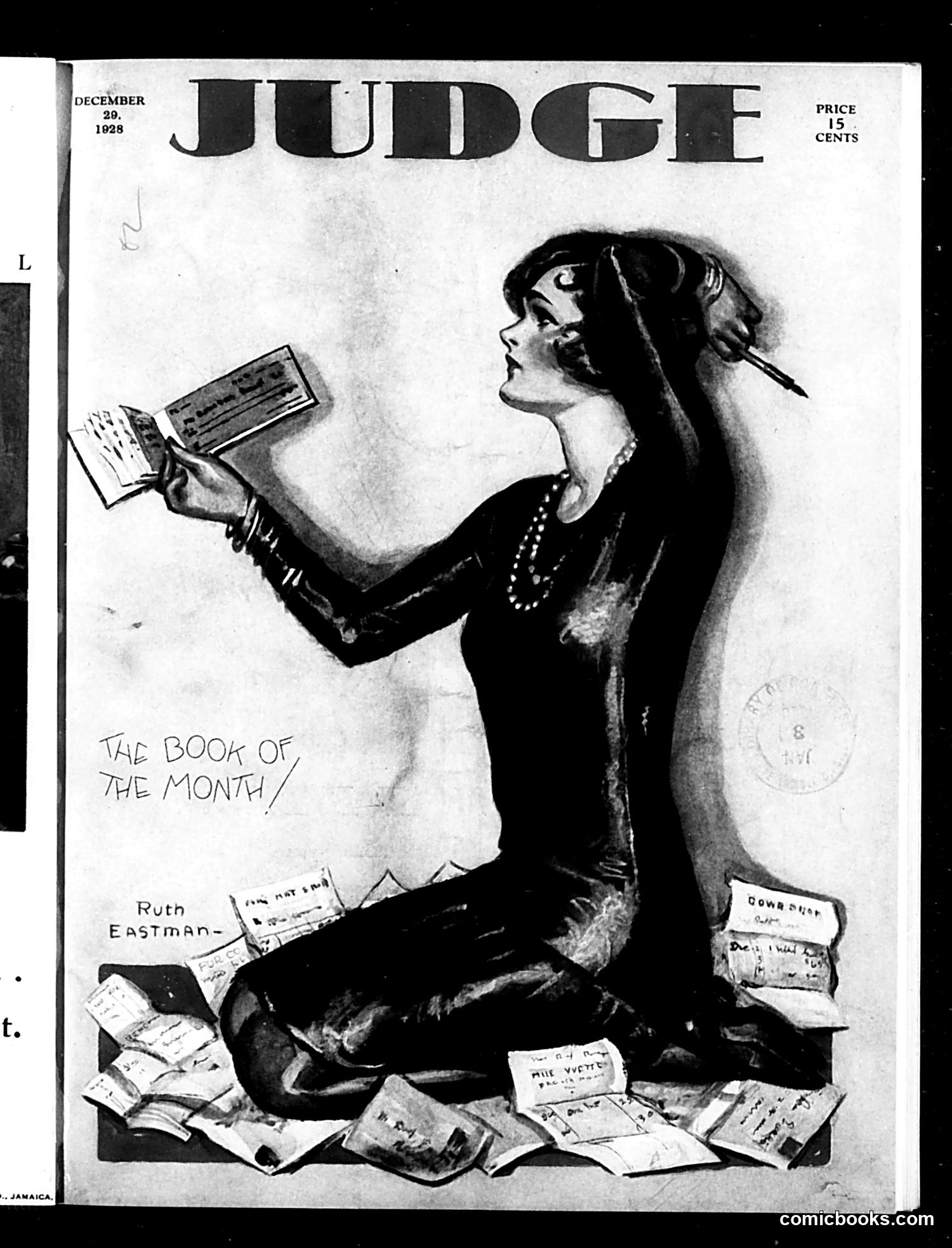
This cover satirizes women's reading habits, depicting a stylish woman surrounded by books and magazines. The illustration is titled "The Book of the Month," suggesting commentary on the newly popular Book-of-the-Month Club (founded 1926). Visible book spines reference "Ruth Eastman" and other titles, though some text is illegible in the reproduction. The woman's fashionable appearance—bobbed hair, pearl necklace, elegant dress—represents the modern 1920s "flapper" aesthetic. The satire likely mocks either: - Women's consumption of popular literature as frivolous - The commercialization of reading through subscription clubs - The gap between highbrow and mass-market tastes The humor targets how modern women engaged with books as status symbols or entertainment rather than serious intellectual pursuits—a common prejudice of the era.
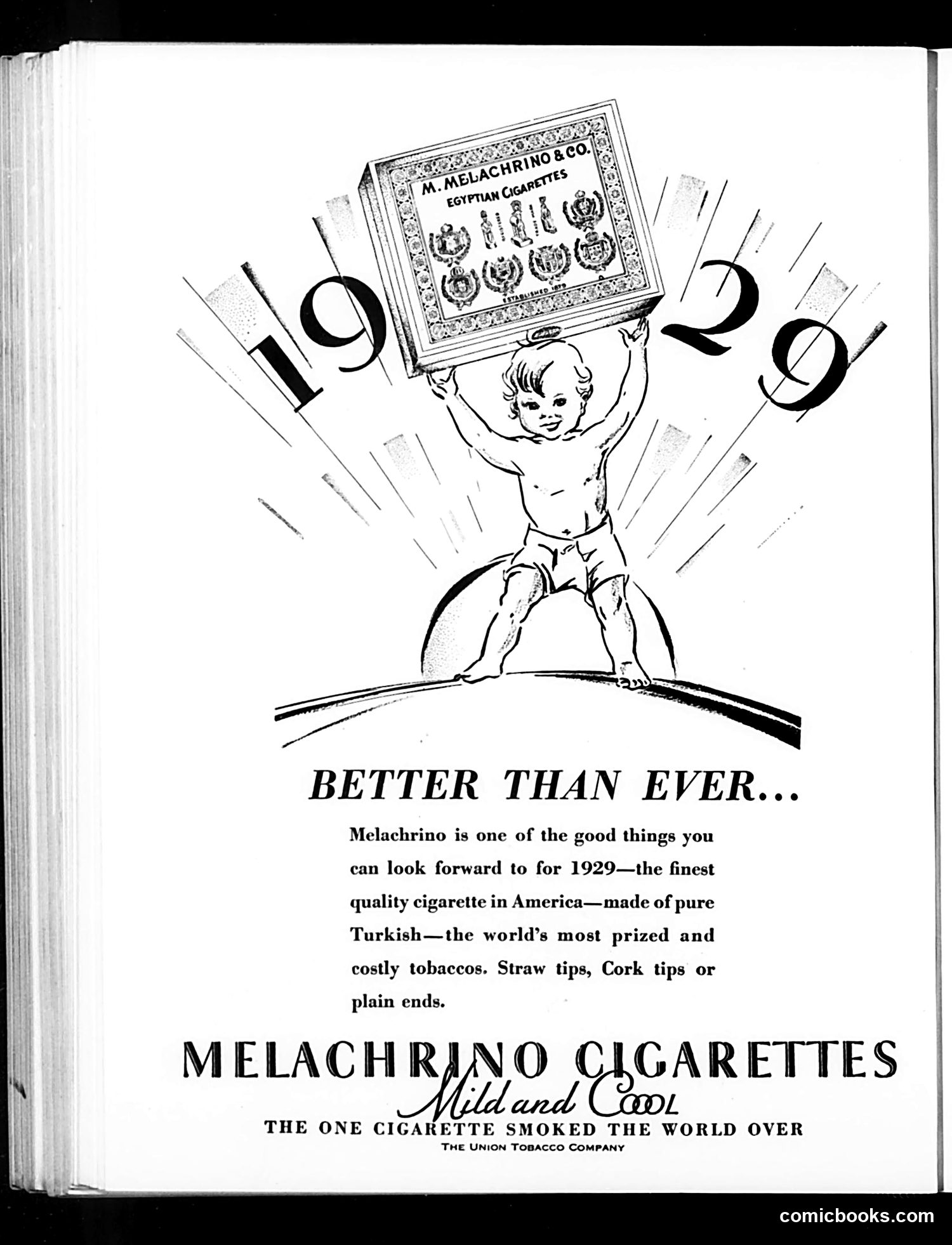
This page is primarily a **cigarette advertisement**, not satire or political commentary. It advertises Melachrino Cigarettes with the tagline "Better Than Ever..." for 1929. The central image shows a cherub or putti figure (a common advertising motif of the era) holding aloft a cigarette box, standing triumphantly on a globe. The numbers "1929" flank the figure, marking the year. The ad copy emphasizes the product's superiority, claiming it uses "pure Turkish"—"the world's most prized and costly tobaccos"—available in multiple tip styles (straw, cork, or plain). This appears in **Judge magazine**, but the content itself is commercial advertising rather than satirical editorial commentary. The cherub imagery and global reference simply marketed the cigarettes as a worldwide premium product.
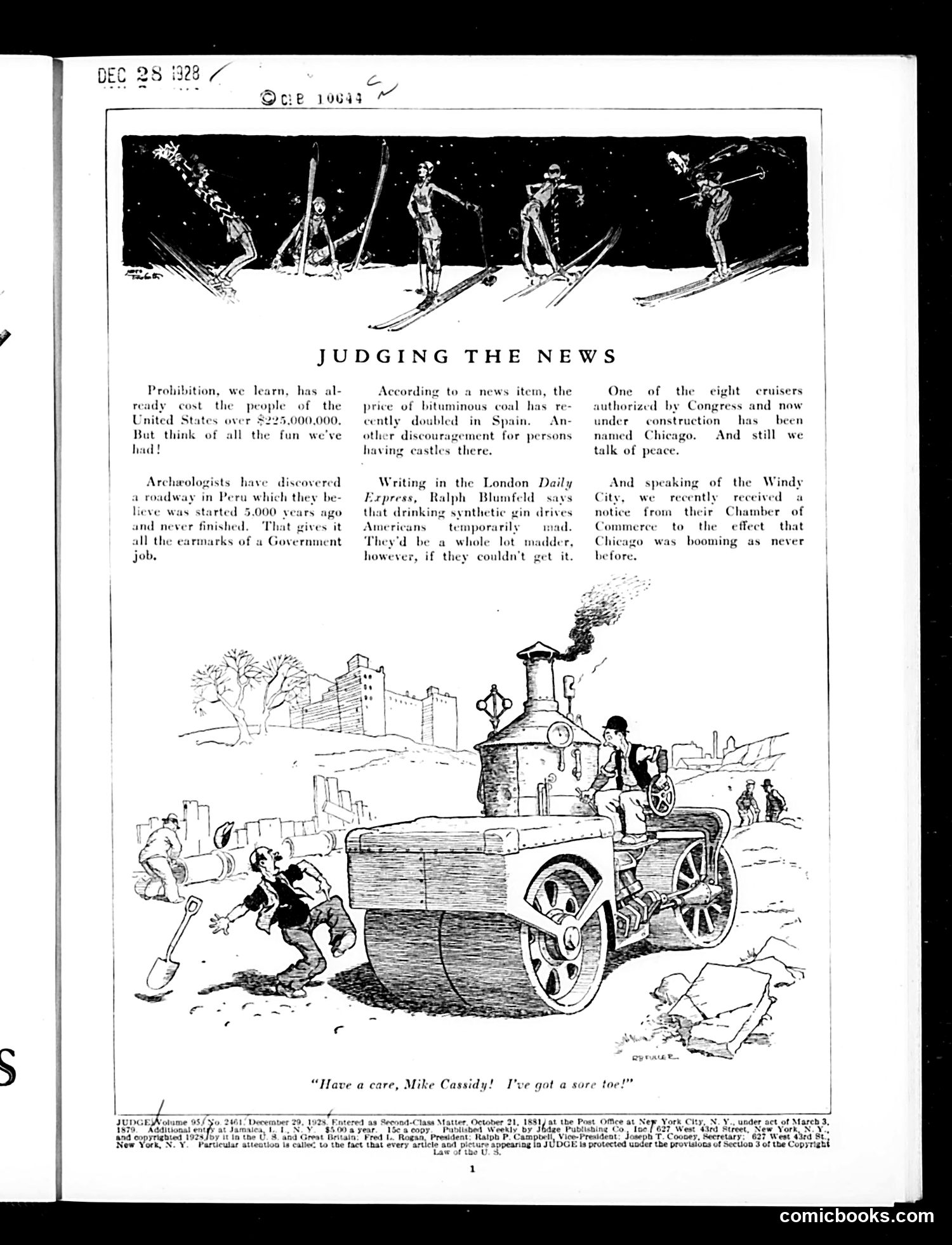
This Judge magazine page from December 28, 1929 contains commentary on current events and a cartoon illustration. **Top Section**: Brief satirical news items mock: - U.S. Prohibition costs ($225 million) with no results - An unfinished Peruvian dam project (5,000 years old) - Spain's doubled bituminous coal prices - Synthetic gin consumption in London - Eight authorized cruisers under construction as "talk of peace" - Chicago's economic boom claims **Main Cartoon**: Depicts a steam-powered vehicle with a large boiler in what appears to be a post-apocalyptic or industrial wasteland. A man with a shovel warns the operator "Have a care, Mike Cassidy! I've got a sure toe!" The illustration seems to satirize either industrial accidents, dangerous working conditions, or possibly the hazards of emerging transportation technology during this industrial era. The specific reference to "Mike Cassidy" remains unclear without additional context.
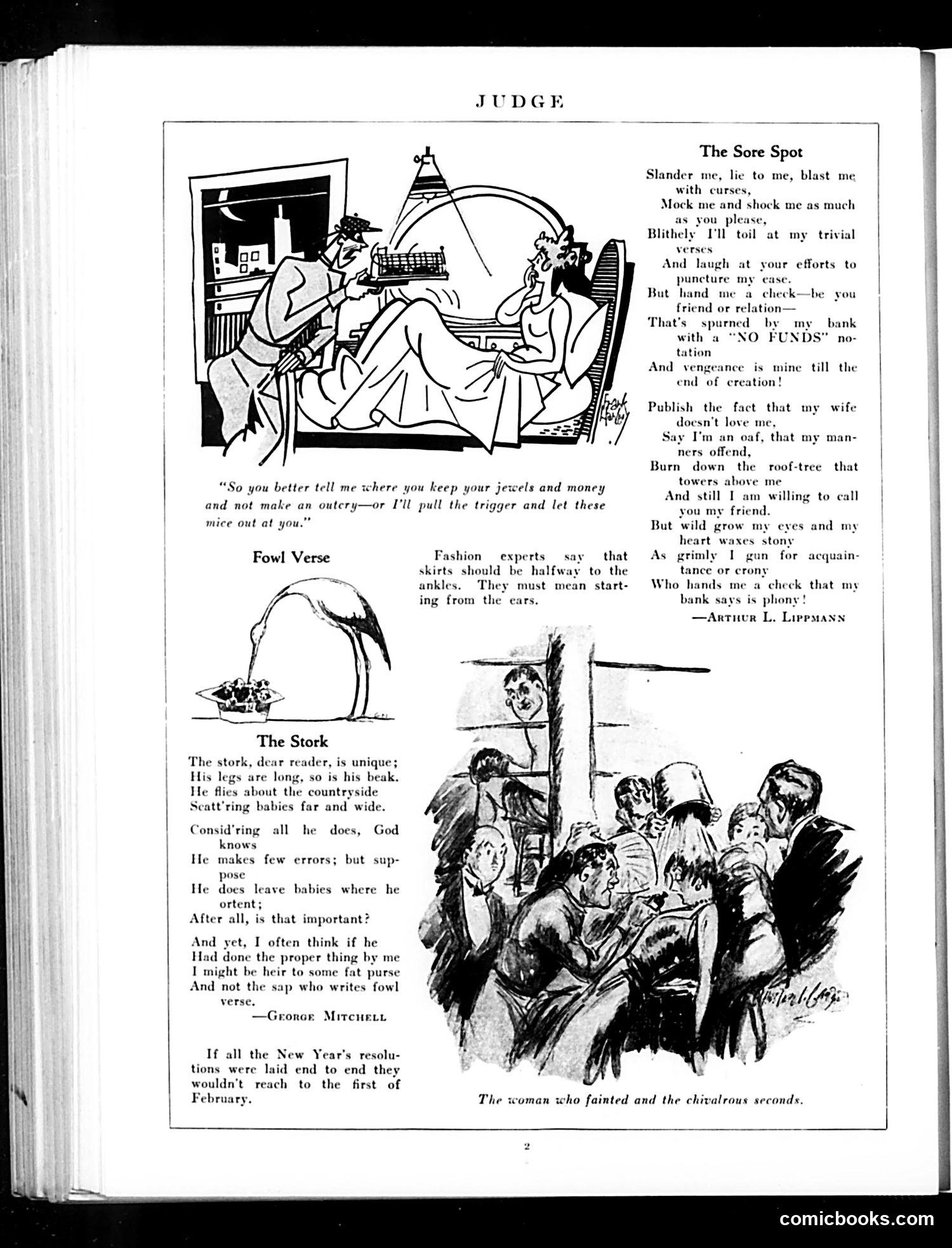
This page contains three distinct satirical pieces: 1. **Top cartoon**: Depicts a robbery scene where a gunman demands a woman reveal her jewelry and money locations, threatening violence. The satire targets marital discord—the joke being that a wife might refuse to tell her own husband such information, making her vulnerable to criminals. 2. **"The Sore Spot" poem** by Arthur L. Lippmann: A bitter monologue from a scorned man whose wife doesn't love him, whose bank rejected his loan ("NO FUNDS"), and who faces public humiliation. It's satirizing male wounded pride and financial desperation. 3. **"The Stork" and "Fowl Verse"** by George Mitchell: Light verse about the stork's role in childbirth, humorously questioning whether the bird deserves credit for deliveries it makes. The page mixes domestic humor with economic anxiety themes typical of early 20th-century Judge magazine.
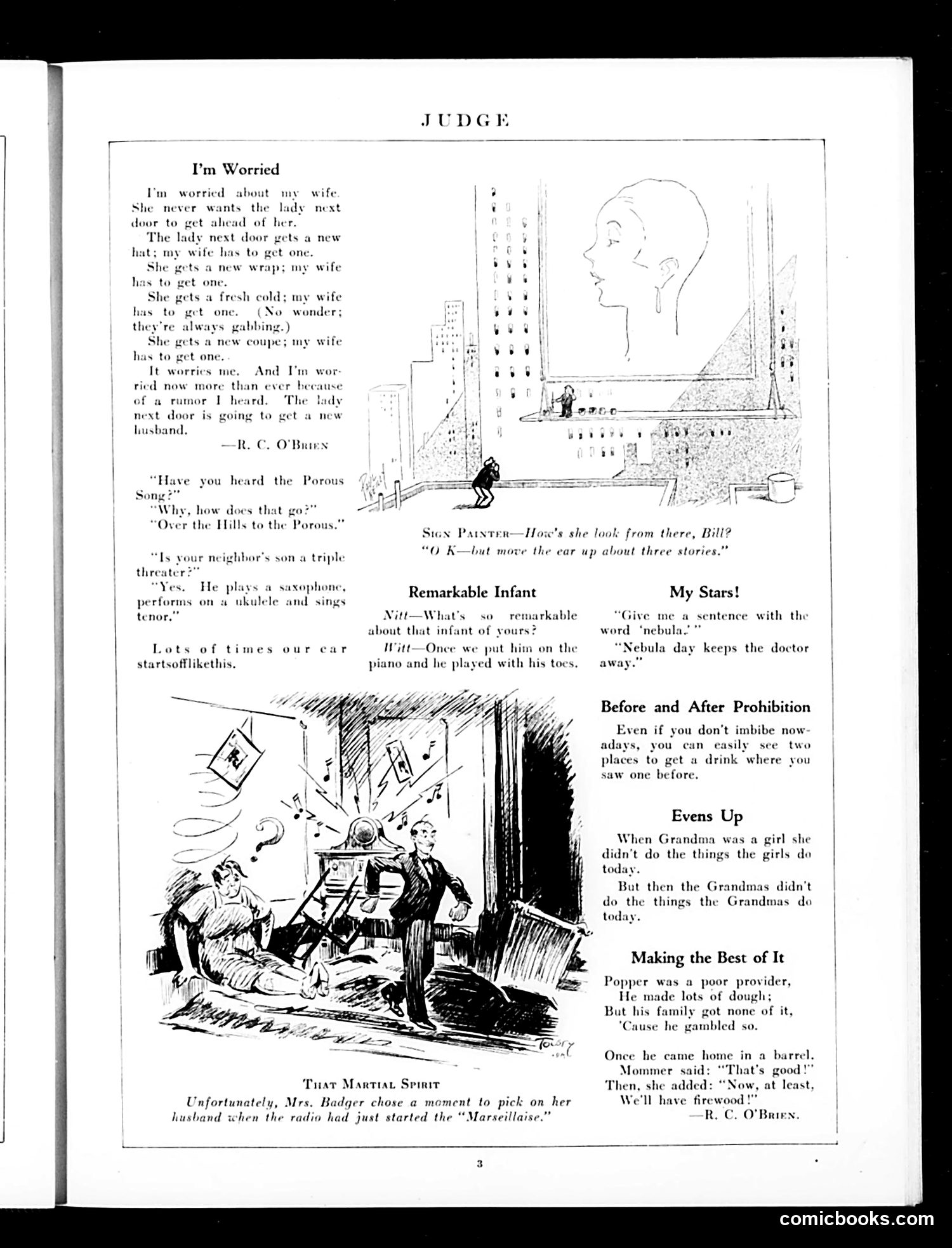
This page contains several brief humorous items rather than a single political cartoon. The main illustrated piece, "That Martial Spirit," depicts a domestic scene where Mrs. Bodger interrupts her husband during a radio broadcast of the "Marseillaise" (French national anthem). The humor relies on the contrast between the husband's patriotic posture and the mundane domestic interruption—suggesting that even moments of nationalist fervor cannot compete with household concerns. Other items are short jokes about everyday life: a wife's endless shopping needs, a neighbor's musically talented son, prohibition-era drinking establishments, and changing social customs between generations. The page reflects early-20th-century American humor focused on domestic life and social observation rather than explicit political commentary.
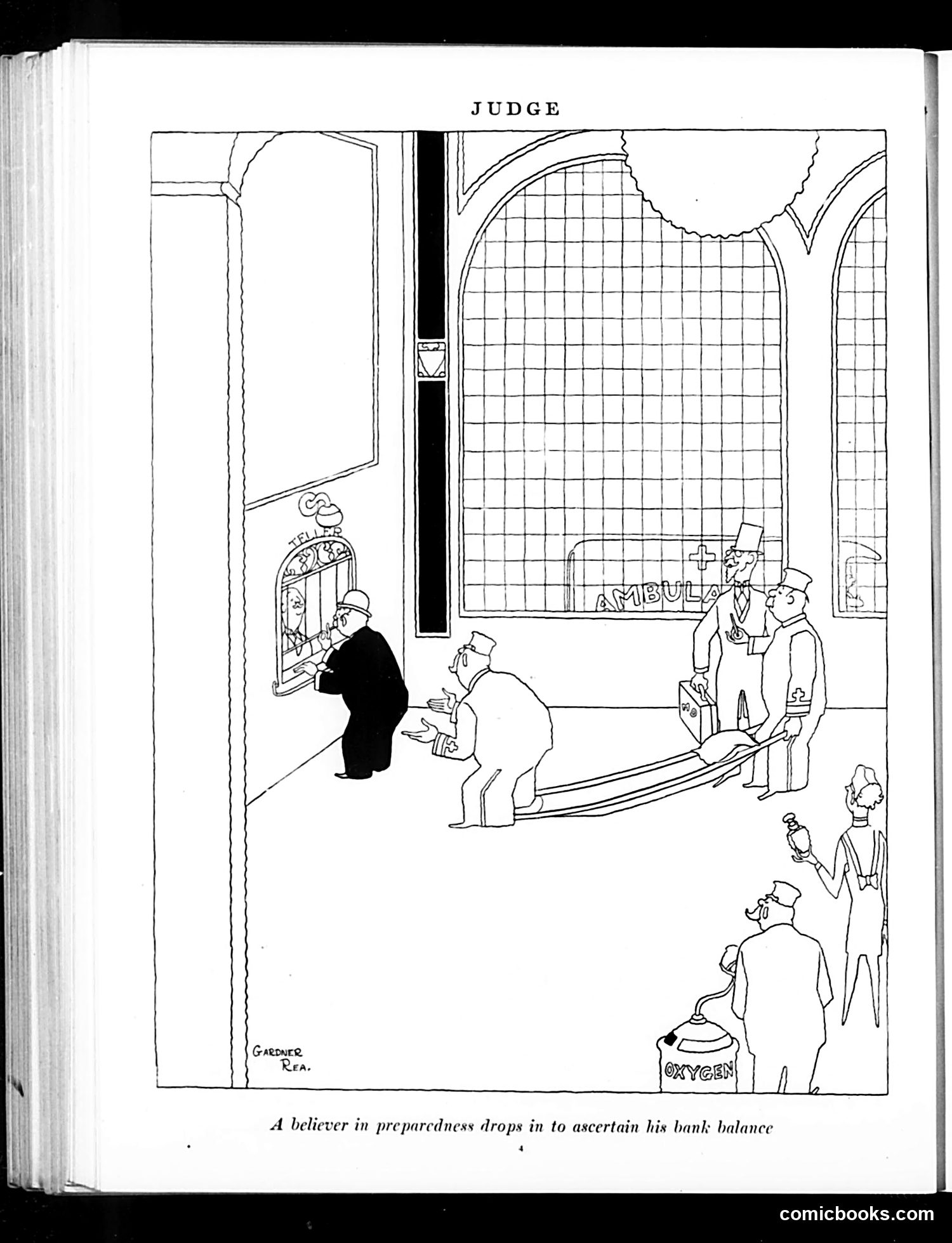
This cartoon satirizes religious extremism and superstitious belief. The caption reads: "A believer in preparedness drops in to ascertain his bank balance." The scene shows a man in formal attire entering a bank, where an "AMBULANCE" is visibly displayed outside and an "OXYGEN" tank sits in the foreground. These medical implements suggest the man expects a health crisis from discovering his financial situation. The satire targets someone whose religious faith in divine "preparedness" (a contemporary concept emphasizing readiness) is so fervent that he anticipates divine punishment or shock upon learning his bank balance. The cartoon mocks the contradiction between religious belief and practical financial responsibility, suggesting such blind faith leads to absurd anxiety about material matters. The cartoonist is credited as "Gardner Rea."
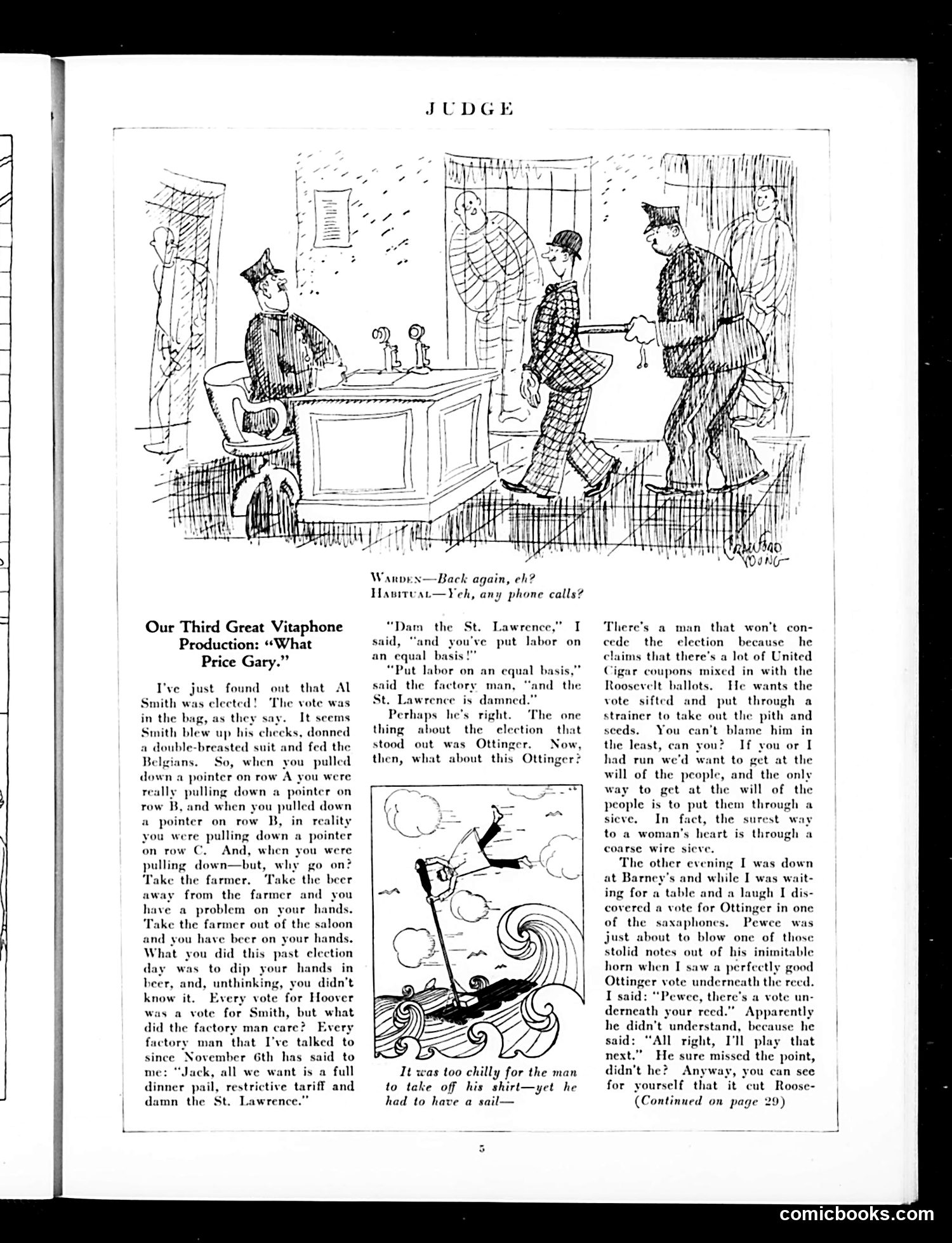
This page satirizes American electoral corruption, specifically referencing a disputed election involving candidates Smith and Ottinger. The top cartoon depicts a courtroom ("Judge") where a warden and habitual criminal discuss election fraud—suggesting the judicial system is examining crooked voting practices. The main article, "Our Third Great Vitaphone Production: 'What Price Gary?'" mocks election manipulation through a factory-worker narrative. It describes how Al Smith's victory involved ballot-stuffing and pointer-switching on tally sheets, with explicit references to the St. Lawrence factory. The accompanying illustration shows a man nearly blown away, humorously depicting chaos. The satire criticizes how working-class voters were manipulated through fraudulent counting methods, treating election-rigging as entertainment while exposing actual corruption practices.
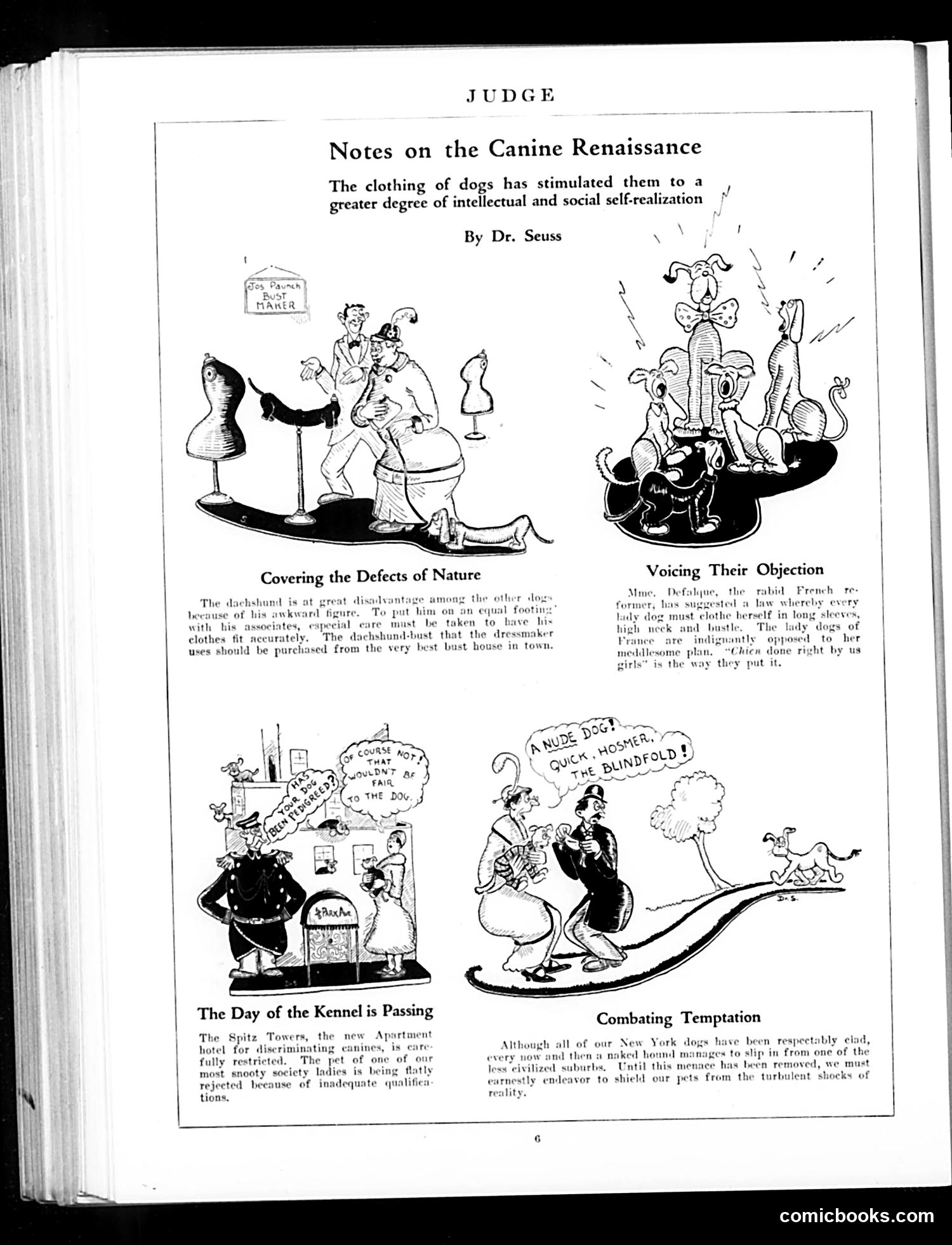
This satirical piece mocks the pretensions of high society through the conceit of dressed-up dogs gaining "intellectual and social self-realization." The four panels lampoon specific upper-class anxieties: 1. **"Covering the Defects of Nature"**: Dachshunds need tailoring to look respectable among other dogs—satirizing how wealthy people use fashion to mask or improve appearance. 2. **"Voicing Their Objection"**: Society ladies (described as "Mme. Defigue, the rabbit French reformer") object to dogs in high necklines, suggesting women's fashion debates were as petty as dogs quarreling over clothing. 3. **"The Day of the Kennel is Passing"**: References "Spitz Towers," an exclusive apartment hotel for well-dressed canines—mocking nouveau-riche housing developments and class segregation. 4. **"Combating Temptation"**: Warns against unclothed dogs from less civilized suburbs corrupting properly dressed New York dogs—a jab at anxieties about lower classes disrupting elite neighborhoods. The satire targets early-20th-century snobbery, conspicuous consumption, and social pretension by literalizing them through absurd canine analogy.
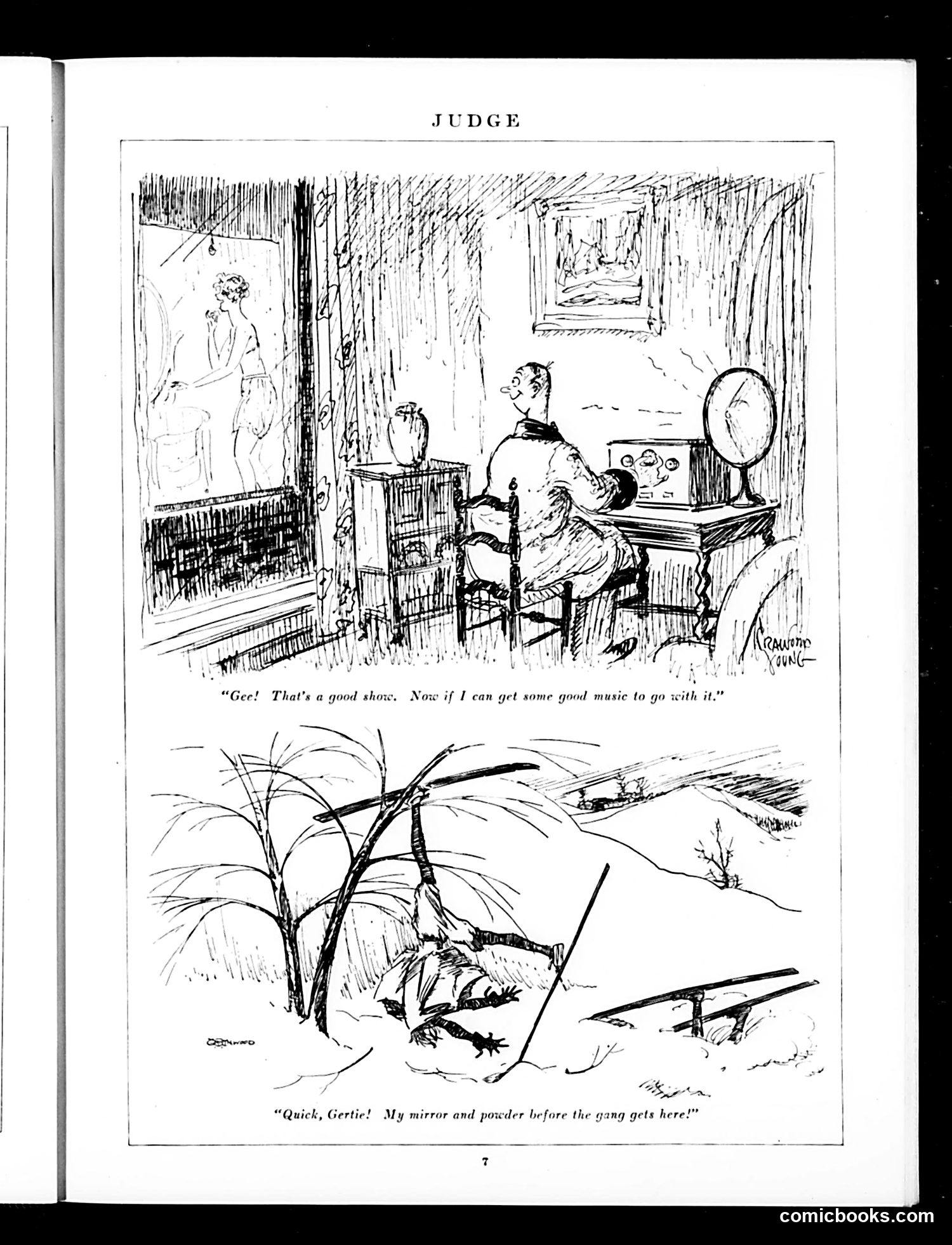
This page contains two unrelated cartoon gags typical of Judge magazine's humor: **Top cartoon**: A man admires a painting of a nude figure, then asks for "good music to go with it"—a joke about aesthetic appreciation masking lustful intent. **Bottom cartoon**: A woman hiding under an umbrella during what appears to be a sandstorm urgently requests her mirror and powder before "the gang gets here." The humor relies on the period stereotype of women's vanity—suggesting that even in dire circumstances (possibly a desert emergency, given the palm tree and dunes), a woman's primary concern is her appearance. Both cartoons reflect early 20th-century gender stereotypes common to Judge's satirical humor: men's focus on female attractiveness and women's supposed obsession with cosmetics and beauty.
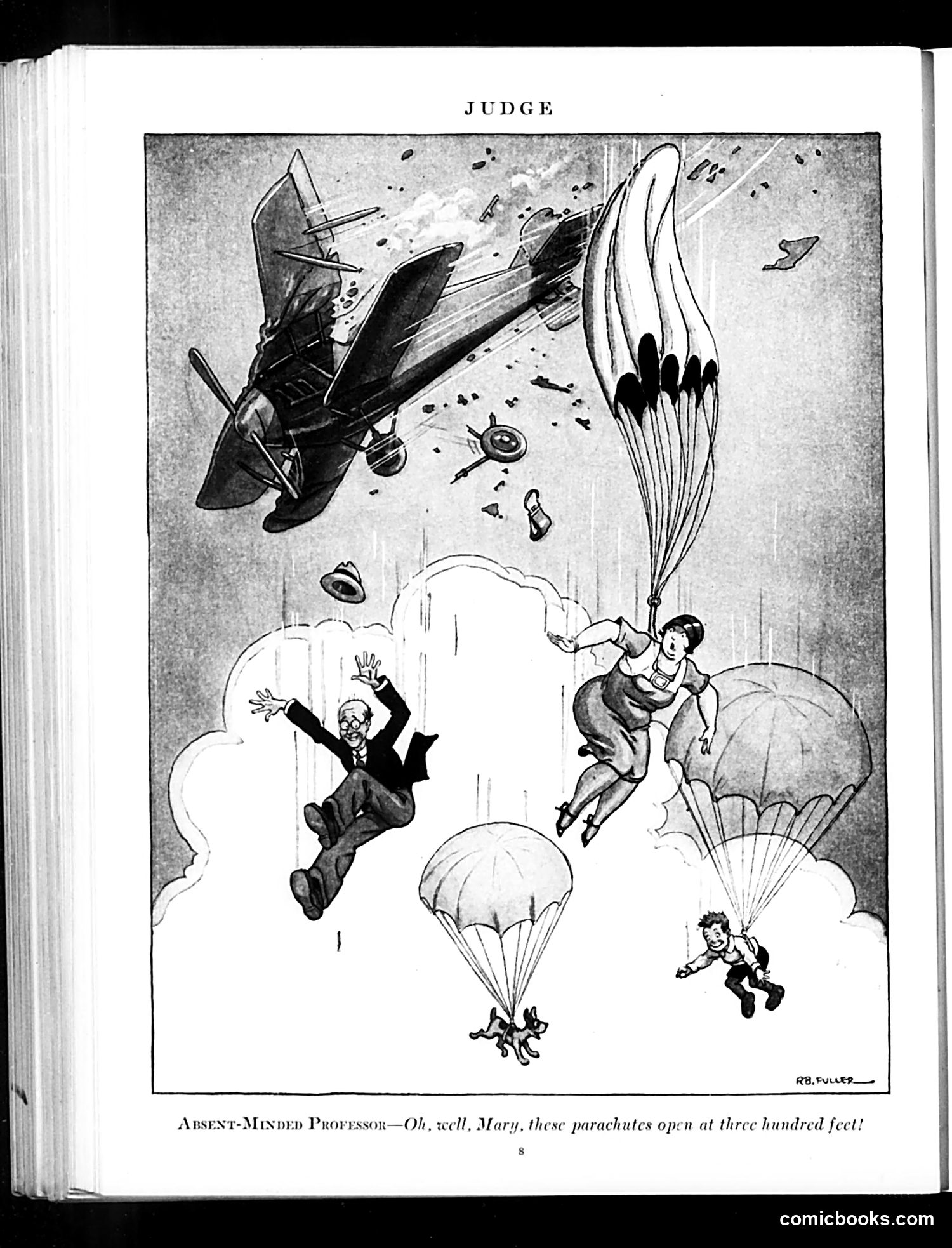
This is a humorous cartoon about an absent-minded academic. The joke depicts a professor so distracted that he's casually jumping out of an airplane with skydivers, seemingly unaware of the danger or what he's doing. His comment to "Mary" about the parachutes opening at three hundred feet suggests he's treating a life-threatening situation with oblivious nonchalance—the hallmark of the absent-minded professor trope. The cartoon satirizes the stereotype of brilliant but socially disconnected academics who lack practical awareness or common sense. The humor relies on the contrast between the extreme danger of skydiving and the professor's casual demeanor. The winged figure in the airplane above adds to the chaotic scene. This was a popular comedic archetype in early 20th-century American humor.
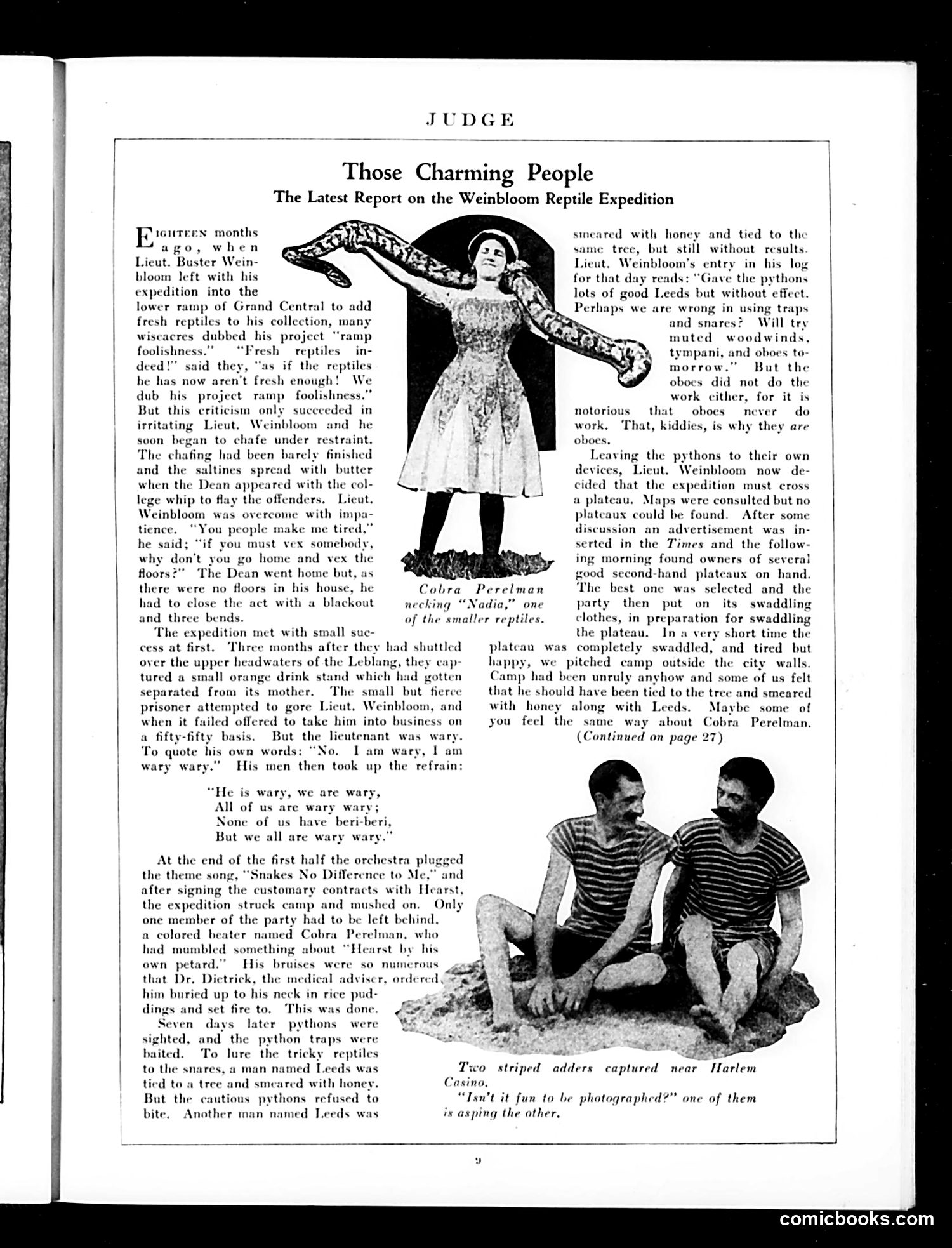
This is a absurdist satirical piece mocking a fictional "Weinbloom Reptile Expedition" supposedly exploring beneath Grand Central Terminal. The humor relies on nonsensical scenarios: attempting to capture pythons using musical instruments and oboes (with a meta-joke that oboes "never do work"), purchasing second-hand plateaux via Times classified ads, and a subplot involving a character named Cobra Perelman who gets buried neck-deep in rice puddings and set on fire. The satire appears to mock expedition narratives popular in early 20th-century magazines and the absurdity of pseudo-scientific ventures. References to Hearst (the media mogul) suggest commentary on sensationalist journalism. The cartoons and illustrations accompanying the text feature a woman posing with a python and two men with captured adders, presenting the expedition's supposed "discoveries" as entertainment. The overall effect is deliberately ridiculous—a parody of adventure stories and their credibility.
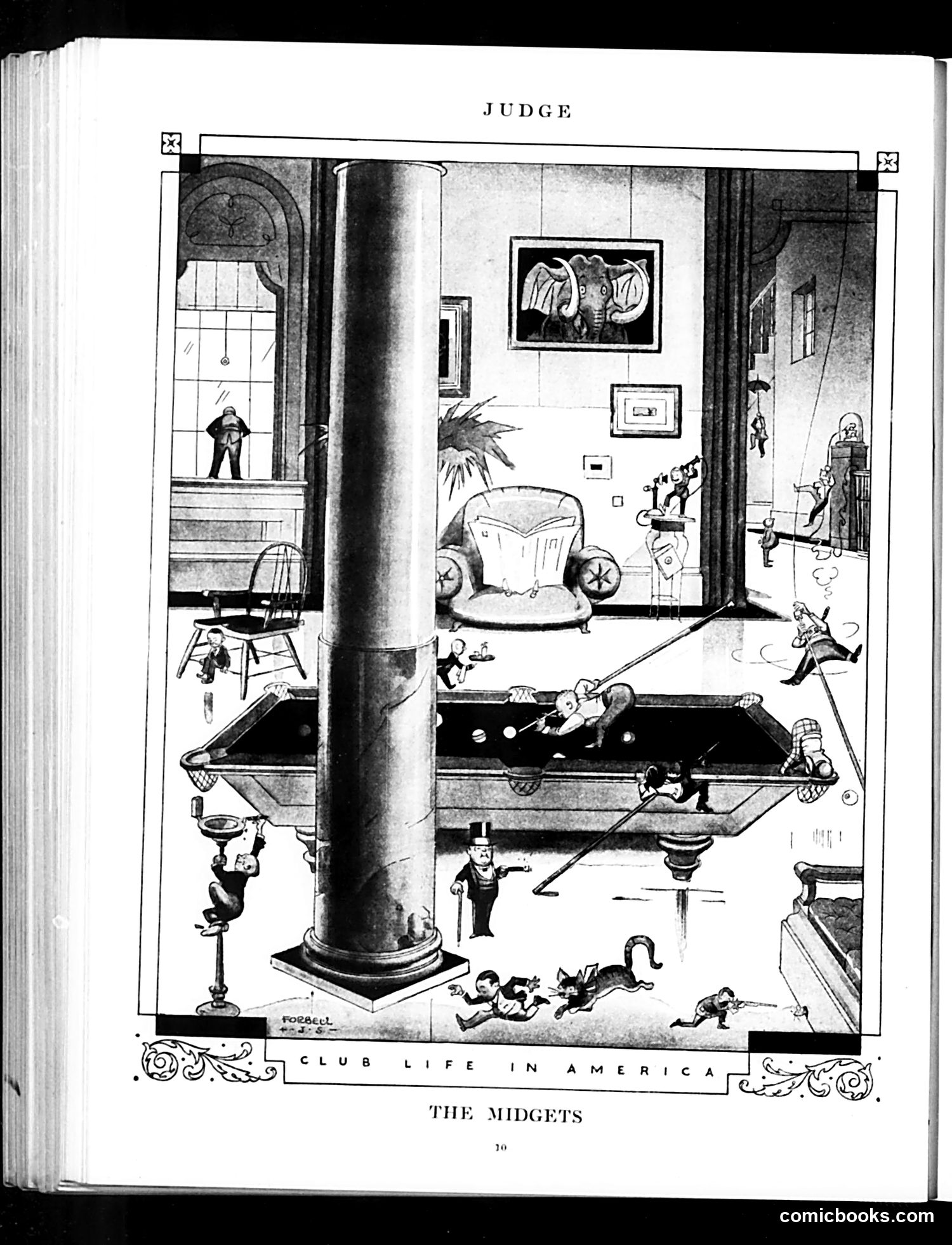
This is a satirical cartoon titled "The Midgets" from Judge magazine's "Club Life in America" section. The illustration depicts a luxurious interior space (likely a gentleman's club) where tiny figures engage in various activities—playing billiards, lounging in furniture, and socializing around a massive central column. The satire appears to mock the pretensions and frivolity of elite club culture by rendering the wealthy patrons as absurdly small "midgets" dwarfed by their own opulent surroundings. The exaggerated scale emphasizes the disproportion between the grand architectural features and the diminished human figures, suggesting a critique of the superficiality or insignificance of club society despite their material wealth and social status.
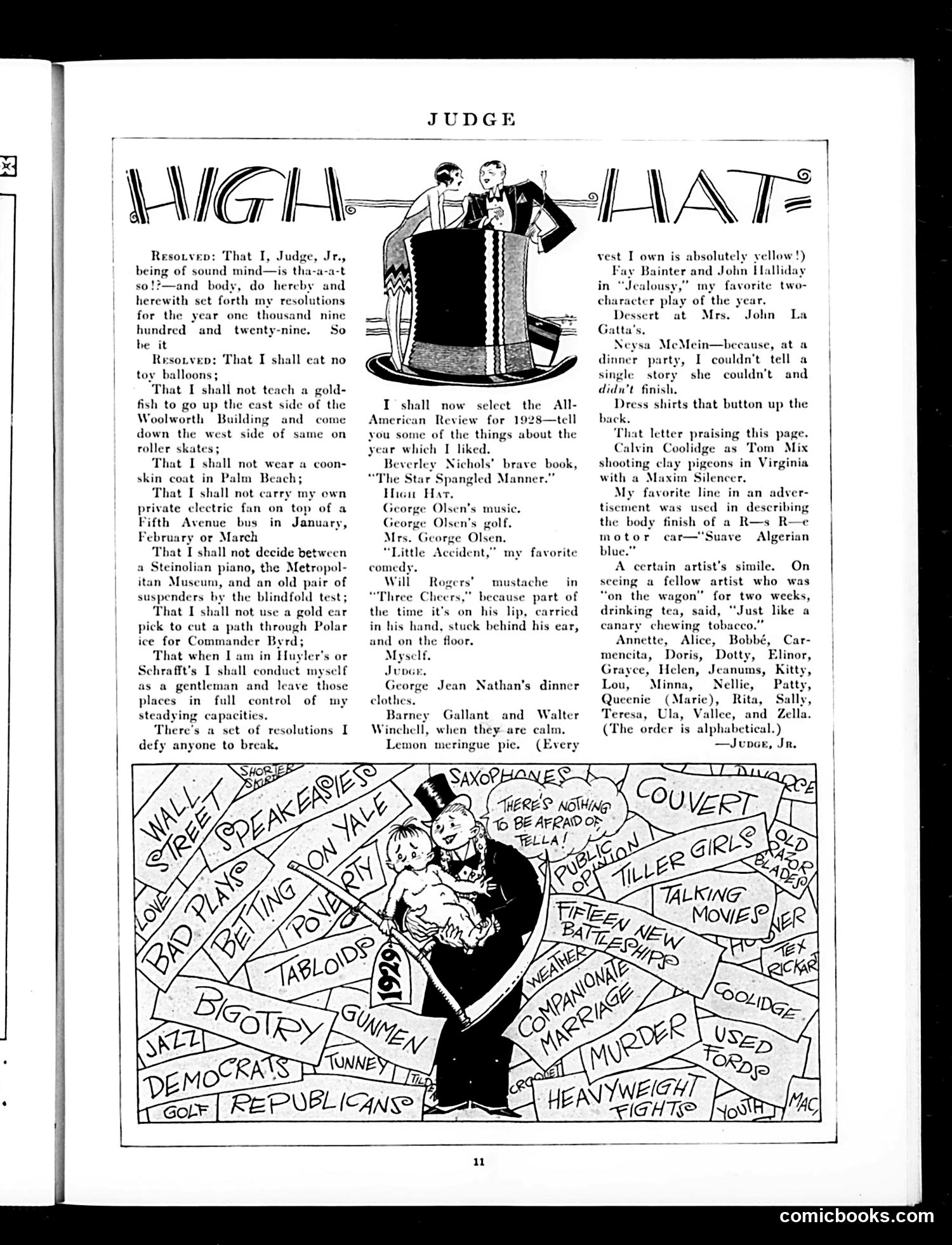
This page is primarily **humorous editorial content** rather than political satire. It features "Judge's New Year's Resolutions for 1929"—absurdist promises the magazine's persona makes, like not teaching goldfish to climb the Woolworth Building on roller skates or using a gold ear pick to cut through polar ice for Commander Byrd. The lower cartoon depicts a figure (likely representing "1928" or the passing year) drowning in a sea of **contemporary cultural references and social topics**: jazz, Democrats/Republicans, golf, tabloids, talking movies, murder cases, prohibition, and various scandals. This visualizes the chaos and sensationalism of 1928 American life. The "All-American Review" section praises 1928 highlights: Beverley Nichols' book, George Olsen's music, Will Rogers' mustache, and various society figures. Calvin Coolidge receives satirical praise as a sharpshooter. Overall, this reflects Jazz Age preoccupations—entertainment, scandals, sports, and political culture—presented through lighthearted, gossipy commentary rather than pointed social criticism.
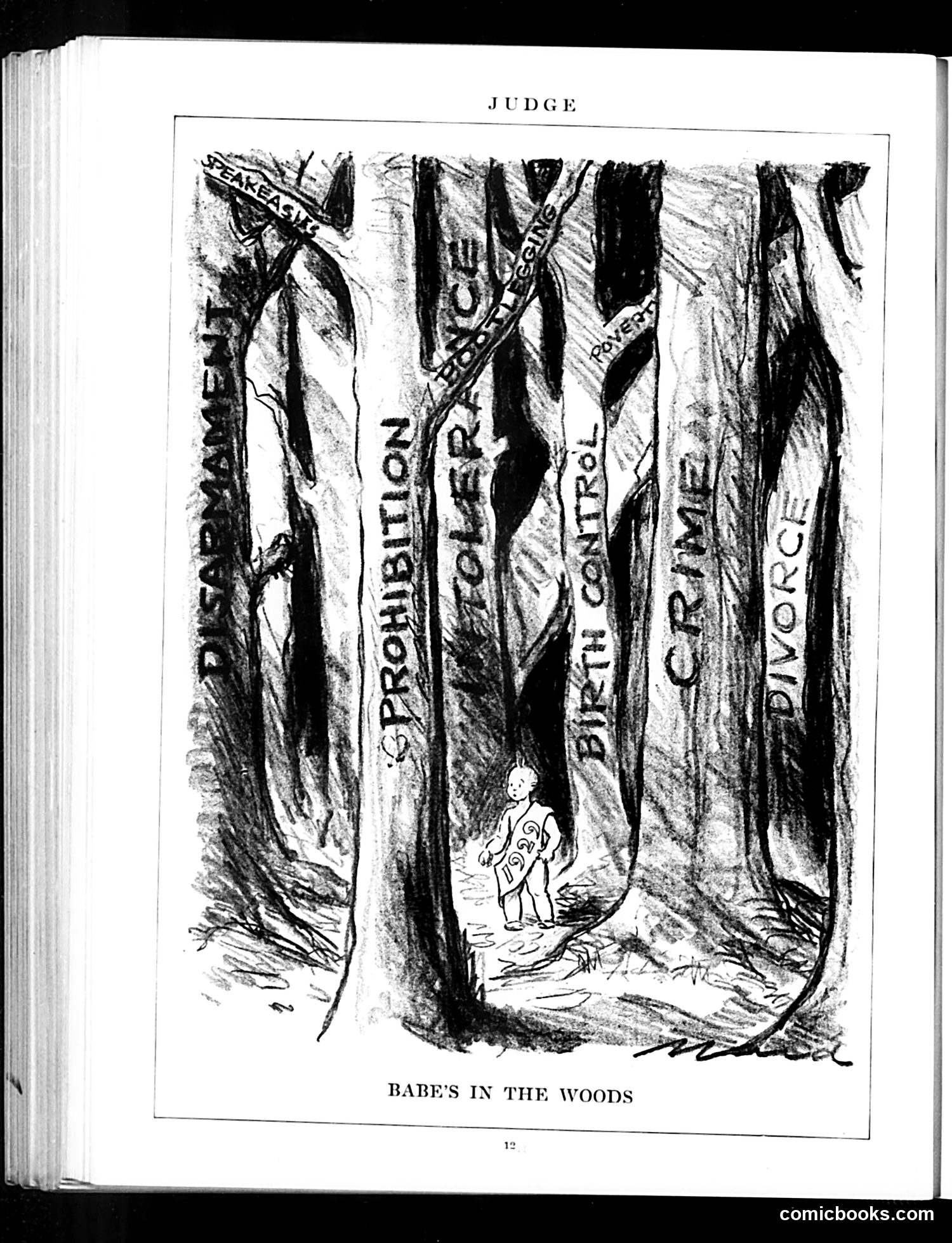
This cartoon depicts a small child standing alone in a dark forest, surrounded by tall trees labeled with various threats: "Prohibition," "Graft," "Bit Control," "Crime," and "Divorce." The child holds what appears to be a document marked "1928" (visible on the figure). The satire uses the fairy tale "Babes in the Woods" to represent American society—specifically, perhaps the nation itself or its citizens—as innocent and vulnerable, abandoned in a dangerous environment. The labeled trees represent major social and political problems of the 1920s era: Prohibition's failures, political corruption, organized crime, and family dissolution. The cartoon critiques how these interconnected crises threaten the vulnerable public, suggesting that ordinary Americans are helpless victims of forces beyond their control during this turbulent decade.
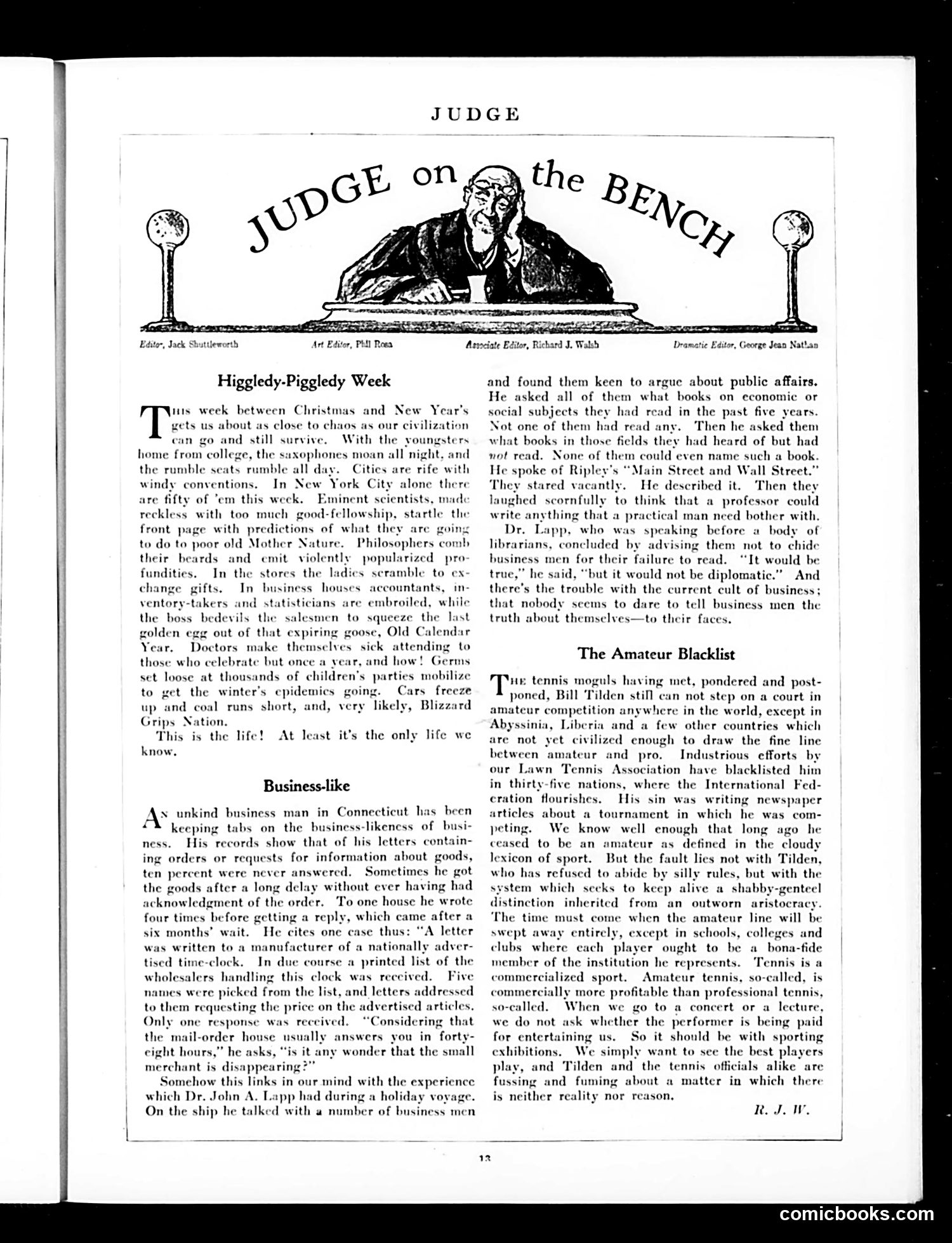
The page contains three articles under the "Judge on the Bench" editorial header. The main illustration shows a judge in robes. **"Higgledy-Piggledy Week"** satirizes the chaos of the Christmas-New Year holiday period in American cities, describing disrupted business, crowds, celebrating doctors, and spreading illness. **"Business-like"** criticizes poor customer service: a Connecticut businessman documents that one-tenth of his business inquiries go unanswered, and mail-order houses don't respond. The piece also relates an anecdote from Dr. John Lapp, who discovered that businessmen aboard a ship had read no economics or social theory books—and ridiculed academics like Ripley who attempted to write about business subjects. The satire suggests business culture lacks intellectual engagement. **"The Amateur Blacklist"** discusses tennis player Bill Tilden's ban from amateur competition worldwide (except in isolated countries). It criticizes the arbitrary distinction between amateur and professional tennis, suggesting the system is elitist rather than reasonable.
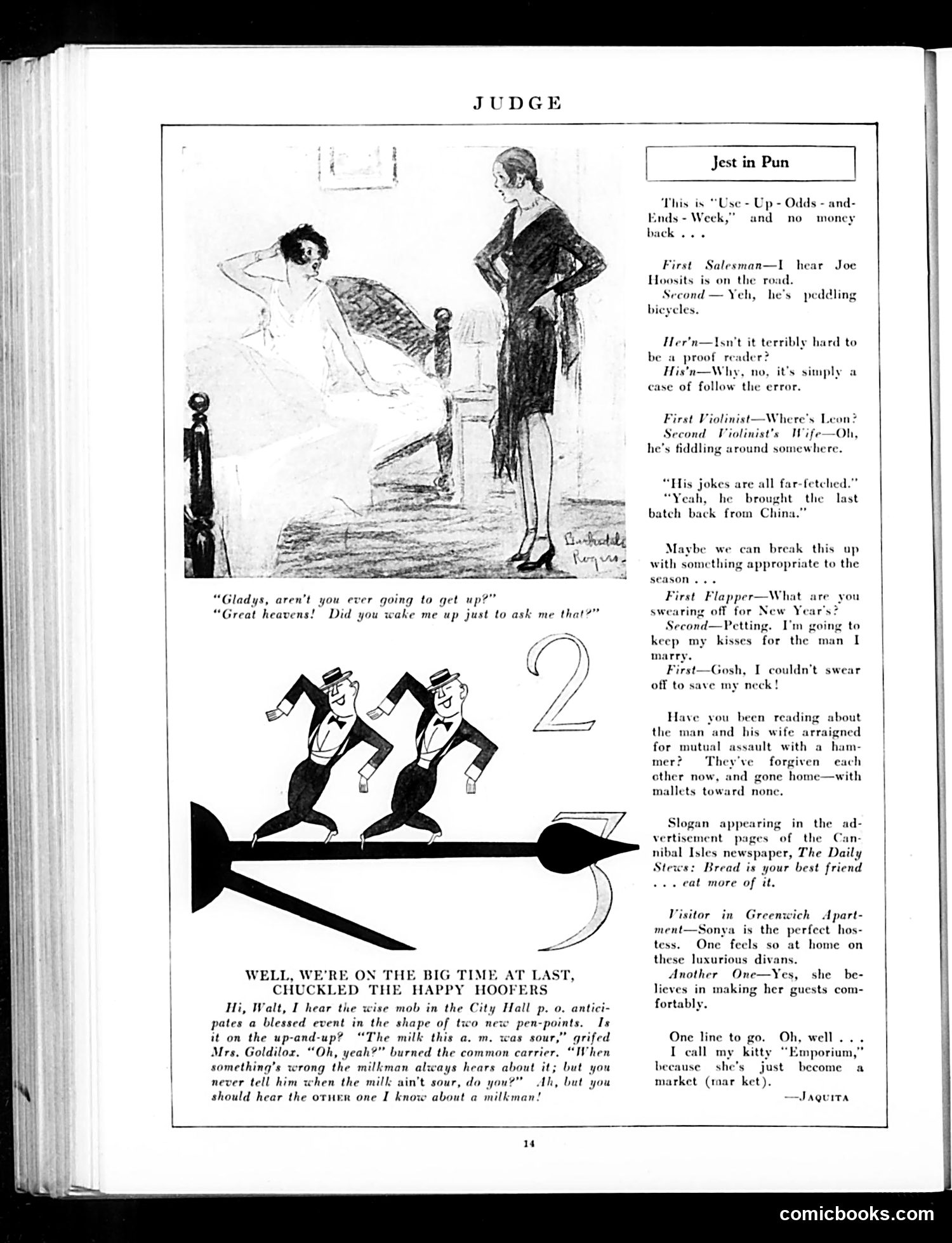
This page from **Judge** magazine contains light satirical humor typical of early-to-mid 20th century American comedy. The content is mostly a collection of brief jokes and puns labeled "Jest in Pun." The cartoons and quips target everyday subjects: a traveling bicycle salesman, proofreaders, musicians ("fiddling around"), and comedians with tired material ("far-fetched" jokes from China). There's wordplay about "petting" for New Year's resolutions and a dark joke about a couple who fought with hammers, ending with the pun "mallets toward none" (playing on "malice toward none"). The main cartoon depicts "happy hoofers" (dancers) celebrating success, with surrounding dialogue about milkmen and spoiled milk—apparently a recurring topic in contemporary urban humor. The satire is genteel and domestic rather than political, reflecting Judge's audience of middle-class American readers. The jokes rely on puns, double meanings, and observational humor about daily life rather than sharp social critique.
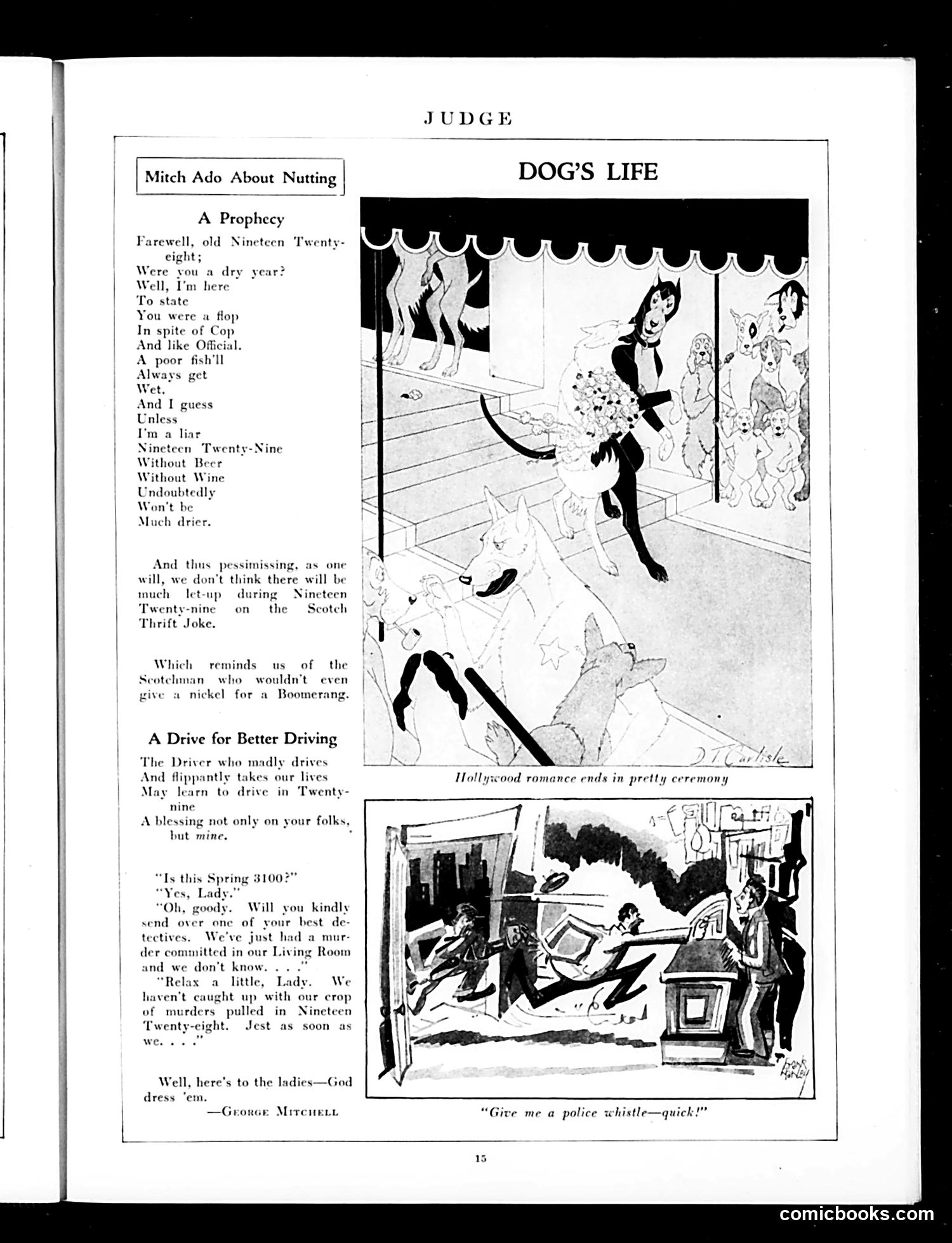
This page satirizes American life during Prohibition (1920-1933). "Mitch Ado About Nutting" mocks the failed promise of Prohibition by predicting 1929 will be equally "dry" (alcohol-free) in name only—suggesting widespread drinking continues despite the law. The Scottish reference humorously reinforces the theme of thriftiness amid illegal drinking. "A Drive for Better Driving" sarcastically suggests reckless drivers might improve by 1929, with dark humor about them "learning to drive" responsibly. The cartoons depict everyday chaos: the top shows a wild Hollywood party ("Hollywood romance ends in pretty ceremony"), and the bottom depicts a murder mystery so routine that police can barely keep up—"we don't know" how many crimes occurred in 1928. This reflects 1920s anxieties about urban crime and moral decay. George Mitchell signs the piece. The overall tone is cynical about social progress and law enforcement effectiveness during this turbulent decade.
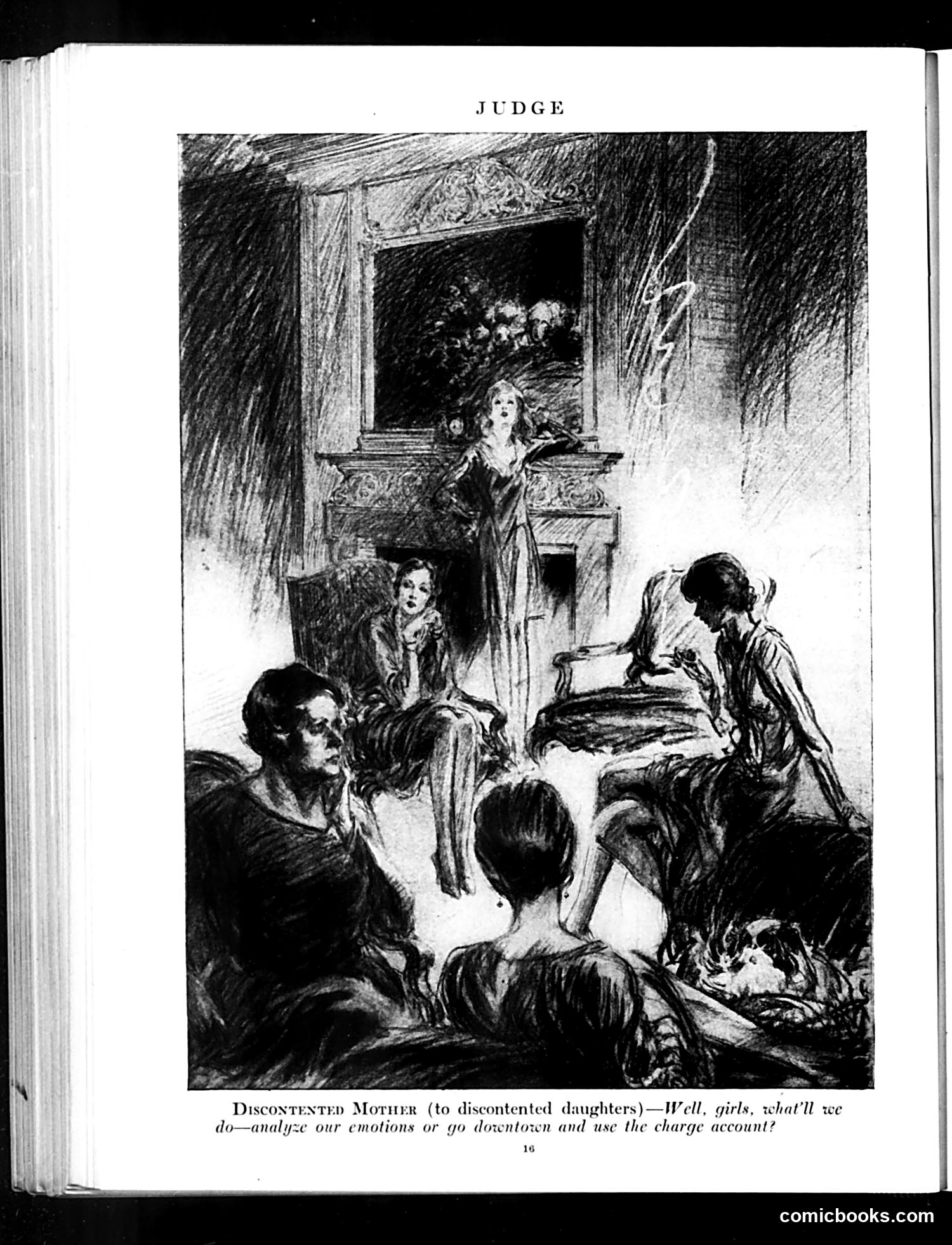
This single-panel cartoon satirizes early 20th-century consumer culture and generational attitudes. A mother addresses her discontent daughters, presenting a false choice between two activities: psychoanalysis ("analyze our emotions") and shopping ("go downtown and use the charge account"). The satire targets the contemporary fascination with Freudian psychology—then newly popular in America—by suggesting it's merely an excuse for inaction compared to the "real" solution of spending money. The joke implies that women (particularly wealthy ones with access to charge accounts) prefer shopping to introspection, while also mocking the era's therapeutic trends as pretentious alternatives to practical indulgence. The cartoon reflects Judge magazine's skeptical, satirical take on modern social movements and consumer behavior among the affluent classes.
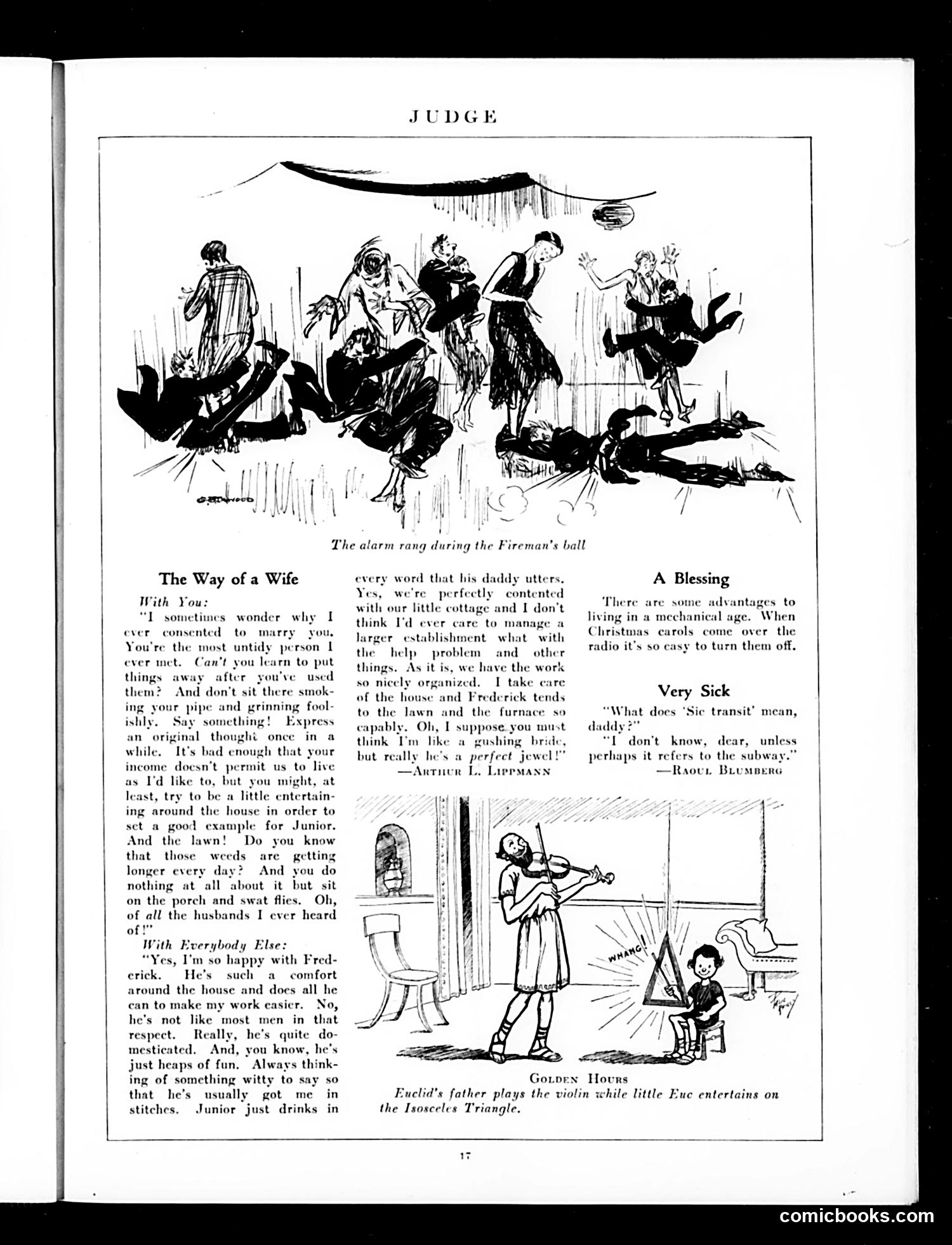
This page contains multiple short humorous pieces satirizing domestic life and gender relations in early 20th-century America. **"The Way of a Wife"** contrasts a wife's private complaints about her untidy, boring husband with her public performance of contentment—a commentary on marital dishonesty and performance. **"With Everybody Else"** shows the husband appearing completely different to outsiders, suggesting people present false versions of themselves socially. **"A Blessing"** and **"Very Sick"** are brief comedic observations: one about radio technology allowing easy escape from Christmas music; the other a child's innocent misinterpretation of "sic transit" (Latin phrase meaning "thus passes away") as referring to the subway. **"Golden Hours"** caption jokes that a father plays violin while his child entertains—playing on the child's name "Euclid" and "Isosceles Triangle" (geometric references for humor). The top illustration depicts chaos at a fireman's ball when an alarm sounds—slapstick comedy showing the disruption and physical comedy of the scene.
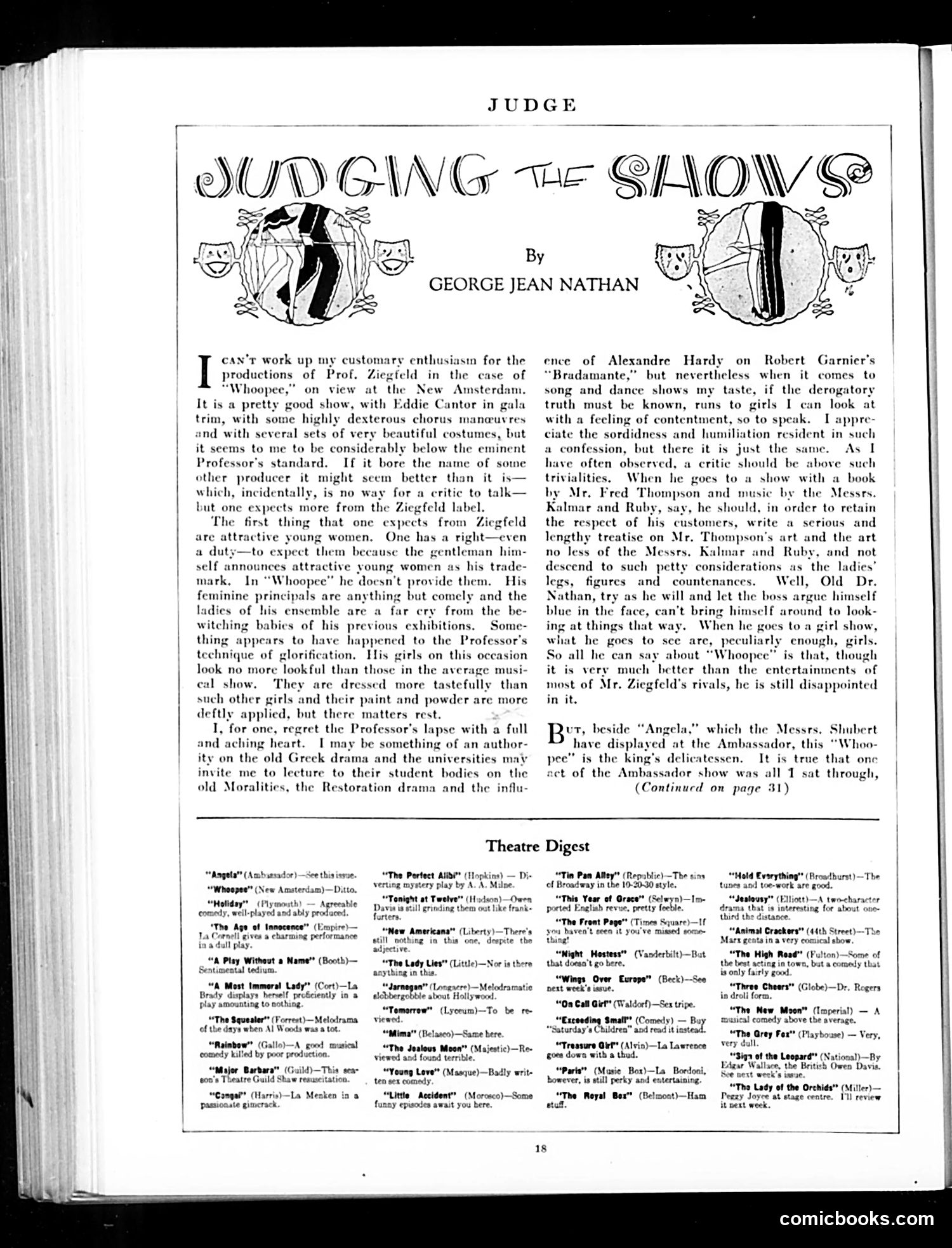
This is a theater review column by prominent drama critic George Jean Nathan, focused on Broadway productions. The main subject is **Florenz Ziegfeld's "Whoopee,"** starring Eddie Cantor at the New Amsterdam Theatre. Nathan's satire is self-aware: he critiques himself for caring about the **physical attractiveness of chorus girls** rather than artistic merit—admitting this is beneath serious critical standards. Yet he argues that Ziegfeld's brand promise is precisely "beautiful women," so when the female performers in "Whoopee" are plain or unattractive (by 1920s standards), the show fails its own premise, regardless of costumes or dancing skill. The joke is Nathan's honest confession: when attending musical comedies, audiences (and critics) actually want to see attractive women, not serious artistic analysis. He's satirizing both theatrical pretension and his own lowbrow tastes. The page includes a "Theatre Digest" listing other current Broadway shows with brief reviews below.
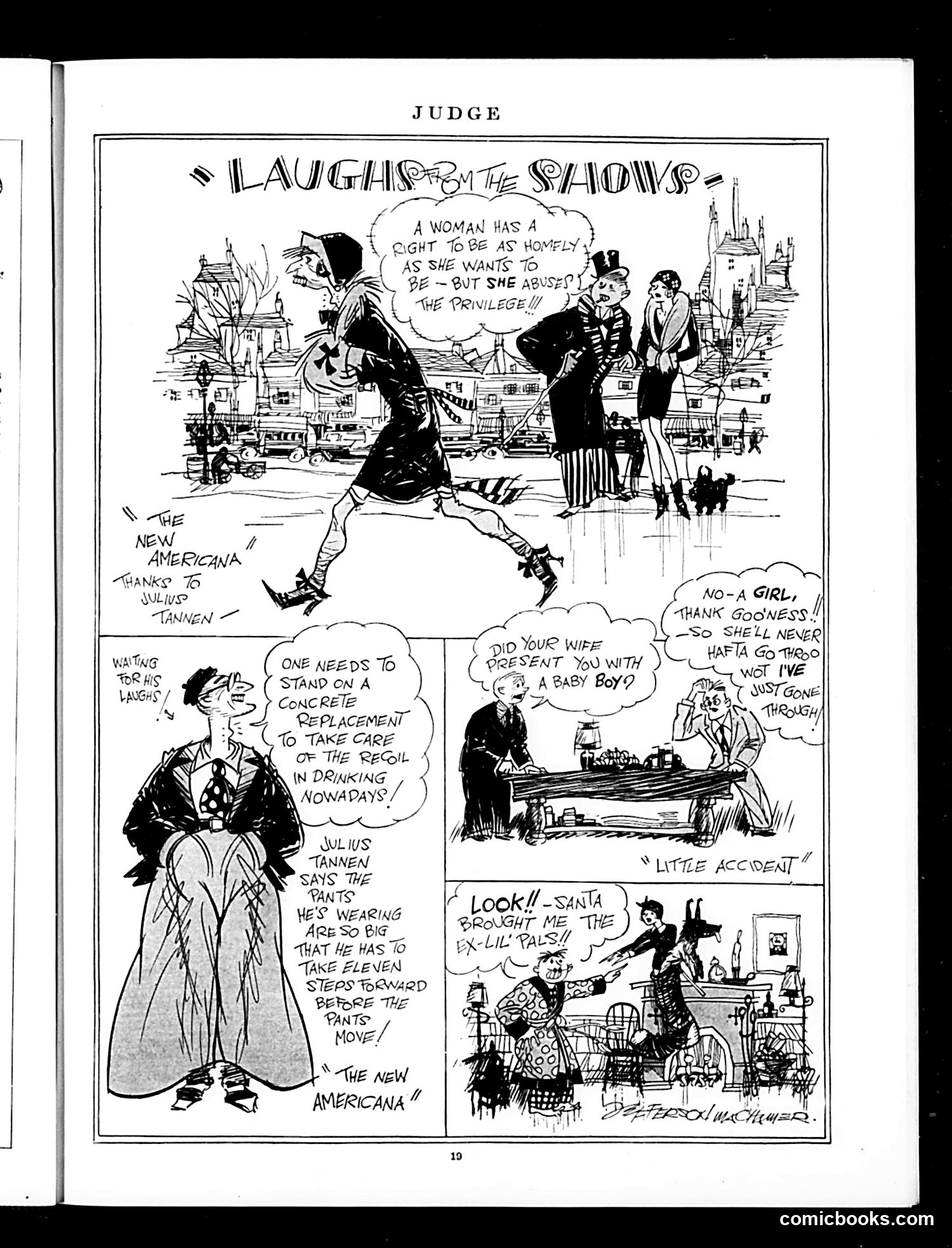
This page satirizes **women's rights and changing social norms** in early 20th-century America, labeled "The New Americana." The top cartoon mocks women's expanding freedoms: a woman exercises vigorously in public while men object that "a woman has a right to be as homely as she wants to be—but she abuses the privilege." Lower panels joke about **gender role disruptions**: one gag references Julius Tannen (a contemporary performer) claiming women's pants are so voluminous the wearer must take eleven steps before they move. Another depicts a man disappointed his wife didn't produce a son, only a daughter. The Christmas scene at bottom shows a child excited about toy "ex-lil' pals"—likely satirizing modern commercialism or toys for girls. The humor relies on mocking women's liberation, physical independence, and departure from traditional domestic roles—reflecting period anxieties about changing gender relations. These "jokes" expose rather than celebrate these social shifts.
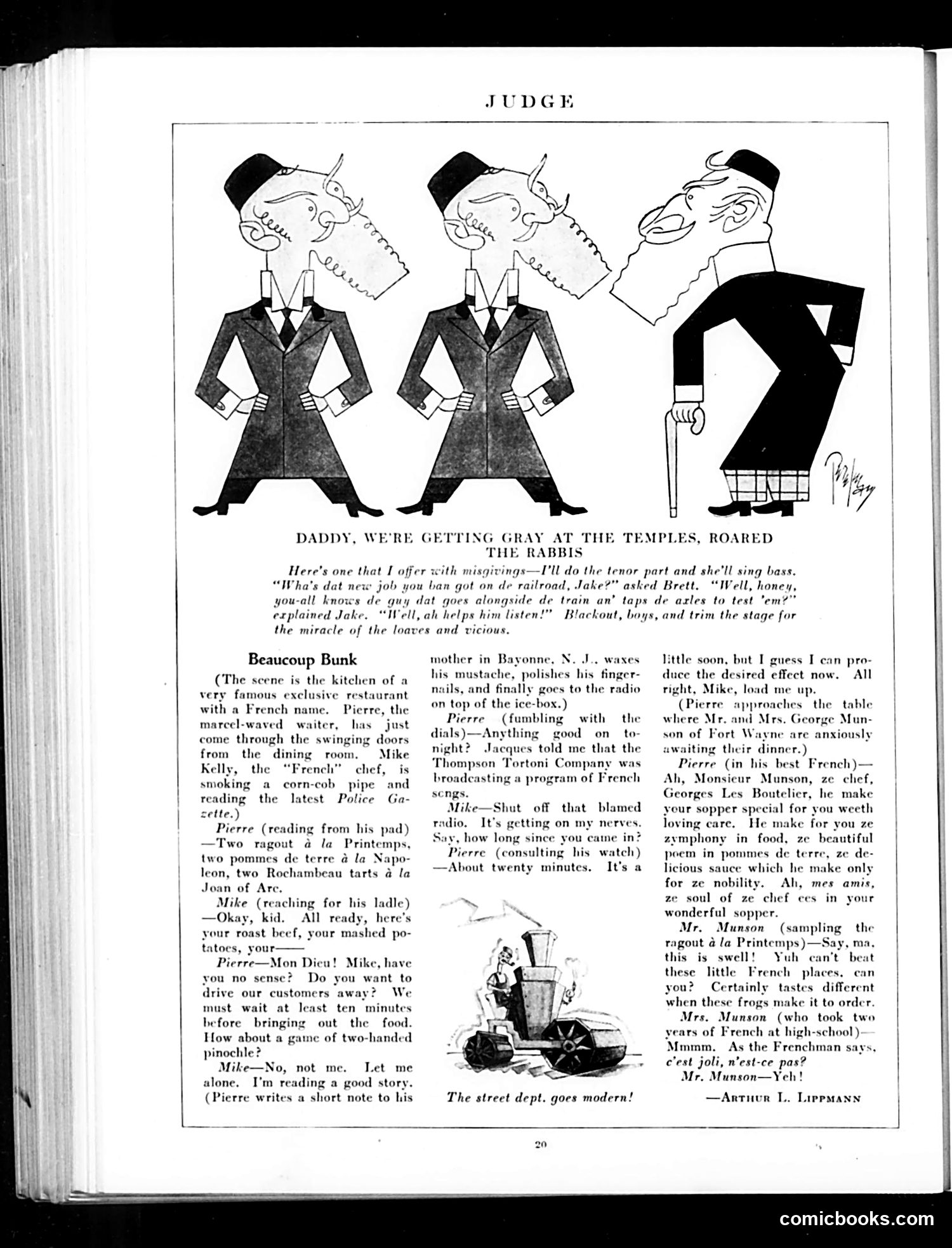
This sketch mocks the American fascination with pseudo-French cuisine and affectation in the 1920s. The setup: Mike Kelly is an ordinary American cook (reading Police Gazette, smoking a corn-cob pipe) working in an "exclusive" restaurant under a French name. His coworker Pierre performs exaggerated French mannerisms and theatrical service rituals. The satire targets two groups: Pierre, who pretends elaborate presentation and French phrases matter more than actual cooking, and the customers (the Munsons from Fort Wayne), who are impressed by trivial French words and romantic descriptions despite eating the same basic food Mike would serve immediately. The joke hinges on American gullibility—customers happily pay for "poetry" and "symphony" when it's really just roast beef with fancy names. The "bunk" is the manufactured sophistication; the humor lies in exposing the gap between pretense and reality.
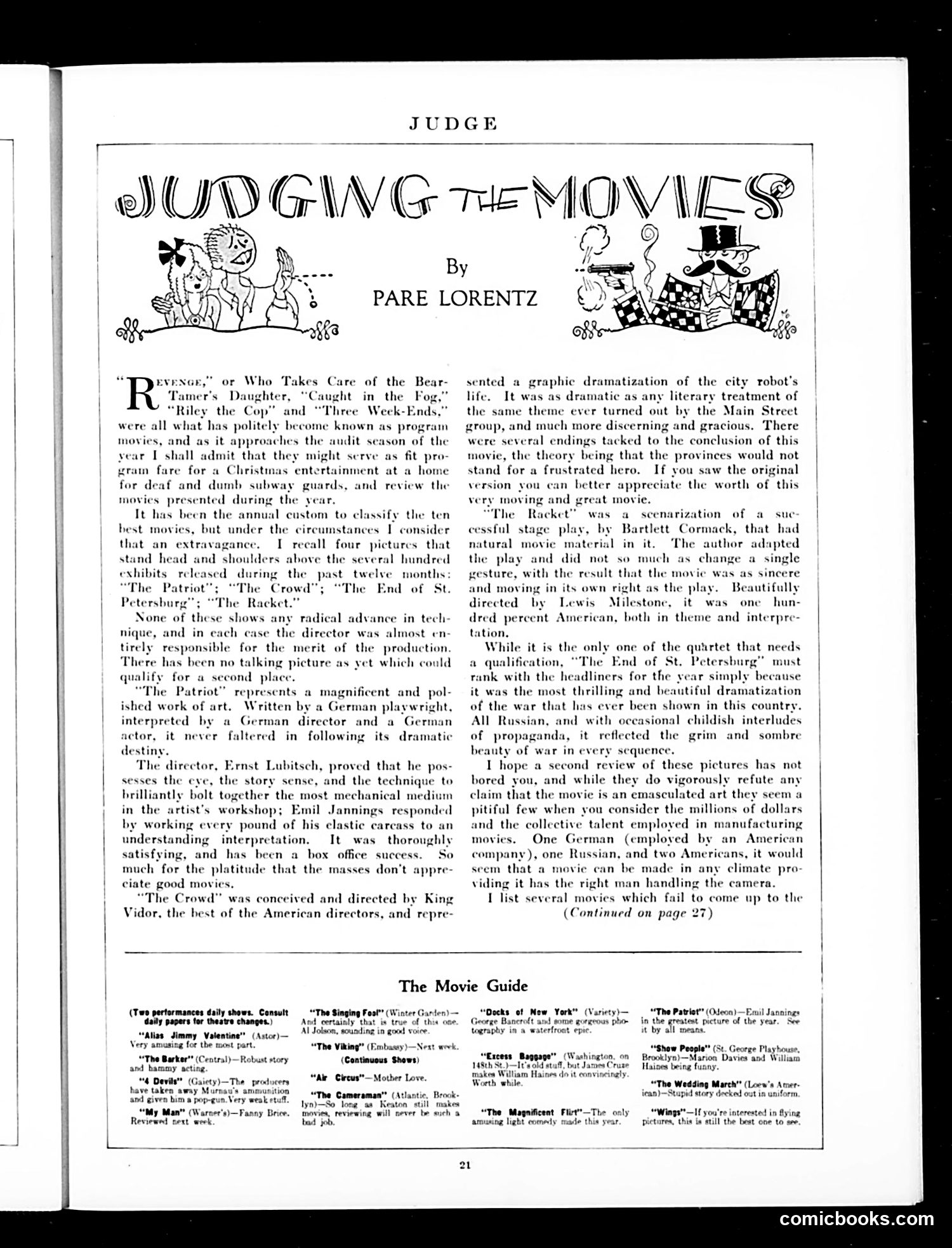
This is a film criticism column by **Pare Lorentz** reviewing the best movies of what appears to be the late 1920s (silent era). The piece is NOT primarily satirical—it's a serious critical assessment. **Key Content:** Lorentz argues that four films stand out: "The Patriot," "The Crowd," "The End of St. Petersburg," and "The Racket." He praises them as genuine art despite Hollywood's massive financial investment producing mostly mediocre "program movies." **Notable Points:** - **"The Patriot"**: German-made film directed by Ernst Lubitsch, starring Emil Jannings—praised as technically masterful - **"The Crowd"**: American director King Vidor's depiction of urban working-class life; notes the film had multiple endings added for provincial audiences uncomfortable with tragic conclusions - **"The Racket"**: Adaptation of a successful stage play about organized crime - **"The End of St. Petersburg"**: Russian film about WWI **The Satire:** Lorentz satirizes Hollywood's indifference to quality and mass audiences' supposed poor taste, suggesting only European films and one American director (Vidor) produced genuine art. The page also includes a "Movie Guide" section listing current theater offerings.
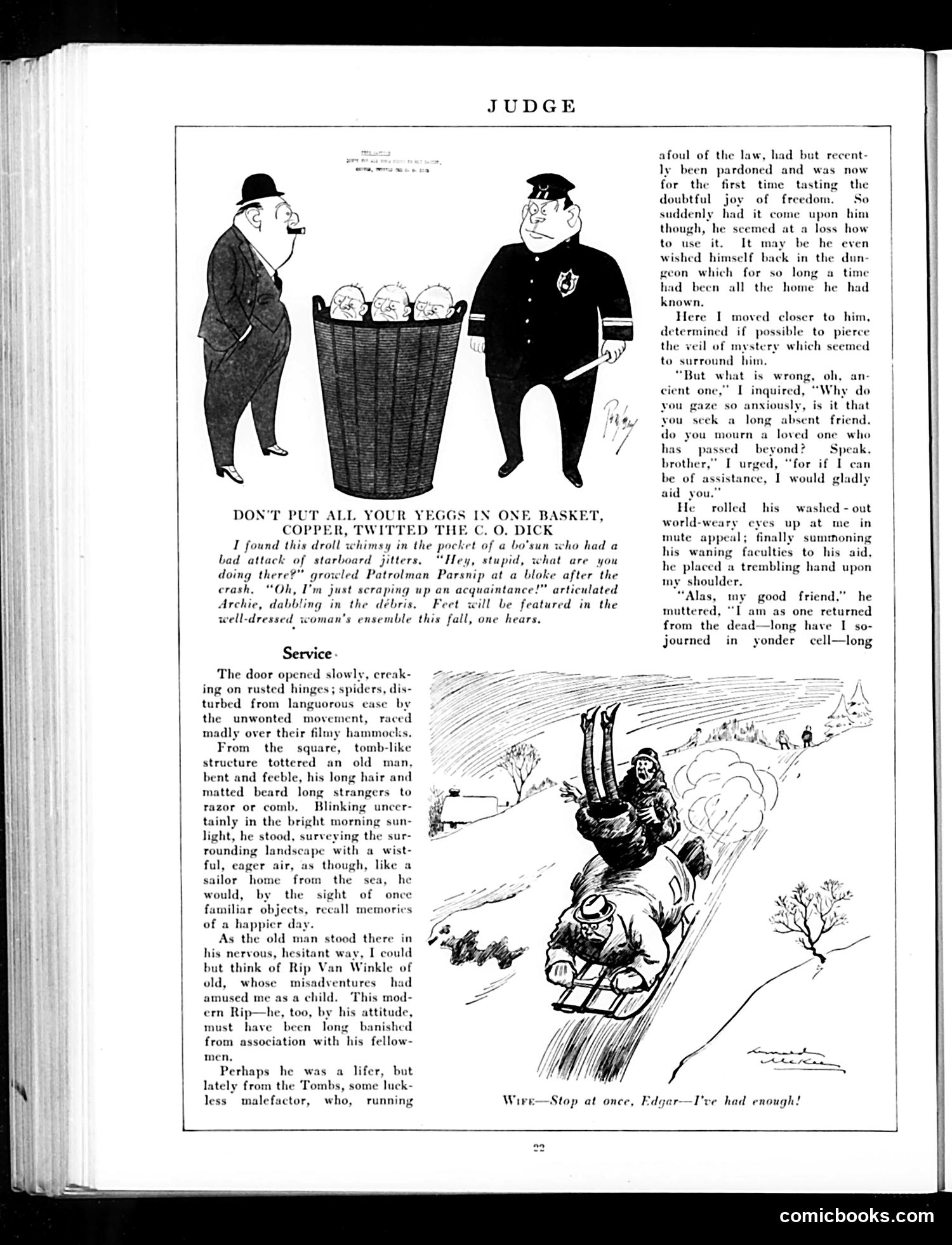
**Top Cartoon:** "Don't Put All Your Eggs in One Basket, Copper, Twitted the C.O. Dick" This appears to be a joke about a police officer ("Copper") encountering someone carrying a basket of heads—a dark visual gag. The caption references a patrolman and someone scraping up debris after a "crash," with dialogue about "scraping up an acquaintance." The humor seems to rely on absurdist imagery and wordplay typical of early satirical magazines. **Main Story/Illustration:** "Service" The narrative describes a released prisoner or paroled convict emerging into society, compared to Rip Van Winkle. He's bewildered and disoriented by freedom after long imprisonment ("yonder cell"). The lower illustration shows sledders going downhill with the caption "Wire—Stop at once, Edgar—I've had enough!" This appears unrelated—possibly commentary on reckless winter sport or loss of control. The page satirizes either prison reform awkwardness or the difficulty of reintegration for formerly incarcerated people—a social concern of the era.
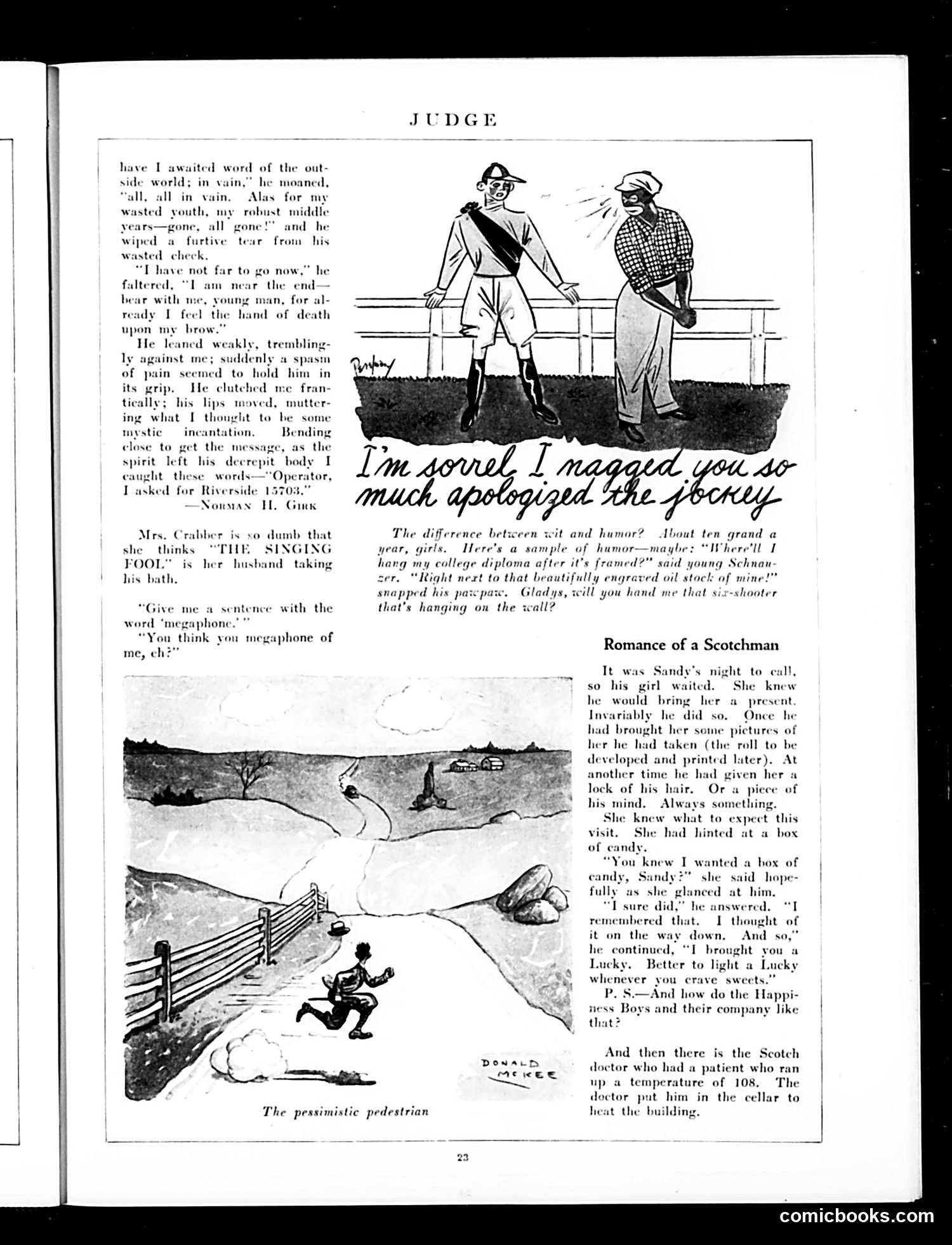
This page contains several brief satirical pieces typical of Judge's style: **Top cartoon** depicts a dying man's final words—a joke about telephone operators. The humor relies on the contrast between dramatic deathbed solemnity and mundane, self-absorbed final words requesting a phone number. **Mrs. Crabber joke**: Simple insult humor about a woman's stupidity, mistaking a movie title for her husband. **"Megaphone" wordplay**: A pun on "made fun of" masquerading as grammatical instruction. **"Romance of a Scotchman"**: Ethnic stereotype humor playing on Scottish frugality. A man brings his girlfriend a Lucky Strike cigarette instead of candy, then promotes cigarettes as a substitute for sweets—likely a **hidden advertisement** disguised as humor. **Doctor joke**: Another ethnic gag about Scottish thriftiness, showing a doctor putting a fevered patient in the cellar rather than heating his room (implying wasteful heating). The page mixes genuine satirical commentary with product placement and ethnic stereotyping typical of early 20th-century American humor magazines.
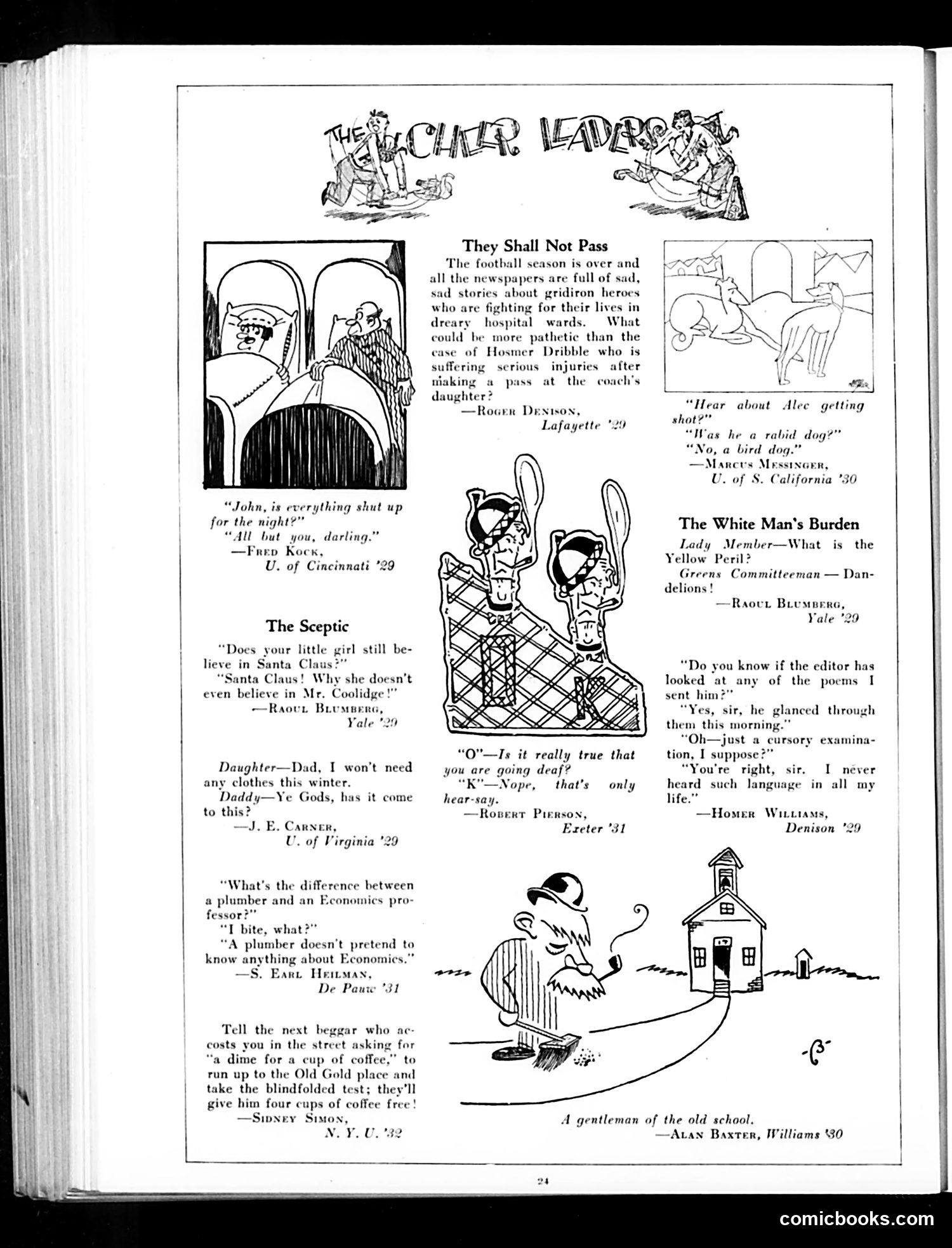
This page from *Judge* magazine features college-authored humor pieces typical of the late 1920s. The jokes target contemporary figures and issues: **"The Sceptic"** mocks President Calvin Coolidge's unpopularity—a child won't believe in Santa Claus *or* Coolidge, suggesting both are equally implausible. This reflects widespread disappointment with Coolidge's presidency by 1929. **"They Shall Not Pass"** jokes about football injuries and hospital wards—referencing the dangerous, unregulated sport of the era. **"The White Man's Burden"** satirizes a Lady Committee Member asking about the "Yellow Peril" (xenophobic anxiety about Asian immigrants). The punchline—that dandelions are the real threat—deflates this racist panic as absurd. Other jokes cover dating, fashion, economics, and panhandling. The cartoons show period-appropriate domestic and school scenes. The humor reflects 1920s college culture: irreverent, topical, and often sexist or xenophobic by modern standards.
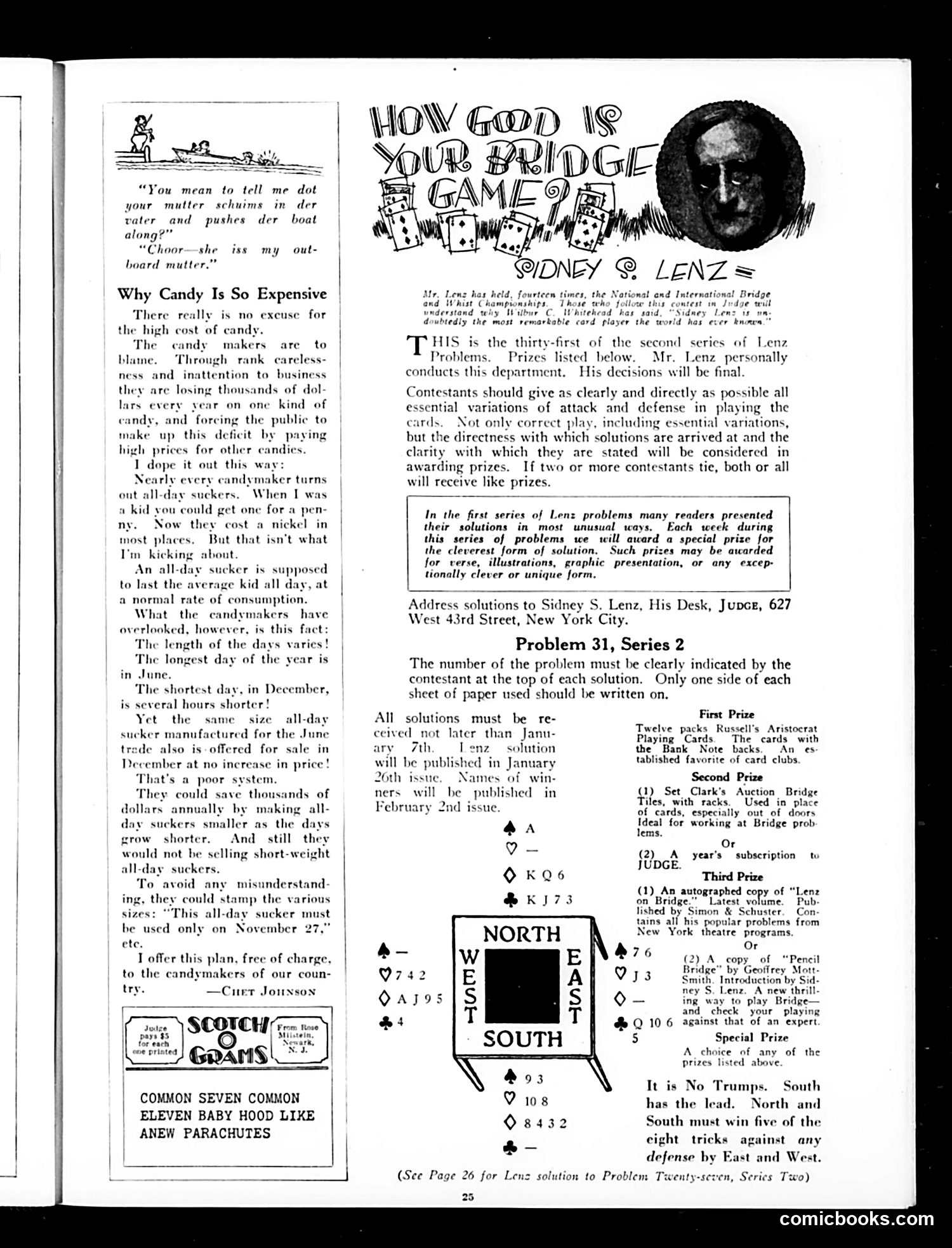
This page contains mixed advertising and editorial content rather than political satire. The main elements are: **"Why Candy Is So Expensive"** – A humorous essay by Cliff Johnson proposing that candy manufacturers lose money by manufacturing all-day suckers the same size year-round. His satirical "solution": stamp different sizes for different seasons since days are longer in June than December. The joke mocks both business inefficiency and the absurdity of the proposed fix. **"How Good Is Your Bridge Game?"** – A bridge card game puzzle feature sponsored by Sidney S. Lenz, offering prizes including playing cards and a subscription to Judge itself. **Small cartoon** (top left) – An ethnic humor piece about a woman who "schuims" (swims) in water while pushing a boat, making her an "outboard mutter" (motor). This relies on dated stereotypical dialect humor common to early 20th-century American comedy. The page reflects Judge's mix of satirical commentary, recreational puzzles, and period-typical ethnic humor.
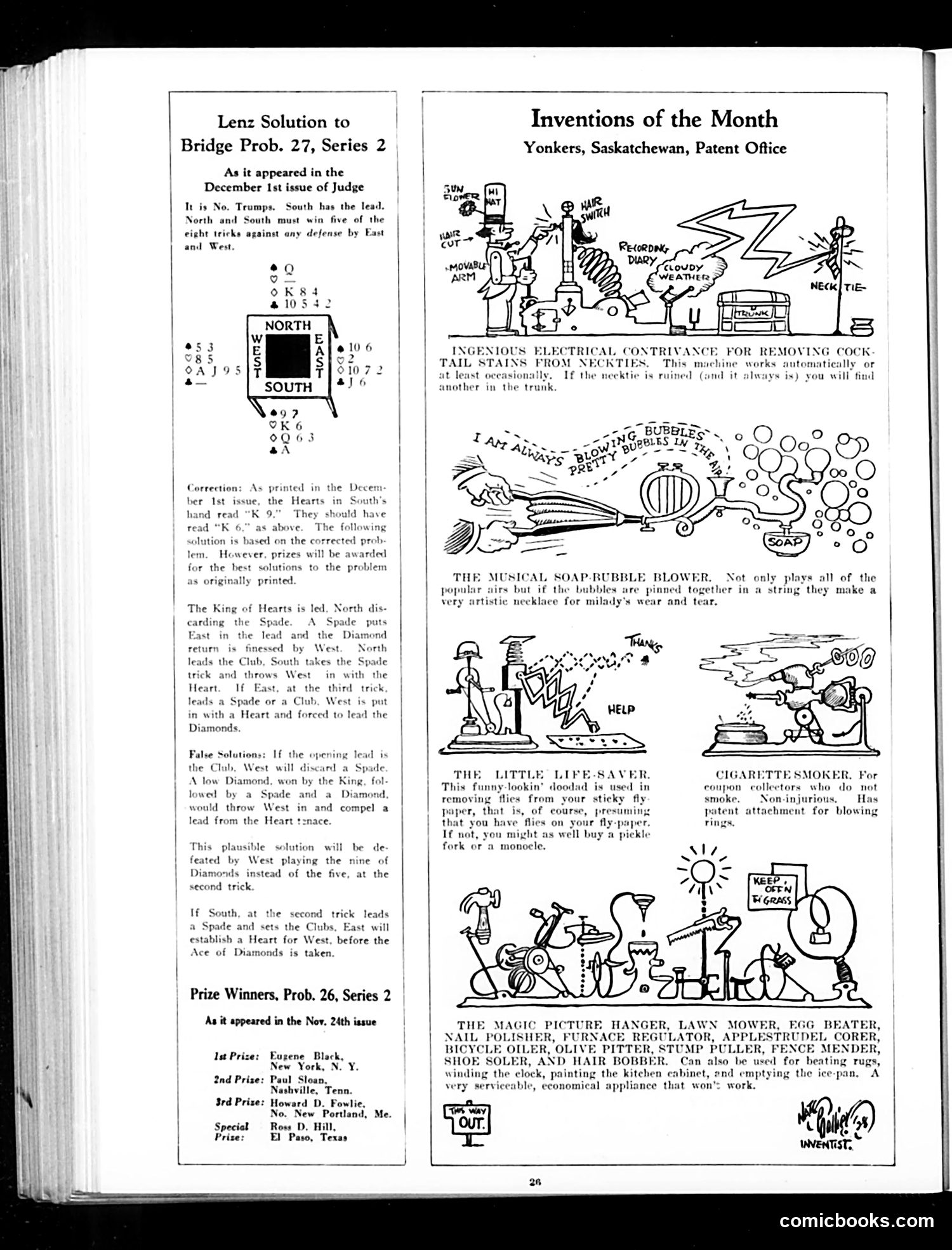
This page contains two distinct sections: **Left side:** A bridge card game problem solution and prize winners announcement. It presents a complex bridge hand puzzle with detailed play-by-play strategy, corrections to a previously published problem, and lists winners of a competition from the November 24th issue. **Right side:** "Inventions of the Month" from Yonkers, Saskatchewan Patent Office—a humorous satirical feature mocking absurd, impractical inventions. These include: - An electrical device for removing stuck neckties - A "musical soap bubble blower" that creates bubble necklaces - A "life-saver" for removing flies from sticky fly-paper - A cigarette smoker's contraption for blowing rings - A multi-purpose household gadget (picture hanger, lawn mower, egg beater, etc.) The satire ridicules frivolous patents and over-engineered "solutions" to non-problems—typical of early 20th-century satirical commentary on consumerism and unnecessary invention. The exaggerated, cluttered drawings emphasize the absurdity of these contraptions.
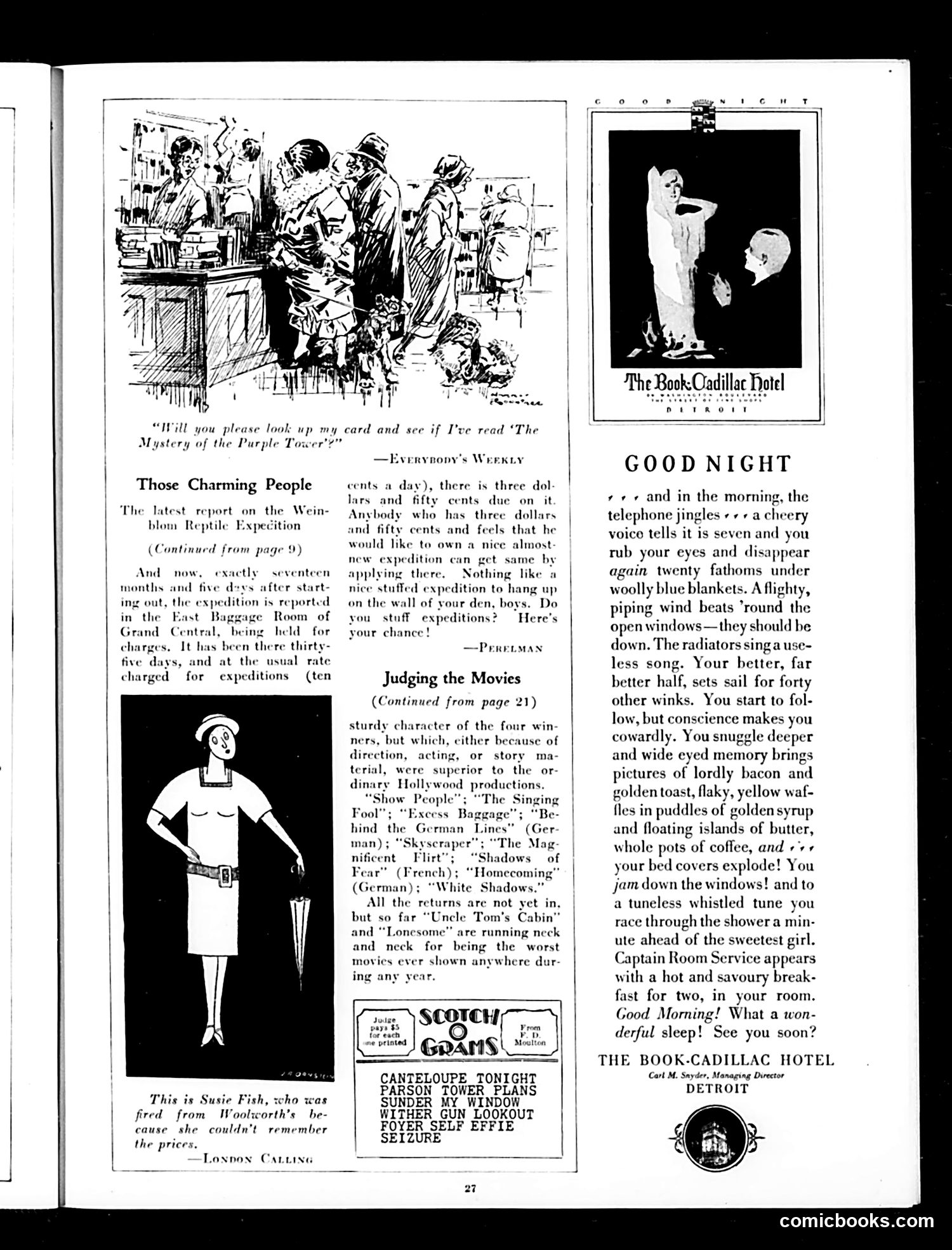
This page contains satirical humor typical of 1920s Judge magazine. The main cartoon features "Susie Fish," fired from Woolworth's for inability to remember prices—a joke about retail incompetence and the era's five-and-dime store culture. The "Those Charming People" column continues a serialized satire about the "Weinblom Reptile Expedition," apparently lost in Grand Central's baggage room for thirty-five days, accumulating storage charges. The humor lies in treating an expedition like abandoned luggage and offering readers the chance to "own" this "nice stuffed expedition." The "Judging the Movies" section critiques contemporary films, dismissing "Uncle Tom's Cabin" and "Lonesome" as among "the worst movies ever shown anywhere during any year"—likely referring to recently released 1920s adaptations. The "Good Night" piece is hotel advertising disguised as poetic prose, promoting the Book-Cadillac Hotel in Detroit. The page demonstrates Judge's blend of visual cartoons, serialized humor columns, and disguised advertising.
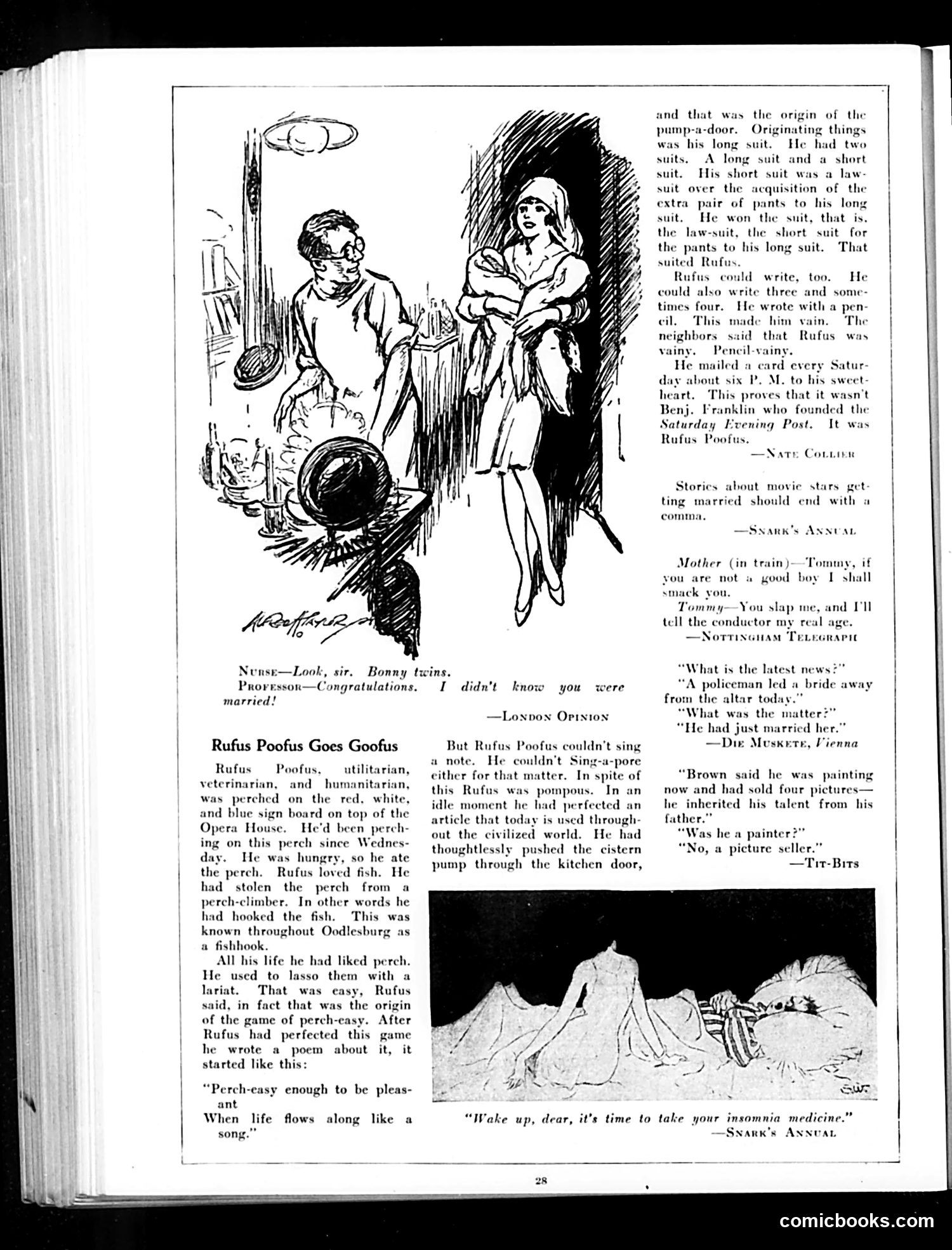
This is a humorous short story illustrated with whimsical line drawings. The narrative follows Rufus Poofus, a pompous character living in "Oodlesburg," through absurdist adventures centered on wordplay. The satire mocks grandiose self-importance: Rufus claims credit for inventing the "pump-a-door" (pushing a cistern pump through a kitchen door) and originating "perch-easy" (a game involving fishing). He's vain about writing with a pencil, and the story ironically credits him—not Benjamin Franklin—with founding the *Saturday Evening Post* simply because he mailed weekly cards. The page also includes unrelated joke items typical of Judge magazine: quips about movie stars marrying, a mother threatening her son on a train, and observations about painters versus picture sellers. These represent the magazine's standard mix of satirical commentary on contemporary pretension and absurdity.
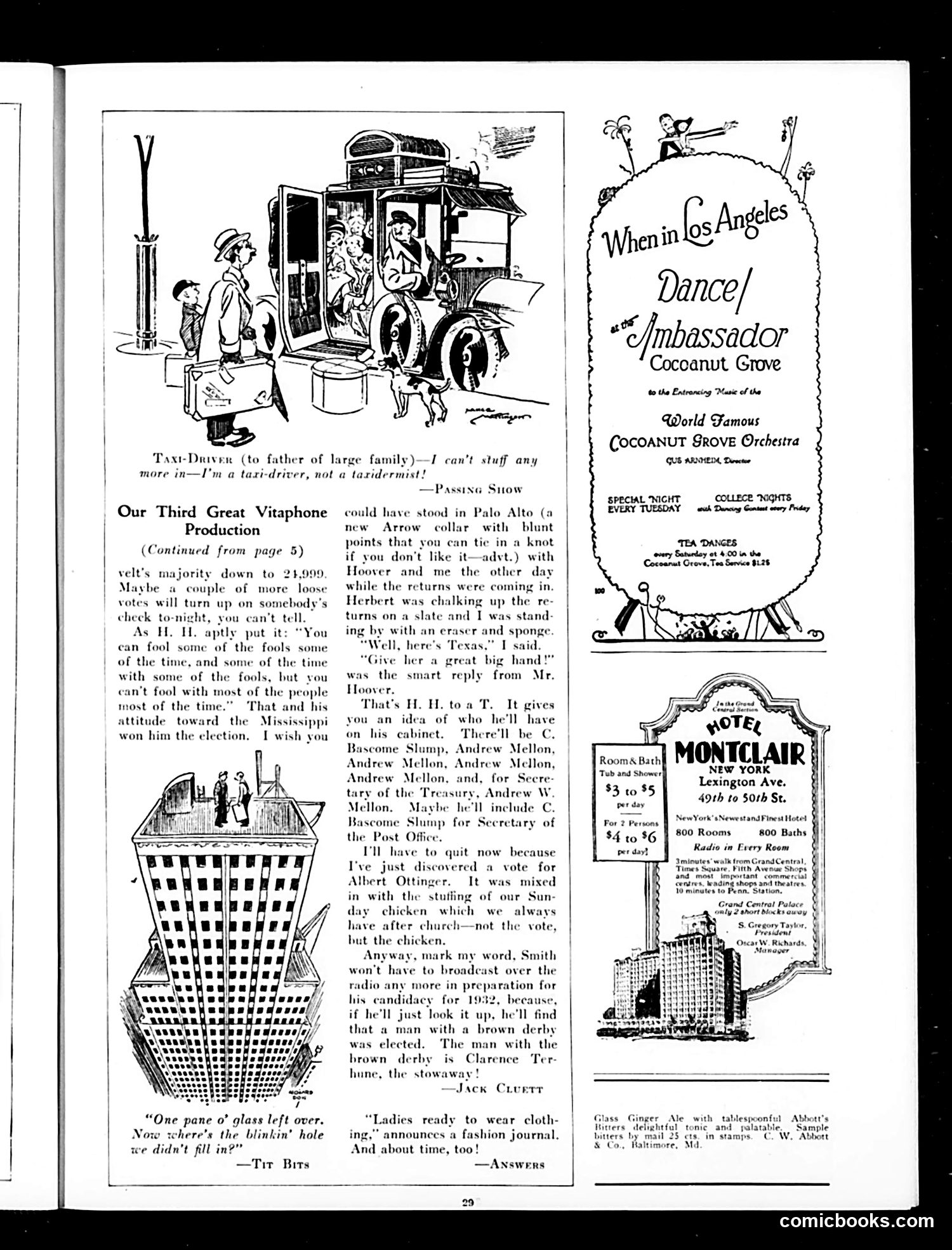
This page contains political and social humor from the 1920s era. The main cartoon depicts a taxi driver refusing to accommodate more passengers, joking he's "a taxi-driver, not a taxidermist"—satirizing overcrowding in vehicles and urban congestion. The accompanying article references the 1928 presidential election, mocking Herbert Hoover's victory and suggesting his cabinet would consist almost entirely of Andrew Mellon (the wealthy Treasury Secretary), repeated multiple times for comic effect. The text ridicules Hoover's election victory, references Al Smith's failed candidacy, and jokes about vote-counting irregularities. The "brown derby" reference alludes to Smith's iconic campaign hat, used mockingly to suggest the election's outcome was predetermined by superficial factors rather than policy. The remaining content is primarily **advertisements** for Los Angeles nightlife (Cocoanut Grove) and New York's Hotel Montclair, typical of Judge's commercial pages.
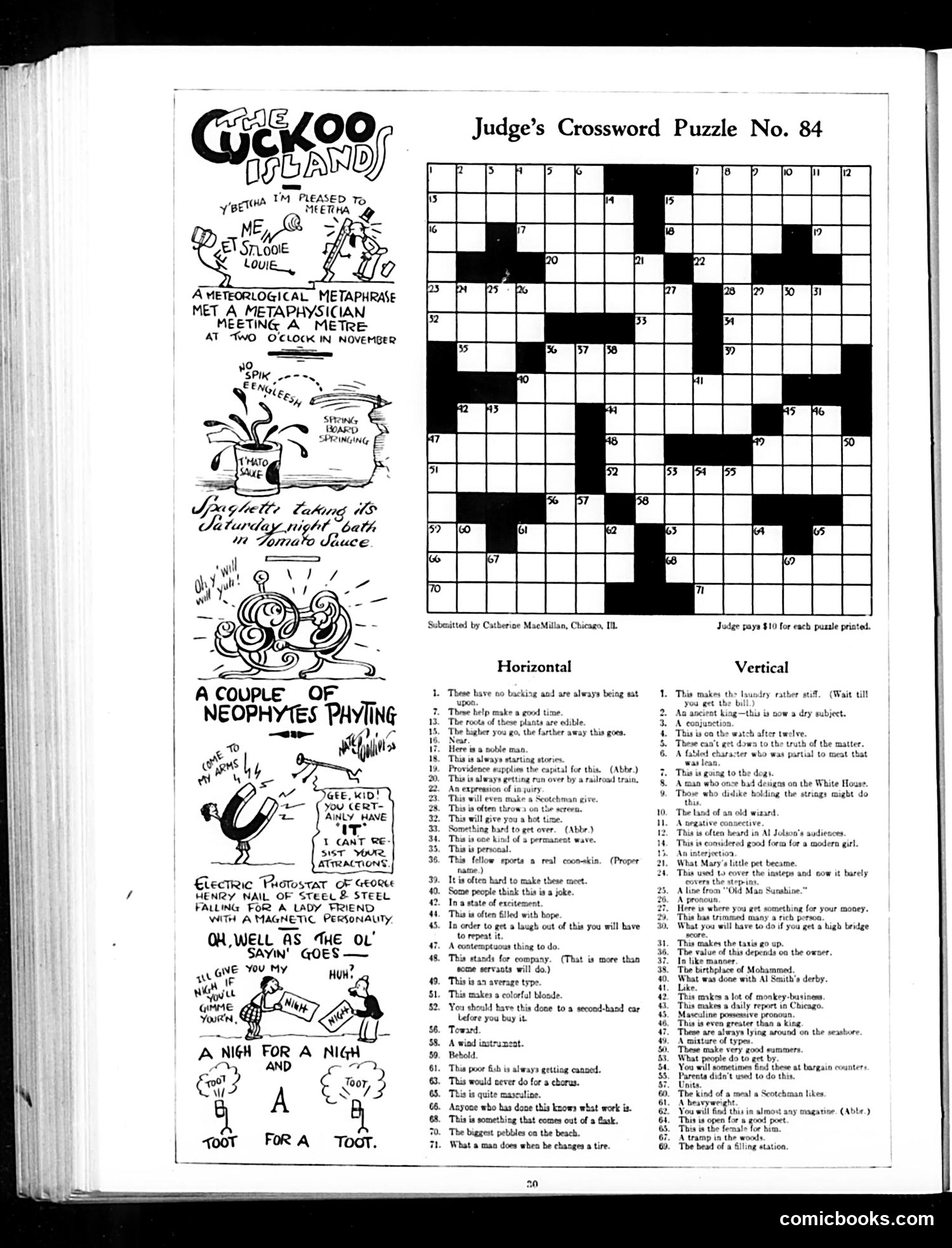
This is primarily a crossword puzzle page with accompanying humorous cartoon vignettes. The cartoons use visual and verbal puns typical of early 20th-century Judge magazine humor: **"A Meteorological Metaphra(se)"** depicts a pun on homophones—a "meteorologist" meeting a "metaphysician" at a "metre" (misspelled as "mete"). **"Spaghetti Eating Contest"** shows the messy humor of competitive eating. **"Couple of Neophytes Prying"** plays on magnetic attraction—a man is drawn to a woman with "magnetic personality" like an "electric photostat." **"A Nigh for a Night and a Toot for a Toot"** appears to be wordplay on reciprocal exchanges. The humor relies on puns, double meanings, and visual exaggeration rather than topical satire. The crossword clues themselves contain dated social references (servants, wealthy car owners, chorus girls) reflecting 1920s-era society.
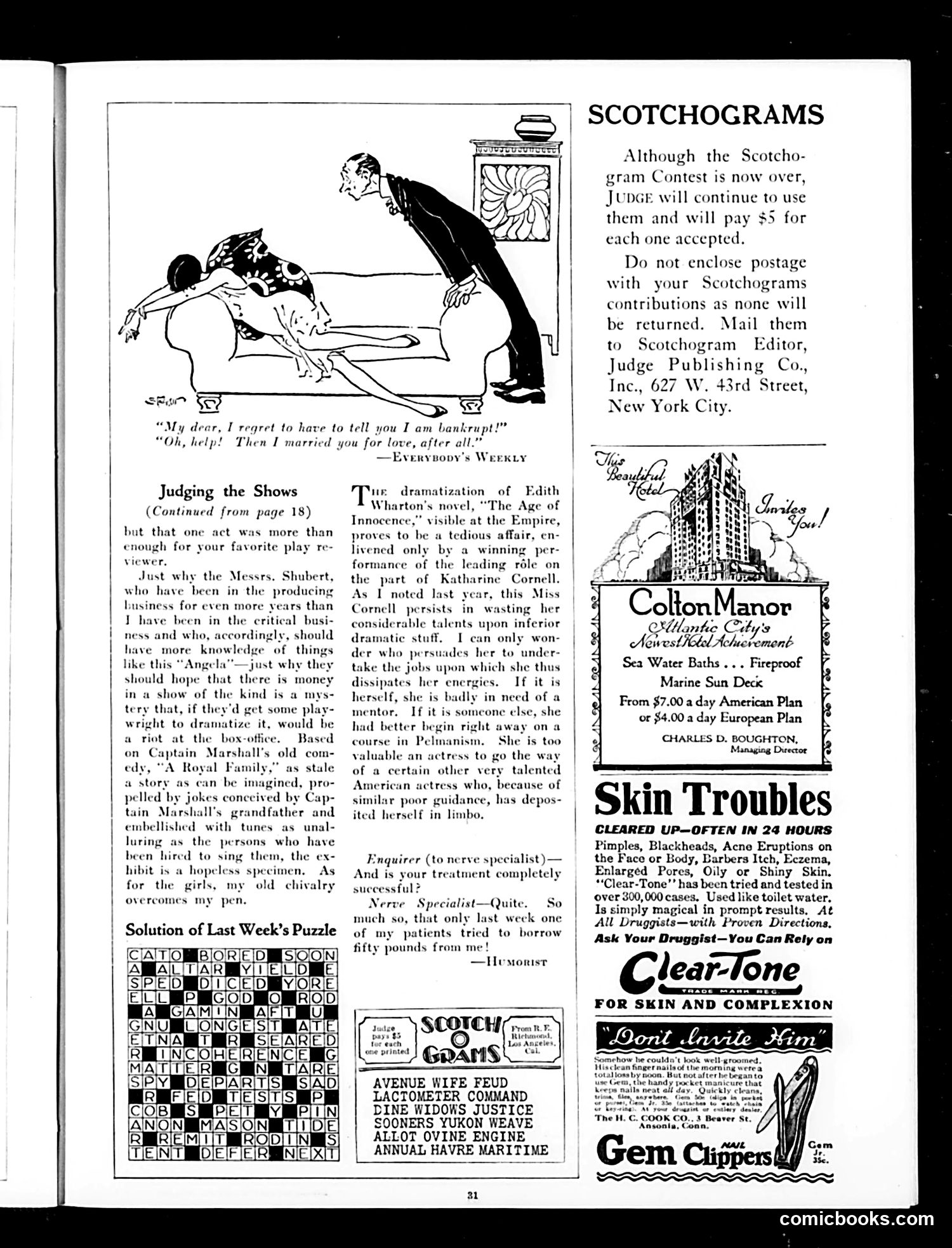
The main cartoon depicts a domestic crisis: a well-dressed man tells his wife "I regret to have to tell you I am bankrupt!" while she responds with dismay. This is a satirical comment on the economic anxiety of the era—likely referencing the financial instability affecting even apparently prosperous middle-class families. The humor lies in the wife's shocked reaction to her husband's financial ruin, playing on contemporary concerns about sudden economic collapse. The page is otherwise dominated by theater criticism (reviewing productions including adaptations of Edith Wharton's work and performances by actress Katharine Cornell) and advertisements for hotels, skin treatments, and personal grooming products. A crossword puzzle and "Scotchogram" contest information also appear. The cartoon's satire targets the disconnect between outward respectability and hidden financial vulnerability—a recurring concern in 1920s American culture.
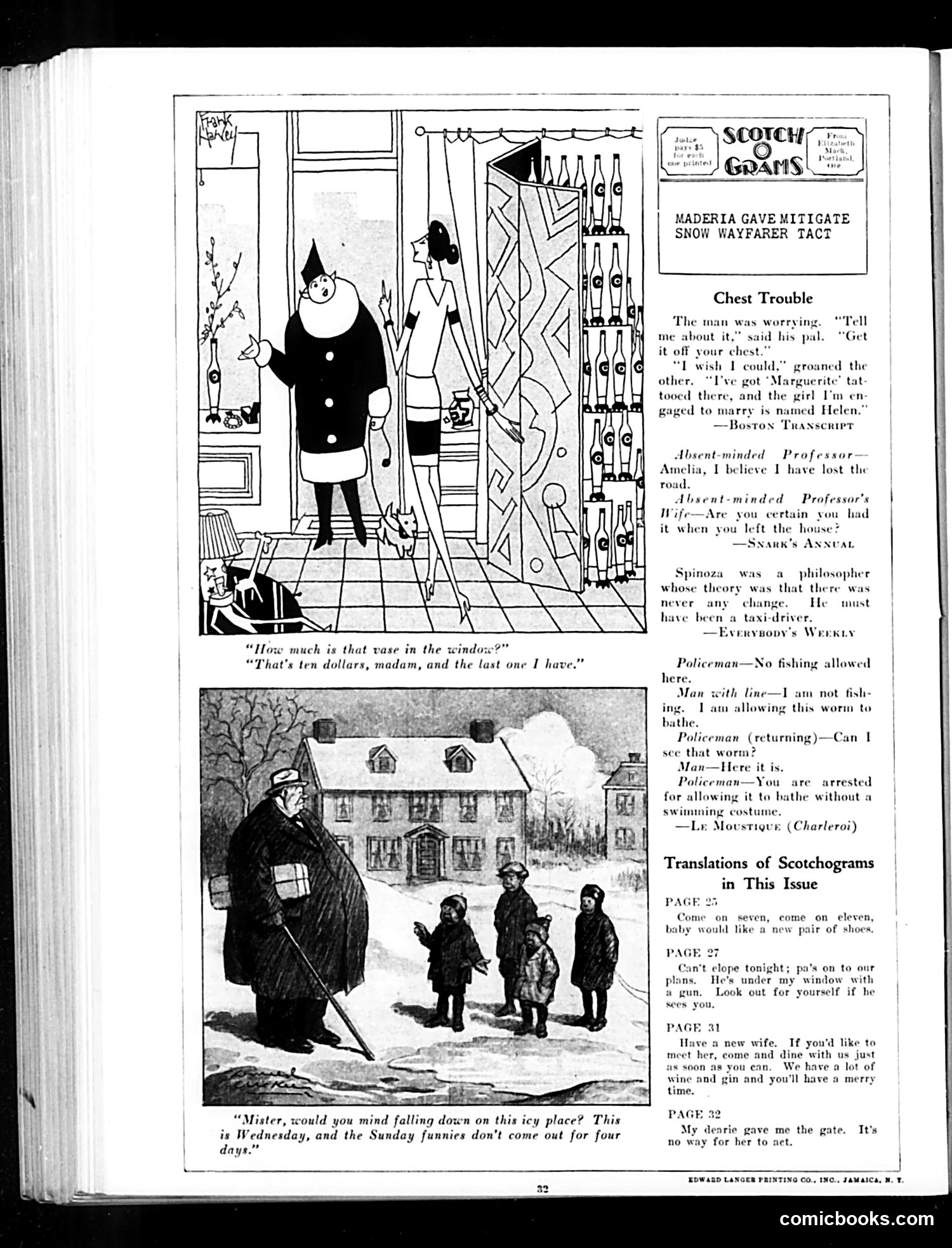
This page collects brief comedic anecdotes and illustrations typical of early-20th-century humor magazines. The top cartoon shows a woman shopping, highlighting consumer culture and domestic concerns. Below, illustrated vignettes address everyday situations: a man with an embarrassing tattoo ("Marguerite") now engaged to "Helen" (marital complications); an absent-minded professor; a taxi driver compared to philosopher Spinoza (implying no progress or change in taxi service). Other jokes mock authority and logic: a man evading fishing laws by claiming he's bathing a worm (wordplay on regulations); a person requesting someone slip on ice so "Sunday funnies don't come out for four days" (suggesting the humor magazine itself creates inconvenient obligations). The translations of "Scotchograms" (likely Scottish dialect humor) at bottom include working-class scenarios: gambling, elopement, domestic drinking. Overall, the page exemplifies Judge's mix of visual gags, puns, and observational humor about class, marriage, bureaucracy, and modern urban life—entertainment assuming readers shared middle-class anxieties and values.
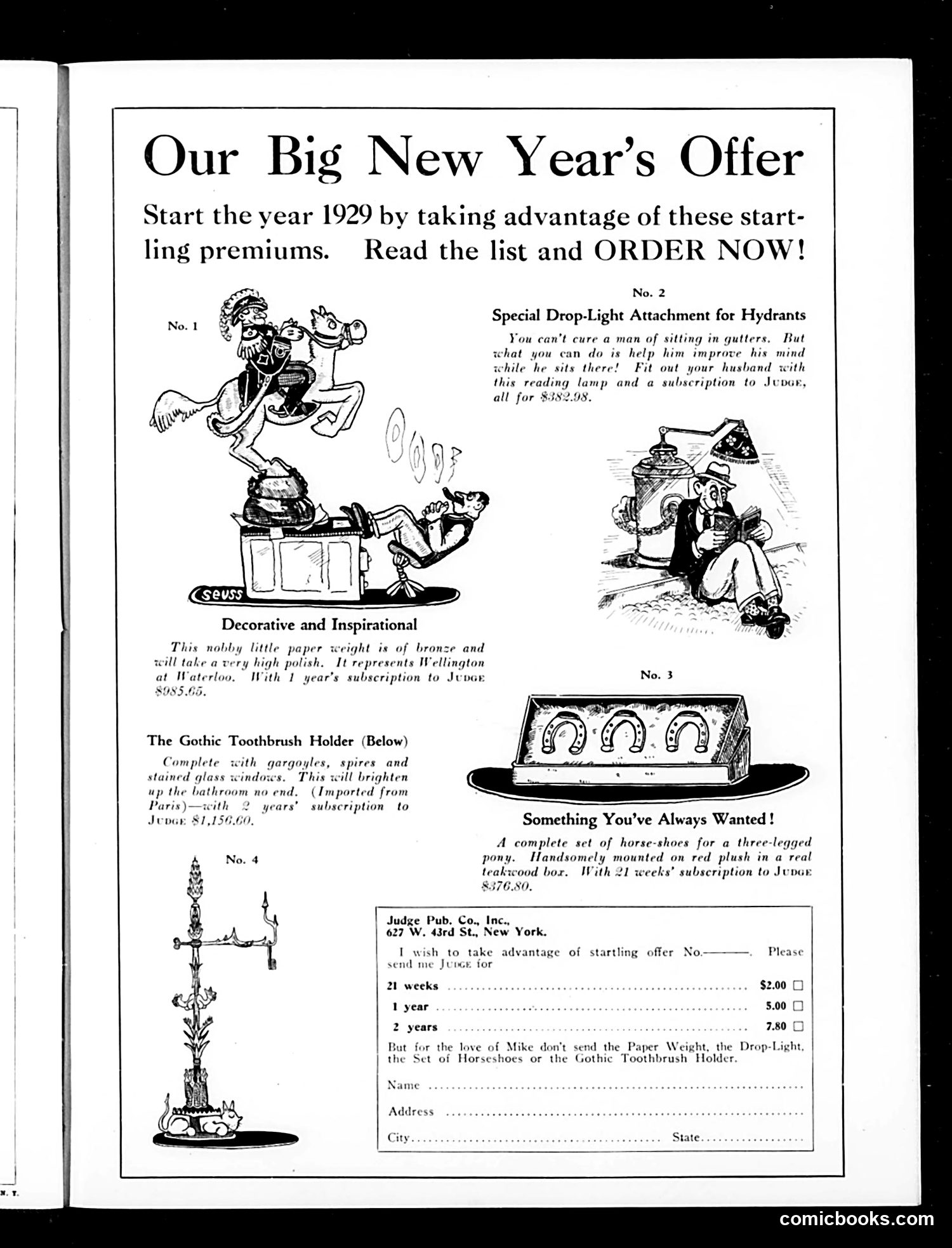
This is a **satirical advertisement** for Judge magazine's 1929 New Year subscription offer. The humor lies in absurd "premium gifts" designed to mock both useless products and the era's aggressive marketing tactics. The four items parodied are: 1. A paper weight depicting Wellington at Waterloo (historically irrelevant decoration) 2. A reading lamp attachment for street hydrants—sarcastically "helping" homeless alcoholics improve their minds while drunk 3. A Gothic toothbrush holder with gargoyles (needlessly ornate bathroom fixture) 4. Horse-shoes for a three-legged pony (functionally pointless) The joke is that these ridiculous items come "free" with magazine subscriptions—a common 1920s marketing gimmick. The fine print's plea "don't send the Paper Weight, the Drop-Light...or the Gothic Toothbrush Holder" reveals the satire: Judge is mocking both consumer culture and subscription-offer absurdity, suggesting readers only want the magazine itself, not worthless premiums.
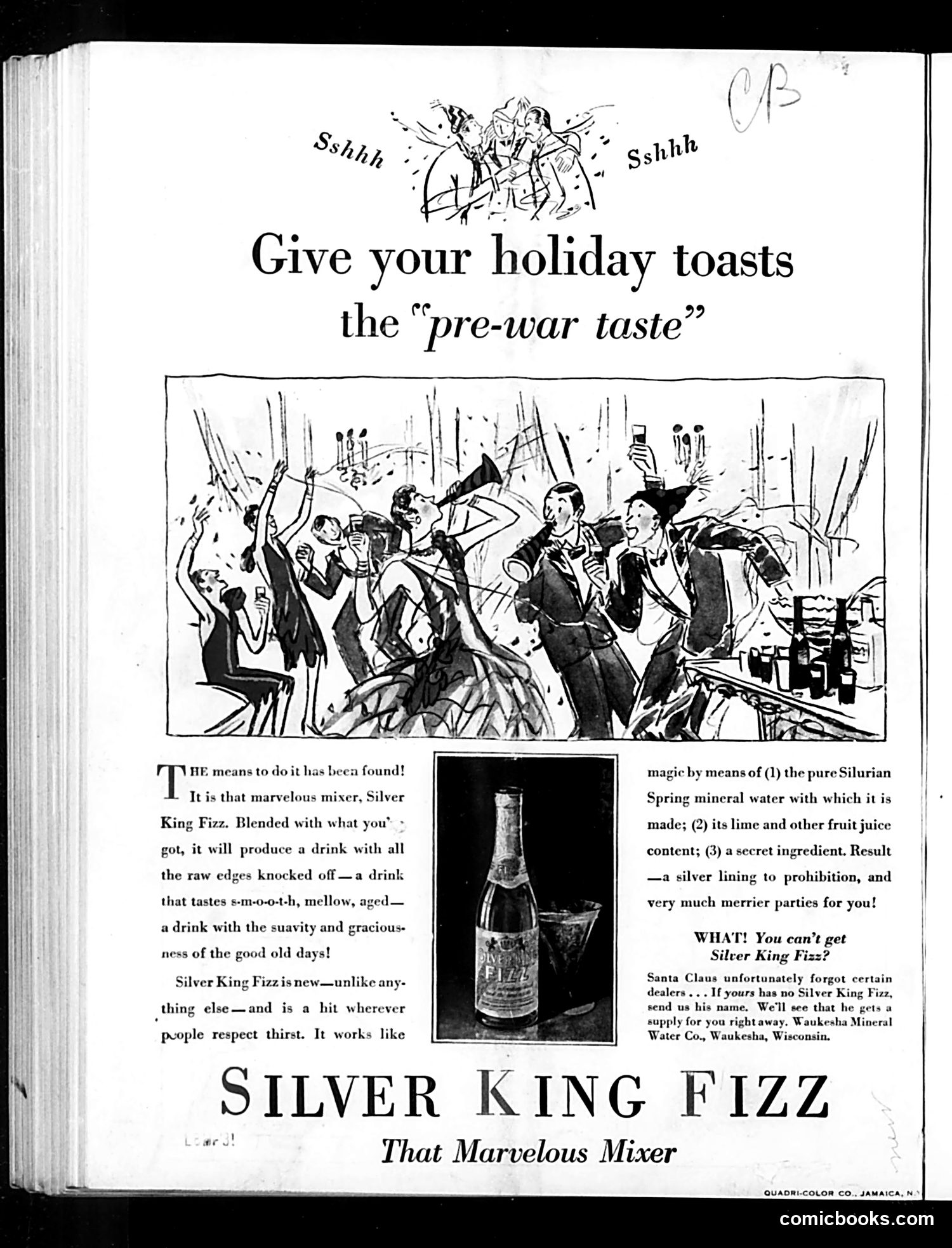
This is a **Prohibition-era advertisement** (likely 1920s), not political satire. The ad promotes "Silver King Fizz," a mixer marketed as enabling people to recreate pre-Prohibition drinking culture during the alcohol ban. The cartoon shows a raucous party scene with celebrants toasting exuberantly—evoking "the good old days" before Prohibition (1920-1933). The ad's core pitch: by mixing Silver King Fizz with whatever alcohol people could obtain illegally, drinkers could achieve a smooth, aged taste mimicking pre-war quality liquor. The humor is darkly ironic: it openly acknowledges Prohibition's existence while explicitly helping consumers circumvent it. The phrase "a silver lining to prohibition" is a wink-and-nod to lawbreaking. The product itself—a mixer from Waukesha Mineral Water Co.—exploits the legal loophole allowing mineral water sales while enabling illegal alcohol consumption. This reflects how American commercial culture tacitly enabled Prohibition's widespread violation.
I'm unable to provide a meaningful analysis of this page. The image appears to be almost entirely blank or blank white space, with only "comicbooks.com" visible at the bottom and some fragmentary text visible on the left margin that is too unclear to read reliably. To accurately explain the cartoon(s) or satirical content as requested, I would need a clearer, more legible scan of the Judge magazine page showing the actual illustrations and readable text. Without being able to see the cartoon artwork or read the complete OCR text, I cannot identify the figures, political references, or satirical intent with the accuracy your instructions correctly emphasize. If you have a clearer version of this page, I'd be happy to analyze it.