
Judge, 1928-12-29 · page 20 of 37
Judge — December 29, 1928 — page 20: what you’re looking at
What you’re looking at
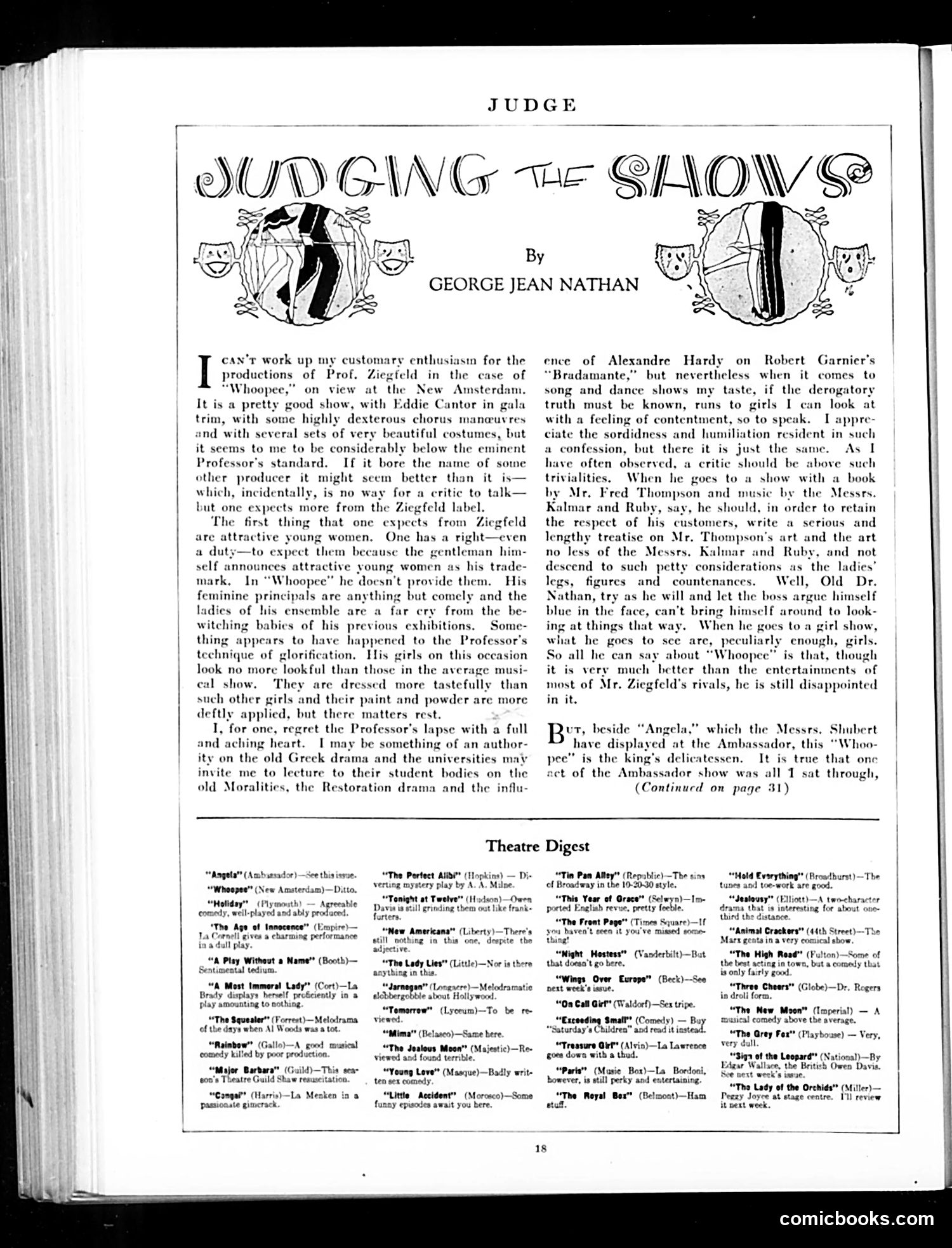
This is a theater review column by prominent drama critic George Jean Nathan, focused on Broadway productions. The main subject is **Florenz Ziegfeld's "Whoopee,"** starring Eddie Cantor at the New Amsterdam Theatre. Nathan's satire is self-aware: he critiques himself for caring about the **physical attractiveness of chorus girls** rather than artistic merit—admitting this is beneath serious critical standards. Yet he argues that Ziegfeld's brand promise is precisely "beautiful women," so when the female performers in "Whoopee" are plain or unattractive (by 1920s standards), the show fails its own premise, regardless of costumes or dancing skill. The joke is Nathan's honest confession: when attending musical comedies, audiences (and critics) actually want to see attractive women, not serious artistic analysis. He's satirizing both theatrical pretension and his own lowbrow tastes. The page includes a "Theatre Digest" listing other current Broadway shows with brief reviews below.
📄 Transcribed text from this page (OCR, searchable)
Machine-transcribed from the original scan — historical spelling and the odd misread are preserved.
can't work up my customary enthusiasin for the I productions of Prof. Ziegfeld in the case of “Whoopee,” on view at the New Amsterdam. It is a pretty good show, with Eddie Cantor in gala trim, with some highly dexterous chorus manauvres and with several sets of very beautiful costumes, but | it seems to me to be considerably below the eminent Professor's standard. If it bore the name of some other producer it might seem better than it is— which, incidentally, is no way for a critic to talk— but one expects more from the Ziegfeld label. | "The first thing that one expects from Ziegfeld are attractive young women, One has a right—even a duty—to expect them because the gentlen self announces attractive young women as his trade- mark, In “Whoopee” he doesn't provide them. His. feminine principals are anything but comely and the ladies of his ensemble are a far cry from the be- witching babies of his previous exhibitions. Some- thing appears to have happened to the Professor's technique of glorification. His girls on this occasion look no more lookful than those in the average musi- cal show. They are dressed more tastefully than such other girls and their paint and powder are more deftly applied, but there matters. rest. I, for one, regret the Professor's lapse with a full and aching heart ay be ity on the old ( nd the universities may invite me to lecture to their student bodies on the old Moralities, the Restoration drama and the influ- n him- something of an author- JUDGE By GEORGE JEAN NATHAN ence of Alexandre Hardy on Robert Garnier’s “Bradamante,” but nevertheless when it comes to song and dance shows my taste, if the derogatory truth must be known, runs to girls I can look at with a feeling of contentment, so to speak. I appre- ciate the sordidness and humiliation resident in such a confession, but there it is just the same. As I have often observed, a critic should be above such trivialities. When he goes to a show with a book hy Mr. Fred Thompson and music by the Messrs. Kalmar and Ruby, say, he should, in order to retain the respect of his customers, write a serious and lengthy treatise on Mr. Thompson's art and the art no less of the Messrs. Kalmar and Ruby, and not descend to such petty considerations as the ladies’ legs, figures and countenances. Well, Old Dr. Nathan, try as he will and let the boss argue himself blue in the fe n't bring himself around to look- ing at things th When he goes to a girl show, what he goes to sce are, peculiarly enough, girls. So all he can say about “Whoopee” is that, though it is very much better than the entertainments of most of Mr. Ziegfeld’s rivals, he is still disappointed in it. ut, beside “Angela.” which the Messrs. Shubert have displayed at the Ambassador, this “Whoo- pee” is the king's delicatessen. It is true that one t of the Ambassador show was all 1 sat through, (Continued on page 31) “Angela” (Ambsrsador) “Whoopee” (New Amsterdam) —Ditto. See this issue. “The Pertect Alidi” (Hopkins) ng mystery play by A. A. Malbe. Tonight at Twelve’ (HH xdson)—Owen Davia itil grinding them out like frank- jurters. “Mew Americans” (Liberty)—There's sill nothing in this one, deepite the adjective. Play Without » Name’ (Booth) — The Lady Lies’ (Little) —Nor is there Sentimental tedium. wrihing in this. “A Mest Immoral Lady” (Cort)—La farvepast” (Longnere)—M shodracoel ie Brady displays herself profciently in a pbergobble about Hollywood play amounting to nothing. Di- Agreeable (Empire) performance “Temerrew” (Lyceum)—To be re The Squealer” (Forrest)—Melodrama view of the days when Al Woods was a tot. samc (Baensh “Rainbow” (G « comedy killed by idey be yraed pret ‘Major Barbar: aild)—This sea- “Young Love” (Masque)—Badly writ- ‘00's Theatre Guild Shaw resuscitation. ten sex comedy. nga” (Harris) a | “Little Accident” (Morosco)—Some funny episodes await you here. “A good musical oot production. La Menke: Theatre Digest “Tin Pam Alley’ (Republic) —The sins cf Broadway in the 19-20-30 etyle. “This Year of Grace” (Selwyn)—Im- “Hold Everything” (Broadhurst)—The tunes and toe-work are good. “Jealousy” (Elliott) —A two-character ported Englah revue, pretty feeble. drama that is interesting for abou “The Front Page” (Timnes Square)—ir ir the distance. you baven't eeen st you've mined some “Animal Crackers” (44th Street)—The a! Marx gents ina very comical show. ‘Might Hostess” (Vanderbilt)—But “The High Read” (Fulton) —Some of that doesn't go bere. the best acting in town, but a cormedy that “Wings Over Europe” (Beck)—See ext week's issue. “On Call Git (Waldorf) —Sex tripe. “Exceeding Small” (Comedy) — Bu; “Saturday's Children” and read it instead “Treasure Girf* (Alvin)—La Lawrence gore dowa with a thud. “Paris” (Music Box)—La Bordoai, bomever, is still perky and entertaining. “The Reyal Bex” (Belmont)—Ham stall. is only fairly good. “Three Cheers” (Globe)—Dr. Rogers in droli form, “The New Moon” (Irperial) — A musical comedy above the average. “The Grey Fox” (Playhouse) — Very, very dull. “Sign of the Leopard” (National) —By Edgar Wallace, the British Owen Davis. fy of the Orchids” (Miller at stage centre. I'll review it next week. comicbooks.com