
Judge, 1928-12-29 · page 15 of 37
Judge — December 29, 1928 — page 15: what you’re looking at
What you’re looking at
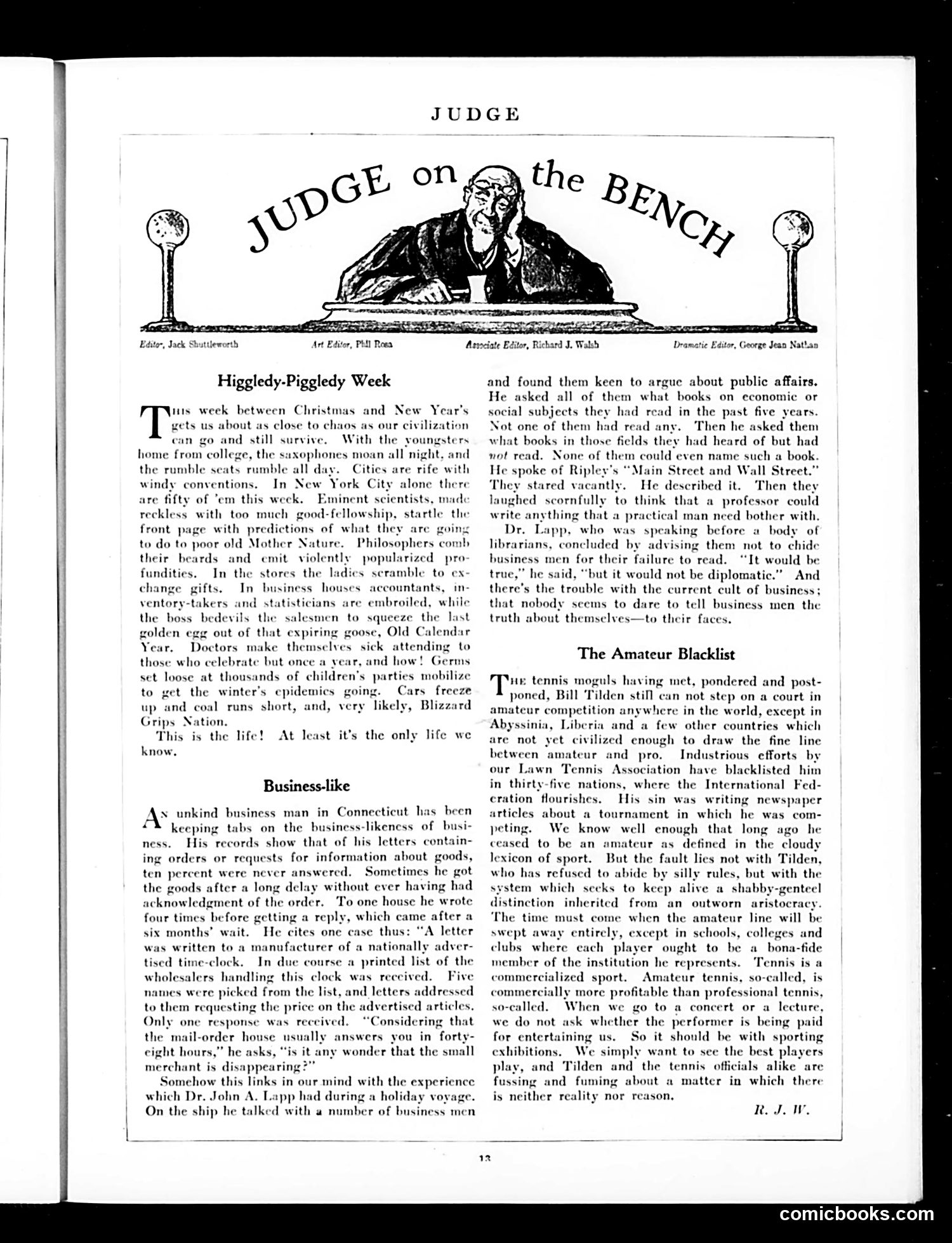
The page contains three articles under the "Judge on the Bench" editorial header. The main illustration shows a judge in robes. **"Higgledy-Piggledy Week"** satirizes the chaos of the Christmas-New Year holiday period in American cities, describing disrupted business, crowds, celebrating doctors, and spreading illness. **"Business-like"** criticizes poor customer service: a Connecticut businessman documents that one-tenth of his business inquiries go unanswered, and mail-order houses don't respond. The piece also relates an anecdote from Dr. John Lapp, who discovered that businessmen aboard a ship had read no economics or social theory books—and ridiculed academics like Ripley who attempted to write about business subjects. The satire suggests business culture lacks intellectual engagement. **"The Amateur Blacklist"** discusses tennis player Bill Tilden's ban from amateur competition worldwide (except in isolated countries). It criticizes the arbitrary distinction between amateur and professional tennis, suggesting the system is elitist rather than reasonable.
📄 Transcribed text from this page (OCR, searchable)
Machine-transcribed from the original scan — historical spelling and the odd misread are preserved.
Editer, Jack Shuttleworth Art Editor, Pill Rosa Higgledy-Piggledy Week its week between Christmas and New Yi uets us about as close to chaos as our civilization can go and still survive. With the youngsters home from college, the saxophones mi Vnight, and the rumble seats rumble all day. Cit re rife with windy conventions. In New York City alone there are fifty of ‘em this weck. Eminent scientists, mad reckless with too much good-fellowship, startle the front page with predictions of what they are going to do to poor old Mother Nature. Philosophers comb their beards and emit violently popularized pro fundities. In the stores the ladies scramble to ex- ch ‘ountants, in- ventory-takers and statisticians are embroiled, while the boss bedevils the salesmen to squeeze the last golden egg out of that expiring goose, Old Calendar Year. Doctors make themselves sick attending to those who celebrate but once a vear, and how! ( set loose at thousands of children’s parties mobilize to get the winter's epidemics going. Cars freeze up and coal runs short, and, very likely, Blizzard Grips Nation. This is the life! At least it’s the only life we know. gifts. In business houses rms: Business-like x unkind business man in Connecticut has been keeping tabs on the business-likeness of busi- ness. His records show that of his letters contain- ing orders or requests for information about goods, ten percent were never answered. Sometimes he got the goods after a long delay without ever having had acknowledgment of the order. To one house he wrote four times before getting a reply, which came after a six months’ wait. He cites one case thus: “A letter was written to a manufacturer of a nationally adver- tised time-clock. In due course a printed list of the wholesalers handling this clock was received. Five names were picked from the list, and letters addressed to them requesting the price on the advertised articles, Only one response was received. “Considering that the mail-order house usually answers you in forty- eight hours,” he asks, “is it any wonder that the small merchant is disappearii Somehow this links in our mind with the experience which Dr. John A. Lapp had during a holiday voyage. On the ship he talked with a number of business men JUDGE Dramatic Editor, George Jean Nattan and found them keen to argue about public affairs. He asked all of them what books on economic or social subjects they had read in the past five years. Not one of them had read « Then he asked them what books in those fields they had heard of but had not read. None of them could even name such a book. He spoke of Ripley's “Main Street and Wall Street.” They stared vacantly. He described it. Then they laughed scornfully to think that a professor could write anything that a practical man need bother with, Dr. Lapp, who was speaking before a body of librarians, concluded by advising them not to chide business men for their failure to read. “It would be true,” he said, “but it would not be diplomatic.” And there's the trouble with the current cult of business; that nobody seems to dare to tell business men the truth about themselves—to their faces. The Amateur Blacklist Tt tennis moguls having met, pondered and _post- poned, Bill Tilden still can not step on a court in amateur competition anywhere in the world, except in Abyssinia, Libe are not 1 and a few other countries which et civilized enough to draw the fine line between ‘amateur and pro. Industrious efforts. by our Lawn Tennis Association have blacklisted him in thirty-five nations, where the International Fed- ion flourishes. His sin was writing newspaper tticles about a tournament in which he was com- peting. We know well enough that long ago he ed to be an amateur as defined in the cloudy lexicon of sport. But the fault lies not with Tilden, who has refused to abide by silly rules, but with the system which secks to kecp alive a shabby-genteel distinction inherited from an outworn aristoc s The time must come when the amateur line will be swept away entirely, except in schools, colleges and clubs where cach player ought to be a bona-fide member of the institution he represents. Tennis is a commercialized sport. Amateur tennis, so-called, is commercially more profitable than professional tennis, so-called. When we go to a concert or a lecture, we do not ask whether the performer is being paid for entertaining us. So it should be with sporting exhibitions. We simply want to see the best players play, and Tilden and’ the tennis officials alike’ are fussing and fuming about a matter in which there is neither reality nor reason, ced RoI. W. — comicbooks.com