
A complete issue · 36 pages · 1927
Judge — November 19, 1927
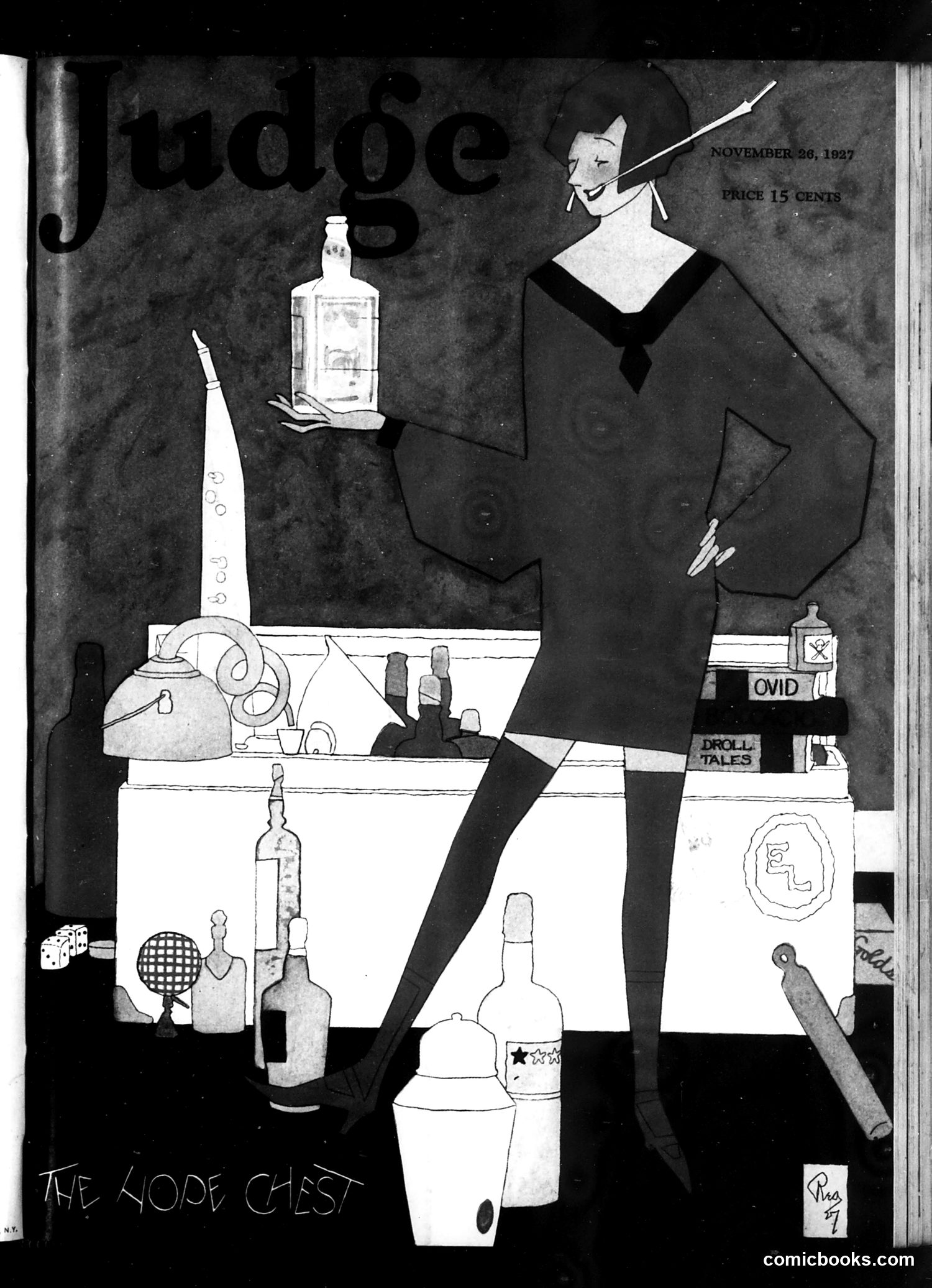
This cover illustration satirizes excessive consumption and vice during Prohibition. A stylishly dressed woman displays various liquor bottles, drinking vessels, and contraband items—depicting the "modern woman" as complicit in flouting alcohol laws. The title "The Lode Chest" suggests hidden treasure or illicit goods. Visible text references "OVID" and "DROLL TALES," implying sophisticated pretense masking crude materialism. The cartoon critiques Jazz Age excess: despite federal Prohibition (1920-1933), wealthy individuals openly maintained private collections of alcohol and elaborate entertainments. The woman's fashionable appearance and confident pose mock the hypocrisy of those who publicly supported Prohibition while privately indulging. The satirical point: the era's moral contradictions and the failure of Prohibition enforcement among the privileged classes.
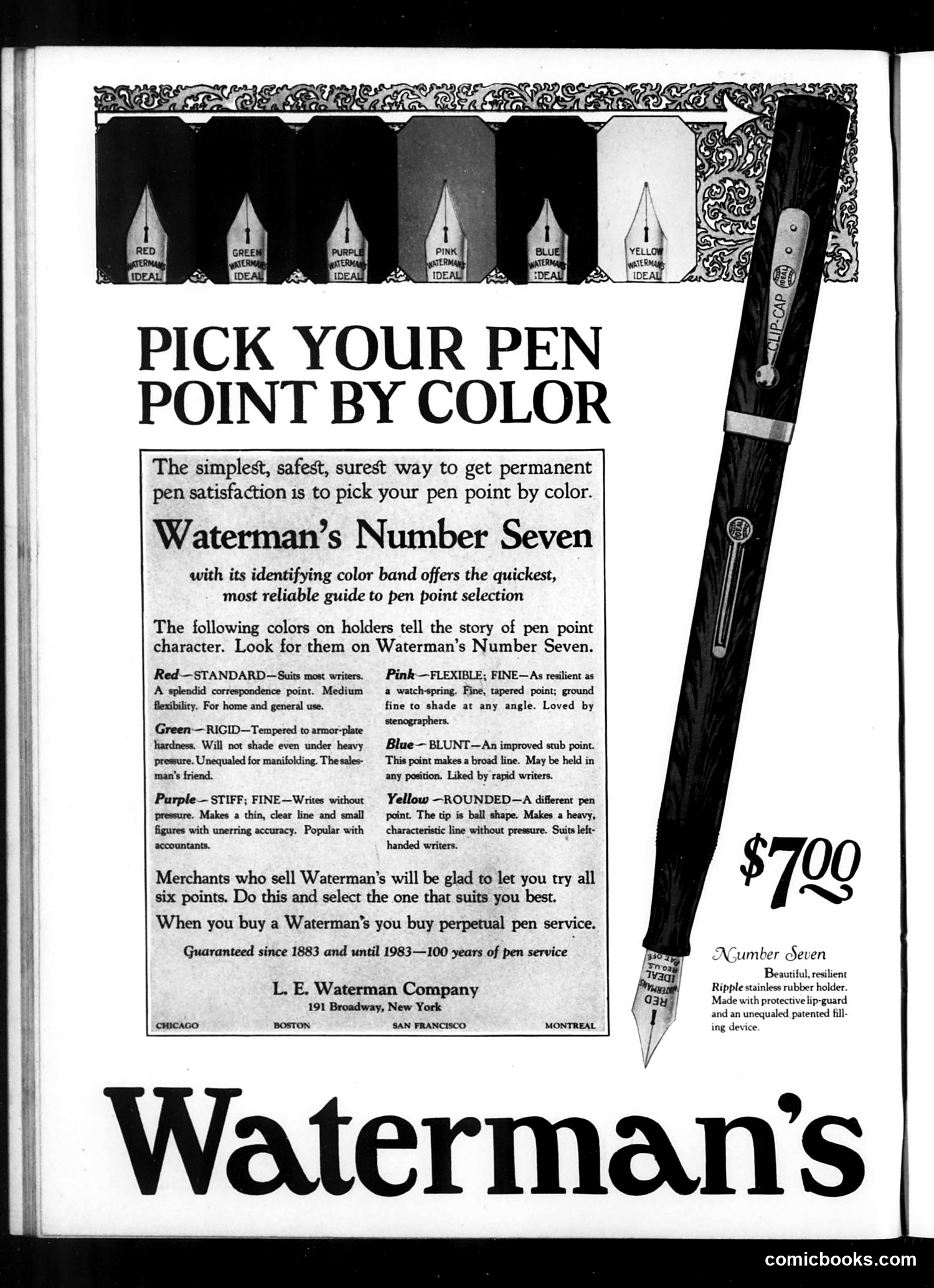
This page is primarily a Waterman's pen advertisement, not political satire. It promotes the "Number Seven" fountain pen model priced at $7.00, emphasizing that customers can "pick your pen point by color." The ad lists six different nib options identified by color bands—Red (standard), Green (rigid), Purple (stiff/fine), Pink (flexible/fine), Blue (blunt), and Yellow (rounded)—each suited to different writing styles and professions. Accountants, stenographers, and left-handed writers are mentioned as specific user groups. The advertisement stresses reliability and longevity, guaranteeing "100 years of pen service" since 1883. There is no political cartoon or satire present on this page—it is straightforward commercial advertising from the L.E. Waterman Company, with offices in Chicago, Boston, San Francisco, and Montreal.
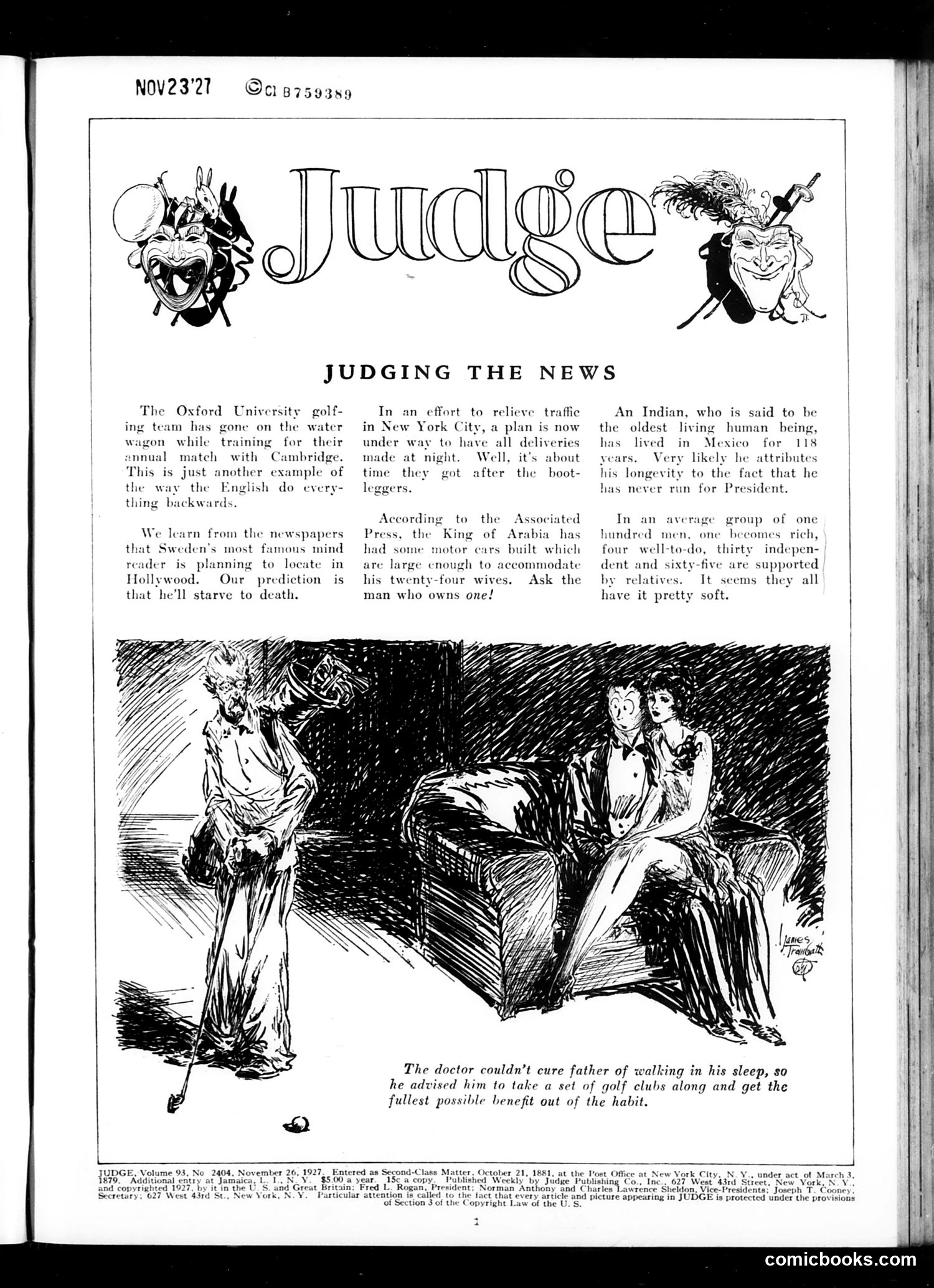
This page satirizes contemporary news items under the heading "Judging the News." The four brief items mock: 1. **Oxford's rowing team** training backwards (suggesting English eccentricity) 2. **New York City traffic relief** through night deliveries (practical but odd) 3. **An elderly Indian man** claiming longevity from never running for President (political humor suggesting U.S. politics is stressful) 4. **The King of Arabia's motor cars**—the joke being that one man owns multiple wives' worth of vehicles The cartoon below illustrates the final item: a doctor advises a father who sleep-walks to take golf clubs along, getting "fullest possible benefit" from the habit. This combines medical humor with the era's golf obsession among wealthy Americans. The satire throughout is gentle, reflecting 1920s upper-class preoccupations.
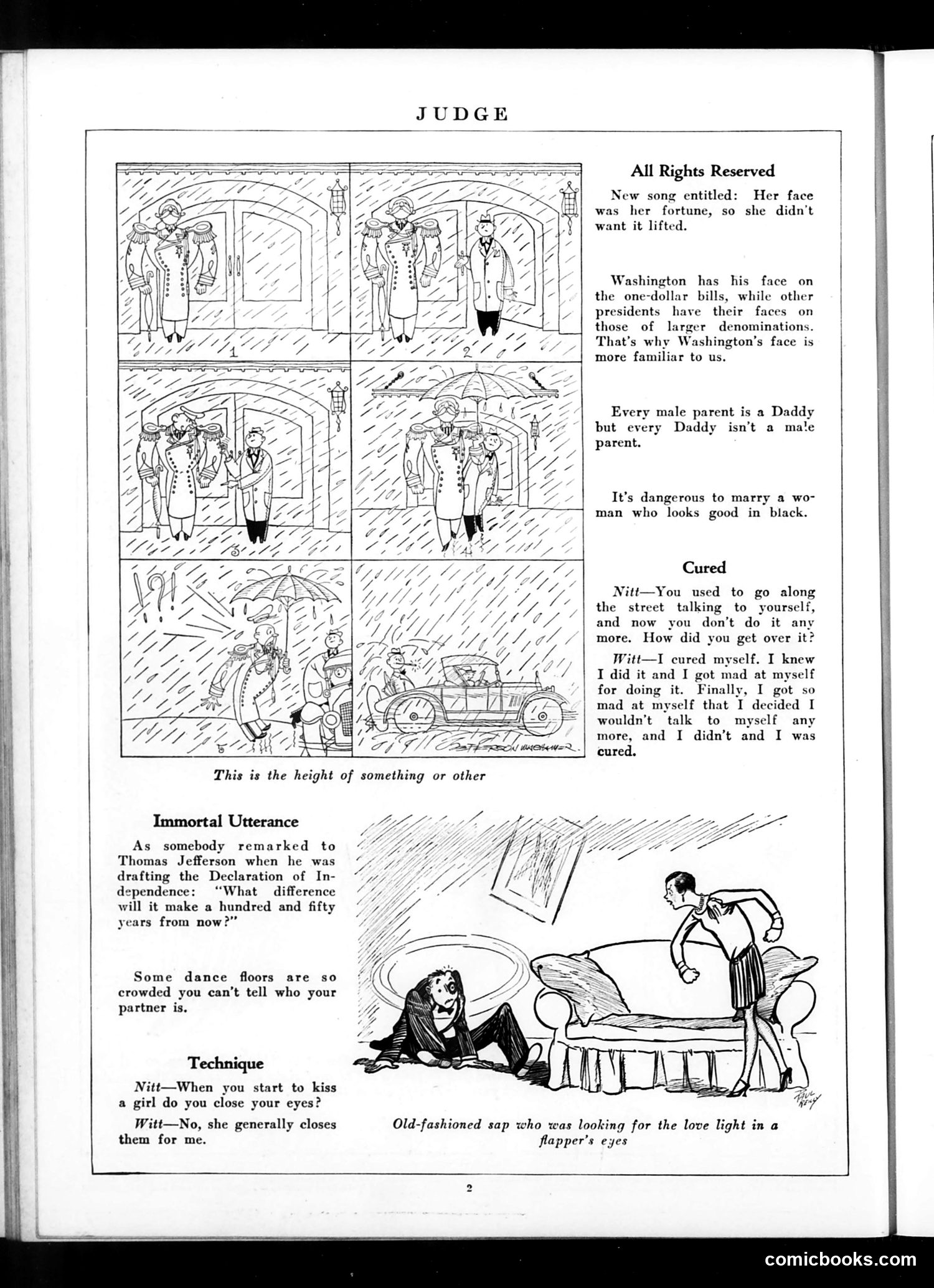
This page contains several unrelated humor pieces typical of Judge magazine's format: **The Comic Strip** (top): Shows a woman in an elevator with various men. The caption "This is the height of something or other" appears to be a pun about elevator heights and romantic/social situations. **"Cured"**: A brief dialogue about someone overcoming the habit of talking to themselves in public. **"Immortal Utterance"**: A quip about Thomas Jefferson's Declaration of Independence and long-term consequences. **"Technique"**: A flirting joke about closing eyes while kissing. **Bottom Illustration**: Shows a man peering under a woman on a couch, captioned as seeking "the love light in a flapper's eyes"—satirizing outdated romantic notions about 1920s women (flappers). The page primarily offers social humor about dating, courtship, and changing modern manners rather than political satire.
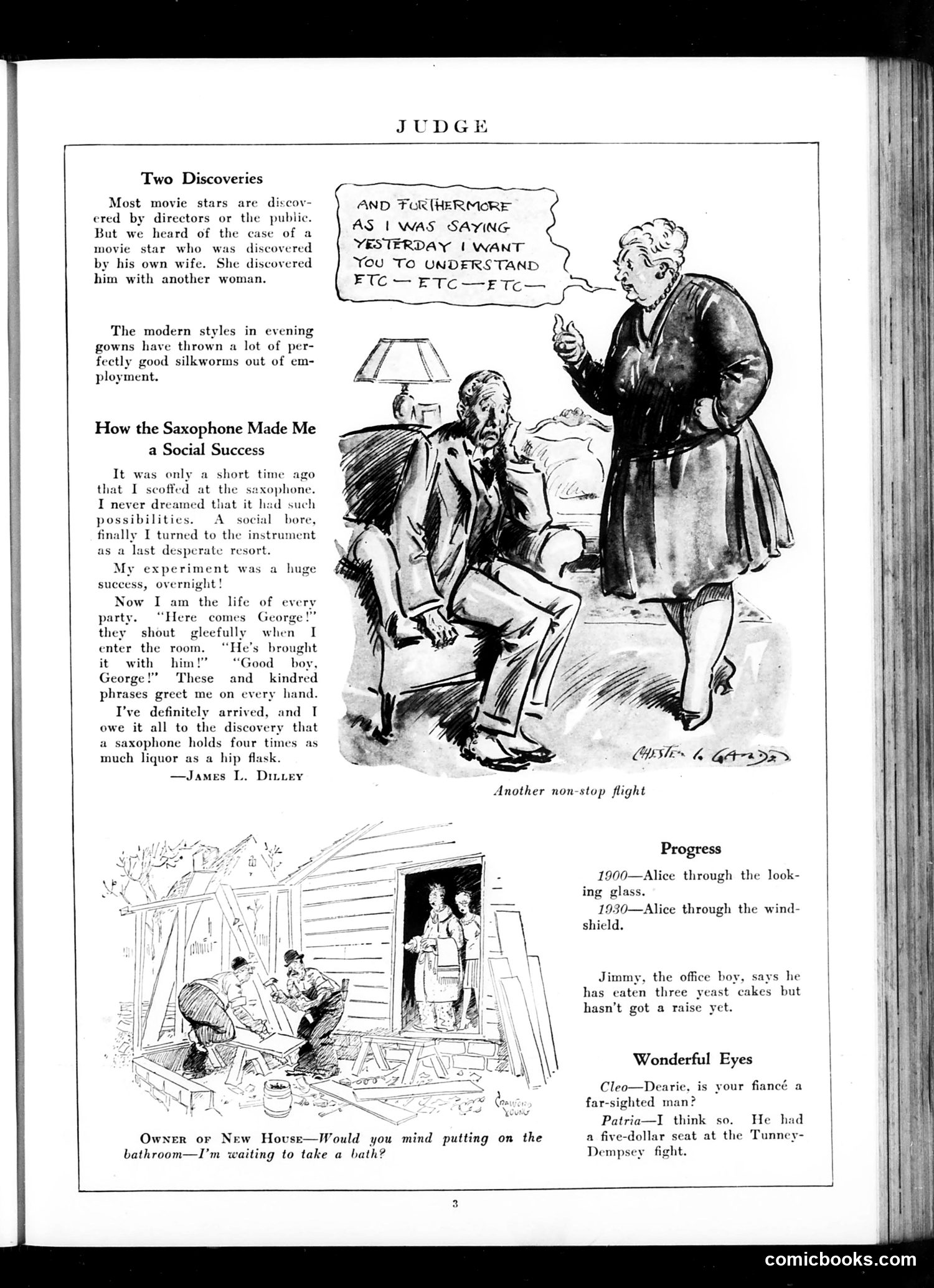
This page contains three separate humor pieces: **"Two Discoveries"** presents brief jokes about movie-star discovery and 1920s fashion (silkworms in evening gowns). **"How the Saxophone Made Me a Social Success"** is a first-person account by James L. Dilley describing how learning saxophone transformed him socially—he's now the life of parties. The cartoon shows him playing while others listen, and he jokes that saxophones hold "four times as much liquor as a hip flask," a Prohibition-era reference suggesting the instrument's hollow body could conceal alcohol. **"Progress,"** "Wonderful Eyes," and the bottom cartoon are brief quips. The final cartoon shows a homeowner asking a worker to delay bathroom installation because he wants to bathe—a joke about construction delays. The content reflects 1920s concerns: Prohibition, social climbing through entertainment, fashion, and domestic inconvenience.
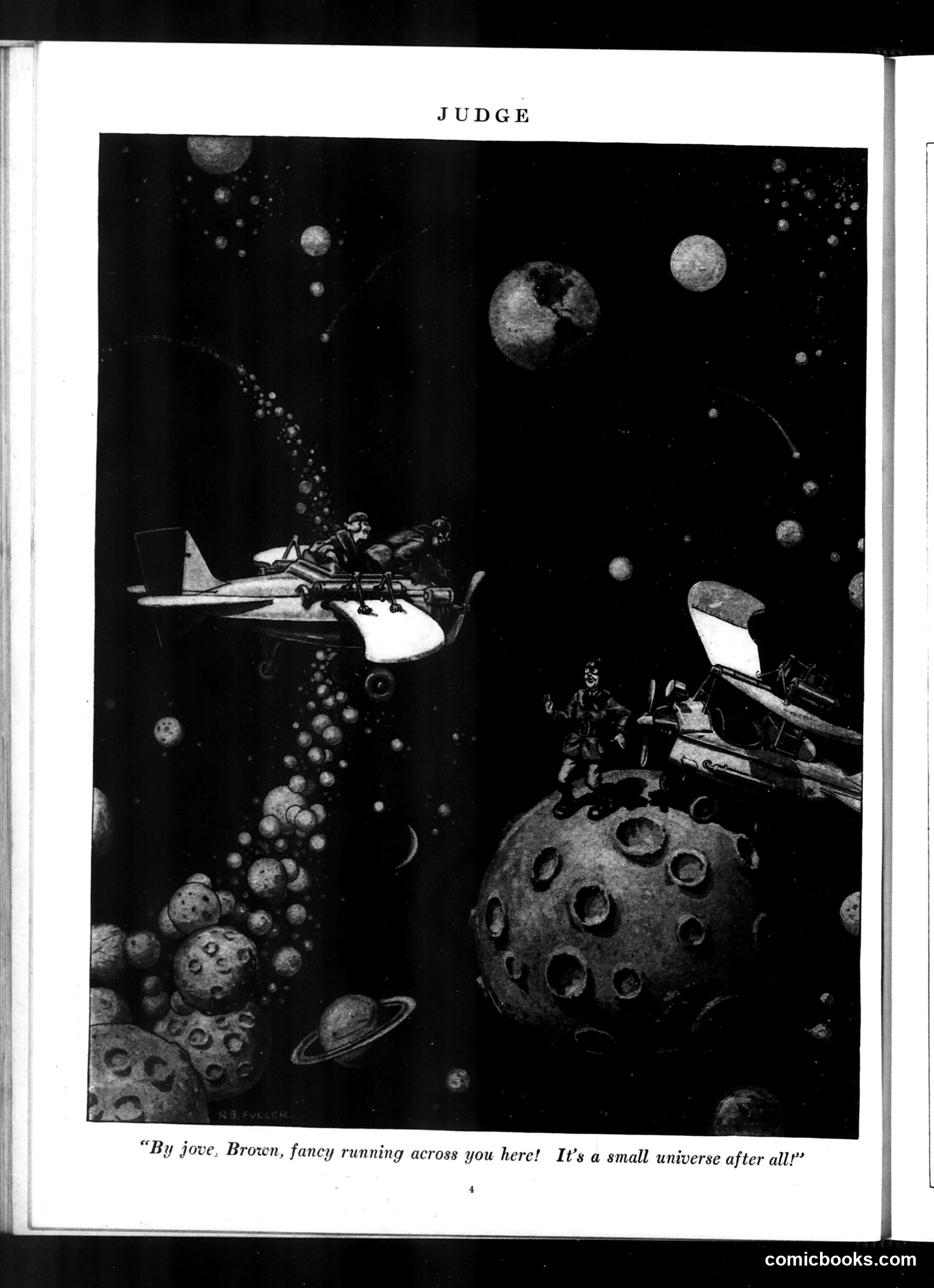
This is a science fiction cartoon depicting two spacecraft encountering each other in space amid asteroids and celestial bodies. The caption reads: "By jove, Brown, fancy running across you here! It's a small universe after all!" The humor is a straightforward play on the phrase "it's a small world" — transposing the common expression of coincidental meetings onto a cosmic scale. Rather than meeting someone unexpectedly on Earth, these space travelers encounter each other in the vast expanse of space, making the surprise encounter absurdly improbable yet rendered "small" by the catchphrase. This appears to be light science fiction humor typical of Judge magazine's satirical offerings, with no apparent political commentary—simply a pun-based joke for entertainment.
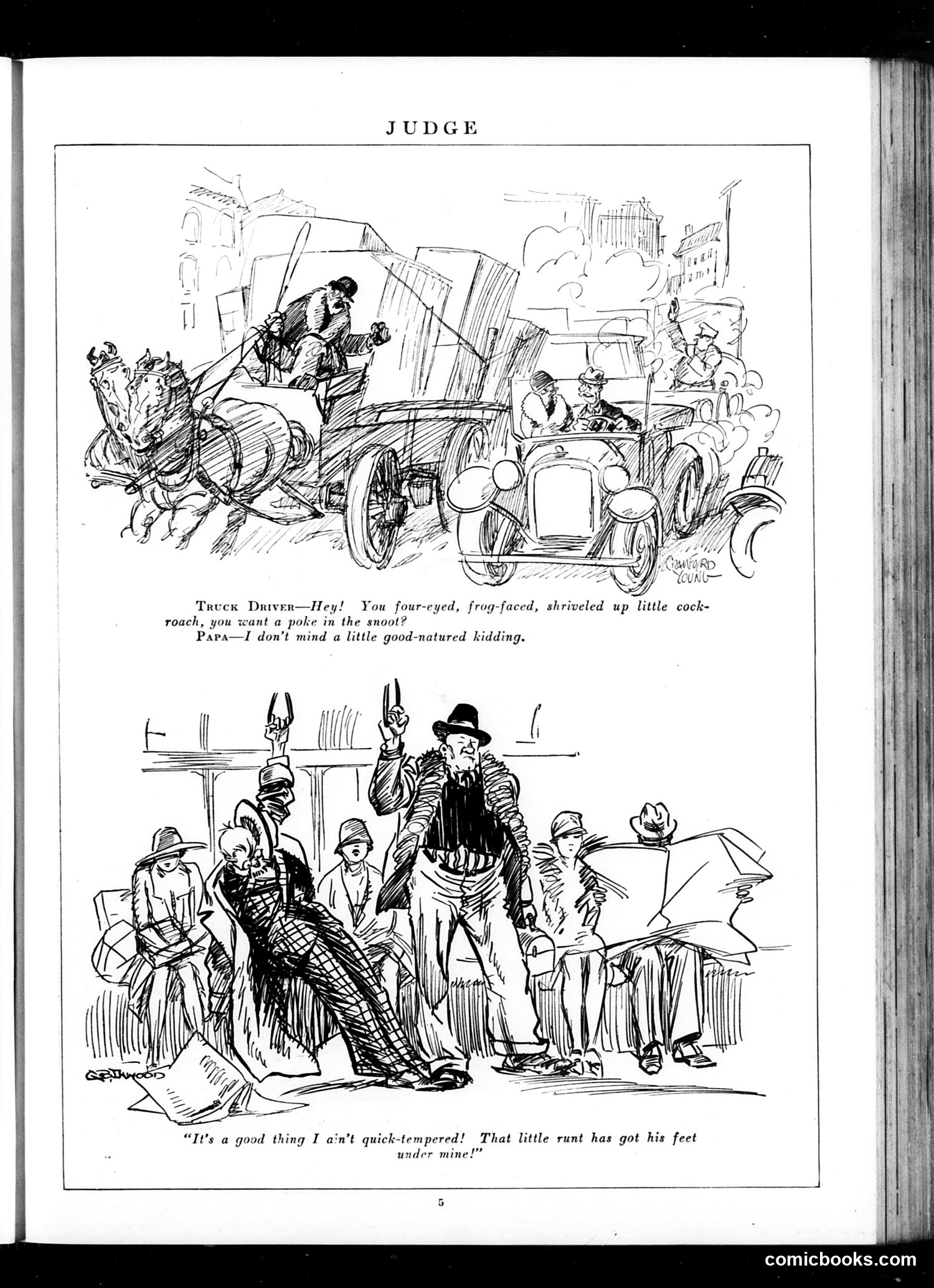
This page contains two satirical cartoons about traffic and driving etiquette. **Top cartoon:** Shows a collision between a horse-drawn truck and an early automobile. The truck driver insults the motorist as "four-eyed, frog-faced, shriveled up little cockroach," while the father figure dismisses such rudeness, saying he doesn't mind "a little good-natured kidding." **Bottom cartoon:** Depicts what appears to be a traffic court or judicial scene. A judge, surrounded by other officials or court attendees, comments that he's "a good thing I ain't quick-tempered" because a small child is literally under his feet. Both cartoons satirize the social tensions of the early automotive era—mocking the antagonism between traditional horse-transport users and new motorists, while also commenting on chaotic urban traffic conditions and inadequate traffic regulation.
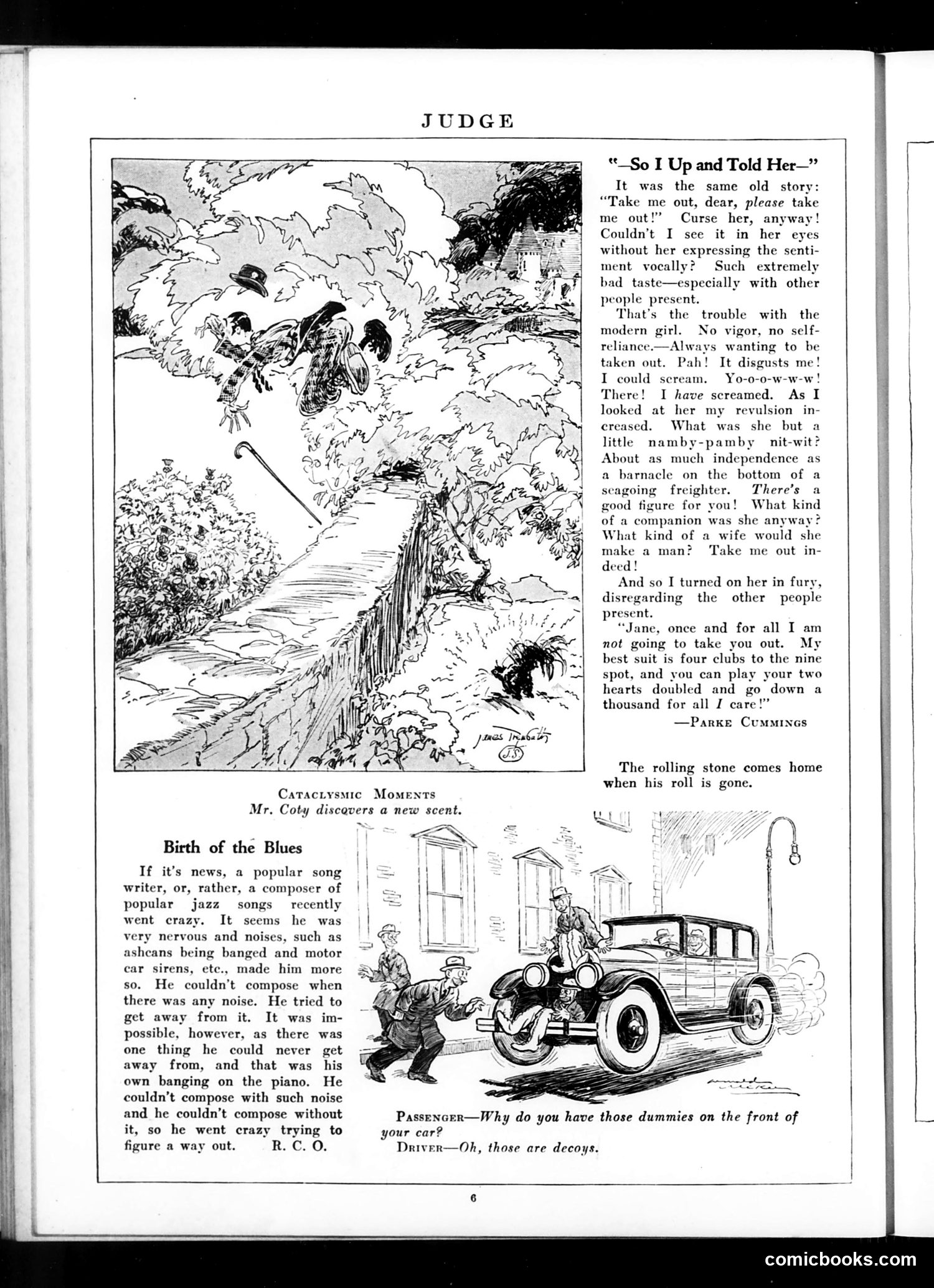
This page contains three satirical pieces mocking 1920s social attitudes: **"So I Up and Told Her"** (top): A husband complains about his wife's desire to go out, revealing his hypocrisy—he criticizes her lack of independence while controlling her, then explodes into an absurd rage, ultimately refusing to take her out by making a bridge card game reference instead. The satire targets domineering husbands who mask control as concern for women's self-reliance. **"Birth of the Blues"** (bottom left): A jazz composer goes mad because he can't escape noise—particularly his own piano playing—while trying to compose. This satirizes the nervous temperament of artists and the paradoxes of creative work. **"Cataclymic Moments"** (bottom right): A driver has dummies mounted on his car's front bumper, explaining they're "decoys." This appears to mock either reckless driving habits or insurance fraud schemes of the era. The overarching theme mocks modern social pretension and hypocrisy among the urban leisure class.
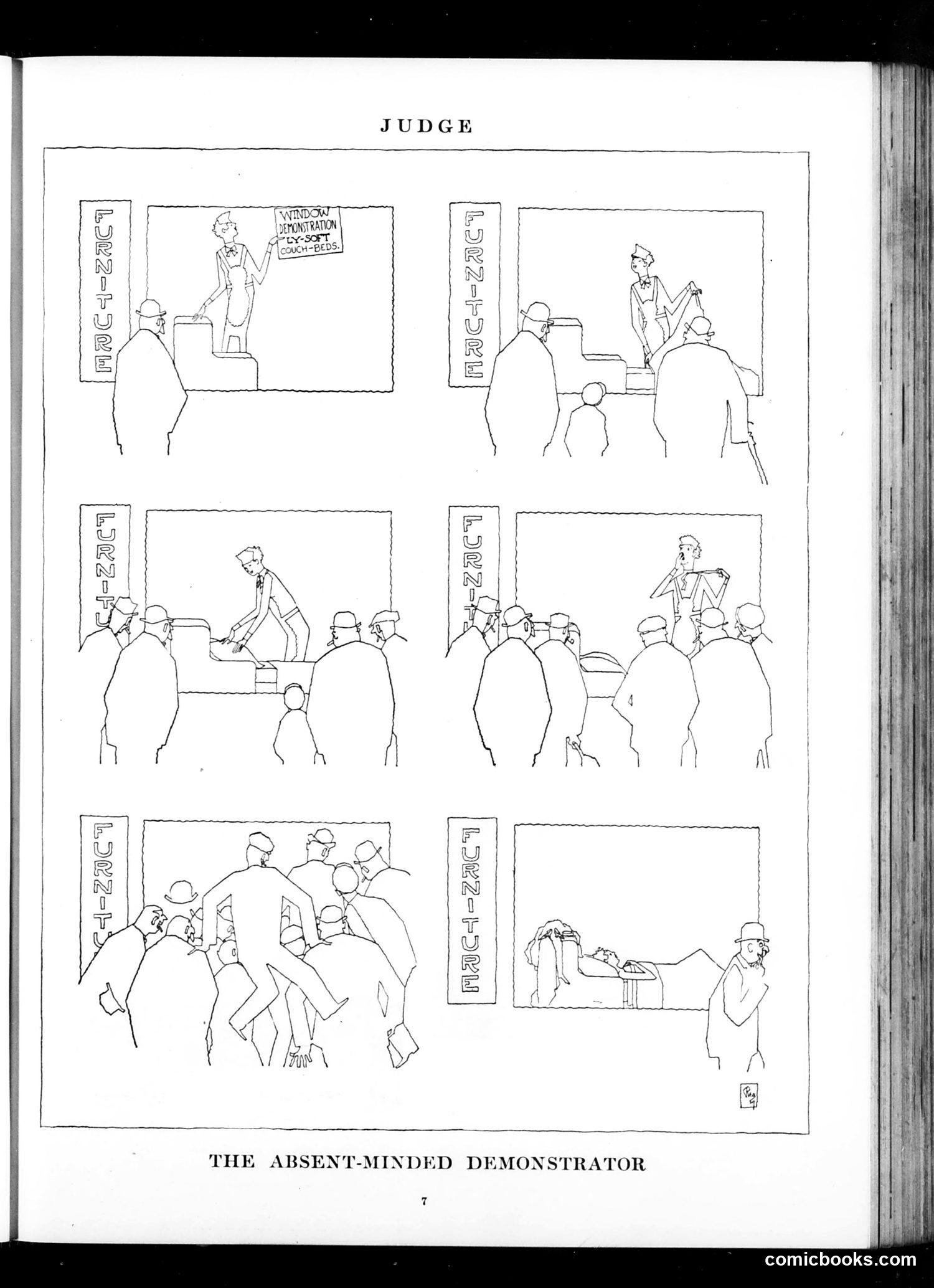
This six-panel comic from *Judge* satirizes a lecturer or demonstrator who is comically disorganized. The narrative follows a man attempting to give a presentation at a podium labeled "Furniture" to an increasingly frustrated audience. The joke progresses through escalating chaos: the speaker appears unprepared, his demonstration materials are missing or misplaced, and by the final panels, the situation devolves into complete pandemonium with audience members physically fighting or mobbing the stage. The satire mocks both incompetent public speakers and the public's impatient response to poor presentations. It's a straightforward humor piece exploiting the universal frustration with bungled lectures—likely resonating with early-20th-century audiences who attended numerous civic demonstrations and educational presentations.
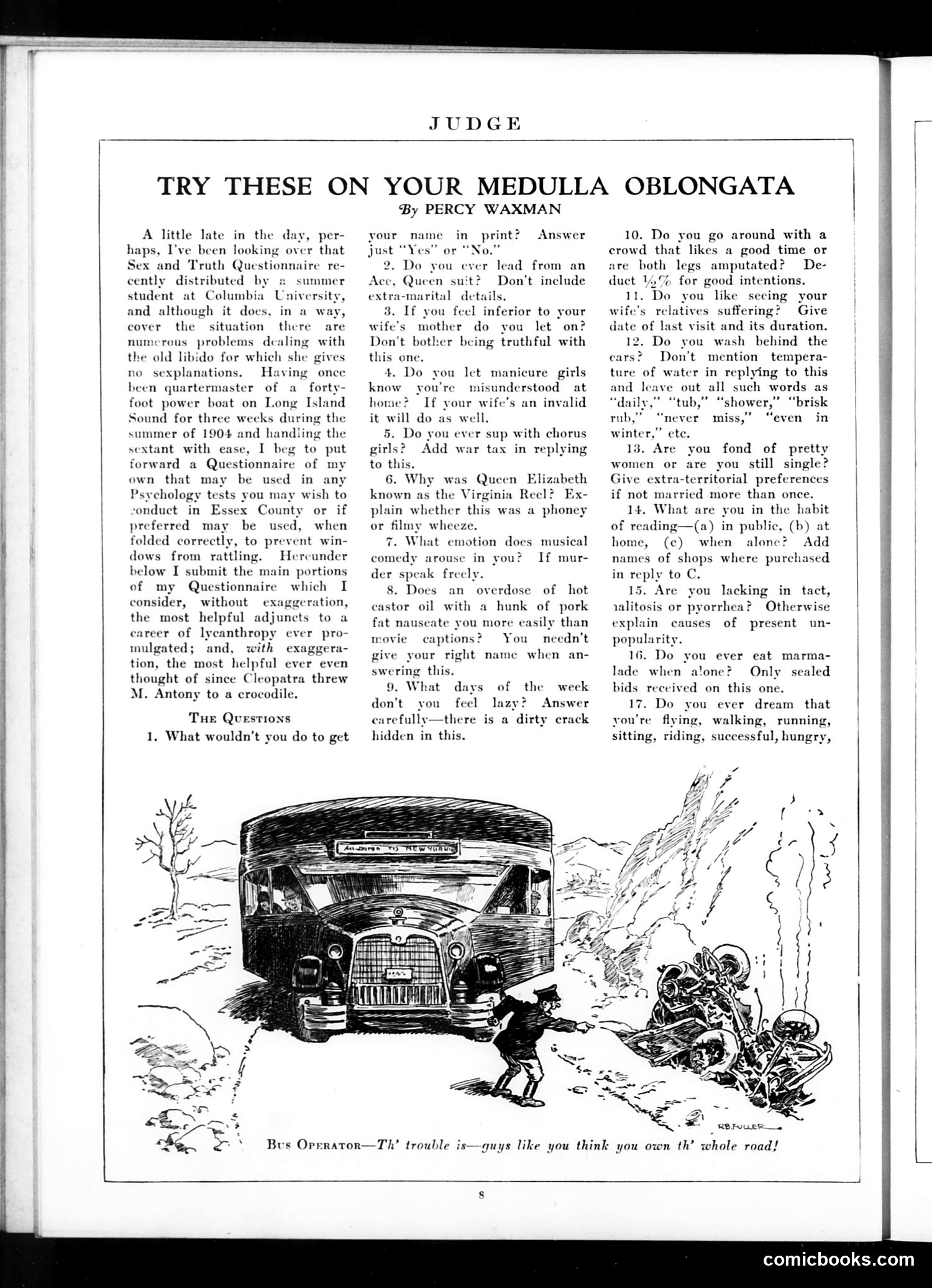
This is a humorous parody questionnaire by Percy Waxman mocking a real "Sex and Truth Questionnaire" recently distributed by a Columbia University student. The piece satirizes overly intrusive psychological surveys and relationship quizzes popular in the 1920s. The joke format presents absurdly personal, contradictory, or unanswerable questions—like asking if you feel "lazy" (with "a dirty crack hidden" in the phrasing), whether you've "lead from an Ace, Queen suit" (a card game reference), or if you dream you're "flying, walking, running, sitting, riding, successful, hungry" simultaneously. The cartoon below shows a bus stuck in a ditch—the operator defensively telling onlookers "Th' trouble is—guys like you think you own th' whole road!"—extending the satire to everyday absurdities and blame-shifting. The overall target: the era's pseudoscientific obsession with quantifying human behavior through invasive questionnaires, presented as ridiculous overreach.
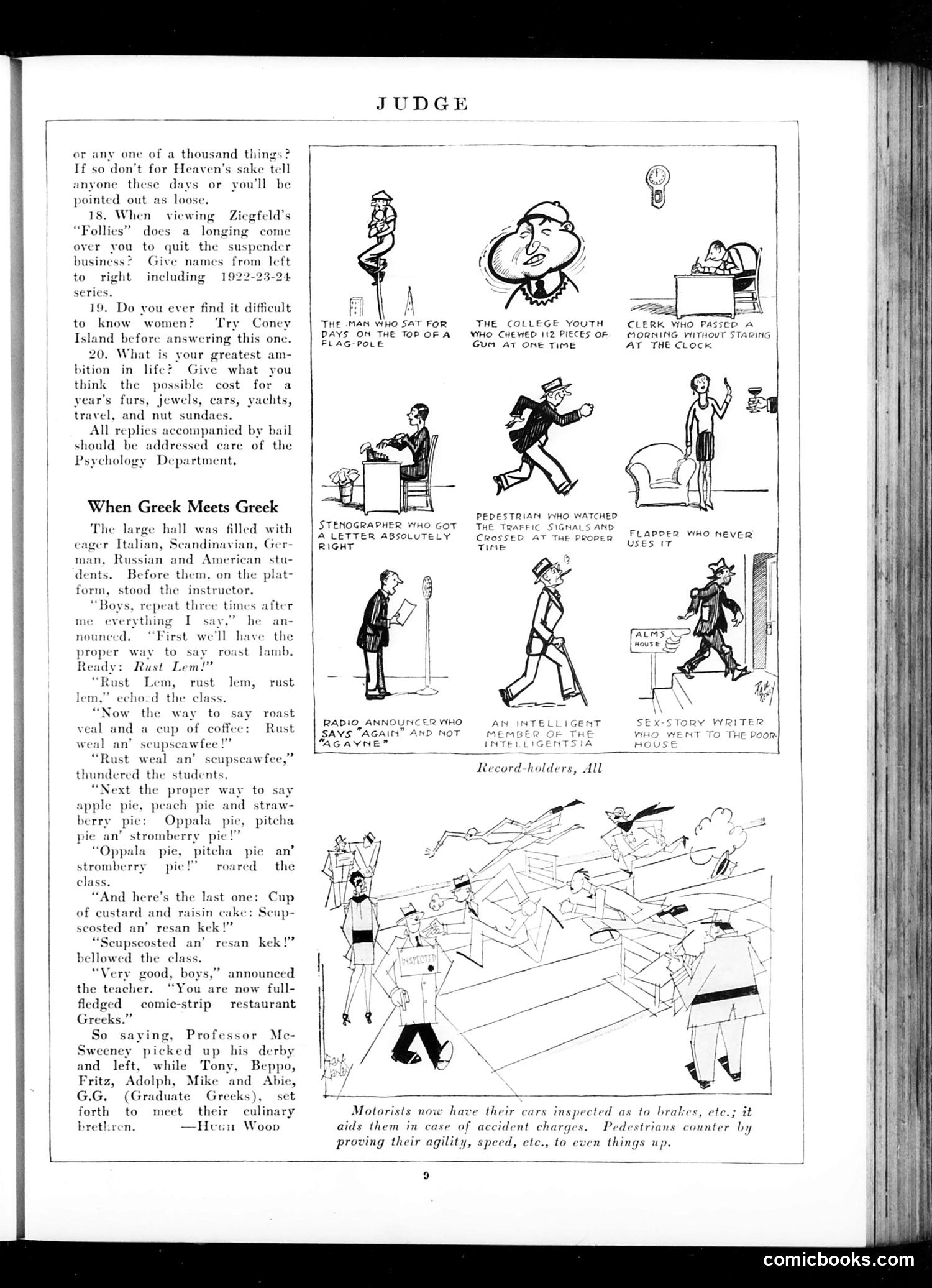
This page contains two distinct satirical pieces mocking 1920s American culture. **"When Greek Meets Greek"** ridicules ethnic stereotyping and accent-based humor. The story depicts an instructor teaching Italian, Scandinavian, German, Russian, and American students to pronounce English words with deliberately exaggerated ethnic distortions ("Rust Lem" for roast lamb, "scupscawfee" for soup and coffee). The joke's cruelty lies in presenting this garbled speech as normal immigrant behavior, ending with the punchline that they've become "full-fledged comic-strip restaurant Greeks"—reducing immigrant communities to stereotyped caricatures. **The cartoon strip** above satirizes various character types through absurdist humor: the flag-pole sitter (1920s fad), the gum-chewer, the motorist (addressing new traffic inspection laws), and other modern social oddities. **The bottom illustration** satirizes new automobile safety regulations by showing pedestrians must now prove their "agility, speed, etc." to counter accident charges—shifting liability from drivers to pedestrians navigating chaotic streets.
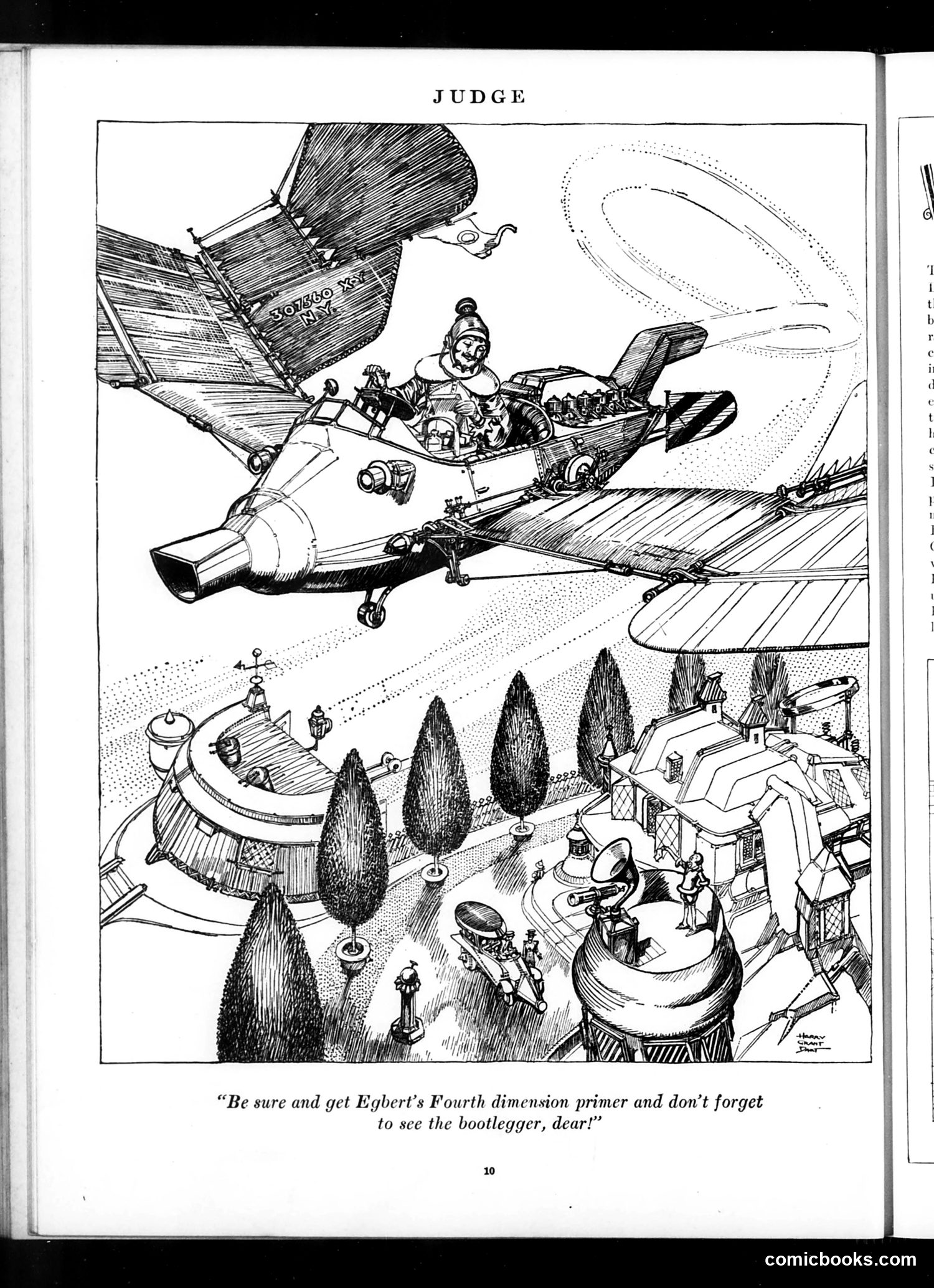
This satirical cartoon depicts a futuristic, fantastical scene with advanced aircraft and architectural structures. The caption references "Egbert's Fourth dimension primer" and instructs someone to "see the bootlegger, dear!"—clearly alluding to Prohibition-era America when alcohol was illegal and bootleggers supplied it illegally. The joke appears to satirize the contrast between futuristic aspirations (represented by the advanced technology and "fourth dimension" primer) and the persistence of illegal activity (bootlegging) in modern society. The comic suggests that even as civilization advances technologically, people remain engaged in flouting laws. The cartoon likely dates to the 1920s-early 1930s Prohibition period, mocking how Americans continued seeking alcohol despite legal bans.
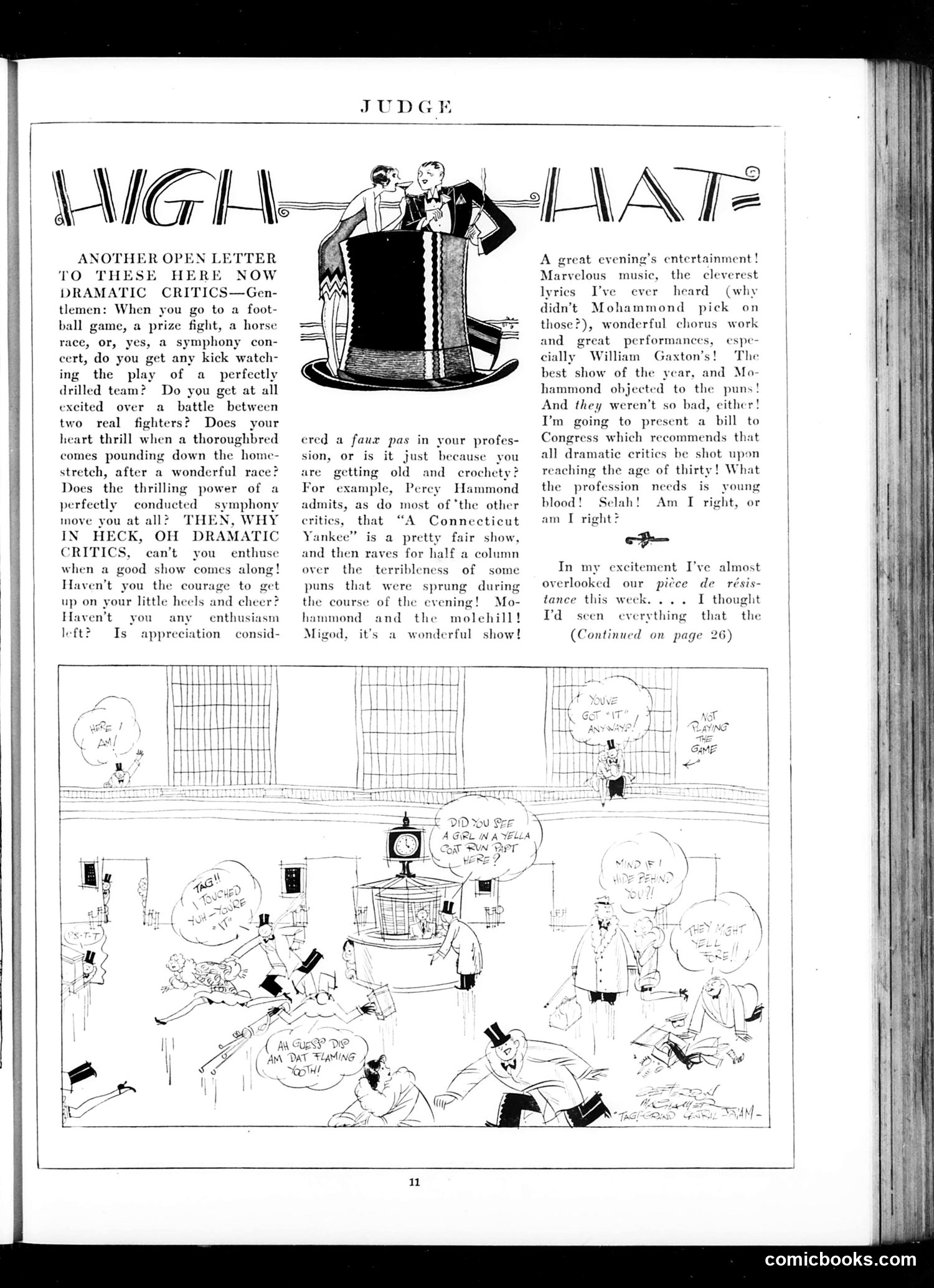
This page from *Judge* satirizes theater critics' apparent inability to enjoy entertainment with genuine enthusiasm. The author (via an open letter) challenges dramatic critics for their joyless, overly analytical approach to theater—contrasting their reserved demeanor with the natural enthusiasm people show at sports events or concerts. The specific target is Percy Hammond (a real theater critic of the era), who the letter claims praised "A Connecticut Yankee" as "a pretty fair show" but then complained extensively about minor puns. The author argues critics nitpick trivial flaws while missing genuine merit, and sarcastically proposes shooting all drama critics upon reaching age thirty to inject "young blood" into the profession. The cartoon below depicts chaotic street scenes with figures in top hats, likely representing these stiff, overly critical theater-world figures amid urban pandemonium—visually reinforcing the disconnect between critics' pretentious reserve and actual human experience.
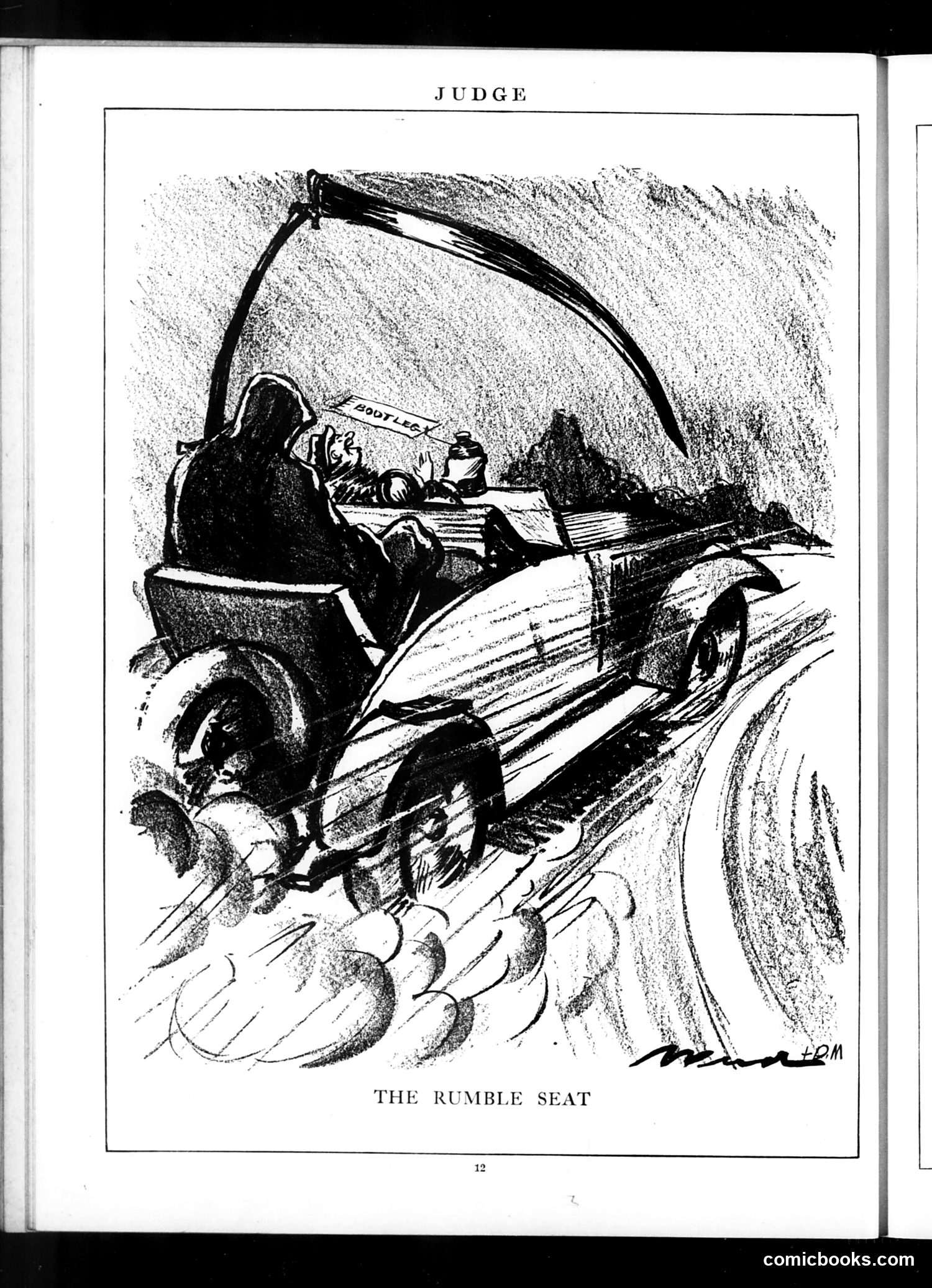
This Judge magazine cartoon satirizes the "rumble seat"—a fold-down external passenger seat popular on 1920s automobiles, positioned behind the main cabin. The image depicts a large figure (likely representing a political authority or establishment power) holding a scythe labeled "BOOTLEG" above a car carrying passengers in the rumble seat. The satire critiques Prohibition-era enforcement: the scythe threatens those riding in the rumble seat—symbolizing common citizens or those outside official circles—while suggesting authorities are weaponizing bootlegging laws against vulnerable populations. The vulnerable positioning of rumble seat passengers parallels their precarious legal status during Prohibition, contrasting with those protected inside the main vehicle. The cartoon mocks unequal enforcement during America's alcohol prohibition period.
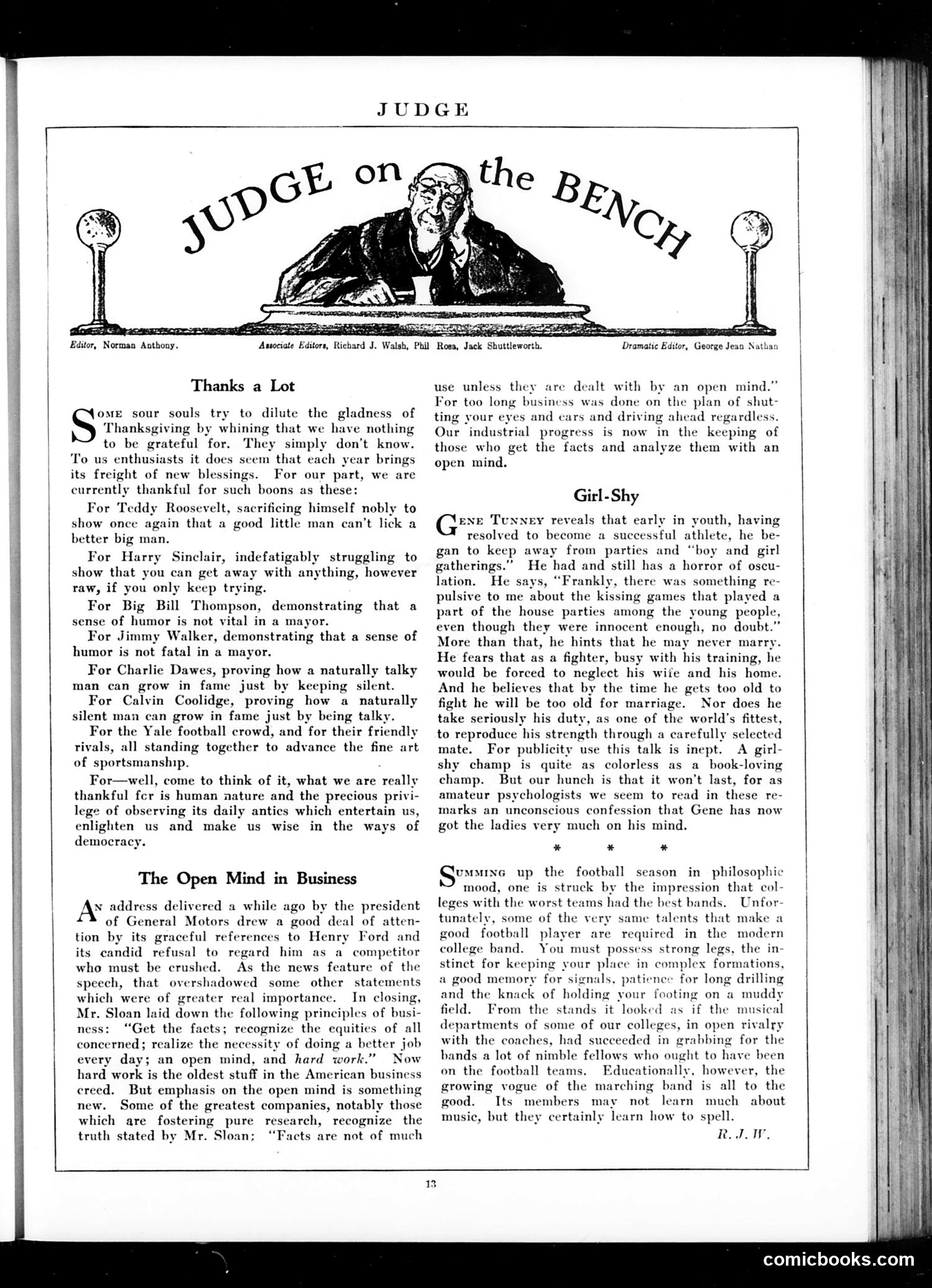
This page from the satirical magazine *Judge* contains three distinct pieces: **"Thanks a Lot"** is a mock-grateful Thanksgiving list that actually ridicules contemporary public figures through irony. It "thanks" Theodore Roosevelt (for losing a comeback bid), Harry Sinclair (Teapot Dome scandal figure, for proving corruption works if persistent), Big Bill Thompson (Chicago's notoriously crude mayor), and others. The humor lies in praising them for demonstrating society's failures—the piece ultimately suggests we're grateful mainly for human nature's entertaining flaws. **"The Open Mind in Business"** praises General Motors president Alfred P. Sloan's philosophy of using facts with open-mindedness, contrasting this favorably against Henry Ford's more dogmatic approach. **"Girl-Shy"** satirizes boxer Gene Tunney's public claims of avoiding romantic entanglements to maintain athletic focus. The writer mocks this as bad publicity—suggesting Tunney's squeamishness about kissing games seems inauthentic and will inevitably fade.
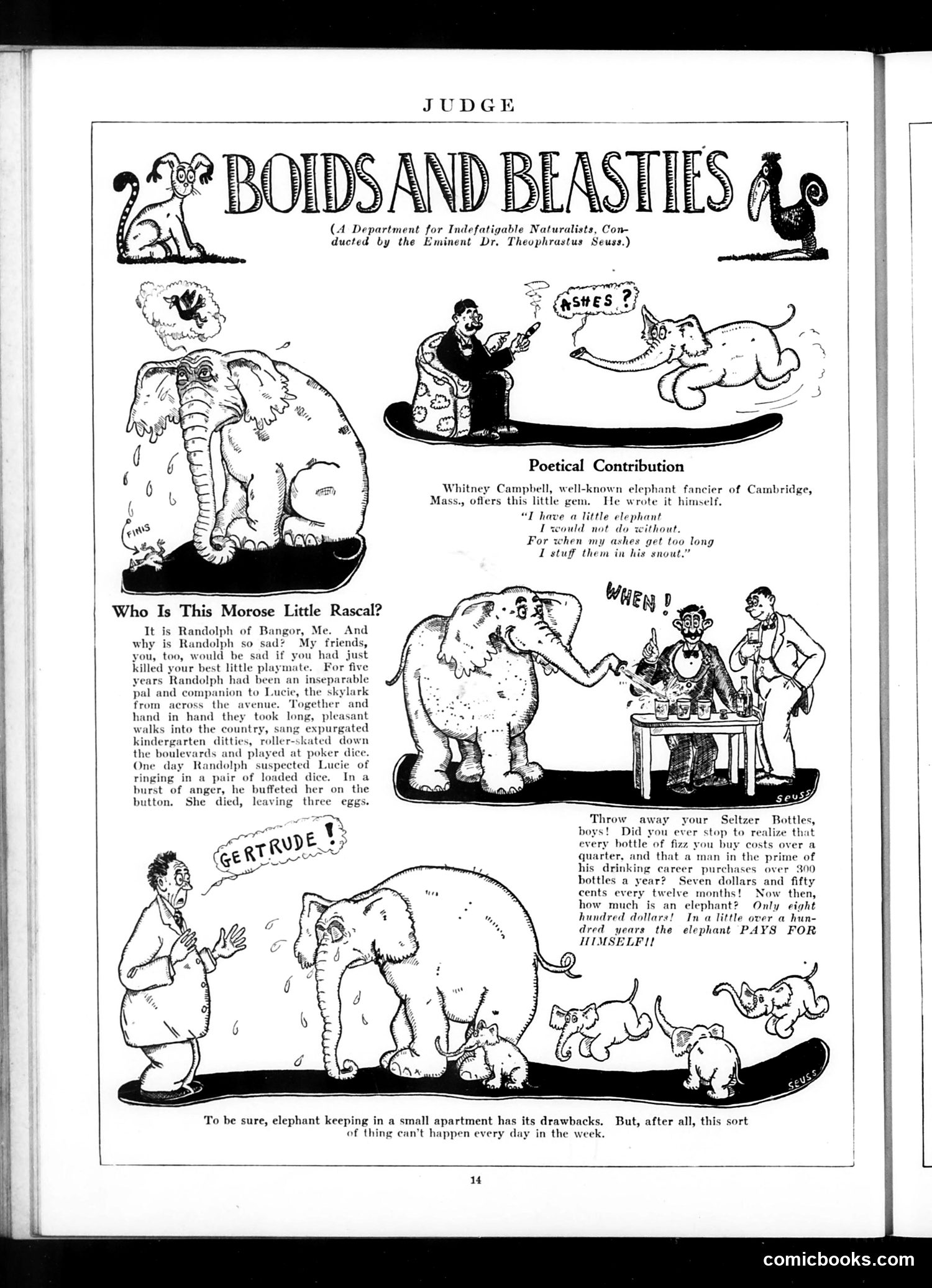
This page satirizes the absurdity of keeping exotic animals as household pets in urban apartments. The main cartoon features a moose named Randolph from Bangor, Maine, who accidentally killed his pet skylark Lucie during a dice game dispute—a darkly humorous cautionary tale about the dangers of wild animal companionship. The accompanying text mocks the financial logic of elephant ownership, arguing that an $800 elephant "pays for itself" in thirteen years by serving as an ashtray (the "poetical contribution"). The satire culminates in a pragmatic conclusion: yes, keeping elephants in apartments has drawbacks, but "this sort of thing can't happen every day." The humor relies on treating absurd premises (elephants in apartments, financial justifications for exotic pets) with mock-serious reasoning—typical Judge magazine style. Dr. Theophrastus Seuss (likely pseudonymous) frames the entire department as naturalist advice.
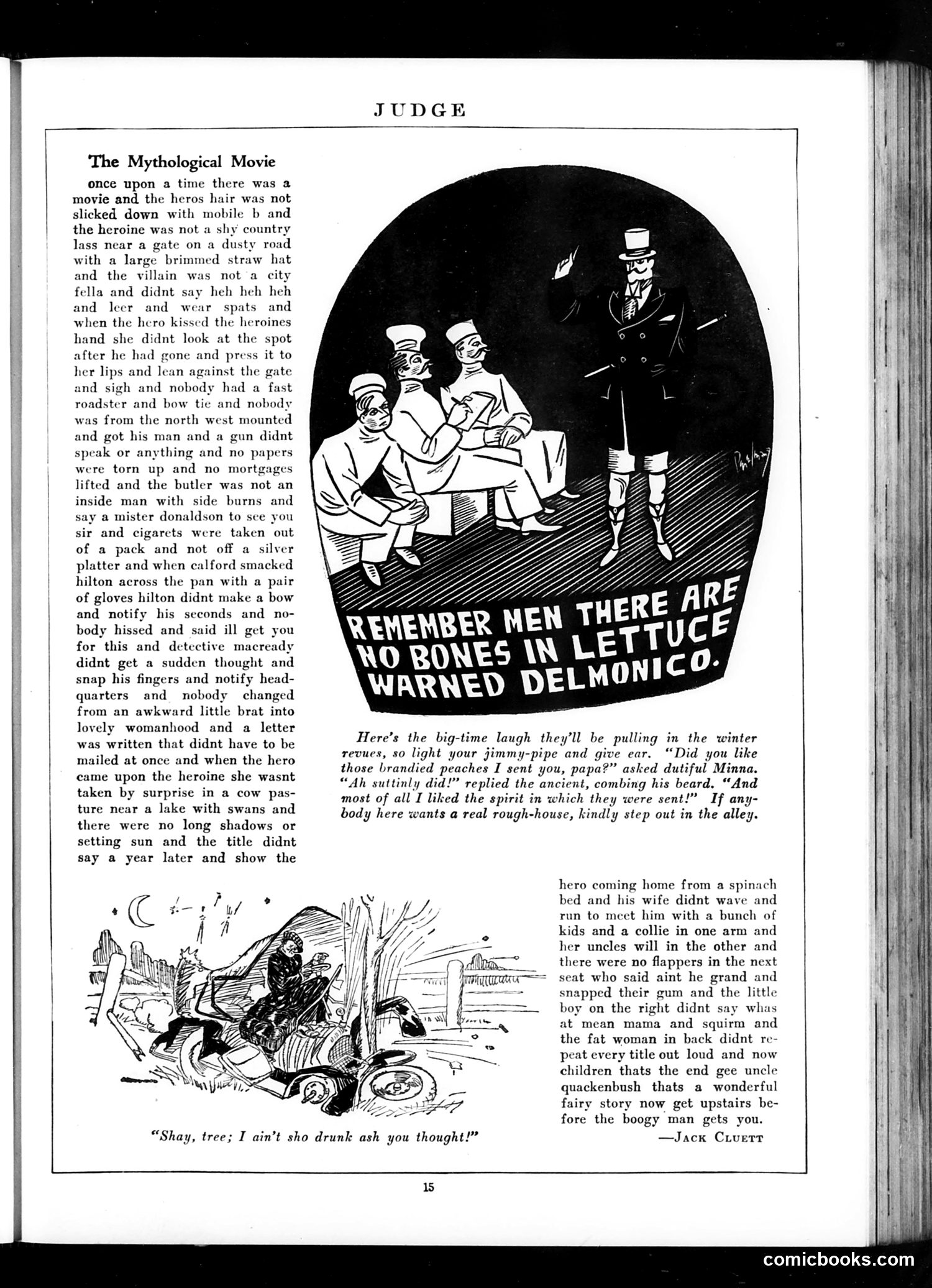
This page satirizes the tired clichés of early cinema melodrama. The main text mockingly catalogs every hackneyed plot device and character type of silent films: the slicked-down hero, the demure heroine in a straw hat, the villainous city man in spats, the fast roadster, mysterious letters requiring immediate mailing, convenient revelations, and syrupy romantic gestures. The accompanying advertisement parodies movie marketing while mocking the implausible scenarios, and the bottom illustration shows a drunk man—another stock character—speaking his lines in exaggerated dialect. The satire targets how formulaic and artificial these films had become, with their reliance on predictable tropes and overwrought emotional beats. By listing what *doesn't* happen in "this" mythological movie (implying none of these things occur), the writer emphasizes how thoroughly these conventions dominated actual cinema of the period, making the form ripe for ridicule.
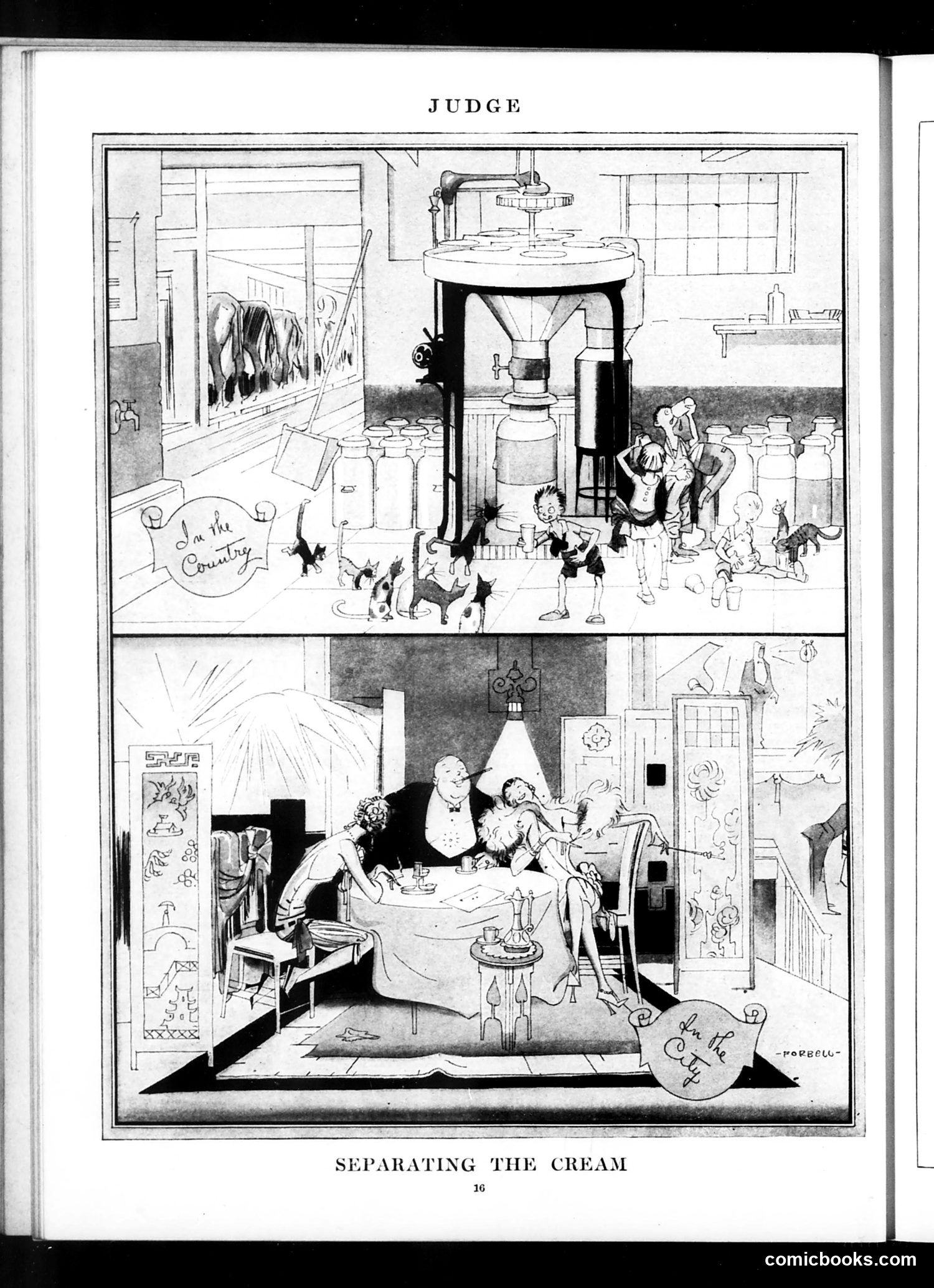
This page titled "SEPARATING THE CREAM" contains two comic panels about dairy processing, likely from early 20th-century Judge magazine. The **top panel** shows a dairy facility where children and dogs interact around large milk containers and industrial separating equipment—apparently satirizing the scale or chaos of commercial milk production. The **bottom panel** depicts an elegant dinner scene where well-dressed adults are dining, suggesting the refined end product of dairy processing. The cartoon's humor appears to contrast the messy, chaotic production process (with children and animals) against the sophisticated consumption of dairy products by the wealthy. This likely satirizes how industrial food production hides its unglamorous reality from consumers, or critiques class divisions in access to refined dairy products. Without a visible date, the specific historical context remains unclear.
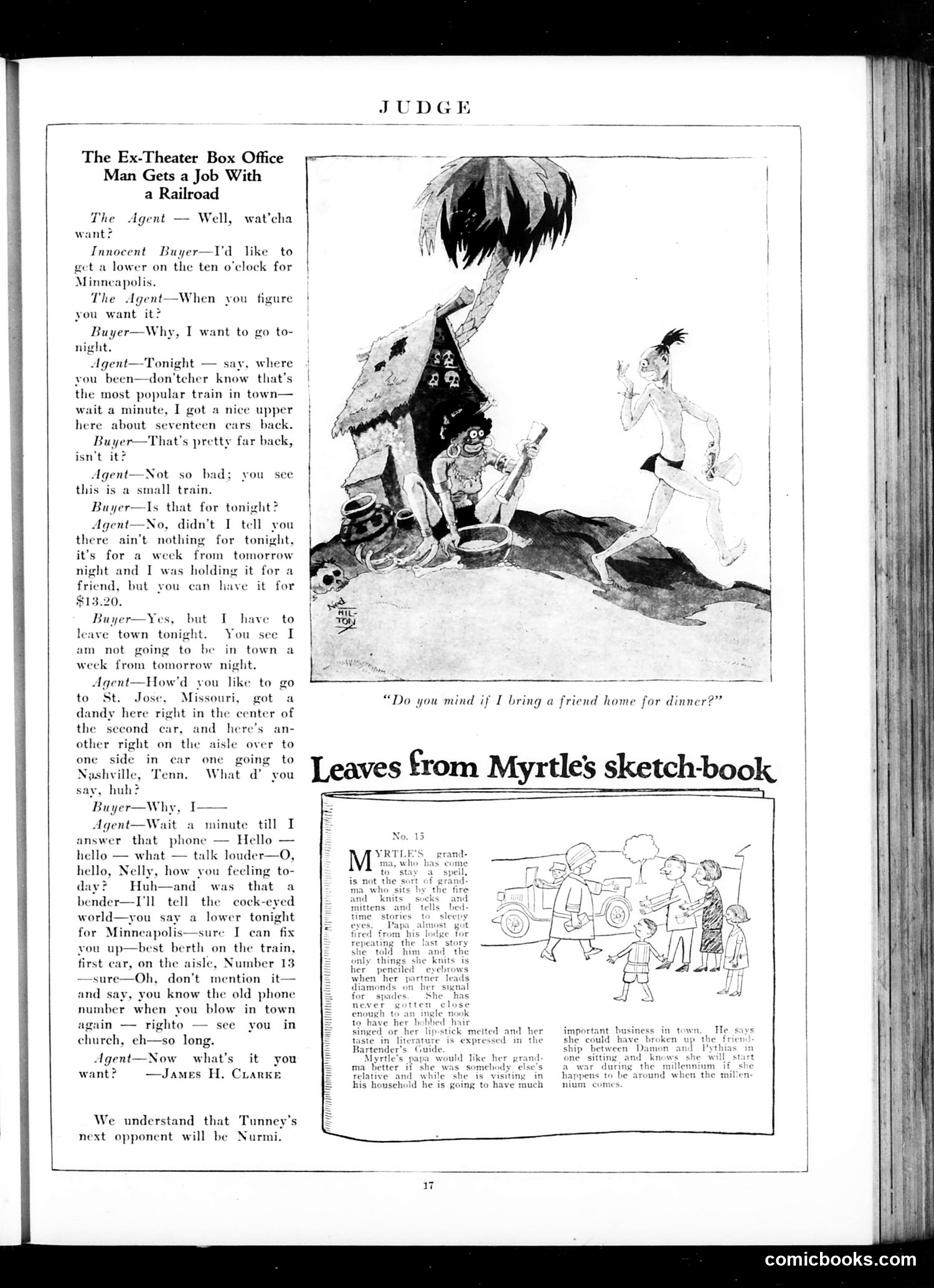
This satirical dialogue mocks the notorious rudeness and obstructiveness of theater box-office workers, now applied to railroad ticket agents. The humor stems from the agent's transparently dishonest sales tactics: he claims the desired train is fully booked, offers inferior alternatives at inflated prices ($13.20), pretends to hold better seats "for a friend," and interrupts the transaction with a personal phone call—behavior familiar from theater box offices. The satire targets both customer service incompetence and the agent's obvious disregard for the buyer's actual needs. The punchline suggests that incompetent theater workers simply transferred their obstructionist practices to railroads, bringing their problematic attitudes unchanged. The accompanying "Myrtle's Sketch-Book" provides lighter domestic humor about a grandmother's old-fashioned knitting skills, offering thematic contrast to the sharp satire above it.
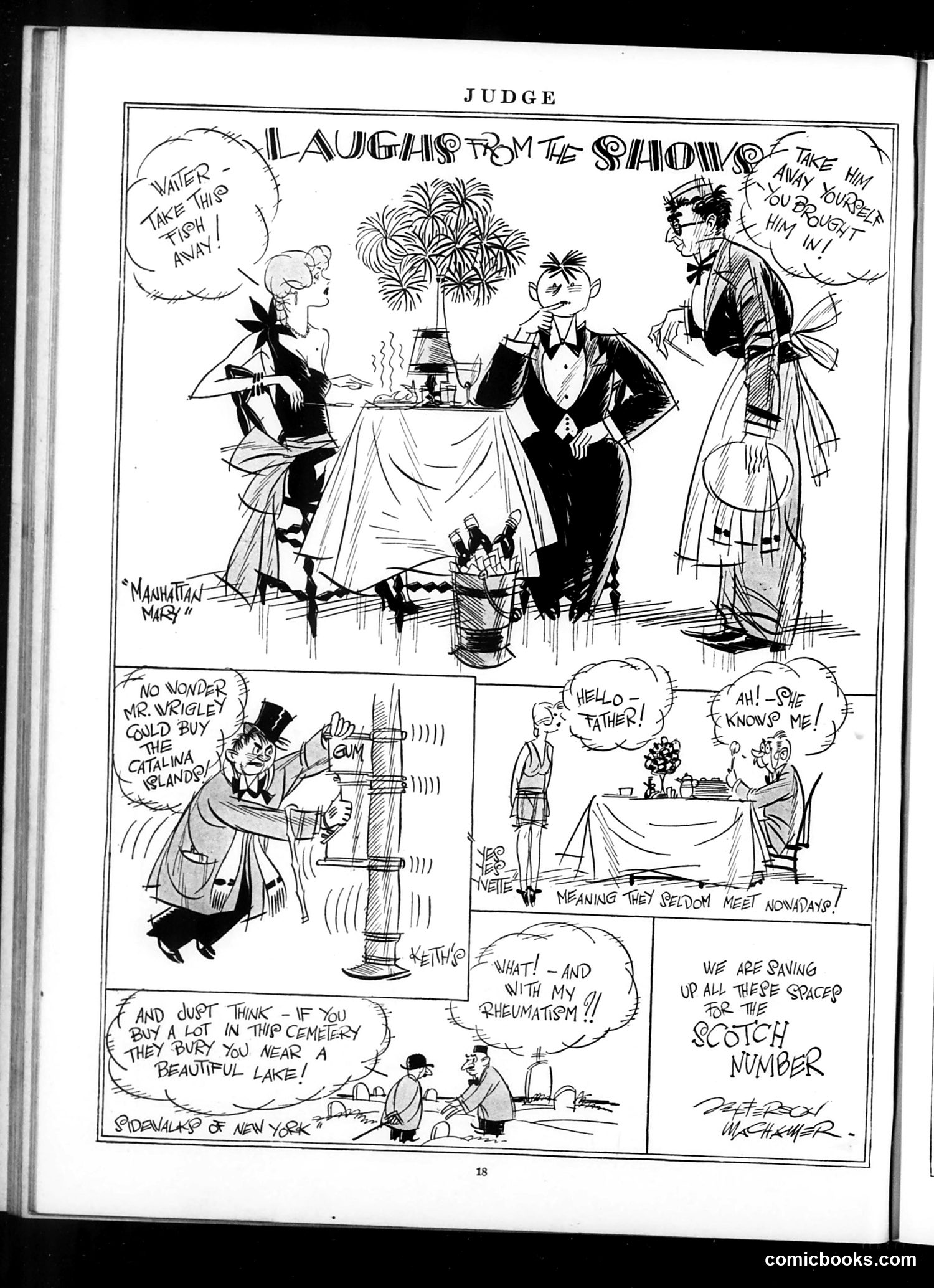
This comic satirizes wealthy New Yorkers' pretensions and social contradictions. The top panel shows an elegant dinner party where guests boast about purchasing the Catalina Islands while discussing expensive acquisitions. The humor centers on conspicuous consumption: a man brags he could "buy the Catalina Islands" while others discuss newfound romance and social climbing ("meaning they seldom meet nowadays"). The lower panels mock the absurdity of this wealth disparity—one figure suggests burying someone in a "beautiful lake" in a cemetery, while another jokes about "saving space" by cramming people together to preserve room for a "Scotch number" (likely referring to Scottish whisky). The underlying satire targets the disconnect between the wealthy's lavish spending and their petty, materialistic concerns, presented as humor about New York's Gilded Age social circles.
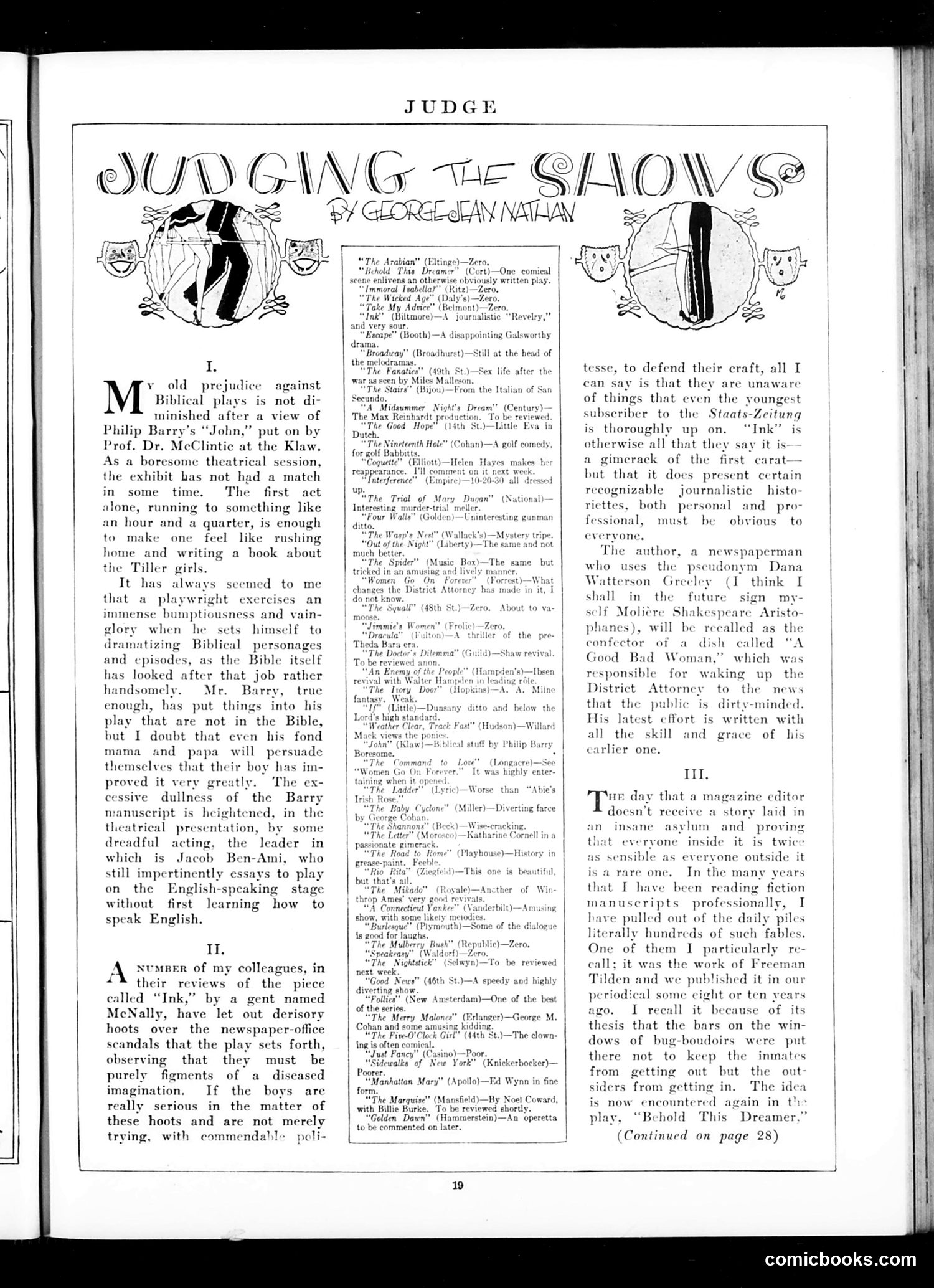
This page from *Judge* magazine contains theater criticism by George Alan Nathan. The main content critiques three Broadway productions: **Section I** attacks Philip Barry's Biblical play "John," directed by McClintic at the Klaw Theatre. Nathan condemns it as tedious and criticizes actor Jacob Ben-Ami for performing in English without properly speaking the language—a pointed jab at what appears to be an immigrant or foreign performer on the English stage. **Section II** defends the play "Ink" by McNally against colleagues' dismissals of its newspaper-office scandals as unrealistic. Nathan argues such corruption actually exists, citing Dana Watterson Greeley's pseudonymous work and a previous story about an asylum by Freeman Tilden that exposed public indifference to institutional abuse. **Section III** (continued on page 28) discusses magazine editors receiving asylum-themed stories. The ornamental illustrations feature stylized theatrical masks and performers, typical of *Judge*'s decorative approach to theater coverage. The extensive play listings suggest this is a theater-focused issue from the 1920s era.
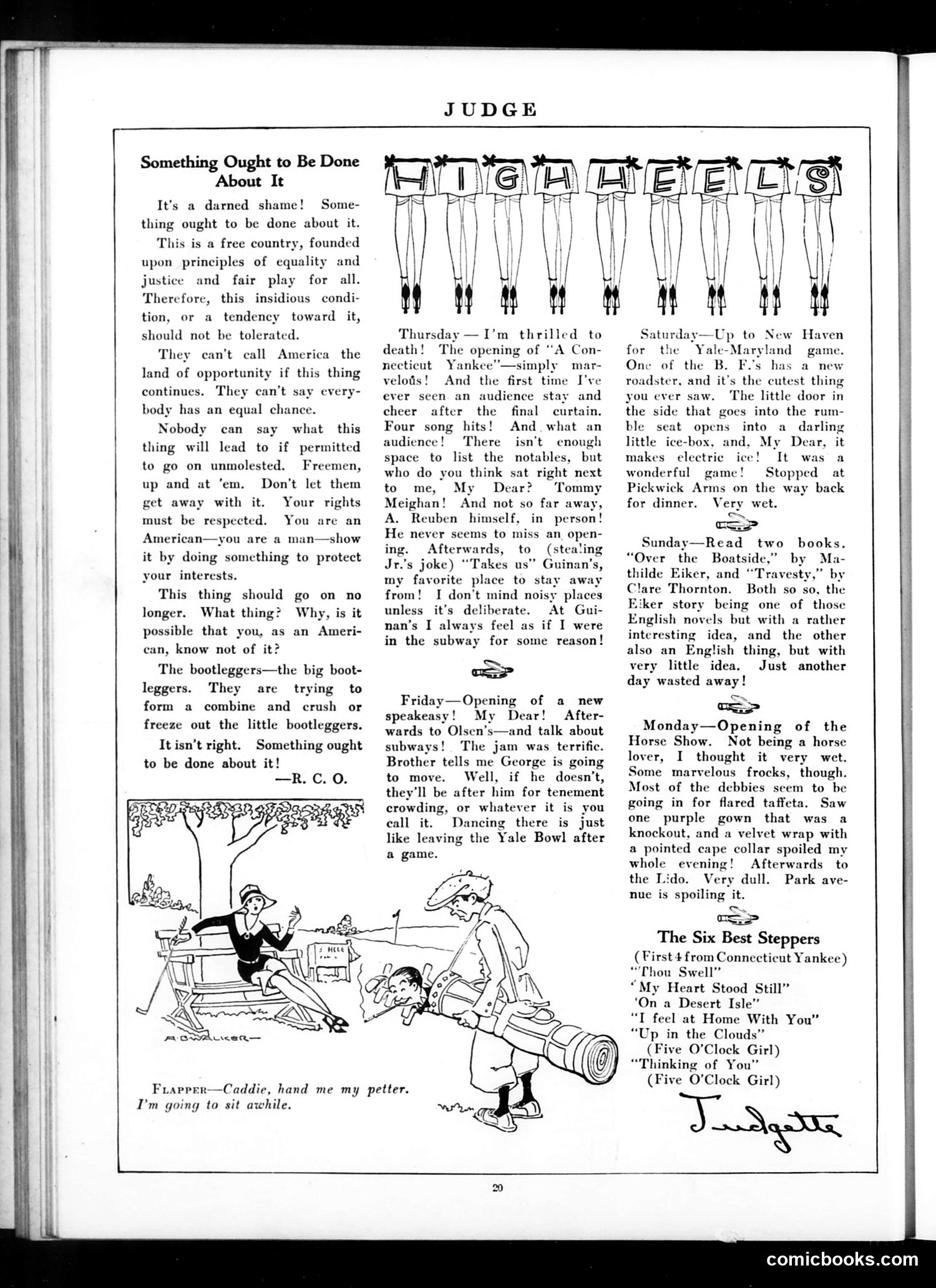
This Judge magazine page satirizes Prohibition-era excess and hypocrisy (1920s America). The lead editorial mock-seriously denounces "bootleggers"—illegal alcohol suppliers—forming monopolies, framing it as an American rights issue, though the satire suggests the real problem is widespread lawbreaking itself. The accompanying "Flapper" diary entries reveal the joke: a wealthy young woman casually chronicles attending speakeasies (illegal bars), discussing "rumbleseat ice boxes" (hidden alcohol compartments in cars), and moving between nightclubs with famous actors—all while Prohibition theoretically banned alcohol. She discusses Broadway shows and horse shows with equal indifference, depicting the frivolous social scene of the Jazz Age elite. The cartoon shows a man attempting to sit while a woman plays golf nearby—illustrating gender role disruption of the era. The satire mocks both flagrant Prohibition violations among the wealthy and the breathless superficiality of flapper culture, where illegal speakeasies are social destinations rather than moral concerns.
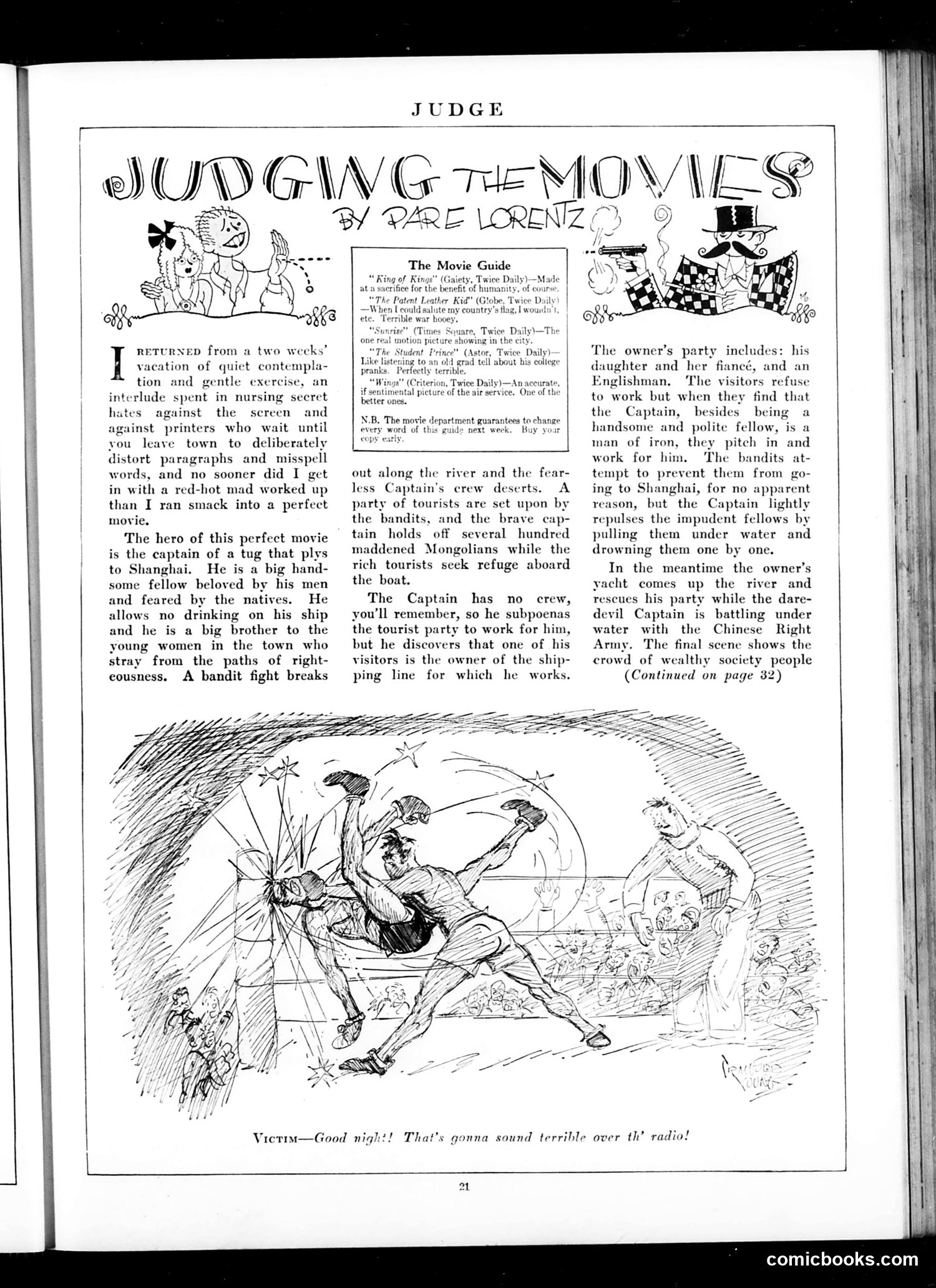
This is a humorous film review of an action-adventure movie set in Shanghai. The hero is a virtuous tugboat captain—a paragon of moral rectitude who forbids drinking and mentors young women. When bandits attack tourists aboard his vessel, he heroically holds off "several hundred maddened Mongolians" single-handedly, then conscripts the wealthy tourists (including a shipping-line owner) into labor. The satire mocks the melodramatic excess and implausible heroics typical of 1920s adventure films. The accompanying cartoon depicts an exaggerated action scene with flying bodies and chaos, literalizing the movie's overwrought theatricality. The joke at bottom—about the radio broadcast sounding "terrible"—suggests the absurdity translates poorly to other media, poking fun at both the film's ridiculousness and early radio's novelty.
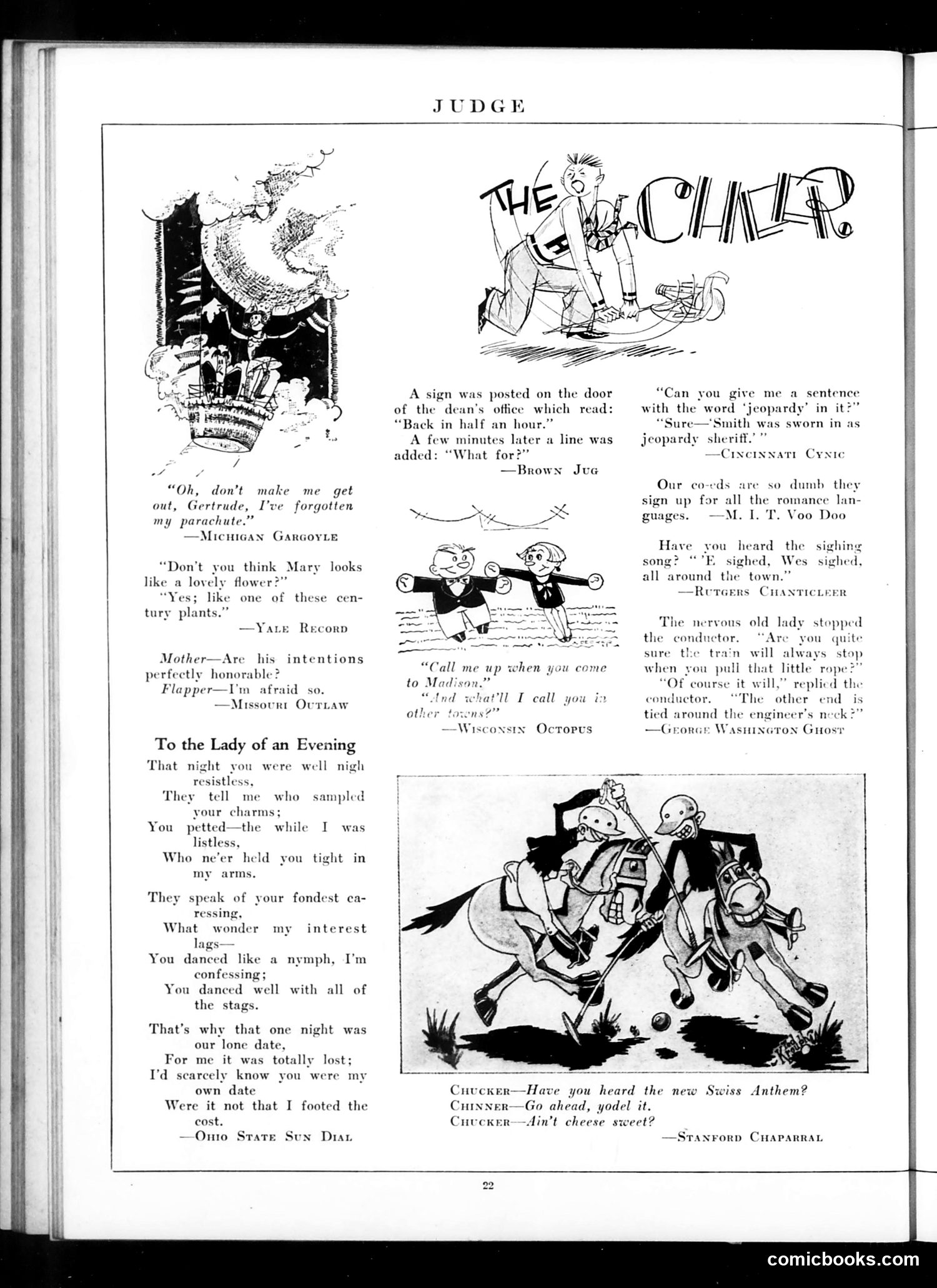
This page collects brief humorous quips and cartoons typical of Judge's satirical format. Most entries mock college students and dating customs of the era. **Key themes:** - **"The Chucker"** cartoon depicts slapstick chaos, likely mocking clumsy or reckless behavior - **Dating/Romance jokes** mock flapper culture and young women's behavior ("Mary looks like a century plant"—implying she's outdated) - **College humor** targets student naivety ("co-eds are so dumb they sign up for all the romance languages") - **Gender satire** includes a jealous boyfriend's complaint about his date dancing with other men - **Institutional mockery** jokes about deans' offices and train conductors The Wisconsin Octopus and Rutgers Chanticleer attributions indicate these were reprinted from college humor magazines, suggesting Judge syndicated collegiate wit. Overall, this reflects 1920s-era satire of youth culture, particularly mocking women's newfound social freedom during the flapper age, while celebrating slapstick physical comedy.
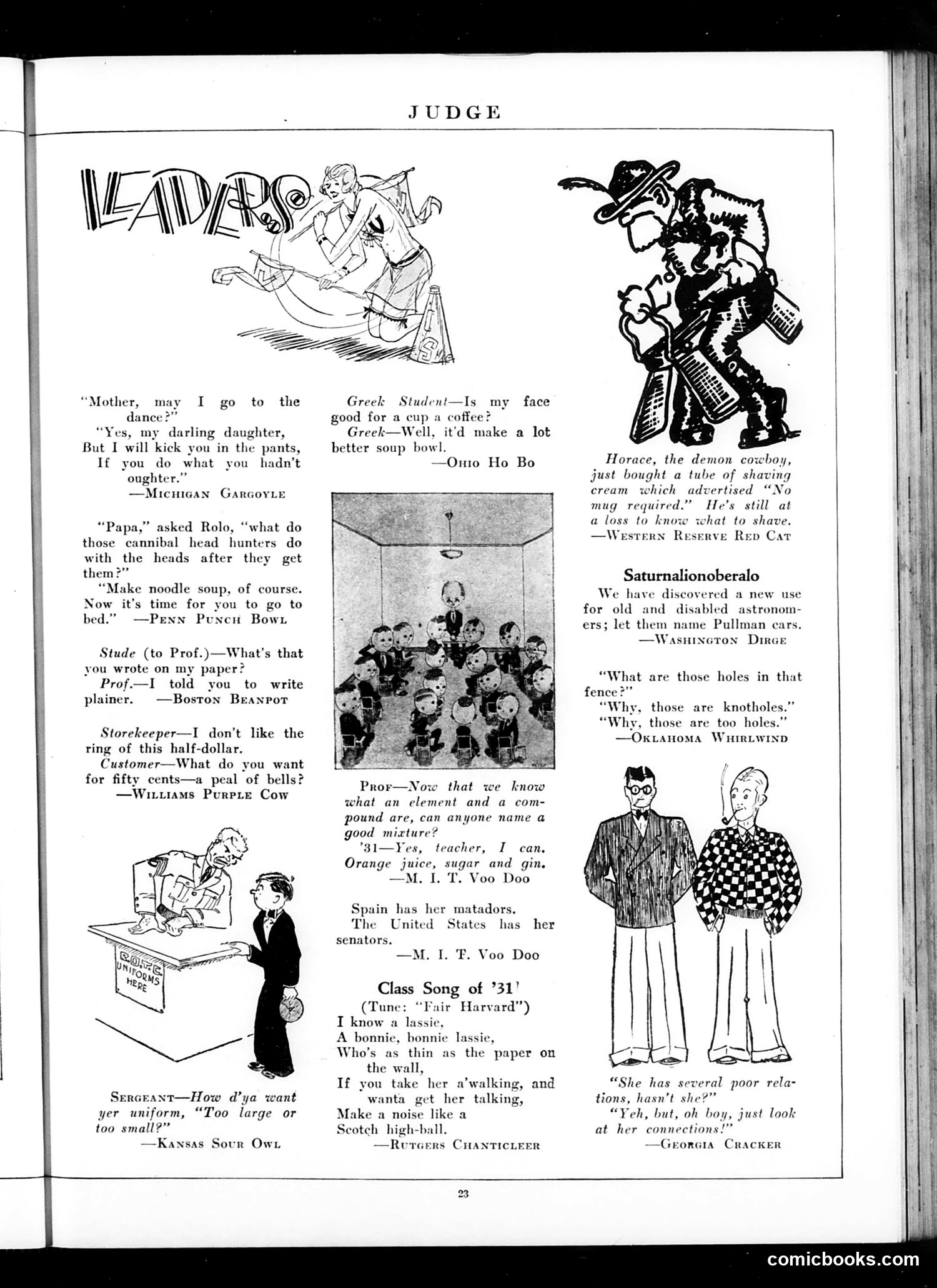
This page collects brief jokes from college humor magazines (MIT Voo Doo, Rutgers Chanticleer, etc.) and student publications—typical of Judge's "humor from the campuses" feature. The satire targets: **College life**: Students asking professors inane questions; the "Class Song of '31" mocks thin girls and drunkenness. **Ethnic stereotypes**: A "Greek student" joke plays on anti-Greek immigrant prejudice (implying Greeks are poor/desperate); a cannibal joke reflects casual racism. **Class anxiety**: A joke about a "half-dollar" suggests economic hardship during what appears to be the Depression era. **American institutions**: Spain's matadors are contrasted with U.S. senators—implying senators are as useless/violent as bullfighters. **Social climbing**: The final cartoon shows a woman with "poor relations" but valuable "connections," satirizing shallow status-seeking. The "demon cowboy" reference appears to be an in-joke about an ongoing character. Overall, this reflects 1930s college humor: irreverent, class-conscious, and reliant on period stereotypes.
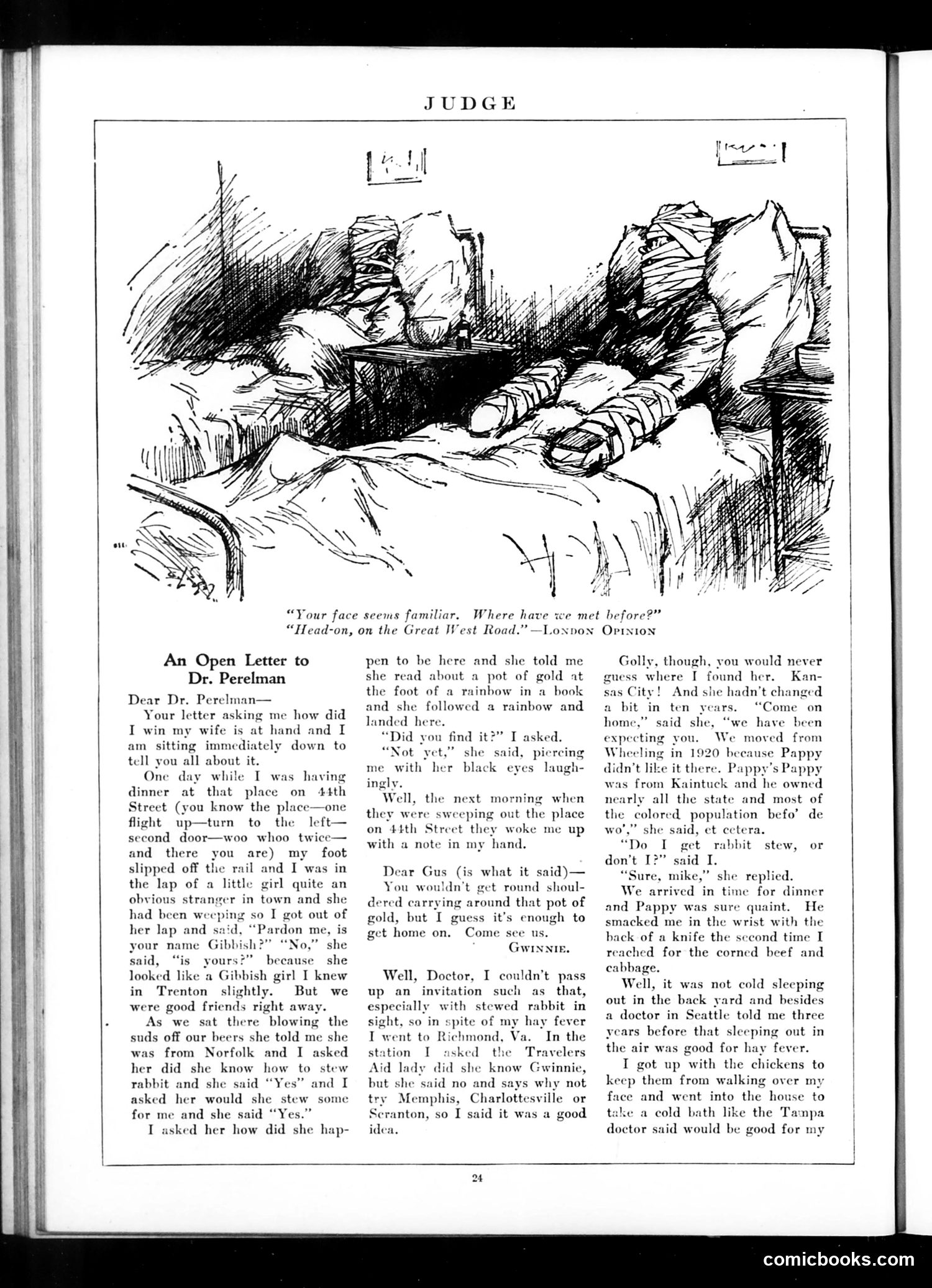
**The Cartoon:** The sketch at top shows two mummy-like figures in bed with the caption referencing a head-on collision on "the Great West Road"—a London reference, suggesting a humorous encounter or accident. **The Main Text:** "An Open Letter to Dr. Perelman" is a comedic letter narrating an absurd romantic story. The narrator describes meeting a woman when his foot slips into her lap at a restaurant, learning she followed a rainbow to Kansas City seeking a pot of gold (referencing folklore). He eventually finds her in Richmond, Virginia, where her eccentric Southern family (with casual period-racist dialect) feeds him corned beef instead of promised rabbit stew, and her father violently discourages him from reaching for food. **The Satire:** The piece mocks romantic conventions and tall tales through deliberately ridiculous plotting—the magical-thinking woman, the coincidental reunion, the absurd Southern gothic family dynamics. It's satirizing both romantic literature clichés and regional stereotypes common to early 20th-century American humor magazines. The overall effect is **nonsensical, deadpan humor** typical of Judge's satirical style.
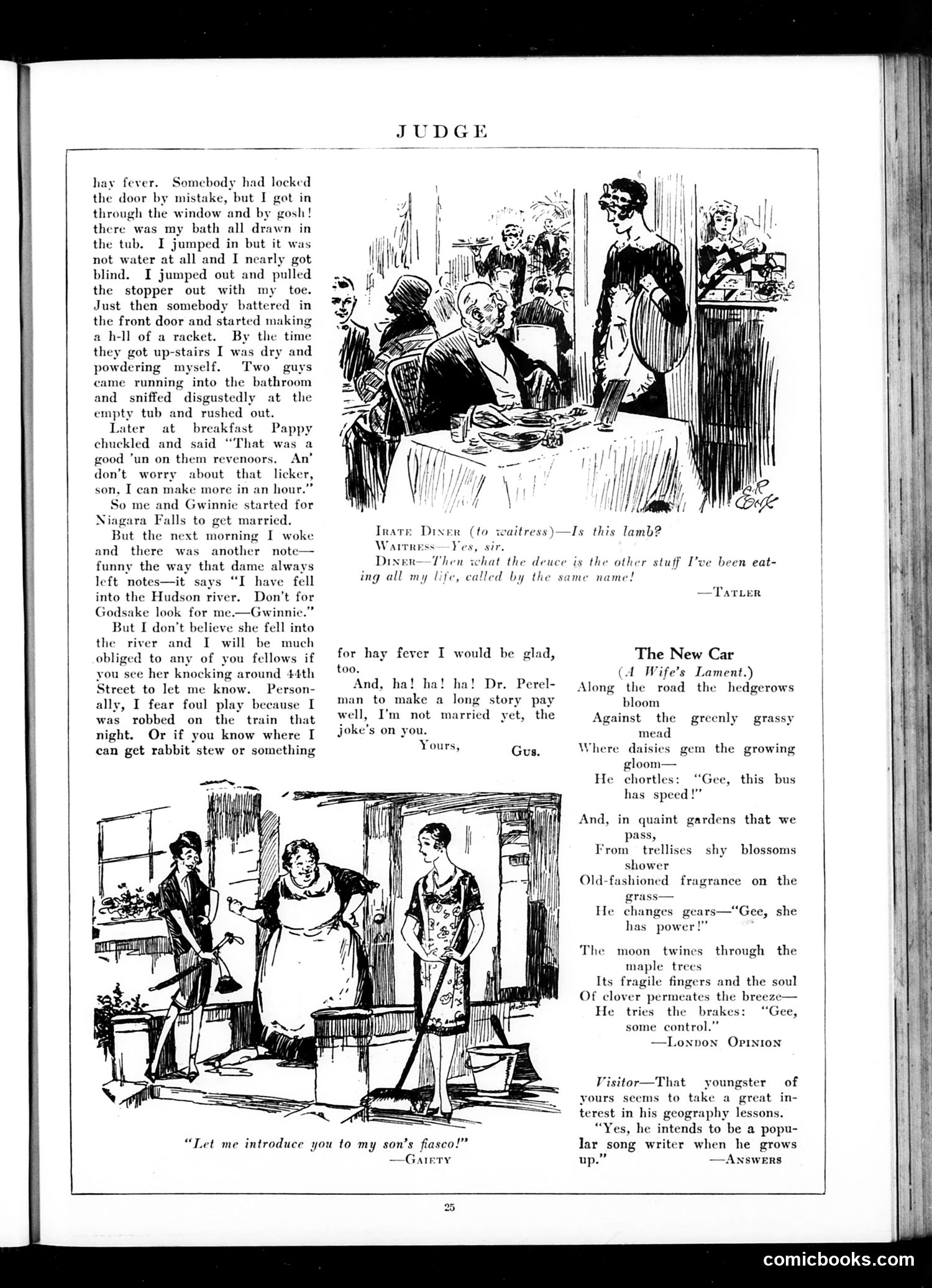
This page contains multiple satirical pieces typical of early 20th-century Judge magazine: **Main Story ("Judge")**: A humorous narrative about Prohibition-era bootlegging. A narrator describes accidentally bathing in bootleg liquor instead of water, then receiving a cryptic note from his girlfriend "Gwinnie" claiming to have fallen in the Hudson River. The satire targets both illegal alcohol production ("revenoors" = revenue agents) and the chaos of Prohibition enforcement. **"The New Car" (poem)**: A wife's lament about her husband's obsession with his vehicle's speed and power, indifferent to natural beauty. Satirizes male materialism and automotive enthusiasm over romance. **Dinner Scene (cartoon)**: A diner customer questions whether the meat is actually lamb, joking he's been eating something else called by the same name his whole life—satirizing food quality or mislabeling in restaurants. **Bottom cartoon**: Shows someone introducing their son as a "fiasco"—gentle humor about parental embarrassment. The overall tone reflects Judge's satirical approach to Prohibition, consumerism, and domestic life in the Jazz Age.
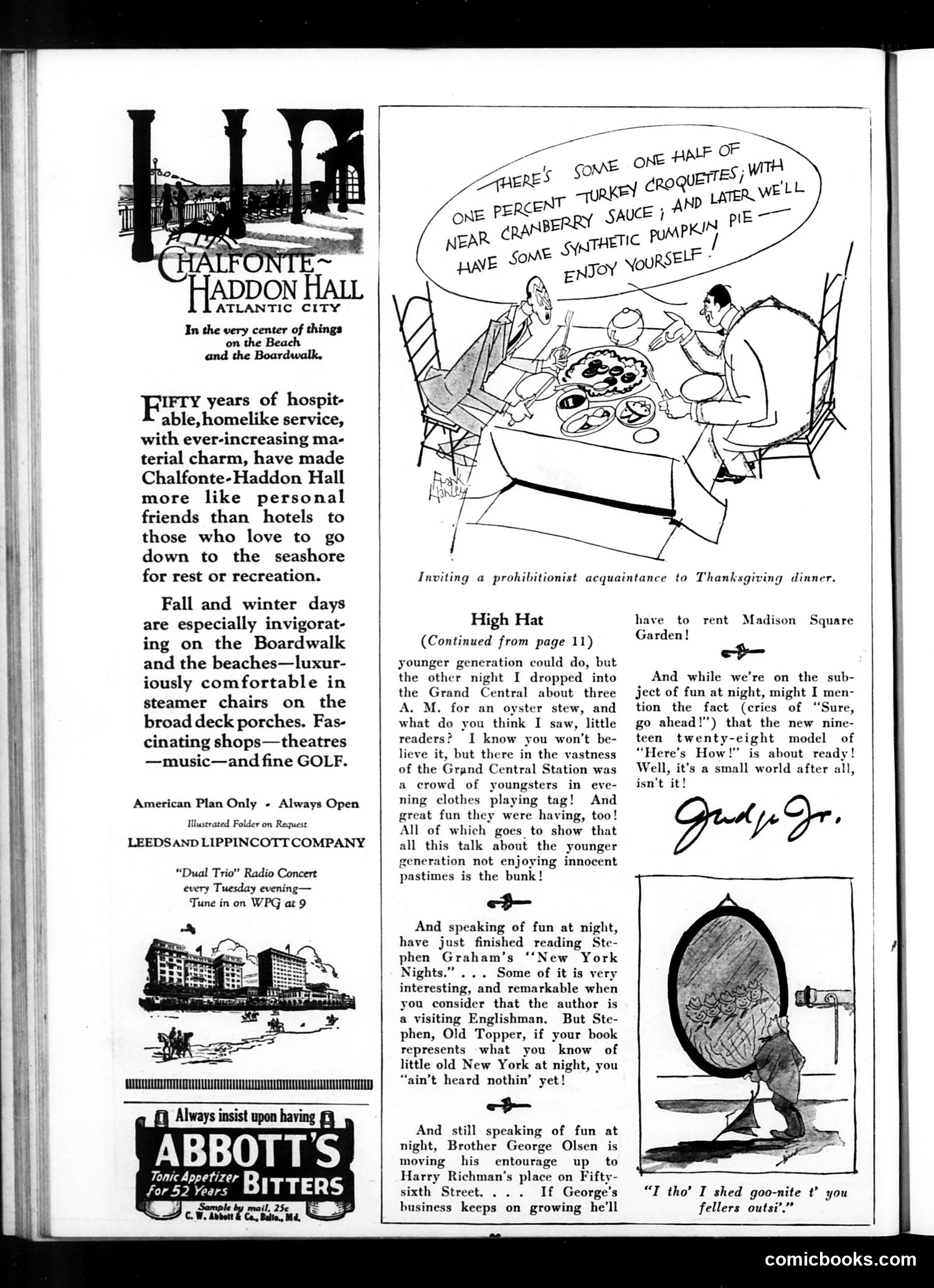
This page primarily features **advertisements** for Atlantic City hotels and liquor products, alongside a satirical cartoon titled "Inviting a prohibitionist acquaintance to Thanksgiving dinner." **The Cartoon's Satire:** The image shows someone enthusiastically offering Prohibition-era fare—"turkey croquettes," "cranberry sauce," and "synthetic pumpkin pie"—to a guest. The joke targets the absurdity of Prohibition (1920-1933): despite the legal ban on alcohol, the host is sarcastically emphasizing artificial/inferior substitutes for traditional holiday foods, implying that just as Americans resorted to fake alcohol ("synthetic" products), they're now eating fake food. The cartoon mocks how Prohibition created widespread black markets and inferior bootleg alternatives. **Period Context:** Judge magazine frequently satirized Prohibition's failures and the younger generation's defiance of it—evident in the article's celebration of youth "having fun" despite laws. The accompanying text celebrates nightlife and modern pleasures. The page reflects 1920s anxieties about Prohibition enforcement and generational rebellion against it.
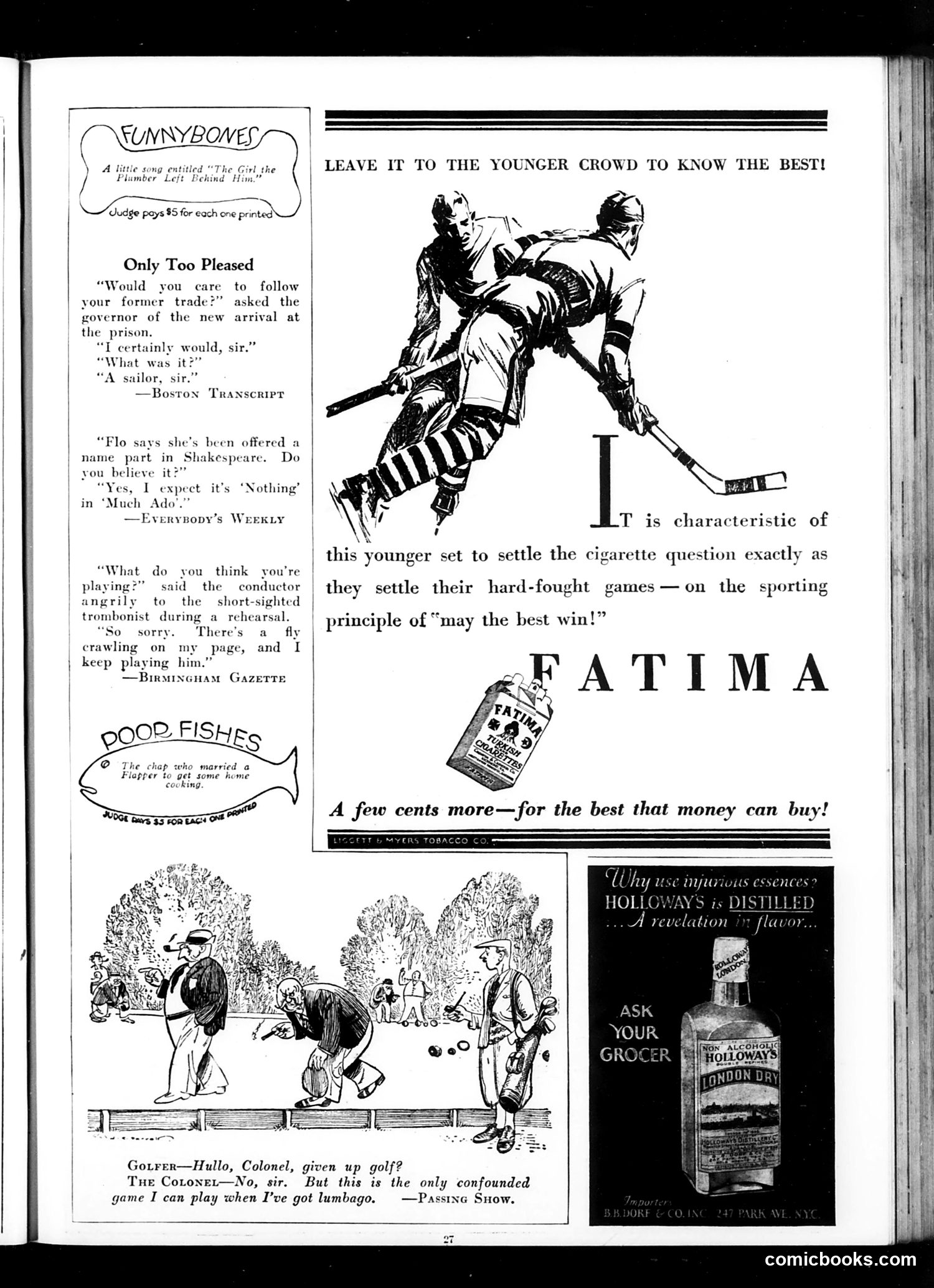
This page from *Judge* magazine contains several humorous short jokes typical of the era, plus advertisements. The main comic strip shows a golf scene where a Colonel claims he can only play golf when suffering from lumbago (lower back pain)—the joke being that lumbago forces him into the hunched posture that golf requires, making it the only sport he can physically manage in his condition. The "Funny Bones" section collects brief jokes: one about a former sailor hired as a prison governor; another mocking an actress offered a role in Shakespeare (implying she'd only be suitable for a silent or negligible part); and one about a trombonist blaming a fly on his sheet music for his poor playing. The page also advertises Fatima cigarettes and Holloway's gin, using appeals to youth and sporting principles. The humor reflects early 20th-century attitudes toward physical aging, gender roles in theater, and the absurdist logic of everyday mishaps.
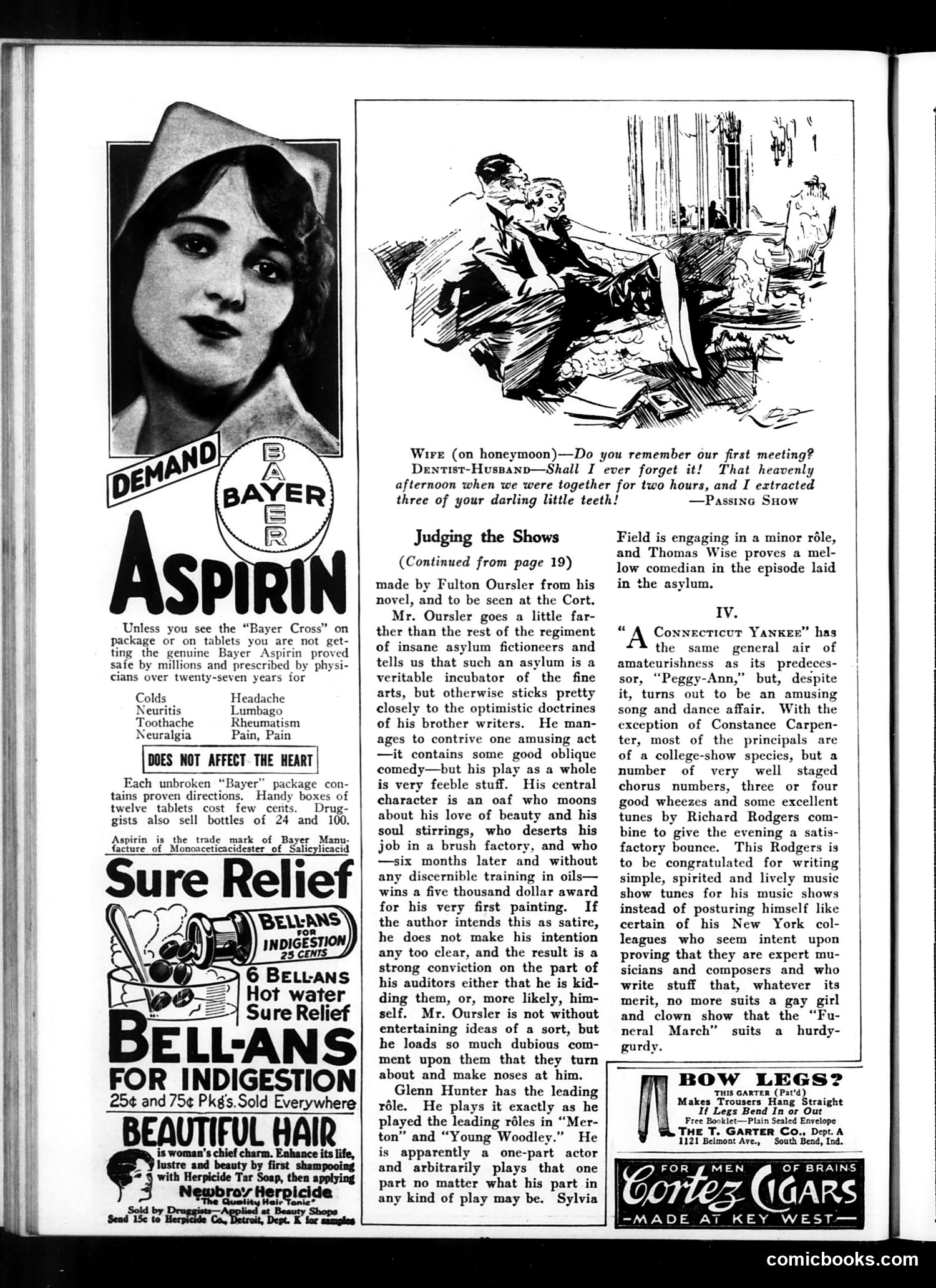
This page is primarily **advertisements and theater reviews**, not political satire. The **cartoon** (upper right) is a domestic humor joke: a wife on her honeymoon asks her dentist-husband if he remembers their first meeting. He enthusiastically says he'll never forget it—the afternoon he extracted three of her teeth. The joke plays on the incongruity of romantic memory versus a dentist's professional recollection. The rest of the page contains **theater criticism** reviewing Broadway shows including an adaptation of Fulton Oursler's novel about an insane asylum, and "A Connecticut Yankee" (with music by Richard Rodgers). The critic is quite harsh about the asylum play's central character—an oaf who wins painting awards without training—questioning whether the author is intentionally satirizing or simply writing poorly. The **advertisements** push period products: Bayer Aspirin, Bell-Ans for indigestion, hair products, and a novelty garter that prevents trouser legs from bending.
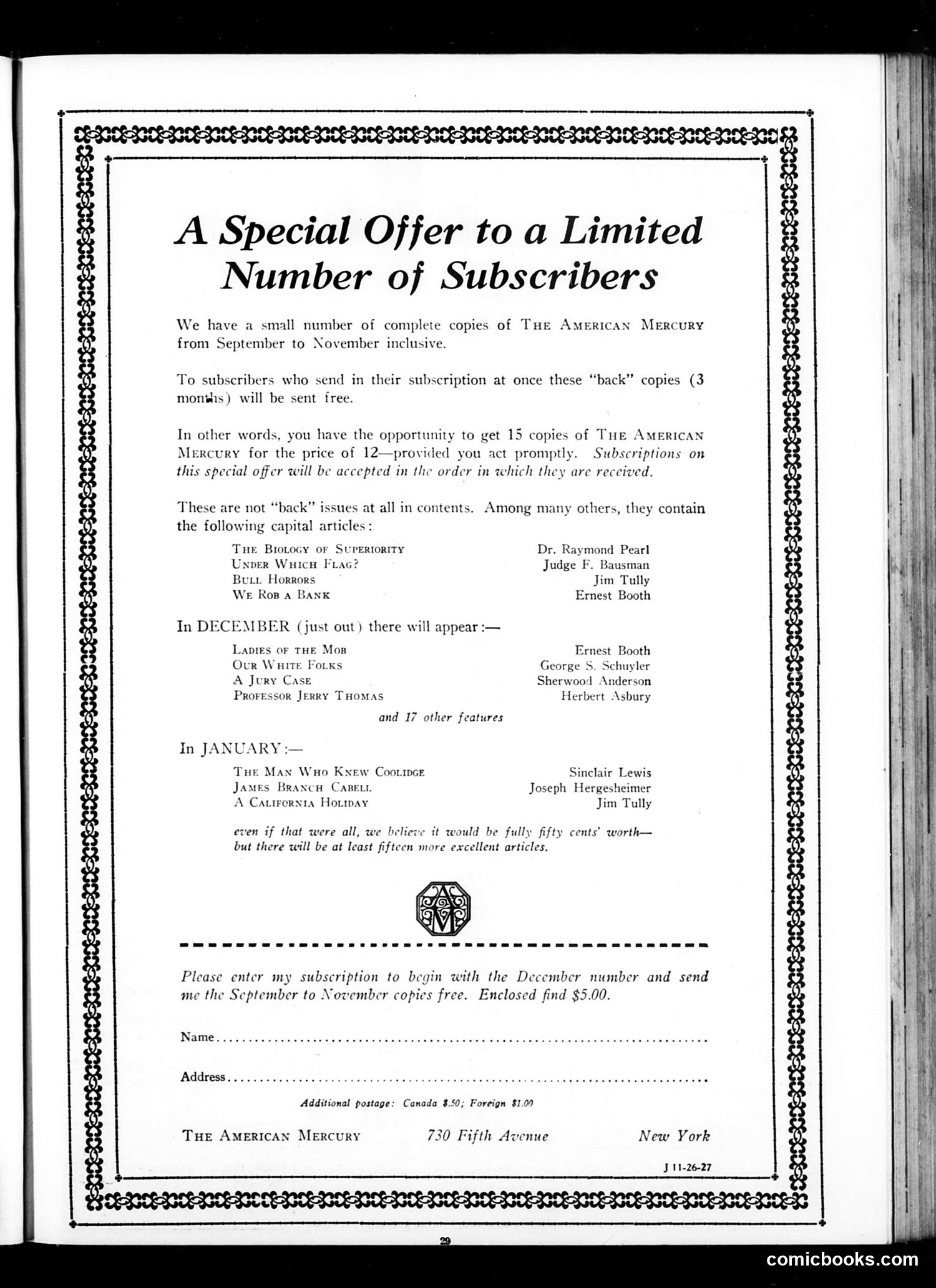
This is an advertisement (not a cartoon) promoting *The American Mercury* magazine subscription. It's a straightforward sales pitch rather than satire. The page offers a deal: subscribe now for $5.00, receive 3 free back issues (September-November), and get 15 total copies for the price of 12. It highlights upcoming articles by prominent writers including Sinclair Lewis, Sherwood Anderson, and Joseph Hergesheimer—suggesting *The American Mercury* was a prestigious literary/intellectual publication. Notable article titles like "The Biology of Superiority" and "Ladies of the Mob" indicate the magazine covered both scientific topics and contemporary social issues. The emphasis on quality contributors and diverse content suggests *The Mercury* positioned itself as serious cultural commentary for educated readers. This represents early 20th-century magazine marketing strategies—offering subscription incentives and listing star contributors to attract subscribers.
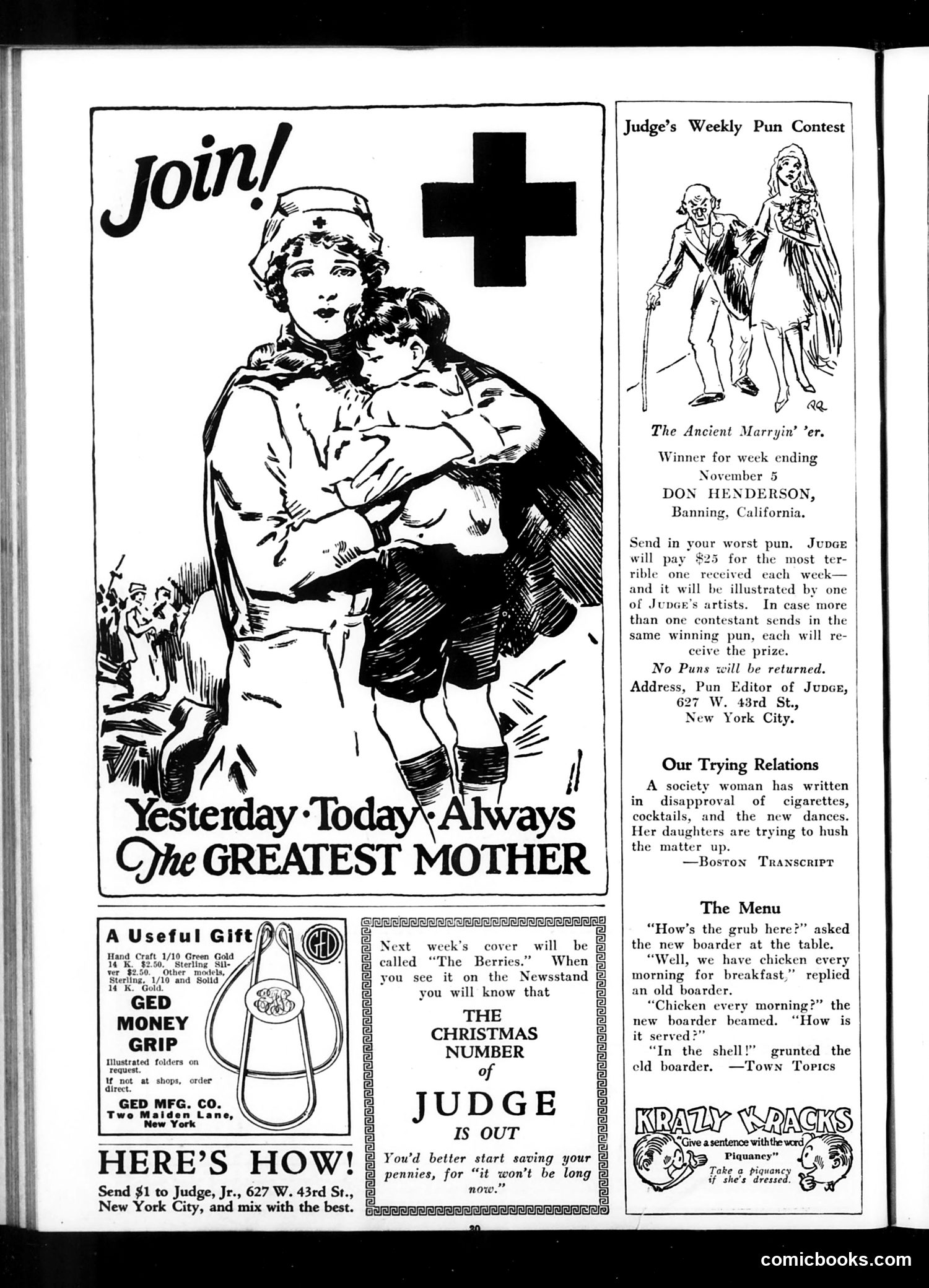
This page is primarily **advertising and promotional content** rather than political satire. The main elements include: **Left side:** A WWI-era Red Cross recruitment poster showing a nurse with a child and the slogan "Yesterday, Today, Always—The Greatest Mother," encouraging readers to join the Red Cross. Below are ads for a "Money Grip" money holder and Judge Jr. membership. **Center:** Promotion for Judge's Christmas issue, urging readers to buy it soon. **Right side:** Judge's weekly pun contest (winner: Don Henderson), humor columns on social topics (a mother disapproving of cigarettes and modern dances; jokes about boarding house food), and a "Krazy Knacks" cartoon feature. The page reflects early-20th-century concerns: WWI service appeals, generational conflict over changing social mores (smoking, dancing), and light domestic humor. It's largely a house-ad and content sampler rather than satirical commentary.
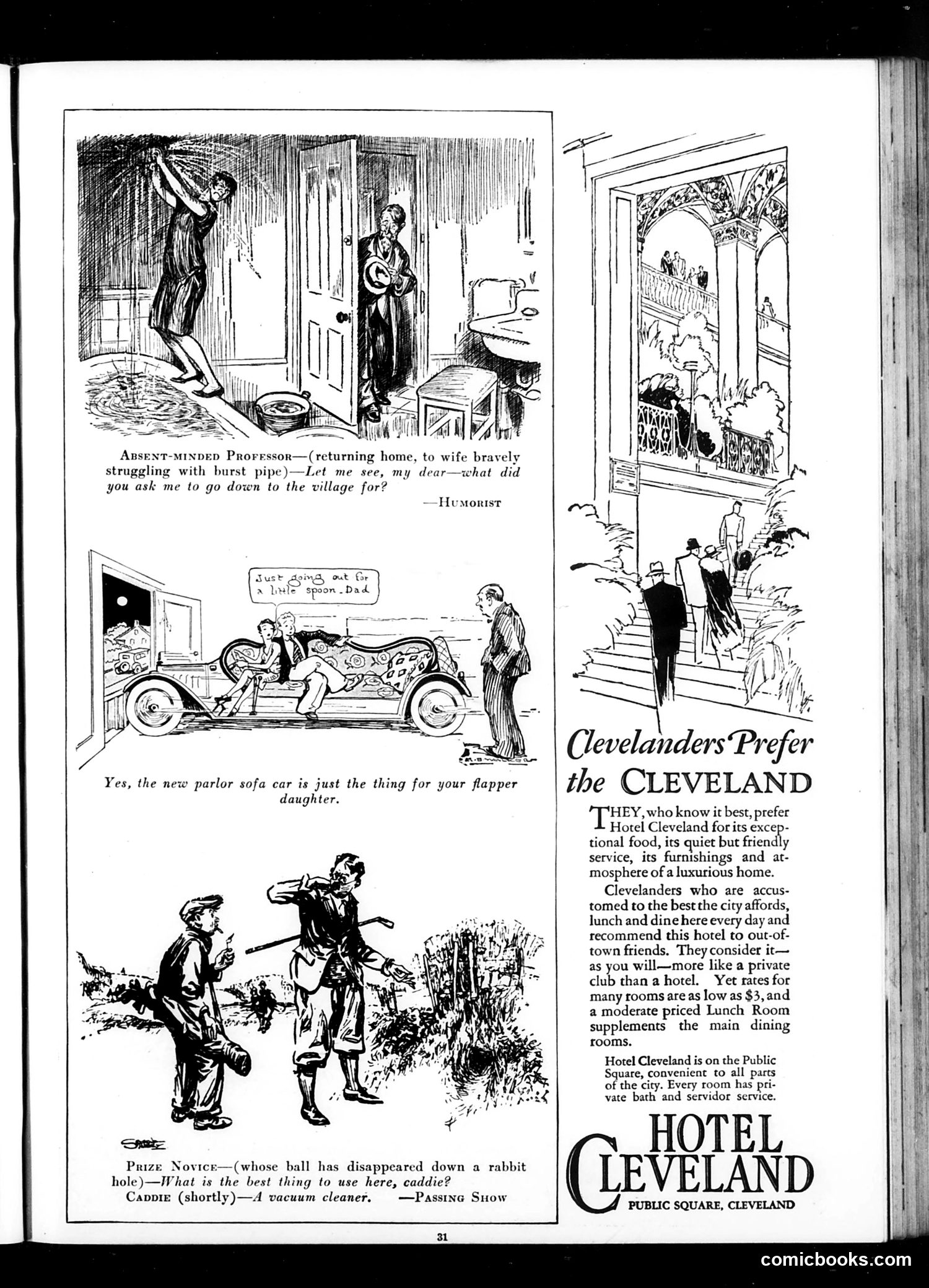
This page mixes three humor cartoons with a hotel advertisement. The cartoons satirize early 20th-century domestic and social life: 1. **Absent-Minded Professor**: A husband returns home while his wife struggles with a burst pipe, yet he can't remember what errand she asked him to run. The joke mocks absent-minded intellectuals and indifferent husbands. 2. **Parlor Sofa Car**: References the novelty of automobile design innovations—here, a car styled like living room furniture, presented as ideal for a "flapper daughter" (young, modern woman of the 1920s). The satire targets excessive consumerism and automotive styling trends. 3. **Golf Caddie**: A novice golfer asks his caddie what tool retrieves a ball lost down a rabbit hole; the caddie suggests a "vacuum cleaner." The humor mocks the absurdity of the question and implies over-reliance on modern appliances. The **Hotel Cleveland advertisement** occupies the right half, promoting luxury accommodations to wealthy Clevelanders at moderate rates ($3/night).
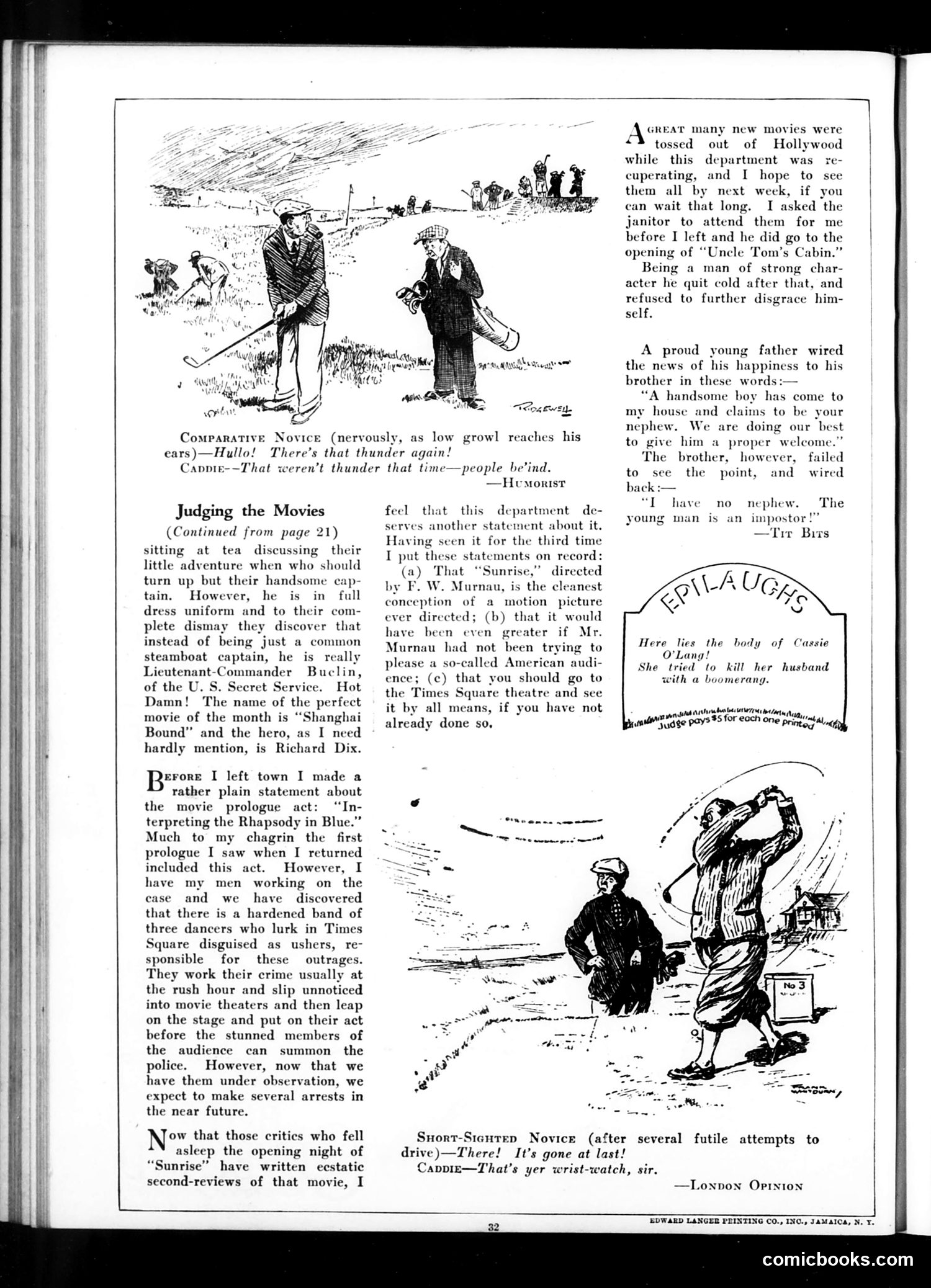
This page satirizes 1920s Hollywood and film criticism through several cartoons and humorous anecdotes: **Top cartoon**: Two men discuss thunder during a storm; the joke plays on mishearing—"thunder" sounds like rowdy audience behavior at movie theaters. **Main article**: The author critiques the film "Sunrise" (by F.W. Murnau), praising it while noting critics who initially slept through the premiere later wrote glowing reviews—mocking critics' tendency to follow consensus rather than form independent judgments. **Anecdotes**: Brief satirical stories mock various absurdities: a janitor quitting after seeing "Uncle Tom's Cabin" (suggesting the film's poor quality), a uncle-nephew mix-up involving a "handsome boy," and a subplot about dancers posing as ushers to perform unauthorized acts in Times Square theaters. **Bottom cartoon**: A short-sighted man, after repeatedly failing to drive, finally succeeds—only to discover he's lost his wristwatch. The page collectively mocks film industry pretension, critical dishonesty, and audience gullibility.
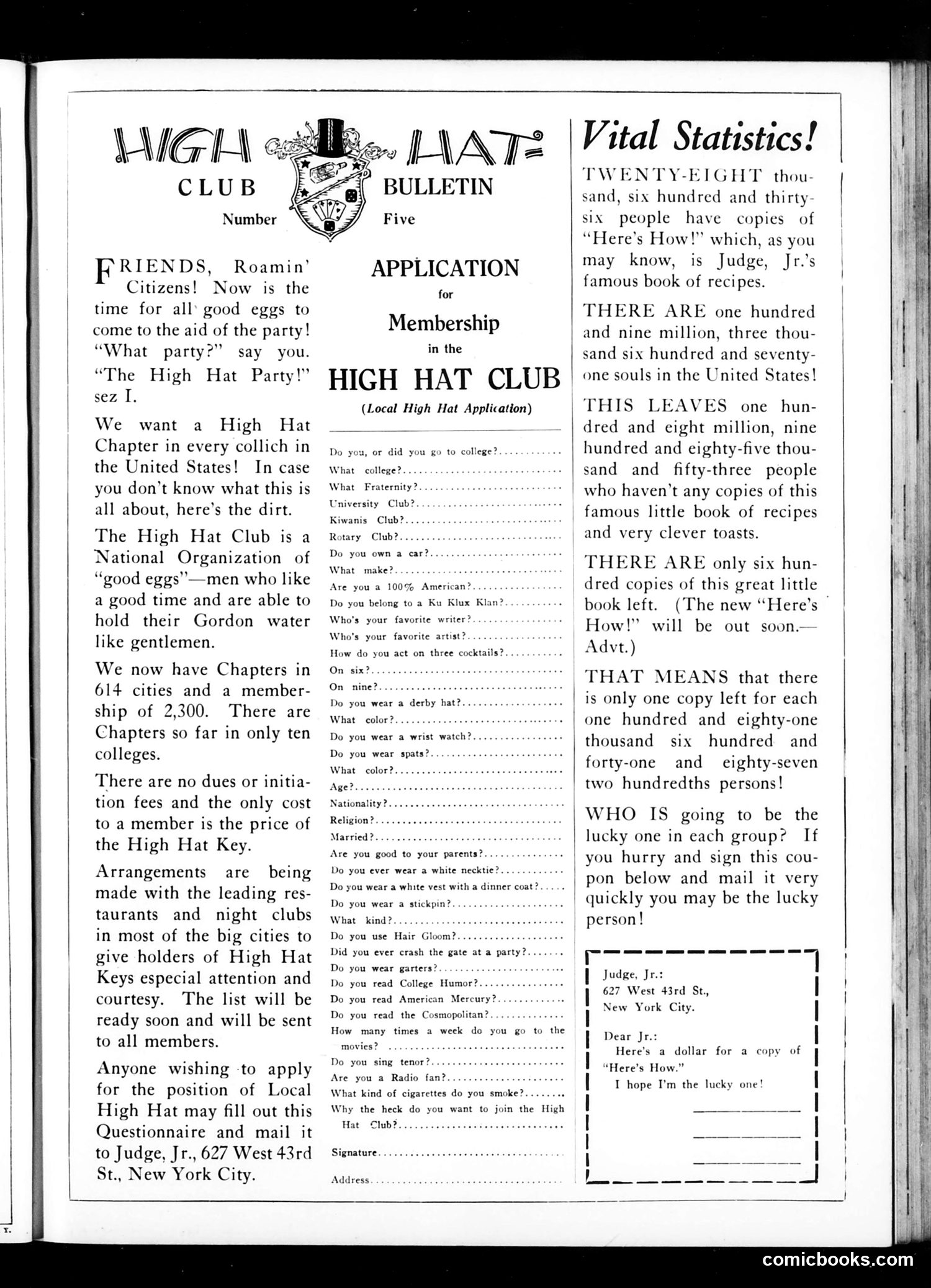
This page from *Judge* magazine satirizes exclusive social clubs and their pretentious membership standards. The "High Hat Club" claims to be a national organization for "good eggs"—gentlemen who enjoy fine dining and drinking—but the membership questionnaire reveals the satire's target. The application asks absurdly specific questions about appearance (derby hats, spats, white neckties), consumption habits (cocktail tolerance), and social credentials (college attendance, fraternity membership, car ownership). Most pointedly, it asks "Do you belong to a Ku Klux Klan?"—indicating that even this supposedly refined gentlemen's club operates within the xenophobic, nativist attitudes of 1920s America (the questionnaire also asks "Are you a 100% American?"). The joke mocks how such clubs use superficial markers—fashion, education, drinking prowess—to maintain exclusivity while harboring prejudiced values. The accompanying "Vital Statistics" about the cookbook *Here's How!* continues the self-promotional, tongue-in-cheek humor typical of *Judge*'s house advertising.
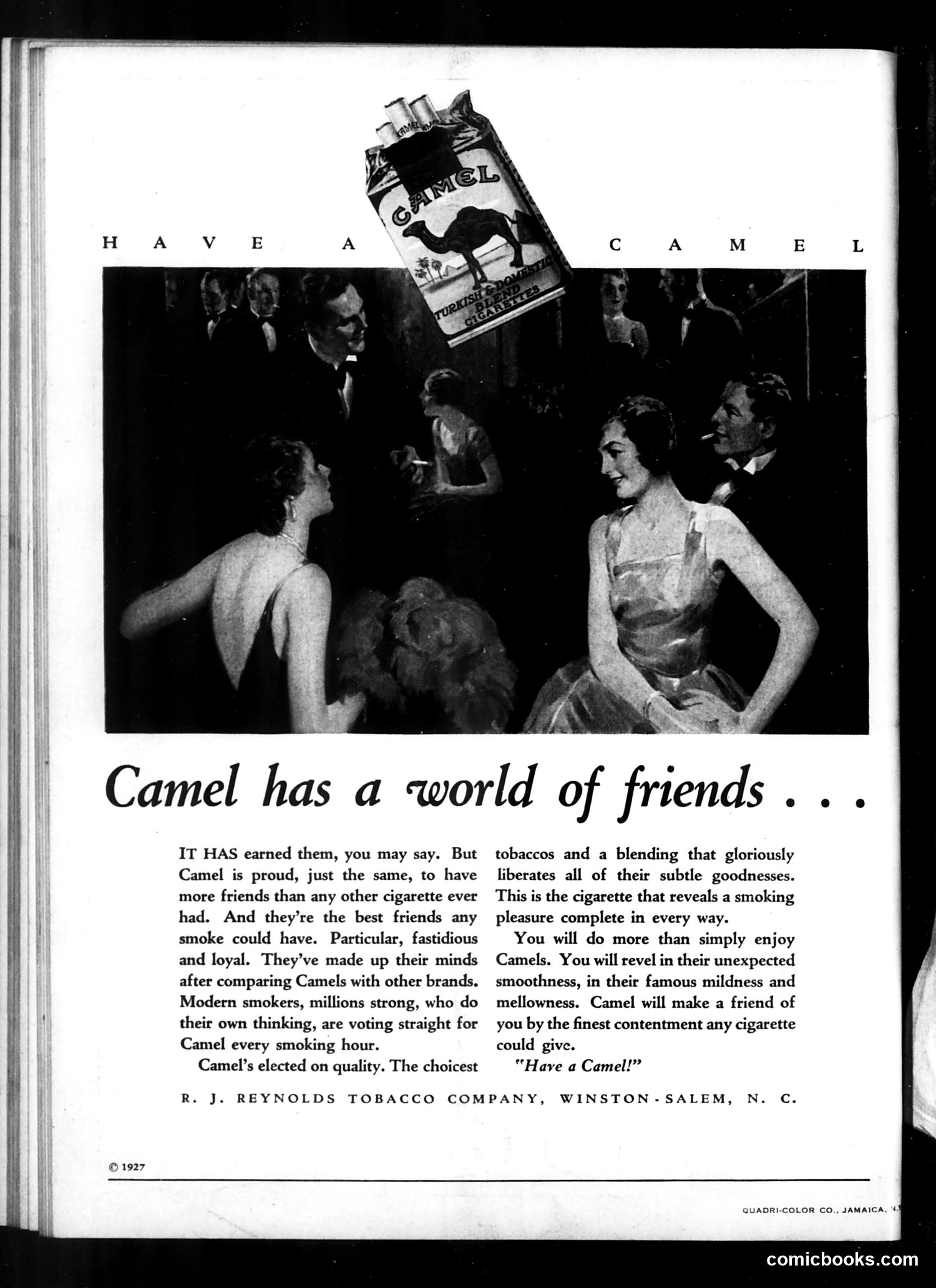
This is a **Camel cigarette advertisement**, not political satire. The 1927 ad uses a sophisticated social appeal rather than health claims. The image shows an elegant evening party scene with well-dressed men and women in formal attire, establishing aspirational social status. The headline "Camel has a world of friends" personifies the brand as socially successful. The ad's strategy is psychological: it claims Camel smokers are "Modern smokers, millions strong, who do their own thinking"—flattering consumers as independent-minded. It emphasizes quality and "mildness" (a common selling point before health risks were acknowledged) while suggesting that choosing Camel demonstrates taste and loyalty. For modern readers: this represents pre-regulation tobacco marketing that freely associated cigarettes with sophistication, friendship, and good judgment—tactics now prohibited. The social pressure implied ("millions...voting straight for Camel") exploits conformity while claiming individuality.