
Judge, 1927-11-19 · page 15 of 36
Judge — November 19, 1927 — page 15: what you’re looking at
What you’re looking at
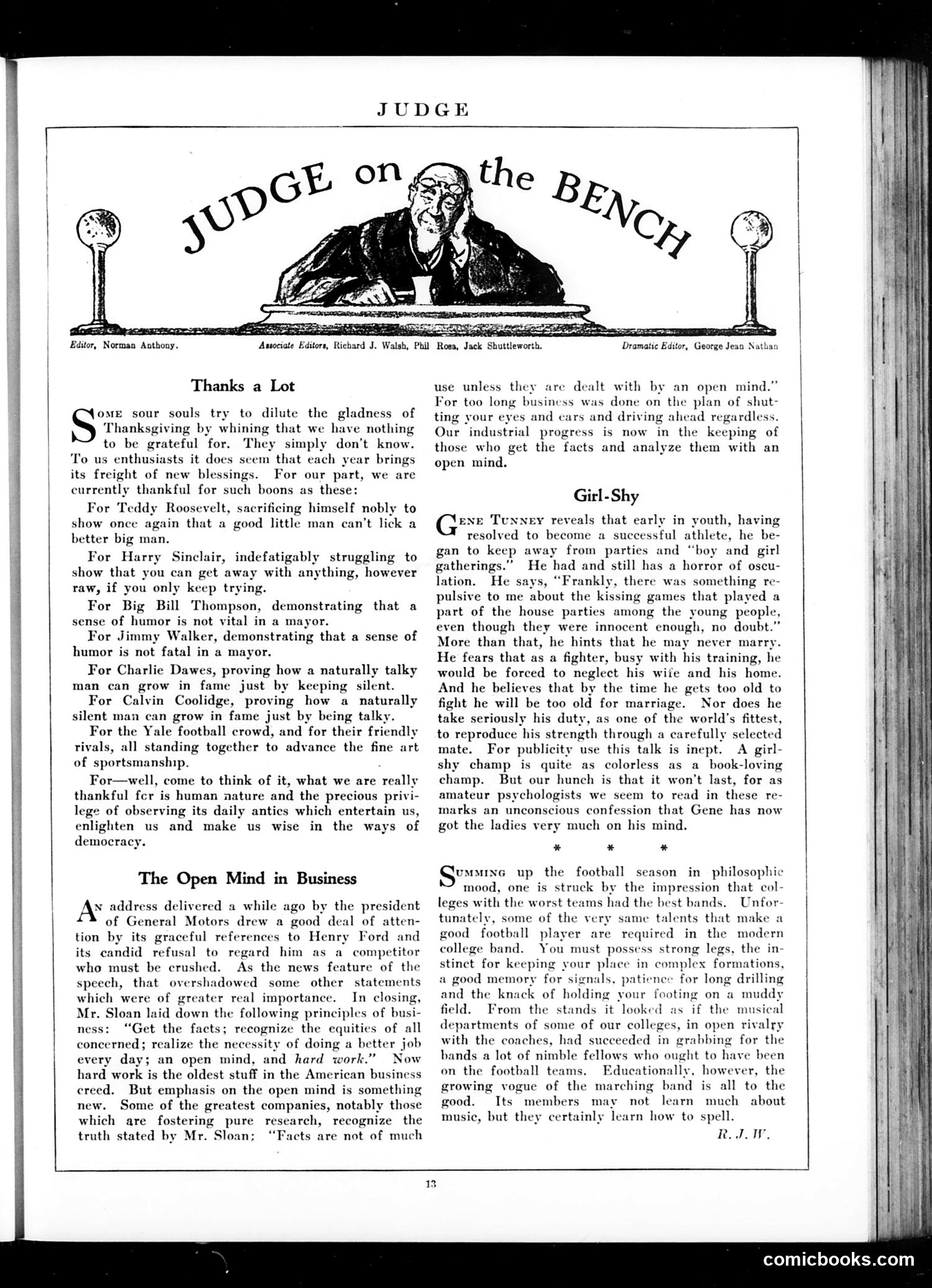
This page from the satirical magazine *Judge* contains three distinct pieces: **"Thanks a Lot"** is a mock-grateful Thanksgiving list that actually ridicules contemporary public figures through irony. It "thanks" Theodore Roosevelt (for losing a comeback bid), Harry Sinclair (Teapot Dome scandal figure, for proving corruption works if persistent), Big Bill Thompson (Chicago's notoriously crude mayor), and others. The humor lies in praising them for demonstrating society's failures—the piece ultimately suggests we're grateful mainly for human nature's entertaining flaws. **"The Open Mind in Business"** praises General Motors president Alfred P. Sloan's philosophy of using facts with open-mindedness, contrasting this favorably against Henry Ford's more dogmatic approach. **"Girl-Shy"** satirizes boxer Gene Tunney's public claims of avoiding romantic entanglements to maintain athletic focus. The writer mocks this as bad publicity—suggesting Tunney's squeamishness about kissing games seems inauthentic and will inevitably fade.
📄 Transcribed text from this page (OCR, searchable)
Machine-transcribed from the original scan — historical spelling and the odd misread are preserved.
JUDGE comnts nn th A ii iain ANC anit naclibis ties Pp acesreecer F5 Editor, Norman Anthony. Thanks a Lot omE sour souls try to dilute the gladness of S Thanksgiving by whining that we have nothing to be grateful for. They simply don’t know. To us enthusiasts it does seem that each year brings its freight of new blessings. For our part, we are currently thankful for such boons as these: For Teddy Roosevelt, sacrificing himself nobly to show once again that a good little man can’t lick a better big man. For Harry Sinclair, indefatigably struggling to show that you can get away with anything, however raw, if you only keep trying. For Big Bill Thompson, demonstrating that a sense of humor is not vital in a mayor. For Jimmy Walker, demonstrating that a sense of humor is not fatal in a mayor. For Charlie Dawes, proving how a naturally talky man can grow in fame just by keeping silent. For Calvin Coolidge, proving how a naturally silent man can grow in fame just by being talky. For the Yale football crowd, and for their friendly rivals, all standing together to advance the fine art of sportsmanship. For—well, come to think of it, what we are really thankful fcr is human aature and the precious pri lege of observing its daily antics which entertain us, enlighten us and make us wise in the ways of democracy. The Open Mind in Business AN address delivered a while ago by the president of General Motors drew a good deal of atten- tion by its graceful references to Henry Ford and its candid refusal to regard him as a competitor who must be crushed. As the news feature of the speech, that overshadowed some other statements which were of greater real importance. In closing, Mr. Sloan laid down the following principles of busi- ness: “Get the facts; recognize the equities of all concerned; realize the necessity of doing a better job every day; an open mind, and hard work.” Now hard work is the oldest stuff in the American business creed. But emphasis on the open mind is something new. Some of the greatest companies, notably those which are fostering pure research, recognize the truth stated by Mr. Sloan; “Facts are not of much Associate Editors, Richard J. Walsb, Phil Rosa, Jack Shuttleworth. Dramatic Editor, George Jean Nathan use unless they are dealt with by an open mind.” For too long business was done on the plan of shut- ting your eyes and ears and driving ahead regardless. Our industrial progress is now in the keeping of those who get the facts and analyze them with an open mind. Girl-Shy G eg Tunney reveals that early in youth, having resolved to become a successful athlete, he be- gan to keep away from parties and “boy and girl gatherings.” He had and still has a horror of oscu- lation. He says, “Frankly, there was something re- pulsive to me about the kissing games that played a part of the house parties among the young people, even though they were innocent enough, no doubt.” More than that, he hints that he may never marry. He fears that as a fighter, busy with his training, he would be forced to neglect his wiie and his home. And he believes that by the time he gets too old to fight he will be too old for marriage. Nor does he take seriously his duty, as one of the world’s fittest, to reproduce his strength through a carefully selected mate. For publicity use this talk is inept. A girl- shy champ is quite as colorless as a book-loving champ. But our hunch is that it won't last, for as amateur psychologists we seem to read in these re- marks an unconscious confession that Gene has now got the ladies very much on his mind. * * * S MMING up the football season in philosophic mood, one is struck by the impression that col- leges with the worst teams had the best bands. Unfor- tunately, some of the very same talents that make a good football player are required in the modern college band. You must possess strong legs, the in- stinet for keeping your place in complex formations, a good memory for signals, patience for long drilling and the knack of holding your footing on a muddy field. From the stands it looked as if the musical departments of some of our colleges, in open rivalry with the coaches, had succeeded in grabbing for the bands a lot of nimble fellows who ought to have been on the football teams. Educationally, however, the growing vogue of the marching band is all to the good. Its members may not learn much about music, but they certainly learn how to spell. R.J.W. comicbooks.com