
A complete issue · 36 pages · 1927
Judge — October 22, 1927
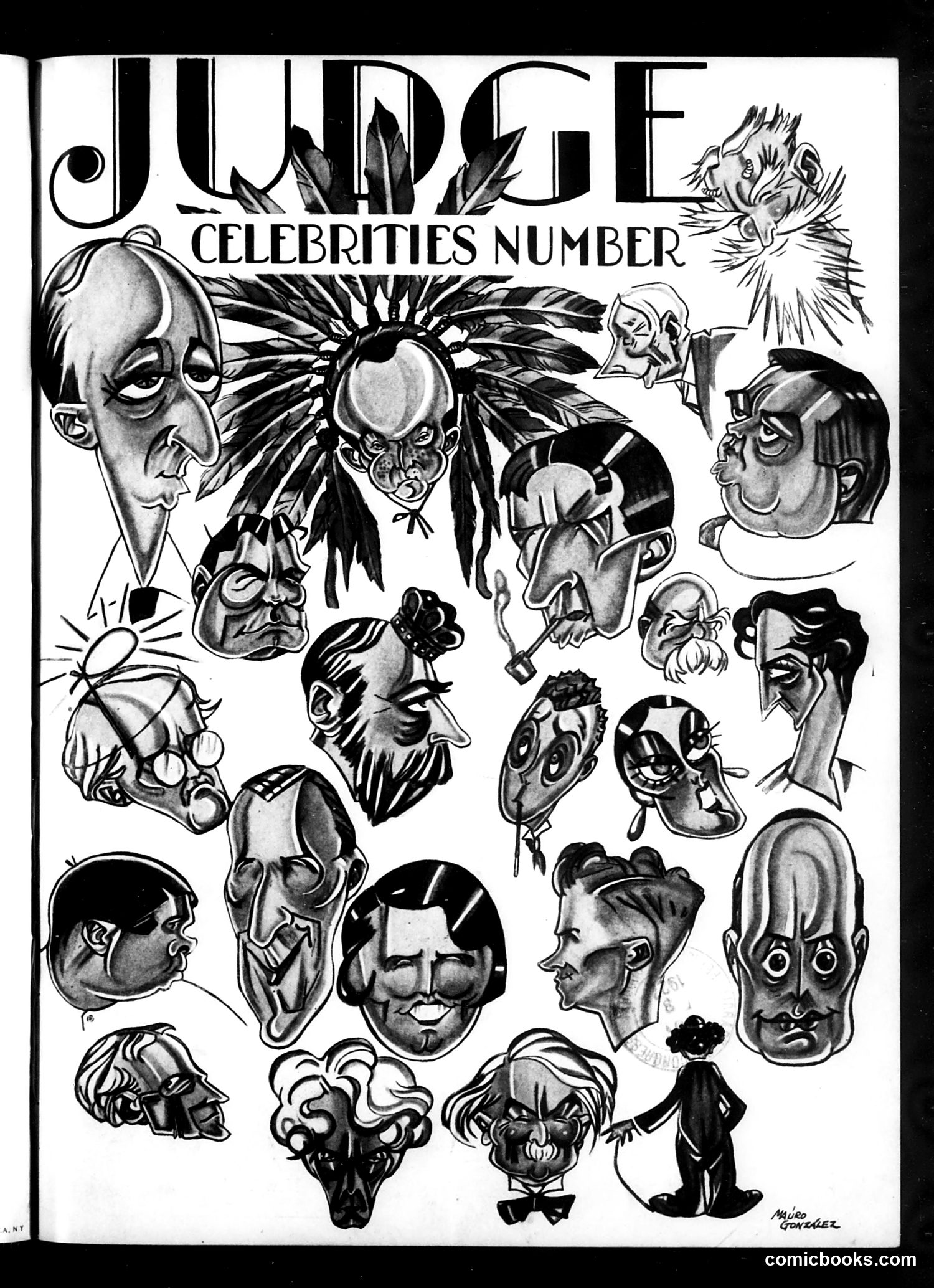
This is a "Celebrities Number" special issue featuring caricatured heads of prominent public figures from the early 20th century. The exaggerated facial features—elongated noses, pronounced chins, distinctive hairstyles—are typical of Judge's satirical style, using physical caricature to mock or comment on recognizable personalities. Without identified labels on individual portraits, I cannot definitively name specific figures. However, the variety of hairstyles, facial hair, and expressions suggests a cross-section of entertainment, politics, or society celebrities of the era. The artistic technique emphasizes distinctive personal characteristics, a common approach Judge used to make figures instantly recognizable to contemporary readers familiar with these public personalities. The page appears primarily illustrative rather than containing substantial text or specific political commentary.
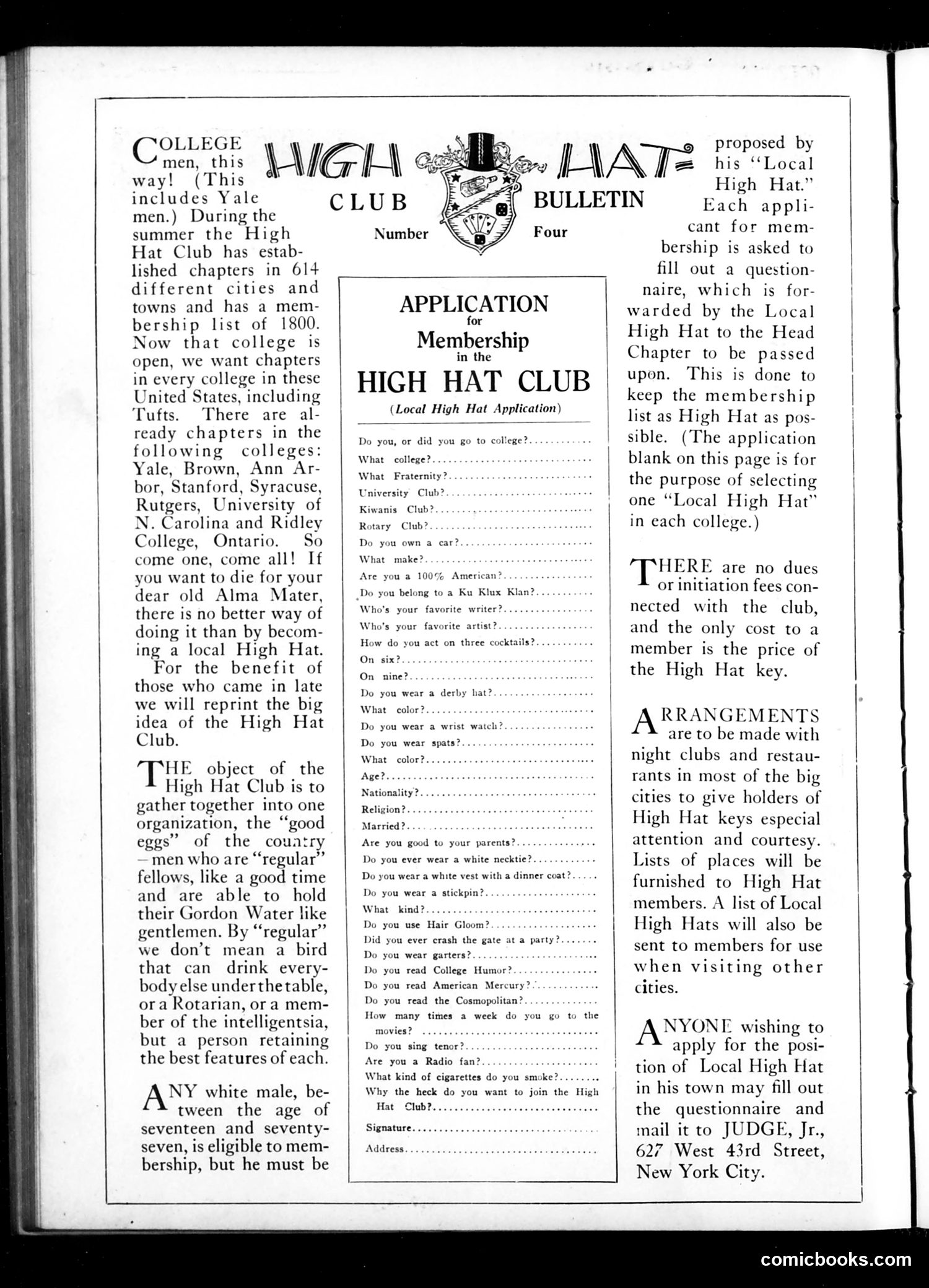
This page is primarily **promotional material** for the High Hat Club, a fraternal organization for college men. The content is not satirical—it's a genuine membership drive. The High Hat Club aimed to unite "regular" white male collegians (ages 17-77) across American universities into chapters in established cities. The membership emphasized social prestige: members received a key, got discounts at nightclubs and restaurants in major cities, and attended social events. The questionnaire reveals the club's values: it screened for "regular" fellows (implicitly excluding ethnic minorities and intellectuals), asking about sports, drinking habits, fashion preferences, and radio entertainment preferences. This represents **early 20th-century fraternal exclusivity**—networking for privileged white men seeking social status and entertainment access.
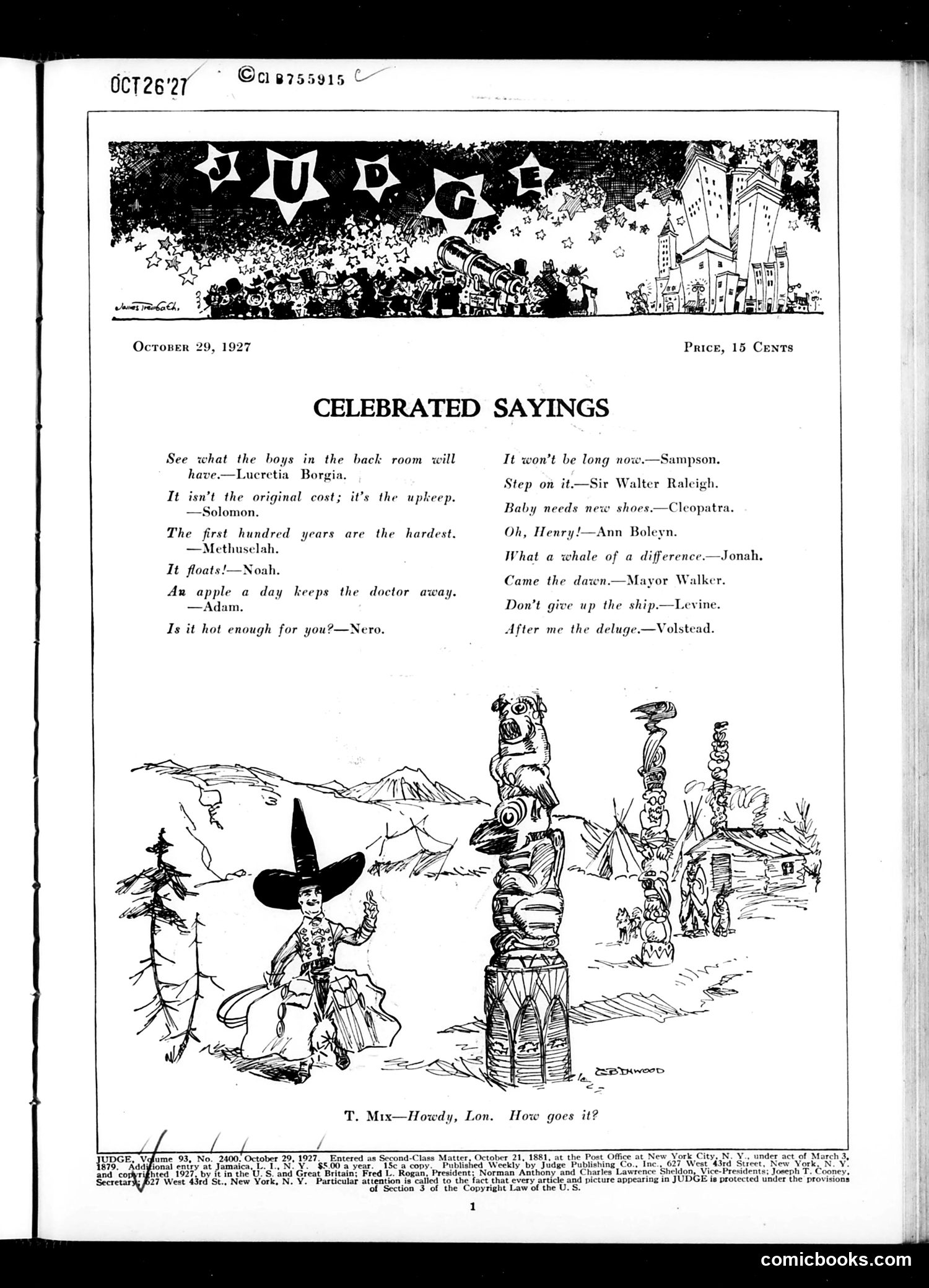
This page features "Celebrated Sayings"—famous historical quotes humorously attributed to unlikely figures. Examples include "An apple a day keeps the doctor away" credited to Adam, and "It floats!" to Noah. The bottom illustration by C.D. Townsend depicts a Western scene labeled "T. Mix—Howdy, Lon. How goes it?" This references **Tom Mix**, the wildly popular silent-film cowboy star of the 1920s. The joke appears to play on Mix's iconic status and frontier persona, with the cartoon rendering him amid exaggerated Western imagery (totem poles, Native Americans, mountains). The satire relies on contemporary celebrity recognition—Mix was ubiquitous in popular culture during this era.
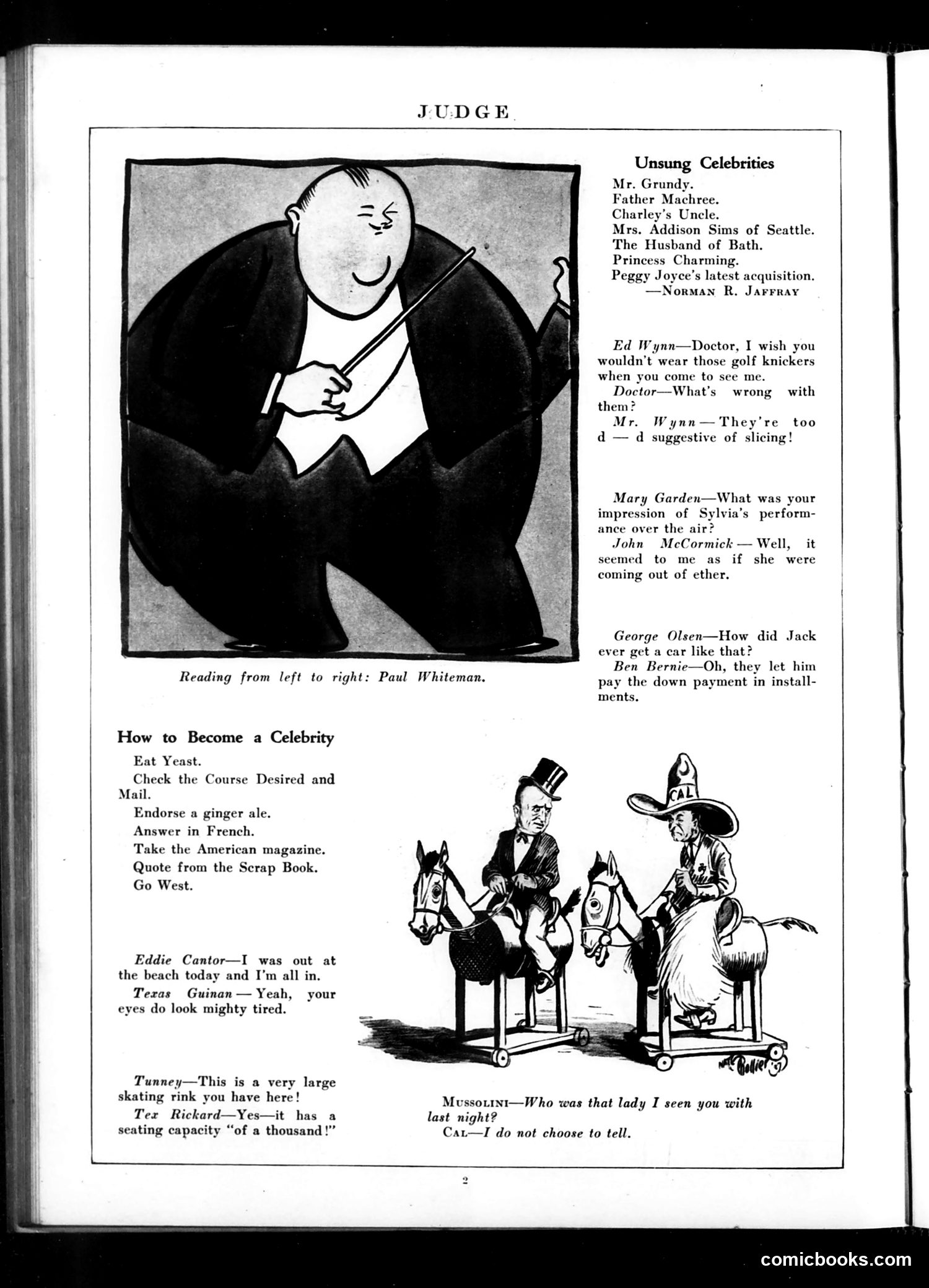
This page contains two satirical sections from Judge magazine. **Top cartoon**: Shows Paul Whiteman reading, captioned with "Unsung Celebrities"—a humorous list of obscure or fictional figures (Mr. Grundy, Father Machree, etc.) by Norman R. Japbray. The joke mocks people seeking fame through dubious means. **"How to Become a Celebrity"**: A cynical list of strategies for achieving fame—eating yeast, endorsing products, answering mail in French, quoting scrapbooks, going west. This satirizes the superficiality of 1920s celebrity culture and advertising-driven fame. **Bottom cartoon**: Shows two men on rocking horses labeled as a "skating rink," with dialogue between Mussolini and Cal (likely Calvin Coolidge). The joke appears to mock political posturing or absurd claims about infrastructure capacity. The page targets early 20th-century American celebrity culture and political pretension through absurdist humor.
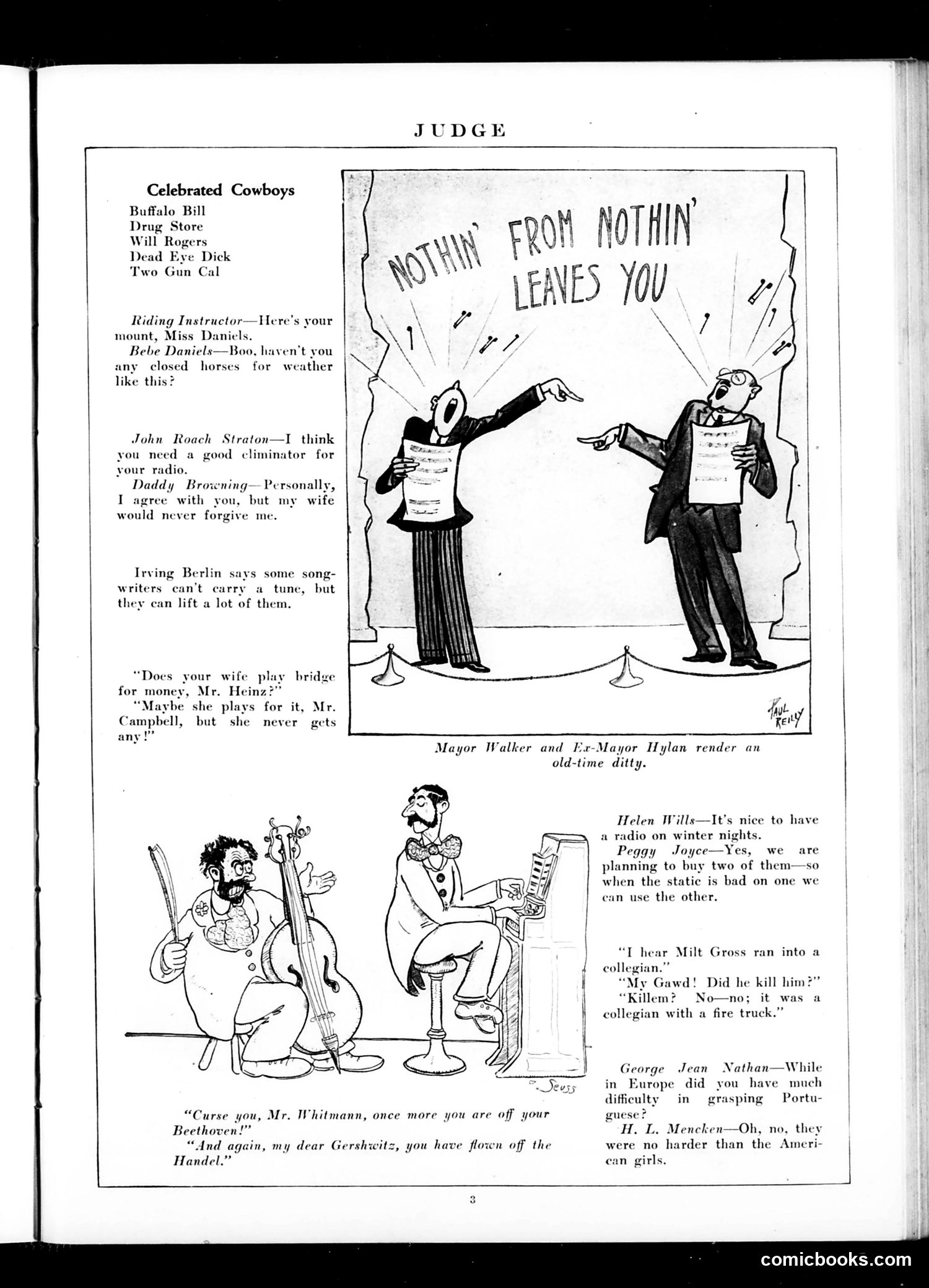
This page contains **miscellaneous humor and anecdotes** rather than political cartoons. The content includes: **Top cartoon**: Two figures (labeled Mayor Walker and Ex-Mayor Hylan) perform "an old-time ditty" with the caption "Nothin' from Nothin' Leaves You"—likely a joke about New York City politics, though the specific reference is unclear without more historical context. **Bottom cartoon**: A musician plays cello while a conductor makes classical music references to Beethoven and Handel—standard "highbrow" humor mocking pretentious classical musicians. **Text snippets**: Various brief jokes about wives, radio, bridge playing, and a collision involving Milt Gross and a fire truck—typical light social satire of the era. The page exemplifies Judge's mix of political in-jokes (New York mayors), classical art mockery, and domestic humor popular in early 20th-century American magazines.
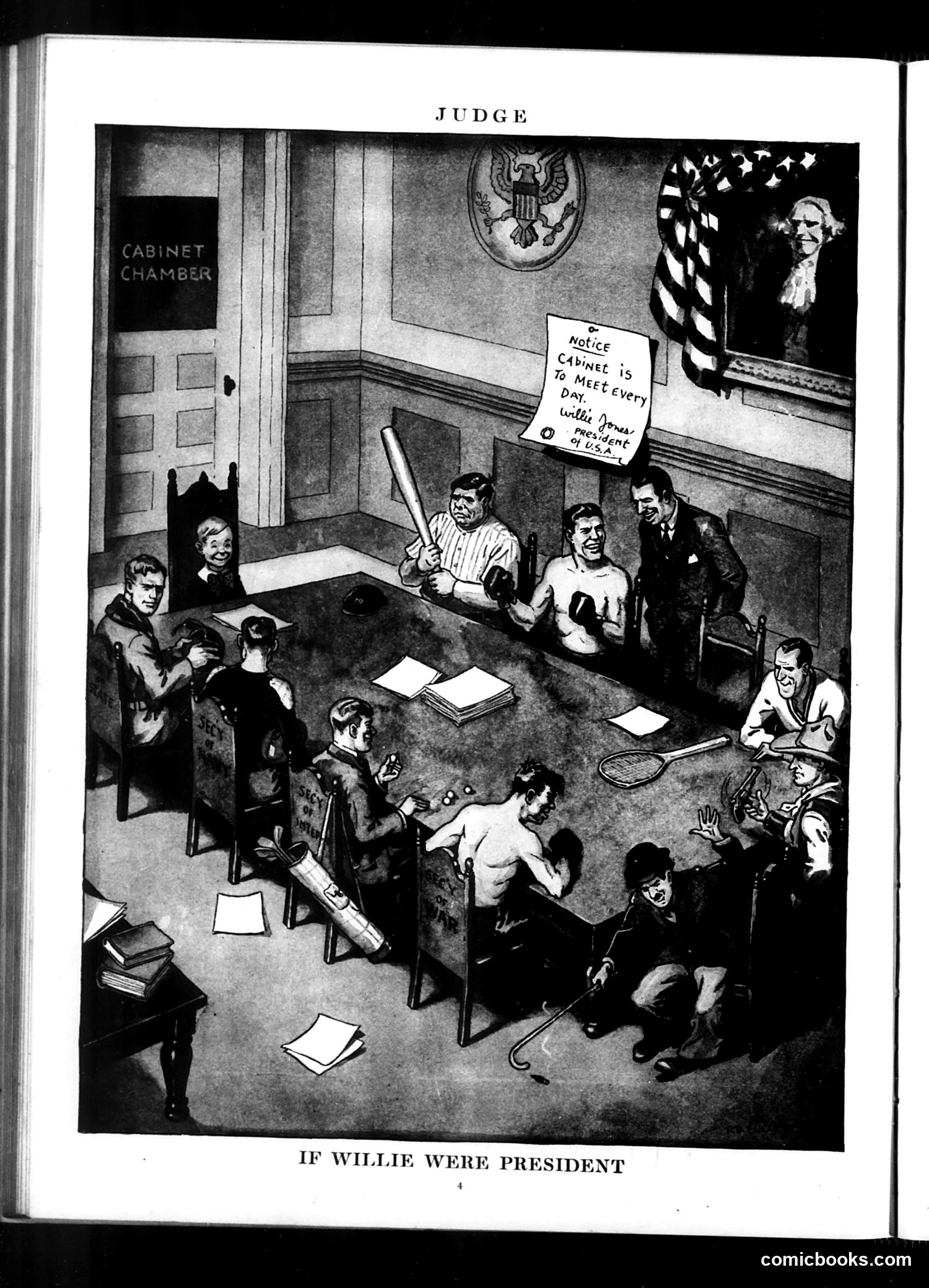
This political cartoon satirizes what would happen if Willie (likely referring to Willie Mays or another prominent "Willie" of the era) became U.S. President. The scene depicts the Cabinet Chamber in complete chaos: men are engaged in a baseball game rather than conducting government business, with one figure wielding a bat, others holding gloves, and baseballs scattered across the floor. The notice on the wall mockingly states the Cabinet meets daily "under new management of U.S.A." The satire suggests that if this particular Willie assumed the presidency, government would devolve into frivolous sports rather than serious policy-making. The cartoon criticizes either the person's perceived incompetence or the absurdity of an unlikely candidacy. The formal judicial setting contrasts sharply with the undignified athletic activity.
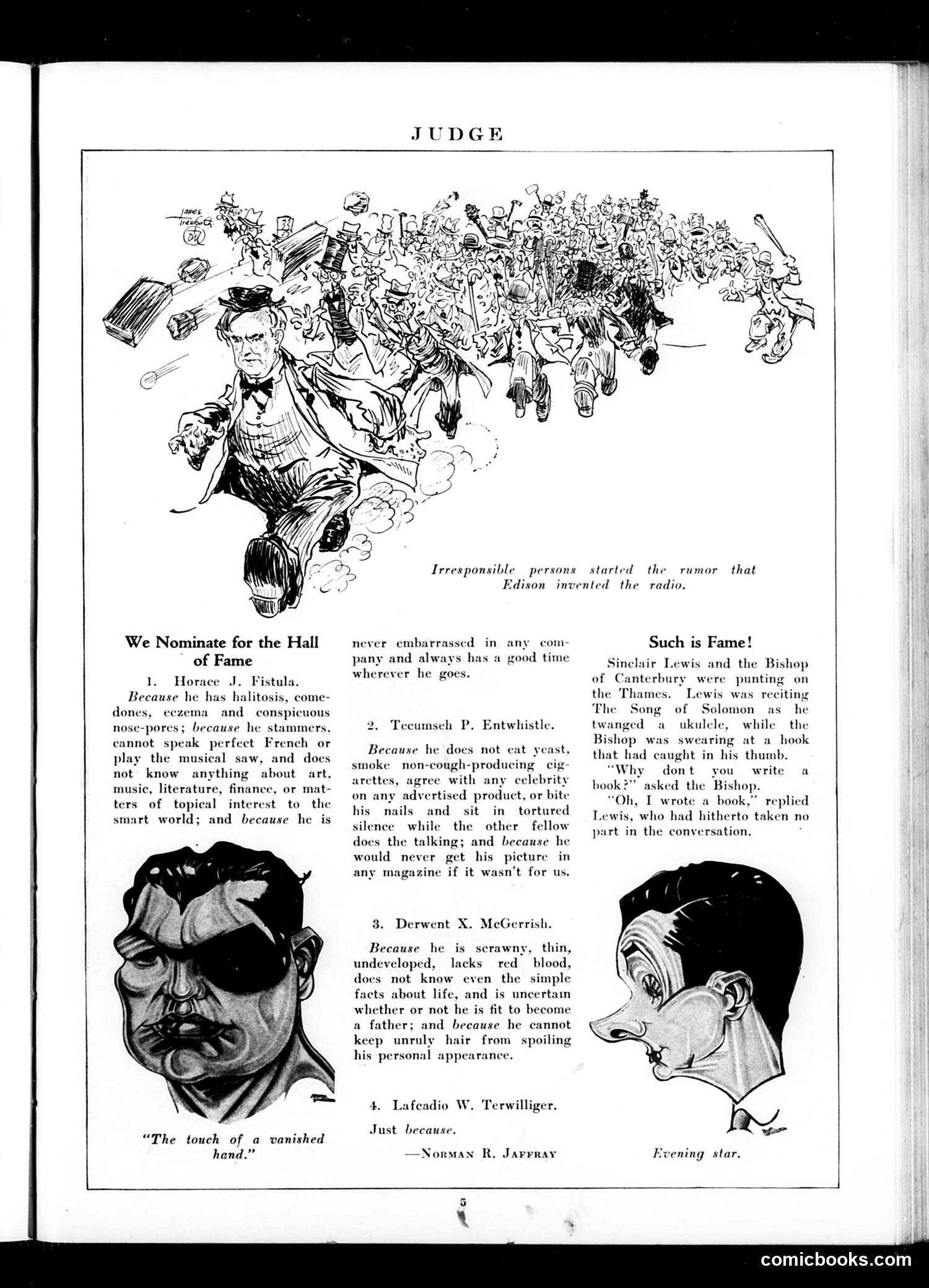
This page from *Judge* satirizes four public figures nominated for a "Hall of Fame," each mocked for specific character flaws: 1. **Horace J. Fistula** — criticized for halitosis, stammering, and ignorance despite claiming sophistication 2. **Tecumseh P. Entwhistle** — ridiculed for refusing to smoke, eat yeast, or advertise products; won't allow his picture in magazines 3. **Derwent X. McGorrish** — portrayed as underdeveloped, lacking intelligence and basic knowledge; unable to maintain personal grooming 4. **Lafcadio W. Terwilliger** — nominated "just because" (implying he deserves mockery without specific reason) The top cartoon shows a judge figure pursued by a mob, captioned about false rumors Edison invented radio—likely satirizing how misinformation spreads. The satirical nominations mock vanity, pretension, and absurd public personalities of the era.
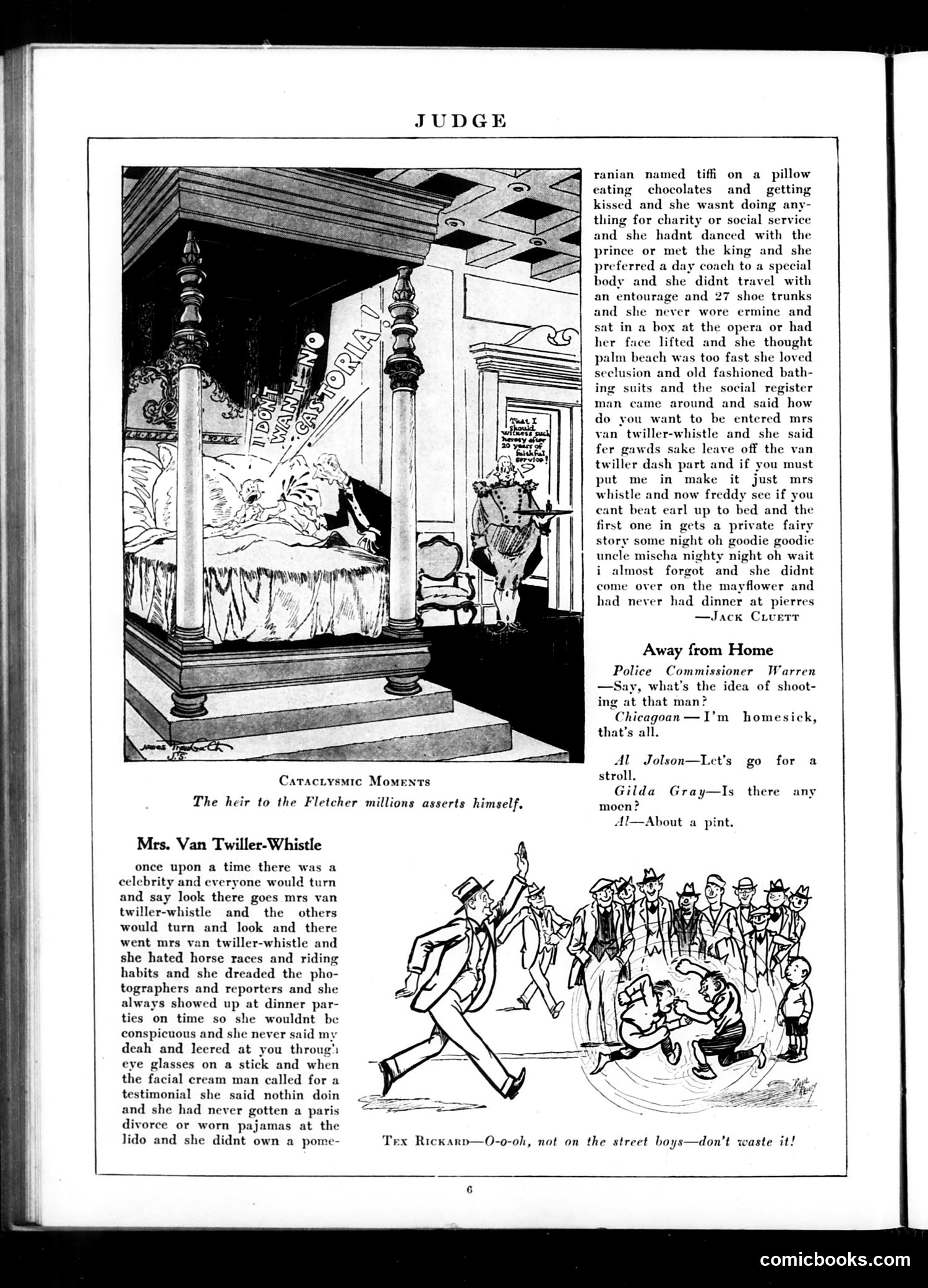
This page contains two distinct satirical pieces mocking 1920s high society. **"Mrs. Van Twiller-Whistle"** (left) ridicules wealthy socialites obsessed with conspicuous consumption and status. The text catalogs the fictional Mrs. Van Twiller-Whistle's deliberately *un*-fashionable behavior—she avoids horse races, photographers, social climbing, and European excess—presented ironically as proof of her snobbery. The joke targets nouveau riche pretension: her very rejection of stereotypical wealthy-woman behavior becomes another form of status-seeking affectation. **"Away from Home"** (right) is a brief comic exchange where a Chicago police commissioner asks a man why he's shooting at someone. The man replies he's "homesick"—the absurdist humor suggests desperate nostalgia drives criminal behavior. Below, brief dialogue jokes reference celebrities (Al Jolson, Gilda Gray) in a vaudeville-style format. Both pieces mock 1920s urban culture, materialism, and entertainment-world obsessions through exaggeration and ironic reversal.
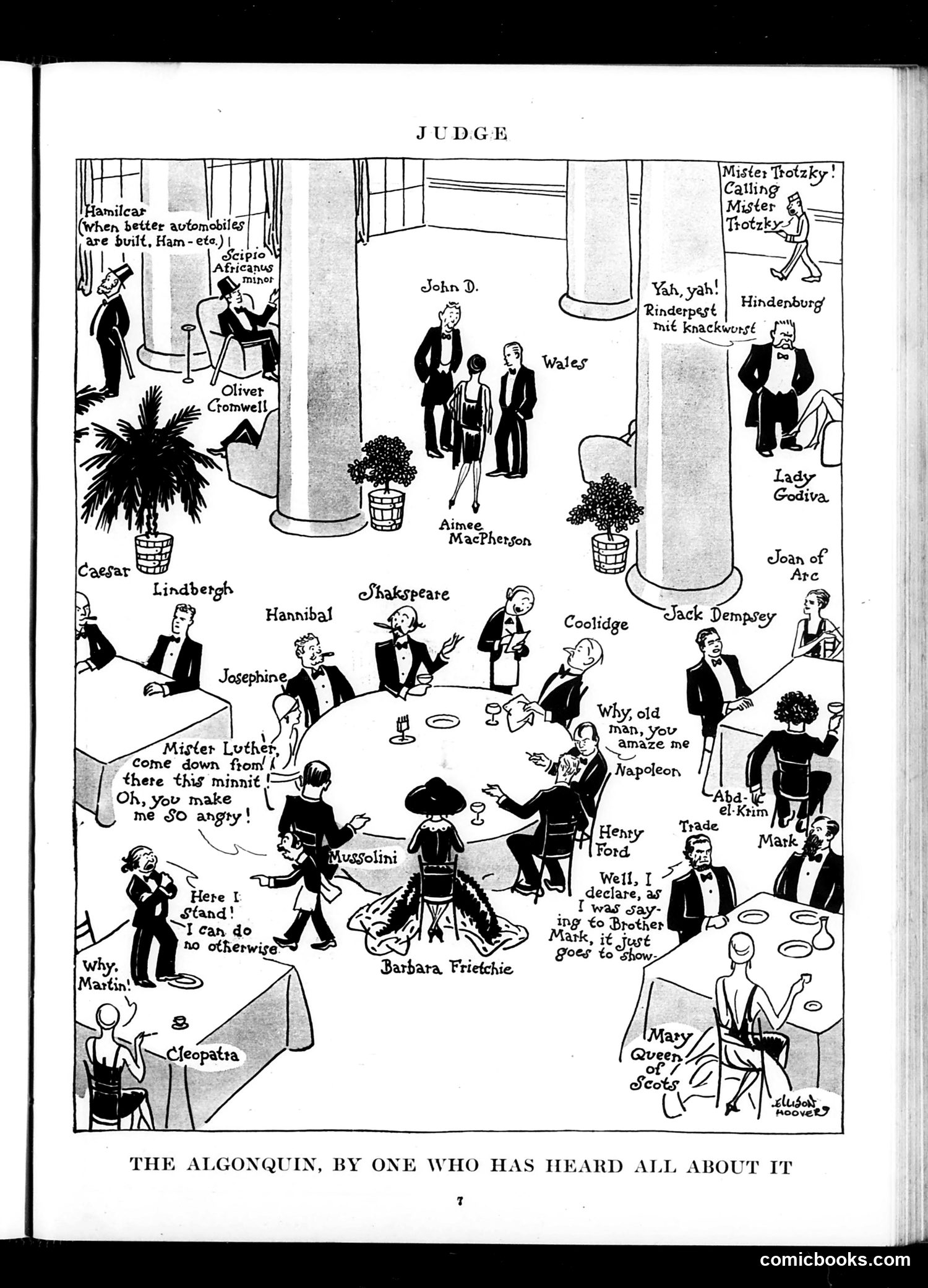
This cartoon satirizes the famous Algonquin Round Table, the New York wit's salon where intellectuals and entertainers gathered daily. The cartoonist mockingly depicts these celebrated figures as pretentious name-droppers, each invoking famous historical or contemporary figures—Caesar, Shakespeare, Napoleon, Cleopatra, Lindbergh—to seem clever or important. The joke targets the Algonquin's reputation for rapid-fire, competitive wit and their tendency to casually reference illustrious names. Labels like "Scipio Africanus," "Oliver Cromwell," and "Hannibal" attached to various attendees suggest they're comparing themselves (or being compared) to great historical figures, which the cartoonist presents as absurdly pretentious. The title—"by one who has heard all about it"—adds ironic distance, implying the cartoonist is mocking secondhand gossip about this exclusive, elite group's self-importance.
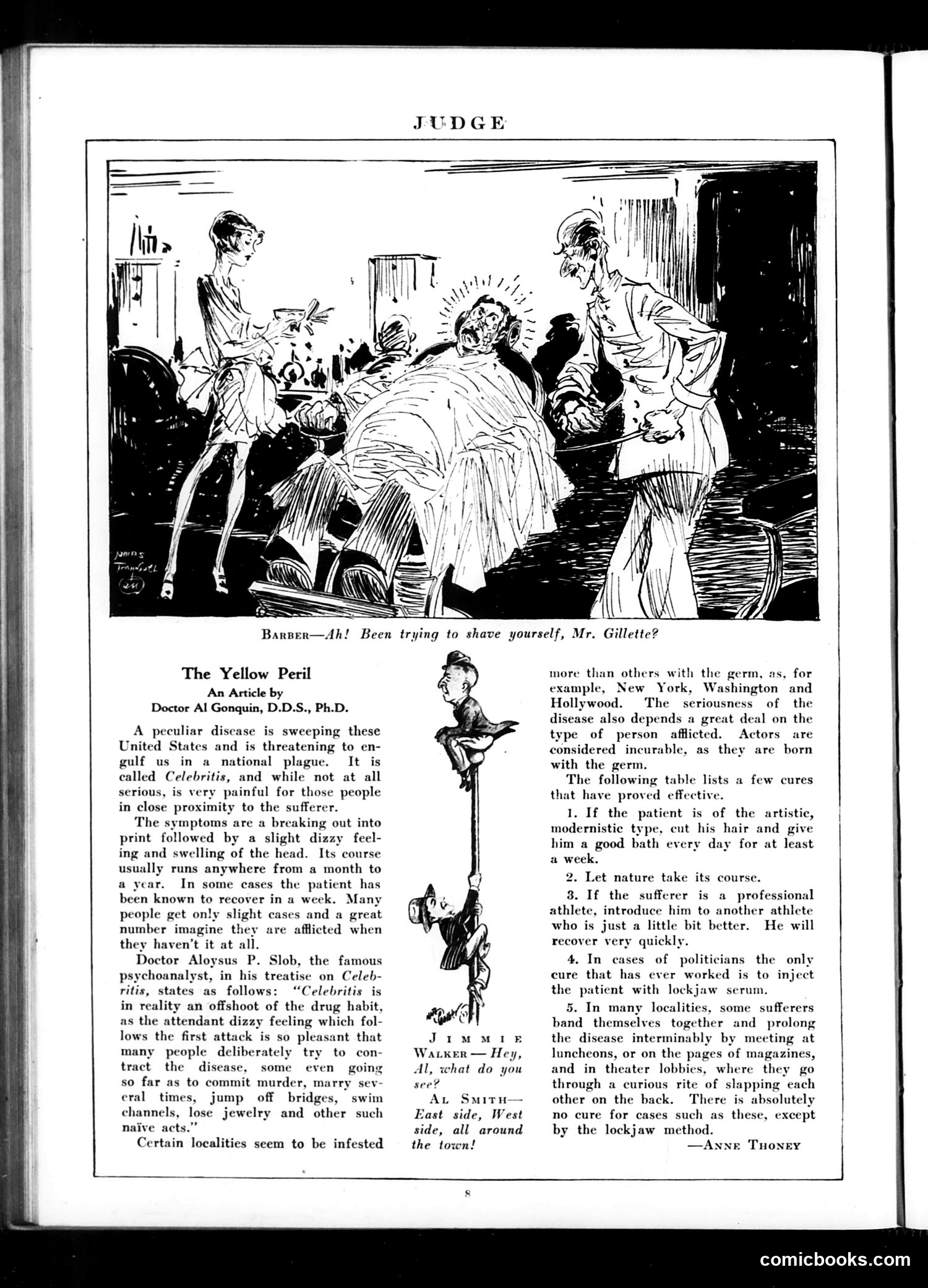
This article satirizes "Celebritis"—a fictional disease representing the obsessive public hunger for celebrity gossip and the celebrities' own narcissism. The title ironically invokes "Yellow Peril," a racist trope about Asian threat, to mock American anxieties being redirected toward frivolous celebrity culture instead. The satire targets: - **Actors** as "incurable" because they're inherently narcissistic - **Politicians** requiring "lockjaw serum" (enforced silence) - **New York, Washington, and Hollywood** as infection centers - The public's complicity: fans deliberately seeking the "disease" by reading gossip columns and attending theater lobbies The cartoon above (captioned "Barber—Ah! Been trying to shave yourself, Mr. Gillette?") appears unrelated—a simple joke about shaving mishaps. The piece mocks both celebrity culture's vapidity and Americans' willing participation in it, presented as medical pathology.
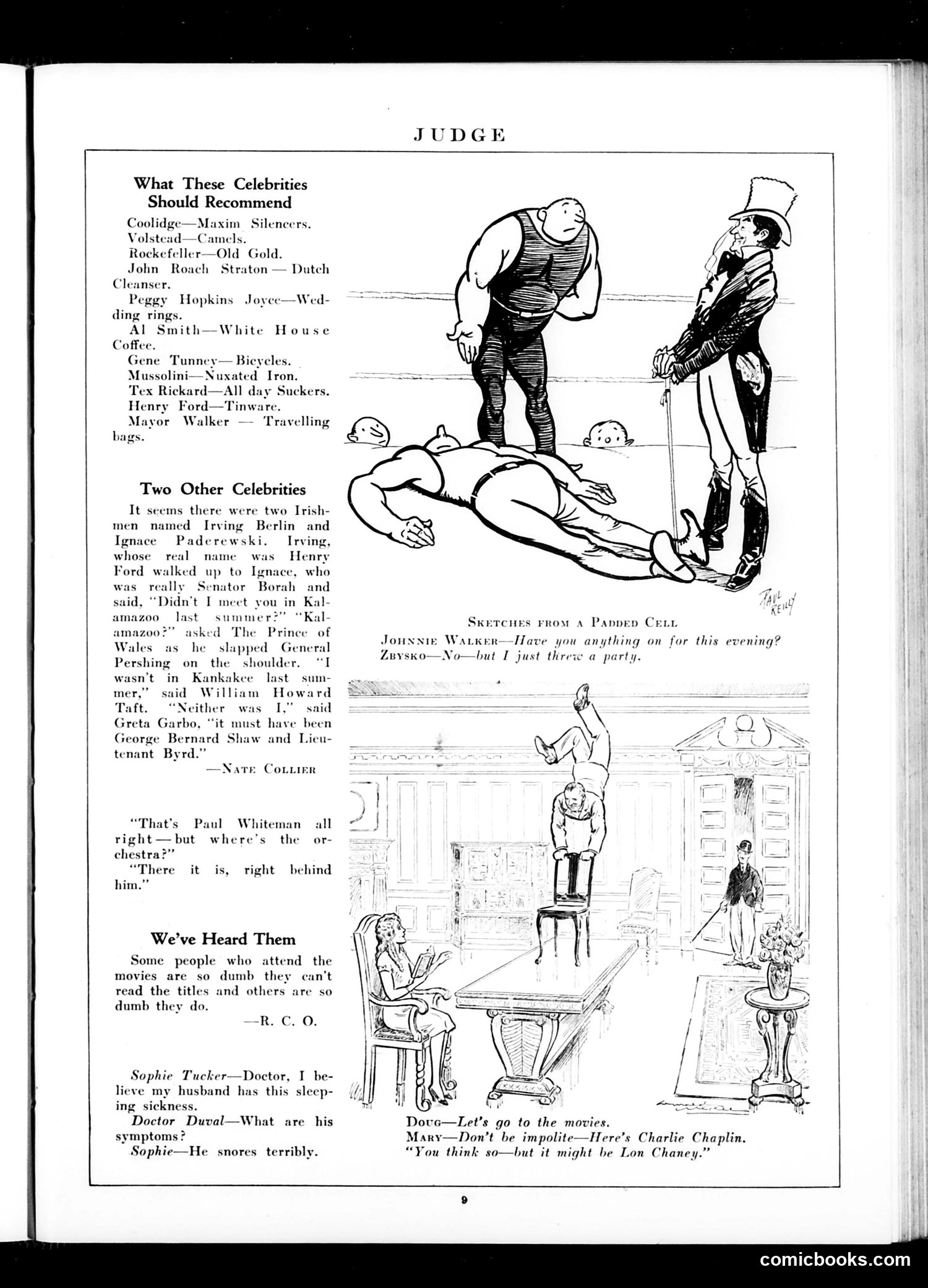
This page contains celebrity product endorsement jokes and vaudeville humor typical of 1920s satire. **"What These Celebrities Should Recommend"** pairs famous figures with products for ironic effect: Coolidge with "Maxim Silencers" (mocking his quiet demeanor), Volstead with Camels (the Volstead Act enforced Prohibition), and Peggy Hopkins Joyce with wedding rings (referencing her multiple marriages). **"Two Other Celebrities"** satirizes confused identity mix-ups among famous people—a standard vaudeville premise where celebrities are mistaken for one another. **"We've Heard Them"** mocks moviegoers too illiterate to read silent-film titles, and includes a doctor joke about snoring (Sophie Tucker was a famous entertainer). The bottom sketches reference silent-film comedians—Charlie Chaplin and Lon Chaney—whose physical comedy defined the era. The humor relies on recognizing these celebrities and understanding 1920s cultural references: Prohibition, silent films, and vaudeville comedy conventions.
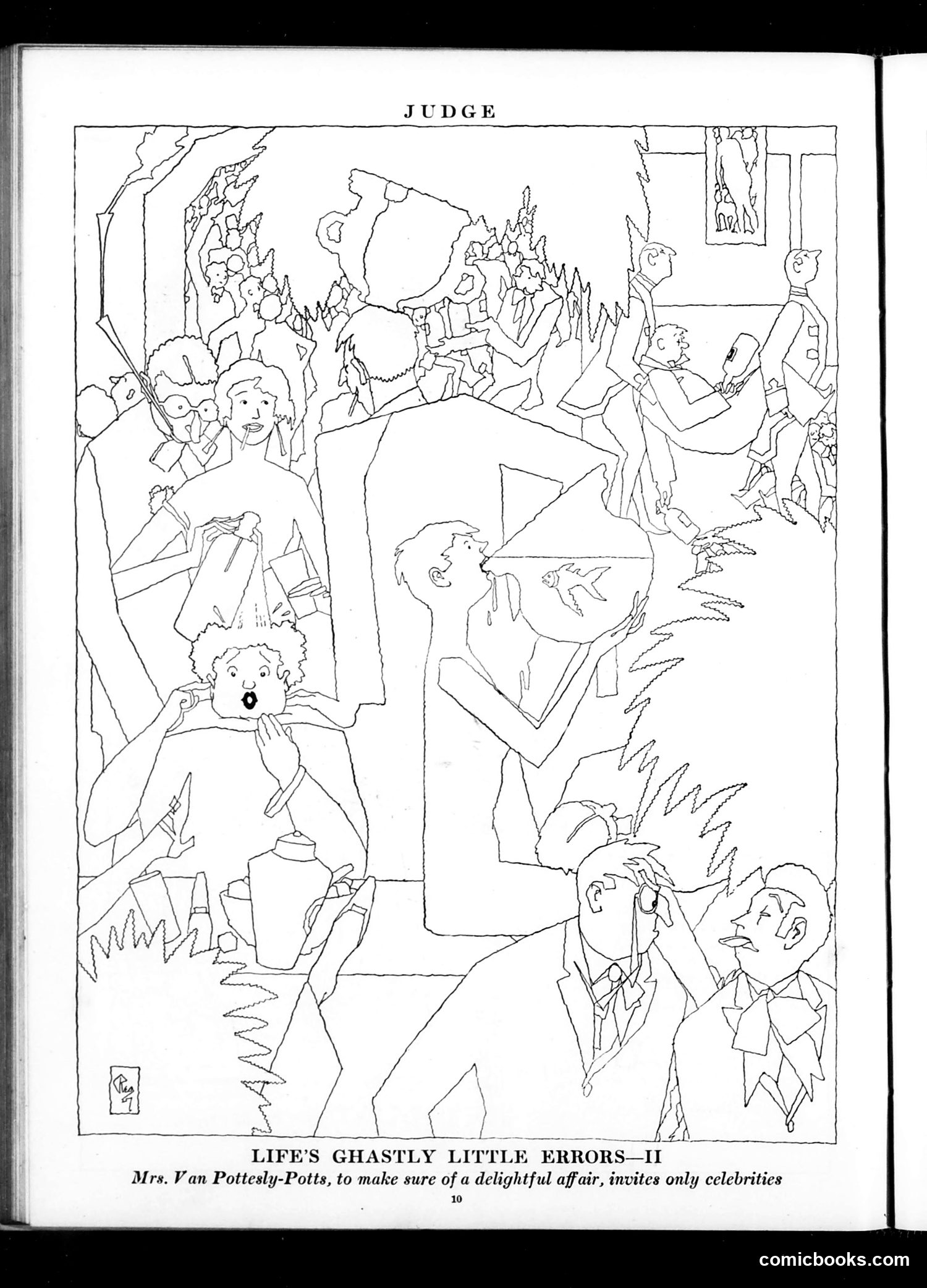
This cartoon satirizes high-society pretension through Mrs. Van Pottesly-Potts, a wealthy socialite who hosts a party exclusively for celebrities to ensure its success. The joke depicts the ironic "ghastly little error" that results: the celebrity guests behave chaotically—fighting, arguing, and causing general mayhem in her home. The satire mocks two targets: the snobbish assumption that inviting famous people automatically creates a "delightful affair," and the implication that celebrities, despite their status, are actually unruly and poorly-behaved guests. The cartoon suggests that social success requires more than prestigious names—it needs compatible personalities. The title indicates this is part two of a series about embarrassing social mistakes.
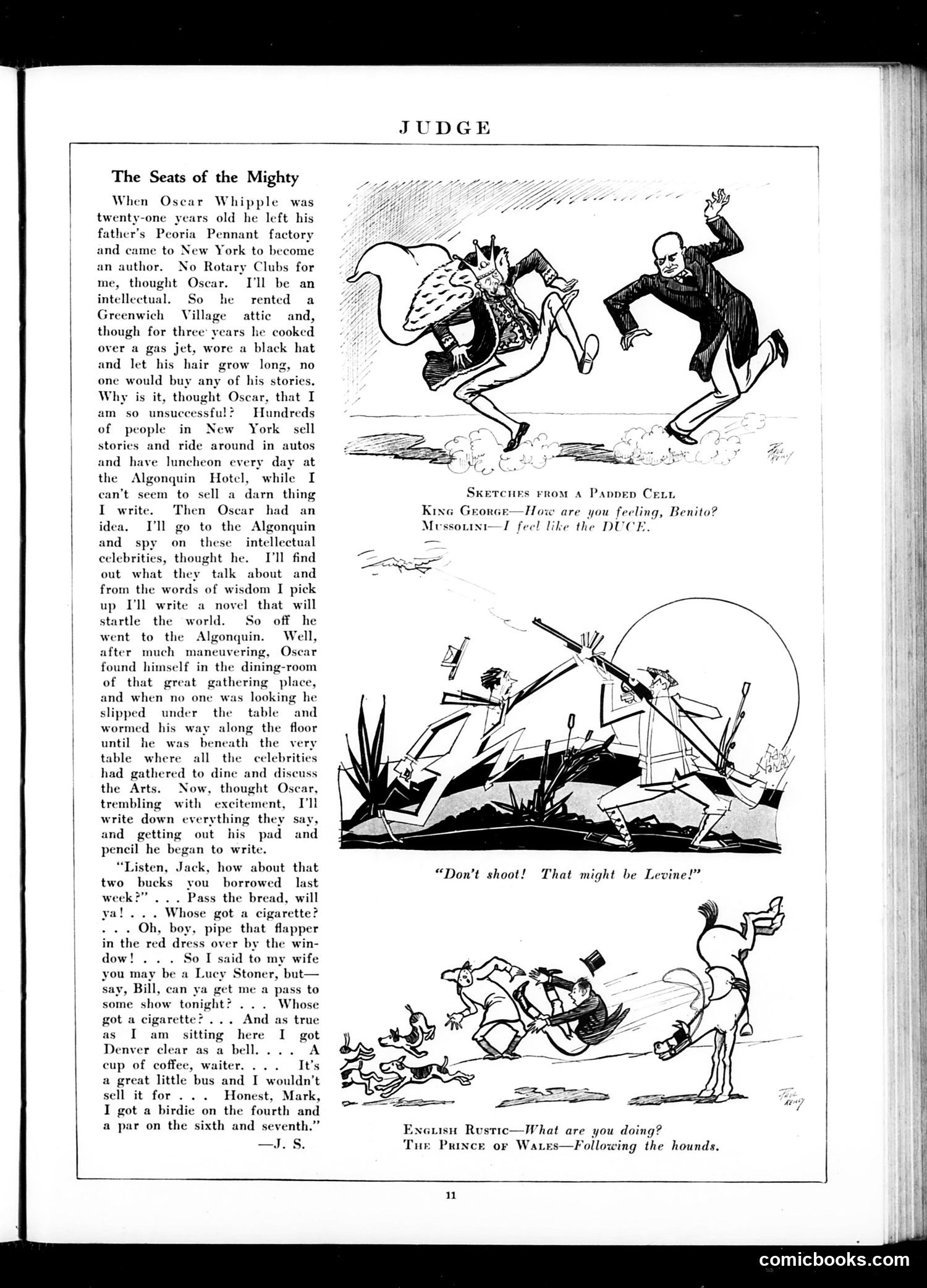
This satirical piece mocks the romantic myth of bohemian intellectualism and the Algonquin Hotel's literary circle. Oscar Whipple, an aspiring author, abandons practical life (his father's factory business) to become an "intellectual," expecting Greenwich Village writers to discuss profound artistic matters. He infiltrates the famous Algonquin Hotel dining room—known as a gathering place for celebrated writers and wits—hoping to overhear wisdom. Instead, he discovers the celebrated literati discussing mundane gossip: borrowed money, flippers, show tickets, golf scores, and coffee orders. The joke exposes the gap between the public mystique of New York's intellectual elite and their actual banal conversations. The cartoon captions add political mockery (Mussolini, the Prince of Wales), but the main satire targets both pretentious aspiring writers and the overrated reputation of famous literary celebrities.
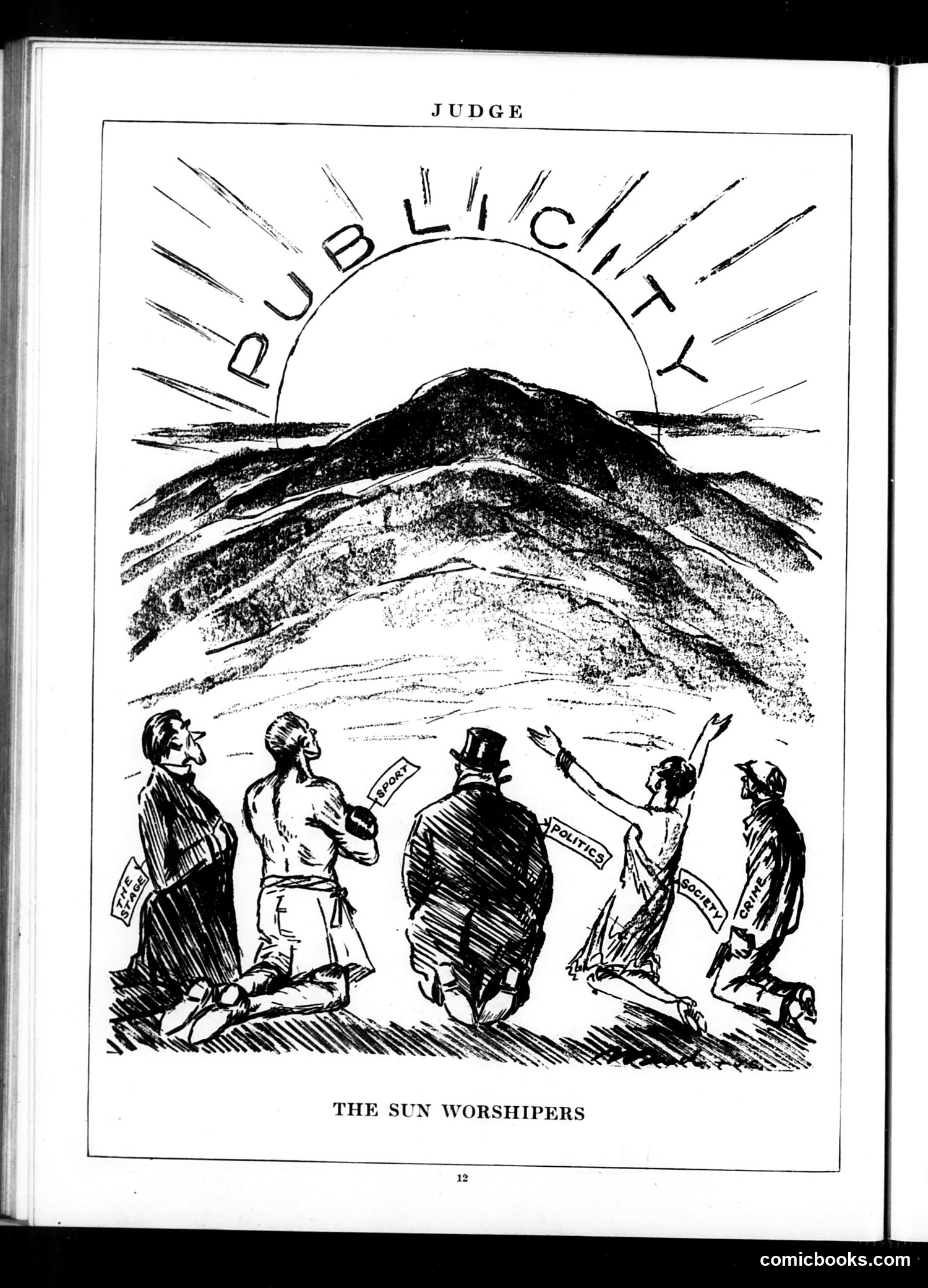
This political cartoon depicts five figures in various states of reverence before a rising sun labeled "PUBLICITY." The figures appear to represent different sectors or types of people—a businessman, an athlete, a politician (identifiable by his top hat), a woman, and another figure—all worshipping or bowing toward the sun. The satire criticizes American society's obsession with publicity and public attention. By portraying these diverse figures as "sun worshippers," the cartoonist mocks how people across different professions and classes have become fixated on gaining public visibility and acclaim. The religious imagery suggests this pursuit of publicity has become a quasi-religious devotion—an unhealthy cultural preoccupation that transcends normal ambition.
This page from *Judge* contains three separate satirical pieces: **"The Gallant Friend of Youth"** discusses Ben Lindsey, a Denver juvenile court judge ousted after 27 years, allegedly by the Ku Klux Klan through fraud and intimidation. The piece praises Lindsey's compassionate approach to youth justice, contrasting him with those who destroyed his career through corruption and threats. It's a sympathetic portrait of a reformer fighting institutional corruption. **"Our Amiable Weakness"** satirizes the proliferation of themed "weeks" (Apple Week, Fire Prevention Week, etc.)—observing that Americans create 135 such weeks annually, making them meaningless through oversaturation. **"Laws of Faded Blue"** catalogs absurd Sunday blue laws still in effect across states—prohibiting ice cream sales, golf, and travel on Sundays—mocking their outdated moral rigidity and uneven enforcement. The page reflects Progressive Era concerns: judicial reform, bureaucratic excess, and Victorian moralism.
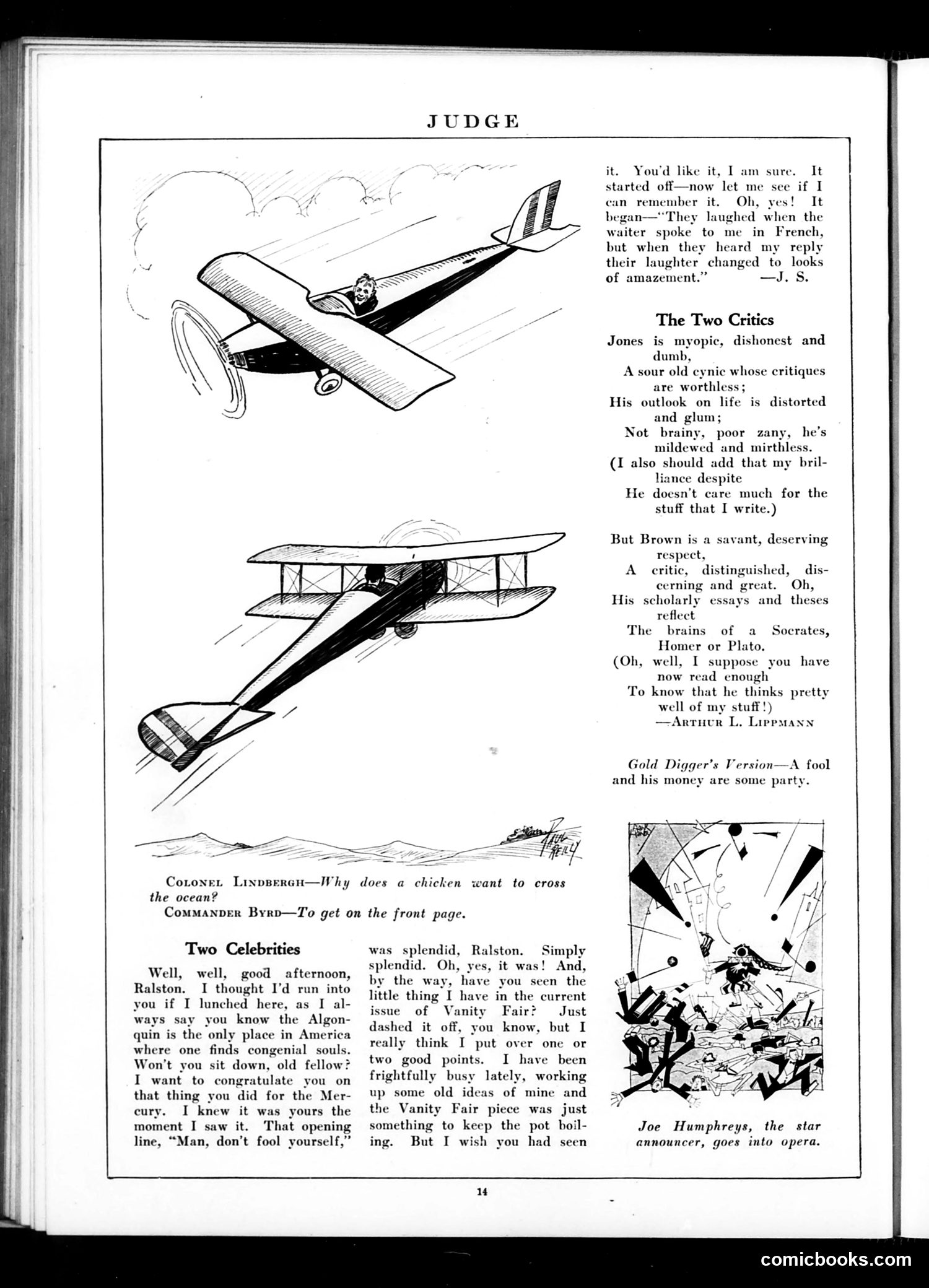
This Judge page contains social satire about 1920s literary culture. "Two Celebrities" mocks self-important writers at the Algonquin Club (a real New York gathering place for intellectuals) who boast about their magazine contributions while plagiarizing advertising copy. The joke: one writer steals a line from a Vanity Fair ad ("They laughed when I sat down at the piano") without realizing it, revealing the pretentiousness is hollow. "The Two Critics" satirizes how authors praise critics who like their work while dismissing those who don't—the speaker admires "Brown" only because Brown flatters the author's writing. This mocks the circular, insincere nature of literary praise. The airplane cartoons and references to Colonel Lindbergh, Commander Byrd, and Joe Humphreys appear to be topical humor about 1920s celebrities, though specific meanings are unclear without more context.
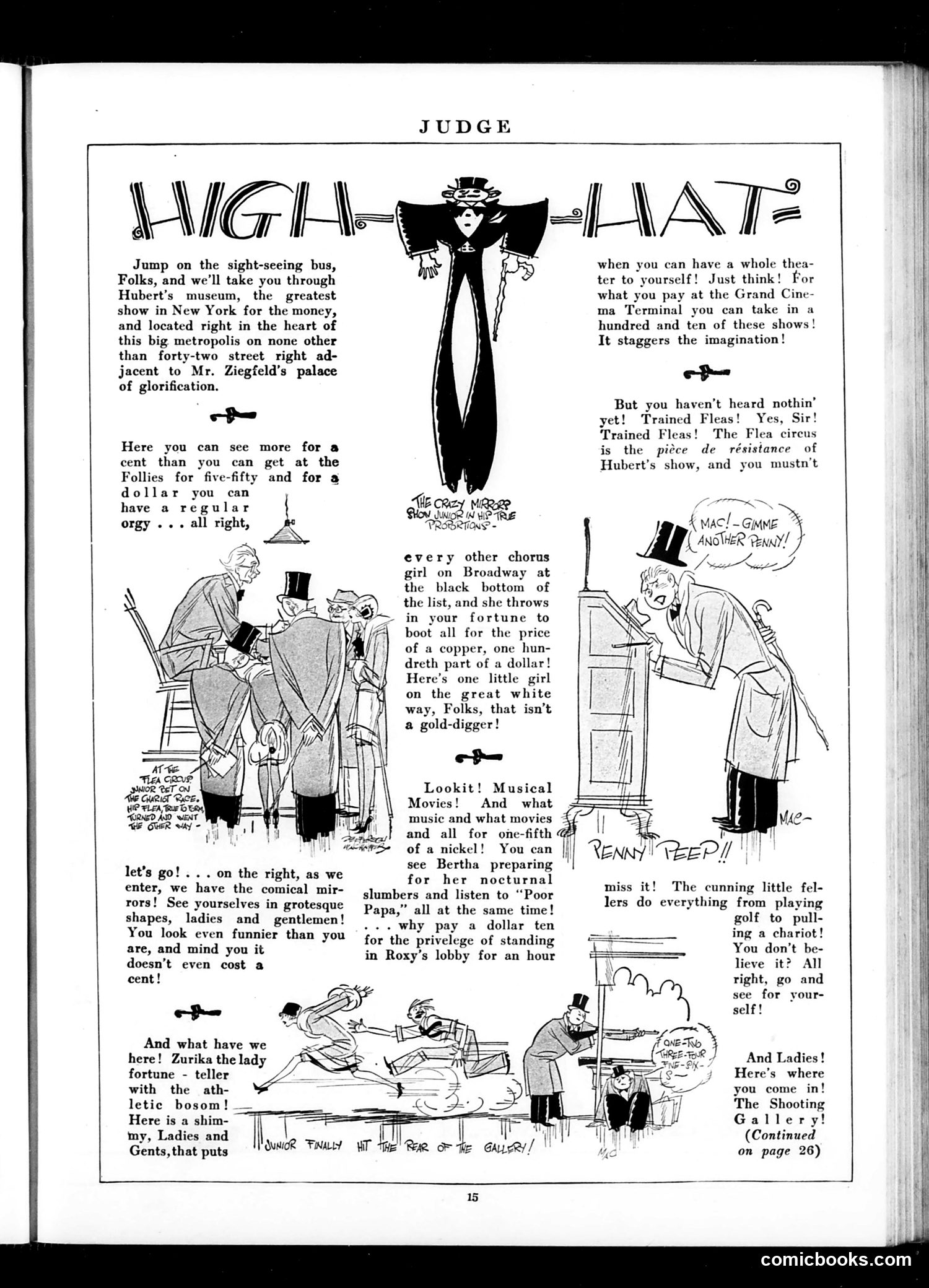
This is a satirical advertisement/tour guide for **Hubert's Museum**, a real Times Square attraction. The cartoonist mocks both the museum's cheap attractions and the tourists who patronize it by presenting an exaggerated "barker's" pitch—the theatrical spieling used by carnival promoters. **Key targets of satire:** - **Hubert's Museum itself**: Positioned as a bargain-basement competitor to the Ziegfeld Follies (an upscale Broadway revue), offering absurd attractions—distorting mirrors, fortune tellers, trained fleas performing circus acts, musical movies, and shooting galleries. - **Comparison to legitimate entertainment**: The text repeatedly contrasts Hubert's penny attractions with legitimate theater prices, mocking the naive visitors who think they're getting theater value for a cent. - **Broadway stereotypes**: References to chorus girls as "gold-diggers," the "black bottom" dance, and performers like Bertha reinforce period racial and gender stereotypes while satirizing the show business world. The humor depends on recognizing Hubert's as a genuine Times Square odditorium—a low-cost, sensationalized attraction—and understanding the contrast with legitimate Broadway culture.
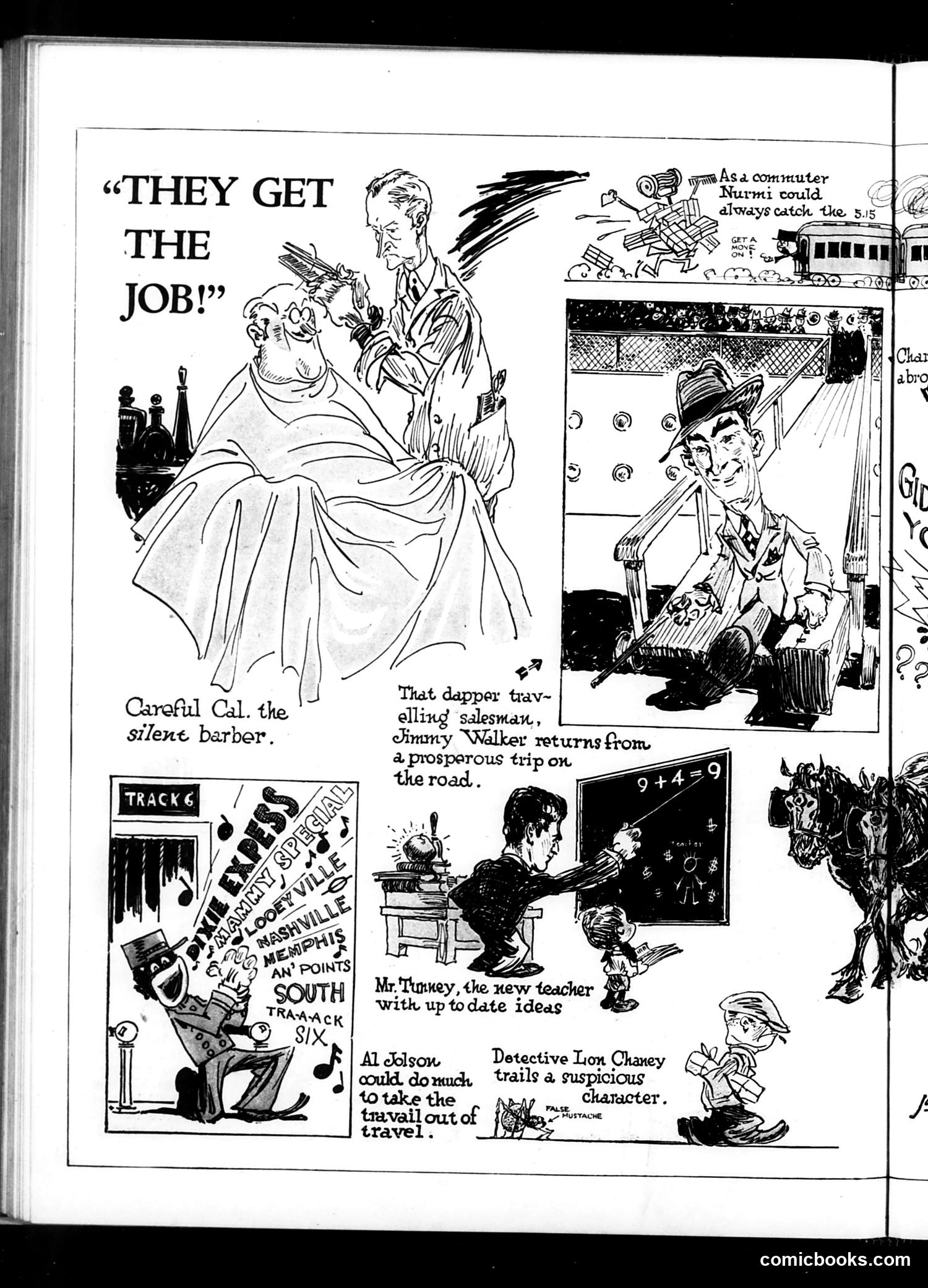
This page presents four brief comic vignettes satirizing employment and social types: 1. **"Careful Cal, the silent barber"** - A barber gives a customer a dramatic haircut while maintaining silence, playing on the stereotype of barbers as compulsive talkers. 2. **"Jimmy Walker returns from a prosperous trip"** - A traveling salesman appears well-fed and successful, satirizing the familiar figure of the door-to-door salesman archetype. 3. **"Mr. Tunkey, the new teacher"** - A teacher instructs using modern pedagogical methods (visible blackboard with math), suggesting generational change in education. 4. **"Detective Lon Chaney"** - References the famous silent-film actor, implying he's naturally suited to detective work given his pantomime skills. The overarching headline "THEY GET THE JOB!" suggests these characters represent people who succeed despite—or because of—their particular quirks or professions. The humor relies on period-specific professional stereotypes now largely obsolete.
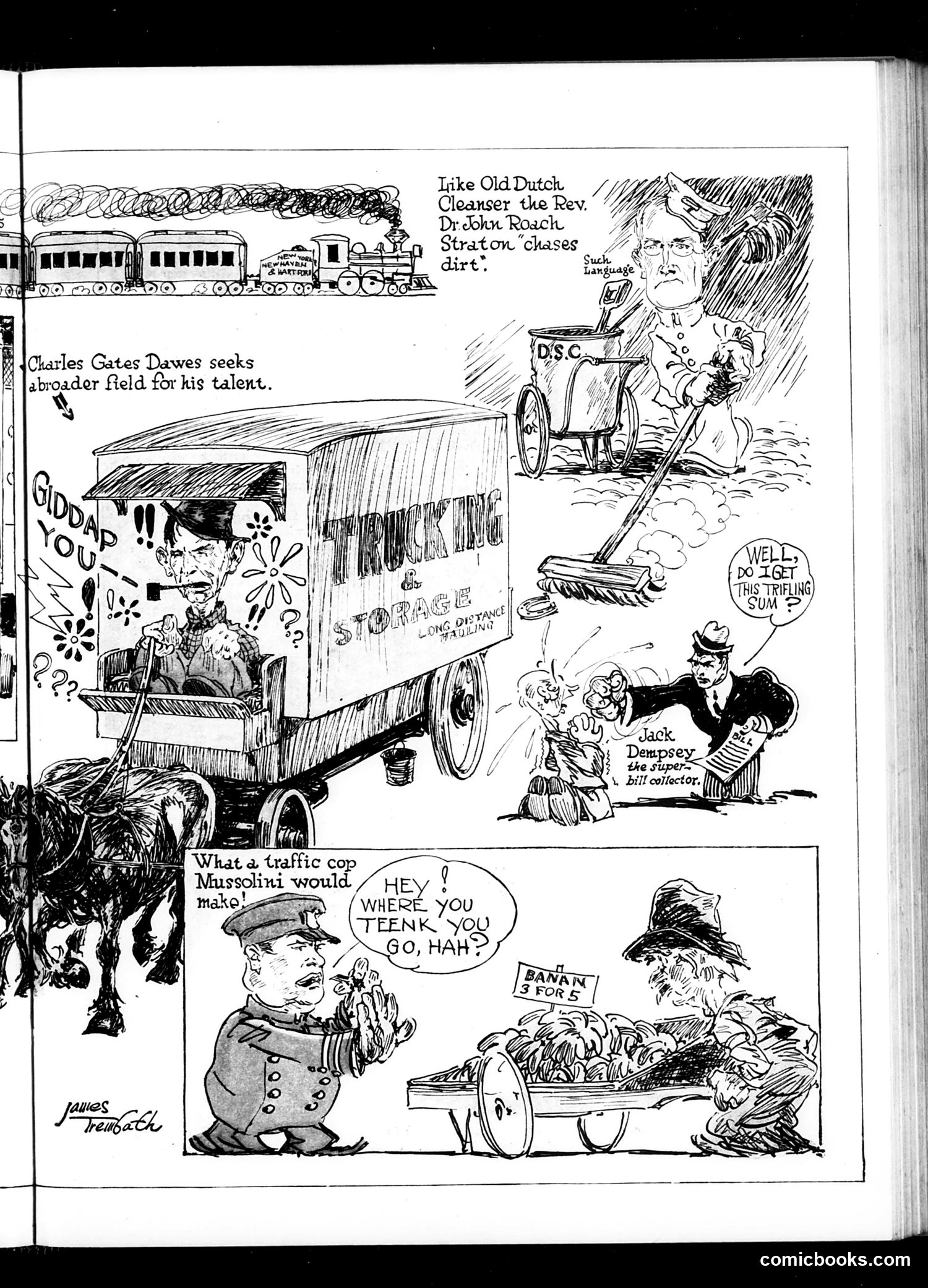
This Judge magazine page contains satirical commentary on 1920s American figures and politics: **Top panel**: References Rev. Dr. John Roach Straton (a prominent fundamentalist clergyman) as "Old Dutch Cleanser," suggesting he's attempting to "cleanse" American society of perceived moral dirt. **Middle section**: Charles Gates Dawes (Vice President under Coolidge) is depicted seeking "a broader field for his talent"—satirizing his ambitions or perceived limitations. **Traffic cop panel**: Compares Mussolini (Italy's fascist dictator) to a traffic cop, likely mocking his authoritarian control or suggesting he's a street-level thug elevated to power. **Bottom panel**: References "Jack" (unclear which Jack without full context) as a "super-bill collector," and shows banana vendors, possibly commenting on commerce or immigrant street traders. The overall tone is typical Judge satirical mockery of contemporary political figures, reformers, and international personalities through exaggerated caricature.
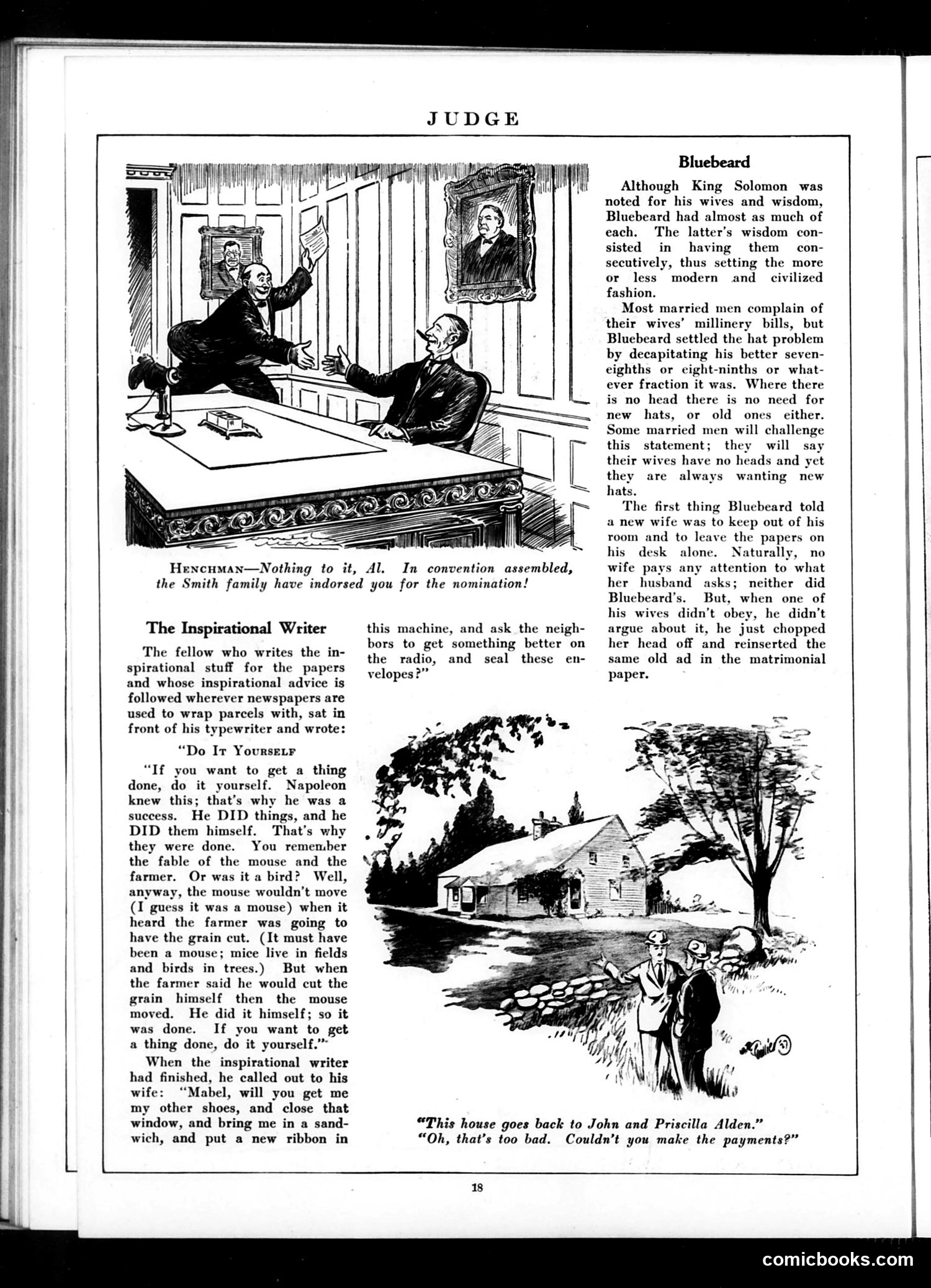
This page contains two separate satirical pieces: **"The Inspirational Writer"** mocks self-help advice columnists. The cartoon shows a man typing motivational content ("Do It Yourself," citing Napoleon) while simultaneously ordering his wife to do everything for him—close windows, make sandwiches, fix his typewriter. The satire is the hypocrisy: he preaches self-reliance while being entirely dependent on others' labor, particularly his wife's unpaid domestic work. **"Bluebeard"** is a darker humor piece referencing the fairy tale of a serial killer who murdered his wives. It uses this grotesque premise to satirize married life and women's fashion expenses. The joke compares Bluebeard's solution (beheading wives to eliminate hat-buying) to husbands' complaints about wives' millinery bills, sarcastically suggesting wives "have no heads" anyway—a misogynistic jab at women's perceived frivolousness. Both pieces employ cynical humor about marriage, gender dynamics, and hypocrisy typical of early 20th-century satirical magazines.
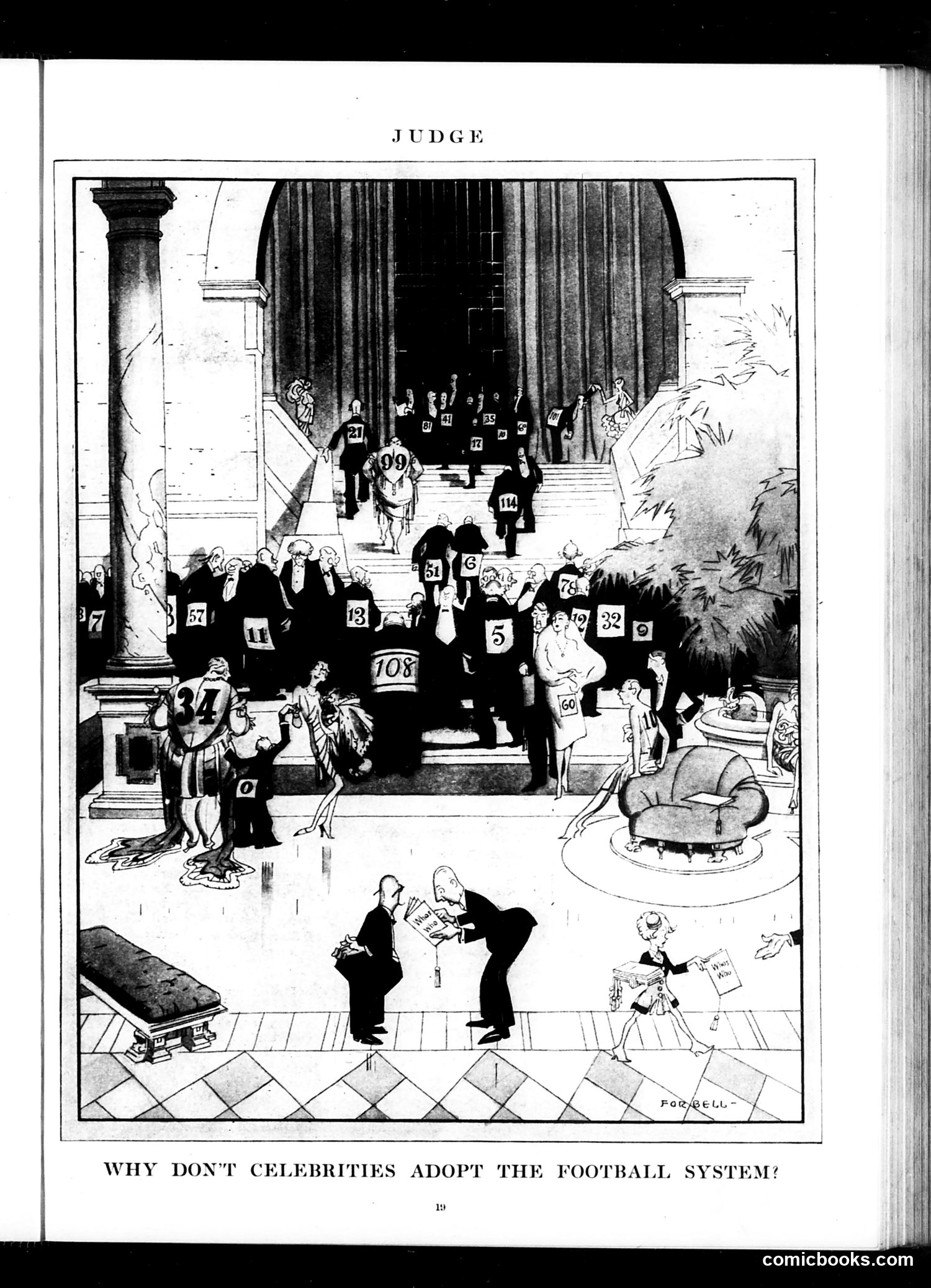
This Judge magazine cartoon satirizes the legal system by proposing it adopt a "football system." The scene depicts a courtroom that resembles a football stadium, with judges and court officials wearing numbered jerseys like players. The satire suggests that the American judicial process is chaotic and disorganized—so much so that it might benefit from football's structured rules and clear scoring system. The crowded courtroom full of numbered participants implies confusion about roles and procedures. The cartoon likely critiques early-20th-century court inefficiency, suggesting that justice should be as organized and rule-based as a sporting event. The humor relies on the absurdist juxtaposition of serious legal proceedings with athletic competition.
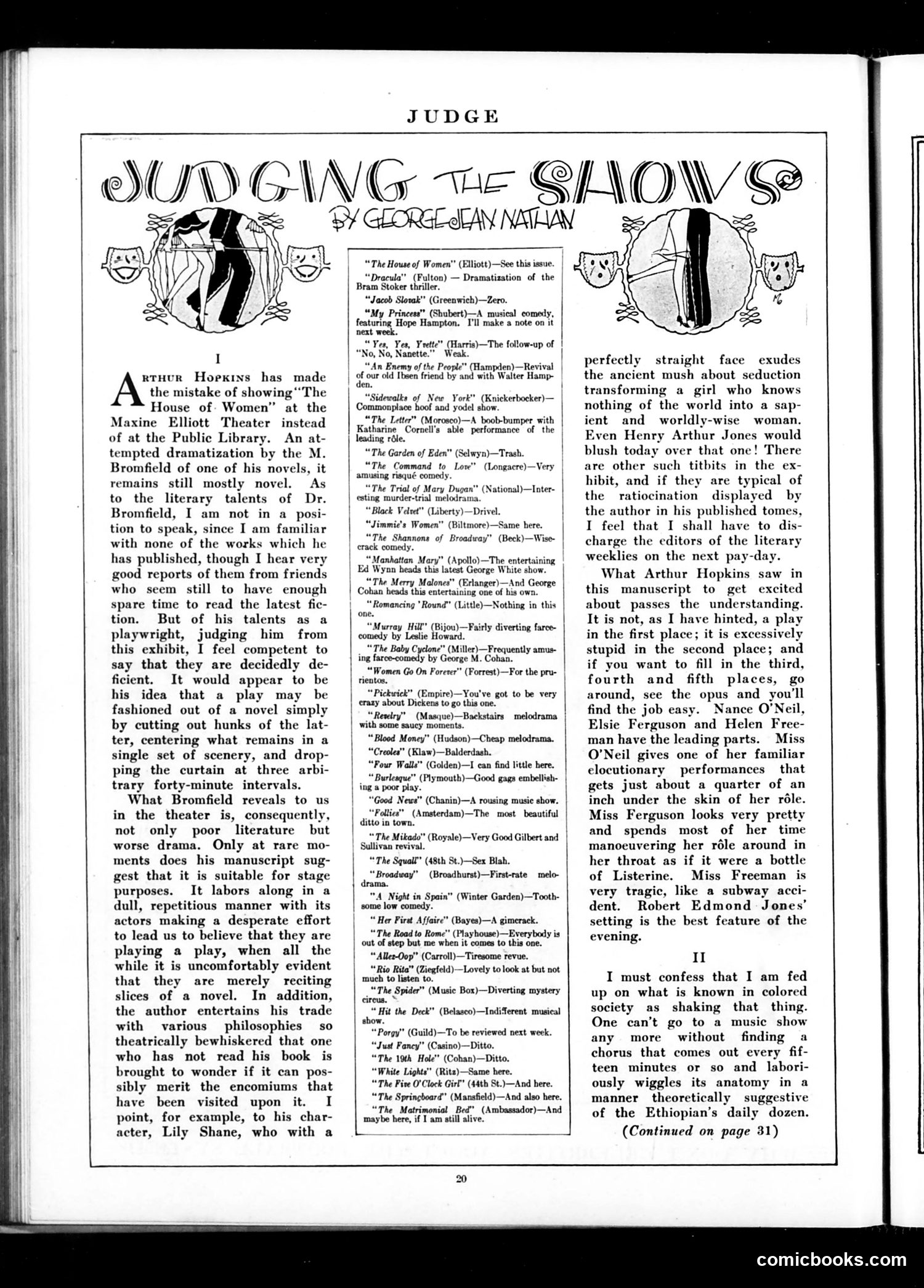
This is a theater review column by George Jean Nathan, a prominent drama critic of the 1920s era. The main article criticizes Arthur Hopkins's stage adaptation of M. Bromfield's novel "The House of Women" at the Maxine Elliott Theater, arguing it fails as drama because Hopkins merely cut chunks from the novel and placed them in a single set with arbitrary intermissions, rather than crafting a proper theatrical work. Nathan contends the production reveals poor playwriting: actors appear to be reciting novel passages rather than performing a cohesive play. He finds the philosophical musings in the script ("theatrically bewhiskered") pretentious and questions whether the source material deserves its critical acclaim. The page also contains Nathan's capsule reviews of numerous Broadway productions, rating them from entertaining to worthless, typical of Judge's theatrical coverage.
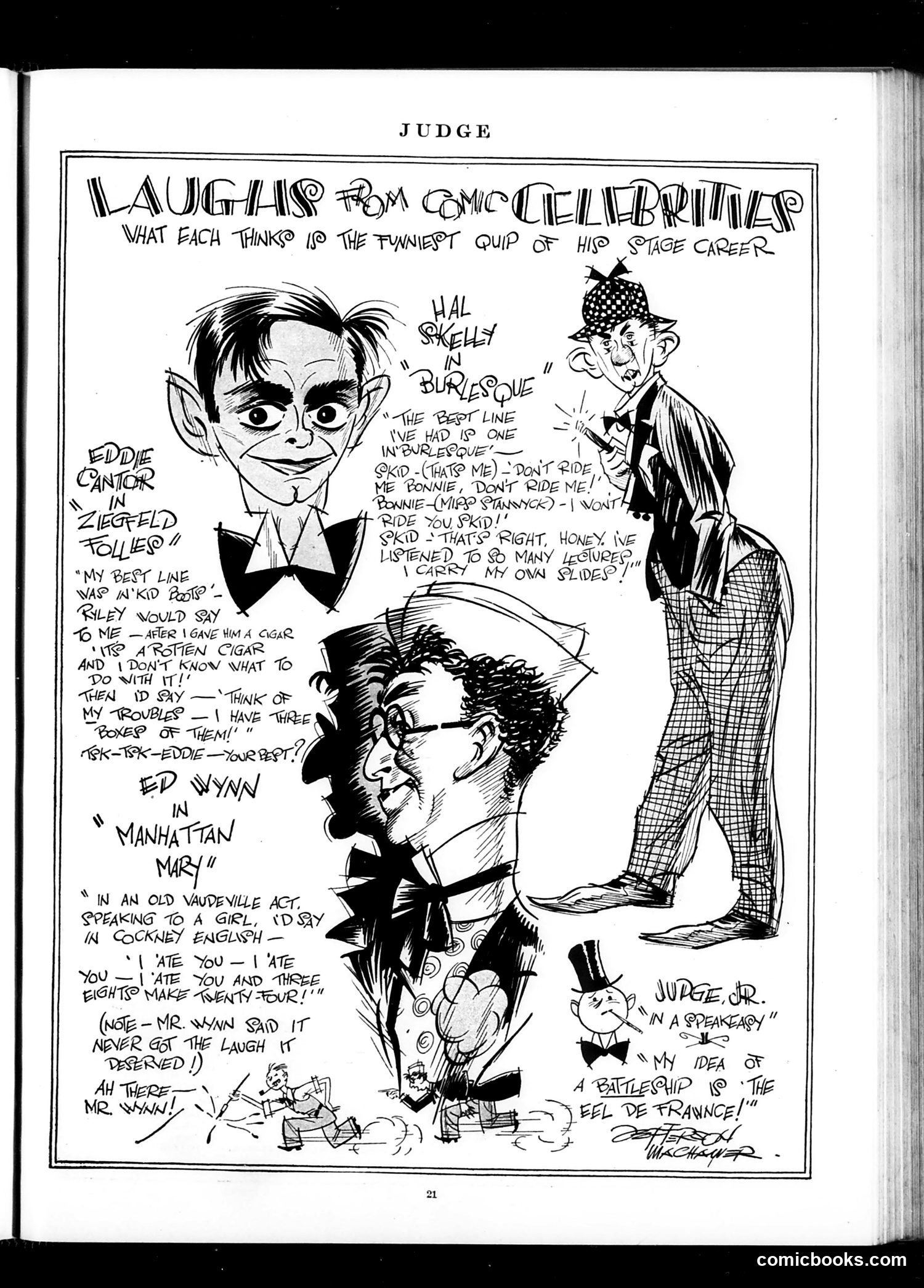
This page features caricatured comedy performers discussing their best stage jokes. **Eddie Cantor** (top left) and **Ed Wynn** (center) are vaudeville/early theater stars sharing anecdotes about their funniest lines. Cantor recalls a burlesque bit from a Ziegfeld Follies production where he'd provoke laughs by complaining about his troubles to a girl. Wynn recounts a cockney-dialect routine ("I ate you") that apparently never landed well, and a separate "pony ride" joke involving a woman named Minnie. The satire mocks performers' tendency to over-explain why their jokes were funny or justify their failure to get laughs—the humor lies in their defensive recounting rather than the actual jokes themselves (which are quite unfunny). The exaggerated caricatures emphasize vaudeville's theatrical, physical comedy tradition. This reflects Judge's interest in lampooning entertainment industry figures and the gap between performers' self-assessment and audience reality.
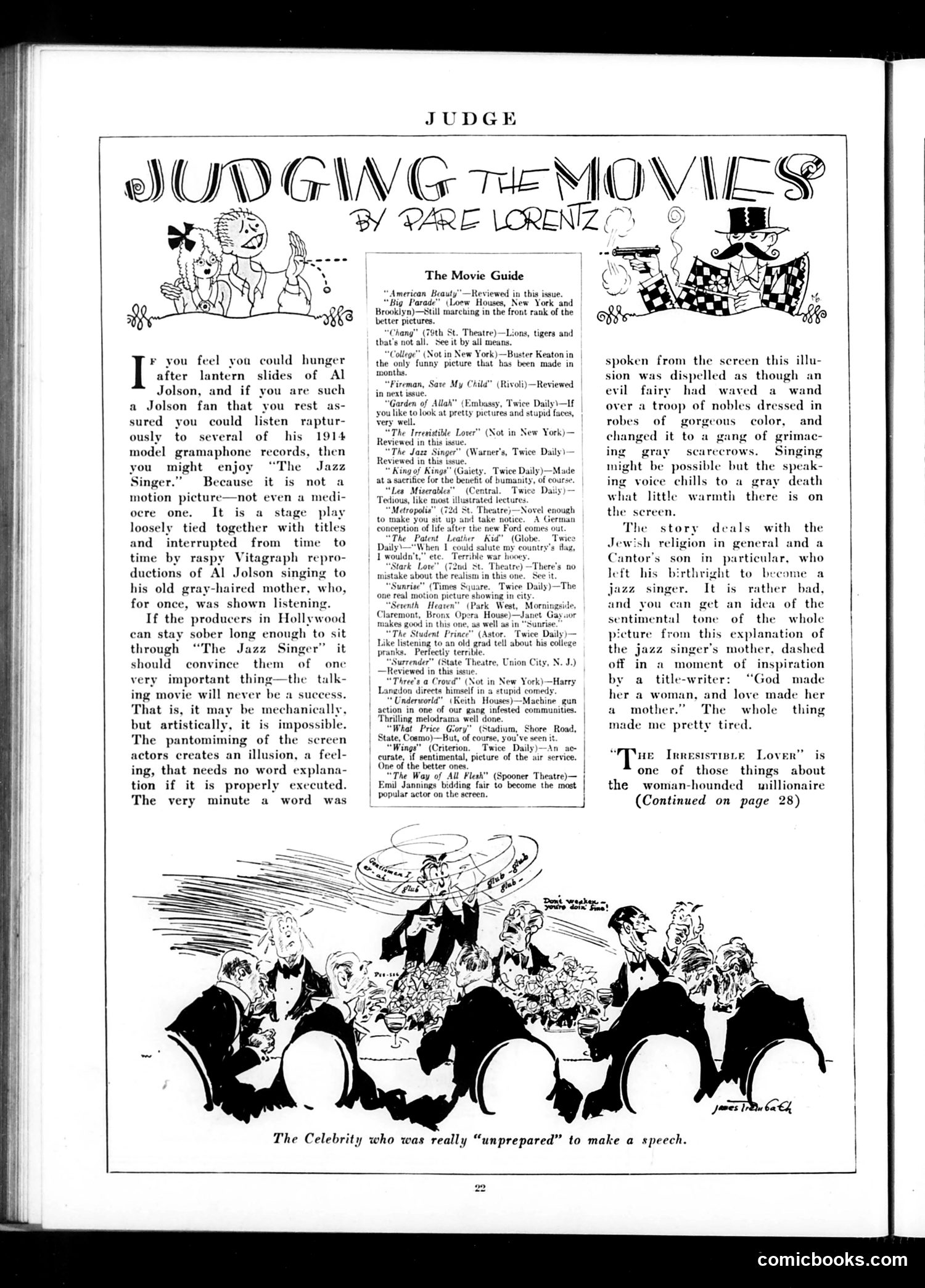
This page reviews "The Jazz Singer" (Warner's, appearing twice daily), the 1927 film starring Al Jolson. The critic argues that talking pictures represent artistic failure, destroying the pantomime illusion that makes silent film work. Each spoken word undermines actors' performances, turning dignified figures into "grimacing gray scarecrows." The review mocks the film's sentimental plot about a Jewish cantor's son becoming a jazz singer, ridiculing its overwrought mother-worship theme. The cartoon below—showing well-dressed men appearing unprepared to speak—likely satirizes celebrities awkwardly adapting to sound technology. The "Movie Guide" column lists contemporary releases with snide commentary, suggesting Judge's broader skepticism toward Hollywood's artistic standards. This reflects 1927 critical resistance to "talkies" as technically gimmicky rather than genuinely cinematic.
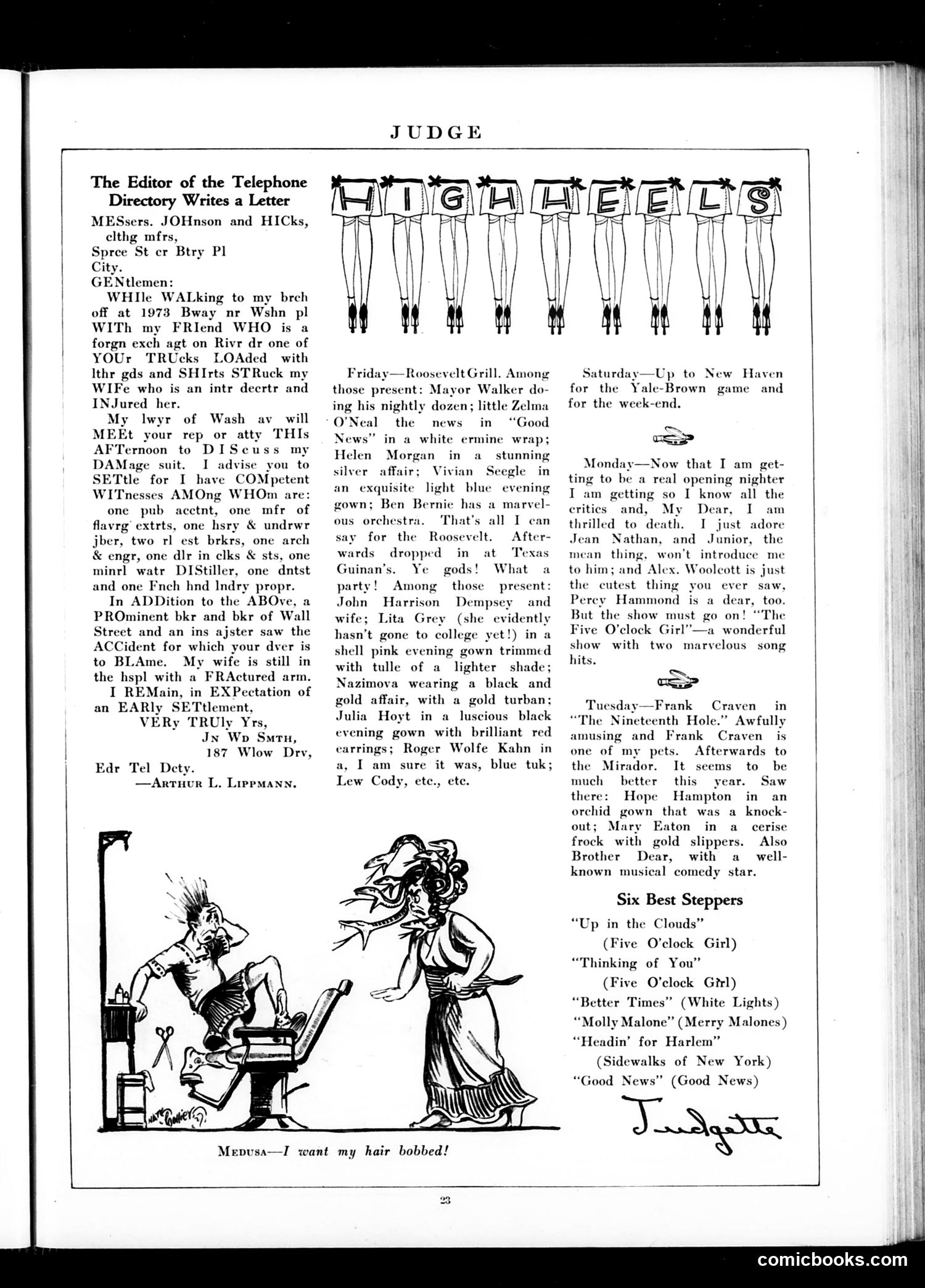
This page contains two distinct pieces of 1920s satire: **The Main Cartoon** (top): A letter from a telephone directory editor complaining about abbreviated business listings. The humor derives from the absurdist premise—the writer deliberately misspells and abbreviates his own letter (WHIle, brch, WIFe, etc.) to mock how telephone directories butcher company names and addresses, making them nearly unreadable. **The Sidebar Content** (right): Social gossip about Manhattan nightlife featuring actual 1920s celebrities: Mayor Jimmy Walker, Helen Morgan (blues singer), Ben Bernie (orchestra leader), Texas Guinan (nightclub owner), Lita Grey (Charlie Chaplin's wife), and others. The writer describes attending opening nights at Broadway theaters and nightclubs, name-dropping entertainment figures. **The Small Cartoon** (bottom): Shows Medusa getting her hair bobbed—a visual pun on the fashionable "bob" hairstyle of the 1920s flapper era. The satire targets both business incompetence and the social pretension of people obsessed with celebrity sightings and theatrical attendance.
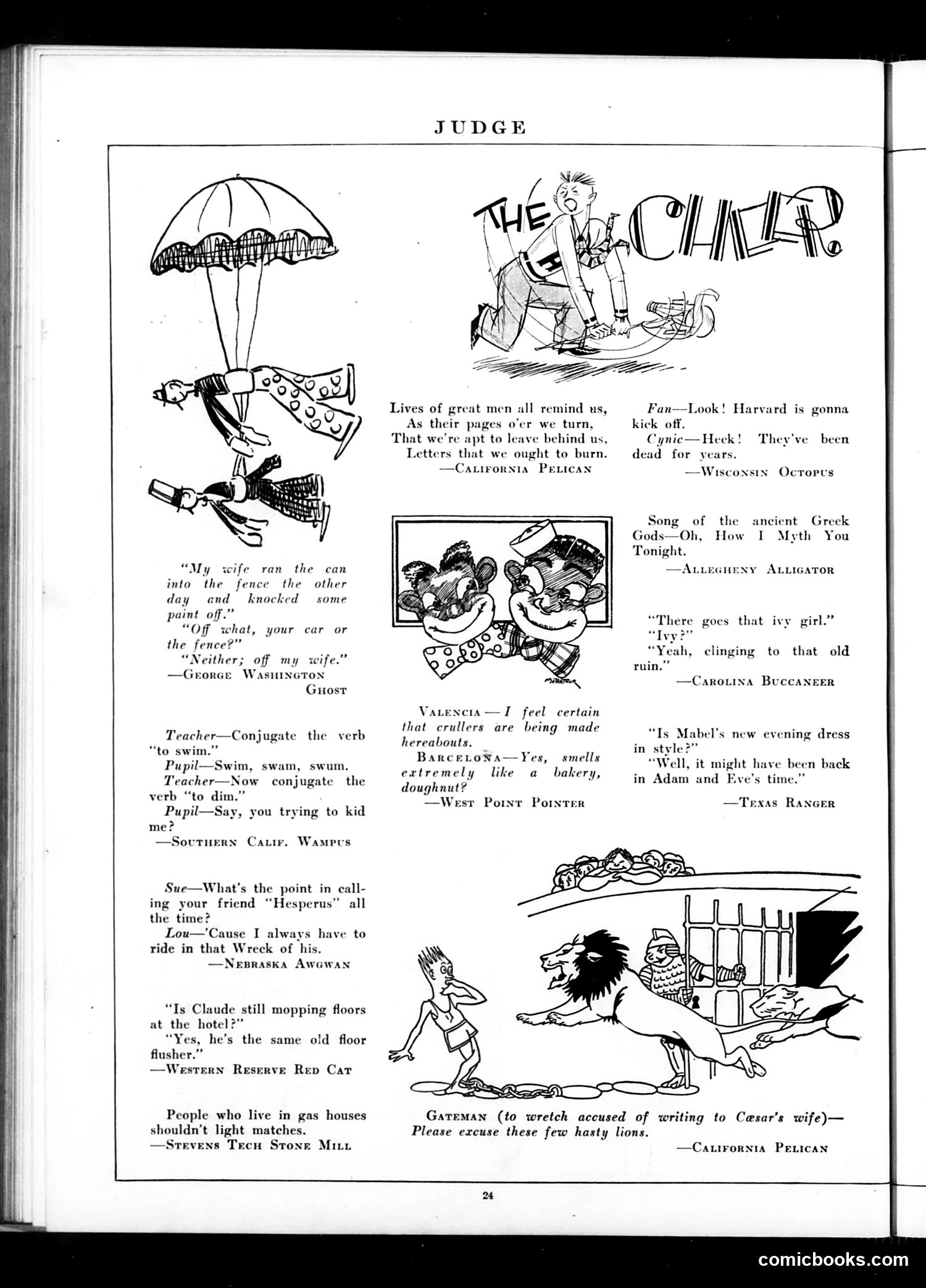
This is a humor page from *Judge*, a satirical magazine, featuring numerous jokes and cartoons from college newspaper contributors (indicated by the university attributions). The content mixes several joke types: puns ("conjugate the verb 'to dim'"), literary references (the "Wreck of Hesperus"), and social commentary. One cartoon depicts a gateman excusing "hasty lions" to someone accused of writing to Caesar's wife—a classical allusion playing on the phrase "Caesar's wife must be above reproach," here made absurd by substituting wild animals for scandal. Other jokes reference Harvard athletics, evening dress fashion, and domestic mishaps. The overall tone is lighthearted collegiate humor typical of early 20th-century American satire, relying on wordplay, classical references, and everyday domestic situations for comedic effect. The page demonstrates *Judge*'s practice of publishing student humor submissions alongside professional cartoons.
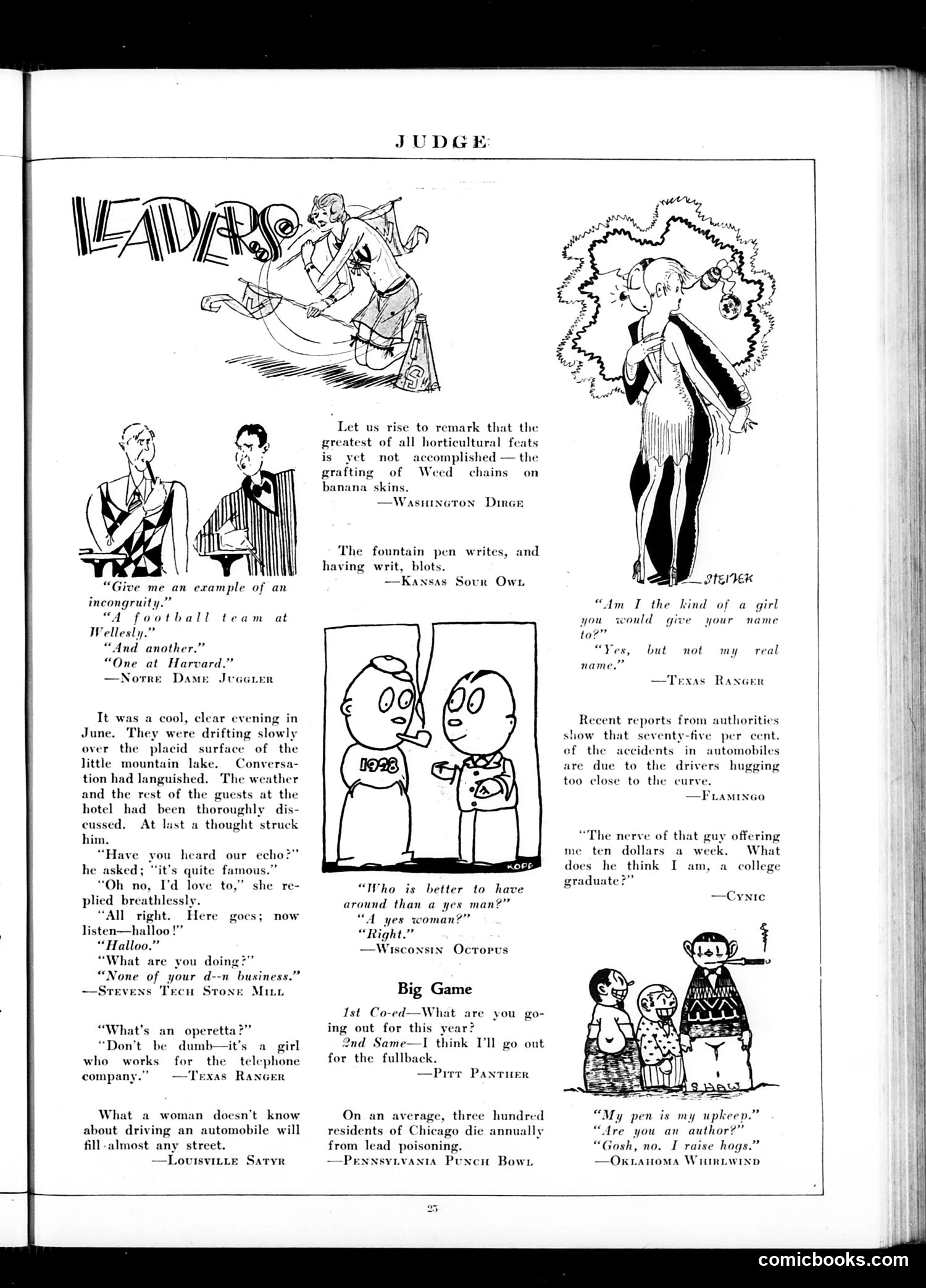
This page collects humorous one-liners and comic vignettes typical of Judge's satirical style. Key content includes: **Social Satire:** - Jokes about women's incompetence driving automobiles and ignorance of mechanics (reflecting 1920s gender stereotypes) - Operetta joke mocking telephone operators as unintelligent - College graduate joke about low wages, suggesting economic anxiety post-WWI **"Big Game" Section:** College co-ed jokes about recruiting for football, with sexual innuendo ("fullback") **Recurring Themes:** - Absurdist humor about romantic courtship ("echo" story) - Fountain pen reliability complaints - Chicago lead poisoning statistics (likely industrial-era concern) - Yes-men workplace culture critique **Visual Style:** Simple line drawings accompanying quips attributed to college humor publications (Notre Dame, Wellesley, Wisconsin, etc.), reflecting Judge's reliance on collegiate wit submissions. The page reflects 1920s preoccupations: automobiles, women's changing social roles, workplace dynamics, and campus humor culture—all delivered through sharp, dismissive jokes.
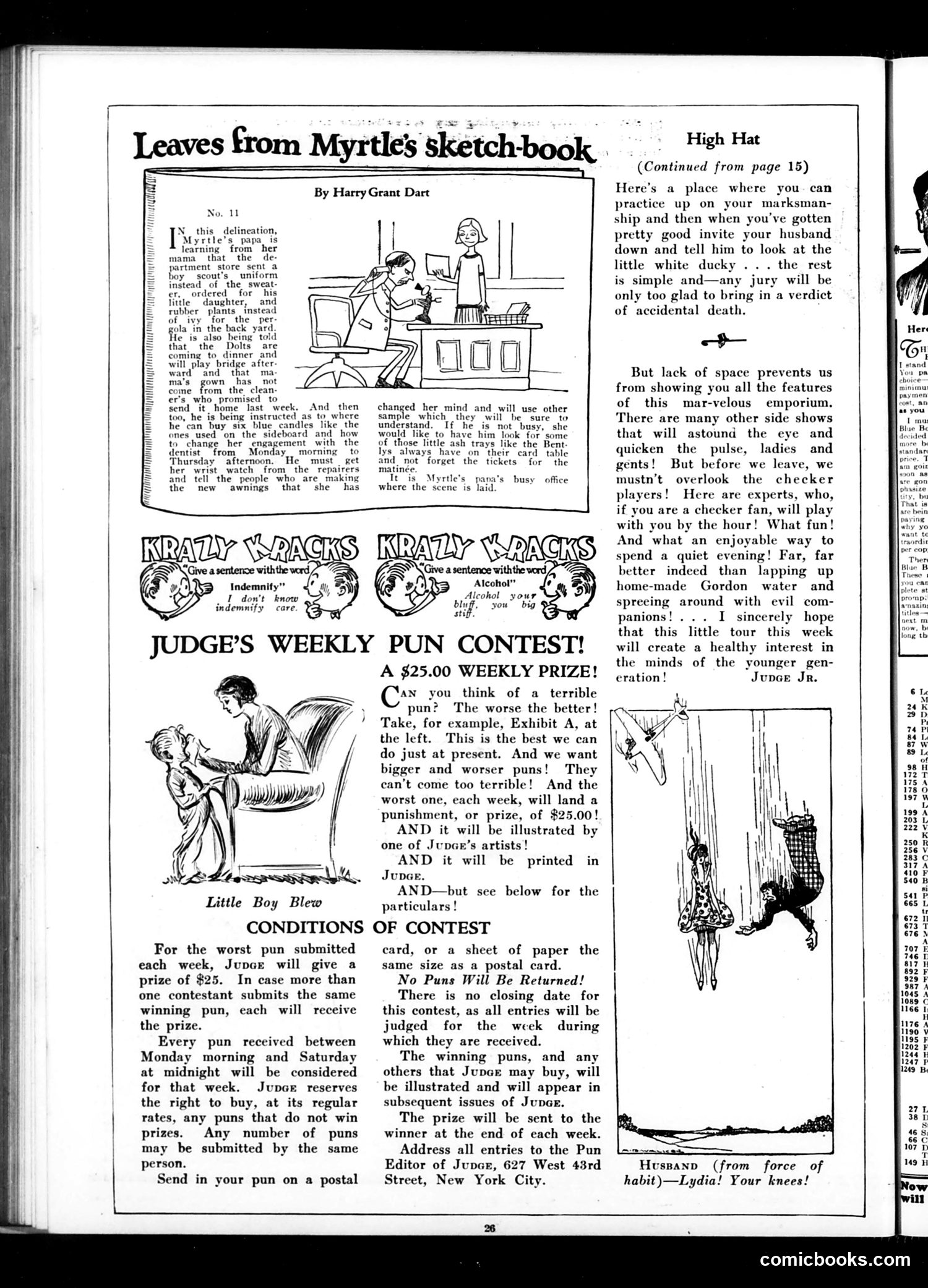
This Judge magazine page contains three distinct sections: **"Leaves from Myrtle's Sketchbook"** (top): A domestic humor cartoon by Harry Grant Dart depicting a harried husband receiving an endless stream of errands and instructions from his wife—dry cleaning, dinner preparations, dentist appointments, shopping for candles and ashtrays. The satire mocks the expectation that husbands serve as errand-runners while wives manage the household. **"Judge's Weekly Pun Contest"** (center): An advertisement for a $25 weekly prize for the worst possible pun. The sample pun shown, "Little Boy Blew," plays on the nursery rhyme. This reflects early-20th-century humor's embrace of groan-worthy wordplay. **"High Hat"** (right): Concluding an article about an amusement venue, with dark satire about a shooting gallery where a wife could practice marksmanship before killing her husband and claiming accidental death—extremely dark gallows humor typical of Judge's satirical edge. The page exemplifies Judge's mix of domestic satire, participatory contests, and edgy social commentary.
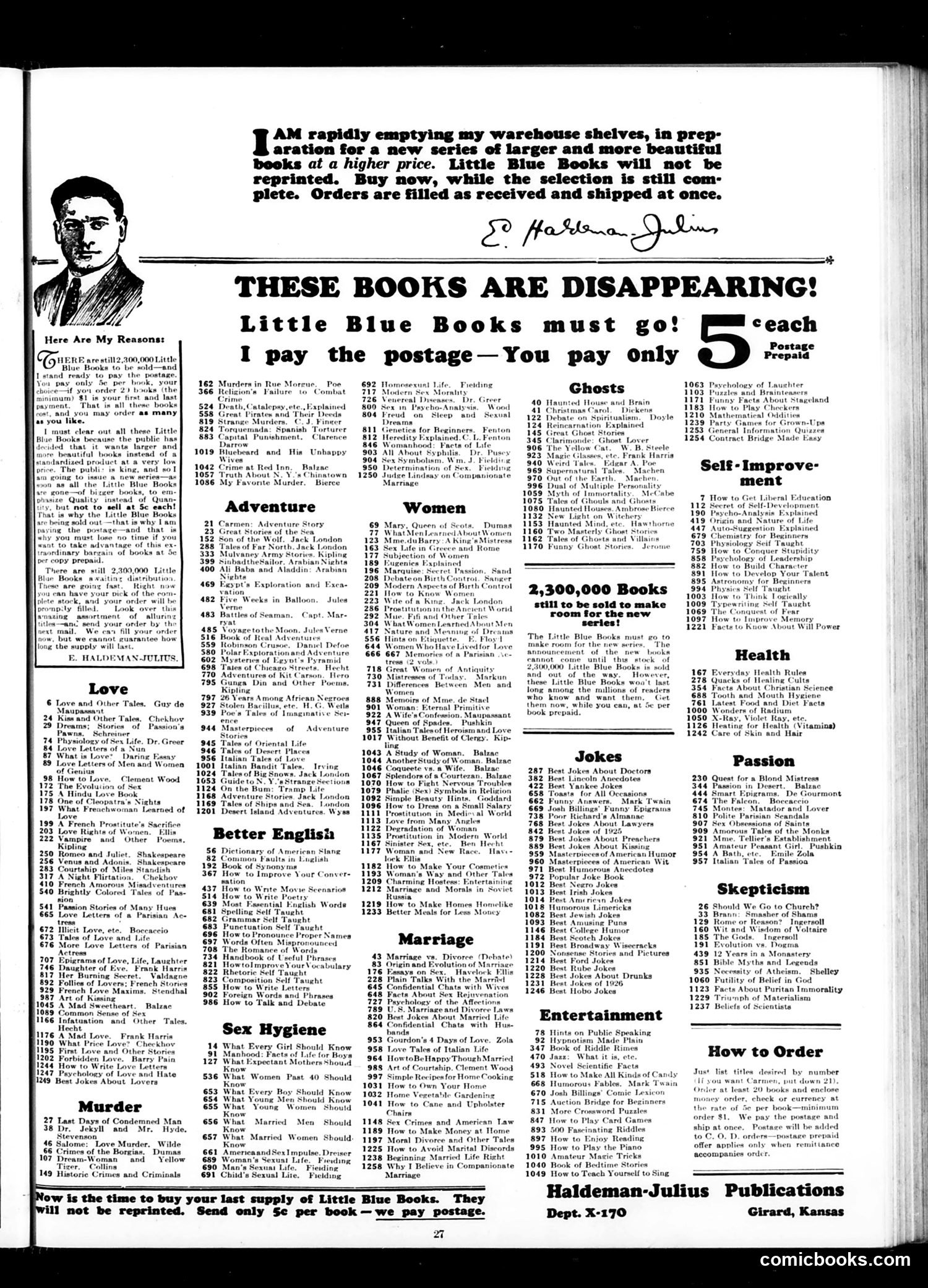
This page is primarily **advertising** for the Haldeman-Julius Publications' "Little Blue Books" series. There are no political cartoons present. The single illustration shows **E. Haldeman-Julius**, the publisher, who announces he is clearing warehouse inventory to make room for a new, larger, more expensive book series. The "little blue books" — apparently affordable, pocket-sized paperbacks sold for 5 cents each (with postage paid by the publisher) — are being discontinued and will "not be reprinted." The advertisement lists hundreds of titles across categories (Murder, Love, Adventure, Women, etc.), emphasizing the breadth of available subjects. The messaging is primarily commercial: urging customers to buy before stock runs out. **Context**: This represents early 20th-century mass-market publishing, where inexpensive pocket books made literature and educational content widely accessible. The format's discontinuation suggests a shift toward higher-margin products.
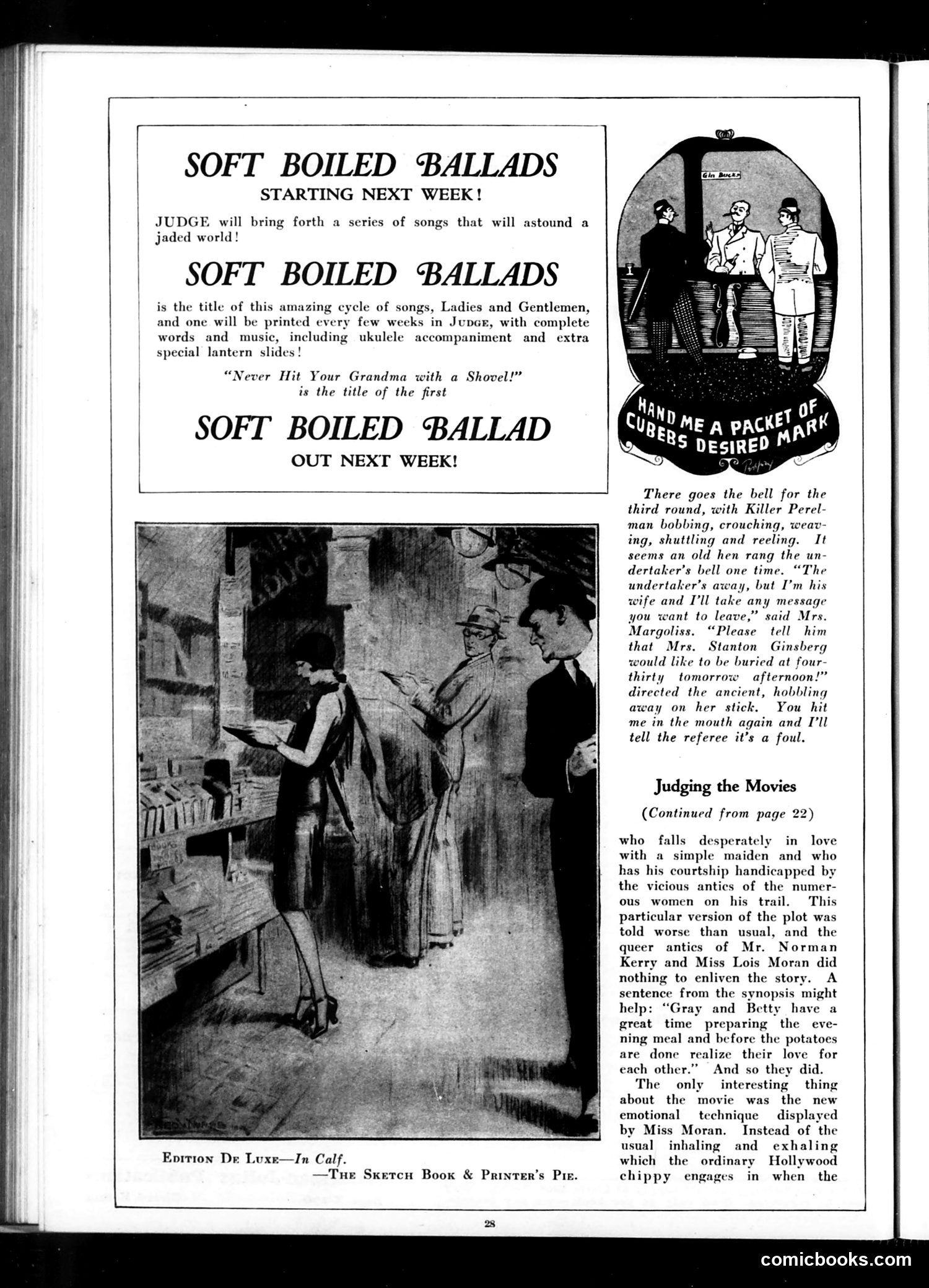
This page primarily advertises an upcoming **"Soft Boiled Ballads"** song series Judge will publish, featuring humorous titles like "Never Hit Your Grandma with a Shovel!"—absurdist comedy typical of 1920s satire. The ukulele accompaniment reference reflects the era's popular music trends. The lower half contains a movie review continuing from page 22, critiquing a film starring Norman Kerry and Lois Moran. The reviewer dismisses the plot as trite (young couple realizes love while cooking) and criticizes the actors' performances. The final sentence sarcastically notes Moran's "new emotional technique," implying Hollywood actresses typically resort to shallow physical acting (inhaling/exhaling) rather than genuine performance skill. The photograph shows what appears to be a scene from the reviewed film. Overall, this is largely advertising and entertainment criticism rather than political satire, reflecting Judge's shift toward lighter humor content.
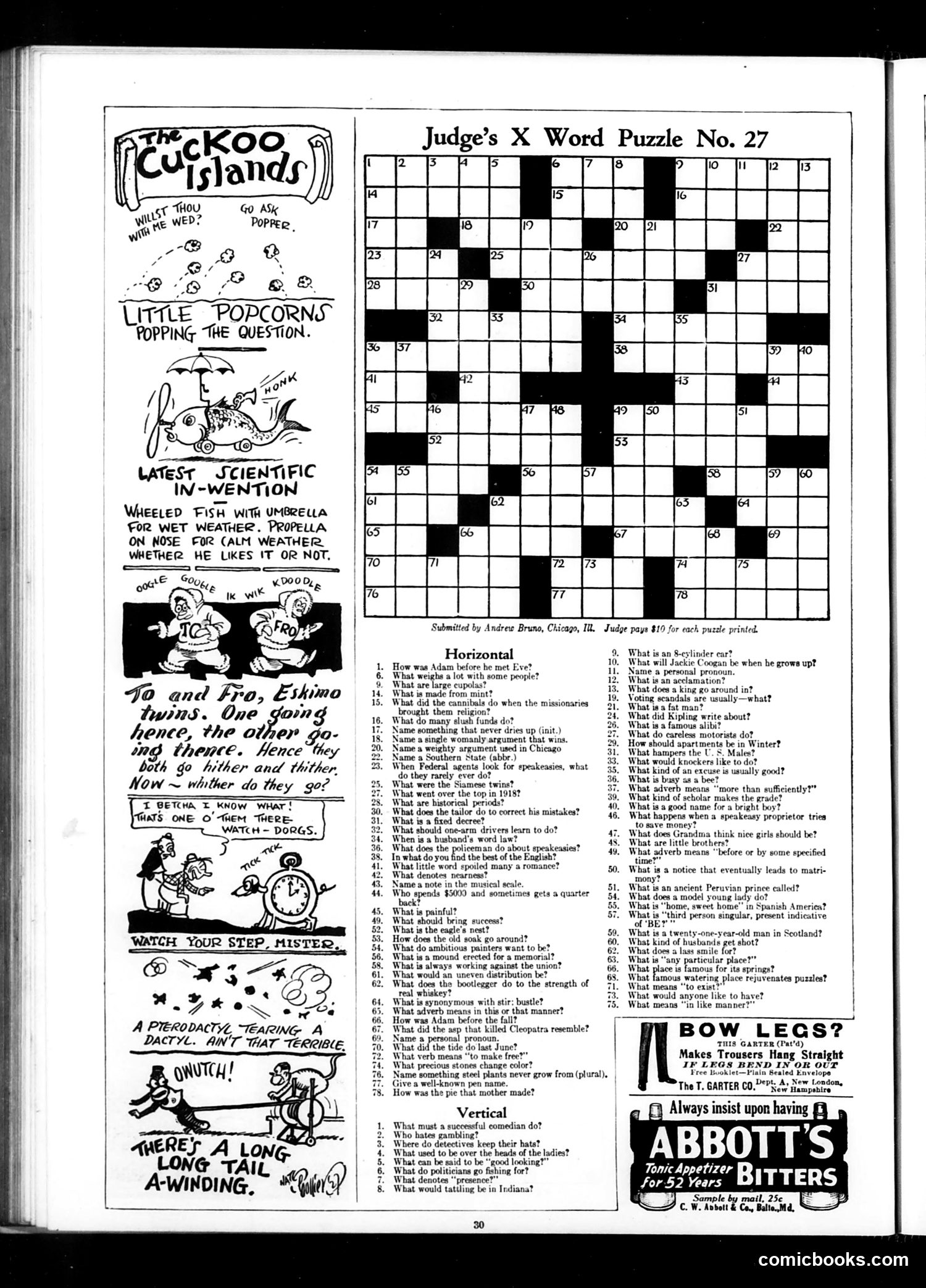
This page from Judge magazine (a satirical publication) contains primarily **humorous comic strips and a crossword puzzle**, rather than political commentary. **The comics** feature absurdist humor typical of early 20th-century American comics: - "The Cuckoo Islands" depicts silly inventions (a wheeled fish with umbrella) and wordplay riddles - "To and Fro, Eskimo Twins" is a play on directional logic - Other strips use puns and visual gags **The crossword puzzle** reflects contemporary 1920s-30s concerns: references to Prohibition ("bootlegger," "speakeasies"), contemporary figures (Jackie Coogan, Kipling), historical events (soldiers going "over the top" in WWI), and period slang. **Notable context**: The advertisements for "Bow Legs" corrective trousers and Abbott's Bitters reflect era-specific medical anxieties and patent medicine marketing. The page is primarily **entertainment-focused humor** rather than political satire—Judge functioned as a humor and general interest magazine alongside its satirical commentary.
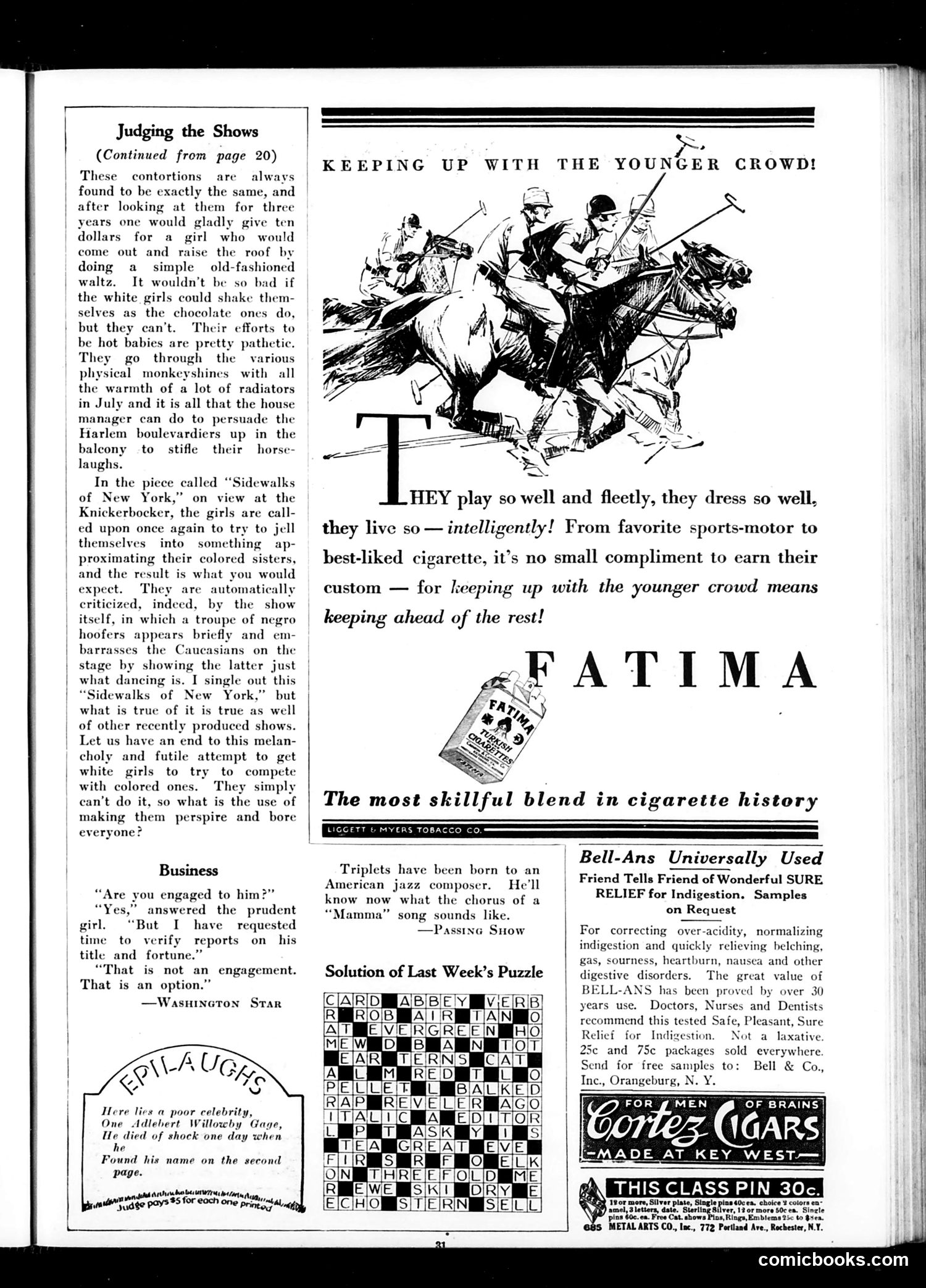
This page contains **racist theater criticism** alongside advertisements. The main "Judging the Shows" column critiques Broadway productions, particularly attacking white female performers who attempt to imitate Black dancers. The author argues white girls lack the natural rhythm and "warmth" of Black performers ("chocolate ones") and should stop trying to compete, calling their efforts "pathetic" and "boring." This reflects 1920s racial attitudes where Black entertainment was consumed by white audiences while Black performers faced segregation. The critic's complaint reveals how white performers' imitation of Black dance was simultaneously valued (as entertainment) and denigrated (as inferior). The page also features cigarette and patent medicine advertisements typical of the era—Fatima cigarettes and Bell-Ans antacid—exploiting consumer anxieties about modern living and digestion. The "Business" humor column makes a lighter joke about engagement and financial verification, unrelated to the racist content above.
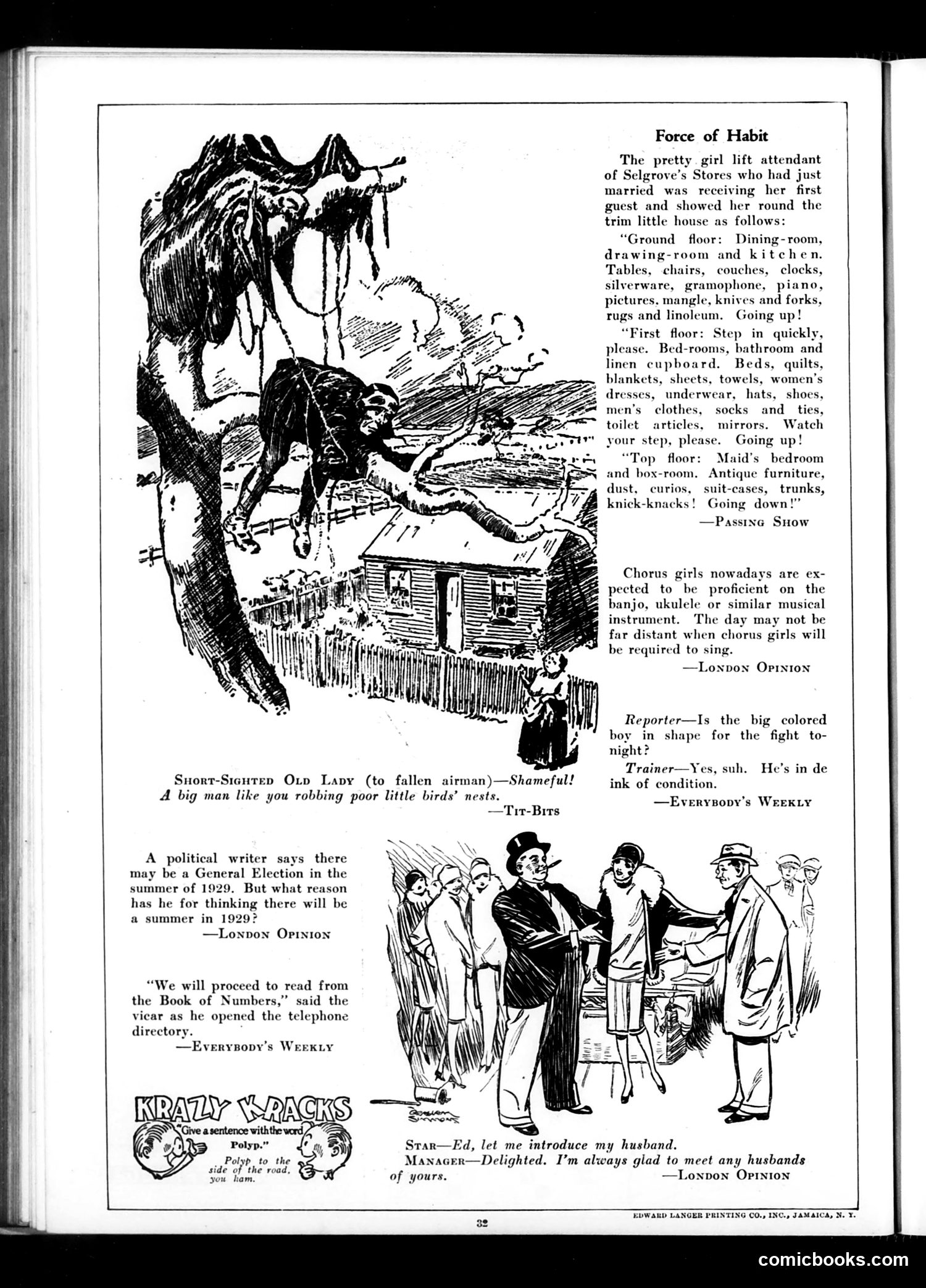
This page collects brief humorous pieces typical of early 20th-century satirical magazines: **"Force of Habit"** mocks a newly married lift (elevator) attendant from a department store who mechanically recites inventory lists while showing her home—she's so habituated to her job that she narrates her own house like merchandise, ending with "Going down!" as she exits. **Other jokes** target contemporary subjects: chorus girls' musical incompetence; a boxer trainer's dialect humor; an elderly woman scolding an airman for stealing birds' eggs (conflating aviation with nest-robbing); pessimism about Britain's 1929 summer; a vicar accidentally reading a telephone directory as scripture. **The street scene cartoon** appears to depict a manager meeting someone's husband—the caption plays on the phrase "always glad to meet any husbands of yours," implying infidelity. These are lightweight social observational humor and wordplay typical of Judge's style—no major political figures are caricatured here. The satire targets everyday absurdities and social foibles rather than specific current events.
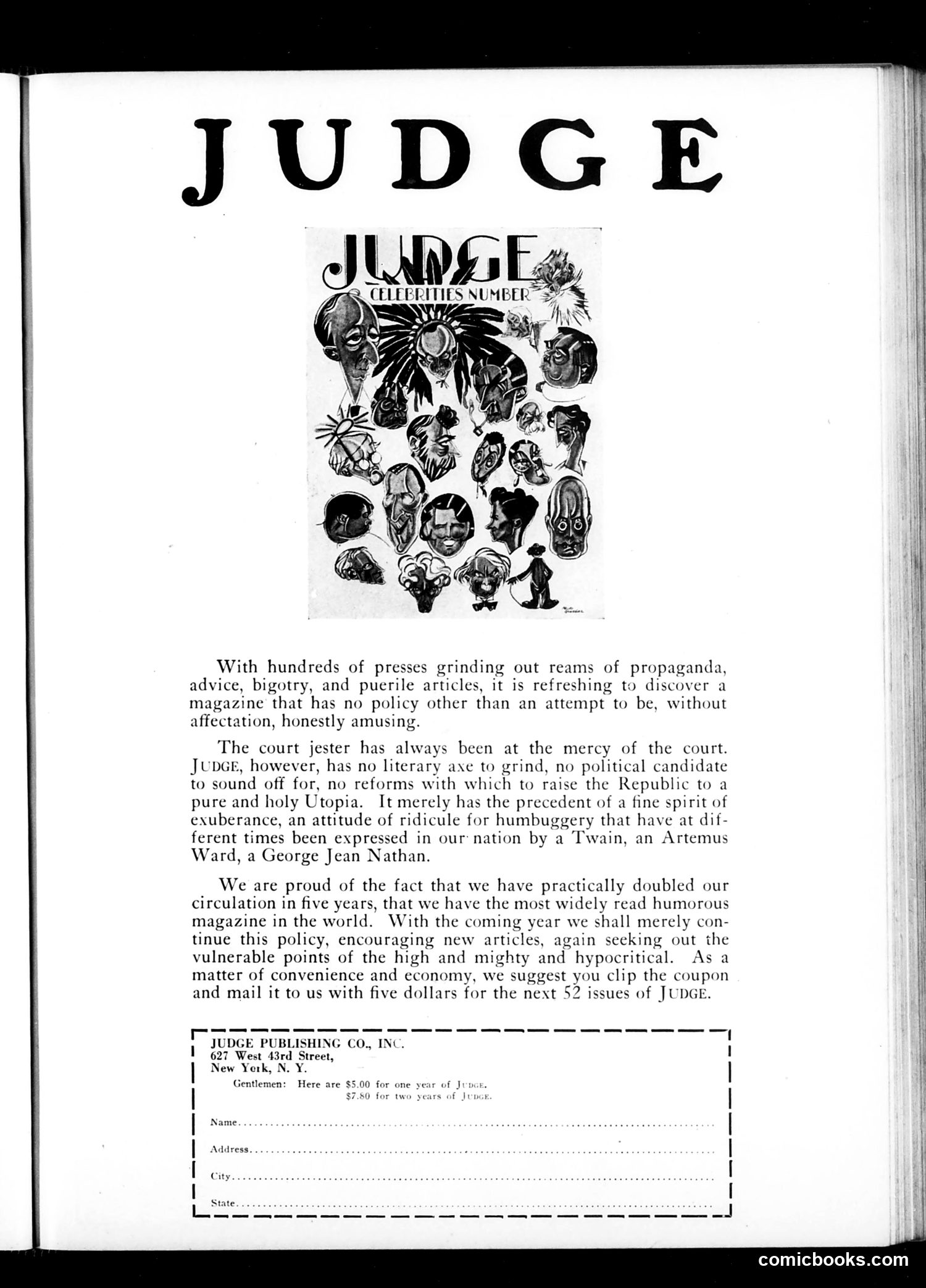
This is a promotional page for **Judge**, a satirical humor magazine, rather than a specific cartoon. The collage image shows various caricatured faces—likely representing different public figures or social types that Judge ridicules. The text is Judge's self-promotional manifesto, positioning itself as America's premier satirical publication. It claims independence from political agendas or reform movements, positioning humor as its only mission. The magazine compares itself to historical American humorists like Mark Twain and Artemus Ward, positioning satire as a respected tradition of mocking "humbug" and hypocrisy among the powerful. Judge boasts of doubled circulation and claims to target "vulnerable points of the high and mighty and hypocritical." The subscription offer ($5 yearly) reflects this as a commercial enterprise selling irreverent social commentary to readers tired of earnest propaganda from other publications.
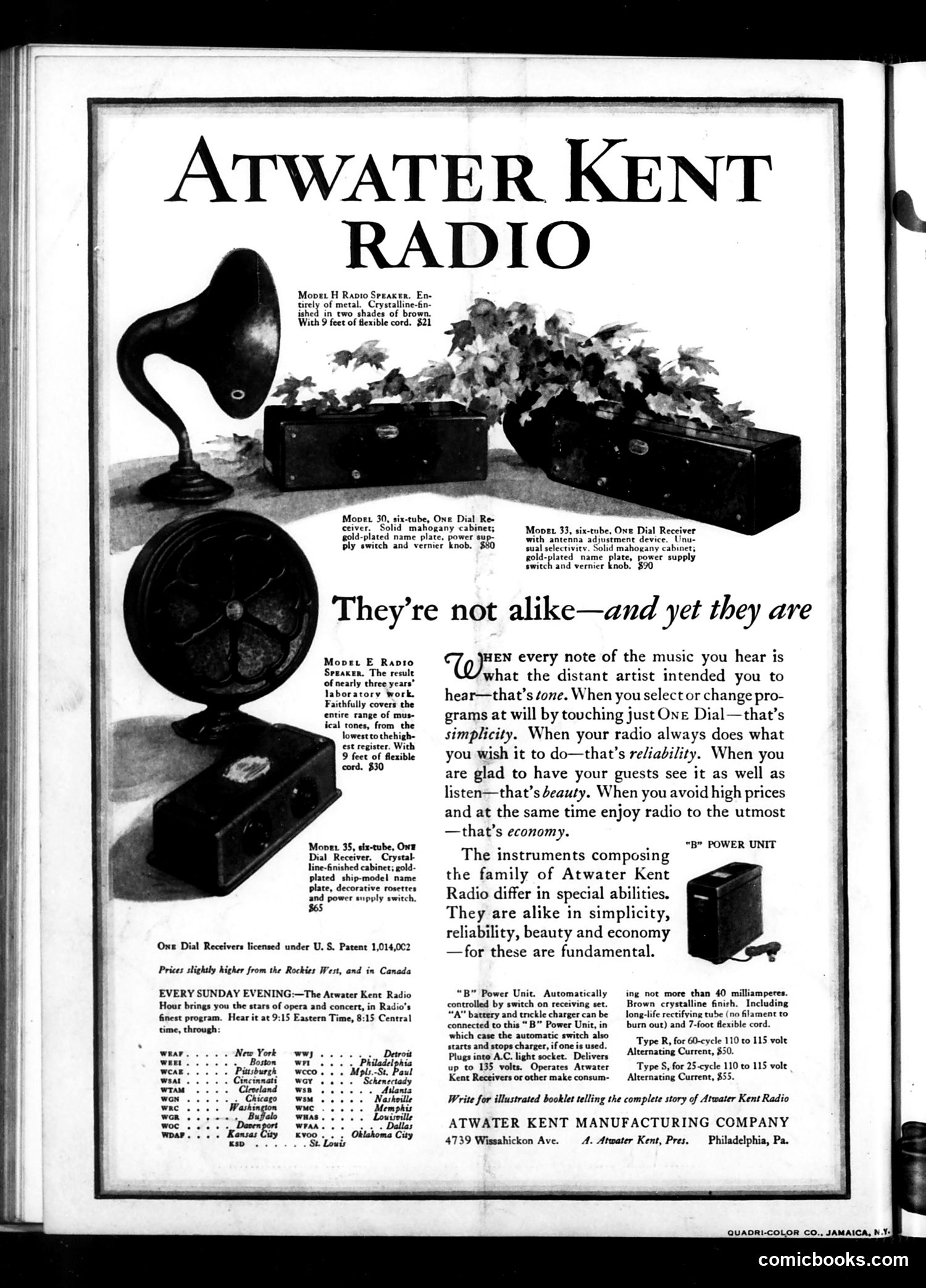
This is **not a political cartoon or satire**—it's a product advertisement for Atwater Kent radios, a major manufacturer of the era. The page displays several radio models (speakers, receivers, and power units) with the headline "They're not alike—and yet they are." This marketing paradox emphasizes that while Atwater Kent's product line varies in price and features ($21–$90), all models share fundamental qualities: simplicity, reliability, beauty, and economy. The copy appeals to middle-class consumers by promising quality sound reproduction and ease of use ("One Dial" operation). The advertisement includes broadcast information for the "Atwater Kent Radio Hour," a sponsored program featuring opera and concert performances—a common radio marketing tactic of the 1920s-30s. This represents early consumer advertising's emphasis on aspirational lifestyle messaging rather than technical specifications.