
Judge, 1927-10-22 · page 20 of 36
Judge — October 22, 1927 — page 20: what you’re looking at
What you’re looking at
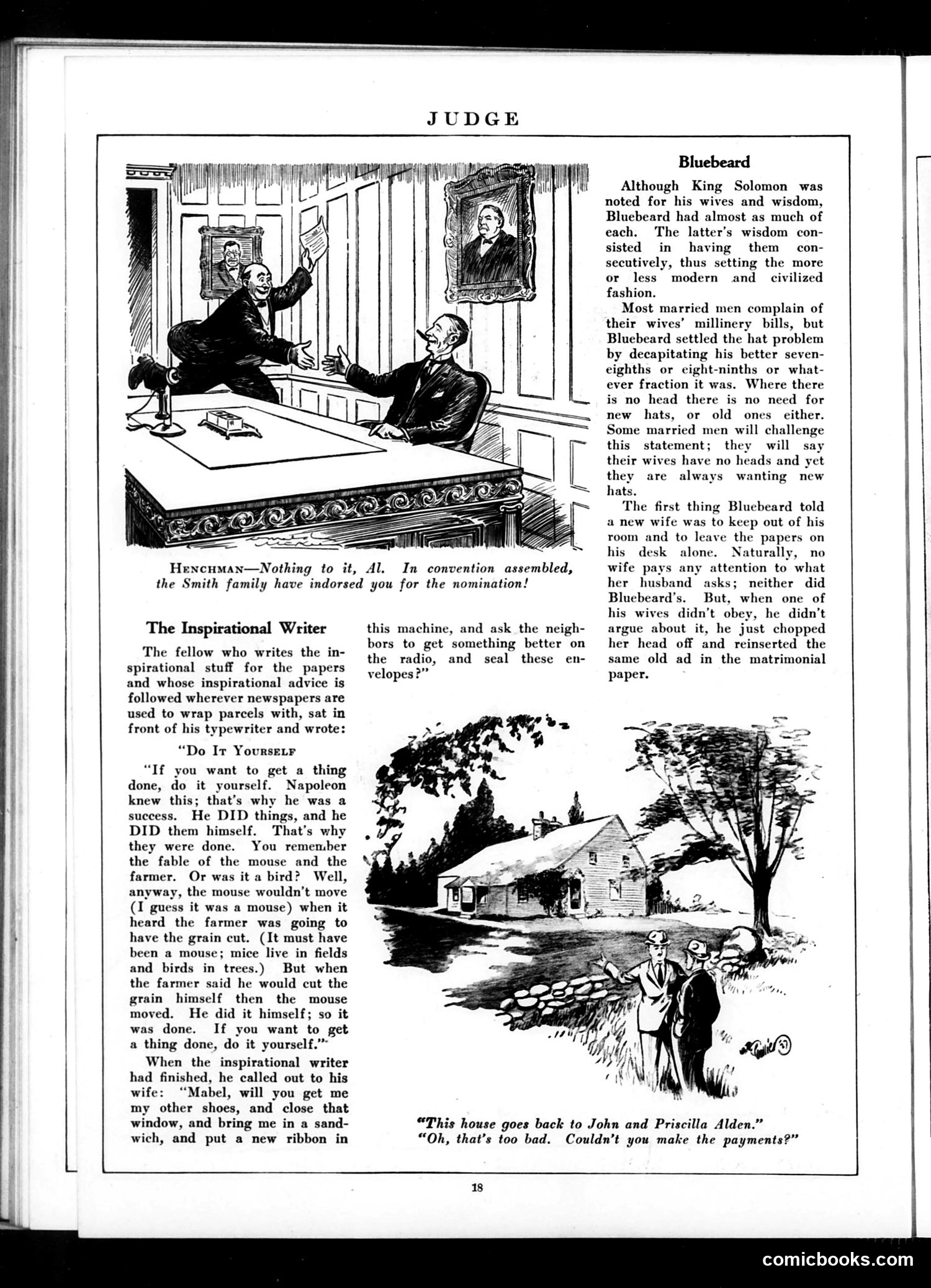
This page contains two separate satirical pieces: **"The Inspirational Writer"** mocks self-help advice columnists. The cartoon shows a man typing motivational content ("Do It Yourself," citing Napoleon) while simultaneously ordering his wife to do everything for him—close windows, make sandwiches, fix his typewriter. The satire is the hypocrisy: he preaches self-reliance while being entirely dependent on others' labor, particularly his wife's unpaid domestic work. **"Bluebeard"** is a darker humor piece referencing the fairy tale of a serial killer who murdered his wives. It uses this grotesque premise to satirize married life and women's fashion expenses. The joke compares Bluebeard's solution (beheading wives to eliminate hat-buying) to husbands' complaints about wives' millinery bills, sarcastically suggesting wives "have no heads" anyway—a misogynistic jab at women's perceived frivolousness. Both pieces employ cynical humor about marriage, gender dynamics, and hypocrisy typical of early 20th-century satirical magazines.
📄 Transcribed text from this page (OCR, searchable)
Machine-transcribed from the original scan — historical spelling and the odd misread are preserved.
Hencuman—Nothing to it, Al. AN In convention assembled, the Smith family have indorsed you for the nomination! The Inspirational Writer The fellow who writes the in- spirational stuff for the papers and whose inspirational advice is followed wherever newspapers are used to wrap parcels with, sat in front of his typewriter and wrote: “Do Ir Yoursetr “If you want to get a thing done, do it yourself. Napoleon knew this; that’s why he was a success. He DID things, and he DID them himself. That’s why they were done. You remember the fable of the mouse and the farmer. Or was it a bird? Well, anyway, the mouse wouldn’t move (I guess it was a mouse) when it heard the farmer was going to have the grain cut. (It must have been a mouse; mice live in fields and birds in trees.) But when the farmer said he would cut the grain himself then the mouse moved. He did it himself; so it was done. If you want to get a thing done, do it yourself.” When the inspirational writer had finished, he called out to his wife: “Mabel, will you get me my other shoes, and close that window, and bring me in a sand- wich, and put a new ribbon in this machine, and ask the neigh- bors to get something better on the radio, and seal these en- Bluebeard Although King Solomon was noted for his wives and wisdom, Bluebeard had almost as much of each. The latter’s wisdom con- sisted in having them con- secutively, thus setting the more or less modern and _ civilized fashion. Most married men complain of their wives’ millinery bills, but Bluebeard settled the hat problem by decapitating his better seven- eighths or eight-ninths or what- ever fraction it was. Where there is no head there is no need for new hats, or old ones either. Some married men will challenge this statement; they will say their wives have no heads and yet they are always wanting new hats. The first thing Bluebeard told a new wife was to keep out of his room and to leave the papers on his desk alon aturally, no wife pays any attention to what her husband asks; neither did Bluebeard’s. But, when one of his wives didn’t obey, he didn’t argue about it, he just chopped her head off and reinserted the same old ad in the matrimonial paper. “This house goes back to John and Priscilla Alden.” “Oh, that’s too bad. Couldn’t you make the payments?” comicbooks.com