
Judge, 1927-10-22 · page 15 of 36
Judge — October 22, 1927 — page 15: what you’re looking at
What you’re looking at
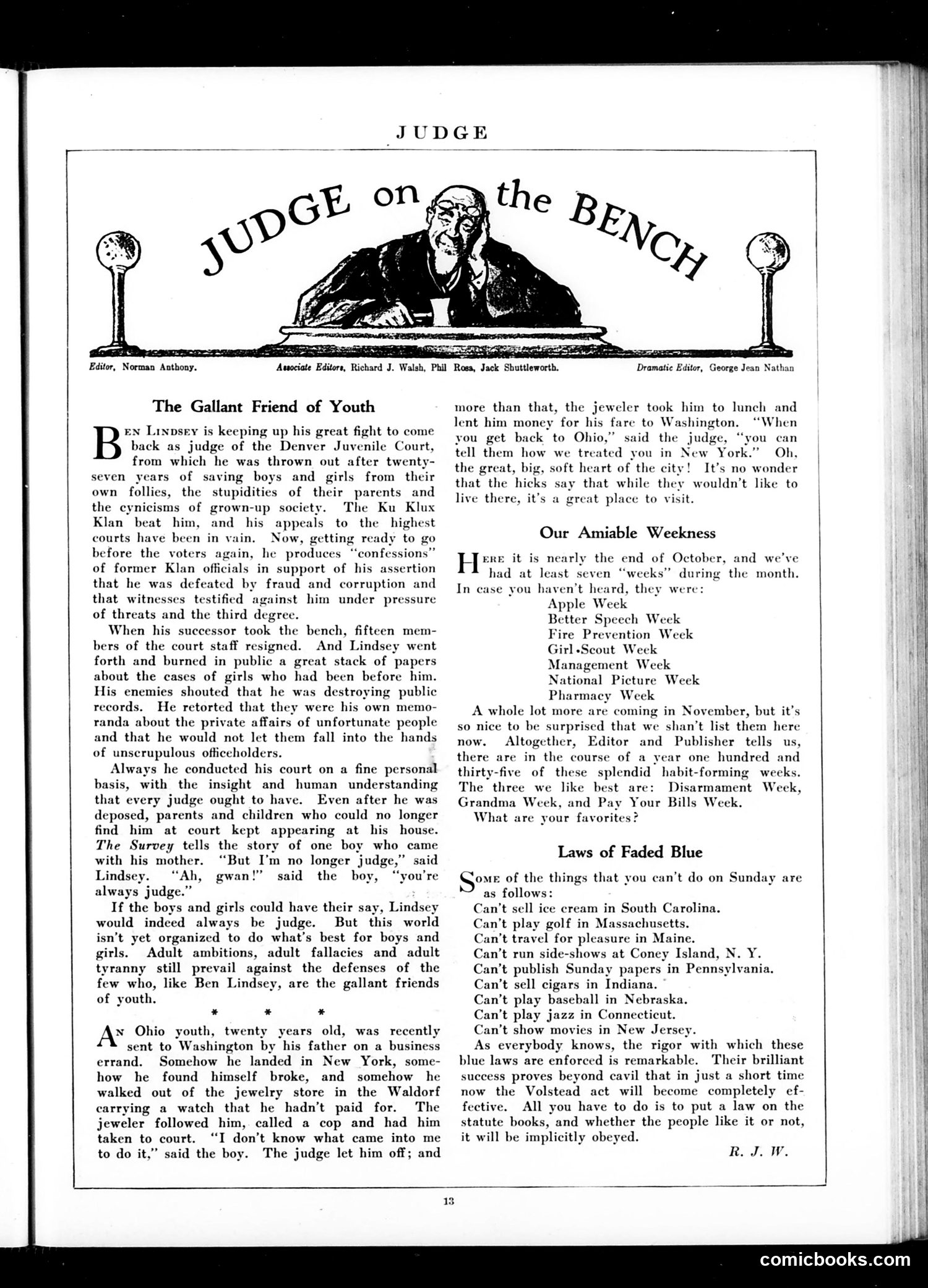
This page from *Judge* contains three separate satirical pieces: **"The Gallant Friend of Youth"** discusses Ben Lindsey, a Denver juvenile court judge ousted after 27 years, allegedly by the Ku Klux Klan through fraud and intimidation. The piece praises Lindsey's compassionate approach to youth justice, contrasting him with those who destroyed his career through corruption and threats. It's a sympathetic portrait of a reformer fighting institutional corruption. **"Our Amiable Weakness"** satirizes the proliferation of themed "weeks" (Apple Week, Fire Prevention Week, etc.)—observing that Americans create 135 such weeks annually, making them meaningless through oversaturation. **"Laws of Faded Blue"** catalogs absurd Sunday blue laws still in effect across states—prohibiting ice cream sales, golf, and travel on Sundays—mocking their outdated moral rigidity and uneven enforcement. The page reflects Progressive Era concerns: judicial reform, bureaucratic excess, and Victorian moralism.
📄 Transcribed text from this page (OCR, searchable)
Machine-transcribed from the original scan — historical spelling and the odd misread are preserved.
Editor, Norman Anthony. The Gallant Friend of Youth EN Linpsey is keeping up his great fight to come B back as judge of the Denver Juvenile Court, from which he was thrown out after twenty- seven years of ing boys and girls from their own follies, the stupidities of their parents and the cynicisms of grown-up society. The Ku Klux Klan beat him, and his appeals to the highest courts have been in vain. Now, getting ready to go before the voters again, he produces “confessions” of former Klan officials in support of his assertion that he was defeated by fraud and corruption and that witn testified nst him under press of threats and the third degree. When his successor took the bench, fifteen mem- bers of the court staff resigned. And Lindsey went forth and burned in public a great stack of papers about the cases of girls who had been before him. His enemies shouted that he was destroying public records. He retorted that they were his own memo- randa about the private affairs of unfortunate people and that he would not let them fall into the hands of unscrupulous officeholders. Iways he conducted his court on a fine personal is, with the insight and human understanding that every judge ought to have. Even after he was deposed, parents and children who could no longer find him at court kept appearing at his house. The Survey tells the story of one boy who came with his mother. “But I’m no longer judge,’ Lindsey. ‘‘Ah, always judge.” If the boys and girls could have their say, Lindsey would indeed always be judge. But this world isn’t yet organized to do what’s best for boys and girls. Adult ambitions, adult fallacies and adult tyranny still prevail against the defenses of the few who, like Ben Lindsey, are the gallant friends of youth, re said said the boy, “you're * * * Nn Ohio youth, twenty years old, was recently sent to Washington by his father on a business errand. Somehow he landed in New York, some- how he found himself broke, and somehow he walked out of the jewelry store in the Waldorf carrying a watch that he hadn’t paid for. The jeweler followed him, called a cop and had him taken to court. “I don’t know what came into me to do it,” said the boy. The judge let him off; and Atsociate Editors, Richard J. Walsh, Phil Ross, Jack Shuttleworth. Dramatic Editor, George Jean Nathan more than that, the jeweler took him to lunch and lent him money for his fare to Washington. “When you get back to Ohio,” said the judge, “you can tell them how we treated you in New York.” Oh, the great, big, soft heart of the city! It’s no wonder that the hicks say that while they wouldn’t like to live there, it’s a great place to visit. Our Amiable Weekness H ERE it is nearly the end of October, and we've had at least seven “weeks” during the month. In case you haven't heard, they were: Apple Week Better Speech Week Fire Prevention Week Girl-Scout Week agement Week tional Picture Week Pharmacy Week A whole lot more are coming in November, but it’s so nice to be surprised that we shan’t list them here now. Altogether, Editor and Publisher tells us, there are in the course of a year one hundred and thirty-five of these splendid’ habit-forming weeks. The three we like best are: Disarmament Week, Grandma Week, and Pay Your Bills Week. What are your favorites? Laws of Faded Blue Some of the things that you can’t do on Sunday are as follo Can't sell ice cream in South Carolina. Can't play golf in Massachusetts. Can't travel for pleasure in Maine. Can’t run side-shows at Coney Island, N. Y. Can’t publish Sunday papers in Pennsylvania. Can’t sell cigars in Indiana. Can’t play baseball in Nebraska. Can’t play jazz in Connecticut. Can’t show movies in New Jersey. As everybody knows, the rigor with which these blue laws are enforced is remarkable. Their brilliant success proves beyond cavil that in just a short time now the Volstead act will become completely ef- fective. All you have to do is to put a law on the statute books, and whether the people like it or not, it will be implicitly obeyed. R. J. W. comicbooks.com