
Judge, 1927-10-22 · page 16 of 36
Judge — October 22, 1927 — page 16: what you’re looking at
What you’re looking at
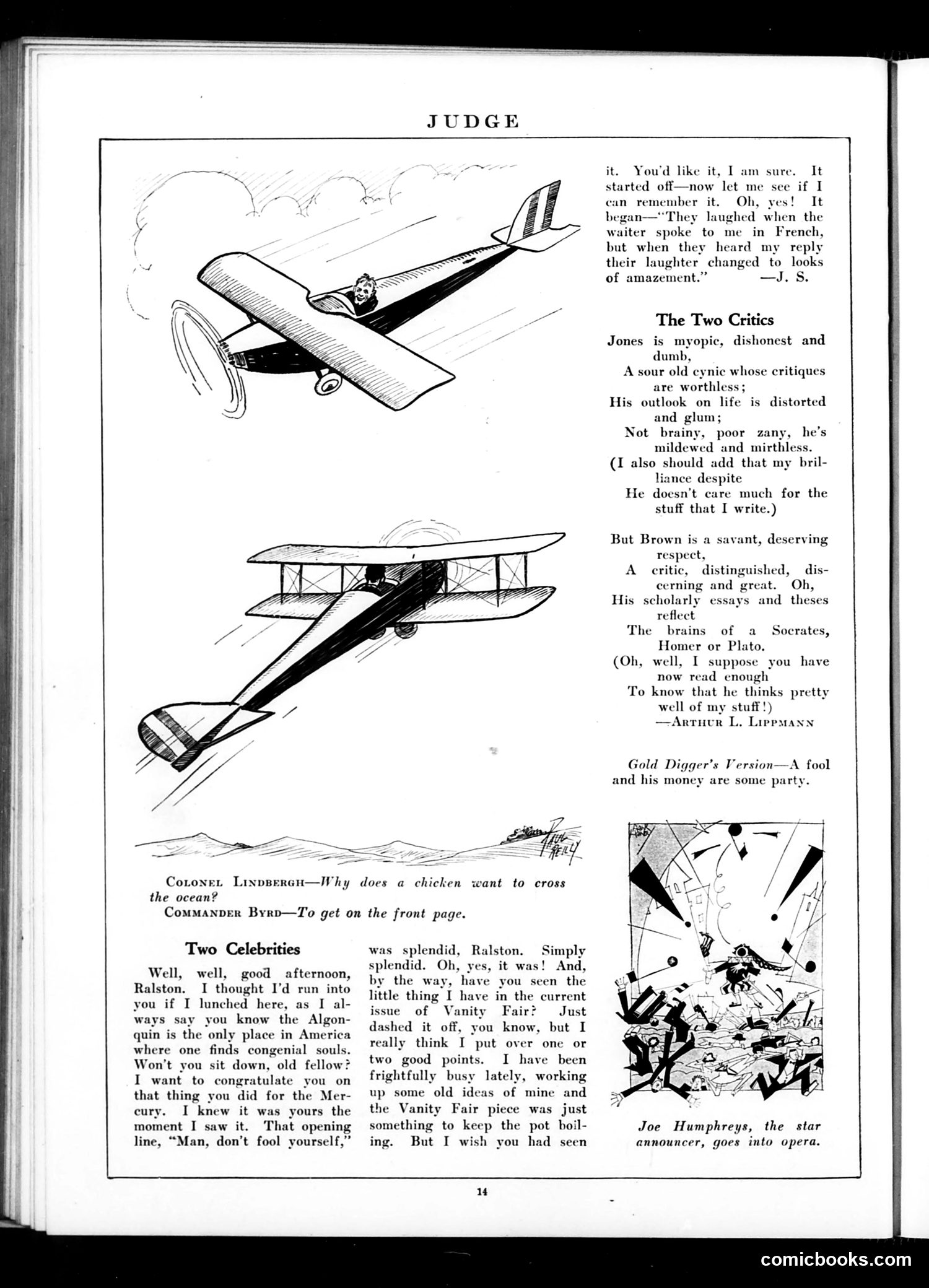
This Judge page contains social satire about 1920s literary culture. "Two Celebrities" mocks self-important writers at the Algonquin Club (a real New York gathering place for intellectuals) who boast about their magazine contributions while plagiarizing advertising copy. The joke: one writer steals a line from a Vanity Fair ad ("They laughed when I sat down at the piano") without realizing it, revealing the pretentiousness is hollow. "The Two Critics" satirizes how authors praise critics who like their work while dismissing those who don't—the speaker admires "Brown" only because Brown flatters the author's writing. This mocks the circular, insincere nature of literary praise. The airplane cartoons and references to Colonel Lindbergh, Commander Byrd, and Joe Humphreys appear to be topical humor about 1920s celebrities, though specific meanings are unclear without more context.
📄 Transcribed text from this page (OCR, searchable)
Machine-transcribed from the original scan — historical spelling and the odd misread are preserved.
F Coronet LinpperGu—Why does a chicken want to cross the ocean? Commanver Byrv—T'o get on the front page. Two Celebrities Well, well, good afternoon, Ralston. I thought I’d run into you if I lunched here, as I al- ways say you know the Algon- quin is the only place in America where one finds congenial souls. Won't you sit down, old fellow? I want to congratulate you on that thing you did for the Mer- cury. I knew it was yours the moment I saw it. That opening line, “Man, don’t fool yourself,” was splendid, Ralston. splendid. Oh it w by the way, hav ttle thing I hav issue Simply n the current of Vanity Fair? dashed it off, you know, but I really think I put over one or two good points. I have been frightfully busy lately, working up some old ideas of mine and the Vanity Fair piece was just something to keep the pot boil- ing. But I wish you had seen it. You'd like it, I am sure. It started off—now let me see if I can remember it. Oh, yes! It began—*They laughed when the waiter spoke to me in French, but when they heard my reply their laughter changed to looks of amazement.” —J. S. The Two Critics Jones is myopic, dishonest and dumb, A sour old cynic whose critiques are worthle His outlook on life is distorted and glum; Not brainy, poor zany, he’s mildewed and mirthless. (I also should add that my bril- liance despite He doesn’t « much for the stuff that I write.) But Brown is a respect, A. critic, distinguished, dis- cerning and great. Oh, His scholarly essays and theses reflect brains of a Homer or Plato. (Oh, well, I suppose you have now read enough To know that he thinks pretty well of my stuff!) —Arrucr L, Lippmann rant, deserving The Socrates, Gold Digger’s Version—A fool and his money are some party. Joe Humphreys, the star announcer, goes into opera. comicbooks.com