
Judge, 1927-10-22 · page 22 of 36
Judge — October 22, 1927 — page 22: what you’re looking at
What you’re looking at
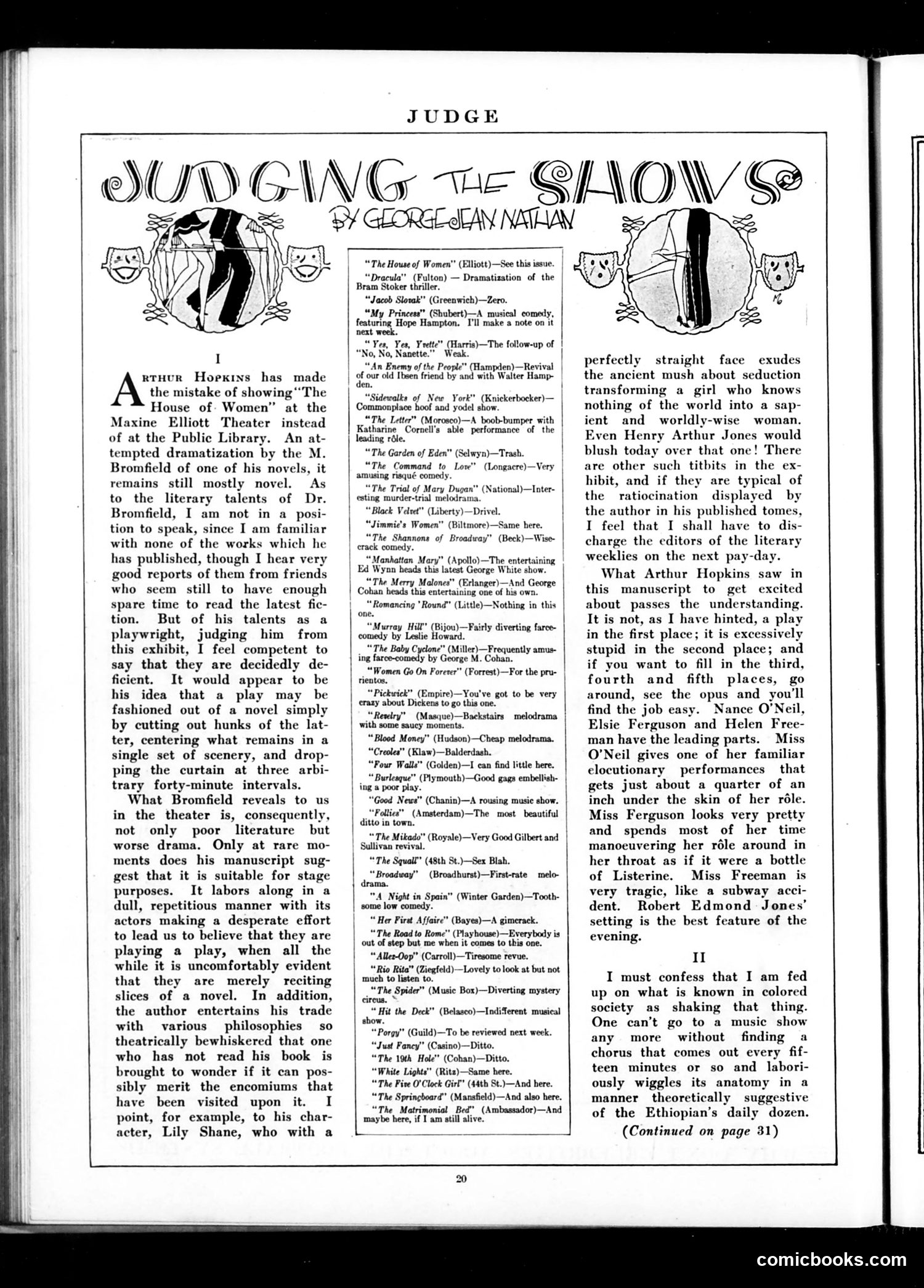
This is a theater review column by George Jean Nathan, a prominent drama critic of the 1920s era. The main article criticizes Arthur Hopkins's stage adaptation of M. Bromfield's novel "The House of Women" at the Maxine Elliott Theater, arguing it fails as drama because Hopkins merely cut chunks from the novel and placed them in a single set with arbitrary intermissions, rather than crafting a proper theatrical work. Nathan contends the production reveals poor playwriting: actors appear to be reciting novel passages rather than performing a cohesive play. He finds the philosophical musings in the script ("theatrically bewhiskered") pretentious and questions whether the source material deserves its critical acclaim. The page also contains Nathan's capsule reviews of numerous Broadway productions, rating them from entertaining to worthless, typical of Judge's theatrical coverage.
📄 Transcribed text from this page (OCR, searchable)
Machine-transcribed from the original scan — historical spelling and the odd misread are preserved.
——— JUDGE / MIYGING tH GANOW = BY GOREN NAT rtHUR Horkins has made AN the mistake of showing “The House of Women” at the Maxine Elliott Theater instead of at the Public Library. An at- tempted dramatization by the M. Bromfield of one of his novels, it remains still mostly novel. As to the literary talents of Dr. Bromfield, I am not in a posi tion to speak, since I am fami with none of the works which he has published, though I hear very good reports of them from friends who seem still to have enough spare time to read the latest fic- tion. But of his talents as a playwright, judging him from this exhibit, I feel competent to say that they are decidedly de- ficient. It would appear to be his idea that a play may be fashioned out of a novel simply by cutting out hunks of the lat- ter, centering what remains in a single set of scenery, and drop- ping the curtain at three arbi- trary forty-minute intervals. What Bromfield reveals to us in the theater is, consequently, not only poor literature but worse drama. Only at rare mo- ments does his manuscript sug- gest that it is suitable for stage purposes. It labors along in a dull, repetitious manner with its actors making a desperate effort to lead us to believe that they are playing a play, when all the while it is uncomfortably evident that they are merely reciting slices of a novel. In addition, the author entertains his trade with various philosophies so theatrically bewhiskered that one who has not read his book is brought to wonder if it can pos- sibly merit the encomiums that have been visited upon it. I point, for example, to his char- acter, Lily Shane, who with a “The House of Women"’ (Elliott) —See this issue. “Dracula” (Fulton) — Dramatization of the Bram Stoker thriller. “‘Jacob Slovak" (Greenwich)—Zero. “My Princess” (Shubert)—A musical comedy, featuring Hope Hampton. I'll make a note on it next week. “Yea, Yes, Yrette” (Harris)—The follow-up of “No, No, Nanette.”” Weak. “An Enemy of the People” (Hampden)—Revival of our old Ibsen friend by and with Walter Hamp- jen. “Sidewalks of New York" (Knickerbocker)— Commonplace hoof and yodel show. “The Letter” (Moroseo)—A boob-bumper with Katharine Cornell's able performance of the leading réle. “The Garden of Eden" |wyn)—Trash. “The Command to Lowe” (Longacre)—Very amusing risqué comedy. “The Trial of Mary Dugan" (National)—Inter- | esting murder-trial melodram “Black Velvet” (Liberty)—Drivel. “Jimmies Women” (Biltmore)—Same here. “The Shannon of Broadway” (Beck)—Wise- crack comedy. ‘Manhattan Mary” (Apollo)—The entertaining Ed Wynn heads this latest George White show. “The Merry Malones” (Erlanger)—And George Coban heads this entertaining one of his own. “Romancing Round” (Little)—Nothing in this one. “Murray Hill" (Bijou)—Fairly diverting farce- comedy by Leslie Howard. “The Baby Cyclone” (Miller) —Frequently amus- ing farce-comedy by George M. Cohan. “Women Go On Forever” (Forrest) —For the pru- | | sieatos” “Pickwick” (Empire)—You've got to be very crazy about Dickens to go this one. “Revelry” ~(Masque)—Backstairs melodrama with some saucy moments. “Blood Money” (Hudson)—Cheap melodrama. “Creoles” (Klaw)—Balderdash. “Four Walls” (Golden)—I can find little here. | _ “Burlesque” (Plymouth)—Good gags embellish- ing a poor play. “Good News” (Chanin)—A rousing music show. “Follies” (Amsterdam)—The most beautiful ditto in town. Sullivan revival. “The Squall” (48th St.)—Sex Blah. “Broadway” (Broadhurst)—First-rate _melo- drama. "A Night in Spain” (Winter Garden)—Tooth- some low comedy. “ Her Pirat Affaire” (Bayes)—A gimerack. “The Road to Rome” (Playhouse)—Everybody is | out of step but me when it comes to this one. “‘Allet-Oop” (Carroll)—Tiresome revue. “Rio Rita” (Ziegfeld)—Lovely to look at but not much to listen to. “The Spider” (Music Box)—Diverting mystery cireus. » “Hit the Deck” (Belasco)—Indierent musical show. “Porgy” (Guild)—To be reviewed next week. “Just Fancy” (Casino)—Ditto. “The 19th Hole” (Cohan)—Ditto. “White Lights (Ritz)—Same here. “The Five O'Clock Girl" (44th St.)—And here. “The Springboard” (Mansfield)—And also here. “The Matrimonial Bed” (Ambassador)—And maybe here, if I am still alive. “ The Mikado" (Royale)—Very Good Gilbert and_| perfectly straight face exudes the ancient mush about seduction transforming a girl who knows nothing of the world into a sap- ient and worldly-wise woman. Even Henry Arthur Jones would blush today over that one! There are other such titbits in the ex- hibit, and if they are typical of the ratiocination displayed by the author in his published tomes, I feel that I shall have to dis- charge the editors of the literary weeklies on the next pay-day. What Arthur Hopkins saw in this manuscript to get excited about passes the understanding. It is not, as I have hinted, a play in the first place; it is excessively stupid in the second place; and if you want to fill in the third, fourth and fifth places, go around, see the opus and you'll find the job easy. Nance O'Neil, Elsie Ferguson and Helen Free- man have the leading parts. Miss O’Neil gives one of her familiar elocutionary performances that gets just about a quarter of an inch under the skin of her réle. Miss Ferguson looks very pretty and spends most of her time manoeuvering her réle around in her throat as if it were a bottle of Listerine. Miss Freeman is very tragic, like a subway acci- dent. Robert Edmond Jones’ setting is the best feature of the evening. Il I must confess that I am fed up on what is known in colored society as shaking that thing. One can’t go to a music show any more without finding a chorus that comes out every fif- teen minutes or so and _ labori- ously wiggles its anatomy in a manner theoretically suggestive of the Ethiopian’s daily dozen. (Continued on page 31) comicbooks.com