
A complete issue · 36 pages · 1927
Judge — September 3, 1927
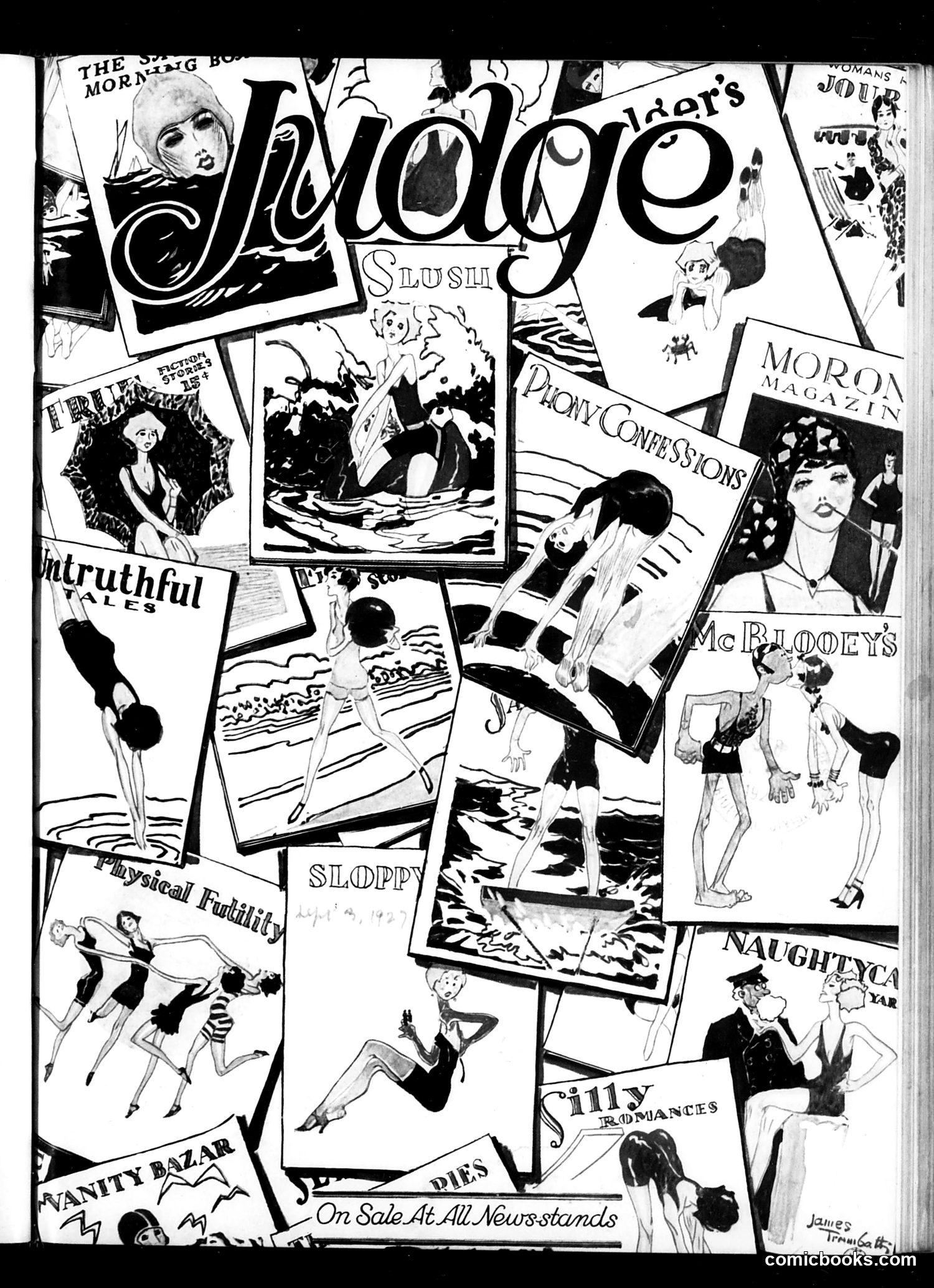
This appears to be a **advertisement compilation** rather than editorial satire. The large "Judge" masthead dominates, surrounded by promotional material for various publications and entertainment. Visible titles include *Slush*, *Moron Magazine*, *Pony Confessions*, *McBlooey's*, *Truthful Tales*, *Sloppy*, *Physical Futility*, *Naughty*, *Silly Romances*, and *Vanity Bazar*—most appearing to be fictional or exaggerated publication names typical of Judge's self-promotional humor. The illustrations feature stylized 1920s-era figures in flapper fashion and humorous scenarios. The overall tone seems to mock both contemporary publications and entertainment trends through absurdist titles and the contrast between refined advertising layout and deliberately ridiculous content descriptions. The tagline states "On Sale At All News-stands," treating these fictional publications as real products.
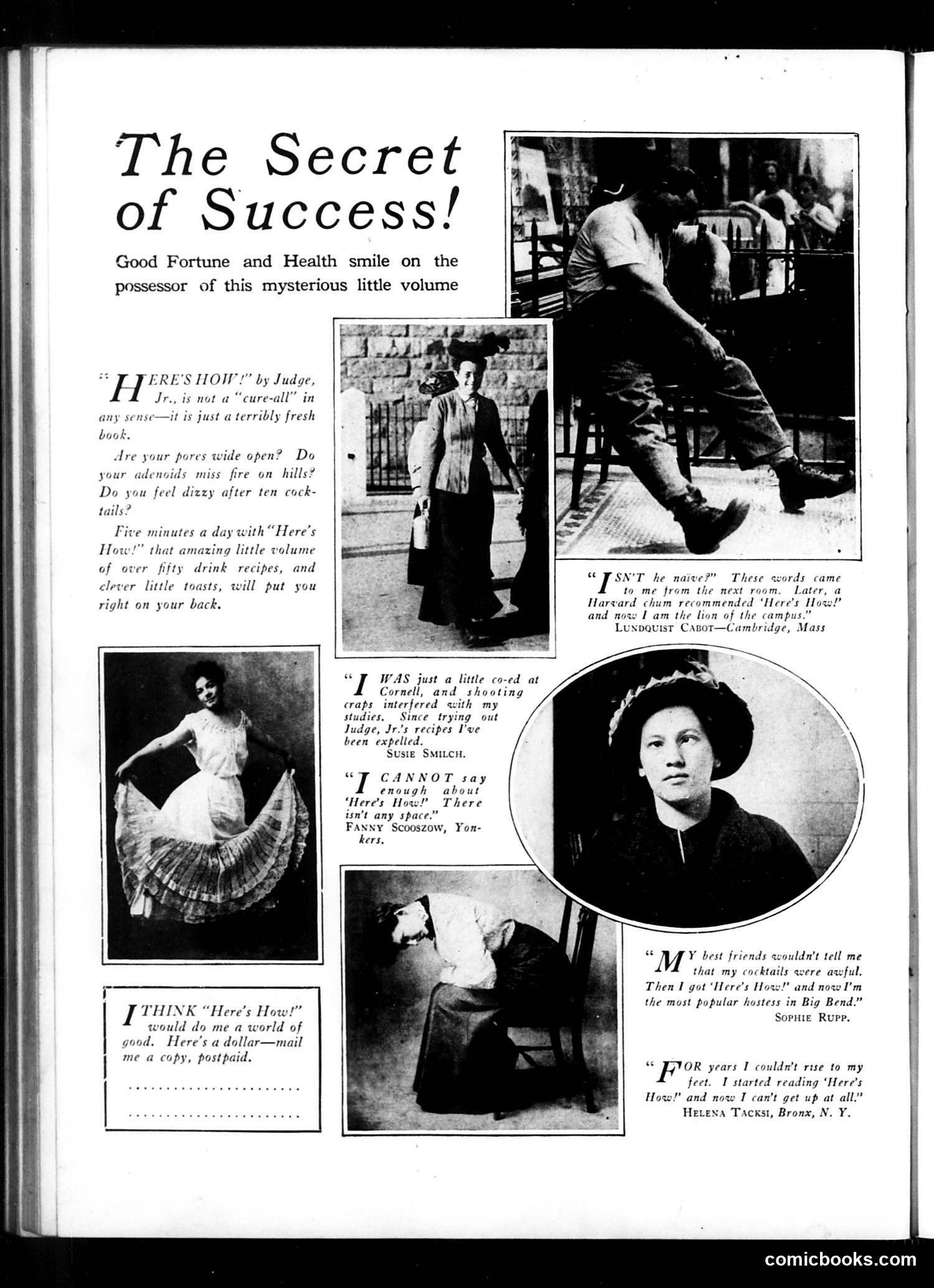
This page is primarily **advertising**, not political satire. It promotes "Here's How!" — a book of cocktail recipes and entertaining tips — marketed as "The Secret of Success!" The page uses testimonials from named individuals (Susan Smith, Fanny Schnow, Sophie Rupp, Helena Tacsi) claiming the book improved their social lives and popularity. One testimonial references Cornell University, another mentions being a "lion of the campus." The photographs show people in social settings — dining, socializing, and entertaining — meant to suggest the book delivers social success. The tagline promises "Good Fortune and Health" to owners. This is straightforward commercial promotion exploiting 1920s anxieties about social acceptance and entertaining, not political commentary or satire.
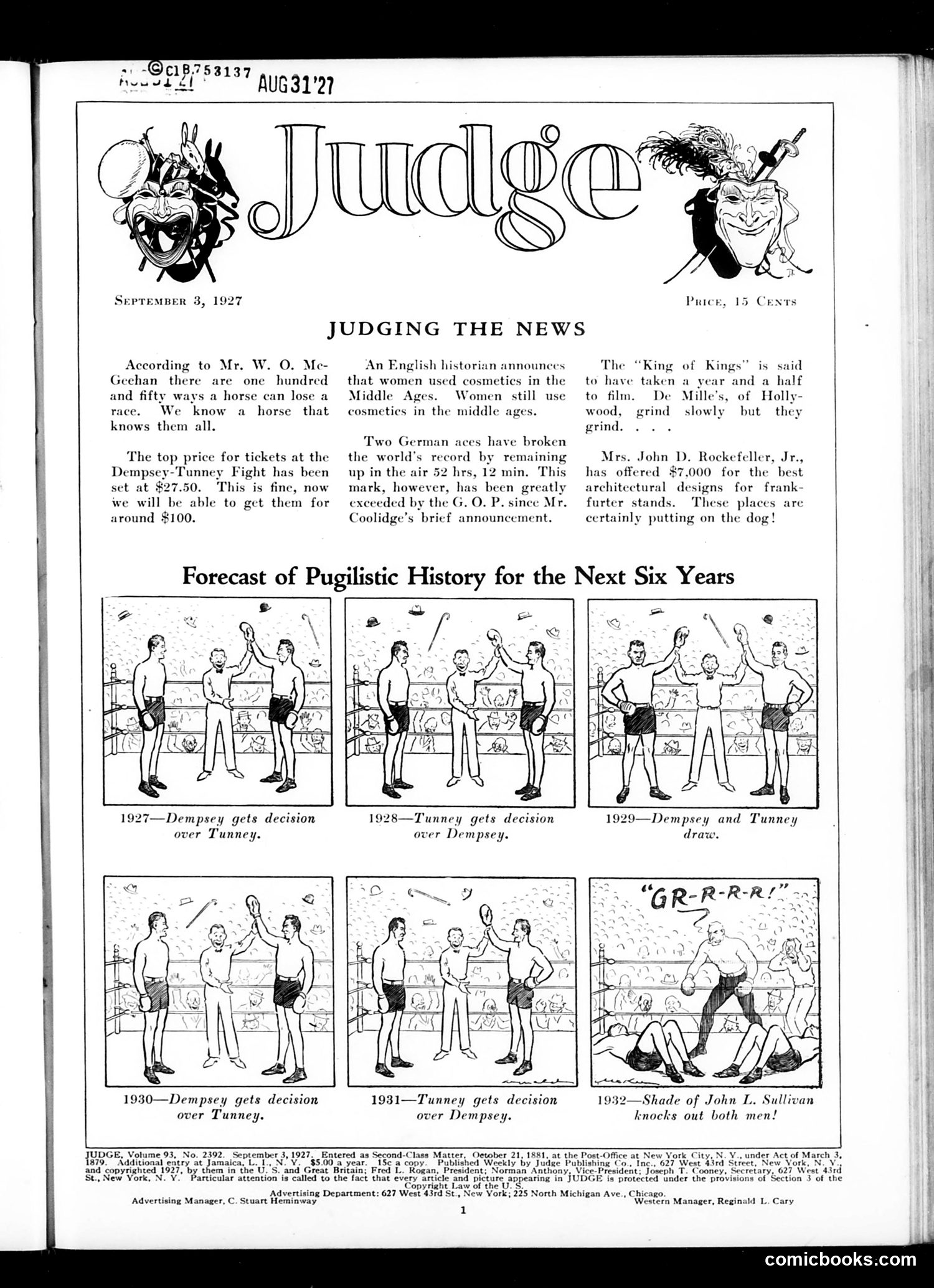
This satirical cartoon series predicts boxing match outcomes between Jack Dempsey and Gene Tunney, who were prominent heavyweight champions of the 1920s. The three judges repeatedly award victories in alternating fashion: - 1927: Dempsey wins - 1928: Tunney wins - 1929: Draw - 1930: Dempsey wins again - 1931: Tunney wins again - 1932: The prediction absurdly escalates to violence, with a mysterious "Shade of John L. Sullivan" (a legendary boxer) knocking out both men The joke satirizes the intense rivalry and repeated rematches between these fighters, suggesting the cycle would continue indefinitely and ridiculously. It mocks both the fighters' competitive obsession and public fascination with their ongoing feud.
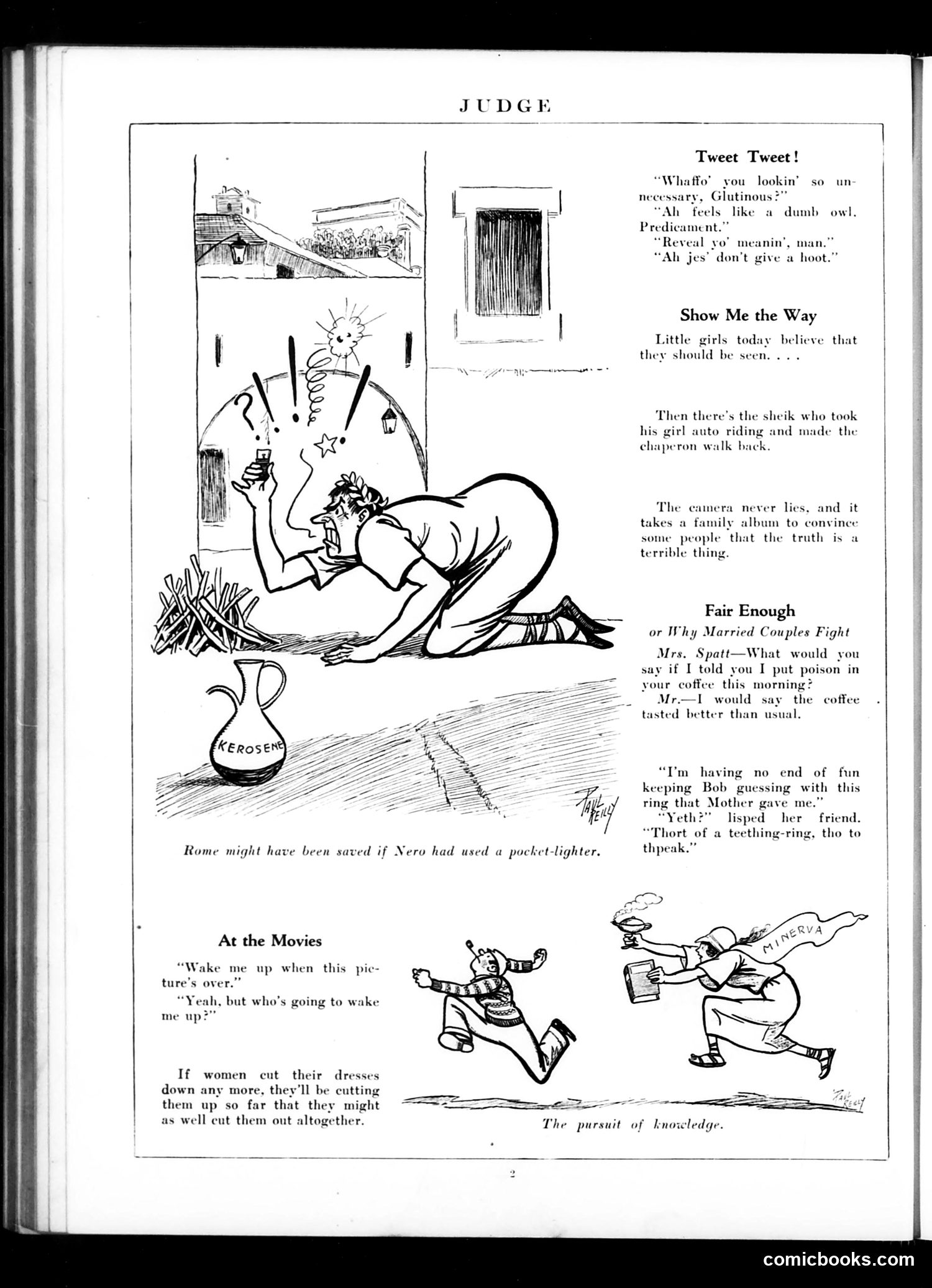
This page contains humor columns and cartoons satirizing early 20th-century American social behavior: **"Tweet Tweet!"** mocks affected, pretentious speech patterns among the upper classes—criticizing people who use unnecessarily fancy language. **"Show Me the Way"** jokes about modern morality: young women claiming to be modest while engaging in scandalous behavior (unchaperoned auto rides), and the hypocrisy of photography as "evidence" of propriety. **"Fair Enough"** presents marital humor about domestic tension and gift-giving confusion. **"At the Movies"** satirizes women's fashion, joking that if dresses get any shorter, women will have nothing left to wear. The bottom cartoon about "pursuit of knowledge" appears to reference academic or intellectual pretense. The overall tone reflects period anxieties about changing social mores, particularly regarding women's liberation and class affectation.
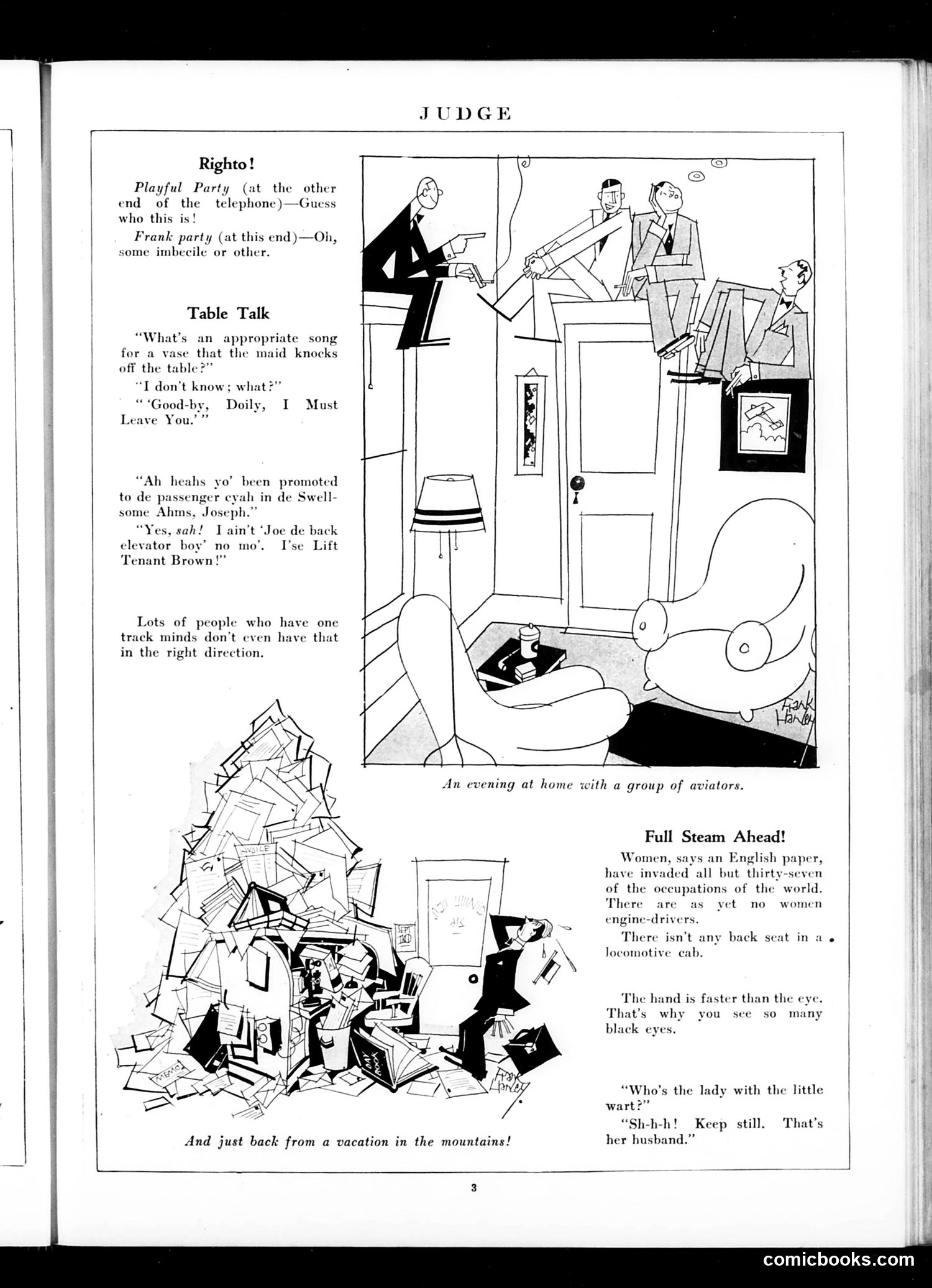
This page contains three separate humorous pieces satirizing early 20th-century social observations: **"Righto!"** depicts a telephone conversation joke about guessing someone's identity. **"Table Talk"** mocks dinner conversation, including a reference to "Joe de back elevator boy" becoming a messenger in the Swell apartments—likely satirizing social climbing or absurd promotions among working-class individuals. **"Full Steam Ahead!"** comments on women entering previously male-dominated occupations, noting women have invaded "all but thirty-seven of the occupations of the world" but remain absent as locomotive engine-drivers and lack backseats in locomotive cabs. The accompanying humor about "black eyes" and the final joke about a woman with a "wart" being someone's husband plays on period stereotypes about gender and appearance. The cartoons reflect contemporary debates about women's workplace participation during the early suffrage era.
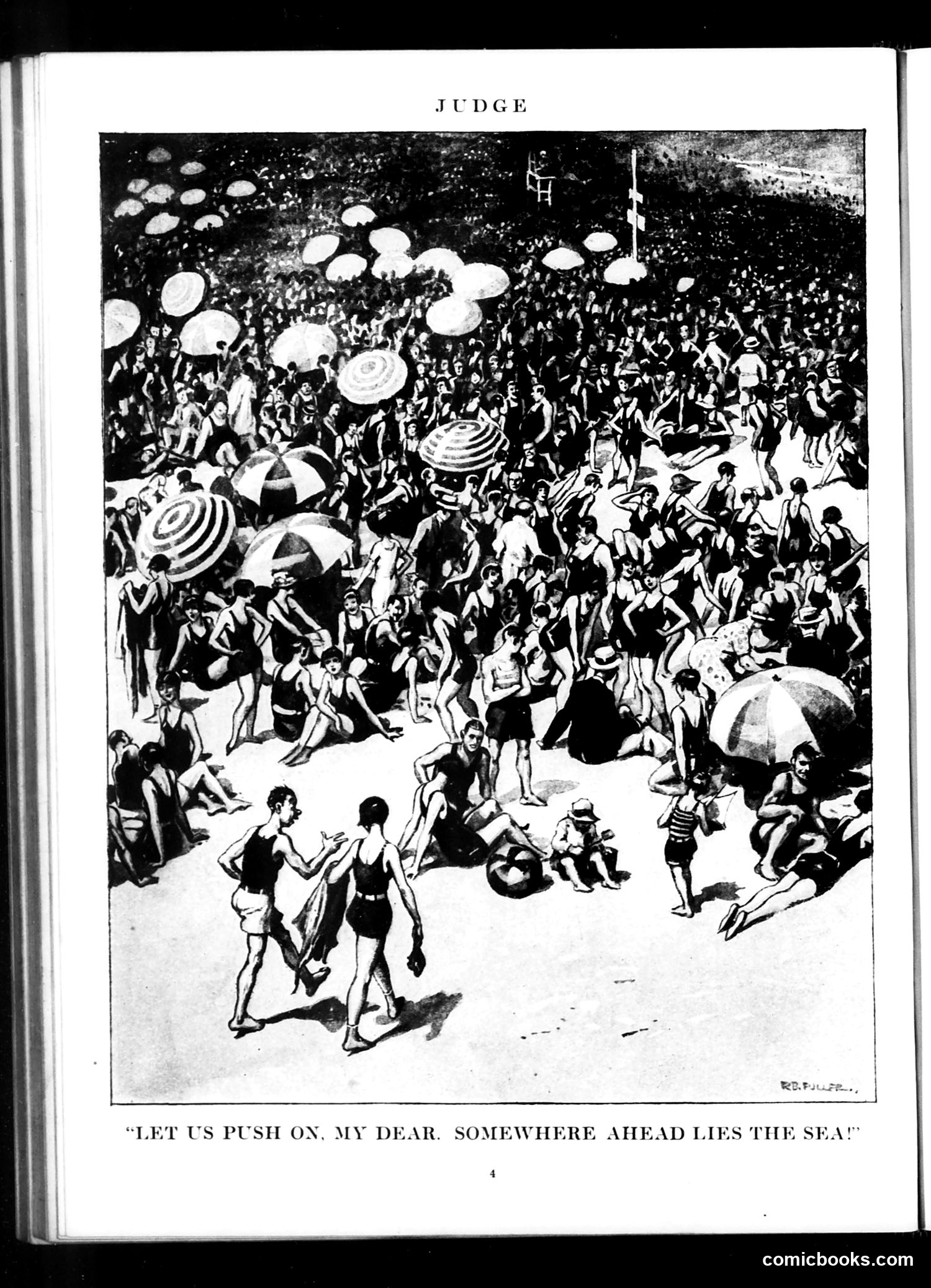
This Judge magazine cartoon depicts a crowded beach scene with numerous umbrellas and beachgoers. The caption reads: "LET US PUSH ON, MY DEAR. SOMEWHERE AHEAD LIES THE SEA." The satire targets the overwhelming crowds at popular beaches, likely during summer leisure season. Two figures in the foreground—apparently a couple—are attempting to navigate through dense masses of people, umbrellas, and beach equipment to reach the actual ocean, which remains obscured by the throng. The joke critiques both the popularity of beach vacations and the irony of seeking nature/solitude only to encounter urban-level congestion. It reflects early 20th-century anxieties about mass tourism and crowded public spaces becoming increasingly common as leisure travel democratized. The cartoon mocks the difficulty of actually enjoying seaside relaxation amid competition from other vacationers.
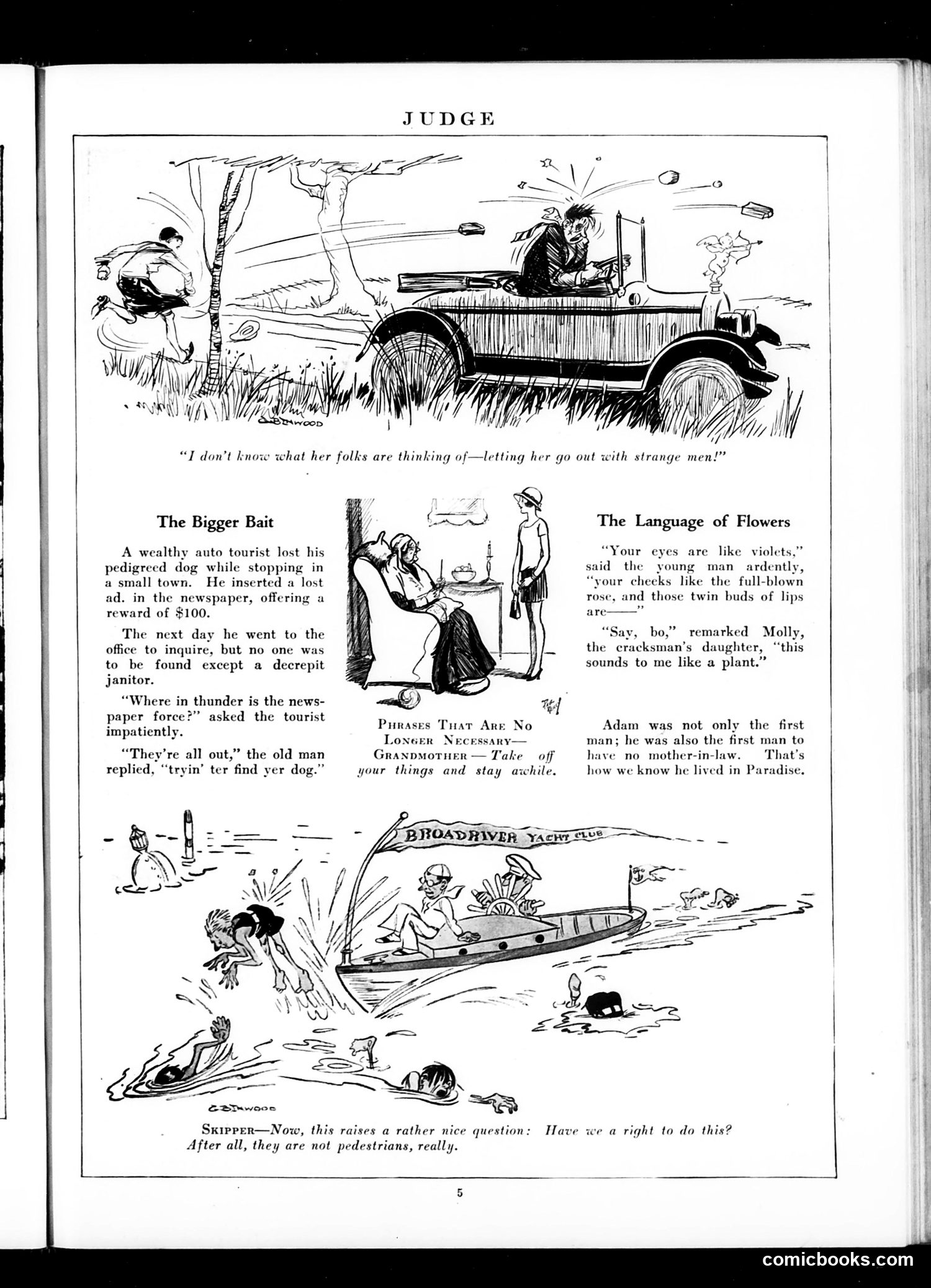
This page contains four separate humorous pieces satirizing early 1920s social attitudes: **Top cartoon**: A young woman driving with a man provokes parental concern about her dating "strange men"—satirizing anxiety over women's newfound automotive independence and dating freedom. **"The Bigger Bait"**: Mocks a wealthy tourist's naive belief that a janitor will find his lost dog, when the janitor clearly has no interest in helping. **"The Language of Flowers"**: A young man attempts flowery romantic language ("Your eyes are like violets"), which Molly, a pragmatic working-class woman, dismisses as nonsense—satirizing class differences in courtship customs. **Bottom cartoon**: Depicts people drowning while a yacht club member questions whether non-pedestrians have the "right" to use public waterways—social satire about class privilege and indifference to others' suffering.
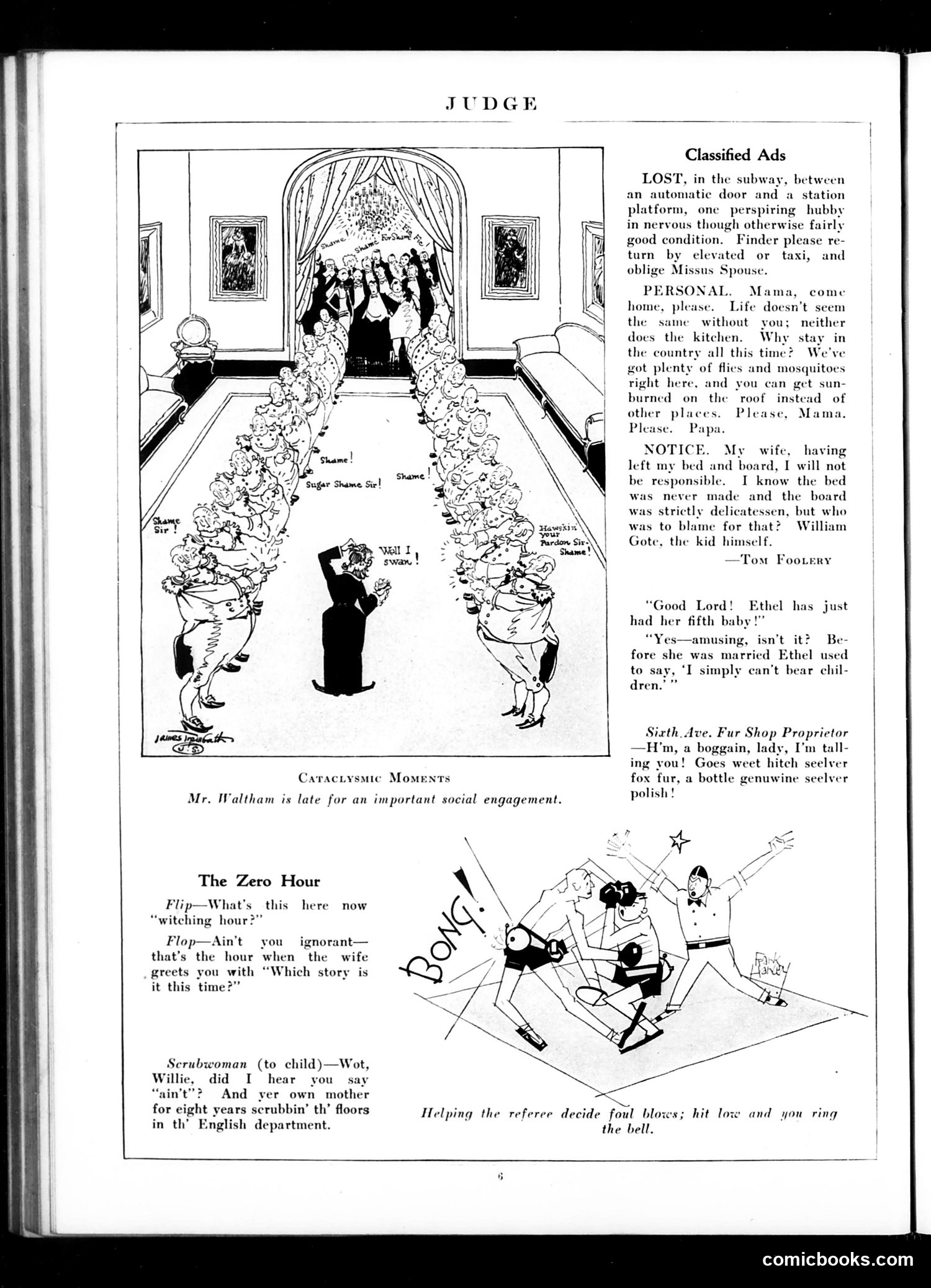
This page contains several satirical pieces reflecting early 20th-century domestic and social humor: **"Cataclysmic Moments"** depicts a man arriving catastrophically late to a social event, with crowds of well-dressed guests spilling out—mocking the social anxiety around tardiness. **"The Zero Hour"** is a joke about marital friction: the "witching hour" is when wives confront husbands about their excuses and whereabouts, satirizing the tension between spouses. **The classified ads section** humorously presents marital discord as lost-and-found notices: wives summoning absent husbands home, husbands disclaiming responsibility for departing spouses. These mock newspaper ads while reflecting real domestic tensions of the era. **Other jokes** include an infant's birth after the mother claimed she "couldn't bear children," and a scrubwoman correcting a child's grammar—reflecting class and educational pretensions of the period. The "boxing" cartoon satirizes referee corruption in professional fights. Overall, the page targets marital problems, social embarrassment, and working-class aspiration to respectability.
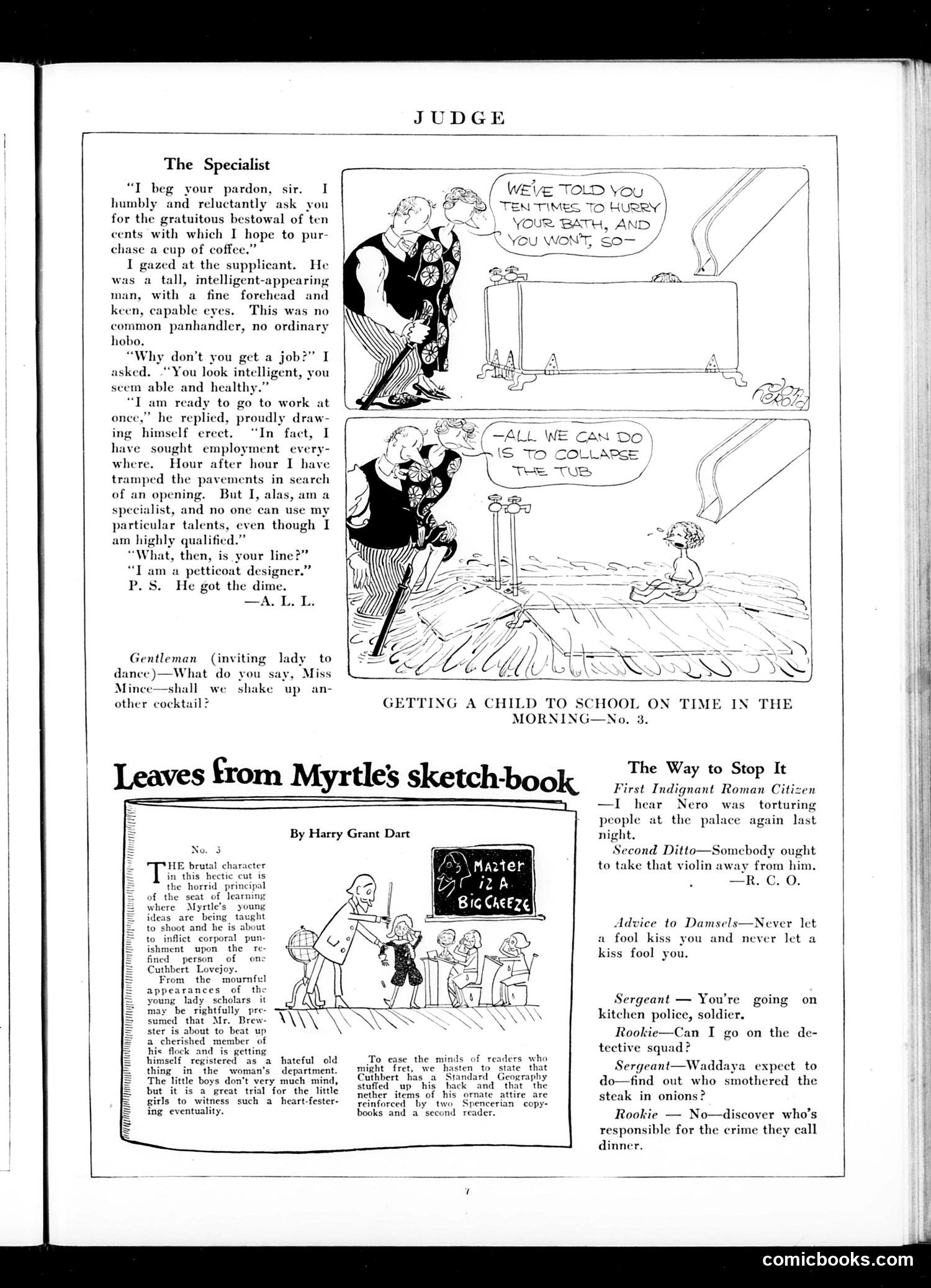
This page contains three satirical pieces typical of early 20th-century American humor: **"The Specialist"**: A panhandler asks for a dime for coffee. Though intelligent-looking, he explains he cannot find work because he's overqualified—he's a "petticoat designer." The joke mocks both unemployment and occupational specialization: his specific skill makes him unemployable in a world needing general laborers. The narrator gives him the dime anyway, perhaps out of sympathy or amusement. **"Getting a Child to School"**: A cartoon sequence showing a parent's exasperated attempt to get a child bathed and ready on time. The humor derives from the relatable domestic frustration of morning routines. **"Leaves from Myrtle's Sketch-book"**: Satirical quips about contemporary issues—a brutal schoolmaster beating students (particularly offensive to "refined" girls), references to Nero's violin-playing during torture (classical allusion), and barracks humor about bad military food. The tone is light social criticism wrapped in jokes.
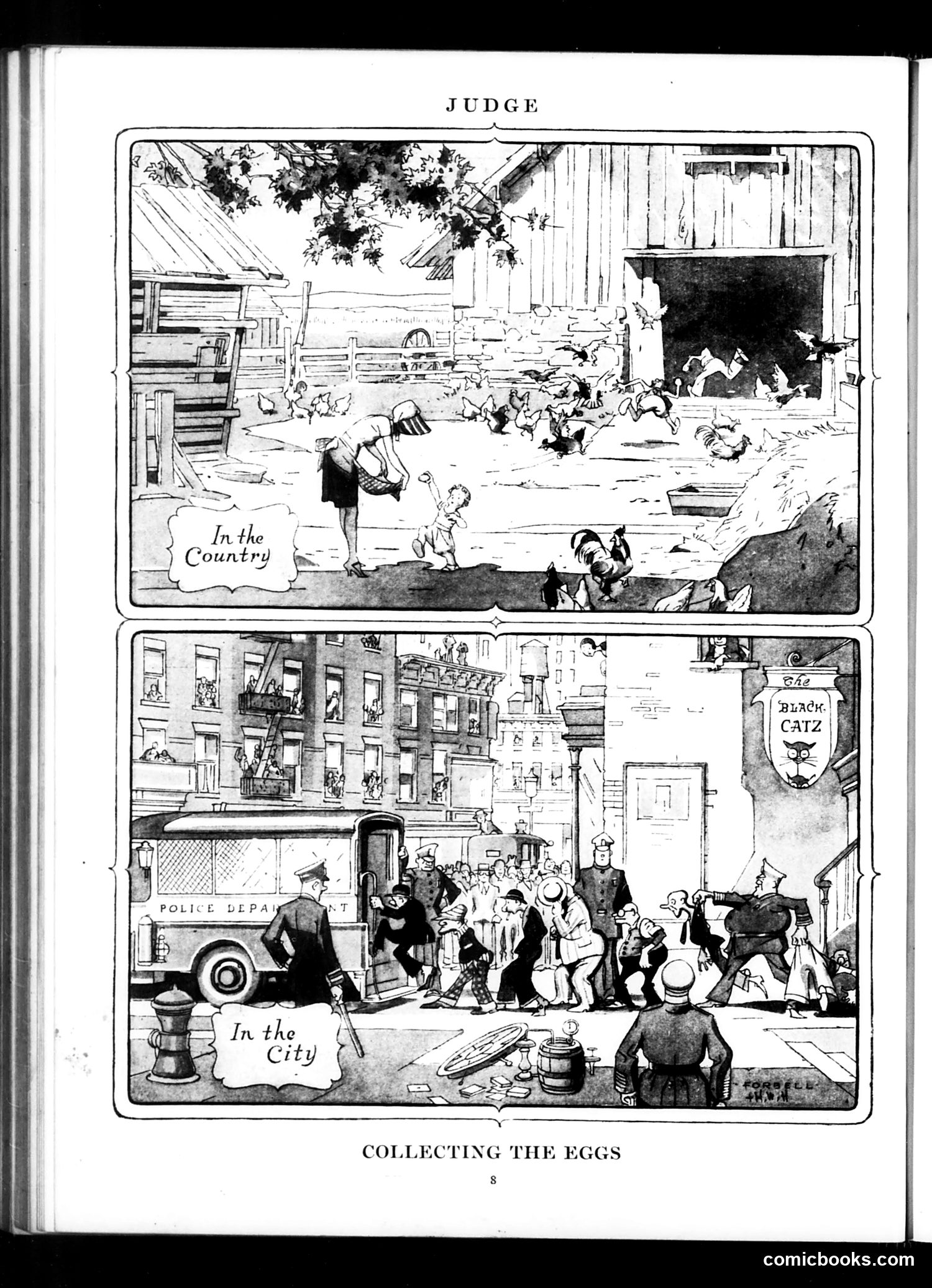
This two-panel satirical cartoon contrasts rural and urban life. The top panel, "In the Country," shows a woman and child gathering eggs from chickens around a farmyard—a straightforward, pastoral scene. The bottom panel, "In the City," depicts police collecting eggs (likely confiscated goods or illegally produced items) from urban residents near a "Black Catz" establishment and police van, with numerous people crowded around. The satire appears to mock Prohibition-era law enforcement. "Collecting eggs" is the euphemistic caption, but the city scene suggests police raids on illegal establishments. The ironic parallel—treating urban law enforcement operations as equivalent to simple rural egg-gathering—mocks either the heavyhanded police tactics or the absurdity of Prohibition enforcement in densely populated urban areas.
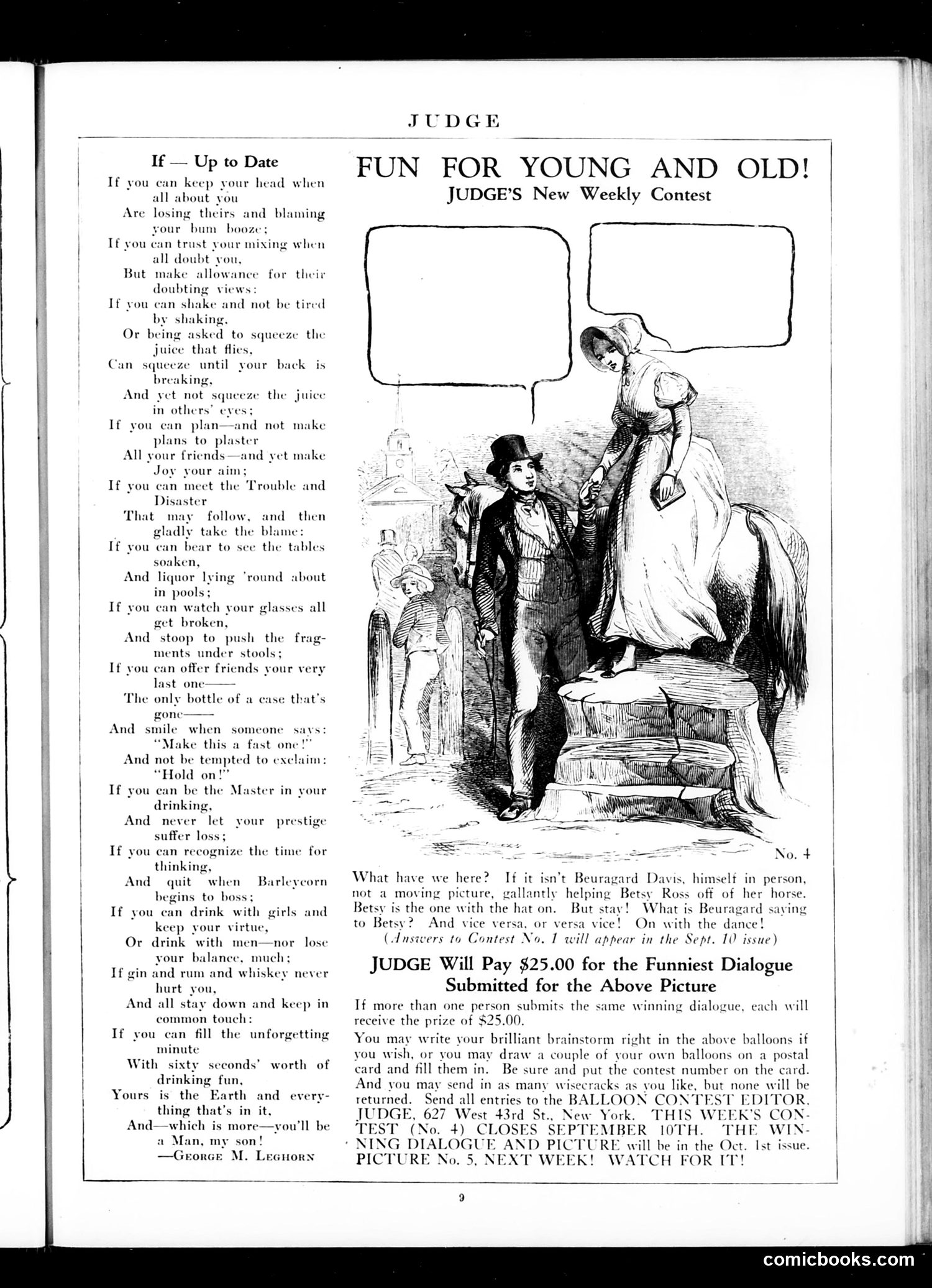
This page contains two distinct elements: **Left side:** A parody poem titled "If — Up to Date," reworking Rudyard Kipling's famous "If—" poem. Instead of Kipling's stoic virtues, this version humorously applies his moral framework to *drinking*. It mocks excessive alcohol consumption by treating drunkenness as an achievable ideal—staying composed while drinking, managing intoxicated friends, hiding broken glasses, and ultimately achieving manhood through mastery of liquor. The satire targets both Prohibition-era drinking culture and the pretentious moralism of Kipling's original. **Right side:** A contest announcement featuring a cartoon of a man in a top hat helping a woman (labeled "Betsy Ross") off a horse. The caption humorously misidentifies the man as "Beauregard Davis" assisting with what appears to be a historical recreation. Judge offers $25 for the funniest submitted dialogue for the empty speech balloons. This is a recurring weekly feature inviting reader participation.
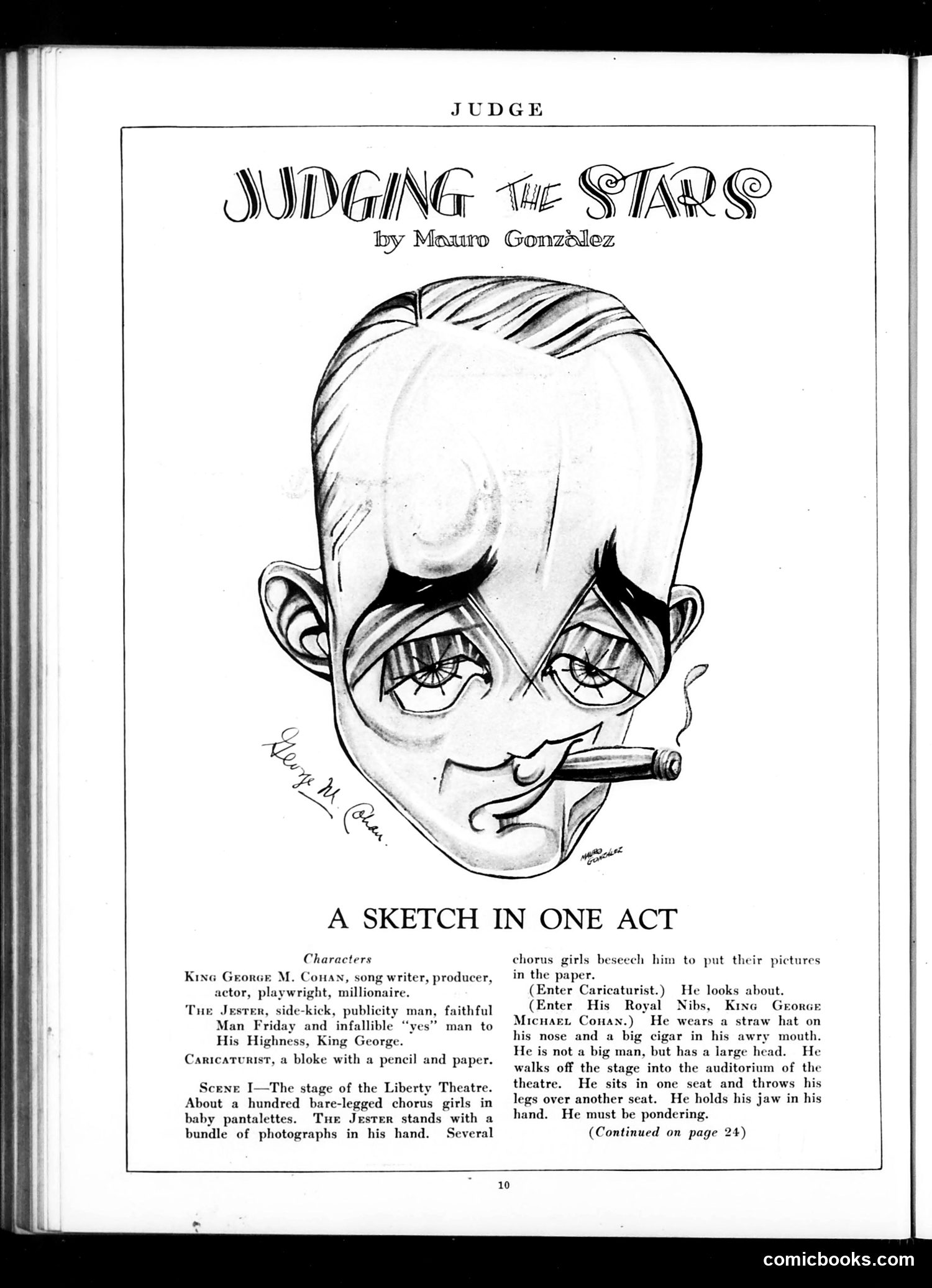
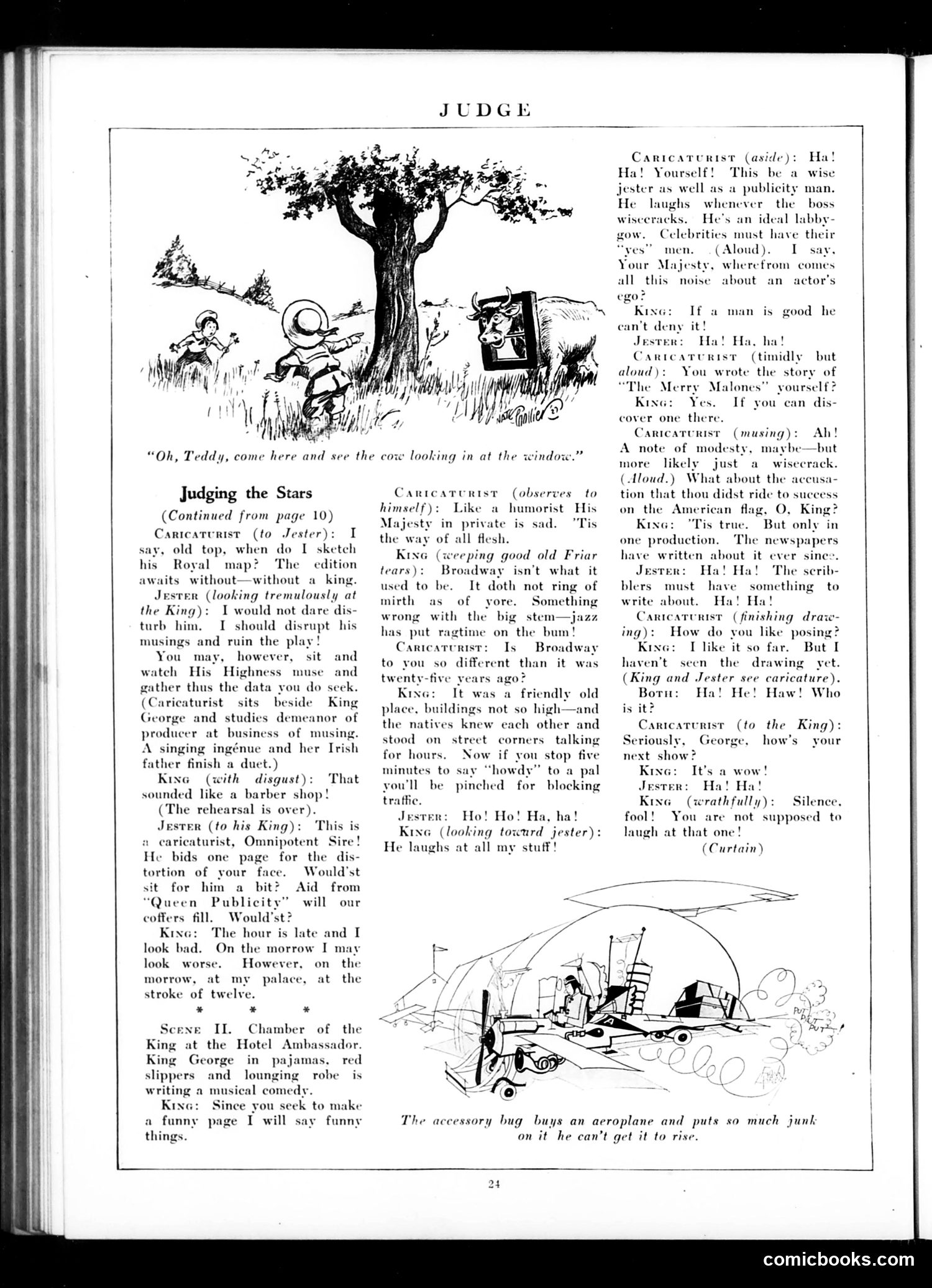
This is a one-act theatrical sketch satirizing **George M. Cohan**, a prominent American songwriter, producer, and playwright of the early 20th century. The caricature exaggerates his distinctive features—large head, prominent nose, and cigar—depicting him as an arrogant showman. The satire centers on Cohan's power in theater and entertainment. He's portrayed surrounded by desperate chorus girls seeking his favor to get their photographs published, highlighting the exploitative dynamics of early Broadway where producers controlled performers' careers and public visibility. The "Jester" character (publicity man) and "Caricaturist" observe Cohan's self-important posturing—lounging ostentatiously in the theater audience with his legs sprawled across seats, hand to jaw in an affected "pondering" pose. Judge magazine mocks Cohan's inflated ego and the corrupt system where performers must court powerful men for professional opportunities.
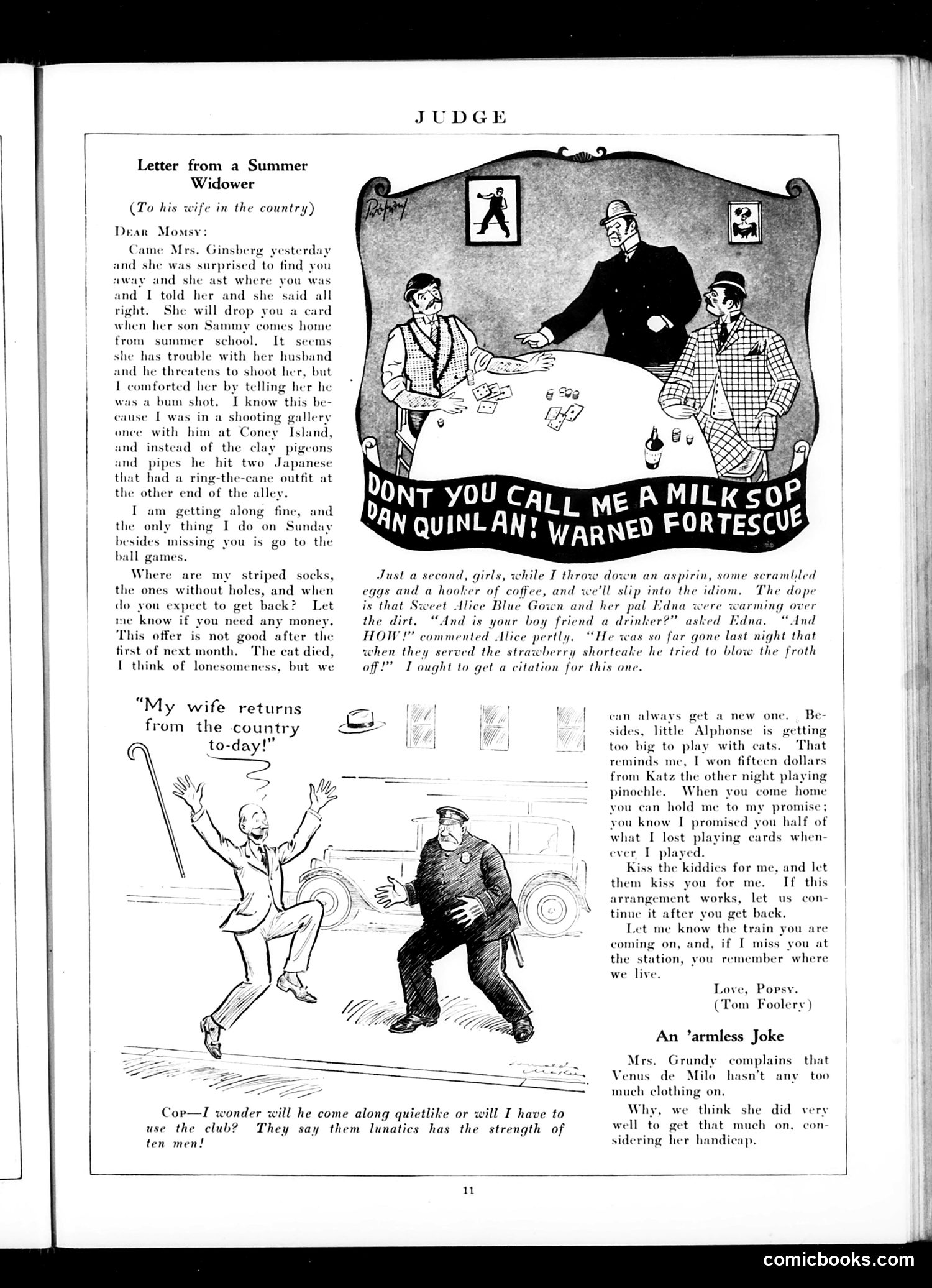
This Judge page contains three satirical pieces mocking domestic life and social conventions: **"Letter from a Summer Widower"**: A humorous letter from a husband whose wife is away. The satire targets male incompetence at home and casual attitudes toward violence—he mentions a neighbor threatening to shoot his wife, dismissing it as mere marital discord. The joke relies on immigrant stereotypes (Mrs. Ginsberg, Sammy) and ethnic caricatures (the Japanese ring-toss operators he accidentally shot at Coney Island). **Top cartoon**: A speakeasy scene (Prohibition-era reference) where a man warns others "Don't call me a milk sop, Dan Quinlan! Warned Fortescue." The joke plays on masculinity anxieties—being called weak or unmanly in front of peers. **Bottom cartoon**: Titled "An 'armless Joke," it's a crude pun on "armless" (harmless) involving the Venus de Milo statue. The "joke" objectifies women's bodies and treats physical disability as comedic fodder. The page reflects early 20th-century attitudes toward ethnicity, gender, and disability that modern audiences would find offensive.
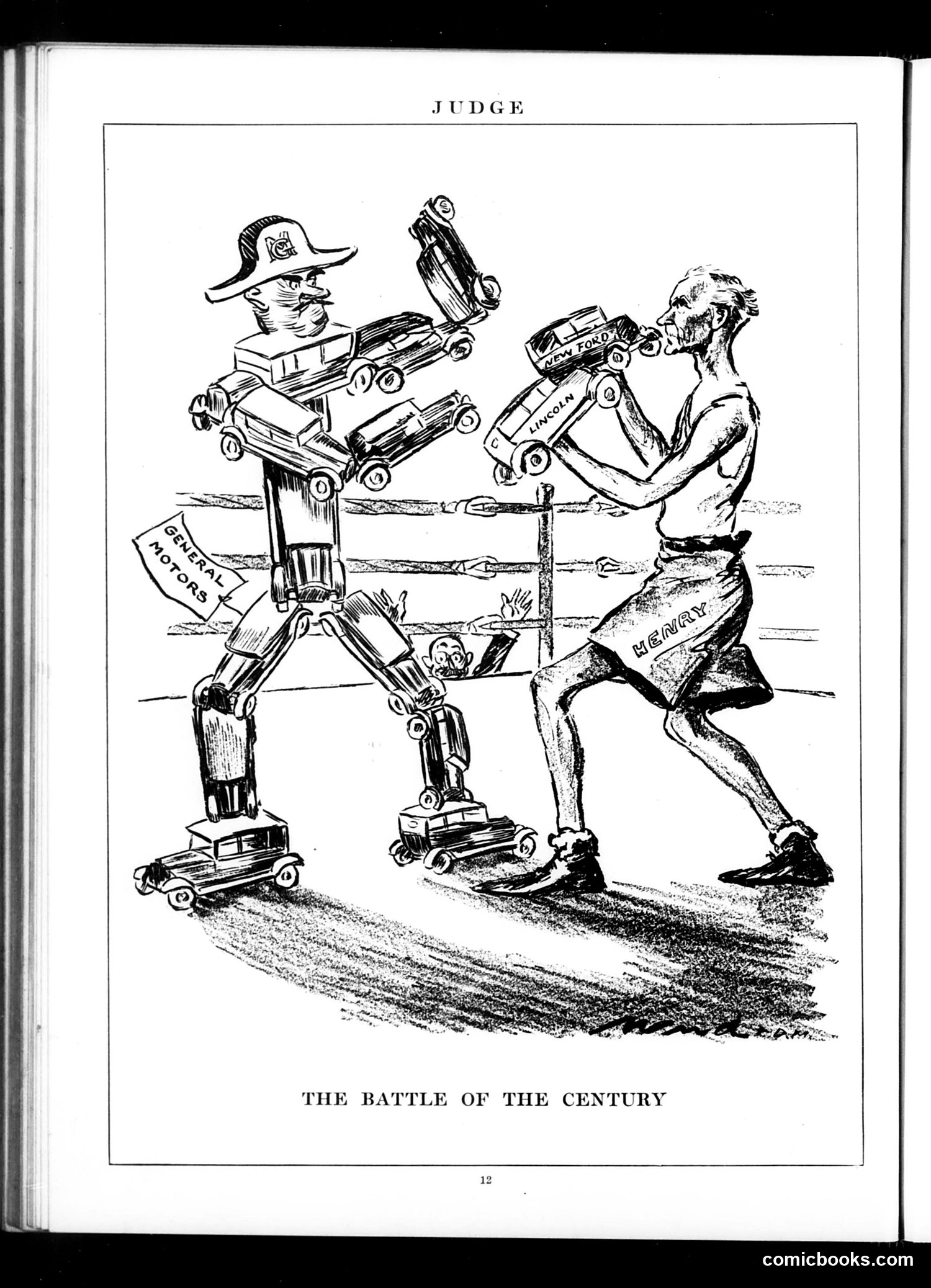
This cartoon depicts an automobile industry competition, likely from the early 20th century. On the left stands a "General Motors" figure (identifiable by the hat and body made of stacked cars), facing off against a boxer labeled "Henry" (likely Henry Ford, identifiable by text on his shorts). The image uses boxing metaphor to satirize corporate rivalry between General Motors and Ford Motor Company. The joke critiques how these industrial titans "battled" for market dominance through vehicle production rather than actual combat. GM's composite-car body emphasizes their multi-brand strategy, while Ford's individualized stance suggests his company's focused approach. The boxing ring setting transforms commercial competition into entertainment spectacle—reflecting how major industrial rivalries captivated the American public during this era of rapid automotive expansion.
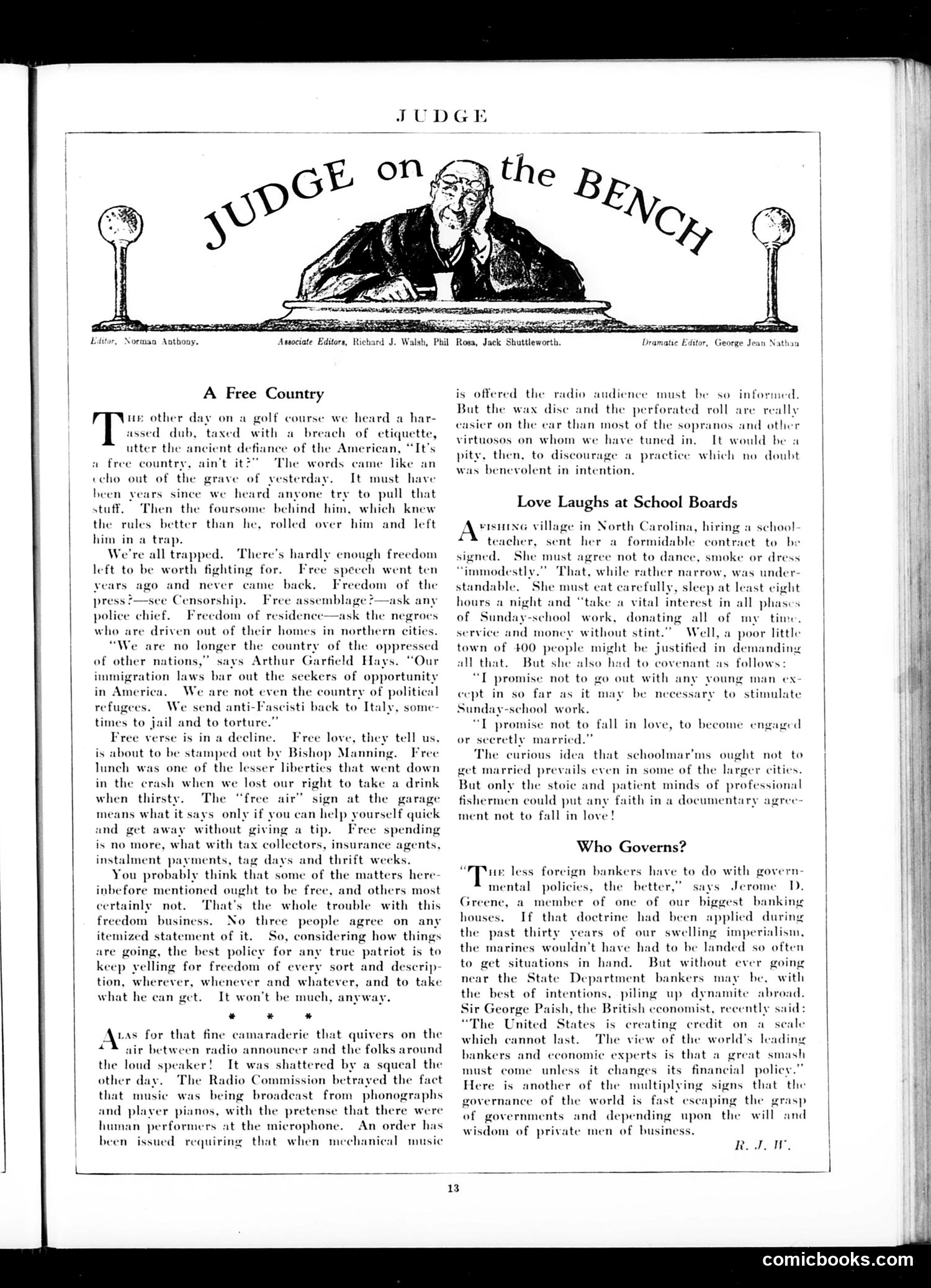
This page features editorial commentary by Norman Anthony (editor) on American freedoms and social hypocrisy circa the 1920s-30s. **"A Free Country"** satirizes the decline of American liberties. A golfer invokes "free country" as excuse for rule-breaking, then gets literally trapped in a sand trap—a metaphor for how Americans claim freedom while being increasingly constrained by laws, taxes, censorship, and social restrictions. Anthony catalogs lost freedoms: free speech (gone "ten years"), assembly, residence for Black Americans, and even free lunch and air. **Other segments** critique: - Radio fakery (pretending phonograph music is live performance) - School boards imposing oppressive contracts on teachers, forbidding dancing, smoking, marriage, and romance The overall message: Americans boast of freedom while systematically surrendering it through regulation and social conformity.
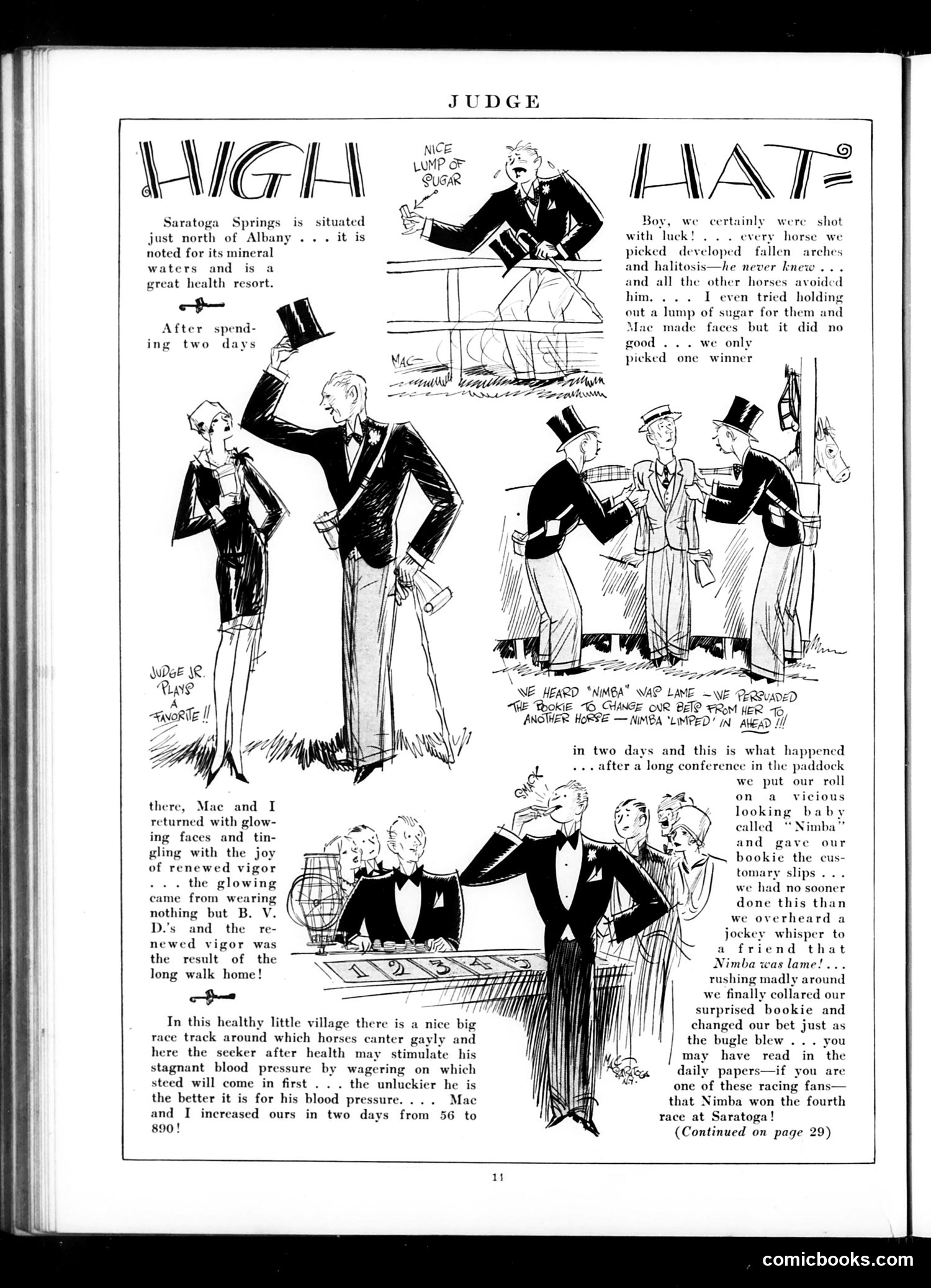
This humorous article satirizes the obsessive culture of horse racing and gambling at Saratoga Springs, a upscale New York resort town. The narrator and his friend "Mac" visit for health reasons but become consumed by betting on racehorses. The joke's progression: they pick a horse named "Nimba" that appears doomed (develops health problems, other horses avoid it), yet they manage to change their bet just before it unexpectedly wins the fourth race. The satire mocks how gambling fever overtakes visitors to fashionable resorts, contradicting the stated health-focused purpose of their visit. The ironic title "High Hat" (meaning pretentious/snobbish) suggests the pretense that Saratoga visitors maintain—claiming refined leisure while actually obsessing over betting odds. The B.V.D.'s reference is to men's underwear, used for comedic effect regarding their "renewed vigor."
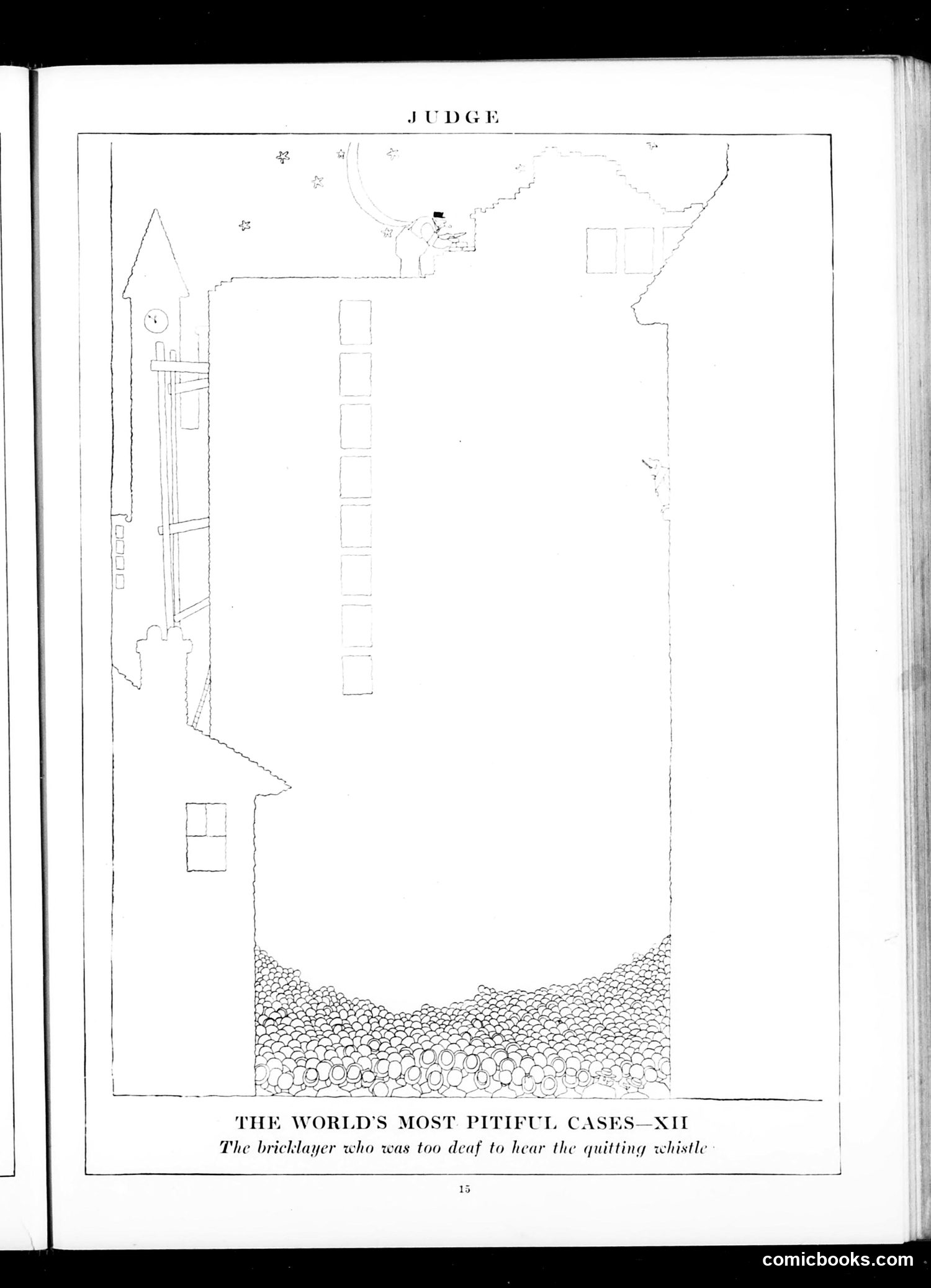
This is an architectural cross-section drawing titled "The bricklayer who was too deaf to hear the quitting whistle." The illustration shows a multi-story building with a worker at the top and a pile of bricks at the bottom, apparently depicting the tragic result of someone who couldn't hear the end-of-workday signal. The cartoon is a dark humor joke about workplace safety and disability. The punchline hinges on the ironic misfortune of a deaf laborer who, unable to hear the whistle signaling quitting time, presumably falls from the building. It's satirizing both the hazards of early 20th-century construction work and the vulnerability of workers with disabilities in dangerous occupations. This reflects Judge magazine's tendency toward morbid, cynical humor about contemporary social issues.
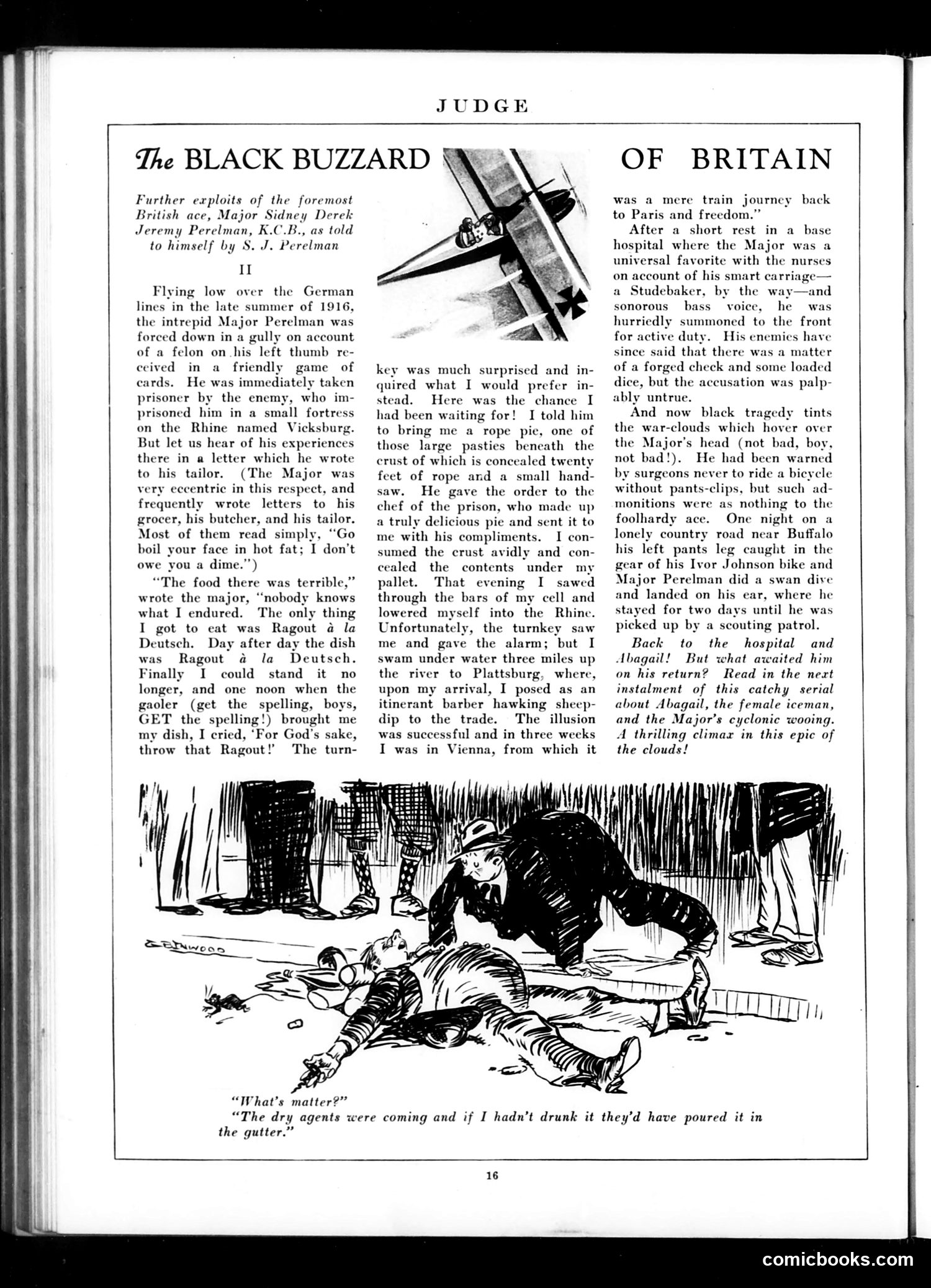
This is a humorous serial story by S. J. Perelman about "Major Sidney Derek Jeremy Perelman," a fictional British World War I fighter pilot. The page presents the second installment of his improbable adventures. The joke relies on absurdist humor: the Major claims he was shot down in 1916, imprisoned in a German fortress, escaped using a rope baked inside a pie, swam miles underwater, and later crashed his motorcycle near Buffalo. The tall-tale narration—told as letters to his tailor—parodies melodramatic war stories and adventure serials popular in that era. The bottom illustration shows the injured Major being discovered after his bike crash. The caption's mention of "dry agents" references Prohibition-era enforcement, adding topical American humor to this supposedly British narrative. The overall satire mocks both overwrought war fiction and romantic serial storytelling conventions.
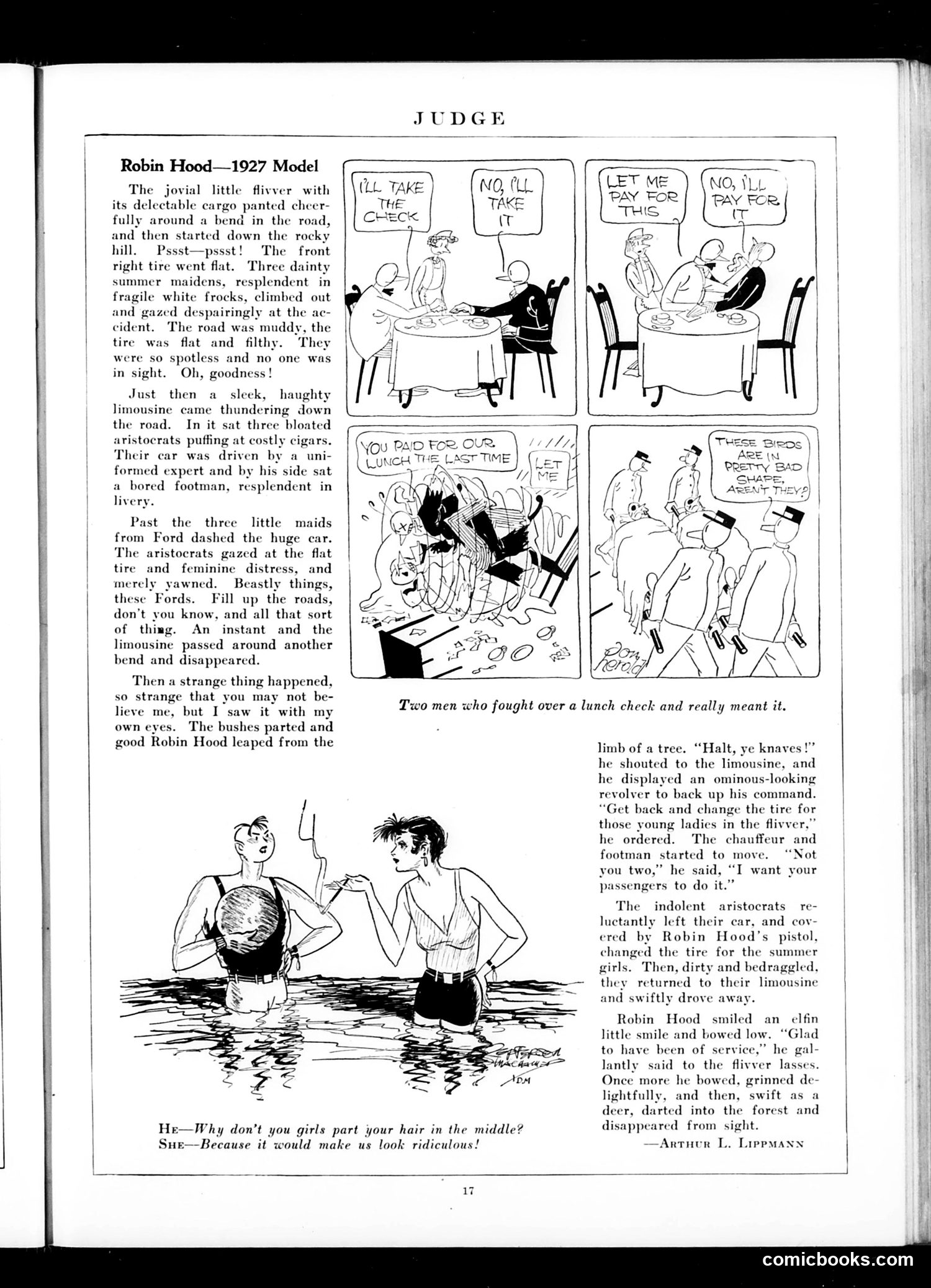
This satirical story mocks class distinctions in 1920s America. Three young women in a Ford (the affordable "flivver" car) get a flat tire. A limousine full of wealthy aristocrats passes without helping, dismissing them as "beastly things, these Fords." Robin Hood then appears and forces the limousine's wealthy *passengers* (not their servants) to change the tire themselves, humbling them through manual labor. The satire critiques the indolence and callousness of the rich toward ordinary people, while celebrating the Robin Hood archetype—taking from the privileged to aid the common folk. The accompanying illustrations and jokes about dining etiquette reinforce themes of class conflict and pretension. This reflects 1920s anxieties about inequality and the nouveau riche during the Jazz Age.
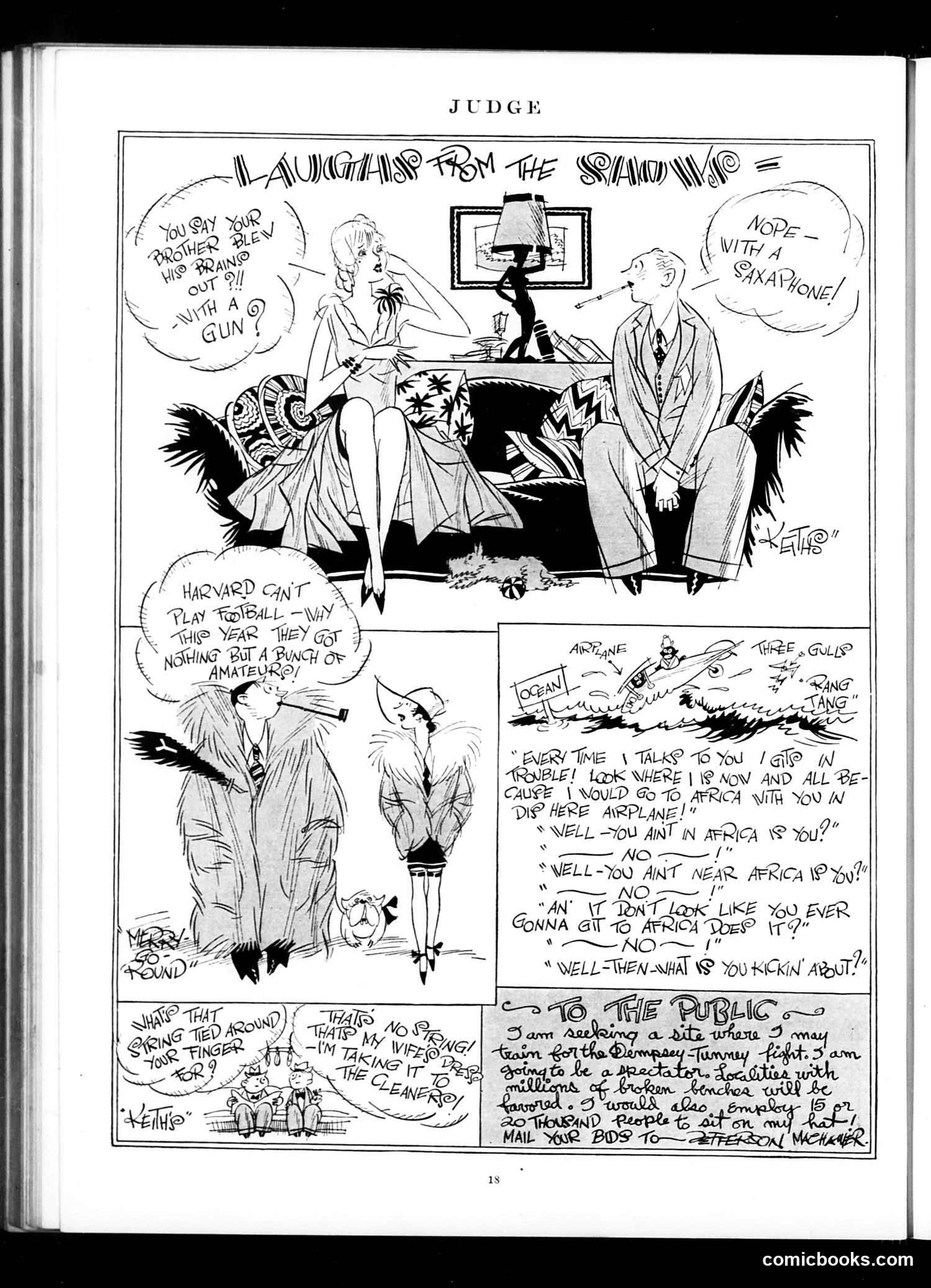
This satirical comic mocks upper-class socialites and their frivolous concerns. The top panel shows a wealthy couple in a living room—she complains her brother "rained his brains out" with a gun; he dismissively responds "nope—with a saxophone!" The middle panels depict two women in flapper-style dress discussing a man who allegedly promised to take one to Africa, but never will. The joke hinges on romantic false promises and the women's gullible belief in such talk. The bottom panel appears to reference Harvard football, suggesting the sport produces only "amateurs." Overall, Judge satirizes Jazz Age excess, romantic deception among the wealthy, and the perceived decline of institutions like Harvard—typical 1920s-era social commentary mocking modern morality and competence.
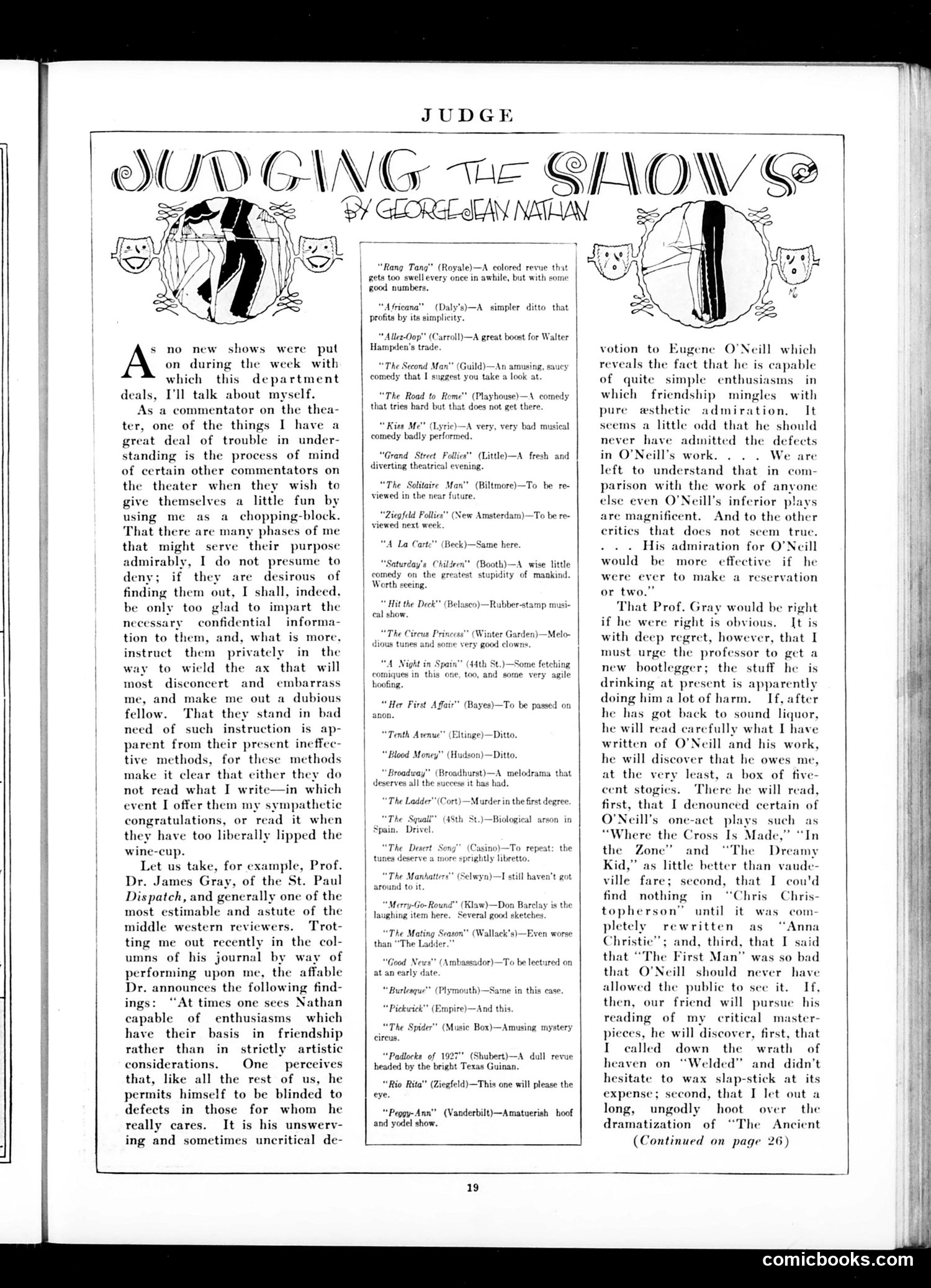
This is a theater column by George Jean Nathan, a prominent drama critic. The "cartoon" is actually textual satire—Nathan responds to criticism from Dr. James Gray of the St. Paul Dispatch, who accused Nathan of letting personal friendships bias his theater reviews. Nathan defends himself with mock self-deprecation, sarcastically offering to teach Gray how to properly criticize him. He then pivots to a lengthy defense of Eugene O'Neill against other critics' dismissals, arguing O'Neill is genuinely great despite his flawed plays. The column closes with a alphabetized list of current Broadway shows (1920s) with Nathan's one-line verdicts—some flattering, others brutally dismissive ("Rubber-stamp musical show," "Drivel"). The satire targets both provincial critics who lack sophistication and fellow New York critics who undervalue O'Neill's significance. It's primarily intellectual humor for theater-world insiders.
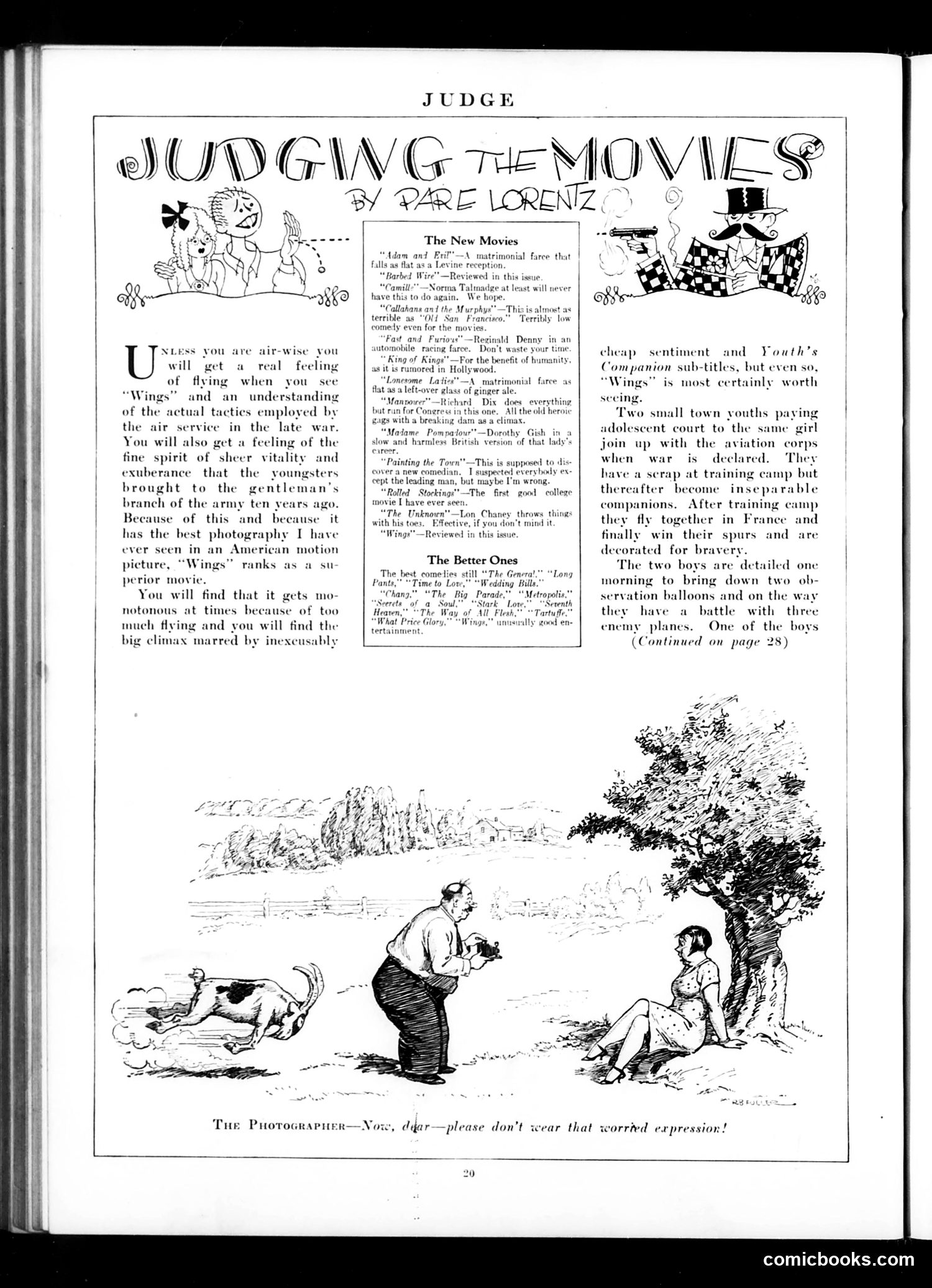
This is a film review column from Judge magazine that critiques contemporary movies, primarily focusing on aviation films. The main subject is "Wings," which the reviewer praises as superior entertainment despite occasional tedium, citing its authentic depiction of WWI air service, vital young performers, and excellent photography. The review contrasts "Wings" favorably against other current releases like "Adam and Evil" and "Smillin' Through" (criticized as poor), while listing better comedies separately. The bottom cartoon, captioned "The Photographer—Now, dear—please don't wear that worried expression!" depicts a photographer directing subjects during a casual outdoor portrait session, likely satirizing the awkwardness of posed photography. The content reflects post-WWI American cinema's fascination with aviation and military service narratives.
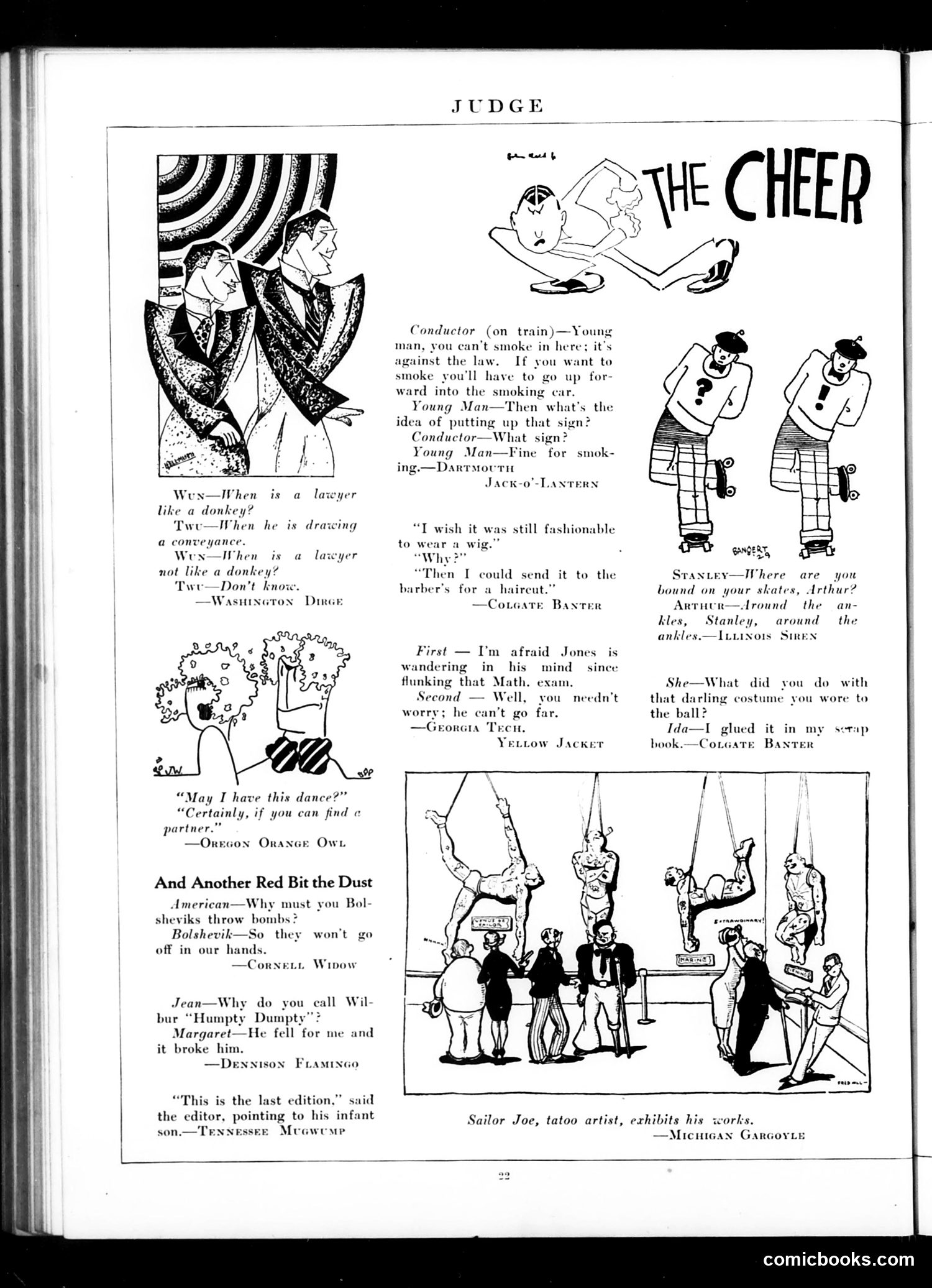
This page collects brief humorous jokes and cartoons typical of early 20th-century American humor magazines. The content includes: **Wordplay jokes** about lawyers (comparing them unfavorably to donkeys), Bolsheviks throwing bombs, and a conductor misinterpreting a "Fine for Smoking" sign as permission rather than a penalty. **Social commentary**: References to Bolsheviks suggest Cold War-era anti-communist sentiment common in this period. **Everyday humor**: Jokes about romance, fashion (storing a costume by gluing it in a scrapbook), skating, and mathematics exams reflect middle-class concerns. **The "Sailor Joe" cartoon** depicts a tattoo artist displaying his work—likely satirizing working-class body modification as entertainment. Overall, this represents Judge's formula: lightweight social satire, puns, and observational humor targeting educated readers familiar with contemporary references like Bolshevism and college life.
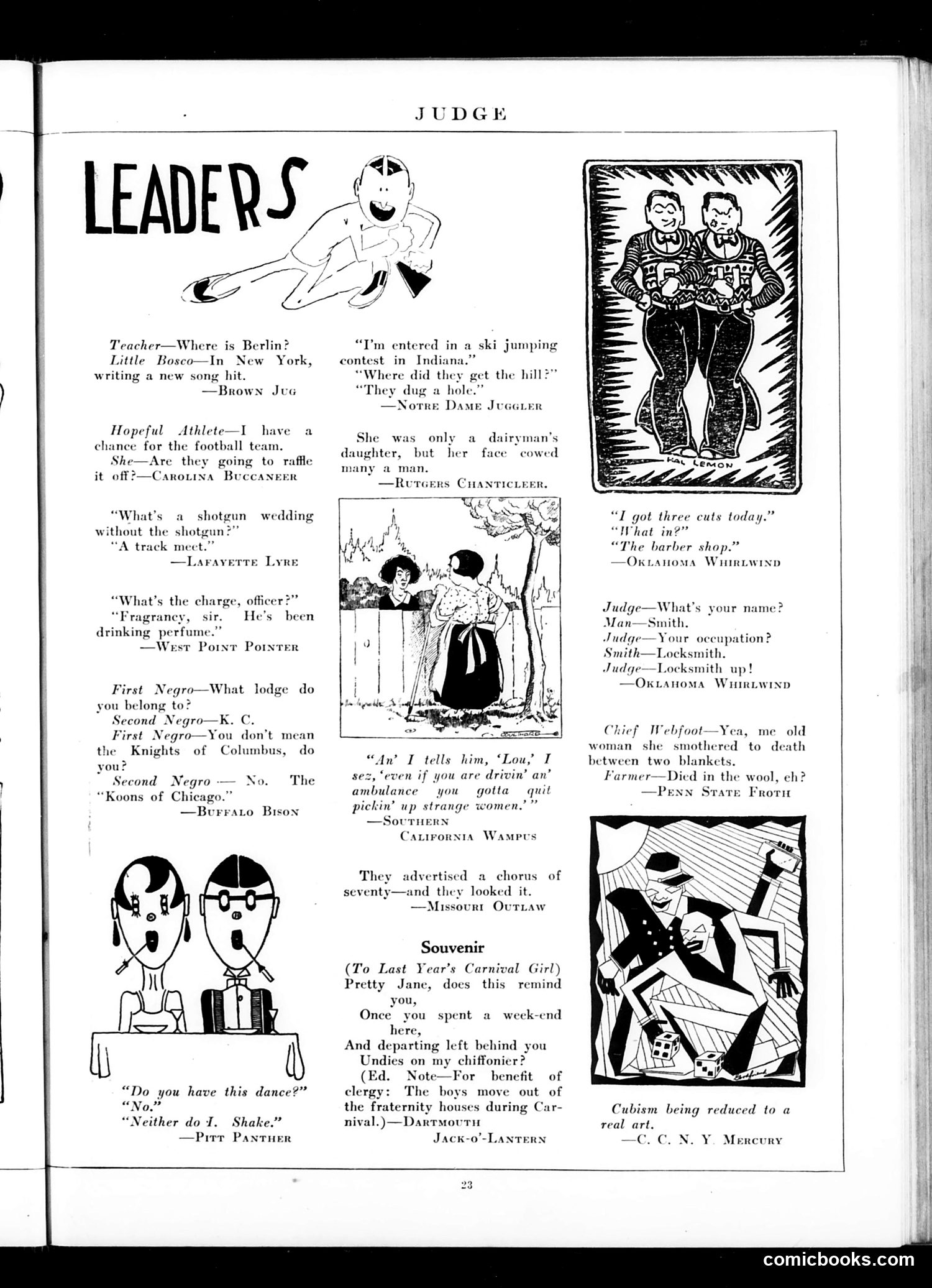
This is a collection of short jokes and one-liners typical of Judge's "Leaders" section—light satirical humor on contemporary topics. **Key references:** - **"Berlin" joke**: References Irving Berlin, the famous songwriter, playing on the double meaning of the city name. - **Racial jokes**: The "First Negro/Second Negro" exchange uses period-offensive terminology and stereotypes about Black fraternal organizations (K.C., "Koons of Chicago"). - **Military/college humor**: References to West Point, Notre Dame, and fraternity life reflect Judge's readership. - **Social satire**: Jokes about shotgun weddings, perfume-drinking officers, and a locksmith being arrested reflect contemporary social anxieties and Prohibition-era concerns. - **"Cubism" cartoon**: The final illustration sardonically comments on modern art's abstraction by depicting a chaotic domestic scene as supposed "art." The humor is period-specific, relying on recognizable cultural figures (Berlin) and social situations now largely historical. The racial content reflects deeply problematic era conventions.
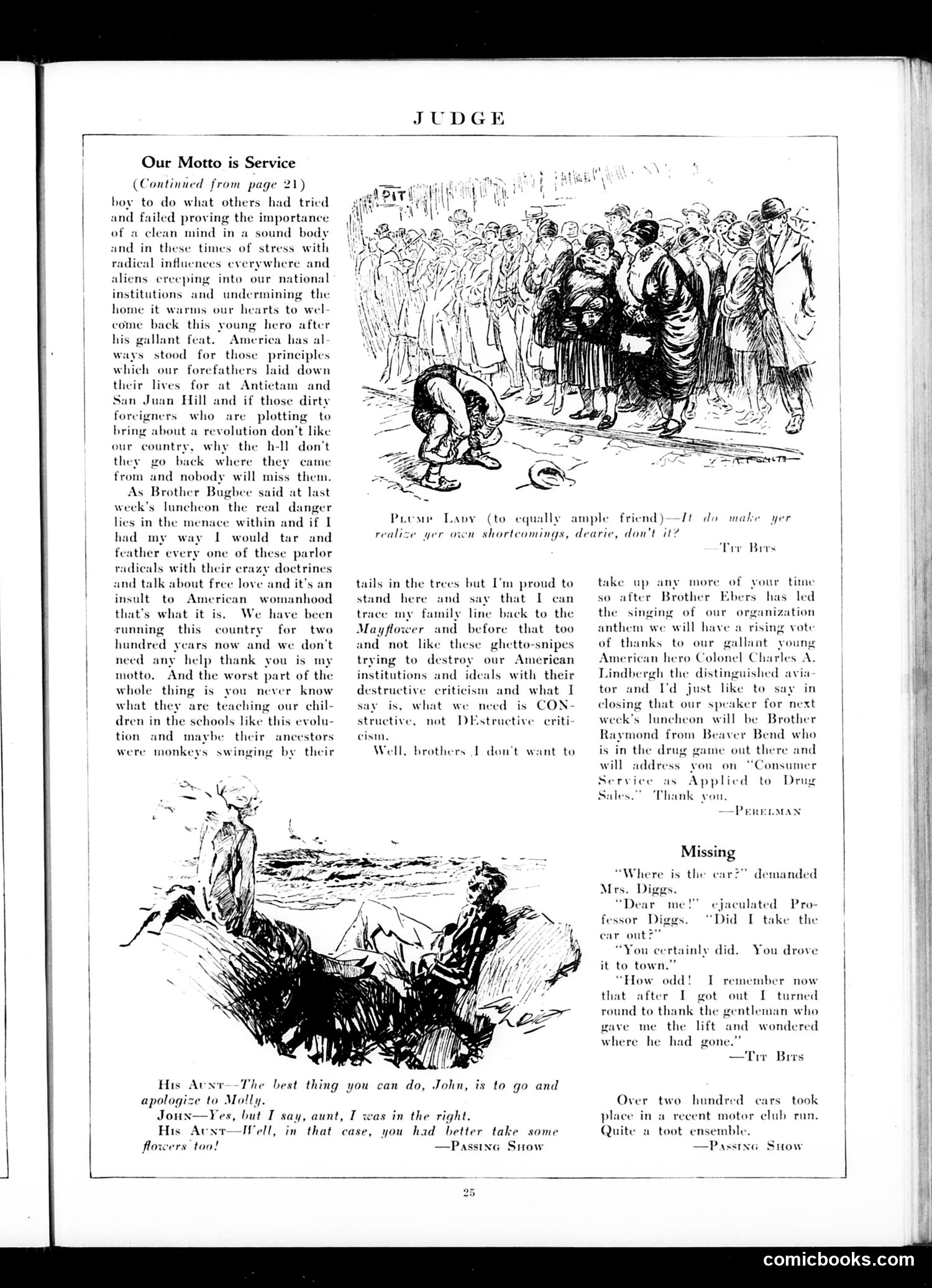
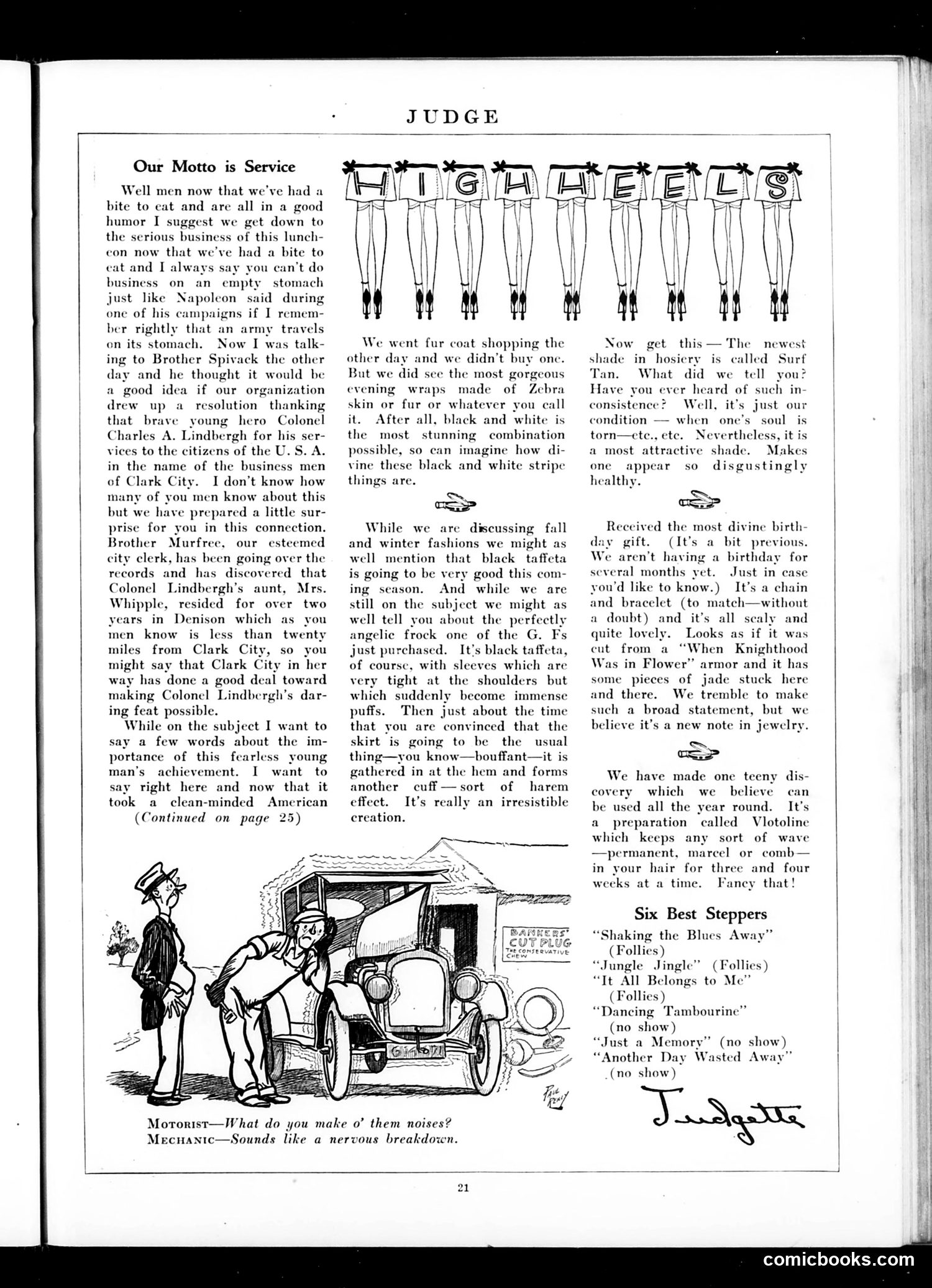
This page contains anti-radical propaganda dressed as humor, reflecting 1920s American anxiety about immigration and socialism. **Main cartoon**: A "Plump Lady" comments to a friend about recognizing her own shortcomings—likely satirizing wealthy American women's self-awareness (or lack thereof) about social inequality. **Text section "Our Motto is Service"**: A speaker at a service club luncheon celebrates Colonel Lindbergh (the famous aviator) while ranting against "parlor radicals," "aliens," and "ghetto-snipes" supposedly plotting revolution. The speaker boasts of tracing his lineage to the Mayflower, contrasting "constructive" patriotism against "destructive criticism" of American institutions. **The satire's target**: The piece mocks self-righteous nativists who conflate immigration with communism and dismiss legitimate social criticism as un-American. The hyperbolic rant—mixing Lindbergh worship, family pedigree-boasting, and crude ethnic slurs—exposes how xenophobic rhetoric disguised itself as patriotic service. **Minor jokes**: Include a domestic comedy about a forgetful professor and references to a motor club run.
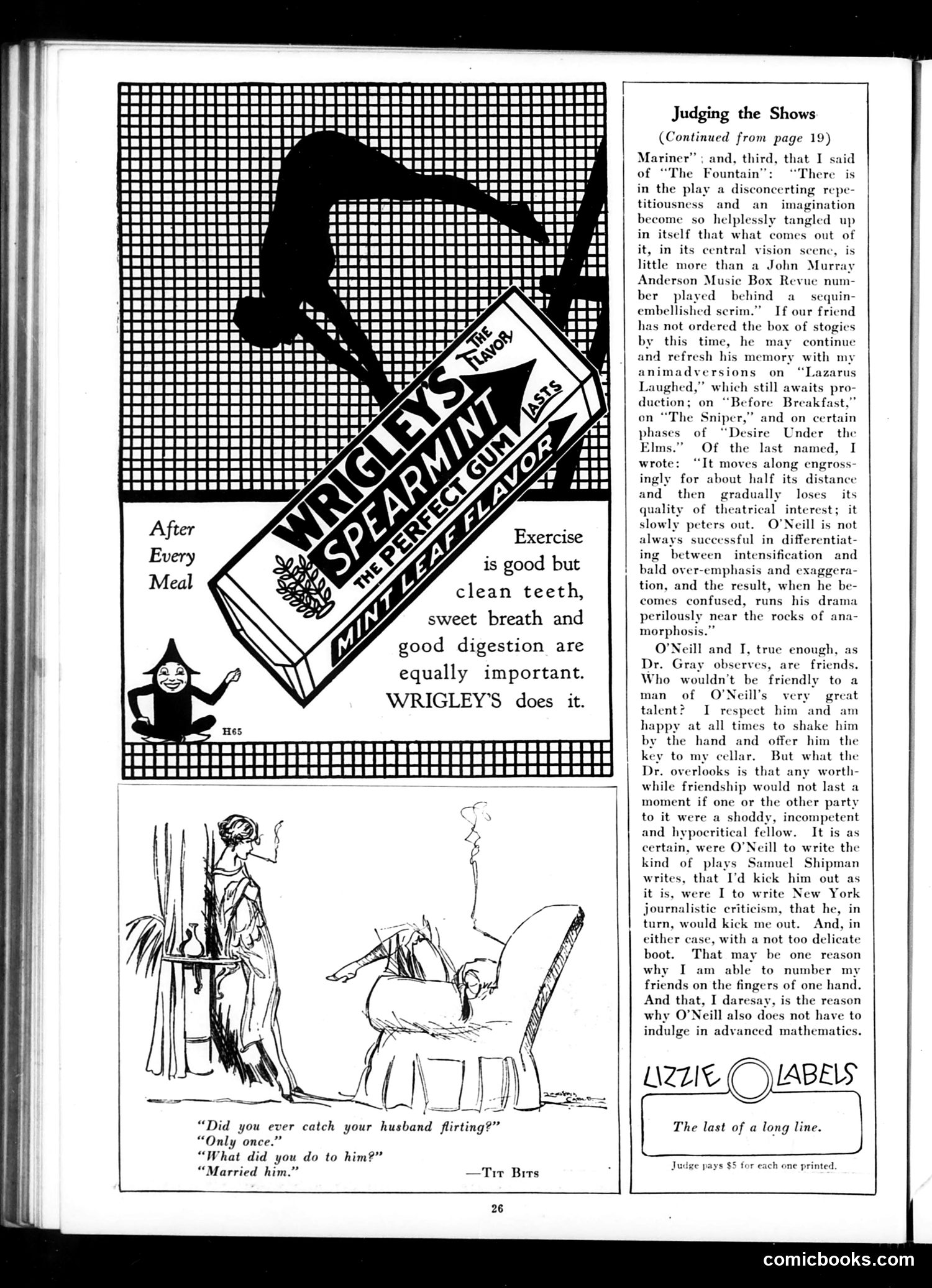
This page contains two unrelated items from *Judge* magazine: **Top section**: A theater critic's response defending his negative reviews of playwright Eugene O'Neill's works ("The Fountain," "Desire Under the Elms," etc.). The critic justifies his harsh assessments while expressing personal respect for O'Neill, arguing that true friendship shouldn't prevent honest professional criticism. This is a meta-commentary on the tension between personal relationships and critical honesty. **Bottom section**: A brief joke about a woman who caught her husband flirting once—and married him as punishment/consequence. The humor relies on the era's gender dynamics and marital expectations. **Wrigley's ad**: An unrelated chewing gum advertisement inserted between the content. **"Lizzie Labels"**: A section paying readers $5 for submitted jokes (the "last of a long line" suggests this was a recurring feature). The page reflects 1920s theatrical culture and social attitudes toward marriage and criticism.
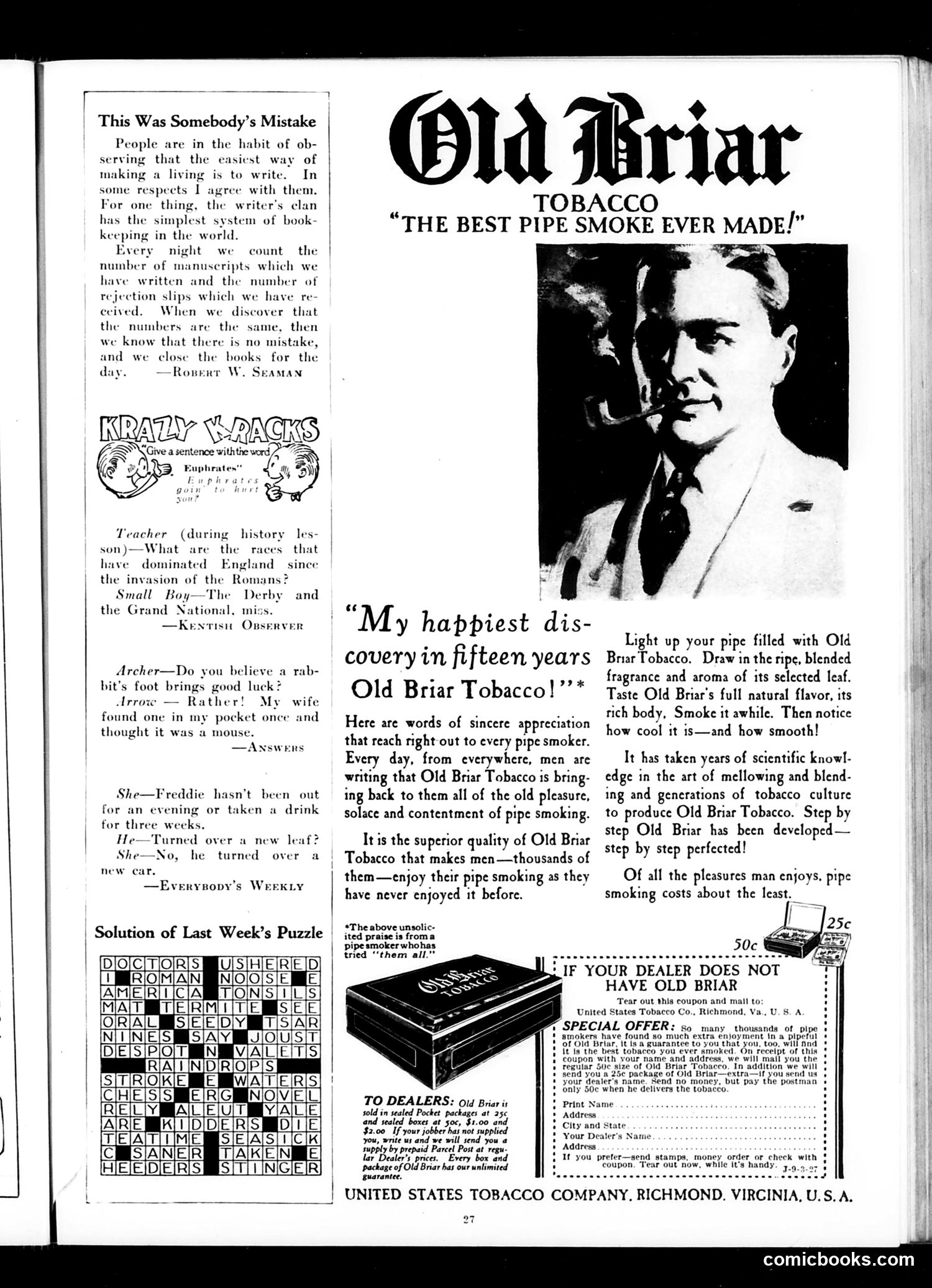
This page is primarily **advertising** for Old Briar Tobacco, occupying most of the right side. The left contains typical Judge magazine humor content: brief jokes and witticisms. ## Left-side humor: - **"This Was Somebody's Mistake"** by Robert W. Seaman satirizes writers' accounting practices—counting manuscripts sent equals rejection slips received, balancing the books. - **"Krazy Kracks"** offers a word puzzle and school joke about English history races (Derby and Grand National horse races, not human races). - **Miscellaneous one-liners** about rabbits' feet as luck charms and a car accident, typical period humor. - **Solution to crossword puzzle** from the previous week. ## Right-side advertisement: The **Old Briar Tobacco ad** features a photograph of a man smoking a pipe with testimonial text claiming it's "the best pipe smoke ever made" and praising its quality. It includes pricing (25¢, 50¢), a dealer coupon, and promotional copy emphasizing superior quality and affordability. **Context for modern readers:** This represents early 20th-century tobacco marketing before health warnings, freely advertising smoking's pleasures in mainstream publications.
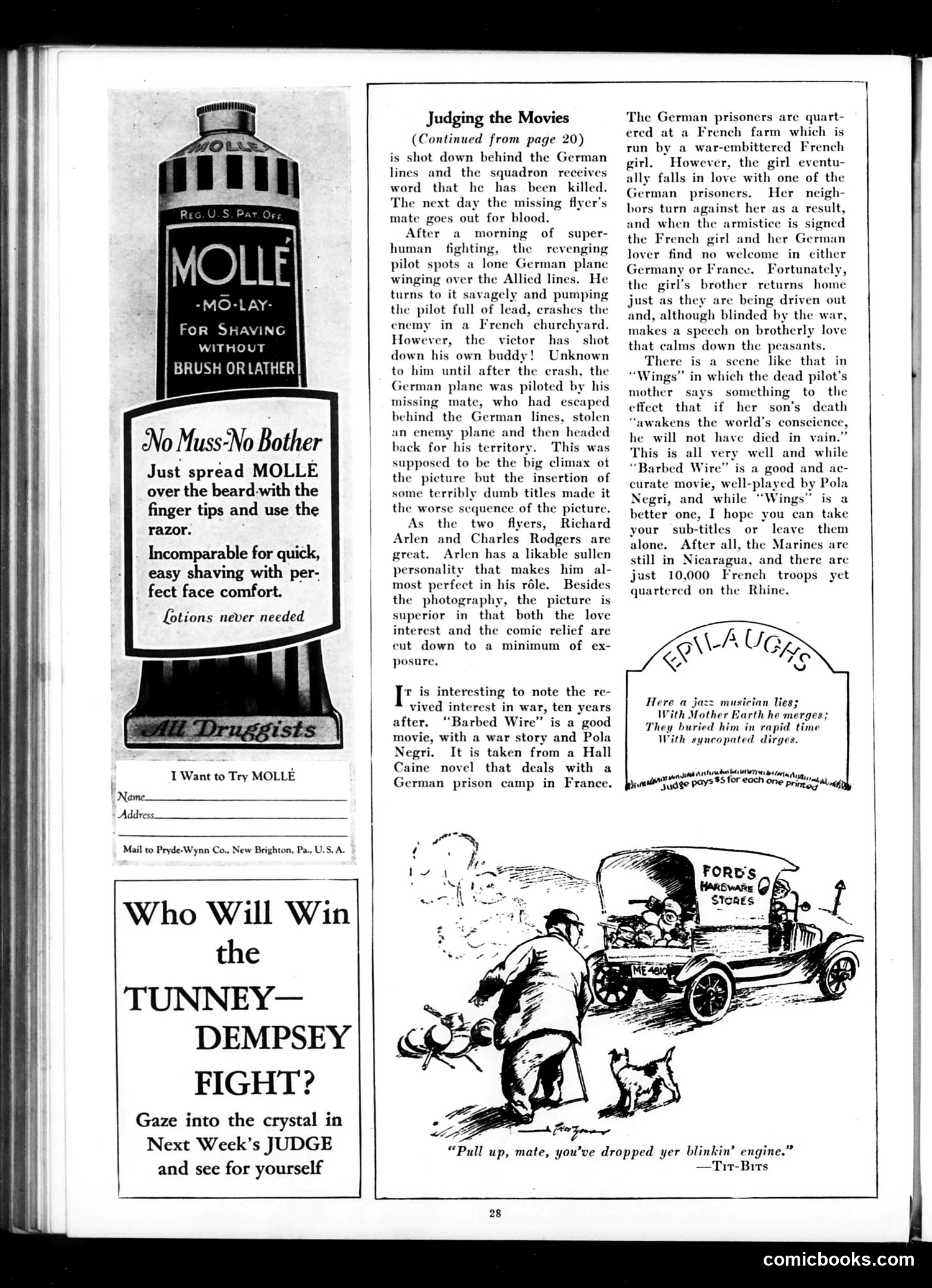
This page contains **advertisements and movie criticism** rather than political cartoons. The **Molly shaving cream ad** promotes a brushless shaving product—typical 1920s advertising. The main content is a **movie review column** critiquing war films from approximately 1927. It discusses "Wings" and "Barbed Wire," both dealing with World War I themes. The reviewer criticizes plot elements—particularly a scene where a pilot unknowingly shoots down his own comrade—and complains that heavy-handed title cards ruin sequences. He praises the acting but notes the films' heavy-handed messaging (a dead pilot's mother's speech about his death "awakening the world's conscience"). The reviewer also comments on the **revival of war films ten years after WWI's end**, and adds a skeptical note about ongoing American military presence in Nicaragua and French troops still stationed on the Rhine. The **bottom cartoon** is a humorous traffic scene unrelated to the reviews—a motorist warning another about a dropped engine.
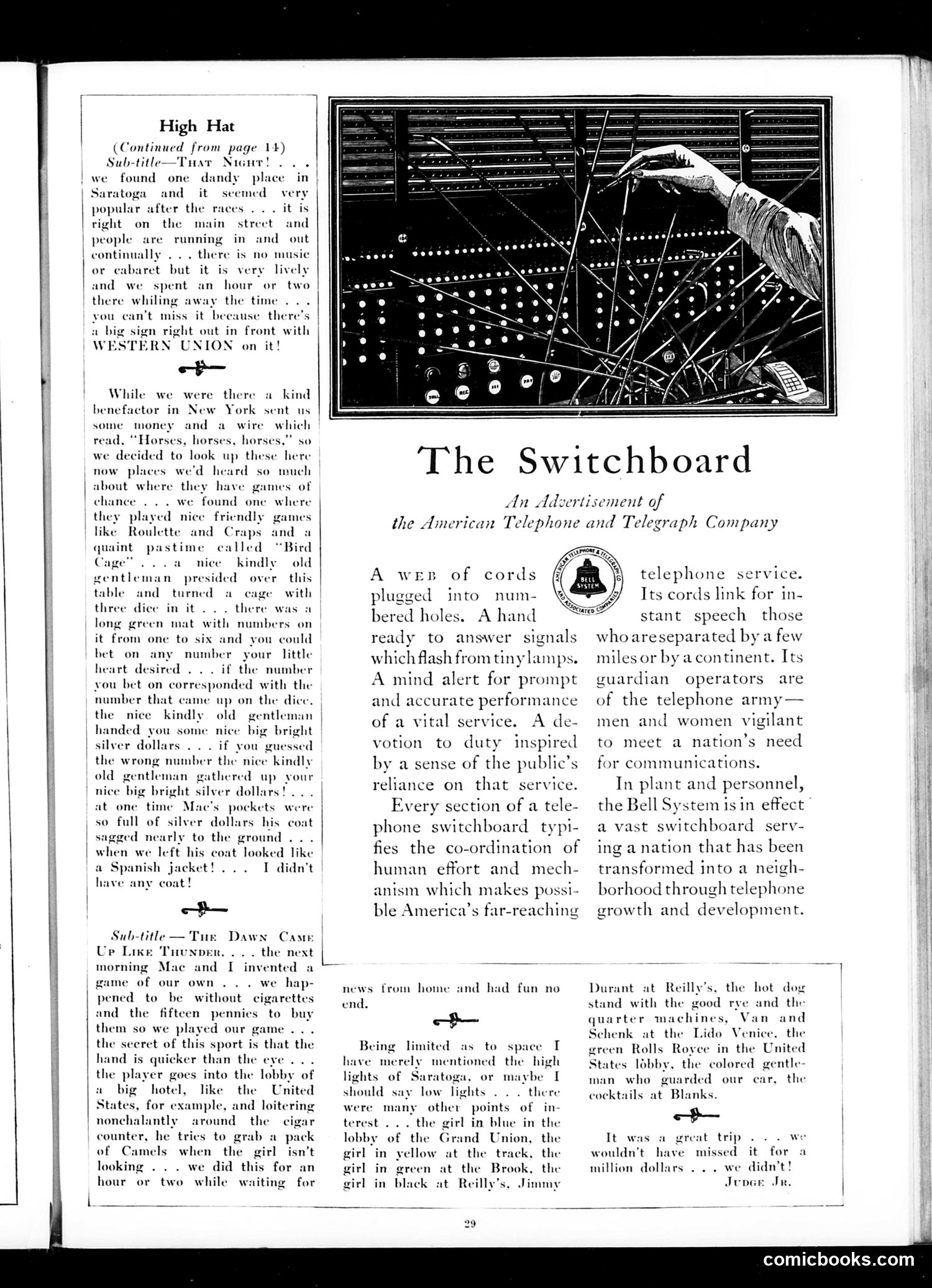
This page contains two distinct elements: a humorous travel essay and a corporate advertisement. **"High Hat" (left column):** A satirical account of a trip to Saratoga Springs, NY, mocking tourist attractions and gambling culture. The author describes visiting a Western Union office (presented as a nightlife destination), witnessing games of chance like roulette and "Bird Cage," and describing petty theft—attempting to steal Camel cigarettes from a hotel lobby. The tone is ironic and self-deprecating, poking fun at both the author and the leisured class frequenting upscale resorts. **"The Switchboard" (right side):** A full-page advertisement for AT&T (American Telephone and Telegraph Company). The ornate illustration shows a telephone switchboard's complexity. The copy celebrates telephone operators—predominantly women—as essential infrastructure, emphasizing their vigilance and duty to connect the nation. This is corporate PR celebrating both technology and the labor force (though operators were notoriously underpaid). The contrast between satirizing wealthy leisure and celebrating technological progress reflects 1920s American anxieties about modernity.
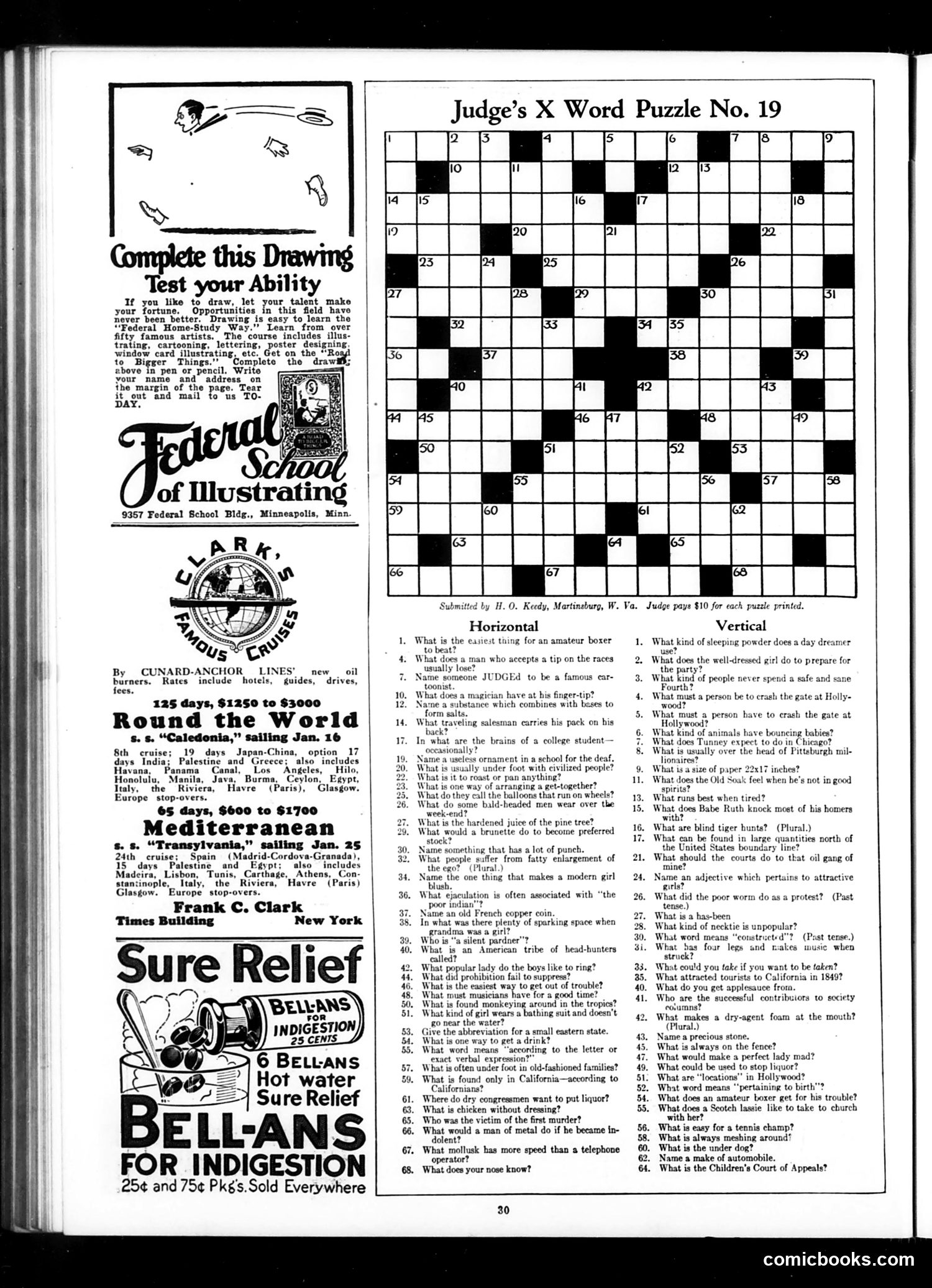
This page is primarily **advertising and a crossword puzzle**, not political satire. The dominant content includes: **Advertisements**: Travel cruises (Cunard-Anchor Lines), art correspondence school (Federal School of Illustrating), and Bellans indigestion medicine. **"Judge's X Word Puzzle No. 19"**: A standard crossword with wordplay-based clues typical of 1920s humor magazines. The clues are puns and riddles rather than straightforward definitions—e.g., "What is the easiest thing for an amateur boxer to beat?" (answer: a retreat/egg). **"Complete this Drawing Test"**: A recruitment ad for the Federal School of Illustrating, encouraging readers to test drawing ability by completing a simple sketch. **No visible political cartoon** appears on this page. The content reflects Judge's format as a humor and lifestyle magazine aimed at middle-class readers, mixing advertising with puzzles and drawing exercises rather than satirical commentary on current events or politics.
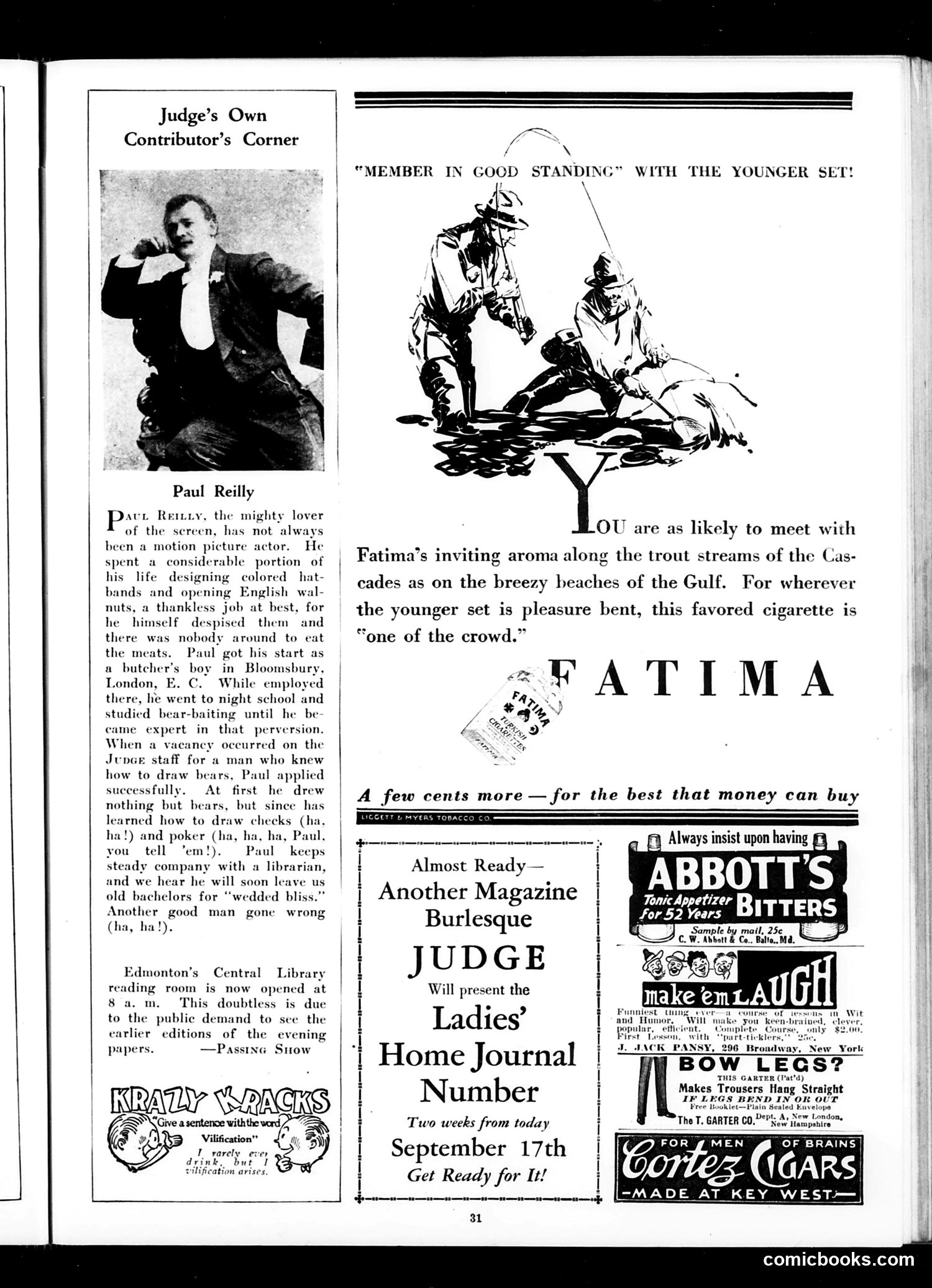
This page is primarily **advertising and promotional content** rather than political satire. The main elements are: **"Judge's Own Contributor's Corner"** profiles Paul Reilly, a cartoonist and illustrator, with humorous biographical details (bear-drawing expertise, failed bear-baiting studies). This is light staff commentary—essentially an in-house bio piece with gentle workplace humor. **The cartoon** above shows outdoorsmen by a tree with text about "member in good standing with the younger set"—it's an advertisement for **Fatima cigarettes**, presenting smoking as fashionable among young people. **The page otherwise contains advertisements** for Abbott's Bitters, Cortez Cigars, and other products, plus promotion for Judge's upcoming "Ladies' Home Journal Number" issue. There is **no significant political content or satire** visible here. It's a typical early 20th-century magazine page mixing contributor profiles, in-house humor, and paid advertising—reflecting how magazines monetized space through ads integrated with editorial content.
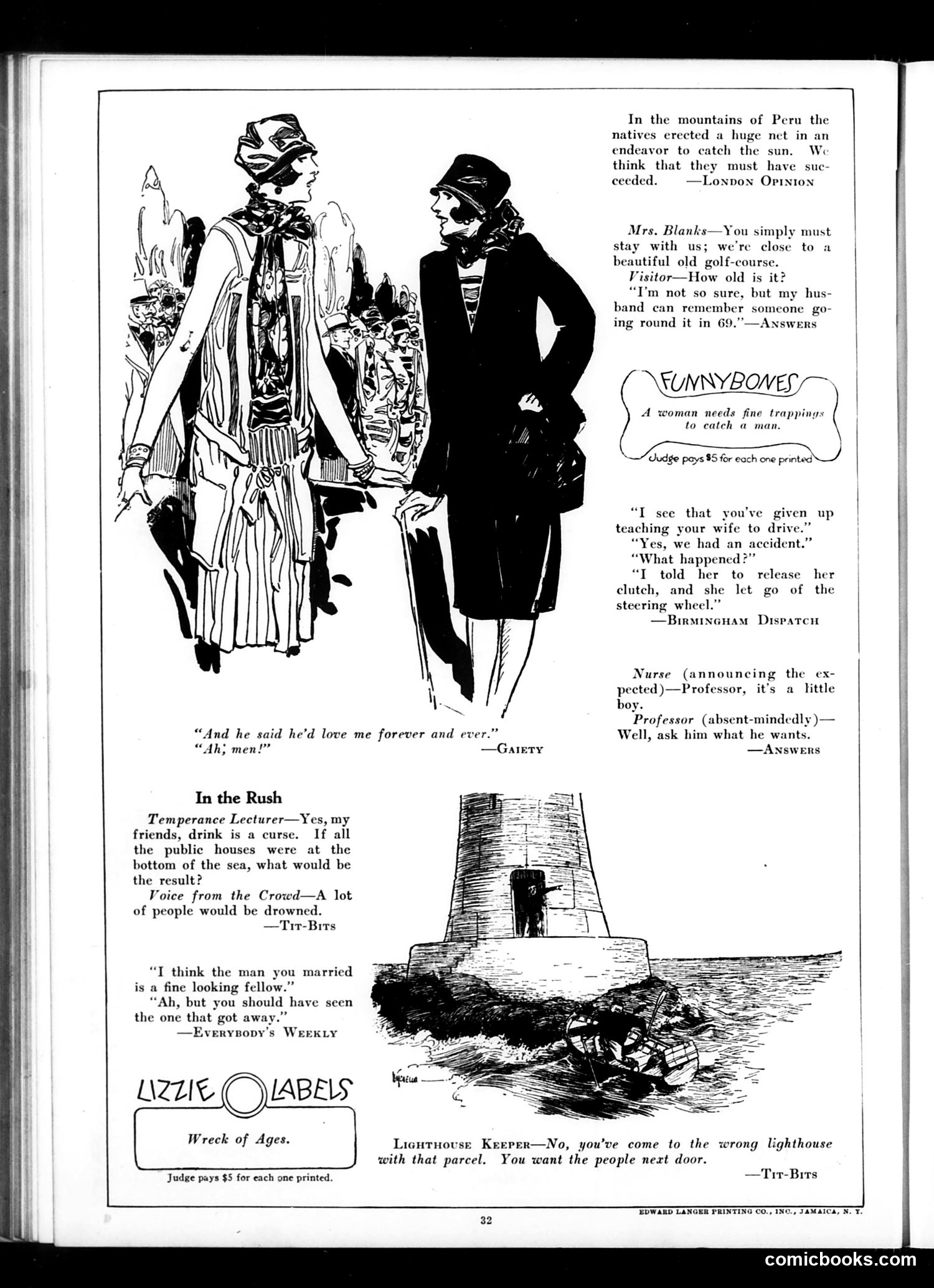
This page collects humorous short jokes and cartoons typical of early 20th-century Judge magazine. The content includes: **Main cartoon (top):** A stylishly dressed woman and man in conversation, captioned with romantic dialogue ("And he said he'd love me forever and ever"). The humor appears to rely on visual contrast or implied irony about romantic promises. **Joke collections:** Multiple short humor pieces sourced from other publications (Tit-Bits, Answers, Birmingham Dispatch, etc.), covering domestic situations—a temperance lecture interrupted by heckler logic, a woman comparing her husband unfavorably to "the one that got away," a driving accident caused by misunderstood instructions, and a professor's absent-minded response to news of a newborn. **Advertisements:** "Funny Bones," "Lizzie Labels," and "Wreck of Ages" appear to be Judge's own branded merchandise—cards or prints readers could purchase for $5. The humor is gentle, focused on marital mishaps, miscommunication, and absurdist logic rather than political commentary. The material reflects domestic comedy popular in this era.
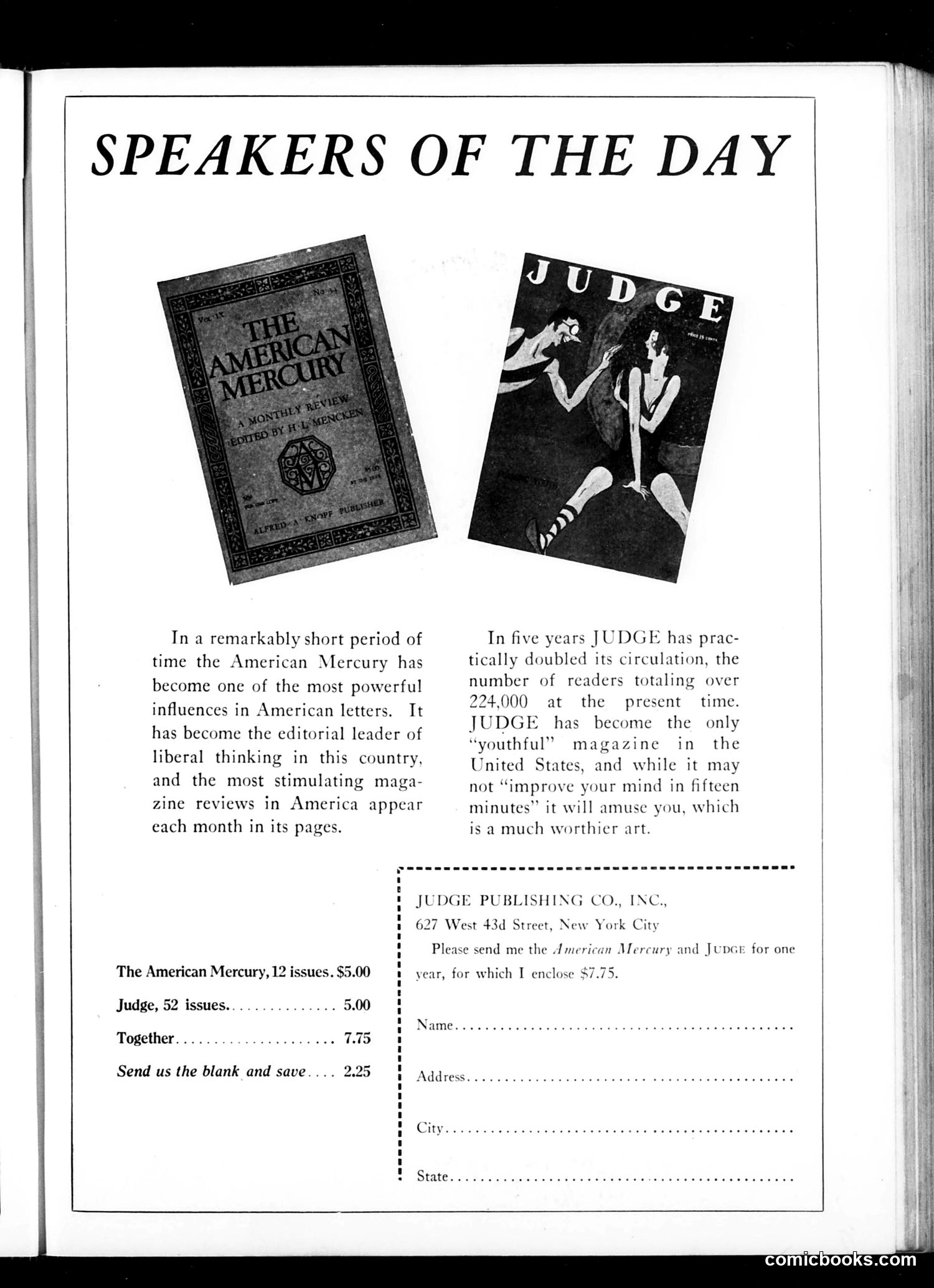
This is primarily an **advertisement page**, not a political cartoon. It promotes two rival American magazines competing for readers in the 1920s. **The Content:** The page juxtaposes *The American Mercury* and *Judge* magazine, presenting them as the leading publications for intelligent American readership. The Mercury is praised as the "editorial leader of liberal thinking," while Judge markets itself as the only "youthful" magazine—positioning itself against the Mercury's more serious intellectual approach. **The Satire:** The implicit joke is competitive positioning: Judge admits it won't "improve your mind in fifteen minutes" but claims entertainment is "a much worthier art." This is tongue-in-cheek self-deprecation, suggesting Judge is the fun alternative to the Mercury's earnest liberalism. **Context for Modern Readers:** Both were prominent satirical/literary magazines. The Mercury (founded 1924) represented sophisticated, often iconoclastic commentary; Judge represented lighter, mass-market humor. This ad captures a media rivalry reflecting different visions of American culture.
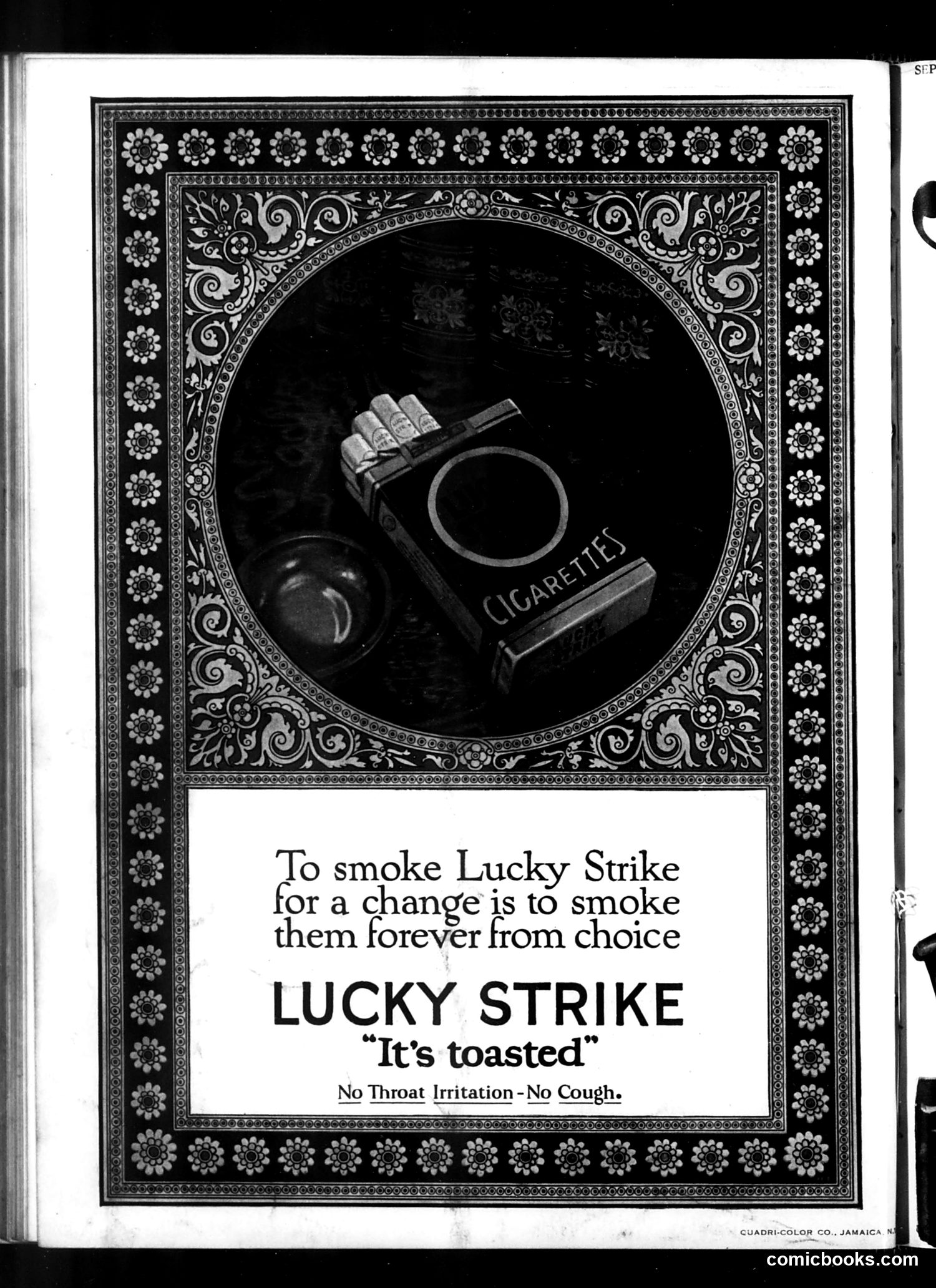
This is a vintage **Lucky Strike cigarette advertisement**, not a political cartoon. The page displays an ornate decorative border framing a product photograph showing cigarettes and a pipe against a dark background. The ad's tagline—"To smoke Lucky Strike for a change is to smoke them forever from choice"—emphasizes consumer loyalty and preference. The slogan "It's toasted" and claims of "No Throat Irritation—No Cough" reflect early 20th-century tobacco marketing that promoted cigarettes as health-conscious choices, a common but misleading advertising tactic of that era before the dangers of smoking were widely acknowledged. The elaborate decorative framing gives the advertisement a premium, sophisticated appearance designed to appeal to affluent readers of *Judge* magazine.