
Judge, 1927-09-03 · page 15 of 36
Judge — September 3, 1927 — page 15: what you’re looking at
What you’re looking at
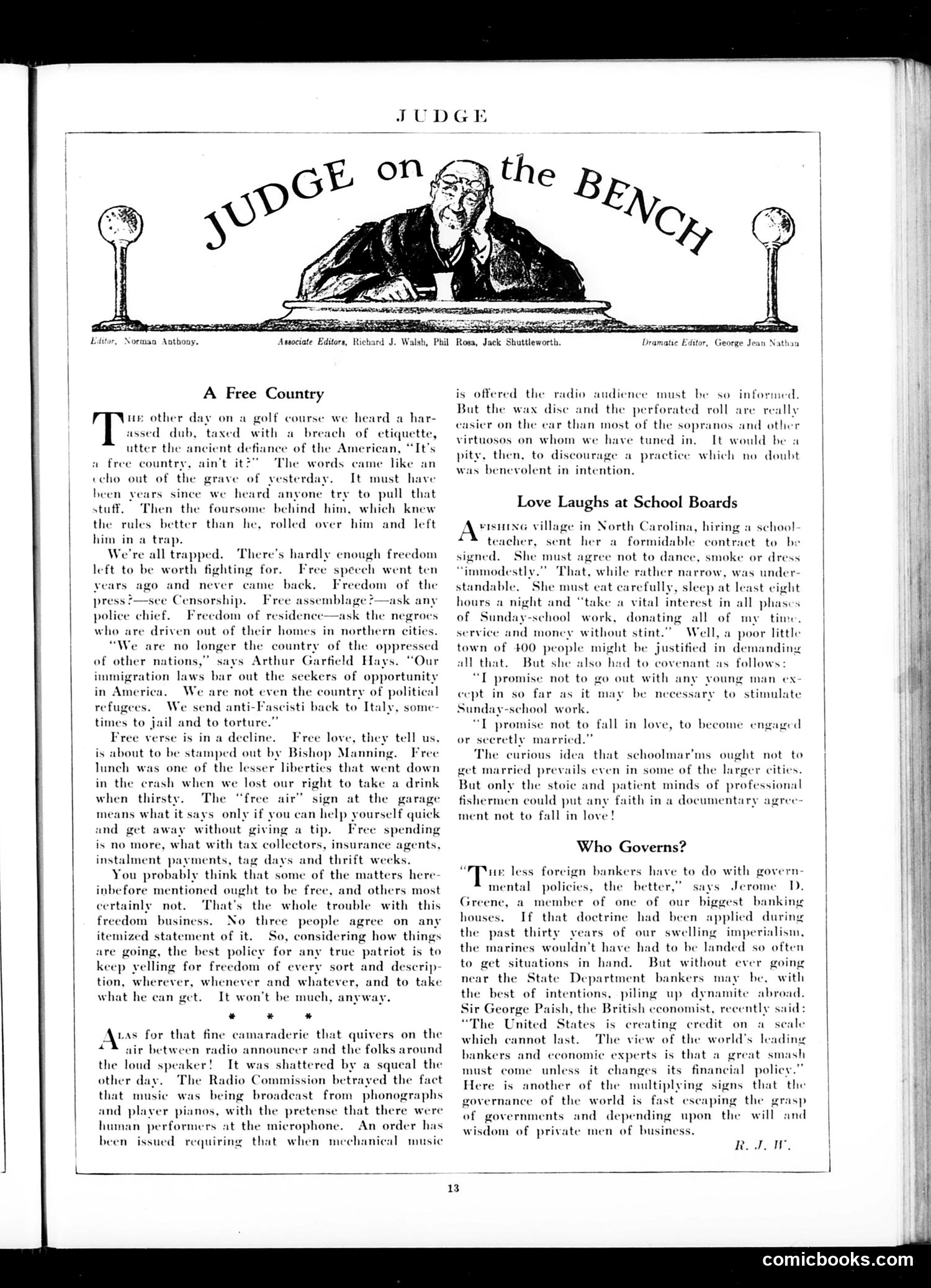
This page features editorial commentary by Norman Anthony (editor) on American freedoms and social hypocrisy circa the 1920s-30s. **"A Free Country"** satirizes the decline of American liberties. A golfer invokes "free country" as excuse for rule-breaking, then gets literally trapped in a sand trap—a metaphor for how Americans claim freedom while being increasingly constrained by laws, taxes, censorship, and social restrictions. Anthony catalogs lost freedoms: free speech (gone "ten years"), assembly, residence for Black Americans, and even free lunch and air. **Other segments** critique: - Radio fakery (pretending phonograph music is live performance) - School boards imposing oppressive contracts on teachers, forbidding dancing, smoking, marriage, and romance The overall message: Americans boast of freedom while systematically surrendering it through regulation and social conformity.
📄 Transcribed text from this page (OCR, searchable)
Machine-transcribed from the original scan — historical spelling and the odd misread are preserved.
Norman Anthony. A Free Country ue other day on a golf course we heard a har- ised dub, taxed with a breach of etiquette, utter the ancient defi a free country, ain't it? nee of the American, “It’s The words came like an ccho out of the grave of yesterday. It must have heen years since we heard anyone try to pull that stuff. Then the foursome behind him, which knew the rules better than he, rolled over him and left him in a trap. We're all trapped. There's hardly enough freedom left to be worth fighting for. Free speech went ten years, ne back. Freedom of the Censorship. Free assemblage ?—ask any police chief. Freedom of residence—ask the negro who are driven out of their homes in northern cities. “We are no longer the country of the oppressed of other nations,” says Arthur Garfield Hays. “Our immigration laws bar out the seekers of opportunity in America. We are not even the country of political refugees. We send anti-Fascisti back to Italy, some- times to jail and to torture.” Free verse is ina decline. Free love, they tell us, is about to be stamped out by Bishop Manning. Free lunch was one of the lesser liberties that went down in the crash when we lost our right to take a drink when thirsty. The “free air” sign at the age means what it says only if you can help yourself quick ind get away without giving a tip. Free spending is no more, what with tax collectors, insurance agents, instalment payments, tag days and thrift weeks. You probably think that some of the matters here inbefore mentioned ought to be free, and others most certainly not. That's the whole trouble with this freedom business. No three people agree on any itemized statement of it. So, considering how things are going, the best policy for any true patriot is to keep yelling for freedom of every sort and deserip- tion, wherever, whenever and w and to take what he can get. It won't be much, anyway. nd never ¢: Ago press 7—se * * * Avas for that fine camaraderie that quivers on the +4 air between radio announcer and the folks around the loud speaker! It was shattered by a squeal the other day. The Radio Commission betrayed the t that music was being broadcast from phonographs and player pianos, with the pretense that there were human performers at the microphone. An order has been issued requiring that when mechanical music is offered the radio audience must be so informed. But the wax dise and the perforated roll are really easier on the car than most of the sopranos and other virtuosos on whom we have tuned in. It would be a pity, then, to discourage a pract was benevolent in intention. © which no doubt Love Laughs at School Boards Atiiise village in North Carolina, hiring a school teacher, sent her a formidable contract to be signed. She must agree not to dance, smoke or dress “immodestly.”” That, while rather narrow, was under- standable. She must eat carefully, sleep at least eight hours a night and “take a vital interest in all phases of Sunday-school work, donating all of my. time, service and money without stint Well, a poor little town of 400 people might be justified in demanding all that. But she also had to covenant as follow “T promise not to go out with any young man ex cept in so far as it may be necessi Sunday-school work. “IT promise not to fall in love, to become engaged or secretly married.” The curious idea that schoolmar’ms ought not to get married previ y to stimulate Is even in some of the k: rger cities. But only the stoic and patient minds of professional fishermen could put any faith in a documentary agree- ment not to fall in love! Who Governs? “rpHe less foreign bankers have to do with govern mental policies, the better,” says Jerome D. Greene, a member of one of our biggest banking houses. If that doctrine had been applied during the past thirty years of our swelling imperialism, the marines wouldn't have had to be landed so often to get situations in hand. But without ever going near the State Department bankers may be, with the best of intentions, piling up dynamite abroad. Sir George Paish, the British economist, recently said: “The United States is ¢ ing credit on a scale which cannot last. The view of the world’s leading bankers and economic experts is that a great smash must come unless it changes its financial policy.” Here is another of the multiplying signs that the governance of the world is fast escaping the grasp of governments and depending upon the will and wisdom of private men of business. a RJ. W. comicbooks.com