
Judge, 1927-09-03 · page 19 of 36
Judge — September 3, 1927 — page 19: what you’re looking at
What you’re looking at
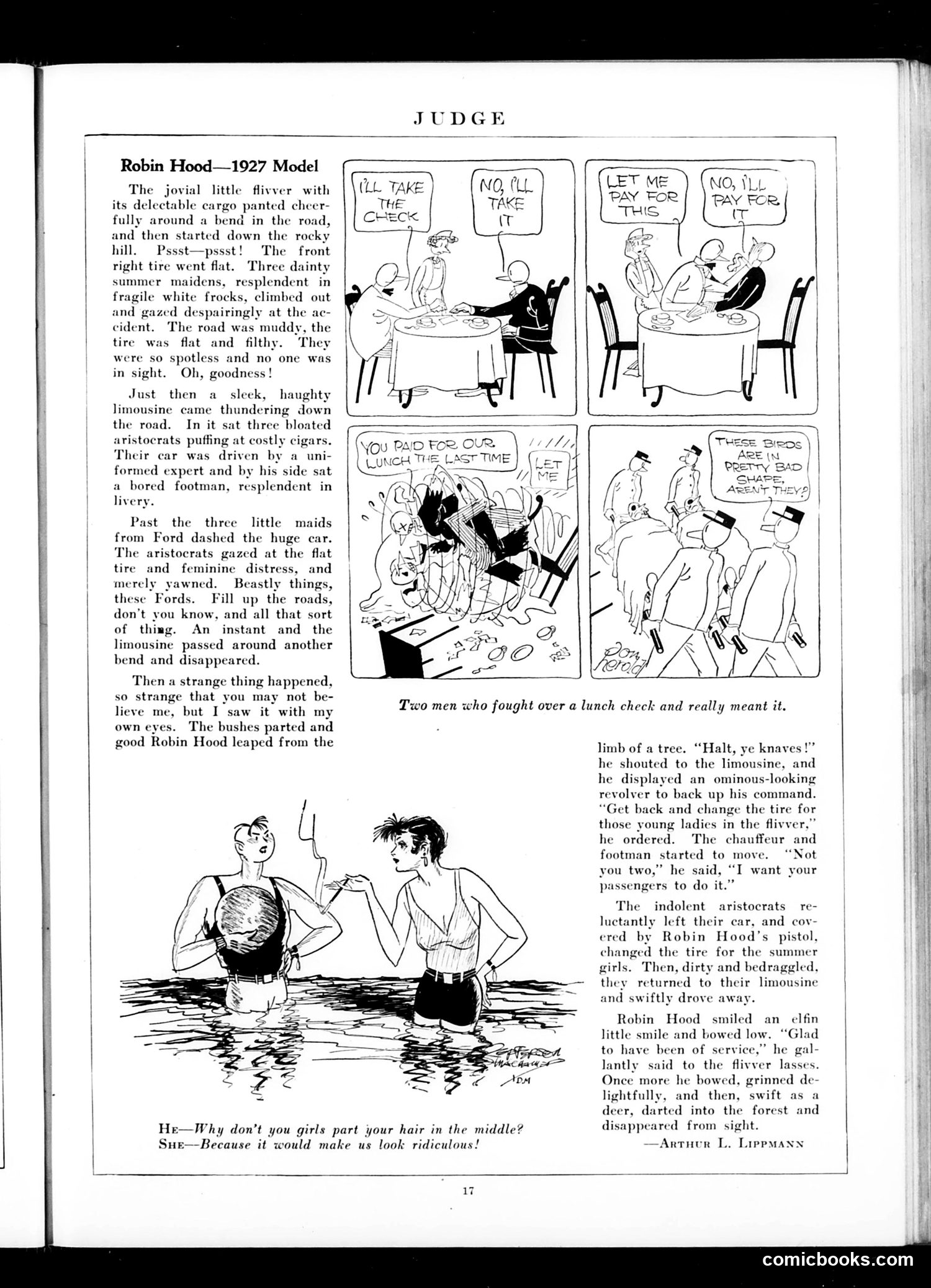
This satirical story mocks class distinctions in 1920s America. Three young women in a Ford (the affordable "flivver" car) get a flat tire. A limousine full of wealthy aristocrats passes without helping, dismissing them as "beastly things, these Fords." Robin Hood then appears and forces the limousine's wealthy *passengers* (not their servants) to change the tire themselves, humbling them through manual labor. The satire critiques the indolence and callousness of the rich toward ordinary people, while celebrating the Robin Hood archetype—taking from the privileged to aid the common folk. The accompanying illustrations and jokes about dining etiquette reinforce themes of class conflict and pretension. This reflects 1920s anxieties about inequality and the nouveau riche during the Jazz Age.
📄 Transcribed text from this page (OCR, searchable)
Machine-transcribed from the original scan — historical spelling and the odd misread are preserved.
JUDGE Robin Hood—1927 Model The jovial little flivver with its delectable cargo panted cheer- fully around a bend in the road, and then started down the rocky hill. Pssst—pssst! The front right tire went flat. Three dainty summer maidens, resplendent in fragile white frocks, climbed out and gazed despairingly at the ac- cident. The road was muddy, the tire was flat and filthy. They were so spotless and no one was in sight. Oh, goodness! Just then a sleek, haughty limousine came thundering down In it sat three bloated s puffing at costly cigars. was driven by a un formed expert and by his side sat a bored footman, resplendent in livery. Past the three little maids from Ford dashed the huge car. The aristocrats gazed at the flat tire and feminine distress, and merely yawned. Beastly things, these Fords. Fill up the roads, don’t you know, and all that sort of thimg. An instant and the limousine passed around another bend and disappeared. Then a strange thing happened, so strange that you may not be- lieve me, but I y it with my own eyes. The bushes parted and good Robin Hood leaped from the He—Why don’t you girls part your hair in the middle? Sur—Because it would make us look ridiculous! Two men who fought over a lunch check and really meant it. limb of a tree. “Halt, ye knaves!” he shouted to the limousine, and he displayed an ominous-looking volver to back up his command. t back and change the tire for those young ladies in the flivver,” he ordered. The chauffeur and footman started to move. ‘‘Not you two,” he said, “I want your passengers to do it.” The indolent aristocrats re- luctantly left their car, and cov- cred by Robin Hood’s pistol, changed the tire for the summer girls. Then, dirty and bedraggled, they returned to their limousine and swiftly drove away. Robin Hood smiled an elfin little smile and bowed low. “Glad to have been of service,” he gal- lantly said to the flivver lasses. Once more he bowed, grinned de- lightfully, and then, swift as a deer, darted into the forest and disappeared from sight. —Artuer L, Lippmann comicbooks.com