
Judge, 1927-09-03 · page 21 of 36
Judge — September 3, 1927 — page 21: what you’re looking at
What you’re looking at
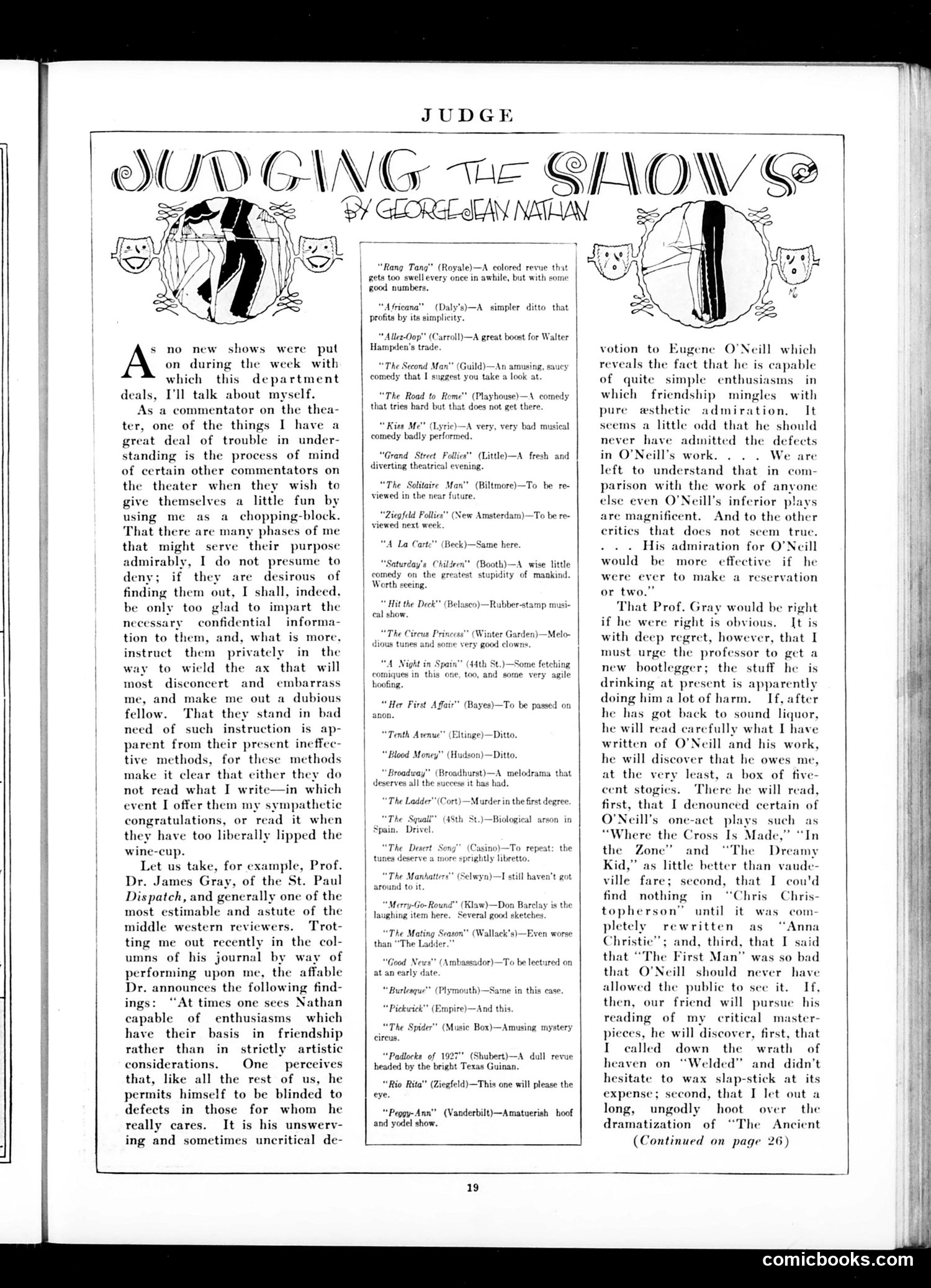
This is a theater column by George Jean Nathan, a prominent drama critic. The "cartoon" is actually textual satire—Nathan responds to criticism from Dr. James Gray of the St. Paul Dispatch, who accused Nathan of letting personal friendships bias his theater reviews. Nathan defends himself with mock self-deprecation, sarcastically offering to teach Gray how to properly criticize him. He then pivots to a lengthy defense of Eugene O'Neill against other critics' dismissals, arguing O'Neill is genuinely great despite his flawed plays. The column closes with a alphabetized list of current Broadway shows (1920s) with Nathan's one-line verdicts—some flattering, others brutally dismissive ("Rubber-stamp musical show," "Drivel"). The satire targets both provincial critics who lack sophistication and fellow New York critics who undervalue O'Neill's significance. It's primarily intellectual humor for theater-world insiders.
📄 Transcribed text from this page (OCR, searchable)
Machine-transcribed from the original scan — historical spelling and the odd misread are preserved.
JUDGE no new shows were put on during the week with which this department deals, I'll talk about myself. As a commentator on the thea- ter, one of the things I have a great deal of trouble in under- standing is the process of mind of certain other commentators on the theater when they wish to give themselves a little fun by chopping-block. That there are many phases of me that might serve their purpose admirably, I do not presume to deny; if they are desirous of finding them out, I shall, indeed, be only too glad to impart the confidenti. informa- tion to them, and, what is more, instruct them privately in the way to wield the ax that will most disconcert and me, and make me out a dubious fellow. That they stand in bad need of such instruction is ap- parent from their present ineffec- tive methods, for these methods make it clear that either they do not read what I write—in which event I offer them my sympathetic using me as necessary embarrass congratulations, d it when they have too liberally lipped the wine-cup. Let us take, for example, Prof. Dr. James Gray, of the St. Paul Dispatch, and generally one of the most estimable and astute of the middle western reviewers. Trot- ting me out recently in the col- umns of his journal by way of performing upon me, the affable Dr. announces the following find- ings: “At times one sees Nathan capable of enthusiasms which have their basis in friendship rather than in strictly artistic considerations. One _ perceives that, like all the rest of us, he permits himself to be blinded to defects in those for whom he really cares. It is his unswerv- ing and sometimes uncritical de- Uy pane LAN “Rang Tang" (Roy gets too swell every on good numbers. fe)—A colored revue that in awhile, but with some “Africana” profits by its simplicity “*Allez-Oop" (Carroll)—A great boost for Walter Hampden’s trade. “The Second Man" (Guild)—An amusing, saucy comedy that I suggest you take a look at “The Road to Rome’ (Playhouse)— comedy that tries bard but that does not get there. ies Me (Lyric)—A very, very bad musical comedy badly performed. “Grand Street Follies’ (Little)—A fresh and diverting theatrical evening. “The Solitaire Man" (Biltmore)—To be re- viewed in the near future, “Ziegfeld Follies" viewed next week (New Amsterda: “A La Carte” (Beck)—Same here. “Saturday's Childeen’* comedy on the gre Worth seeing. (Booth)—A wise lit ity of mankind. "Hit the Deck" cal show. “The Circus F us tunes and (Winter Garden)—Melo- very good clowns. “4 Night in Spain’ (44th St.)—So comiques in this one, too, and some v hoofing. Her First Affair’ anon. (Bayes)—To be passed on “Tenth Avenue” (Eltinge)—Ditto. "Blood Money" (Hudson)—Ditto. “Broadway” (Broadhurst)—A melodrama that deserves all the success it has had. “The Ladder"*(Cort)—Murder in the first degree. “The Squall” (48th St.)—Biological arson in Spain. Drivel ino)—To repeat: the sprightly libretto. * (Selwyn) —I still haven't got * Merry-Go-Roun laughing item here. Klaw)—Don Barclay is the “The Mating Season’ (Wallack's jood News" (Ambassador)—To be lectured on at an early date. *Burle Pl uth) —Same in this case, “Pickwick” (Empire)—And this. “The Spider” (Music Box)—Amusing mystery circus. “Padlocks of 1927" (Shubert)—A dull revue headed by the bright Texas Guinan. “Rio Rita” (Zies eye. eld)—This one will please the Peggy-Ann" (Vanderbilt)—Amatuerish hoof and yodel show. (Daly’s)—A simpler ditto that | Belasco)—Rubber-stamp musi- | OW & O'Neill which t that he is caps votion to Eugene reveals the f le of quite simple enthusiasms in which friendship mingles with pure wsthetic admiration, It seems a little odd that he should never have admitted the defects in O° I’s work. . . . We are left to understand that in com- parison with the work of anyone else even O'Neill's inferior plays are magnificent. And to the other crities that does not seem true. * His admiration for O'Neill would be more effective if he were ever to make or two.” That Prof. Gray would be right if he were right is obvious. [t is with deep regret, however, that I must urge the professor to get a new bootlegger; the stuff he is drinking at present is apparently doing him a lot of harm. If, after he has got back to sound liquor, he will read carefully what I have written of O'Neill and his work, he will discover that he owes me, at the very least, a box of five- cent stogies. There he will read, first, that I denounced certain of O'Neill’s one-act plays such as “Where the Cross Is Made,” “In the Zone” and “The Dre Kid,” as little better than vaude- ville fare; second, that I cou'd find nothing in topherson’ a reservation my “Chris Chris- until it was com pletely rewritten as “Anna Christie”; and, third, that I s that “The First Man” d that O'Neill should never have allowed the public to see it. If, then, our friend will pursue his reading of my was so t critical master- pieces, he will discover, first, that I alled down the wrath of heaven on “Welded” and didn’t hesitate to wax slap-stick at its expense; second, that I let out long, ungodly hoot over the dramatization of “The Ancient (Continued on page 26) 19 comicbooks.com