
A complete issue · 36 pages · 1927
Judge — July 30, 1927
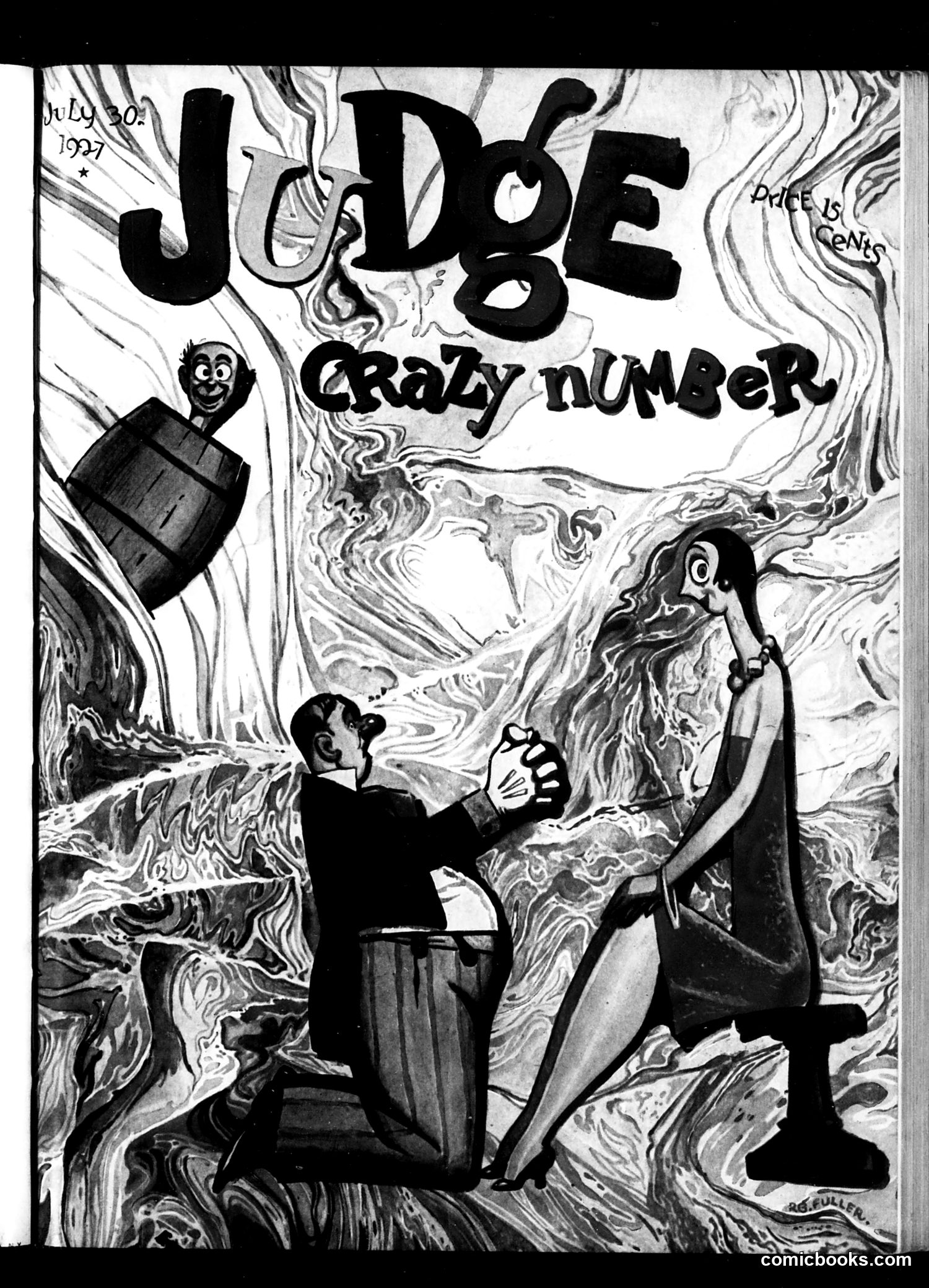
This appears to be a **modern parody** rather than historical political satire. The cover titled "JUDGE CRAZY NUMBER" depicts what seems to be a courtroom scene with exaggerated, grotesque characters in a surreal, psychedelic background. The date "July 30, 1997" and price of 15 cents suggest this is either a **reproduction/homage** to Judge magazine's style or possibly a later revival publication. Without clearer identification of the specific figures or readable OCR text providing context, the exact satirical target remains unclear. The wild, swirling background and caricatured figures suggest commentary on legal proceedings or judicial absurdity, but the precise reference cannot be definitively determined from the visual information alone.
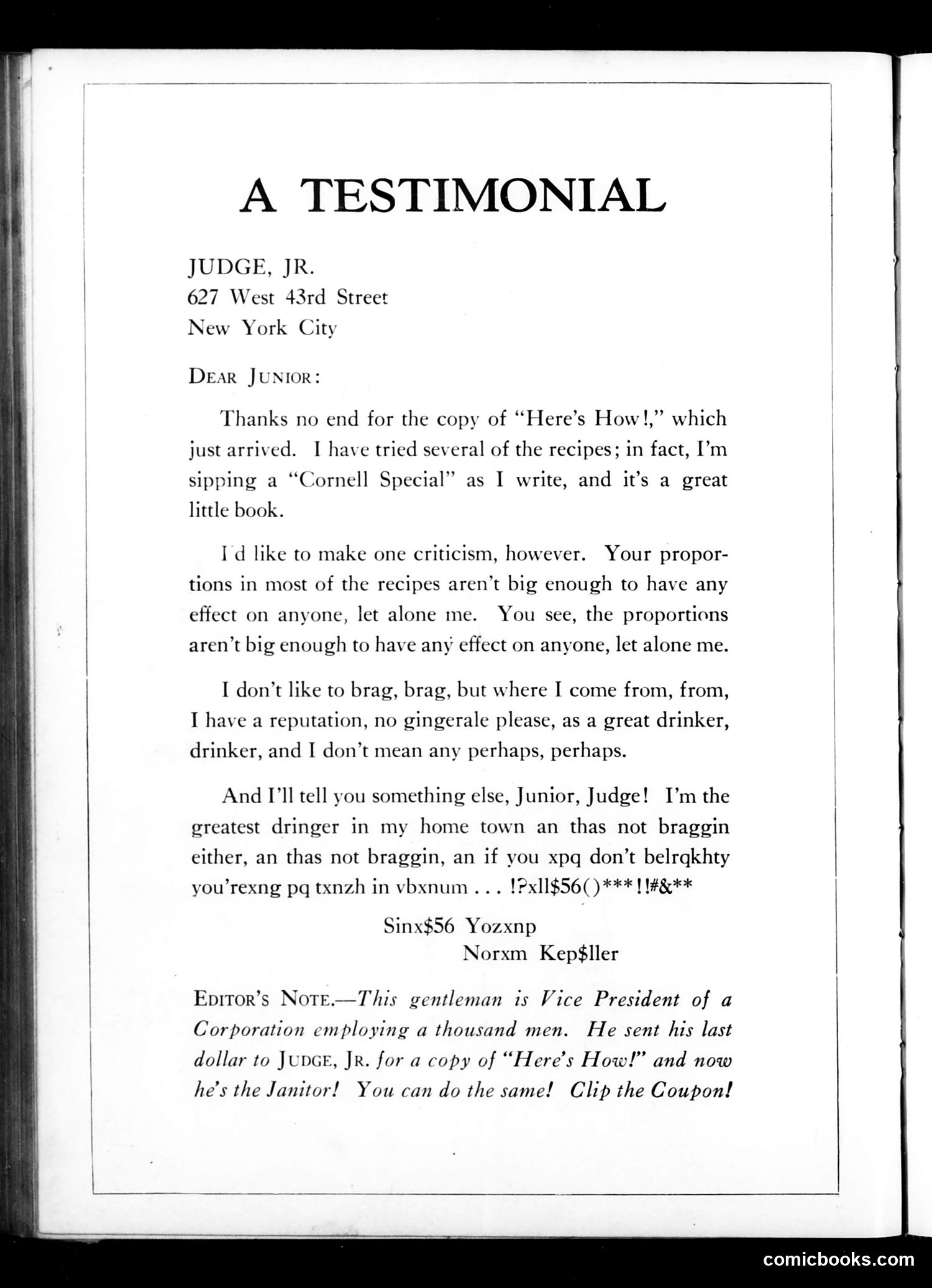
This page is a **testimonial advertisement** for "Here's How!," a cocktail recipe book. The humor works on multiple levels: **The Setup:** Judge, Jr. receives a letter from "Norm Kep$ller" (a wealthy businessman, indicated by the $ substitution), praising the recipes but complaining they're too small in proportion to actually affect a drinker of his caliber. **The Joke:** The writer boasts about being "the greatest dringer in my home town" while denying he's bragging—a contradiction that becomes absurd when his signature devolves into garbled text, suggesting intoxication. **The Editor's Note** completes the satire: this Vice President sent his "last dollar" for the book and is now "the Janitor," implying the recipes were so effective he drank himself into poverty. The advertisement mocks both excessive drinking culture and desperate testimonial advertising tactics.
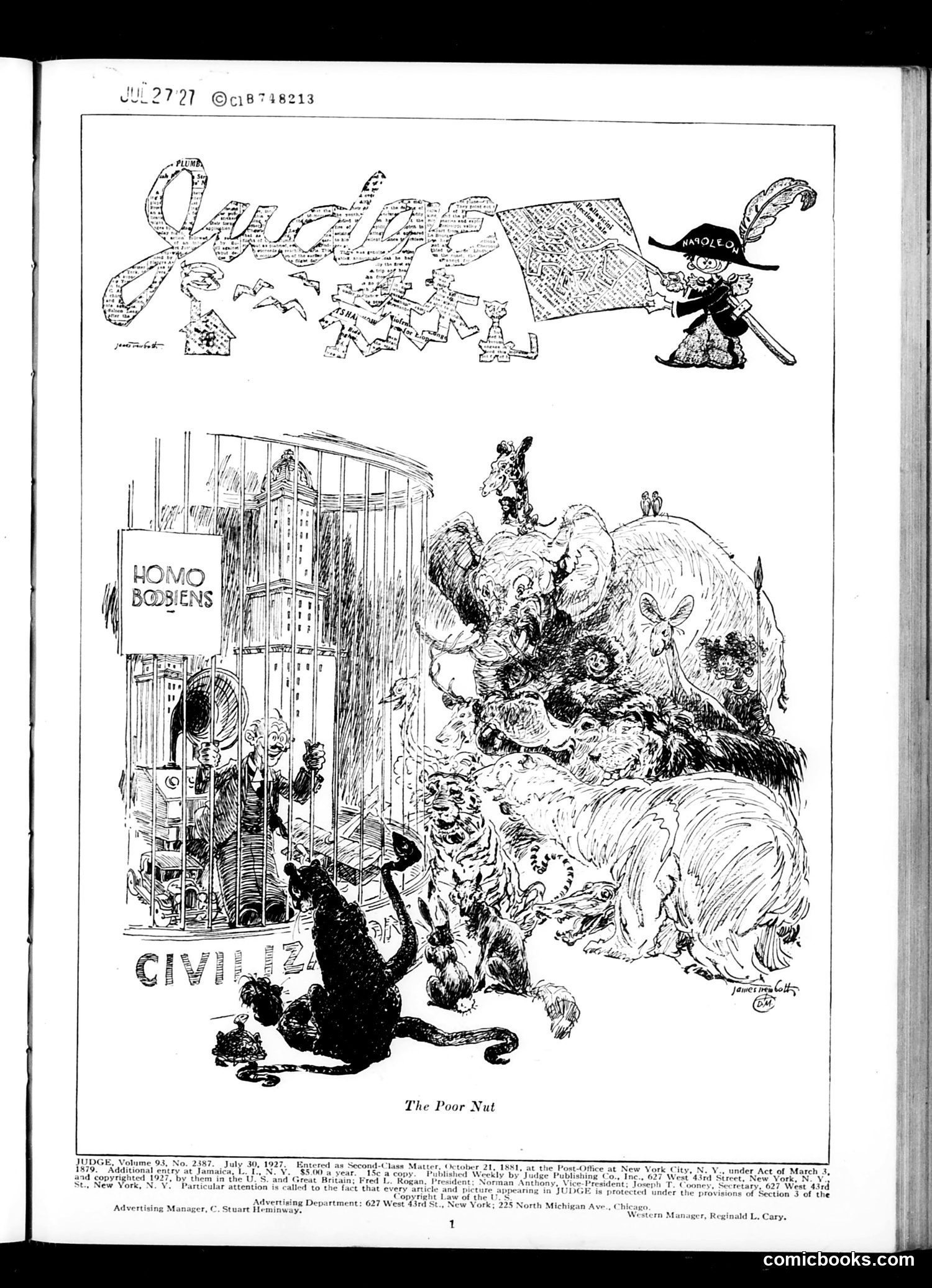
This cartoon satirizes the contrast between civilization and primitivism. On the left, "Homo Dobens" (civilized man) is caged behind bars labeled "Civilization," depicting modern society as a prison. On the right, wild animals and primitive figures roam freely in natural chaos. The central figure—"the poor nut"—appears to be a civilized person trapped between these worlds, suggesting the satirist's view that modern civilization constrains human nature. The cartoon critiques the artificiality of advanced society by contrasting it with untamed wilderness. The top panel features decorative lettering and appears to be a title treatment, though its specific reference is unclear from the OCR text. This reflects 1920s primitivism discourse—a common satirical theme questioning whether progress actually improved human life.
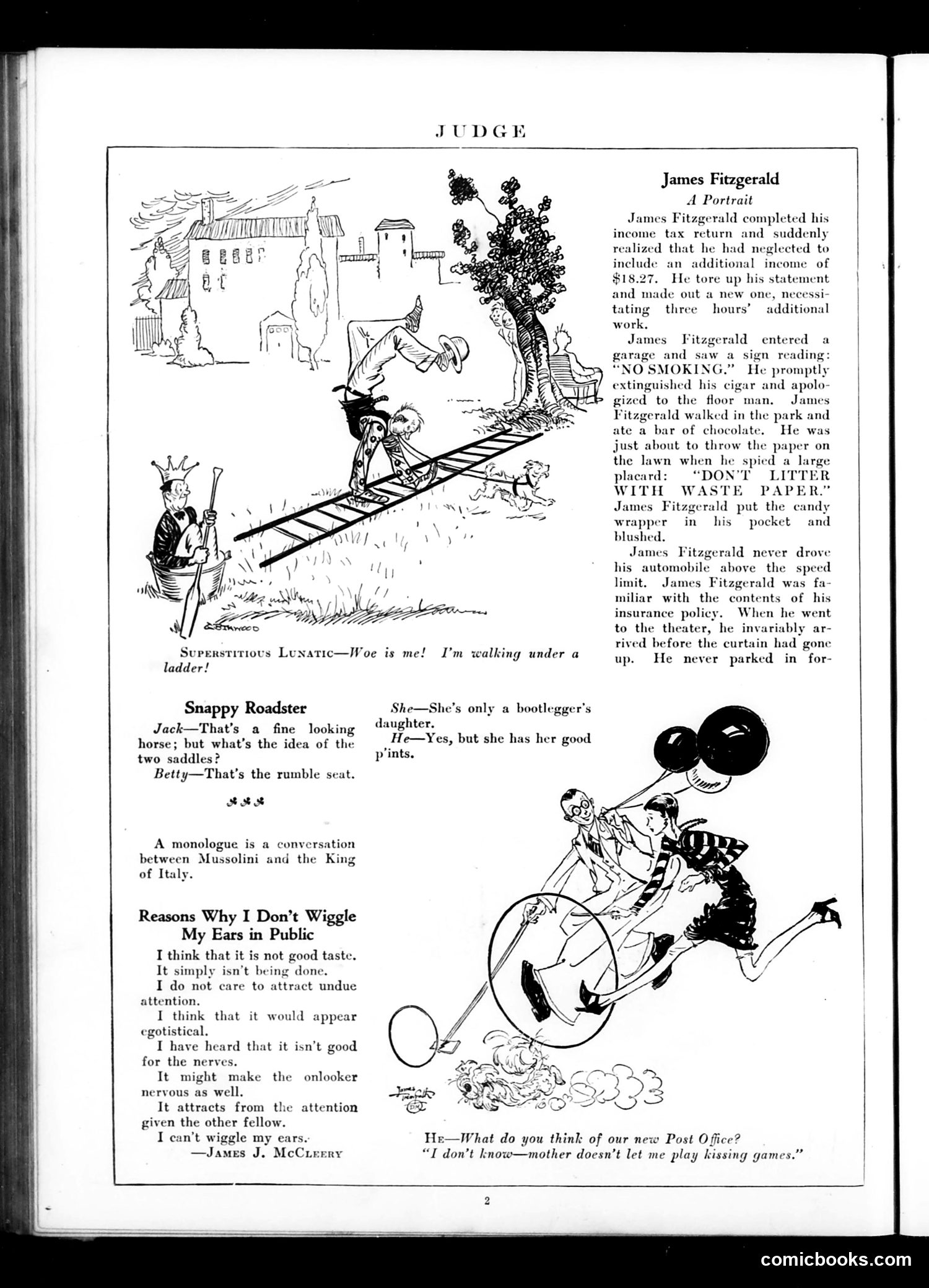
This page contains several unrelated satirical pieces typical of Judge magazine's format: **"James Fitzgerald: A Portrait"** mocks a man obsessively following arbitrary rules—correcting his tax return, extinguishing cigars at "NO SMOKING" signs, picking up litter, respecting speed limits, and arriving early to theaters. The satire suggests such rigid rule-following is absurdly excessive and neurotic. **"Snappy Roadster"** is a brief joke about a woman with "good p'ints" (pints of alcohol), playing on Prohibition-era humor. **"Reasons Why I Don't Wiggle My Ears"** by James J. McCaffery humorously lists pretentious reasons for not performing this childish act. The remaining cartoons appear to be unrelated jokes without clear political references—likely general humor for entertainment rather than commentary on specific contemporary events.
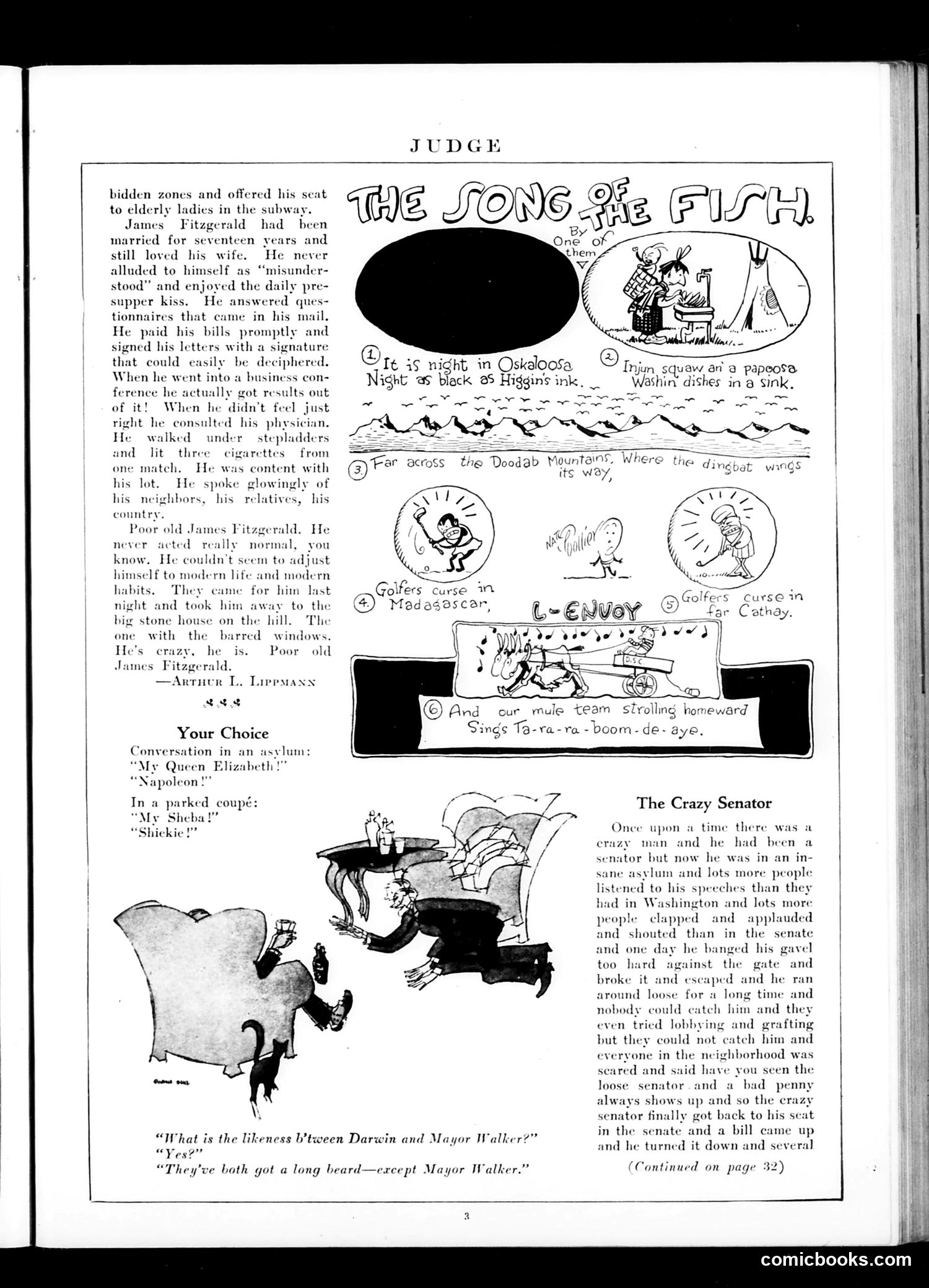
**"The Song of the Fish"** is a humorous comic strip about golfers cursing in Madagascar and the Doodab Mountains. It's a nonsensical adventure story with no apparent political content—simply absurdist humor typical of Judge's entertainment sections. **"The Crazy Senator"** satirizes an actual senator confined to an asylum who frequently escapes and disrupts Senate proceedings. The story mocks both the senator's erratic behavior and the Senate's inability to manage him, presenting his escapes as ongoing public embarrassment. The comparison joke about Darwin and Mayor Walker's beards suggests this references real contemporary political figures, though specific identities aren't clear from the text alone. The page emphasizes Judge's mix of absurdist comedy and political satire.
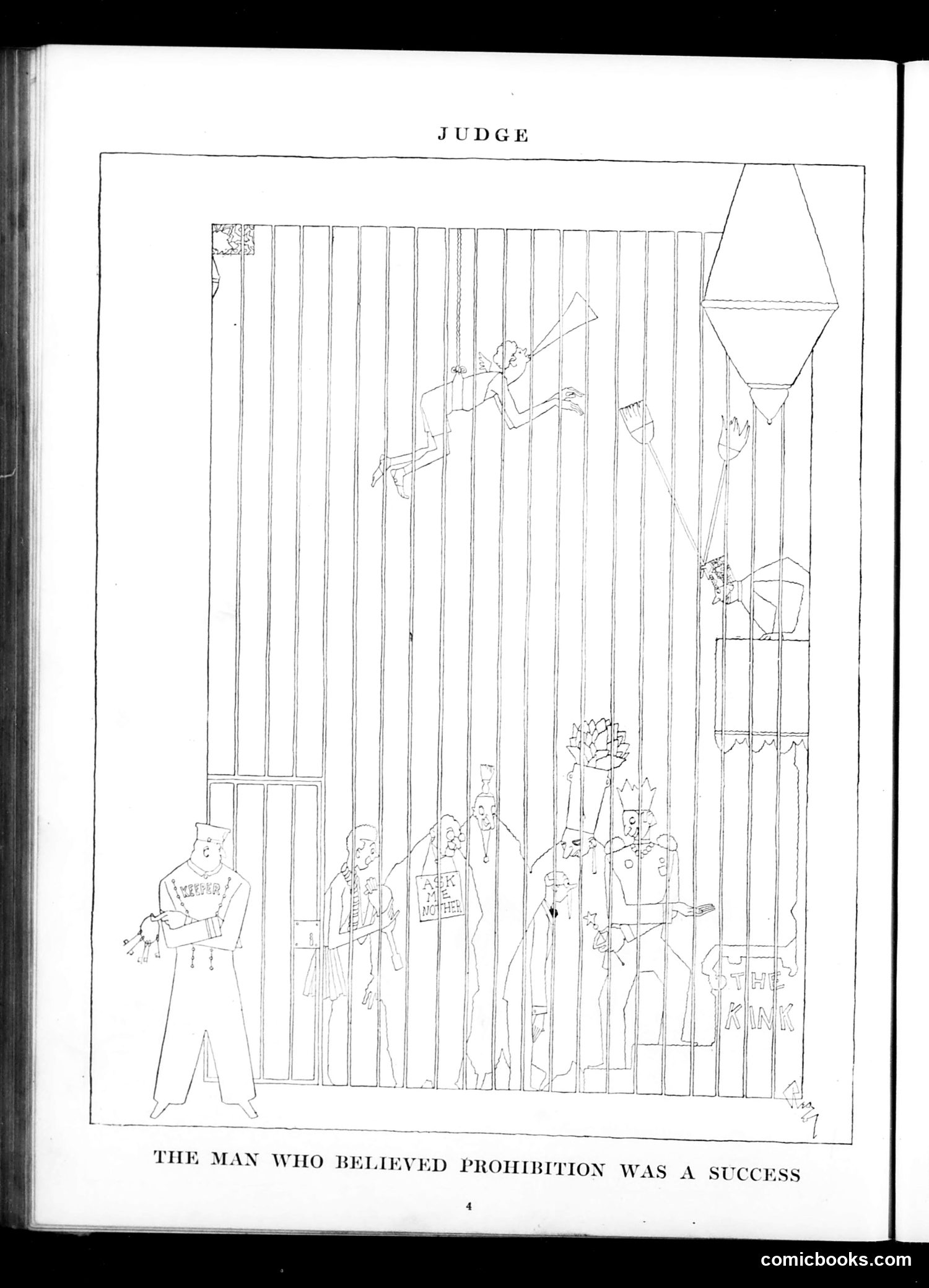
This Judge magazine cartoon satirizes prohibition enforcement through courtroom imagery. A judge presides over what appears to be a crowded courtroom or jail cell filled with numerous figures—likely representing arrested individuals or violators. The title's irony suggests that whoever "believed prohibition was a success" is the actual fool being judged. The cartoon mocks the failure of Prohibition (1920-1933) to eliminate alcohol consumption. Instead of reducing crime and vice as promised, Prohibition created overcrowded courts and jails while bootlegging and speakeasies flourished. The packed courtroom visualizes the policy's unintended consequence: massive legal caseloads, implying that prohibition's "success" was merely generating endless prosecutions rather than eliminating alcohol use.
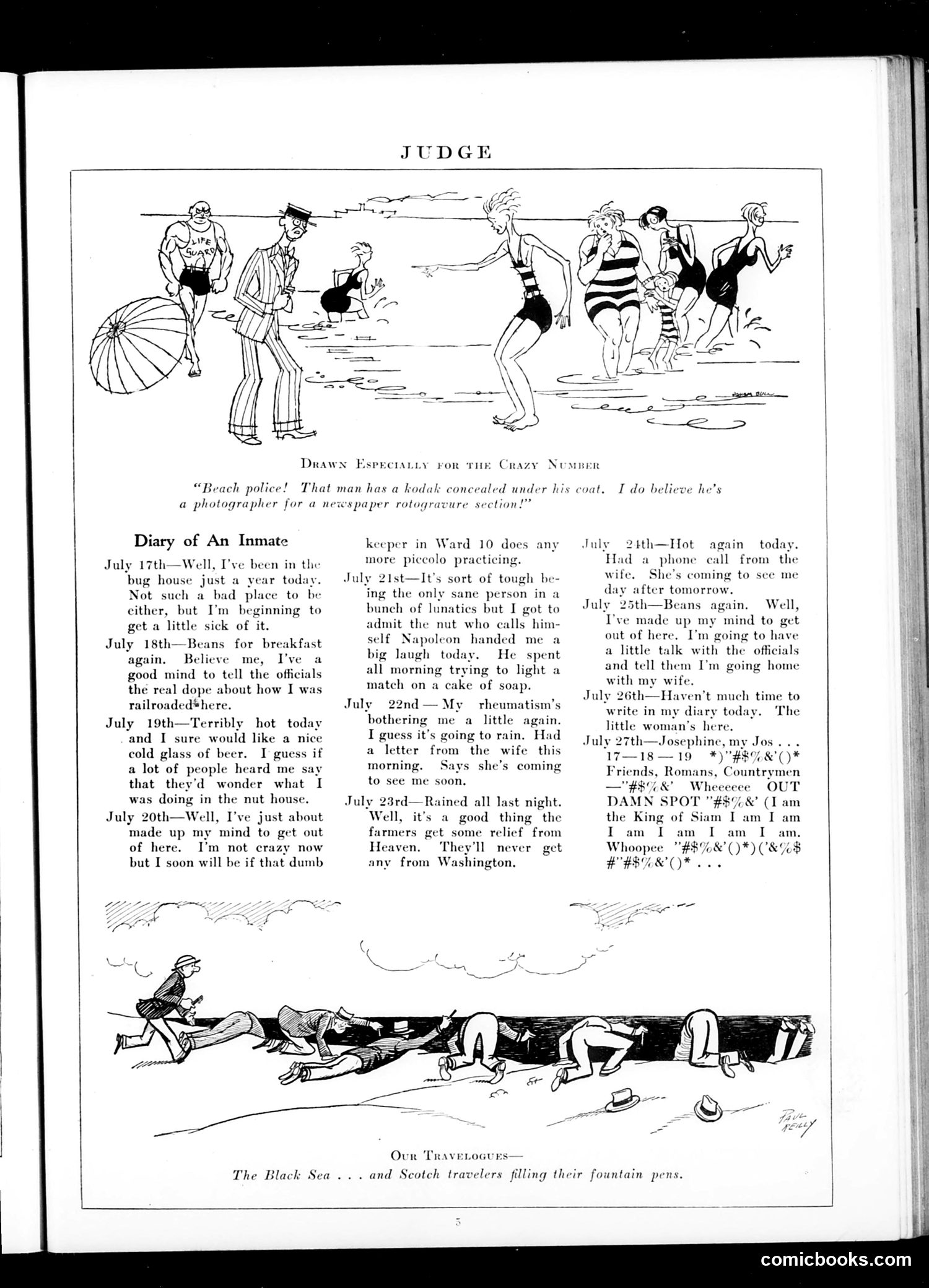
**Top Cartoon ("Judge"):** This beach scene satirizes overzealous newspaper photographers. A well-dressed man at the beach is accused of concealing a "kodak" (camera) under his coat, supposedly a "photographer for a newspaper rotogravure section." The joke mocks the era's invasive press photography—particularly candid camera operators who pursued subjects for sensational newspaper images. The beach setting (with various swimmers and sunbathers) emphasizes how photographers intruded into private leisure moments. **"Diary of an Inmate":** This humorous column depicts prison life during summer heat, with complaints about food, rheumatism, and boredom. References to Napoleon and the "King of Siam" appear garbled (likely coded prison argot or deliberate obfuscation). **Bottom Cartoon ("Our Travelogues"):** Depicts tourists at the Black Sea filling fountain pens—a lighthearted travel joke about collecting water souvenirs.
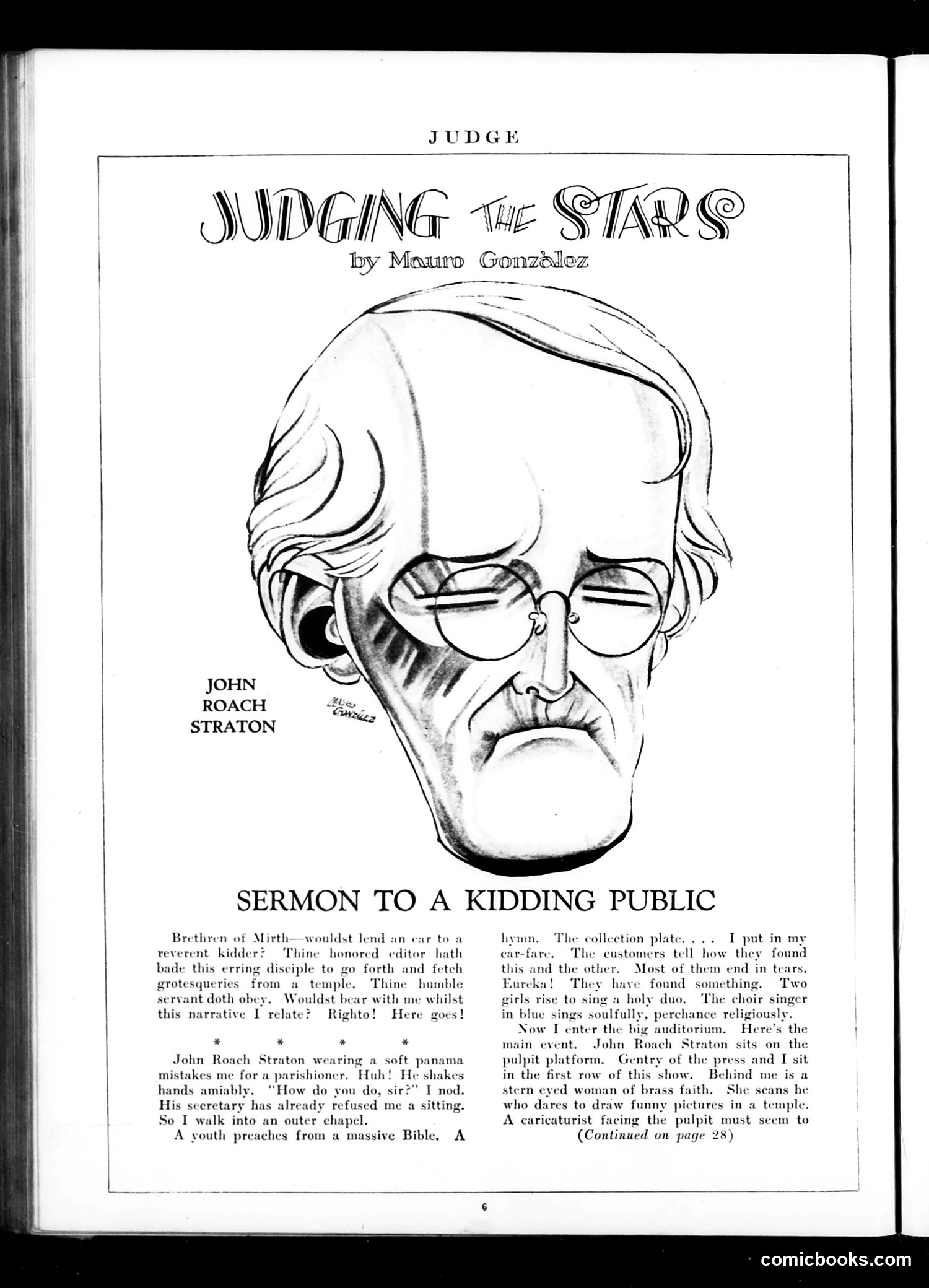
This is a satirical piece about **John Roach Straton**, a real New York fundamentalist minister known for fiery sermons and public moralizing. The cartoon caricatures him with exaggerated features—prominent nose, glasses—emphasizing his stern demeanor. The satire targets Straton's theatrical preaching style. Author Gonzalez describes attending his church service, observing the theatrical elements: collection plates, emotional hymn-singing, the "show" atmosphere. The title "Sermon to a Kidding Public" suggests Straton himself is the subject of mockery—that his religious performances are somewhat performative or insincere. The joke appears to be that while Straton judges others' morality from the pulpit, the magazine is "judging" (evaluating/mocking) him. The stern woman glaring at the caricaturist drawing in church adds another layer: religious authority figures policing secular observation of their domain. This reflects 1920s-era criticism of fundamentalist preachers' celebrity and showmanship.
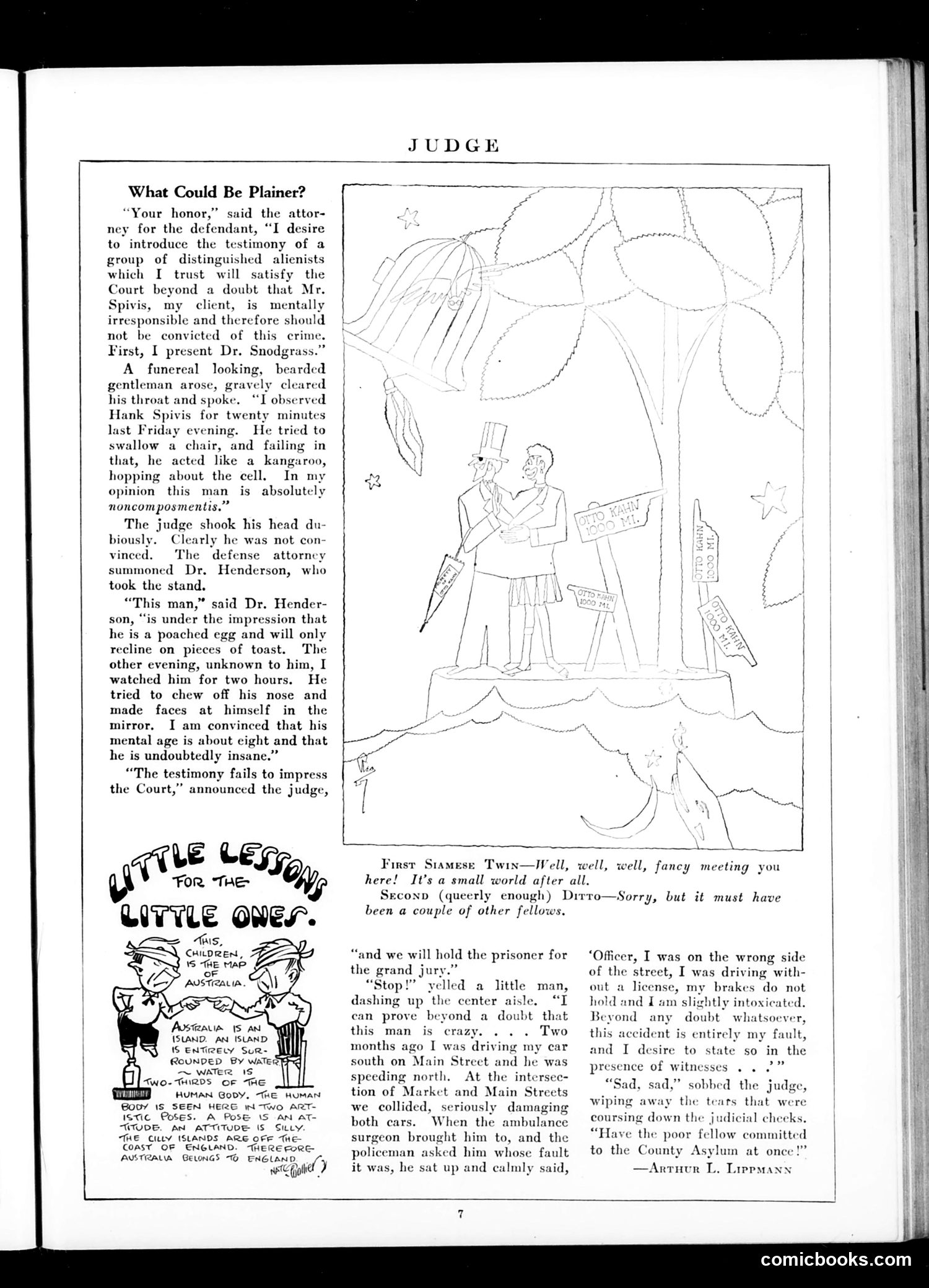
This page satirizes the absurdity of using expert psychiatric testimony to excuse criminal behavior. The main cartoon depicts a court case where the defendant, Hank Spivis, is accused of a crime. His defense attorney calls "alienists" (period term for psychiatrists) who provide increasingly ridiculous "evidence" of insanity—one claims Spivis tried to swallow a chair and hopped like a kangaroo; another says he believes he's a poached egg. The judge remains unmoved by this testimony. However, when a witness provides *rational* evidence (Spivis honestly admitted fault in a car accident), the judge immediately orders him committed to an asylum—suggesting that admitting responsibility and speaking truth are themselves signs of insanity. The satire mocks both the era's psychiatric establishment (presenting dubious testimony as science) and a legal system that rewards dishonesty while punishing honesty. The cartoonist argues this inverted logic makes no sense.
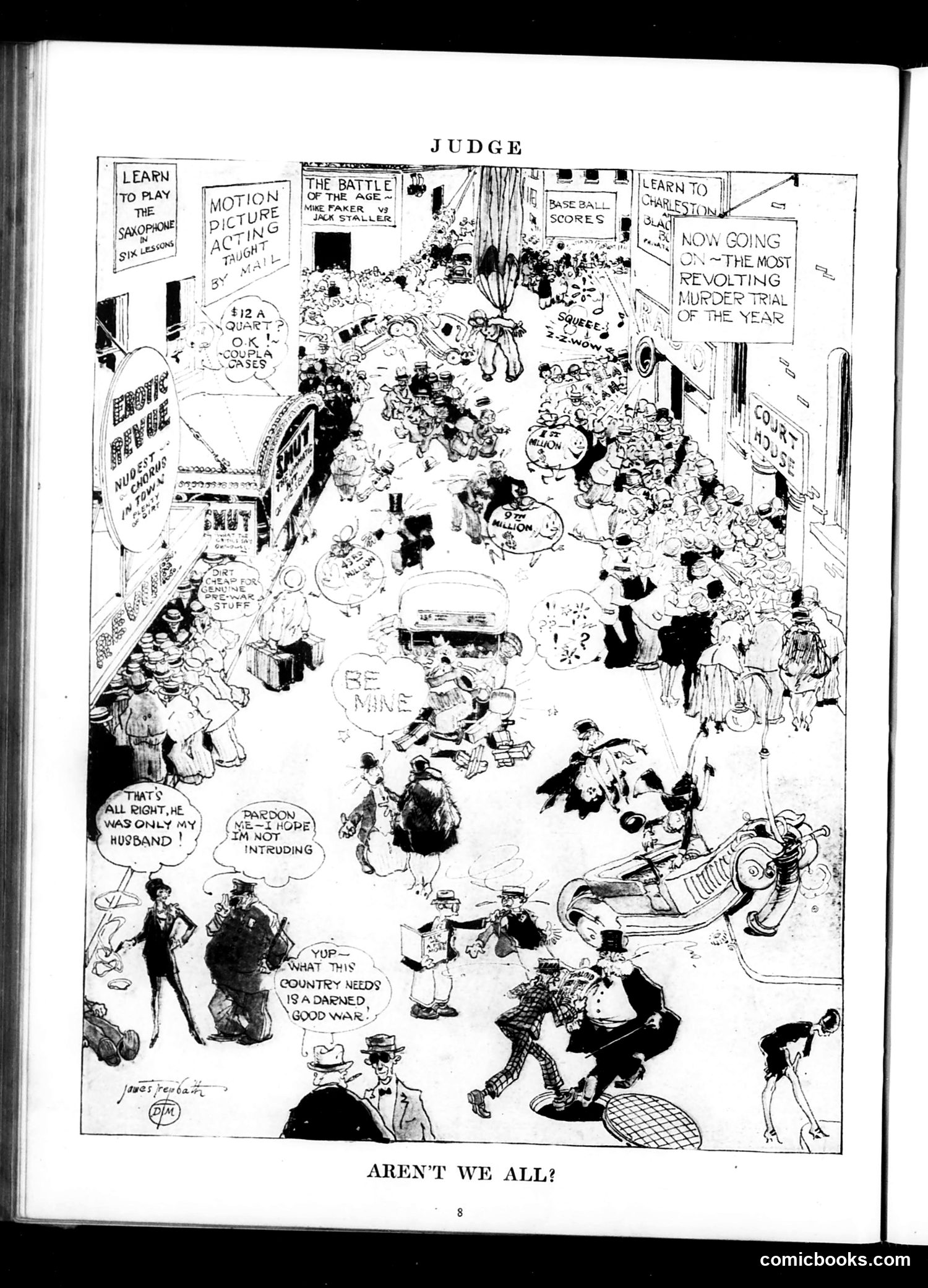
This is a crowded satirical cartoon depicting American popular culture and social preoccupations circa the 1910s-1920s. The central message, emphasized by the title "AREN'T WE ALL?", critiques the public's obsession with entertainment and frivolity during serious times. The scene shows a bustling street or public square packed with people attending to various diversions: baseball games, saxophones lessons, motion pictures, and sensational "murder trials." Key satirical targets include: - The baseball craze (advertised prominently) - Jazz/popular music culture - Entertainment industry excess - Media coverage of salacious trials - General moral distraction from substantive civic concerns Two figures discuss how "this country needs a good war"—a darkly ironic commentary suggesting Americans are so distracted by entertainment that only a major crisis might refocus national priorities. The overall message criticizes American society's shallow preoccupations and moral drift during the early 20th century.
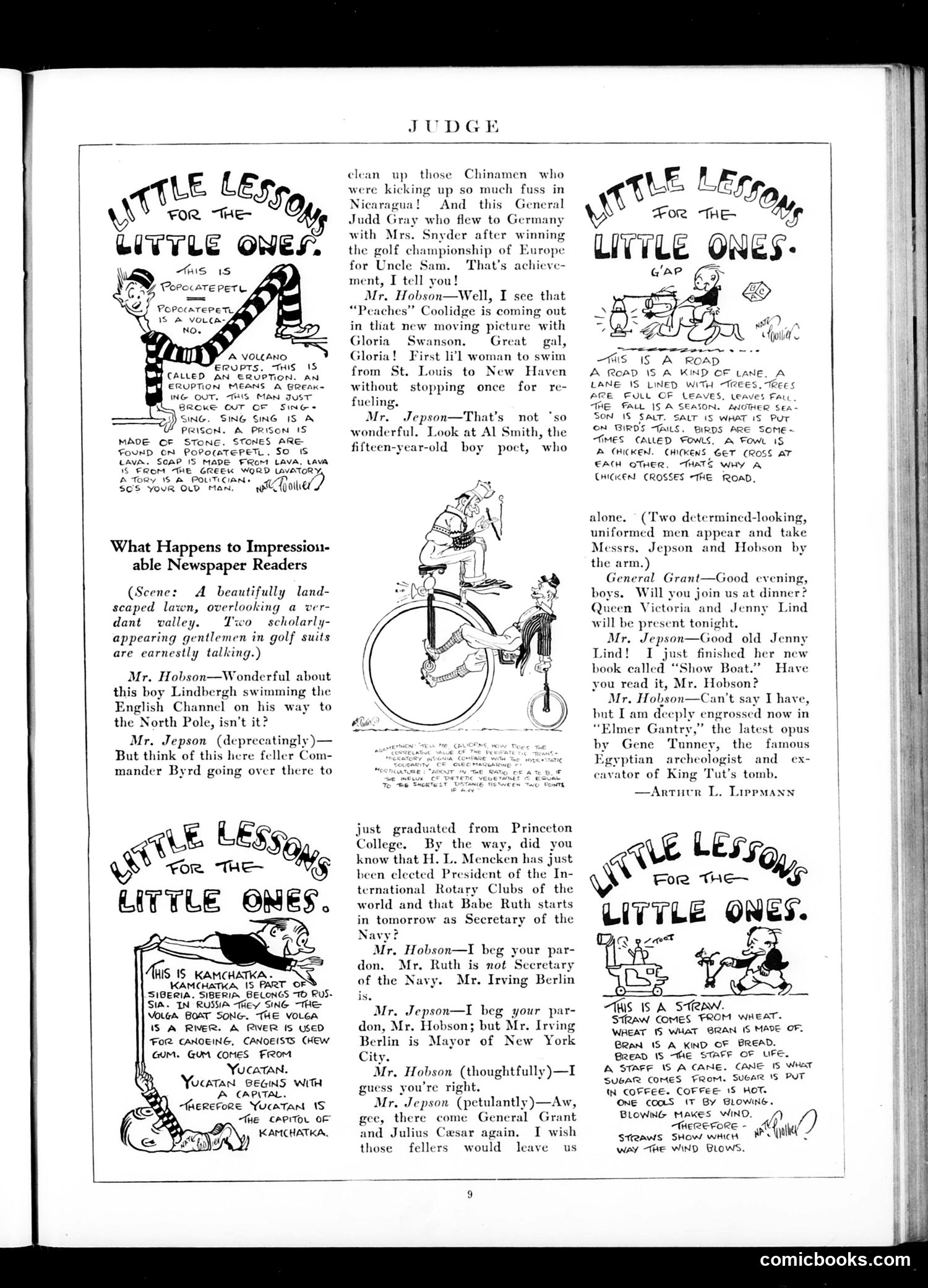
This page satirizes how newspapers create confusion through sensationalized, inaccurate reporting that gullible readers believe uncritically. **The Main Cartoon** depicts two gentlemen earnestly discussing wildly false "facts"—Lindbergh swimming the English Channel to the North Pole, Commander Byrd's exploits, and absurd celebrity news. When corrected by uniformed men (appearing to be authorities), they remain oblivious, even as historical figures like General Grant and Julius Caesar materialize to join them for dinner. The joke: newspaper readers absorb and repeat contradictory misinformation without noticing logical impossibilities. **"Little Lessons for the Little Ones"** (three sections) parodies educational content by presenting absurd chain-association definitions—connecting volcanoes to prisons to politicians, Kamchatka to yucatan via nonsensical links, and straws to wind through ridiculous logic. This mirrors how newspapers' loose associations and errors propagate confusion. The satire targets both credulous readers and the press's responsibility for spreading falsehoods.
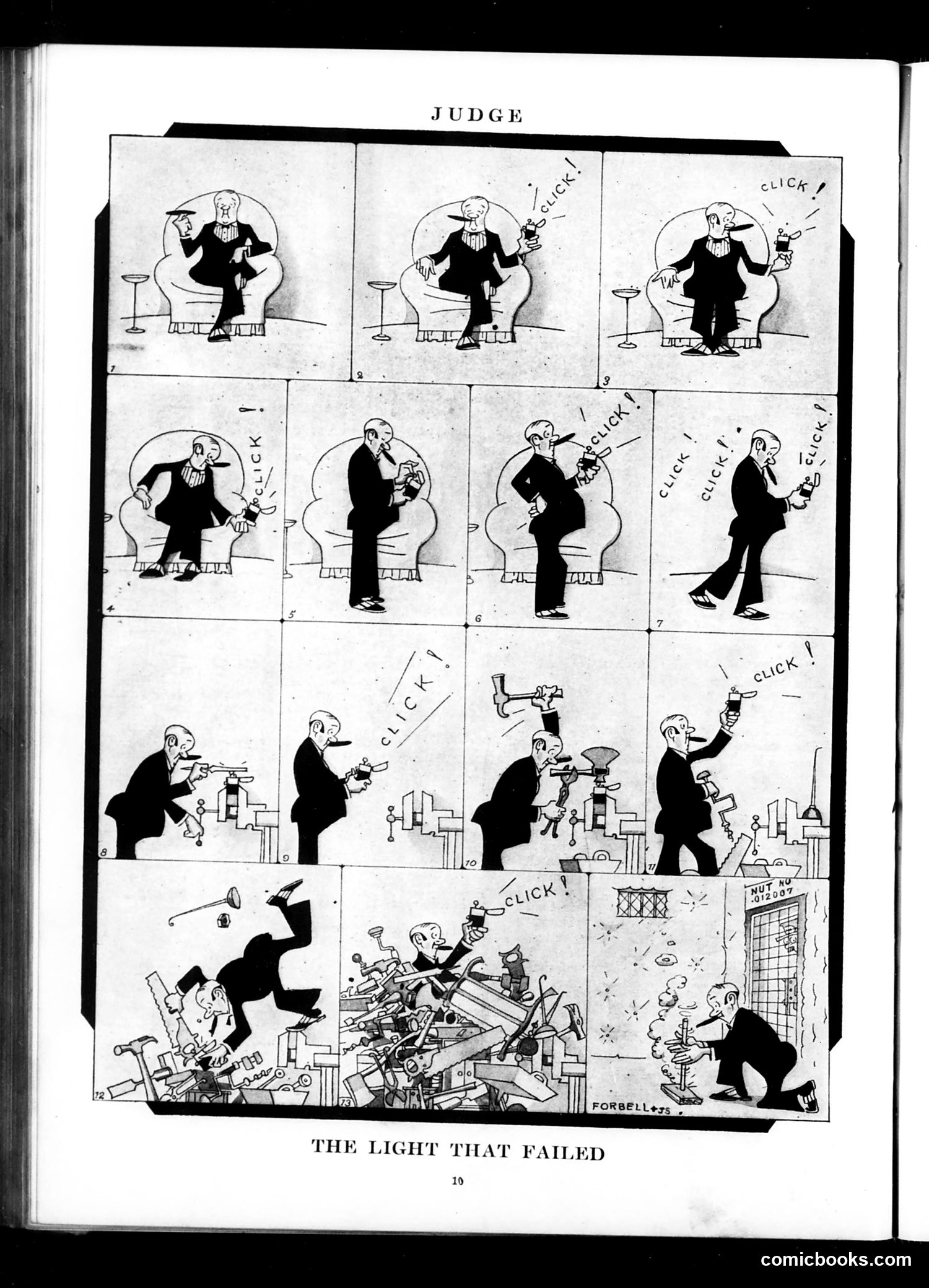
This cartoon depicts a judge seated at his desk, initially calm and composed. Through sequential panels, he becomes increasingly agitated by repeated "click" sounds—apparently his electric light malfunctioning. His frustration escalates: he stands, paces, examines the lamp, and ultimately descends into chaos, surrounded by debris and destruction as he apparently destroys his office in rage over the failed light. The satire mocks judicial temperament and dignity. It suggests that even supposedly rational, authoritative figures like judges can be reduced to irrational fury by modern conveniences that fail to work properly. The title references Rudyard Kipling's 1891 novel about decline and failure, implying commentary on the unreliability of new electrical technology—a timely concern in early 20th-century America when electric lighting was still novel and often problematic.
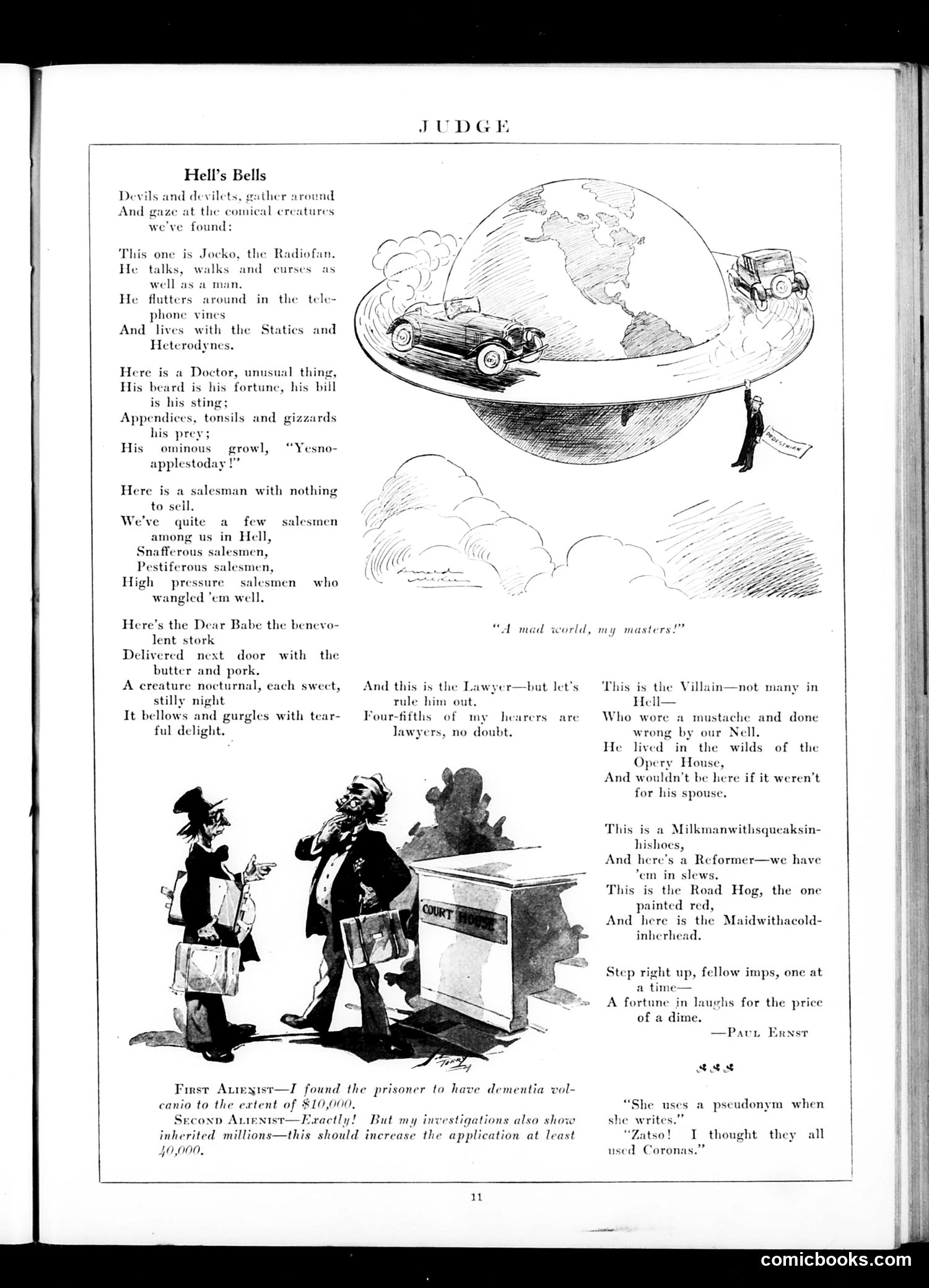
This is a satirical "gallery of types" mocking various American stereotypes and professions. The poem introduces characters as if they're damned souls in Hell, each representing a recognizable social type: "Jocko the Radiofan" (early radio enthusiasts), a greedy doctor, pushy salesmen, a lazy milkman, a reform-minded crusader, a reckless driver ("Road Hog"), and others. The humor relies on exaggeration and moral judgment—the piece treats ordinary occupations as character flaws worthy of damnation. At bottom, two brief jokes mock lawyers (the audience is "four-fifths lawyers") and mock women writers using pseudonyms. The overall satire reflects early 20th-century anxieties about consumer culture, professionalism, and social hypocrisy—presenting modern American types as moral failures. It's punchy social commentary disguised as whimsical verse.
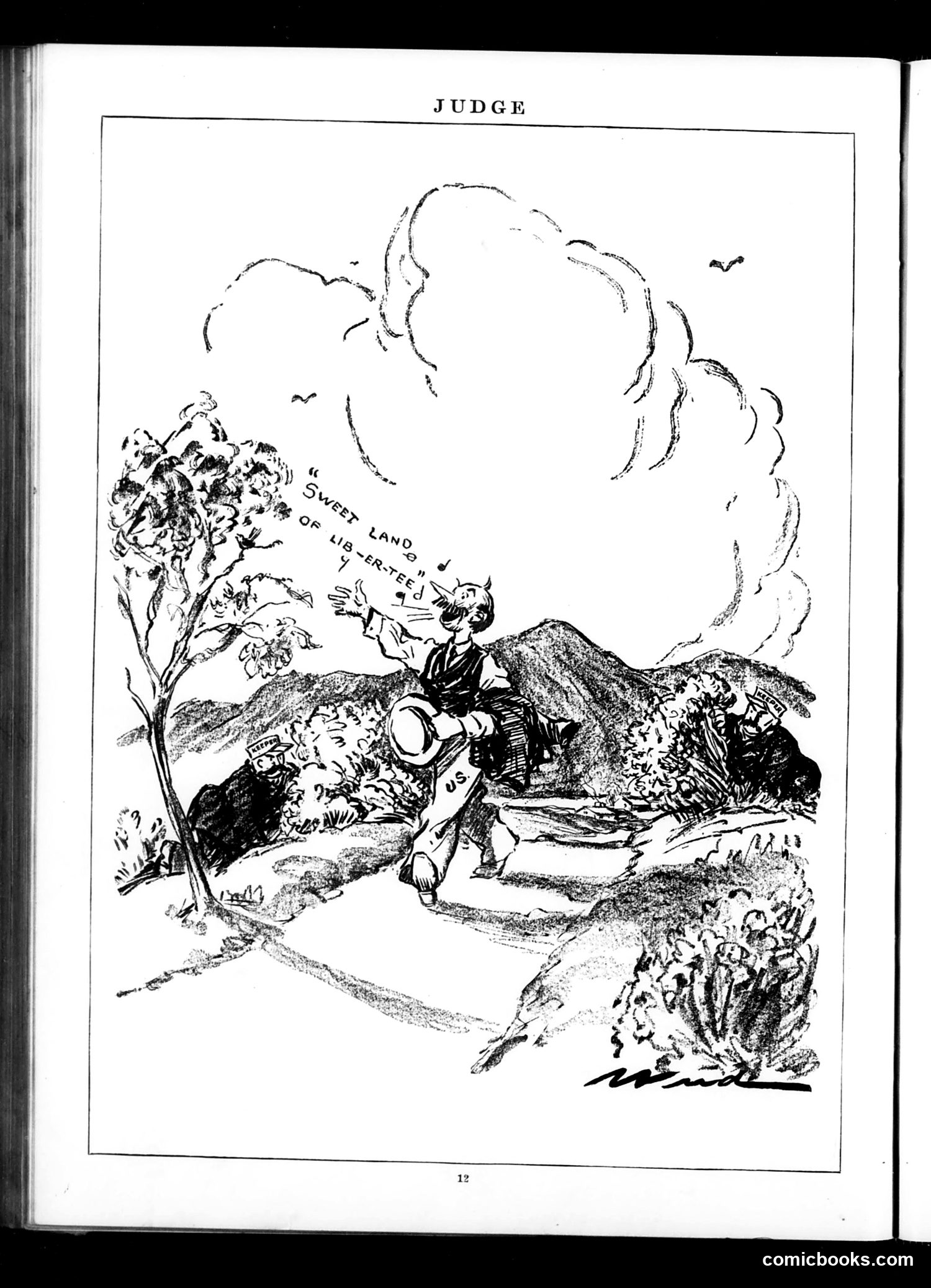
This page shows a single political cartoon titled "JUDGE" depicting a figure in formal dress standing in a pastoral landscape, gesturing toward clouds labeled "SWEET LAND OF LIBERTY." The figure appears to be presenting or promoting this idealized vision. Without additional context or visible date information, I cannot definitively identify the specific historical figure or political moment this references. The cartoon's general message seems to be satirizing the gap between America's idealistic self-image ("sweet land of liberty") and some implied reality the cartoonist is critiquing—a common Judge magazine theme. The figure's theatrical pose suggests ironic commentary on patriotic rhetoric or political promises. The specific target and satire remain unclear without more contextual information.
This page contains editorial commentary rather than cartoons. The masthead features a judge sitting at a bench—the magazine's recurring framing device for satirical legal/political judgment. **"Governors Agog"** mocks the annual Governors' Conference (held at Mackinac Island) as largely performative. The author argues that while governors invoke "States' Rights" rhetoric, modern problems—flood control, agriculture, transportation, maritime issues—are inherently interstate or federal, making individual state power irrelevant. The piece names rising national political figures (Al Smith, Ritchie, Donahey, Moody) as those actually gaining influence by operating *beyond* state boundaries. **"Peace and the Pacific"** discusses the Institute of Pacific Relations conference in Honolulu, arguing that public opinion shaped by such diplomatic gatherings matters more than formal treaties. It warns Americans must develop informed views on Pacific policy before crisis forces hasty decisions. **"England's Liquor Bill"** briefly notes England's ongoing prohibition debate, citing statistics on drinking habits. The tone throughout is sophisticated political analysis for educated readers.
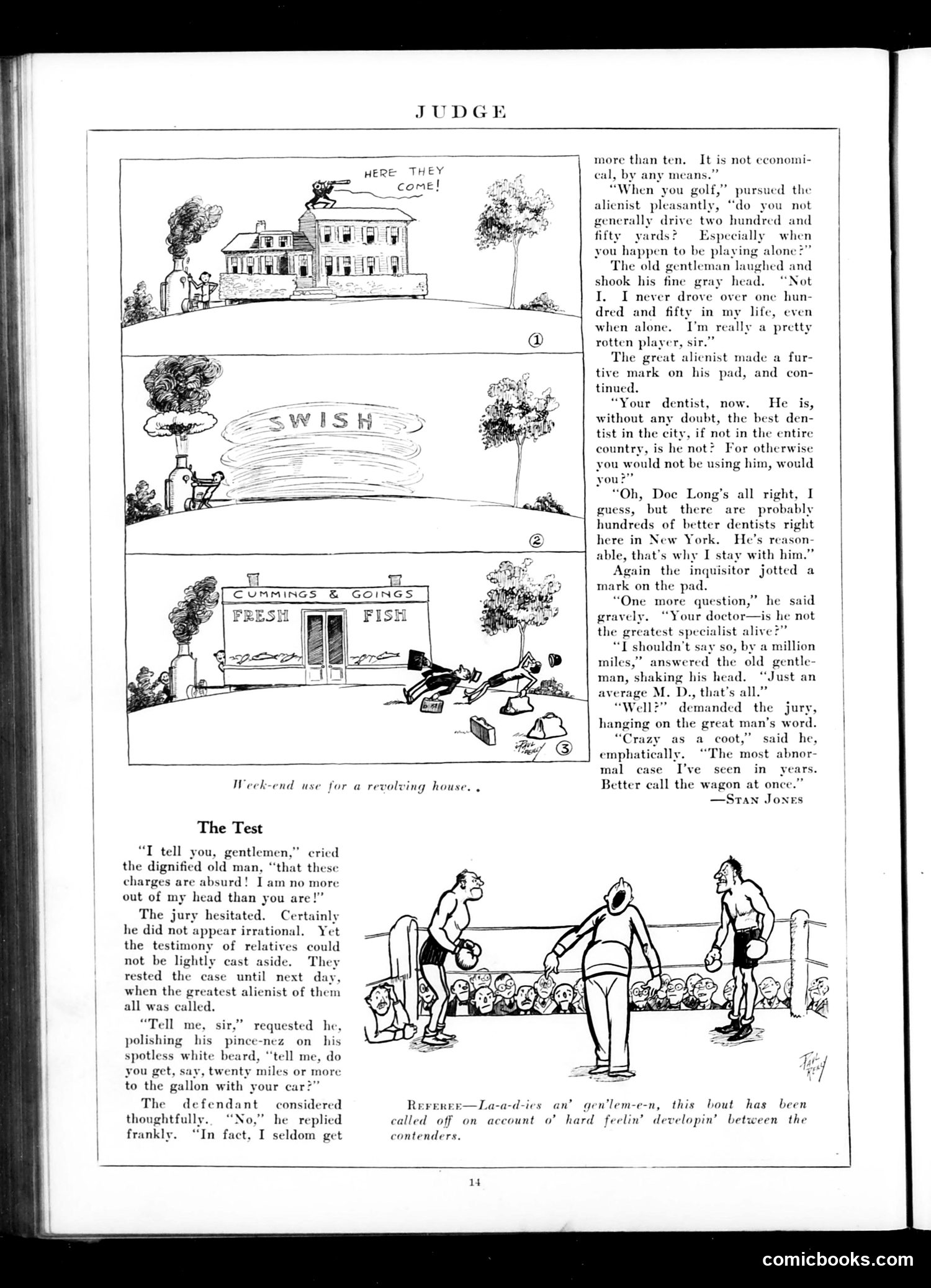
This page contains two satirical pieces mocking early 20th-century psychology and sanity hearings. **"The Test"** ridicules a psychiatric competency evaluation. An elderly defendant faces a jury questioning his sanity. A prestigious "alienist" (period term for psychiatrist) attempts to prove insanity through leading questions—asking if the man drives 250 yards golfing, uses the "best" dentist and doctor. When the defendant gives modest, reasonable answers ("I'm a pretty rotten player," "hundreds of better dentists exist"), the psychiatrist marks these as evidence of delusion, concluding him "crazy as a coot." The satire exposes how psychologists twisted testimony: normal humility or honesty became "abnormal." The joke: the defendant's rational self-assessment proves him insane to the self-important expert. The boxing cartoon below mocks referee incompetence during matches. The three comic strips above satirize absurd property uses, typical Judge humor of exaggerated situations.
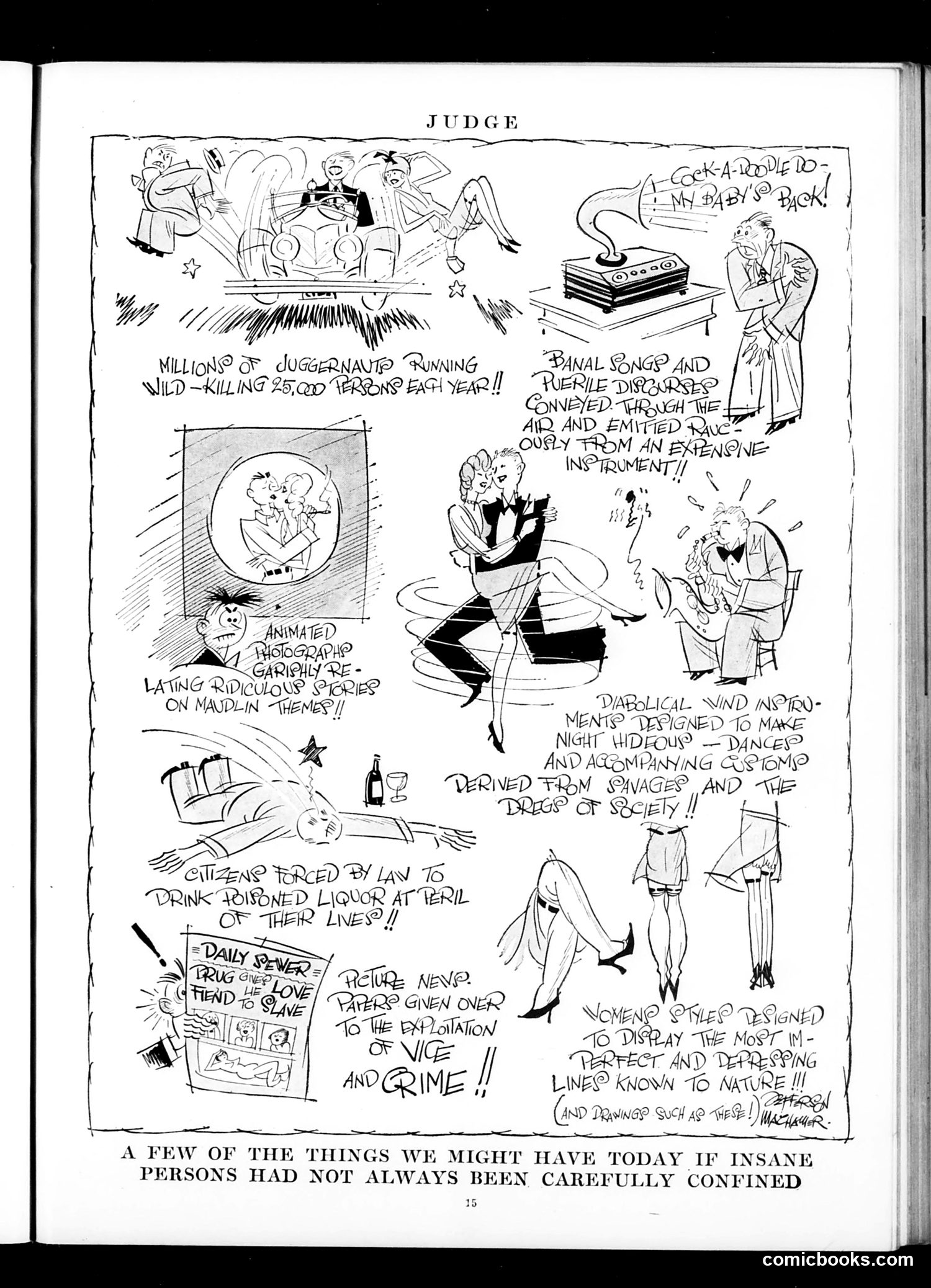
This satirical cartoon argues that confining "insane persons" has benefited society by preventing various social ills. Through exaggerated vignettes, it depicts imaginary consequences of unrestricted mentally ill individuals: - **Juggernaut runners** causing mass casualties - **Phonograph technology perverted** into tools of vice - **"Animated holographic" entertainment** replacing wholesome media - **Poisoned liquor** forced on citizens - **Obscene women's fashions** designed to corrupt - **Crime and vice** spreading unchecked The cartoon's premise—that institutionalization protects public morality and safety—reflects early 20th-century attitudes toward mental illness and institutionalization. It presents confinement as a necessary social good, using hyperbolic humor to mock what it sees as predictable consequences of leniency. By modern standards, this reflects outdated and troubling views on mental health treatment, dignity, and institutional care that have since been substantially reformed.
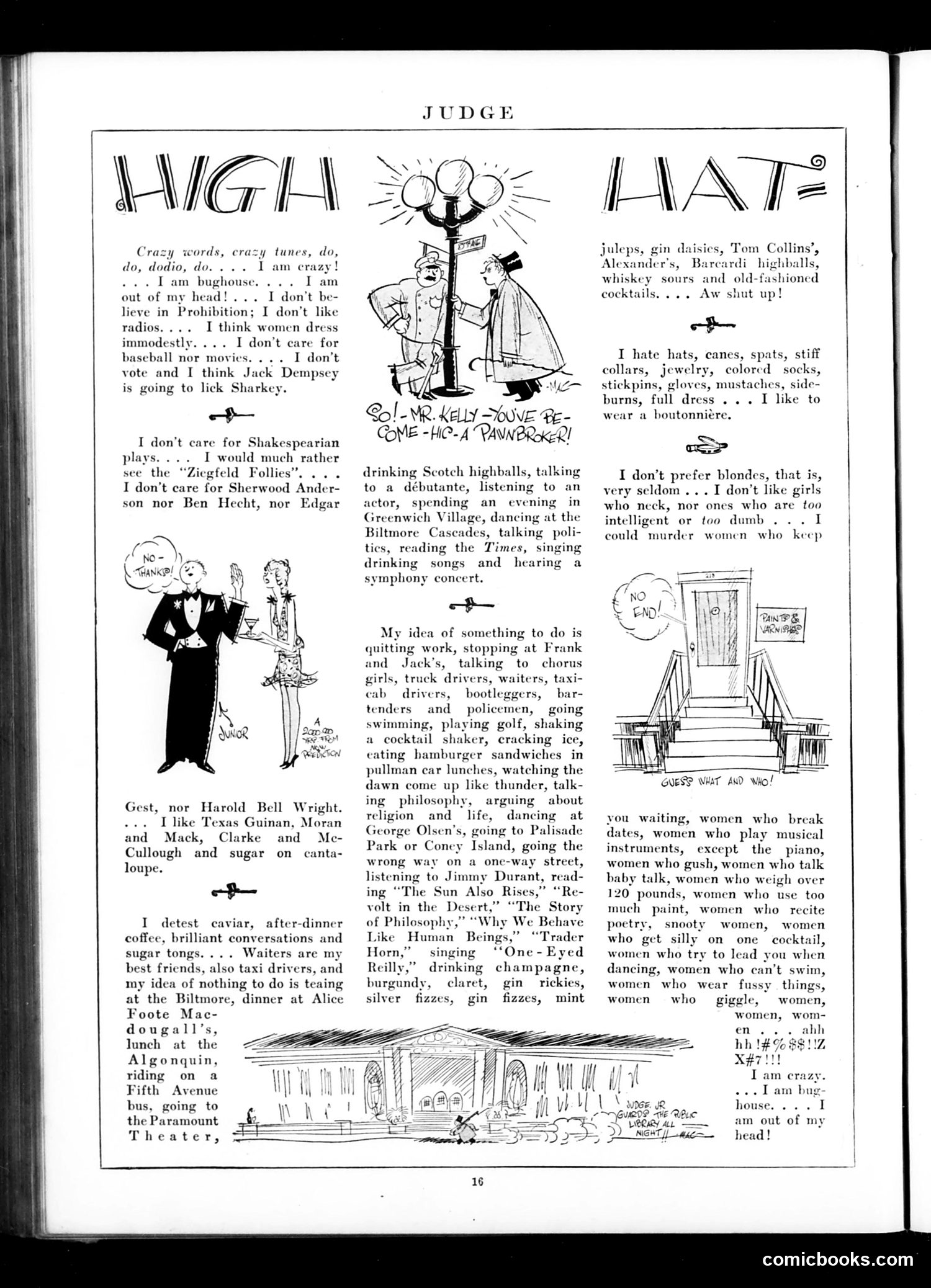
This page satirizes 1920s cultural pretension and generational divide. The central figure—likely representing a young Jazz Age sophisticate—declares himself "crazy" while listing contradictory tastes: he rejects "high culture" (Shakespeare, caviar, formal dress) yet claims to embrace it through specific references (Ziegfeld Follies, Greenwich Village, literary works like "The Sun Also Rises"). The satire targets the era's newly wealthy or aspiring urban youth who performed cosmopolitan sophistication while actually preferring lowbrow pleasures: speakeasies, chorus girls, Coney Island. References to Texas Guinan (famous speakeasy hostess), Jimmy Durante, and Prohibition-era drinking venues anchor the 1920s setting. The repeated phrase "I am crazy...bughouse...out of my head" mocks this performative contradiction—the character simultaneously claims refined taste and celebrates vulgarity, embodying the period's cultural confusion and the magazine's skepticism toward modern youth pretension.
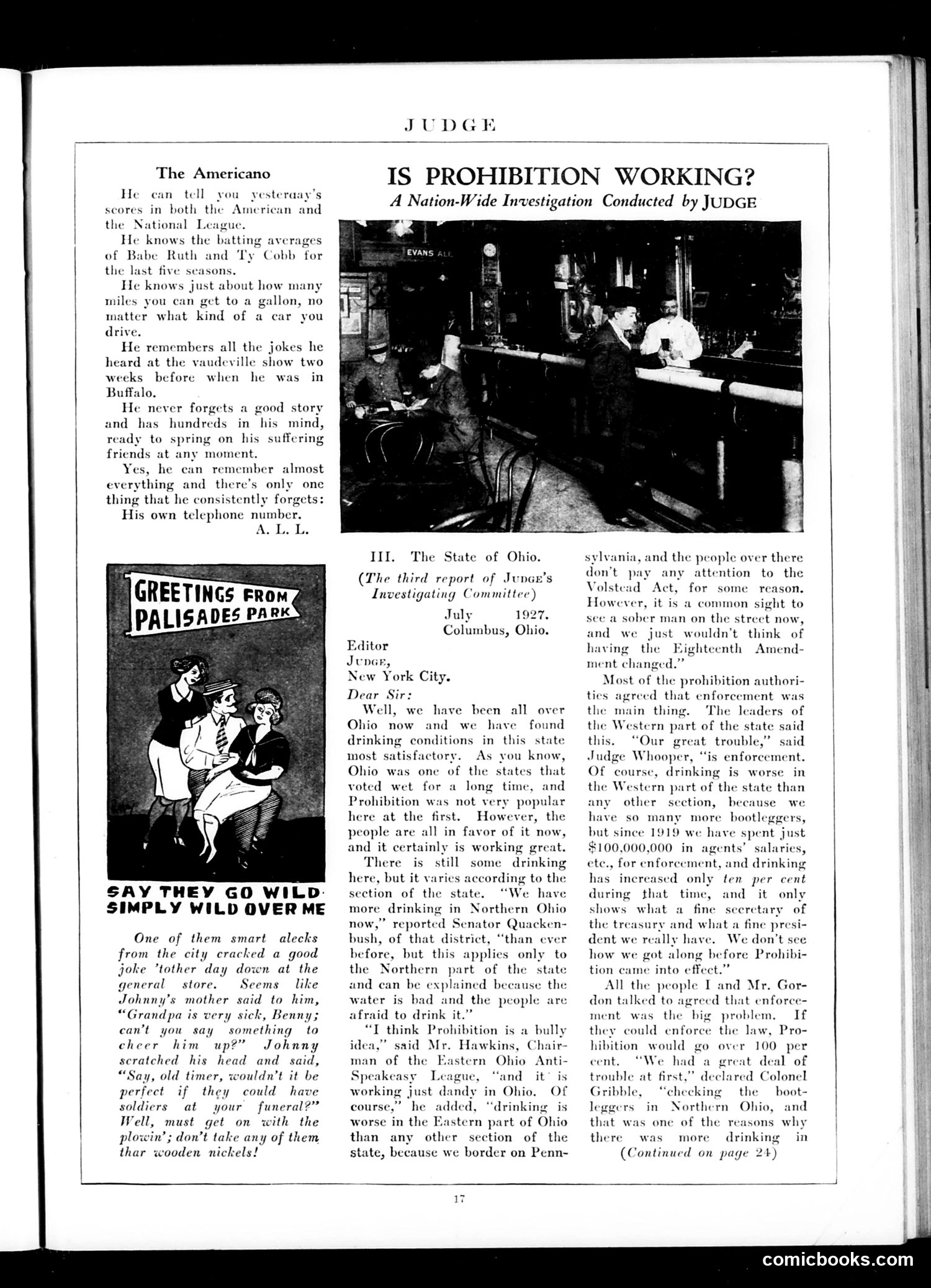
This page satirizes the widespread failure of Prohibition enforcement in Ohio while officials publicly claimed success. The "Investigation" format mocks how authorities rationalized drinking across the state: Northern Ohio officials blamed bad water; Eastern Ohio leaders credited Prohibition's success while admitting drinking was "worse in the Eastern part"; Western officials claimed enforcement was working despite spending $100 million and seeing drinking increase. The core joke is that every region admits drinking is worst *in their region specifically*, while praising Prohibition overall. Officials contradict themselves—praising the law while acknowledging it plainly isn't working. This reflects the historical reality that Prohibition (1920-1933) largely failed, with widespread bootlegging and public drinking continuing despite official denial. Judge magazine here exposes the absurdity of these self-deluding enforcement reports.
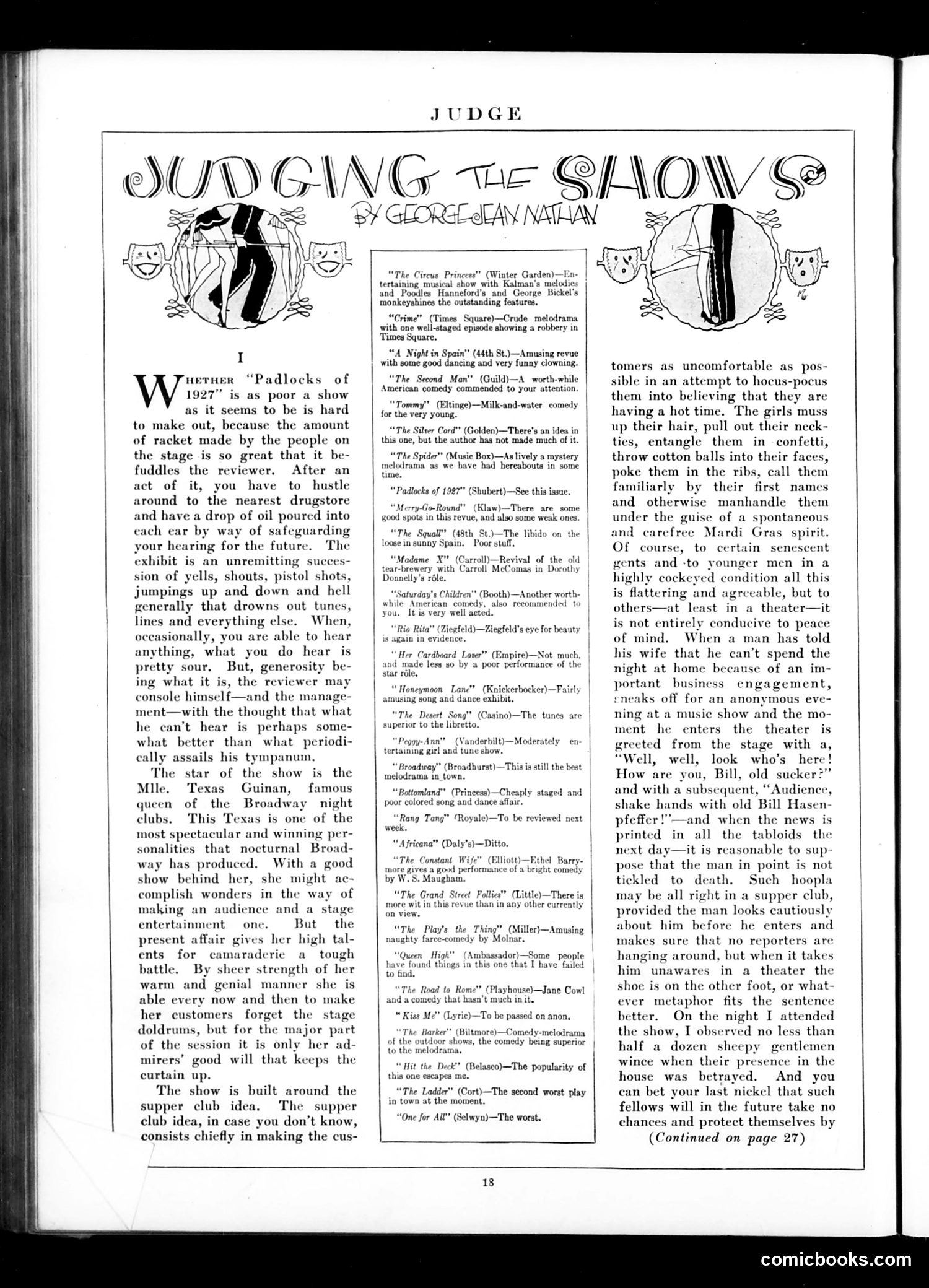
This is a theater review column by George Jean Nathan critiquing Broadway productions from 1927. The page contains no political cartoons—rather, it's a satirical review of current stage shows. **The Main Target:** Mlle. Texas Guinan, a famous nightclub owner and performer, whose show "Padlocks of 1927" is the featured review. Nathan mocks the production's excessive noise and spectacle, claiming the cacophony is so loud that audience members need ear treatment afterward—a hyperbolic complaint about poor sound design. **The Satire:** While acknowledging Guinan's genuine charm and talent as a personality, Nathan argues her considerable charisma cannot salvage the show's fundamental problems. He suggests only her admirers' goodwill keeps the curtain up. **Context:** This reflects 1920s Broadway's competitive theater scene and Nathan's acerbic reviewing style. The list of other shows (Crime, Rio Rita, Broadway, etc.) shows the era's theatrical output, many now-forgotten productions.
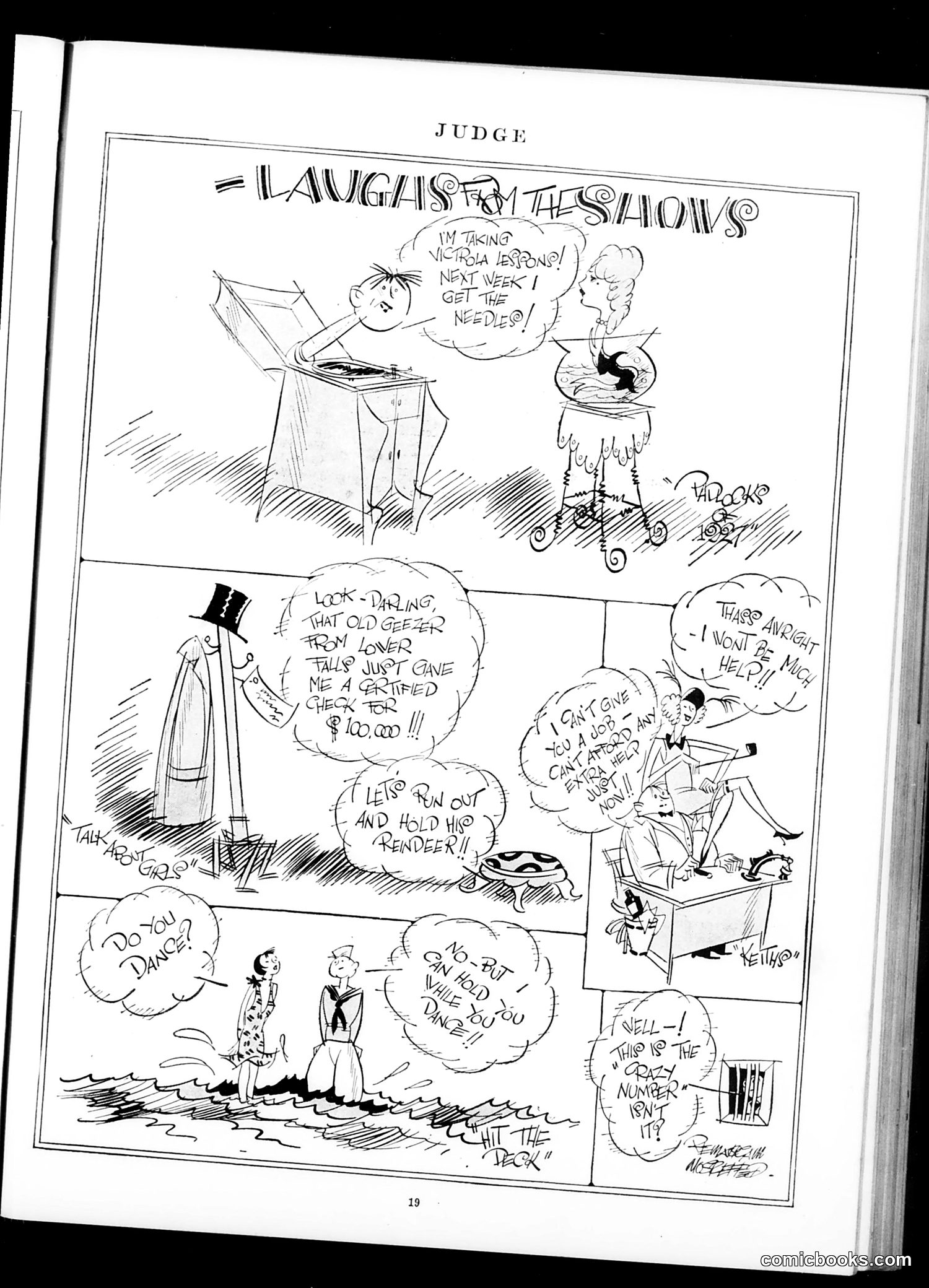
This Judge cartoon satirizes theatrical producers or promoters pitching absurd Christmas-themed entertainment concepts. The top panel shows someone presenting ridiculous show ideas—taking "Victoria Jardons" (unclear reference) and obtaining needles, suggesting nonsensical or exploitative performances. Subsequent panels mock financial desperation: a character in top hat requests $100,000 from what appears to be an old moneylender for a "certified check." Other characters beg for help staging shows, unable to afford basic production needs. The bottom panel depicts the financial collapse: performers on a dock discuss cancellations, with one lamenting "No put-up, will you do?" The satire targets Depression-era theatrical hustle—producers making increasingly desperate pitches, investors losing money on failed shows, and performers left stranded without resources. It critiques both the frivolous entertainment schemes and the economic chaos affecting the theater industry.
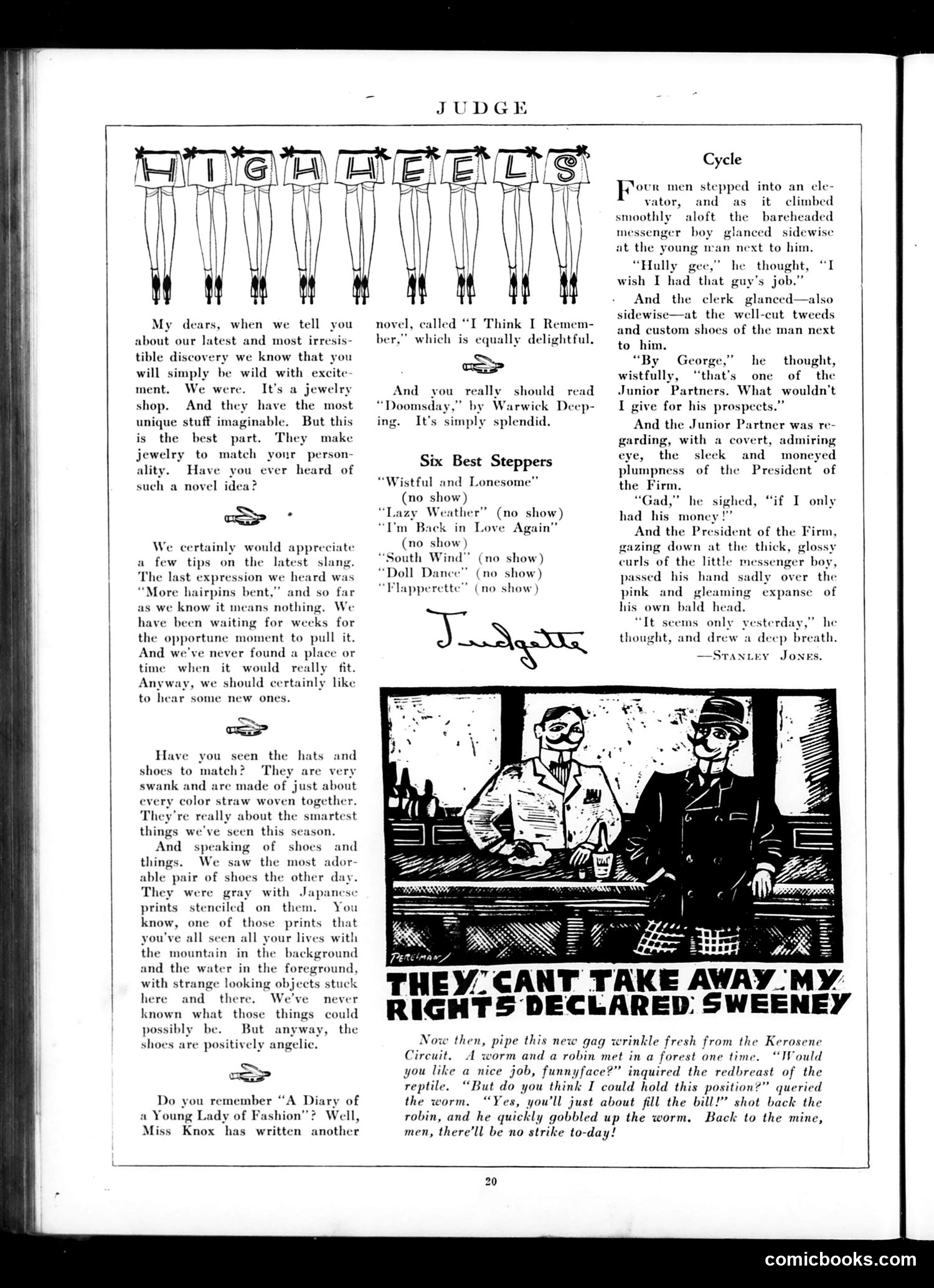
This Judge magazine page contains two distinct pieces of satire: **"Cycle"** (right column) mocks social aspiration and the human tendency toward envy. Four men in an elevator each covet what the next man has: a messenger boy envies a clerk's job, the clerk admires a Junior Partner's prospects, the Junior Partner covets the President's wealth and status, and the President—ironically at the top of the hierarchy—desperately wishes for the messenger boy's youth and hair. The satire is that everyone wants what someone else has, creating an endless, circular cycle of dissatisfaction regardless of actual position. **The cartoon below** (captioned "They Can't Take Away My Rights Declared Sweeney") appears to be a labor-related joke. The gag about a worm and robin illustrates worker vulnerability: the worm is promised a "nice job" but is promptly consumed. The final caption suggests this relates to labor strikes or working conditions—implying workers who trust management promises face exploitation. The specific "Sweeney" reference is unclear without additional context.
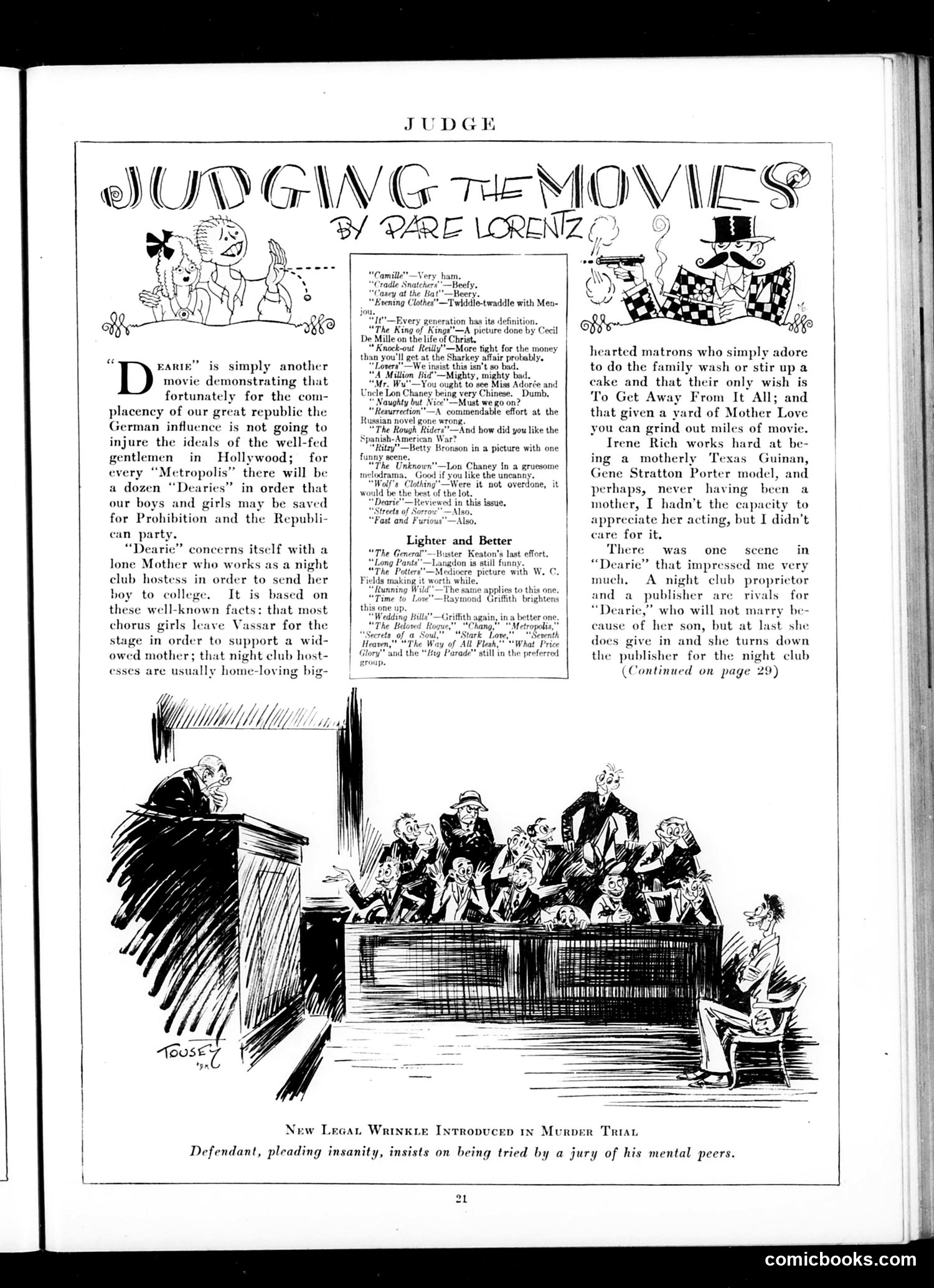
This satirical page from Judge magazine contains two distinct sections: **Top Section:** "Judging the Movies" by Pare Lorentz reviews contemporary films, including "Dearie" (the main focus). The review notes the film tells a familiar story: a night club hostess works to support herself and send her son to college—a premise Lorentz sarcastically notes is based on "well-known facts" that chorus girls actually do this. He criticizes the film for depicting idealized "big-hearted matrons" doing family chores, targeting middle-class fantasy rather than reality. Other films reviewed include Buster Keaton's "The General" and Harry Langdon's "Long Pants." **Bottom Cartoon:** Titled "New Legal Wrinkle Introduced in Murder Trial," it satirizes the insanity defense. The sketch shows a courtroom where a defendant pleads insanity and demands "being tried by a jury of his mental peers"—the joke being that finding eleven other mentally unfit jurors would be absurd, mocking both the defendant's logic and the legal system's vulnerability to such claims.
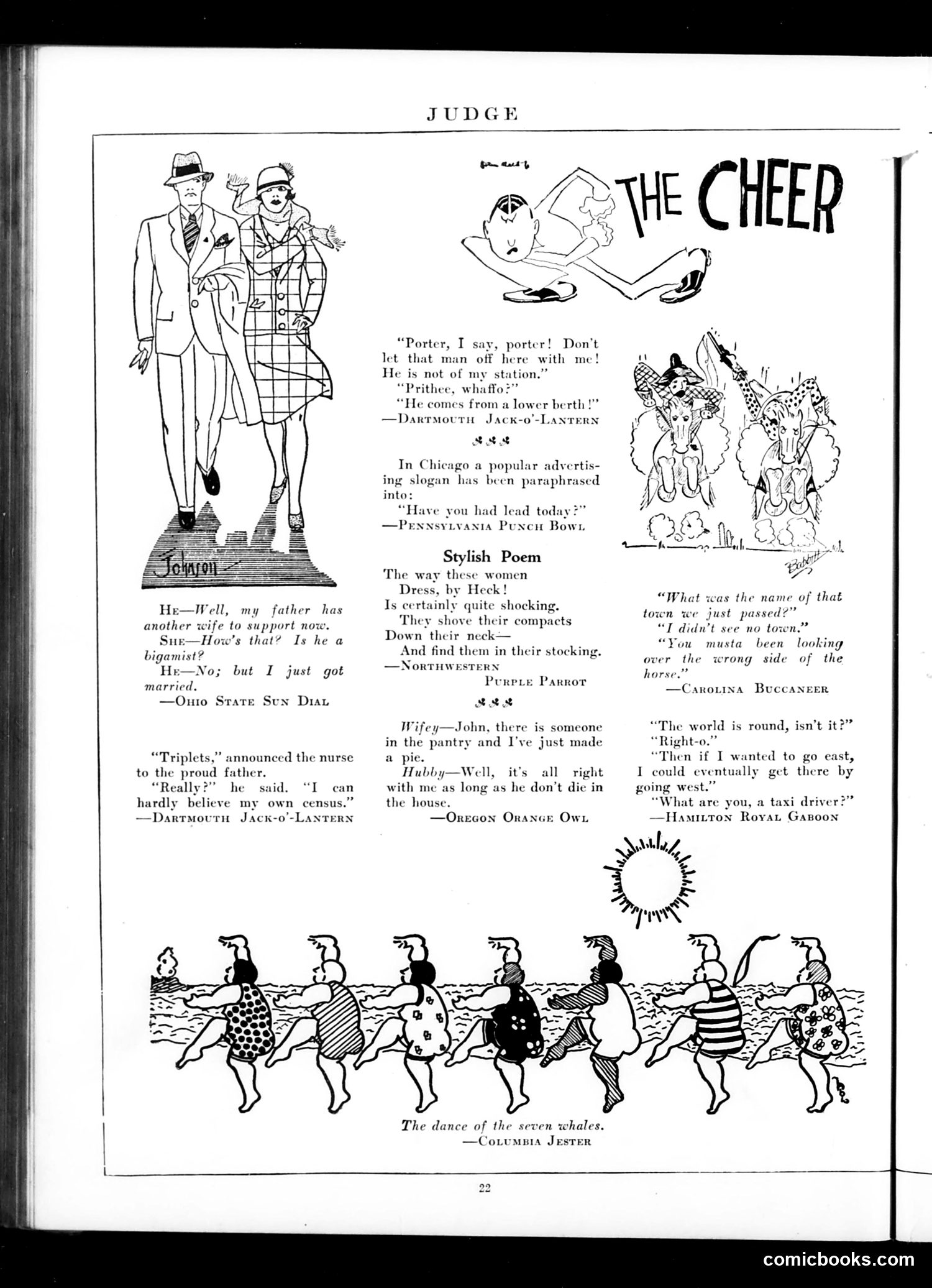
This is a collection of short jokes and comic sketches typical of Judge magazine's humor section. The content reflects early-20th-century American attitudes: **The jokes** use wordplay and social commentary: a man's marriage increases his father's expenses; a father disbelieves triplets as statistically improbable; a passenger objects to sharing a train berth with someone from "lower berth" (class-based snobbery); a wife's pie is so bad the husband jokes about it being lethal. **"Stylish Poem"** mocks women's fashion—specifically the practice of storing compacts (cosmetic cases) in their stockings, satirizing both vanity and the impracticality of 1920s women's clothing. **The bottom illustration** shows women in various patterned swimsuits dancing on a beach, captioned "The dance of the seven whales"—crude body-shaming humor about women's physiques. The overall tone is lighthearted domestic and social satire aimed at middle-class readers, with casual class consciousness and gender mockery typical of the era's mainstream humor.
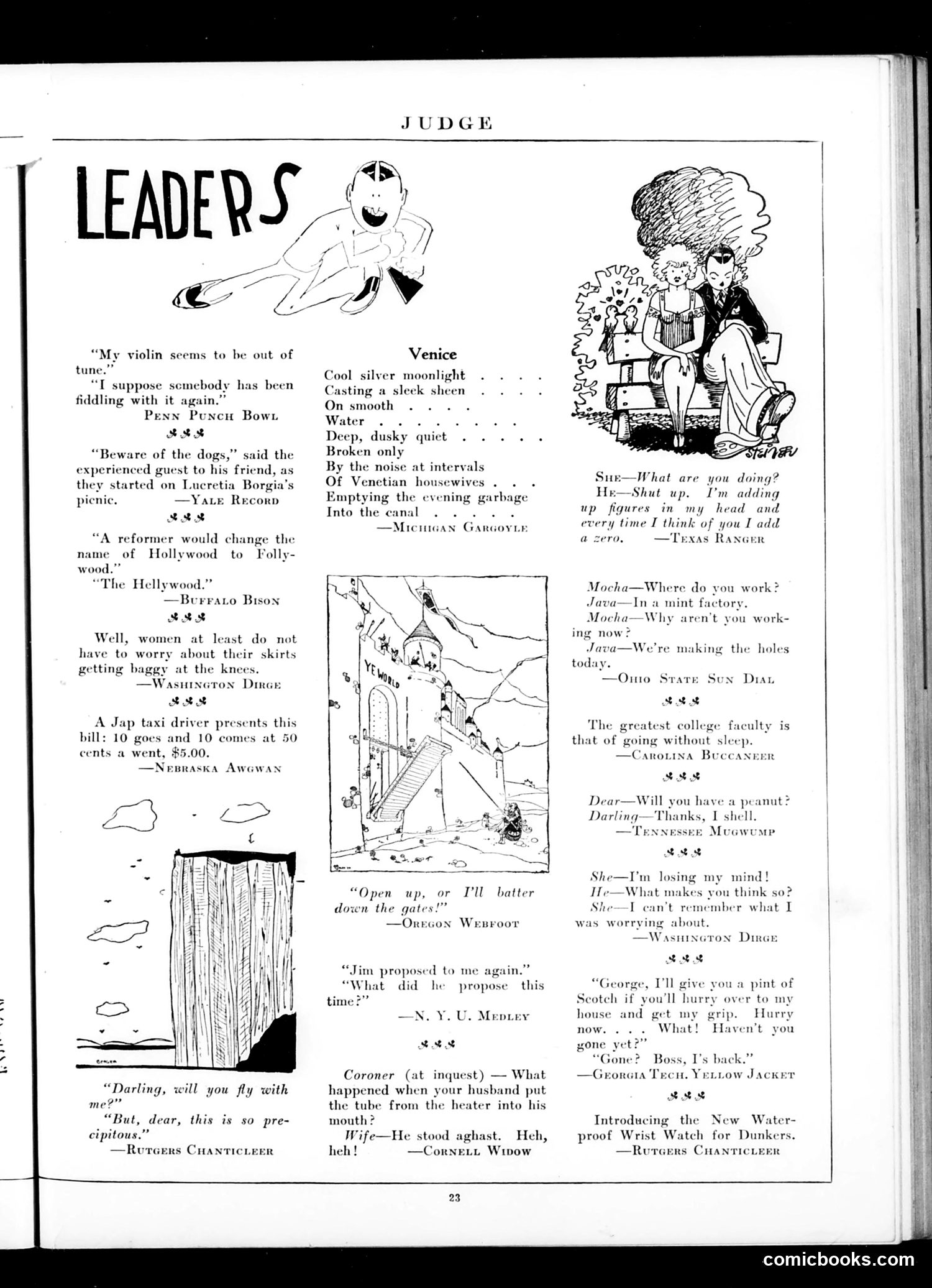
This page collects humor excerpts and cartoons typical of Judge's satirical style. The content addresses early 20th-century social observations: **Key elements:** - **The cartoons** appear largely domestic and whimsical—a woman with elaborate hair, a Venice scene mocking tourist poetry, architectural sketches. - **The quips** target contemporary social foibles: women's fashion (baggy knees), college life (sleep deprivation), Prohibition-era humor ("pint of Scotch"), and ethnic wordplay (the "Java/Mocha" mint factory joke playing on coffee-related names). - **Notable references**: "Lucretia Borgia's picnic" invokes the historical poisoner as shorthand for danger; "Hollywood to Follywood" satirizes the film industry's frivolousness; the "waterproof wrist watch for dunkers" likely mocks an emerging consumer gadget. - **Tone**: Gentle, domestic satire rather than hard political commentary—typical of Judge's middle-class readership humor targeting manners, relationships, and modern conveniences.
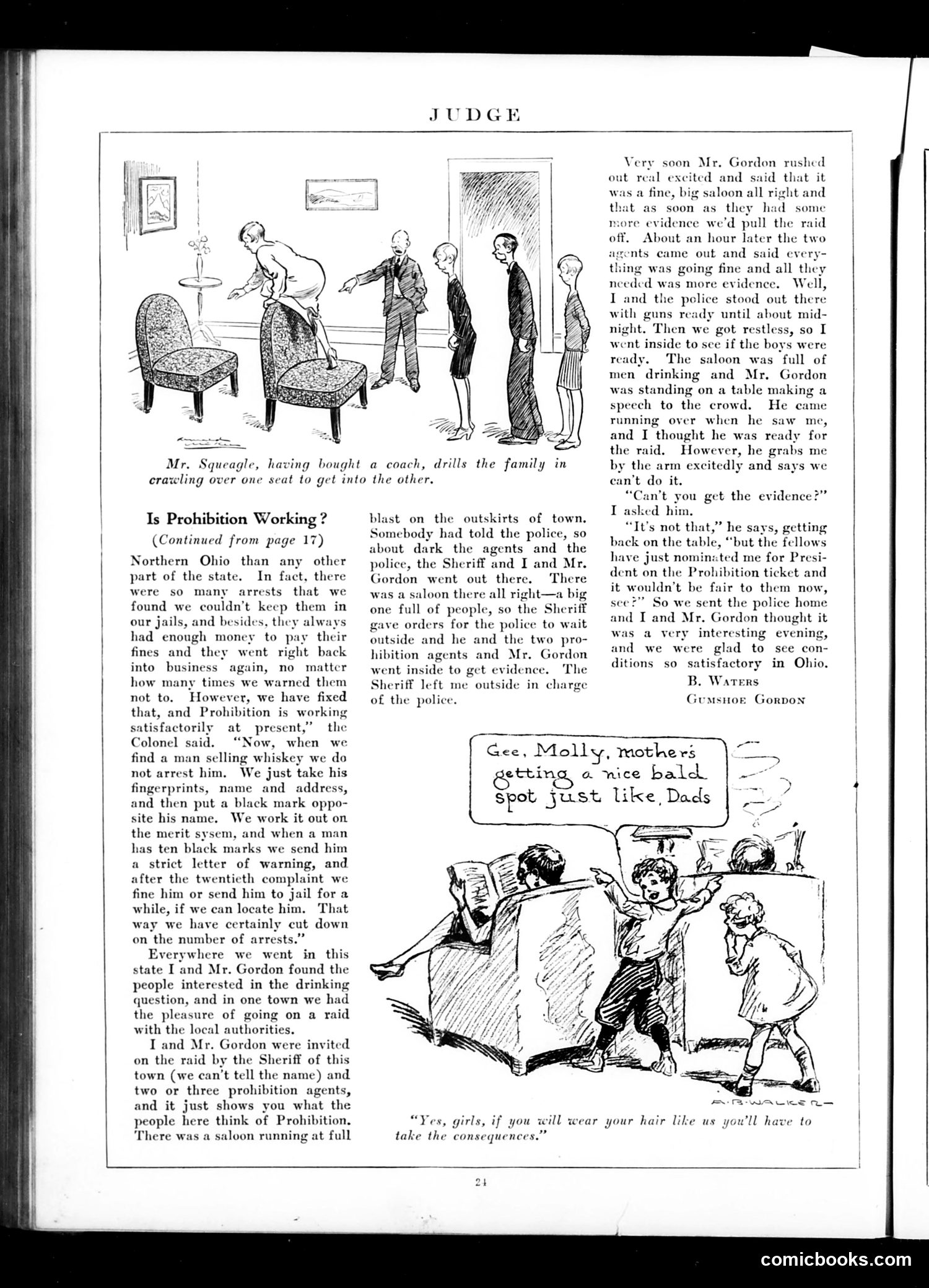
This Judge magazine page satirizes Prohibition enforcement in 1920s Ohio through two cartoons. **Top cartoon**: Shows Mr. Squeagle demonstrating awkward contortions to his family—a visual joke about the absurdity of navigating cramped spaces, likely metaphorical for the impracticality of Prohibition itself. **Main text/bottom cartoon**: The accompanying article mocks Prohibition's actual failure. A Colonel describes a laughably ineffective enforcement system: instead of arresting bootleggers, they issue "warnings" after twenty complaints. The punchline reveals the hypocrisy: during a raid on a functioning saloon, Mr. Gordon—a Prohibition agent—gets so caught up in being nominated for President on the Prohibition ticket that he refuses to complete the raid, prioritizing politics over enforcement. The bottom cartoon shows children imitating their parents' bad habits, reinforcing the article's implicit message: Prohibition doesn't work because the authorities themselves don't actually enforce it—they're more interested in self-promotion than genuine reform.
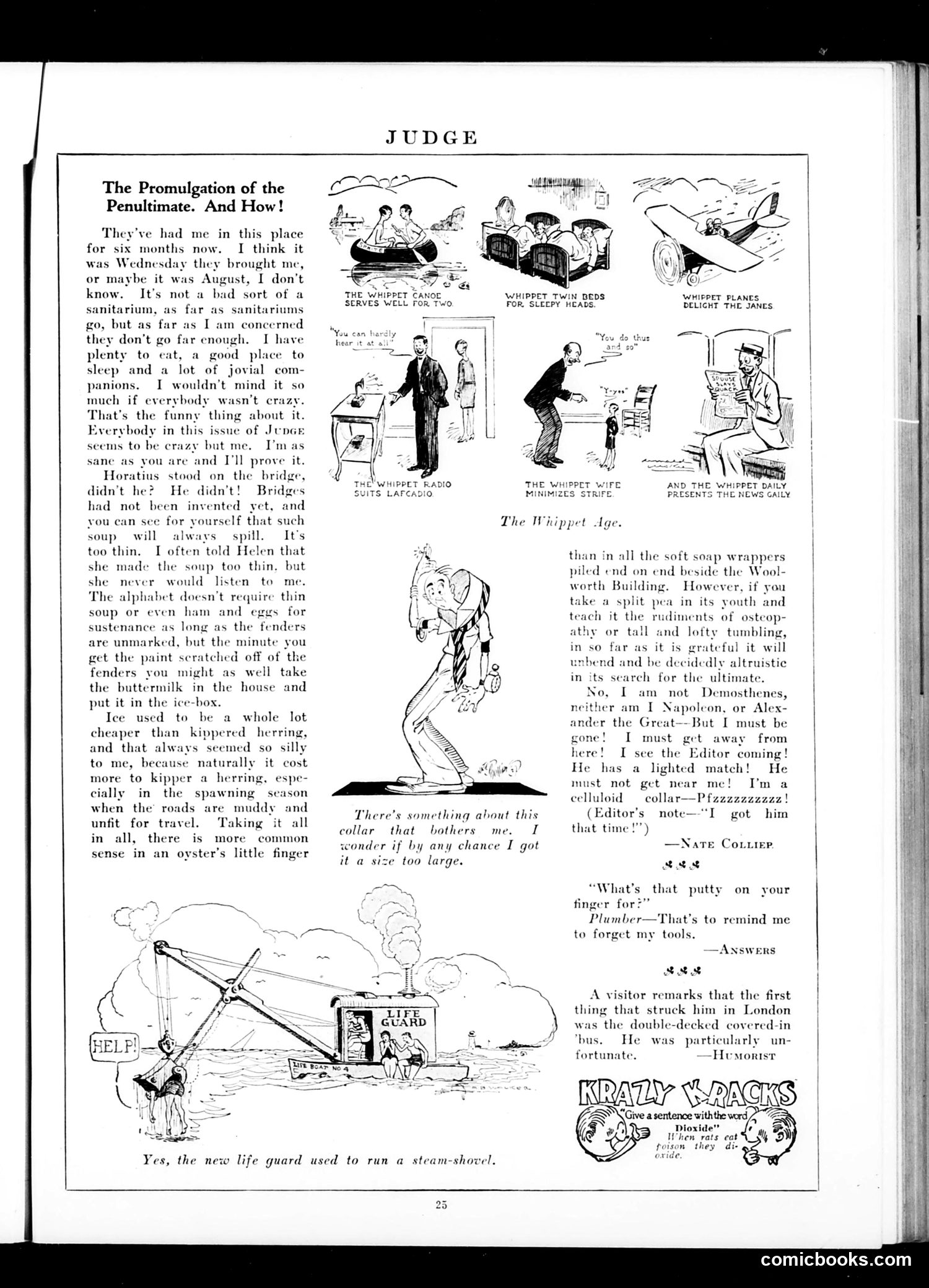
This page satirizes modern consumer culture and advertising through absurdist humor. The main article is a monologue by an unnamed narrator in a sanitarium who claims everyone *else* is crazy while he speaks in deliberately nonsensical, stream-of-consciousness rambling—undermining his own credibility as the supposedly sane one. The cartoons promote "Whippet" branded products (canoes, radios, beds, planes, etc.), likely referencing the Whippet automobile. This appears to be both product placement and gentle mockery of the era's aggressive advertising that slapped brand names onto unrelated items. The joke: in this world of absurd marketing and mass consumption, the genuinely rational person appears insane. The page mocks both consumer culture's proliferation and the era's tendency to institutionalize those deemed eccentric—suggesting sanity itself is subjective when everyone around you is participating in collective madness.
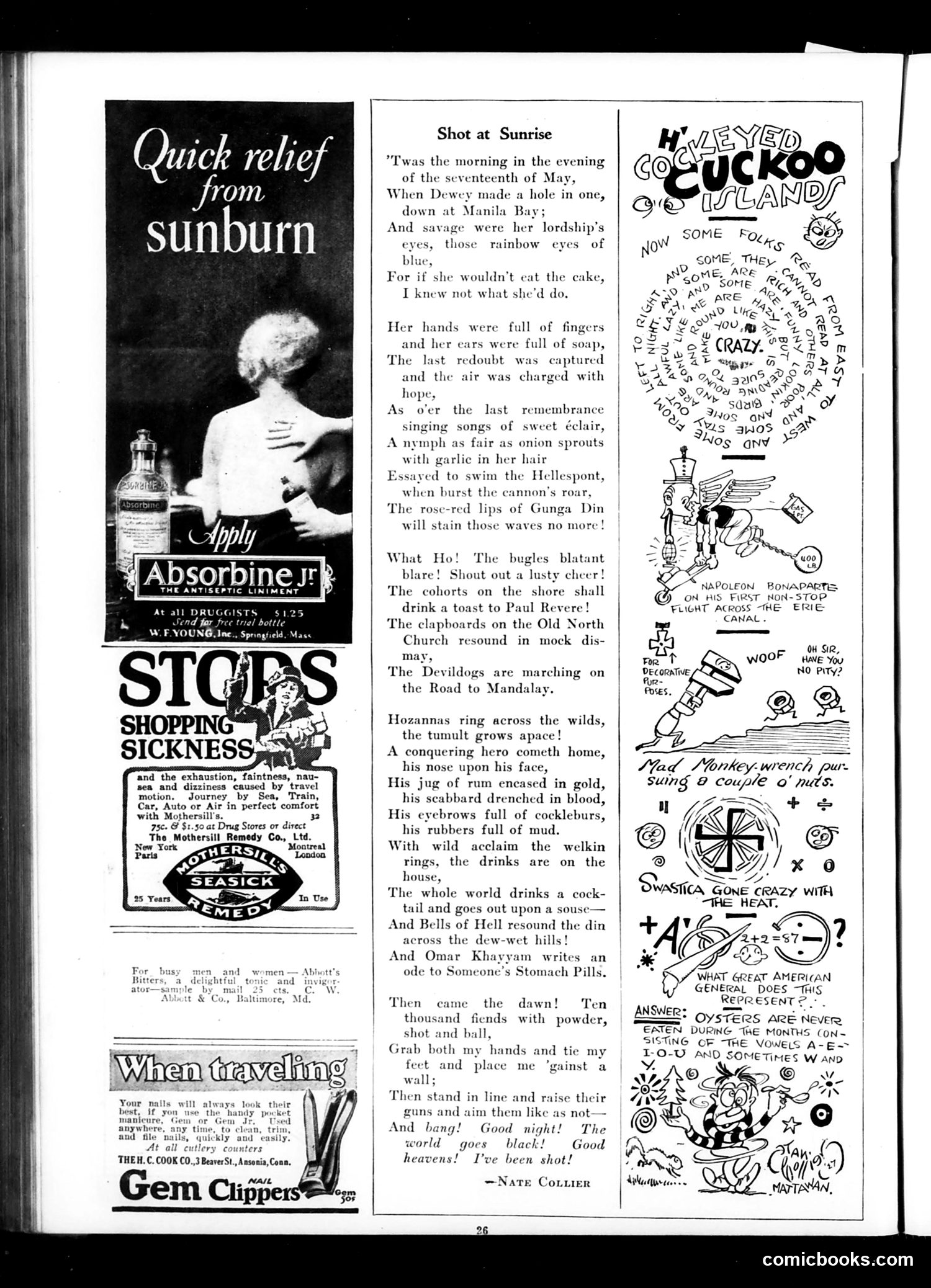
This page contains two distinct pieces: **Left side:** Advertisements for Absorbine Jr. (sunburn relief) and Mothersill's (motion sickness remedy), plus Stokes cough medicine and Gem Clippers. **Right side:** A humorous poem titled "Shot at Sunrise" by Nate Collier, with accompanying whimsical cartoon illustrations. The poem appears to be a satirical, stream-of-consciousness narrative mixing military references (Manila Bay, Dewey, the Spanish-American War) with absurdist imagery and nonsense—soldiers executing the narrator, random literary allusions, and surreal comedy. The cartoon section below parodies a children's riddle format, featuring crude drawings with jokes about Napoleon Bonaparte, oyster-eating seasons, and other puns. The overall tone is comedic absurdism typical of early-20th-century Judge magazine humor—deliberately nonsensical and irreverent rather than making a specific political point.
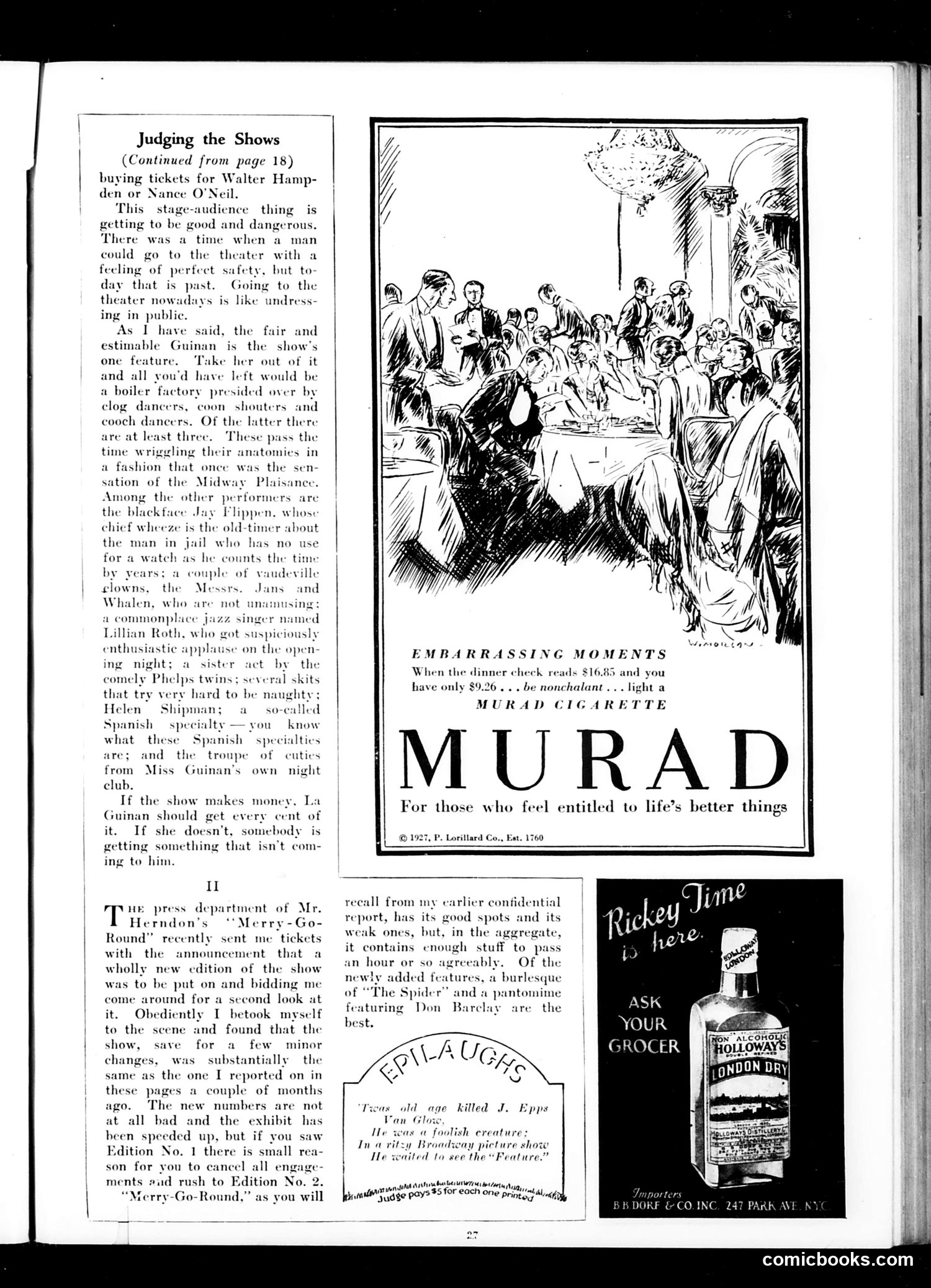
This page contains theater reviews and advertisements from 1927. The main critical content discusses two Broadway shows: **"Merry-Go-Round"**: The reviewer, having seen both the original and a supposedly "new edition," reports the show is largely unchanged despite claims of renovation. He finds it adequately entertaining but not worth special effort to see the revised version. **An unnamed show** (likely "The Merry-Go-Round" continued): The critic praises La Guinan as the show's only worthwhile feature, noting her talent would make even a mediocre production viable. He argues she deserves all profits if the show succeeds. The page also includes period advertisements: a Murad cigarette ad playing on social embarrassment (checking dinner bills), and a Holloway's London Dry gin advertisement. The theatrical criticism reflects 1920s attitudes toward vaudeville entertainment, burlesque, and chorus dancers—content considered risqué for the era.
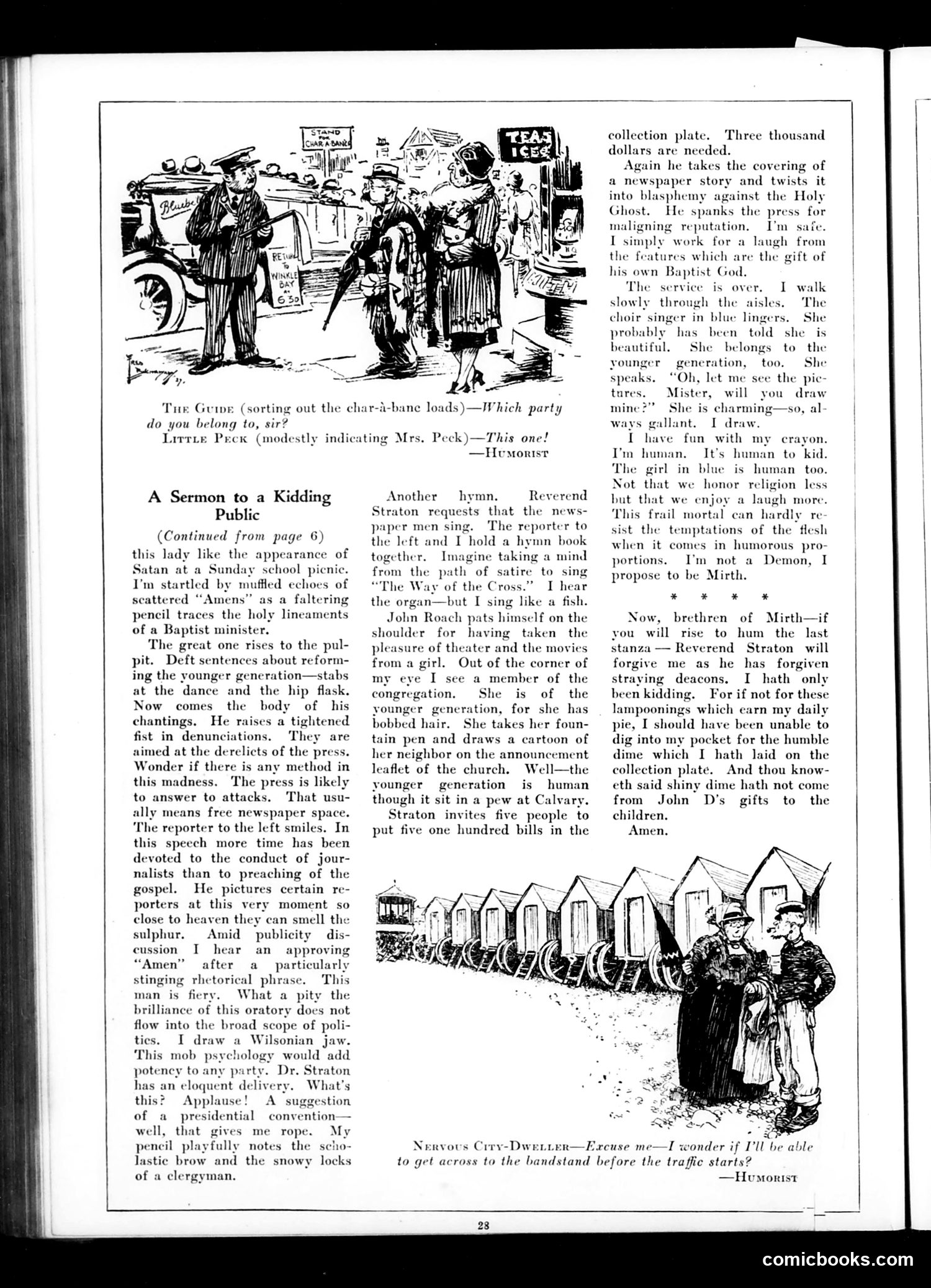
This page contains **"A Sermon to a Kidding Public,"** a humorous essay by a cartoonist attending a church service led by **Reverend Straton** (likely John Roach Straton, a prominent Baptist minister known for fiery sermons against moral decay). The top cartoon shows a **tour guide sorting passengers** into groups, asking which "party" they belong to—a joke about post-WWI charabanc (motor coach) tours and social divisions. The essay satirizes Straton's sermon attacking **newspaper reporters and the press** for moral corruption, while the cartoonist observes the irony: the preacher devotes more energy denouncing journalists than preaching Gospel. The piece mocks both the minister's theatrical denunciations and the congregation's superficial piety—including young women with "bobbed hair" sketching cartoons during worship. The bottom illustration shows **seaside beach huts**, captioned with a woman's concern about traffic—unrelated social commentary. The satire targets **religious hypocrisy and generational conflict** in 1920s America, with the cartoonist defending his own "kidding" as humanly honest compared to sanctimonious preaching.
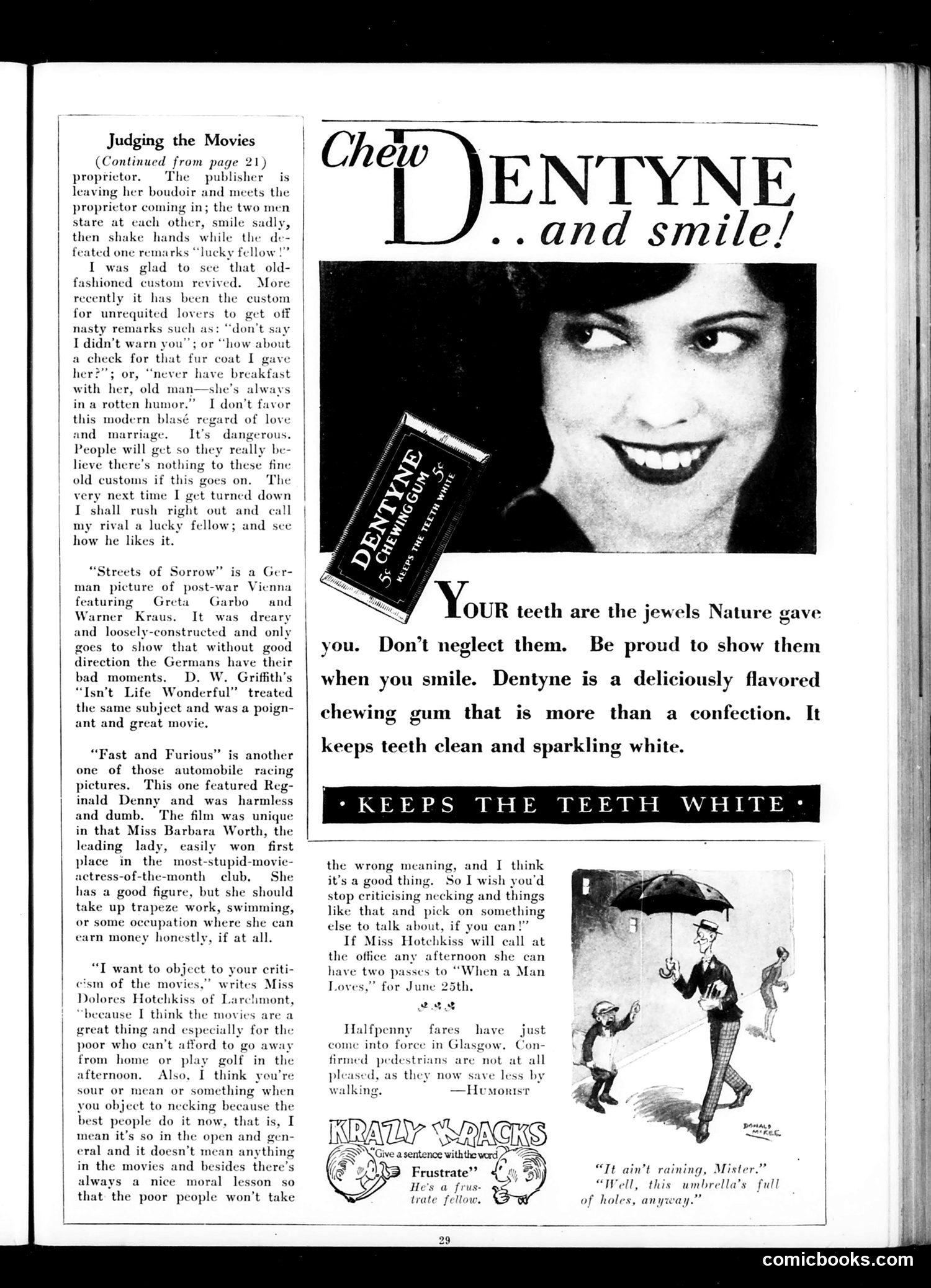
This page is primarily a **Dentyne gum advertisement** disguised as editorial content in Judge magazine. The large image shows a woman's smiling face promoting the product with the tagline "Dentyne...and smile!" The ad's message is straightforward: teeth are "jewels Nature gave you," so maintain them with Dentyne chewing gum, which "keeps teeth clean and sparkling white." This reflects early 20th-century marketing that positioned dental hygiene and an attractive smile as markers of respectability and social status. The left column contains unrelated movie reviews (mocking films like "Fast and Furious" and discussing cinema's moral implications). The bottom includes a small "Krazy Kracks" humor section—a filler joke about a man with a leaky umbrella—typical of Judge's satirical layout. The advertisement represents the era's consumer culture where magazines blended paid advertising seamlessly into editorial pages, often without clear distinction.
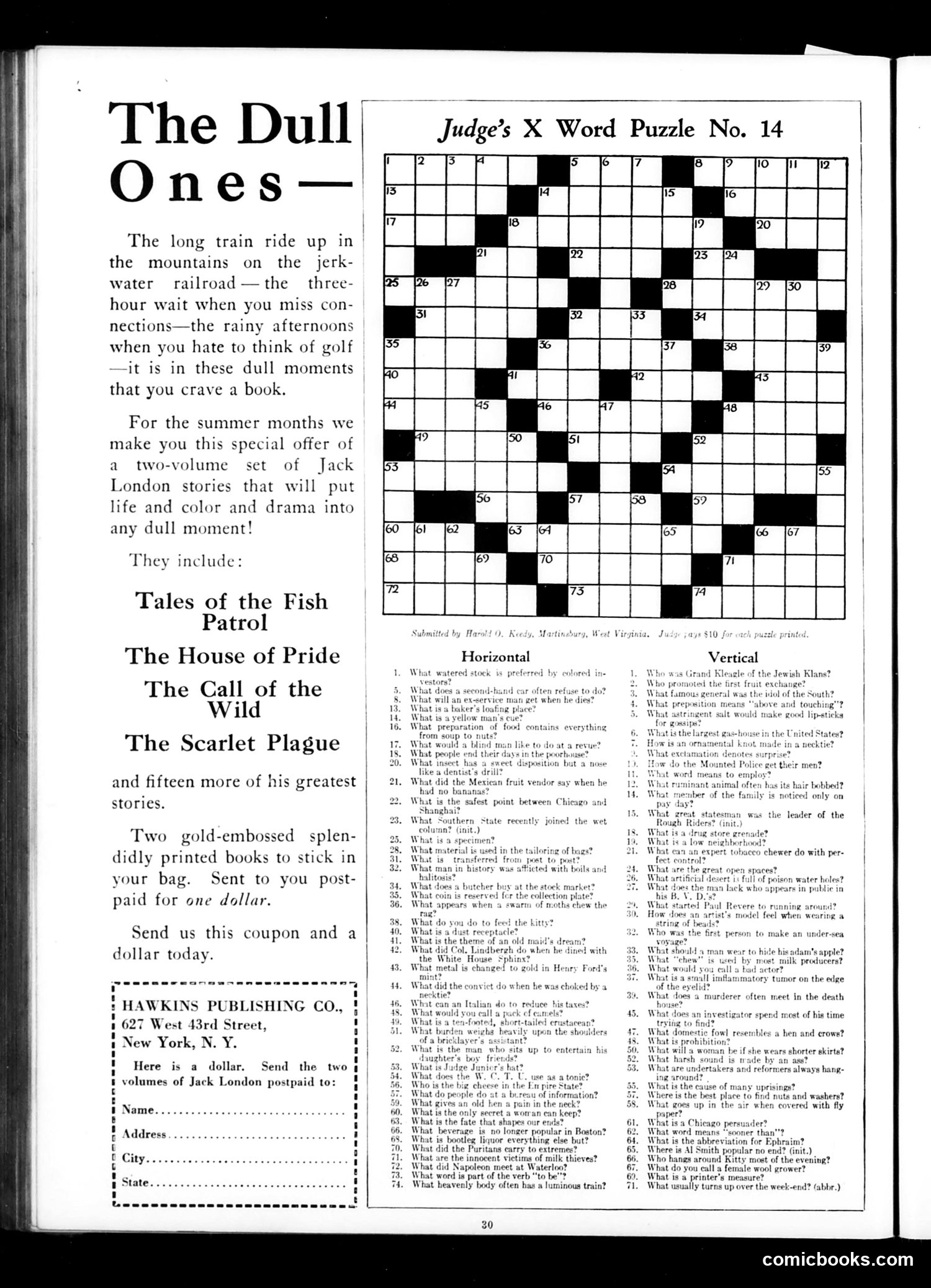
This page is primarily **advertising**, not political satire. It promotes a two-volume Jack London collection from Hawkins Publishing Co., priced at one dollar. The advertisement's pitch targets readers during tedious moments—train rides, missed connections, rainy afternoons—when they crave entertainment. It lists London's famous works: *Tales of the Fish Patrol*, *The House of Pride*, *The Call of the Wild*, and *The Scarlet Plague*, promising these stories will inject "life and color and drama" into dull summer days. The accompanying crossword puzzle (Judge's X Word Puzzle No. 14) serves as editorial filler, typical of magazine content from this era. **Historical context**: Jack London was a hugely popular author in the early 20th century, known for adventure and social realism. The ad's appeal to summer leisure and the modest one-dollar price point reflect post-WWI publishing marketing strategies targeting middle-class readers seeking affordable entertainment during vacation periods.
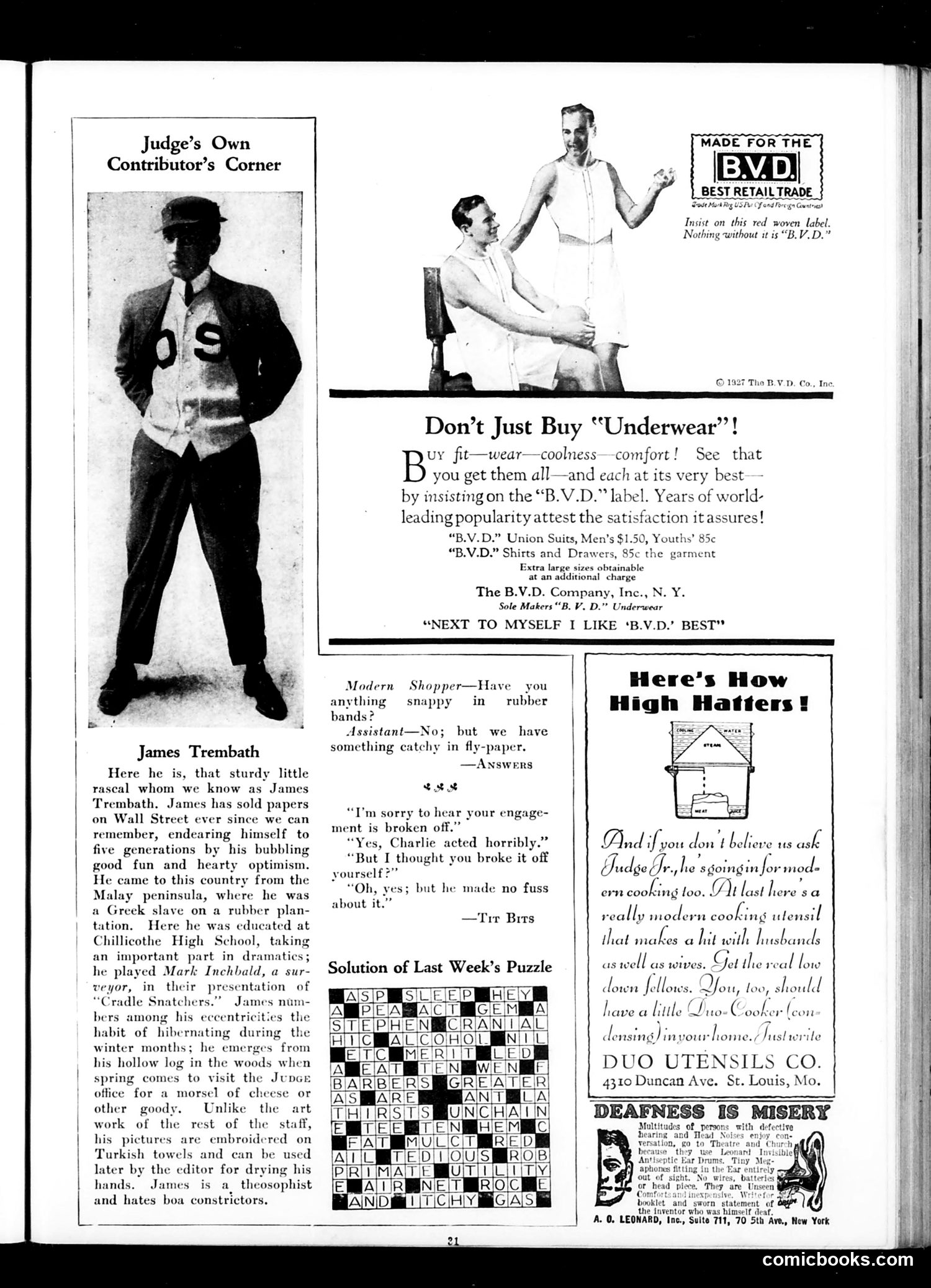
This is primarily a **page of advertisements and filler content** rather than political satire. The main feature is a biographical sketch of **James Trembath**, a Wall Street newspaper vendor who apparently sold papers to Judge's readers for decades. The piece humorously describes his eccentric habits (hibernating in winter, living in a hollow log) and notes he's a theosophist who hates boa constrictors. It's gentle, affectionate humor about a local character—likely someone Judge readers recognized. The rest of the page consists of **vintage advertisements** for B.V.D. underwear (1927), including advice columns with light jokes about rubber bands and broken engagements, a crossword puzzle solution, and ads for the Duo Utensil cooking device and Leonard's deafness remedy. There is **no significant political cartoon or satire**—this appears to be a typical early-20th-century magazine page mixing advertorial content with house humor about recognizable local personalities.
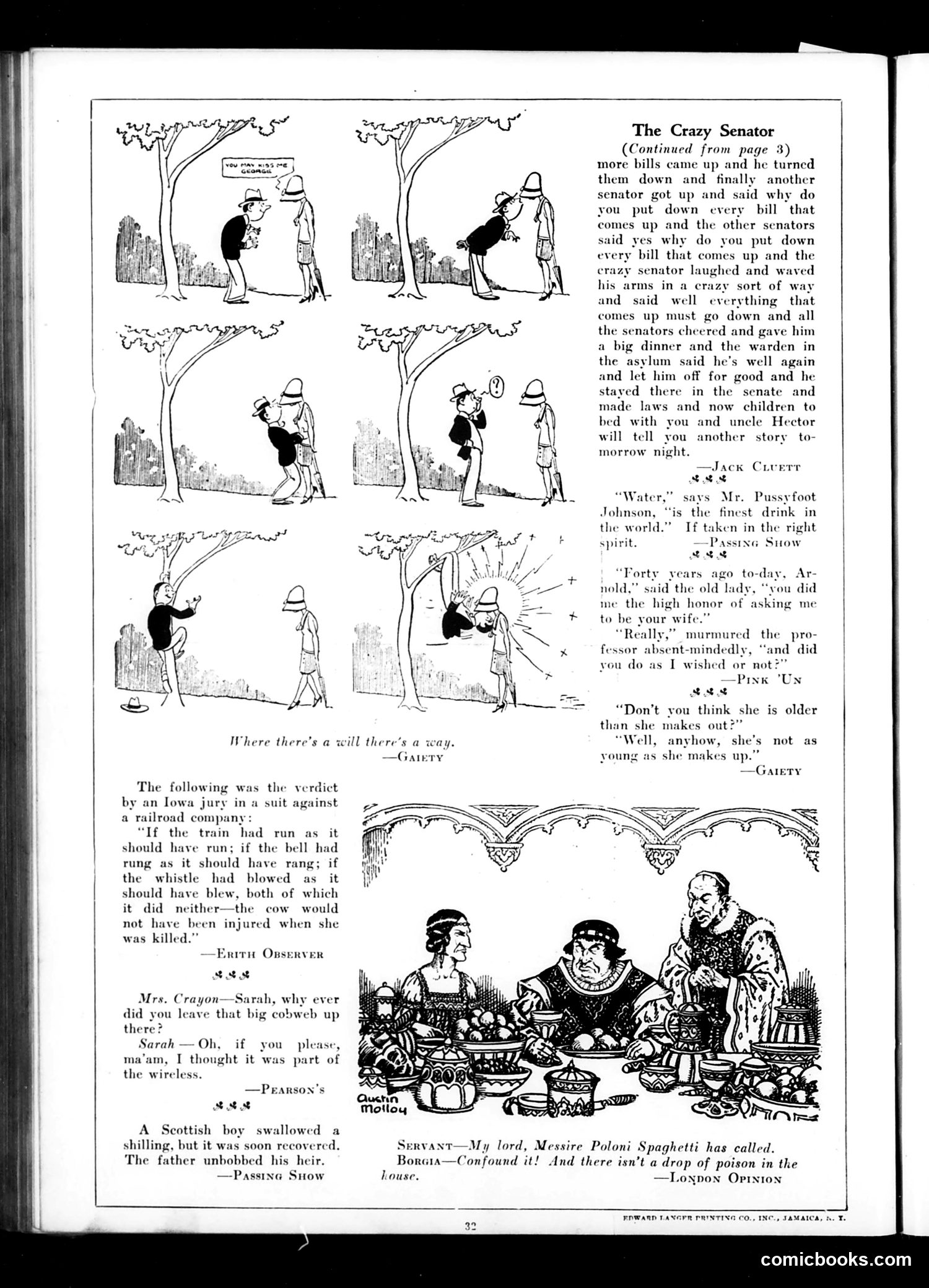
This page contains several unrelated humor pieces typical of Judge magazine's format. **"The Crazy Senator"** (top left comic strip): A satirical story about an eccentric senator who opposes every bill presented, claiming "everything that comes up must go down." The joke mocks obstructionist politicians who oppose legislation reflexively rather than on merit. He's eventually committed to an asylum but released and returns to the Senate—suggesting such behavior is normalized in politics. **The remaining items** are brief jokes and quotes: - A railroad company's absurd legal verdict using double negatives - Puns about wireless technology and swallowed coins - A quote mocking temperance advocate "Pussyfoot" Johnson's claims about water - Marital humor about a forgetful professor **The bottom illustration** appears unrelated—a historical scene of diners, possibly referencing poisoning in Renaissance Italy. The page reflects Judge's typical mix of political satire, puns, and social commentary aimed at educated readers familiar with current public figures and debates of the era.
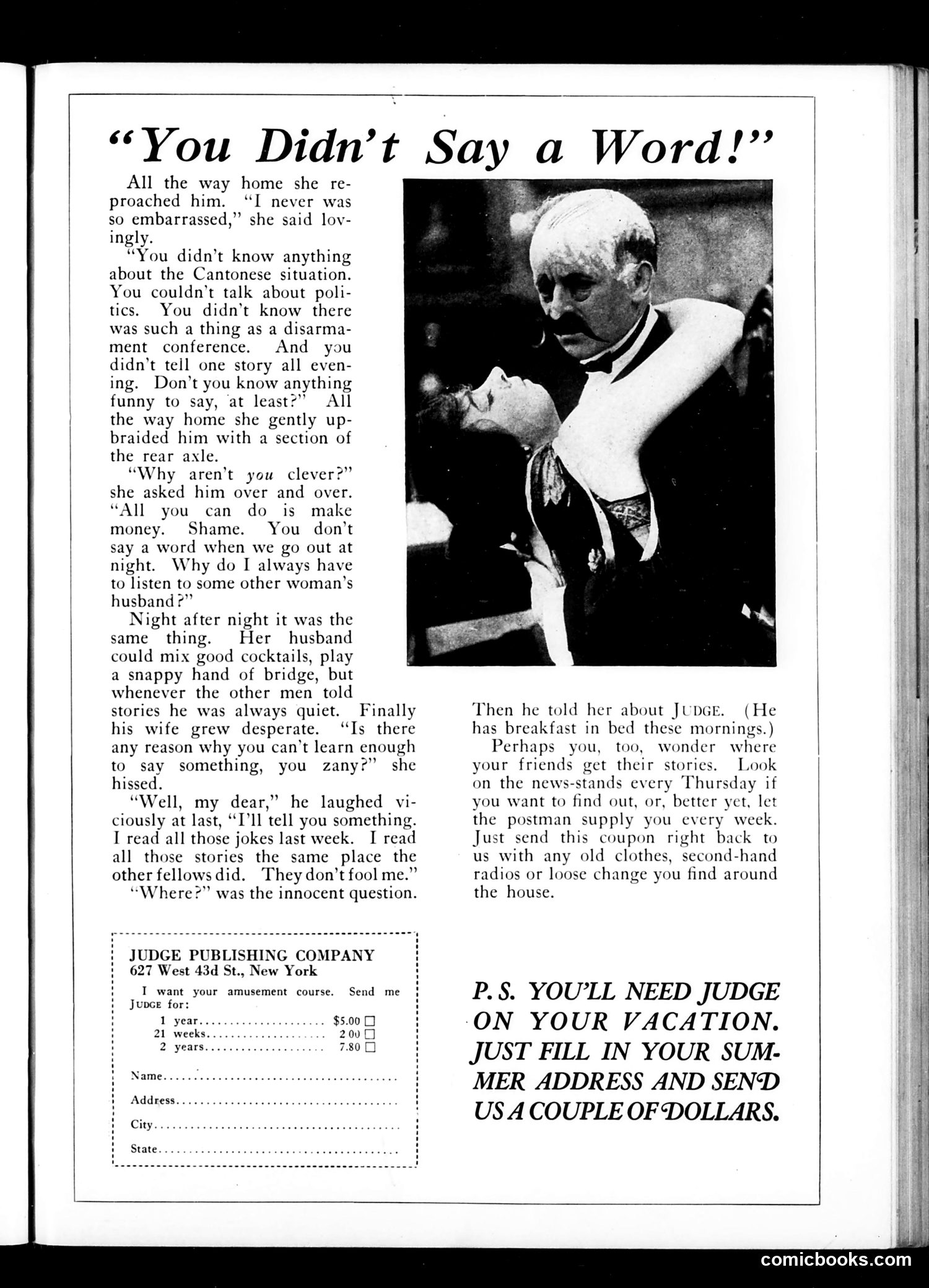
This is a humorous advertisement for Judge magazine disguised as a domestic comedy sketch. The unnamed husband is socially awkward at dinner parties—unable to discuss current events like the "Cantonese situation" (likely referencing early 20th-century China politics) or disarmament conferences. His wife repeatedly criticizes him for not telling funny stories while other men entertain. The punchline reveals he's read all their jokes in Judge magazine, which publishes the same humorous material weekly. The ad implies that by subscribing to Judge, readers can become the clever conversationalists at parties—positioning the magazine as essential for social wit. The photograph shows an elderly man with a young woman, seemingly illustrating the marital dynamic described. The ad concludes with a tongue-in-cheek P.S. inviting subscriptions, even suggesting readers send "old clothes, second-hand radios or loose change" as payment—mock desperation humor typical of Judge's self-promotional style.
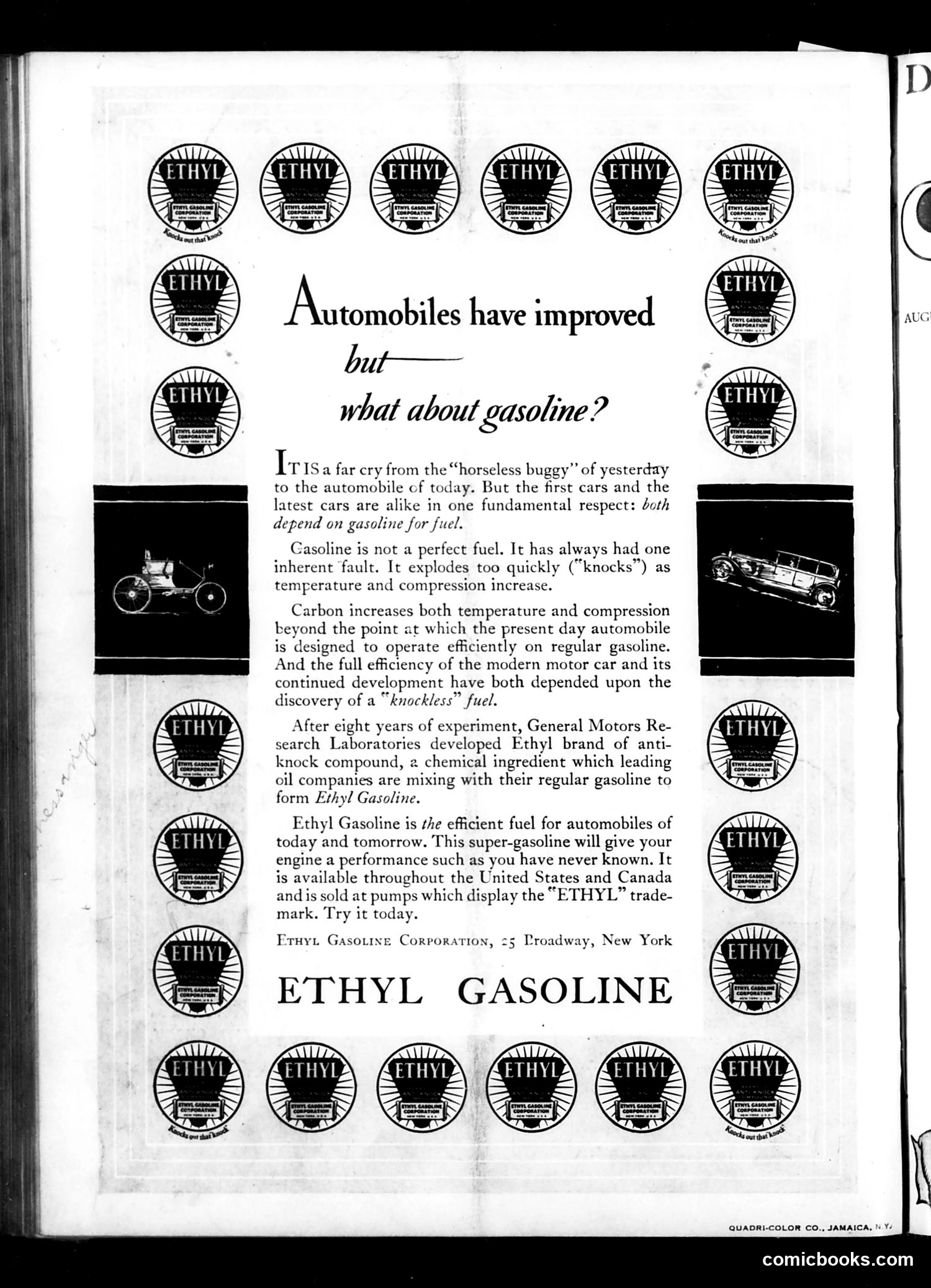
This is a **full-page advertisement**, not satire or political commentary. It promotes "Ethyl Gasoline," a fuel additive developed by General Motors Research Laboratories. The ad argues that while automobiles have advanced significantly from early "horseless buggies," gasoline itself hasn't improved—it still "knocks" (explodes prematurely) under high compression and heat, limiting engine efficiency. The solution: Ethyl brand anti-knock compound, mixed into regular gasoline to create a superior "super-gasoline." The decorative border of repeated "ETHYL" logos emphasizes brand recognition. Two car illustrations (vintage and modern) visually underscore the contrast between old and new automobiles. The ad targets consumers directly, claiming Ethyl Gasoline is available nationwide at branded pumps and promising unprecedented engine performance. The Ethyl Gasoline Corporation (New York) positions their product as essential for modern automotive development.