
Judge, 1927-07-30 · page 15 of 36
Judge — July 30, 1927 — page 15: what you’re looking at
What you’re looking at
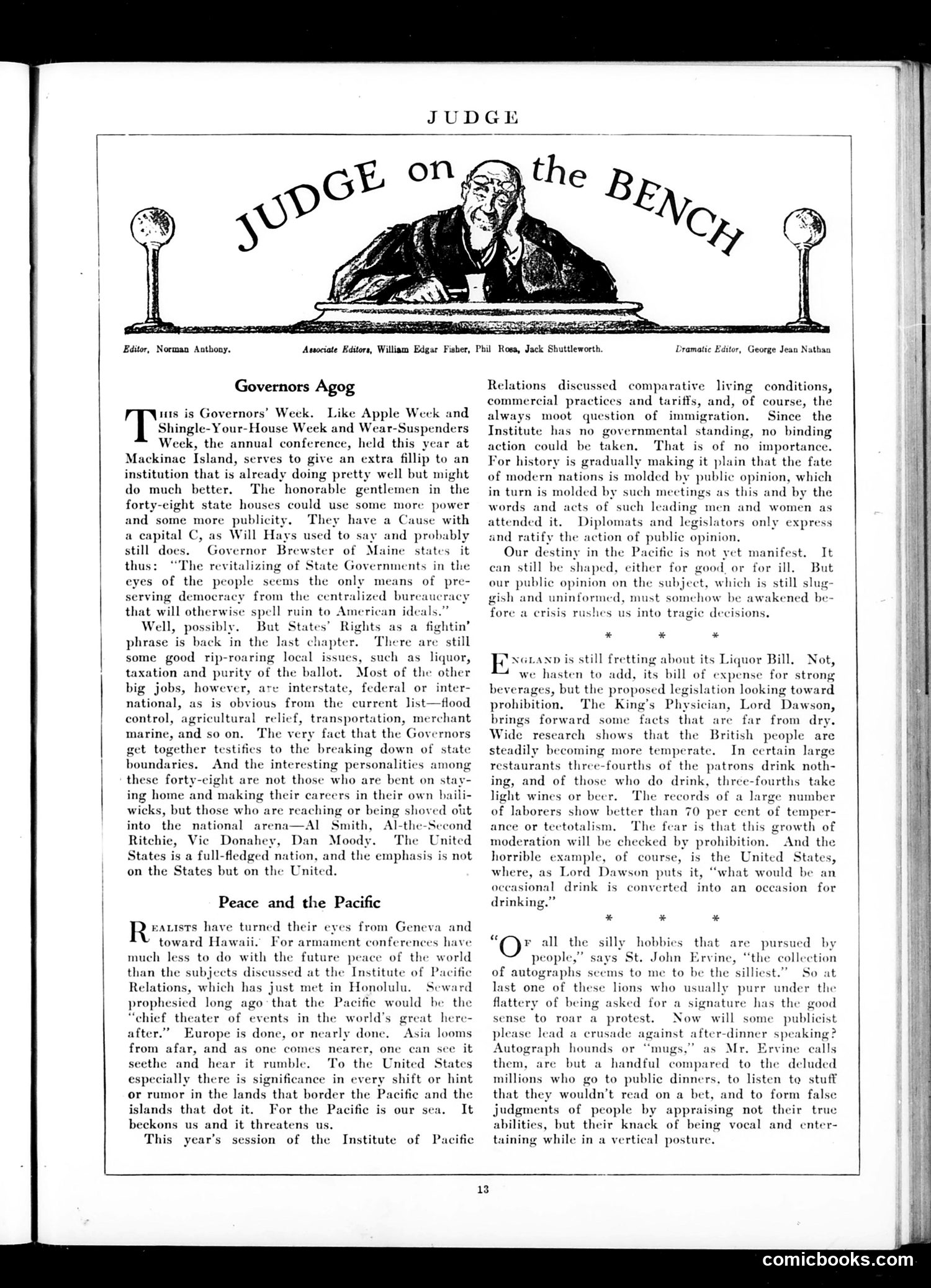
This page contains editorial commentary rather than cartoons. The masthead features a judge sitting at a bench—the magazine's recurring framing device for satirical legal/political judgment. **"Governors Agog"** mocks the annual Governors' Conference (held at Mackinac Island) as largely performative. The author argues that while governors invoke "States' Rights" rhetoric, modern problems—flood control, agriculture, transportation, maritime issues—are inherently interstate or federal, making individual state power irrelevant. The piece names rising national political figures (Al Smith, Ritchie, Donahey, Moody) as those actually gaining influence by operating *beyond* state boundaries. **"Peace and the Pacific"** discusses the Institute of Pacific Relations conference in Honolulu, arguing that public opinion shaped by such diplomatic gatherings matters more than formal treaties. It warns Americans must develop informed views on Pacific policy before crisis forces hasty decisions. **"England's Liquor Bill"** briefly notes England's ongoing prohibition debate, citing statistics on drinking habits. The tone throughout is sophisticated political analysis for educated readers.
📄 Transcribed text from this page (OCR, searchable)
Machine-transcribed from the original scan — historical spelling and the odd misread are preserved.
Editor, Norman Anthony. Auociate Editors, William Edgar Fisher, Governors Agog uts is Governors’ Weck. Like Apple Week and | Shingle-Y our-House Week and Wear-Suspenders Week, the annual conference, held this year at Mackinac Island, serves to give an extra fillip to an institution that is already doing pretty well but might do much better. The honorable gentlemen in the forty-eight state houses could use some more power and some more publicity. They have a Cause with a capital C, as Will Hays used to say and probably still doe Governor Brewster of Maine states it thus: “The revitalizing of State Governments in the eyes of the people seems the only means of pre- serving democracy from the centralized bureaucr that will otherwise spell ruin to Americ: Well, possibly. But States’ Rights as a fightin’ phrase is back in the last chapter. There are still some good rip-roaring local issues, such as liquor, taxation and purity of the ballot. Most of the other big jobs, however, are interstate, federal or inter- national, as is obvious from the current Jist—tlood control, agricultural relief, transportation, merchant ine, and so on. The very fact that the Governors -t together testifies to the breaking down of state cy boundaries. And the interesting personalities among these forty-eight are not those who are bent on stay- ing home and making their careers in their own baili- wicks, but those who are reaching or being shoved out into the national arena—Al Smith, Al-the-Second Ritchie, Vic Donahey, Dan Moody. The United States is a full-fledged nation, and the emphasis is not on the States but on the United. Peace and the Pacific Reatsts have turned their eyes from Geneva and toward Hawaii. For armament conferences have much less to do with the future peace of the world than the subjects discussed at the Institute of Pacific Relations, which has just met in Honolulu. Seward prophesied long ago’that the Pacifie would be the “chief theater of events in the world’s great here- after.” Europe is done, or nearly done, Asia looms from afar, and as one comes nearer, one can see it seethe and hear it rumble. To the United States especially there is significance in every shift or hint or rumor in the lands that border the Pacifie and the islands that dot it. For the Pacific is our sea. It beckons us and it threatens us. This year’s session of the Institute of Pacific Phil Rosa, Jack Shuttleworth. Dramatic Editor, George Jean Nathan Relations discussed comparative living conditions, commercial practices and tariffs, and, of course, the always moot question of immigration, Since the Institute has no governmental standing, no binding action could be taken. That is of no importance. For history is gradually making it plain that the fate of modern nations is molded by public opinion, which in turn is molded by such meetings as this and by the words and acts of such leading men and women as attended it. Diplomats and legi and ratify the action of public opinion, Our destiny in the Pacific is not yet manifest. It can still be shaped, either for good or for ill. But our public opinion on the subject, which is still slug- ators only express gish and uninformed, must somehow be awakened be- fore a crisis rushes us into tragic decisions. * * * Fe sess is still fretting about its Liquor Bill, Not, we hasten to add, its bill of expense for strong ages, but the proposed legislation looking toward prohibition, The King’s Physician, Lord Dawson, brings forward some facts that far from dry. Wide research shows that the British people are steadily becoming more temperate. In certain large restaurants three-fourths of the patrons drink noth- ing, and of those who do drink, three-fourths take light wines or beer. The records of a large numb: of laborers show better than 70 per cent of temper- ance or tectotalism, ne fear is that this growth of moderation will be checked by prohibition. And the horrible example, of course, is the United States, where, as Lord Dawson puts it, “what would be an occasional drink is converted into an occasion for drinking.” “Op all the silly hobbies that are pursued by people, s St. John Ervine, “the collection of autographs seems to me to be the silliest.” So at last one of these lions who usually purr under the bev * * * flattery of being asked for a signature has the good sense to roar a protest. Now will some publicist after-dinner speaking? please lead a crusade against Autograph hounds or ‘ them, are but a handful compared to the deluded millions who go to publie dinners, to listen te stuff that they wouldn’t read on a bet, and to form false judgments of people by appraising not their tr abilities, but their knack of being vocal and ente taining while in a vertical posture. mugs,” as Mr, Ervine calls 13 comicbooks.com eee eee