
Judge, 1927-07-30 · page 19 of 36
Judge — July 30, 1927 — page 19: what you’re looking at
What you’re looking at
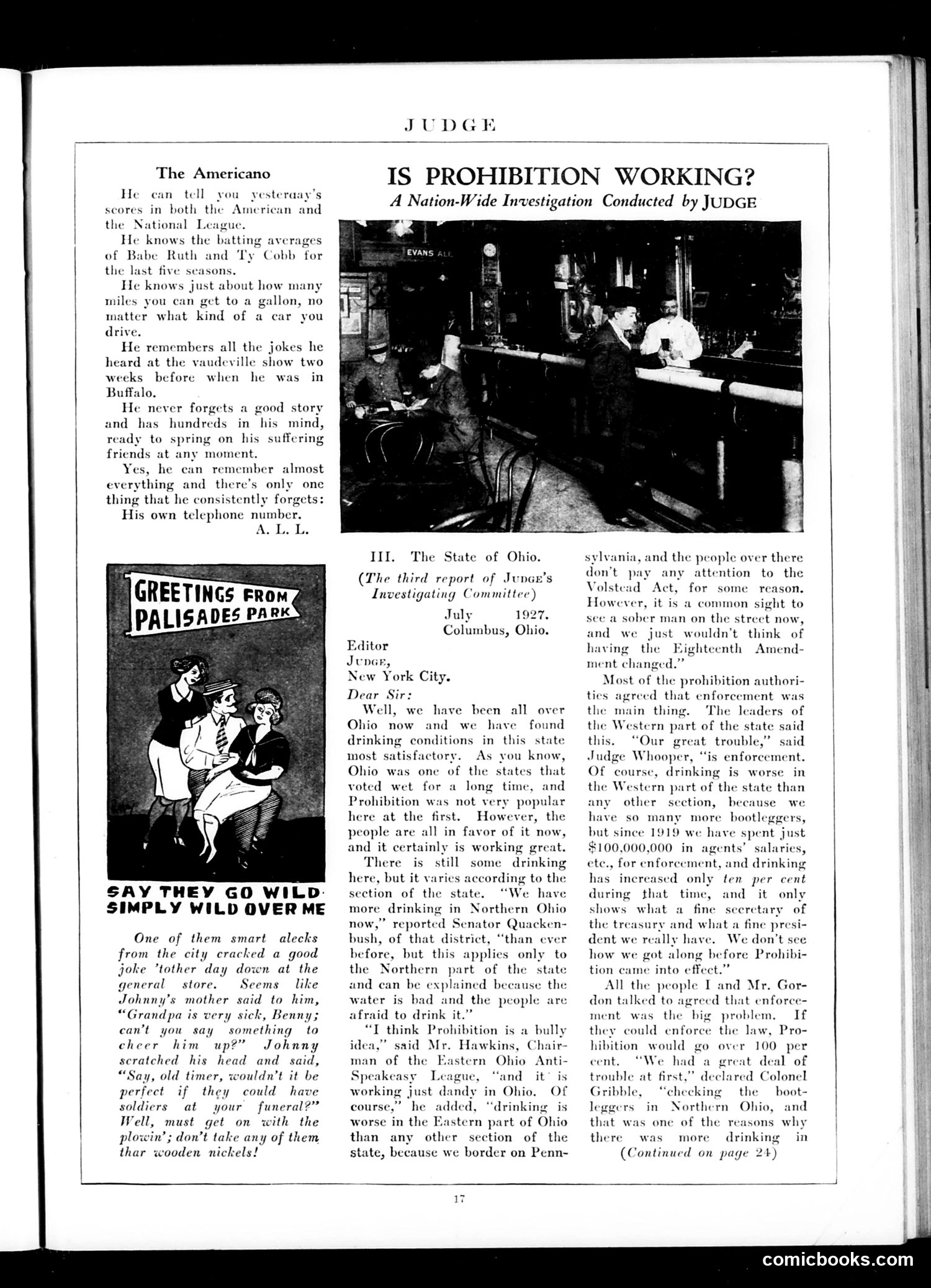
This page satirizes the widespread failure of Prohibition enforcement in Ohio while officials publicly claimed success. The "Investigation" format mocks how authorities rationalized drinking across the state: Northern Ohio officials blamed bad water; Eastern Ohio leaders credited Prohibition's success while admitting drinking was "worse in the Eastern part"; Western officials claimed enforcement was working despite spending $100 million and seeing drinking increase. The core joke is that every region admits drinking is worst *in their region specifically*, while praising Prohibition overall. Officials contradict themselves—praising the law while acknowledging it plainly isn't working. This reflects the historical reality that Prohibition (1920-1933) largely failed, with widespread bootlegging and public drinking continuing despite official denial. Judge magazine here exposes the absurdity of these self-deluding enforcement reports.
📄 Transcribed text from this page (OCR, searchable)
Machine-transcribed from the original scan — historical spelling and the odd misread are preserved.
JUDGE The Americano He can tell you yesteraay’s scores in both the American and the National League. He knows the batting averages of Babe Ruth and Ty Cobb for the last five seasons, He knows just about how many miles you can get to a gallon, no matter what kind of a car you drive. He remembers all the jokes he heard at the vaudeville show two weeks before when he was in Buffalo. He never forgets a good story and has hundreds in his mind, read to spring on his suffering friends at any moment. Yes, he can remember almost everything and there’s only one thing that he consistently forgets: His own telephone number, ALL. L. GREETINGS FROM SAY THEY GO WILD: SIMPLY WILD OVER ME One of them smart alecks from the city cracked a good joke "tother day down at the general store. Seems like Johnny’s mother said to him, “Grandpa is very sick, Benny; can’t you say something to cheer him up?” Johnny scratched his head and said, “Say, old timer, wouldn’t it be perfect if they could have soldiers at your funeral?” Well, must get on with the plowin’ ; don’t take any of them thar wooden nickels! IS PROHIBITION WORKING? A Nation-Wide Investigation Conducted by JUDGE III. The State of Ohio. (The third report of Juvce Investigating Committee) July 1927, Columbus, Ohio. Editor Junge, New York City. Dear Sir: Well, we have been all over Ohio now and we have found drinking conditions in this state most satisfactory. As you know, Ohio was one of the states that voted wet for a long time, and Prohibition was not very popular here at the first. However, the people are all in favor of it now, and it certainly is working great. There is still some drinking here, but it varies according to the section of the state. ‘We have more drinking in Northern Ohio now,” reported Senator Quacken- bush, of that district, “than ever before, but this applies only to the Northern part of the state and can be explained because the water is bad and the peop afraid to drink it.” “I think Prohibition is a bully idea,” said Mr. Hawkins, Chair- man of the Eastern Ohio Anti- Speakeasy League, ‘and it’ is working just dandy in Ohio. Of course,” he added, ‘drinking is worse in the Eastern part of Ohio than any other section of the state, because we border on Penn- sylv: don't} any attention to the Volstead Act, for some reason. However, it is a common sight to see a sober man on the street now, and we just wouldn't think of havi the Eighteenth Amend- ment changed.” Most of the prohibition authori- ties agreed that enforcement was the main thing. The leaders of the Western part of the state said this. “Our great trouble,” said Judge Whooper, “is enforcement. Of course, drinking is worse in the Western part of the state than any other section, because we have so many more bootleggers, but since 1919 we have spent just $100,000,000 in agents’ salaries, ete., for enforcement, and drinking has increased only ten per cent during that time, and it only shows what a fine sc tary of the treasury and what a fine presi- dent we really have. We don’t see how we got along before Prohibi- tion came into effect.” All the people I and Mr. Gor- don talked to agreed that enforce- ment was the big problem. If they could enforce the law, Pro- hibition would go over 100 per cent. “We had a great deal of trouble at first,” declared Colonel Gribble, “checking the — boot- leggers in) Northern Ohio, and that was one of the reasons why there was more drinking in (Continued on page 24) comicbooks.com