
Judge, 1927-07-30 · page 20 of 36
Judge — July 30, 1927 — page 20: what you’re looking at
What you’re looking at
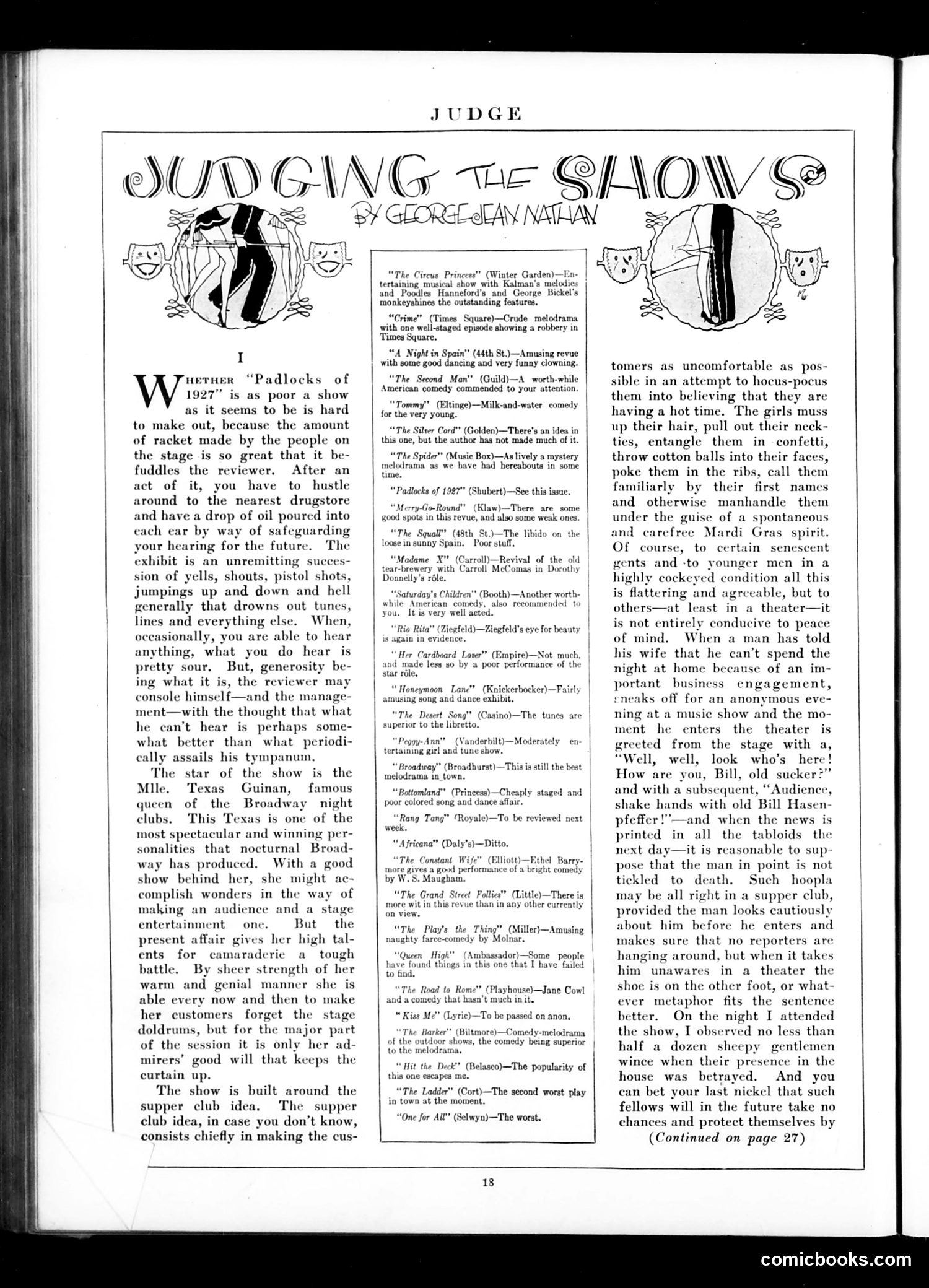
This is a theater review column by George Jean Nathan critiquing Broadway productions from 1927. The page contains no political cartoons—rather, it's a satirical review of current stage shows. **The Main Target:** Mlle. Texas Guinan, a famous nightclub owner and performer, whose show "Padlocks of 1927" is the featured review. Nathan mocks the production's excessive noise and spectacle, claiming the cacophony is so loud that audience members need ear treatment afterward—a hyperbolic complaint about poor sound design. **The Satire:** While acknowledging Guinan's genuine charm and talent as a personality, Nathan argues her considerable charisma cannot salvage the show's fundamental problems. He suggests only her admirers' goodwill keeps the curtain up. **Context:** This reflects 1920s Broadway's competitive theater scene and Nathan's acerbic reviewing style. The list of other shows (Crime, Rio Rita, Broadway, etc.) shows the era's theatrical output, many now-forgotten productions.
📄 Transcribed text from this page (OCR, searchable)
Machine-transcribed from the original scan — historical spelling and the odd misread are preserved.
JUDGE eW) CNG bor ee CGAONX HETH “Padlocks of 1927” is as poor a show s it seems to be is hard to make out, because the amount of racket made by the people on the stage is so great that it be- fuddles the reviewer. After an act of it, you have to hustle around to the nearest drugstore and have a drop of oil poured into each ear by way of safeguarding ring for the future. The ; an unremitting succes- sion of yells, shouts, pistol shots, jumpings up and down and hell generally that drowns out tunes, lines and everything else. When, occasionally, you are able to hear anything, what you do hear is pretty sour, But, generosity be- ing what it is, the reviewer may console himself—and the manage- ment—with the thought that what he can’t hear is perhaps some- what better than what periodi- cally s his tympanum, The star of the show is the Mlle. Texas Guinan, famous queen of the Broadway night clubs, This Texas is one of the most spectacular and winning per- sonalities that nocturnal Broad- way has produced. With a good show behind her, she might ac- complish wonders in the way of making an audience and a stage entertainment — one. But the present affair gives her high tal- ents for camaraderie a tough battle. By sheer strength of her warm and genial manner she is able every now and then to make her customers forget the stage doldrums, but for the major part of the session it is only her ad- mirers’ good will that keeps the curtain up. The show is built around the supper club id The supper club idea, in case you don’t know, fly in making the cus- “The Circus Princess (Winter G: tertaining musical show with Kalman's mel and Poodles Hanneford’s and George Bickel’s monkeyshines the outstanding features. “Crime (Times Square)—Crude melodrama with one well-staged episode showing a robbery in Times Square. Night in Spain’ (44th St.)—Amusing revue with some good dancing and very funny clowning. “The Second Man" (Guild)—A worth-while American comedy commended to your attention. | “Tommy” (Eltinge)—Milk-and-water comedy for the very young. “The Silver Cord" (Golden)—There’s an idea in this one, but the author has not made much of it. “Padlocks of 1987" (Shubert)—See this issue. “Merry-Go-Round” (Klaw)—There are good spots in this revue, and also some weak ones. “The Squall” (48th St.)—The libido on the loose in sunny Spain. Poor stuff. Madame X" (Carroll)—Revival of the old ery with Carroll McComas in Dorothy Donnelly's réle. ‘Saturday's Child: while American co you, It is very well (Booth)—Another wort also. recommended “Rio Rita” (Ziegfeld)—Ziegfeld’s eye for beauty s again in evidence. “Her Cardboard Lover” (Empire)—Not mucl and made less so by a poor performance of the star rile. “Honeymoon Lane (Knickerbocker)— musing song and dance exhibit. The Desert Song" (Casino)—The tunes 2 superior to the libretto, Pegoy-Ann (Vanderbilt)—Moderately _en- tertaining girl and tune show. “ Broadway" (Broadhurst)—This is still the best melodrama in town. “Bottomland” (Princess)—Cheaply staged and poor colored song and dance affair. “Rang Tang” ‘Royale)—To be reviewed next week. “Africana” (Daly’s)—Ditto. “The Constant Wife’ (Elliott)—Ethel Barry- more gives a gol performance of a bright comedy by W.S. Maugham. “The Grand Street Follies" (Little)—There ia more wit in this revue than in any other currently on view. “The Play's the Thing” (Miller)—Amusing naughty farce-comedy by Molnar. “Queen High” (Ambassador)—Some people and things in this one that I have failed (Playhouse)—Jane Cow! ¢t much in it. ytic)—To be passed on anon, The Barker" (Biltmore)—Ci lodrama of the outdoor shows, the comedy being superior to the melodrama, “Hit the Dec this one escapes m “The Ladder” (Cort)—The second worst play in town at the moment. “One for All” (Selwyn)—The worst. (Belasco)—The popularity of tomers as uncomfortable as sible in an attempt to hocus-pocus them into believing that they are having a hot time. The girls muss up their hair, pull out their neck- ties, entangle them in confetti, throw cotton balls into their faces, poke them in the ribs, call them familiarly by their first names and otherwise manhandle them under the guise of a spontaneous and carefree Mardi Gras. spirit. Of course, to certain senescent gents and -to younger men in a highly cockeyed condition all this is flattering and agreeable, but to others—at least in a theater—it is not entirely conducive to peace of mind. When a man has told his wife that he can’t spend the night at home because of an im- portant business engagement, £ ks off for an anonymous eve ning at a music show and the mo- ment he enters the theater is greeted from the stage with a, “Well, well, look who’s here! How are you, Bill, old sucker?” and with a subsequent, “Audience, shake hands with old Bill Hasen- pfeffer!”—and when the news is printed in all the tabloids the next day—it is reasonable to sup- pose that the man in point is not tickled to death. Such hoopla may be all right in a supper club, provided the man looks cautiously about him before he enters and makes sure that no reporters are hanging around, but when it takes him unawares in a theater the shoe is on the other foot, or what- ever metaphor fits the sentence better. On the night I attended the show, I observed no less than half a dozen sheepy gentlemen wince when their presence in the house was betrayed. And yeu can bet your last nickel that such fellows will in the future take no chances and protect themselves by (Continued on page 27) comicbooks.com