
A complete issue · 37 pages · 1927
Judge — June 25, 1927
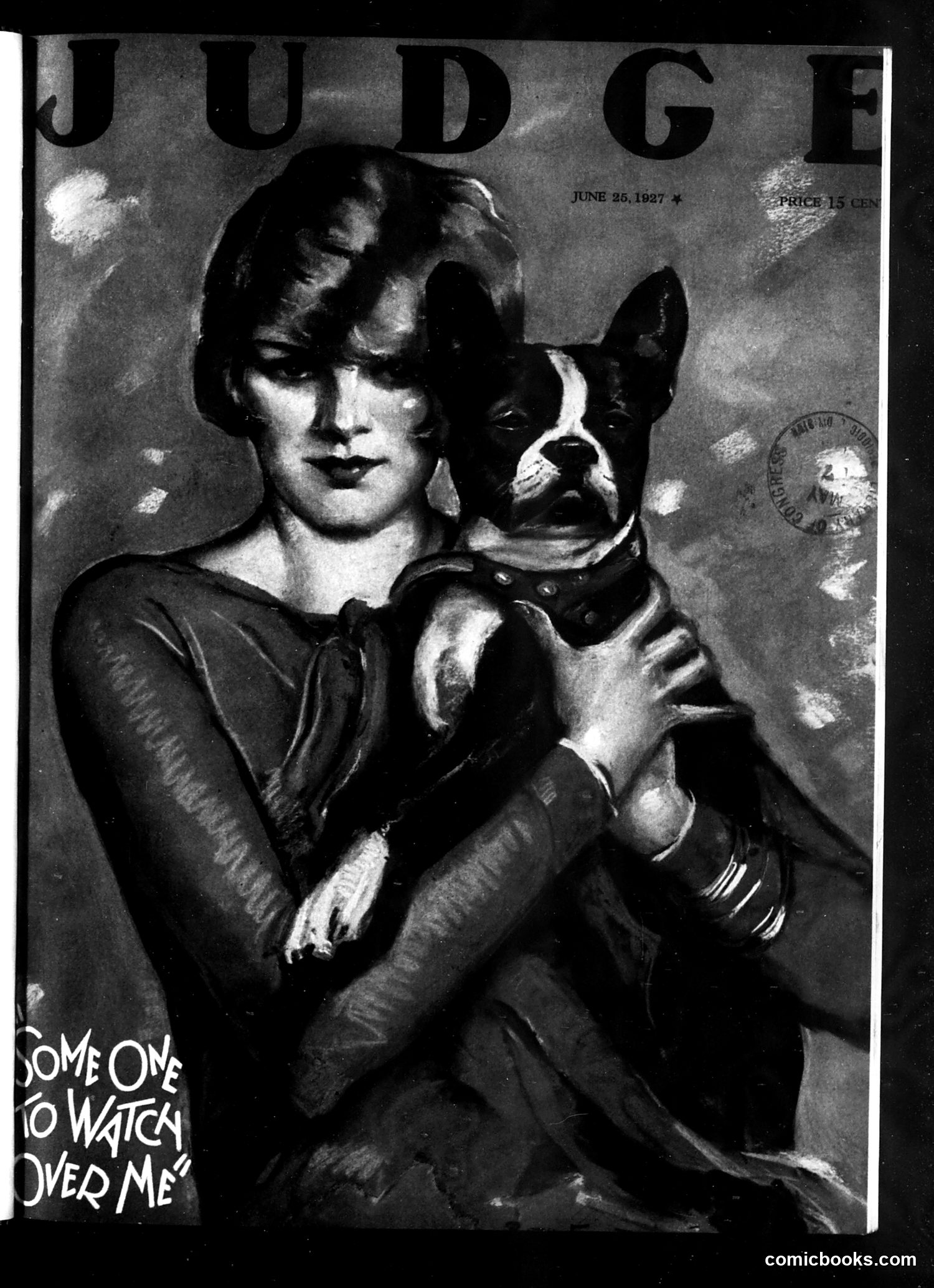
This cover features a woman with 1920s styling holding a Boston Terrier dog. The visible text reads "Someone to Watch Over Me" — likely referencing the popular 1927 George and Ira Gershwin song of that title. The satire appears to play on romantic sentiment and companionship during the Jazz Age. Rather than depicting a human romantic partner "watching over" the woman, the magazine substitutes a small dog — suggesting either commentary on modern dating habits, women's independence, or perhaps the popularity of pet companionship as an alternative to traditional relationships. The cover price of 15 cents and the June 26, 1927 date confirm this is authentic period material from Judge's heyday as America's premier satirical weekly.
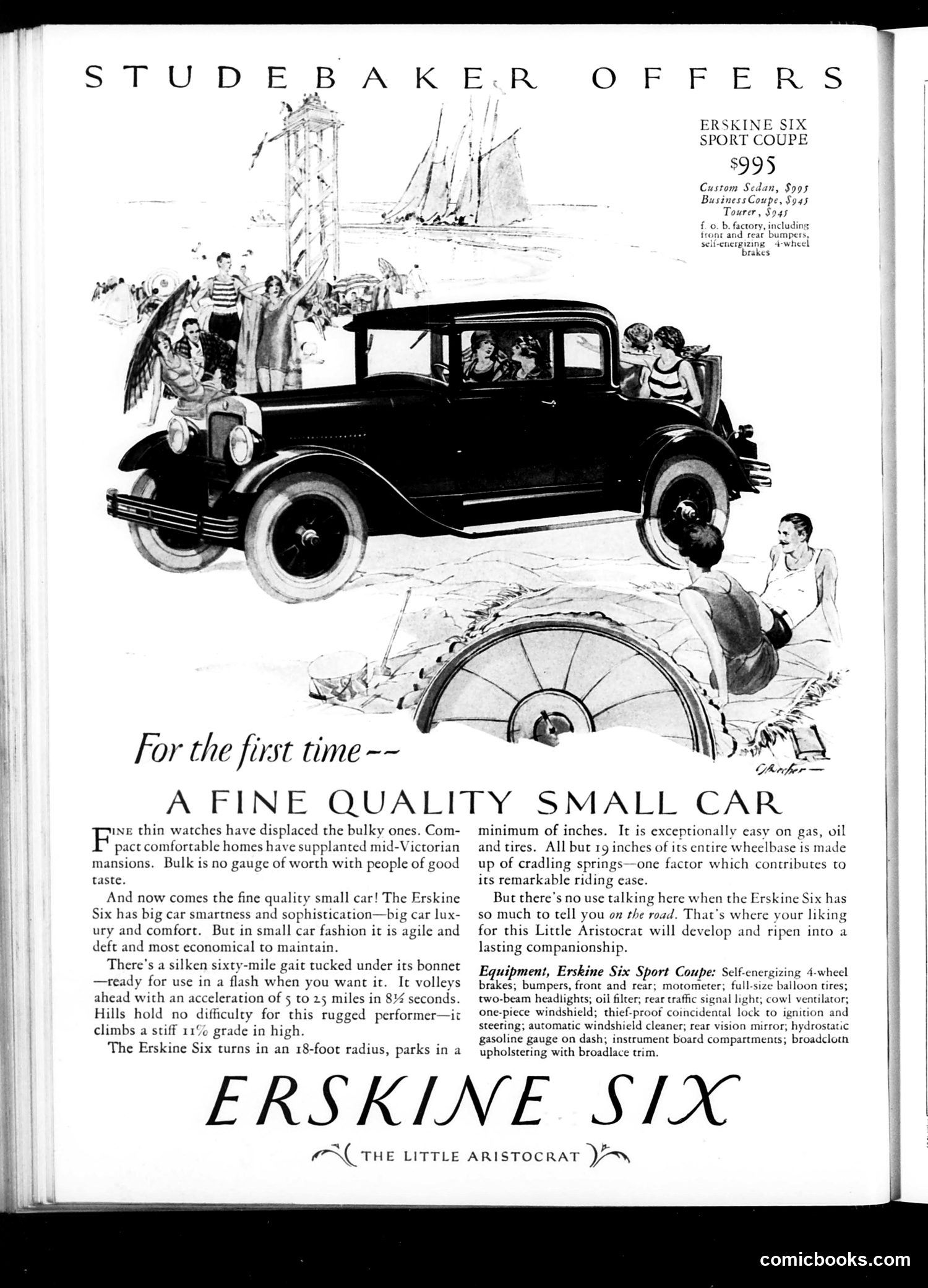
This page is **primarily an advertisement**, not political satire. It promotes the Erskine Six Sport Coupe automobile, priced at $995. The illustration shows a sleek car surrounded by leisurely figures—people in a boat, a woman with a parasol—suggesting the lifestyle the vehicle enables. The ad's tagline, "The Little Aristocrat," positions the car as an affordable luxury item for middle-class buyers. The satirical element is subtle: the comparison between "fine quality small cars" and "fine thin watches" that have "displaced the bulky ones" suggests mass-produced goods can match luxury goods in sophistication. This reflects 1920s consumer culture messaging—that modern manufacturing democratizes quality once reserved for the wealthy. The cartoon reinforces aspirational middle-class identity through affordable elegance.
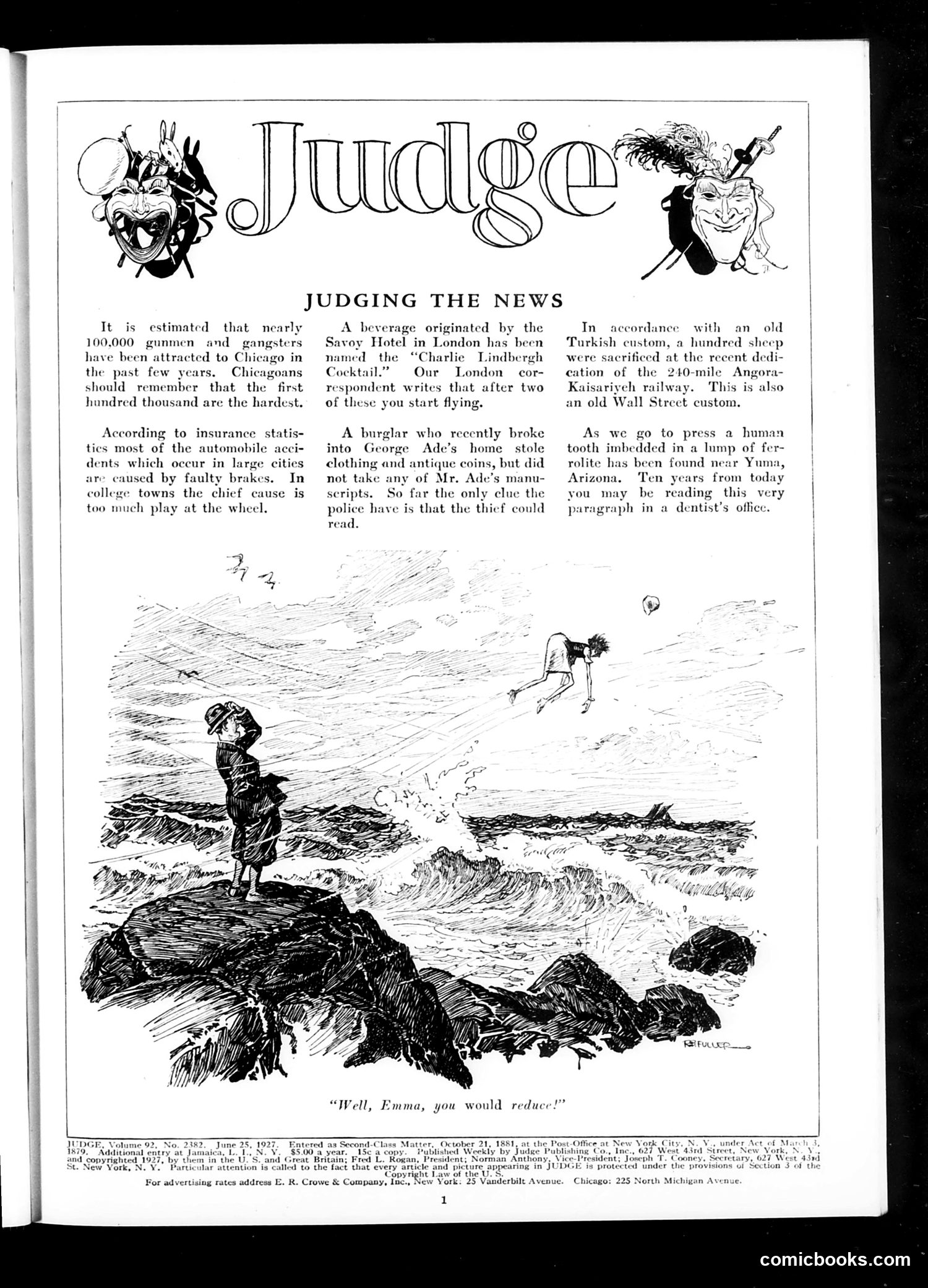
The main illustration depicts a beach scene with a child standing on rocks watching another child in the water, captioned "Well, Emma, you would reduce!" This appears to be a satirical commentary on **weight-loss dieting trends** among women in the 1920s. "Reduce" was contemporary slang for losing weight. The joke seems to mock the pressure on women—even children—to diet and maintain slim figures, a growing cultural obsession during the Jazz Age. The "Judge" column above contains miscellaneous satirical news items, including quips about Chicago gangsters, automobile accidents, a burglar targeting George Ade, and a Turkish sheep sacrifice—typical editorial fare mocking contemporary scandals and absurdities. The overall tone is lighthearted social commentary characteristic of 1920s humor magazines.
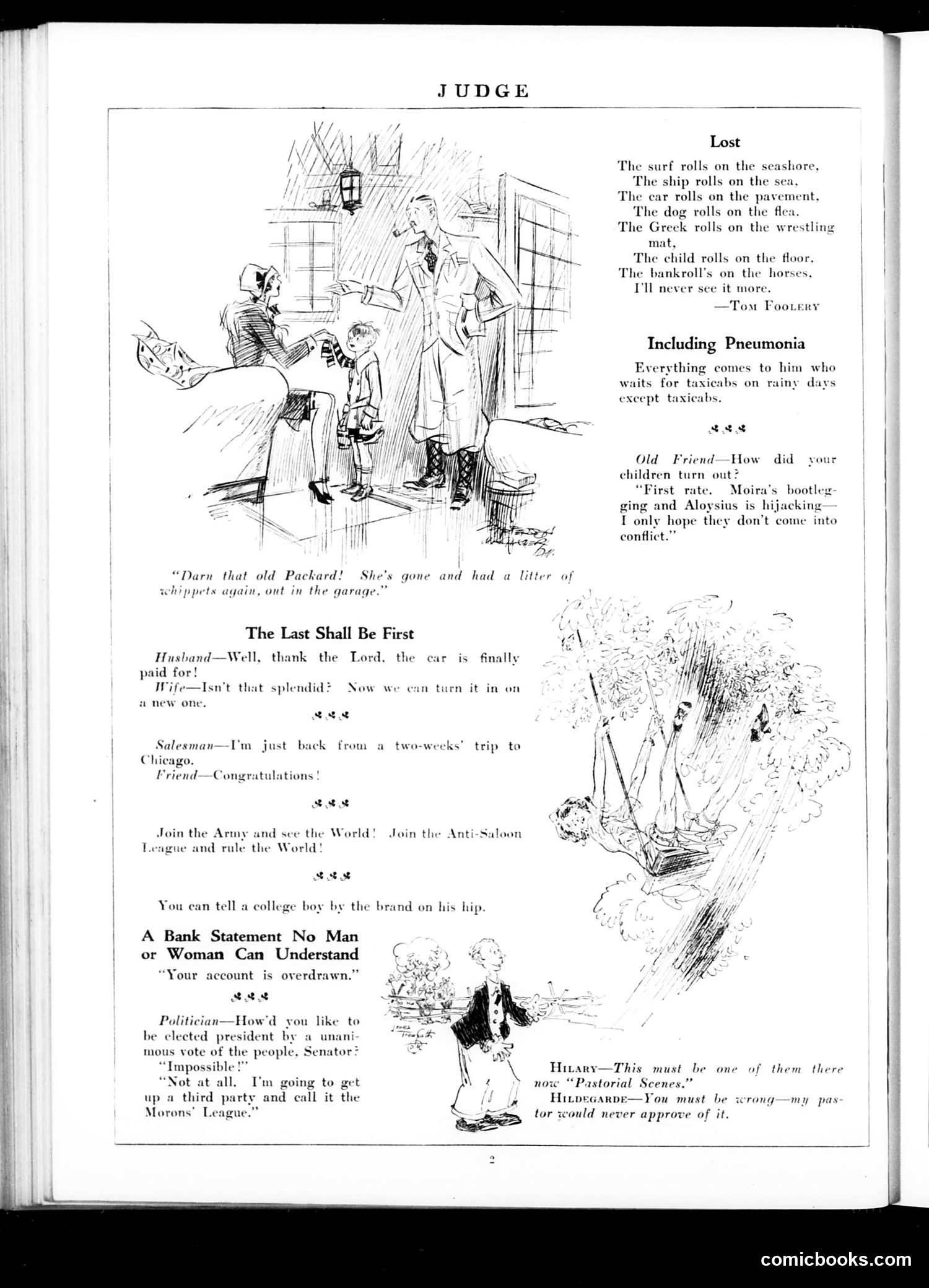
This page contains several satirical jokes and a literary excerpt rather than political cartoons: **"Lost"** — Tom Foolery's poem humorously catalogs things that roll in various contexts (surf, ships, cars, dogs, Greeks, children, bankrolls), ending with "I'll never see it more." **"Including Pneumonia"** — A joke about waiting for taxicabs, implying one might catch pneumonia from the wait. **"The Last Shall Be First"** — Exchanges about a paid-off car and a salesman returning from Chicago. **"A Bank Statement No Man or Woman Can Understand"** — A politician jokes about creating a "third party" called the "Morons' League" to get elected president. The right side contains illustrations of people in casual situations, possibly from "Pastoral Scenes" based on the caption fragment visible. The page is primarily humor-focused rather than explicitly political.
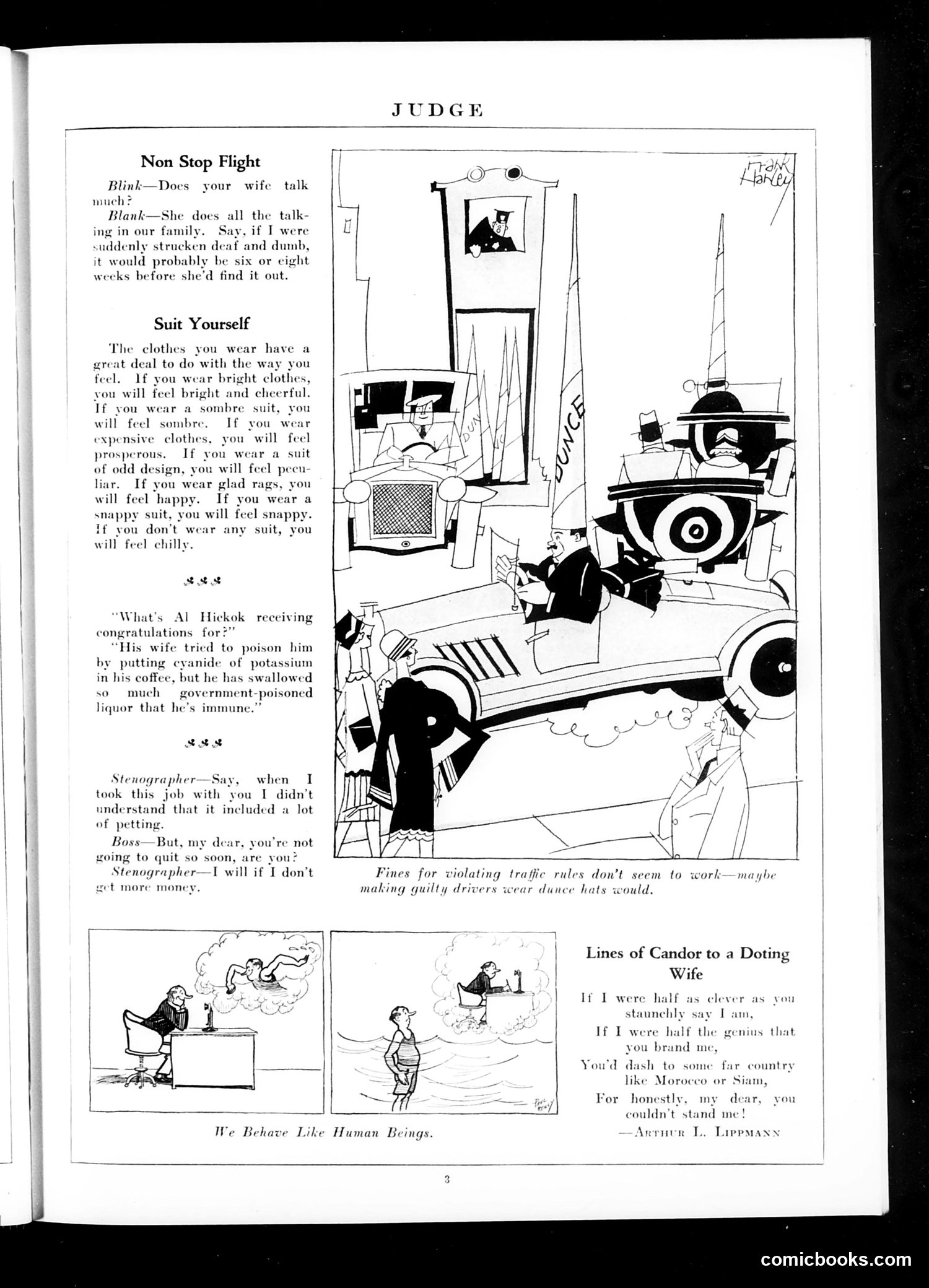
This page contains three distinct humor pieces typical of Judge's satirical style: **"Non Stop Flight"** jokes about wives' talkativeness—a common domestic humor trope of the era. **"Suit Yourself"** offers fashion advice with light social commentary about clothing reflecting character. The main cartoon, **"Fines for violating traffic rules don't seem to work—maybe making guilty drivers wear dance hats would,"** satirizes ineffective traffic enforcement. It depicts chaotic street scene with oversized mechanical or robotic traffic enforcement devices, suggesting authorities resort to absurd measures when fines fail as deterrents. This reflects early 20th-century frustrations with automobile safety and urban traffic management. **"Lines of Candor to a Doting Wife"** is a poem by Arthur L. Lippmann about marital devotion, accompanied by whimsical illustrations of romantic daydreaming.
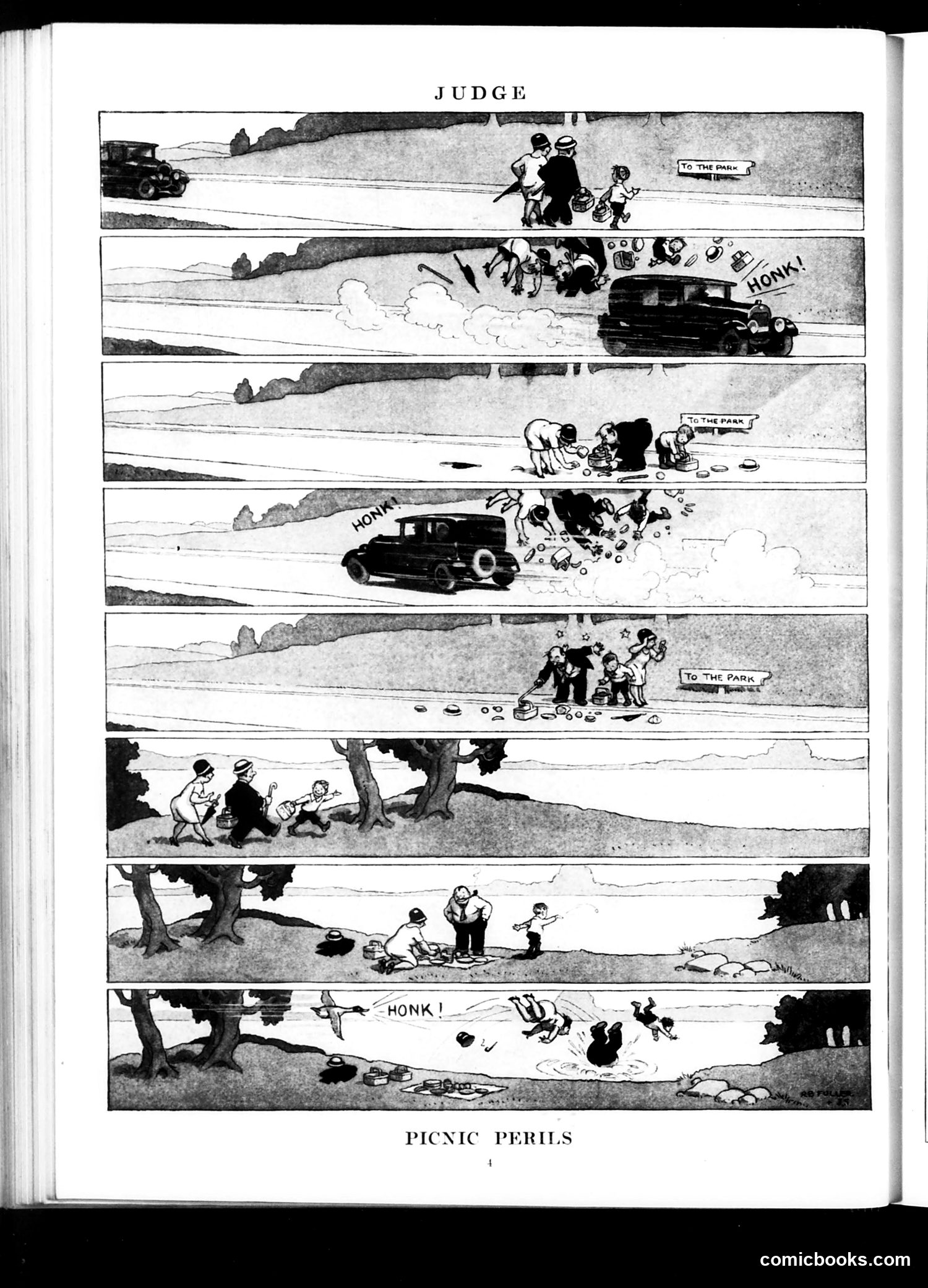
This comic strip satirizes the collision between modern automobile culture and traditional leisure. A family heads to the park for a picnic, but a speeding car repeatedly interrupts their outing with loud horn blasts ("HONK!"), scattering their belongings and disrupting their meal. The joke targets the social anxiety surrounding early automobiles—vehicles represented as aggressive, noisy intrusions into peaceful public spaces. The car's driver appears indifferent to the family's distress, suggesting commentary on reckless drivers and the automobile's disruptive effect on American social life. Published in *Judge* (a satirical magazine), this reflects 1920s-era concerns about traffic safety and the tension between new technology and traditional pastoral pleasures. The repeated "HONK!" emphasizes the car's obnoxious dominance over quieter activities.
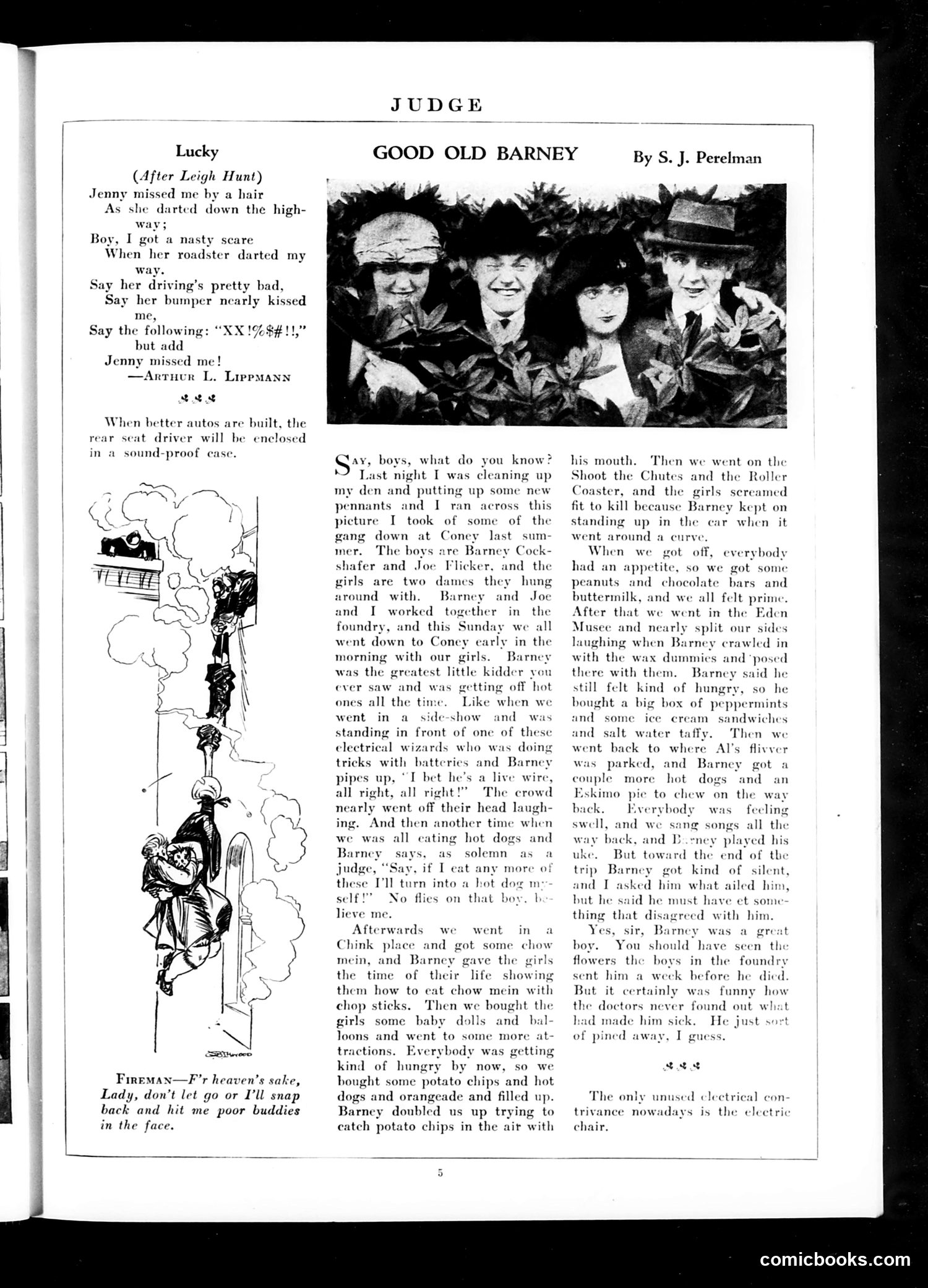
This is a lighthearted narrative piece by S.J. Perelman about a boy named Barney Cockshafer and his friend Joe Flicker. The story recounts a memorable outing to Coney Island with "the gang" and their girlfriends. The piece uses gentle humor to capture childhood adventures—visiting amusement attractions, eating hot dogs and peppermints, playing with electrical tricks, and Barney's attempts to catch potato chips thrown in the air. The overall tone is affectionately nostalgic, celebrating youthful camaraderie and innocent mischief. The accompanying cartoon on the left depicts a fireman on a ladder amid smoke and flames, unrelated to the main story. The content represents typical Judge magazine fare: light social commentary and humor aimed at middle-class readers.
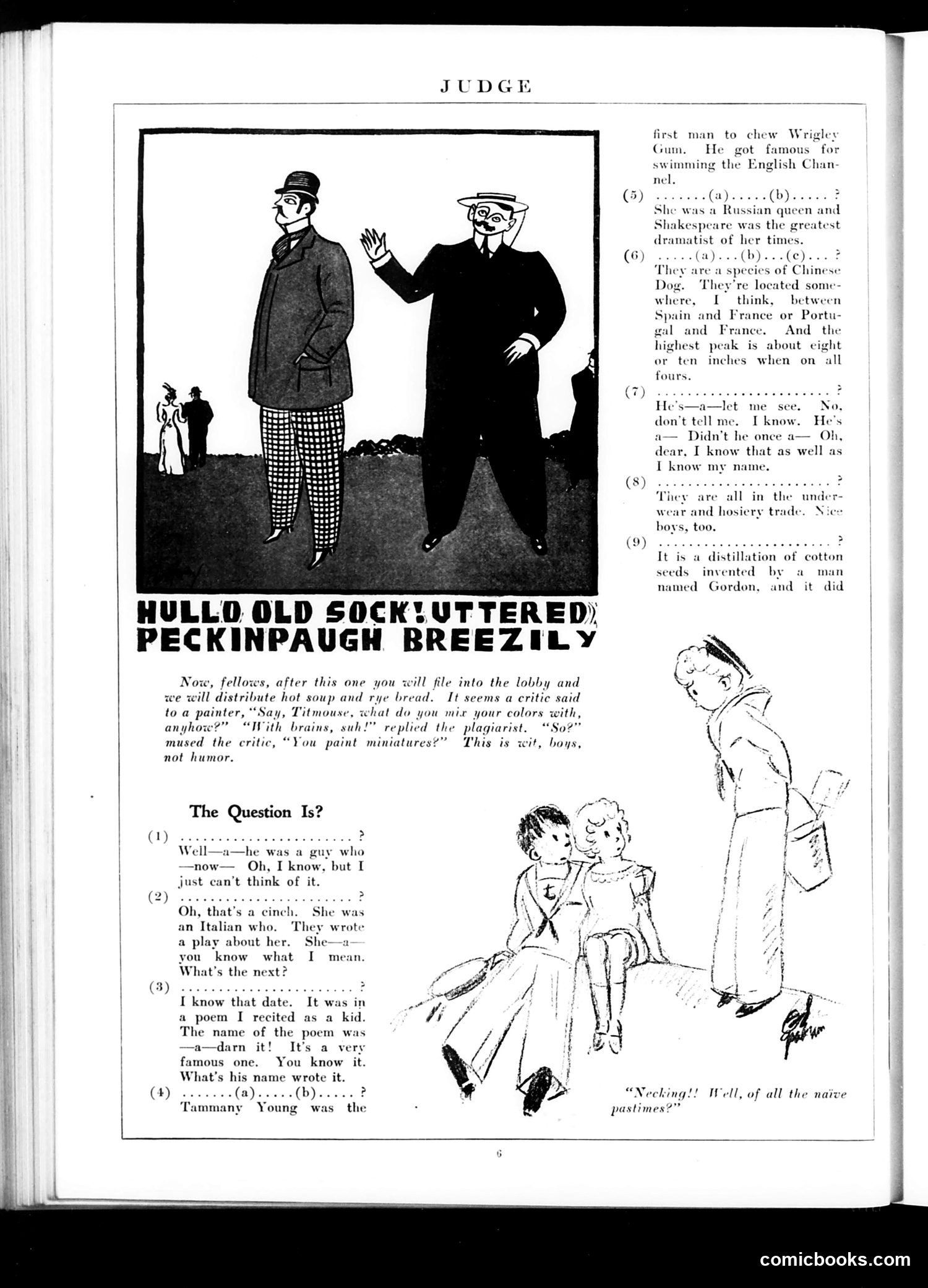
This page contains two separate satirical pieces from *Judge* magazine: **"Hullo Old Sock! Uttered Peckinpaugh Breezily"** (top): A cartoon mocking pretentious art criticism. Two well-dressed men discuss painting technique; when a critic asks what a painter mixes colors with, the painter replies "with brains"—which the critic then plagiarizes. The joke satirizes critics who steal artists' ideas and pretend to originality. **"The Question Is?"** (bottom): A quiz-format humor piece where people struggle to answer simple trivia questions (about historical figures, famous poems, dog breeds, etc.), fumbling with incomplete answers like "I know that date...darn it!" The accompanying illustration shows adults awkwardly questioning a child. The satire mocks educated people's embarrassing inability to recall basic knowledge—a commentary on vanity and pretended sophistication among the upper classes. Both pieces exemplify *Judge's* focus on satirizing American social pretension and intellectual affectation.
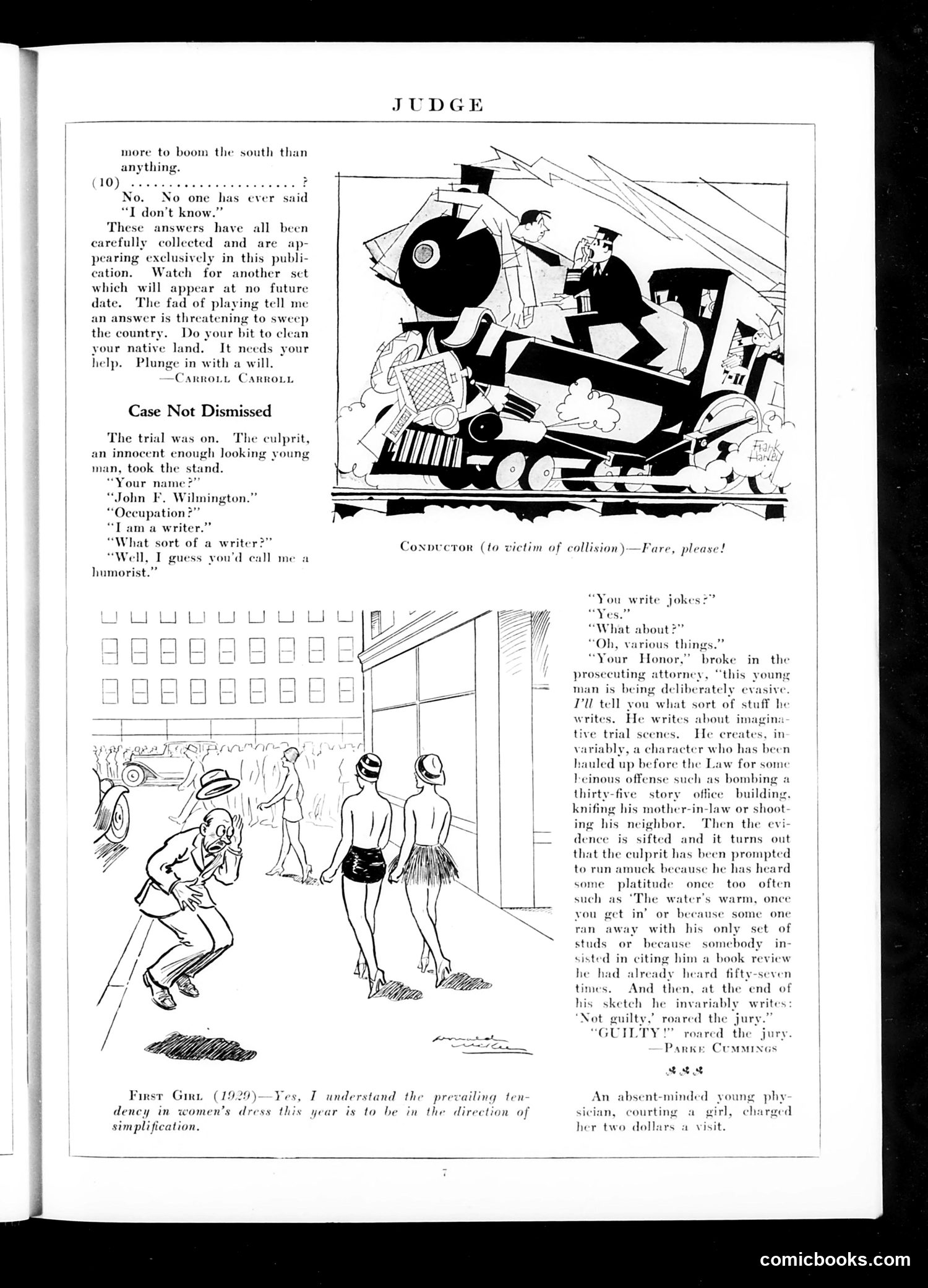
This page contains multiple satirical pieces reflecting 1920s American culture: **"Case Not Dismissed"** is the main feature—a courtroom sketch mocking humorist writers. A young man accused of being a writer admits he creates imaginary trial scenes featuring criminals driven to violence by trivial grievances ("The water's warm, once you get in"). The prosecuting attorney sarcastically catalogues his clichéd plots (bombing buildings, stabbing neighbors) to mock how shallow such humor is. The joke's irony: the writer himself is being tried for evasion while describing trials in his writing. **The cartoon above** shows a train conductor asking for fare from crash victims tangled in wreckage—an absurdist commentary on bureaucratic indifference. **"First Girl (1929)"** jokes about women's fashion trending toward "simplification"—likely referencing the flapper era's move away from restrictive corseting. **The bottom item** satirizes an absent-minded physician charging patients for visits while distracted by romance. Overall, the page exemplifies Judge's satirical approach: lampooning writers, social conventions, and professional absurdities through exaggerated scenarios and deadpan delivery.
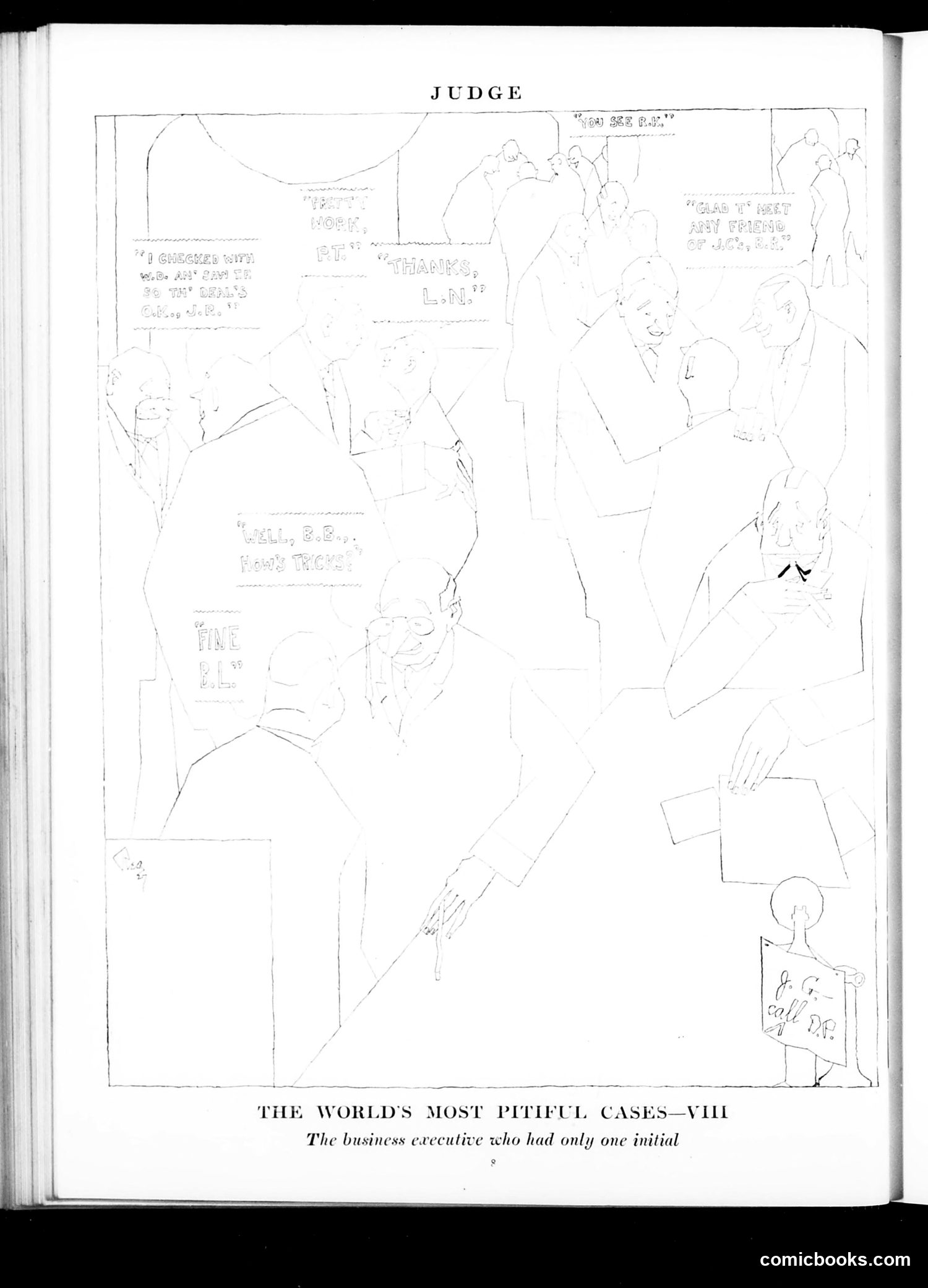
This page from *Judge* magazine presents a satirical cartoon titled "The World's Most Pitiful Cases—VIII," subtitled "The business executive who had only one initial." The cartoon depicts a businessman or executive figure with minimal identifying characteristics—specifically, a name consisting of only a single letter rather than the typical first initial and last name. The satire mocks business culture and naming conventions of the era, treating this abbreviated nomenclature as a humorous misfortune worthy of pity. The joke relies on early 20th-century conventions where business professionals typically displayed formal names with at least two initials. Having "only one initial" represents an unusual or deficient status—the absurdist humor suggesting this is somehow a serious social or professional handicap deserving sympathy, when it's actually a trivial concern inflated for comedic effect.
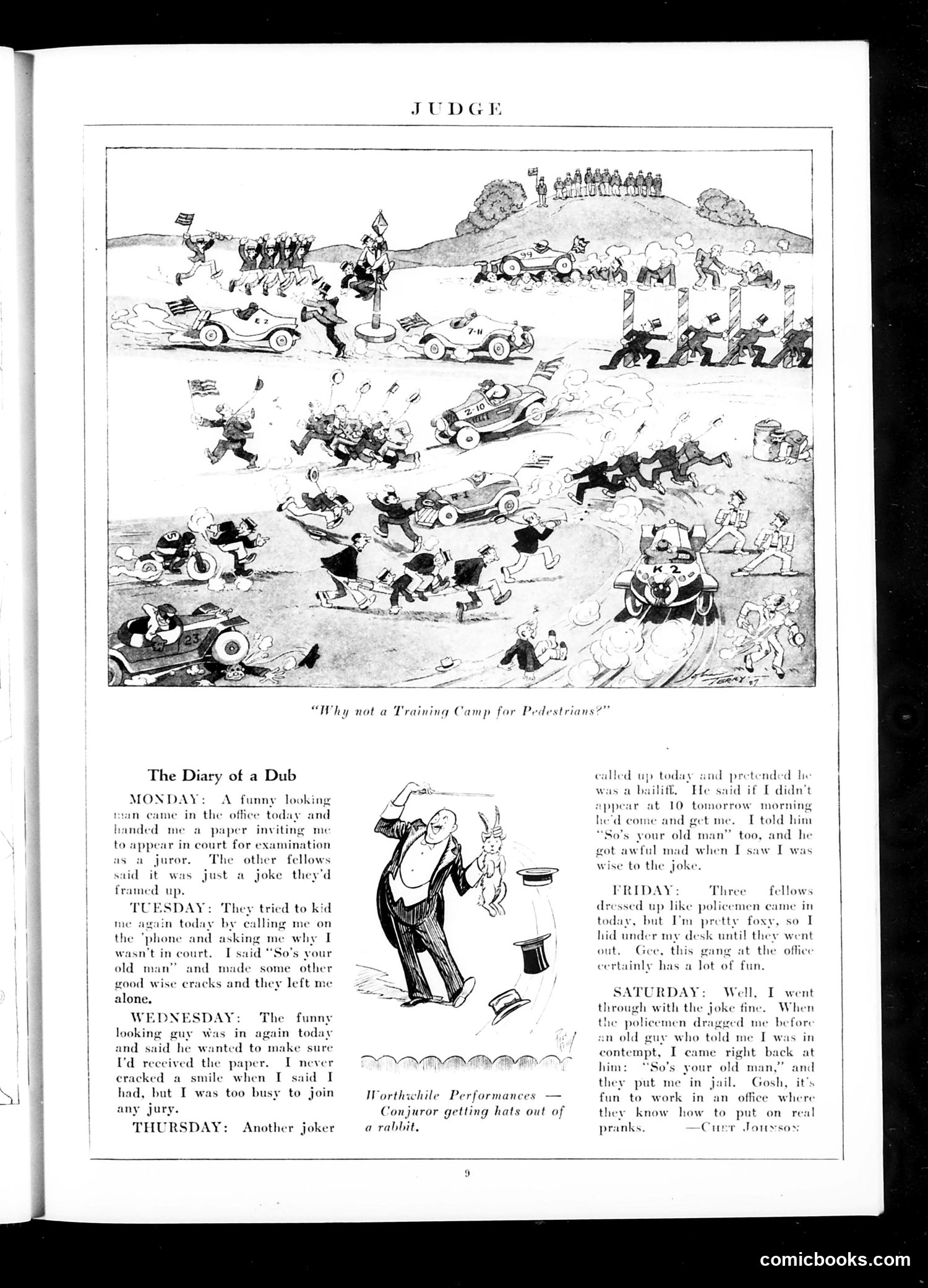
This is a humorous serial story about a naive office worker who repeatedly dismisses a genuine jury summons as an elaborate office prank. Over the week, his coworkers escalate their "joke"—calling him, dressing as policemen, and hiding his summons—while he responds with wisecracks ("So's your old man"). The satire targets two things: the man's gullibility and poor judgment, and office culture's cruel hazing rituals. The punchline reveals his stupidity—what he believed was an elaborate fake turned out to be real. He's arrested for contempt of court, jailed, yet still thinks it's all "fun" workplace pranks. The upper cartoon, "Why not a Training Camp for Pedestrians?," appears to depict chaotic street scenes with vehicles and crowds, likely satirizing dangerous urban traffic conditions and pedestrian safety issues of the era (based on visible cars and collision imagery).
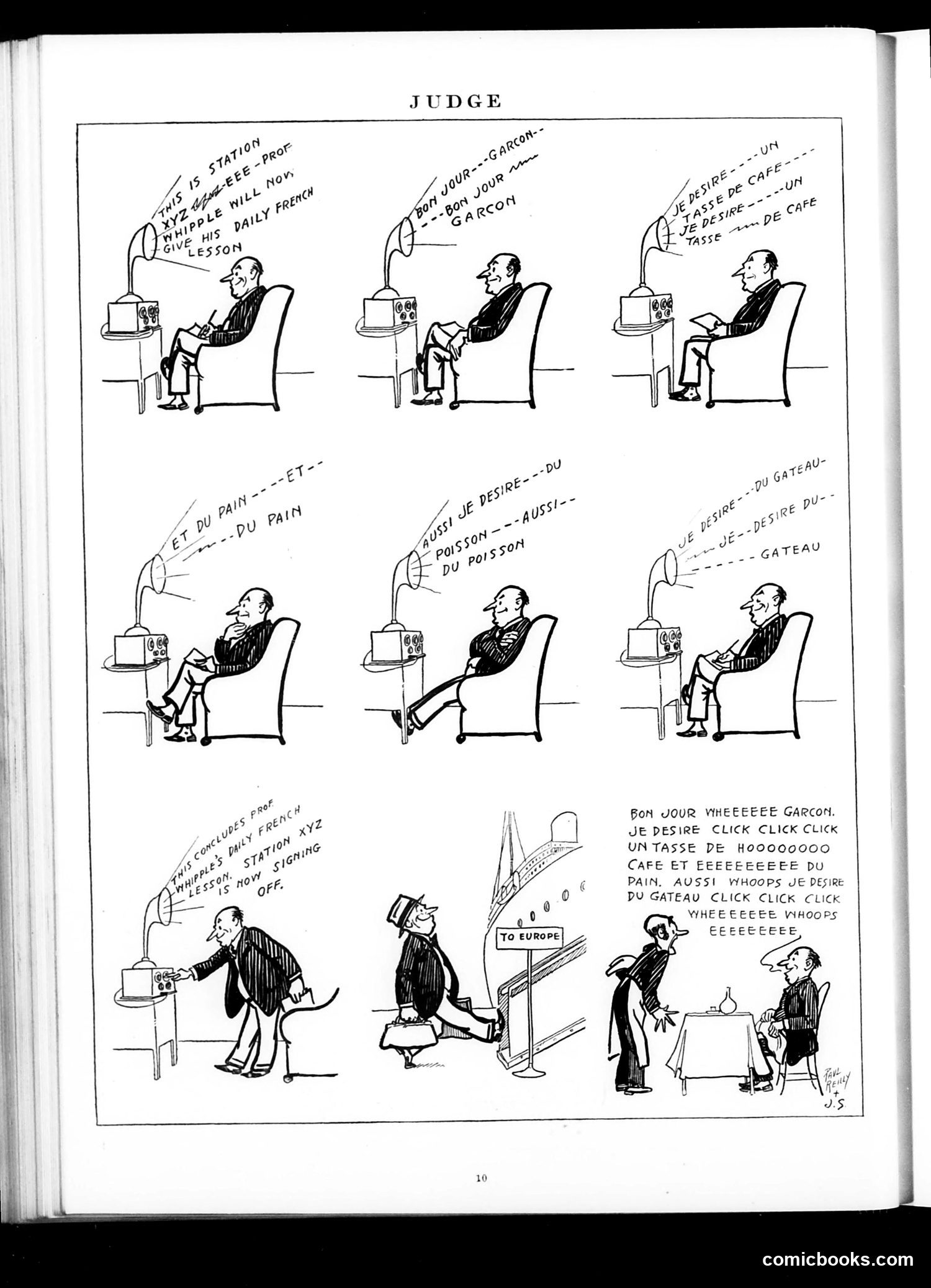
This cartoon satirizes a French waiter stereotype through exaggerated, nonsensical French. A man sits repeatedly ordering from a lamp-like contraption labeled a "station," requesting coffee, bread, and cake in a stream of pseudo-French gibberish mixed with mechanical "click" and "whee" sounds. The joke targets American attitudes toward French language and dining culture—mocking both the pretentiousness of French restaurants and Americans' inability (or unwillingness) to actually speak French. The repetitive panels showing identical requests emphasize the absurdity. The final panels show the man abandoning the lamp device entirely, suggesting frustration with this incomprehensible "French" service system. It's a xenophobic humor typical of early 20th-century American satirical magazines, ridiculing foreign sophistication as incomprehensible nonsense.
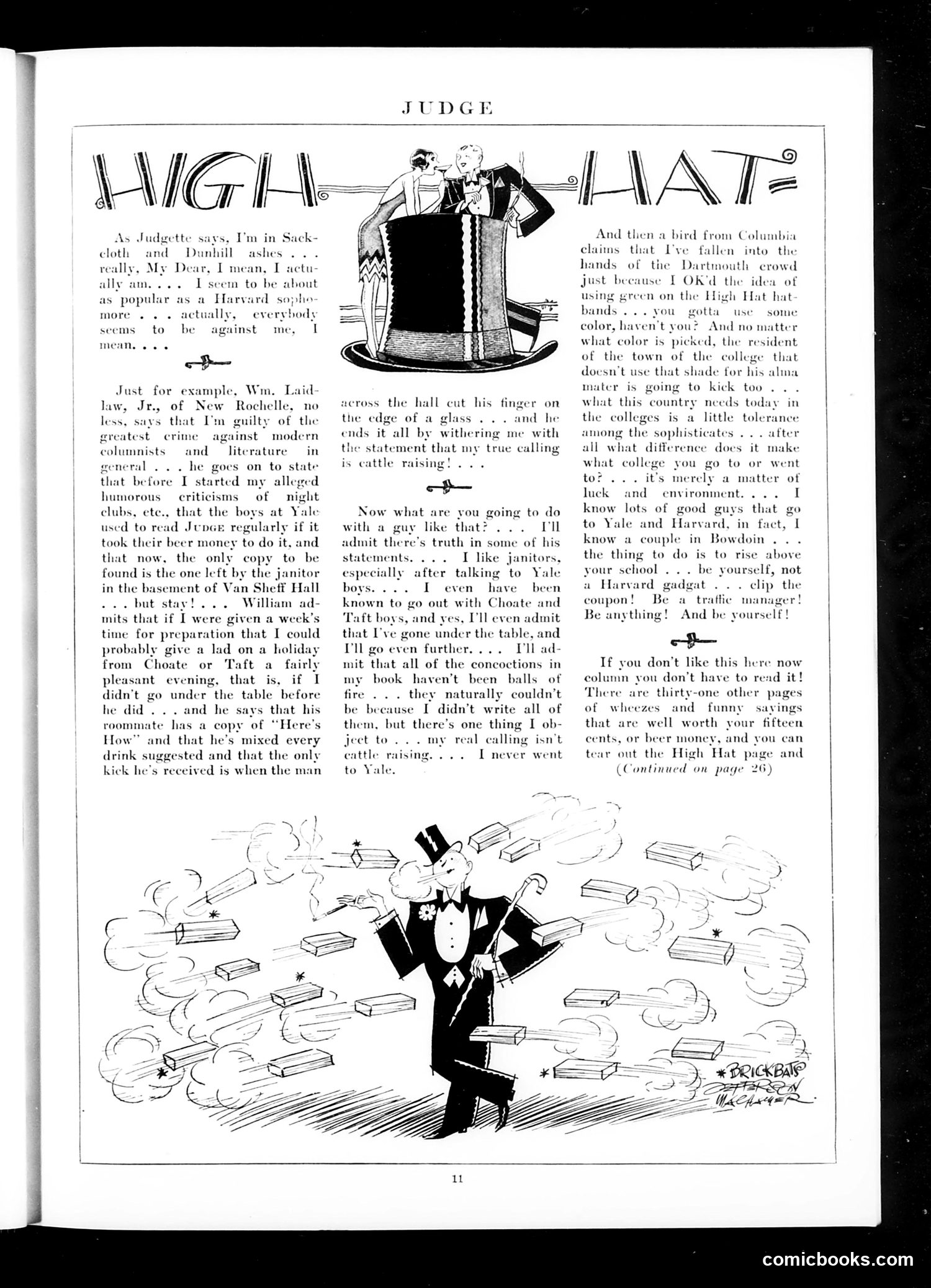
This is a satirical column mocking elite collegiate culture and snobbery among Ivy League students. The "Judgette" narrator responds defensively to criticisms from Yale, Harvard, Columbia, and Dartmouth students who object to his writing in *Judge* magazine. The satire targets: - **College pretension**: Students boasting about their schools' superiority while dismissing the author's humor - **Class affectation**: References to exclusive prep schools (Choate, Taft) and cocktail culture ("Here's How") - **Collegiate tribalism**: The absurd notion that which college you attend determines your worth - **Hypocrisy**: The author admits going "under the table" at parties while his critics lecture him about propriety The lower cartoon shows a figure juggling books amid clouds—likely satirizing the pompous intellectualism these college students display. The column's message is fundamentally democratic: stop taking your school's prestige seriously and "be yourself" rather than a "Harvard gadget." It's social commentary attacking upper-class pretension disguised as casual banter.
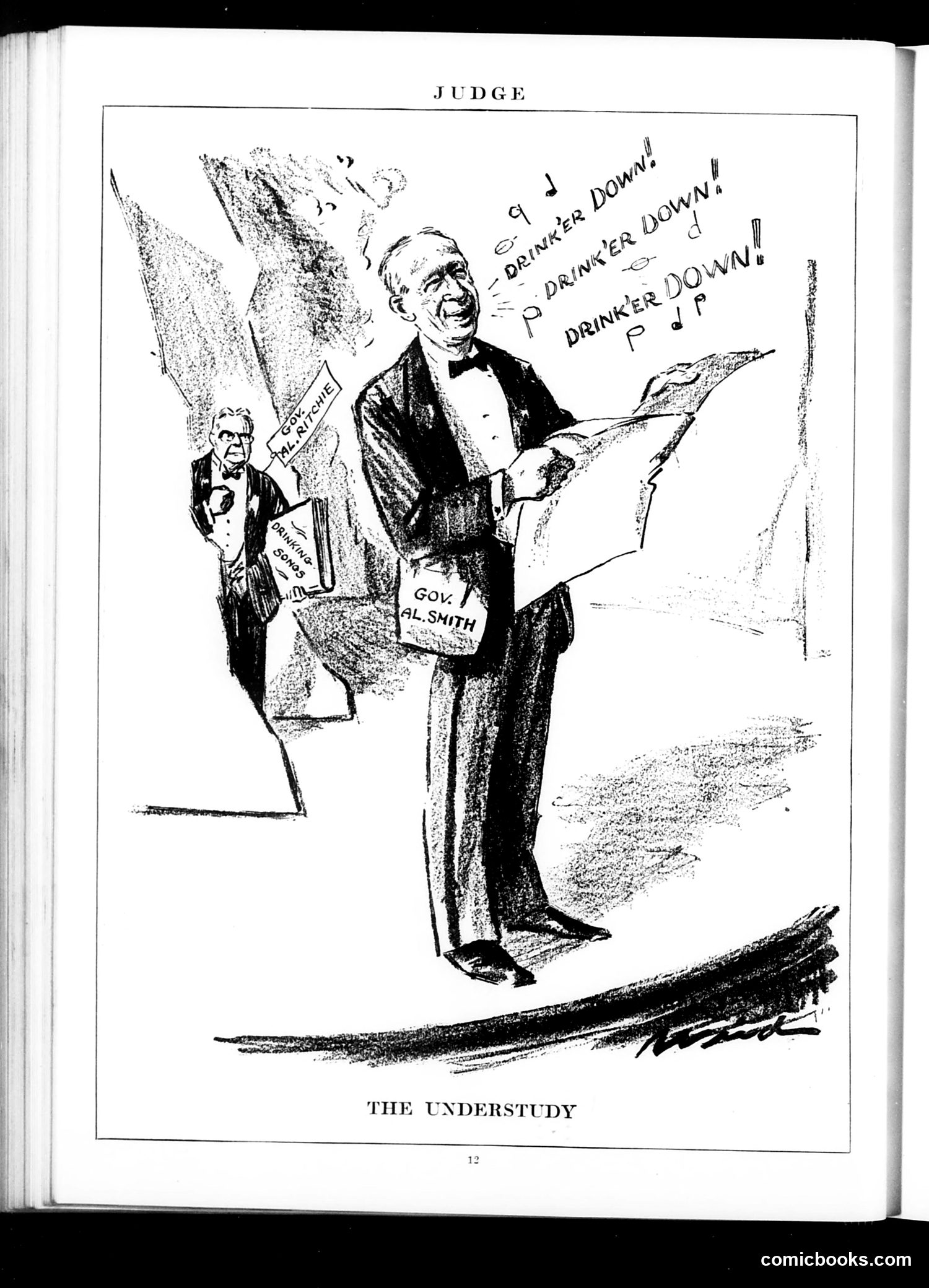
This political cartoon depicts a judge (labeled "Gov. Gl. Smith") as a puppet master controlling an "understudy" figure below him. The judge is shown gleefully commanding the understudy to "DRINKER DOWN! DRINKER DOWN!" repeatedly, while the smaller figure obeys. The satire appears to criticize Governor Smith for manipulating or controlling a subordinate political figure through judicial or executive authority. The "understudy" metaphor suggests the figure is merely following orders rather than acting independently. The repeated "drinker down" commands likely reference alcohol prohibition or alcohol-related policies of the era, suggesting hypocrisy or abuse of power in enforcing such laws. The cartoon's title emphasizes the subordinate, replaceable nature of the controlled figure.
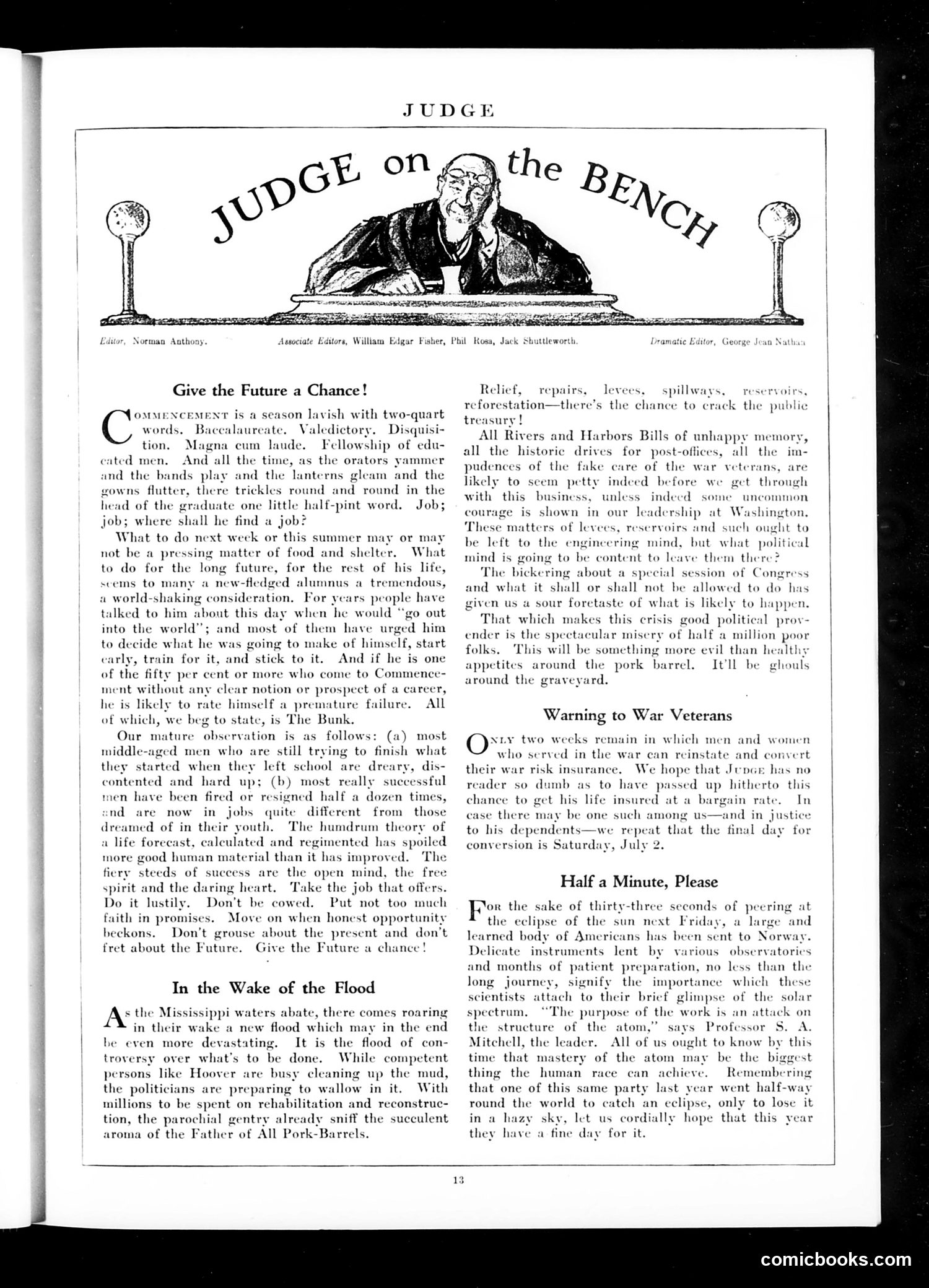
This page from Judge magazine contains several opinion pieces addressing post-WWI America (likely 1927, based on the "Warning to War Veterans" deadline of July 2). **"Give the Future a Chance!"** advises recent college graduates not to obsess over finding permanent careers. The author argues that successful men often changed jobs multiple times, and that rigid life planning actually ruins talent. He encourages graduates to take available work, pursue it enthusiastically, and move on when better opportunities arise. **"In the Wake of the Flood"** critiques political opportunism following Mississippi River flooding. While competent figures like Herbert Hoover handle actual relief and reconstruction, politicians scheme to exploit the disaster through "pork-barrel" spending—federal money distributed to benefit specific constituencies rather than genuine need. The piece warns that post-disaster politics will devolve into squabbling over special congressional sessions and patronage projects. **"Warning to War Veterans"** and **"Half a Minute, Please"** are brief notices about insurance conversion deadlines and an eclipse observation.
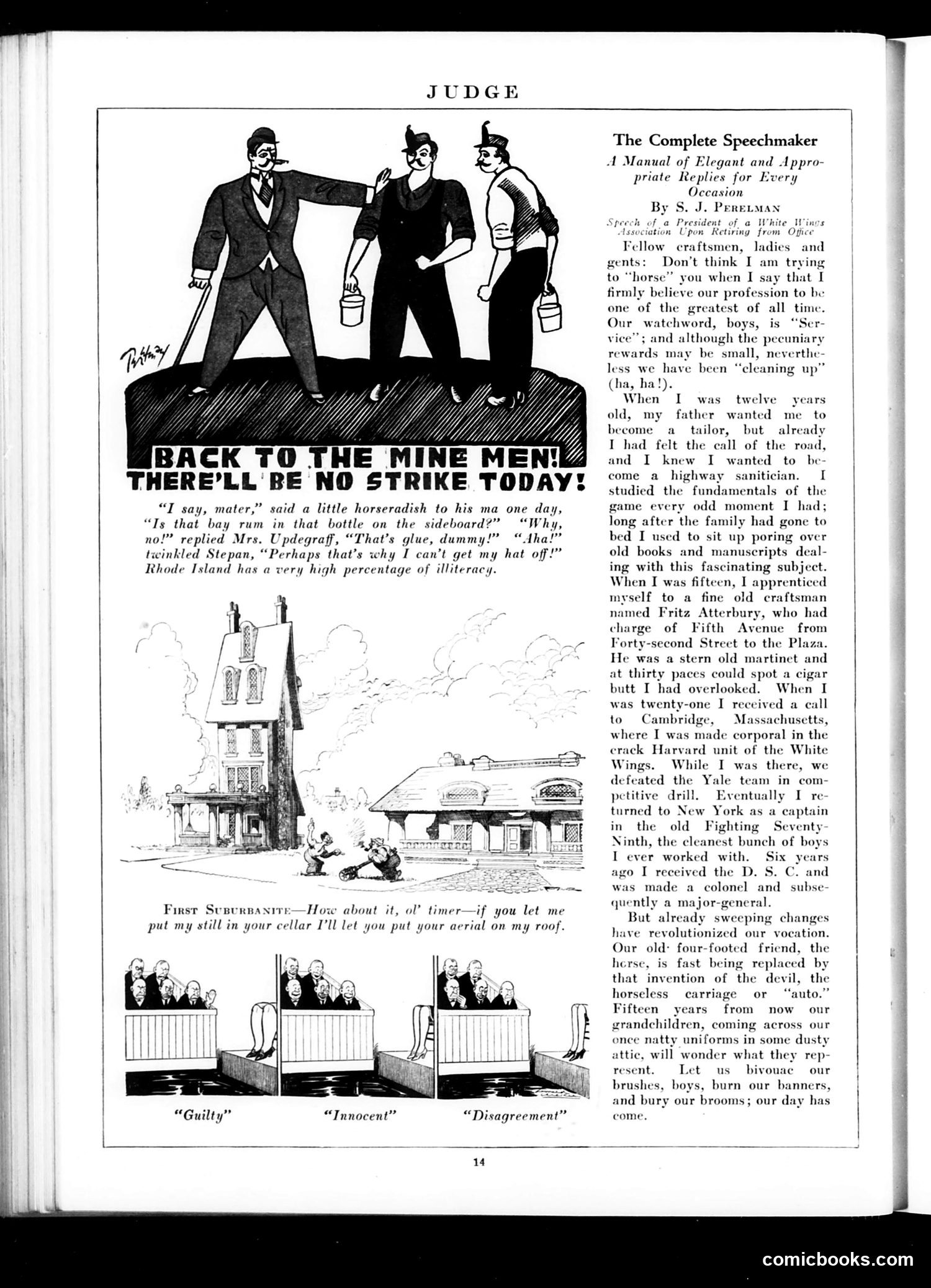
**Top Cartoon:** A propaganda-style image showing three men with cleaning implements captioned "BACK TO THE MINE MEN! THERE'LL BE NO STRIKE TODAY!" This satirizes anti-strike messaging and labor disputes, likely from the early 20th century when mining strikes were common. The cartoon mocks authority figures' attempts to prevent worker organizing. **Middle Section:** Jokes about Rhode Island's illiteracy (a contemporary stereotype), including a pun about "horseradish" and "bay rum," and a Prohibition-era gag about hiding alcohol stills and radio aerials. **Right Column:** S.J. Perelman's satirical essay "The Complete Speechmaker" humorously traces a "sanitation engineer's" (street cleaner's) career. The piece mockingly celebrates this humble profession while lamenting that motorized vehicles are replacing horse-drawn equipment—capturing anxiety about rapid technological change displacing traditional working-class jobs. The tone is affectionate mockery of working-class dignity and occupational pride.
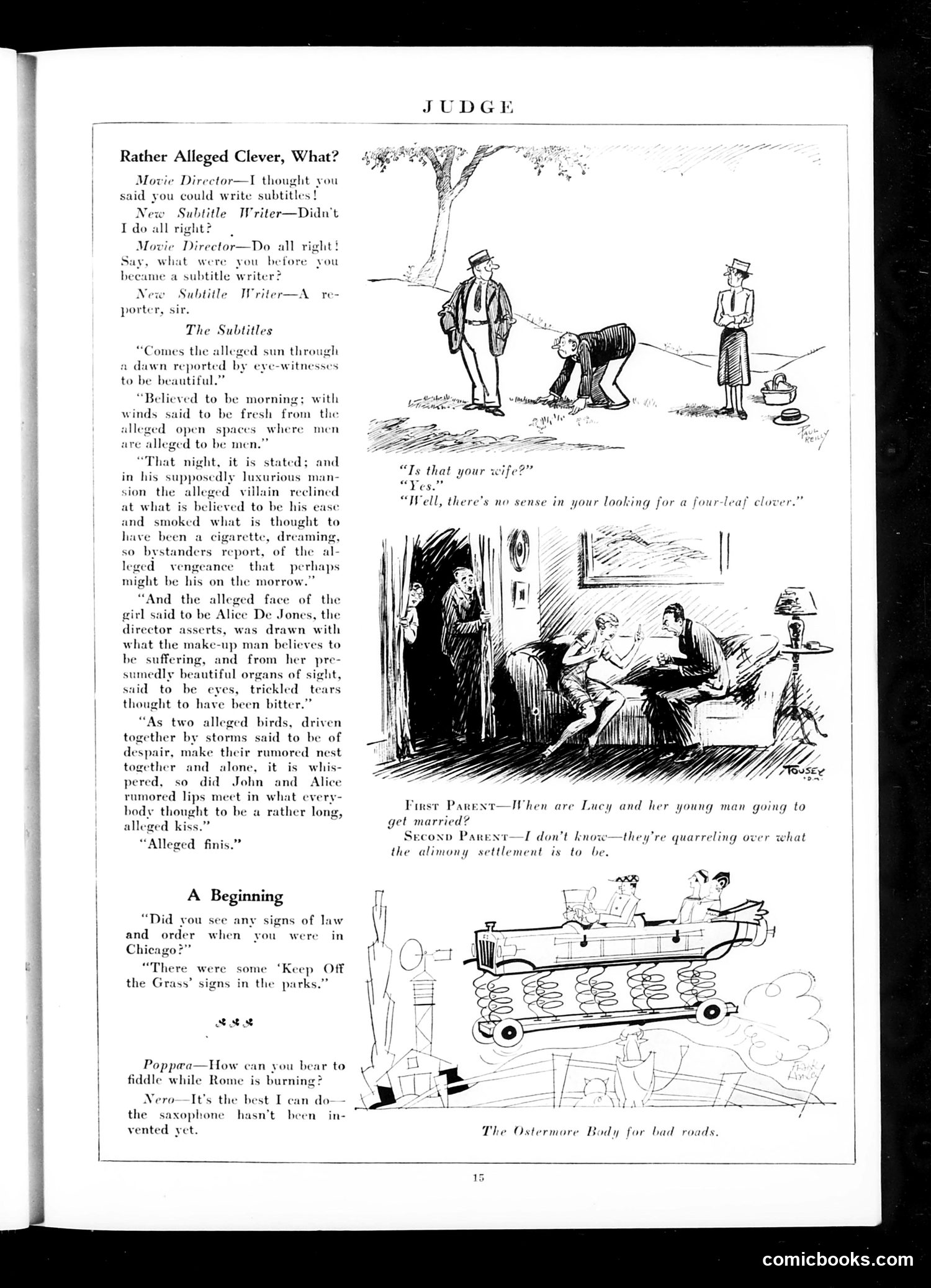
This page contains multiple unrelated satirical items typical of Judge magazine: **"Rather Alleged Clever, What?"** mocks the emerging film subtitle industry. A newspaper reporter hired as a subtitle writer produces absurdly verbose, legalistic captions ("the alleged sun," "believed to be morning") that parody journalistic hedging and overcomplication. The joke is that reporters' cautious, qualifying language makes terrible film subtitles. **"A Beginning"** includes two brief gags: one about Chicago lacking law and order (only "Keep Off the Grass" signs exist), and one about Nero fiddling while Rome burns—a classical reference with the punchline that he can't play saxophone since it hasn't been invented yet. **Other cartoons** joke about marital discord (a couple quarreling over alimony *before* marriage) and include an automobile diagram labeled "Ostermore Body for bad roads." The satire targets early cinema conventions, journalistic pretension, and social commentary on marriage and urban disorder—all typical Judge magazine fare circa the 1920s.
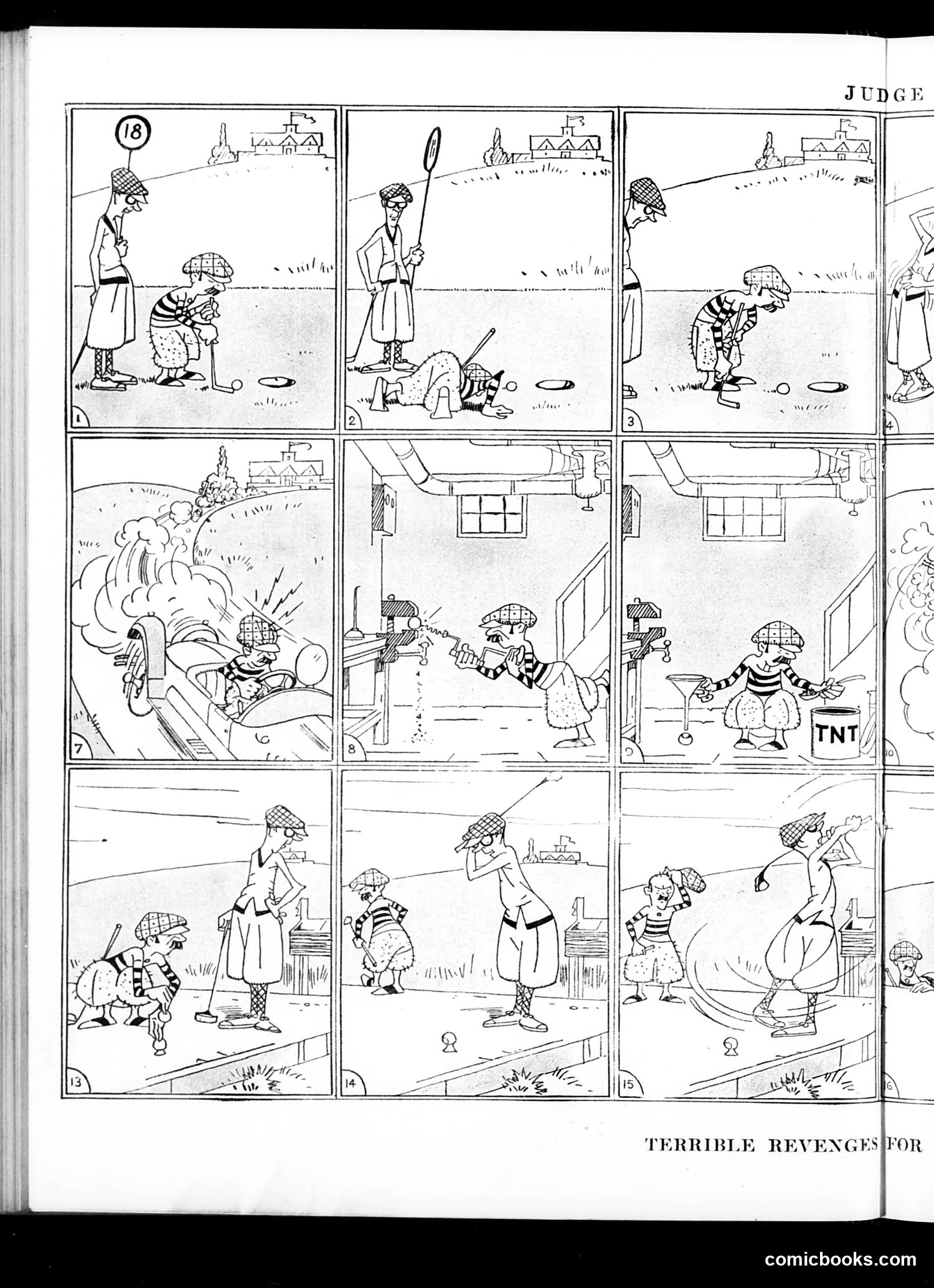
This multi-panel comic depicts a domestic scenario involving an adult woman and children playing golf. The narrative appears to show escalating "revenge" pranks or mishaps: Panels 1-3 show outdoor golf instruction gone wrong. Panels 4-6 depict indoor chaos—possibly water or mess-making consequences. Panels 7-9 show the woman attempting her own golf practice with increasingly comedic results, culminating in what appears to be property damage (the "TNT" marking visible). The satire likely mocks domestic power dynamics of the era—specifically, a woman seeking "revenge" through destructive antics against her children or their father. The title "Terrible Revenges" suggests humorous retaliation for prior wrongs, presented as slapstick comedy typical of early-20th-century Judge magazine humor emphasizing physical comedy and domestic chaos.
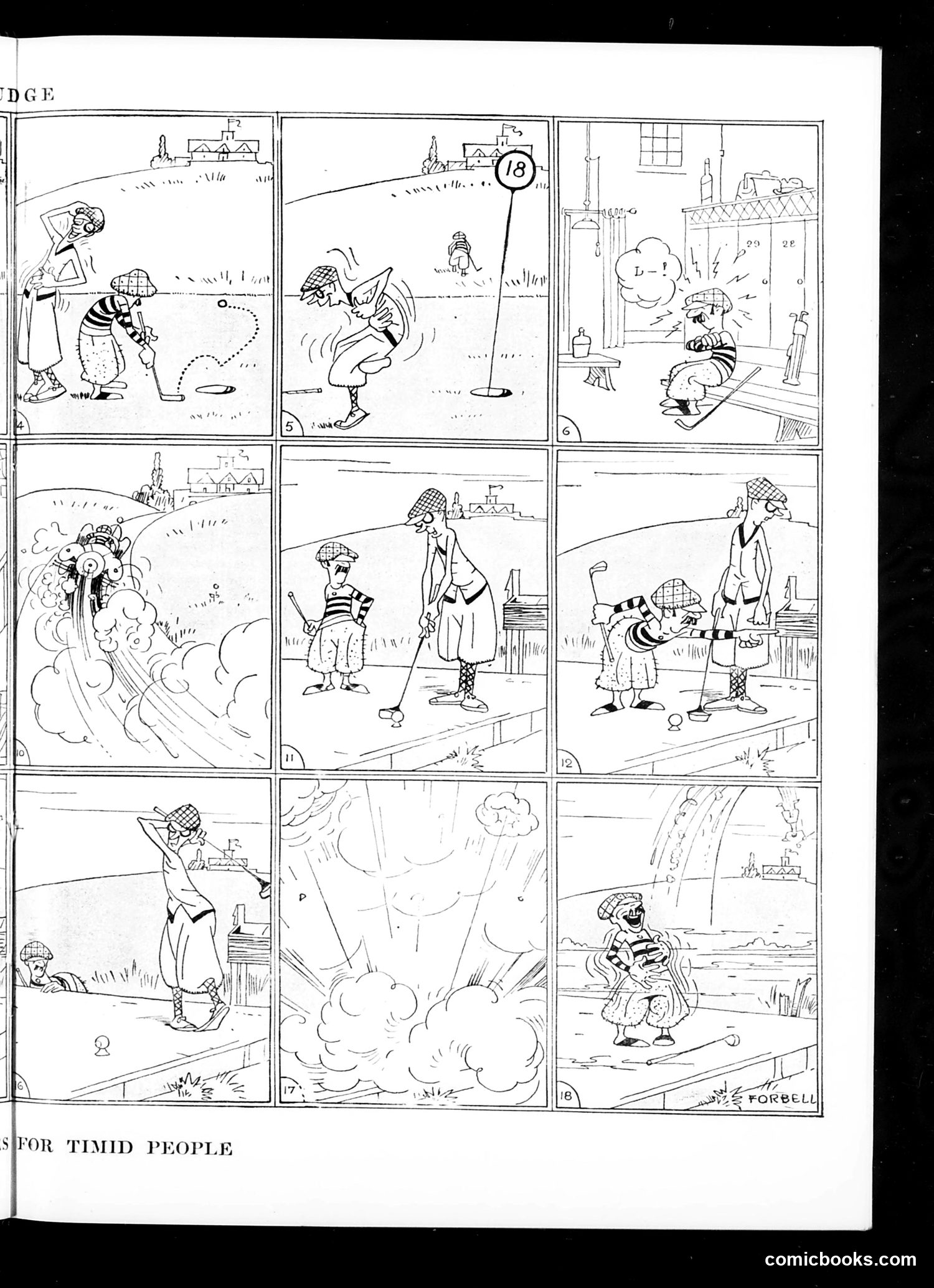
This appears to be a multi-panel comic strip by Forbell titled "For Timid People." The strip depicts a nervous golfer attempting to play golf while increasingly anxious about potential dangers. The sequence shows: 1. A child and woman observing the golfer 2. The golfer struggling with his swing 3. An explosion or accident occurring nearby 4. Subsequent panels showing escalating chaos—water spray, collapsing structures, and further disasters The satire targets timid, anxious individuals who imagine catastrophic consequences from ordinary activities. The humor lies in the protagonist's mounting panic as increasingly absurd disasters seem to result from (or coincide with) his golf attempt. It's a commentary on anxiety and overthinking—exaggerating how nervous people perceive minor situations as disasters. The comic's appeal is to readers who recognize this psychological pattern in themselves or others.
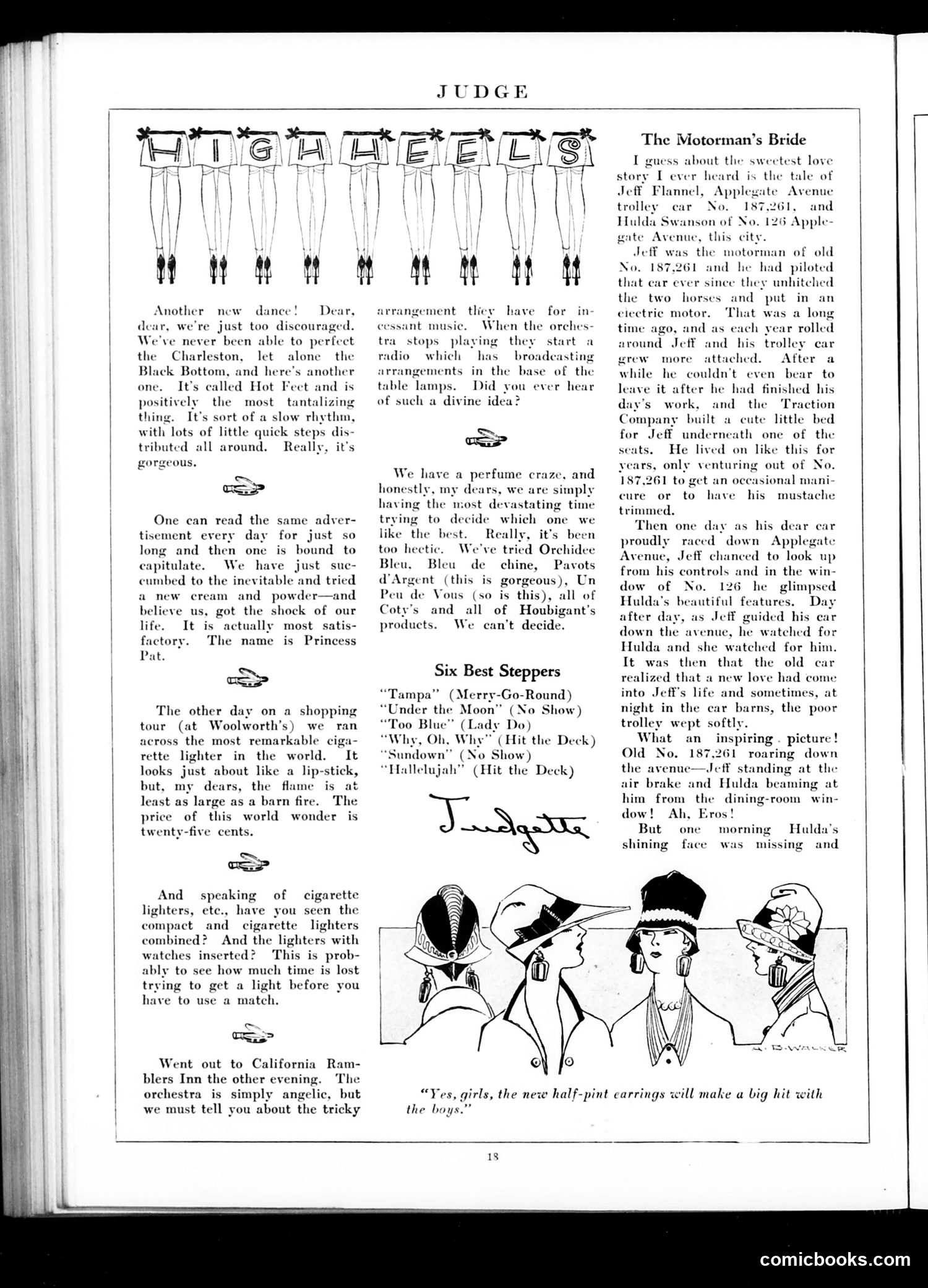
This page from Judge magazine (appears to be 1920s-era) contains two distinct sections: **Left side:** A gossip column discussing social trends—new dance crazes (Charleston, Black Bottom, "Hot Feet"), cosmetics (Princess Pat), novelty items (cigarette lighters designed like lipsticks, combined lighter-compacts with watches), and perfume brands. The humor relies on satirizing upper-class women's consumption obsessions and their breathless enthusiasm for trivial products. **Right side:** "The Motorman's Bride," a sentimental parody about a trolley car motorman (Jeff) who falls in love with a woman (Hulda) he glimpses from his car window. The satire mocks melodramatic romance stories by treating an electric trolley car as the emotional center—the "poor trolley wept softly" when realizing Jeff had found love elsewhere. **Bottom illustration:** Shows four women wearing decorative earrings, with a caption joking that half-pint earrings will appeal to men—likely satirizing exaggerated fashion trends. The page reflects 1920s consumer culture and period romantic conventions.
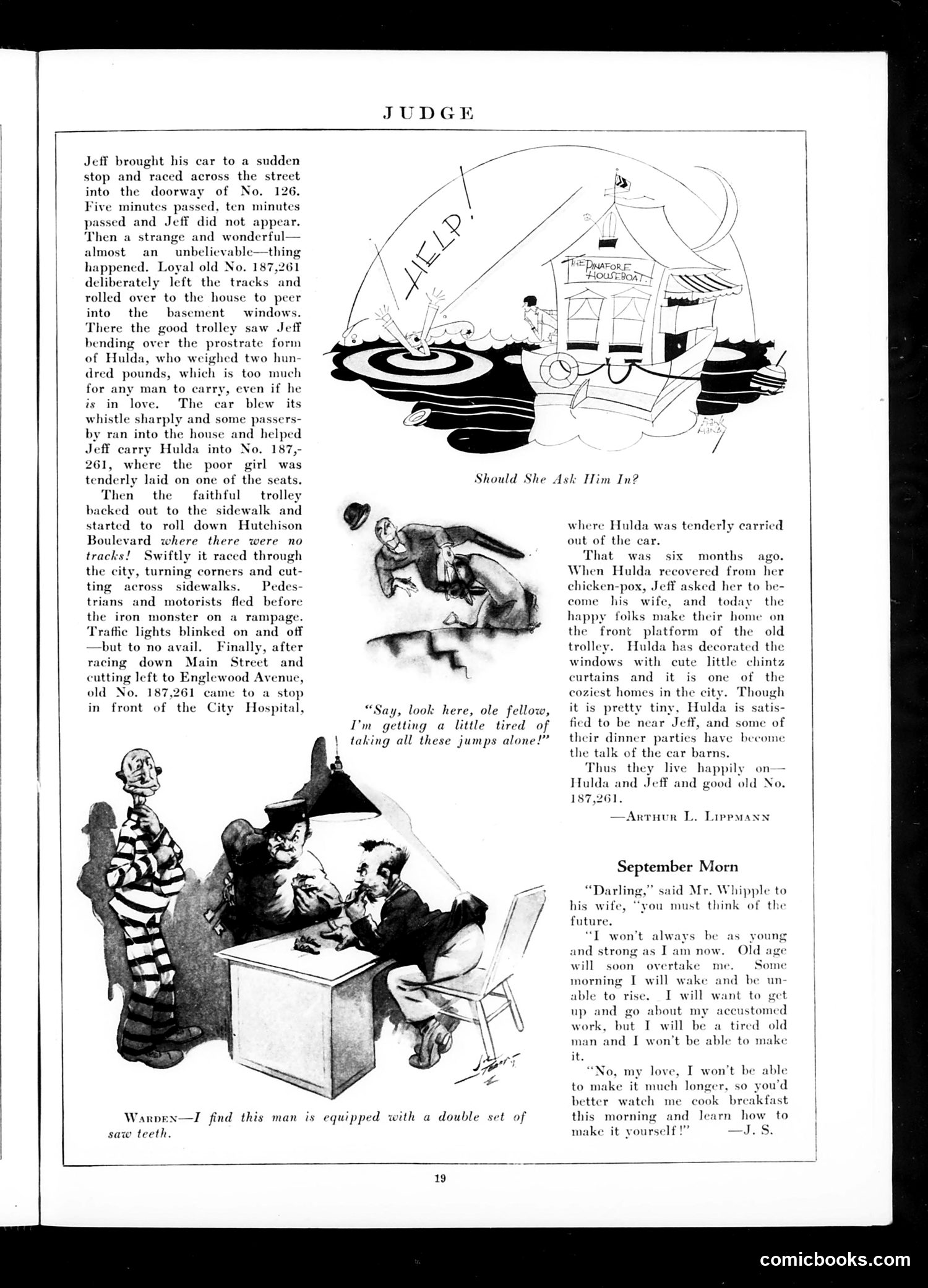
This page contains two satirical stories with accompanying illustrations: **"Judge"** (top): A whimsical tale where a streetcar (trolley No. 187,261) acts as a sentient being, independently leaving its tracks to peer into a house, then deliberately racing to the City Hospital to deliver an injured woman named Hulda. The satire mocks anthropomorphization and melodramatic sentimentality—the "loyal" trolley becoming a romantic facilitator. The story ends with Hulda and Jeff living on the trolley itself, treated as an absurdly cozy home. The humor lies in the over-the-top romanticization of industrial machinery and working-class life. **"September Morn"** (bottom): Mr. Whipple lectures his wife about his inevitable aging and inability to work, concluding she should learn to cook breakfast herself. The satire targets husbands who use mortality anxiety as justification for shirking responsibility or expecting wives to take on additional domestic labor. The crude illustration of the man with "double set of saw teeth" emphasizes his unpleasantness. Both pieces mock contemporary social attitudes through exaggeration.
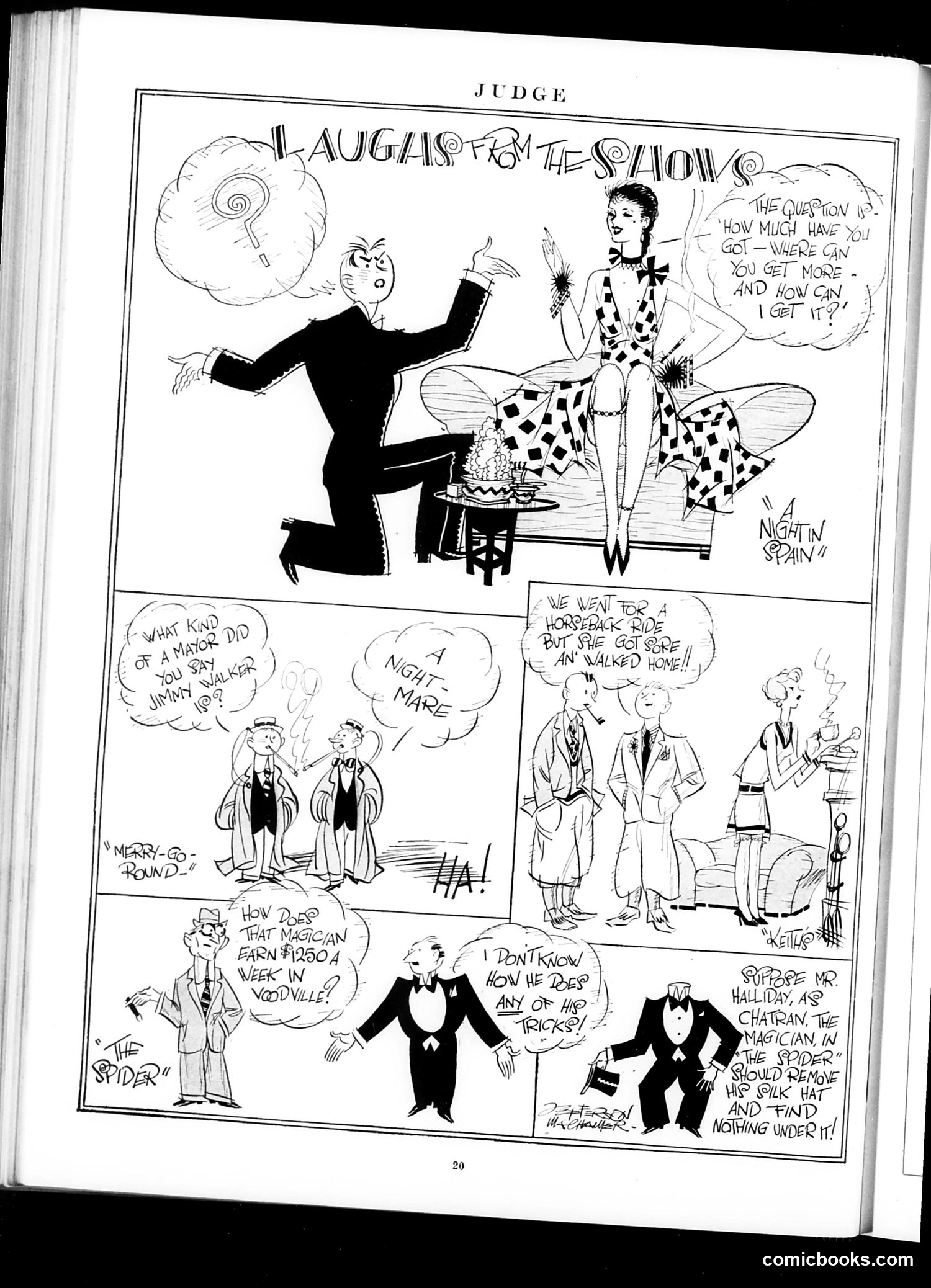
This appears to be a satirical comic from Judge magazine mocking stage magicians and their tricks. The top panel shows an elegantly dressed woman (likely representing wealthy patrons or society) questioning a magician about where to obtain more illusions and money. The subsequent panels feature dialogue about a magician's income ("earn $1,200 a week in vaudeville") and references to magic tricks that involve deception—specifically mentioning hiding things under silk hats. The character "The Spider" appears to be a magician figure. The satire likely critiques **professional magicians as con artists** who profit through sleight-of-hand deception, playing on contemporary concerns about theatrical fraud or charlatans. The repeated questions about obtaining "more" money suggest mockery of greed and the gullibility of wealthy audiences willing to pay for illusions. The cartoonist's style and subject matter suggest this targets early 20th-century vaudeville culture and public skepticism toward stage performers.
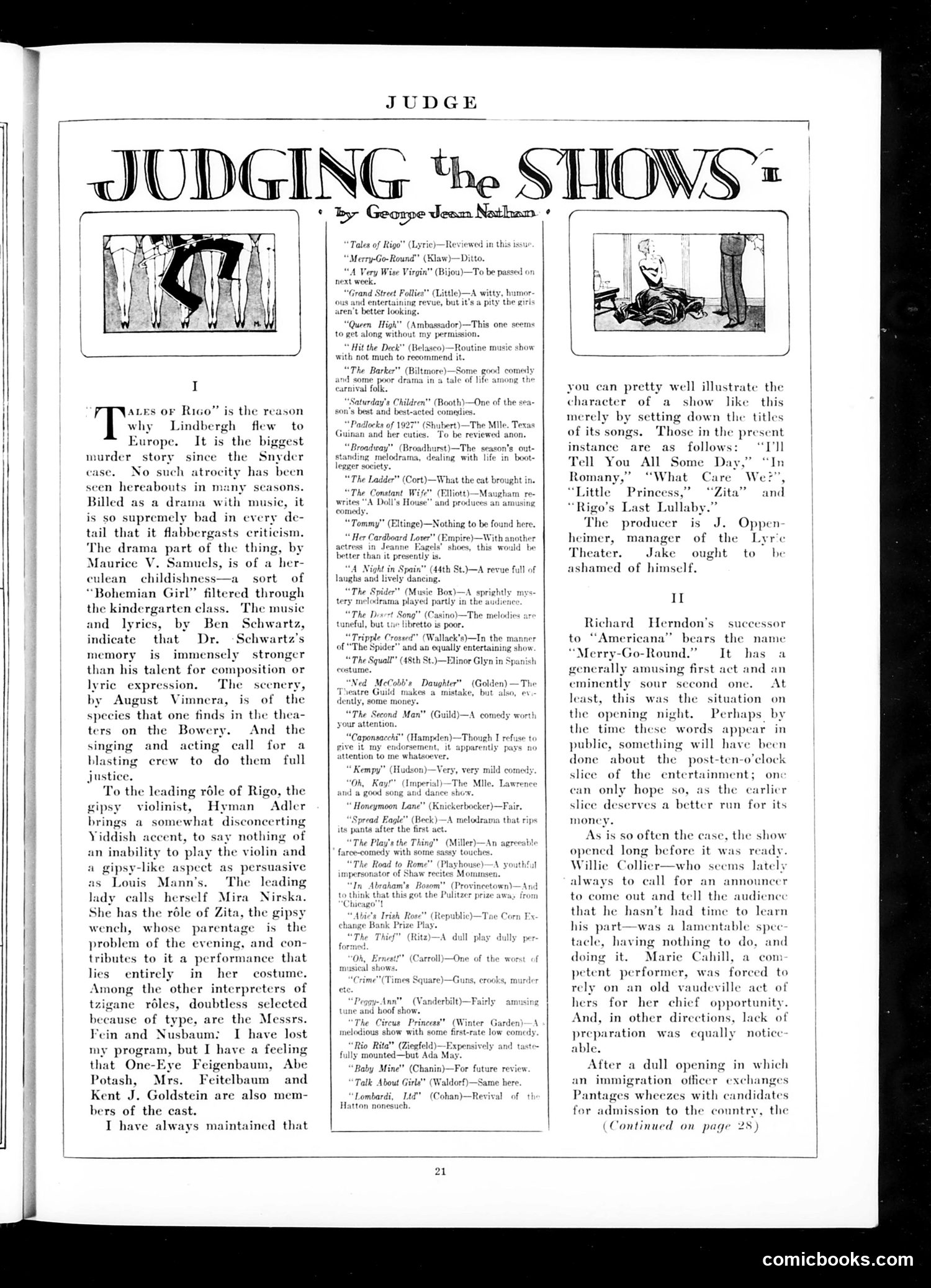
This is a theater review column by George Jean Nathan, a prominent drama critic of the 1920s. The page critiques Broadway productions currently running, with particular focus on "Tales of Rigo," which Nathan savagely demolishes as artistically inept despite its topical appeal (he opens by noting it's the reason Lindbergh flew to Europe—a reference to the famous 1927 transatlantic flight). Nathan's reviews employ caustic wit to mock poor performances and productions. He ridicules the "Bohemian Girl" plot as kindergarten-level drama, the music as derivative, and the cast—identifying performers by ethnic stereotypes (Yiddish accent, Jewish character names)—as inadequate. The accompanying illustrations show scenes from productions. This reflects 1920s theatrical criticism's frank, often crude judgmental style and casual ethnic caricaturing common to the era's entertainment journalism.
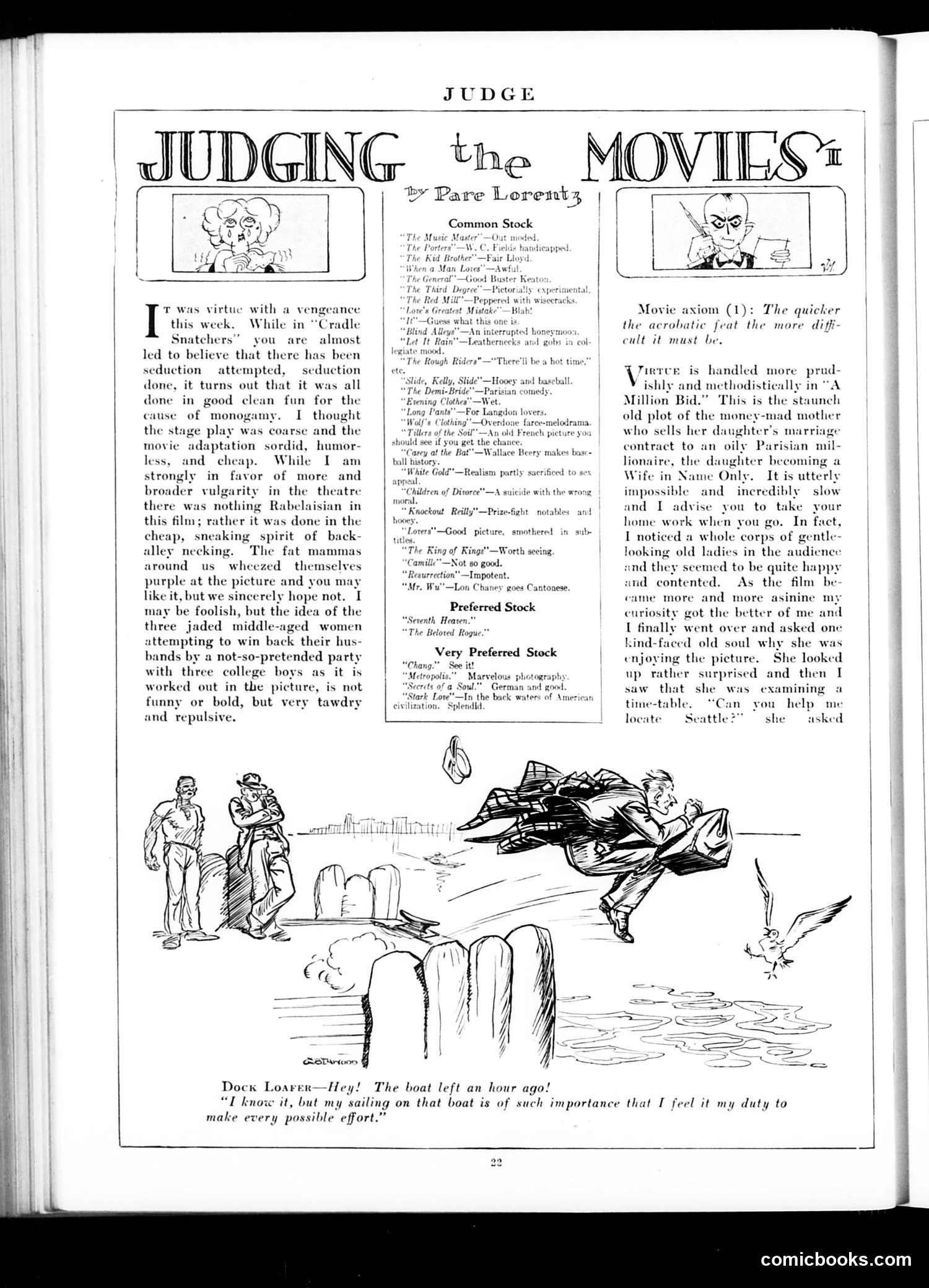
This page contains a film critic's review of contemporary movies (likely early 1920s based on references). The critic harshly judges "Cradle Snatchers," calling it cheap and morally dubious despite its facade of virtue—three middle-aged women attempt to seduce college boys to win back their husbands, which the reviewer finds "tawdry and repulsive" rather than genuinely bold or funny. The page lists other current films with brief judgments (Common Stock, Preferred Stock, Very Preferred Stock ratings). "A Million Bid" receives criticism for prudish, slow storytelling about a woman selling her daughter's marriage contract to a Parisian man. The cartoon below shows a "Dock Loafer" scene where someone insists on completing a boat journey despite its departure, prioritizing duty. The implicit satire appears directed at moviegoers—particularly older women—who endure tedious, moralistic films uncritically, confusing moral messaging with entertainment quality.
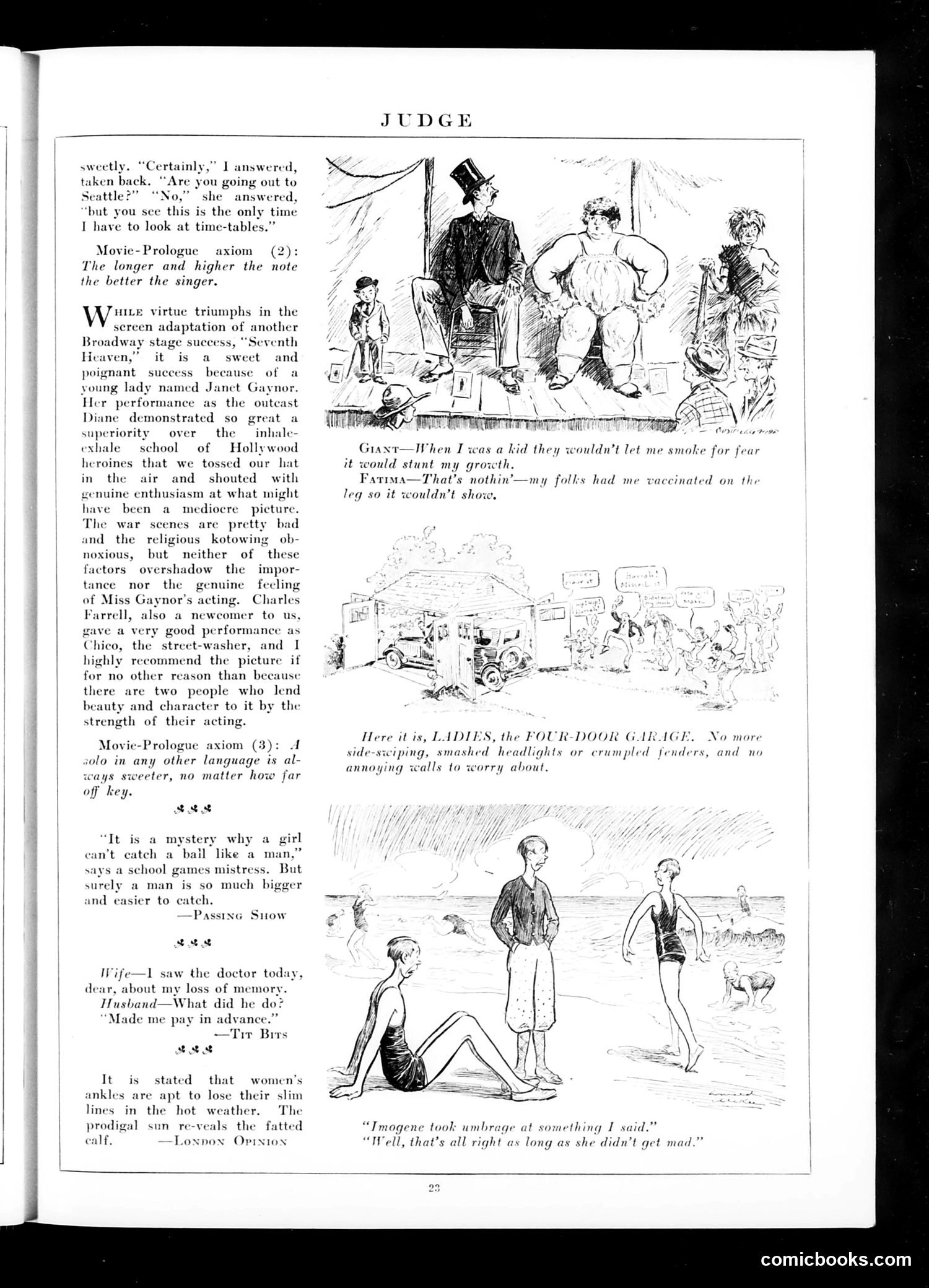
This page combines film criticism with humor pieces typical of 1920s satirical journalism. **Main Content:** A review of the film "Seventh Heaven," praising actress Janet Gaynor's performance as elevating what might otherwise be a mediocre picture. The critic mocks Hollywood's theatrical acting conventions (the "exhale school") while commending Gaynor and co-star Charles Farrell for genuine talent. **Surrounding Humor:** The page includes various jokes mocking contemporary life—a woman consulting timetables, marital comedy about memory loss and doctor's fees, and quips about women's athletics and summer heat affecting ankle appearance. One cartoon advertises a "four-door garage" for automobiles, addressing the practical annoyance of car damage in cramped spaces. **Satirical Tone:** The content satirizes both cinema pretension and everyday married life, using gentle ridicule typical of Judge's middle-class readership. The automobile humor reflects 1920s concerns about car ownership becoming commonplace.
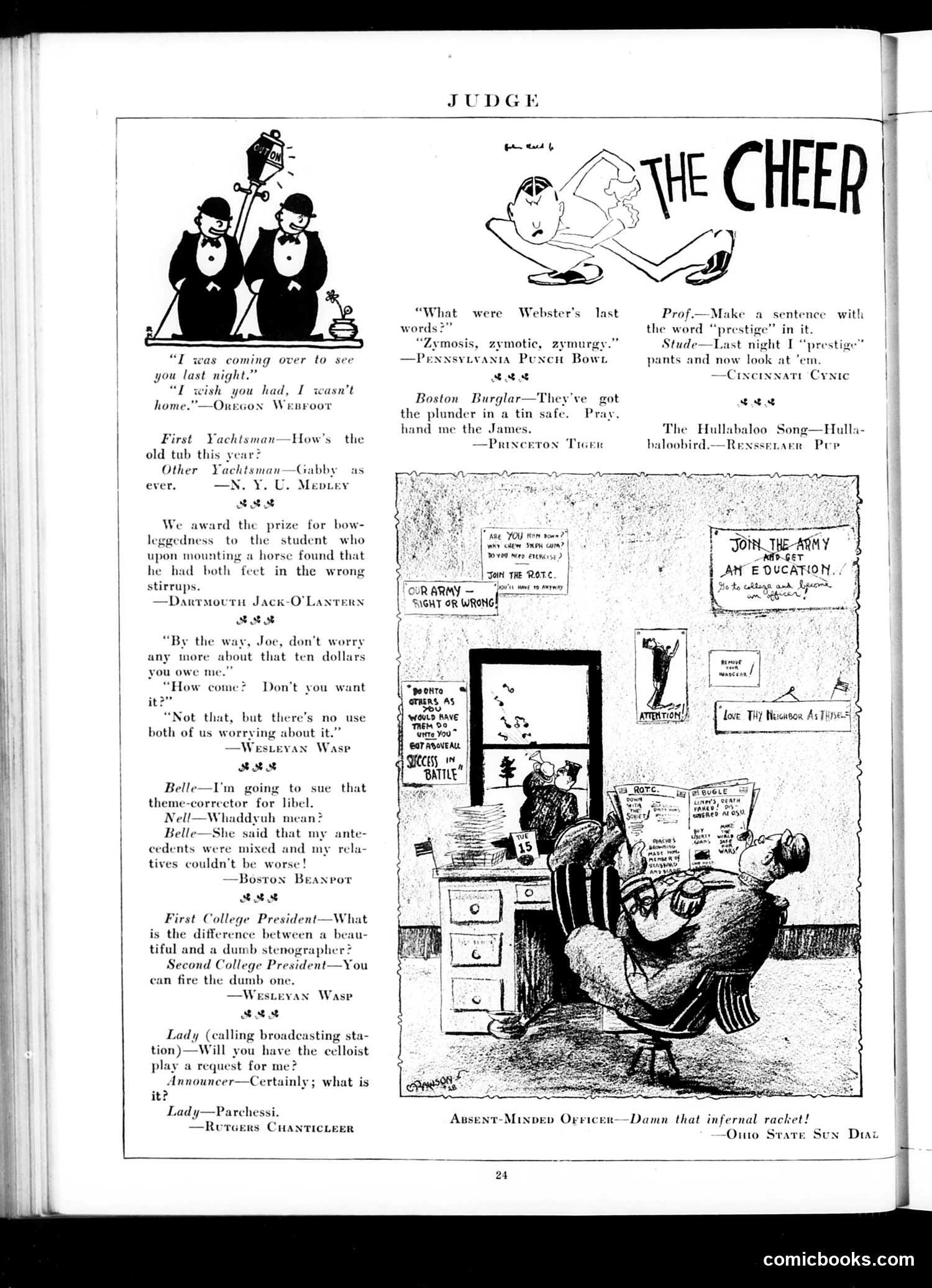
This page from Judge contains a mix of short jokes and a satirical cartoon about military recruitment during what appears to be WWI era. **The Main Cartoon:** Shows a soldier at a desk surrounded by patriotic recruitment posters ("Join the Army," "Army Education") playing loud music or making noise. An "Absent-Minded Officer" complains: "Damn that infernal racket!"—the joke being that recruitment propaganda is so aggressively promoted it becomes annoying rather than persuasive. **The Jokes:** Mostly generic college humor and wordplay typical of the era—puns about stenographers, yachtsmen, a play on "prestige" as a verb. One references Webster's dictionary (his last words being obscure dictionary entries). The Boston Burglar joke uses period slang ("the James" for a crowbar). **The Satire:** The cartoon mocks aggressive military recruitment tactics of the period, suggesting the constant push to enlist was intrusive and counterproductive—a common civilian complaint during wartime.
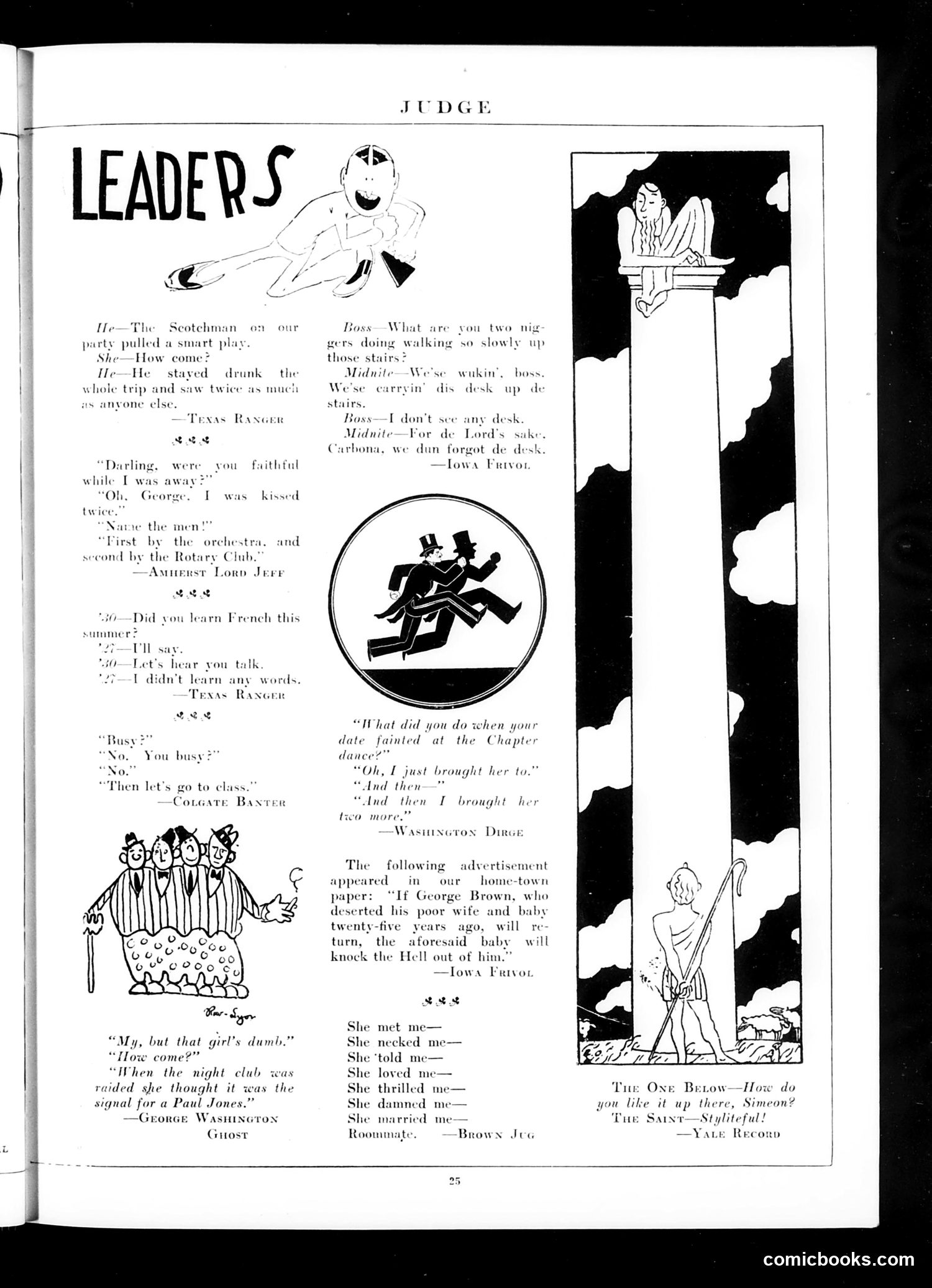
This Judge page satirizes various social behaviors and stereotypes of the era through humor columns and cartoons. The main jokes target: - **Infidelity/Social Hypocrisy**: Multiple quips about unfaithful spouses and casual romance (the "George Brown" ad mocks a deadbeat father). - **Racial Stereotypes**: A conversation between "Boss" and "Midnite" (African American workers) uses heavy dialect and depicts them as forgetful laborers—reflecting the offensive racial humor common to period satirical magazines. - **Youth/Dating Culture**: Jokes about college students, chapter dances, and nightlife suggest disapproval of modern dating practices. - **Gender**: Women are portrayed as dim-witted ("that girl's dumb") or overly romantic. The circular cartoon shows two men in top hats running, likely satirizing some contemporary social event or behavior, though the specific reference is unclear. The page represents early 20th-century American satirical humor: mocking modern social changes while reinforcing period prejudices through stereotypes.
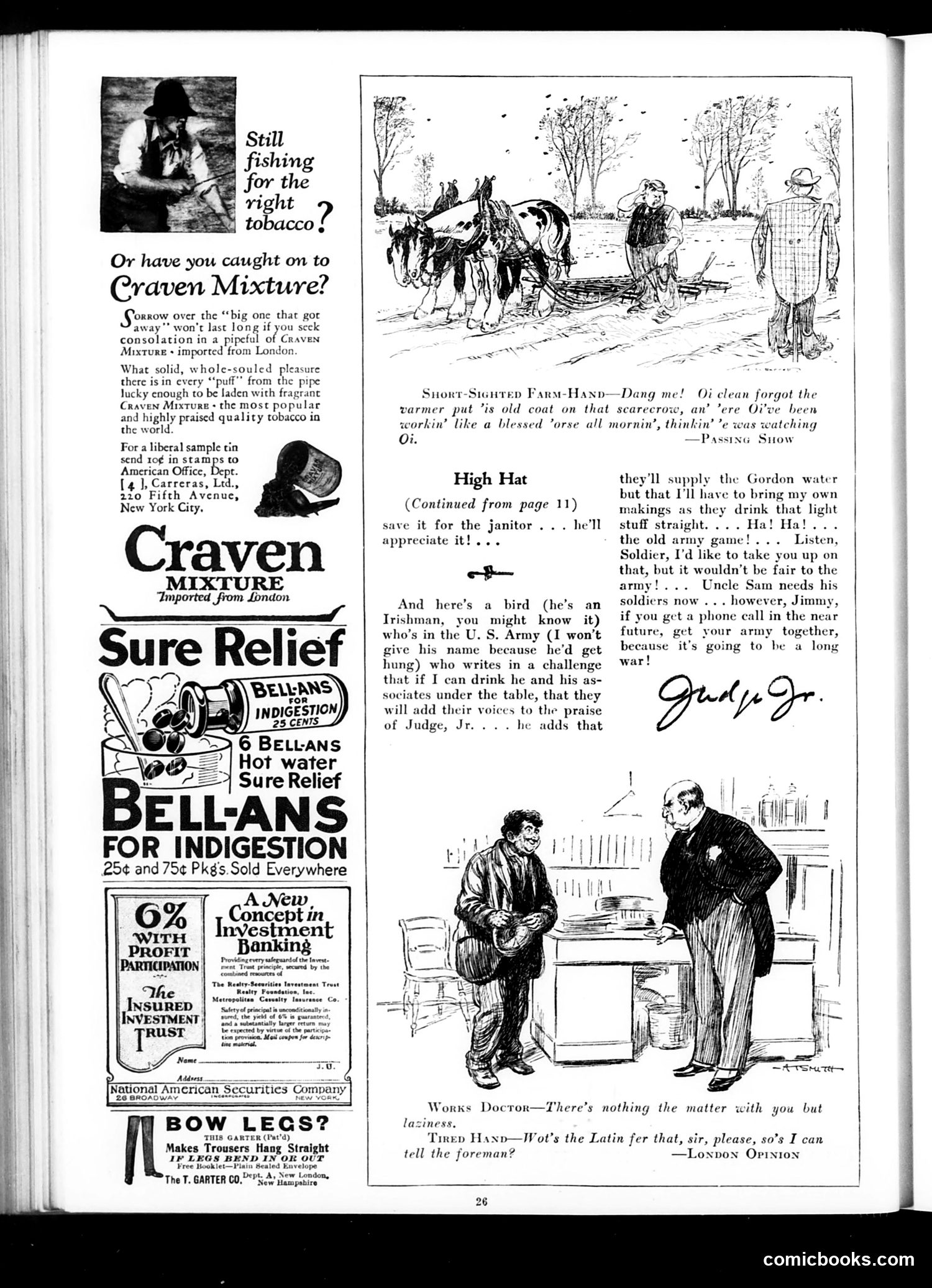
This page is primarily **advertisements** interspersed with comic content. The ads include tobacco (Craven Mixture), indigestion relief (Bell-Ans), investment banking, and men's garters—typical 1910s-20s commercial products. The main satirical content is "High Hat" (continued from earlier), a humorous column featuring short anecdotes. One depicts a **farm worker** in rural dialect who forgot he'd dressed a scarecrow in his coat, then worked all morning thinking it was watching him—a classic "fooled by a scarecrow" joke. Another anecdote involves an **Irish soldier in the U.S. Army** issuing a drinking challenge to the column's author. The humor plays on soldiers' reputation for heavy drinking and camaraderie, with the author joking he can't accept because "Uncle Sam needs his soldiers." A final gag shows a **tired worker** asking for Latin translation of something medical, likely related to the exhaustion theme of the page's various tired characters.
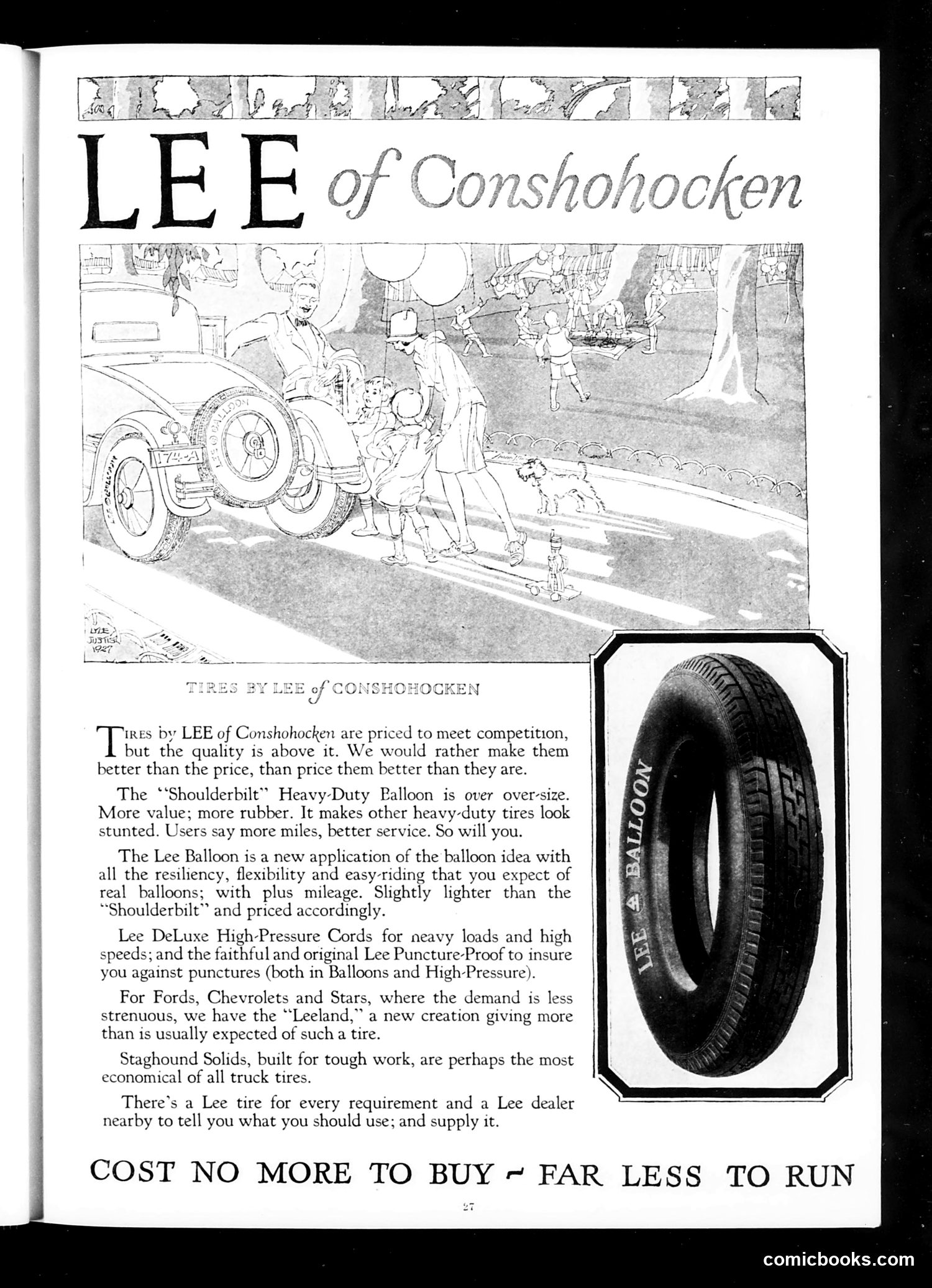
This is a **tire advertisement**, not political satire. The page promotes Lee tires manufactured in Conshohocken, Pennsylvania. The illustration depicts an early automobile (appears to be 1920s-era) with passengers and a small dog, showcasing the tire product. The accompanying text describes various tire models: the "Shoulderbilt" heavy-duty balloon tire, the "Lee Balloon," high-pressure cords, the "Leeland" (for lighter vehicles like Fords and Chevrolets), and solid truck tires. The advertisement's sales pitch emphasizes quality over price—claiming Lee prioritizes durability and performance rather than competing solely on cost. The slogan "Cost No More to Buy—Far Less to Run" promises long-term savings through durability. There is **no political satire or social commentary** on this page; it is straightforward commercial advertising typical of Judge magazine's revenue model.
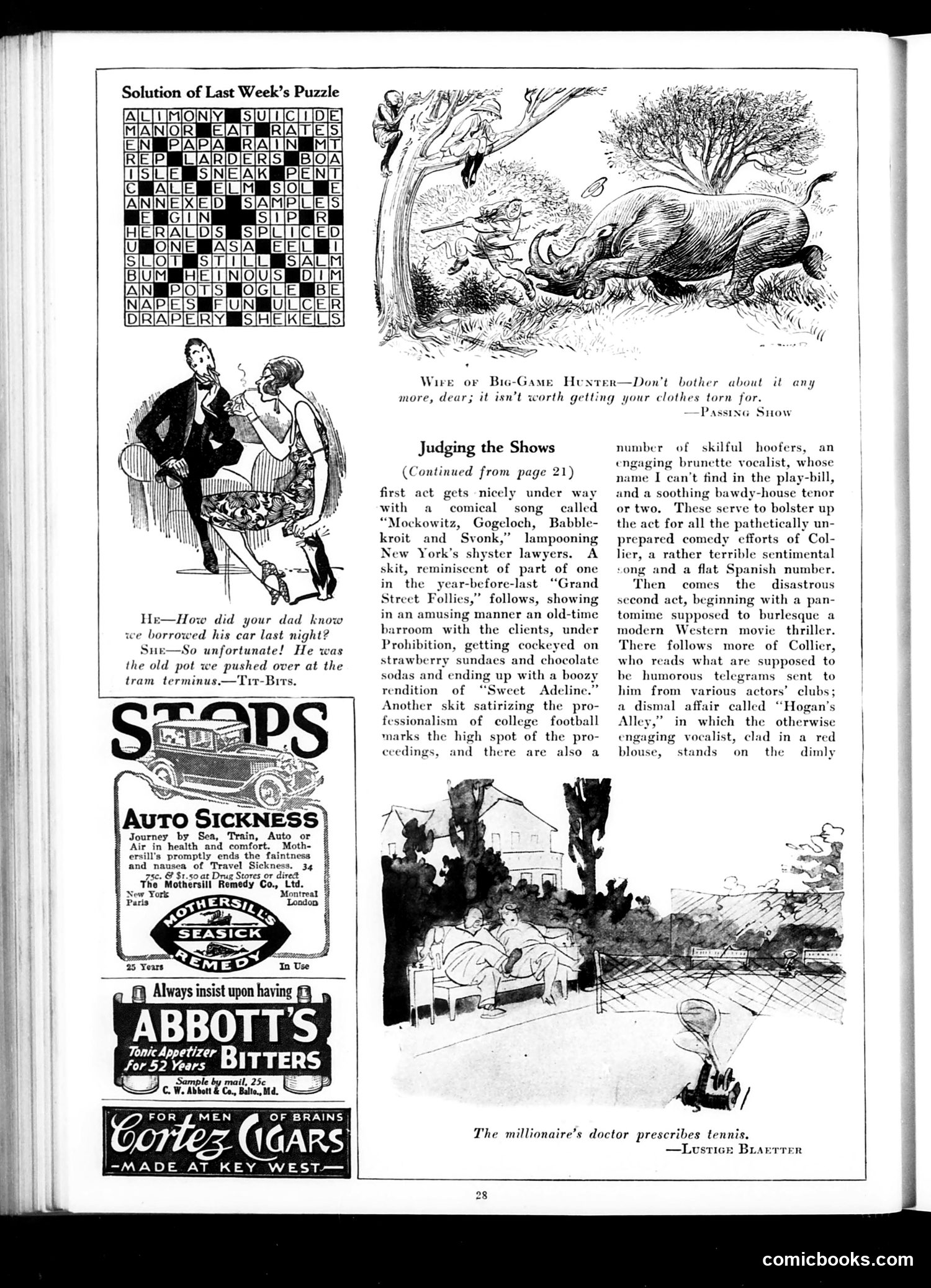
This page contains theatrical criticism mixed with period advertisements and light humor. ## Main Content: "Judging the Shows" A theater reviewer discusses a Broadway musical revue (likely from the 1920s based on references). The review critiques a show featuring: - Comedy songs mocking Jewish shyster lawyers - Sketches satirizing Prohibition-era speakeasies (where people drink "strawberry sundaes and chocolate sodas" to get drunk) - College football satire - A weak Western movie parody in act two The reviewer is largely negative, calling the comedy "pathetically unprepared" and one performer's efforts "terrible." ## Cartoons Two small gag comics appear: 1. A couple discusses borrowing a car and hitting something at a tram station 2. A "Big Game Hunter" wife tells her husband not to worry about torn clothes from hunting ## Context for Modern Readers The ads (auto sickness remedy, bitters, cigars) and theatrical discussion reflect 1920s entertainment and concerns. The Jewish lawyer jokes reflect casual period stereotyping common in mainstream publications.
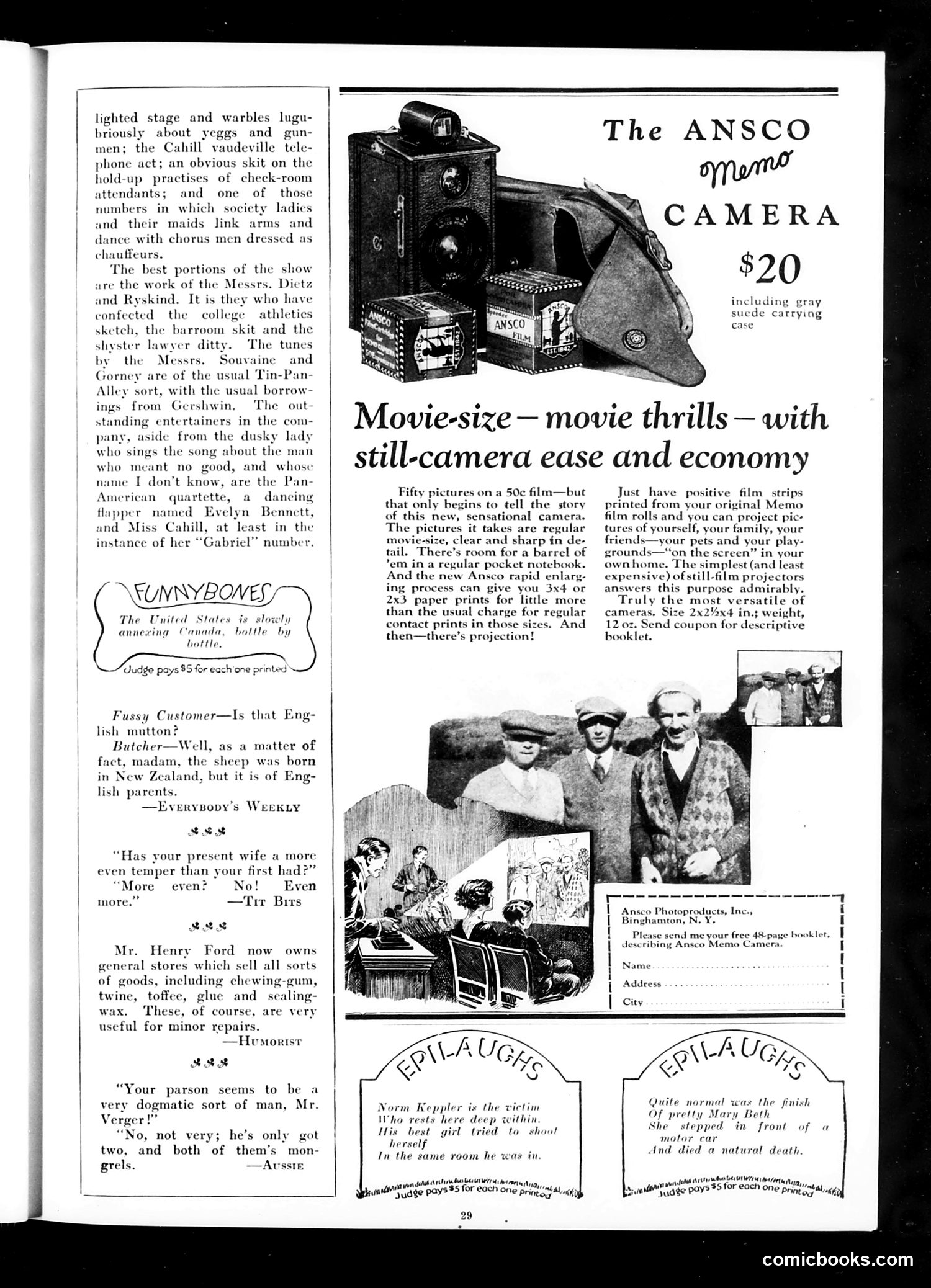
This is primarily an **advertising page** for the Ansco Memo Camera ($20), which the ad promotes as a portable, affordable still camera capable of producing movie-quality images. The page includes several unrelated humor sections typical of Judge magazine: - **"Funnybones"**: Brief jokes about domestic life, marriage, and Henry Ford's business ventures - **"Epilaughs"**: Dark humor epitaphs (appears to reference a crime of passion involving "Norm Keppler" and "Mary Beth") The camera advertisement dominates, emphasizing novelty features: 50 pictures on inexpensive film, pocket-sized portability, and the ability to project images at home—positioning amateur photography as accessible entertainment for middle-class consumers. The humor sections are disconnected filler content, typical of Judge's format mixing satire with advertisements and jokes. No significant political content appears on this page.
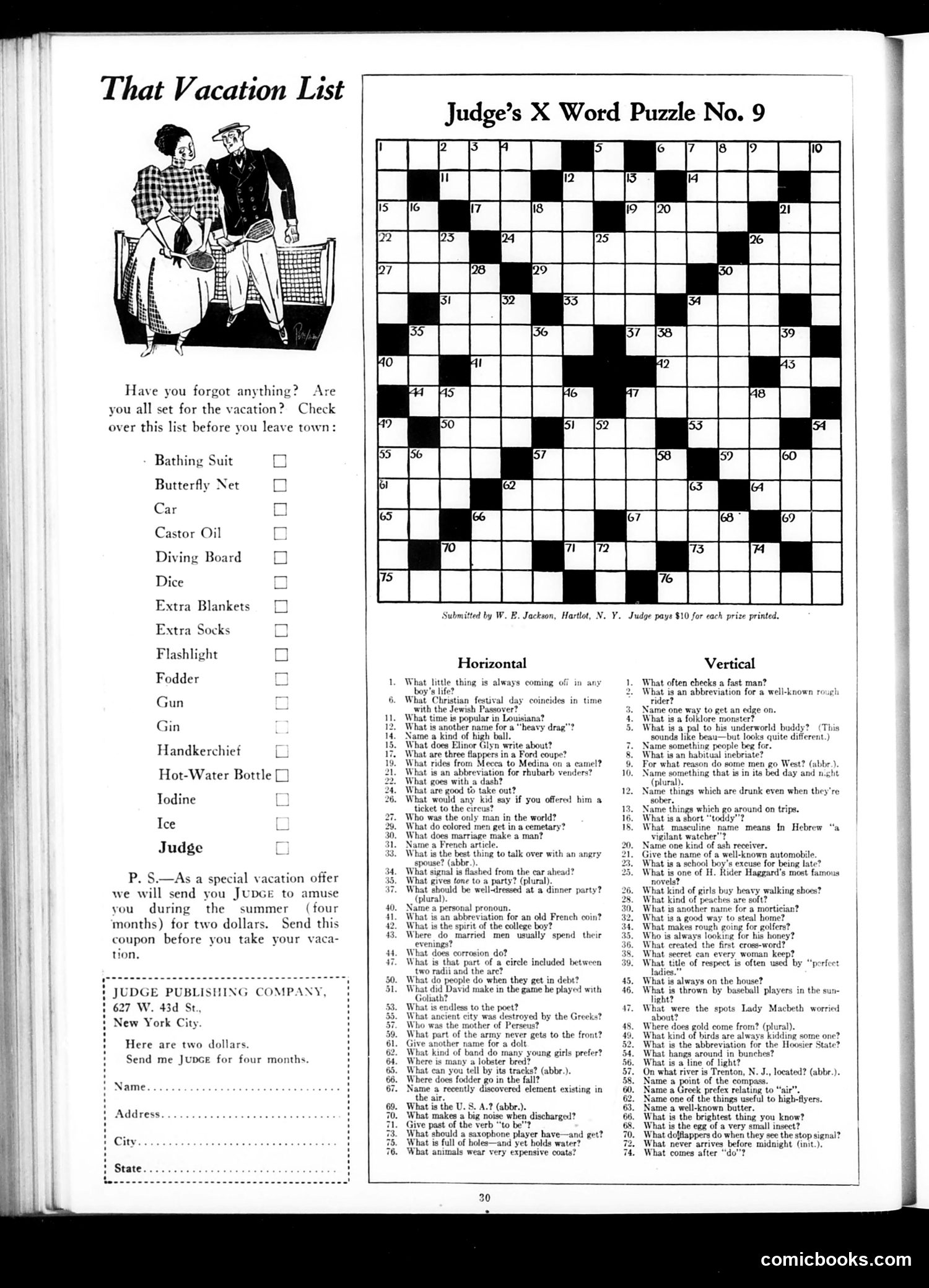
This page combines a humorous checklist cartoon with a crossword puzzle contest, both targeting vacation-minded readers. **The Cartoon:** The illustration shows a couple packing for vacation, accompanied by a practical checklist of items to remember before leaving town—bathing suit, flashlight, castor oil, hot-water bottle, etc. The humor lies in the mundane domesticity of pre-trip preparation; the detailed list suggests anxious forgetfulness common to travelers. **The Crossword Contest:** Judge magazine offered readers a chance to solve a word puzzle for prizes, positioning it as entertainment for the summer months. This was a popular feature in early 20th-century magazines, encouraging reader engagement and subscription renewals. **The Offer:** A promotional insert solicits subscriptions at two dollars for four months, using the vacation theme as a hook—Judge as ideal summer reading material. The page reflects Judge's dual purpose: satirical humor about contemporary American life (vacation culture, domestic anxieties) combined with interactive entertainment to build readership.
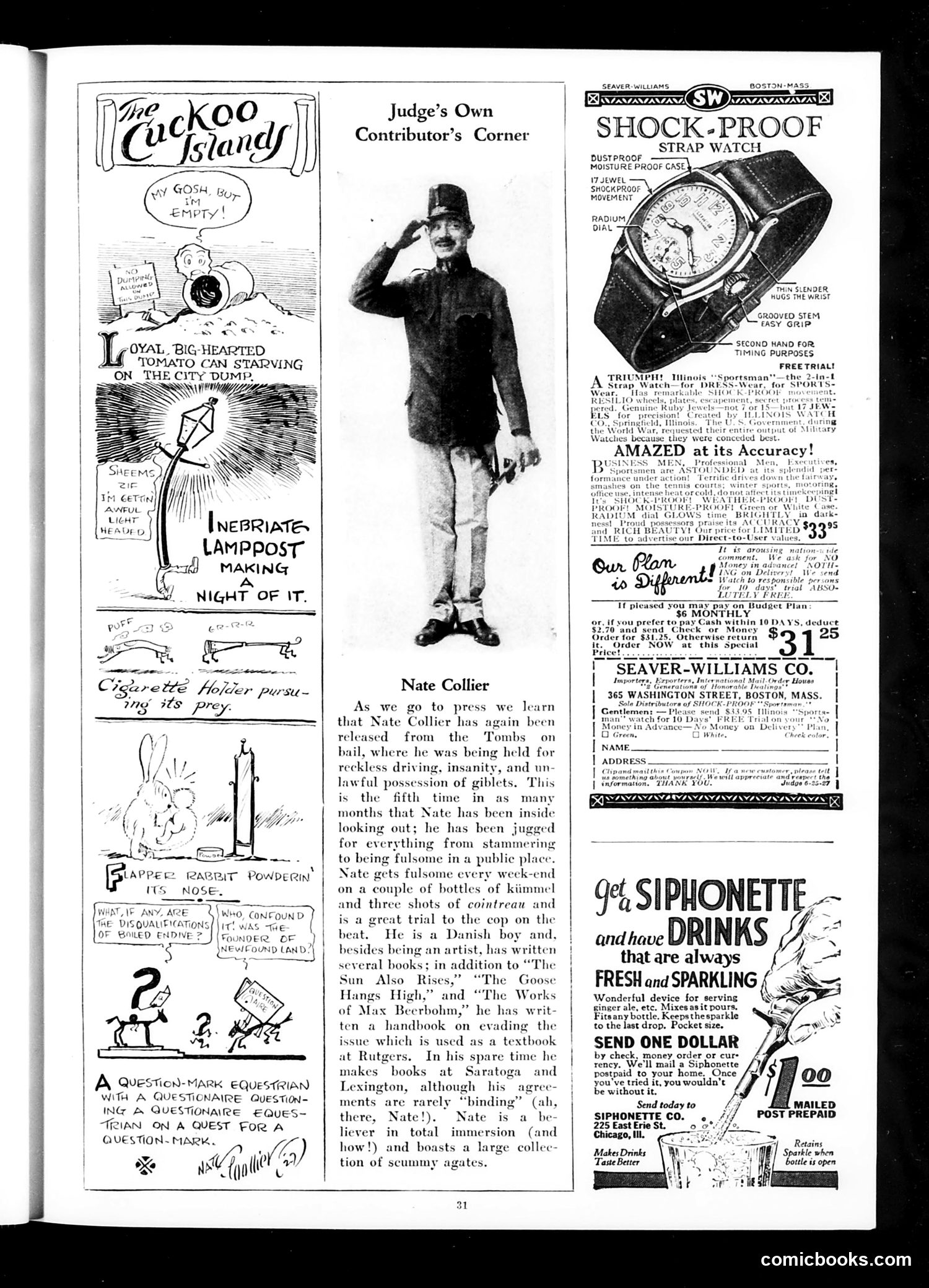
This page mixes humor content with period advertising. **Left side comics:** Several absurdist gag cartoons by contributor Nate Collier—a tomato can starving on a city dump, a cigarette holder pursuing prey, an inebriated lamppost, a rabbit powder joke, and a wordplay riddle about a question-mark equestrian. These are non-topical visual gags typical of Judge's humor style. **Center:** A biographical note on Nate Collier himself, presented satirically. The text jokes that Collier has been repeatedly arrested for "reckless driving, insanity, and unlawful possession of giblets"—clearly fabricated humor. It mockingly attributes famous literary works to him (sarcastically crediting him with Hemingway's *The Sun Also Rises*) and describes him as a Danish artist and book collector with a drinking problem. The humor relies on exaggeration and irony about his fictional misadventures. **Right side:** Period advertisements for a shock-proof watch and a "Siphonette" drink mixer—typical Judge advertising content unrelated to editorial material.
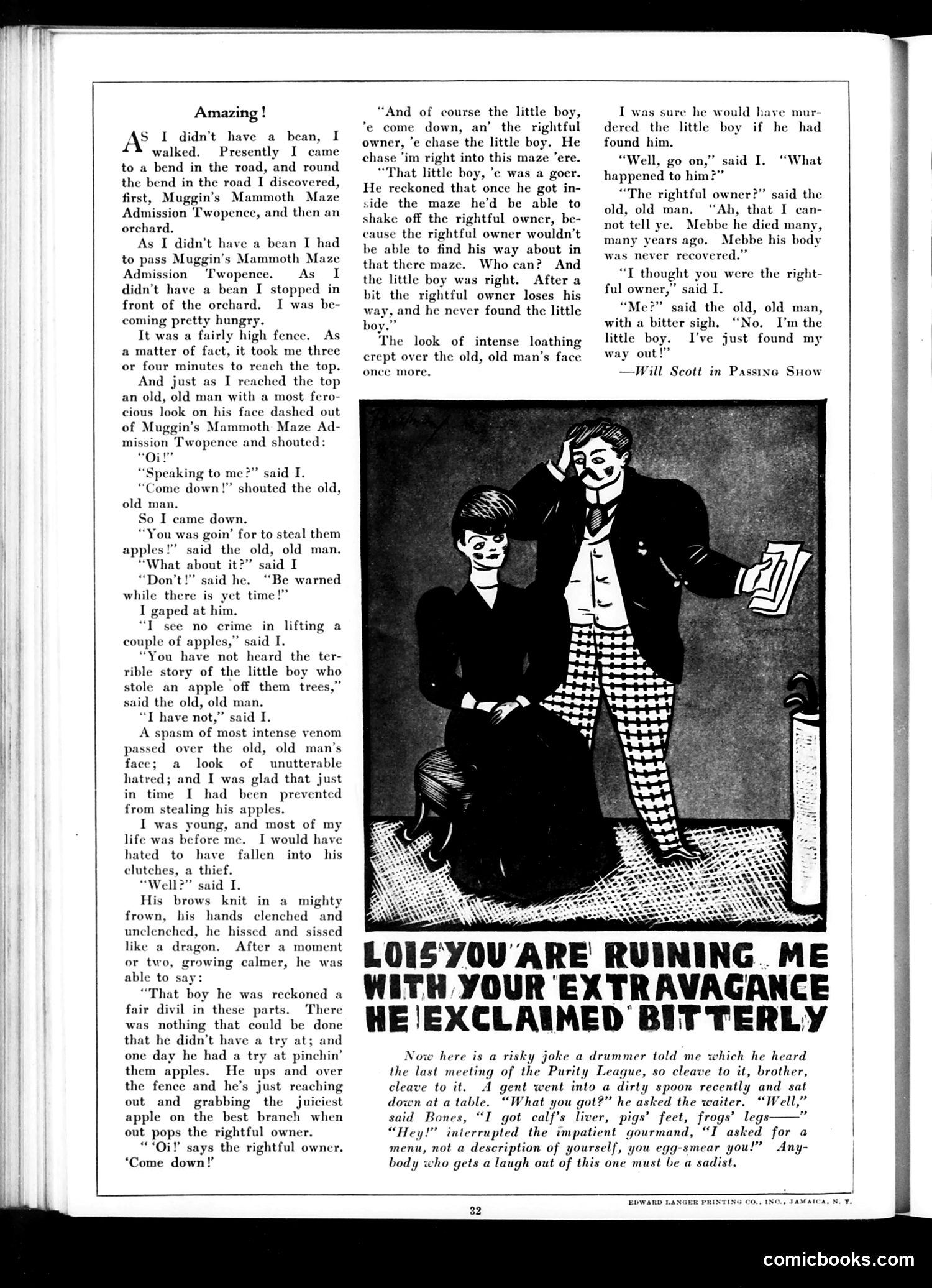
This page contains two separate humorous pieces: **"Amazing!"** — A narrative story about a hungry traveler attempting to steal apples from an orchard. An old man stops him and recounts a cautionary tale: a local boy once stole apples, fled into nearby "Muggin's Mammoth Maze" (a paid attraction), and became permanently lost inside. The rightful owner couldn't find him in the maze. The story's dark twist: the old man reveals he *is* that rightful owner—he's been waiting years and finally "found my way out," implying he was trapped in his own maze. The joke plays on ironic role reversal and the absurdity of being imprisoned by one's own property. **"Lois, You Are Ruining Me With Your Extravagance"** — A cartoon showing a well-dressed couple with the man exclaiming bitterly about spending. The accompanying text is a separate joke about a diner ordering from a waiter who describes himself instead of the menu—a crude insult humor typical of the era. Both pieces reflect early 20th-century American humor: dark irony, working-class dialect, and somewhat cruel punchlines.
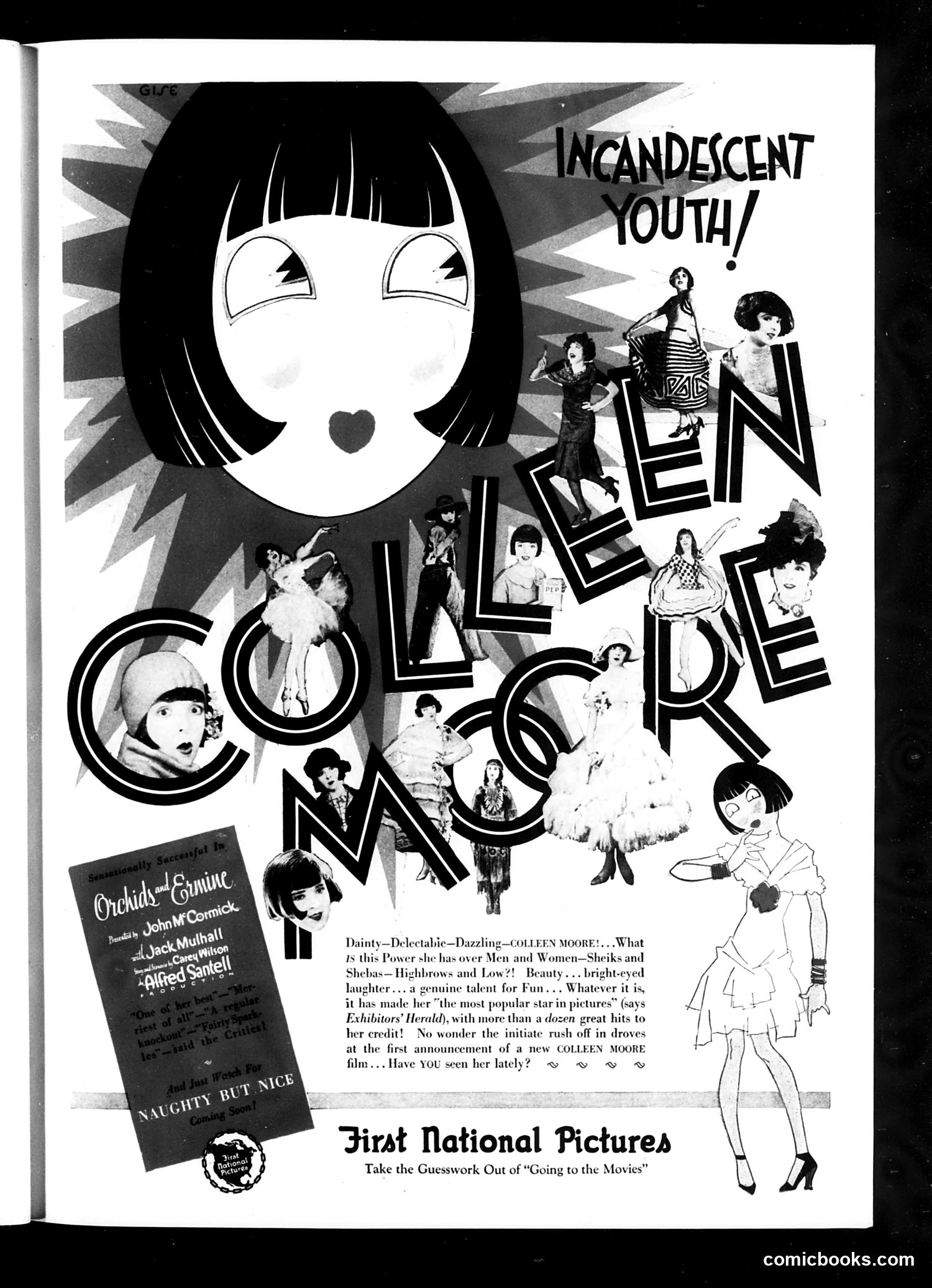
This is primarily a **film advertisement**, not political satire. It promotes actress **Colleen Moore** and her new film "Incandescent Youth," distributed by First National Pictures. The page uses Art Deco design typical of 1920s advertising—a stylized female face with dramatic eyes dominates the composition, surrounded by smaller photos of Moore in various glamorous poses and costumes. The text emphasizes her popularity ("most popular star in pictures") and her appeal to audiences. A smaller advertisement in the lower left promotes another Moore film, "Naughty But Nice," reinforcing the studio's marketing campaign. The phrase "Take the Guesswork Out of 'Going to the Movies'" suggests First National positioned itself as a reliable studio brand—implying moviegoers could trust their productions would be quality entertainment worth the admission price. This reflects the 1920s star-system era when studios marketed individual actors aggressively to fill theater seats.
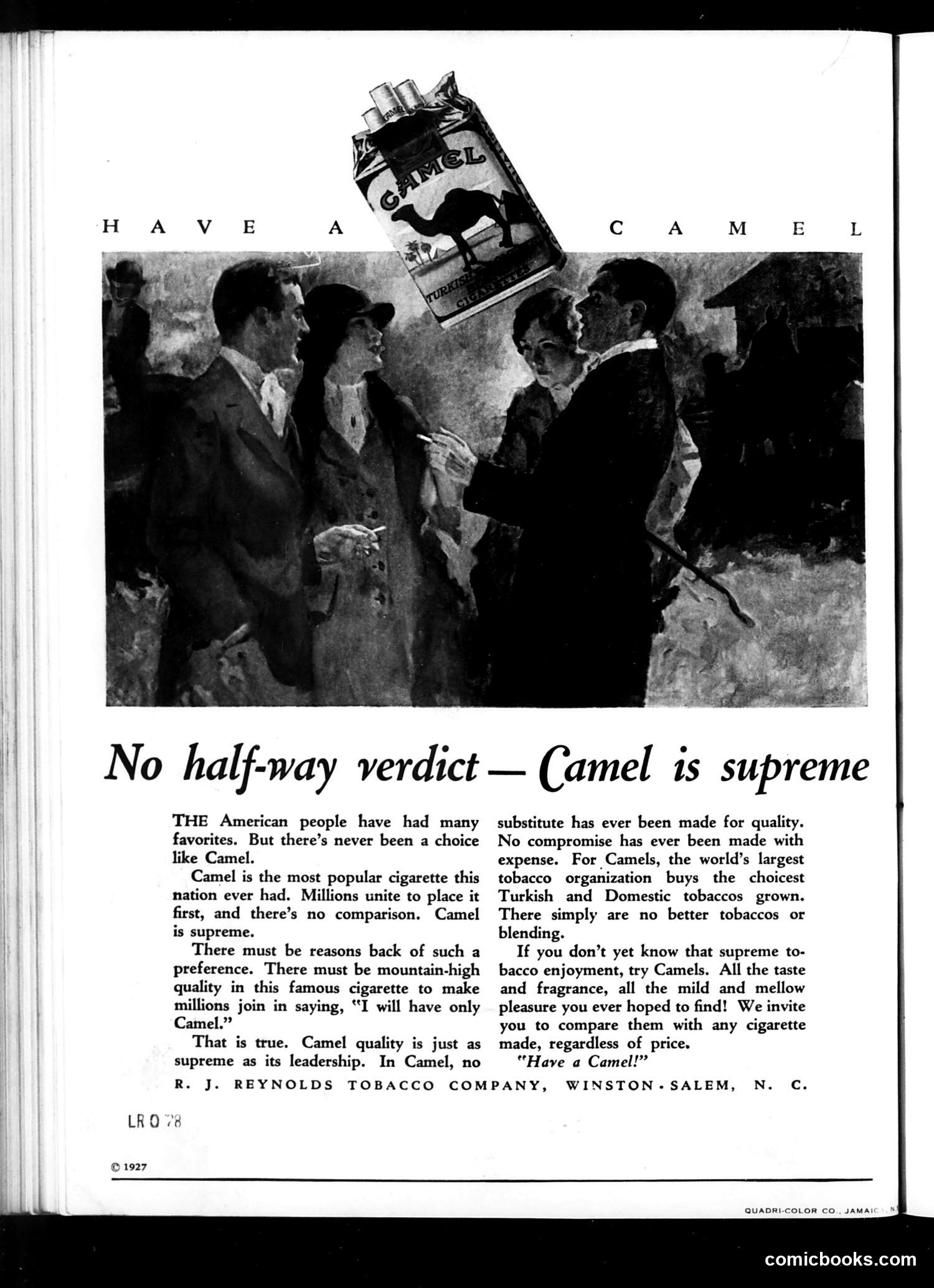
This is a **Camel cigarette advertisement**, not political satire. The page from *Judge* magazine (1927) features a full-page commercial promoting Camel as America's supreme cigarette brand. The black-and-white photograph shows well-dressed men in business attire gathered in conversation, apparently at a social gathering. The large Camel cigarette pack looms above them—a visual metaphor for the product's dominance and prestige. The advertisement's rhetoric emphasizes **quality, popularity, and exclusivity**: Camel is presented as the unchallenged favorite, made with "choicest Turkish and Domestic tobaccos" with "no compromise." The copy claims "millions" prefer Camels and invites readers to compare them favorably against any competitor. By modern standards, this represents **pre-regulation tobacco marketing**—a time when cigarettes were openly advertised in mainstream publications without health warnings, targeting broad audiences by associating the product with sophistication and social success.

I can see this is a page from Judge magazine, but the image appears to be almost entirely blank or blank white space. The only visible text is "comicbooks.com" at the bottom right corner, which appears to be a watermark or source attribution rather than original content from the magazine page itself. Without visible cartoon illustrations, caricatures, headlines, or substantive text content to analyze, I cannot identify the figures, political references, or satirical points that would be present on an actual Judge magazine page. The page may be a blank separator page, or the image quality/scanning has rendered the content invisible. To provide meaningful analysis, a clearer image showing the actual cartoon and text content would be needed.