
Judge, 1927-06-25 · page 9 of 37
Judge — June 25, 1927 — page 9: what you’re looking at
What you’re looking at
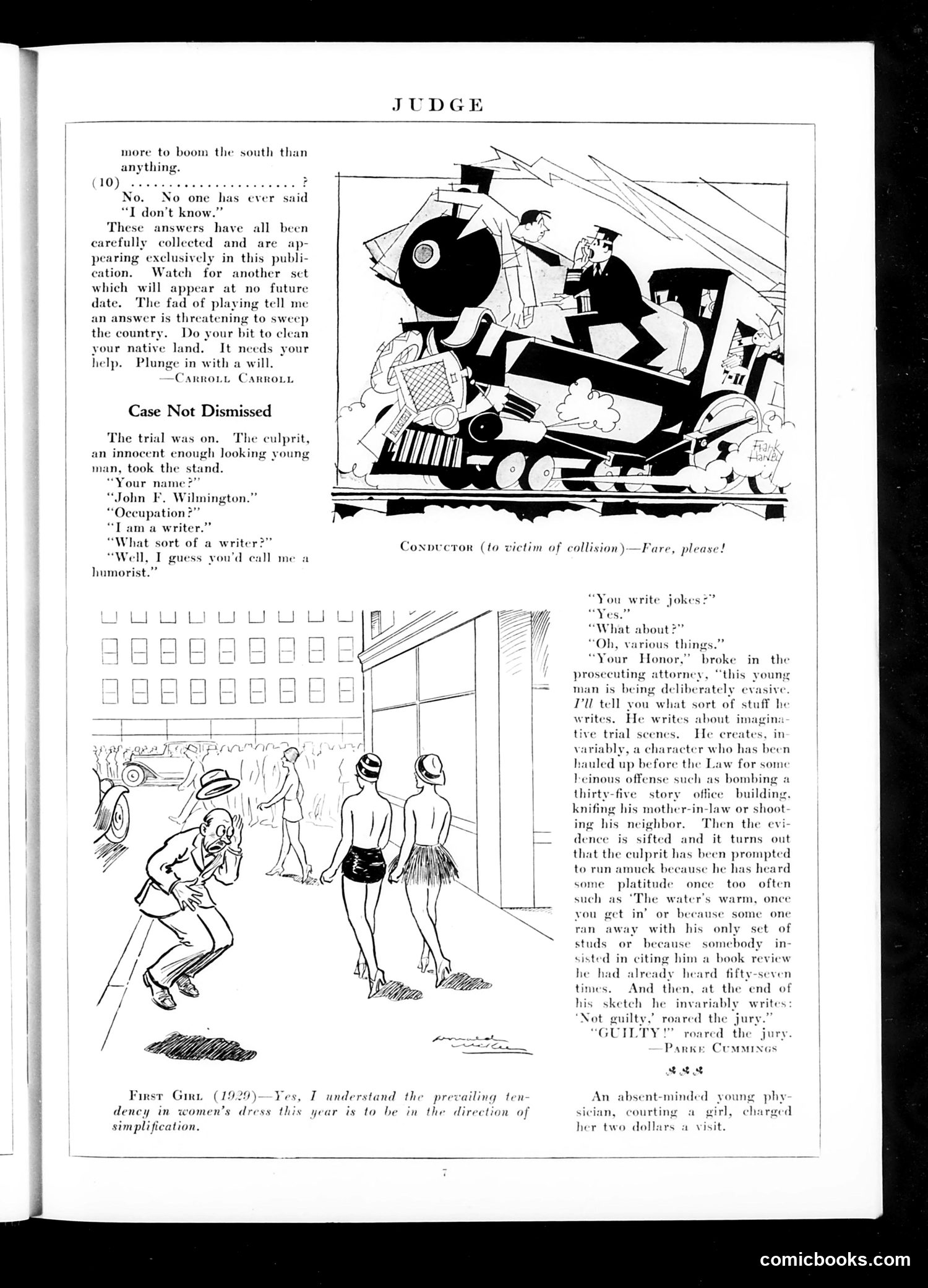
This page contains multiple satirical pieces reflecting 1920s American culture: **"Case Not Dismissed"** is the main feature—a courtroom sketch mocking humorist writers. A young man accused of being a writer admits he creates imaginary trial scenes featuring criminals driven to violence by trivial grievances ("The water's warm, once you get in"). The prosecuting attorney sarcastically catalogues his clichéd plots (bombing buildings, stabbing neighbors) to mock how shallow such humor is. The joke's irony: the writer himself is being tried for evasion while describing trials in his writing. **The cartoon above** shows a train conductor asking for fare from crash victims tangled in wreckage—an absurdist commentary on bureaucratic indifference. **"First Girl (1929)"** jokes about women's fashion trending toward "simplification"—likely referencing the flapper era's move away from restrictive corseting. **The bottom item** satirizes an absent-minded physician charging patients for visits while distracted by romance. Overall, the page exemplifies Judge's satirical approach: lampooning writers, social conventions, and professional absurdities through exaggerated scenarios and deadpan delivery.
📄 Transcribed text from this page (OCR, searchable)
Machine-transcribed from the original scan — historical spelling and the odd misread are preserved.
JUDGE more to boom the south than anything. (10) No. “I don’t know.” These answers have all been arefully collected and are ap- pearing exclusively in this publi- cation. Watch for another set which will appear at no future date. The fad of playing tell me an answer is threatening to sweep the country. Do your bit to clean your native land. It needs your help. Plunge in with a will. Carroie Carroun Case Not Dismissed The trial was on. The culprit, an innocent enough looking young man, took the stand. “Your nam “John F, Wilmington.” “Occupatio “Tam a writer.” t sort of a writer?” Vell, I guess you'd call me a humorist.” Convveror (to victim of collision) —Fare, please! “You write jokes?” “Yes.” “What about?” “Oh, various things.” “Your Honor,” broke in’ the prosecuting attorney, “this young man is being deliberately evasive. Pll tell you what sort of stuff he writes. He writes about imagina tive trial scenes. He creates, in ably, a character who has been hauled up before the Law for som« heinous offense such as bombing a thirty-five story office building. knifing his mother-in-law or shoot ing his neighbor. Then the evi dence is sifted and it turns out that the culprit has been prompted to run amuck beeause he has heard some platitude once too often such as ‘The water's warm, once | you get in’ or because some one ran away with his only set of studs or 1 ause somebody in- sisted in citing him a book review he had already heard fifty-seven times. And then, the end of his sketch he invariably w ‘Not guilty,’ roared the jury “GUILTY roared the Parke CumMincs Lt First Girt (1929)—Yes, I understand the prevailing ten An absent-minded young phy dency in women’s dress this year is to be in the direction of sician, courting a girl, charged simplification. her two dollars a visit. comicbooks.com