
Judge, 1927-06-25 · page 23 of 37
Judge — June 25, 1927 — page 23: what you’re looking at
What you’re looking at
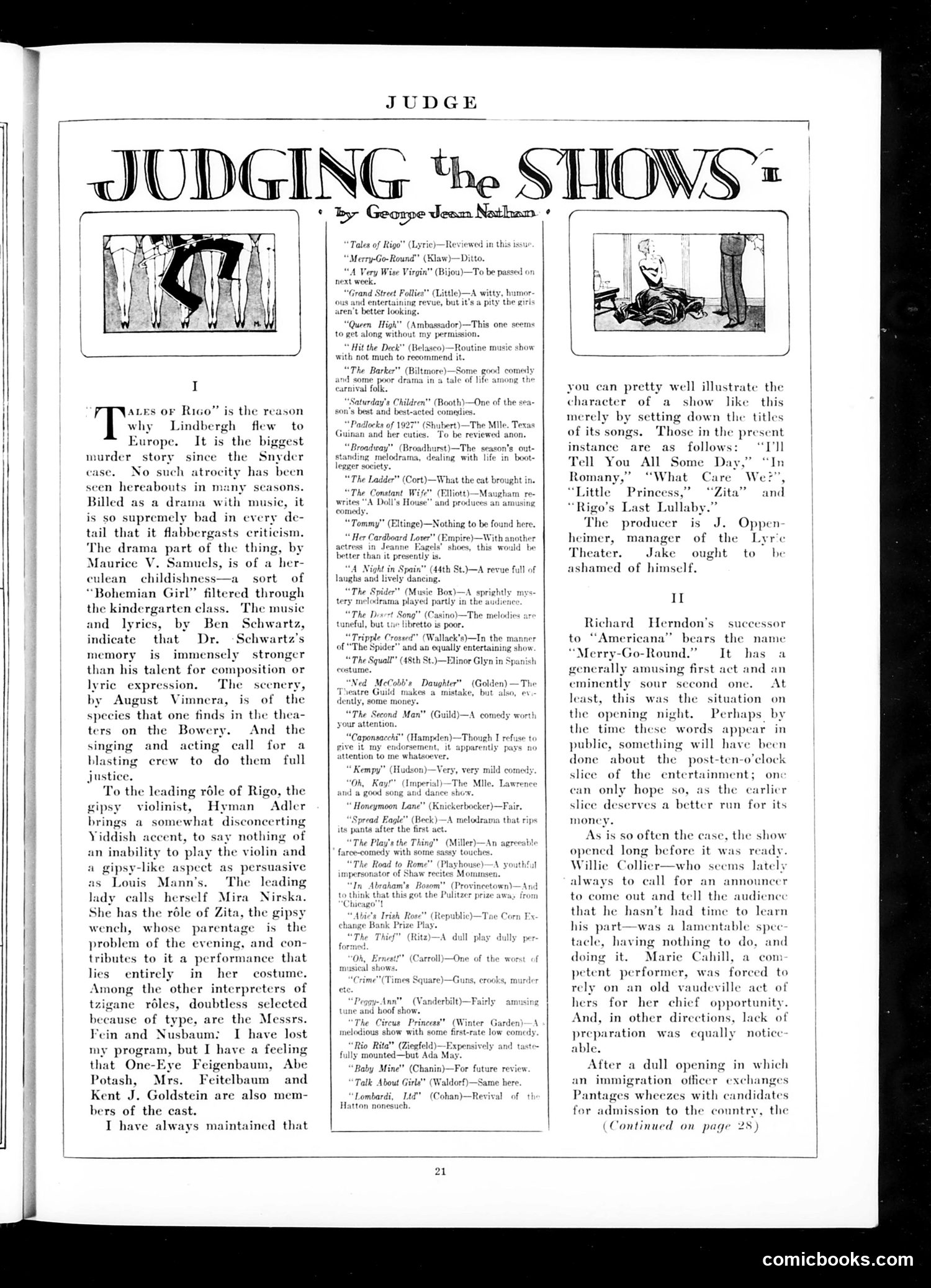
This is a theater review column by George Jean Nathan, a prominent drama critic of the 1920s. The page critiques Broadway productions currently running, with particular focus on "Tales of Rigo," which Nathan savagely demolishes as artistically inept despite its topical appeal (he opens by noting it's the reason Lindbergh flew to Europe—a reference to the famous 1927 transatlantic flight). Nathan's reviews employ caustic wit to mock poor performances and productions. He ridicules the "Bohemian Girl" plot as kindergarten-level drama, the music as derivative, and the cast—identifying performers by ethnic stereotypes (Yiddish accent, Jewish character names)—as inadequate. The accompanying illustrations show scenes from productions. This reflects 1920s theatrical criticism's frank, often crude judgmental style and casual ethnic caricaturing common to the era's entertainment journalism.
📄 Transcribed text from this page (OCR, searchable)
Machine-transcribed from the original scan — historical spelling and the odd misread are preserved.
JUDGE I ALES OF Rico” is the reason Tris Lindbergh flew to Europe. It is the biggest murder story since the Snyder No stich atrocity } seen here: case. as been outs in + any seasons. Billed as a drama with music, it is so supremely bad in every de- ail that it flabbergasts criticism. The drama part of the thing, by Maurice V. is of a her- can childishness—a_ sort of “Bohemian Girl” filtered through the kindergarten class. The music and lyrics, by Ben Schwart indicate that’ Dr. -Schwartz’s memory is muels immensely — stronger than his talent for composition or lyric expression. The by August Vimnera, is of the species that one finds in the thea- ters on the Bowery. And _ the singing and acting call for a blasting crew to do them full justice. To the leading réle of Rigo, the gipsy violinist, Hyman Adler brings a somewhat disconcerting Yiddish accent, to say nothing of an inability to play the violin and scenery, ie psy-like aspect as persuasiv Mann's. The leading lls herself Mira Nirska. Zita, the gipsy wench, whose parentage is the problem of the evening, and con- tributes to it a performance that lies entirely in her Among the ‘other interpreters of ey as Louis lady. ¢ She has the réle of costume. ane réles, doubtless selected because of type, are the Messrs. Fein and Nusbaum: I have lost my program, but I have a feeling that One-Eye Feigenbaum, Abe Potash, Mrs. Feitelbaum and Kent J. Goldstein a bers of the cast. I have alw so mem- ained that ys main “A Very Wise Virgin" (Bijou): next week. “Grand Street Follies" nd entertaining revu aren't better looking. “Queen High? (Ambassador)—This one to get along without my perm ttle)—A witty, hum but it’s a pity the sion. Hit the Deck"* (Belasco) —Routine musie show b not much to recommend “The Barker (Biltmo and some poor drama in a carnival folk. “Saturday's Children" (Booth)—One of the sea- 's best and best-acted comedies. Padlocks of 1927" (Shubert)—The Mile. Texa: Guinan and her cuties. To be reviewed anon. ‘ome good cot ale of life among th fhurst)—The se dealing with | “Broadway” (Bro: ‘on's_out- boot- (Cort)—What the cat brought in. “The Constant Wife’ (Elliott) —Maugham re- writes “A Doll’s House” and produces an g comedy. * Her Cardboa actress in Jean better than it pr npire)—With ar shoes, this w “4. Night in Spain’ laughs and liv ncing. “The Spider” (Music Box)—A sprightly mys tery “The Desert Song” (C: peful, but tn played partly in t ino)—The mele libretto is poor. riprle C1 (Wallack’s)—In the manner of “The Spider” and an equally entertaining show “The Squall” (48th St.)—Elinor Glyn tume. Ned tre reCob '» Daughter” (Golden) —The 1 makes a mistake, but also, ev dently, money. “The Second Man" (Guild)—A com your attention Hampden)—Though I r ment, it apparently p attention to me whatsoever. very mild co: The Mile. Lawrence Kempy” (Hudson)—Very ‘Oh, Kay!” (1 Honeymoon Lan id Eagle” (Beck) rbocker)—Fair, A melodrama that rips its panta after the first act. The Play's the Thing” (Miller)—An agreeable farce-comedy with some sassy touches. ie Road to Rome” mpersonator of Shaw re In Abrahan * (Provincetown) to think that this got the Pulitzer prize awa, *Abie's Irish Rose’ (Republic change Bank Prize Play. Tae Corn Ex A dull play duly. per * (Carroll)—Or (Vanderbilt)—Fs The Circus Princess” (Winter ( ndious show with some fir “Rio Rita” (Ziegfeld) —Expen fully mounted—but Ada May. Baby Mine (Chanin)—For fu Talk About Girle” (Wald Lombardi, Ltd" (Cohan)—R Hatton nonesuch. am you can pretty well illustrate the character of a show like this merely by setting down the titles Those in the present instance are as follows “TH Tell You All Some Day,” “In Romany,” What Care We?’, “Little Princess,” “Zita” and igo’s Last Lullaby.” of its song: The producer is J. Oppen heimer, manager of the Lyre Theater. Jake ought to Ix ashamed of himself. II Richard Herndon’s to “Americana” bears the name “Merry-Go-Round.” It) has a generally amusing first : eminently successor ‘tand an sour second one, At least, this was the situation on the opening night. the time these Perhaps. by words appear in public, something will have been done about the post-ten-o’clock slice of the entertainment; on can only hope so, as the earlier slice deserves a better run for its mone As is so often the case, the show opened long before it v udy. Willie Collier—who seems lately alw ys to call for an announcer to come out and tell the audienc: that he hasn’t had time to learn his part—was a lamentable spec having nothing to do, and Marie Cahill, petent performer, was for rely on an old tac! doing it. 1 com d to deville act of hers for her chief opportunity. And, in other directions, lack of preparation ¥ able. After a dull opening in which an immigration officer exchar noticc s equally Pantages wheezes with candidates 1dmission to the country, the (Continued on page 28) comicbooks.com