
A complete issue · 36 pages · 1927
Judge — April 2, 1927
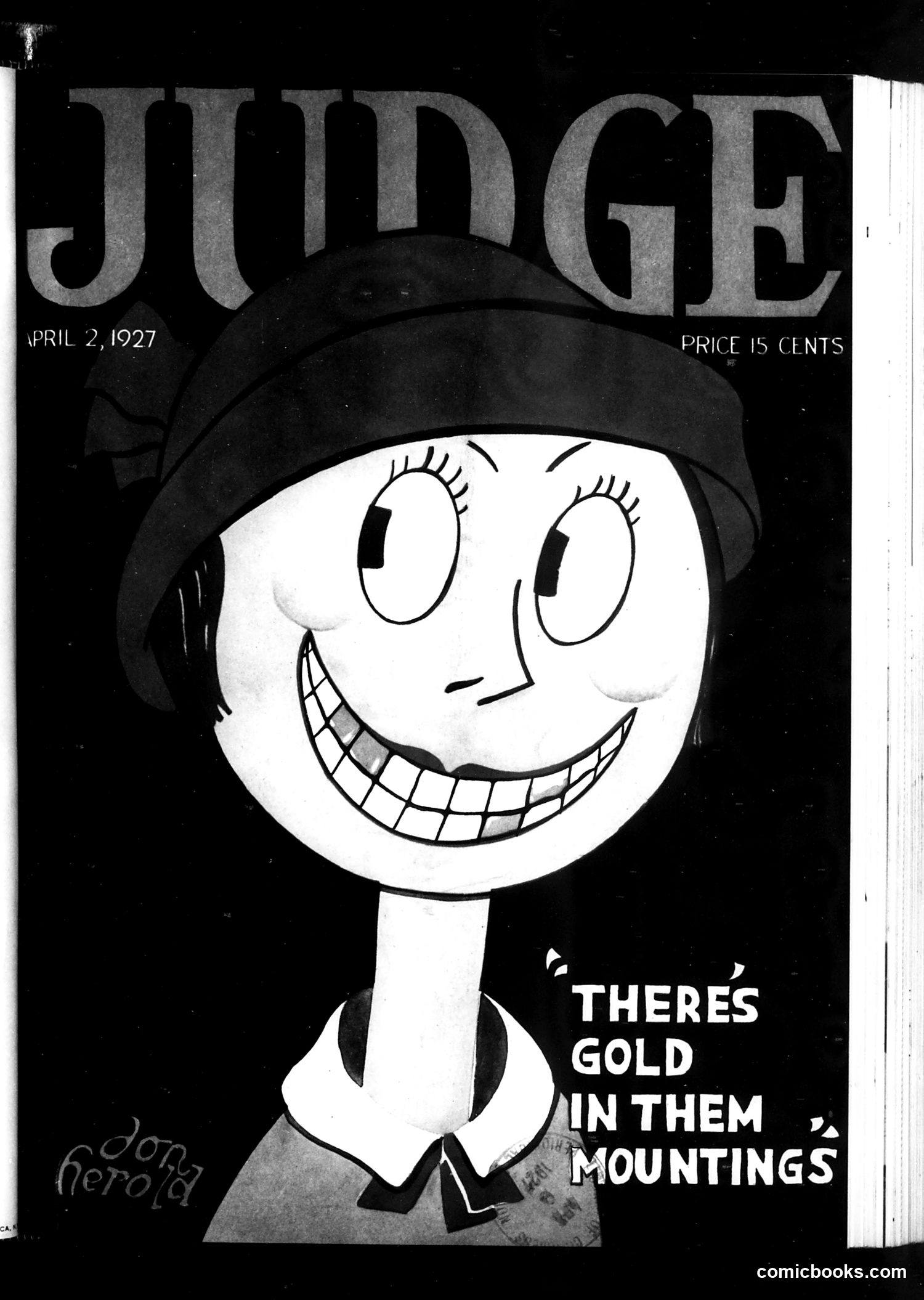
This is a **Judge magazine cover from April 2, 1927** (price: 15 cents). The artwork shows a cheerful, cartoonish character with an enormous grin wearing a black hat and white collar, characteristic of 1920s illustration style. The text "THERE'S GOLD IN THEM MOUNTINGS" appears to be a play on the phrase "there's gold in them hills" — a reference to gold rush fever. The specific "mountings" reference likely alludes to **jewelry settings or watch cases**, suggesting a satirical commentary on commercialization or speculative economic ventures popular during the 1920s prosperity era. Without additional context about the specific date or political climate, the exact target of this satire remains unclear, though it appears to mock contemporary consumer enthusiasm or financial speculation during the Jazz Age.
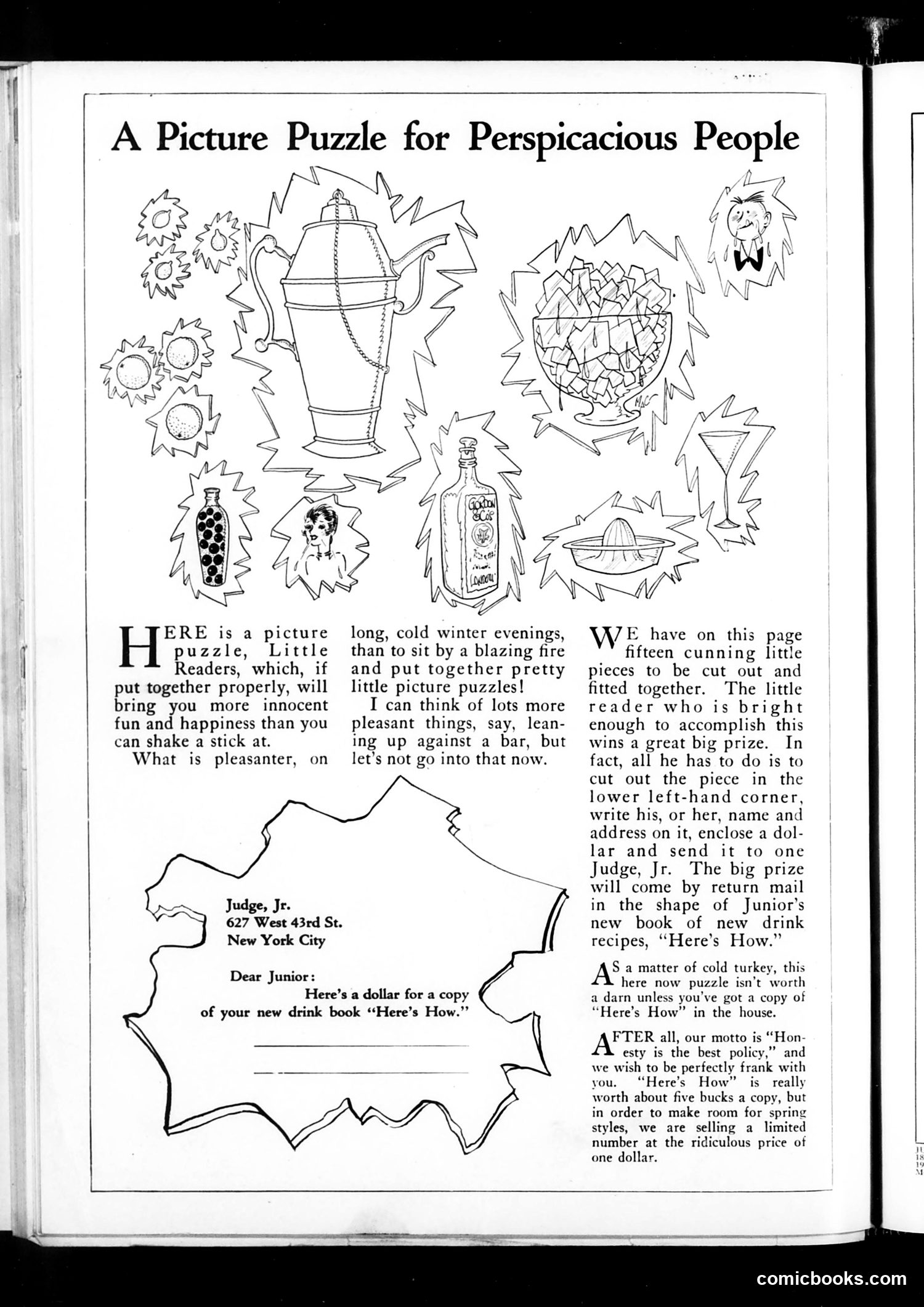
This page is primarily a **puzzle contest advertisement** rather than political satire. Judge magazine is promoting a picture puzzle competition where readers cut out fifteen pieces and assemble them, then mail the result to "Judge, Jr." at the provided address. The puzzle pieces depict **drinking-related imagery**: a cocktail shaker, bottle, citrus juicer, fruit basket, cocktail glass, and a caricatured face (likely representing a drunk person). This reflects the **Prohibition era context**—the imagery appears to ironically reference illegal alcohol despite the 18th Amendment's ban. The prize is a copy of a "drink recipes" book titled "Here's How," sold for one dollar. The ad's humor relies on this oblique reference to forbidden beverages during a period when such content was necessarily subtle or coded.
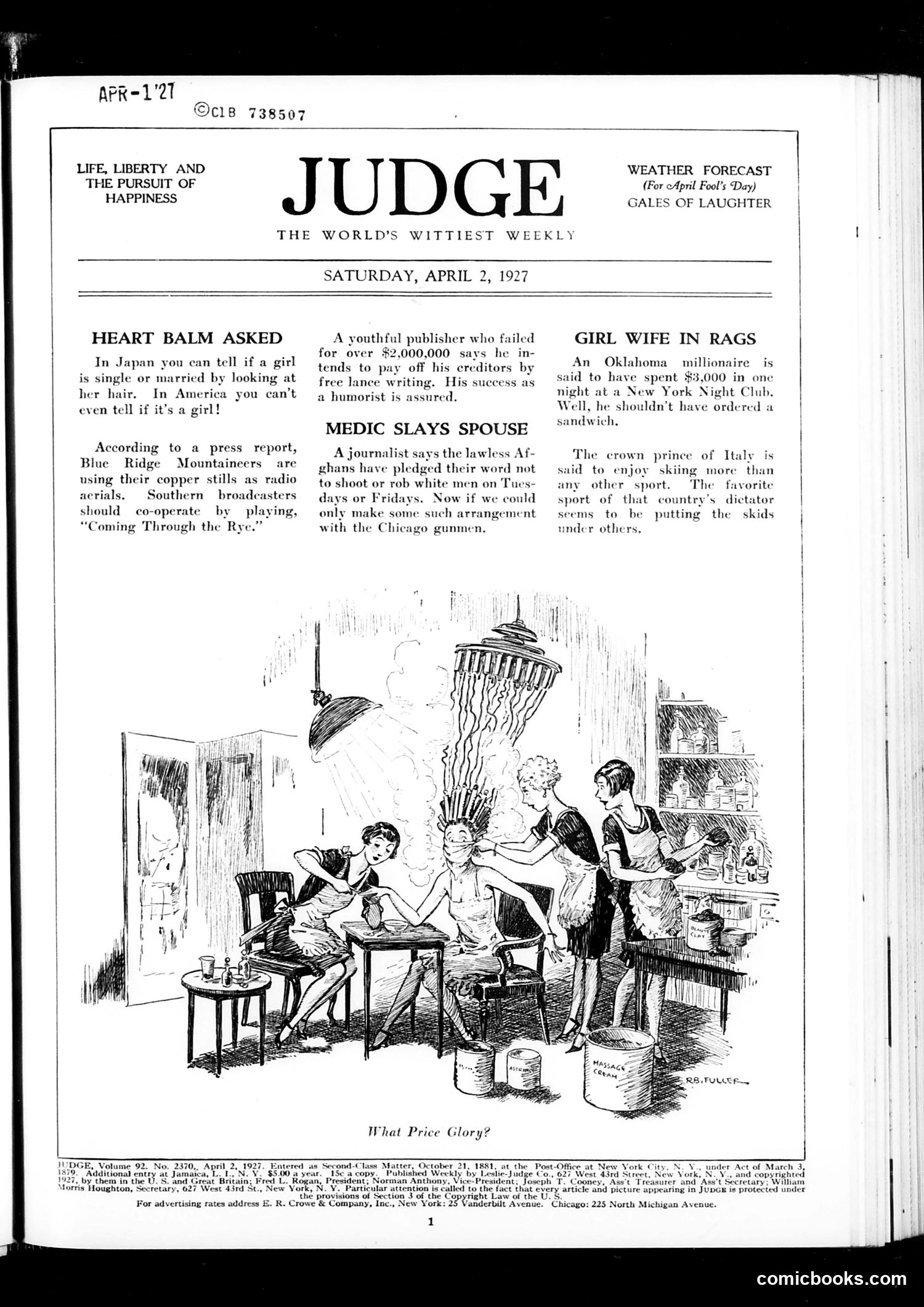
The main cartoon satirizes domestic labor and women's roles in 1920s households. It depicts women engaged in various household tasks—cooking, cleaning, ironing—with water pouring down on them from above, suggesting they're drowning in endless domestic duties. The caption "What Price Glory?" is ironic: it questions what "glory" or reward women receive for their constant, exhausting housework. This reflects 1920s feminist discourse about unpaid domestic labor, even as women gained voting rights (1920) and entered the workforce. The cartoon critiques the gap between women's newfound legal freedoms and their continued entrapment in traditional domestic roles. The satire suggests that despite social progress, women still faced relentless, thankless household responsibilities with no recognition or compensation.
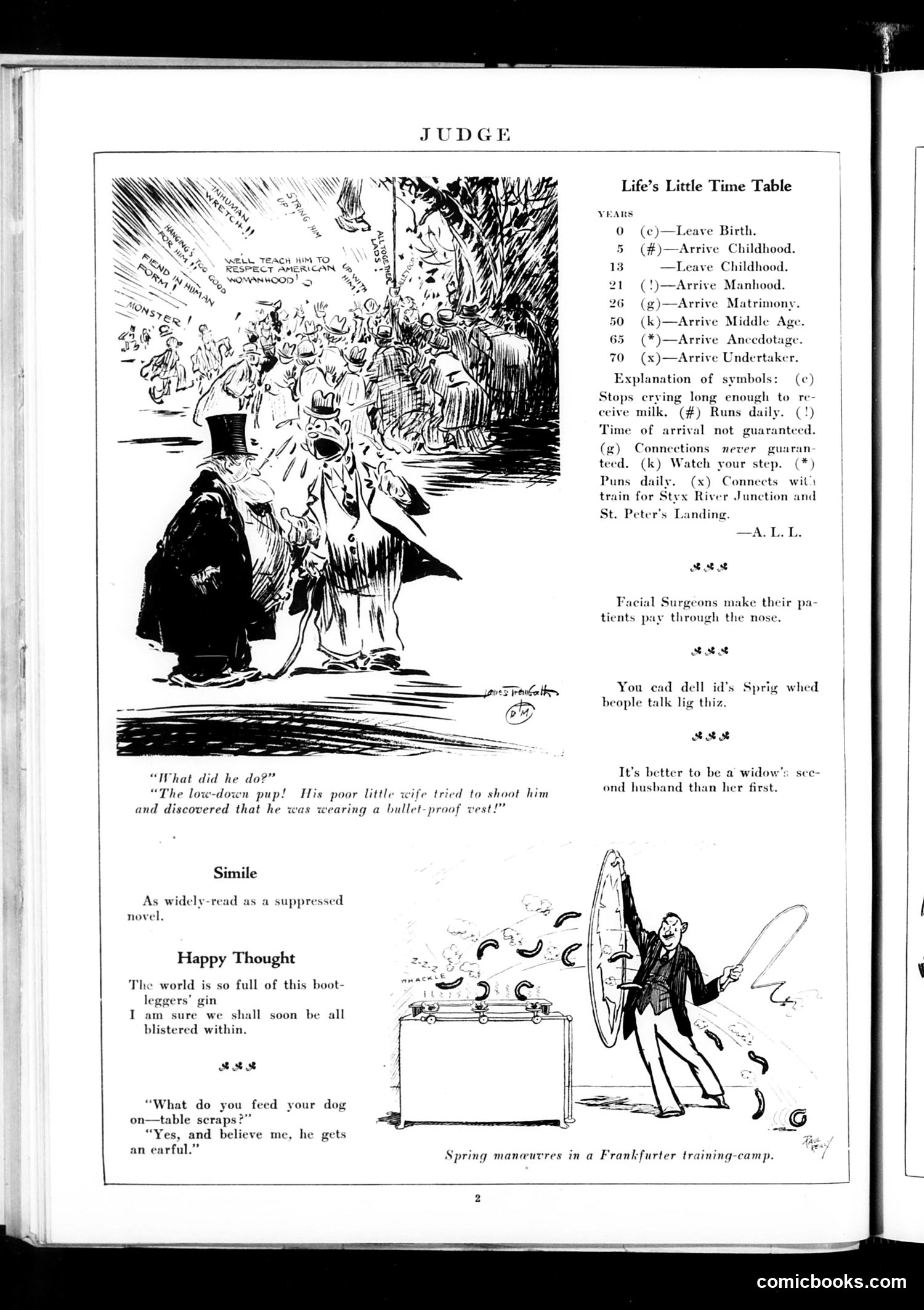
This page from *Judge* magazine contains several satirical pieces and illustrations. The main cartoon depicts a figure in black (appearing to be Death or a similar dark character) confronting a group of people, with a caption referencing someone shooting another person wearing a bullet-proof vest—likely satirizing violent crime or a specific incident. The secondary content includes brief humorous observations and a sketch labeled "Spring manoeuvres in a Frankfurter training camp," showing a man with a sausage, which appears to be visual wordplay. The "Life's Little Time Table" is a cynical life-stage guide using symbols to mark life events from birth through old age, exemplifying *Judge*'s satirical approach to social commentary. Without specific dating or additional context, the precise political references remain unclear, though the overall tone reflects early-to-mid 20th century American satirical sensibilities about crime, mortality, and modern life.
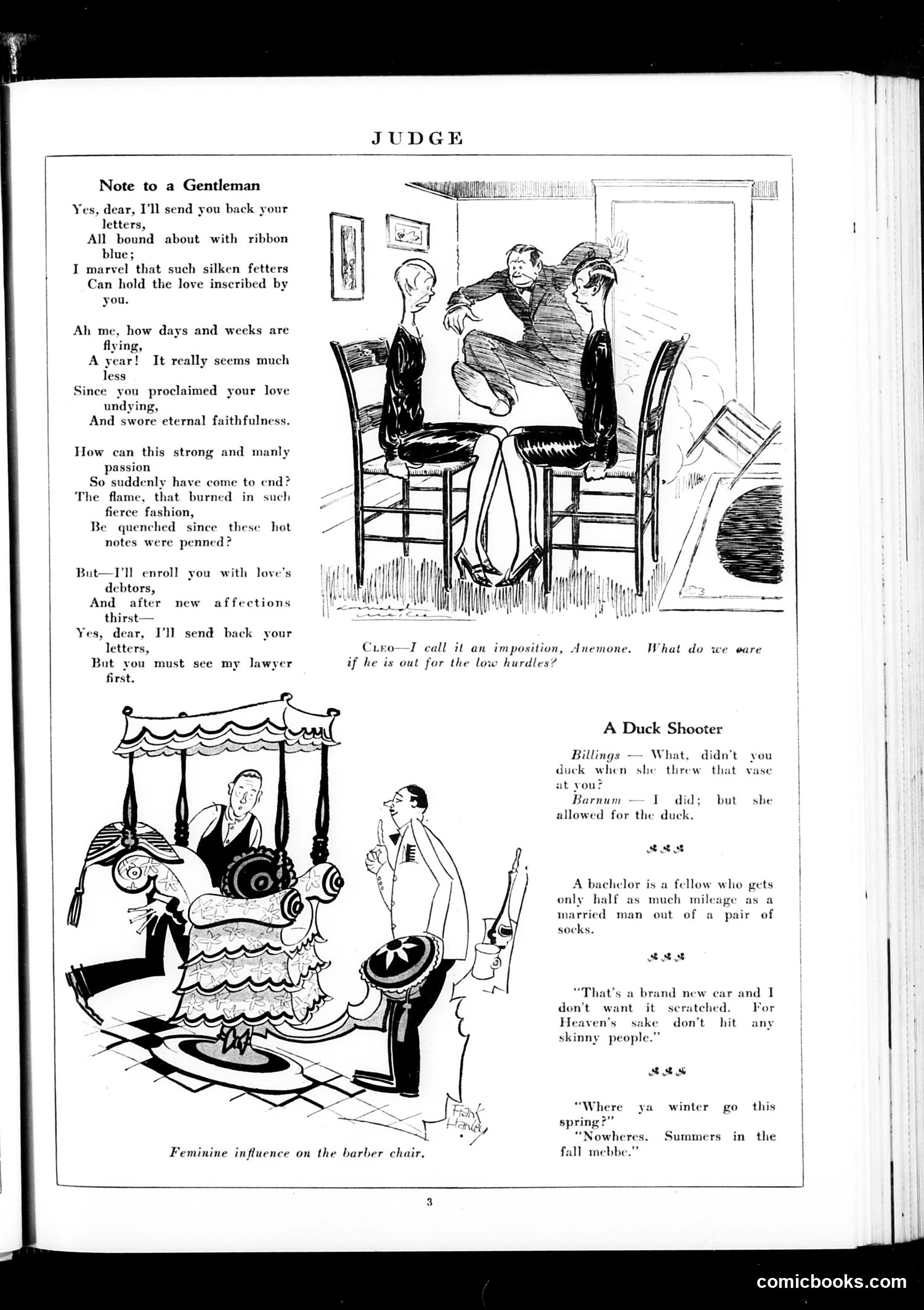
This page contains three satirical pieces: **"Note to a Gentleman"** (top): A poem mocking romantic disillusionment. A man intercepts his girlfriend with another suitor, discovering her infidelity after declaring eternal love. The satire targets male naiveté about female constancy, suggesting women "enroll" new lovers once passion fades. The final line—"you must see my lawyer first"—jokes that even romantic rejection requires legal intervention. **"A Duck Shooter"** (bottom left): Cartoon mocking a man's complaint about his girlfriend damaging his new car. The punchline—"she allowed for the duck"—suggests she deliberately aimed for the bird, showing careless disregard for his property. **Miscellaneous jokes** (right): Brief quips on bachelor frugality and automotive vanity reflect early 20th-century consumer culture humor. The overall theme satirizes courtship, gender relations, and modern materialism.
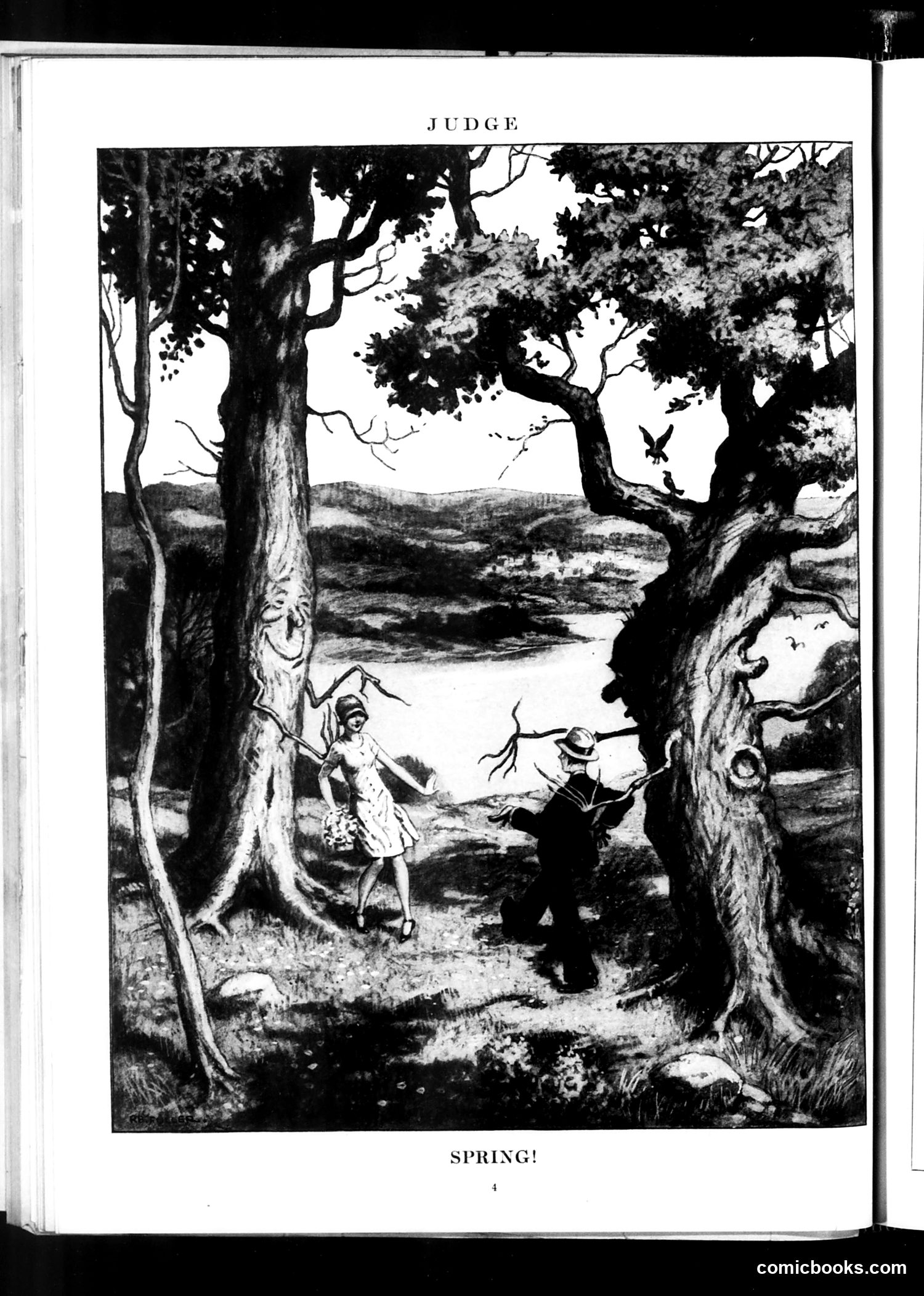
This page shows a romantic woodland scene titled "Spring!" with a young couple by a river framed by large trees. The man appears to be proposing or expressing affection to the woman, who holds a fishing rod. The illustration represents the seasonal theme of spring as a time of renewal, romance, and courtship—a common sentimental trope in early 20th-century American humor magazines. The natural setting, blooming foliage, and young lovers embody idealized springtime romance. Without additional OCR text or context, the specific satirical intent remains unclear. Judge often used such imagery either to celebrate romantic ideals ironically or to gently mock courtship conventions of the era. The fishing rod suggests outdoor leisure and courtship rituals typical of the period.
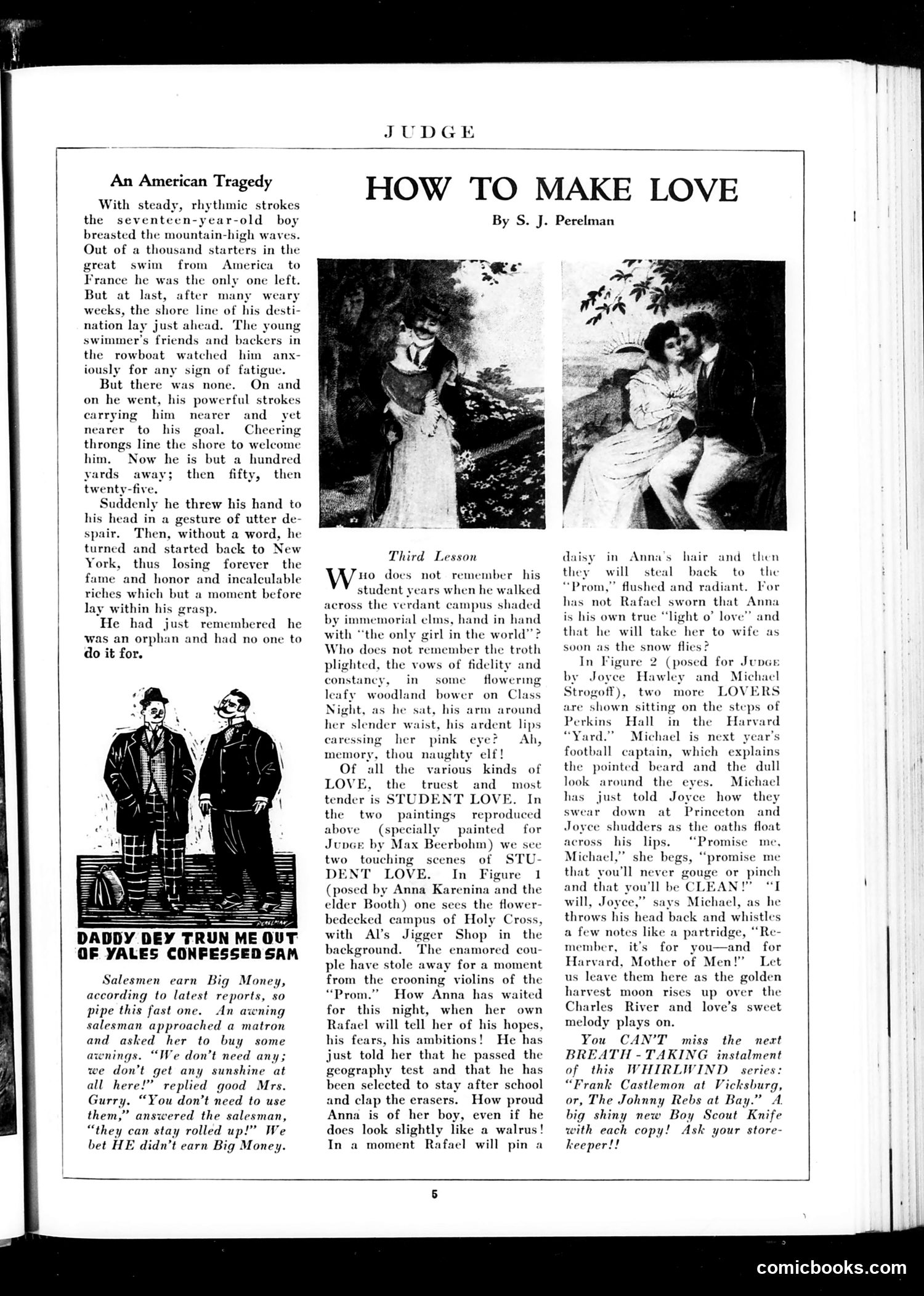
This cartoon satirizes working-class men making dubious claims about wealth. The dialogue mocks a salesman boasting about earning "Big Money" through sales, with another man skeptically challenging his story about not getting "any sunshine at all here." The final exchange—where the first man claims the salesman didn't earn real money—suggests humor around exaggerated business success stories and door-to-door sales pitches common in the era. The accompanying article "How to Make Love" appears to be romantic advice, unrelated to the cartoon's economic satire. The page captures Judge magazine's typical blend of working-class humor and social commentary about American commerce and aspiration.
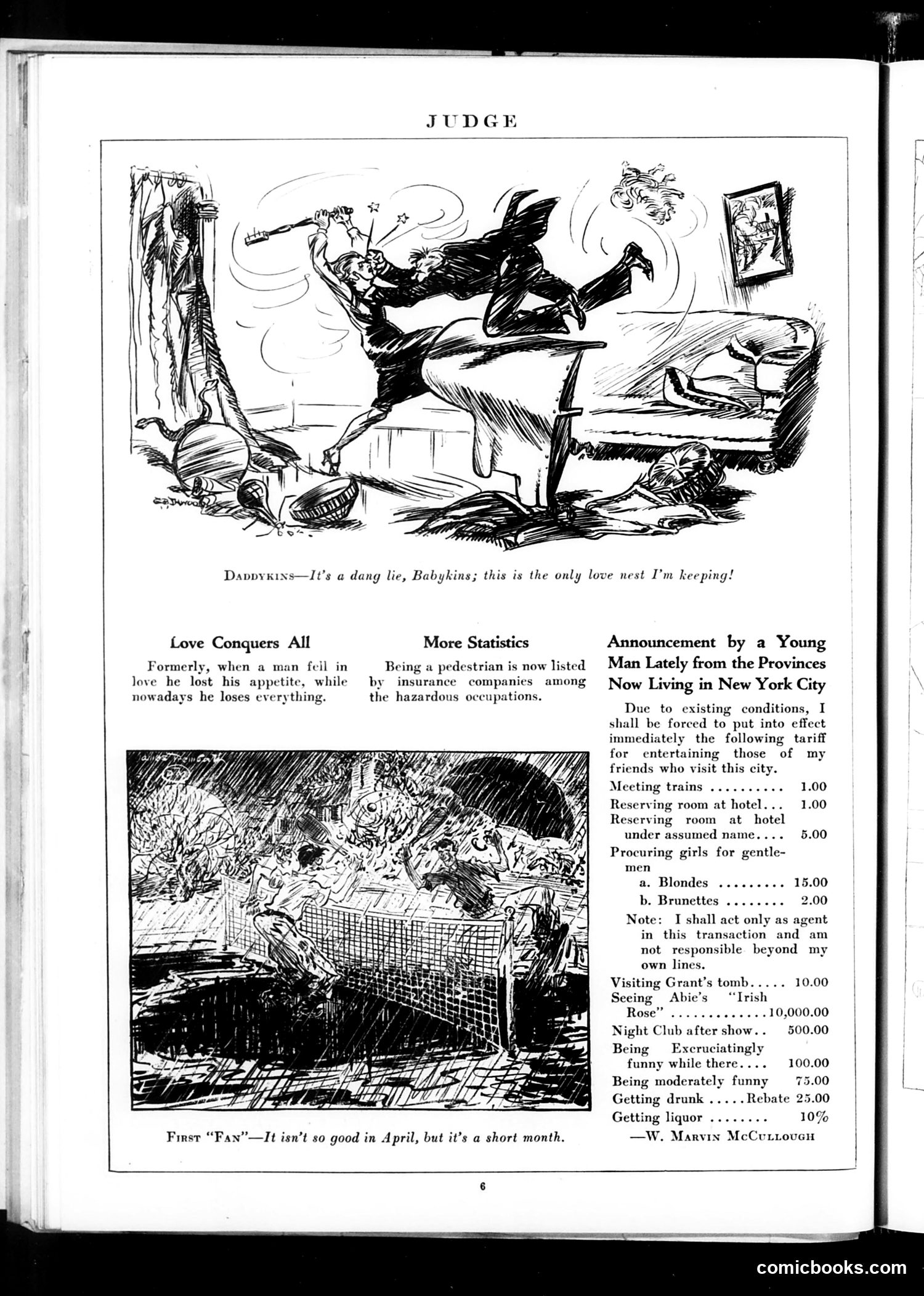
This page contains multiple satirical pieces mocking early 20th-century American social life: **Top cartoon**: "Dappykins" depicts a man in a messy apartment, caught by his partner. He claims this is his "only love nest," sarcastically commenting on infidelity and the era's sexual double standards. **"Love Conquers All"**: A brief observation that while past lovers lost their appetites, modern men lose "everything"—likely referencing financial ruin from romantic entanglements or divorce. **"More Statistics"**: Dark humor about pedestrian safety, suggesting cars have made walking dangerously common. **"Announcement" (main feature)**: A provincial newcomer to New York City humourously "charges" visiting friends for entertainment, with inflated prices for procuring women (blondes costlier than brunettes), nightclubs, and inebriation—satirizing both urban vice and provincial naïveté. The overall tone mocks romantic folly, modern urban corruption, and social climbing.
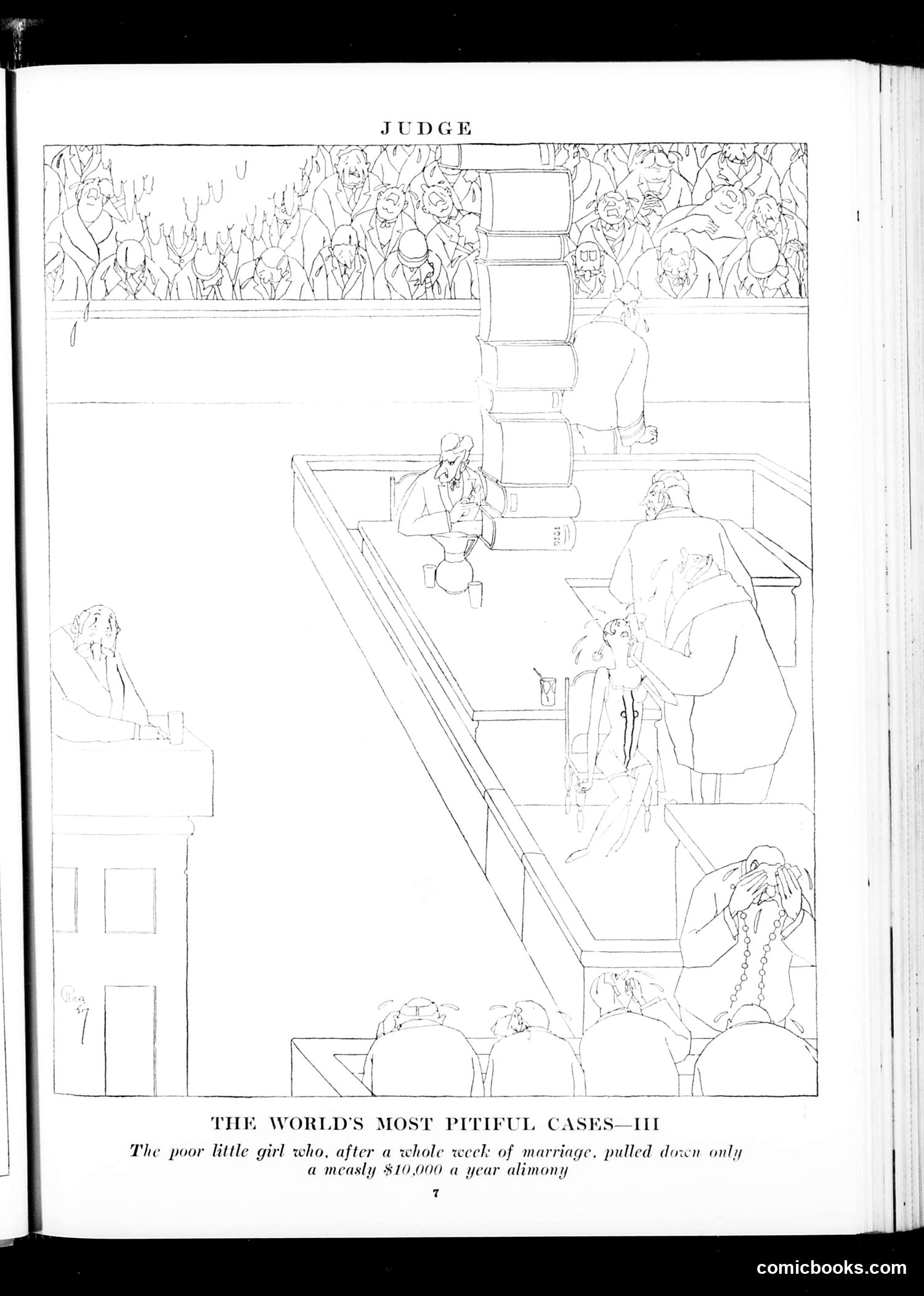
This satirical cartoon from *Judge* magazine mocks a wealthy woman's alimony settlement. The illustration depicts a courtroom scene where a young woman, after only one week of marriage, successfully sued for divorce and received $10,000 annual alimony—which the caption sarcastically calls "measly." The satire targets the perceived excess of wealthy women exploiting brief marriages for financial gain. The "pitiful cases" series format suggests ironic sympathy: the cartoon presents her complaint about the alimony amount as laughably inadequate, when $10,000 yearly was substantial income for the 1910s-1920s era. This reflects broader social anxieties about divorce, women's legal rights to spousal support, and wealth inequality. The courtroom's crowded gallery suggests public fascination with such scandals. The joke assumes reader agreement that the settlement is absurdly generous.
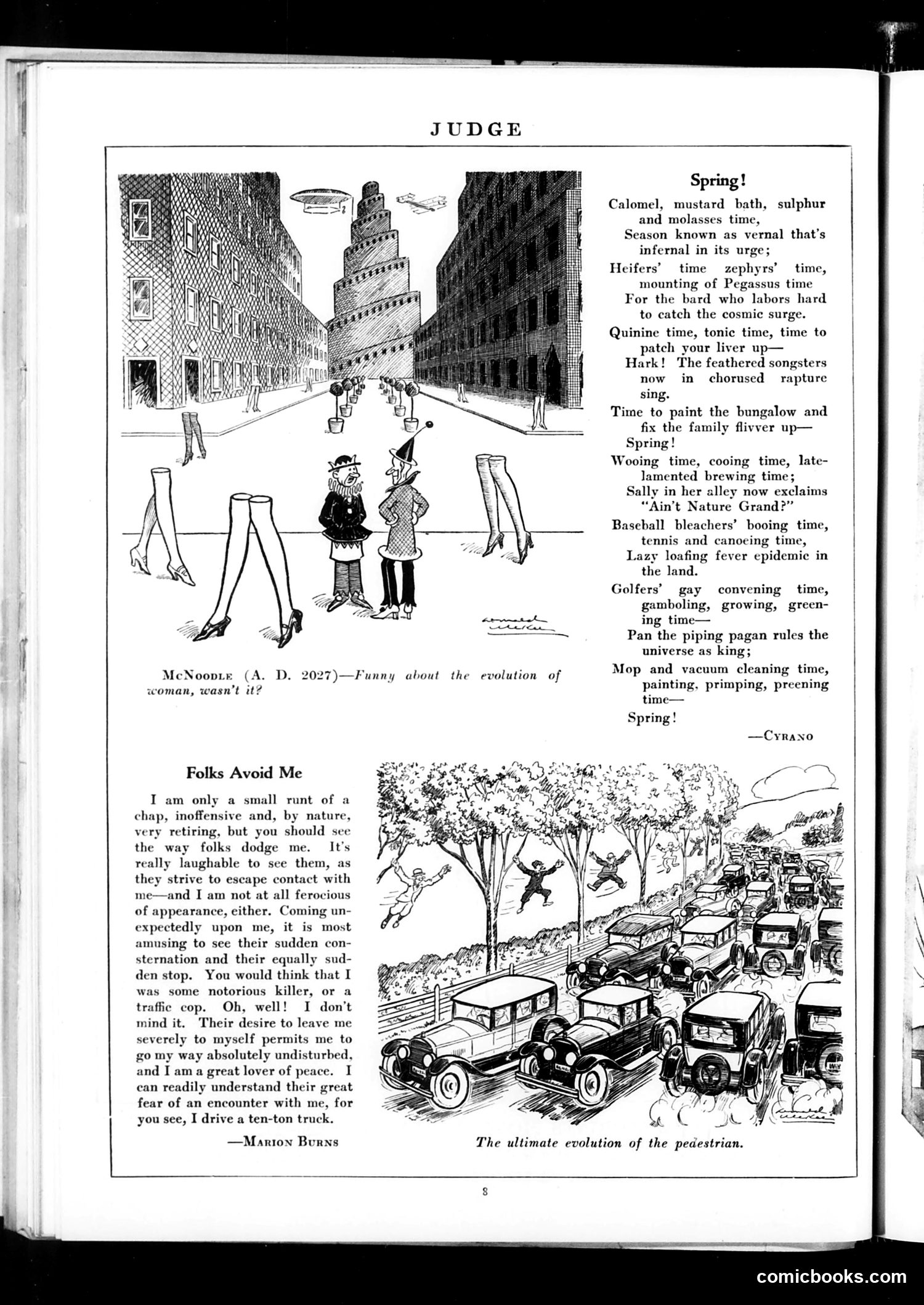
This Judge page contains two separate pieces of satire from the 1920s era. **"McNoodle (A.D. 2027)"** depicts a futuristic woman, apparently transformed by evolution. The joke plays on anxieties about women's changing roles—the caption "Funny about the evolution of woman, wasn't it?" suggests bemused commentary on how women had become more independent and visible in public life following suffrage (1920). **"Folks Avoid Me"** is a humorous monologue by a ten-ton truck driver explaining why pedestrians fearfully scatter around him. The satire mocks the rapid motorization of American life and the new dangers trucks posed to street life—the irony being that an "inoffensive" person becomes terrifying simply because of the vehicle he drives. **"Spring!"** is a lighthearted poem celebrating springtime activities—from spring cleaning to baseball to courting—with no particular political bite. The bottom cartoon, "The ultimate evolution of the pedestrian," visually reinforces the truck joke: it shows pedestrians reduced to tiny figures dwarfed by automobiles, satirizing how cars were literally displacing people from urban streets.
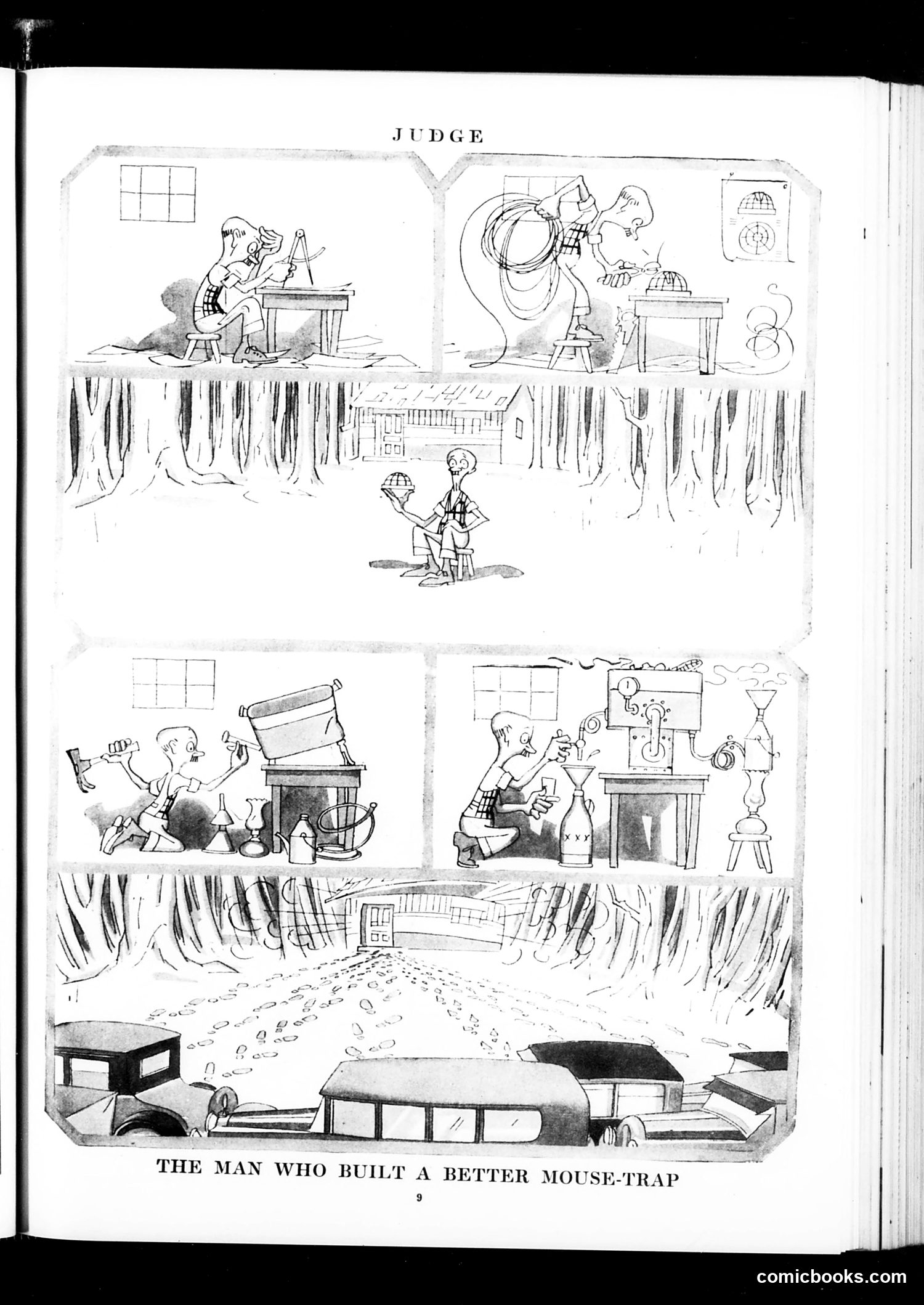
This satirical cartoon illustrates the famous Ralph Waldo Emerson quote: "Build a better mousetrap, and the world will beat a path to your door." The sequence shows an inventor in his forest workshop progressively creating an elaborate mechanical trap. The humor escalates as his invention becomes increasingly complex and impractical—far exceeding what's needed to catch a simple mouse. The satire mocks American entrepreneurial optimism and the obsession with "improvement" and innovation for its own sake. It suggests that inventors can become so fixated on perfecting their creations that they lose sight of practicality. The expanding scale of the contraption, complete with elaborate machinery, demonstrates how ambition can spiral into absurdity. The cartoon critiques the belief that innovation alone guarantees success—a common theme in Judge magazine's commentary on American business culture.
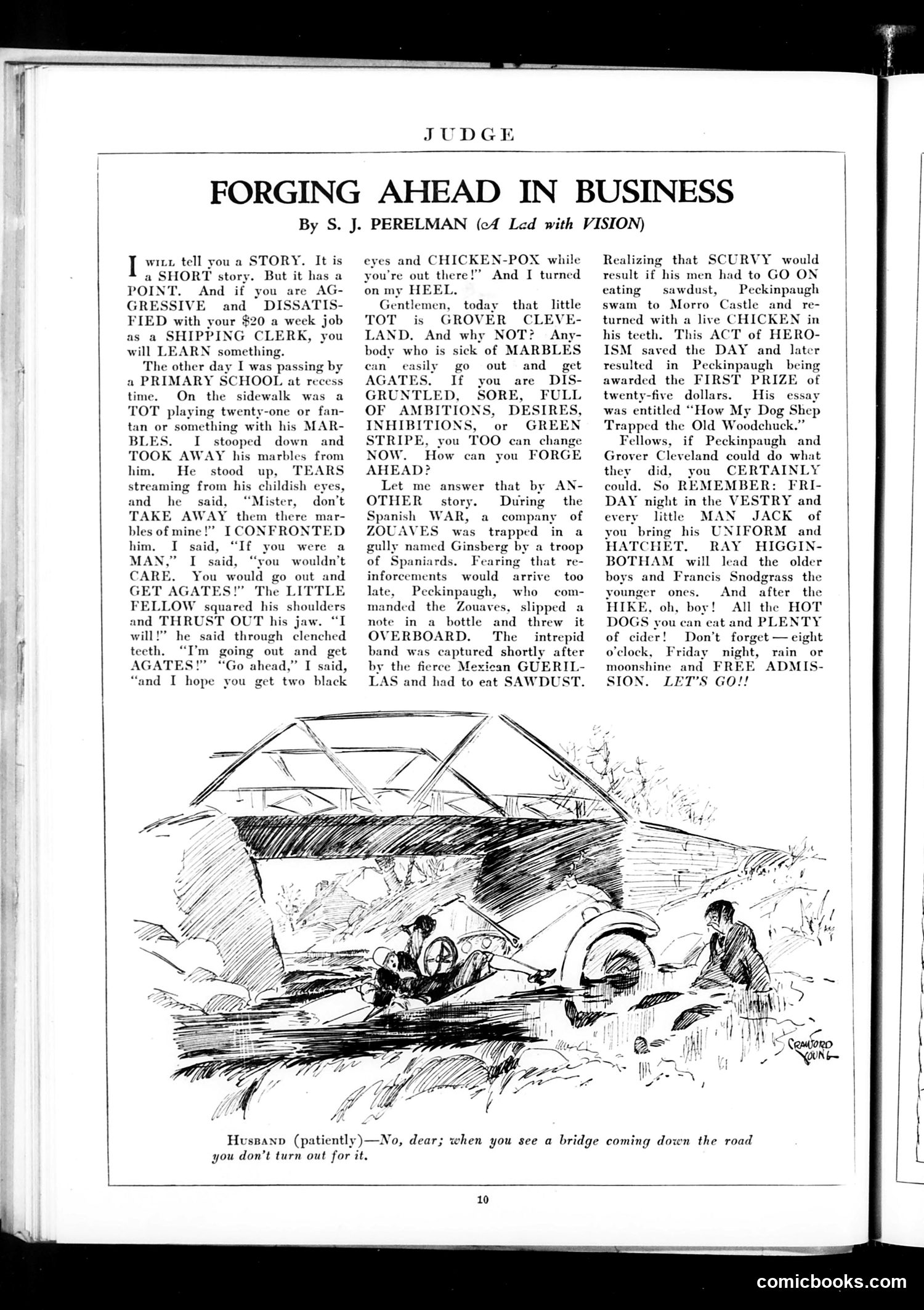
This is a satirical article by humorist S.J. Perelman mocking American success-narrative propaganda. The piece presents absurd, rambling "inspirational" anecdotes meant to mock the genre entirely. Perelman's narrator describes stealing marbles from a schoolboy to supposedly motivate him—an obviously terrible approach presented as wisdom. The second story involves a Spanish-American War soldier eating sawdust, contrived impossibly to end with a dog-and-woodchuck tale winning a prize. The humor lies in the deliberately non-sequiturs, logical gaps, and the cartoon's caption showing a husband advising against dodging bridges—visual proof the advice is nonsensical. The satire targets Gilded Age "bootstrap" business ideology and motivational speaking that passed off cruelty or absurdity as character-building. Perelman exposes how such narratives collapse under scrutiny, working through exaggeration and bewildering plot leaps to show their fundamental dishonesty.
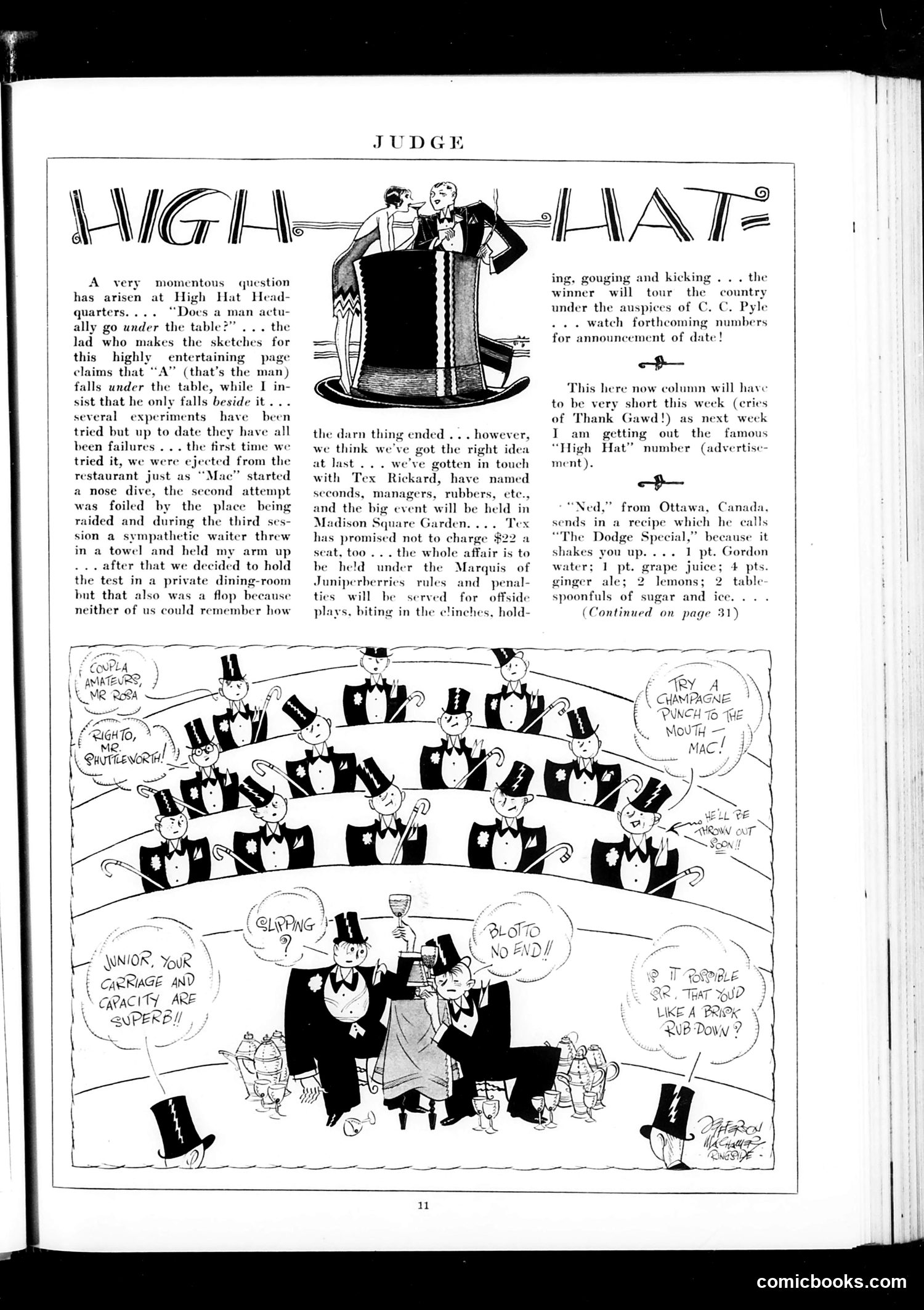
This page satirizes the Prohibition era's speakeasy culture and underground drinking. The main cartoon depicts a "High Hat" (fancy) speakeasy dinner where well-dressed men in formal wear are getting drunk—speech bubbles reveal their inebriated states ("Slurping," "Blotto no end," "Try a champagne punch to the mouth, Mac"). The accompanying text humorously debates whether a drunk man actually goes "under the table" during revelry, proposing to settle it as a boxing match at Madison Square Garden with a referee (Tex Rickard, a famous fight promoter). This mocks both the absurdity of Prohibition enforcement and the era's obsession with spectacle. The recipe section provides a "Dodge Special" cocktail—the "Dodge" reference likely alludes to Prohibition-era slang or evasion tactics. Overall, the page satirizes upper-class flouting of Prohibition laws through elaborate private dining venues and the elaborate "sporting" nature of their drinking culture.
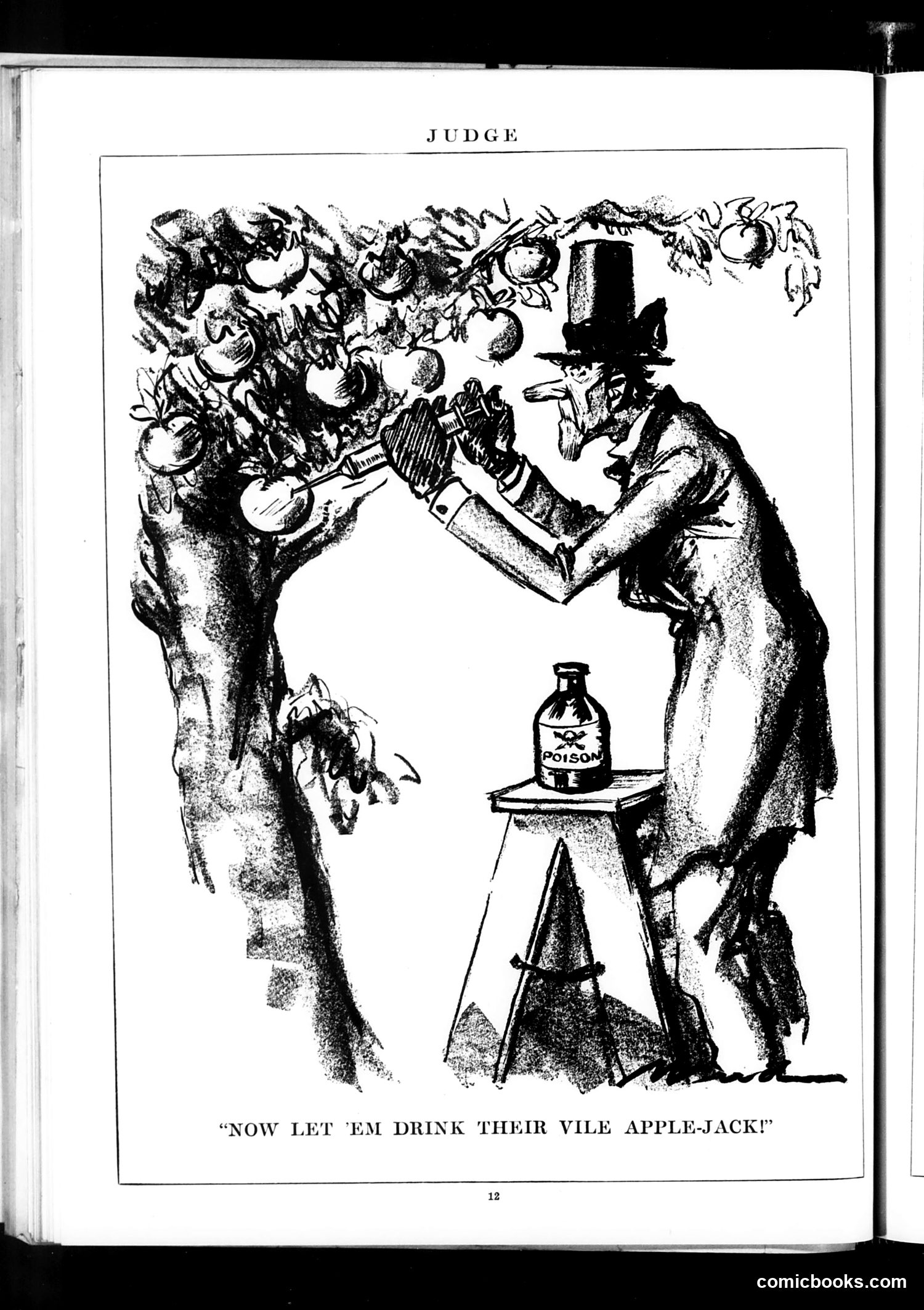
This political cartoon depicts a well-dressed man in a top hat poisoning an apple tree. A bottle labeled "POISON" sits prominently on a table below. The caption reads: "Now let 'em drink their vile apple-jack!" The satire appears to target **Prohibition-era politics**. The gentleman represents someone (likely a politician or wealthy industrialist) deliberately contaminating apple products—presumably to create applejack (an alcoholic cider beverage)—to harm the working class or opponents. The cartoon critiques either: 1. Hypocrisy around Prohibition enforcement, or 2. Deliberate sabotage of liquor supplies for political gain The "vile apple-jack" reference suggests class-based mockery, portraying the drink as inferior and the poisoning as intentional harm to common people. Without a date visible, the exact political moment remains unclear, though the Prohibition context is unmistakable.
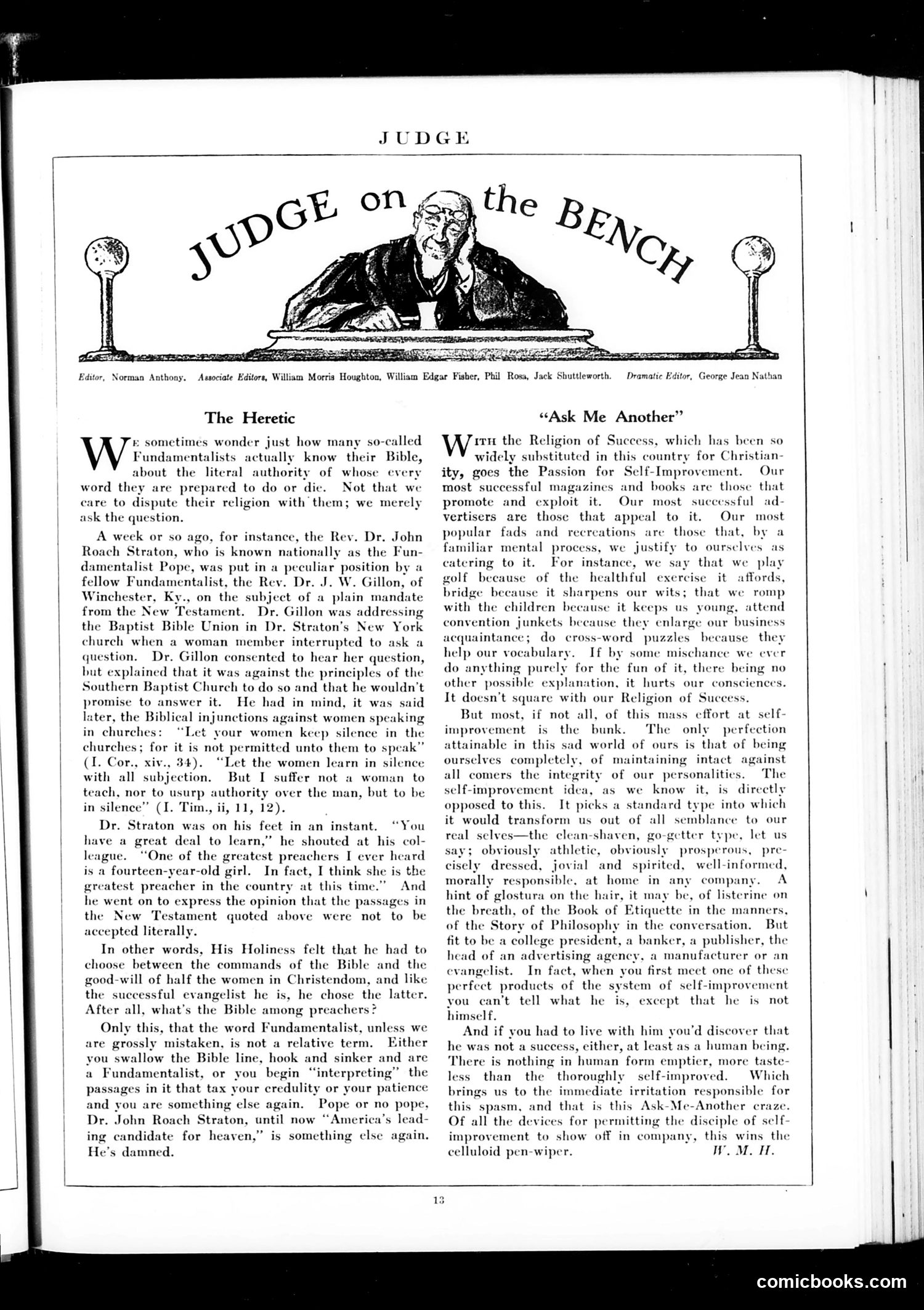
This page contains two satirical essays attacking American religious and cultural hypocrisy. **"The Heretic"** mocks Fundamentalist preacher Dr. John Roach Straton (called the "Fundamentalist Pope"). The satire exposes his contradiction: Straton invokes Biblical passages forbidding women to speak in church to silence a questioner, yet immediately contradicts himself by praising a fourteen-year-old girl preacher. The author argues that true Fundamentalism means accepting *all* Biblical authority literally—you can't pick and choose which passages to follow. By compromising with female preachers for practical reasons, Straton proves Fundamentalists don't actually believe their own doctrine. **"Ask Me Another"** critiques Americans' obsession with self-improvement culture. The author argues that most self-help pursuits (golf, bridge, crossword puzzles) are rationalized excuses for entertainment disguised as self-improvement to satisfy the "Religion of Success"—the era's materialistic, competitive values replacing traditional Christianity. The satire suggests authentic virtue lies in accepting yourself, not constant self-optimization. Both essays target hypocrisy between professed beliefs and actual behavior.
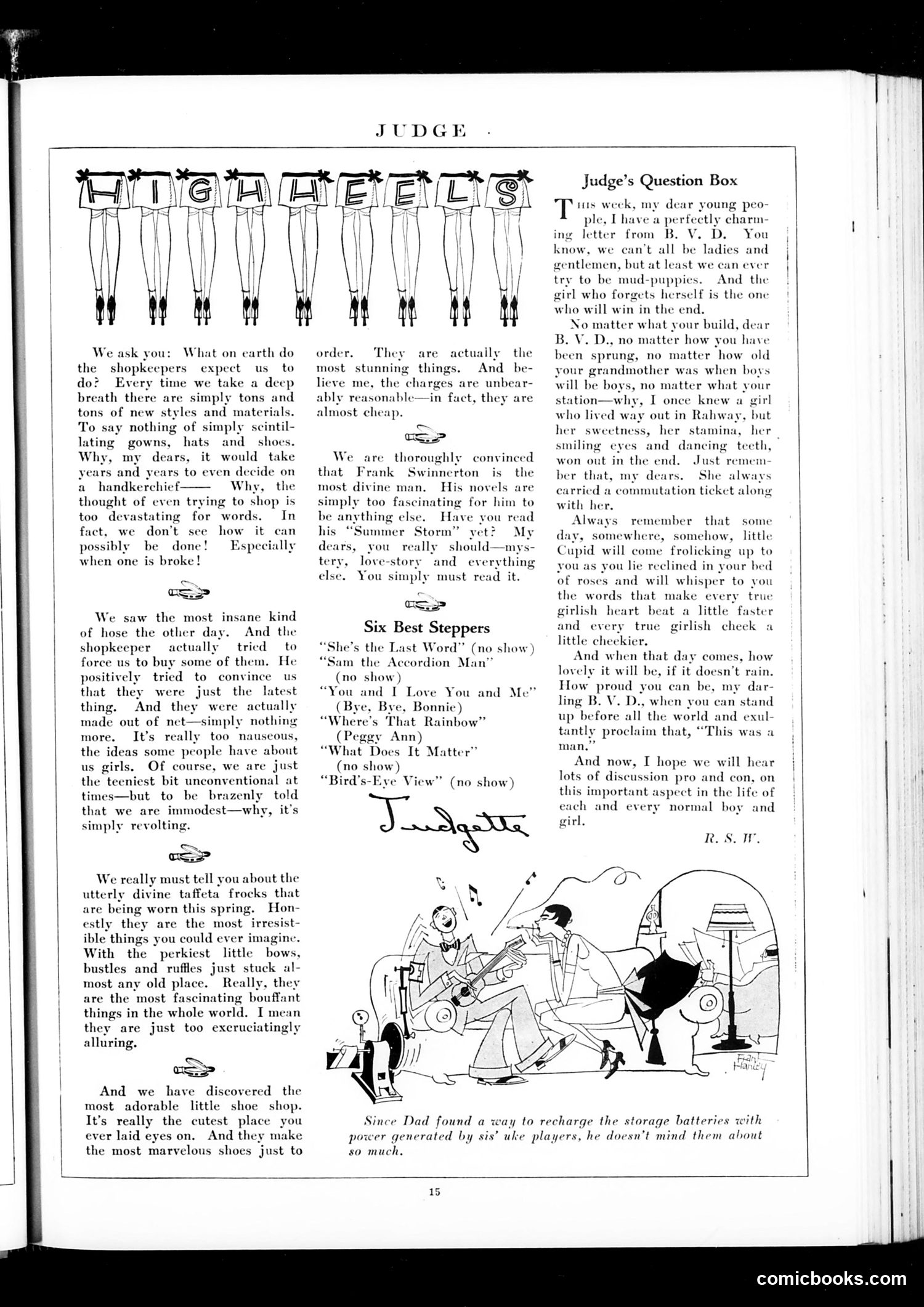
This page satirizes 1920s consumer culture and gender roles. The top illustration shows identical women in fashionable dress, mocking the obsessive consumption expected of shoppers—particularly women—who must constantly chase new styles in clothing, accessories, and shoes. The text columns humorously exaggerate female consumerism: women complaining that shopping decisions are "devastating," praising expensive taffeta dresses and expensive shoe shops, and gushing over novelist Frank Swinnerton. The satire targets both frivolous feminine consumption and the pressure society places on women to constantly update their appearance. The bottom cartoon jokes about ukulele music (extremely popular in the 1920s): a father tolerates his daughters' uke playing because he's discovered the instruments can generate electrical power to recharge storage batteries—mocking both the ubiquity of amateur musicianship and the era's fascination with modern technology. The "Judge's Question Box" offers romantic advice using dated slang ("mud-puppies," "B.V.D."), maintaining the satirical tone throughout.
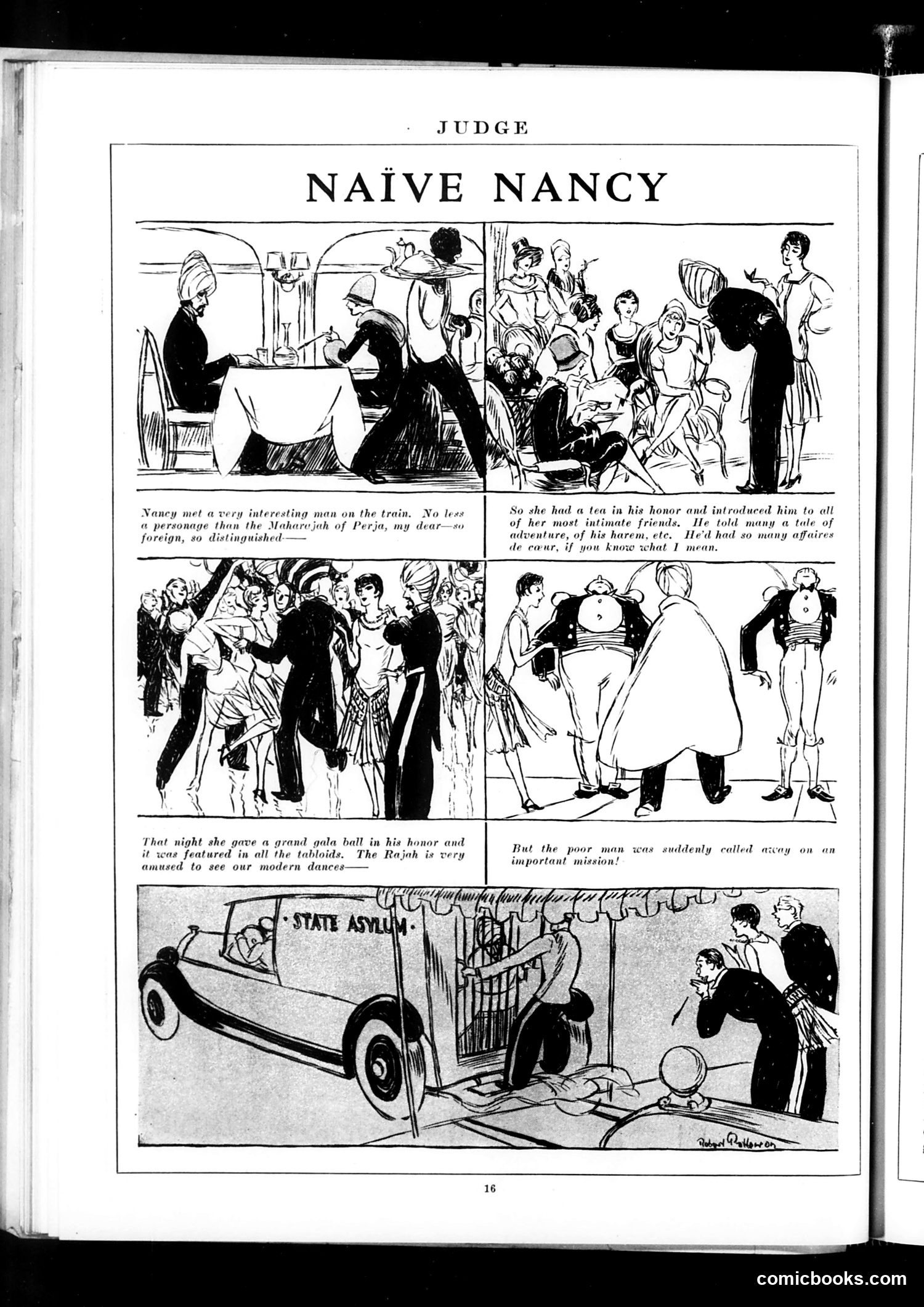
This four-panel comic mocks an upper-class American woman ("Naive Nancy") who naively entertains a foreign dignitary she met on a train. The satire targets: **The Plot:** Nancy mistakes a visiting "Rajah of Persia" for exotic nobility and hosts an elaborate gala featuring "modern dances" to impress him. The joke is her pretentious, obsequious fawning over someone she knows nothing about. **The Satire:** The comic ridicules American social climbing and the 1920s fascination with "exotic" foreign visitors. Nancy's desperate attempts to appear cultured by showcasing modern entertainment reflect period anxiety about authenticity and social status. **The Punchline:** The final panel reveals the "important mission"—the man is transported in a "State Asylum" vehicle, suggesting he's actually an escaped mental patient or vagrant, not royalty at all. Nancy's gullibility and status-consciousness are thoroughly mocked.
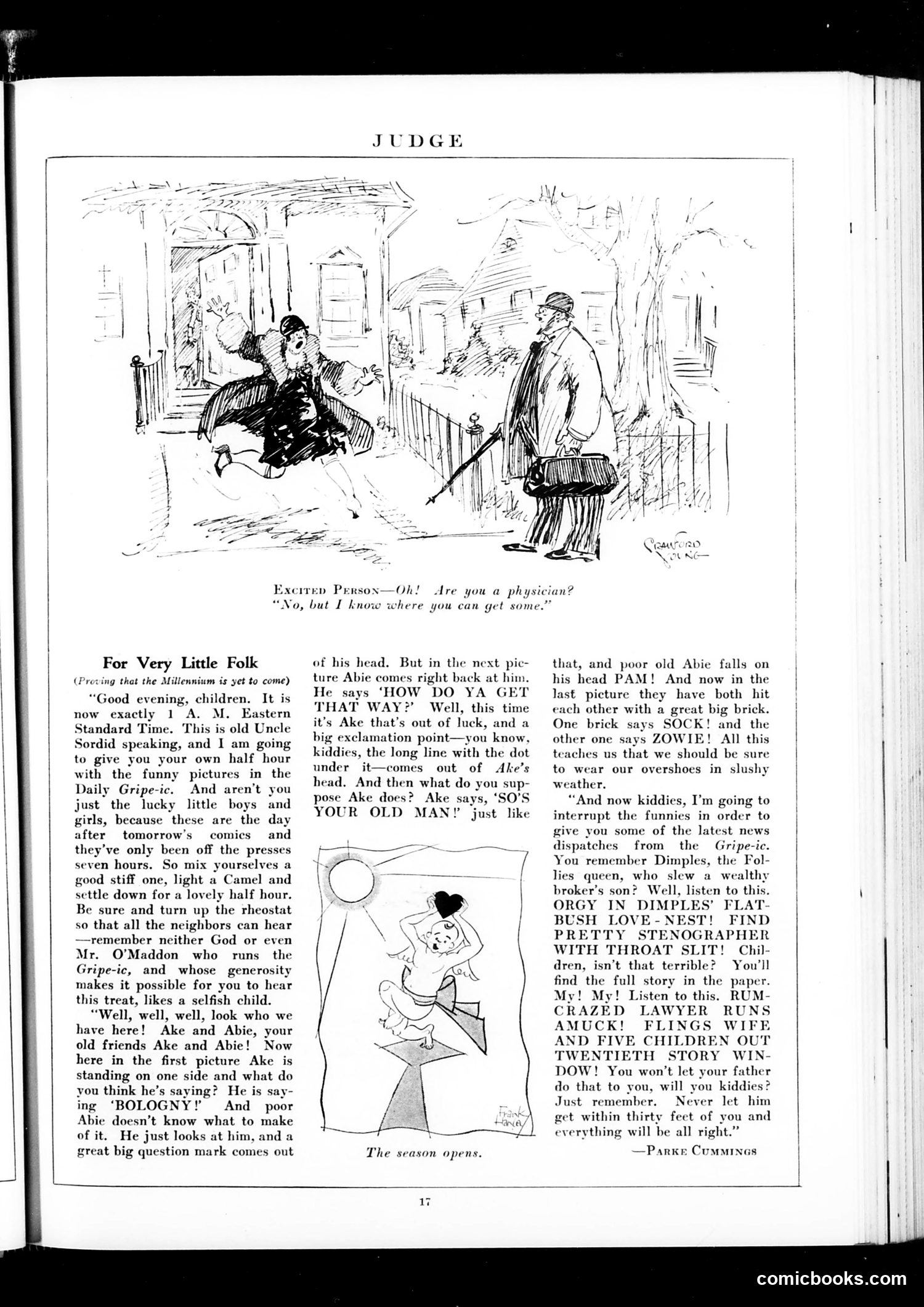
This is satirical commentary on 1920s tabloid journalism and sensationalism masquerading as family entertainment. "Uncle Sordid" (a transparently cynical persona) presents the "Daily Gripe-ic" to children while narrating lurid headlines: murders, affairs, domestic violence, and infanticide. The satire operates on multiple levels: the cartoon shows two boys (Ake and Abie) in a silly, harmless squabble, yet the framing text juxtaposes this innocent content against grotesque crime reporting. The joke is the *contrast*—tabloids profit by mixing trivial comics with sensational crime stories, all presented as entertainment for families. The opening mentions "Camel" cigarettes and alcohol ("stiff one"), further highlighting the hypocrisy: adult vices are normalized while children are exposed to violent content. The author (Parke Cummings) critiques how newspapers commodify scandal while claiming family-friendly status.
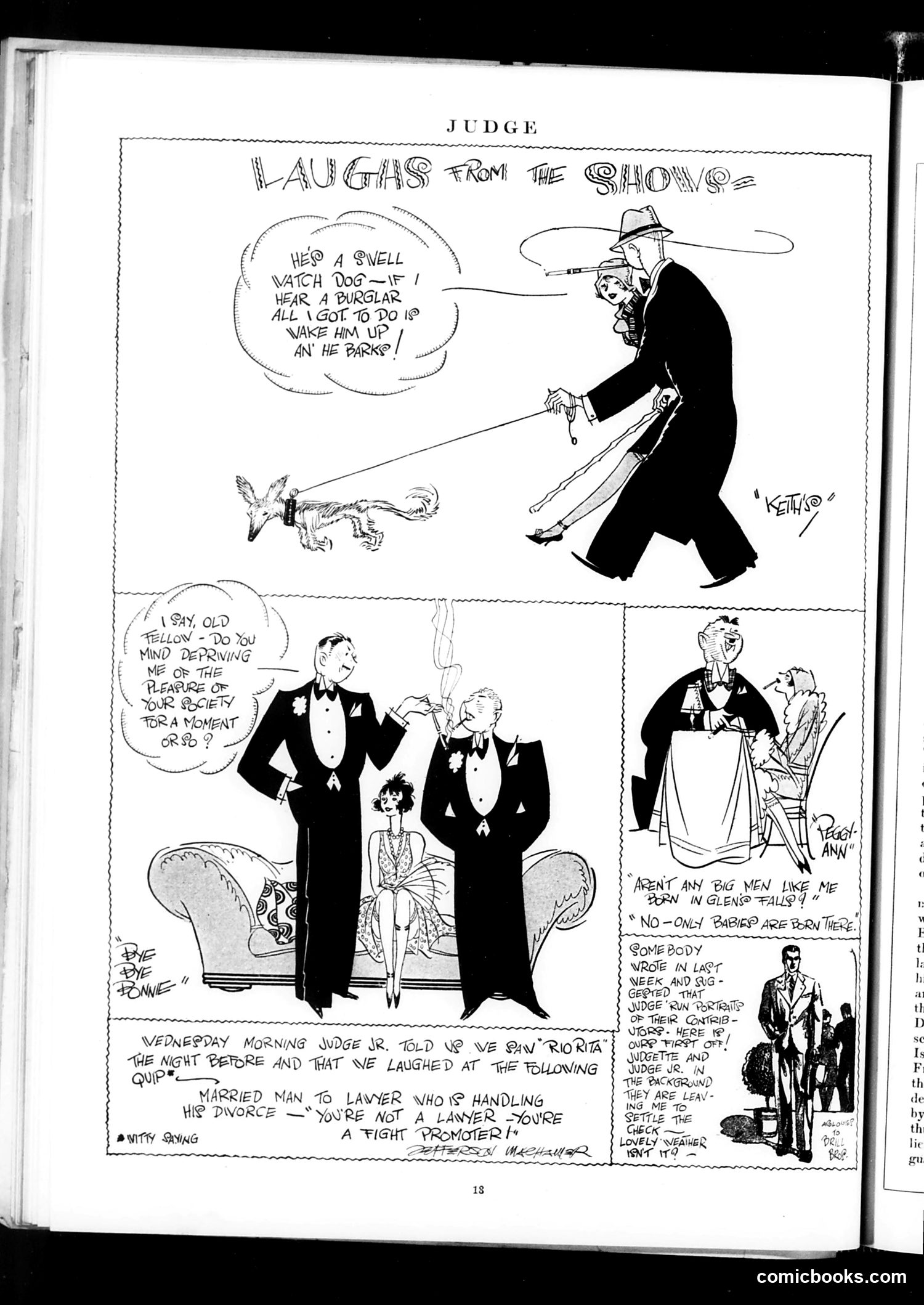
This page from *Judge* magazine contains two humorous sketches satirizing urban social life, likely from the early 20th century. The **top panel** depicts a man walking a small dog while wearing formal attire and carrying a cane—a visual joke about masculine pride being deflated by the necessity of walking a tiny pet. The dog's thought bubble about watching for burglars is comedic absurdism. The **bottom panels** feature socialites and legal professionals in formal settings. One joke involves a divorce lawyer's competence being questioned—the "fight promoter" quip suggests lawyers are merely hired combatants in marital disputes. Another satirizes vanity: a man boasts that "big men" like him aren't born in small towns, only babies—mocking his pretentious self-importance. The satire targets **upper-class affectation and hypocrisy**: the contrast between formal appearance and ridiculous behavior, inflated egos masking insecurity, and the mercenary nature of professional services. The humor relies on the audience recognizing these social conventions and their absurdities.
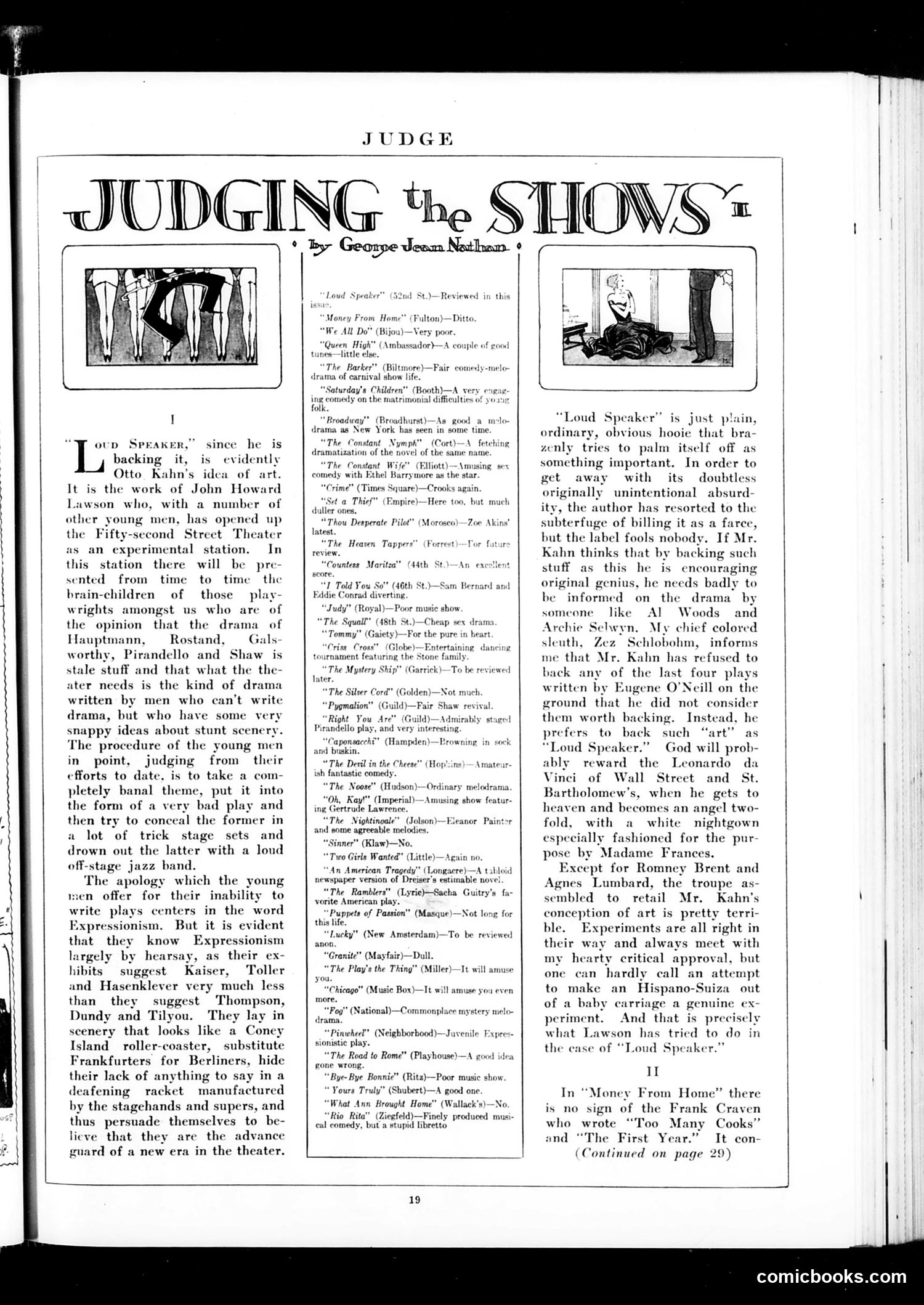
This is a theater review column by George Jean Nathan critiquing experimental Broadway productions. The main satirical target is the Fifty-second Street Theatre, an avant-garde venue backed by wealthy patron Otto Kahn and run by John Howard Lawson. Nathan mocks young Expressionist playwrights who, he argues, lack actual writing talent but hide their incompetence behind grandiose staging—"trick stage sets," loud off-stage bands, and scenery resembling "a Coney Island roller-coaster." He suggests they invoke Expressionism (a legitimate continental theatrical movement) as mere excuse, while their work actually derives from popular entertainers like Thompson, Dundy, and Tilyou (amusement park operators). The core joke: these self-proclaimed avant-garde reformers are simply manufacturing noise and spectacle to disguise banal, poorly-written drama—making them no different from commercial vaudeville, despite their artistic pretensions. Nathan positions himself as the skeptical arbiter dismissing false innovation.
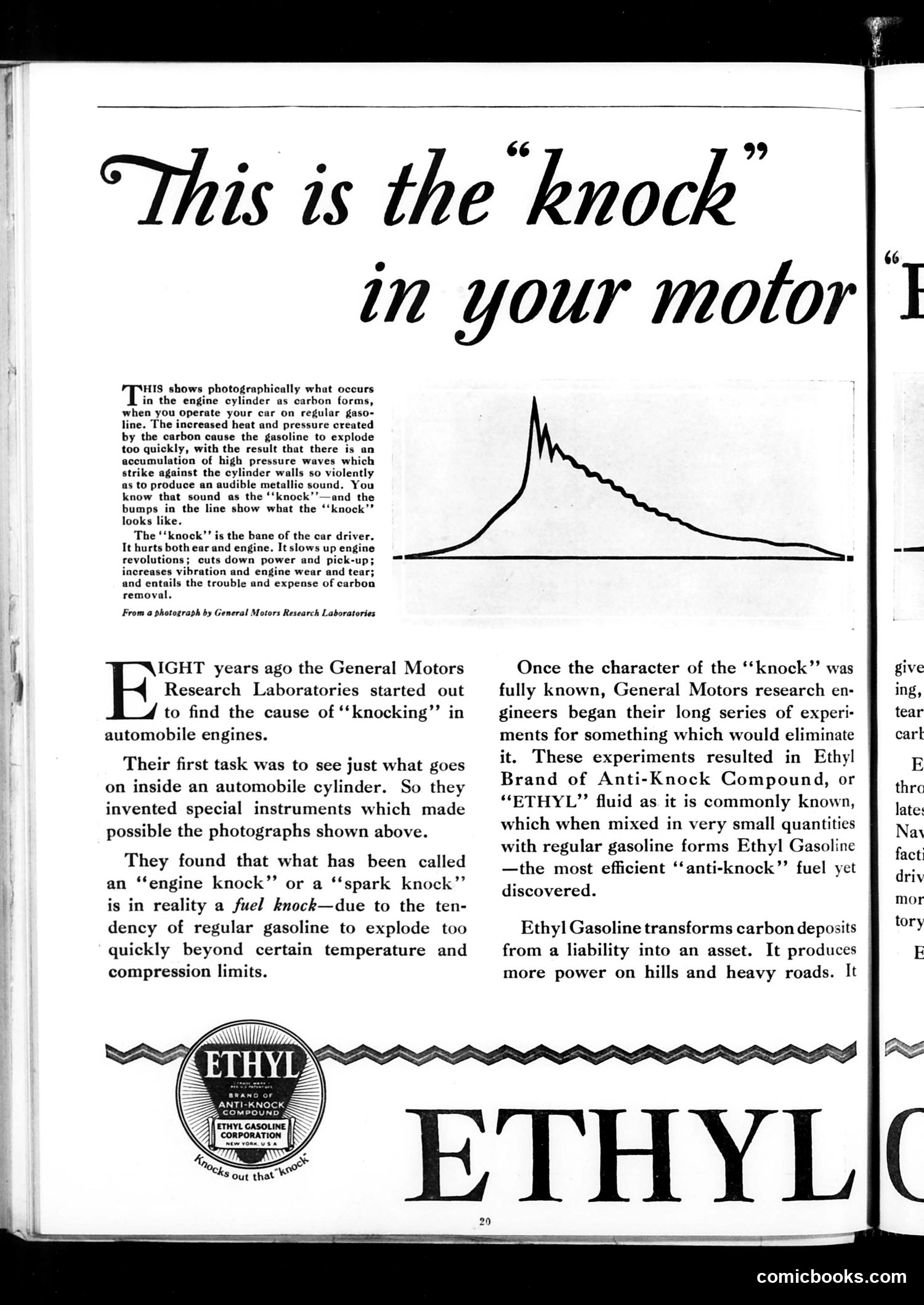
This is primarily a **General Motors advertisement**, not satire or political commentary. It appears in Judge magazine to promote "Ethyl Gasoline," a commercial fuel product. The page explains engine "knock"—the metallic sound and vibration caused by regular gasoline detonating too quickly under heat and pressure. GM's Research Laboratories developed this problem explanation and the solution: Ethyl Brand Anti-Knock Compound, which when added to gasoline creates Ethyl Gasoline. The graph at top shows knock vibrations visually. The advertisement emphasizes scientific credibility (GM's research, photographs) to market their fuel additive as solving a real mechanical problem that reduces engine performance and causes wear. **For modern readers**: This represents early 20th-century automotive marketing that combined technical explanation with brand-name chemical solutions—the ancestor of modern fuel additive advertising. The "Ethyl" product mentioned here is historically significant as an early leaded gasoline additive (later recognized as toxic).
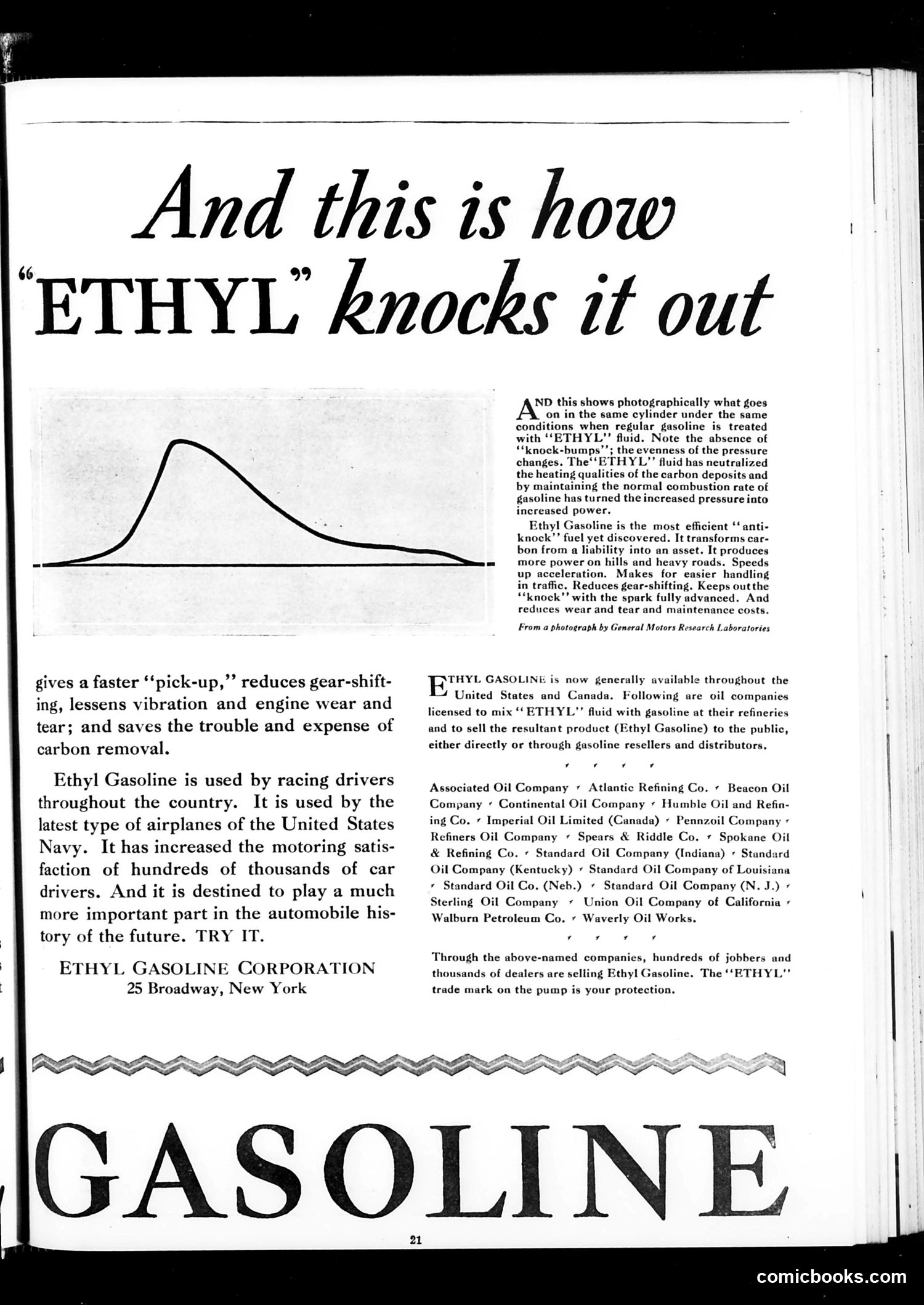
This is **not a cartoon or satire**, but rather a **full-page advertisement** for Ethyl Gasoline, published in Judge magazine. The page promotes Ethyl Gasoline's anti-knock properties using technical authority: a graph (labeled as from General Motors Research Laboratories) shows how Ethyl fuel produces smoother pressure curves compared to regular gasoline, eliminating engine "knock" (the destructive pinging sound caused by improper combustion). The copy emphasizes Ethyl's superior performance—faster acceleration, easier gear-shifting, reduced engine wear—and claims widespread adoption by racing drivers and the U.S. Navy. The advertisement lists numerous oil companies licensed to distribute Ethyl-treated gasoline nationwide. This represents early automotive marketing during the 1920s-30s era when gasoline additives were novel innovations. The "ETHYL" brand name itself became historically significant as a leaded gasoline product (later recognized as environmentally harmful).
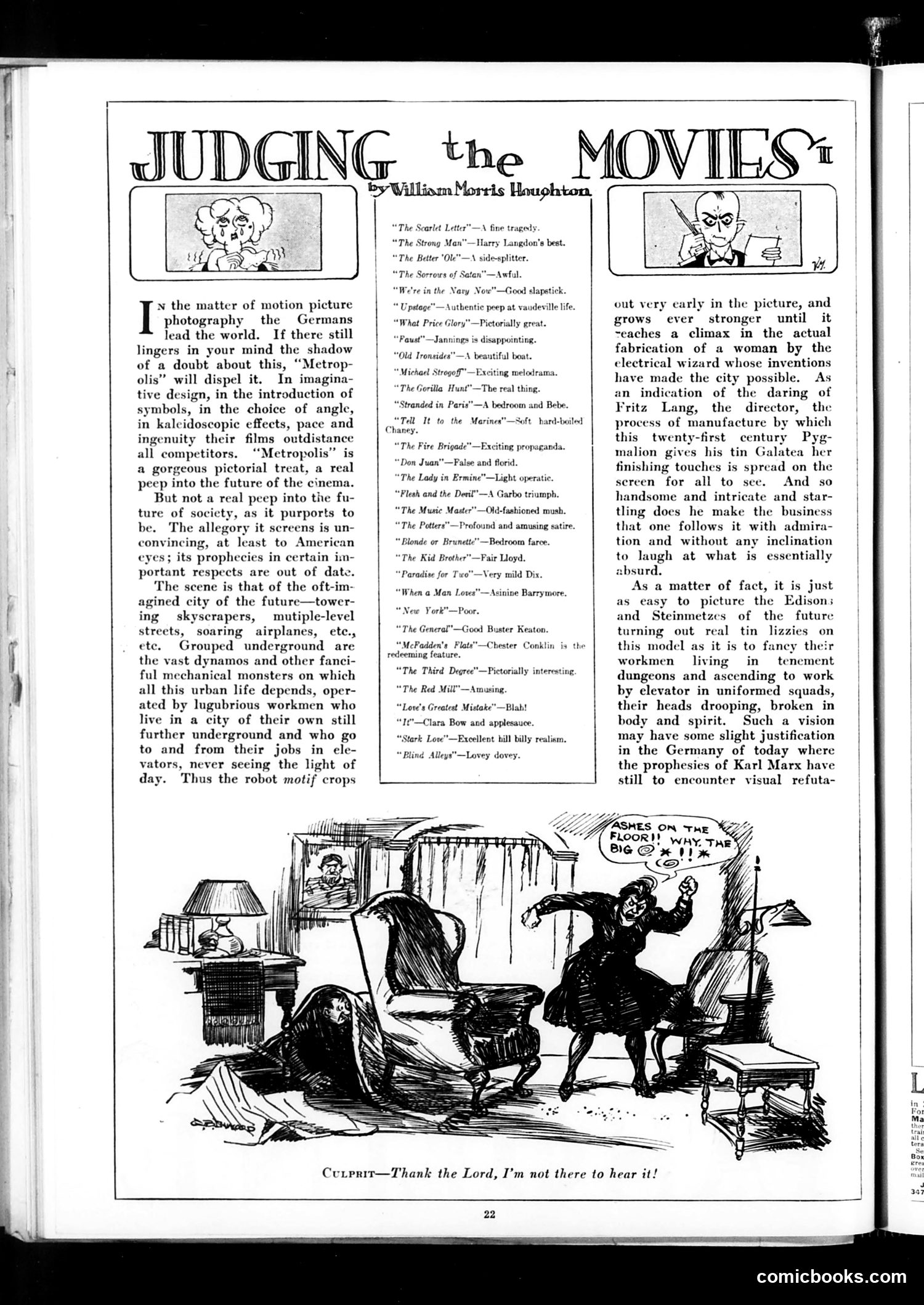
This is a film review column by William Morris Houghton critiquing contemporary silent films, particularly the German expressionist film *Metropolis*. The main review praises German cinematography's technical superiority while criticizing *Metropolis*'s social vision as unconvincing. The film depicts a futuristic city where workers toil in underground dungeons operating machinery, never seeing daylight. Houghton argues this dystopian vision is "out of date" and unrealistic for America, though he acknowledges it might reflect contemporary Germany where "the prophesies of Karl Marx have still to encounter visual refutation"—suggesting Marxist predictions of worker exploitation seem plausible in 1920s Germany but not America. The accompanying cartoon shows a wealthy couple ignoring their servant's distress, captioned "Thank the Lord, I'm not there to hear it!"—satirizing comfortable indifference to others' suffering. The page also lists brief reviews of other current films.
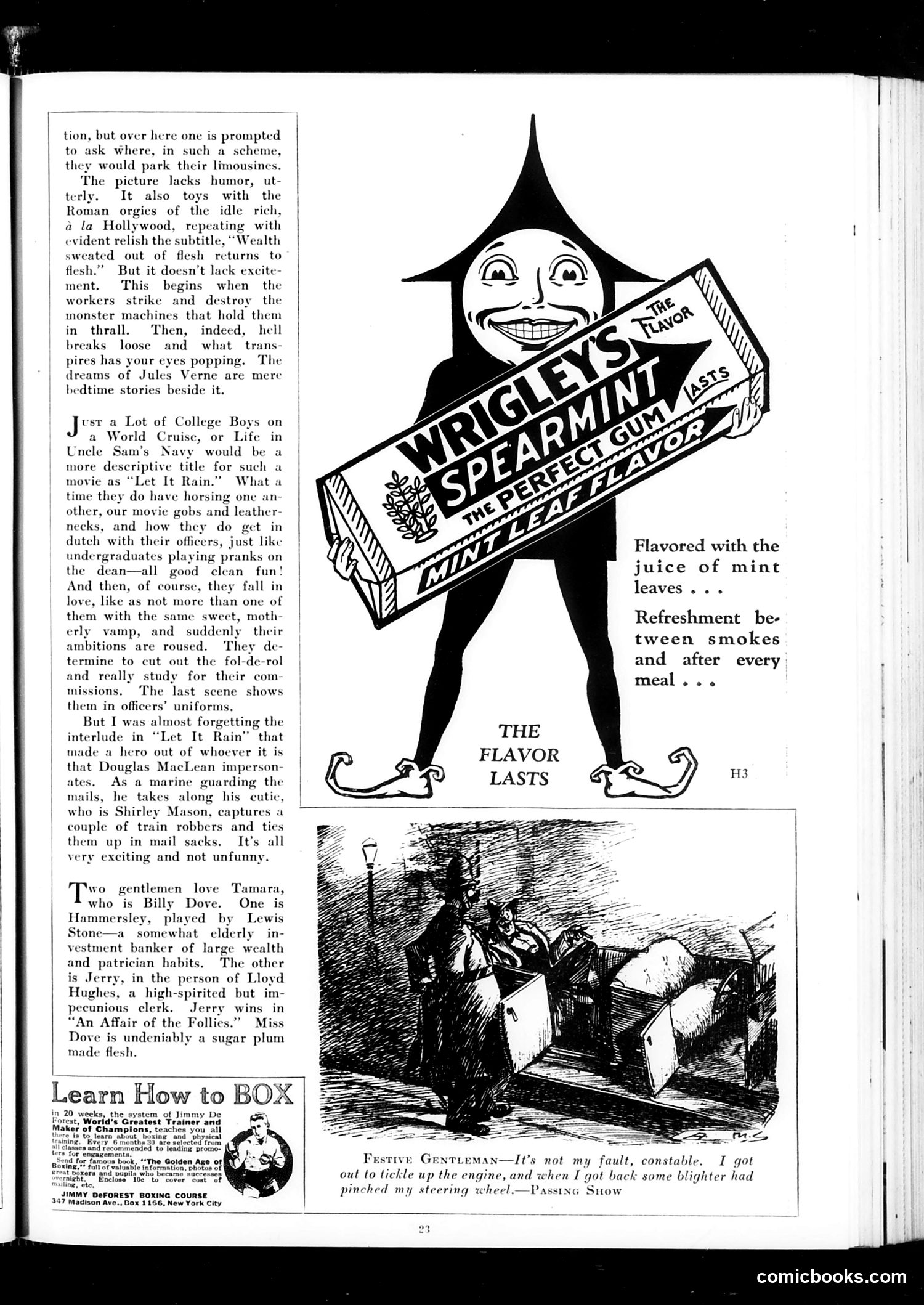
This page contains film reviews and advertising from an American satirical magazine. The main content critiques several movies: **Film Reviews:** - "Let It Rain" (starring Douglas MacLean and Shirley Mason) is described as a lighthearted naval comedy about college boys, featuring pranks, romance, and heroic mail-guard antics. - "An Affair of the Follies" features Billy Dove (described as a "sugar plum made flesh") caught between two suitors: an elderly wealthy banker and an impecunious young clerk. **Wrigley's Spearmint Advertisement:** The prominent illustration shows a cartoonish elf-like character hawking gum, emphasizing mint flavor and digestive benefits—typical early 20th-century product marketing. **Tone:** The reviews are mildly sardonic about formulaic Hollywood plots (wealthy-vs-poor love triangles, military coming-of-age stories) while acknowledging entertainment value. The page reflects Judge's satirical approach to American popular culture and consumer products of the era.
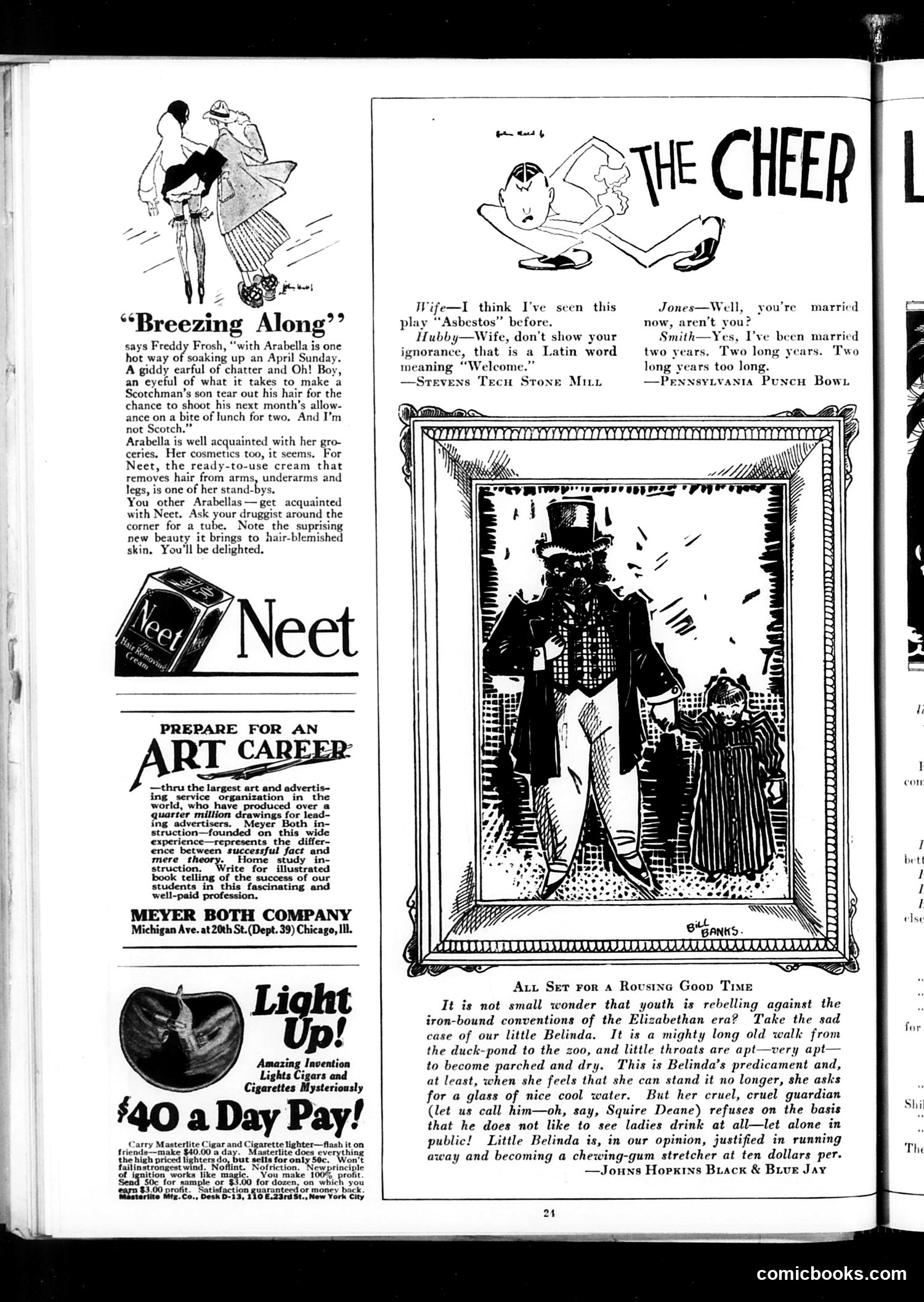
This Judge magazine page contains satirical humor and period advertising typical of early 20th-century American magazines. **"The Cheer" cartoon** mocks Victorian social conventions by depicting a guardian (likely "Squire Deane," as the text identifies him) refusing to let a young woman named Belinda drink water in public—considering it improper behavior for ladies. The satire ridicules such rigid Elizabethan-era morality as absurdly outdated, suggesting the girl is justified in rebelling against such nonsensical restrictions. **"Breezing Along"** is a Neet hair-removal cream advertisement disguised as a dating anecdote, presenting a young man and woman on a bicycle ride. The humor plays on courtship rituals and gender expectations of the era. The page reflects 1920s-era anxieties about changing social norms, youth rebellion, and women's increasing social freedom—themes Judge magazine frequently satirized. The other advertisements (art career training, novelty lighters, cigarettes) are standard period commercial content.
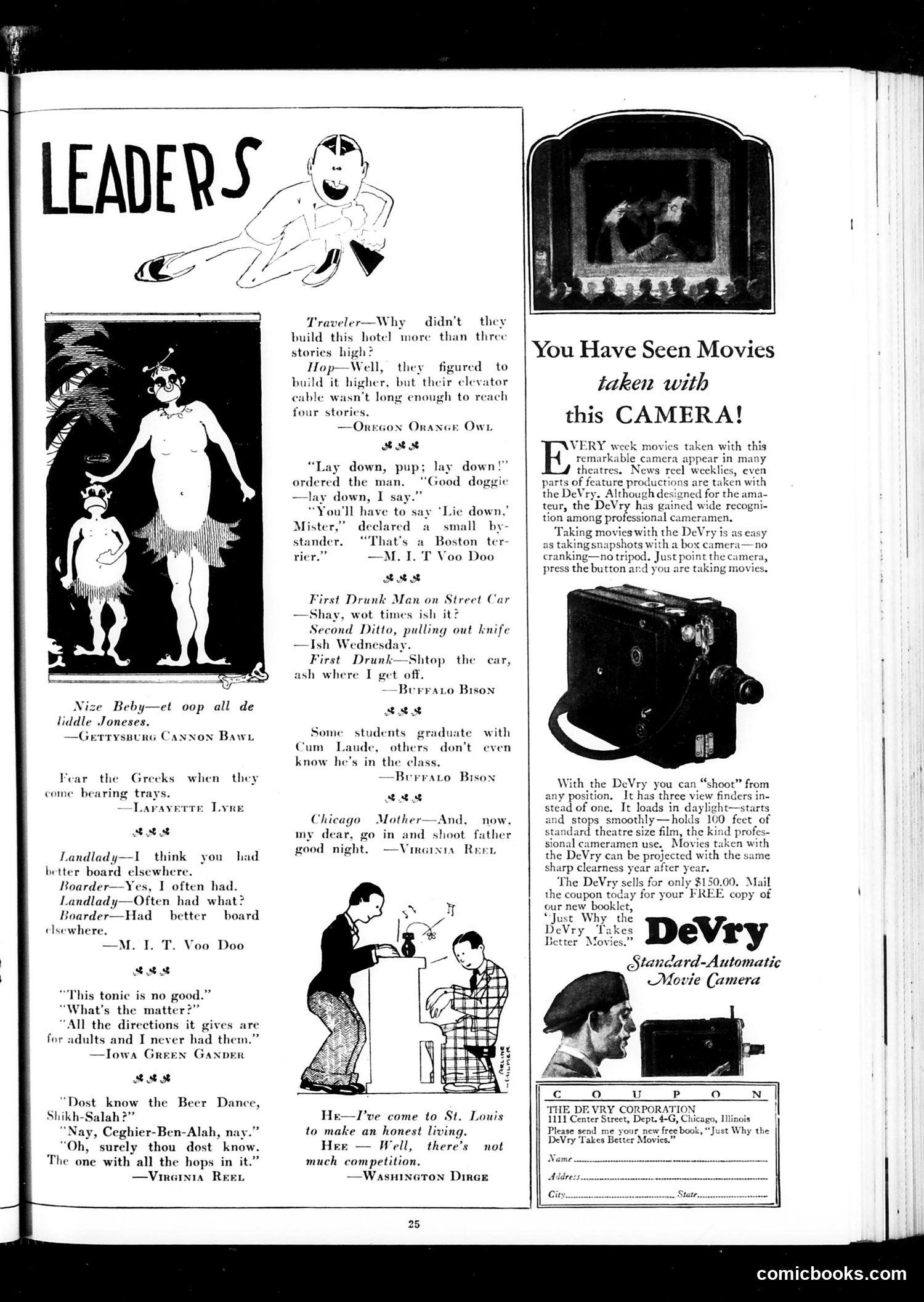
This page is primarily **advertising** for the DeVry movie camera, with humor content secondary. The right half features a full-page ad promoting the DeVry as an amateur filmmaking device, claiming it's used in professional movie productions and is easy enough for consumers to operate. The left side contains brief **joke submissions** from college humor magazines (M.I.T. Voo Doo, Buffalo Bison, etc.). These are typical early-20th-century collegiate humor: puns and wordplay about everyday situations—mispronounced words, misunderstandings between landlords and boarders, drunk men on street cars, and gentle domestic comedy. The single cartoon (top-left) shows a figure and child with vague mythological elements, accompanying a joke about "little Joneses"—likely mocking stereotypical or pretentious naming conventions of the era. The page reflects 1920s-30s advertising integration into humor magazines, where product promotion and brief joke collections filled editorial space, targeting college-educated male readers.
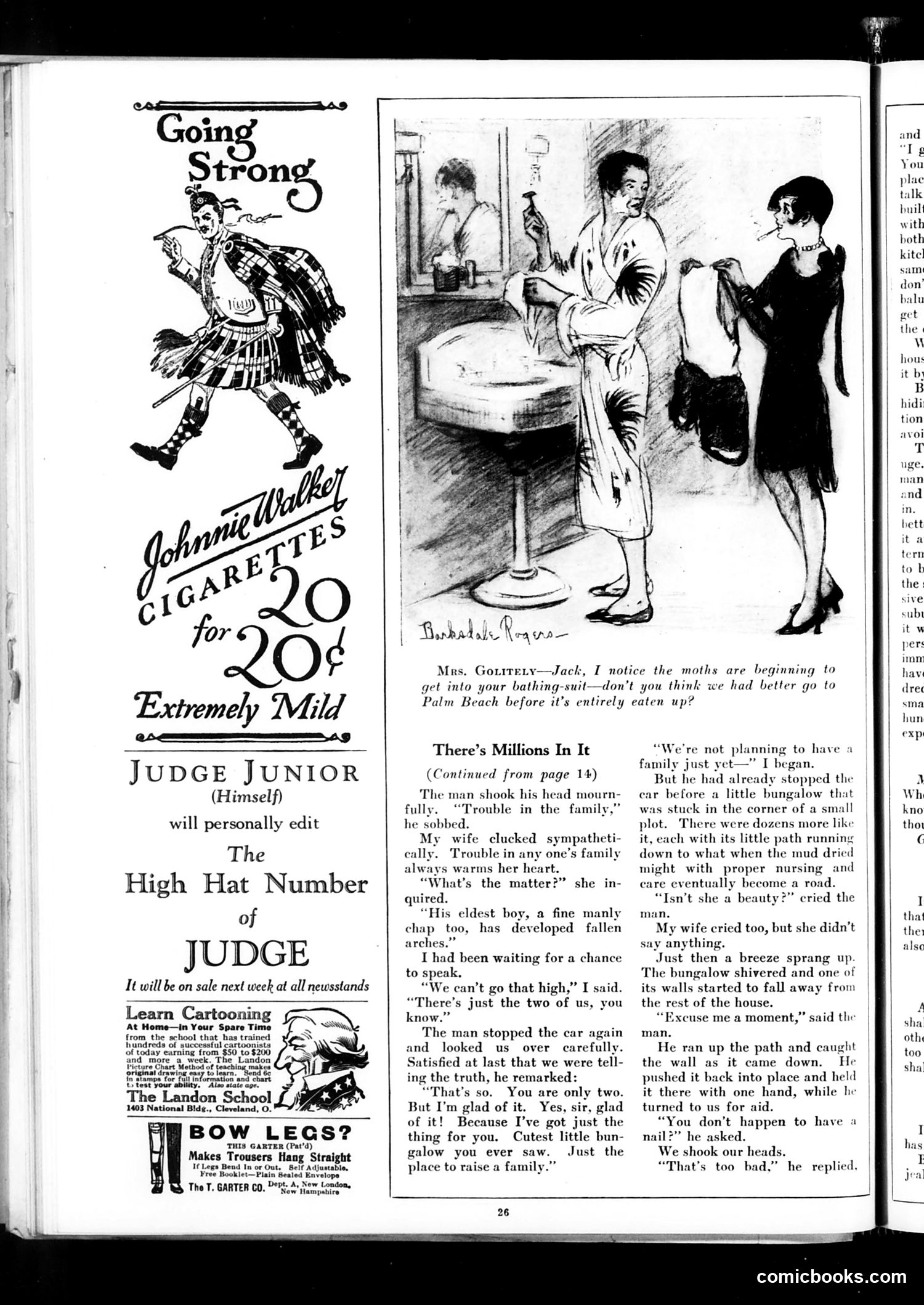
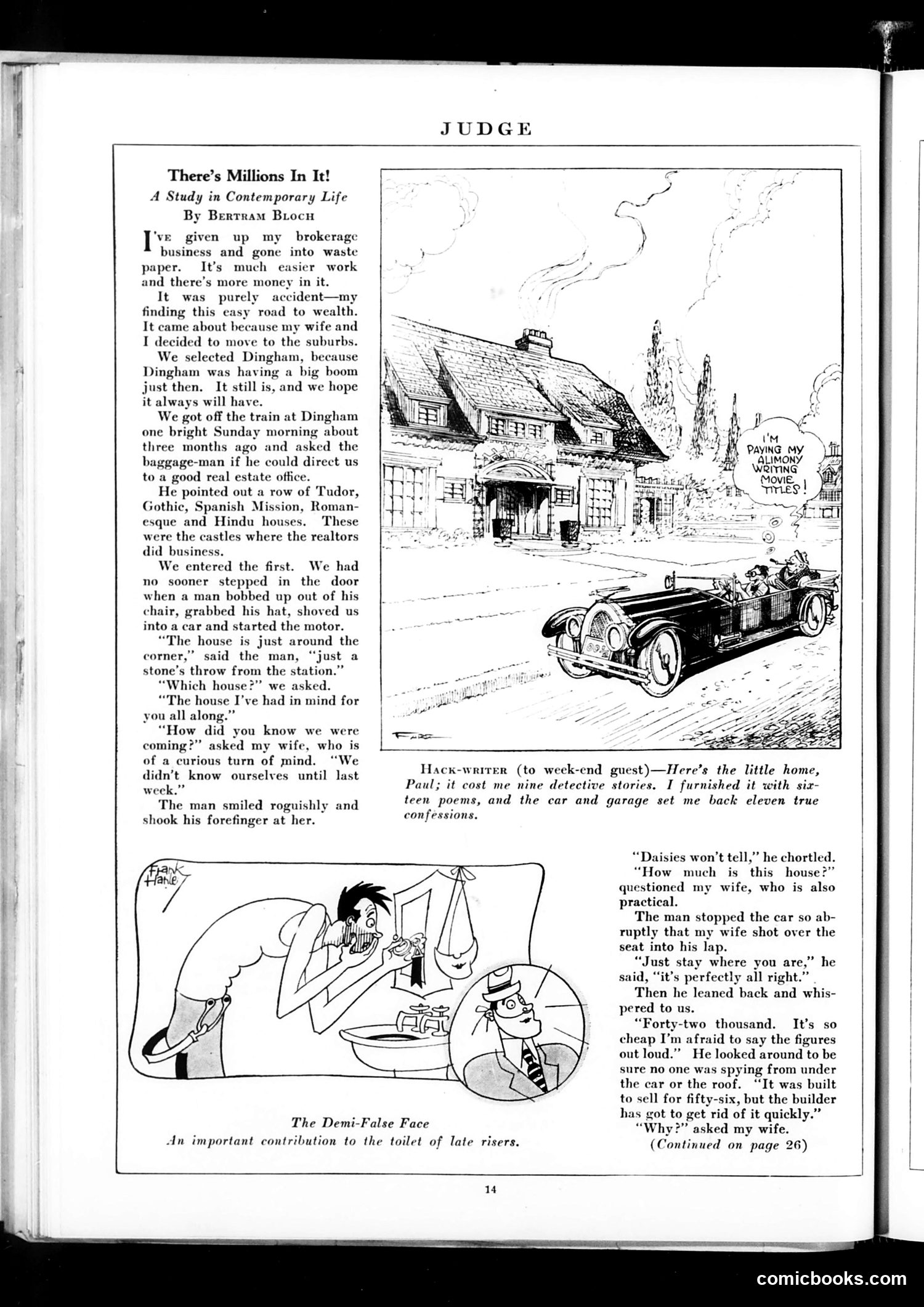
This page contains mostly **advertisements and serialized fiction** rather than political satire. The main content is "There's Millions In It," a humor story about a real estate agent trying to sell a couple a cheap bungalow. The joke hinges on the agent's assumption that any couple must want a family home—until learning there are only two of them. The satire targets **overeager salesmen and shoddy housing construction**: the bungalow is so poorly built that its walls literally fall down during the viewing. The side advertisements reveal period concerns: the Landon School promotes cartooning careers (to Judge readers), while "Bow Legs?" garters promise to straighten trouser appearance—reflecting early 20th-century anxieties about physical appearance and propriety. A small cartoon shows a wife (Mrs. Goltrey) suggesting they visit Palm Beach before moths eat their clothing entirely—absurdist humor about wealthy leisure. No significant political figures or events are referenced on this page.
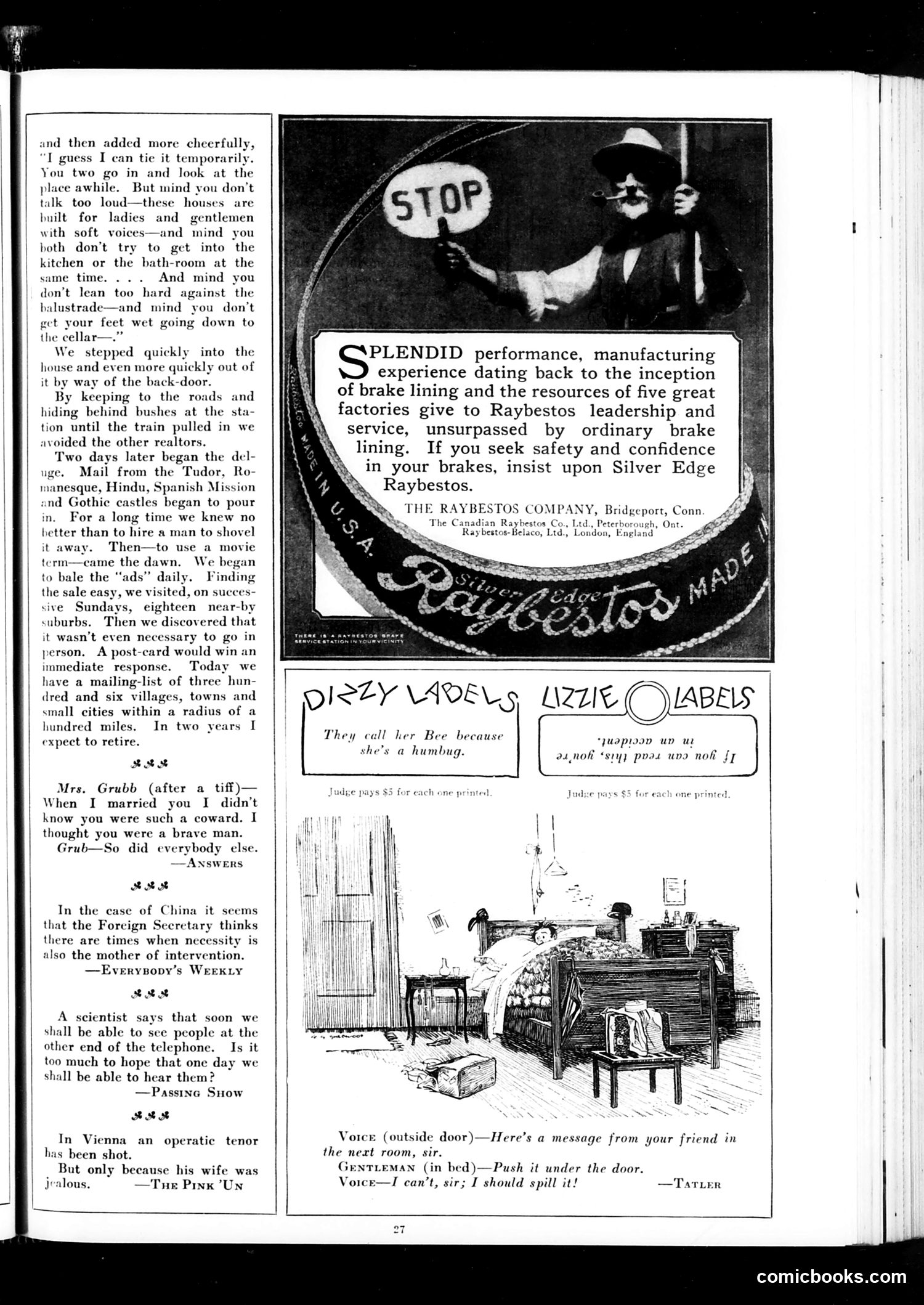
This page contains **humor pieces and advertisements** rather than political cartoons. The main content includes: 1. **A narrative joke** about real estate fraud: A con artist describes selling decrepit houses by showing them briefly with minimal access, then profiting from mass-mailed advertisements to distant towns. The humor lies in the audacious mail-order real estate scam and his boastful retirement plans. 2. **Brief joke exchanges**: Mrs. Grubb's marital quip about cowardice; comments on Chinese foreign policy and telephone technology; an operatic jealousy reference—all typical satirical one-liners. 3. **A domestic cartoon**: A gentleman in bed receives a message he cannot retrieve without spilling it—a simple visual gag about impracticality. 4. **Raybestos brake lining advertisement**: Prominently featured, emphasizing manufacturing heritage and safety. 5. **"Dizzy Labels" joke section**: Humorous captions about nicknames ("Bee" for someone dishonest). The page reflects early 20th-century Judge magazine's blend of satirical commentary, domestic humor, and advertising.
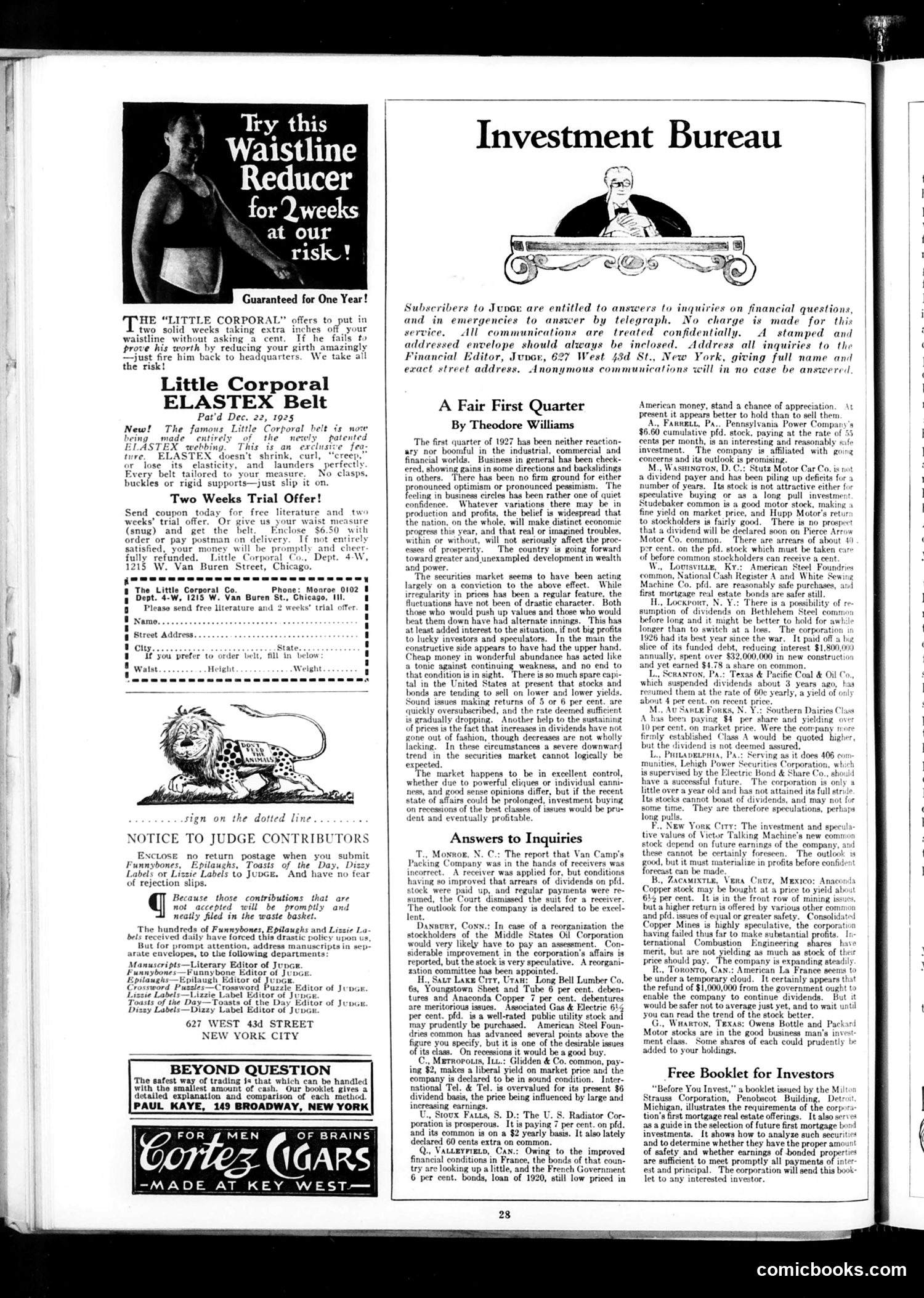
This page is primarily **advertising and financial content**, not satirical cartoons. The main elements are: 1. **"Little Corporal Elastex Belt"** advertisement: A weight-loss product promising waistline reduction in two weeks. The "Little Corporal" name likely references Napoleon (a short military figure), humorously applied to a girdle-like device. The satire is implicit—using a famous military commander's name to sell a belt device. 2. **"Investment Bureau"** section: Appears to be a financial advice column addressing reader inquiries about stocks and investments, typical of 1920s financial journalism. 3. **Contributor notice**: A humorous, self-aware editorial joke warning that unsolicited submissions will be "promptly and neatly filed in the waste basket." 4. **Cortez Cigars ad**: Standard tobacco advertising. The page reflects 1920s consumer culture—weight-loss schemes and stock-market enthusiasm during the pre-Depression era. The "Little Corporal" is the only clearly satirical visual element, though subtle.
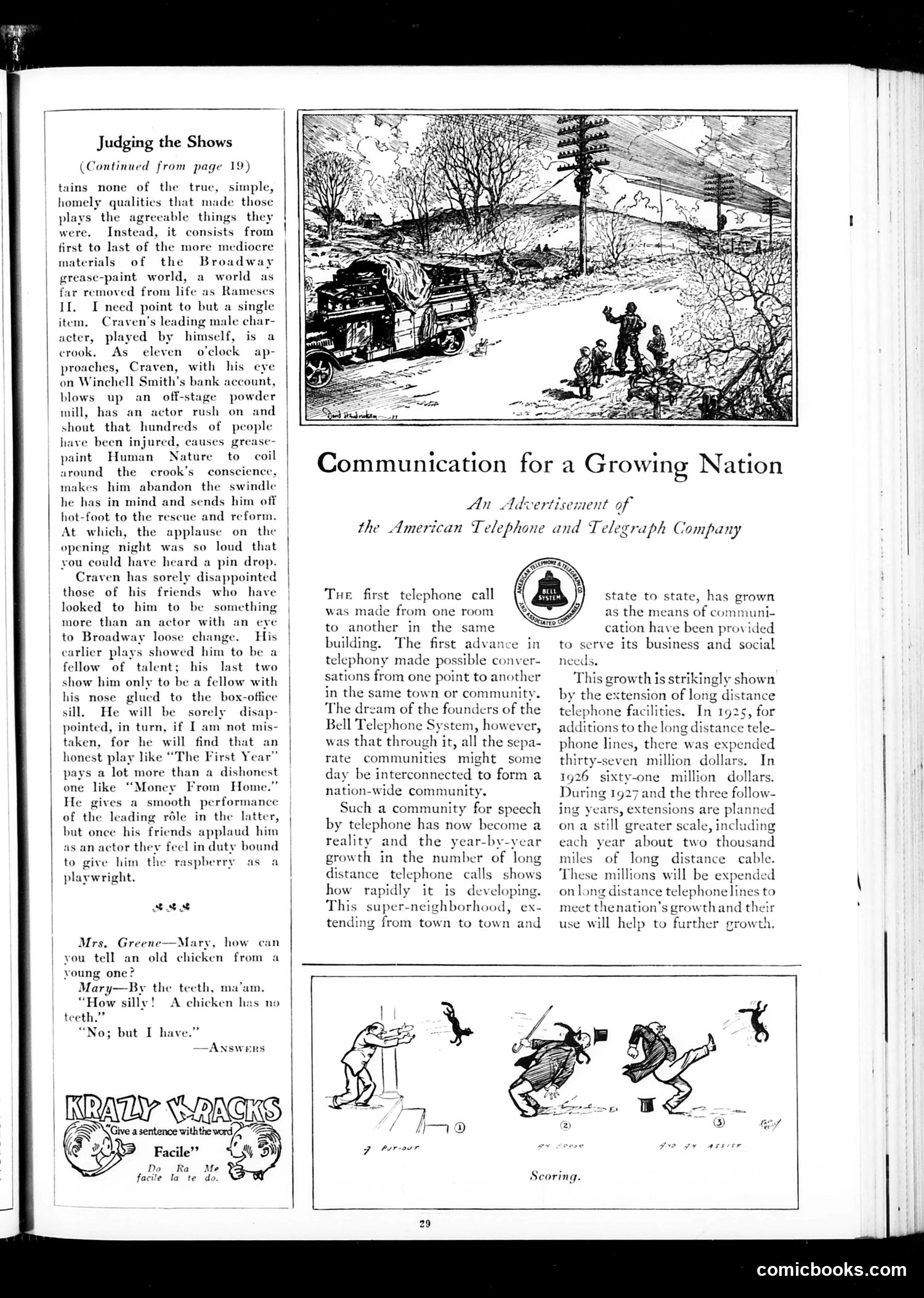
This page contains two distinct sections: **Left side:** A theater review criticizing actor Frank Craven's play "Money From Home." The critic argues Craven has compromised his talent by performing in shallow Broadway comedies focused on box-office profits rather than artistic merit. The reviewer contrasts this with Craven's earlier serious work like "The First Year," suggesting commercial success has corrupted his artistic integrity. **Right side:** An AT&T advertisement celebrating telephone infrastructure expansion. It presents the company's vision of a "nation-wide community" connected by long-distance telephone lines. The ad emphasizes investment figures ($37-61 million annually in mid-1920s) and future expansion plans, framing telephone infrastructure as essential to national growth and communication. The "Krazy Kracks" section at bottom is a joke feature unrelated to the main content.
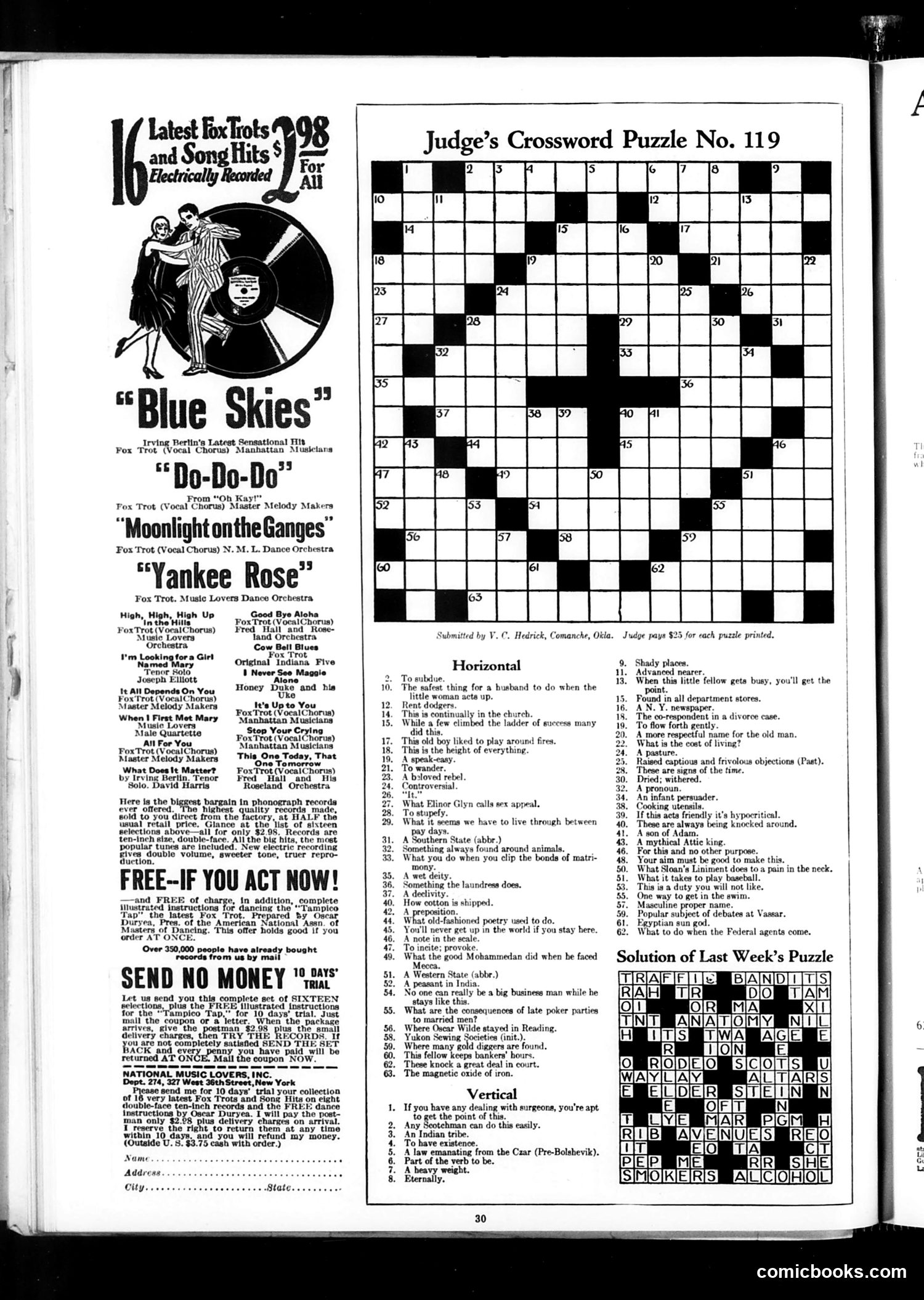
This page is primarily **advertising and entertainment content**, not political satire. It features: **Main Content:** A mail-order phonograph record offer from National Music Lovers, Inc., promoting 16 Fox Trot and song hits for $2.98—half retail price. The records include Irving Berlin's "Blue Skies" and other popular dance numbers of the era. The ad emphasizes "new electric recording" technology and offers free dancing instructions for the "Tampico Tap." **Secondary Content:** Judge's Crossword Puzzle No. 119, with clues and a solution grid. The page reflects **1920s consumer culture**: mail-order commerce, the phonograph as cutting-edge entertainment technology, and dance crazes (Fox Trots) as popular leisure. The "10 Days' Trial" payment scheme represents early mail-order marketing tactics. There is **no political cartoon or satire** visible on this page—it's a commercial publication page typical of Judge magazine's revenue model.
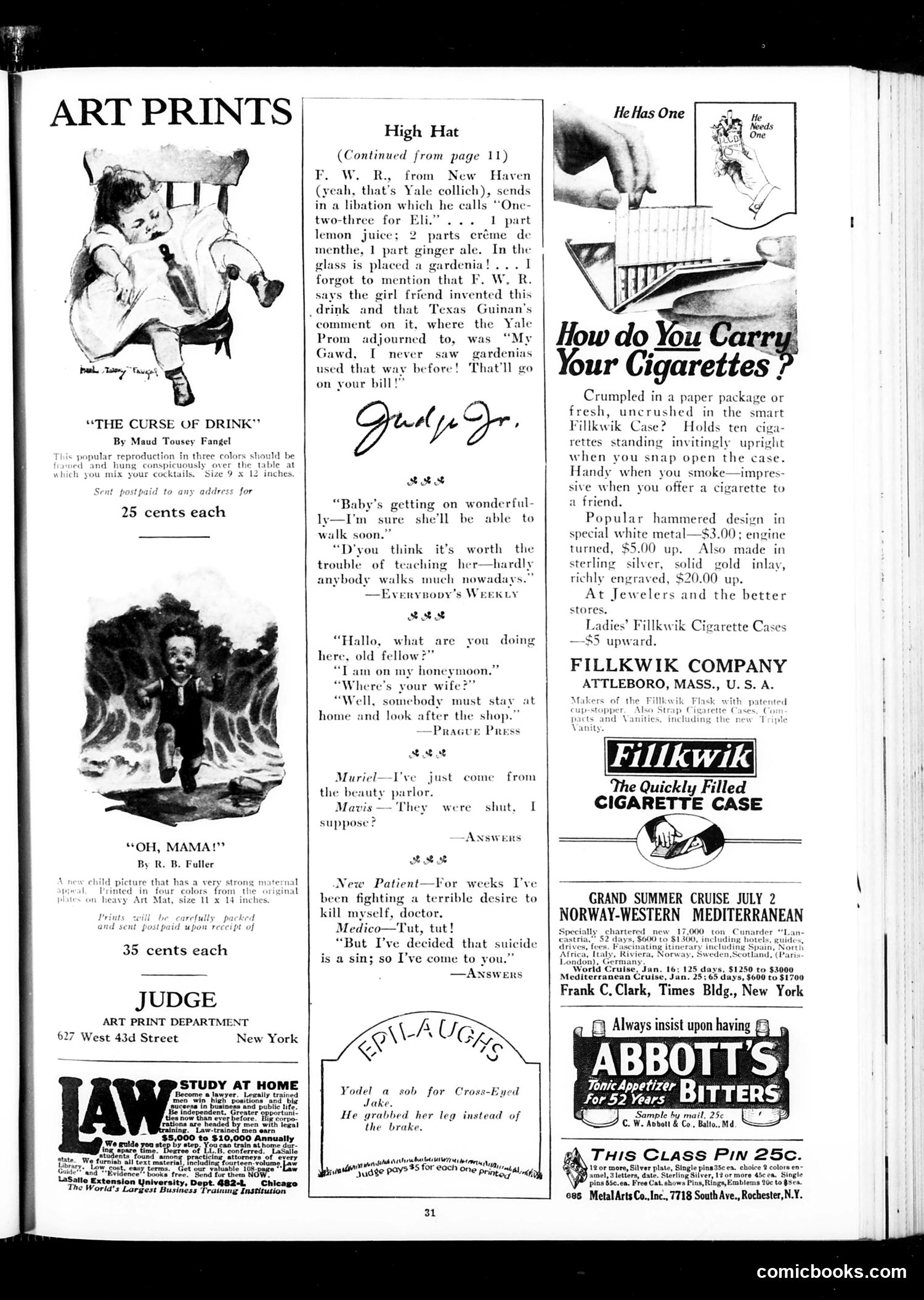
This page mixes satirical cartoons with period advertisements. The cartoons address social concerns of the era: **"The Curse of Drink"** and **"Oh, Mama!"** are reproduction prints satirizing alcohol consumption and its consequences—likely referencing Prohibition-era anxieties about drinking's social effects on families and children. The humor pieces (jokes about honeymoons, beauty parlors, and suicide) reflect typical early-20th-century magazine humor: wordplay and domestic comedy. **Key context for modern readers:** The advertisements reveal what this audience valued—cigarette cases, cruise ships, correspondence law schools, and Abbott's Bitters (marketed as a "tonic," likely containing alcohol despite Prohibition). The casual mention of a Yale drinking recipe ("One-two-three for Eli") shows how Prohibition was widely flouted among the educated classes. The page captures a moment when American magazines simultaneously critiqued drinking's dangers while advertisers profited from related luxury goods.
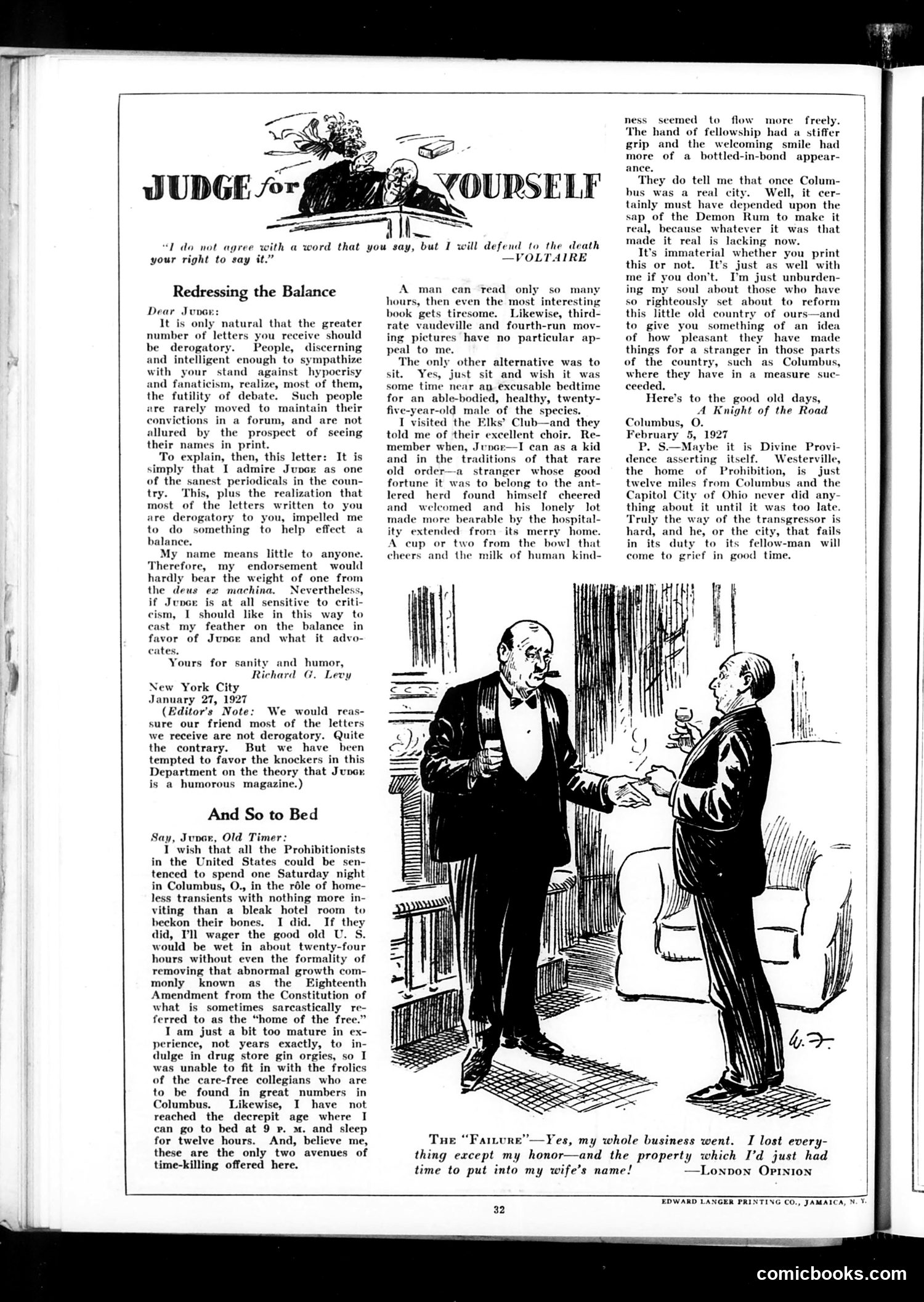
This page contains reader letters and a cartoon addressing **Prohibition-era hypocrisy**, particularly in Columbus, Ohio. ## The Cartoon The illustration depicts two well-dressed men in formal attire. One holds a drink while speaking to the other—a visual commentary on the contradiction between Prohibition law (enacted 1920) and actual drinking practices among the wealthy and respectable classes. ## The Letters The "And So to Bed" letter sarcastically wishes Prohibitionists would experience a night as homeless transients in Columbus, implying their moral enforcement of Prohibition is hypocritical. The writer notes Columbus's location near the state capital makes this irony sharper. A secondary letter references Columbus's Elks Club, where despite Prohibition, alcohol ("the bowl that cheers") apparently flows freely—showing how social clubs circumvented dry laws. ## The Point Judge ridicules Prohibition's selective enforcement: the privileged drank openly while laws supposedly protected morality. The satire targets the gap between stated values and actual behavior among respectable society.
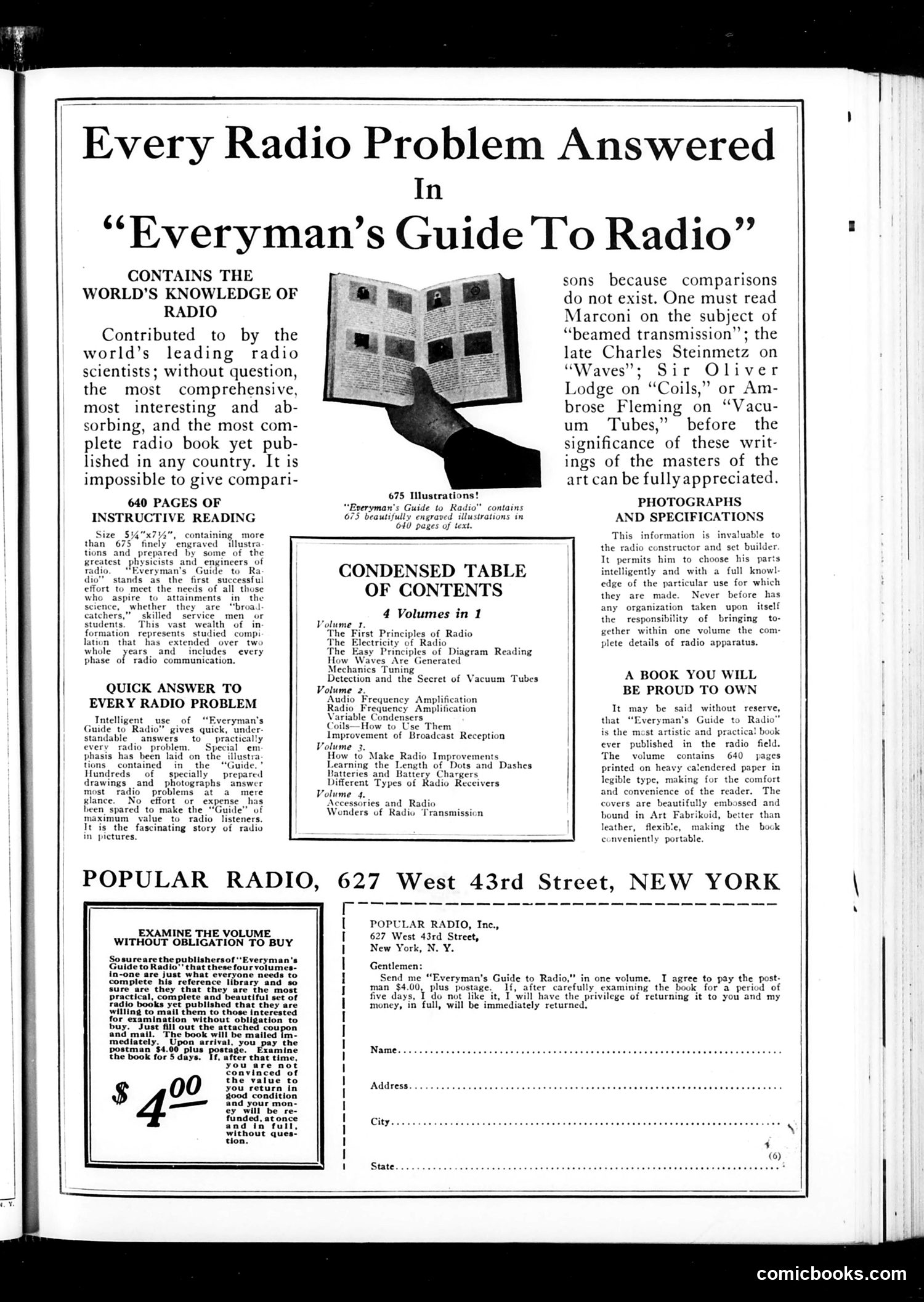
This page is entirely **advertising and product promotion**, not satire or political commentary. It advertises a comprehensive four-volume radio instructional guide published by Popular Radio, Inc. The ad emphasizes the book's authority by claiming contributions from "world's leading radio scientists" and naming historical figures like Marconi and Oliver Lodge. For a modern reader, the key context: this represents the **early radio era** (likely 1920s), when radio technology was new, complex, and required technical expertise. The guide positioned itself as democratizing this knowledge for ordinary people ("Everyman"). The $4.00 price tag and mail-order examination offer reflect period sales techniques. The emphasis on 675 illustrations and practical problem-solving reflects how technical manuals of this era relied heavily on visual instruction—the technology was too novel for most readers to understand through text alone. This is a straightforward commercial advertisement with no cartoon, satire, or political content.
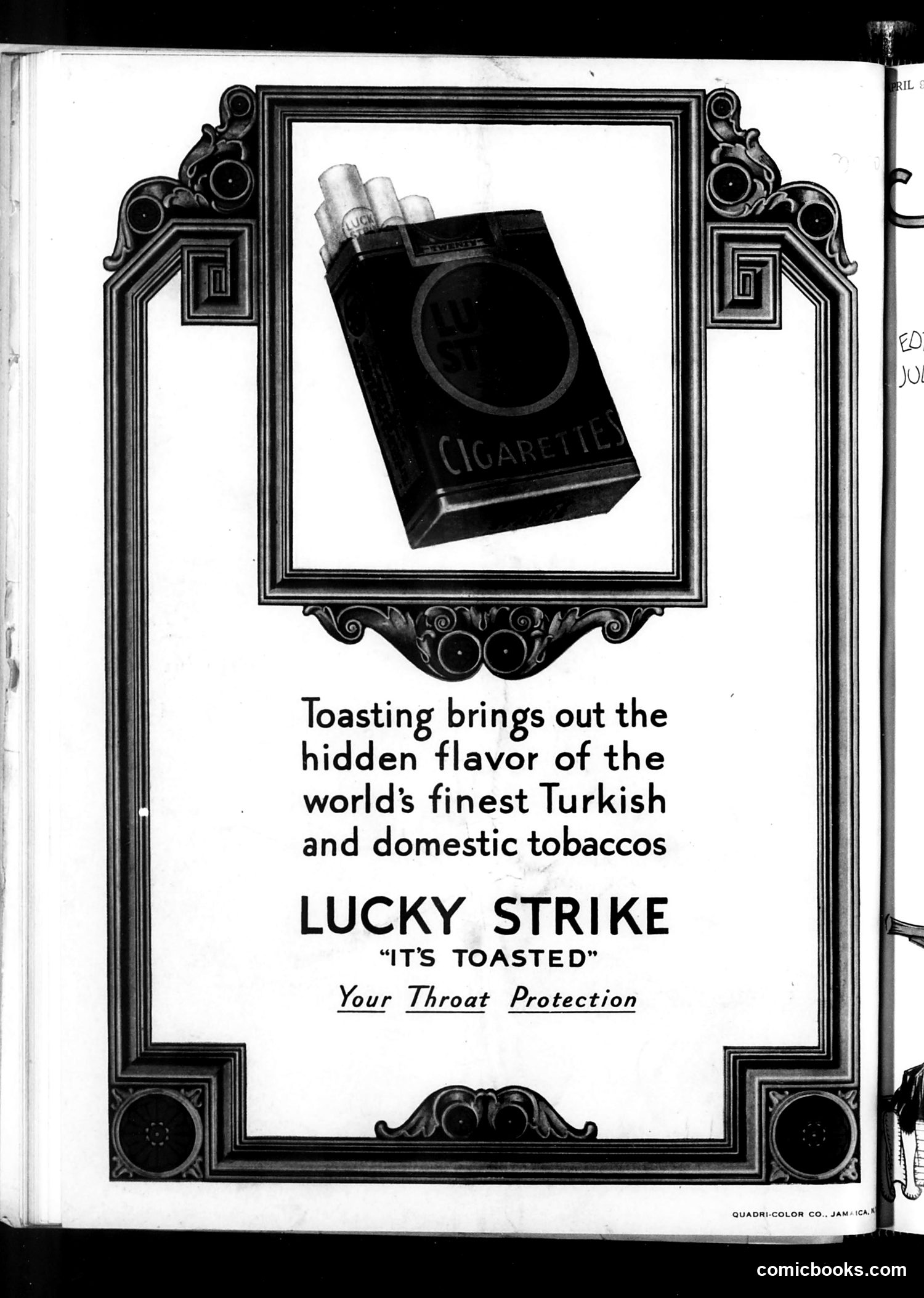
This is a **cigarette advertisement**, not political satire. It promotes Lucky Strike cigarettes, emphasizing their "toasting" process as a selling point that enhances flavor from Turkish and domestic tobaccos. The ad claims "Your Throat Protection"—a health claim that would be shocking to modern readers. In the early 20th century, tobacco companies made unsubstantiated medical assertions to market cigarettes. The "toasting" process was presented as beneficial, suggesting it somehow made smoking safer. The ornate Art Deco border frame indicates this ran in an upscale publication. By today's standards, marketing cigarettes with throat-protection claims is fraudulent and illegal—a striking reminder of how different advertising standards and tobacco regulation were before the health dangers became widely accepted.