
Judge, 1927-04-02 · page 24 of 36
Judge — April 2, 1927 — page 24: what you’re looking at
What you’re looking at
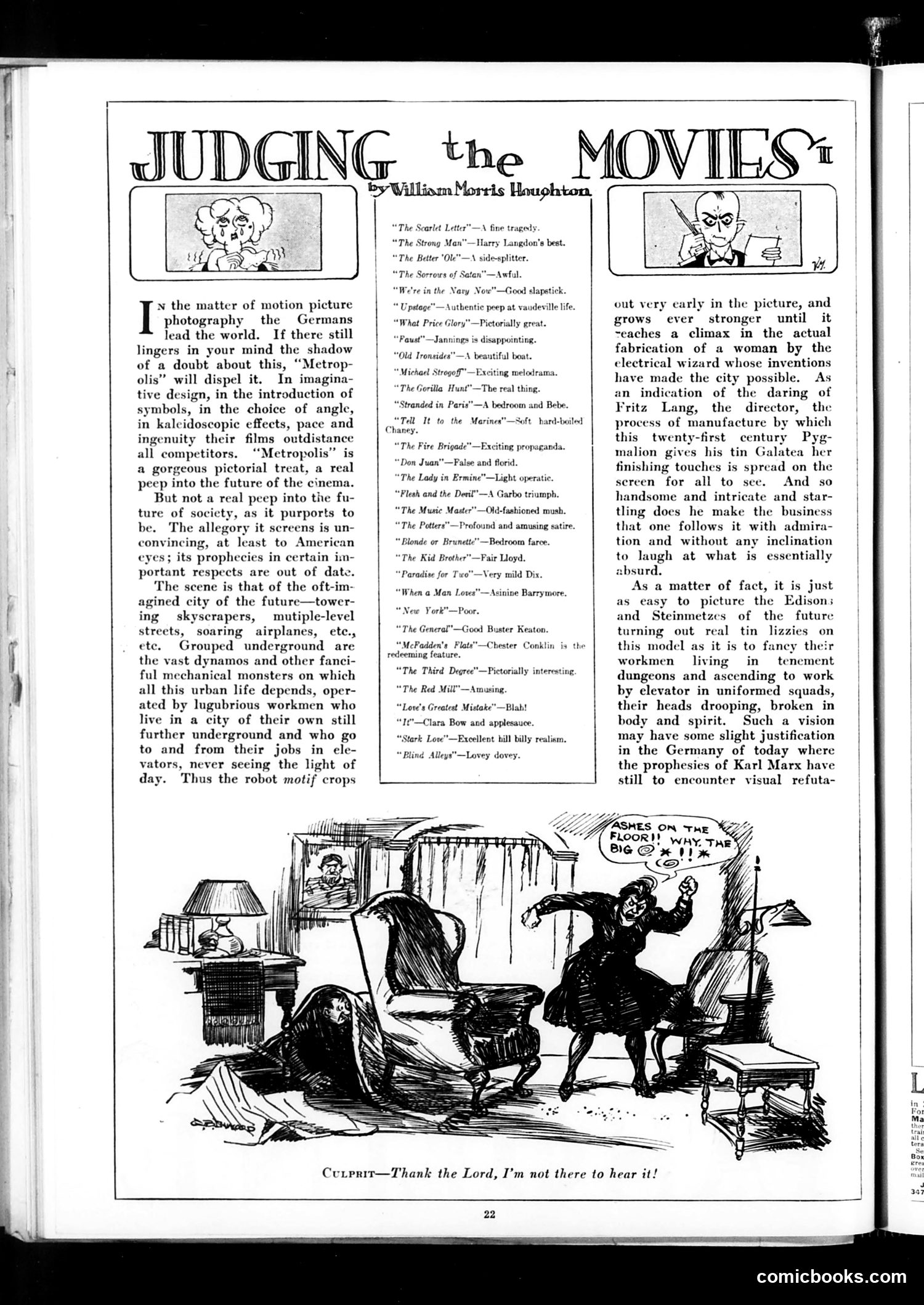
This is a film review column by William Morris Houghton critiquing contemporary silent films, particularly the German expressionist film *Metropolis*. The main review praises German cinematography's technical superiority while criticizing *Metropolis*'s social vision as unconvincing. The film depicts a futuristic city where workers toil in underground dungeons operating machinery, never seeing daylight. Houghton argues this dystopian vision is "out of date" and unrealistic for America, though he acknowledges it might reflect contemporary Germany where "the prophesies of Karl Marx have still to encounter visual refutation"—suggesting Marxist predictions of worker exploitation seem plausible in 1920s Germany but not America. The accompanying cartoon shows a wealthy couple ignoring their servant's distress, captioned "Thank the Lord, I'm not there to hear it!"—satirizing comfortable indifference to others' suffering. The page also lists brief reviews of other current films.
📄 Transcribed text from this page (OCR, searchable)
Machine-transcribed from the original scan — historical spelling and the odd misread are preserved.
GING. ne MOVIES: N the matter of motion picture I photography the Germans lead the world. If there still lingers in your mind the shadow of a doubt about this, “Metrop- olis” will dispel it. In imagina- tive design, in the introduction of symbols, in the choice of angle, in kaleidoscopic effects, pace and ingenuity their films outdistance all competitors. “Metropolis” is a gorgeous pictorial treat, a real peep into the future of the cinema. But not a real peep into the fu- ture of society, it purports to be. The allegory it screens is un- convincing, at least to American eyes; its prophecies in certain im- portant respects are out of date. The scene is that of the oft-im- agined city of the future—tower- ing skyscrapers, mutiple-level streets, ring planes, ete., etc. Grouped underground are the vast dynamos and other fanci- ful mechanical monsters on which all this urban life depends, oper- ated by lugubrious workmen who live in a city of their own still further underground and who go to and from their jobs in ele- vators, never seeing the light of day. Thus the robot motif crops | | “The Scarlet Letter"—A fine trag Strong Man"—Harry Langdon’s best. oq) 1e Better "Ole" —\ side-splitter. “The Sorrows of Satan" Awful. “We're in the Nary Now"—Good slapstick. “ Upstage”—Auth peep at vaudeville life. “What Price Glory"—Pictorially great. *Paust”"—Jannings is disappoi ing. “Old Ironsides"—A beautiful boa Michael Strogof’—Exciting melodrama. “The Gorilla. Hunt”—The real thing. “Stranded in Paris —A bedroom and Bebe. “Tell It to the Marines"—Soft hard-boiled "ye “The Fire Brigade” Exciting propaganda. “Don Juan"—Palse and florid. “The Lady in Ermine—Light operatic. “Flesh and the Deril”—A “The Music Master" bo triumph. ‘Old-fashioned mush. “The Potters" —Profound and amusing satire. "Blonde or Brunette’ —Bedroom farce. “The Kid Brothe “Paradise for Two"—Very mild Dix. —Pair Lloyd. “When a Man Loves"—Asinine Barrymore. “ New York"—Poor. “The General"—Good Buster Keaton. “McPadden's Flats"—Chester Conklin is the redeeming feature, “The Third Degree"—Pictorially interesting. “The Red Milt” —Atnusing. “Low's Greatest Mistake"—Blah! {"—Clara Bow and applesauce. “Stark Love"—Excellent bill billy realism. Lovey dovey. out very early in the picture, and grows ever stronger until it reaches a climax in the actual fabrication of a woman by the electrical ard whose inventions have made the city possible. As an indication of the daring of Fritz Lang, the director, the process of manufacture by which this twenty-first century Pyg- malion gives his tin Galatea her finishing touches is spread on the sereen for all to see. And so handsome and intricate and star- tling does he make the business that one follows it with admira- tion and without any inclination to laugh at what is essentially absurd. As a matter of fact, it is just y to picture the Edison; as and Steinmetz of the future turning out real tin li on this model as it is to fancy their workmen living in tenement dungeons and ascending to work by elevator in uniformed squads, their heads drooping, broken in body and spirit. Such a vision may have some slight justification in the Germany of today where the prophesies of Karl Marx have still to encounter visual refuta- 22 oo eee comicbooks.com