
Judge, 1927-04-02 · page 31 of 36
Judge — April 2, 1927 — page 31: what you’re looking at
What you’re looking at
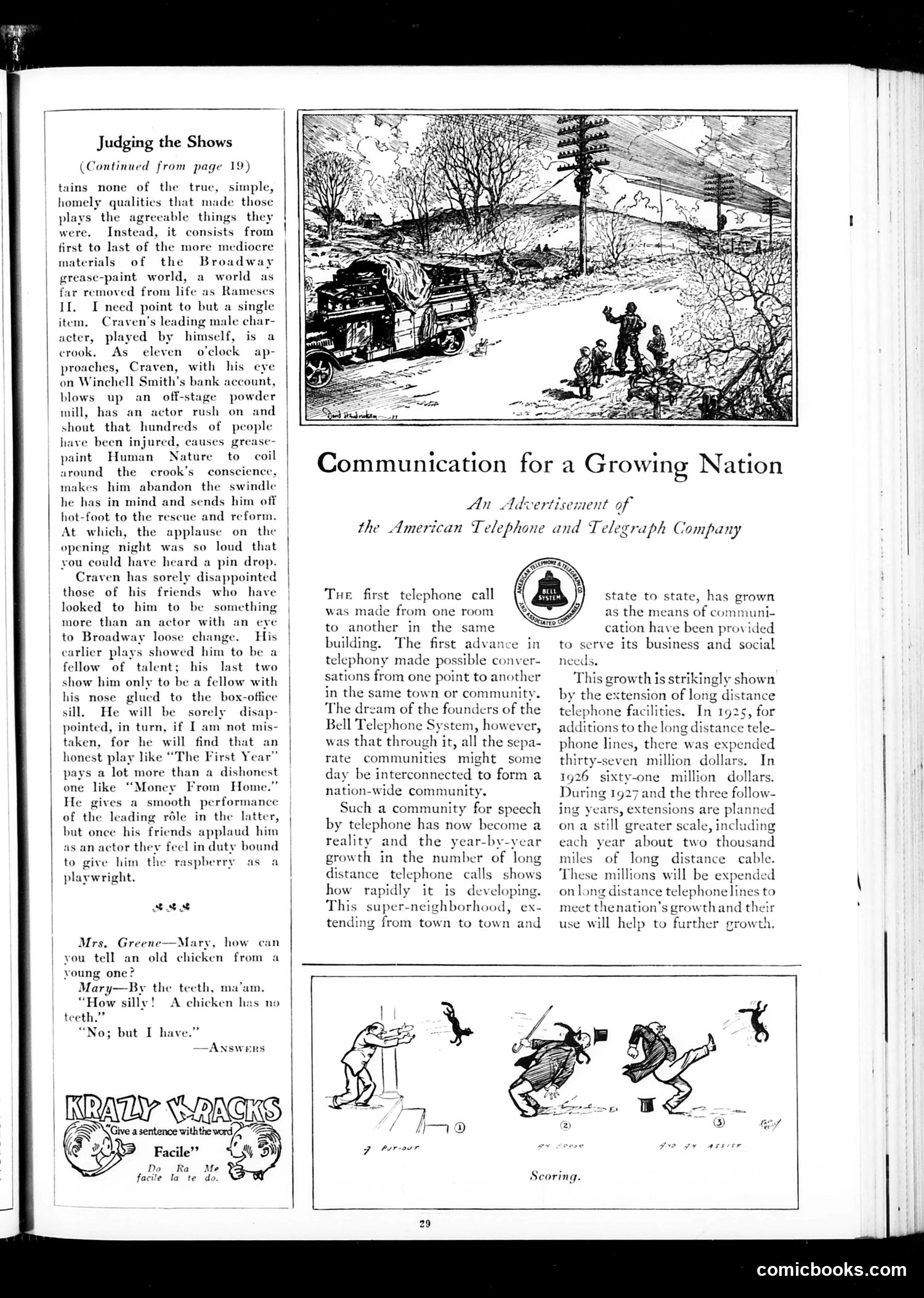
This page contains two distinct sections: **Left side:** A theater review criticizing actor Frank Craven's play "Money From Home." The critic argues Craven has compromised his talent by performing in shallow Broadway comedies focused on box-office profits rather than artistic merit. The reviewer contrasts this with Craven's earlier serious work like "The First Year," suggesting commercial success has corrupted his artistic integrity. **Right side:** An AT&T advertisement celebrating telephone infrastructure expansion. It presents the company's vision of a "nation-wide community" connected by long-distance telephone lines. The ad emphasizes investment figures ($37-61 million annually in mid-1920s) and future expansion plans, framing telephone infrastructure as essential to national growth and communication. The "Krazy Kracks" section at bottom is a joke feature unrelated to the main content.
📄 Transcribed text from this page (OCR, searchable)
Machine-transcribed from the original scan — historical spelling and the odd misread are preserved.
Judging the Shows (Continued from page 19) tains none of the true, simple, homely qualities that made those plays the agreeable things they were. Instead, it consists from first to last of the more mediocre materials of the Broadway grease-paint world, a world as far removed from life as Rameses II. I need point to but a single item, Craven’s leading male char- acter, played by himself, is a crook, As o'clock ap- proaches, C n, with his eye on Winchell Smith’s bank account, blows up an off-stage powder mill, has an actor rush on and shout that hundreds of people have been injured, causes grease- paint Human ture to coil around the crook’s makes him abandon eleven conscience, the swindle he has in mind and sends him off hot-foot to the rescue and reform. At which, the applause on the opening night was so loud that you could have heard a pin drop. Craven has sorely disappointed those of his friends who have looked to him to be something more than an actor with an eve to Broadway loose change. His carlier plays showed him to be a fellow of talent; his last two show him only to be a fellow with his nose glued to the box-offi sill. He will be disap- pointed, in turn, if I am not mis- taken, for he will find that an honest play like “The First Year” ays a lot more than a dishonest like “Money From Home.” He gives a smooth performance of the leading réle in the latter, but once his friends applaud him as an actor they feel in duty bound sorely one to give him the raspberry as a playwright. od Mrs. Greene—Mary, how can you tell an old chicken from a young one? Mary—By the teeth, ma'am. “How silly! A chicken has no teeth.” o; but I have.” —~ANSWERS Communication for a Growing Nation An Advertisement of the American Telephone and Telegraph Company Tue first telephone call was made from one room to another in the same building. The first advance in telephony made possible conver- sations from one point to another in the same town or community. The dream of the founders of the Bell Telephone System, however, was that through it, all the sepa- rate communities might some day be interconnected to form a nation-wide community. Such a community for speech by telephone has now become a reality and the year-by-year growth in the number of long distance telephone calls shows how rapidly it is developing. This super-neighborhood, ex- tending from town to town and state to state, has grown as the means of communi- cation have been provided to serve its business and social needs. t by the extension of long distance telephone facilities. In 1925, for additions to the long distance tele- phone lines, there was expended thirty-seven million dollars. In 1926 sixty-one million dollars. During 1927 and the three follow- ing years, extensions are planned | ona still greater scale, including each year about two thousand miles of long distance cable. These millions will be expended \ on long distance telephone lines to meet thenation’s growthand their ; use will help to further growth. Scoring. comicbooks.com