
Judge, 1927-04-02 · page 22 of 36
Judge — April 2, 1927 — page 22: what you’re looking at
What you’re looking at
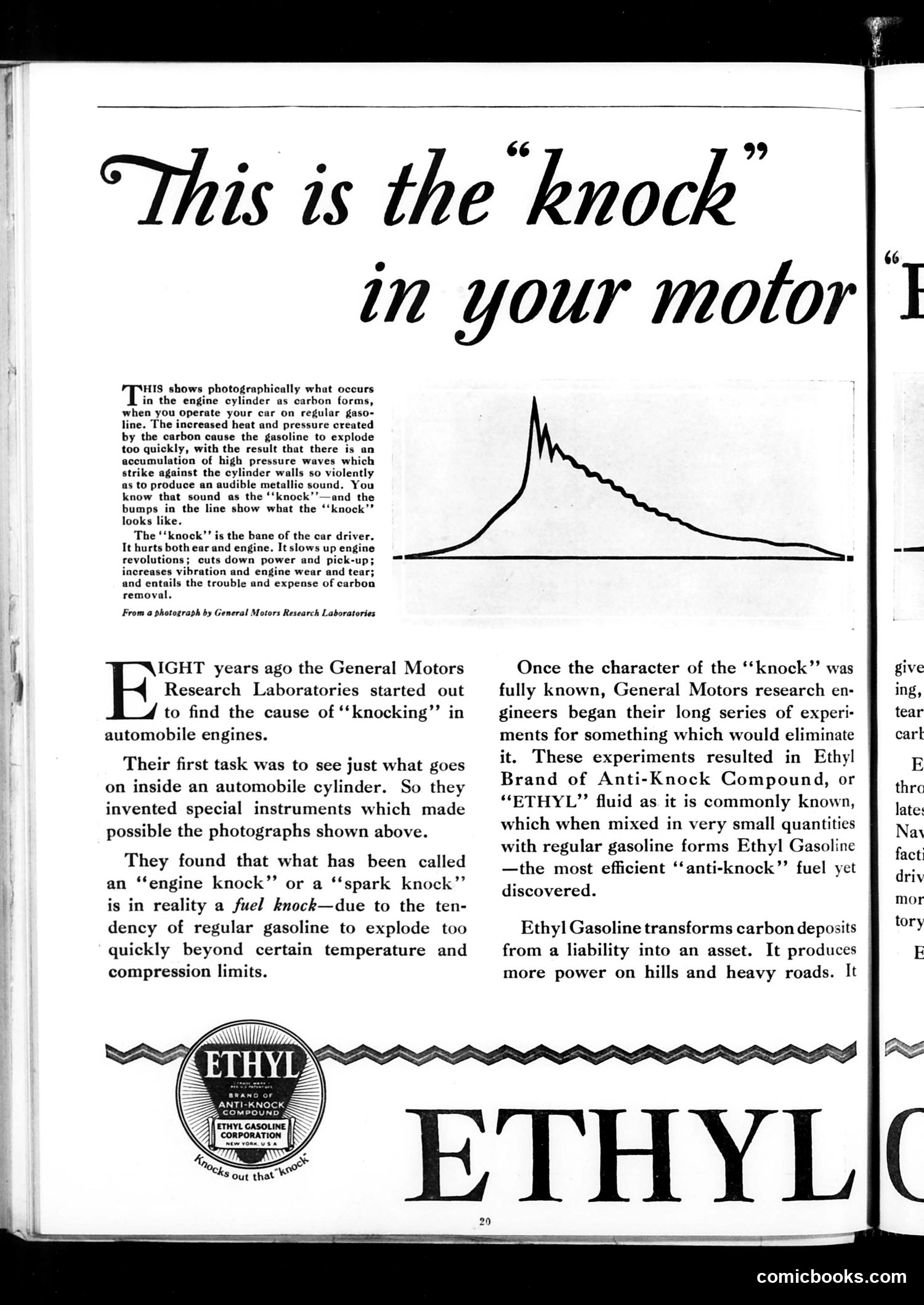
This is primarily a **General Motors advertisement**, not satire or political commentary. It appears in Judge magazine to promote "Ethyl Gasoline," a commercial fuel product. The page explains engine "knock"—the metallic sound and vibration caused by regular gasoline detonating too quickly under heat and pressure. GM's Research Laboratories developed this problem explanation and the solution: Ethyl Brand Anti-Knock Compound, which when added to gasoline creates Ethyl Gasoline. The graph at top shows knock vibrations visually. The advertisement emphasizes scientific credibility (GM's research, photographs) to market their fuel additive as solving a real mechanical problem that reduces engine performance and causes wear. **For modern readers**: This represents early 20th-century automotive marketing that combined technical explanation with brand-name chemical solutions—the ancestor of modern fuel additive advertising. The "Ethyl" product mentioned here is historically significant as an early leaded gasoline additive (later recognized as toxic).
📄 Transcribed text from this page (OCR, searchable)
Machine-transcribed from the original scan — historical spelling and the odd misread are preserved.
This is the knock” in your motor HIS shows photographically what occurs in the engine cylinder as carbon forms, when you operate your car on regular gaso- line. The increased heat and pressure created by the carbon cause the gasoline to explode too quickly, with the result that there is an accumulation of high pressure waves which strike against the cylinder walls so violently as to produce an audible metallic sound. You know that sound as the ‘‘knock’’—and the bumps in the line show what the ‘‘knock’’ looks like. The ‘‘knock”’ is the bane of the car driver. It hurts both ear and engine. It slows up engine revolutions; cuts down power and pick-up; increases vibration and engine wear and tear; and entails the trouble and expense of carbon removal. From a photograph by General Motors Research Laboratories IGHT years ago the General Motors Research Laboratories started out to find the cause of ‘‘knocking”’ in automobile engines. Their first task was to see just what goes on inside an automobile cylinder. So they invented special instruments which made possible the photographs shown above. They found that what has been called an ‘‘engine knock”’ or a ‘‘spark knock”’ is in reality a fuel knock—due to the ten- dency of regular gasoline to explode too quickly beyond certain temperature and compression limits. Once the character of the ‘‘knock’’ was fully known, General Motors research en- gineers began their long series of experi- ments for something which would eliminate it. These experiments resulted in Ethyl Brand of Anti-Knock Compound, or “ETHYL” fluid as it is commonly known, which when mixed in very small quantities with regular gasoline forms Ethyl Gasoline —the most efficient ‘‘anti-knock”’ fuel yet discovered. Ethyl Gasoline transforms carbon deposits from a liability into an asset. It produces more power on hills and heavy roads. It 66 I give ing, tear cark E thro late: Nay facti driv mor tory E comicbooks.com