
Judge, 1927-04-02 · page 21 of 36
Judge — April 2, 1927 — page 21: what you’re looking at
What you’re looking at
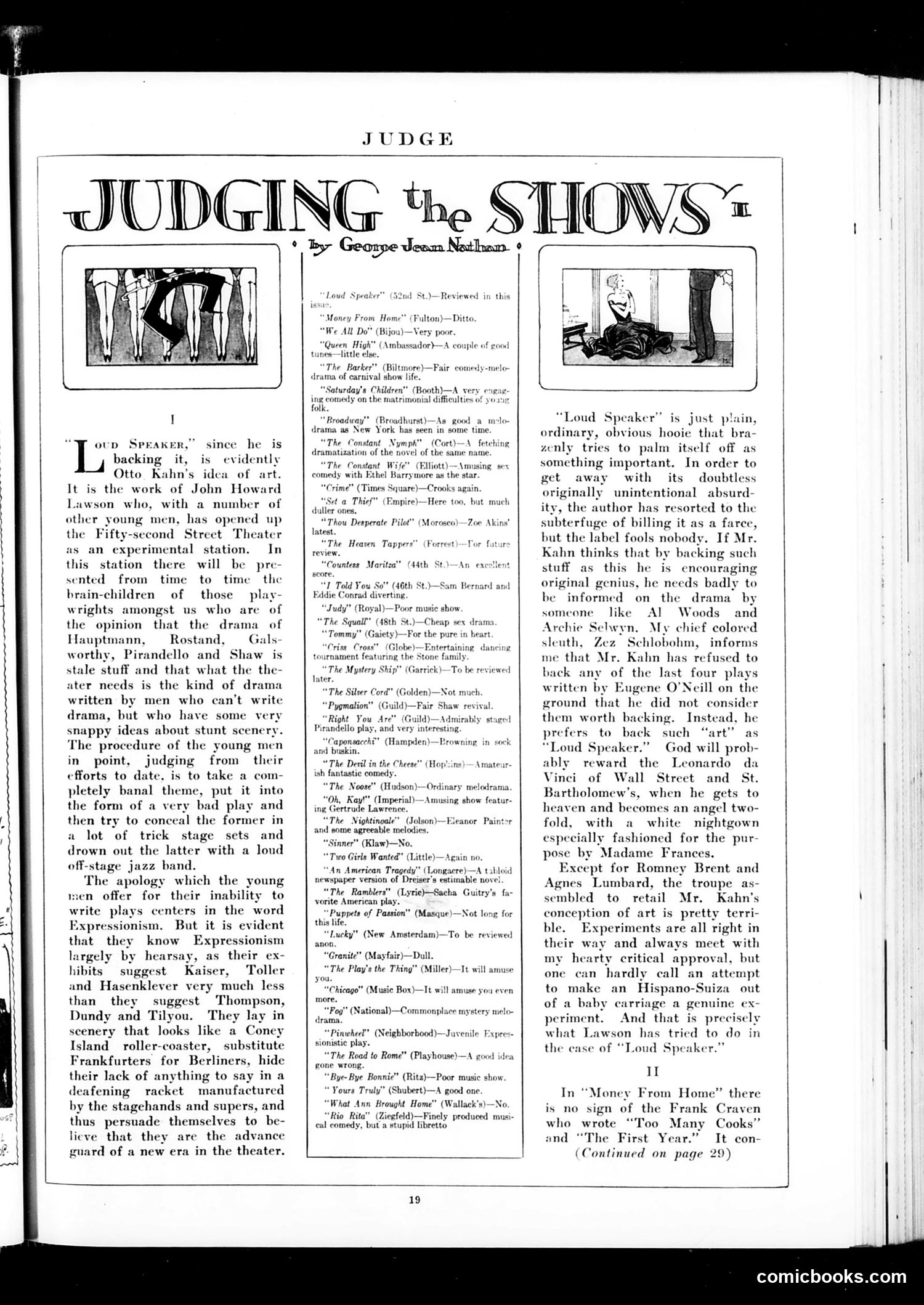
This is a theater review column by George Jean Nathan critiquing experimental Broadway productions. The main satirical target is the Fifty-second Street Theatre, an avant-garde venue backed by wealthy patron Otto Kahn and run by John Howard Lawson. Nathan mocks young Expressionist playwrights who, he argues, lack actual writing talent but hide their incompetence behind grandiose staging—"trick stage sets," loud off-stage bands, and scenery resembling "a Coney Island roller-coaster." He suggests they invoke Expressionism (a legitimate continental theatrical movement) as mere excuse, while their work actually derives from popular entertainers like Thompson, Dundy, and Tilyou (amusement park operators). The core joke: these self-proclaimed avant-garde reformers are simply manufacturing noise and spectacle to disguise banal, poorly-written drama—making them no different from commercial vaudeville, despite their artistic pretensions. Nathan positions himself as the skeptical arbiter dismissing false innovation.
📄 Transcribed text from this page (OCR, searchable)
Machine-transcribed from the original scan — historical spelling and the odd misread are preserved.
| } ; } i i \ ) \ ) ) ) JUDGE JUDGING te SHOWS “ up Speaker,” since he is L; backing it, is evidently Otto Kahn’s idea of art. It is the work of John Howard 1 who, with a number of other young men, has opened up wson the Fifty-second Street Th as an experimental station. this station there will be pre- sented from time to time the brain-children of those — play- wrights amongst us who are of the opinion that the drama of Hauptmann, Rostand, — Gals worthy, Pirandello and Shaw is stale stuff and that what the the- er needs is the kind of drama written by men who can’t write drama, but who have some very snappy ideas about stunt scenery The procedure of the young men in point, judging from their efforts to date, is to take com- pletely banal theme, put it into the form of a very bad play and then try to conceal the former in a lot of trick stage sets and drown out the latter with a loud off-stage band. The apology which the young n offer for their inability to write plays centers in the word pressionism. But it is evident that they know Expressionism largely by hearsay, as their ex- hibits suggest Kaiser, Toller and Hasenklever very much less than they suggest Thompson, Dundy and Tilyou. They lay in scenery that looks like a Cone Island roller-coaster, substitute Frankfurters for Berliners, hide their lack of anything to say in a deafening racket manufactured by the stagehands and supers, and thus persuade themselves to be- lieve that they are the advance guard of a new era in the theater. tunes—litd dran com test. review. score. “Judy” ( later. Right buskin. “The this life. "Lucky" anon. “Granite” you. more. “Pog” (Ni drama. e wrong. cal comed; Hi ‘Caponsacch Money From Home* “We All Do® The Barker drama of carnival show life Saturday's Children” * Broadway" as New York ha The Constant dramatization of the The Constant Wife y with Ethe Thou Desperate Pilo “Countess. Maritza” ‘he Squall” (48th St.) For the pu The Mystery Ship’ "The Sileer Cord” (Gol “Pygmalion” You 4 Pirandello pl The Devil in the Cheese” nntastie comedy. “The Noose” “Oh, Kay" ing Gertrude Lawrence. The Nightinoale” some agreeable melodies, inner” (Klaw)—No. Tico Girls Wanted” (Little)—Again no An American Tragedy” (Long: newspaper version of Dreiser's estimable nove Ramblers” vorite American play. “Puppets of Passion” val) — (Biltmor (Broadhurst) —A. n it Nymph 1 of the Barryme Crime” (Times Square)—Crooks a Thief” Empire). Her “The Heaven Tappers” (For (44th St “I Told You So” (46th St.)—Sam Bi Eddie Conrad diverting. Poor music Chea uring the Stone f ick) -Fair Sh and very rest (Hampden)—B: (Hop! (Hudson)—Ordin (Imperial) —Ammusi (Jolson): (Lyrie}—Sact (Masque (Booth)—A very engag: comedy on the matrimonial difficulties of young (Cort) (Elliott) —Am ‘as the stat (Morosco! Globe)—Entert: n)—Not m (Guild)—A¢ 52nd St.)—Reviewed in th Fulton)—Ditto. (Bijou)—Very poor. (Amba —A couple « ‘air comedy-melo- 8 goo n some time. A fe same nam ng ses ain. e too, but much Zoe Akins! est) —Tor futur An excellent ard and how p sex drama, ure in heart ning dancing To be reviewed ach. 4 ing. rowning in sock ns) —Amateur- nary melodrama. ing show featur- Eleanor Painter re)—A tabloid ha Guitry's fa- —Not long for (New Amsterdam)—To be reviewed (Mayfair)—Dull. “The Play's the Thing” ational)—Comn “Pinwheel” (3 sionistic play. “The Road to Rome” (Playhouse)—A go * Bye-Bye Bonn (Miller, pla Mm feld)—I stupid libretto Tt will ami hicago” (Music Box)—It will amuse you even ce mystery melo ighborbood)—Juvenile Expres- idk ” (Rita)—Poor music show. “ Yours Truly” (Shubert)—A good one. “What Ann Brought Home’ “Rio Rita” Mack's) —No. produced musi- 4 a mslo- ching “Loud Sp ker” is just plain, ordinary, obvious hooie that bra- zenly tries to palm itself off as something important. In order to get away with its doubtless originally unintentional absurd- ity, the author has resorted to the subterfuge of billing it as a farce, but the label fools nobody. If Mr. Kahn thinks that by backing such stuff as this he is encouraging inal genius, he needs badly to be informed on the drama by like Al Woods and Archie Selwyn. My chief colored sleuth, Zez Schlobohm, informs me that Mr. Kahn has refused to back any of the last four plays written by Eugene O'Neill on the ground that he did not consider them worth backing. Instead, he prefers to back such “art” as “Loud Speaker.” God will prob- ably reward the Leonardo Vinci of Wall Street and St. Bartholomew’s, when he gets to heaven and becomes an angel two- fold, with a white nightgown especially fashioned for the pur pose by Madame Frances. Except for Romney Brent and Agnes Lumbard, the troupe as- sembled to retail Mr. Kahn's conception of art is pretty terri- ble. Experiments are all right in their way and always meet with my hearty critical approval, but one hardly call an attempt to make an Hispano-Suiza out of a baby carriage a genuine ex- periment. And that is precisely what Lawson has tried to do in the case of “Loud Speaker.” II In “Money From Home” there is no sign of the Frank Craven who wrote “Too Many Cooks” and “The First Year.” It con- (Continued on page 29) someone da can comicbooks.com