
A complete issue · 36 pages · 1927
Judge — January 15, 1927
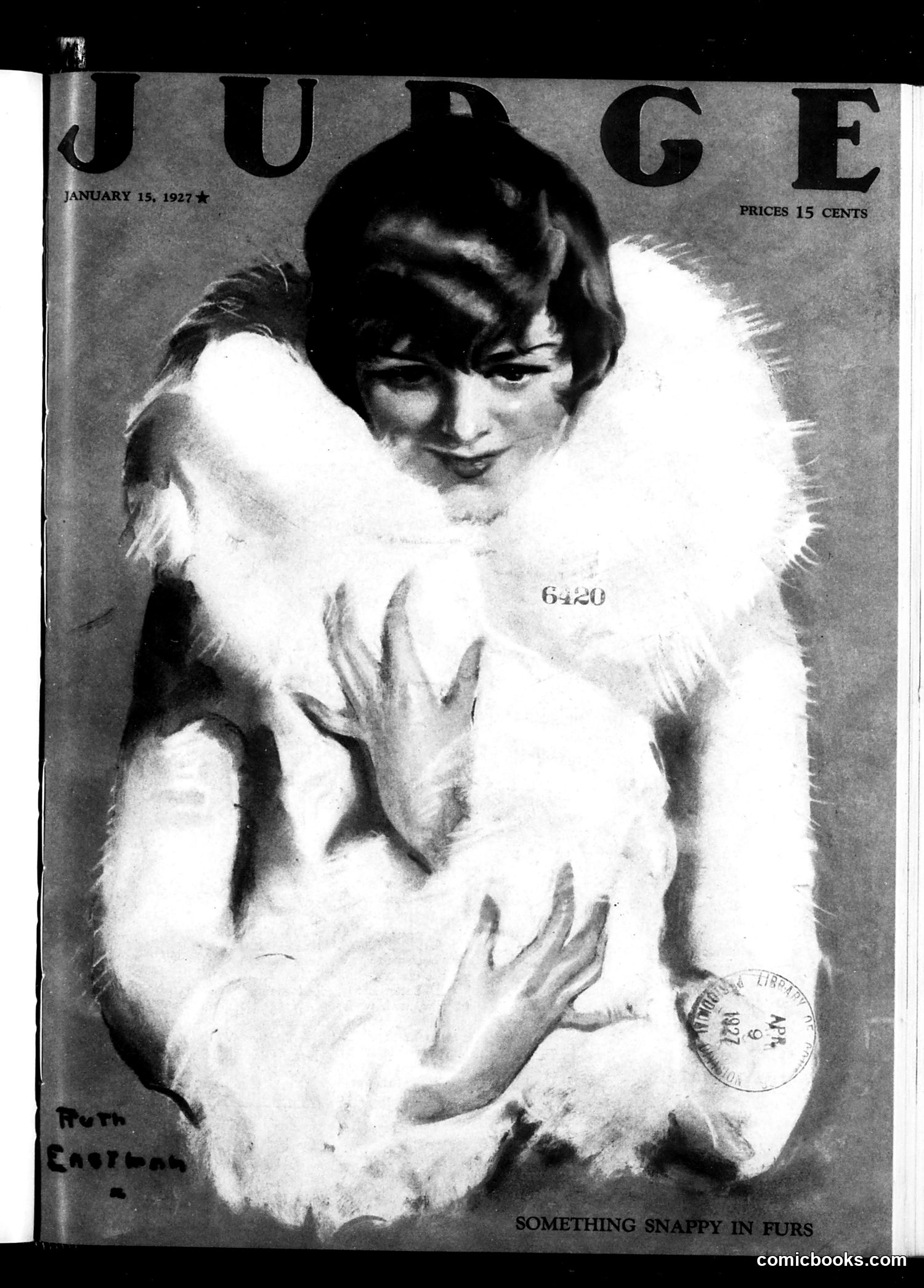
This January 15, 1927 *Judge* cover features a woman in fashionable 1920s attire—a fur stole and short bobbed hairstyle—gazing downward. The caption "SOMETHING SNAPPY IN FURS" suggests this is primarily a fashion/style advertisement rather than political satire. The cover appears designed to showcase luxury fur garments as status symbols during the Jazz Age, when such items signified wealth and sophistication. The woman's pose and styling exemplify the "modern woman" aesthetic of the 1920s—shorter hair, elegant accessories, and refined presentation. The artist signature reads "Ruth Carhon" (or similar). This represents *Judge*'s typical blend of satirical humor publication with high-end consumer advertising targeting affluent readers.

This page is **primarily an advertisement**, not editorial content or satire. It promotes Everready Layerbilt "B" batteries for radios and loudspeakers, manufactured by National Carbon Co., Inc. The ad claims the Layerbilt battery is "the most economical of 'B' Batteries" based on "practical tests." It emphasizes the battery's unique layered construction—stacking flat, current-producing elements rather than cylindrical cells—which allegedly makes it more durable and cost-effective than competitors like Light-Duty batteries. The page includes product images and detailed technical explanations of the battery's construction. The text is straightforward marketing copy rather than satire or political commentary, reflecting the 1920s-30s era when home radio sets required separate "B" batteries for operation.
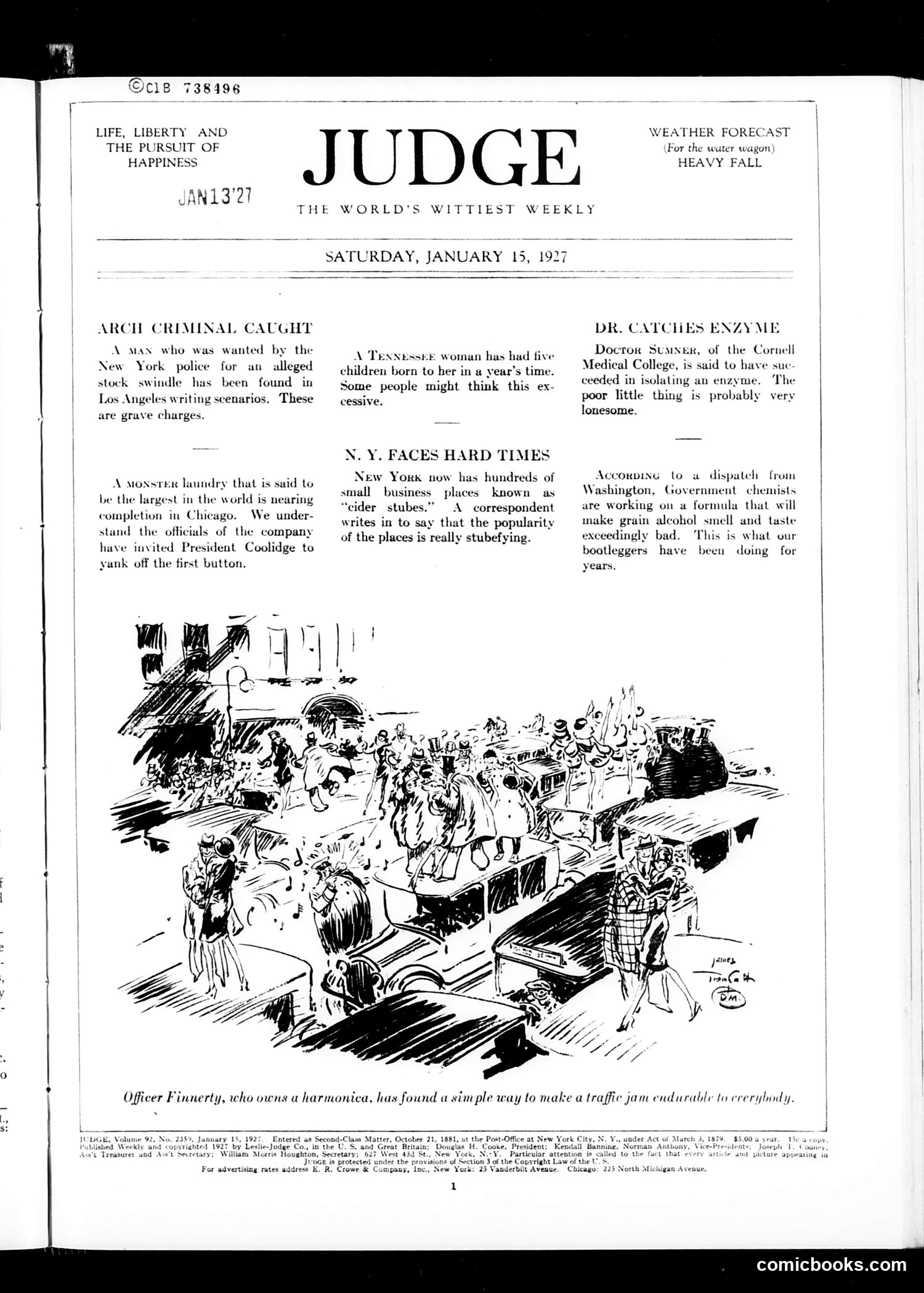
The main cartoon depicts a massive traffic jam with cars piled haphazardly on top of each other and people milling about in chaos. The caption credits "Officer Finnerly, who owns a harmonica" with finding "a simple way to make a traffic jam endurable to everybody." The joke is that Finnerly plays his harmonica to entertain stuck motorists during congestion—transforming an annoying urban problem into entertainment. This satirizes both 1920s traffic congestion in major cities and the era's somewhat naive faith that simple solutions or distractions could solve modern problems. The cartoonist treats this impossible gridlock with dark humor typical of Judge's satirical style, suggesting traffic management had become absurd.
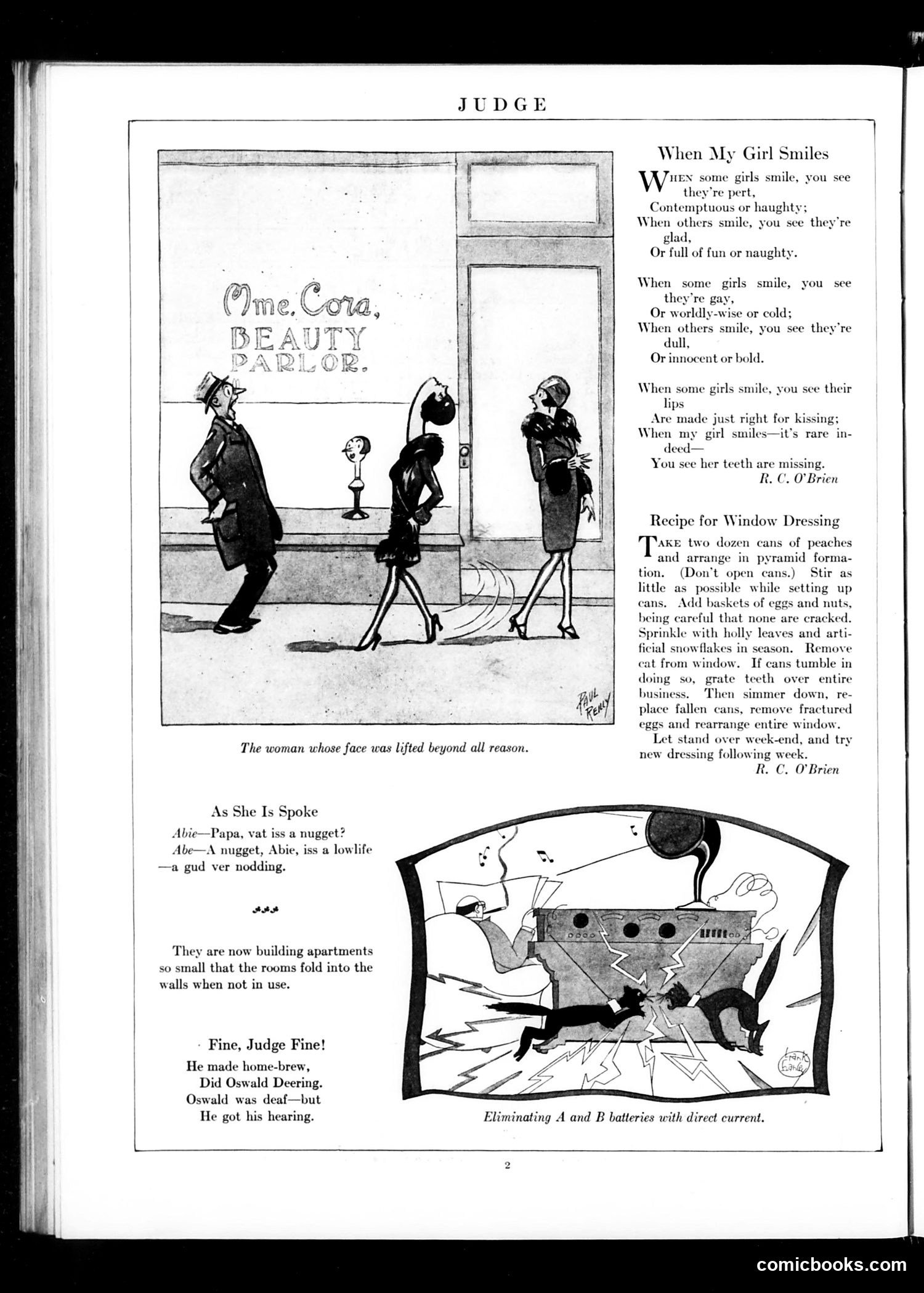
This page contains three distinct pieces of humor: 1. **"When My Girl Smiles"** - A poem by R.C. O'Brien satirizing how different girls' smiles reveal their character (vain, gay, dull, cold), concluding that his girl's smile shows her teeth are missing—a self-deprecating joke about his romantic partner's appearance. 2. **"Recipe for Window Dressing"** - A humorous mock-recipe by O'Brien offering absurdist instructions for window displays, treating it as a cooking process with ingredients like canned peaches, eggs, and cat. 3. **"Ome, Cora, Beauty Parlor"** - An illustration showing a beauty salon storefront where women's faces appear cartoonishly distorted, satirizing cosmetic procedures or the effects of beauty treatments. The page exemplifies Judge's light satirical humor targeting beauty culture and courtship conventions of the era.
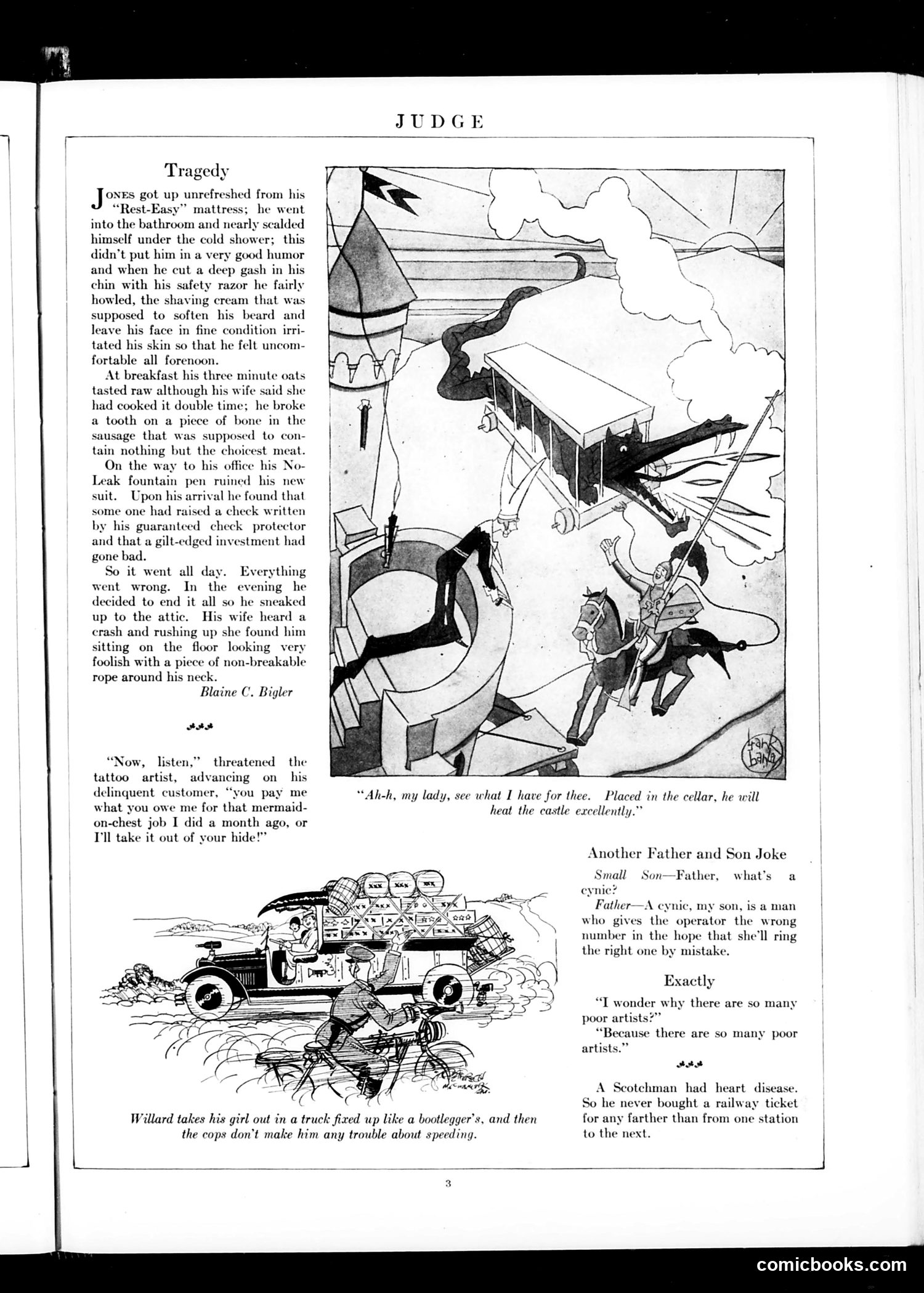
This page contains three separate humorous items rather than political cartoons: 1. **"Tragedy"** (top): A satirical story by Blaine C. Bigler about Jones's disastrous day—from shaving mishaps to uncooked oatmeal to a ruined suit, culminating in him hanging himself in the attic. It's darkly comedic domestic humor. 2. **Middle cartoon**: Shows a chaotic scene with a overloaded car and various figures, captioned about "Willard" taking his girl out in a truck, suggesting the cops won't trouble him about speeding. Likely mocks reckless driving or police indifference. 3. **"Another Father and Son Joke"** (bottom): A brief joke about cynicism—a cynic is someone who gives the wrong phone number hoping for a different result. Light wordplay humor. The page emphasizes general comedy and satire rather than specific political commentary.
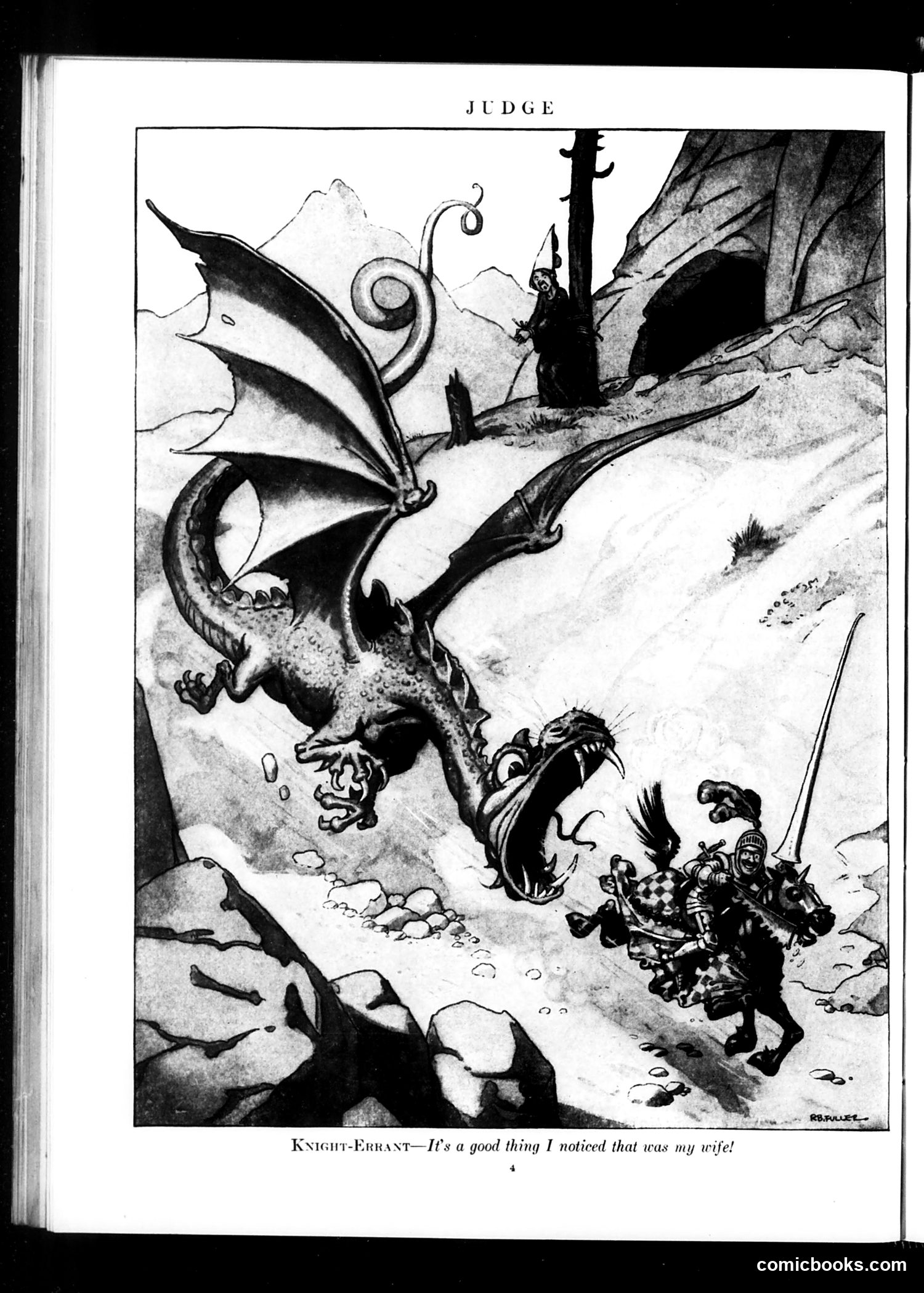
This cartoon from Judge magazine depicts a medieval knight encountering a dragon. The caption reads: "Knight-Errant—It's a good thing I noticed that was my wife!" The humor relies on a visual pun playing with the term "knight-errant" (a wandering medieval knight seeking adventure). The joke appears to be that the knight nearly attacked what he thought was a dragon but realized it was actually his wife. This is likely satirizing either marital relationships (wives portrayed as dragon-like) or perhaps mocking overly romantic medieval adventure narratives popular in contemporary literature and theater. The elaborate fantasy scene with castles in the background suggests this may parody the era's fascination with medieval romance fiction. Without additional context about Judge's publication date or specific contemporary references, the precise satirical target remains unclear, though the domestic humor angle is evident.
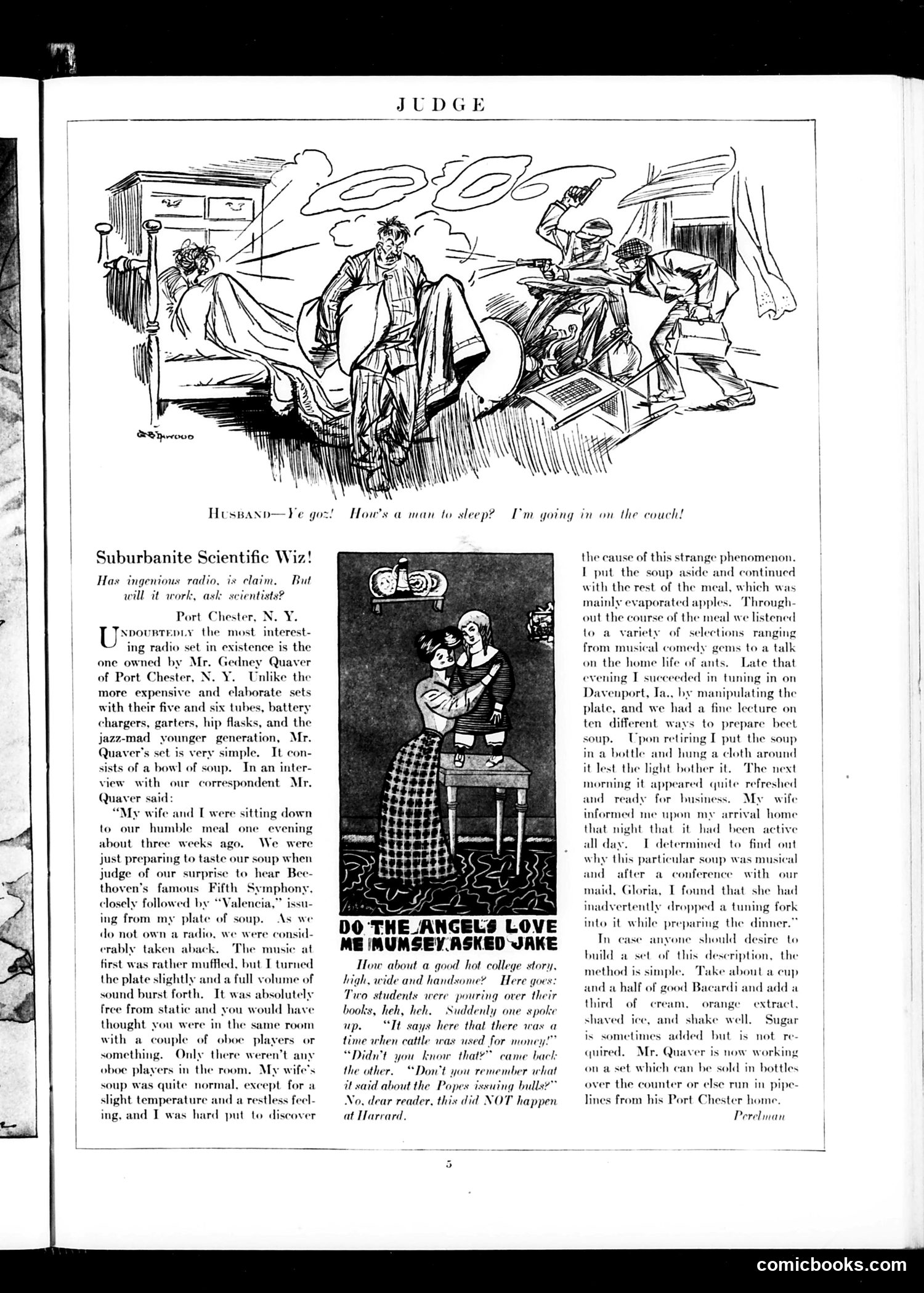
The top cartoon satirizes marital discord over a husband's desire to nap on the couch while his wife entertains. The sketch humorously depicts domestic conflict over leisure time and household priorities—a relatable complaint about spousal consideration. The bottom section features an article titled "Suburbanite Scientific Wiz!" describing a Port Chester, New York resident's homemade radio set. The accompanying illustration shows someone operating early radio equipment. The piece humorously recounts how the family's radio accidentally interfered with dinner preparations, causing peculiar phenomena with their soup course. This satirizes the novelty and unpredictability of early radio technology in domestic settings—a timely subject given radio's relatively recent adoption in American homes during the 1920s-1930s era.
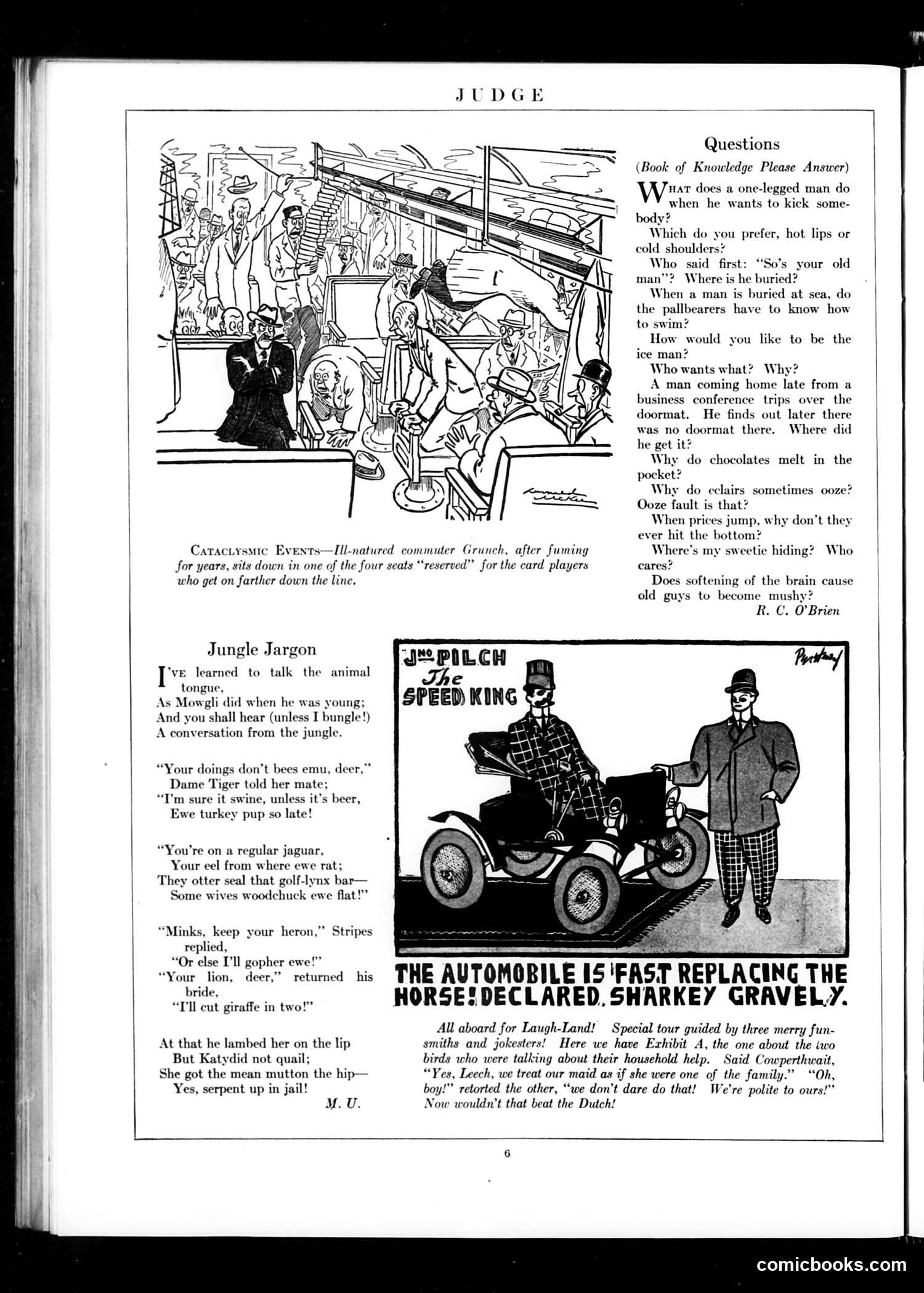
This page from Judge (an American satirical weekly) contains three distinct humor pieces: **Top cartoon**: Shows an ill-tempered commuter ("Grunch") disrupting card players by claiming reserved subway seats. The satire mocks urban commuting irritants and territorial disputes over transit seating. **"Jungle Jargon"**: A whimsical poem using animal puns (emu/emu, swine/swine, otter/ought to, etc.) where jungle animals converse in punning animal-speak. The humor relies entirely on wordplay rather than social commentary. **"Speed King" advertisement**: Features "Sharkey Gravely" declaring automobiles are replacing horses. The accompanying joke mocks servant treatment—wealthy people treat their household help as "family" while being rudely polite to visitors, inverting normal social hierarchy for absurdist effect. **"Questions" section**: A riddle column offering whimsical, nonsensical brain-teasers ("What does a one-legged man do when kicking somebody?"). Overall, this is entertainment-focused humor without significant political content—typical of Judge's lighter fare mixing puns, absurdist jokes, and early automobile-age satire.
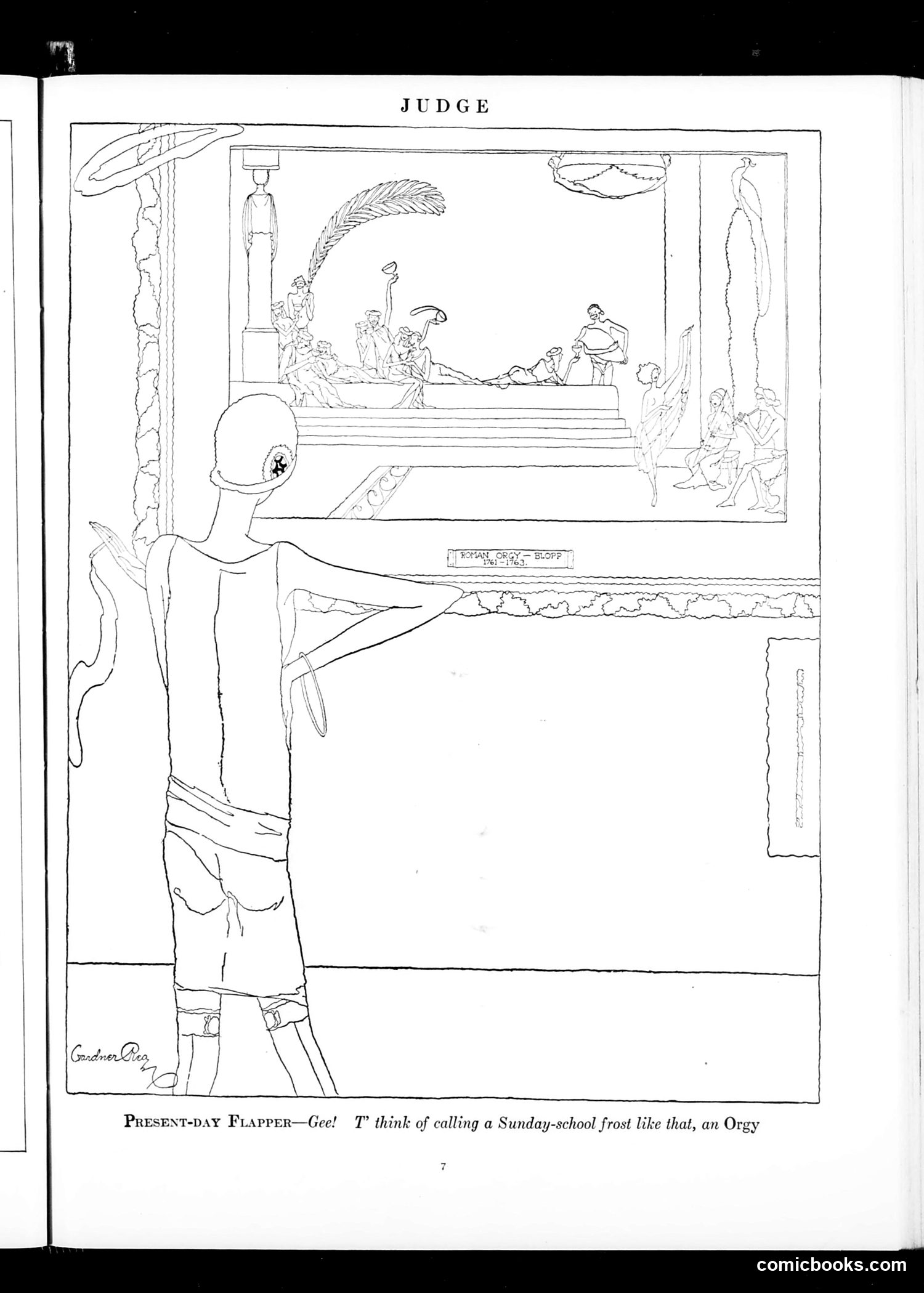
This page titled "JUDGE" features a satirical cartoon criticizing modern youth behavior. The central image shows a young woman in 1920s flapper attire observing a lively party scene above her. The caption jokes about calling a "Sunday-school frost" (a modest social gathering) an "orgy"—mocking how contemporary youth exaggerated and used provocative language to describe innocent social events. The satire targets the generational divide of the Jazz Age: older Americans viewed flappers' relatively tame gatherings as scandalously wild, while young people dramatically described ordinary social occasions with sensationalized terminology. The "present-day flapper" represents the new, modern woman defying Victorian propriety through fashion, speech, and social behavior—a key source of cultural anxiety in 1920s America.
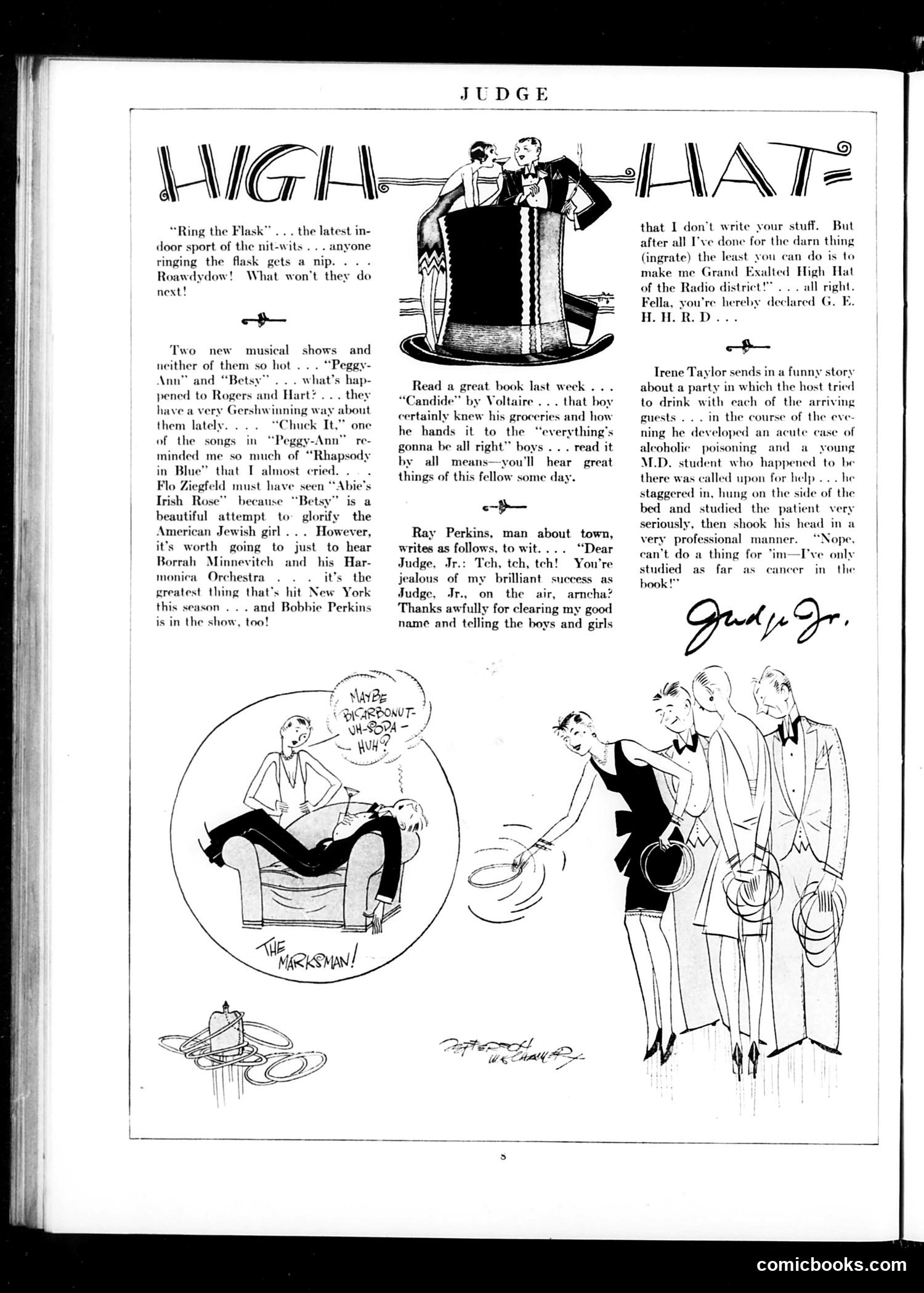
This is a humor column mixing entertainment gossip with cartoon vignettes. The main targets are 1920s Broadway and radio culture: **"Ring the Flask"** satirizes Prohibition-era speakeasies where patrons would ring a flask as an "indoor sport"—mocking both the novelty and lawlessness of drinking during alcohol's legal ban. **The musical theater section** references contemporary shows ("Peggy-Ann," "Betsy") and composers Rodgers & Hart, dismissing them while praising Voltaire's *Candide* and mocking sentimental optimism ("everything's gonna be all right"). **Ray Perkins' letter** concerns radio personality "Judge, Jr." (unclear if real or fictional). Perkins humorously thanks him for improving his reputation on air—a self-deprecating joke about needing radio help. **The cartoons** show: a man lounging titled "The Marksman" (unclear meaning), and a woman with three men holding hats (possibly an illustration of Irene Taylor's story about a drunk party host). Overall, the page mocks Prohibition, Broadway pretension, and radio's growing social influence during the Jazz Age.
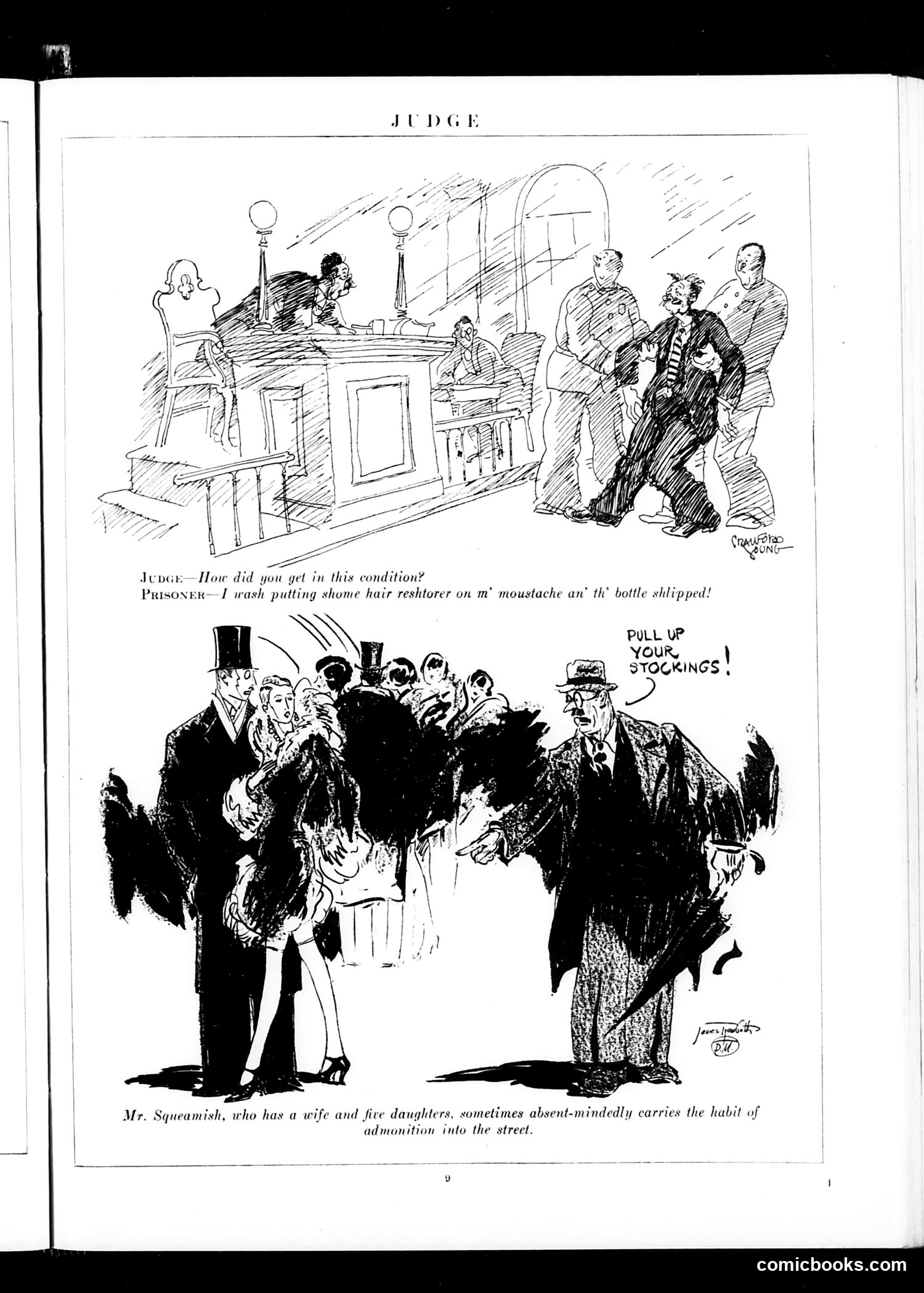
This page contains two separate cartoons satirizing social behavior. **Top cartoon**: A courtroom scene where a prisoner explains his disheveled appearance resulted from accidentally ingesting hair restorer meant for his mustache. The humor relies on the absurdity of the excuse and the judge's skepticism. **Bottom cartoon**: The main satire depicts "Mr. Squeamish," a man accustomed to correcting his wife and five daughters at home, unconsciously applying this habit to strangers in public. He's shown commanding a woman to "Pull up your stockings!"—a reference to the era's standards of female modesty. The joke mocks how domestic authority bleeds into inappropriate public behavior, and the social awkwardness this creates. The caption explicitly explains the satire for readers who might miss it. Both cartoons reflect early 20th-century concerns about propriety, male authority, and social embarrassment.
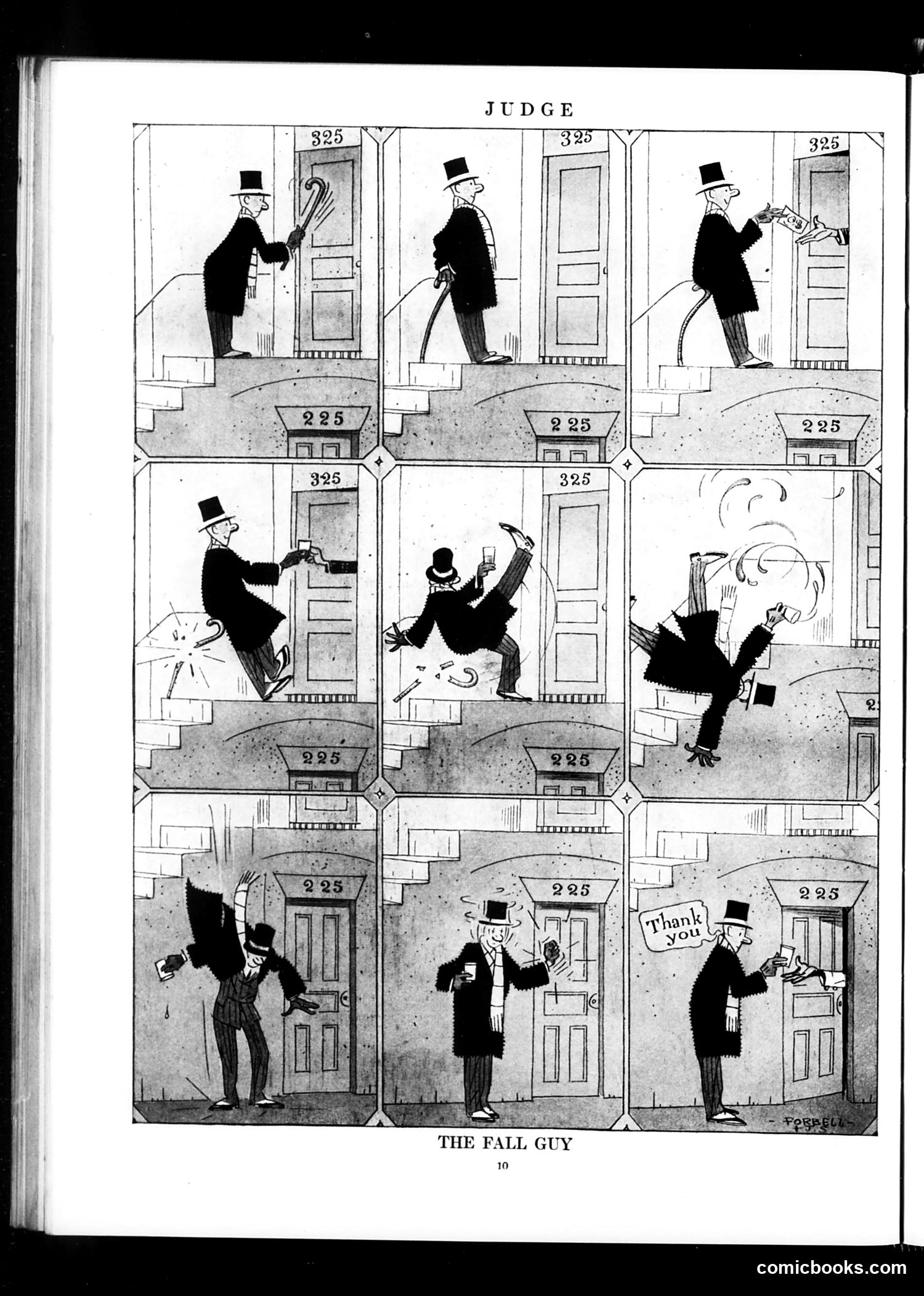
This is a silent comic strip depicting a man in formal attire (top hat and coat) visiting apartment 225 multiple times. The sequence shows him: 1. Arriving at the door with various items 2. Slipping and falling on the floor 3. Being thrown out violently 4. Gradually being ejected with increasing force The final panels show him departing with a "Thank you" sign, appearing grateful despite the rough treatment. The satire appears to target either a specific social type or political figure being repeatedly humiliated or rejected. "Fall guy" refers to someone made a scapegoat. Without additional context about Judge's publication date or contemporary events, the specific target remains unclear, though the visual joke emphasizes slapstick consequence for persistent unwanted visits.
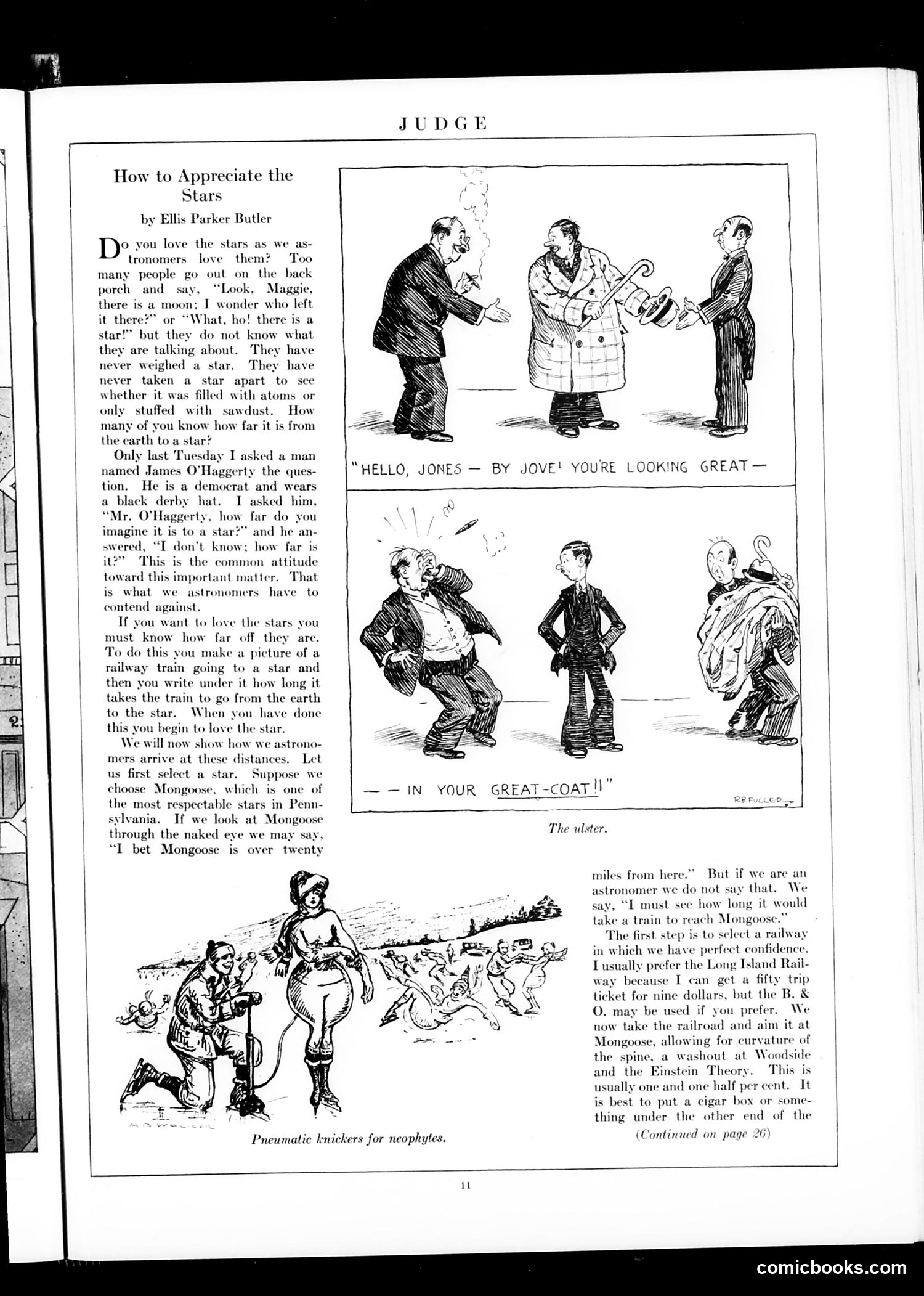
This is a humorous essay satirizing both amateur stargazers and pseudo-intellectual astronomers. Butler mocks ordinary people (represented by "James O'Haggerty," a Democrat in a derby hat) who casually admire stars without understanding them. He then ridicules astronomers' own absurd methodology—proposing to measure stellar distance by building a hypothetical railroad to a star like Mongoose, accounting for "curvature of the spine" and the "Einstein Theory." The cartoons above show men complimenting each other's appearance (the "great-coat" joke), and below, figures in "pneumatic knickers for neophytes"—likely mocking fashionable or absurd clothing trends. The satire targets pretentious pseudo-science and the gap between actual knowledge and confident bluffing—a common Judge magazine theme ridiculing American social pretension.
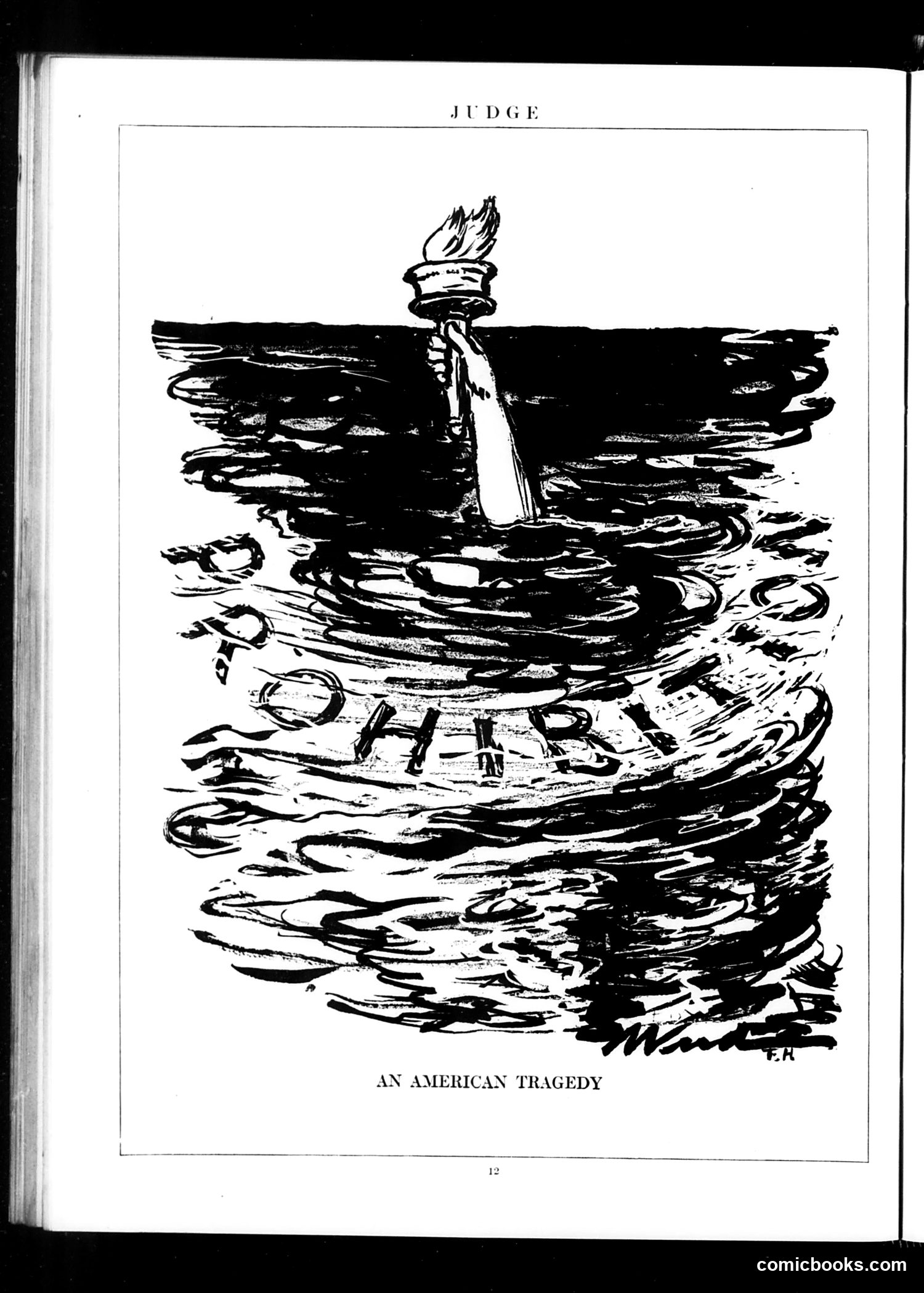
This political cartoon depicts Lady Justice (recognizable by her torch) standing atop an enormous stack of law books, with the word "HIRE" visible among them. The composition suggests a critique of the American legal system's complexity and apparent dysfunction. The title "An American Tragedy" indicates the cartoon satirizes justice itself as tragically flawed or inaccessible. The towering, chaotic pile of legal materials implies that justice has become buried under bureaucratic complexity—the very laws meant to serve it obstruct it instead. The torch, traditionally symbolizing enlightenment and fair judgment, appears isolated at the top, suggesting justice is isolated from practical application. This appears to criticize how the legal system serves special interests (indicated by "HIRE") rather than genuine justice, making it an indictment of American law's corruption or ineffectiveness during whatever era this was published.
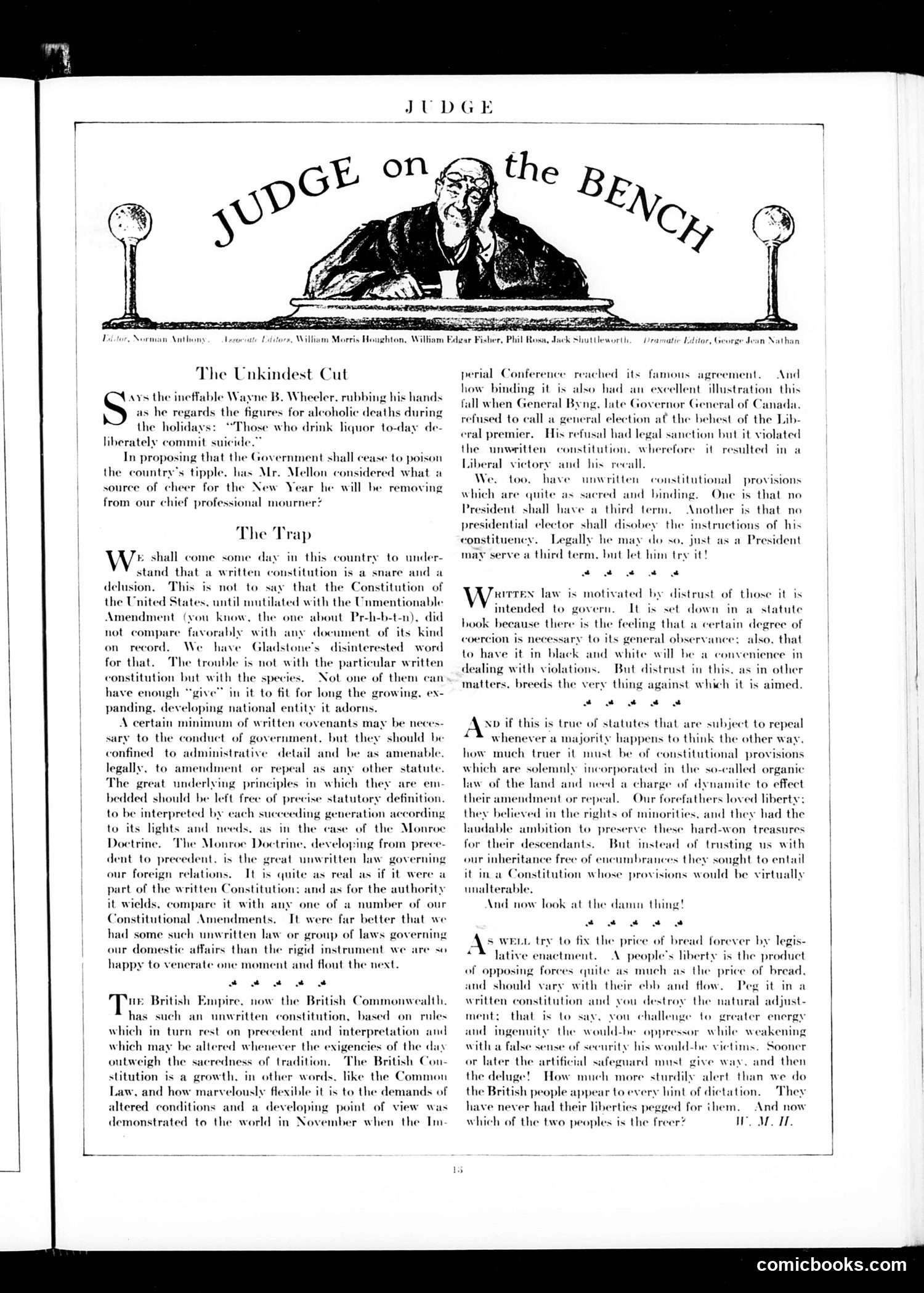
This page contains three editorial pieces satirizing American constitutional and legal issues, likely from the Prohibition era (the repeated references to alcohol regulation and "Pr-h-b-t-n" suggest the 1920s). **"The Unkindest Cut"** mocks Wayne B. Wheeler (a prominent Prohibition advocate) for celebrating alcohol-related deaths while simultaneously pushing for government alcohol bans—finding dark irony in his position. **"The Trap"** argues that written constitutions are inherently inflexible and problematic, contrasting them favorably with Britain's unwritten constitutional tradition. It cites the Monroe Doctrine as an unwritten principle more effective than formal amendments. **Written Law** contrasts written statutes (motivated by distrust, requiring explicit codification) with unwritten constitutional conventions like presidential term limits—suggesting written law reflects governmental suspicion of citizens. The satire critiques both Prohibition enforcement and rigid constitutional legalism, favoring flexible, tradition-based governance over explicit statutory control.
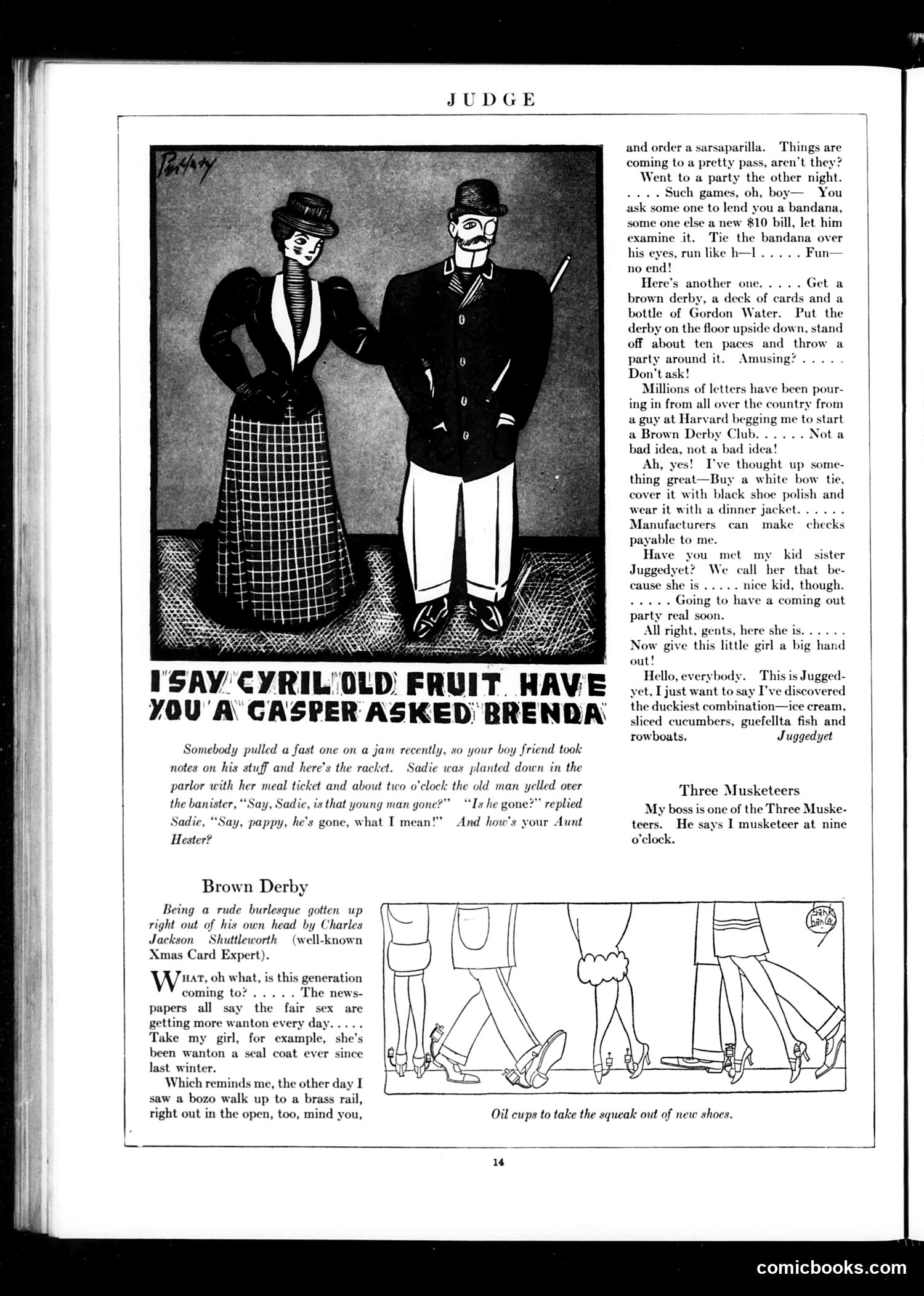
This page collects humorous commentary and party games from the 1920s. The main content includes: **"Brown Derby"** section: A satirical piece mocking young women's fashion and behavior. The author complains that girls are "wanton" (reckless/immoral), using a pun—his girl has been wanting a seal coat all winter. This reflects period anxieties about women's increasing independence and changing social norms during the Jazz Age. **Party games**: The text describes trendy parlor games like placing a brown derby on the floor and throwing cards at it—reflecting 1920s social entertainment. **"Juggedyet"** column: Rambling social commentary and jokes about contemporary trends, including references to Harvard clubs and fashion absurdities (painting a bow tie black with shoe polish). **Bottom illustration**: Shows women's feet/shoes with the caption about "oil cups to take the squeak out of new shoes"—likely mocking either new fashion footwear or women's dancing fads. Overall, the page satirizes modern youth culture, women's changing roles, and contemporary social fads of the period.
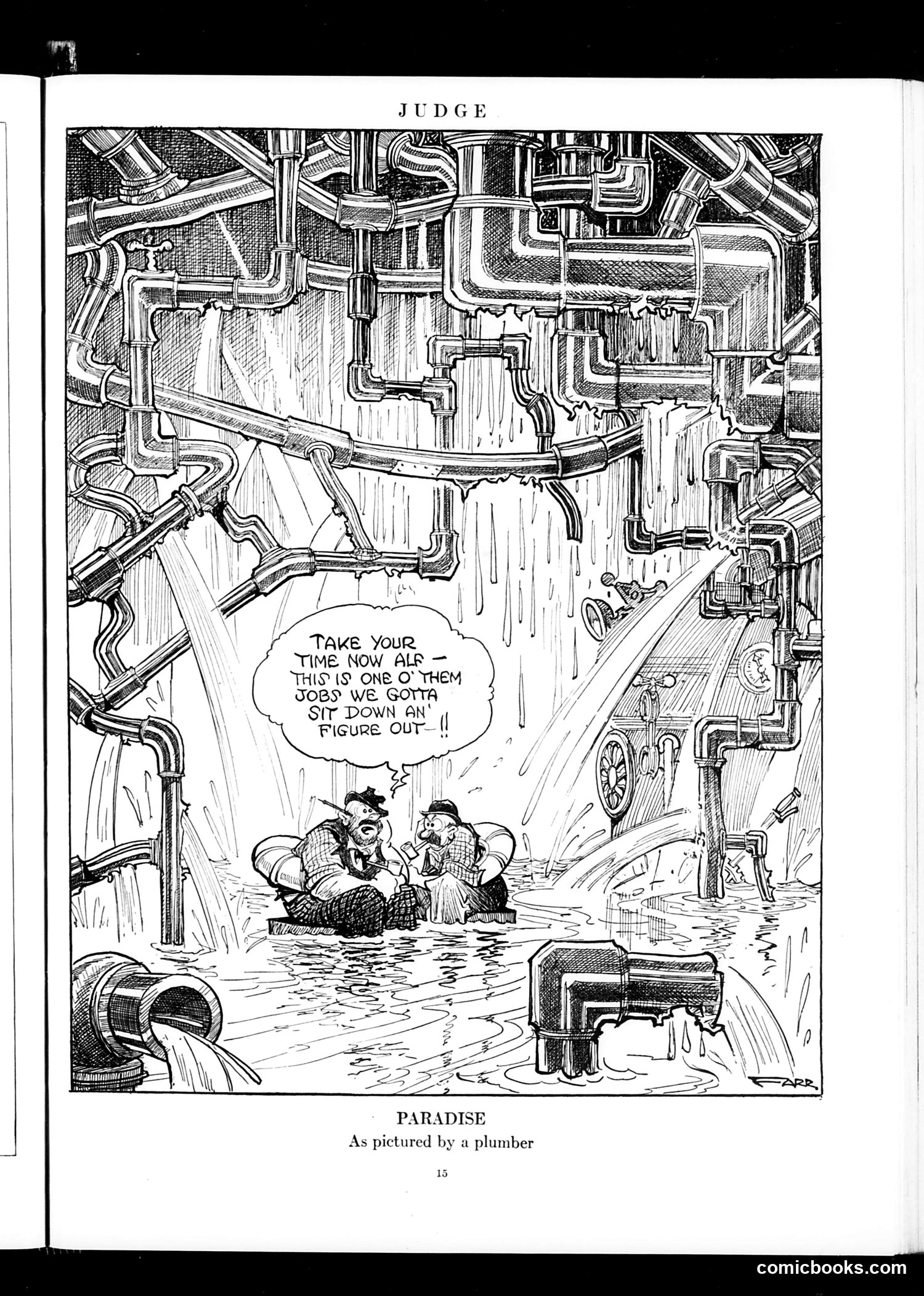
This cartoon satirizes plumbers' working conditions through dark humor. Two plumbers sit in a flooded basement surrounded by complex, maze-like pipes and water damage. One tells the other to "take your time" because "this is one of them jobs we gotta sit down and figure out." The satire is straightforward: the caption calls this "Paradise as pictured by a plumber"—meaning a plumber's idea of paradise is having complicated, lucrative work that requires extensive problem-solving and time on the job (thus maximizing billable hours). The joke mocks both the chaotic nature of plumbing repairs and the profession's incentive to make jobs seem more complex and time-consuming than necessary. The intricate pipe work emphasizes how bewilderingly complicated these systems appear.
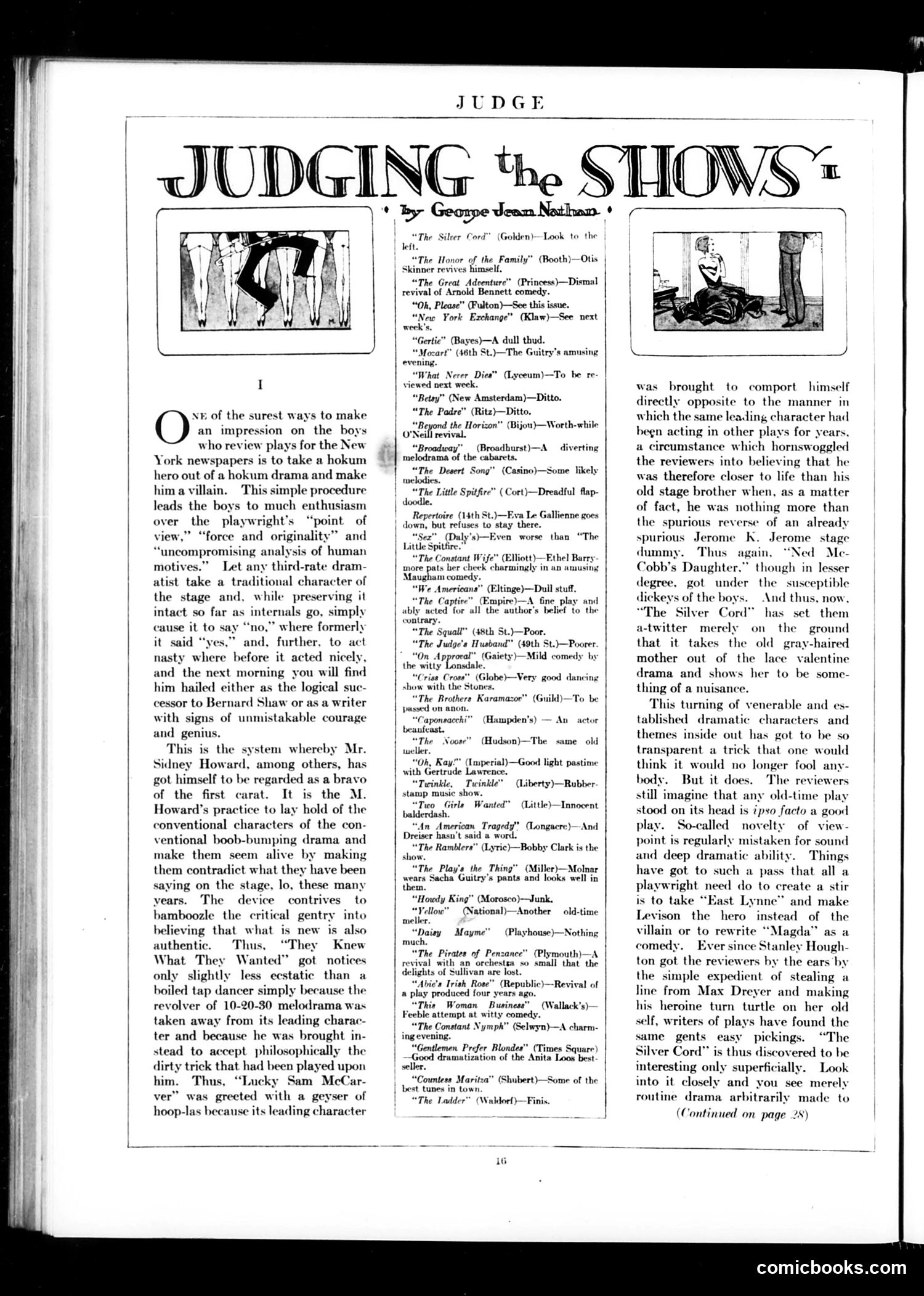
This is a theater review column by George Jean Nathan, a prominent drama critic of the 1920s. The page contains two elements: **The illustrated commentary (top left):** The main article satirizes playwrights—particularly Sidney Howard—who gain critical acclaim by taking conventional stage characters and simply reversing their moral behavior: making traditionally "nice" characters act "nasty" instead. Nathan argues critics mistake this superficial inversion for genuine artistic innovation, wrongly praising it as bold originality comparable to Bernard Shaw's work. **The theater listings (right):** A rapid-fire review of current Broadway productions with brief, often dismissive judgments ("Dull thud," "Dreadful flap-doodle," "Innocent balderdash"). This demonstrates Nathan's cynical approach to contemporary theater. The satire targets both lazy playwrights exploiting tired formulas and credulous theater critics easily bamboozled by surface-level subversion of dramatic convention.
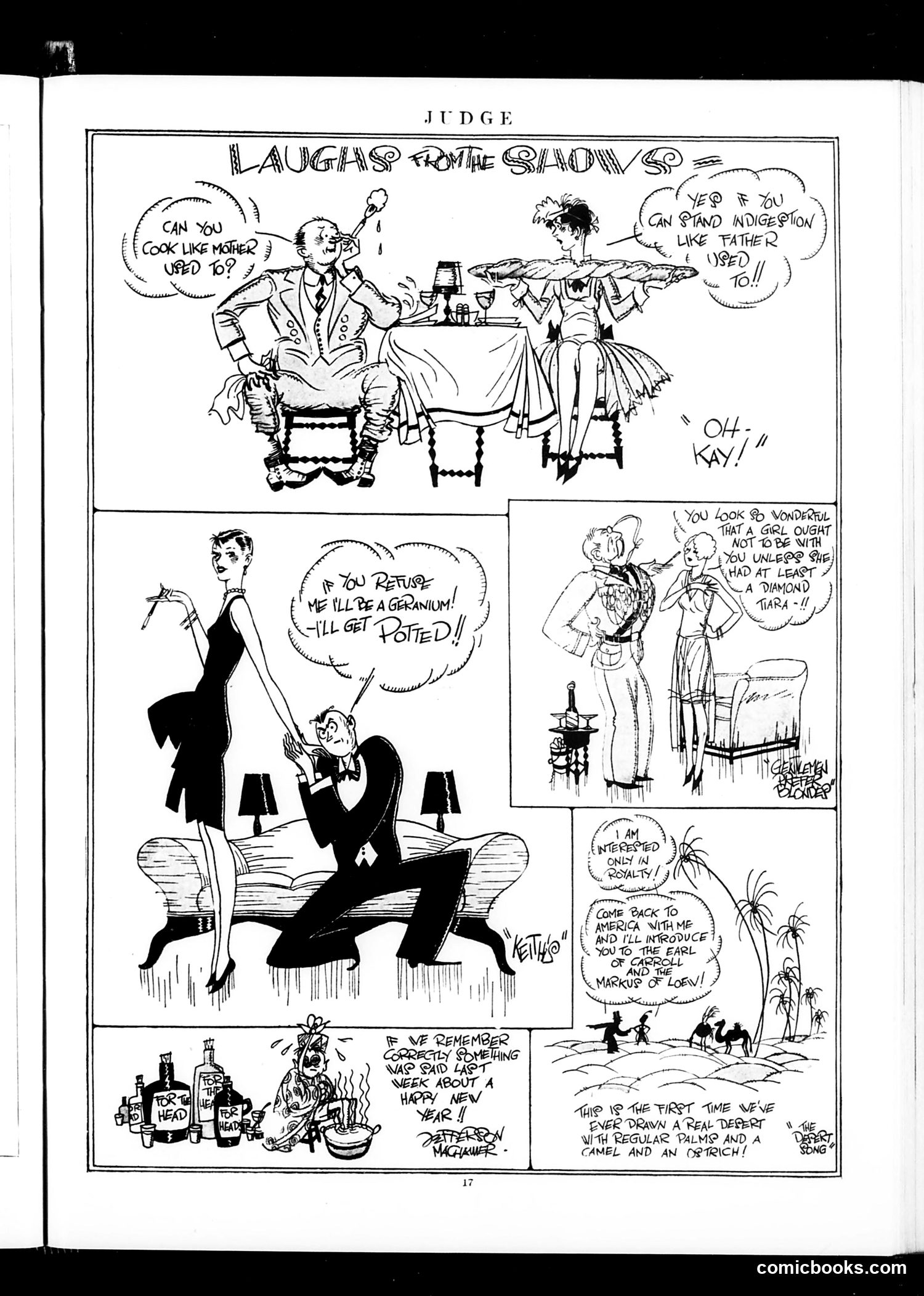
This page from *Judge* magazine contains multiple satirical vignettes mocking domestic and social life, likely from the 1920s-30s era based on art style. The top panel jokes about gender roles: a man holding cooking utensils asks if his wife can "cook like mother used to," while a woman balances household items, quipping about standing "indignation like father used to"—inverting expectations about domestic skills. The middle section depicts romantic/marital scenarios: a man pursuing a woman promises "a geranium" and getting "potted," while another scene shows women discussing a man's wealth and the acquisition of a "diamond tiara." The bottom panel references New Year's resolutions with figures around bottles and fire, suggesting over-indulgence. The final desert scene appears to joke about romantic fantasies or escapism—introducing someone to "the earl of carrots" and desert life with "camel and ostrich." Overall, these cartoons satirize courtship rituals, marriage dynamics, materialism, and the gap between romantic ideals and domestic reality.
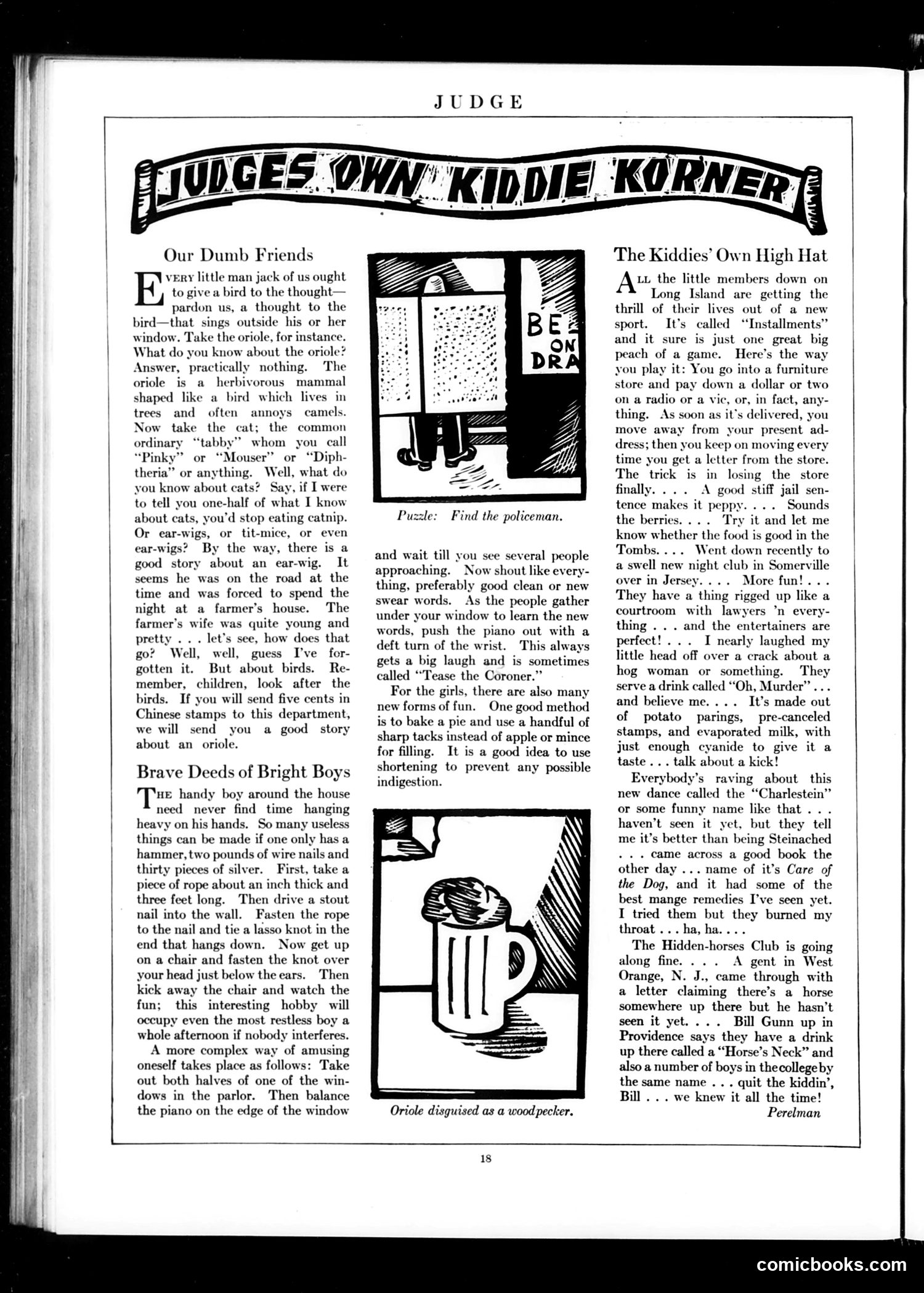
This page from *Judge* contains three satirical humor sections targeting different audiences. "Our Dumb Friends" mocks readers' ignorance about animals while making absurd claims (orioles are "herbivorous mammals"). The joke is that we claim to care about nature while knowing nothing about it. "Brave Deeds of Bright Boys" uses dark humor to satirize parenting and DIY culture. The "hobbies" described—fashioning nooses, dropping pianos on crowds, baking pies with tacks inside—are obviously lethal pranks presented deadpan as innocent projects. This likely critiques both careless parenting and the era's casual attitude toward children's safety. "The Kiddies' Own High Hat" satirizes 1920s consumer culture and installment buying. "Installments" is a game where players buy furniture on credit, then move repeatedly to evade payment collectors. It mocks both the predatory lending system and working-class evasion tactics, while also joking about Prohibition-era speakeasies ("Horse's Neck" drinks). The puzzles and illustrations are decorative filler typical of the era's magazine format.
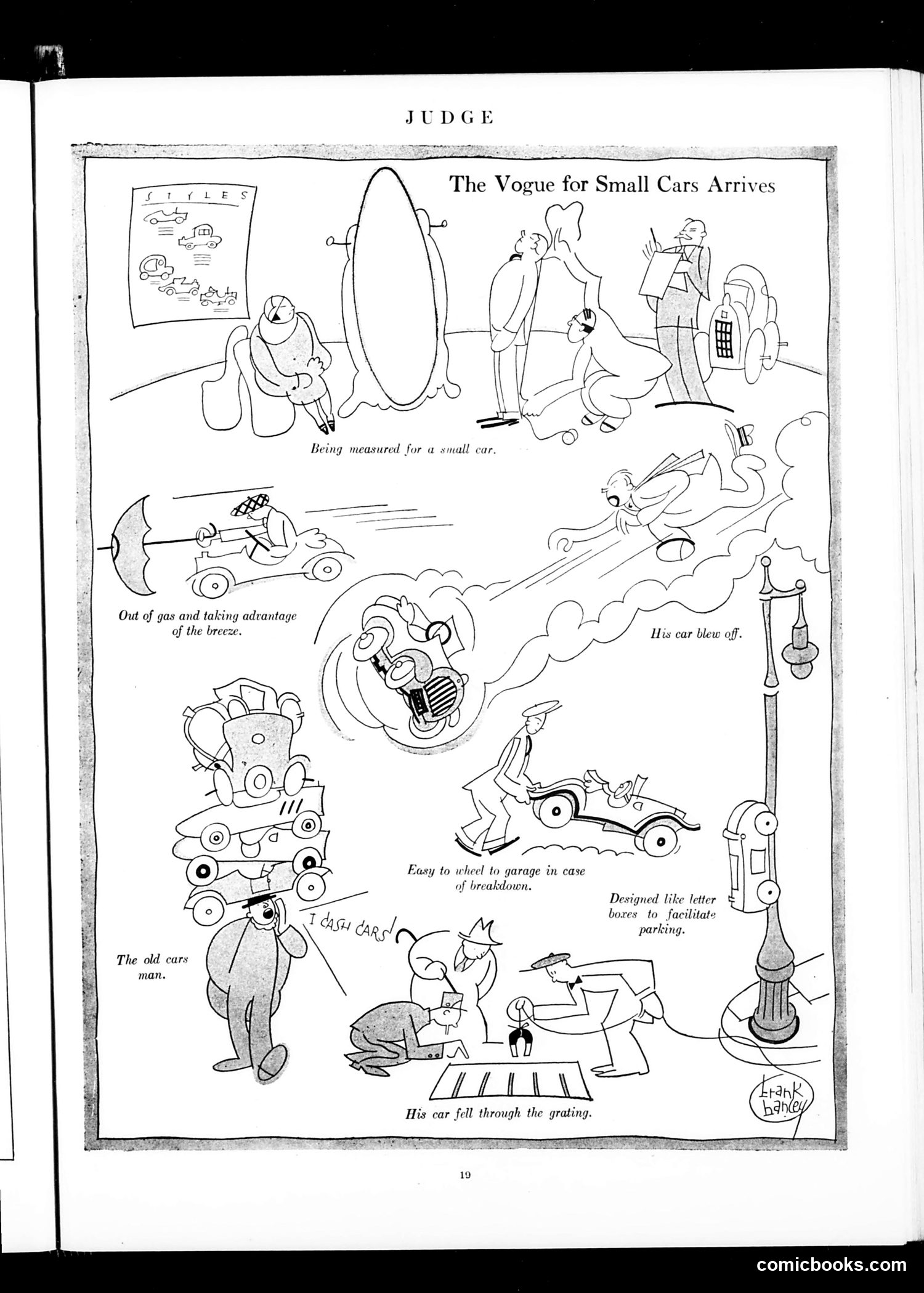
This comic page satirizes the emerging trend of compact automobiles, likely from the 1920s-30s when small cars first gained popularity. The humor mocks the impracticality and absurdity of downsizing vehicles: **Key jokes depicted:** - Cars so tiny they require measurement like clothing - A vehicle blown away by wind due to insufficient weight - Engine failure requiring manual pushing to the garage - A car designed like a "letter box" for parking in tight spaces - A vehicle falling through a street grating - The "old cars man" representing obsolete attitudes toward full-size automobiles The satire targets both manufacturers promoting miniaturization as modern progress and buyers embracing the trend uncritically. The cartoonist questions whether smaller cars actually solve urban problems or simply create new, comic ones—a skeptical take on technological "advancement" that prioritizes novelty over functionality.
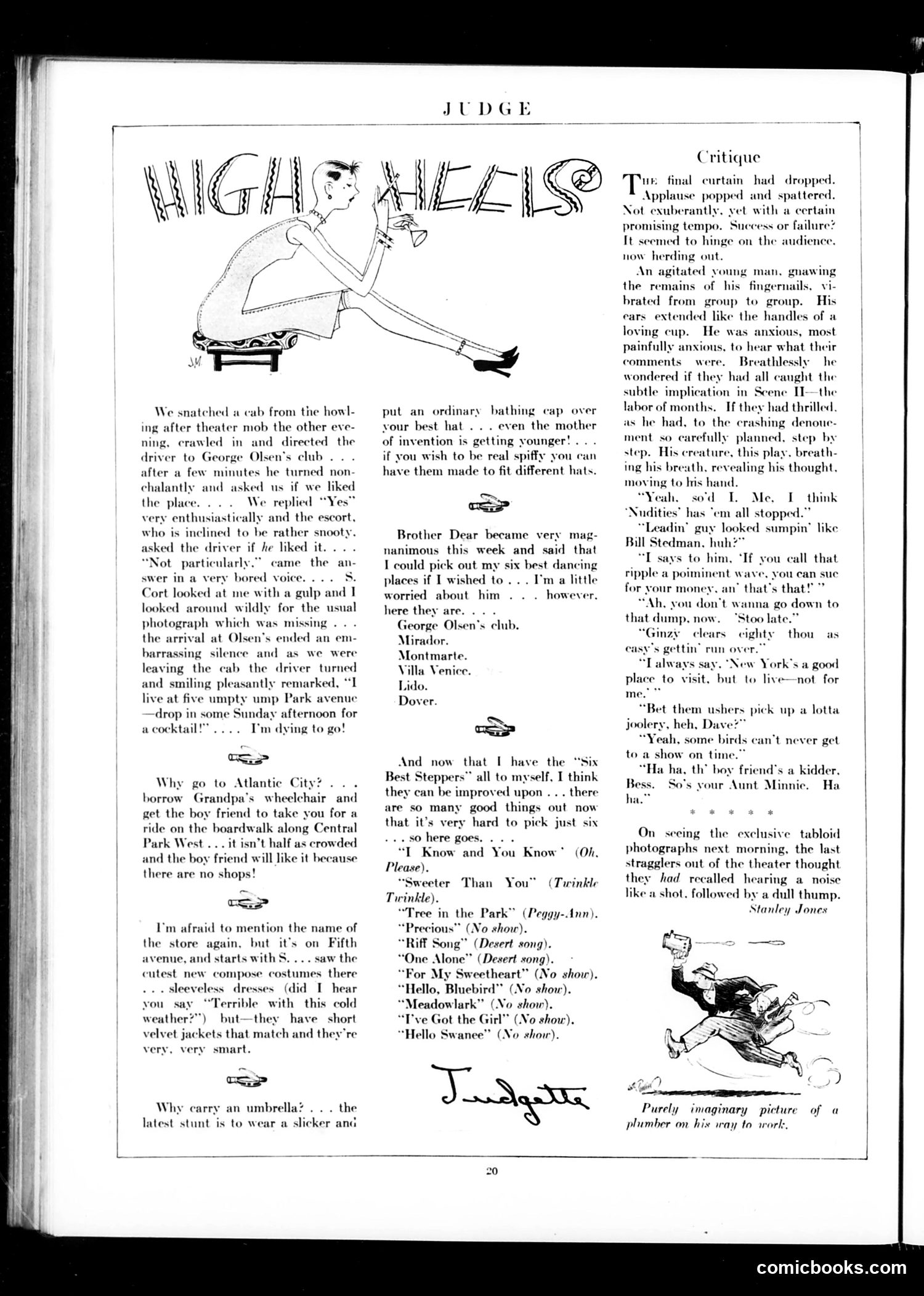
This page from *Judge* satirizes the theater world and nightlife of what appears to be the 1920s. The main cartoon shows a young man anxiously waiting after a show's conclusion, depicted with exaggerated features (extended ears like "handles of a loving cup") as he desperately seeks audience reactions to his play. The accompanying text is a gossipy social column describing nightclub visits to venues like "George Olsen's club" and "Villa Venice," mentioning fashionable destinations and theatrical songs. The satire targets the self-absorbed anxieties of theater producers/playwrights who obsess over audience approval, contrasted with theatergoers' indifference—they discuss practical matters (crowding, shopping) rather than artistic merit. The humor lies in deflating pretension: the earnest creator's intense emotional investment in his "creature" of a play versus audiences' casual, dismissive chatter about completely unrelated topics.
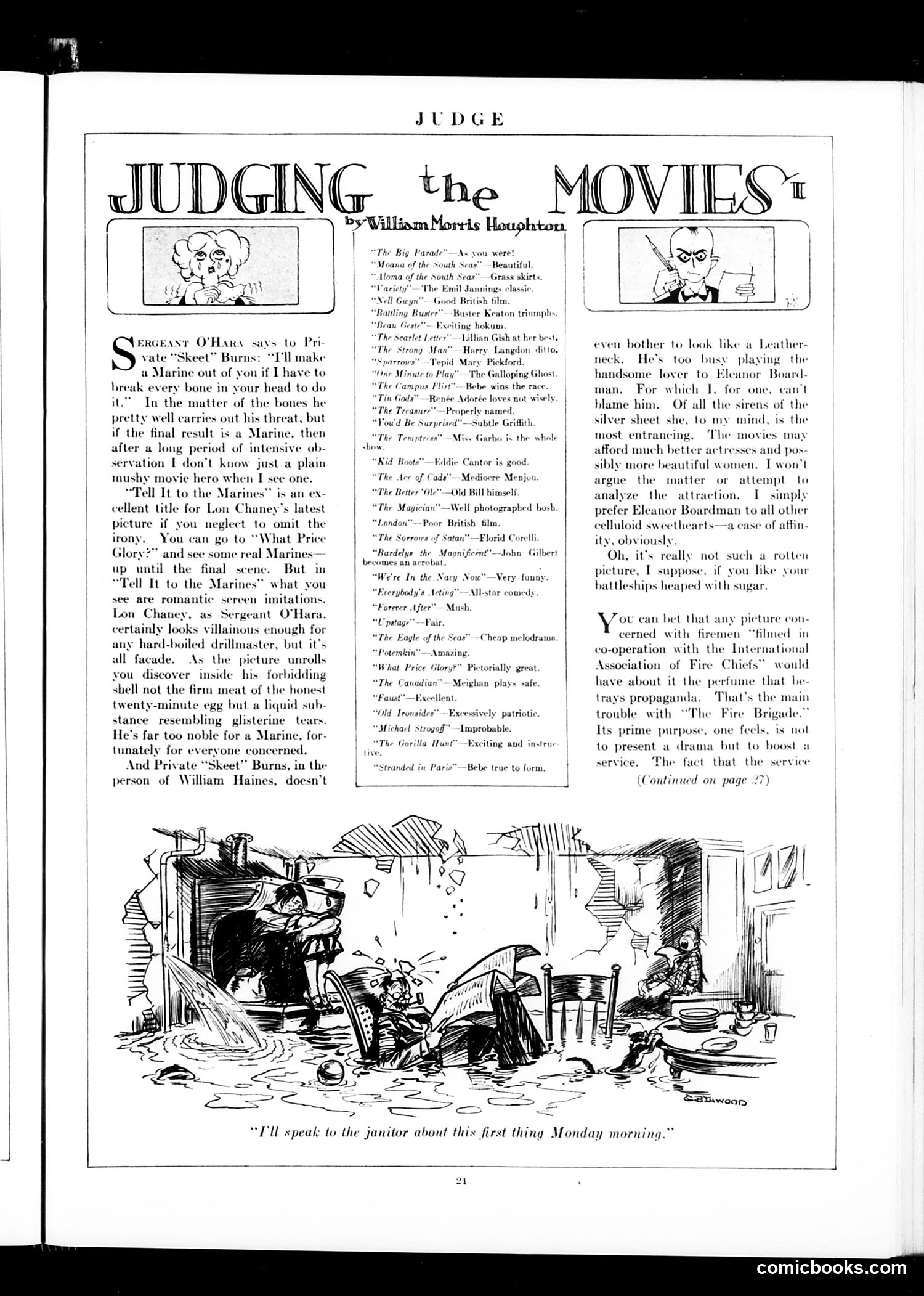
This is a film review column from Judge magazine's entertainment section. The main cartoon depicts a flooded apartment, with the caption "'I'll speak to the janitor about this first thing Monday morning'"—likely satirizing how minor complaints get deprioritized. The bulk of the page consists of Houghton's brief, sarcastic reviews of current 1920s silent films. He praises some (praising Buster Keaton, John Gilbert) while dismissing others as melodramatic or tedious. Notably, he expresses strong admiration for actress Eleanor Boardman, writing that despite other beautiful actresses in cinema, she's the most "entrancing" and he "simply prefer[s]" her—a personal endorsement that reads as sincere among his otherwise arch critiques. The column also mocks propaganda films, particularly "The Fire Brigade," criticizing how it prioritizes boosting institutional service over genuine drama. The reviews reflect typical 1920s film criticism: technical assessment mixed with personality-driven commentary.
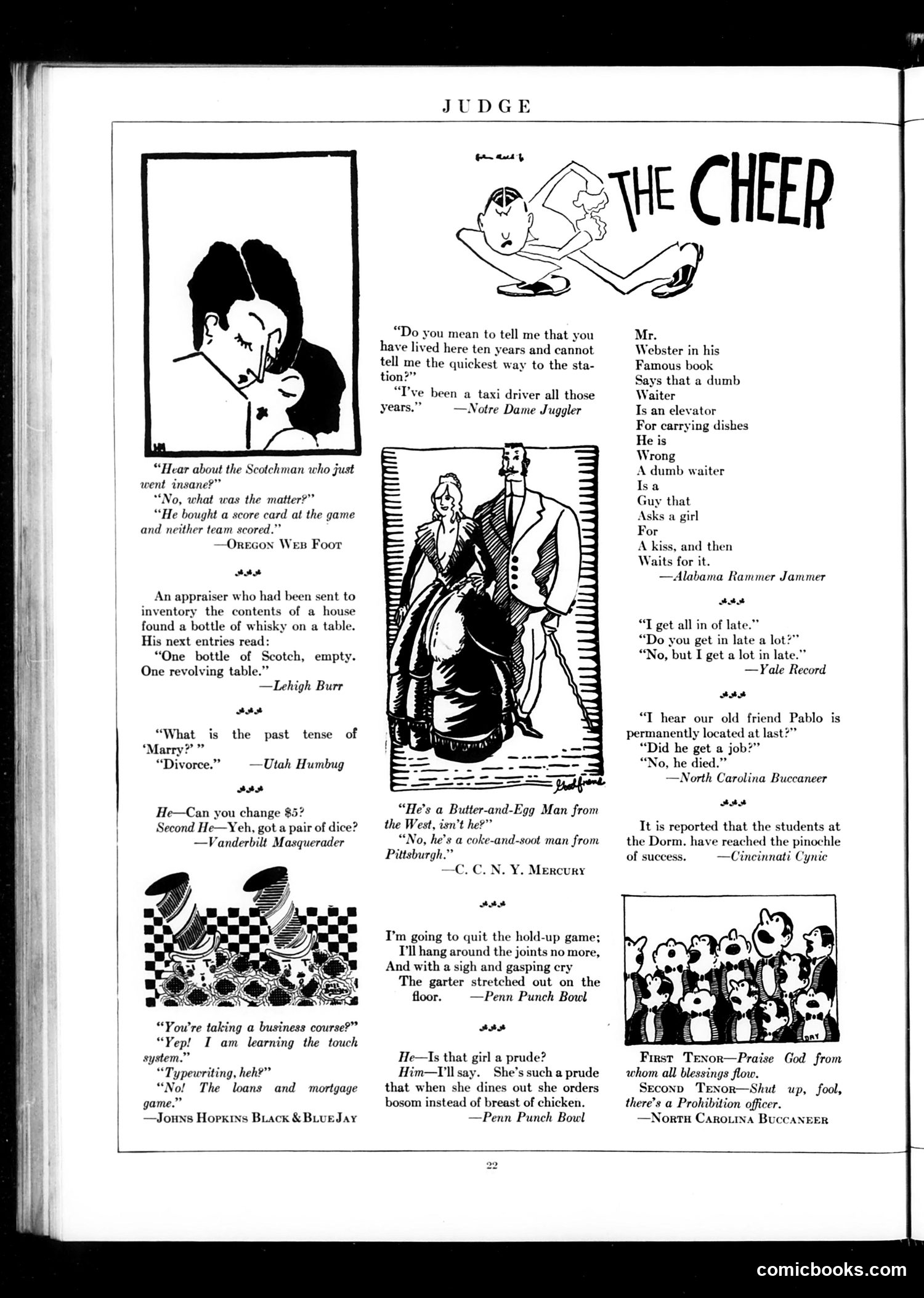
This page compiles brief jokes and witticisms from college and university humor publications, typical of Judge's satirical format. The humor reflects 1920s-era concerns: **Key themes:** - **Prohibition**: Multiple jokes reference bootleg whiskey and hiding from "Prohibition officers," reflecting the alcohol ban era (1920-1933) - **Dating/courtship**: Jokes about awkward male-female interactions, prudishness, and romantic hesitation - **Class/money**: References to taxi drivers, appraisers, and financial games (dice, loans) - **College life**: Sourced from university humor magazines, featuring student pranks and dating culture **Notable references:** The "butter-and-egg man" joke plays on 1920s slang for wealthy businessmen. The "dumb waiter" joke exploits the term's double meaning—both furniture and oblivious suitor. The illustrations show period dress and social scenes. Overall, this represents genteel American college humor of the Jazz Age, emphasizing wordplay over cutting political satire.
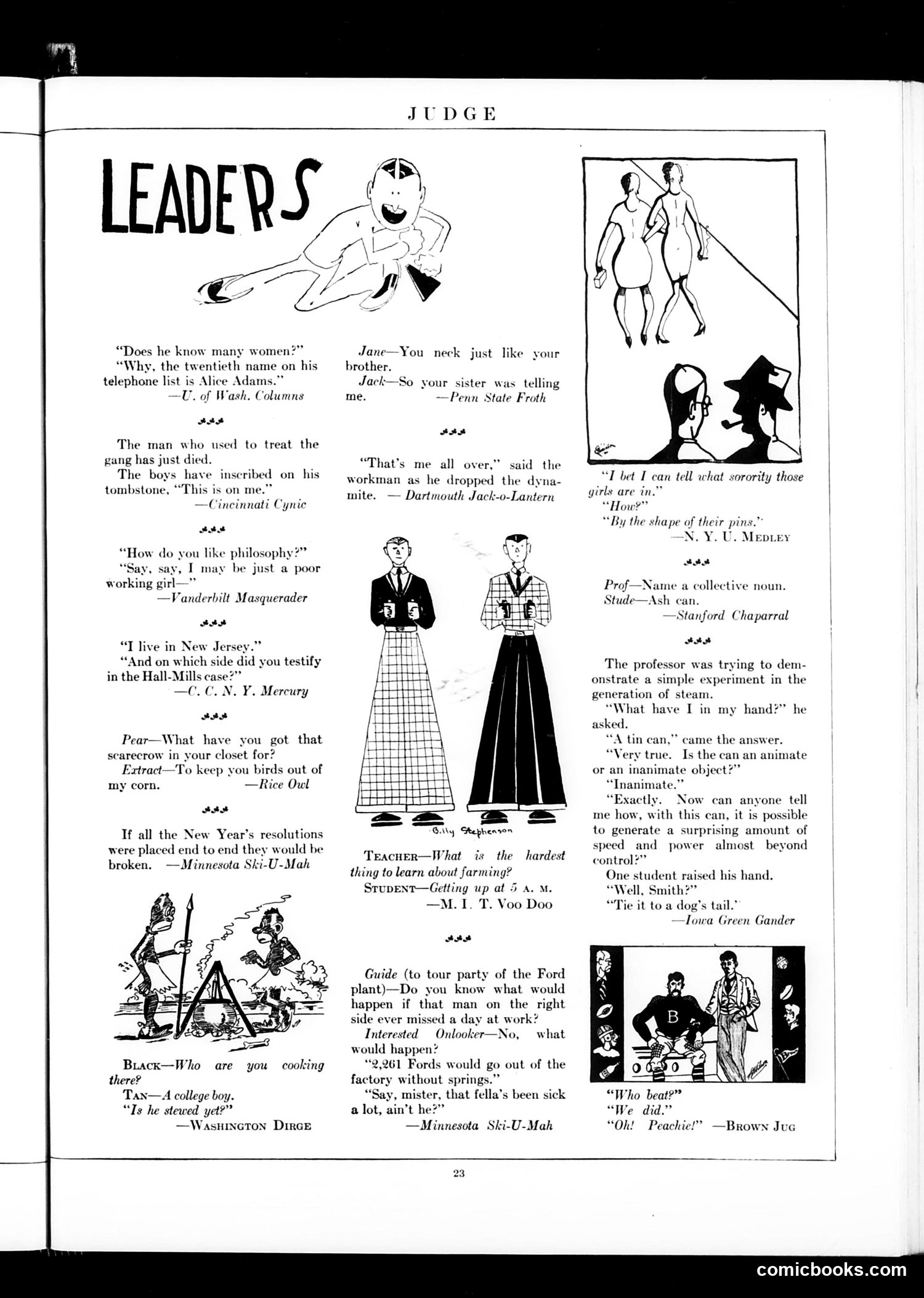
This page collects brief humorous quips and jokes from various college newspapers and satirical sources, typical of Judge's format. The content reflects early 20th-century college and social humor: **Key themes:** - **Dating/courtship humor**: References to necking, telephone lists of women, and fraternity pin culture - **College life satire**: Philosophy majors pretending to be working girls, New Year's resolutions that fail, agricultural students learning to wake early - **Contemporary events**: An oblique reference to the Hall-Mills murder case (a real 1920s scandal) - **Ford assembly line jokes**: Mocking Henry Ford's mass production efficiency—one man's absence supposedly would halt 2,261 cars **The cartoons** use simple line drawings to illustrate gags about scarecrows, tombstones, and couples. The overall tone is lighthearted mockery of college pretension, courtship conventions, and modern industrial efficiency. Nothing appears explicitly political; it's primarily social satire aimed at young readers.
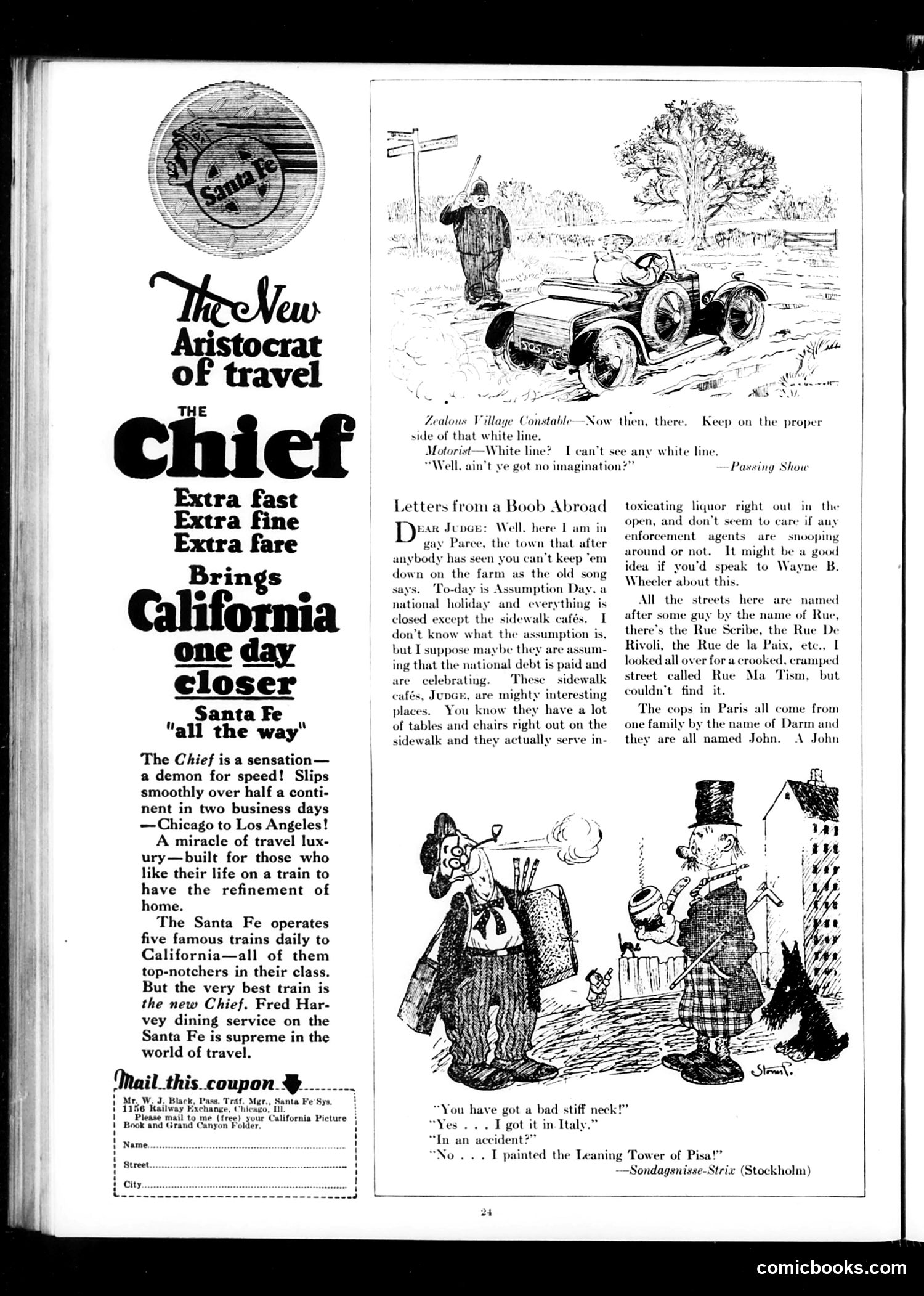
This page combines a Santa Fe Railway advertisement with satirical humor columns typical of Judge magazine. **The Advertisement:** Promotes "The Chief" train as luxury travel from Chicago to Los Angeles, emphasizing speed ("demon for speed"), comfort, and Fred Harvey dining service. **The Cartoons & Humor:** The top cartoon depicts a village constable ordering a motorist to stay on the white line—the motorist's joke about lacking "imagination" to see an invisible line suggests poor road infrastructure of the era. **"Letters from a Boob Abroad"** satirizes American tourists in 1920s Paris. The writer complains about: - Paris street names (all named "Rue") - Open sale of alcohol in cafés (ironic, given Prohibition in America) - Police all named "John" from one family The bottom cartoon jokes about American tourists acquiring physical ailments while sightseeing—the stiff neck from painting the Leaning Tower of Pisa—mocking both tourist behavior and vacation injuries. The humor targets American provincialism, Prohibition hypocrisy, and tourist culture.
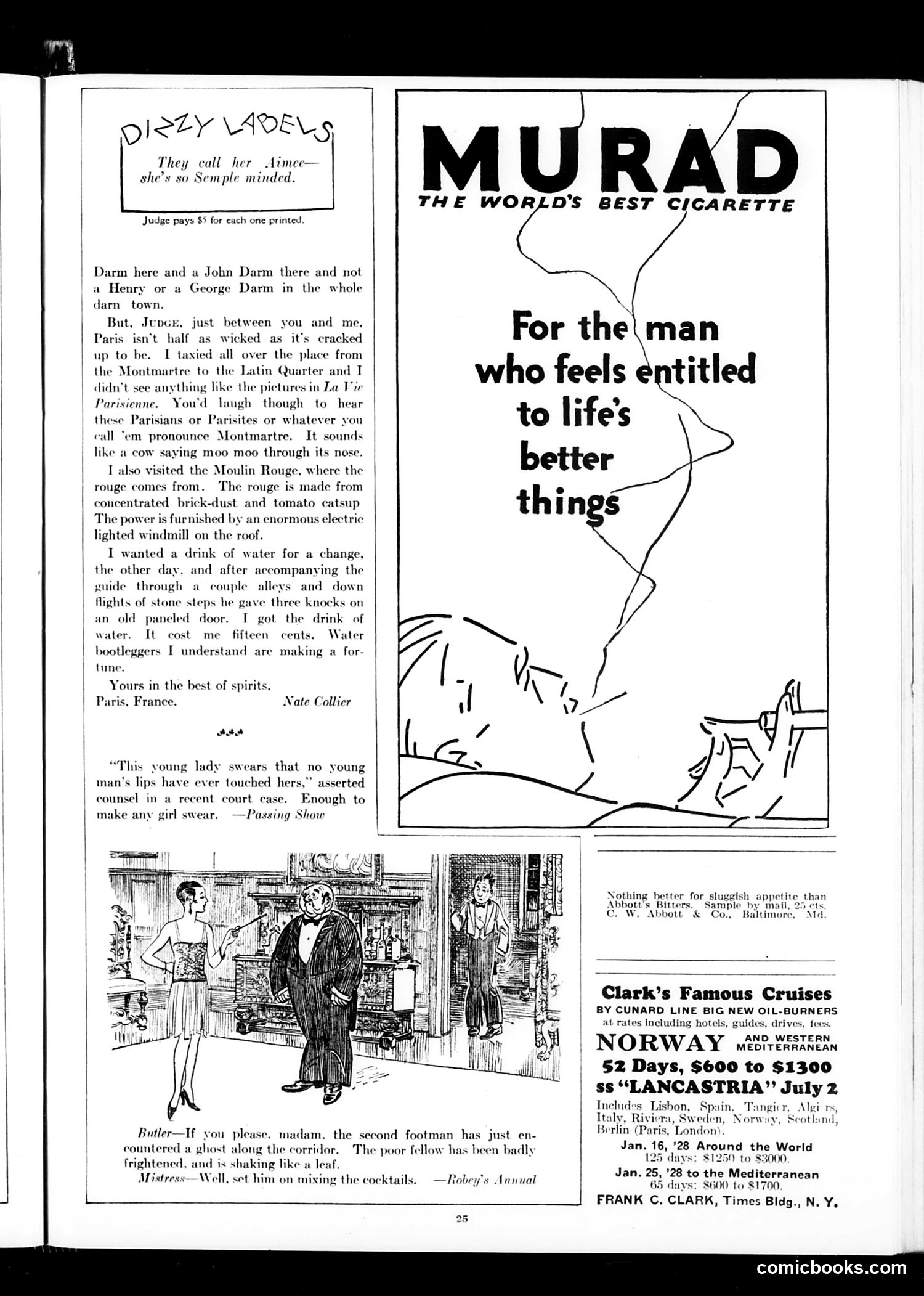
This page from Judge contains satirical humor mixed with period advertisements. The main joke references **Aimee Semple McPherson**, the famous 1920s evangelist and radio preacher, with a pun on her middle name ("Semple minded"—simple minded). The caption suggests she's not intellectually sophisticated, a common satirical jab at religious figures of the era. The letter from "Nate Collier" mocks American tourists' exaggerated expectations of Paris—the writer debunks stereotypes about Parisian wickedness and explains that "rouge" comes from brick dust and catsup, poking fun at both the city's mystique and naive travelers. A courtroom anecdote jokes about a woman claiming no man has kissed her, satirizing legal absurdity and female chastity claims. The **Murad cigarette advertisement** targets affluent men seeking luxury goods—a common marketing approach in this era. The remaining content is cruise ship advertising typical of 1920s Judge publications.
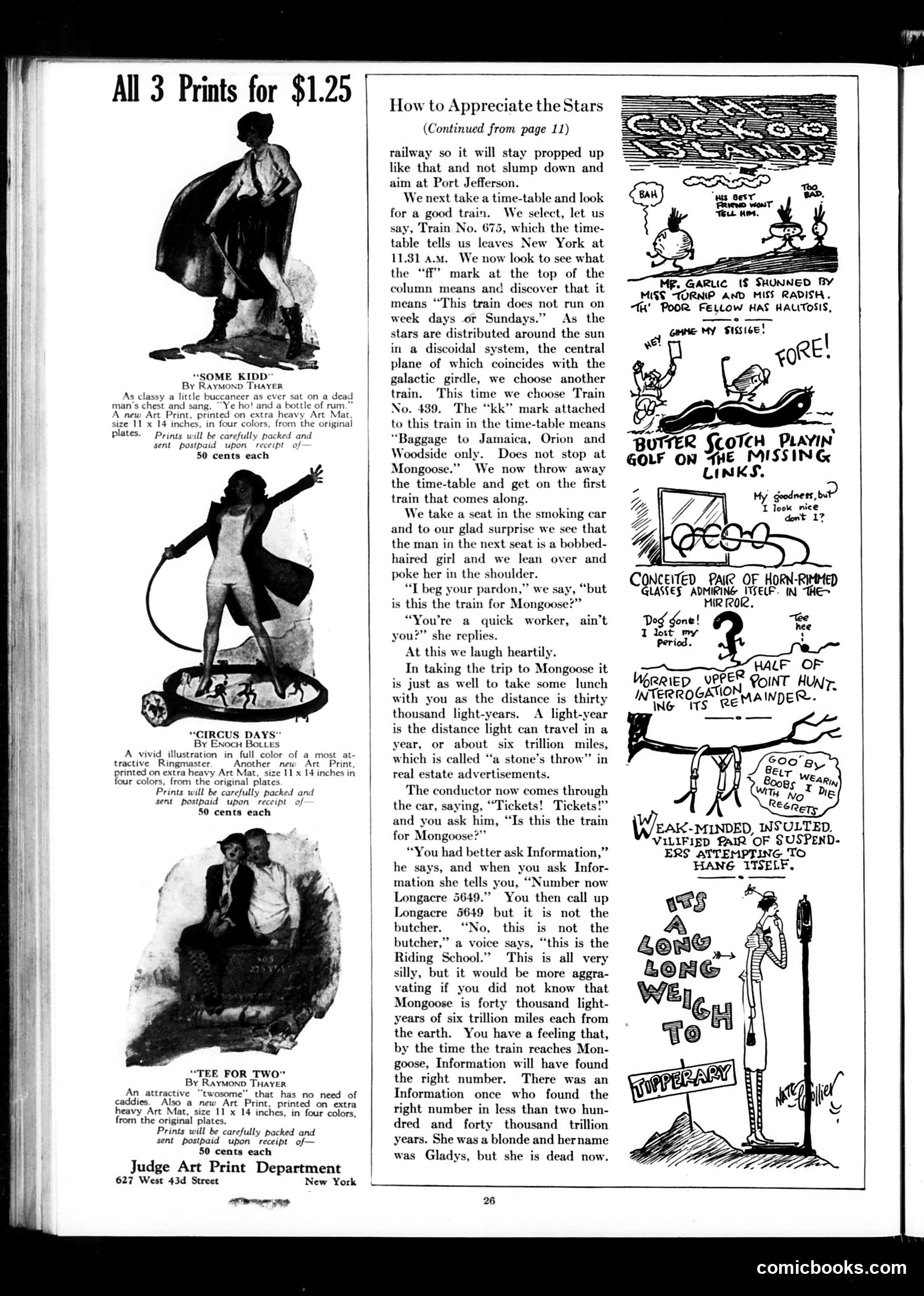
This page contains two sections: art print advertisements and a humorous essay about train travel and astronomy. **The Art Prints** advertise three illustrations by Raymond Thayer and Enoch Bolles—"Some Kidd" (a pirate), "Circus Days" (a ringmaster), and "Tee for Two" (a golf couple). These are typical 1920s commercial art prints sold by mail. **The Main Feature** is a satirical essay titled "How to Appreciate the Stars" that conflates train travel with astronomy. The joke mocks the absurdity of railroad schedules: trains have countless asterisk-marked exceptions ("does not run on week days or Sundays"), making them nearly useless. The author humorously compares trying to navigate train schedules to calculating distances to other planets—both equally frustrating exercises in futility. The concluding anecdote about Information operators provides the punchline: even Information has trouble finding correct phone numbers, suggesting bureaucratic incompetence. **The Comics Section** features crude gag cartoons mocking various social types: uptight women, conceited golfers, and weak-minded men—typical Judge magazine humor of the era.
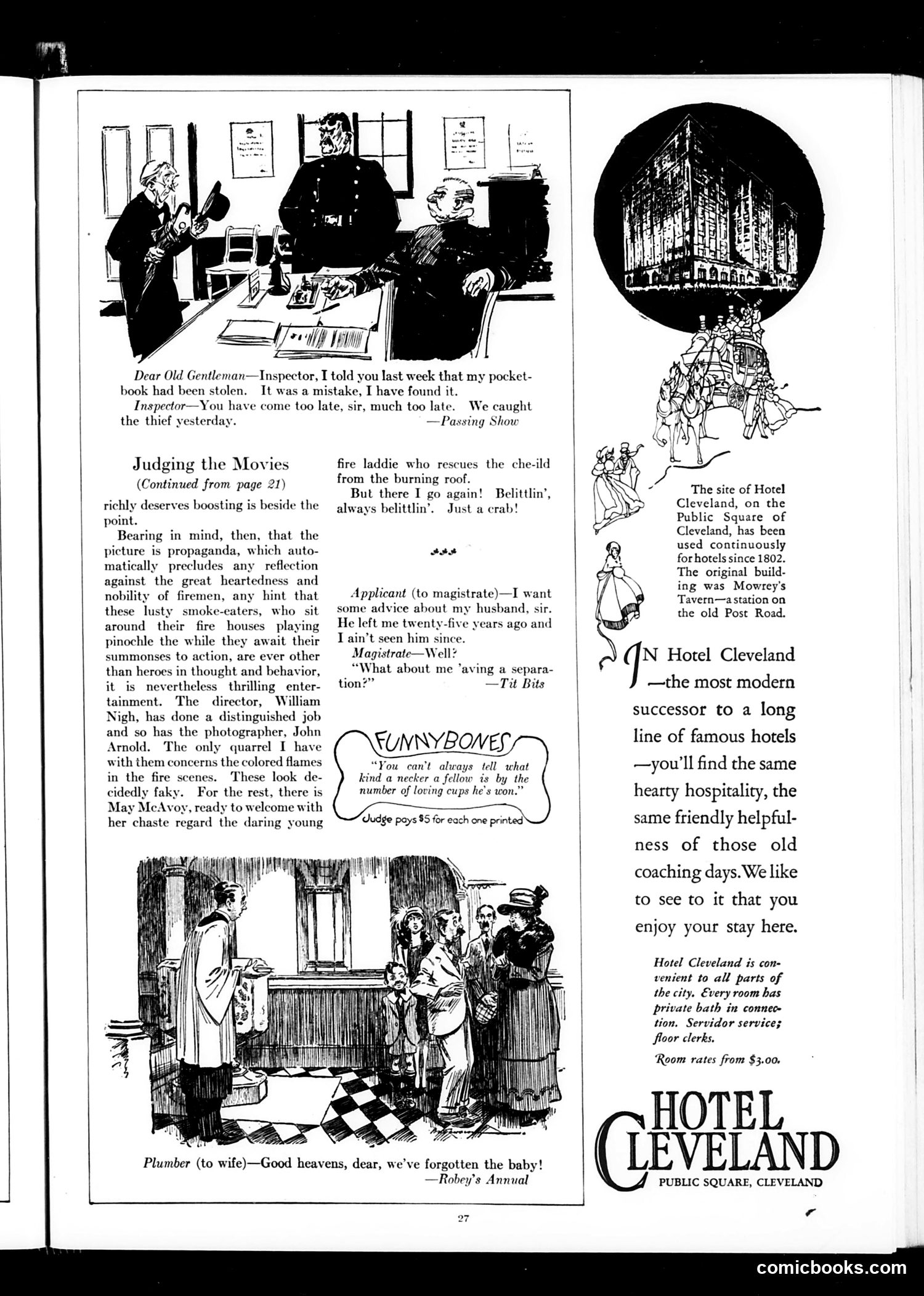
This page contains several unrelated humor pieces typical of Judge's satirical format: **The Inspector Cartoon**: A man reports his stolen pocketbook found—but too late. The police already arrested someone for the theft. The joke satirizes bureaucratic inefficiency: the system moves forward regardless of changed circumstances. **"Judging the Movies"**: A film critique (continued from earlier) praising a firefighter rescue film while critiquing its artistic choices, particularly artificial-looking colored flames in fire scenes. It balances appreciation for propaganda value with honest artistic assessment. **"Funny Bones"**: A quip about dating—you can't judge a man's romantic skill by his trophy collection (loving cups). **The Plumber Cartoon**: Dark domestic humor—a plumber and wife leave home only to realize they've forgotten their baby. **Hotel Cleveland Advertisement**: The right half is a full-page hotel ad emphasizing continuity with historic American hospitality, claiming the site's hotel use since 1802. The page mixes editorial humor with advertising—typical Judge format blending satire with commercial content.
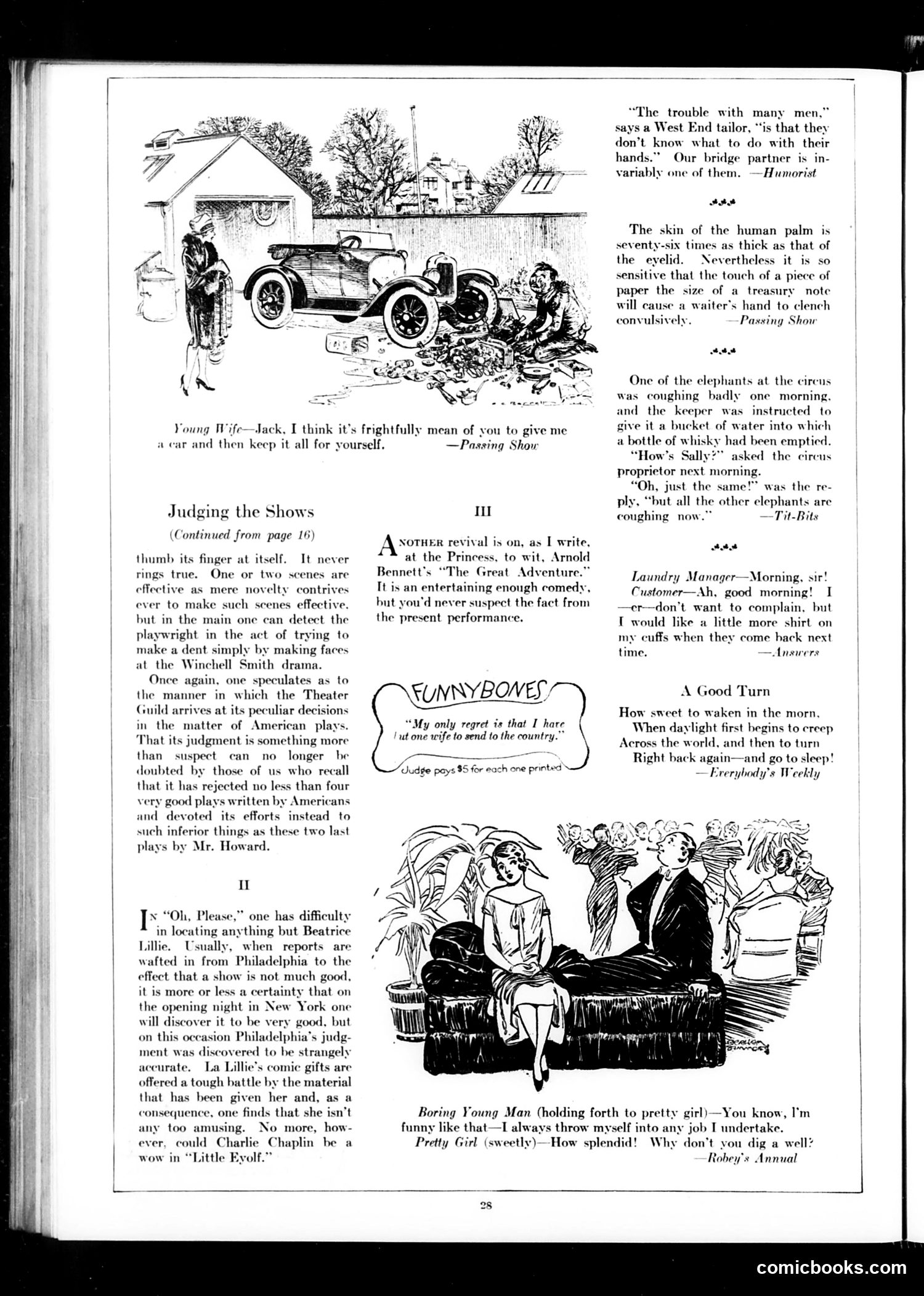
This page from Judge contains theatrical criticism and light humor pieces typical of 1920s-30s American satirical magazines. **Main Cartoon:** The top illustration shows a young wife complaining to her husband "Jack" that he selfishly keeps their new automobile to himself. The satire targets marital dynamics around consumer goods—a contemporary social issue as cars became household luxuries. **Theater Criticism Section:** Reviews Broadway productions, particularly critiquing the Theater Guild's judgment in selecting plays. It praises actress Beatrice Lillie but faults the material given her, and compares unfavorably to Charlie Chaplin's abilities. **"Funny Bones" Section:** Brief humorous anecdotes—one jokes about a man with only one wife to send away; another describes a waiter's hand sensitivity; a third involves a drunk elephant at a circus. **Bottom Cartoon:** Depicts a boring young man boasting about throwing himself into jobs, with a pretty girl sarcastically suggesting he "dig a well"—mocking his self-aggrandizing pretension. The page reflects period concerns: automobile ownership, theater criticism, and social commentary on male behavior.
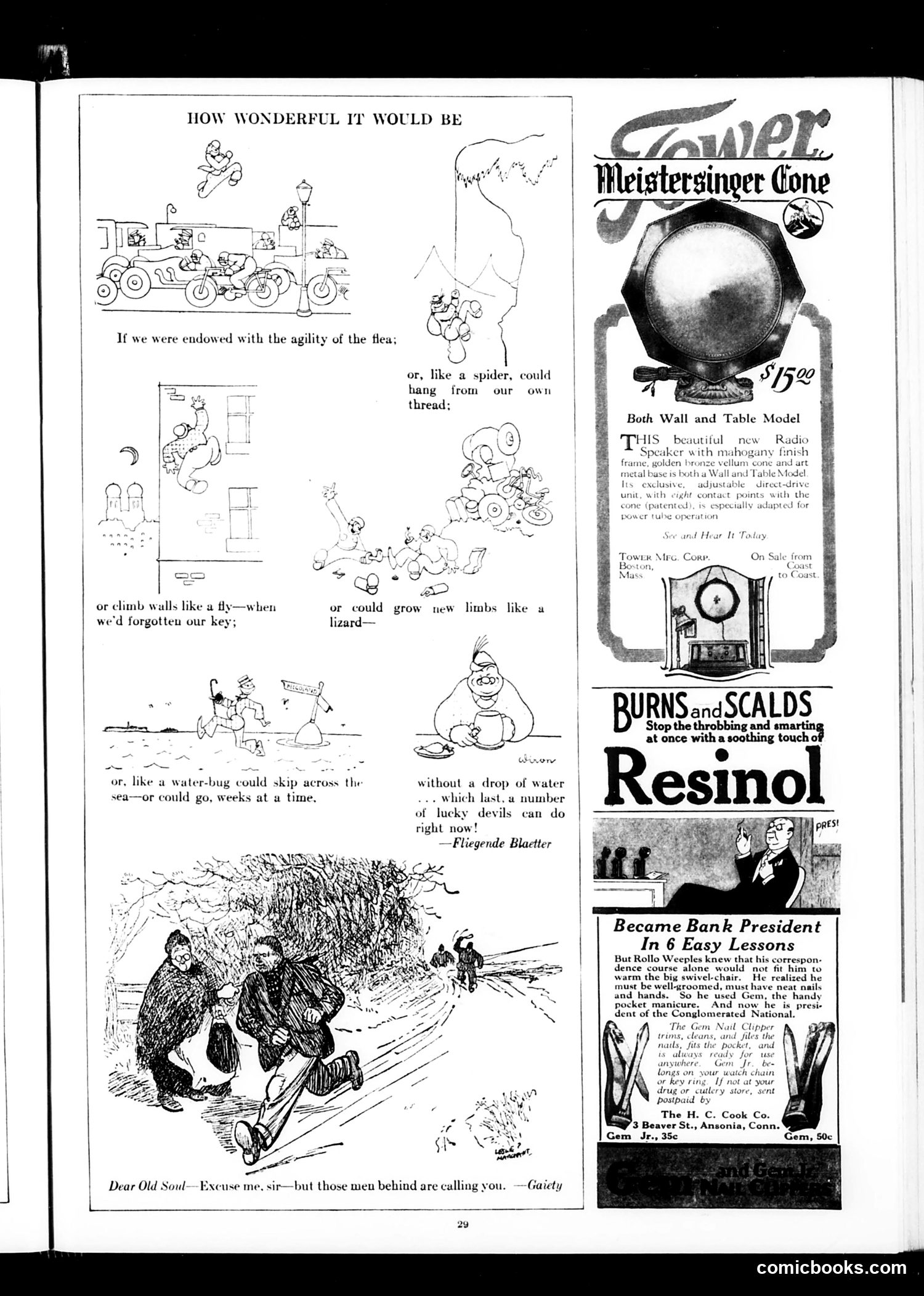
The main cartoon on the left, titled "HOW WONDERFUL IT WOULD BE," is a whimsical piece by Fliegende Blaetter imagining fantastical human abilities—if we had a flea's agility, a spider's climbing ability, a lizard's regeneration, or a water bug's capacity to traverse water for weeks. The final panel, captioned "Dear Old Soul," references wartime absence: a man being called away by "those men behind" (military recruiters or officers), implying conscription or military service. This likely dates to WWI era, when Judge was active in satirizing the war effort. The right side comprises vintage advertisements: a Meistersinger radio speaker ($15.00), Resinol ointment for burns and scalds, and a humorous ad promising that using "Gem" manicure tools will help someone become a bank president—poking fun at self-improvement product marketing claims. The page is primarily entertainment with commercial messaging typical of early-20th-century magazine publishing.
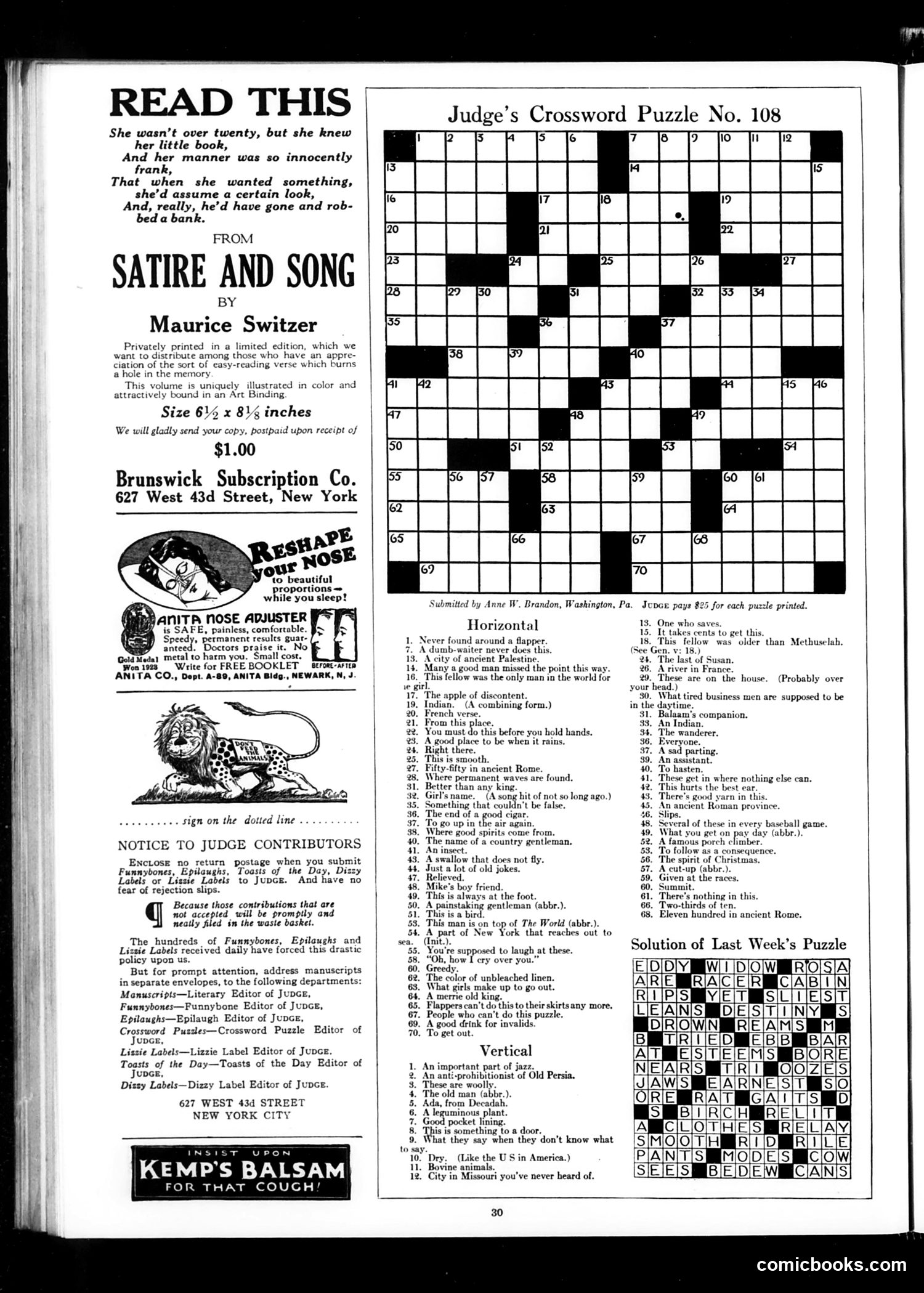
This is primarily a **crossword puzzle page** with advertising, not a political cartoon. The main content is "Judge's Crossword Puzzle No. 108," a standard word puzzle with horizontal and clues referencing 1920s American culture (flappers, jazz, Prohibition). The advertisements are notable: 1. **"Satire and Song"** by Maurice Switzer—promoting a poetry book about seduction, featuring verse about a young woman manipulating a man into criminal acts through feminine charm. 2. **Anita Nose Adjuster**—a pseudoscientific beauty device claiming to reshape noses while sleeping. This reflects 1920s anxieties about appearance and ethnic features, targeting immigrants seeking assimilation. 3. **Kemp's Balsam**—a cough remedy advertisement. The **Notice to Judge Contributors** is humorous, sarcastically claiming rejected submissions go to the "waste basket" rather than receiving rejection slips—commentary on the magazine's high submission volume. The page reflects Jazz Age concerns: beauty standards, gender dynamics, commercial hucksterism, and consumer culture.
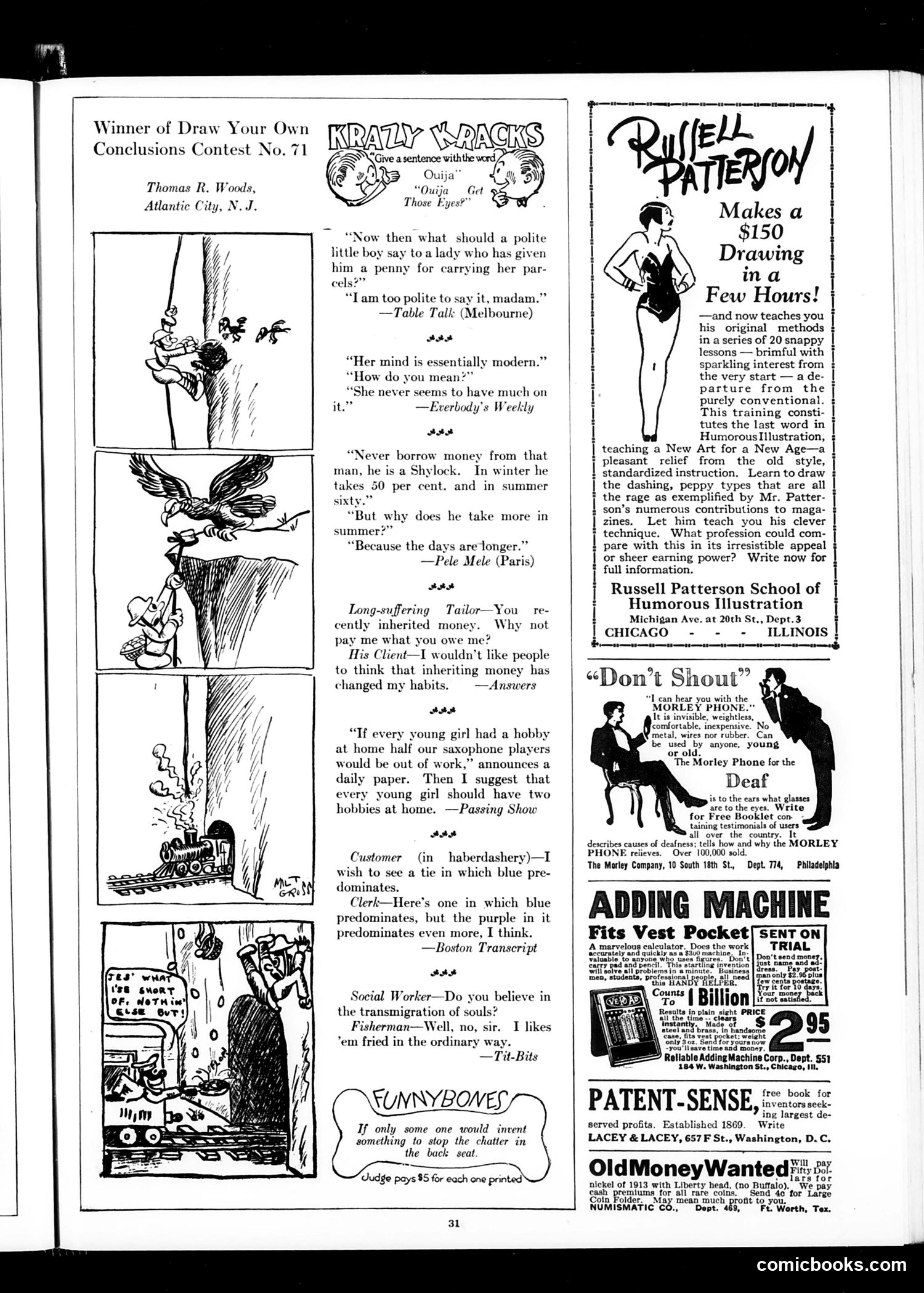
This page contains **four satirical comic strips** plus advertisements. The main content is "Krazy Klacks," a series of brief jokes with accompanying cartoons by Thomas R. Woods. The humor targets **early 20th-century social pretensions and logic**: a boy who's "too polite" to thank someone for money; a woman with a "modern mind" who thinks little; a Shylock (Jewish moneylender stereotype) who charges higher interest in summer "because days are longer"; a tailor unable to collect from a spendthrift heir; workplace saxophonists; and a fisherman literalizing "transmigration of souls." The final panel, "Funny Bones," jokes about backseat chatter in automobiles—a modern technology concern. **Right-side advertisements** include Russell Patterson's humorous illustration school, the Morley Phone (a hearing device), an adding machine, patent services, and rare coin solicitation. The page reflects **1920s consumer culture and genteel social humor**, with cartoons satirizing class pretension, gender stereotypes, and emerging modern conveniences.
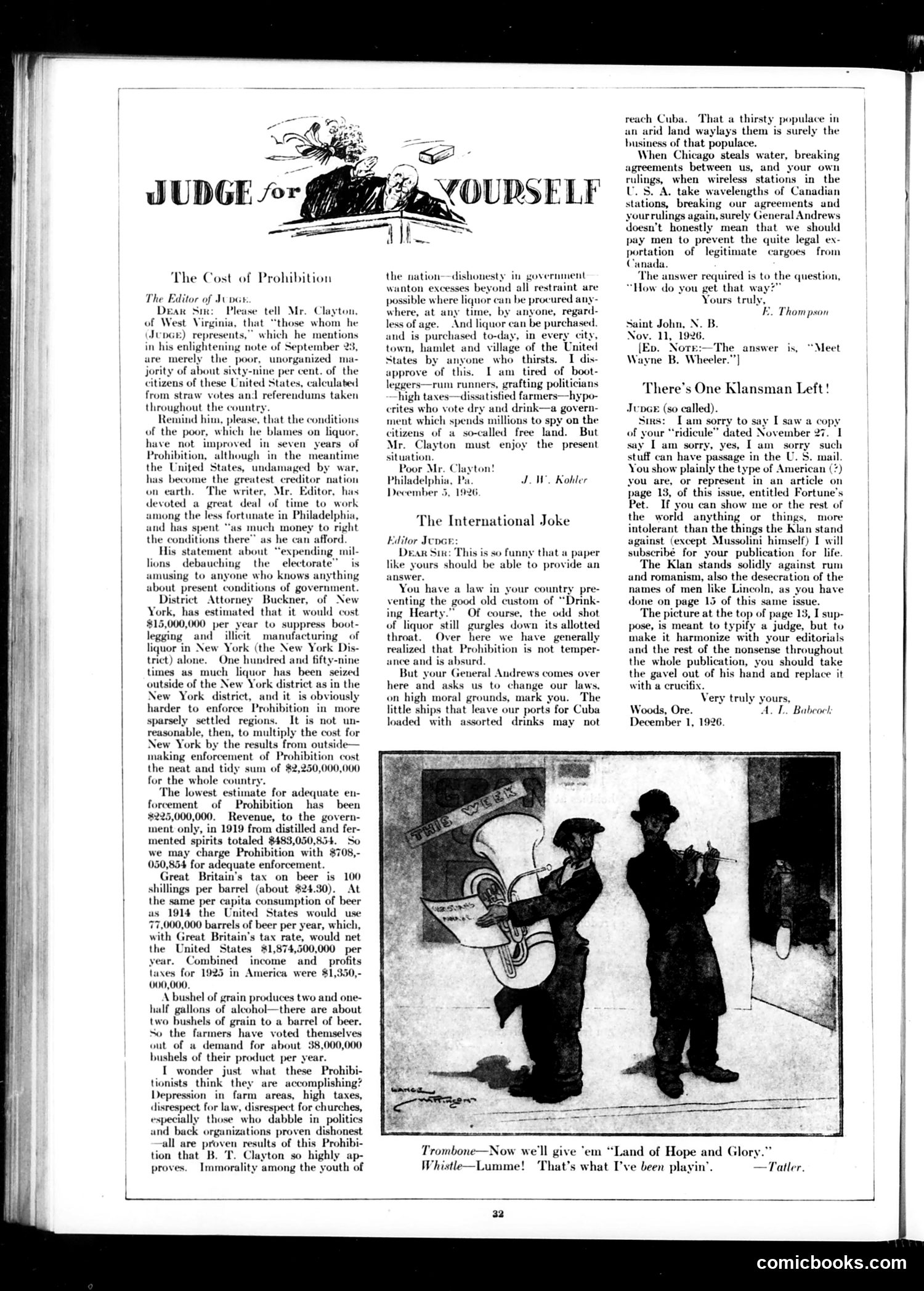
This page contains letters to the editor of *Judge* magazine debating Prohibition's effectiveness and costs. The main content is text-based commentary rather than cartoons. **Key Points:** The first letter argues Prohibition has **failed economically and socially**—it costs an estimated $2.25 billion annually to enforce while generating zero tax revenue (previously $483 million in 1919). The writer contrasts this with Britain's beer tax revenue (~$1.87 billion equivalent) and notes farmers lost demand for 38 million bushels of grain yearly. The letter catalogs Prohibition's alleged failures: bootlegging persists, farm depression continues, government corruption spreads, youth immorality increases, and disrespect for law grows—despite seven years of the policy. **The cartoon** (bottom) shows musicians playing a trombone and whistle, captioned about "Land of Hope and Glory"—likely satirizing the gap between Prohibition's noble ideals and messy reality. A second letter briefly mentions international amusement at America's contradictory alcohol laws. The satire targets **Prohibition advocates' disconnect from real-world consequences**.
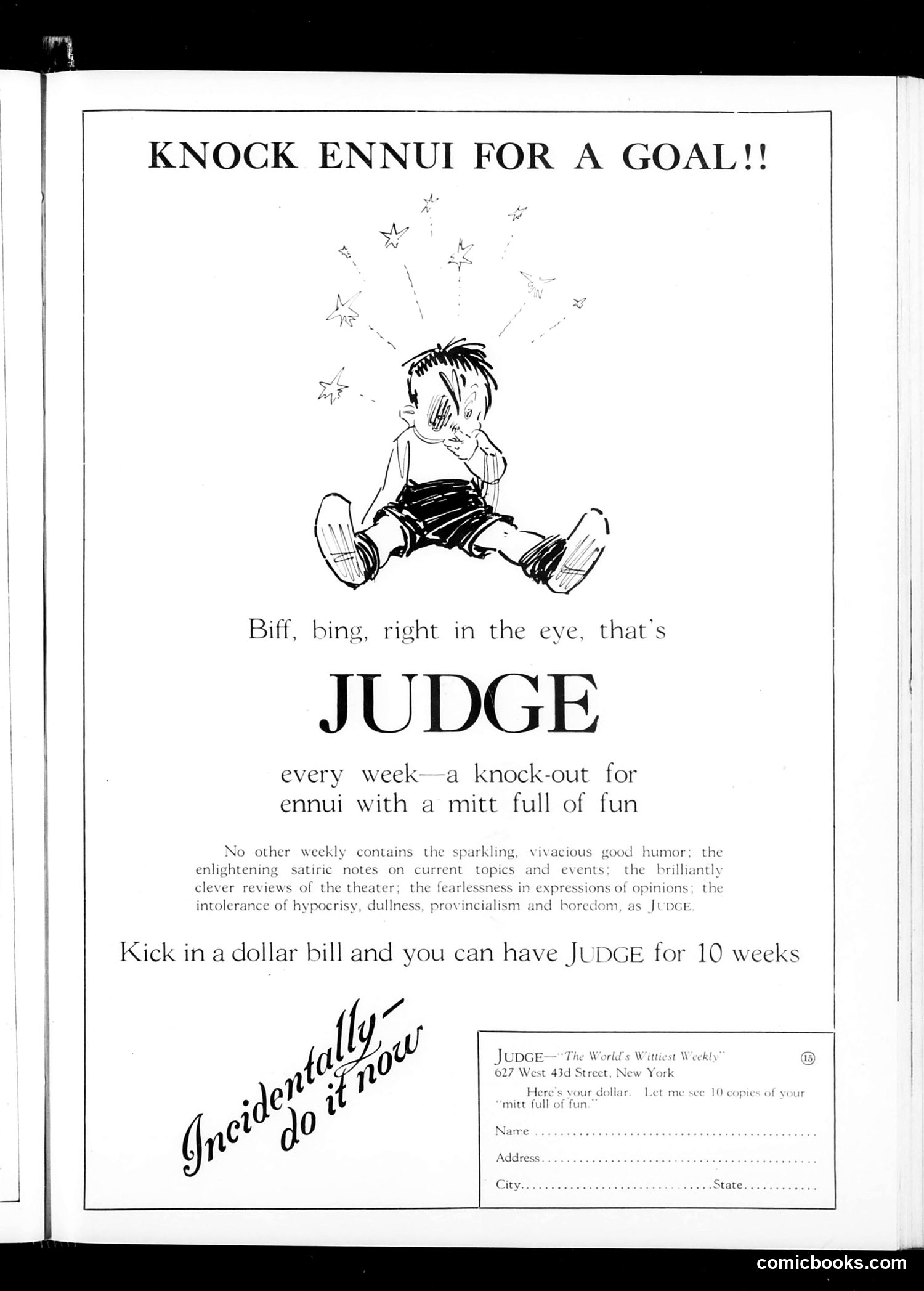
This is primarily a **subscription advertisement** for *Judge* magazine, described as "The World's Wittiest Weekly." The page uses boxing/fighting imagery—a cartoon child throwing a punch labeled "KNOCK ENNUI FOR A GOAL"—as a metaphor for the magazine's purpose: to combat boredom and tedium ("ennui") with humor and satire. The ad emphasizes *Judge's* editorial strengths: sparkling humor, satirical commentary on current events, theater reviews, and fearless opinions attacking "hypocrisy, dullness, provincialism and boredom." The "incidentally do it now" tagline and dollar-bill tear-off coupon encourage immediate subscription—ten weeks for one dollar. This appears to be a **house advertisement** promoting the magazine to potential readers, rather than political commentary on a specific figure or event.
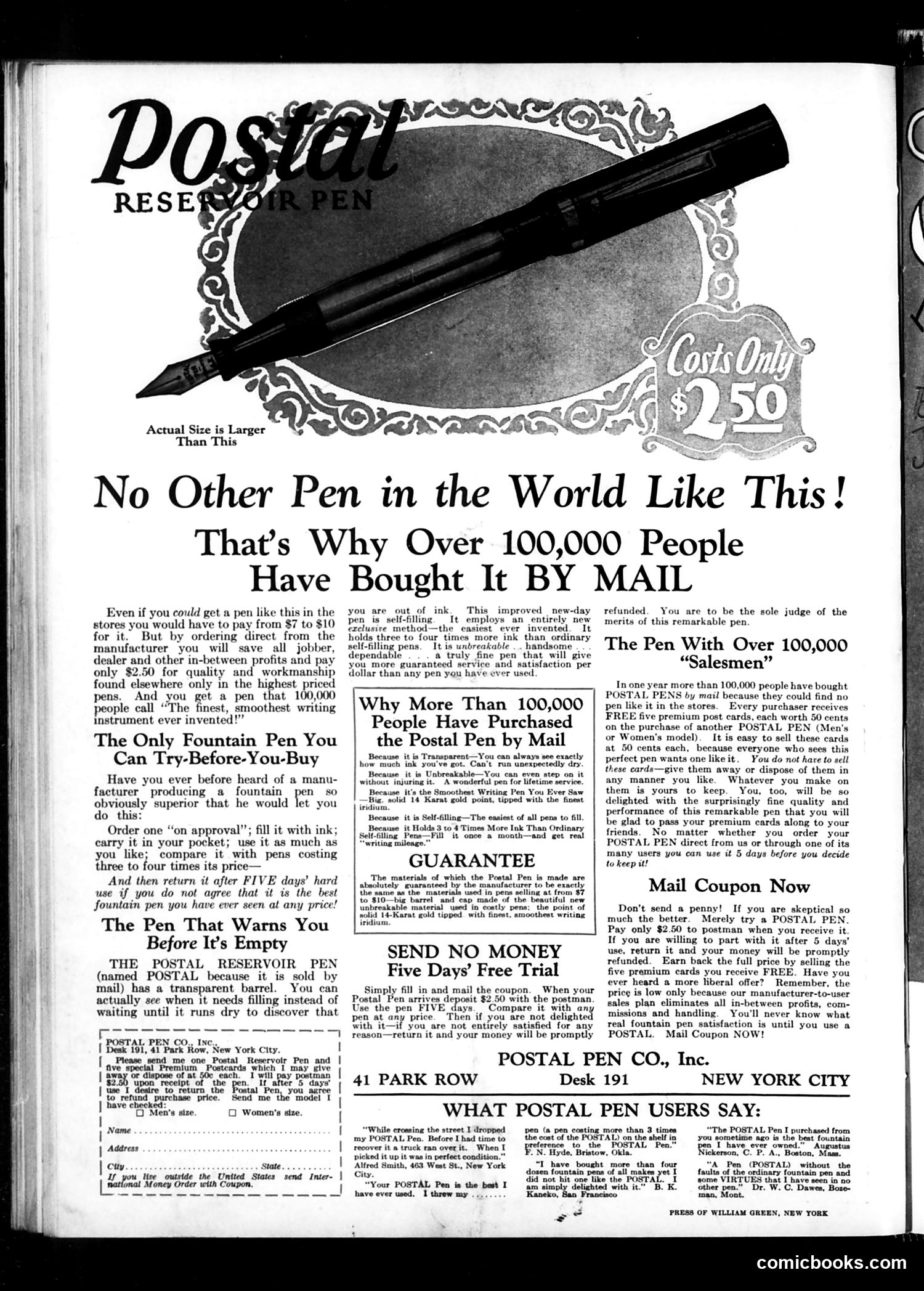
This is not a political cartoon but rather a full-page advertisement for the Postal Reservoir Pen, appearing in Judge magazine. The page promotes a mail-order fountain pen priced at $2.50, claiming over 100,000 satisfied customers. The ad employs several sales tactics typical of early 20th-century mail marketing: emphasizing the transparent barrel (so users can see ink levels), the unbreakable construction, and the five-day trial period. It positions direct mail ordering as advantageous, claiming customers save money by eliminating middlemen profits (pens normally cost $7-10 in stores). The page includes customer testimonials and a fill-in coupon. The language stresses durability, ease-of-use, and value—standard advertising appeals of the era. This represents the nascent mail-order economy and aggressive promotional techniques that became hallmarks of American consumer culture in the early 1900s.