
Judge, 1927-01-15 · page 34 of 36
Judge — January 15, 1927 — page 34: what you’re looking at
What you’re looking at
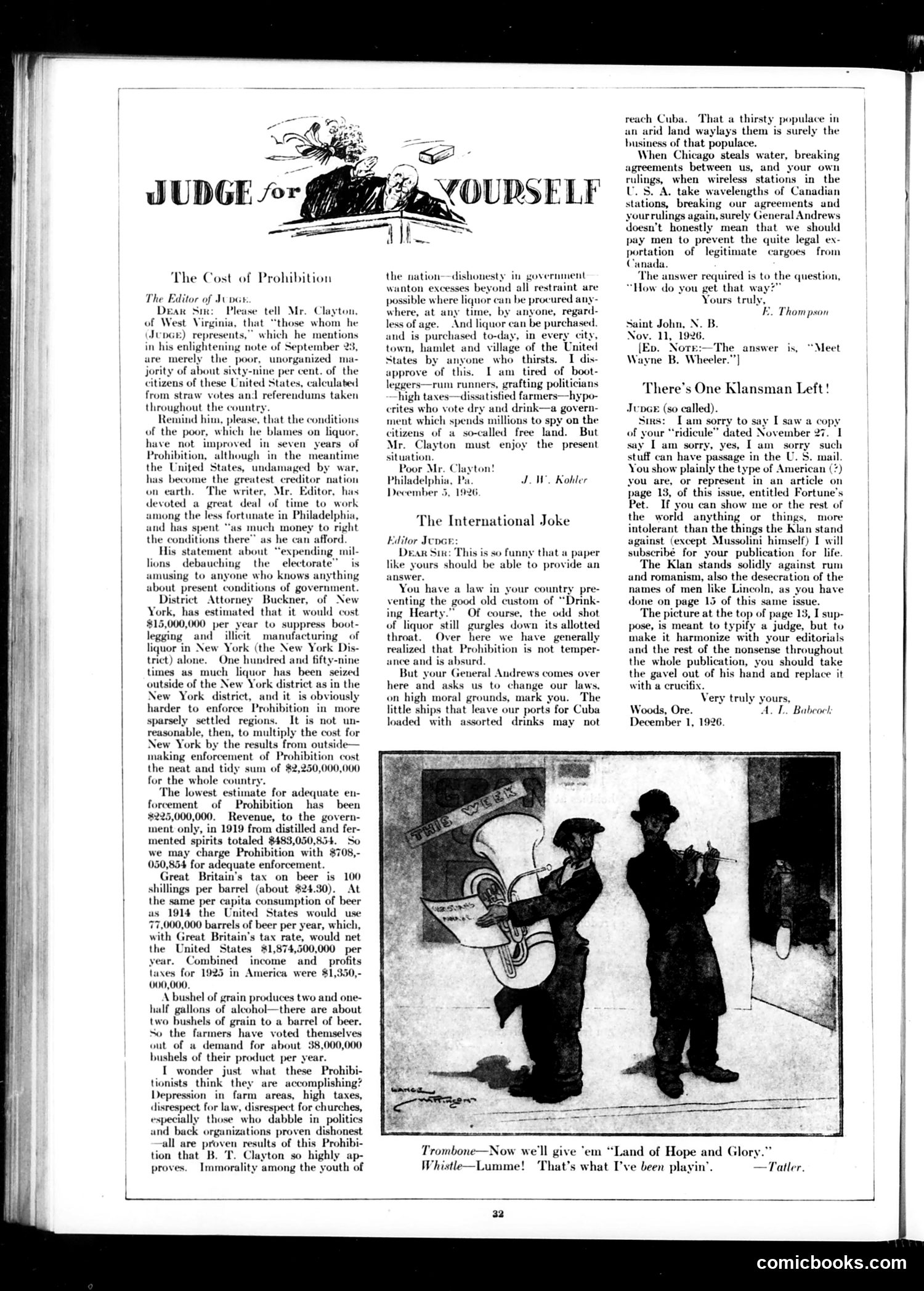
This page contains letters to the editor of *Judge* magazine debating Prohibition's effectiveness and costs. The main content is text-based commentary rather than cartoons. **Key Points:** The first letter argues Prohibition has **failed economically and socially**—it costs an estimated $2.25 billion annually to enforce while generating zero tax revenue (previously $483 million in 1919). The writer contrasts this with Britain's beer tax revenue (~$1.87 billion equivalent) and notes farmers lost demand for 38 million bushels of grain yearly. The letter catalogs Prohibition's alleged failures: bootlegging persists, farm depression continues, government corruption spreads, youth immorality increases, and disrespect for law grows—despite seven years of the policy. **The cartoon** (bottom) shows musicians playing a trombone and whistle, captioned about "Land of Hope and Glory"—likely satirizing the gap between Prohibition's noble ideals and messy reality. A second letter briefly mentions international amusement at America's contradictory alcohol laws. The satire targets **Prohibition advocates' disconnect from real-world consequences**.
📄 Transcribed text from this page (OCR, searchable)
Machine-transcribed from the original scan — historical spelling and the odd misread are preserved.
The Cost of Prohibition The Editor of Jvvat Deak Sir: se tell Mr. Clayton, of West Virginia, that “those whom he (JupGe) represents,” which he mentions in his enlightening note of September 2: are merely the poor, unorganized ma- jority of about sixty-nine per cent. of the citizens of these United States, calculated from straw votes and referendums taken throughout the country. Remind him, pleas at the conditions of the poor, which he blames on liquor, have not improved in seven years of Prohibition, although in the meantime the United States, undamaged by war, has become the greatest creditor nation on earth. The writer, Mr. E + has devoted deal of time to, w mong the less fortunate in Philadelphia, and has spent “as much money to right the conditions there” as he can afford His statement about “expending mil lions debauching the electorate” is amusing to anyone who knows anything about present conditions of government. District Attorney Buckner, of New York, has estimated that it would cost $15,000,000 per year to suppress boot- legging and_ illicit’ manufacturing of liquor in New York (the New York Dis- trict) alo One hundred and fifty-nine times as much liquor has been seized outside of the New York district as in the New York district, and it is obviously harder to enforce Prohibition in more sparsely settled regions. It is not un- reasonable, then, to multiply the cost for New York by the results from outside— making enforcement of Prohibition cost the neat and tidy sum of $2,250,000,000. for the whole countr: ‘The lowest estimate for adequi forcement of Prohibition has 225,000,000. Revenue, to the gover ment only, in 1919 from distilled and fe mented spirits totaled $483,050,854. So we may charge Prohibition with $708,- 050,854 for adequate enforcement. Great Britain's tax on beer is 100 shillings per barrel (about $24.30). At the same per capita consumption of beer s 1914 the United States would use 100,000 barrels of beer per year, whic! with Great Britain's tax rate, would net the United States %1,874,500,000 per year. Combined income ‘and _ profits taxes for 1925 in America were $1 000,000. \ bushel of grain produces two and one- half gallons of alcohol—there are about two bushels of grain to a barrel of beer. so the farmers have voted themselves out of a demand for about 38,000,000 bushels of their product per year. I wonder just what these Prohil tionists think they are accomplishing? Depression in farm areas, high taxes, disrespect for law, disrespect for churches, especially those who dabble in_ polities H tion that B. T. Clayton 80 gti ap- proves. Immorality among the youth of the nation--dishonesty in government wanton excesses beyond all restraint are possible where liquor can be procured any- where, at any time, by anyone, regard- less of age. And liquor ean be purchased. and is purchased to-c in ev city, town, hamlet and village of the United States by anyone who thirsts. I dis- approve of this. I am tired of boot- leggers—rum runners, grafting politicians high taxes—dissatisfied farme hy po- crites who vote dry and drink—a govern- ment which spends millions to spy on the ns of a so-called free land. But Mr. Clayton must enjoy the present situation. Poor Mr. Clayton! Philadelphia, 1 December 5, 1926. JoW. Kohler The International Joke Editor Sever: Dear Sir: This is so funny that a paper like yours should be able to provide an answer. ‘ou have a law in your country: pre- venting the good old custom of “Drink- ing I * Of course, the odd shot of liquor still gurgles down its allotted throat. Over here we have generally realized that Prohibition is not temper- ance and is absurd. But your General Andrews comes over here and asks us to change our laws, on high moral grounds, mark you. The little ships that leave our ports for Cuba loaded with assorted drinks may not Trombone—Now we'll give ‘em “ Whistle—Lumme! That’s what I’ve been play reach Cuba. That a thirsty populace in un arid land waylays them is surely the business of that populace. When Chicago steals water, breaking agreements between us, and your own rulings, when wireless stations in the S. A. take wavelengths of Canadian stations, breaking our agreements and yourrulings again, surely General Andrews doesn’t honestly mean that we should pay men to prevent the quite legal ex- portation of legitimate cargoes from Canada. ‘The answer required is to the question, “How do you get that w Yours truly Saint John, N. B. Nov. 11, I Eo. 'Nowis—The answer is, “Meet Wayne B. Wheeler.” There’s One Klansman Left! JvpcE (so called). Sins: [am sorry to say I saw a copy of your “ridicule” dated November 27. 1 say I am sorry Tam sorry such stuff can hav ge in the U. mail You show plainly the type of American (7) you are, or represent in an article on page 13, of this issue, entitled Fortune's Pet. If you can show me or the rest of the world anything or things, more intolerant than the things the Klan stand against (except Mussolini himself) I will subscribe for your publication for life The Klan stands solidly against rum und romanism, also the deseci eration of the names of men x e Lincoln, done on page 15 of this same ii The picture at the top of page 13, I sup- pose, is meant to typify a judge, but to make it harmonize with your editorials and the rest of the nonsense throughout the whole publication, you should take the gavel out of his hand and replace it with a crucifix. Very truly yours, Woods, Ore. ALL. Babeoel: December 1, 1926. Land of Hope and Glory.” —Tatler. comicbooks.com