
Judge, 1927-01-15 · page 15 of 36
Judge — January 15, 1927 — page 15: what you’re looking at
What you’re looking at
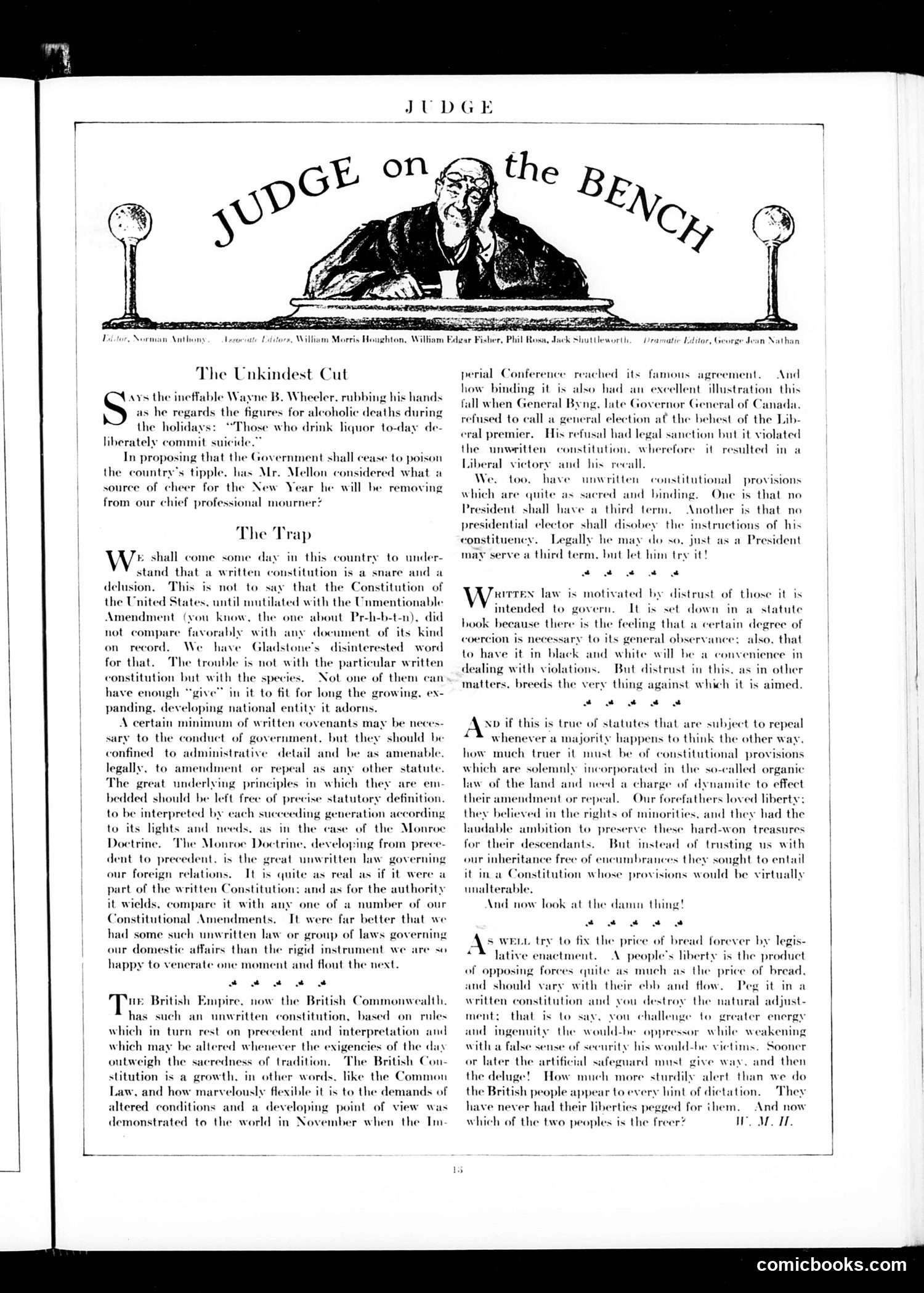
This page contains three editorial pieces satirizing American constitutional and legal issues, likely from the Prohibition era (the repeated references to alcohol regulation and "Pr-h-b-t-n" suggest the 1920s). **"The Unkindest Cut"** mocks Wayne B. Wheeler (a prominent Prohibition advocate) for celebrating alcohol-related deaths while simultaneously pushing for government alcohol bans—finding dark irony in his position. **"The Trap"** argues that written constitutions are inherently inflexible and problematic, contrasting them favorably with Britain's unwritten constitutional tradition. It cites the Monroe Doctrine as an unwritten principle more effective than formal amendments. **Written Law** contrasts written statutes (motivated by distrust, requiring explicit codification) with unwritten constitutional conventions like presidential term limits—suggesting written law reflects governmental suspicion of citizens. The satire critiques both Prohibition enforcement and rigid constitutional legalism, favoring flexible, tradition-based governance over explicit statutory control.
📄 Transcribed text from this page (OCR, searchable)
Machine-transcribed from the original scan — historical spelling and the odd misread are preserved.
The Unkindest Cut 1¢ B. Wheeler, rubbing his hands: ays the ineffable Way as he regards the figures for alcoholic deaths during “Those who drink liquor to-day de- liberately commit suicide. In proposing that the Government shall cease to poison the country’s tipple, has Mr. Mellon considered what a source of cheer for the New Year he will he removing from our chief professional mourner? The Trap W* shall come some day in this country to under- stand that a written constitution is a snare and a delusion. This is not to say that the Constitution of the United States, until mutilated with the Unmentionable Amendment (vou know, the one about) Pr-h-b-t-n), did not compare favorably with any document of its kind on record. We disinterested word for that. The trouble is not with the particular written constitution but with the species. Not one of them can have enough “give” in it to fit for long the growing, ex- panding. developing national entity it adorns. A certain minimum of written covenants may be neces- sary to the conduct of government. but they should be confined to administrative detail and be as amenable. legally, to amendment or repeal as any other statute. The great underlying principles in which they are em bedded s have Gladstone's wuld be left free of precise statutory definition. to be interpreted by h succeeding generation according to its lights and needs, as in the case of the Monroe Doctrine. The Monroe Doctrine, developing from prece- dent to precedent. is the ge our foreign relations. { unwritten lay Tt is quite as real as t were a part of the written Constitution: and as for the authority it wields, compare it with any one of a number of our Constitutional Amendments. It were far better that we had some such unwritten law or group of our domestic ai happy to vene governing Ws governing tirs than the rigid instrument we one moment and flout the next. Ce ee ee ey Te British Empire, now the British Commonwealth. such an unwritten constitution, based on rules which in turn rest on precedent and int which may be outweigh the sacredness of tr: stitution is a growth, in oth pretation and pncies of the day he British Con- words. like the Common Law, and how marvelously flexible it is to the demands of altered conditions and a developing point of view was demonstrated to the world in November when the Im L_ red whenever the exig lition. + William Morris Houghton, William Edgar Fisher, Phil Ros ek Shuttleworth Vramatic Editor, George Jean Nathan perial Conference reached its famous agreement. And how binding it is also had an excellent illustration this fall when General Byng, late Governor General of Canada. refused to call a ¢ f the behest of the Lib- His refusal had legal sanction but it violated constitution, wherefore it Liberal vietory and his recall. Wi unwritten constitutional which are quite as sacred and binding. One is that no President shall have a third term. Another is that no presidential elector shall disobey the instructions of his constituency. neral election premier. the unwritten resulted in a too, have provisions Legally he may do so, just as a President serve a third term, but let him try it! “2 et es Wires law is motivated by distrust of those it is intended to govern. It is set down in a statute hook because there is the feeling that ac ain degree of coercion is necessary to its general observanc : also, that to have it in black and white will he a convenience in dealing with violations. But distrust in this. as in other matters, breeds the very thing against which it is aimed. oe er ey A» if this is true of statutes that are subject to reps 42% whenever a majority happens to think the other how much truer it must be of constitutional provisions which are solemnly incorporated in the so-called organic law of the land and need a charge of dynamite to effect their amendment or repeal. Our forefathers loved liberty: they believed in the rights of minorities, and they had the laudable ambition to preserve these hard-won treasures for their descendants. But instead of trusting us with our inheritance free of encumbrances they sought to entail it ina Constitution whose provisions would be virtually unalterable. And now look at the damn thing! As WELL try to fix the price of bread forever by legis- * lative enactment. a a ey \ people's liberty is the product of opposing forces quite as much as the price of bread. and should vary with their and flow. written constitution and you destroy the 1 ment: Pog it ina tural adjust- that is to say. vou challenge to and ingenuity the with a false sense or later the artif the deluge! ater energy would-be oppressor while weakening security his would-t victims. Sooner 1 safegua and then than we do way How much more sturdily alert the British people appear to every hint of dictation. They have never had their liberties pegged for them. And now which of the two peoples is the freer? WM. comicbooks.com