
Judge, 1927-01-15 · page 18 of 36
Judge — January 15, 1927 — page 18: what you’re looking at
What you’re looking at
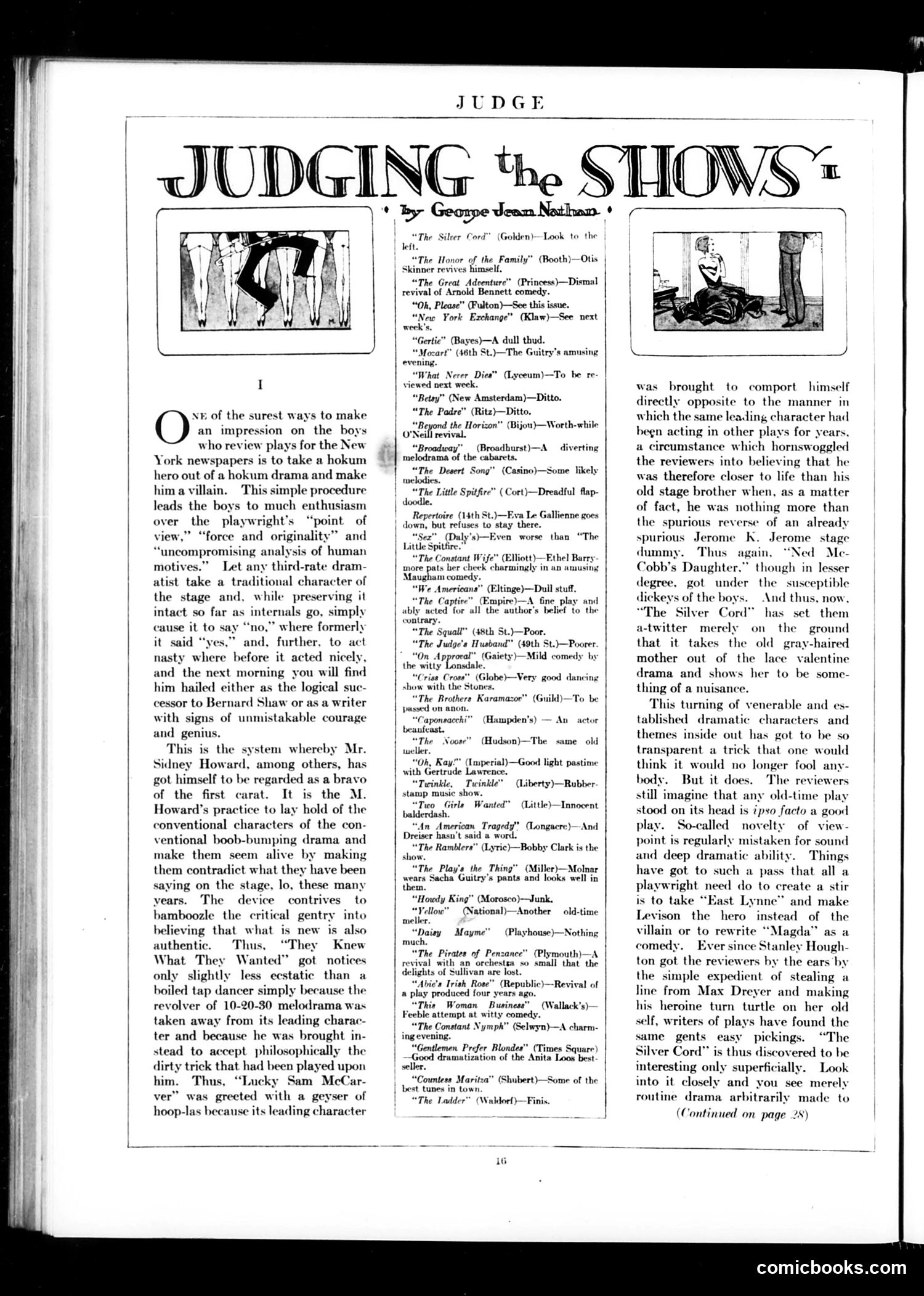
This is a theater review column by George Jean Nathan, a prominent drama critic of the 1920s. The page contains two elements: **The illustrated commentary (top left):** The main article satirizes playwrights—particularly Sidney Howard—who gain critical acclaim by taking conventional stage characters and simply reversing their moral behavior: making traditionally "nice" characters act "nasty" instead. Nathan argues critics mistake this superficial inversion for genuine artistic innovation, wrongly praising it as bold originality comparable to Bernard Shaw's work. **The theater listings (right):** A rapid-fire review of current Broadway productions with brief, often dismissive judgments ("Dull thud," "Dreadful flap-doodle," "Innocent balderdash"). This demonstrates Nathan's cynical approach to contemporary theater. The satire targets both lazy playwrights exploiting tired formulas and credulous theater critics easily bamboozled by surface-level subversion of dramatic convention.
📄 Transcribed text from this page (OCR, searchable)
Machine-transcribed from the original scan — historical spelling and the odd misread are preserved.
JUDGE NE of the surest ways to make O an impression on the boys who review plays for the New York newspapers is to take a hokum hero out of a hokum drama and make hima villain. This simple procedure leads the boys to much enthusiasm over the playwright’s “point of view,” “force and originality” and “uncompromising analysis of human motives.” Let any third-rate dram- atist take a traditional character of the stage and, while preserving it intact so far as internals go, simply cause it to say “no,” where formerly it said “yes,” and, further, to act nasty where before it acted nicely, and the next morning you will find him hailed either as the logical suc- cessor to Bernard Shaw or as a writer with signs of unmistakable courage and genius. This is the system whereby Mr. Sidney Howard, among others, has got himself to be regarded as a bravo of the first carat. It is the M. Howard’s practice to lay hold of the conventional characters of the con- ventional boob-bumping drama and make them seem alive by making them contradict what they have been saying on the stage, lo, these many years. The device contrives to bamboozle the critical gentry into believing that what is new is also authentic. Thus, “They Knew What They Wanted” got notices only slightly less ecstatic than a boiled tap dancer simply because the revolver of 10-20-30 melodrama was taken away from its leading charac- ter and because he was brought stead to accept philosophically the dirty trick that had been played upon him. Thus, “Lucky Sam McCar- ver” was greeted with a geyser of hoop-| “The Silver Cord” (Golden)—Look to the left. “The Honor of the Family” (Booth)—Otis Skinner revives himself. “The Great Adventure” (Princess)—Dismal revival of Arnold Bennett comedy “Oh, Please” (Fulton)—See this issue. ‘ew York Exchange” (Klaw)—See next “Gertie” (Bayes)—A dull thud. “Mozart” (48th St.)—The Guitry’s amusing evening. “What Nerer Di viewed next week. “Betsy” (New Amsterdam)—Ditto. “The Padre” (Ritz)—Ditto. “Beyond the Horizon" (Bijou)—Worth-while O'Neill reviv “Broadway” (Broadburst)—A melodrama of the cabarets. “The Desert Song” (Casino)—Some likely (Lyceum)—To be re- diverting ttle Spitfire” (Cort)—Dreadful flap- Repertoire (14th St.)\—Eva Le Gallienne goes down, but refuses to stay there. “Sez” (Daly’s)—Even worse than “The | Little Spitfire.” “The Constant Wife” (Elliott) —Fthel Barry more pats her cheek charmingly in an amusing | Maughai comed “We Americans” (Eltinge)—Duil stuff. “The Captive” (Empire)—A. fine play and ably acted for all the author's belief to the contrary. “The Squall” (48th St.)—Poor. “The Judge's Husband” (49th St.)—Poorer. “On Approval” (Gaiety)—Mild comedy by the witty Lonsdale. “Criss Cross’ (Globe)—Very good dan show with the Stoi “The Rrothere Karamaz passed on anon. “Caponsacchi” beanfeast. Noose” (Hudson)—The same old snild)—To be (Hampden’s) — An actor mperial)—Good light pastime | with Gertrude Lawrence. (Liberty)—Rubber. “Two Girle Wanted” (Little)—Innocent balderdash. American Tragedy” (Longacre)—And Dreiser hasn't said a word “The Ramblers” (Lytic)—Bobby Clark is the show. “The Play's the Thing” (Millet)—Molnar wears Sacha Guitry’s pants and looks well in (National)—Another old-time meller. “Daisy Mayme” much. “The Pirates of Penzance” (Plymouth)—A tea so small that the hts of Sullivan are lost. bie's Trish Rose” (Republic)—-Revival of 1 play produced four years a “This Woman Business” (Wallack's)- (Playhouse)—Nothing | Feeble attempt at witty comedy. “The Constant Nymph’ (Selwyn)—A charm- vening. jentlemen Prefer Blondes” (Times Square) Good dramatization of the Anita Loos best seller. “Countess Maritza” best tunes in tow “The Ladder” (Waldort)—Finis. (Shubert)—Some of the was brought to comport himself directly opposite to the manner in which the same leading character had heen acting in other play a circumstance which horr the reviewers into belie’ was therefore closer to life than his old stage brother when, as a matter of fact, he was nothing more than the spurious reverse of an already spurious Jerome Kk. Jerome stage dummy. Thus again, “Ned Me- Cobb's Daughter.” though in lesser degree. got under the susceptible dickeys of the boys. And thus, now, “The Silver Cord” has set them a-twitter merely on the ground that it takes the old gr ired mother out of the lace valentine drama and shows her to be some- thing of a nuisance. This turning of venerable and es- tablished dramatic characters and themes inside out has got to be so transparent a trick that one would think it would no longer fool any- hody. But it does. The reviewers still imagine that any old-time play stood on its head is ipso facto a good play. So-called novelty of view- point is regularly mistaken for sound and deep dramatic ability. Things have got to such a pass that all a playwright need do to create a stir is to take “East Lynne” and make son the hero instead of the villain or to rewrite “Magda” as a comedy. Ever since Stanley Hough- ton got the reviewers by the ears by the simple expedient of stealing a line from Max Dreyer and making his heroine turn turtle on her old self, writers of plays have found the same gents easy pickings. “The Silver Cord” is thus discovered to be interesting only superficially. Look into it closely and you see merely routine drama arbitrarily made to (Continued on page 28) comicbooks.com