
A complete issue · 36 pages · 1926
Judge — October 2, 1926
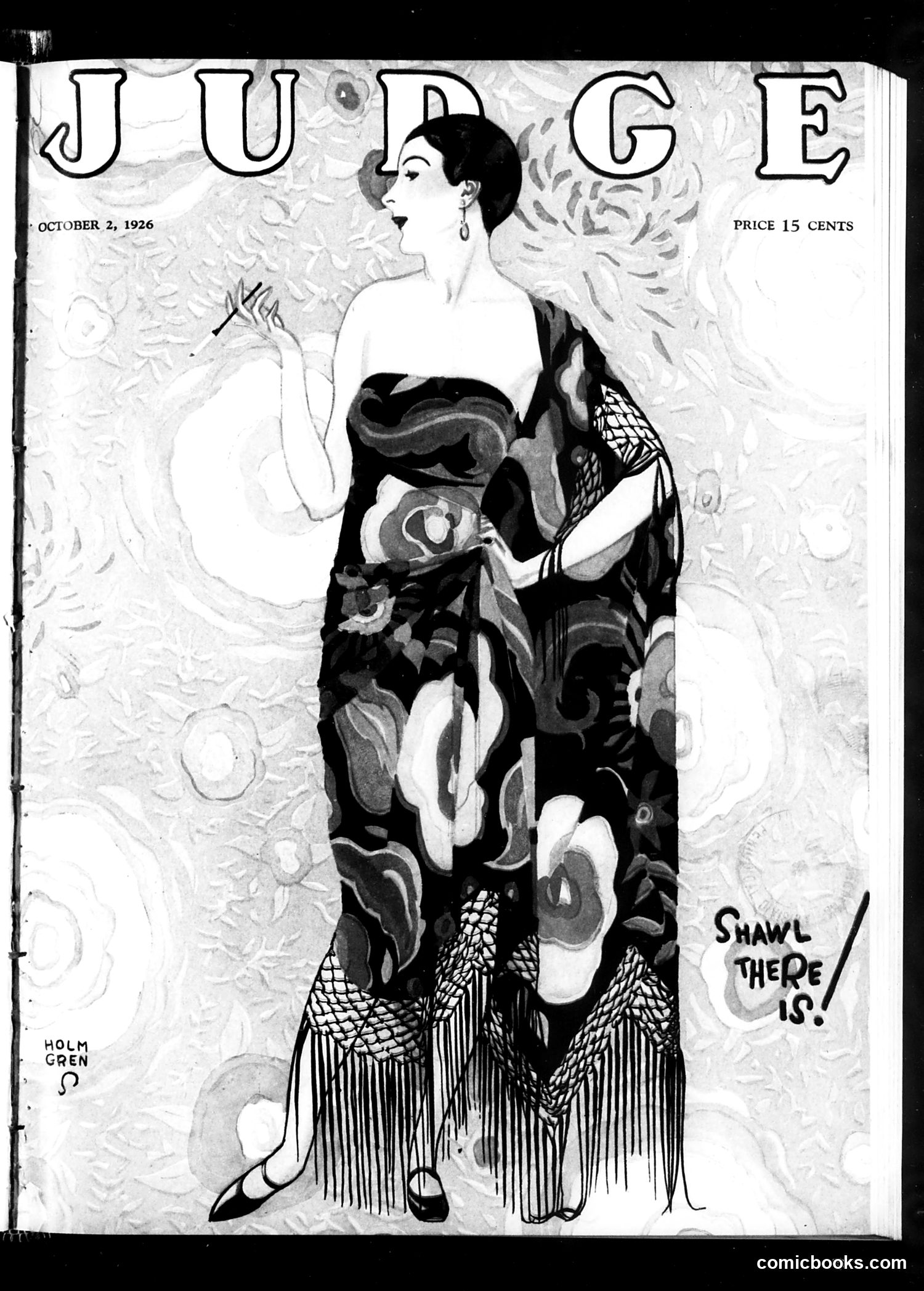
This cover illustration by Holm Greñ depicts a fashionable woman in 1920s attire—a shawl with bold floral patterns and a fringed hemline. The caption "SHAWL THERE IS!" appears to be a visual pun playing on the phrase "shall there is?" or a similar expression. The artwork satirizes 1920s fashion trends, specifically the theatrical, dramatically patterned shawls that were popular during the era. The illustration emphasizes the garment's ornate design and the stylish silhouette it created. Without additional context from the magazine's interior, the specific social commentary remains unclear, though it likely mocks either excessive fashion expenditures during the prosperous 1920s or the theatrical nature of contemporary women's fashion trends.
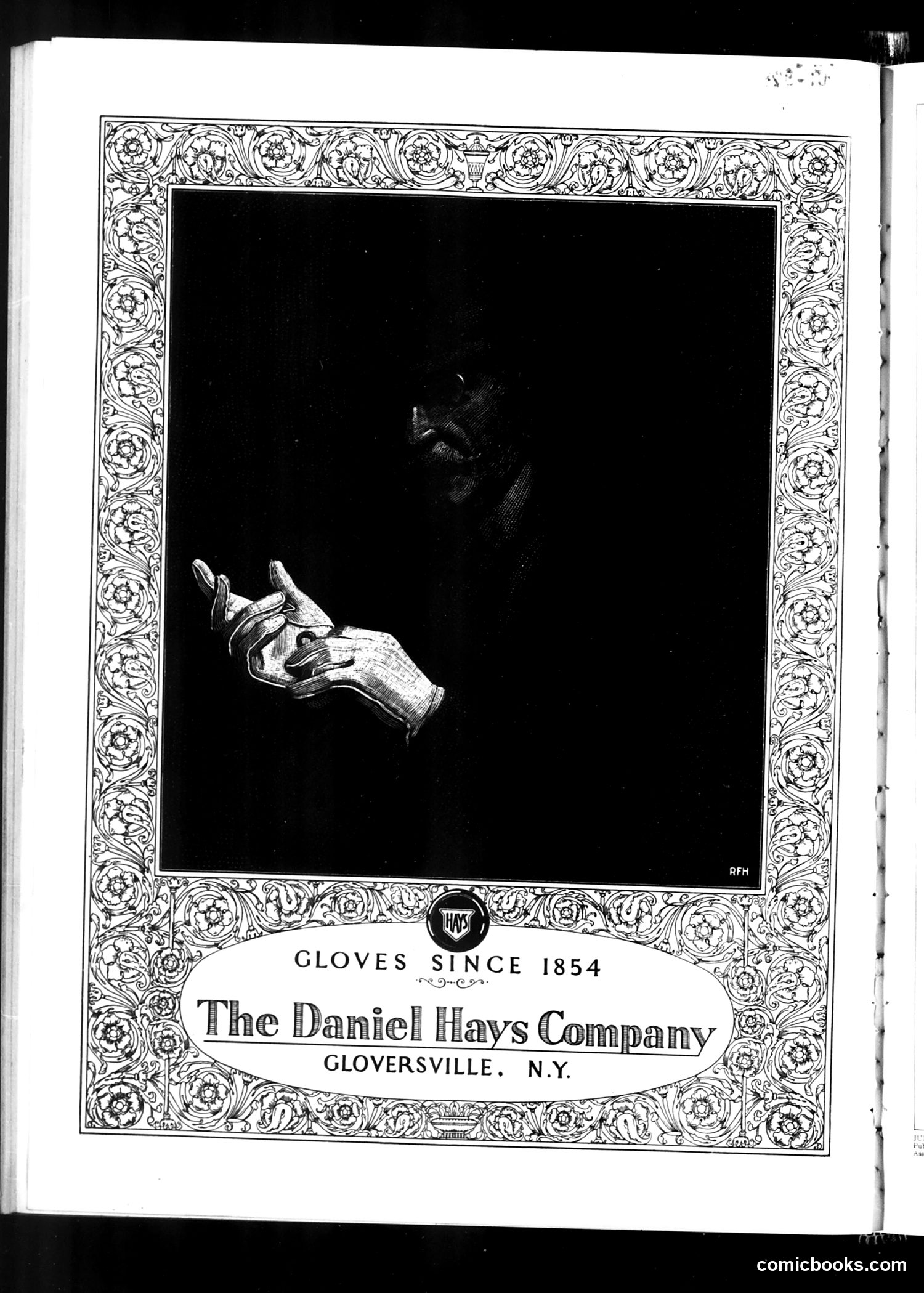
This page is primarily an **advertisement**, not a political cartoon. It promotes "The Daniel Hays Company," a glove manufacturer based in Gloversville, New York, emphasizing their long history ("Gloves Since 1854"). The image shows a **detailed hand illustration** wearing what appears to be a formal glove, rendered in high-contrast black and white. The ornate decorative border features repeated floral or medallion patterns, typical of late 19th/early 20th-century advertising design. The emphasis on craftsmanship and heritage suggests this was pitched to consumers as a quality, established product. There is **no political satire** present—this is simply a vintage commercial advertisement using the prestigious publication *Judge* as its venue.
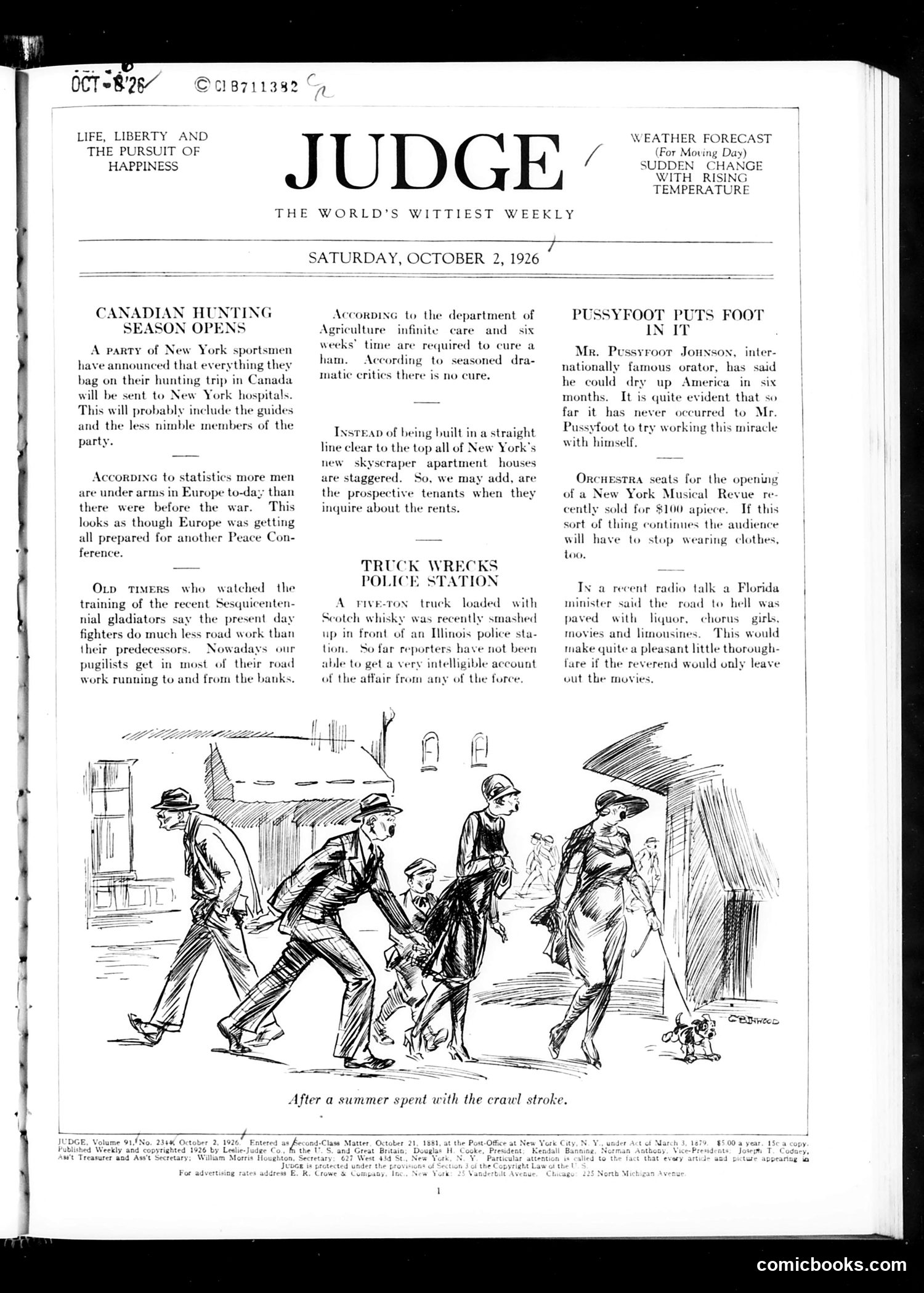
The main cartoon depicts men experiencing the "crawl stroke" — a swimming technique. The caption "After a summer spent with the crawl stroke" suggests these figures are awkwardly walking, their bodies contorted as if mimicking swimming motions on land. This is satirical commentary on the popularity of the crawl stroke (modern freestyle swimming) during the 1920s, when it was a relatively new technique gaining widespread adoption. The joke mocks how absorbed people had become with this swimming style, humorously suggesting it affected their normal walking posture even after leaving the water. The surrounding articles address contemporary topics: Canadian hunting, New York skyscraper housing, truck wrecks at police stations, and Pussyfoot Johnson's claims about drying up America — typical 1920s satire targets.
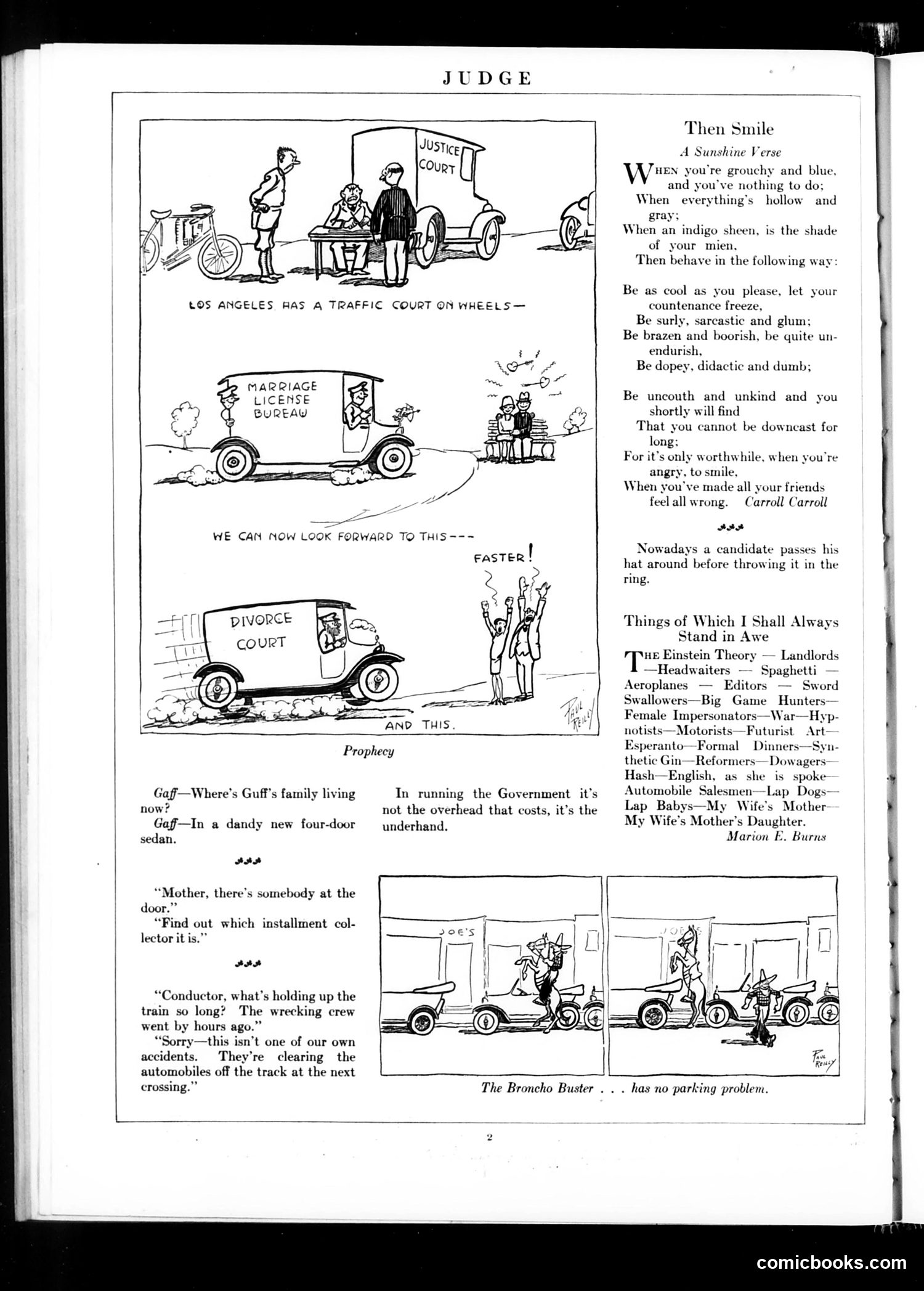
This page satirizes early 20th-century American bureaucratic expansion through mobile courts. The top cartoons mock Los Angeles installing a "traffic court on wheels," followed by predictions of a "marriage license bureau" and "divorce court" also becoming mobile vehicles—suggesting government is becoming increasingly intrusive and omnipresent in citizens' lives. The "Prophecy" caption cynically implies that if courts can travel, divorce proceedings will soon be as mobile and accessible as other government services, commenting on rising divorce rates and expanding state regulation. The bottom section contains unrelated humor about train delays and automobiles blocking railroad crossings—typical early-automotive-era jokes reflecting public frustration with newfangled cars interfering with established transportation. The overall message criticizes government overreach through bureaucratic proliferation.
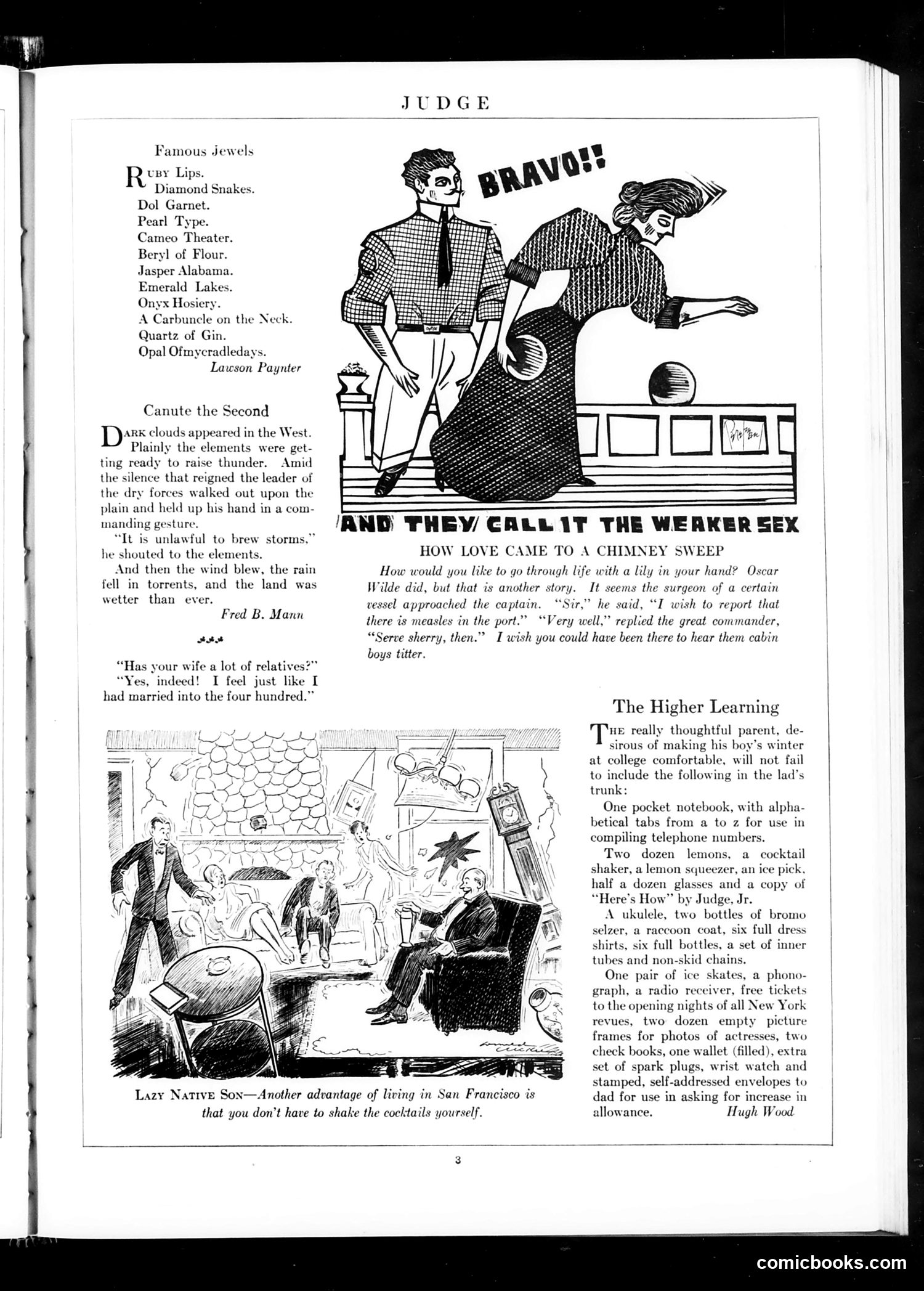
This page contains several discrete satirical pieces rather than one unified cartoon. **"Famous Jewels"** lists humorous fake gem names (Ruby Lips, Diamond Snakes, Pearl Type). **"Canute the Second"** is a poem by Fred B. Mann comparing a contemporary figure to the legendary King Canute, who famously tried commanding the tide. The reference suggests someone ineffectually attempting to control forces beyond their power—likely a political leader or public figure of the era, though the specific target is unclear from this page alone. **"And They Call It the Weaker Sex"** shows a woman bowling while a man watches, satirizing gender stereotypes by depicting a woman engaged in athletic activity, challenging the notion of female weakness. **"The Higher Learning"** humorously lists absurd luxury items a wealthy parent might provide for a college-bound son, mocking upper-class excess and helicopter parenting.
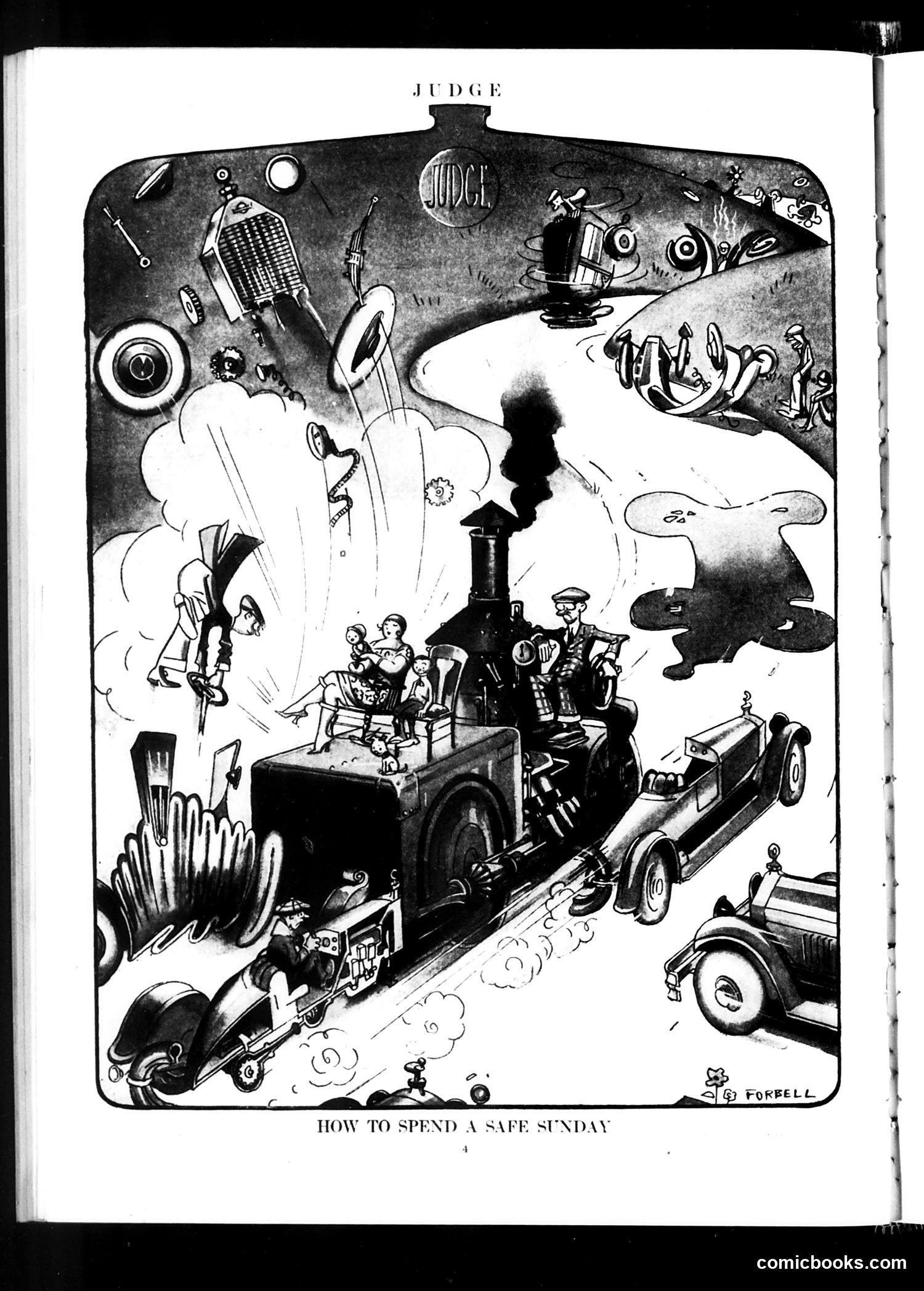
This satirical cartoon from *Judge* magazine mocks automobile safety concerns of the early 20th century. The title ironically presents a chaotic scene of reckless driving as "safe." The illustration depicts multiple vehicles—cars and what appears to be a steam-powered locomotive or experimental vehicle—operating dangerously on the same road. Collisions, explosions, and near-misses fill the composition. The exaggerated chaos satirizes both: 1. The genuine hazards of early motoring, when automobiles shared roads unpredictably with other vehicles 2. Contemporary debates about automobile regulation and public safety The cartoon's humor derives from the absurdity of calling such mayhem "safe," while subtly critiquing the period's inadequate traffic laws and safety standards. The artist (signed "Forrell") uses visual excess to highlight real societal anxieties about the automobile era.
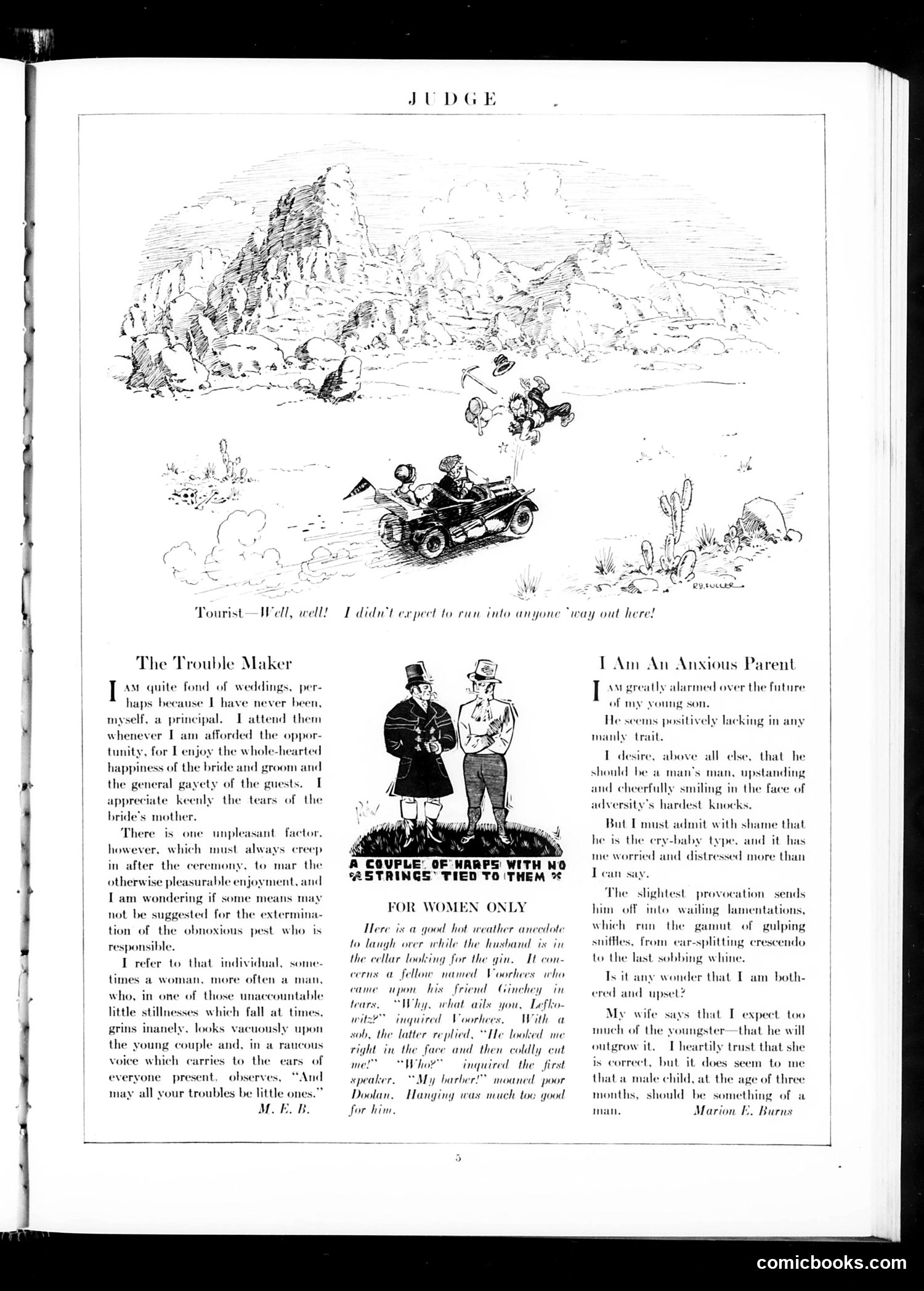
This page contains two separate satirical pieces from Judge magazine: **Top cartoon**: Shows tourists in a desert landscape encountering what appears to be a couple on a motorcycle, with the caption "Tourist - Well, well! I didn't expect to run into anyone way out here!" The joke appears to play on the unexpected intrusion of modern motorized transportation into remote wilderness areas. **"The Trouble Maker"** (left column): Satirizes wedding etiquette and the persistent disruption caused by someone—described as potentially male or female—who causes problems during ceremonies and receptions through unspecified misbehavior. **"I Am An Anxious Parent"** (right column): A father expresses worry about his son's character development, specifically the boy's tendency toward crying and apparent lack of manly traits—reflecting early 20th-century anxieties about masculine development. Both pieces reflect period social concerns about propriety, gender roles, and modern intrusions.
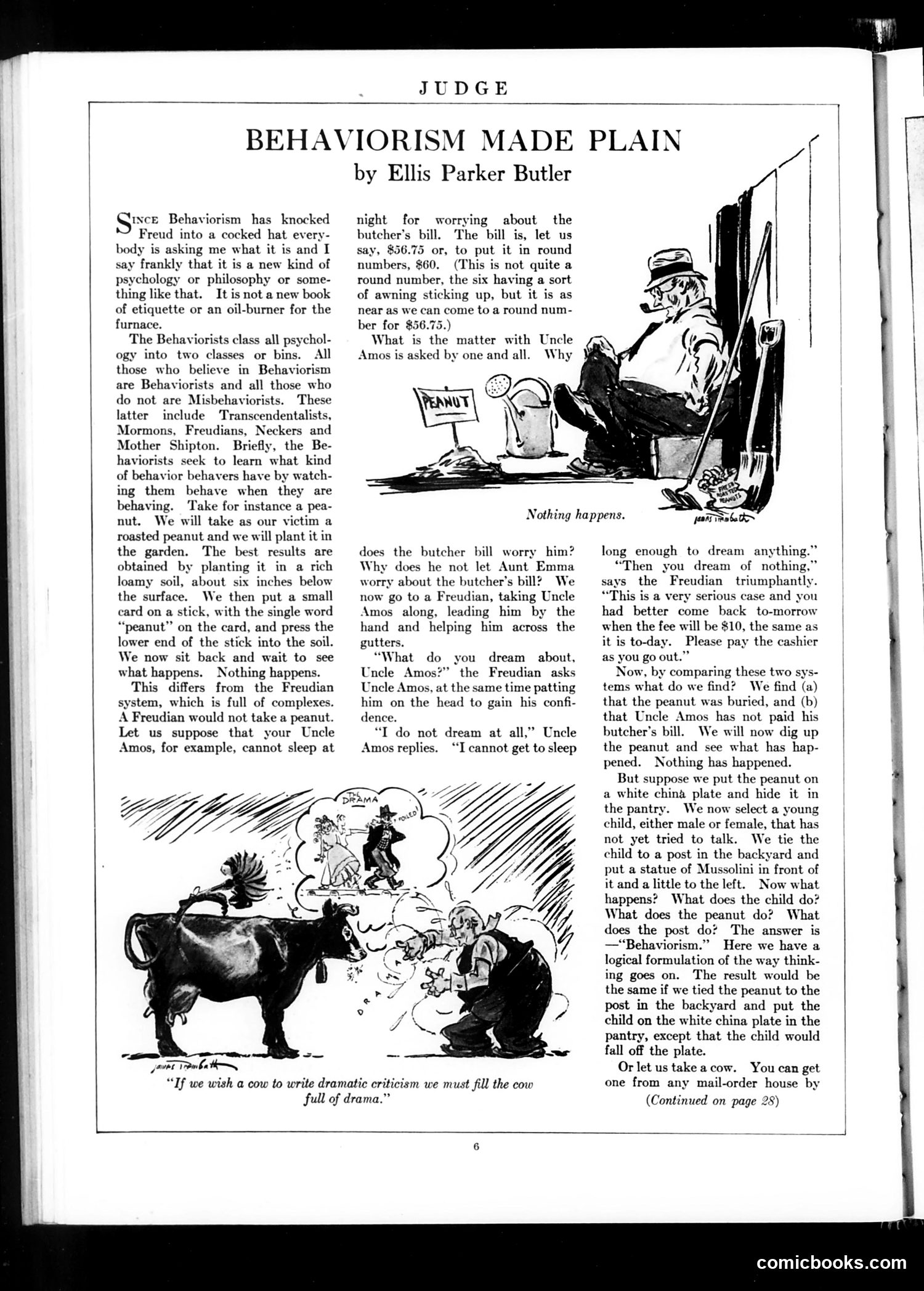
This satirical essay ridicules the newly fashionable psychological theory of Behaviorism, which had recently displaced Freudian psychology in popular discourse. Butler mocks Behaviorism's claim to scientific rigor by demonstrating its logical absurdity through deliberately ridiculous examples: planting a labeled peanut and observing "nothing happens," or tying a child to a post with a Mussolini statue nearby to study behavioral responses. The satire targets both psychological schools—Behaviorists (who observe only external actions) and Freudians (who dig for hidden meanings). Butler suggests both approaches are equally useless for solving real problems like Uncle Amos's unpaid butcher's bill. The cartoons reinforce this mockery of pseudoscientific pretension, presenting these theories as elaborate nonsense dressed in academic language.
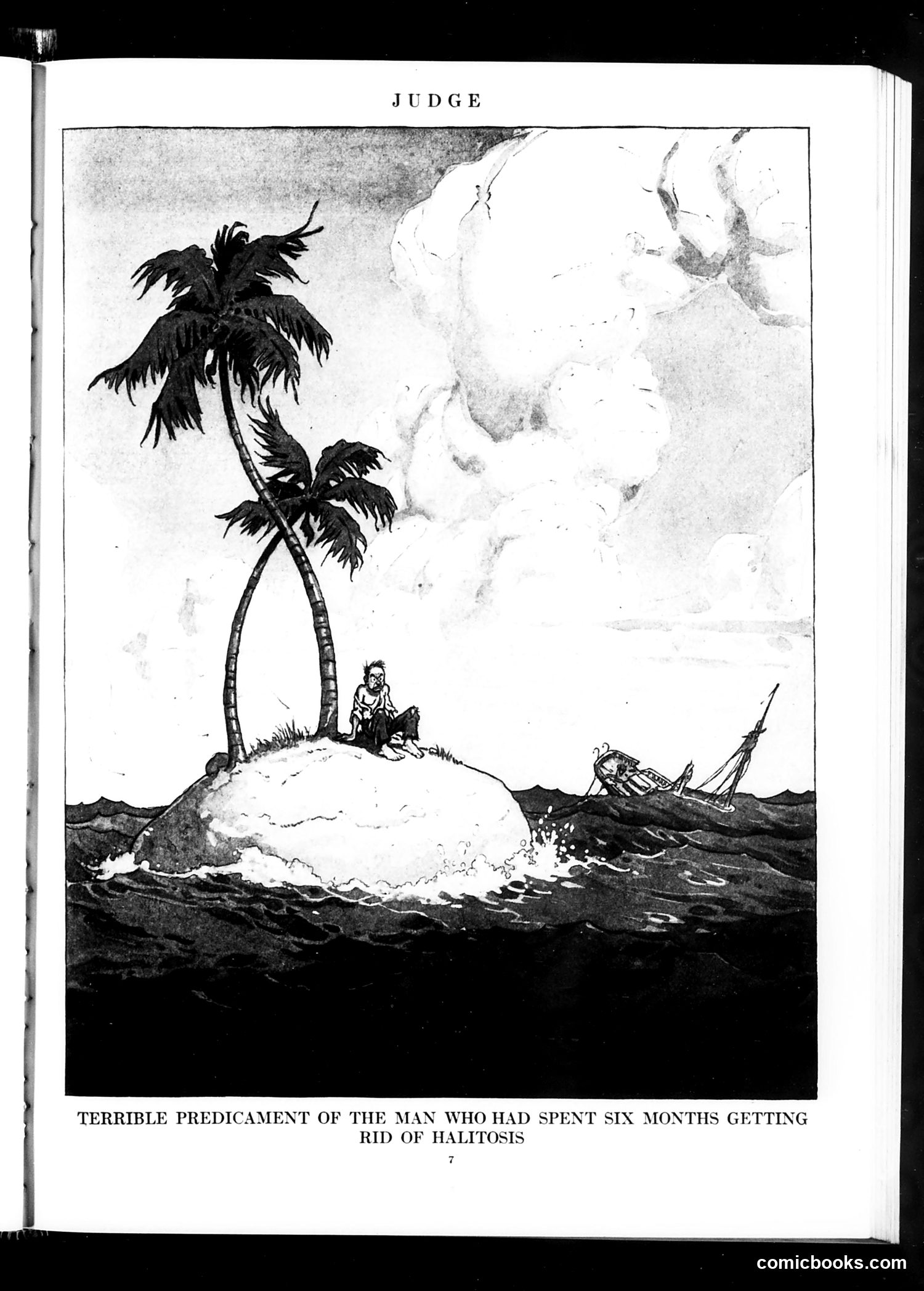
This is a satirical cartoon about halitosis (bad breath) treatment advertising. The cartoon depicts a man on a desert island with a palm tree and a wrecked ship, illustrating the ironic "predicament" of its caption. The satire targets the exaggerated claims of early 20th-century halitosis remedies that were heavily advertised. Judge mocks the absurdity of spending six months treating bad breath only to find himself completely isolated—stranded on a desert island where his breath issues are now entirely irrelevant. The visual joke plays on advertising's promise that curing halitosis will improve one's social life, while suggesting such remedies are pointless in extreme situations. The cartoon critiques both the desperation of consumers and the excessive marketing surrounding this common ailment.
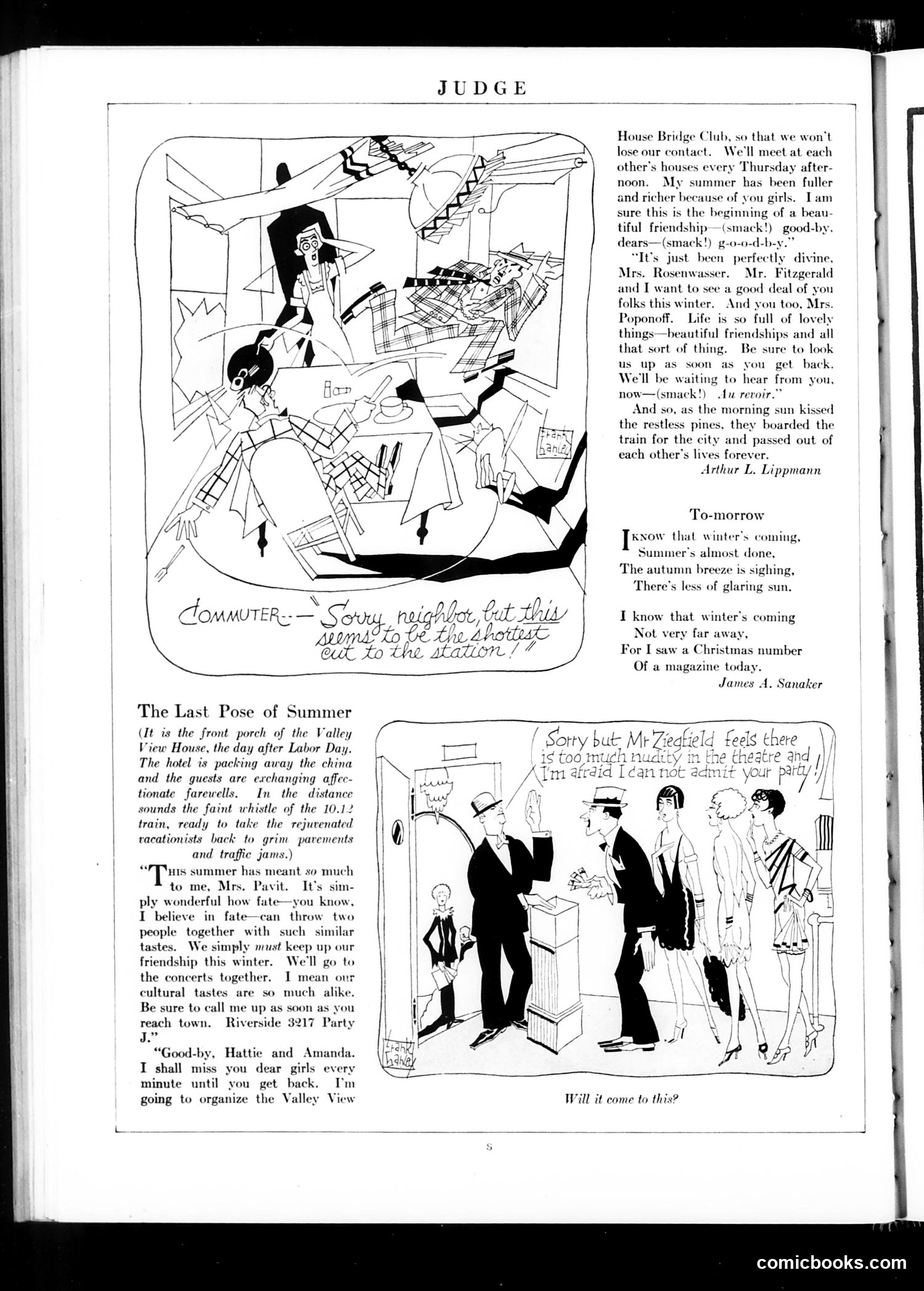
This satirical piece mocks the performative friendships formed at summer vacation resorts. The cartoon shows hotel guests exchanging elaborate, effusive farewells on the front porch—calling each other "dear," promising winter concerts and bridge clubs, exchanging kisses—while the caption's final line reveals the bitter truth: "they boarded the train for the city and passed out of each other's lives forever." The satire targets the shallow social rituals of the era's leisure class, who annually retreated to places like "Valley View House" and formed intense, temporary bonds they had no genuine intention of maintaining. The contrast between their flowery promises ("beautiful friendship," "Au revoir") and the cold reality of permanent separation exposes the hypocrisy of vacation-season sentimentality. The joke is that these elaborate goodbyes meant nothing—a commentary on superficial upper-class social conventions.
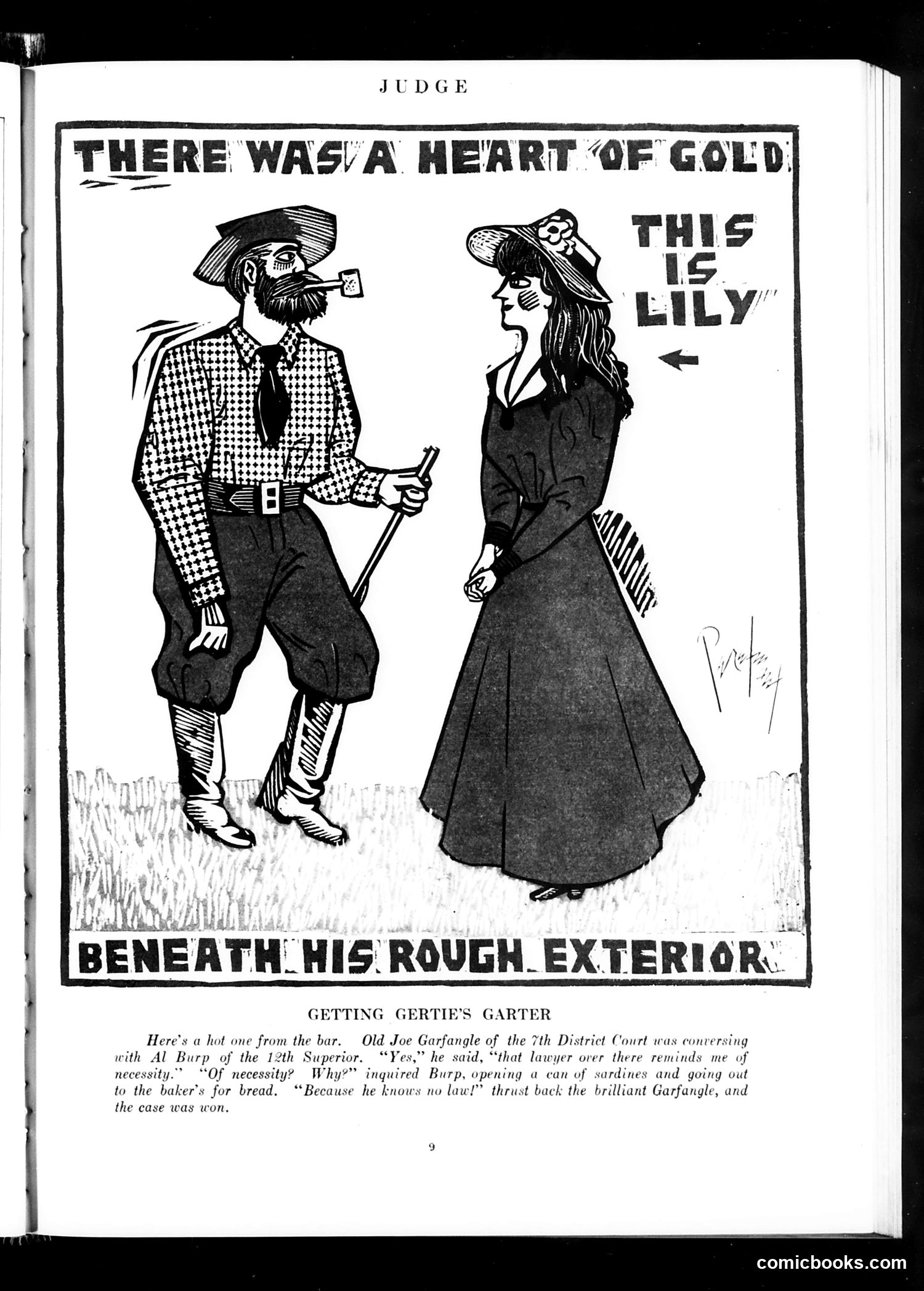
This page from *Judge* magazine features a cartoon titled "Beneath His Rough Exterior" illustrating a joke about a rough, bearded prospector or frontier man named "Old Joe Garfangle" and a woman identified as "Lily." The accompanying text presents a bar joke: two judges discuss a lawyer, with one claiming the lawyer "reminds me of necessity" because "he knows no law." This is a pun on the legal maxim "necessity knows no law"—suggesting the lawyer is so incompetent he embodies lawlessness itself. The cartoon's caption "There Was a Heart of Gold / This Is Lily" suggests the prospector, despite his crude appearance, has noble character. The overall joke appears to be social commentary on rough exteriors concealing inner virtue, while the bar joke satirizes legal incompetence among the judiciary.
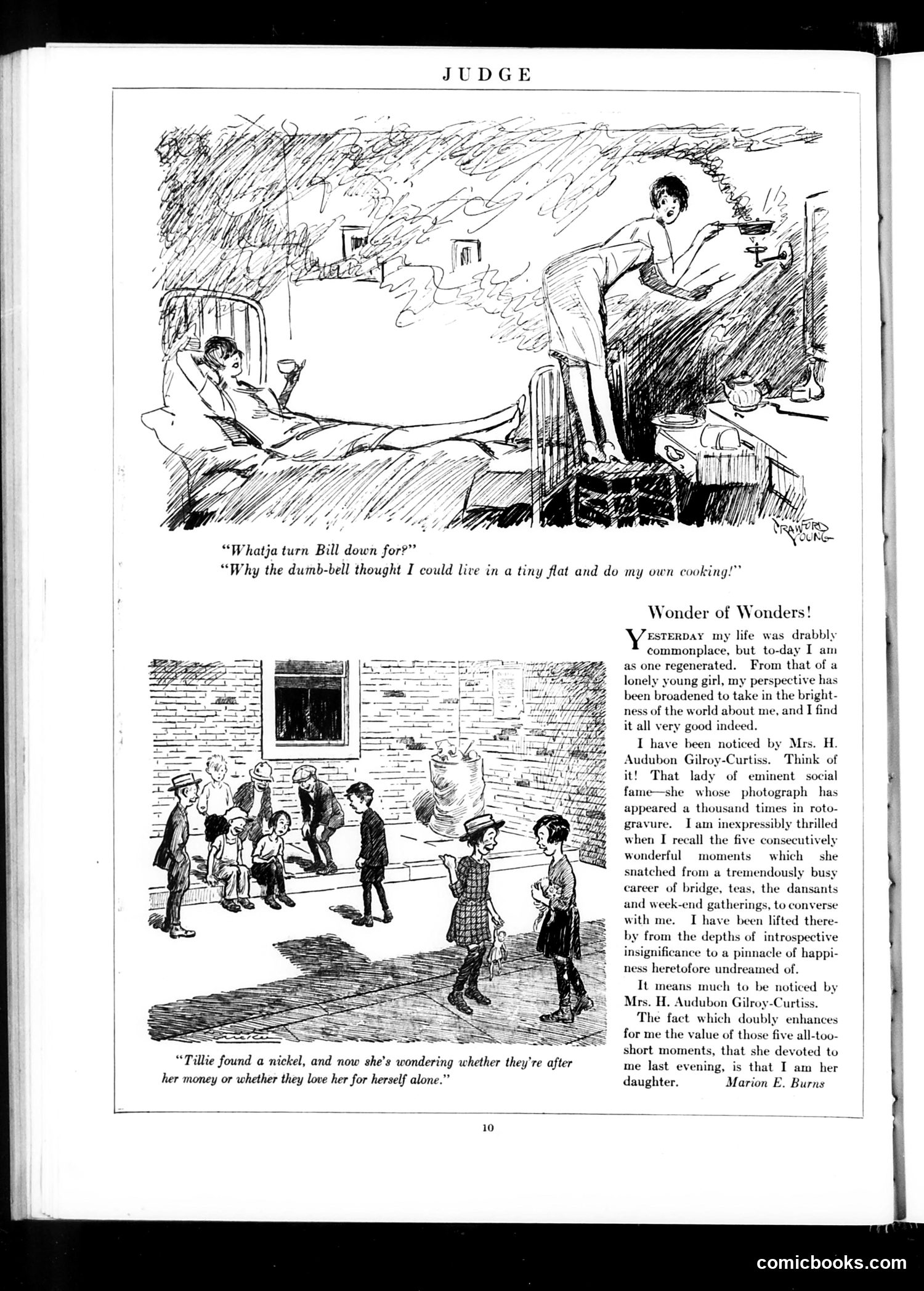
This page contains two satirical pieces mocking early 20th-century American social attitudes. The top cartoon ridicules courtship expectations: a woman rejects a suitor ("Bill") because he naively expected her to live in a small apartment and cook—suggesting women sought financial security and comfortable lifestyles rather than romantic partnership. The lower cartoon and accompanying text parody social-climbing and name-dropping among the wealthy. A narrator gushes about being noticed by the prominent socialite "Mrs. H. Audubon Gilroy-Curtiss"—described as constantly attending bridge games and social events. The narrator finds five minutes of the woman's attention life-changing, having been "lifted" from insignificance. The caption below—about a girl named Tillie finding a nickel and wondering if people want her money or love her—undercuts this, suggesting the narrator's newfound social attention is similarly mercenary. Both pieces satirize materialistic values in American society: women pursuing wealthy men, and social climbers valuing superficial elite attention.
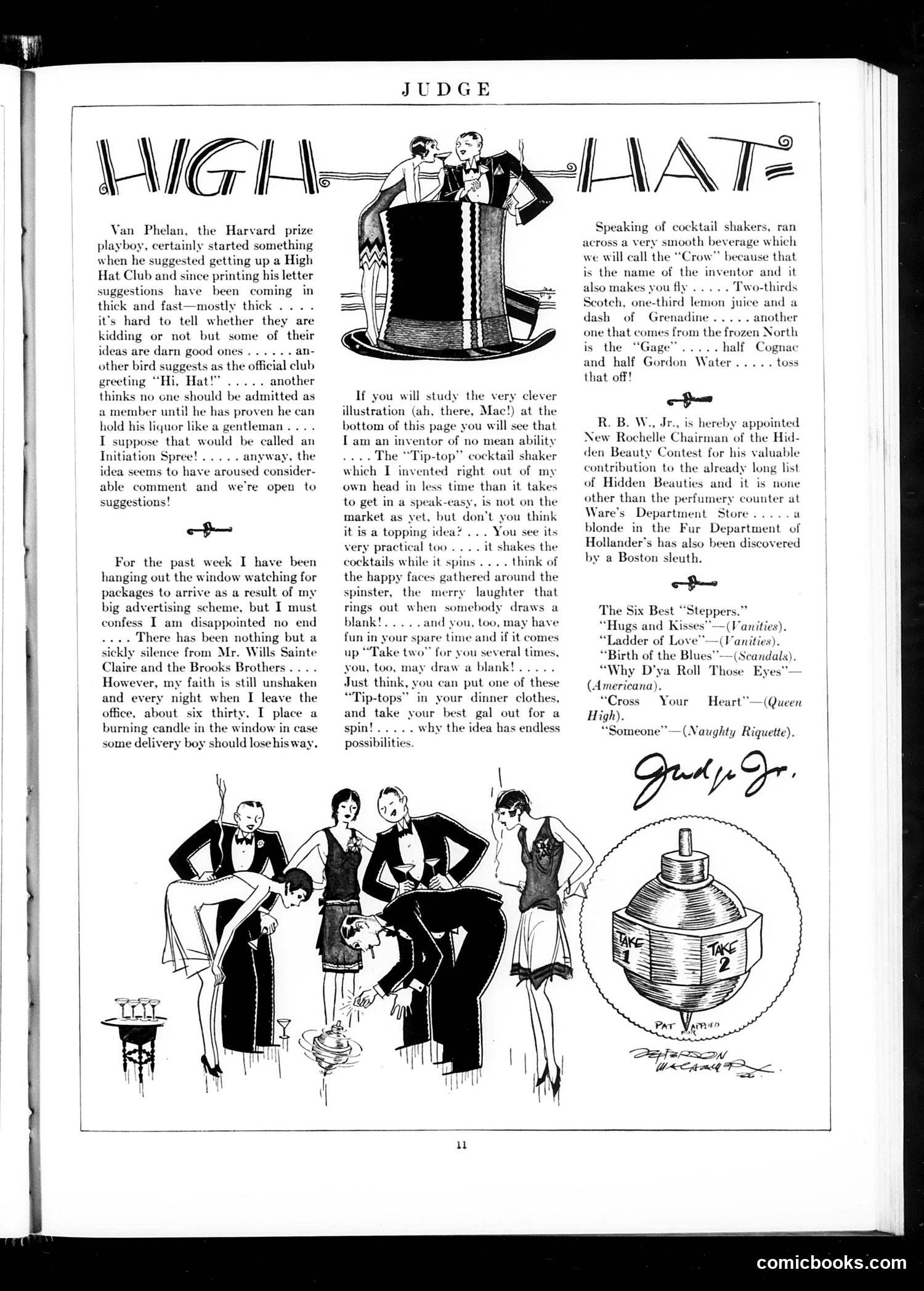
This page satirizes the newly proposed "High Hat Club," a fictional organization for Harvard playboys. The columnist (identified as "Judge Jr.") mocks Van Phelan's suggestion to create an exclusive club with absurd membership requirements—including proving one can "hold his liquor like a gentleman" and using "Hi, Hat!" as an official greeting. The satire targets 1920s elite pretension and the speakeasy culture of Prohibition. The main illustration shows well-dressed partygoers spinning a novelty cocktail shaker—the columnist's own invention, a "Tip-top" device. The joke is that this impractical contraption is presented as ingenious while the columnist admits nothing has resulted from his advertising schemes (he's been waiting for product delivery all week). Secondary jokes include recipes for fashionable cocktails ("The Crow," "The Gage") and listings of popular dance crazes. The overall tone mocks both nouveau riche social climbing and the era's cocktail obsession during Prohibition.
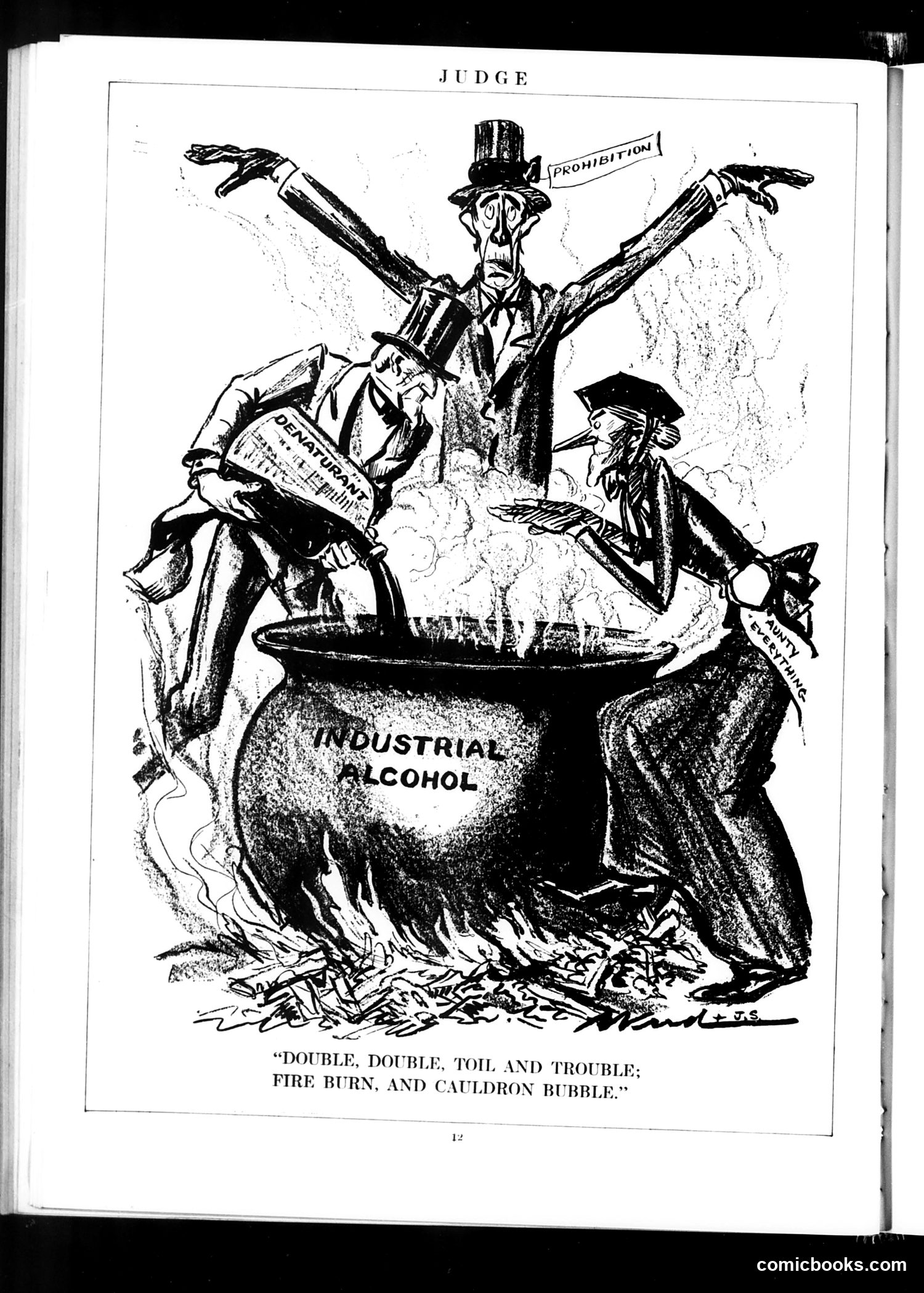
This Judge magazine cartoon satirizes **Prohibition** and its enforcement. The central cauldron labeled "INDUSTRIAL ALCOHOL" represents a dangerous brewing problem—industrial alcohol being illegally diverted for consumption during Prohibition (1920-1933). The tall skeletal figure in the top hat holding a revolver represents **Prohibition enforcement** or the law itself. Two figures stir the cauldron: one labeled "DETECTIVE" and another appearing to be a smuggler or bootlegger, suggesting corruption or collusion between enforcers and lawbreakers. The Shakespeare quote ("Macbeth," Act IV) implies witchcraft and trouble brewing. The cartoon's message: Prohibition's enforcement creates a dangerous, bubbling mess of industrial poison, criminality, and hypocrisy—with authorities either complicit or ineffectual in controlling the resulting chaos.
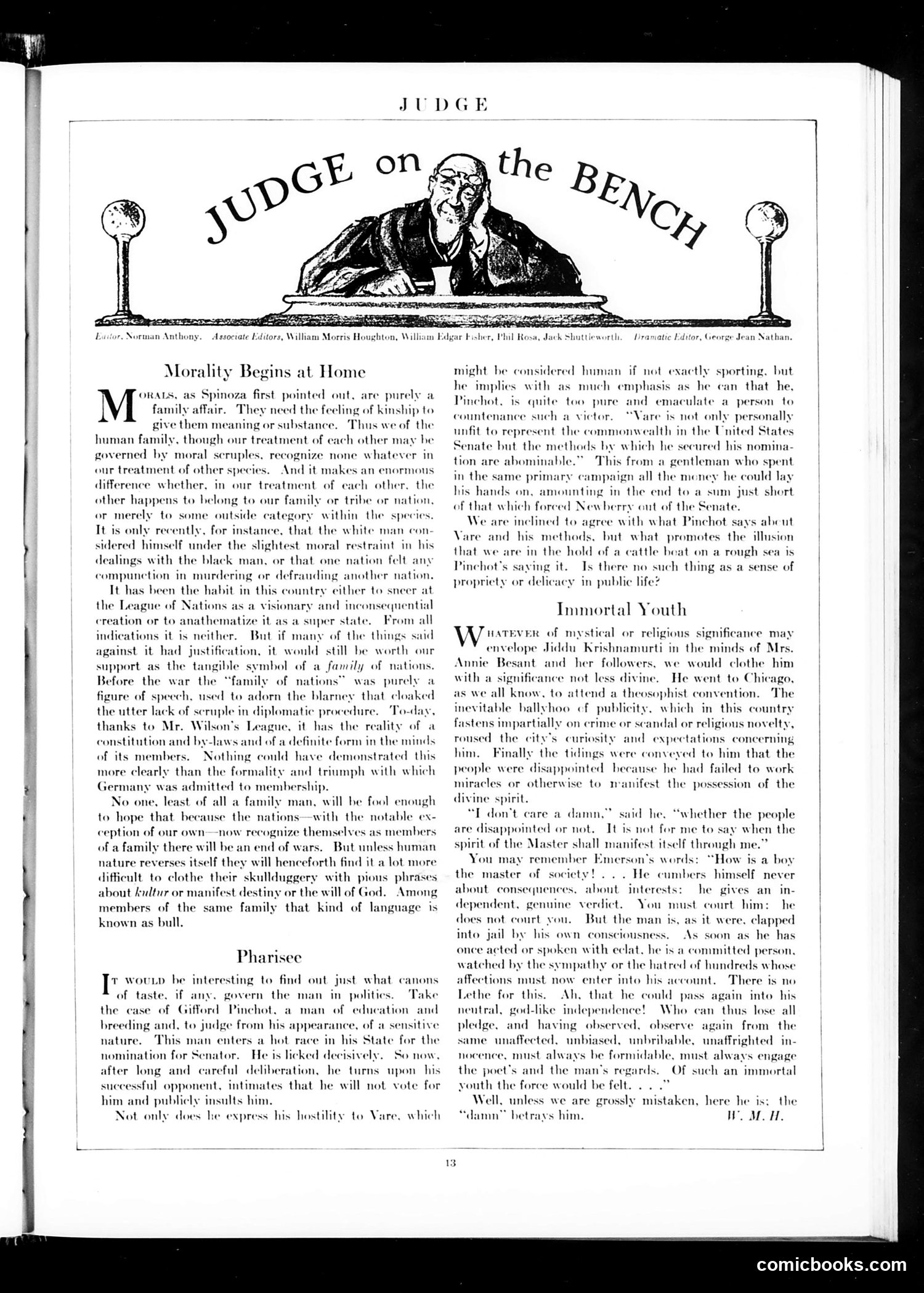
This page contains three editorial pieces by Judge magazine's editors (likely early 1920s, given references to Wilson's League of Nations and Gifford Pinchot). **"Morality Begins at Home"** defends the League of Nations against American skeptics, arguing that treating nations as a "family" with moral obligations makes diplomatic hypocrisy harder to justify. **"Pharisee"** critiques Gifford Pinchot, a prominent conservationist who lost a Pennsylvania Senate primary to William Vare. Pinchot publicly attacked Vare's campaign methods as corrupt—but Pinchot himself had spent nearly as much money in the same primary. The satire: Pinchot's moral outrage rings hollow given his own behavior. The title "Pharisee" references biblical hypocrisy. **"Immortal Youth"** (incomplete here) appears to discuss Jiddu Krishnamurti, a spiritual figure controversially promoted by Annie Besant. The page's masthead illustration shows a stern judge—representing editorial authority dispensing judgment on public figures and politics.
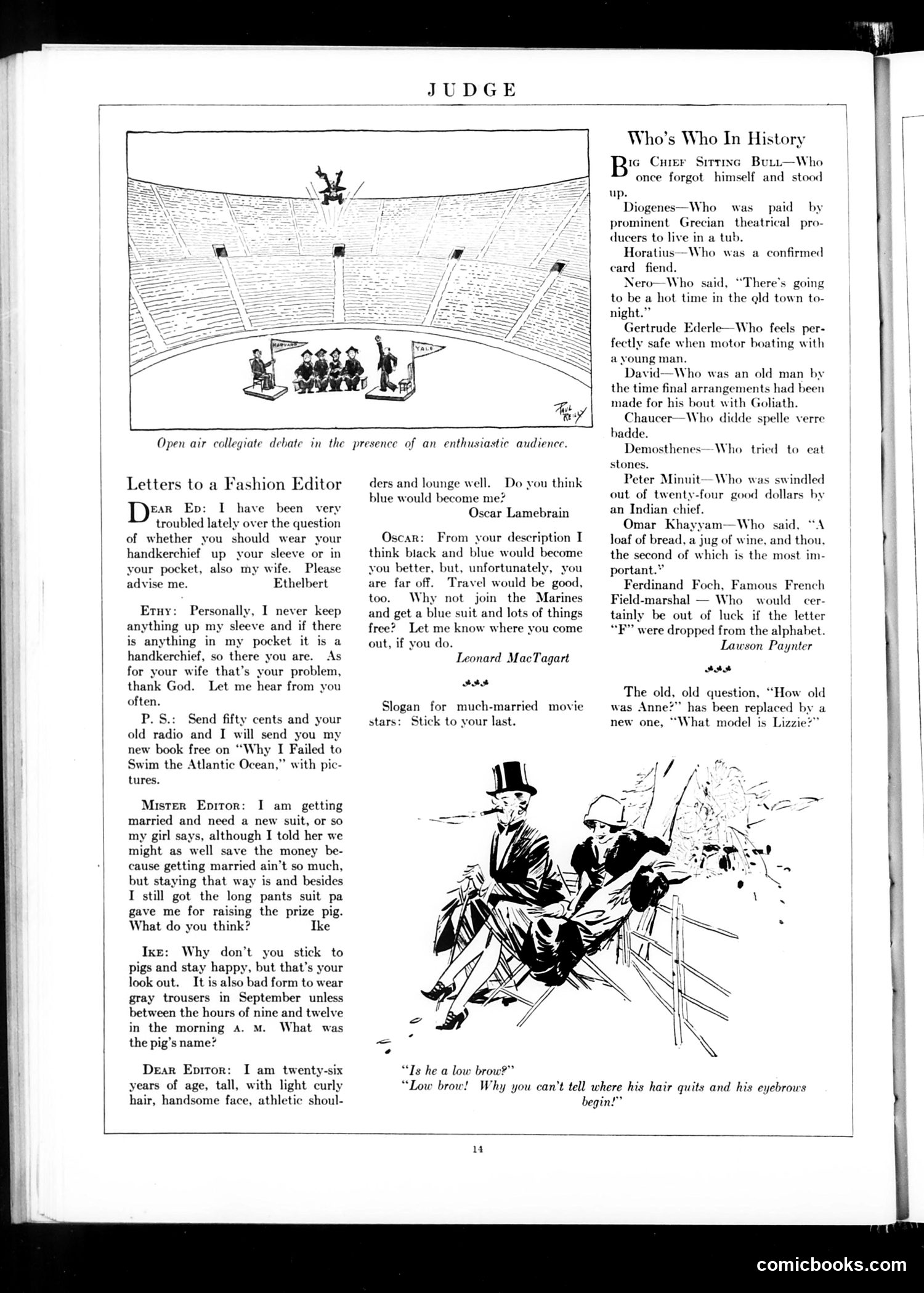
This page features **satirical advice columns and humor** typical of 1920s Judge magazine. The main cartoon depicts an "open air collegiate debate," mocking academic discourse with exaggerated formality before an enthusiastic crowd—likely satirizing pretentious intellectual culture. The **"Letters to a Fashion Editor"** section consists of humorous advice exchanges where the editor ridicules letter writers through backhanded responses. Oscar Lamebrain receives a joke about becoming "black and blue" (beaten up). Ike is told to stick with pigs rather than marriage. The responses mock fashion anxieties and life choices of ordinary people. The **"Who's Who In History"** sidebar contains brief comedic definitions of historical figures, many containing contemporary references. Gertrude Ederle (the famous swimmer) appears, suggesting this is from the mid-1920s. The humor relies on reducing famous figures to single absurd characteristics. The bottom cartoon shows two men debating someone's intellect ("low brow"), with the joke being physical indistinguishability between hair and eyebrows—visual mockery of appearance-based class judgments. The overall tone is **irreverent, class-conscious satire** targeting social pretension and conventional values.
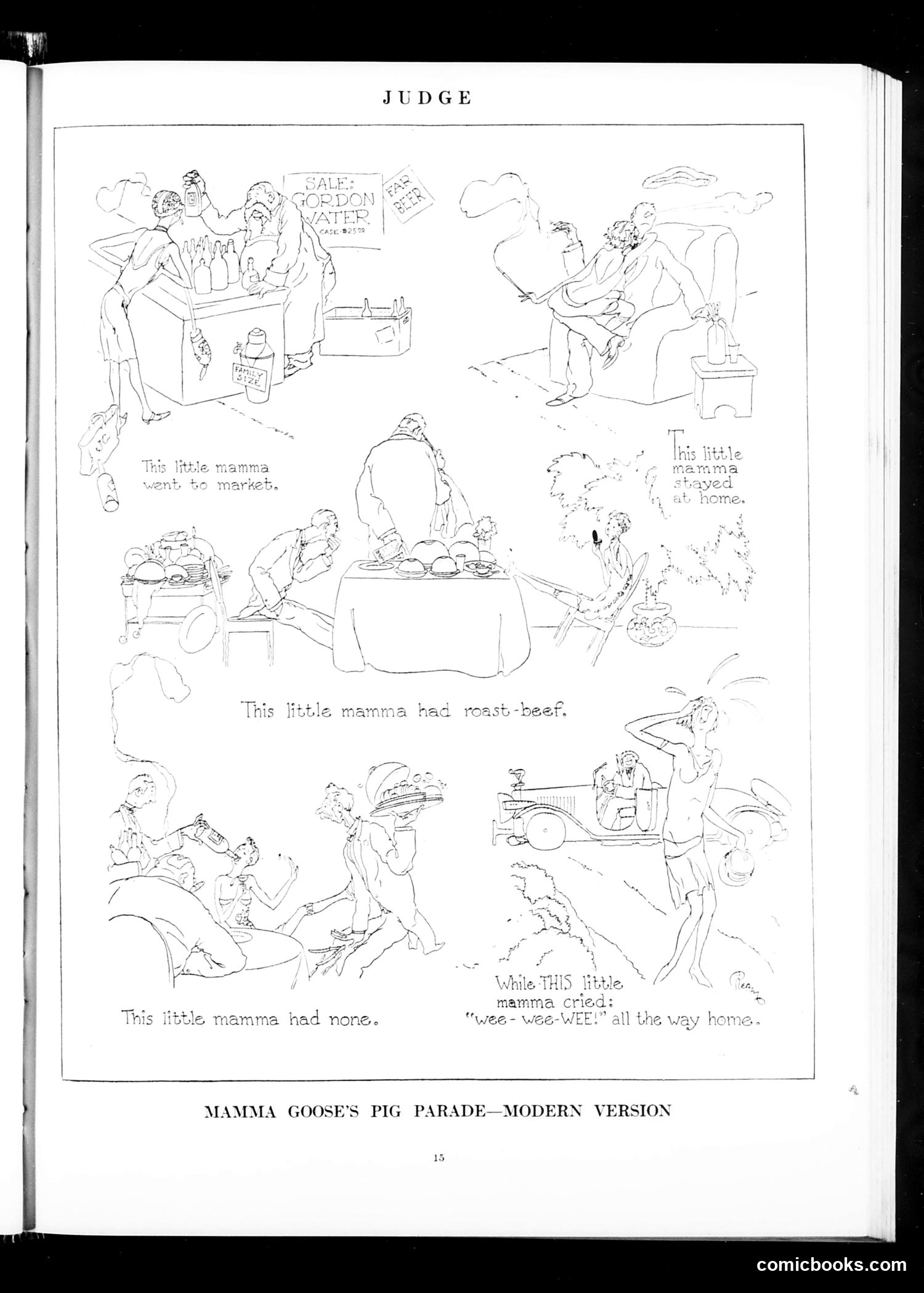
This is a modernized parody of the nursery rhyme "This Little Pig Went to Market." Instead of the traditional farmyard pigs, the cartoon depicts various scenes of urban, contemporary life (the illustration shows what appears to be early-to-mid 20th century activities). Each scene follows the rhyme's structure with variations: one pig goes to market, one stays home, one has roast beef, one has none, and one cries "wee-wee-wee" all the way home. The "modern version" appears to satirize contemporary consumer culture, shopping, domestic life, and urban activities—replacing the simple pastoral original with depictions of bustling modern society. The satire likely mocks how modern life has become complex and commercialized compared to simpler times.
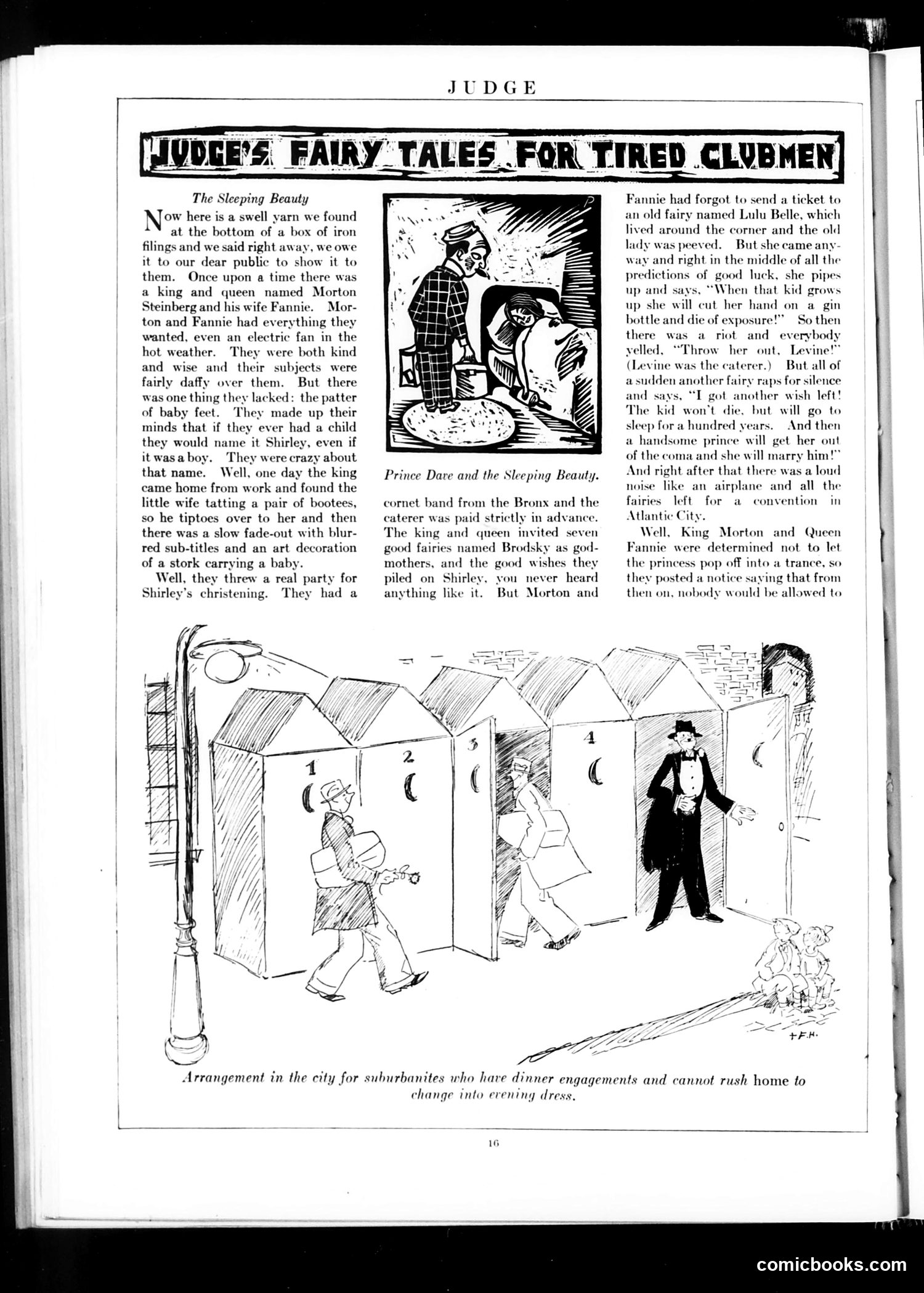
This is a humorous retelling of the Sleeping Beauty fairy tale, but with early 20th-century American satirical twists. The story features King Morton Steinberg and Queen Fannie—ordinary middle-class names substituted for traditional royalty, mocking the pretensions of wealthy industrialists of the era. The satire targets several things: the obsession with having children ("patter of baby feet"), material excess ("electric fan in the hot weather"), and social status anxiety. The fairy godmothers are named "Brodsky"—likely a Jewish surname, reflecting Judge's occasionally crude ethnic humor typical of that period. The bottom cartoon jokes about suburban commuters unable to change into evening clothes before dinner engagements in the city—a practical concern for prosperous early 1900s businessmen. The overall tone mocks both fairy-tale conventions and contemporary upper-middle-class aspirations, suggesting that even wealth and planning cannot prevent life's complications.
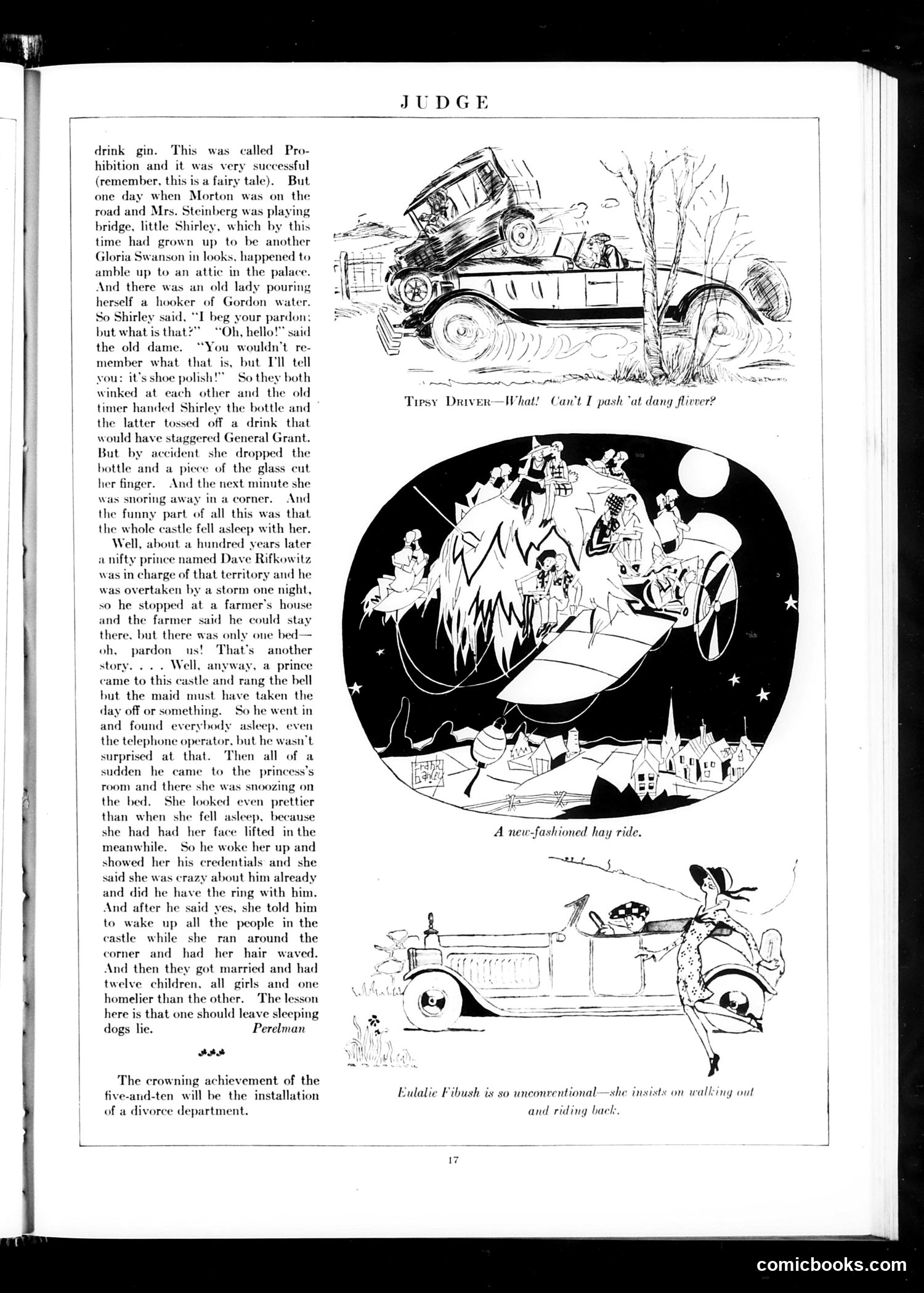
This page contains a satirical fairy tale parody by S.J. Perelman mocking Prohibition and modern social conventions. The narrative twists Sleeping Beauty, replacing the prince with "Dave Rifkowitz" and the princess with "Gloria Swanson" (referencing the famous silent film star). The satire's point: during Prohibition, the "old dame" hides alcohol by calling it "shoe polish"—a common subterfuge of the era. When the princess drinks it and passes out for a century, the humor undercuts Prohibition's supposed "success." The cartoons illustrate related themes: one shows a reckless driver, another depicts a flashy nighttime "hay ride" with flapper-era revelry. A final quip notes the "five-and-ten" (dime store) installing a "divorce department"—cynical commentary on modern marriage instability. Together, the content ridicules Prohibition's ineffectiveness, changing sexual mores, and the increasingly disposable nature of marriage in Jazz Age America.
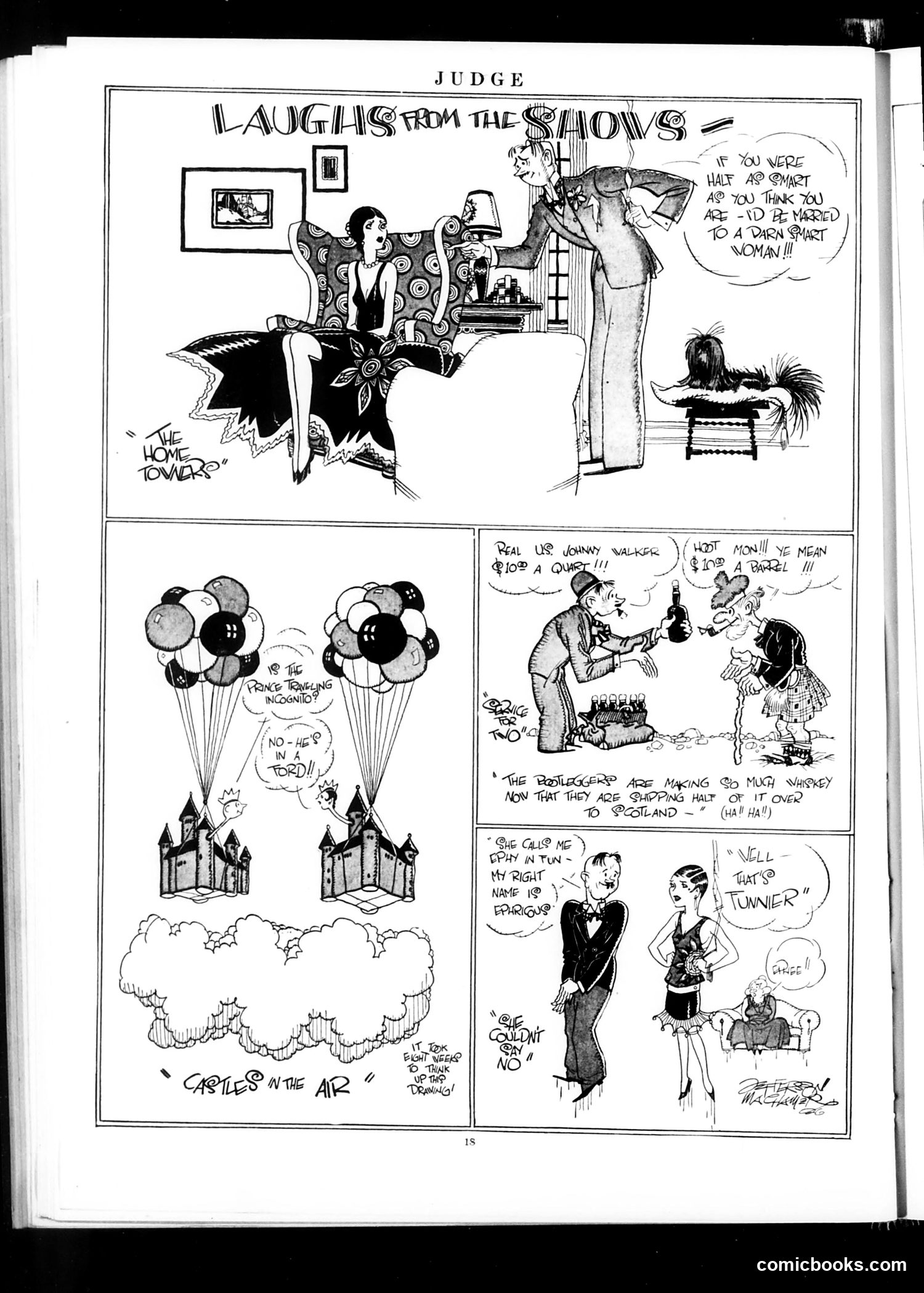
This page collects theatrical humor from stage productions. The top panel depicts a domestic comedy scene where a man chides a woman for marrying him while half-asleep, satirizing hasty marriages. The middle section shows two panels: one featuring castles floating in clouds (referencing a stage production), and another depicting whiskey-smuggling bootleggers during Prohibition, joking about illegally shipping Scottish whisky to Scotland itself—absurdist humor about the era's alcohol black market. The bottom panels show romantic/dating comedy scenarios typical of stage farces: a woman correcting a man's proposal with the word "funnier," and dialogue about attractive women being "fun" to date. The cartoons mock both romantic entanglements and Prohibition-era lawbreaking through exaggerated theatrical situations. Without visible dates or specific show titles, the exact productions remain unclear, though the Prohibition reference dates this to the 1920s-1930s era.
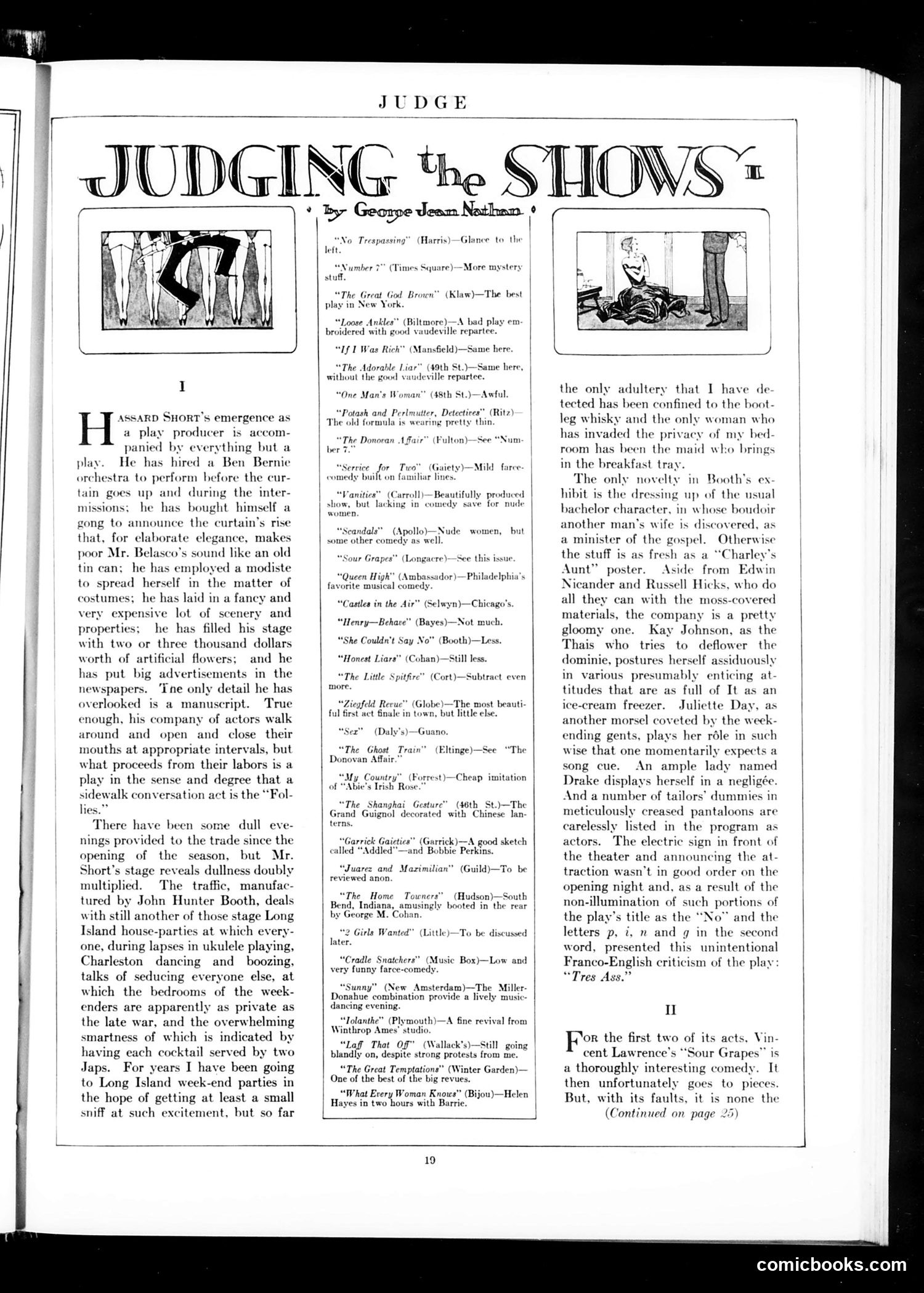
This page is theater criticism by George Jean Nathan, a prominent Judge magazine drama critic. The left column reviews Hassard Short's emergence as a Broadway producer—satirizing him for elaborate production values (orchestra, gong, expensive costumes, artificial flowers, advertisements) while lacking an actual *play*. The joke is that Short prioritizes spectacle over substance: "the only detail he has overlooked is a manuscript." The center column lists current Broadway shows with brief, dismissive reviews—mostly one-liners mocking their quality or subject matter. References include *Sour Grapes*, *Queen High*, and *Sex*. The right column continues the critique, noting that Vincent Lawrence's *Sour Grapes* suffers from poor plotting and weak execution despite competent actors. This reflects 1920s theatrical tastes and Nathan's caustic critical style—a insider's view of Broadway's commercialism versus artistic merit during the Jazz Age.
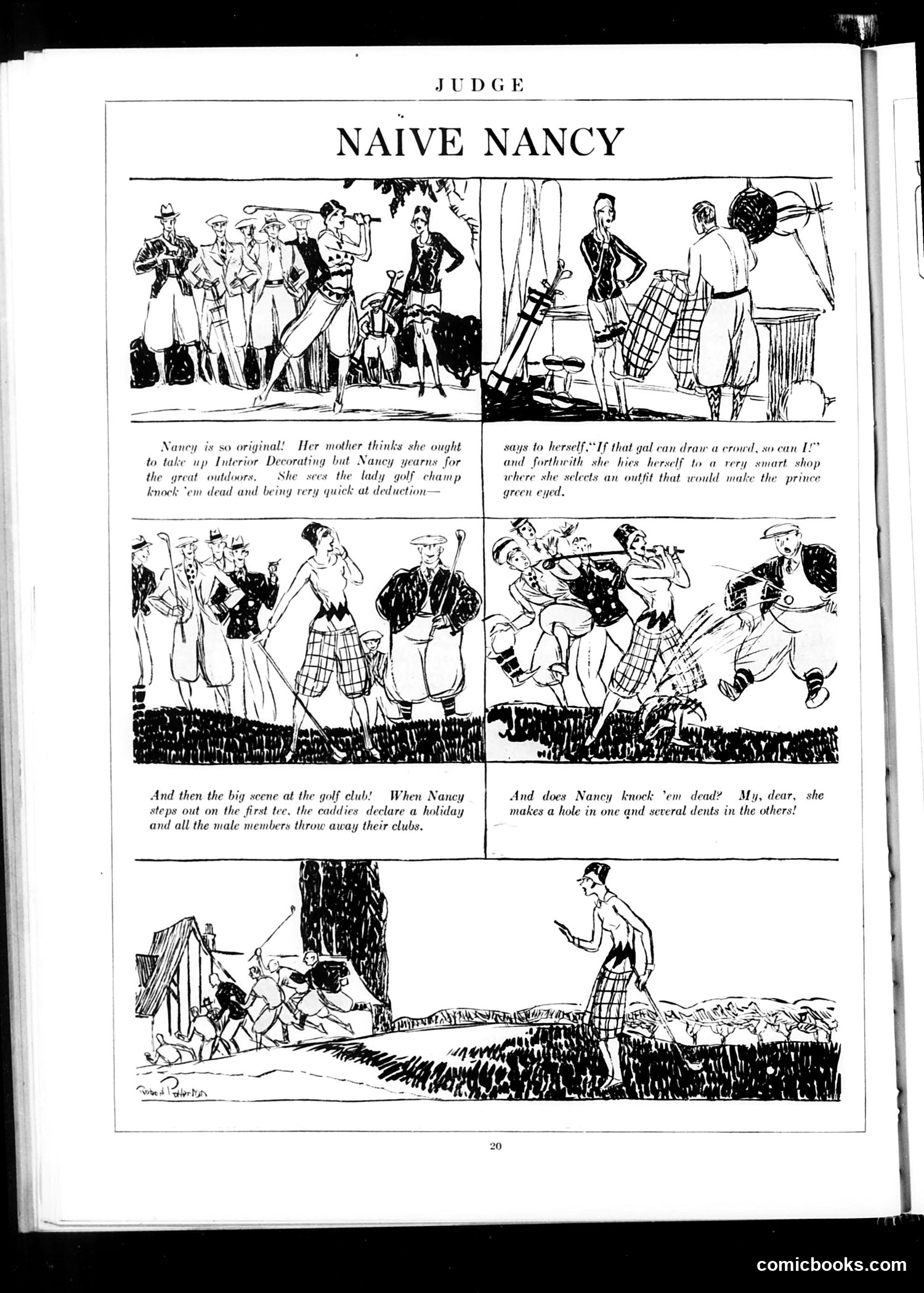
This comic strip satirizes early 20th-century women's entry into sports and social spaces traditionally dominated by men. Nancy, an unconventional young woman interested in outdoor activities rather than interior decorating, observes a successful female golf champion and decides to pursue golf herself. The satire centers on Nancy's naïveté and her disruptive effect: she dresses fashionably to attract attention at the golf club, causing male members to abandon their sport entirely. The punchline mocks both her golfing incompetence (making "a hole in one and several dents in the others"—suggesting wildly erratic shots) and the absurd male response to her presence. The humor targets changing social norms—women invading male recreational spaces—while portraying Nancy as simultaneously empowering herself and creating chaos through her very presence rather than actual golfing skill.
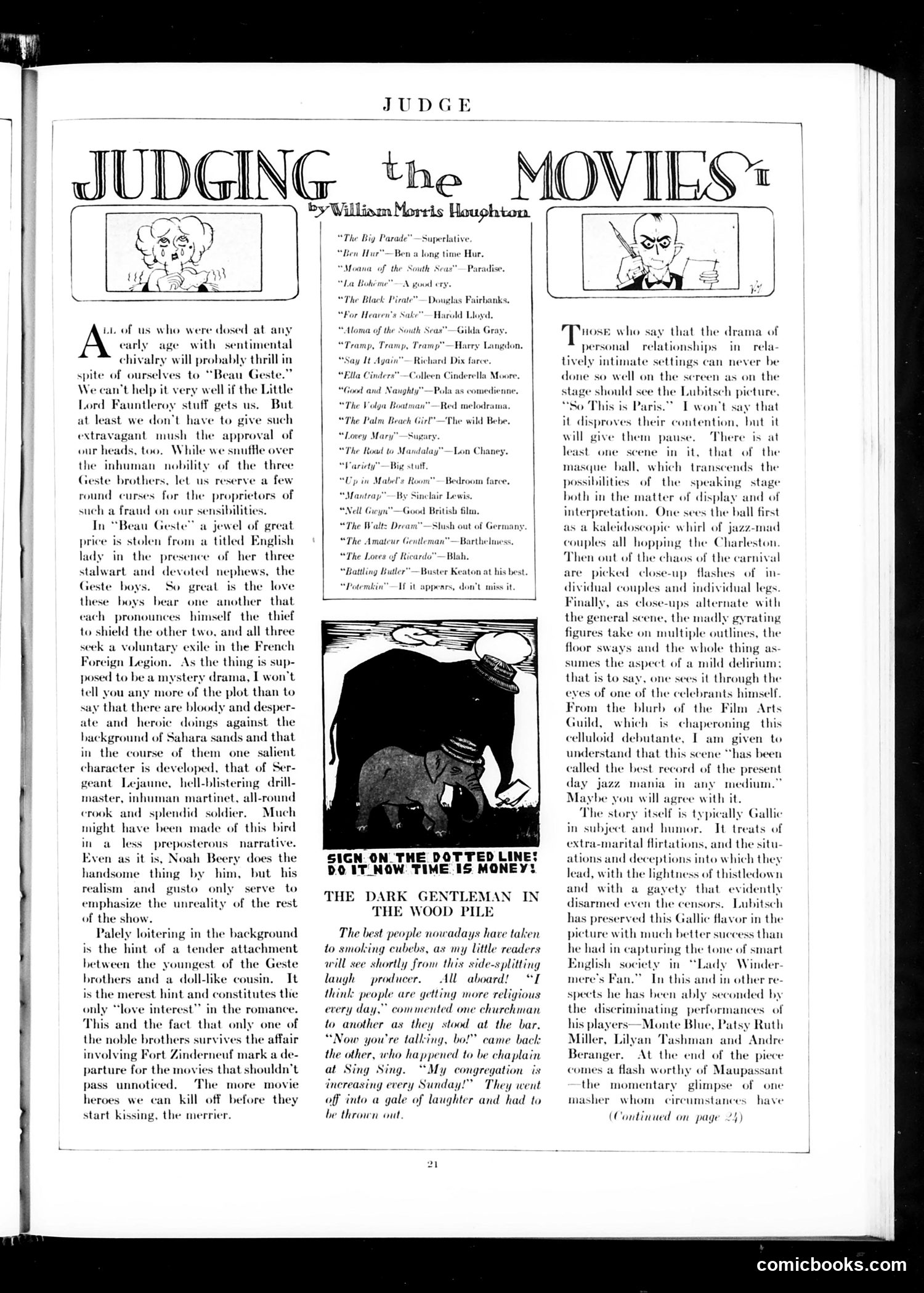
This page contains a film review column by William Morris Houghton critiquing current movies. The main review discusses *Beau Geste*, a drama about three English brothers who each claim responsibility for a stolen jewel, leading all three to exile in the French Foreign Legion. The reviewer praises Noah Beery's portrayal of the brutal Sergeant Lejaune but criticizes the film's overall implausibility and melodramatic romance subplot. He appreciates that the film kills off characters before requiring kissing scenes—a jab at Hollywood's romantic conventions. A sidebar reviews Ernst Lubitsch's *So This is Paris*, defending intimate relationship dramas as viable cinema. The page includes a list of current films with brief judgments (mostly dismissive of sentimental fare) and a small cartoon about "the dark gentleman in the wood pile"—likely a dated racial euphemism about hidden problems. The tone reflects 1920s cinematic tastes: skepticism toward sentimentality, appreciation for character-driven acting, and irreverence toward studio conventions.
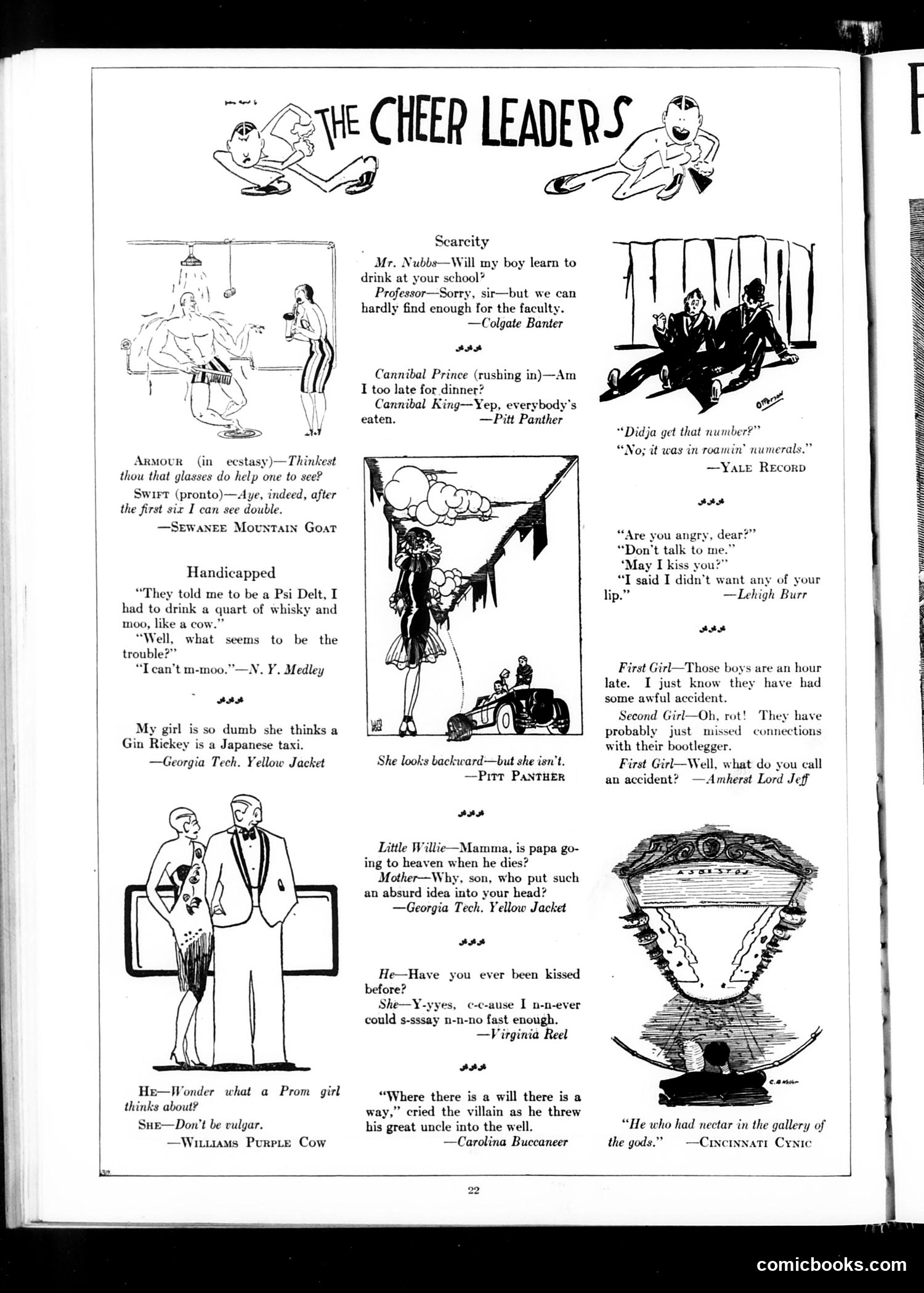
This is a collection of college humor jokes and cartoons from Judge magazine, likely from the 1920s Prohibition era. The page's title frames these as witty observations from various college publications. **Key themes:** - **Drinking culture**: Multiple jokes reference alcohol consumption at fraternities and colleges, with one joke about a professor admitting the school can't find enough liquor for faculty—satirizing how commonplace drinking was despite Prohibition. - **Fraternity hazing**: One joke mocks initiation rituals requiring pledges to drink whisky and perform degrading acts ("moo, like a cow"). - **Bootleggers**: A cartoon references missing "connections with their bootlegger," normalizing illegal alcohol procurement during Prohibition. - **Dating/gender dynamics**: Several jokes mock women as intellectually inferior or overeager for physical affection. The page's satire targets college social excess, hypocrisy around Prohibition enforcement, and era-specific gender attitudes. These were attributed to different college newspapers ("Georgia Tech. Yellow Jacket," "Pitt Panther," etc.), suggesting syndicated collegiate humor.
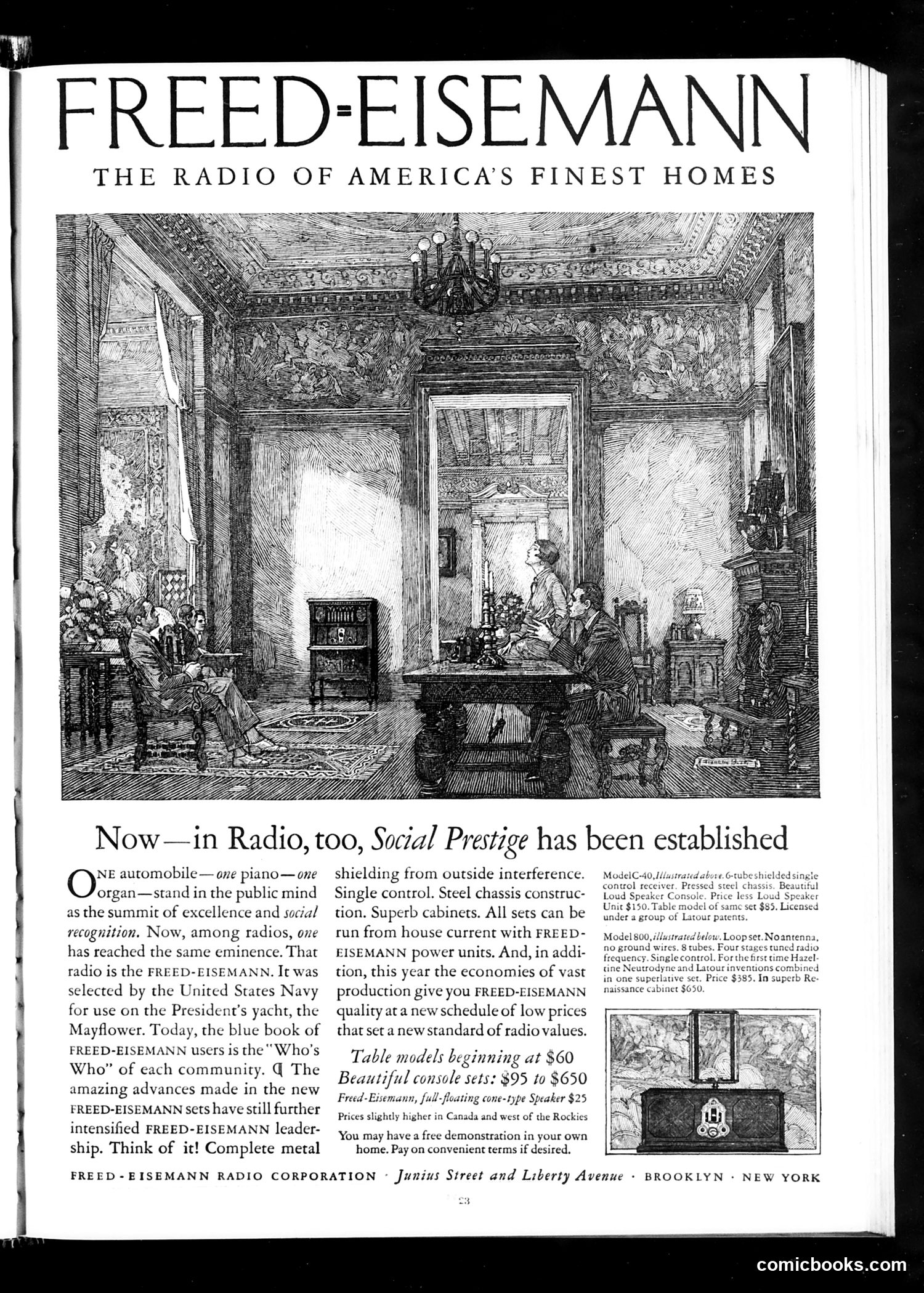
This is primarily a **product advertisement**, not a political cartoon. It promotes Freed-Eisemann radios by claiming they've achieved social prestige comparable to pianos and automobiles. The satire is subtle: the ad mocks American class consciousness by suggesting that radio brand choice now signals social status. It references the radio's selection for President Coolidge's yacht (*Mayflower*) and claims Freed-Eisemann users constitute the "Who's Who" of their communities—implying that owning the right radio brand marks one as socially elite. The ornate illustration of an affluent home interior reinforces this messaging: radio ownership is positioned as a marker of wealth and refinement, like fine furniture and art. The humor lies in the implicit critique of consumer culture—the idea that commercial products can confer social legitimacy. However, this serves the advertiser's purposes: by framing Freed-Eisemann radios as society's choice, it encourages aspirational purchasing among middle-class readers.
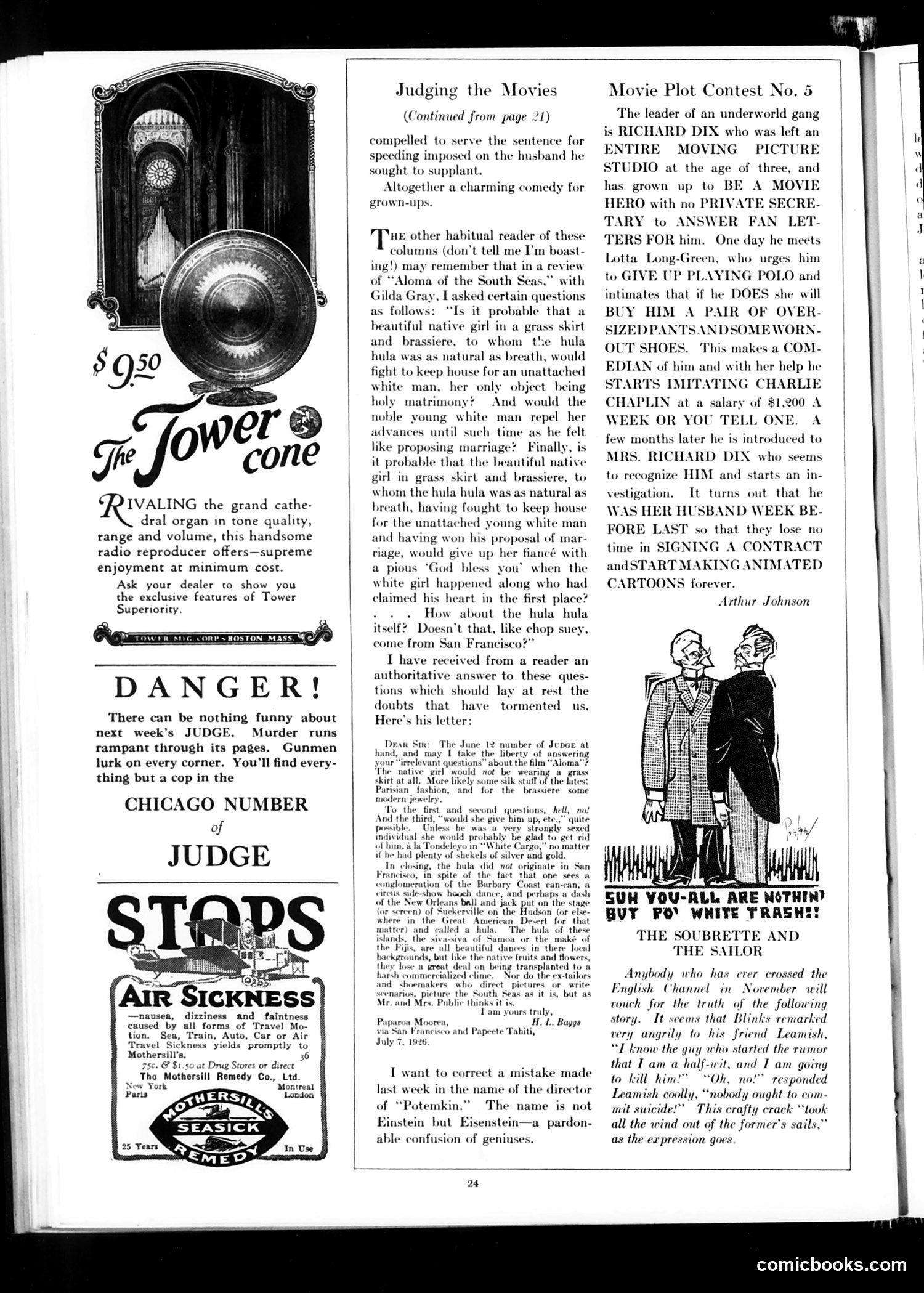
This page contains movie criticism and advertisements from Judge magazine (circa 1926, based on the July 7 date visible in text). **Main Content:** The "Judging the Movies" column critiques films, including "Aloma of the South Seas" with Gilda Gray. The critic sarcastically questions whether a native Hawaiian woman would realistically abandon her fiancé for a white woman—highlighting the implausible racial and gender stereotypes in 1920s Hollywood films. **Movie Plot Contest:** A humorous parody of melodramatic plots: Richard Dix plays an underworld gang leader raised in a movie studio who becomes a Charlie Chaplin imitator, marries/remarries characters named Lotta Long-Green and Mrs. Richard Dix, and ends up making "animated cartoons forever"—satirizing the absurd, contrived scenarios common in silent films. **Cartoons:** "The Soubrette and the Sailor" presents a brief comedic exchange about starting rumors, with no clear political content. **Advertising:** Tower radio reproducer and Mothersill's remedy for travel sickness occupy substantial space. The page primarily mocks contemporary Hollywood's narrative conventions and racial attitudes.
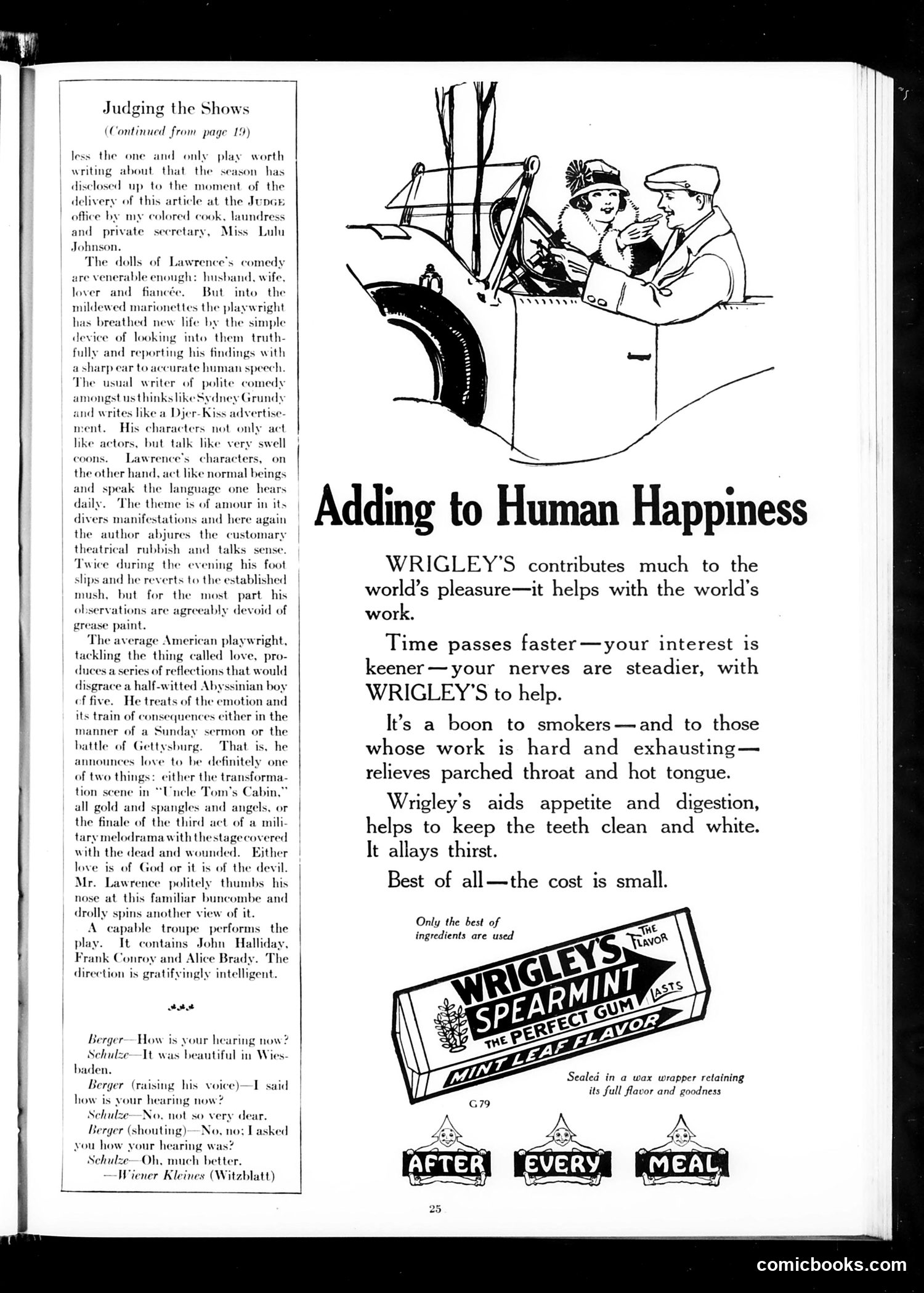
This page contains two distinct elements: a theater review and an advertisement. **The Theater Review** critiques a comedy play (author unnamed on this excerpt), praising its realistic dialogue and human characters compared to typical theatrical conventions. The critic contrasts this playwright favorably with "Sydney Grundy" and dismisses other American playwrights for treating love melodramatically—either as sentimental ("Uncle Tom's Cabin" style) or as military melodrama tragedy. The review mentions actors John Halliday, Frank Conroy, and Alice Brady. **The Advertisement** is a Wrigley's Spearmint gum pitch using early 20th-century marketing psychology: gum improves focus, steadies nerves, relieves smokers' throats, aids digestion, cleans teeth, and costs little. The "After Every Meal" tagline became iconic. The page reflects Judge's dual function: satirical commentary on theater and culture alongside commercial advertising, typical of magazines from this era (appears to be 1920s-1930s based on style).
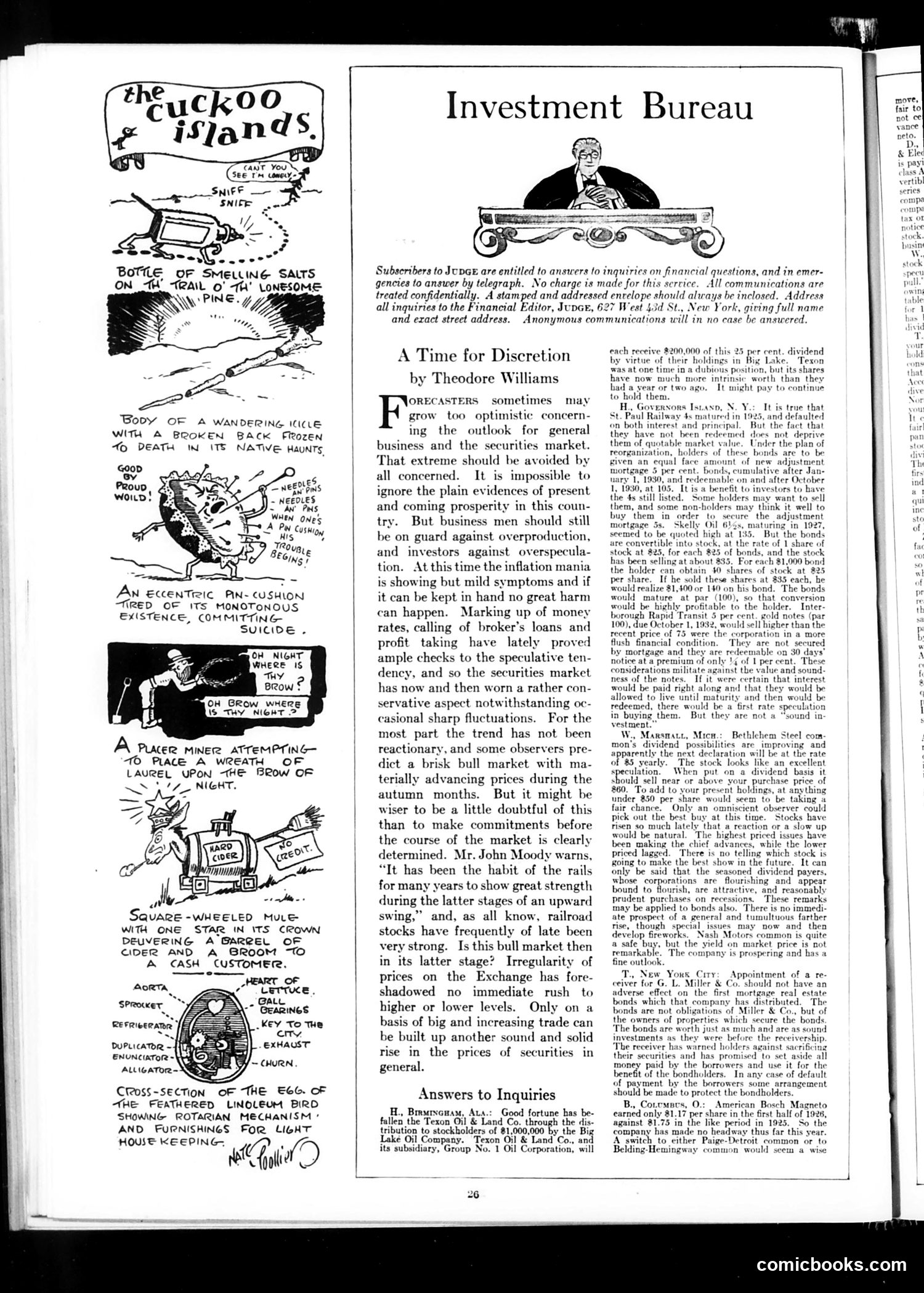
This Judge magazine page combines whimsical cartoons with serious financial advice. **Left side:** "The Cuckoo Islands" features absurdist drawings of impossible creatures and scenarios—a pin-cushion committing suicide, a square-wheeled mule delivering cider—with technical-sounding but nonsensical labels ("cross-section of the feathered linoleum bird"). This appears to be satirizing pseudoscientific or fraudulent schemes targeting investors. **Right side:** The "Investment Bureau" offers Theodore Williams's article "A Time for Discretion," warning against overspeculation during a bull market. It cautions readers to ignore excessive optimism about business prospects and avoid making hasty investment commitments. The advice column addresses subscriber inquiries about specific stocks (Texon Oil, St. Paul Railway bonds). **The satire:** The juxtaposition suggests that during market booms, investors become susceptible to absurd schemes—the ridiculous "cuckoo" drawings mock this gullibility while the serious financial advice urges restraint.
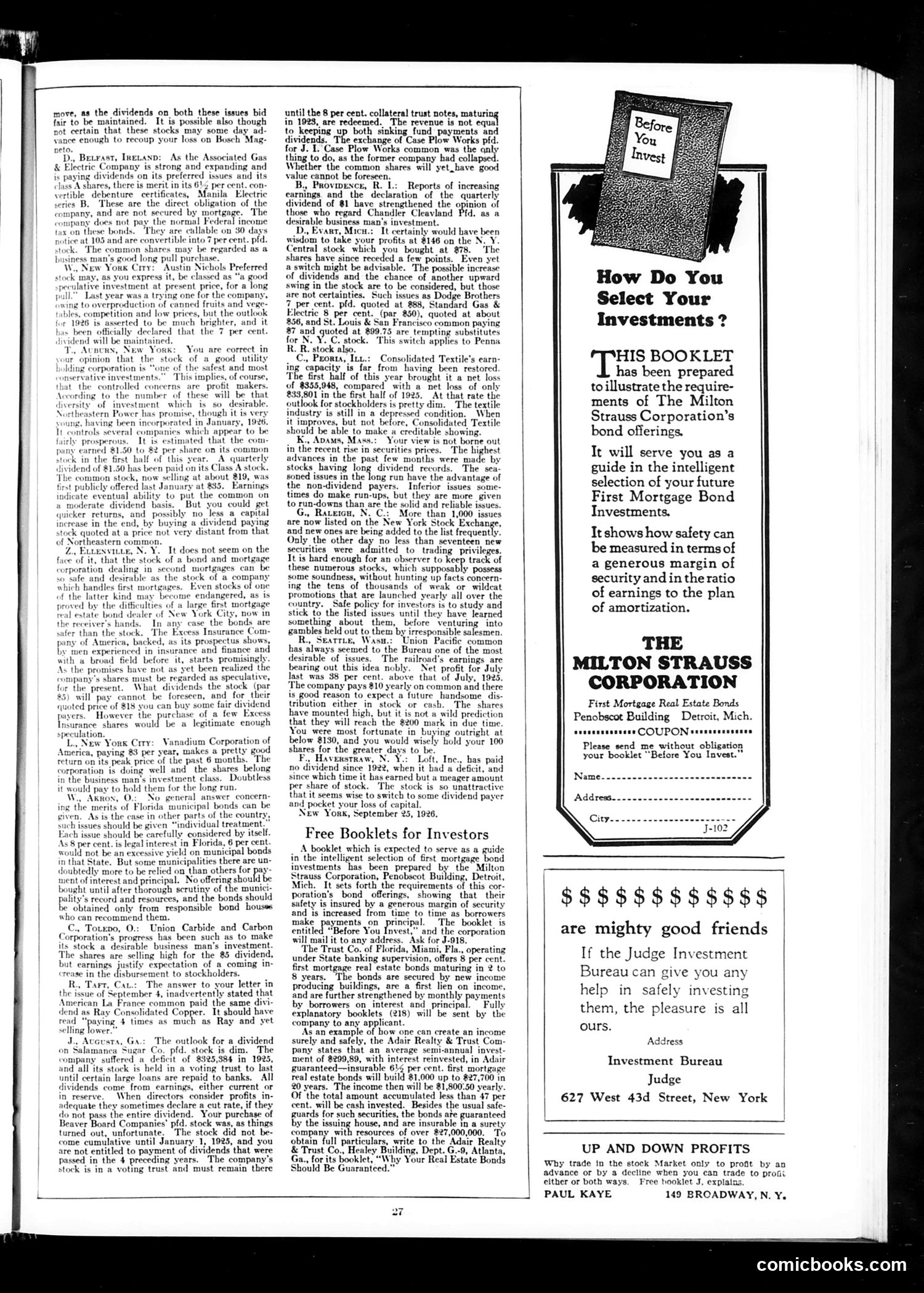
This page is primarily **financial advice and advertising**, not political satire. The main content consists of investment Q&A responses from what appears to be Judge magazine's finance column. The central cartoon, titled "How Do You Select Your Investments?", advertises **Milton Strauss Corporation's First Mortgage Real Estate Bonds**—a financial product. The cartoon shows a figure examining investment options, serving as a visual hook for the bond offering. The surrounding text answers reader questions about stocks like Associated Gas & Electric, Vanadium Corporation, and Manila Electric. The advice emphasizes dividend-paying stocks and bonds as safer investments compared to speculative holdings. The small advertisement at bottom right promotes the **Investment Bureau** (Judge magazine itself), offering free guidance on selecting bonds—a service pitched to readers seeking help navigating investment decisions during the 1920s economic boom. The page reflects the era's focus on individual stock investment as a path to wealth, before the 1929 crash fundamentally altered American attitudes toward financial markets.
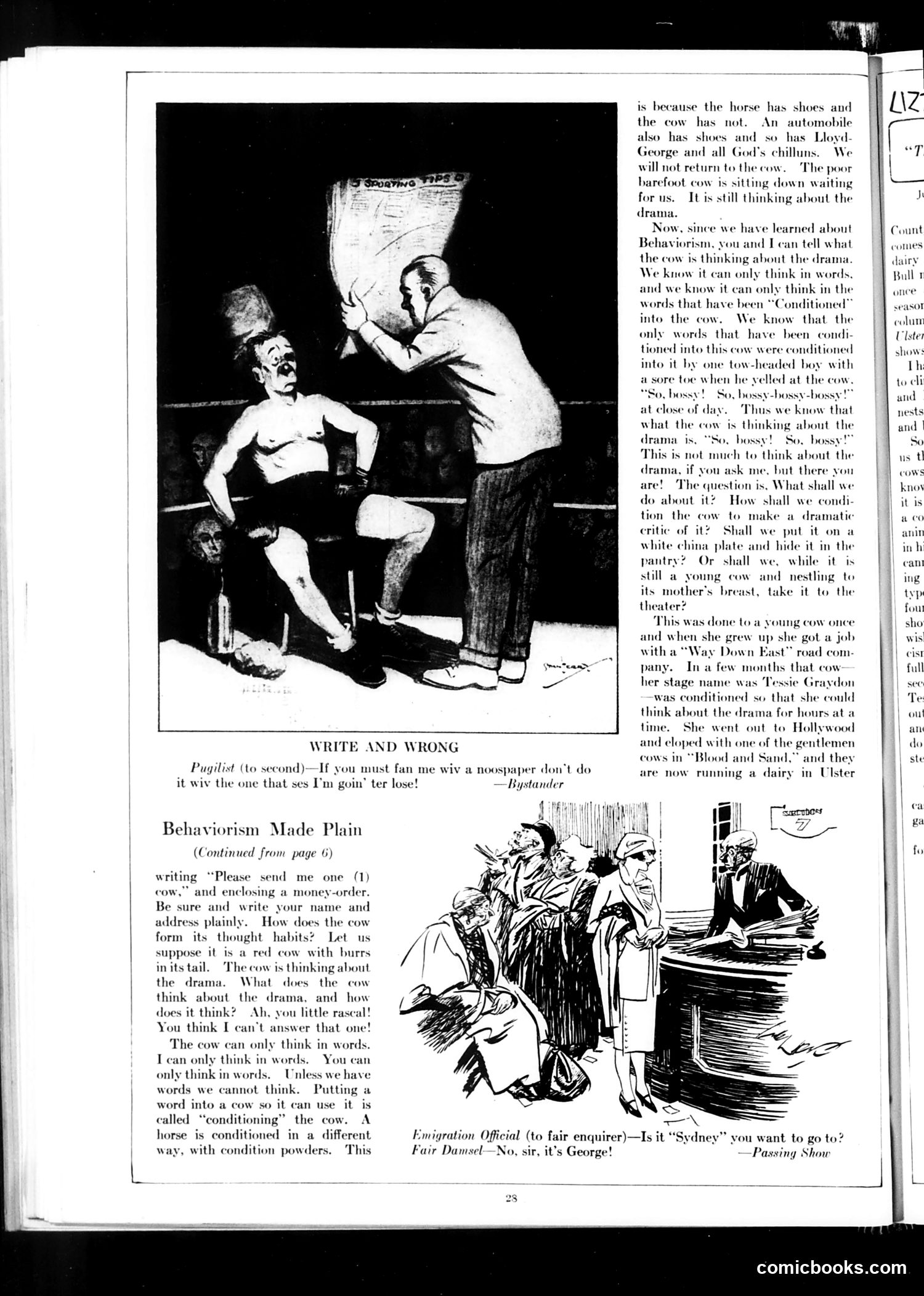
This Judge magazine page satirizes **Behaviorism**, the early 20th-century psychological theory that human and animal behavior results entirely from conditioned responses to stimuli, not inherent thinking. The main article humorously argues that cows can only think in words they've been "conditioned" to understand—like a boy yelling "So, bossy!" repeatedly. The satire's point: if behaviorism is true, we could theoretically condition a cow into a dramatic critic by taking it to theaters. The cartoon illustrates the absurdity: a boxing trainer tells his second he needs a newspaper that predicts *his fighter will lose*—implying he can then condition the fighter's mindset through this negative reinforcement. The bottom cartoons are unrelated humor: a boxer's crude dialect, and an Irish emigration joke playing on the name "George" (likely a contemporary reference unclear today). The satire mocks behaviorism's mechanistic view of consciousness by applying it ridiculously to farm animals.
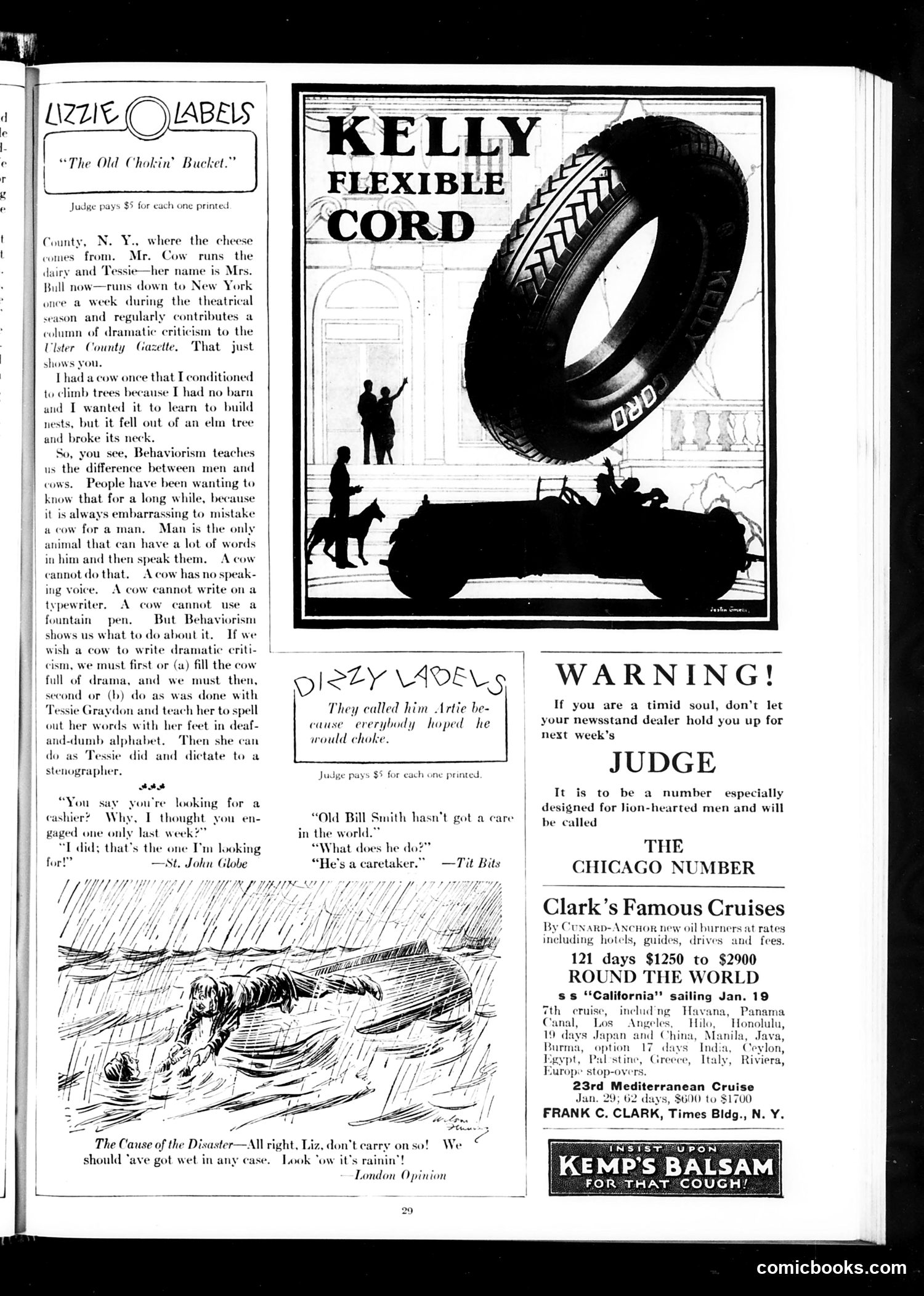
This page contains multiple unrelated items typical of Judge's format: **Left column ("The Old Chokin' Bucket"):** A humorous essay arguing that behaviorism—the psychological theory reducing behavior to stimulus-response—proves humans differ from animals because humans can write and speak while cows cannot. The writer mocks this obvious distinction, using absurd examples (teaching a cow to write drama criticism by filling it with drama, then training it to type with its feet). It's satirizing both behaviorism's oversimplifications and educated pretension. **Dizzy Labels cartoon:** A brief joke about someone named Artie whom "everybody hoped he would choke"—unclear context without more information. **Right side:** Mostly advertisements (Kelly Flexible Cord, Clark's cruises, Kemp's Balsam) and brief jokes, with a "WARNING" about the next issue being "THE CHICAGO NUMBER" designed for "lion-hearted men." The page is primarily **advertising-driven filler content** rather than focused political satire.
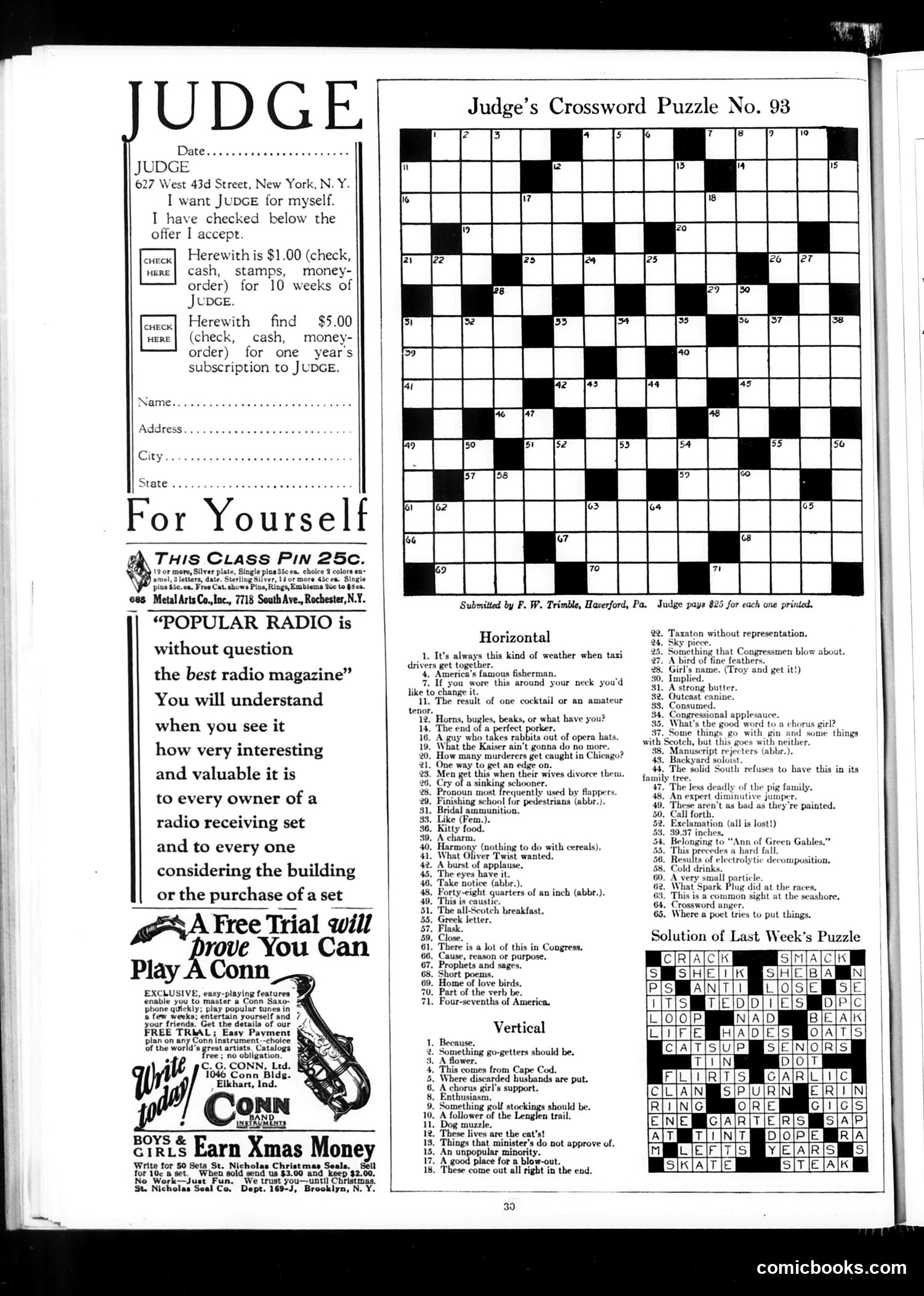
This page is primarily **advertising and subscription material** for Judge magazine itself, along with unrelated commercial ads (radio magazines, musical instruments, Christmas seals, class pins). The main content is **Judge's Crossword Puzzle No. 93**, a standard crossword with clues submitted by P. W. Trimble of Haverford, Pennsylvania. The puzzle clues are typical 1920s-era humor and wordplay—references to Prohibition cocktails, flappers, Oliver Twist, the Kaiser (WWI), silent film actresses ("Ann of Green Gables"), and contemporary slang. There are **no political cartoons visible** on this page. The "satirical" content is limited to the crossword clues themselves, which gently mock 1920s social trends (divorced husbands, go-getters, rejected manuscripts) rather than target specific figures or events. The page functions primarily as a **magazine promotion and puzzle feature**—a typical interior page designed to encourage subscriptions and reader engagement.
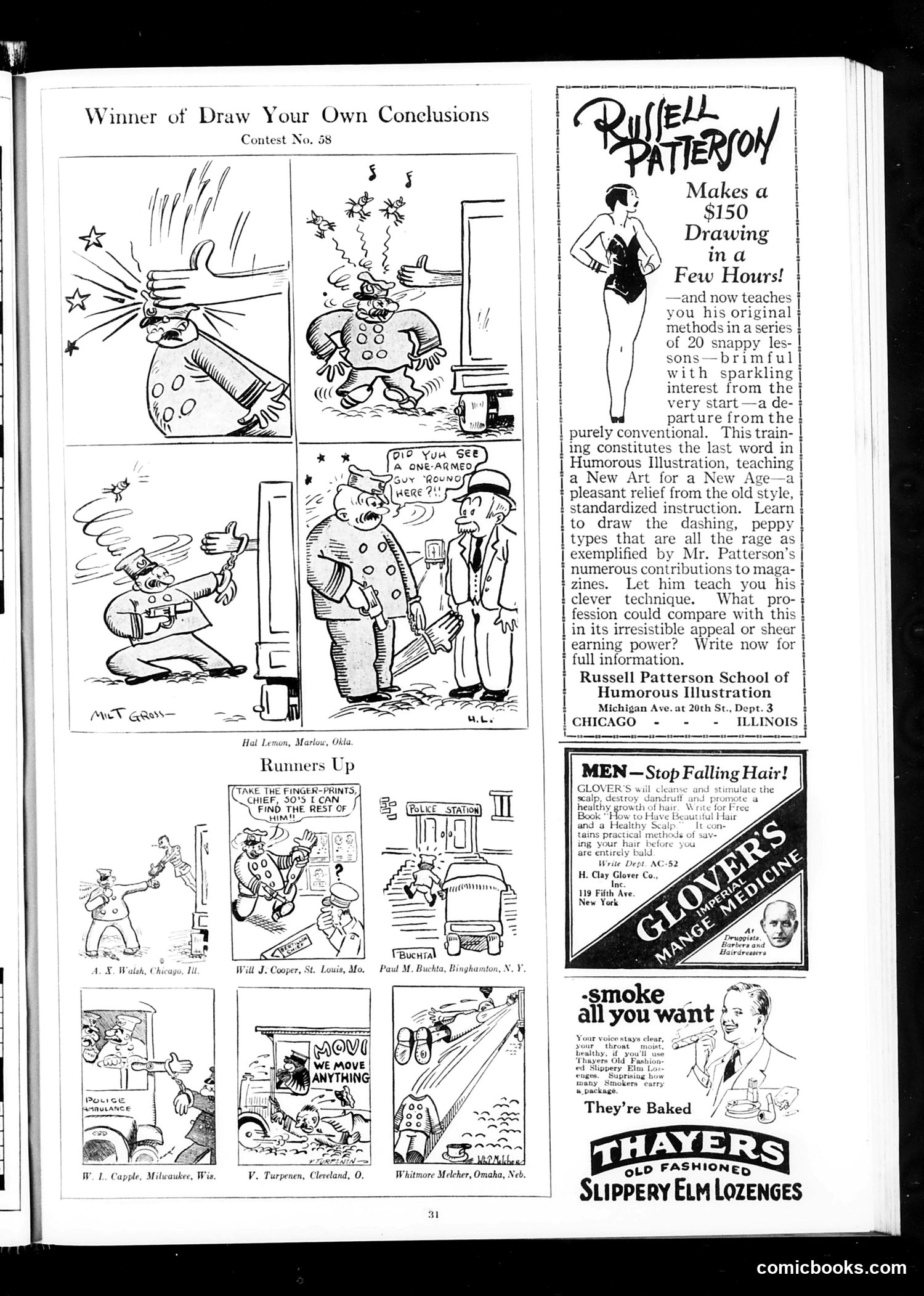
This page showcases the winning and runner-up cartoons from Judge's "Draw Your Own Conclusions" Contest No. 58. The winner (credited to Hal Lemon) depicts a slapstick scene of someone accidentally detonating what appears to be a bomb or explosive device, with exaggerated comic violence. The runners-up cartoons feature similarly broad humor typical of 1920s-30s comic strips. The page is primarily advertising-driven, featuring pitches for Russell Patterson's correspondence school in humorous illustration, hair-loss remedies (Glover's), and Thayer's cough lozenges. These ads reflect common commercial anxieties of the era: baldness, artistic aspiration, and minor ailments. The cartoons themselves lack overt political content; they represent generic physical comedy appealing to mainstream audiences.
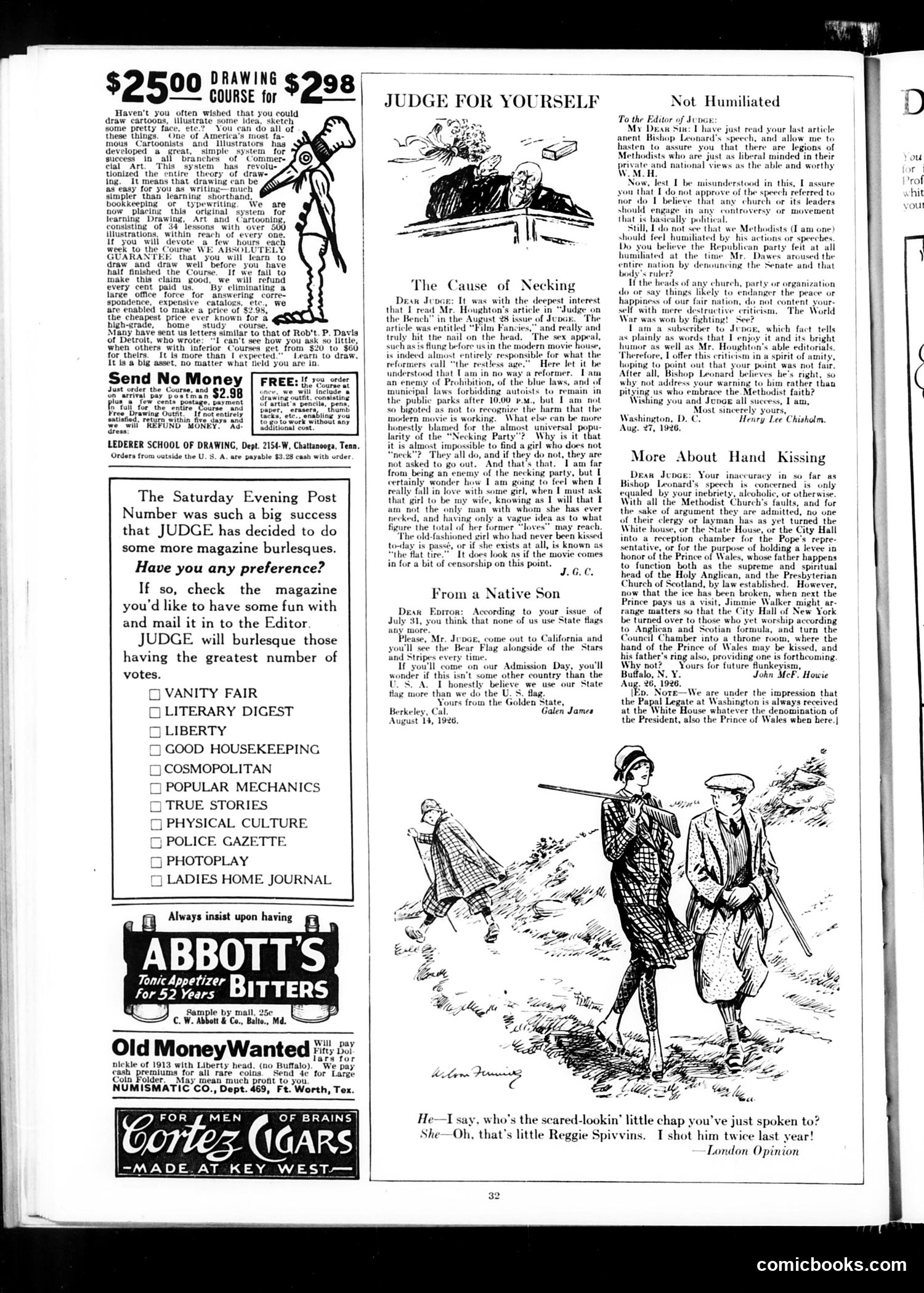
This page is primarily **advertising and reader engagement content** rather than political satire. The main elements are: 1. **Drawing course ad** ($25 for $2.98): A commercial pitch promising anyone can learn cartooning through mail-order lessons, featuring a cartoon figure. 2. **Magazine preference poll**: Judge solicits reader votes on which magazine they'd like parodied next (Vanity Fair, Literary Digest, etc.), following a successful Saturday Evening Post parody. 3. **Letters section** ("Judge for Yourself"): Includes reader correspondence on topics like "The Cause of Necking" (criticizing modern dating customs) and "From a Native Son" (defending California's state flag usage). 4. **Vintage ads**: Abbott's Bitters, rare coin solicitation, Cortez cigars. The necking letter reflects 1920s social anxiety about loosening sexual mores among youth—a common Judge theme. Otherwise, this is largely a **reader-participation page** with minimal editorial cartoon content.
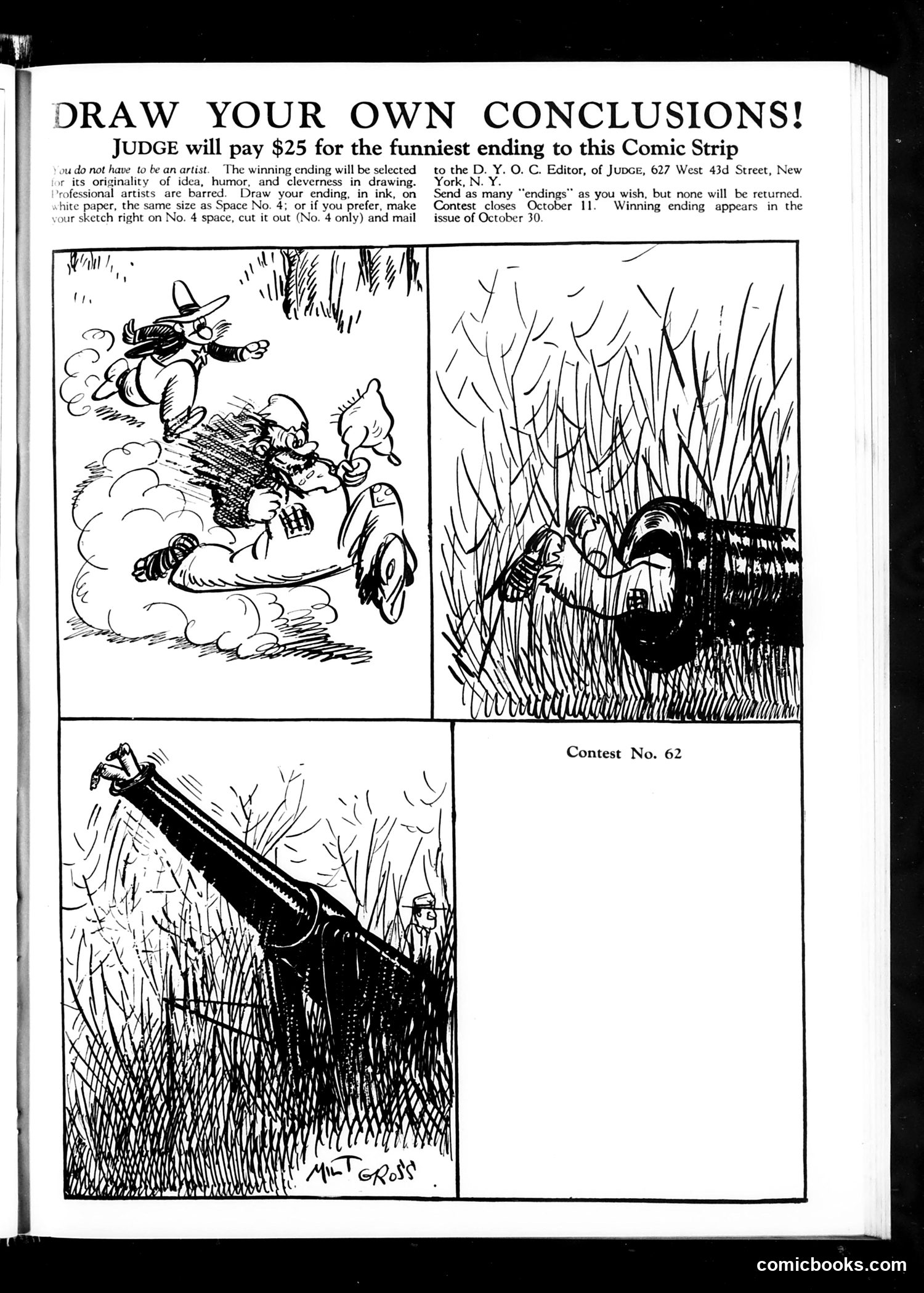
This is a reader-participation contest page from *Judge* magazine (Contest No. 62). Rather than completed political satire, it's an interactive feature inviting readers to supply humorous endings. The three comic strip panels show: 1. A cowboy figure emerging from clouds, appearing to confront or pursue someone 2. A figure in tall grass with what appears to be a cannon or large weapon 3. A close-up of the weapon/cannon pointed downward The premise is unclear without the original setup panels, but the Western/frontier setting and the escalating action suggest a comedic scenario about conflict or confrontation. Readers were encouraged to draw their own conclusions about how the story should end, with $25 awarded for the funniest submission—a significant prize at the time. This format was typical of *Judge's* participatory humor approach, making readers co-creators rather than passive consumers.
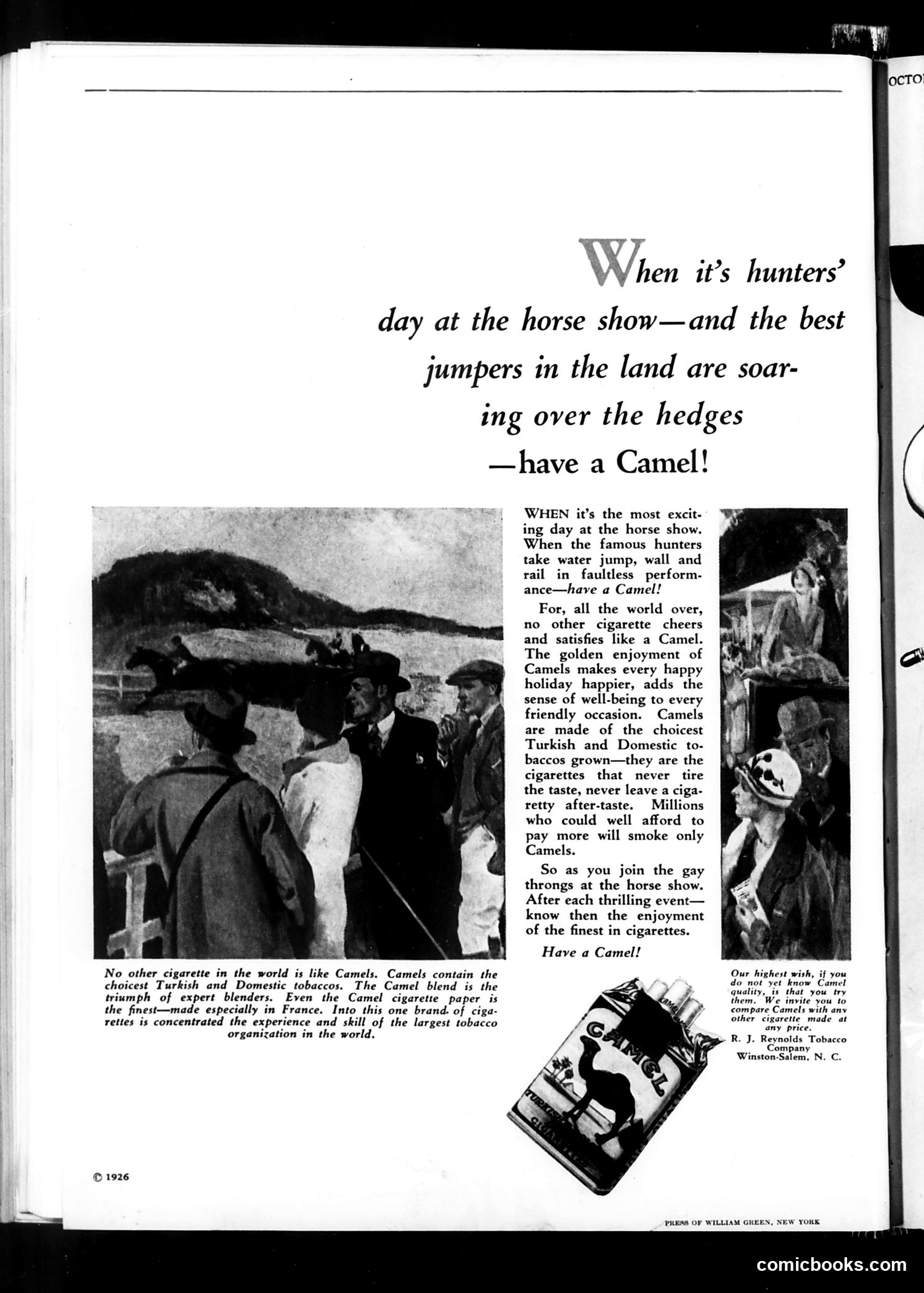
This is a **Camel cigarette advertisement**, not satirical content. It uses the prestigious setting of a horse show—specifically hunters' competition with jumps—to market cigarettes to an affluent audience. The ad associates smoking Camels with leisure, refinement, and social status. The images show well-dressed spectators at an exclusive equestrian event, implying that sophisticated people smoke this brand. The text emphasizes quality: "choicest Turkish and Domestic tobaccos" and paper "made especially in France." The pitch targets aspirational consumers: "Millions who could well afford to pay more will smoke only Camels." This framing positions Camel as a luxury choice despite its reasonable price. By modern standards, the most striking aspect is the casual promotion of cigarettes as a healthful social enhancer that adds "well-being to every friendly occasion"—claims that would be illegal today. The 1926 date reflects an era before tobacco's serious health risks were widely acknowledged or regulated.