
Judge, 1926-10-02 · page 21 of 36
Judge — October 2, 1926 — page 21: what you’re looking at
What you’re looking at
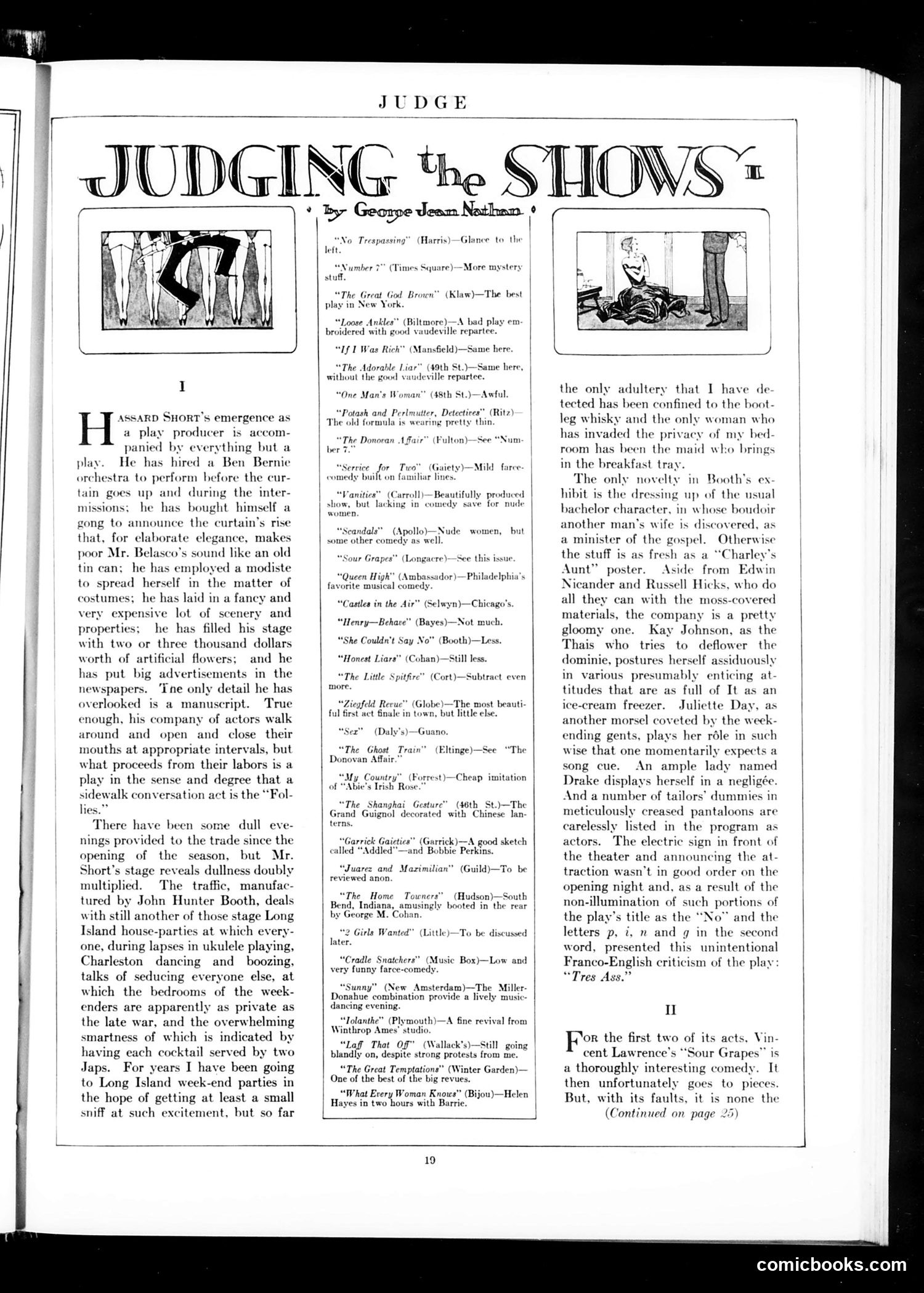
This page is theater criticism by George Jean Nathan, a prominent Judge magazine drama critic. The left column reviews Hassard Short's emergence as a Broadway producer—satirizing him for elaborate production values (orchestra, gong, expensive costumes, artificial flowers, advertisements) while lacking an actual *play*. The joke is that Short prioritizes spectacle over substance: "the only detail he has overlooked is a manuscript." The center column lists current Broadway shows with brief, dismissive reviews—mostly one-liners mocking their quality or subject matter. References include *Sour Grapes*, *Queen High*, and *Sex*. The right column continues the critique, noting that Vincent Lawrence's *Sour Grapes* suffers from poor plotting and weak execution despite competent actors. This reflects 1920s theatrical tastes and Nathan's caustic critical style—a insider's view of Broadway's commercialism versus artistic merit during the Jazz Age.
📄 Transcribed text from this page (OCR, searchable)
Machine-transcribed from the original scan — historical spelling and the odd misread are preserved.
JU DGE JUDGING ‘he SHOWS* ASSARD SHORT’S emergence as a play producer is accom- panied by everything but a play. He has hired a Ben Bernie orchestra to perform before the cur- tain goes up and during the inter- has bought himself a gong to announce the curtain’s rise that, for elaborate elegance, makes poor Mr. Belasco’s sound like an old tin can; he has employed a modiste to spread herself in the matter of he has laid in a fancy and scenery and filled his stage missions; he costumes; ive lot of very expe properties; he hb with two or three thousand dollars worth of artificial flowers; and he has put big advertisements in the newspapers. ‘Tne only detail he has overlooked is a manuscript. True enough, his company of actors walk around and open and close their mouths at appropriate intervals, but what proceeds from their labors is a play in the sense and degree that a sidewalk conversation act is the “Fol- lie There have been some dull eve- nings provided to the trade since the opening of the season, but Mr. Short’s stage reveals dullness doubly multiplied. The traffic, manufac- tured by John Hunter Booth, deals with still another of those stage Long Island house-parties at which every- one, during lapses in ukulele playing, Charleston dancing and_ boozing, talks of seducing everyone else, at which the bedrooms of the week- enders are apparently as private as the late war, and the overwhelming smartness of which is indicated by having each cocktail served by two Japs. For years I have been going to Long Island week-end parties in the hope of getting at least a small sniff at such excitement, but so far | One of the best of the big rev » Trespassing” (Harris) —€ “Number ? stuff. “The Great God Brown’ play in New York. (Times Square) (Klay “Loose Ankles” (Biltmore) —A “If 1 Was Rich” “The Adorable Liar” (49th St without th vaudeville rep “One Man's Woman’ (48th St utter, Detect ring prett: “Potash and Perl The old formula is w “The Donovan Affair” (Fulton ber 7." ‘Service for Two" (Gaiety) nedy built on familiar lines: “Vanities (Carroll) —Beautif “Sour Grapes” (Longacre)—Se “Queen High" (Ambassador) favorite musical comed: “Castles in the Air” ‘Henry—Behave” (Bayes)—N. (Booth the Couldn't Say “Honest Liars” (Cohan)—Still “The Little Spitfire" more. (Cort)— -afeld Revue" “Sex” (Daly's) —Guano, “The Ghost Train” an Affair.” (Elting Do “My Country” (F ‘Abie's Trish Re of “The Shanghai Gesture” (4 terns. “Garrick Gaicties” (G called “. “Jua: and Mazimilian” reviewed anon. Bend, Indiana, amusingly boot Cohan. Girls Wanted” by Georg ‘radle Snatchers” very funny farce-comedy. “Sunny” Donahue combination provide dancing evening. “Tolanthe” (Plymouth)—A fin Winthrop Ames’ studio. “Laff That Of" (Wallack’ “The Great Temptations” ( hat Every Woman Know: es in two hours with Barrie broidered with good vaudeville repartee. show, but lacking in comedy save for nude women, “Scandals (Apollo)—Nude some other comedy as well —Philadelphia’s (Selwyn)—Chicago’s. (Globe)—The most beauti- ful first act finale in town, but little else. st)—Cheap imitation Grand Guignol decorated with Chinese lan- rrick)—A good sketch ‘Addled""—and Bobbie Perkins. (Guild)—To be Little)—T. Music Box)—L¢ (New Amsterdam)—The blandly on, despite strong prote by Georpe Jeon Nathan ¢ Slance to the ~More mystery w)—The best bad play em (Mansfield)—Same here. }—Same here, Awful. | ies” (Ritz) y thin “Num )—See —Mild farce. ully produced women, but e this issue. | jot much, h)—Less. I less. Subtract even e)—See “The th St.) —The judson)—South ed in the rear | ‘o be discussed vw and | Miller- a lively music- | ne revival from s)—Still going ‘sts from me. ter Garden)— | (Bijou)—Helen | | the only adultery that I tected has been confined to the boot- leg whisky and the only woman who has invaded the privacy of my bed- room has been the maid who brings in the breakf: The only ust tray. novelty in Booth’s ex hibit is the dressing up of the usual bachelor ¢ eter, in whose boudoir is discovered, as Otherwise another man’s wife a minister of the gospel. the stuff is as fresh as a “Charley's Aunt” poster. Aside from Edwin Nicander and Russell Hicks, who do all they can with the moss-covered materials, the s a pretty gloomy one. Kay Johnson, as the Thais who tries to deflower the dominie, postures herself assiduously in various presumably enticing at- titudes that are as full of It as an ice-cream freez Juliette Da another morsel coveted by the week- ending gents, plays her réle in such wise that one momentarily expects a song cue. An ample lady named Drake displays herself in a negligée. And a number of tailors’ dummies in meticulously creased pantaloons are carelessly listed in the program as The electric sign in front of the theater and announcing the at- traction wasn’t in good order on the opening night and, as a result of the non-illumination of such portions of the play’s title as the “No” and the letters p, i, n and g in the second word, presented this unintentional Franco-English criticism of the play: “Tres Ass.” company as actors. Il Fo the first two of its acts, Vin- cent Lawrence's “Sour Grapes” is a thoroughly interesting comedy. It then unfortunately goes to pieces. But, with its faults, it is none the (Continued on page 25) comicbooks.com