
Judge, 1926-10-02 · page 15 of 36
Judge — October 2, 1926 — page 15: what you’re looking at
What you’re looking at
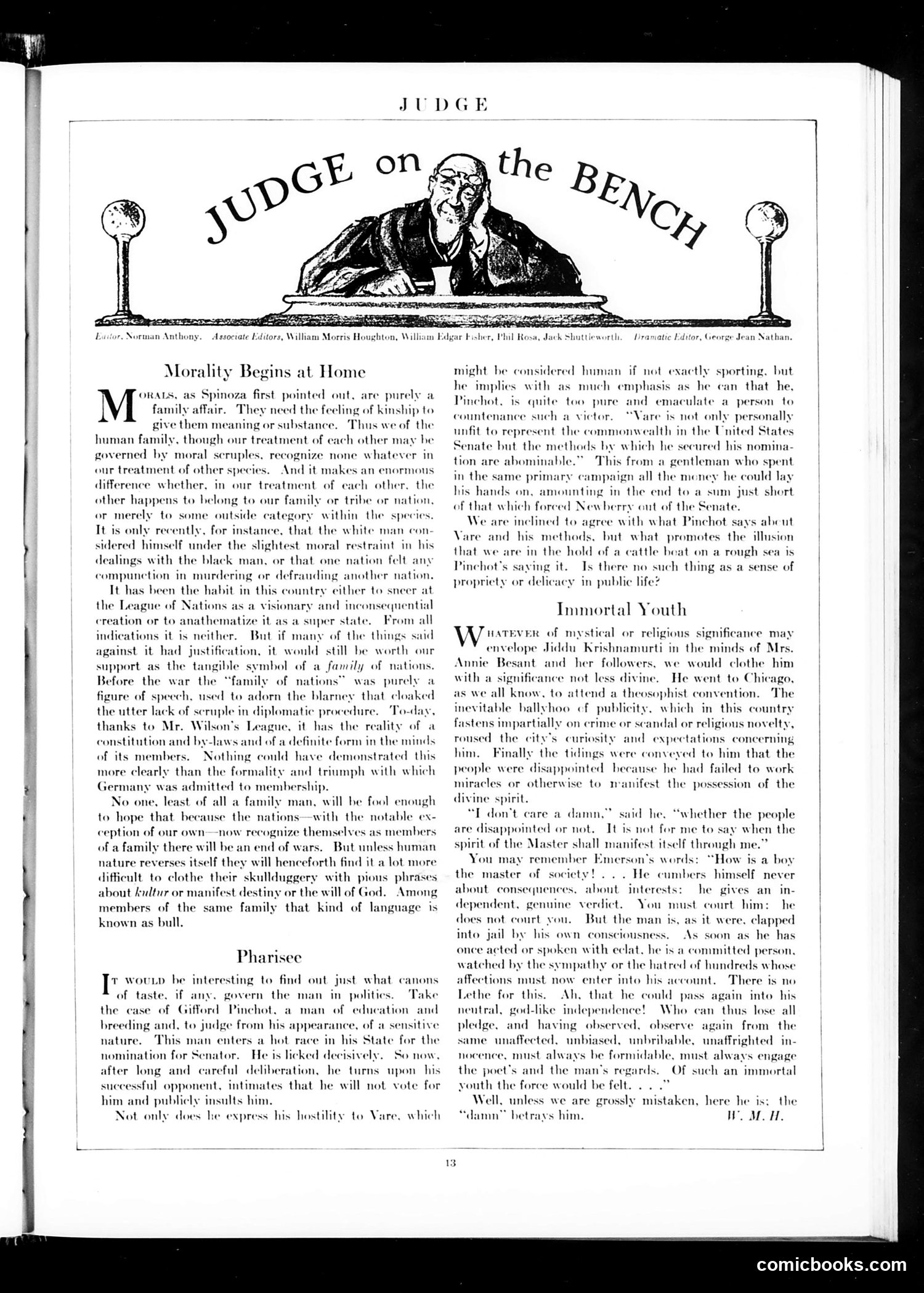
This page contains three editorial pieces by Judge magazine's editors (likely early 1920s, given references to Wilson's League of Nations and Gifford Pinchot). **"Morality Begins at Home"** defends the League of Nations against American skeptics, arguing that treating nations as a "family" with moral obligations makes diplomatic hypocrisy harder to justify. **"Pharisee"** critiques Gifford Pinchot, a prominent conservationist who lost a Pennsylvania Senate primary to William Vare. Pinchot publicly attacked Vare's campaign methods as corrupt—but Pinchot himself had spent nearly as much money in the same primary. The satire: Pinchot's moral outrage rings hollow given his own behavior. The title "Pharisee" references biblical hypocrisy. **"Immortal Youth"** (incomplete here) appears to discuss Jiddu Krishnamurti, a spiritual figure controversially promoted by Annie Besant. The page's masthead illustration shows a stern judge—representing editorial authority dispensing judgment on public figures and politics.
📄 Transcribed text from this page (OCR, searchable)
Machine-transcribed from the original scan — historical spelling and the odd misread are preserved.
wan Anthony. Agsoctate Editors, William Morris Ho shton, William Ed Morality Begins at Home ORALS, as Spinoza first pointed out, are purely a M family affair. They need the feeling of kinship to, give them meaning or substance. Thus we of the human family, though our treatment of each other may be governed by moral scruples. recognize none whatever in our treatment of other spe And it makes an enormous difference whether, in our treatment of each other, the other happens to belong to our family or tribe or nation, or merely to some outside category within the species. It is only recently, for instance, that the white man con sidered himself under the slightest: moral restraint in his dealings with the black man, or that one nation felt any compunction in murdering or defrauding another nation, It has been the habit in this country either to sneer at the League of Nations as a visionary and inconsequential crea ation or to anathematize it as a super state. From all But if many of the things said vation, it would still be worth our indications it is neithe against it had justific support as the tangible symbol of a family of nations. Before the war the “family of nations” was purely a figure of speech, used to adorn the blarney that cloaked the utter lack of scruple in diplomatic procedure. lay, thanks to Mr. Wilson's League, it has the reality of a constitution and | laws and of a definite form in the minds of its members. thing could have demonstrated. this more clearly than the formality and triumph with which Germany admitted to membership. No one, least of all. a family man, will be fool enough to hope that because the nations—with the notable ex- ception of our own—now recognize themselves as members of a family there will be an end of wars. But unless human nature reverses itself they will henceforth find it a lot more difficult. to clothe their skullduggery with pious phrases about ultur or manifest destiny or the will of God. Among members of the same family that kind of language is known as bull. Pharisee I woutp be interesting to find out just what canons Take the case of Gifford Pinchot. a man of education and of taste. if any. govern the man in_ polities. breeding and, to judge from his appearance, of a sensitive nature. ‘This man enters a hot race in his State for the nomination for Senator. He is licked decisively. So now, after long and careful deliberation, he turns upon his successful opponent, intimates that he will not vote for him and publicly insults him, t only does he express his hostility to Vare, which Jar Fisher, Phil ek Shuttieworth. Dramatic Editor, George Jean Nathan, might be considered human if not exactly sporting, but he implies with as much emphasis as he can that he, Pinchot, is quite too pure and emaculate a person to countenance such a victor. “Vare is not only personally unfit to represent the commonwealth in the United States Senate but the methods by which he secured his nomina- tion ¢ abominable.” This from a gentleman who spent in the same primary campaign all the money he could lay his hands on, amounting in the end to a sum just short of that which forced Newberry out of the Senate. We are inclined to agree with what Pinchot abeut Vare and his methods, but what promotes the illusion that we are in the hold of a cattle heat on a rough sea is Pinchot’s saying it. Is there no such thing as a sense of propriety or delicacy in public life? Immortal Youth W steven of mystical or religious significance may envelope Jiddu: Krishnamurti in the minds of Mrs. Annie Besant and her followers, we would clothe him with a significance not less divine. He went to Chicago, I know, to attend a theosophist convention. The inevitable ballyhoo ef publicity. which in this country fastens impartially on crime or scandal or religious novelty, as We roused the city’s curiosity and expectations concerning him. Finally the tidings were conveyed to him that the people were disappointed heeause he had failed to work miracles or otherwise to manifest the possession of the divine spirit. “[ don't care a damn,” said he, “whether the people are disappointed or not. It is not for me to say when the spirit of the Master shall manifest itself through me.” You may remember Emerson's words: “How is a boy the master of | so iety! . . . He cumbers himself never about consequences, about in rests: he gives an in- dependent, genuine verdict. You must court him: he does not court you. But the man is, as it were, clapped til by his own. consciousness. cted or spoken with eclat. he is a committed person, watched by the sympathy or the hatred of hundreds whose affections must now enter into his account. There is no Lethe for this. neutral, god-like independence! into As soon as he has once Ah, that he could pass again into his Who can thus lose all pledge, and having observed, observe again from the same unaffected, unbiased, unbribable, unaffrighted in. necence, must always be formidable, must always engage the poet's and the man’s regards. Of such an immortal youth the force would be felt... 2” Well, unless we are grossly mistaken, here he is: the W. OM. H. “damn” betrays him. comicbooks.com