
Judge, 1926-10-02 · page 8 of 36
Judge — October 2, 1926 — page 8: what you’re looking at
What you’re looking at
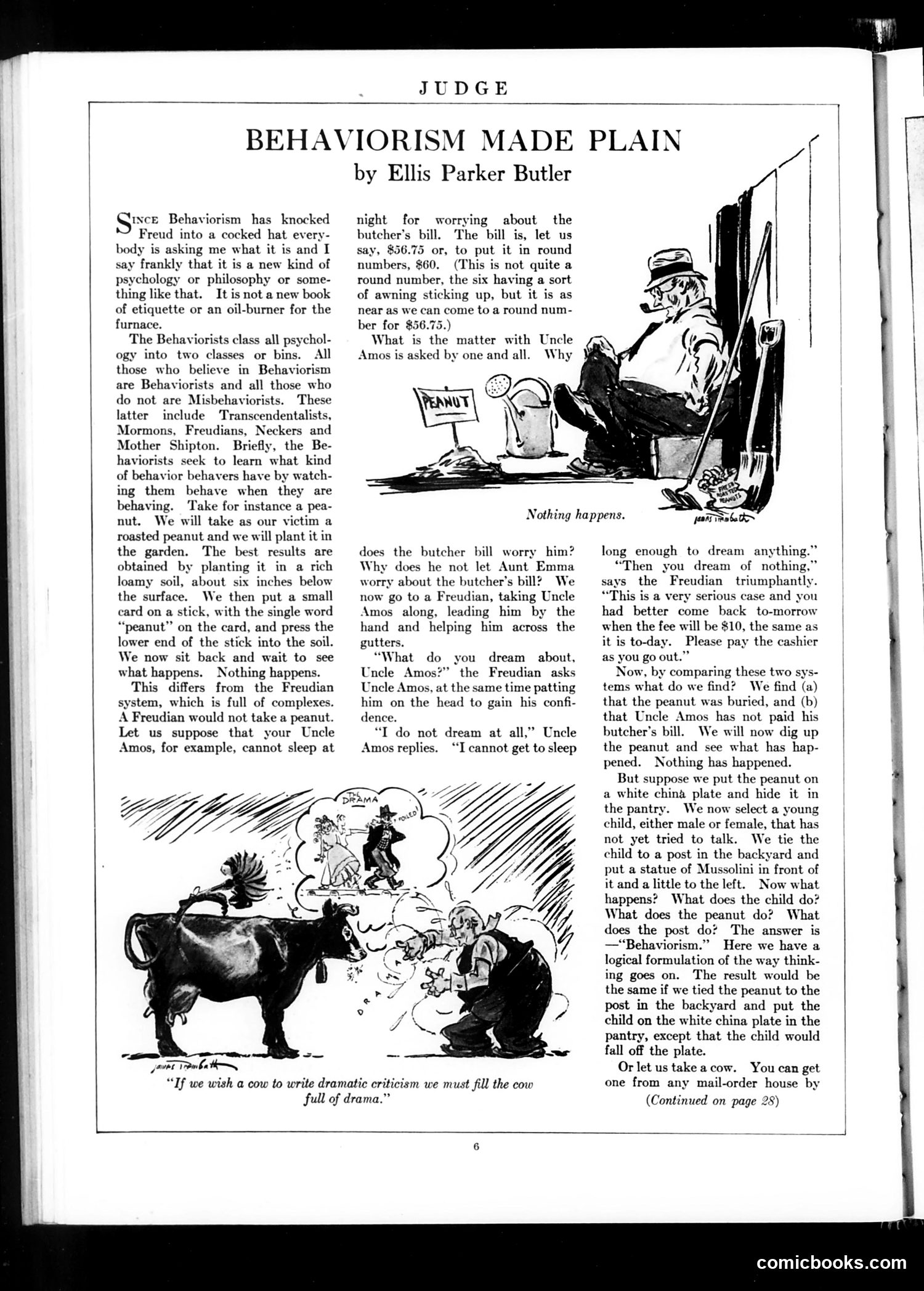
This satirical essay ridicules the newly fashionable psychological theory of Behaviorism, which had recently displaced Freudian psychology in popular discourse. Butler mocks Behaviorism's claim to scientific rigor by demonstrating its logical absurdity through deliberately ridiculous examples: planting a labeled peanut and observing "nothing happens," or tying a child to a post with a Mussolini statue nearby to study behavioral responses. The satire targets both psychological schools—Behaviorists (who observe only external actions) and Freudians (who dig for hidden meanings). Butler suggests both approaches are equally useless for solving real problems like Uncle Amos's unpaid butcher's bill. The cartoons reinforce this mockery of pseudoscientific pretension, presenting these theories as elaborate nonsense dressed in academic language.
📄 Transcribed text from this page (OCR, searchable)
Machine-transcribed from the original scan — historical spelling and the odd misread are preserved.
JUDGE BEHAVIORISM MADE Qixce Behaviorism has knocked Freud into a cocked hat every- body is asking me what it is and I say frankly that it is a new kind of psychology or philosophy or some- thing like that. It is not a new book of etiquette or an oil-burner for the furnace. The Behaviorists class all psychol- ogy into two classes or bins. All those who believe in Behaviorism are Behaviorists and all those who do not are Misbehaviorists. These latter include Transcendentalists, Mormons, Freudians, Neckers and Mother Shipton. Briefly, the Be- haviorists seek to learn what kind of behavior behavers have by watch- ing them behave when they are behaving. Take for instance a pea- nut. We will take as our victim a roasted peanut and we will plant it in the garden. The best results are obtained by planting it in a rich loamy soil, about six inches below the surface. We then put a small card on a stick, with the single word “peanut” on the card, and press the lower end of the stick into the soil. We now sit back and wait to see what happens. Nothing happens. This differs from the Freudian system, which is full of complexes. A Freudian would not take a peanut. Let us suppose that your Uncle Amos, for example, cannot sleep at pair Tbs tems, by Ellis Parker Butler night for worrying about the butcher's bill. The bill is, let us say, $56.75 or, to put it in round numbers, $60. (This is not quite a round number, the six having a sort of awning sticking up, but it is as near as we can come to a round num- ber for $56.75.) What is the matter with Uncle Amos is asked by one and all. Why does the butcher bill worry him? Why does he not let Aunt Emma worry about the butcher's bill? We now go to a Freudian, taking Uncle Amos along, leading him by the hand and helping him across the gutters. “What do you dream about, Uncle Amos?” the Freudian asks Uncle Amos, at the same time patting him on the head to gain his confi- dence. “I do not dream at all,” Uncle Amos replies. ‘“‘I cannot get to sleep “If we wish a cow to write dramatic criticism we must fill the cow full of drama.” Nothing happens. PLAIN long enough to dream anything.” “Then you dream of nothing,” says the Freudian triumphantly. “This is a very serious case and you had better come back to-morrow when the fee will be $10, the same as it is to-day. Please pay the cashier as you go out.” Now, by comparing these two sys- tems what do we find? We find (a) that the peanut was buried, and (b) that Uncle Amos has not paid his butcher's bill. We will now dig up the peanut and see what has hap- pened. Nothing has happened. But suppose we put the peanut on a white china plate and hide it in the pantry. We now select a young child, either male or female, that has not yet tried to talk. We tie the child to a post in the backyard and put a statue of Mussolini in front of it and a little to the left. Now what happens? What does the child do? What does the peanut do? What does the post do? The answer is —Behaviorism.” Here we have a logical formulation of the way think- ing goes on. The result would be the same if we tied the peanut to the post in the backyard and put the child on the white china plate in the pantry, except that the child would fall off the plate. Or let us take acow. You can get one from any mail-order house by (Continued on page 28) 6 comicbooks.com