
A complete issue · 36 pages · 1926
Judge — August 14, 1926
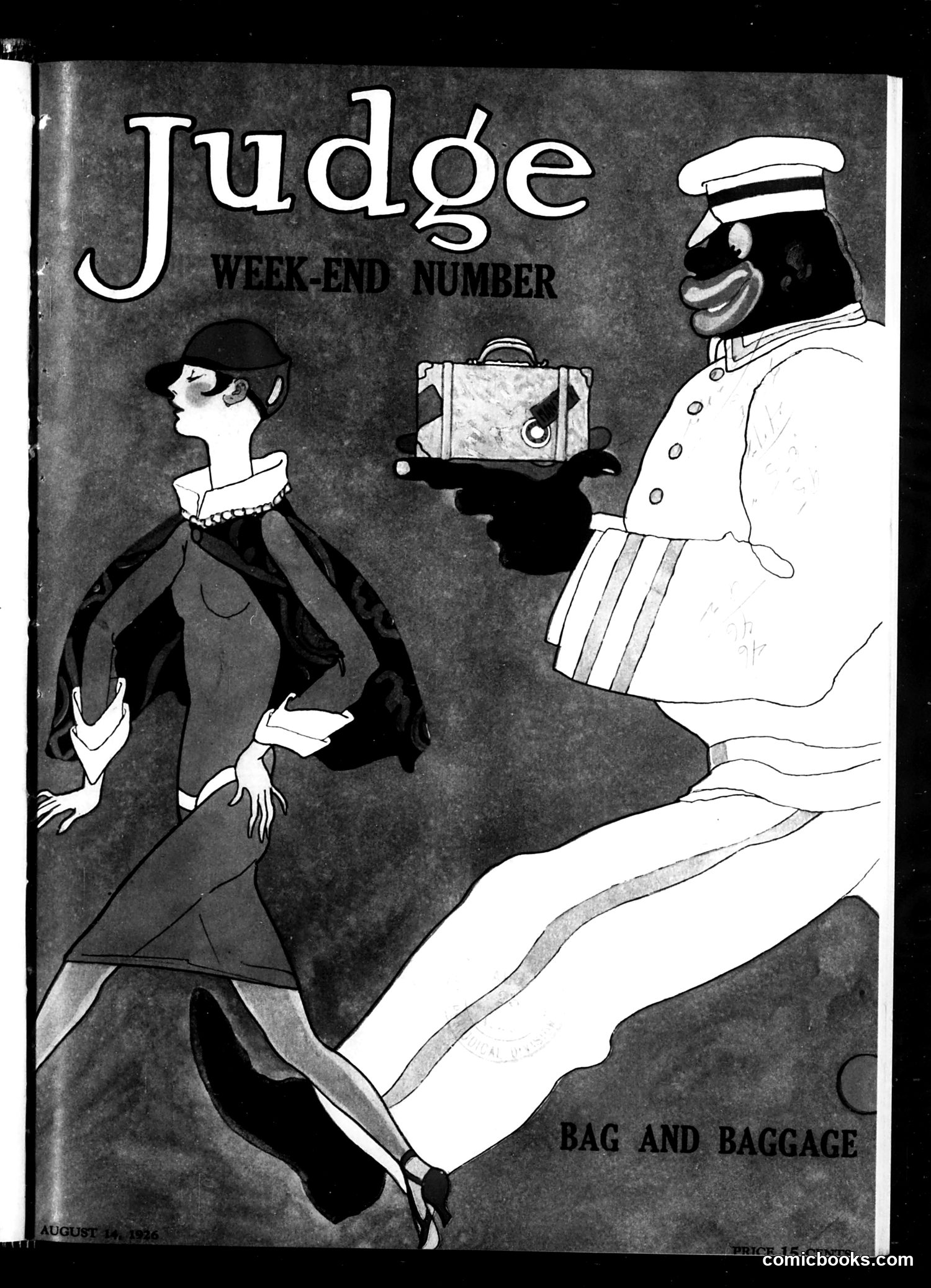
This August 14, 1936 cover satirizes travel and luggage, likely commenting on vacation season or holiday travel. The illustration shows a stylish woman in fashionable 1930s attire (cloche hat, coat, heeled shoes) being approached by a uniformed porter or bellhop holding a suitcase. The title "Bag and Baggage" is a period idiom meaning departure with all one's possessions. The satire appears to target either excess luggage for short trips (a common source of humor) or perhaps the porter's eager service. The woman's elegant but somewhat exaggerated pose suggests commentary on travelers' pretensions or the fashion-consciousness of affluent 1930s travelers. Without additional context, the specific social target remains unclear, though the piece likely mocks leisure-class travel habits typical of Judge's audience.
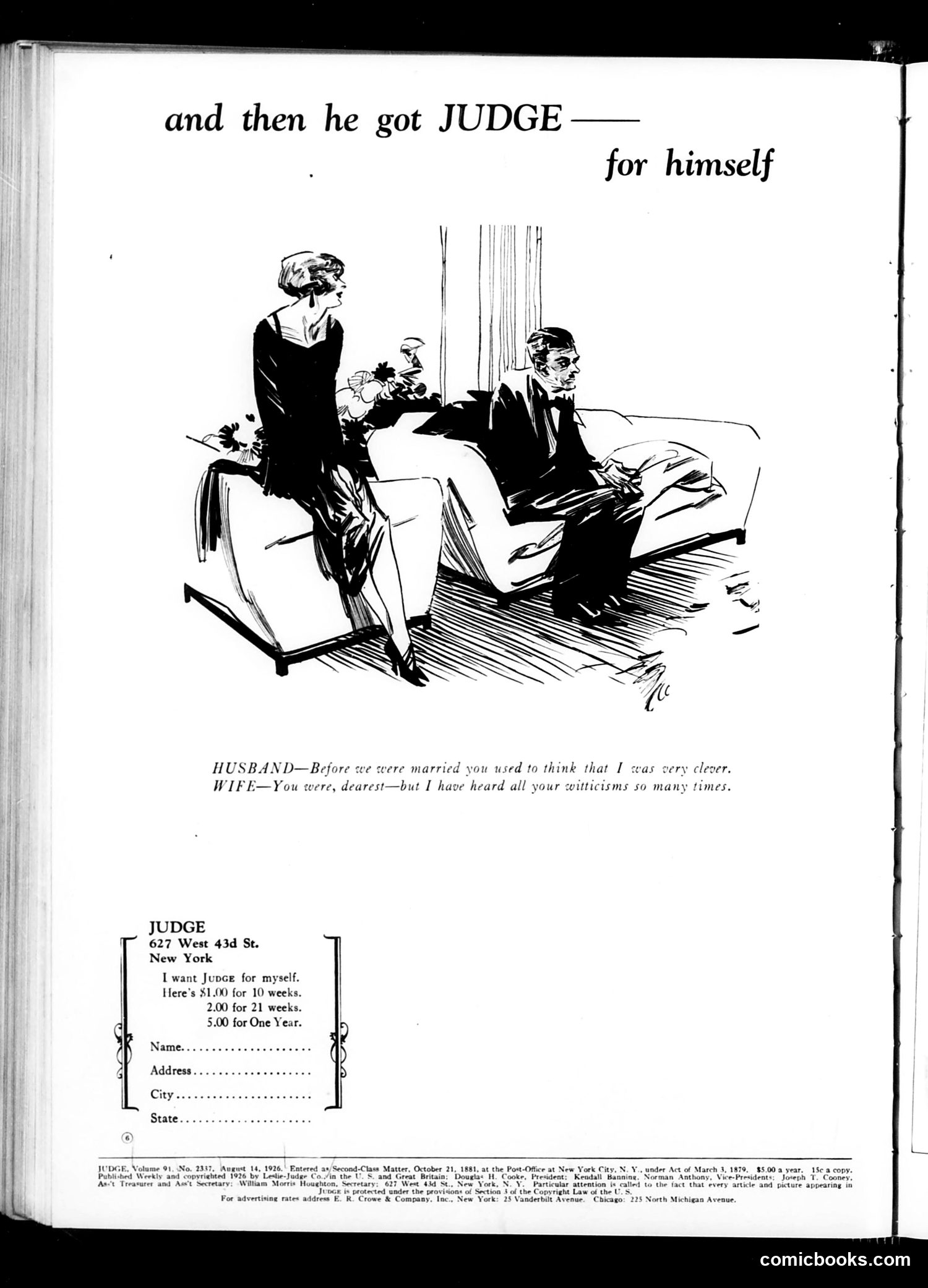
This cartoon satirizes marital conflict, particularly the phenomenon of husbands becoming self-righteous judges in their own homes. The title "and then he got JUDGE—for himself" suggests a husband who has appointed himself arbiter of family disputes. The dialogue shows the wife responding to her husband's criticism of her pre-marriage cleverness by noting she's "heard all your criticisms so many times." The joke hinges on the husband becoming an insufferable domestic critic after marriage—someone who constantly judges his wife's behavior rather than enjoying companionship. This reflects early 20th-century gender tensions: the satire targets husbands who become pedantic, fault-finding partners. The advertisement below promotes a "Judge for myself" subscription, making the domestic critique theme commercial.
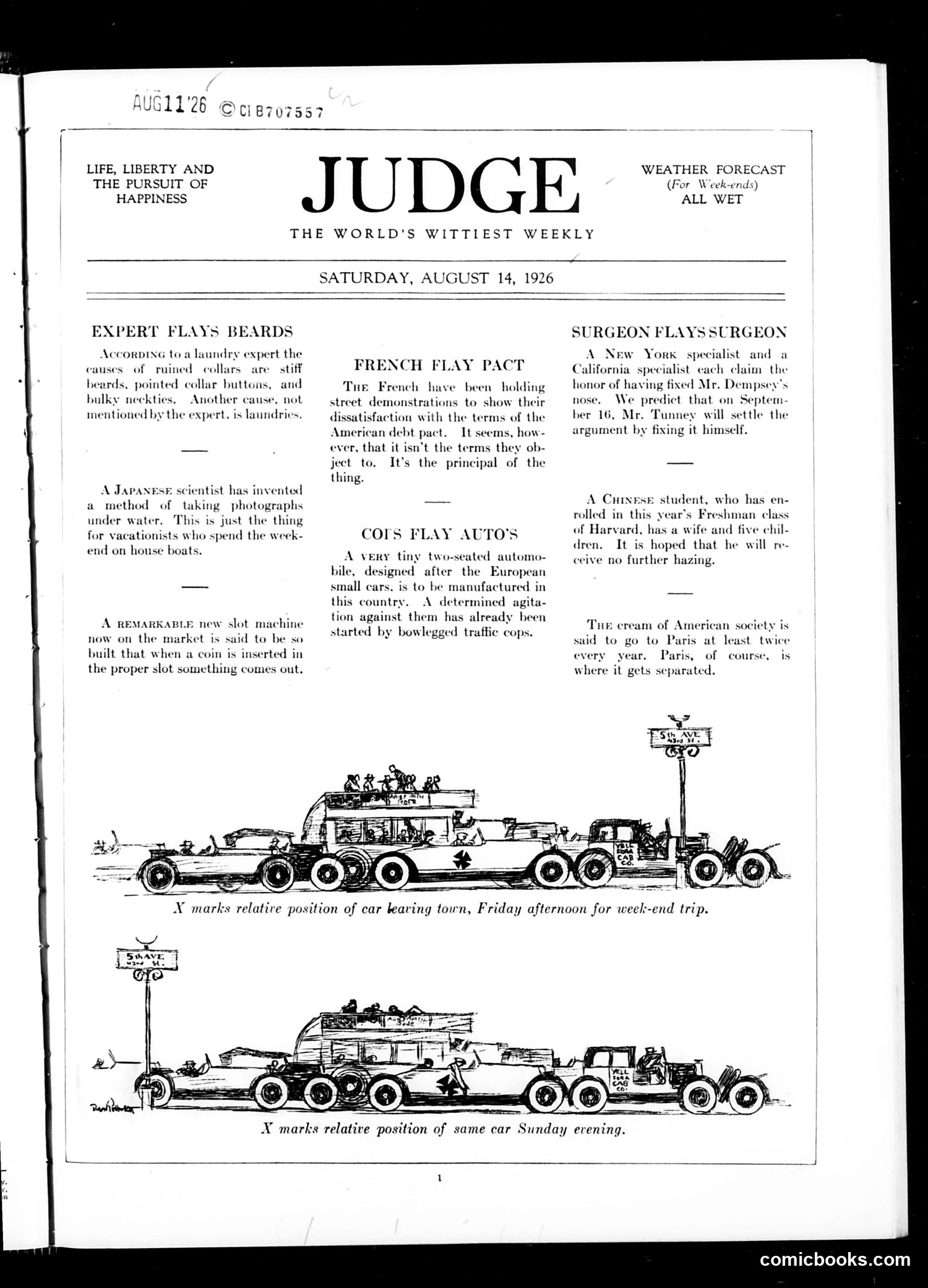
This page contains brief satirical items rather than a political cartoon. The "Cols Fly Auto's" section mocks a compact European-style automobile being manufactured domestically, noting that traffic cops have already begun "agitation against them"—likely joking that such small cars will become nuisance targets for enforcement. The two technical drawings below illustrate a humorous piece about a town being transported via large vehicle convoy, with an "X" marking a car's relative position on Friday versus Sunday. The caption suggests the vehicle shifts location during the weekend trip, appearing to satirize the chaotic or unpredictable nature of weekend automobile travel in the 1920s. The remaining items are brief humor notes about laundry and photography techniques—typical filler content for the satirical weekly.
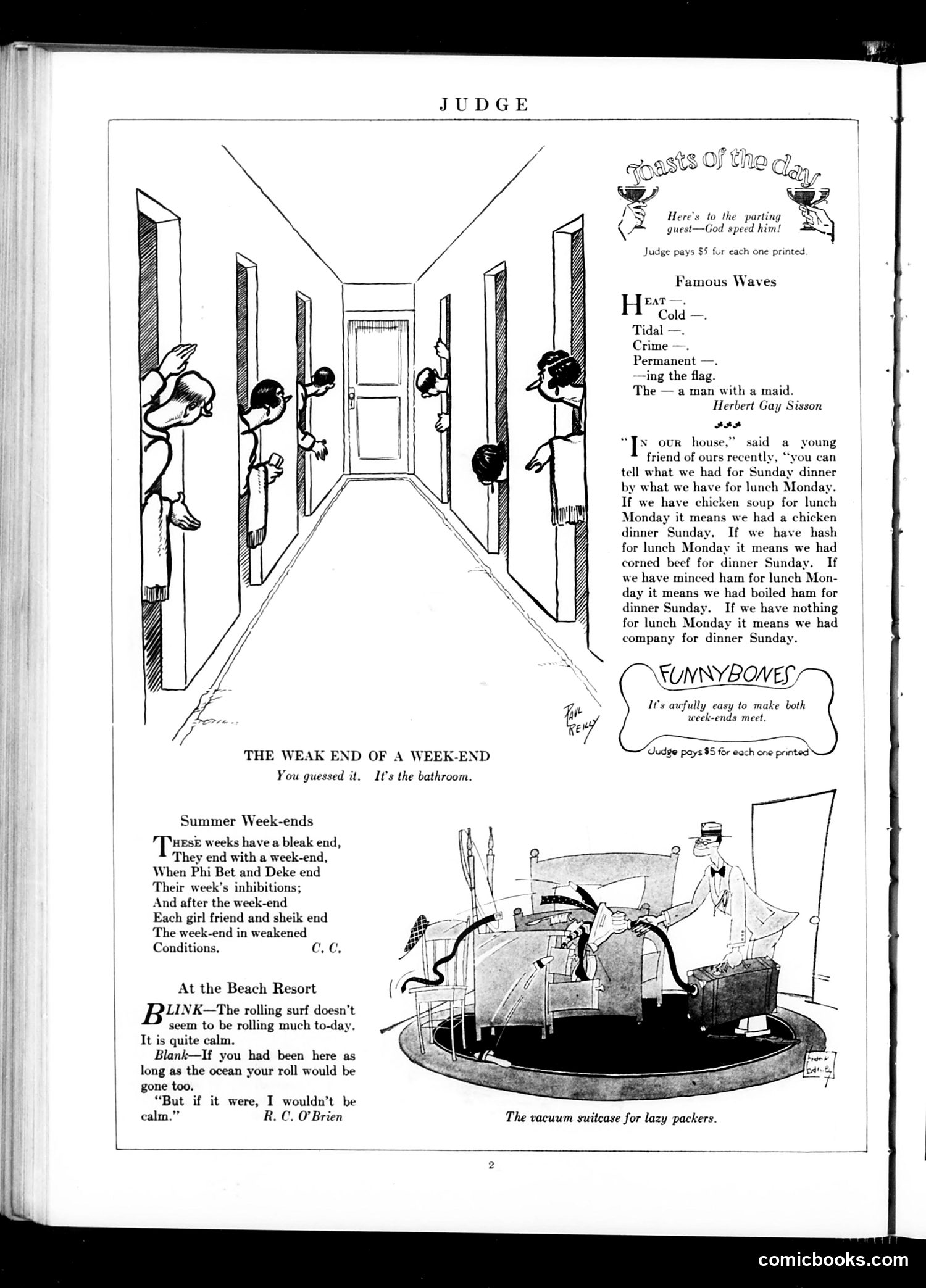
This page contains humor and illustrations rather than political cartoons. The main content includes: **"The Weak End of a Week-End"** — A bathroom scene cartoon showing multiple people crowded outside a bathroom door, illustrating the domestic chaos of weekend guests competing for bathroom access—a relatable domestic humor joke. **"Summer Week-Ends"** and **"At the Beach Resort"** — Brief humorous poems about weekend travel, with observations that the rolling surf at beaches doesn't seem calm, and a witty response questioning whether calmness itself would be pleasant. **"The vacuum suitcase for lazy packers"** — An illustration satirizing travelers who overpack, showing someone with an oversized vacuum-packed suitcase. The page is primarily lighthearted domestic and leisure humor targeting middle-class weekend activities, with no apparent political commentary.
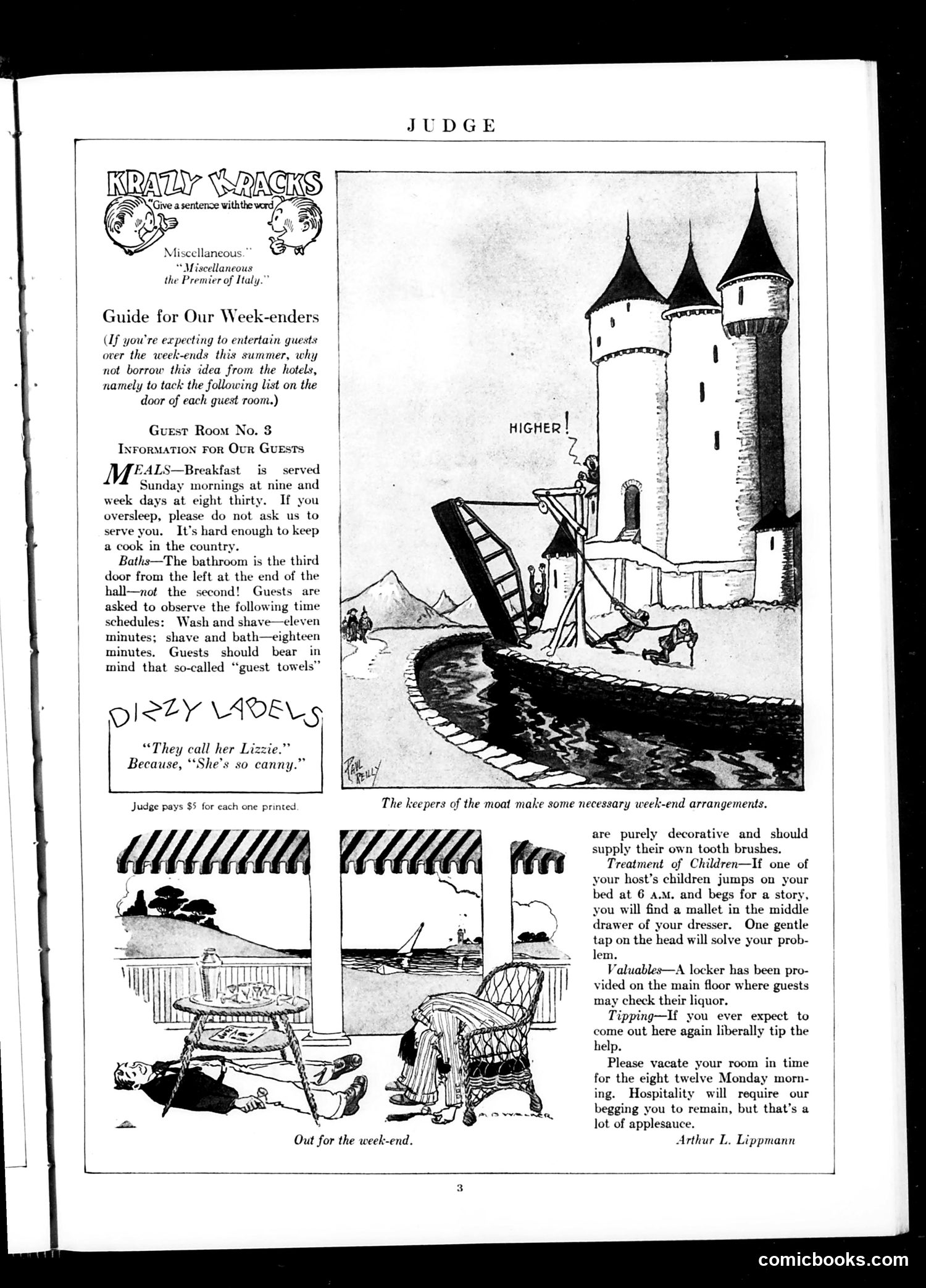
This page combines humor with practical advice for wealthy hosts entertaining weekend guests. **"Krazy Kracks"** features wordplay riddles typical of the era's light humor sections. **"Dizzy Labels"** is a pun on someone nicknamed "Lizzie" for being "canny" (shrewd/careful with money). The main content is **"Guide for Our Week-enders,"** satirizing the pretensions and challenges of hosting overnight guests in the country. It humorously addresses practical issues: breakfast timing, bathroom schedules, towel etiquette, and children's misbehavior. The castle illustration and jokes about "keepers of the moat" mock the affectations of wealthy country estates. The final panel, "Out for the week-end," shows guests departing with excessive luggage—satirizing the burden hosts endure. Arthur L. Lippmann's closing note emphasizes the labor hospitality demands, suggesting this was wealthy-reader satire about the costs of maintaining social status through entertaining.
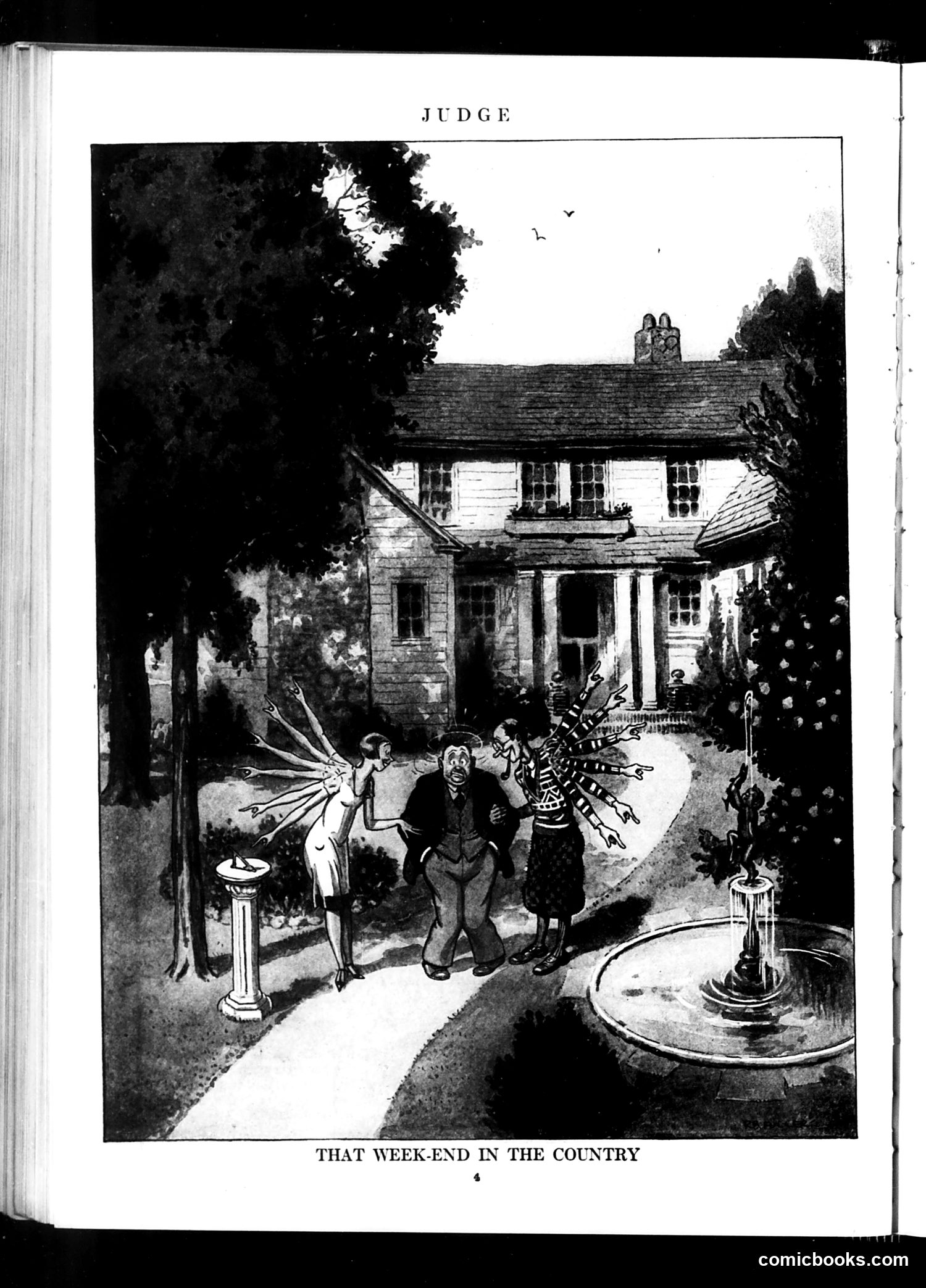
This Judge cartoon satirizes upper-class social pretension during a country house visit. The illustration shows three figures in an elegant garden setting with fountains and a stately home—depicting the aspiration to refined leisure. The satire likely mocks the artificial nature of such weekend retreats: the carefully curated elegance, the performative sophistication, and perhaps the discomfort or awkwardness of the participants trying to maintain their social facade in a country setting. The winged figures on either side appear to be allegorical, possibly representing aspects of vanity or affectation. The title itself is somewhat ironic—suggesting these "country" weekends are less about genuine relaxation and more about social display. Without additional context, the specific targets remain unclear, but the cartoon reflects Judge's typical criticism of wealthy American society's pretensions.
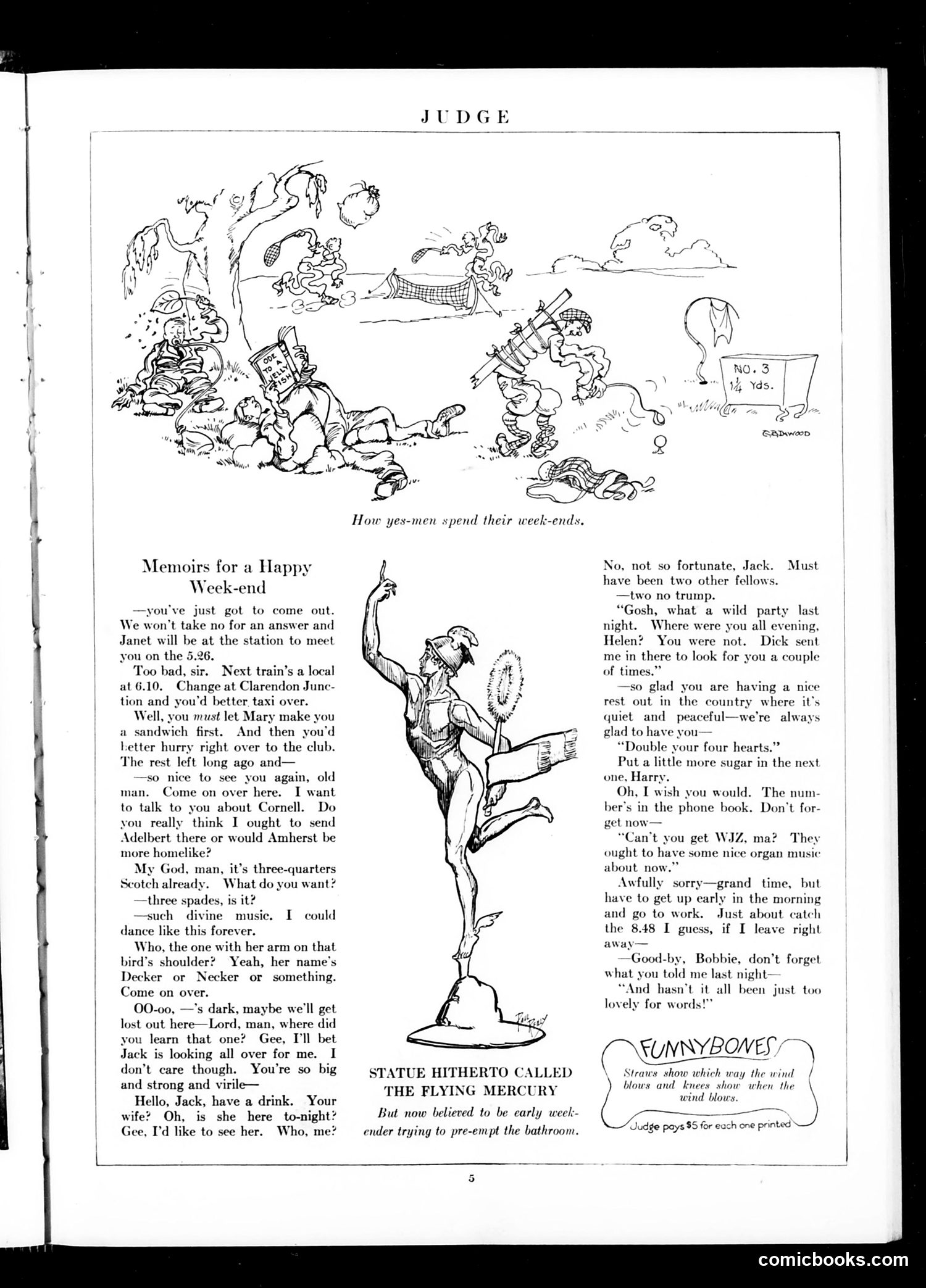
This page satirizes **wealthy men's weekend leisure activities**. The top cartoon depicts gentlemen engaging in various frivolous pastimes—playing golf, tennis, boating, and general lounging—illustrating how the affluent spent their leisure time. The dialogue below ("Memoirs for a Happy Week-end") presents a conversation between two men discussing social plans: attending clubs, taking trains, meeting women, and dancing to "three-quarter Scotch" music. One mentions "the Flying Mercury" statue, referencing a classical sculpture. The satire targets the **idle pursuits and self-indulgent lifestyle of the wealthy class**, mocking their preoccupations with social clubs, romance, and entertainment while framed as serious "memoirs." The tone is gently comedic rather than politically scathing—typical Judge magazine humor aimed at upper-class readers.
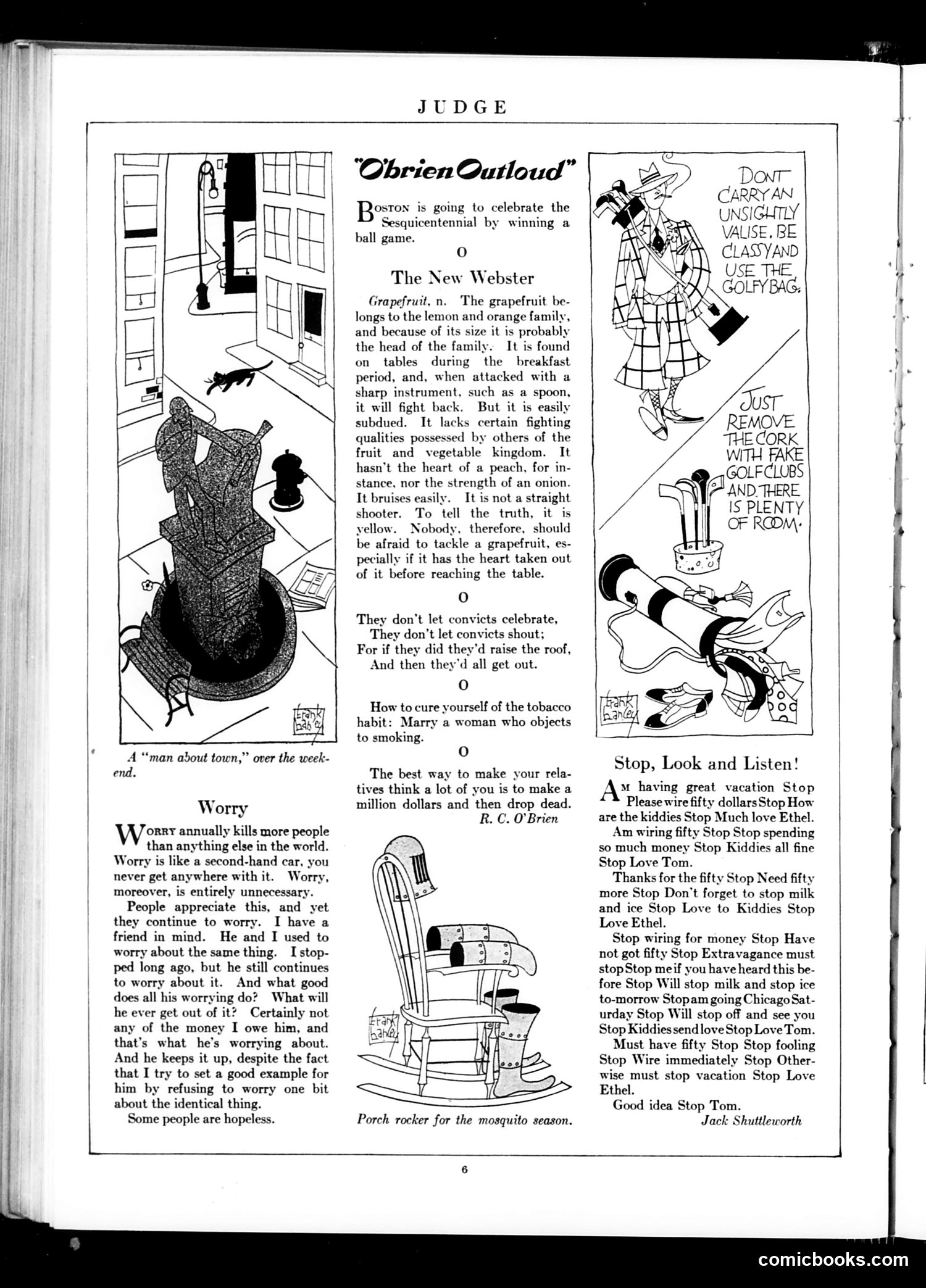
This page contains several satirical pieces typical of early 20th-century American humor: **"O'Brien Outloud"** (top left): A cartoon showing a man being ejected from a window—likely satirizing Boston's upcoming Sesquicentennial celebration (250th anniversary), with the caption suggesting the city will "win a ball game" to mark it. The visual joke mocks both the man and civic pride. **"The New Webster"** (center): A humorous dictionary definition of "grapefruit" that anthropomorphizes the fruit as cowardly and weak—unable to "fight back" like other produce. This is absurdist humor poking fun at how dictionaries define everyday objects. **"Worry"** (left column): An essay-format joke where the author claims worry is pointless, then admits he continues worrying about money a friend owes him—undermining his own advice. **"Stop, Look and Listen!"** (right): A parody of telegram-style messages full of "Stop" punctuation, humorously depicting financial anxiety between family members about vacation spending and money wiring. The page reflects pre-Depression-era American concerns: financial anxiety, civic boosterism, and absurdist wordplay humor.
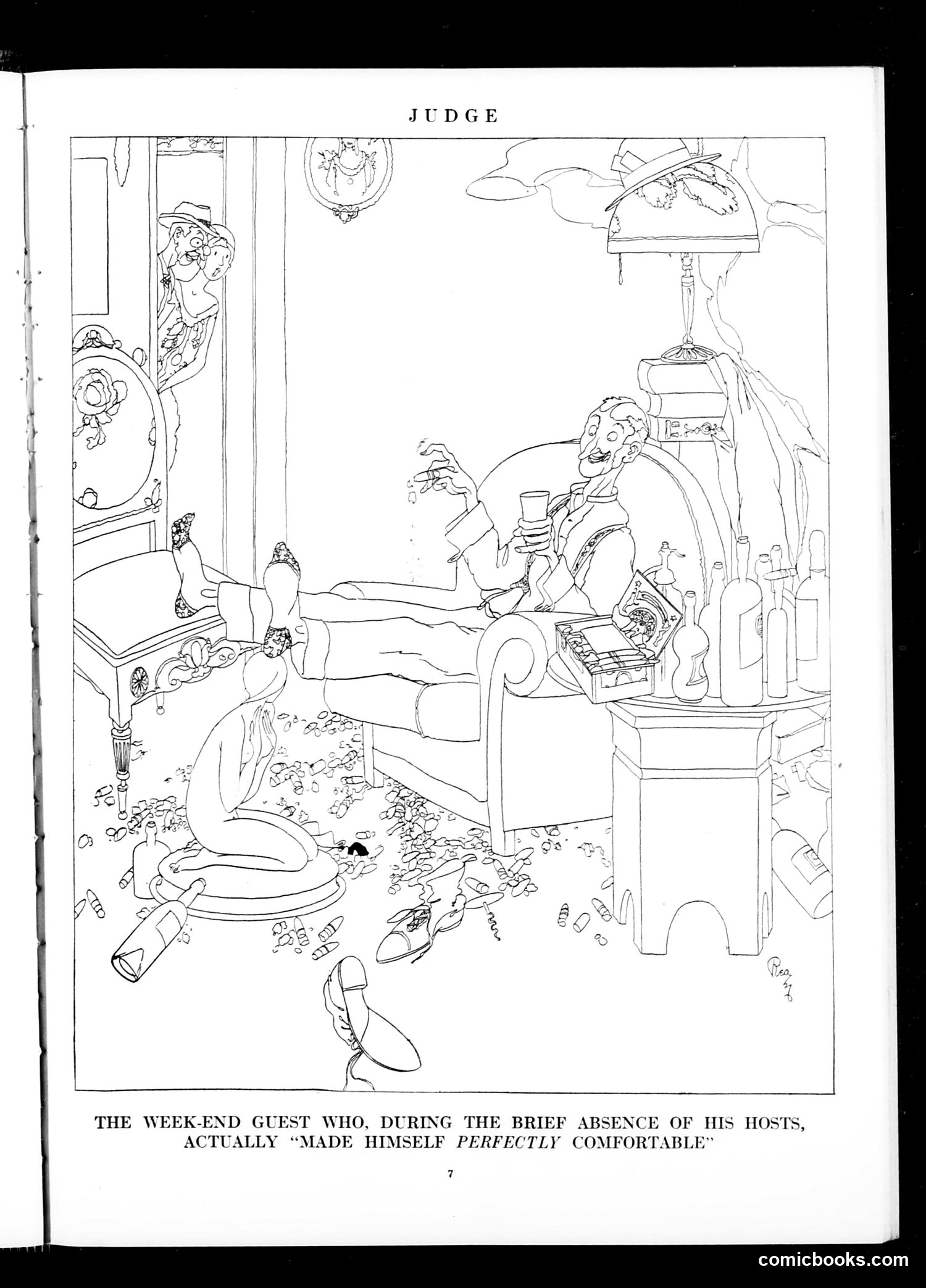
This single-panel cartoon satirizes the behavior of an inconsiderate house guest. The title reads: "The week-end guest who, during the brief absence of his hosts, actually 'made himself perfectly comfortable.'" The illustration depicts a man sprawled on furniture in a luxurious parlor, surrounded by excessive mess—scattered bottles, glasses, food debris, and overturned items. He appears utterly relaxed and self-satisfied despite the chaos he's created. A servant or host figure stands shocked in the doorway, and a woman (likely the hostess) is visible in distress. The satire targets social hypocrisy: guests who claim to be "comfortable" while actually abusing their hosts' hospitality through slovenly, destructive behavior. The cartoon mocks both the oblivious guest's lack of decorum and the phrase "made himself comfortable"—a polite euphemism for what is clearly improper conduct. This reflects early 20th-century anxieties about social etiquette and household civility.
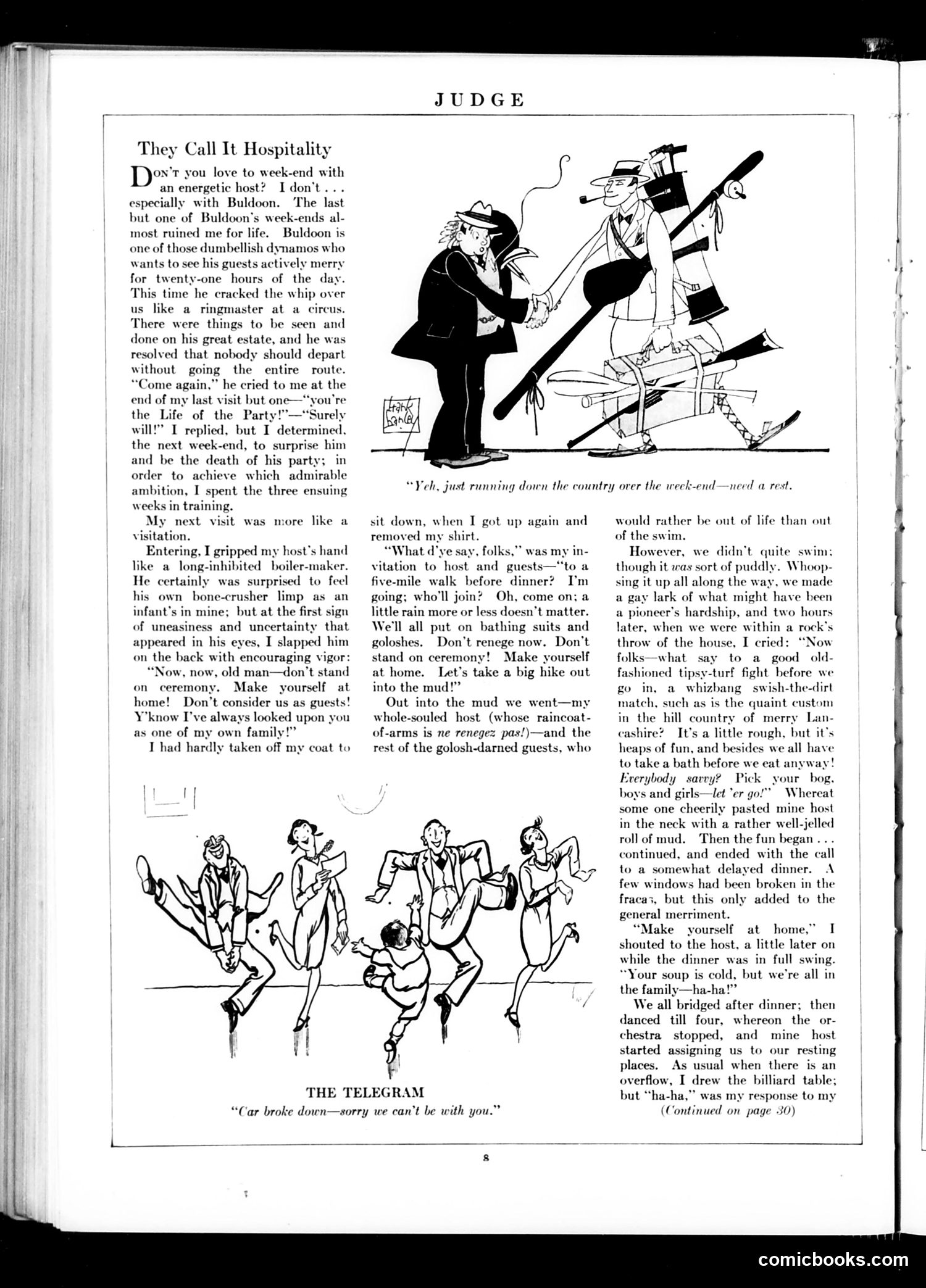
This article satirizes the exhausting social performance expected of weekend house guests in the early 20th century. The narrator describes visiting his friend "Buldoon," an overbearing host who demands his guests be constantly, performatively cheerful and active for their entire stay. The joke: The narrator decides to outdo Buldoon at his own game. He arrives deliberately exhausted after three weeks of training, then relentlessly drags everyone on muddy hikes, mud fights, and all-night dancing while repeating the host's own phrase "make yourself at home." By taking Buldoon's expectations to absurd extremes—removing his shirt immediately, organizing muddy games, breaking windows—he exposes how ridiculous forced merriment is. The bottom cartoon ("The Telegram") provides ironic contrast: someone wisely avoids the chaos by claiming their car broke down. The satire targets both exhausting hosts and the artificial social obligation to perform perpetual happiness.
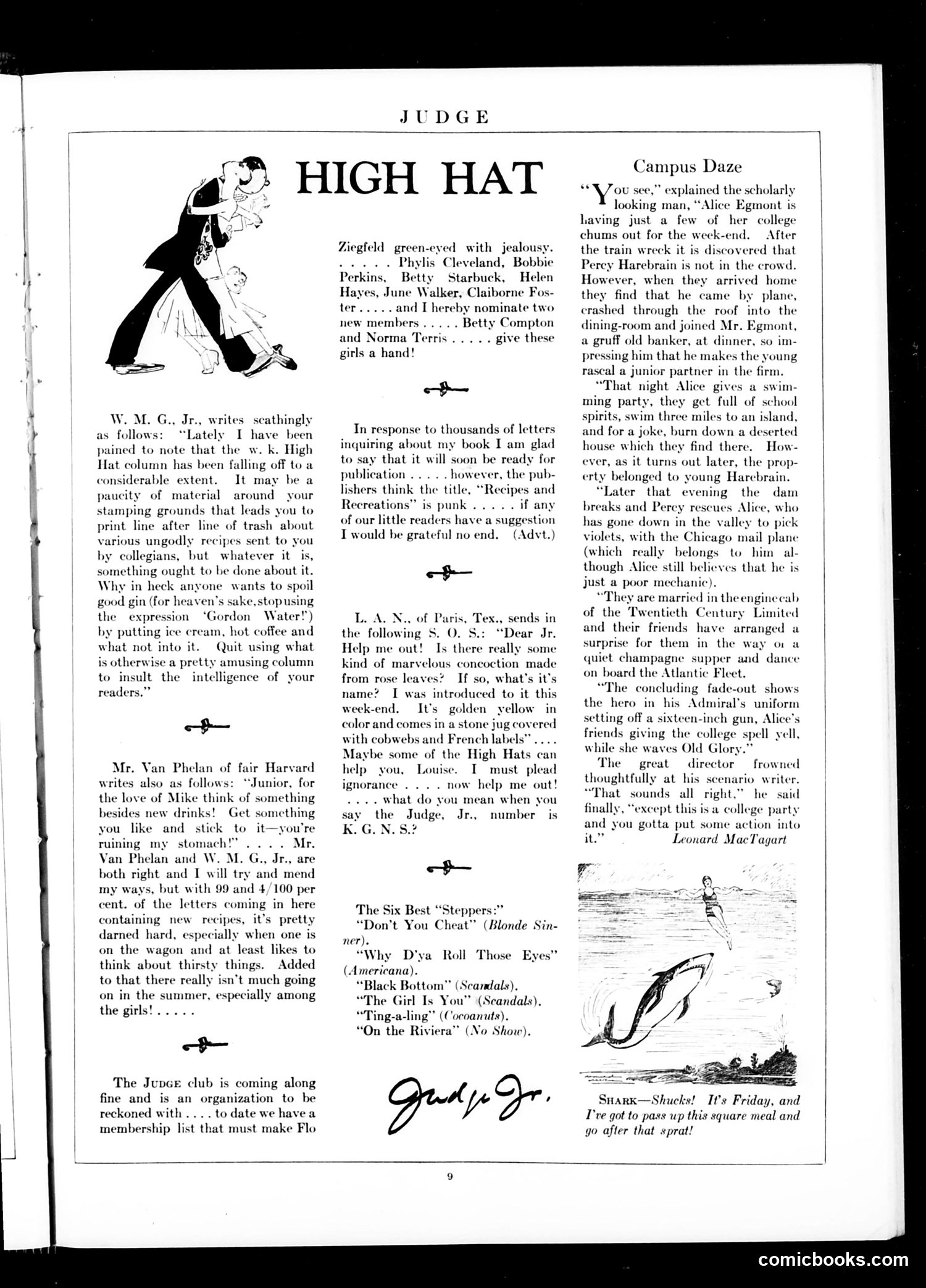
This page showcases the "High Hat" column, Judge magazine's society/gossip section. The main content consists of reader complaints about the column's direction. **The Satire:** W.M.G. Jr. and Mr. Van Phelan (Harvard) criticize the column for publishing too many cocktail recipes instead of substantial social commentary. They mock the trend of mixing quality gin with ice cream and hot coffee—a Prohibition-era workaround suggesting readers were creating makeshift drinks from available ingredients. **Context:** This reflects 1920s Prohibition culture, where respectable people publicly lamented ruined alcohol while privately seeking creative drinking solutions. **Other Content:** The page includes a humorous "Campus Daze" story mocking melodramatic college narratives, and lists popular dance songs ("The Six Best 'Steppers'"), reflecting Jazz Age entertainment. The cartoon illustration shows a man in formal dress—likely representing the column's persona—surrounded by animated figures, embodying the frivolous social scene being critiqued.
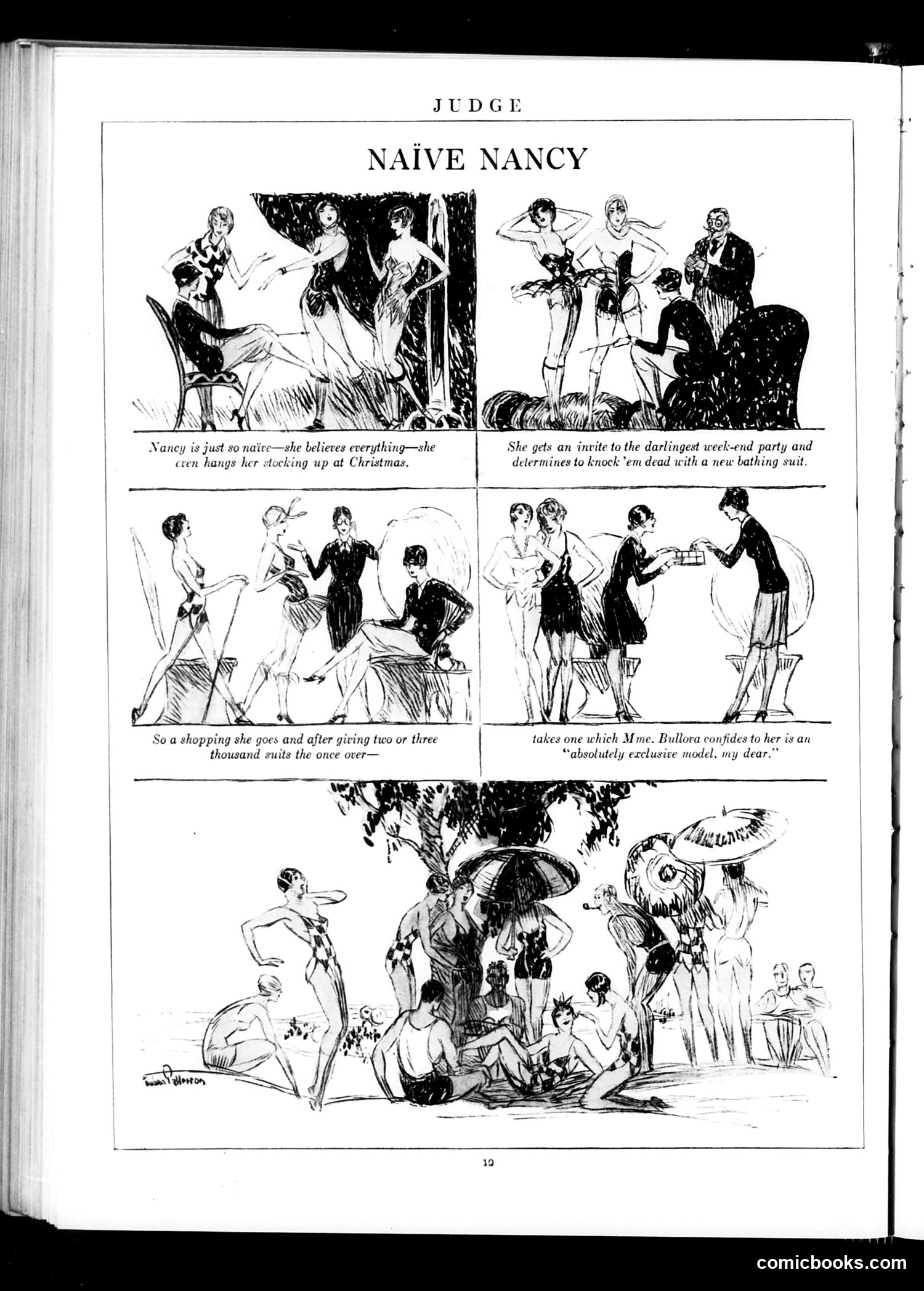
This comic strip satirizes a naïve young woman named Nancy who is gullible and easily manipulated. The humor derives from her credulity: she literally hangs Christmas stockings despite being old enough to know Santa isn't real. When invited to a fashionable weekend party, she's determined to impress with a new bathing suit. A saleswoman (Mme. Bullova) exploits Nancy's naïveté by selling her an expensive suit, claiming it's an "absolutely exclusive model"—a common sales tactic targeting foolish consumers. The strip mocks both Nancy's innocence and the fashion industry's deceptive marketing practices, particularly targeting wealthy or aspiring women. The satire critiques materialism and the gap between naive expectations and fashionable reality in 1920s society.
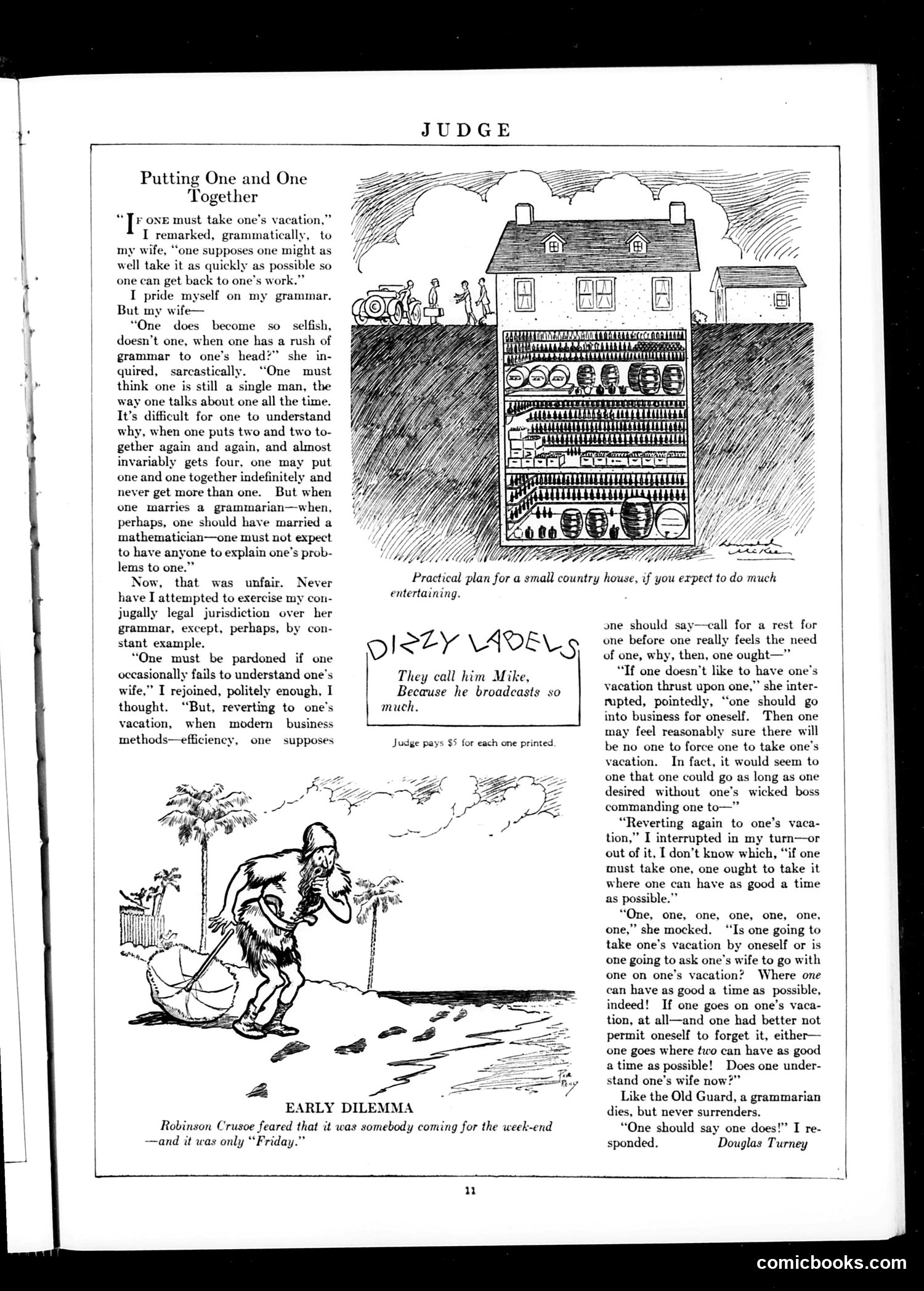
This page satirizes marital bickering disguised as grammatical pedantry. A husband prides himself on correct grammar, repeatedly using the impersonal pronoun "one" while discussing vacation plans. His wife mocks this affectation, pointing out the logical absurdity: "one and one" should equal "two," yet he uses "one" indefinitely without reaching a conclusion—a metaphor for his inability to make actual decisions or compromises in their marriage. The joke works on two levels: it's both a genuine grammar lesson and commentary on how couples hide relationship conflicts behind intellectual posturing. The wife's final point—that vacation decisions involve "two," not "one"—underscores that marriage requires considering one's partner, not self-centered grammatical preening. The accompanying illustration shows Robinson Crusoe fearing a visitor arriving Friday—a visual pun on the day's name, unrelated to the main article.
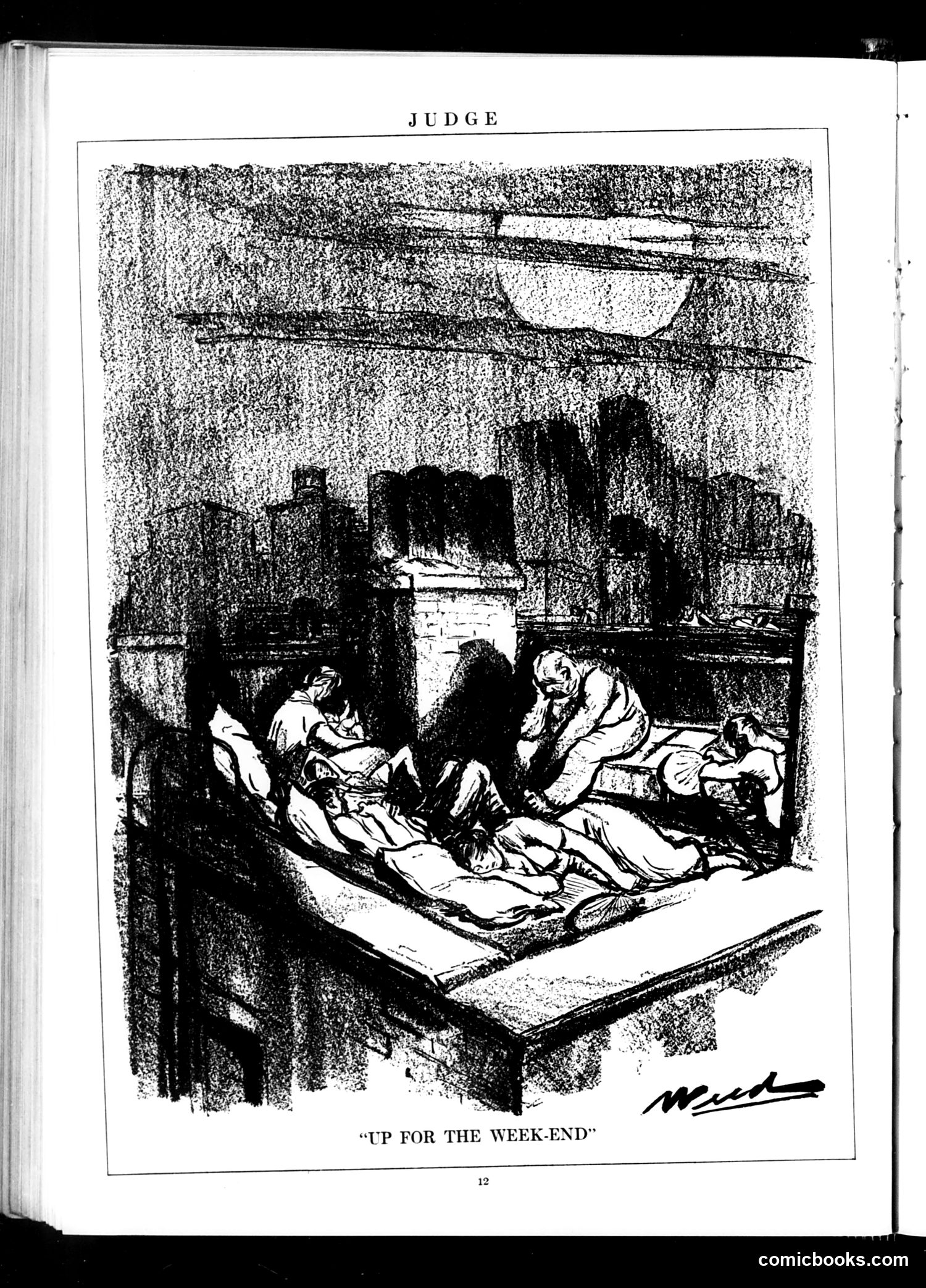
This cartoon from *Judge* magazine depicts several figures reclining in what appears to be a basement or cellar, signed by the artist Cesare. The title "Up for the Week-End" suggests social commentary about leisure activities or weekend getaways. The sketch shows multiple people in relaxed poses in a confined space with barred windows and industrial architecture. Given the *Judge* magazine's satirical focus on contemporary social issues, this likely critiques either: - Urban crowding and poor living conditions - Working-class recreation or escape attempts - Possibly vacation culture or how different social classes spent leisure time The cramped, somewhat grim setting contrasts with the title's implication of enjoyment, suggesting ironic commentary on limited opportunities for rest or entertainment among certain populations. Without additional context, the specific social critique remains somewhat unclear.
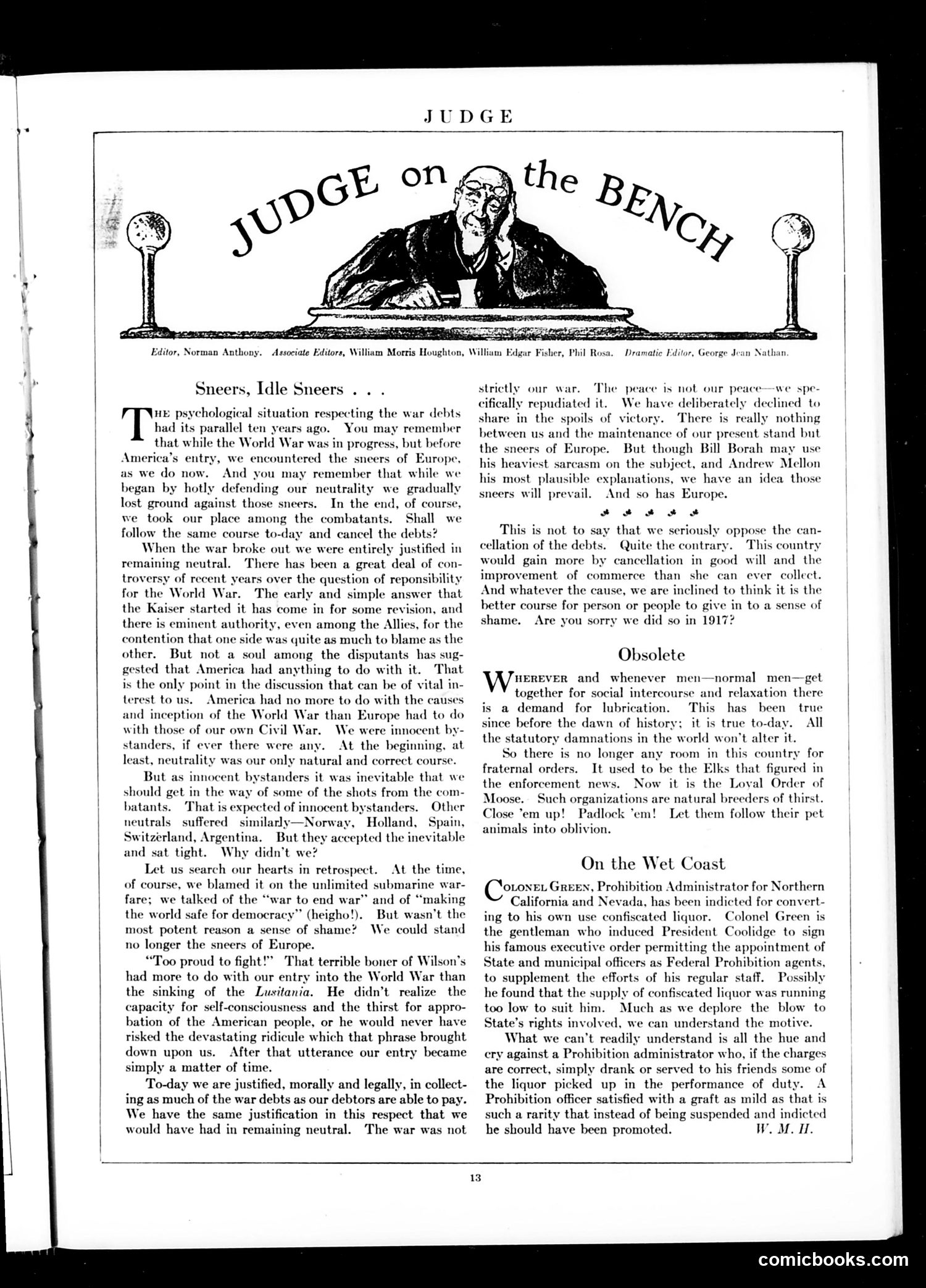
This editorial cartoon critiques American post-WWI debt collection policy. The main illustration shows a stern judge at his bench, symbolizing America's legal but morally questionable position. The text argues that America entered WWI primarily due to European mockery (particularly Wilson's "Too proud to fight" comment) rather than genuine war necessity. Now, the author claims, similar "sneers" will pressure America to cancel war debts owed by European nations—despite America's legal right to collect them. The satirical point: America is about to repeat its mistake. Just as shame pushed us into an unnecessary war, shame will likely force debt forgiveness, even though economically canceling debts would actually benefit America more through improved commerce and goodwill than through collection. The cartoon mocks American susceptibility to European scorn and predicts we'll surrender financial claims rather than endure ridicule—essentially calling out American vanity as a foreign policy driver.
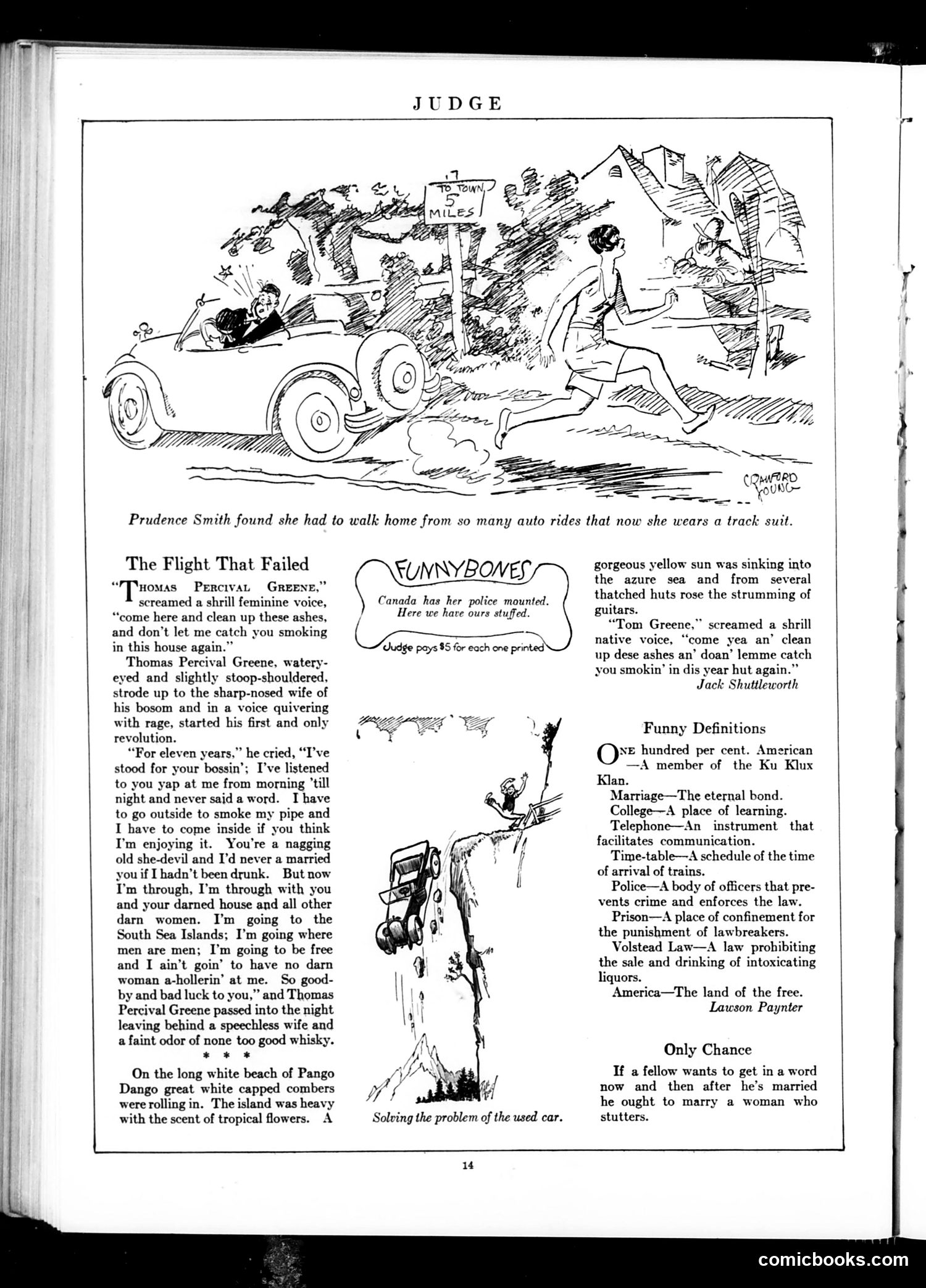
This story satirizes the fantasy of male escape from domesticity. Thomas Percival Greene, a henpecked husband, dramatically announces he's leaving his nagging wife for the South Seas to be "free" and smoke in peace. The punchline: he arrives in Pango Dango only to encounter an identical scenario—a shrill native woman demanding he clean ashes and stop smoking indoors. The satire targets masculine delusions about freedom and suggests that marital dynamics are inescapable, whether in America or the tropics. The joke reflects early 20th-century gender anxieties: wives as controlling figures, husbands as oppressed. The accompanying "Funny Definitions" mock American institutions (including a reference to the Ku Klux Klan and Prohibition's Volstead Law), while "Only Chance" jokes that a stammering wife offers the only way a married man gets conversation. The cartoons collectively present cynical views of marriage, law, and national identity typical of *Judge's* satirical approach.
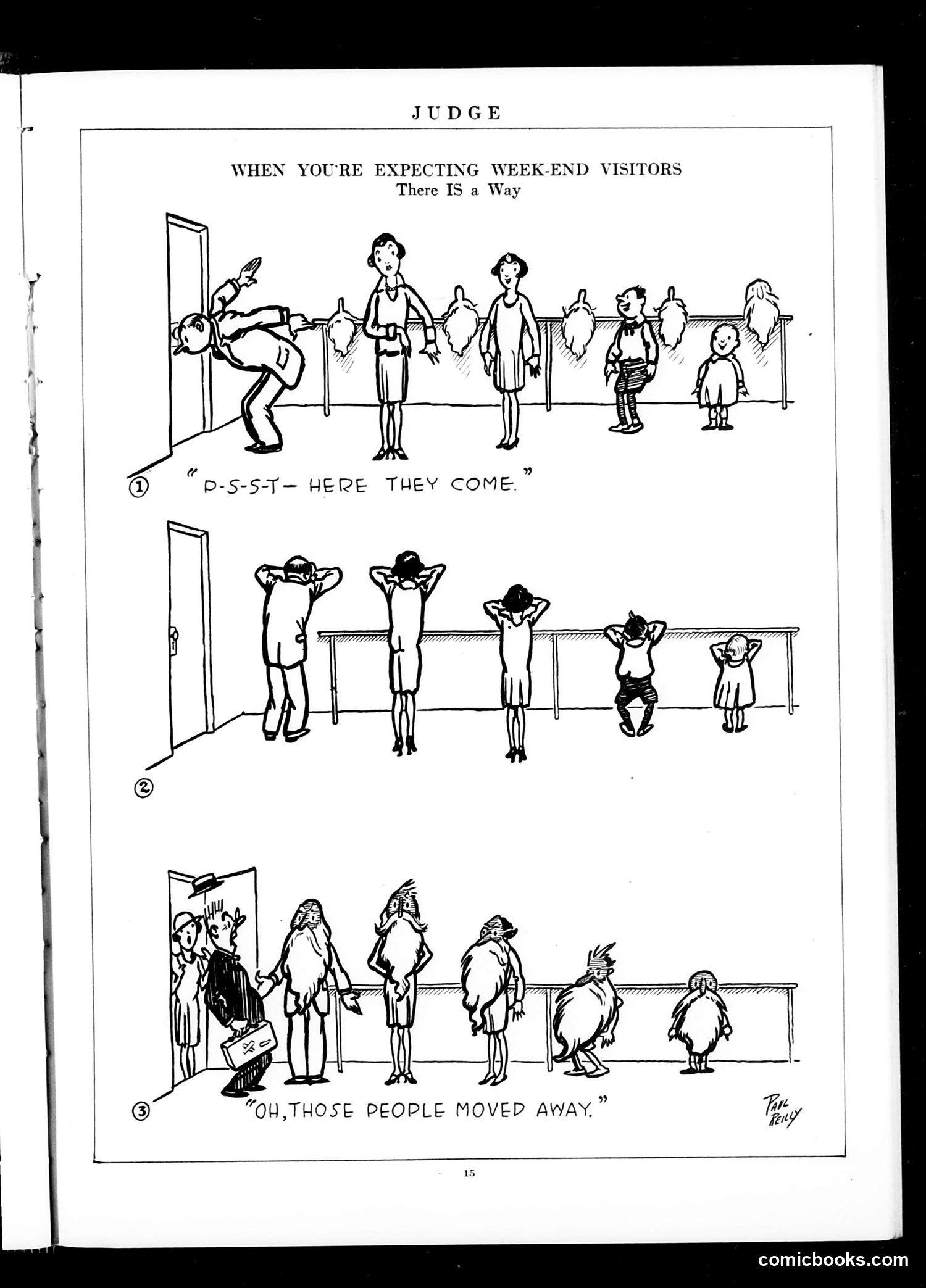
This three-panel comic satirizes the anxiety of hosting houseguests. Panel 1 shows a man frantically hiding items behind his back as visitors approach, captioned "P-S-S-T— HERE THEY COME." Panel 2 depicts the same people now sitting rigidly on chairs with their hands behind their heads—appearing uncomfortable or awkward. Panel 3 reveals the "solution": the original visitors have apparently moved away, replaced by different, presumably more desirable guests, with the caption "OH, THOSE PEOPLE MOVED AWAY." The joke mocks the social pressure homeowners face when preparing for guests and the fantasy of avoiding unwanted visitors altogether. It's relatable domestic humor targeting middle-class anxieties about entertaining and social propriety—typical fare for *Judge* magazine's satirical commentary on American life.
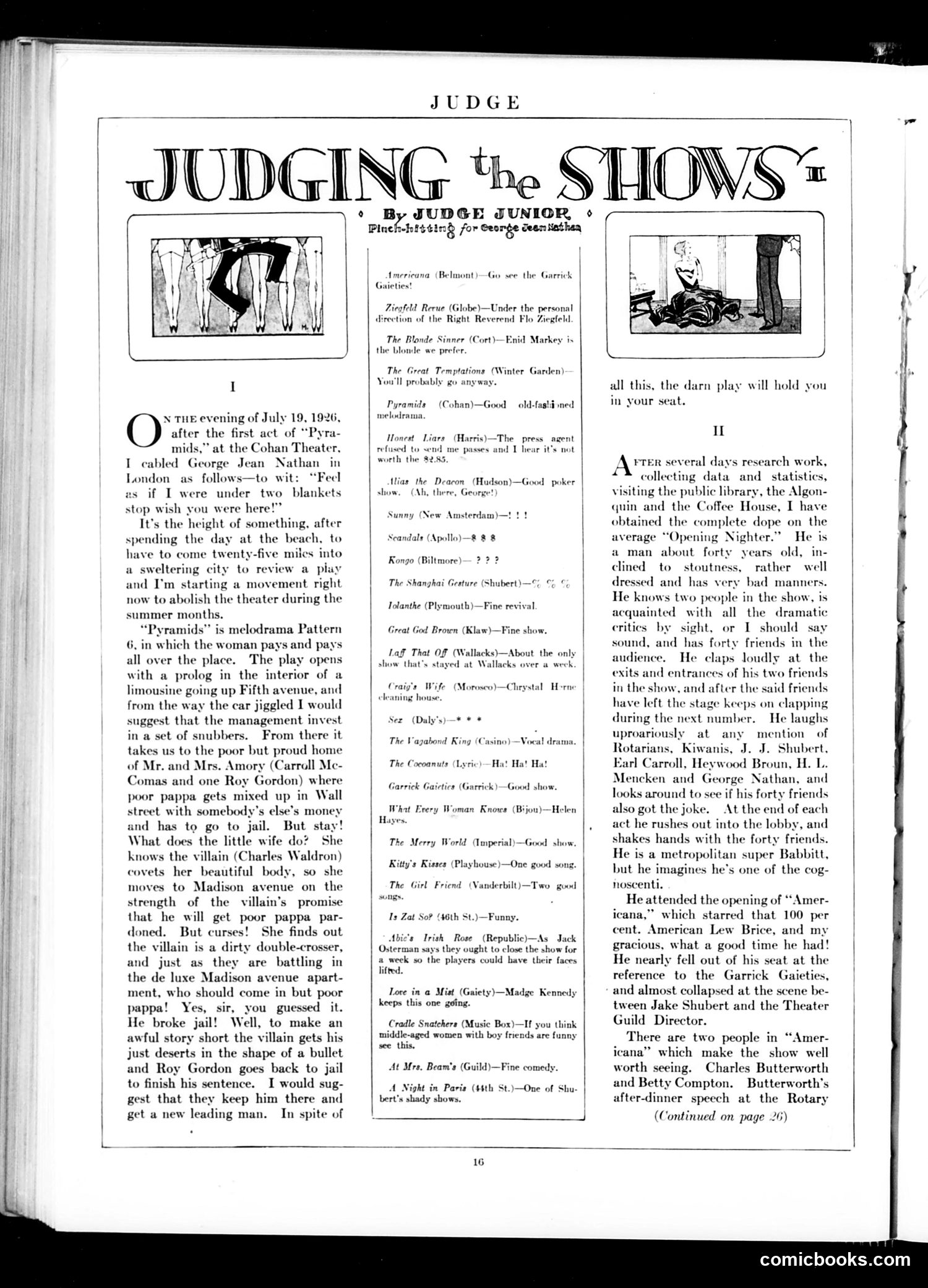
This is a theater review column by "Judge Junior" covering Broadway shows from July 1926. The page contains two main elements: **The Review:** Judge Junior critiques "Pyramids," a melodrama at the Cohan Theater featuring Carroll McComas and Roy Gordon. He dismisses it as formulaic—a woman sacrifices herself to save her imprisoned husband, complications ensue, justice is served. Despite finding the plot predictable and the ride rough ("the car jiggled"), he acknowledges the show's entertainment value. **The Show Listings:** Below are brief, sarcastic capsule reviews of current Broadway productions, using a rating system of stars, question marks, and exclamation points. The humor is light—praising Helen Hayes in "What Every Woman Knows" and mocking Jack Osterman's "Abie's Irish Rose" as so tedious the actors need a week off to recover from their facial expressions. The page reflects 1920s theater culture and Judge magazine's irreverent comedy style.
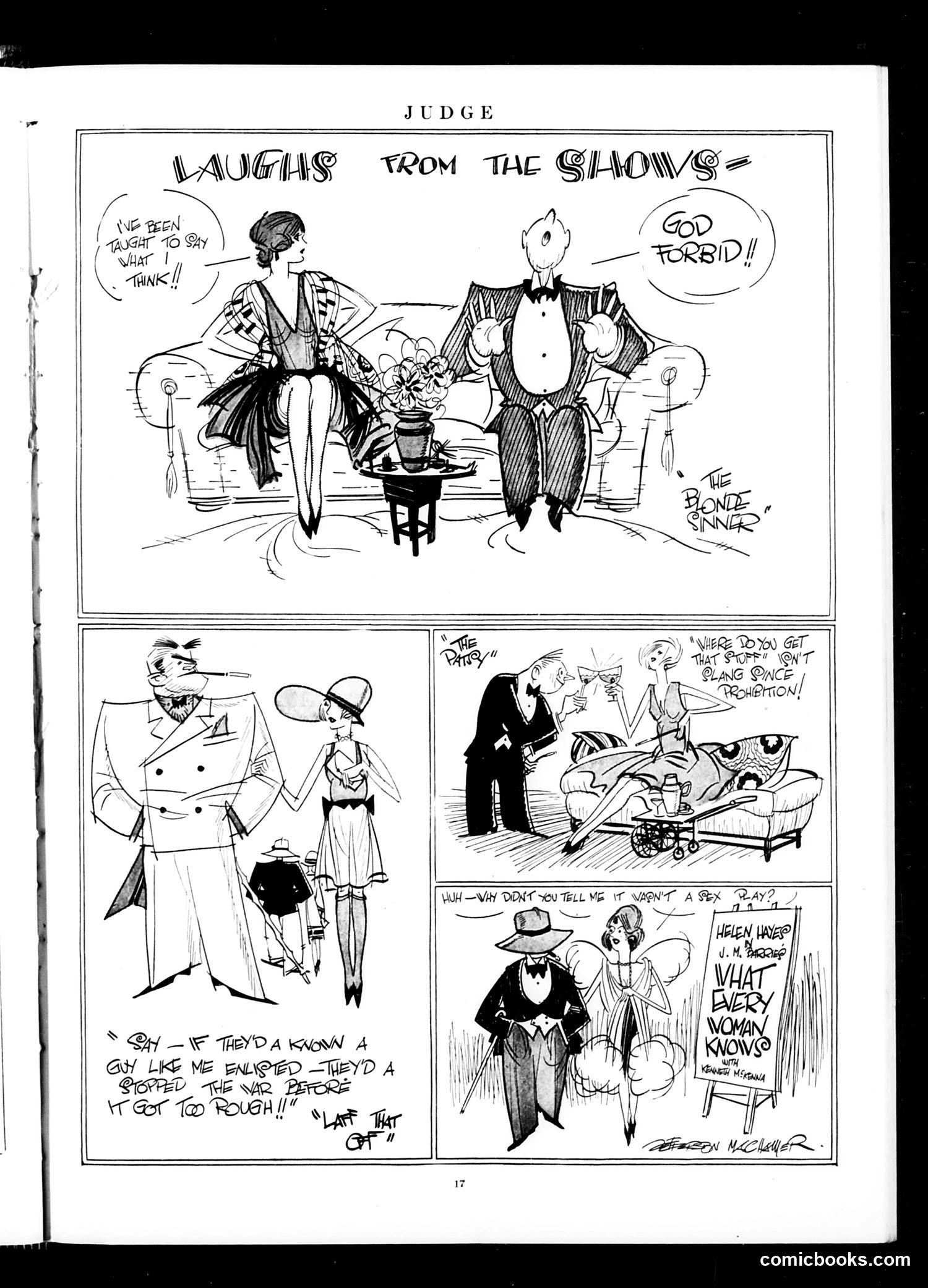
This page contains theatrical humor satirizing early 20th-century stage productions. The top panel shows a couple discussing show etiquette, with the woman saying she's been taught "what to think" and the man responding "God forbid!"—mocking rigid social conventions around theater attendance. The lower panels depict various show-related scenarios: a man enlisting a woman's help finding an "enlightened" date (joking that she's too "rough"), a theatrical father concerned about propriety, and references to famous actresses (Helen Hayes, J.M. Barrie's work) discussing "what every woman knows." The satire targets theatrical pretension and gender roles of the era—the disconnect between bohemian theater culture and conservative social expectations. The cartoonist (signature unclear) skewers both uptight moralists and theater people's affectations through exaggerated character types and situational comedy typical of Judge magazine's satirical approach.
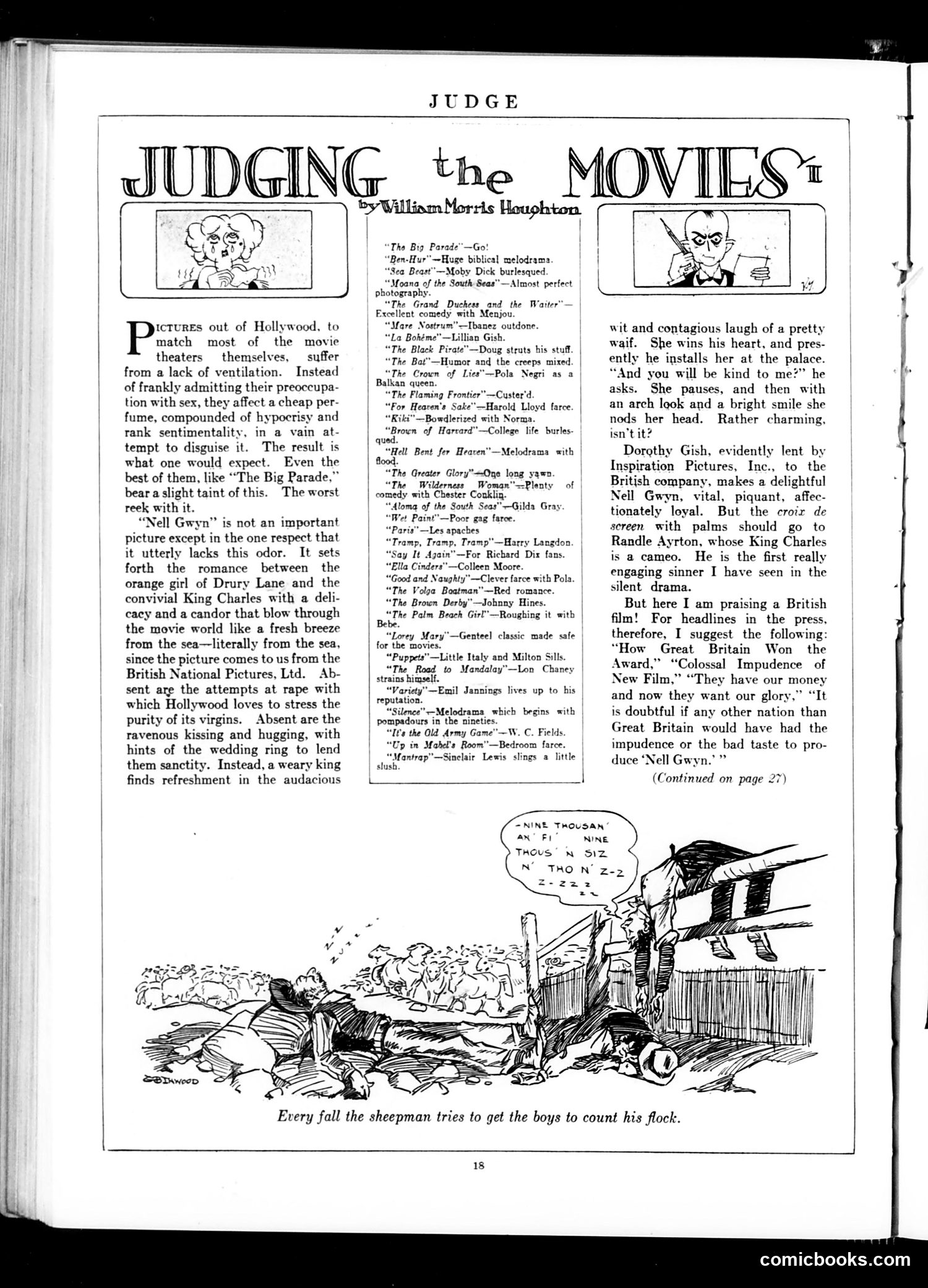
This 1925 *Judge* column by William Morris Morris critiques Hollywood's approach to film morality while praising a British production. The article argues that American studios, unable to openly address sexual content, mask it with cheap sentimentality and perfume—literally and figuratively—creating an offensive atmosphere in theaters. The column praises *Nell Gwyn*, a British film about King Charles II and an orange-seller, for its refreshing restraint and "delicacy and candor." It contrasts this with Hollywood's reliance on attempted rape scenes, excessive kissing, and wedding-ring innuendo to stress actresses' "purity." The satire's point: American filmmakers are hypocritical—they avoid explicit acknowledgment of sexuality while saturating films with it, creating an unpleasant, sanctimonious result. The column suggests that honest treatment (as in the British film) proves more artistically effective than American prudishness disguised as morality. The humor concludes with ironic suggested headlines mocking America's wounded pride at losing cinematic prestige to Britain.
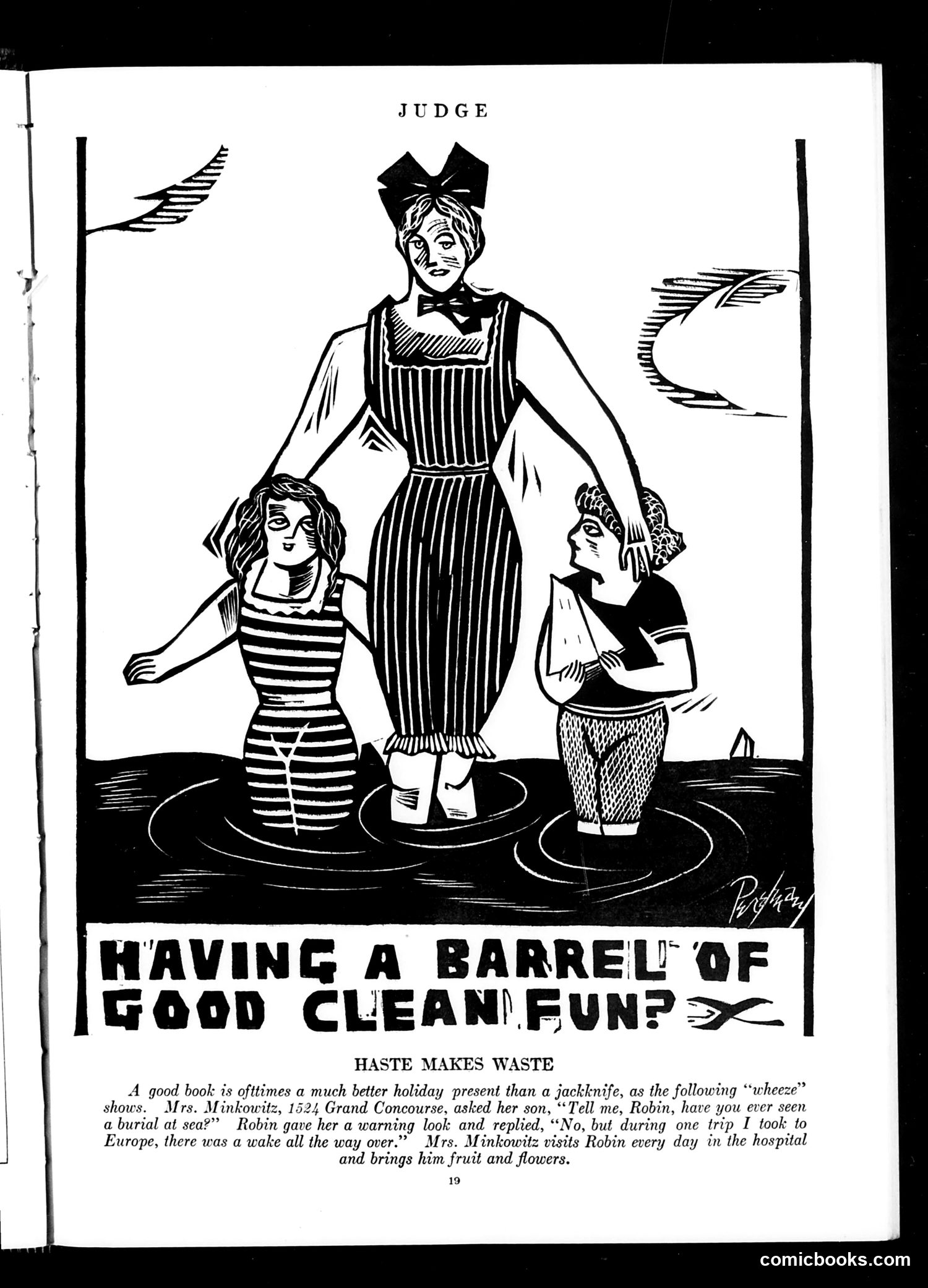
This is a humorous anecdote from *Judge* magazine titled "Haste Makes Waste." The joke hinges on a pun: when Mrs. Minkowitz asks her son Robin if he's seen a "burial at sea," he misunderstands (or pretends to) and replies about a "wake all the way over"—a double meaning referring both to a funeral vigil and to being awake during an ocean voyage. The accompanying illustration shows a woman in a large hat standing in water with two children, labeled "Having a Barrel of Good Clean Fun?"—suggesting wholesome family entertainment. The framing text recommends giving books as holiday gifts rather than practical items like jackknives, positioning this joke as wholesome family humor. The punchline's dark undertone (a child's supposed misadventure) paired with the upbeat caption exemplifies early 20th-century satirical magazine humor: mildly irreverent wordplay presented as innocent entertainment.
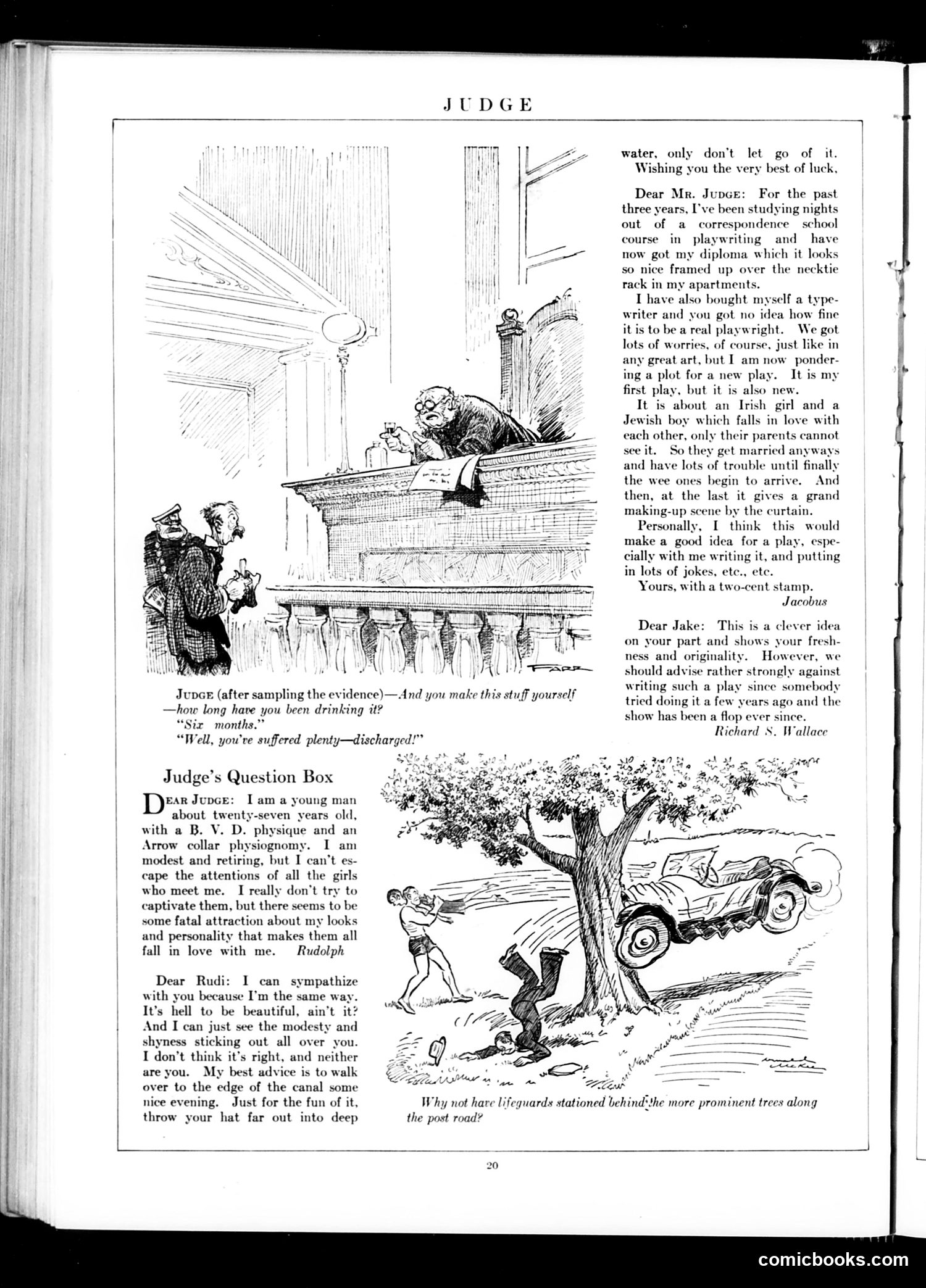
This page from *Judge* (a satirical magazine) contains a main cartoon and an advice column parody called "Judge's Question Box." **The main cartoon** depicts a Prohibition-era scene: a judge samples homemade alcohol while interrogating its maker about how long he's been producing it. The humor targets both bootleggers and enforcement hypocrisy—judges themselves sampled illegal liquor. **The advice column** offers mock-serious responses to three letters: 1. A vain young man complaining that women find him irresistible; the Judge sarcastically suggests he drown himself. 2. A would-be playwright proud of his correspondence-school diploma, proposing a play about an Irish girl and Jewish boy whose interfaith marriage causes family conflict. The Judge dismissively notes this plot already failed when "somebody tried doing it a few years ago"—likely referencing a real play, though the specific reference is unclear. 3. A cartoon caption suggesting lifeguards be stationed near trees along roads—dark humor about car accidents. The overall tone mocks pretension, bootlegging culture, and mediocre artistic ambition.
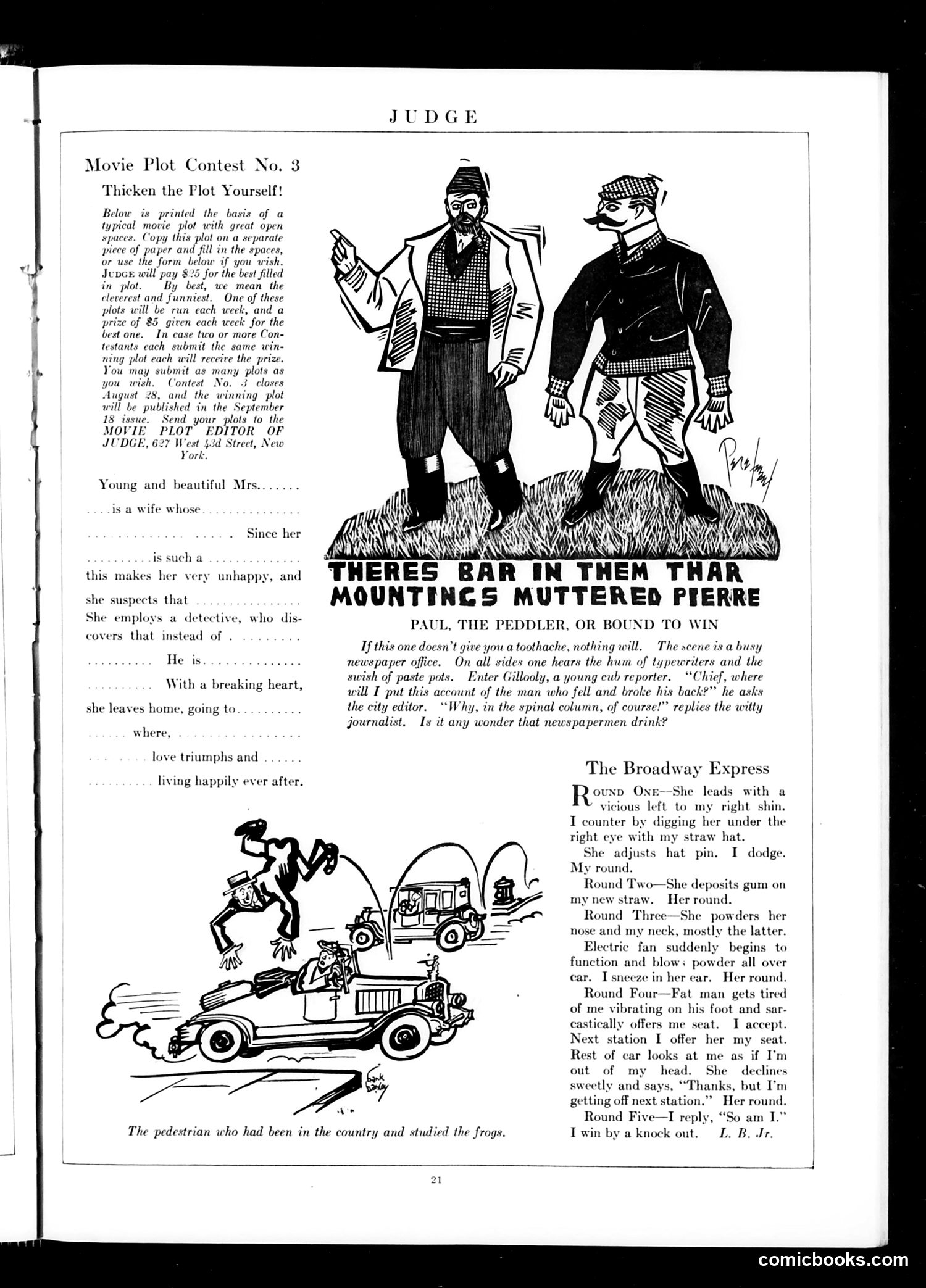
This page from Judge presents three satirical pieces aimed at early 20th-century readers: **Movie Plot Contest**: Judge mocks formulaic silent film plots by providing a template with blanks for readers to fill in—a wife, her unhappiness, a detective's discovery, and inevitable happy ending. The satire targets how predictable and hollow commercial movies were. **"Paul the Peddler" cartoon**: A visual gag about newspaper office wordplay. A cub reporter asks where to place a story about a man who broke his back; the city editor replies "the spinal column"—a pun on both the newspaper section and human anatomy. The caption sardonically suggests such groan-worthy humor explains why journalists drink. **"The Broadway Express"**: A humorous account of a subway flirtation narrated as boxing rounds, where a man and woman engage in increasingly absurd interactions (shin-kicking, powder-throwing, hat-pin dodging). It satirizes the cramped, chaotic awkwardness of public transit and modern urban courtship rituals. All three pieces mock popular entertainment and contemporary urban life.
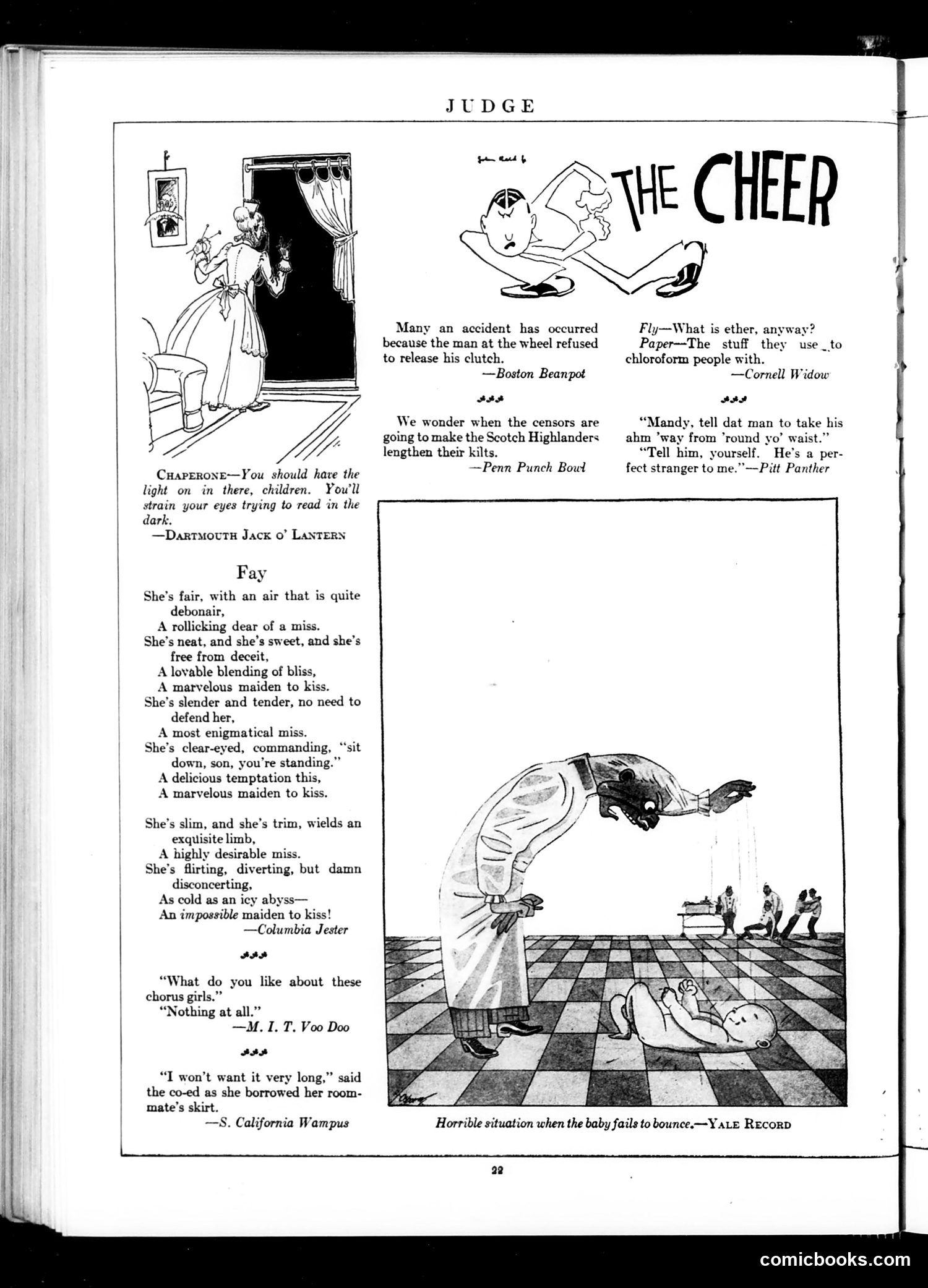
This page collects satirical quips and cartoons from various college humor magazines (Columbia Jester, M.I.T. Voo Doo, etc.), typical of Judge's format. **Key content:** The main cartoon depicts a dramatic scene where a baby has apparently failed to bounce after being tossed in the air—a period practice intended to amuse infants. The caption ("Horrible situation when the baby fails to bounce") treats this genuinely dangerous scenario as comedic. **Surrounding jokes address:** - Gender dynamics: Women described as simultaneously desirable yet "impossible" to pursue - College life: Co-eds borrowing clothing, intimate situations - Period safety concerns: Clutch-release accidents (early automobiles) - Scottish fashion: Censorship of Highland kilts as potentially indecent The humor reflects early 20th-century attitudes toward women, vehicles, and child-rearing practices now considered reckless or inappropriate. The tone is lighthearted but reveals casual acceptance of behaviors modern readers would find alarming.
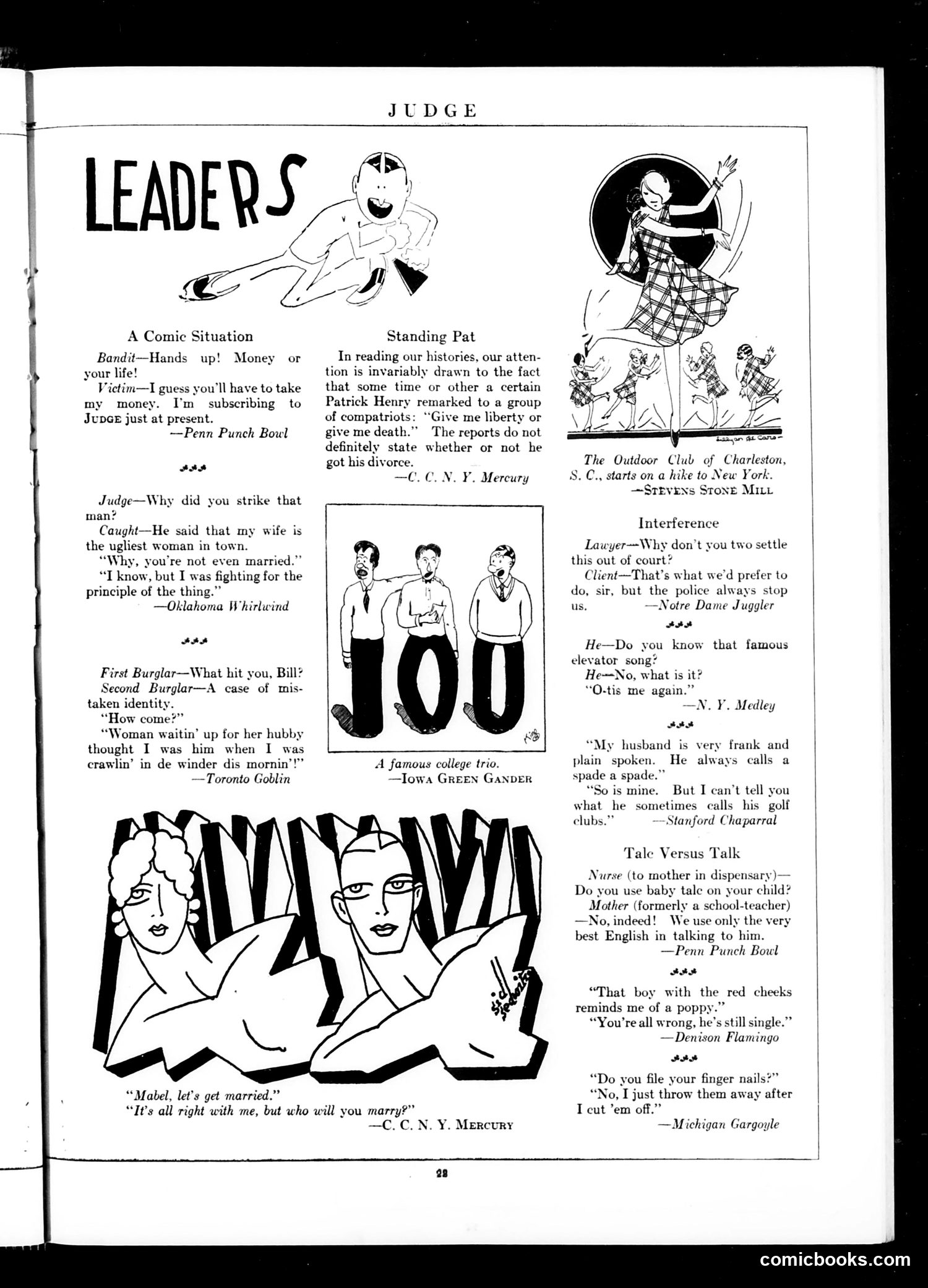
This page from *Judge* collects humor from college and regional publications circa early 20th century. The content consists entirely of short jokes and comic situations—no political cartoons—organized around themes of courtship, marriage, and social absurdities. Key recurring jokes exploit: - **Marriage anxieties**: the "who will you marry?" paradox, divorce references to Patrick Henry - **Gender/class commentary**: working-class dialect humor ("Woman waitin' up for her hubby"), the "ugliest woman in town" principle - **Wordplay and literalism**: the elevator song "O-tis me again" (Otis elevators), filing fingernails by throwing them away, calling golf clubs a "spade" - **Professional awkwardness**: lawyers, nurses, schoolteachers misunderstanding modern speech The humor reflects 1920s-era anxieties about changing gender roles, urbanization, and linguistic propriety. The college-paper attributions (Iowa, Stanford, NYU) suggest these jokes circulated among educated readers as light social satire rather than hard political commentary.
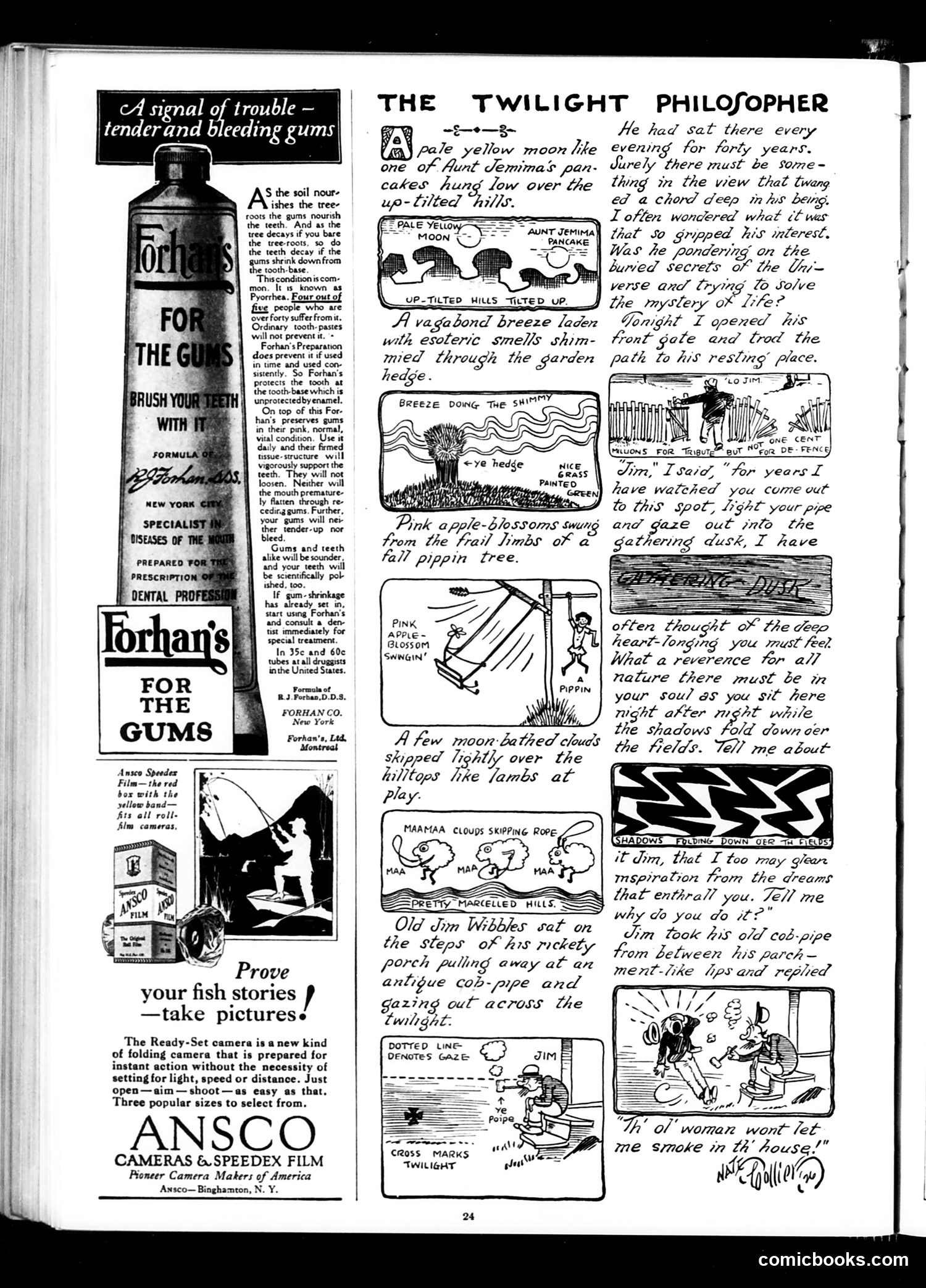
This page is primarily a short story illustrated with comic panels, not political satire. The narrative follows an unnamed narrator who approaches "Old Jim Wibbles," an elderly man who sits nightly on his porch gazing into the twilight landscape. The narrator, moved by what he assumes is Jim's philosophical contemplation of nature and existence, asks Jim to explain his deep spiritual practice. Jim's response—revealed in the final panel—subverts the reader's romantic expectations: he's simply smoking his pipe because "a woman won't let me smoke in th' house." The humor derives from deflating the narrator's (and reader's) assumption that rural simplicity masks profound wisdom. Instead, Jim's evening ritual is merely practical avoidance of domestic complaint. The accompanying advertisements for Forhan's toothpaste and Ansco cameras are period product promotions unrelated to the story's content.
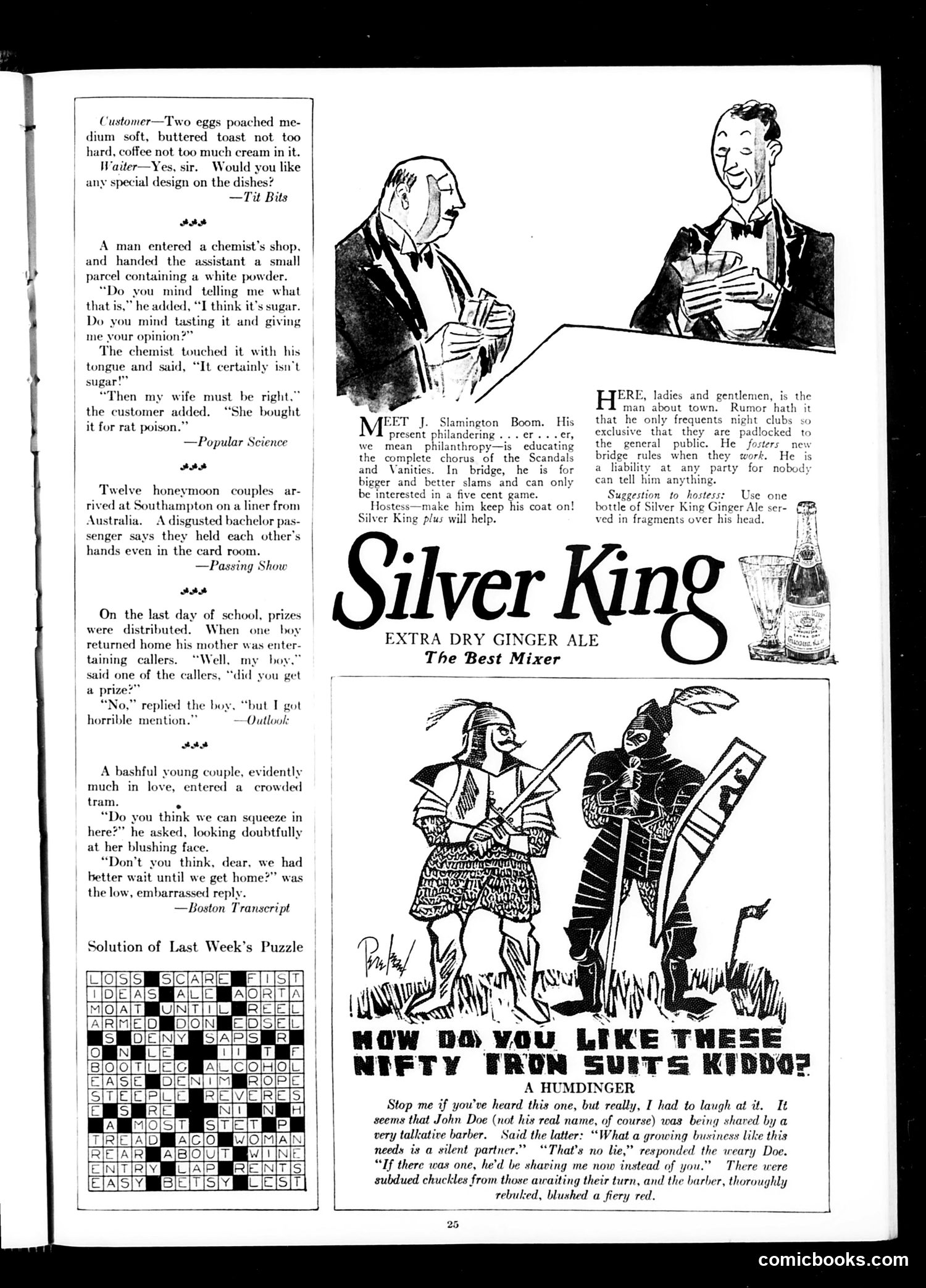
This page combines short humor pieces (common to Judge magazine) with advertising. The jokes target everyday social situations: **Humor Sections:** - A chemist shop anecdote about rat poison mistaken for sugar—satirizing a wife's poor judgment - Honeymoon couples' public displays of affection criticized by a bachelor—poking fun at romantic excess - School prize distribution reversal (boy got "horrible mention" instead)—gentle mockery of failure - A bashful couple on a tram unable to speak plainly about physical closeness—Victorian-era sexual prudishness played for laughs - A barber's talkativeness mocked by a weary customer—commentary on overzealous service workers **Advertisement:** A "Silver King Ginger Ale" ad features caricatured figures in armor suits with the tagline "How Do You Like These Nifty Iron Suits Kiddo?"—likely referencing Medieval aesthetics or a contemporary fashion/theater trend. The page reflects early 20th-century Judge's formula: brief, mild social commentary disguised as anecdotes, plus advertising integrated throughout.
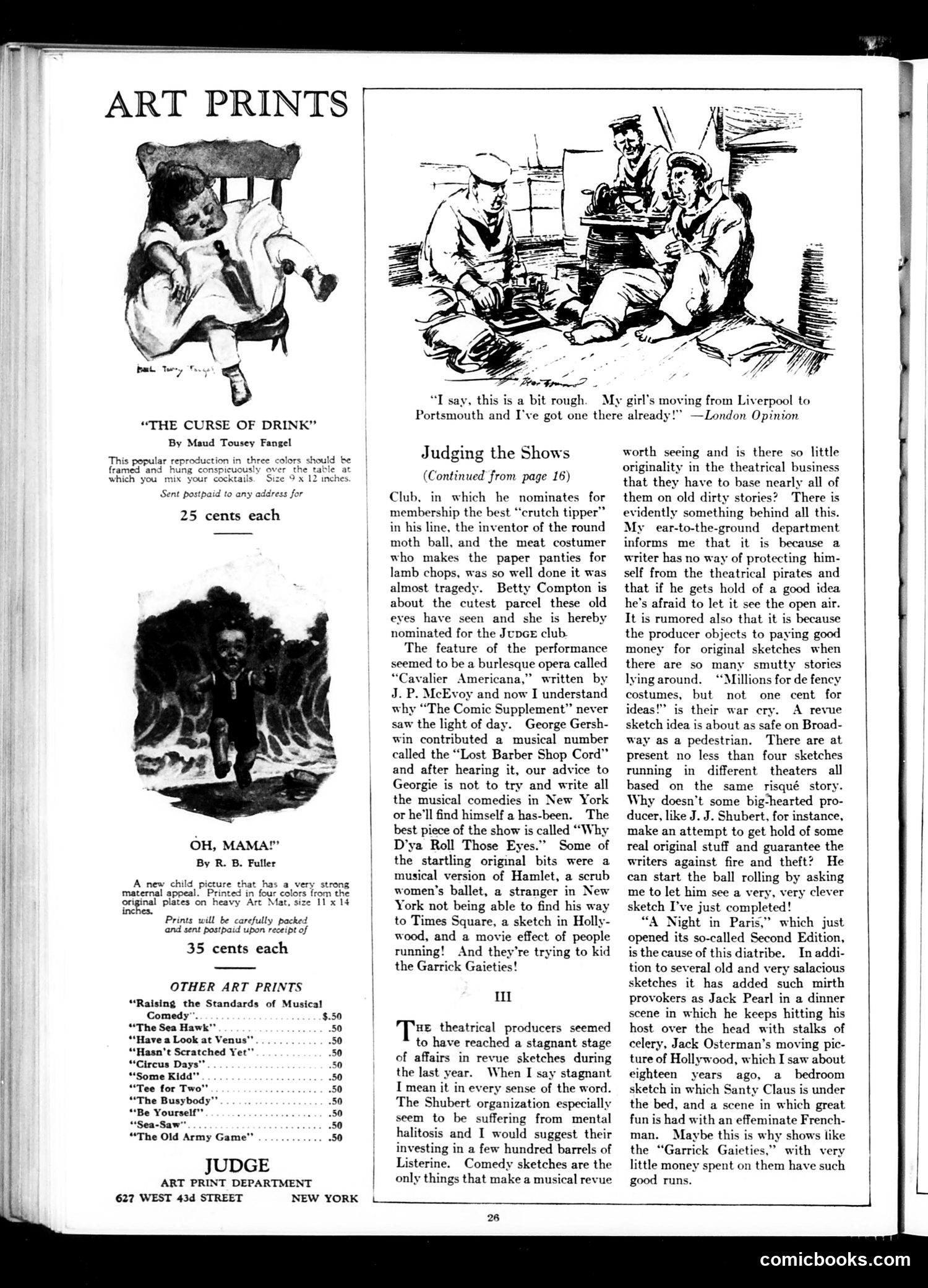
This page is primarily an **art print advertisement section** for Judge's print department, selling reproductions of illustrations and cartoons. The two featured prints are: 1. **"The Curse of Drink"** by Maud Tousey Fangel—a satirical domestic scene showing the effects of alcohol, humorously positioned for display "over the table at which you mix your cocktails" (ironic commentary on Prohibition-era drinking) 2. **"Oh, Mama!"** by R.B. Fuller—described as having "strong maternal appeal," a sentimental child picture The page also includes a theater review column ("Judging the Shows") discussing Broadway revues, particularly criticizing the Shubert organization for lack of originality and recycled risqué material. The cartoonist laments producers' unwillingness to pay for original sketches, fearing theatrical piracy. A small cartoon caption references wartime separation ("Liverpool to Portsmouth"), typical of Judge's topical humor. Overall, this reflects early 20th-century middle-class taste in home decoration and satirical commentary on theater production.
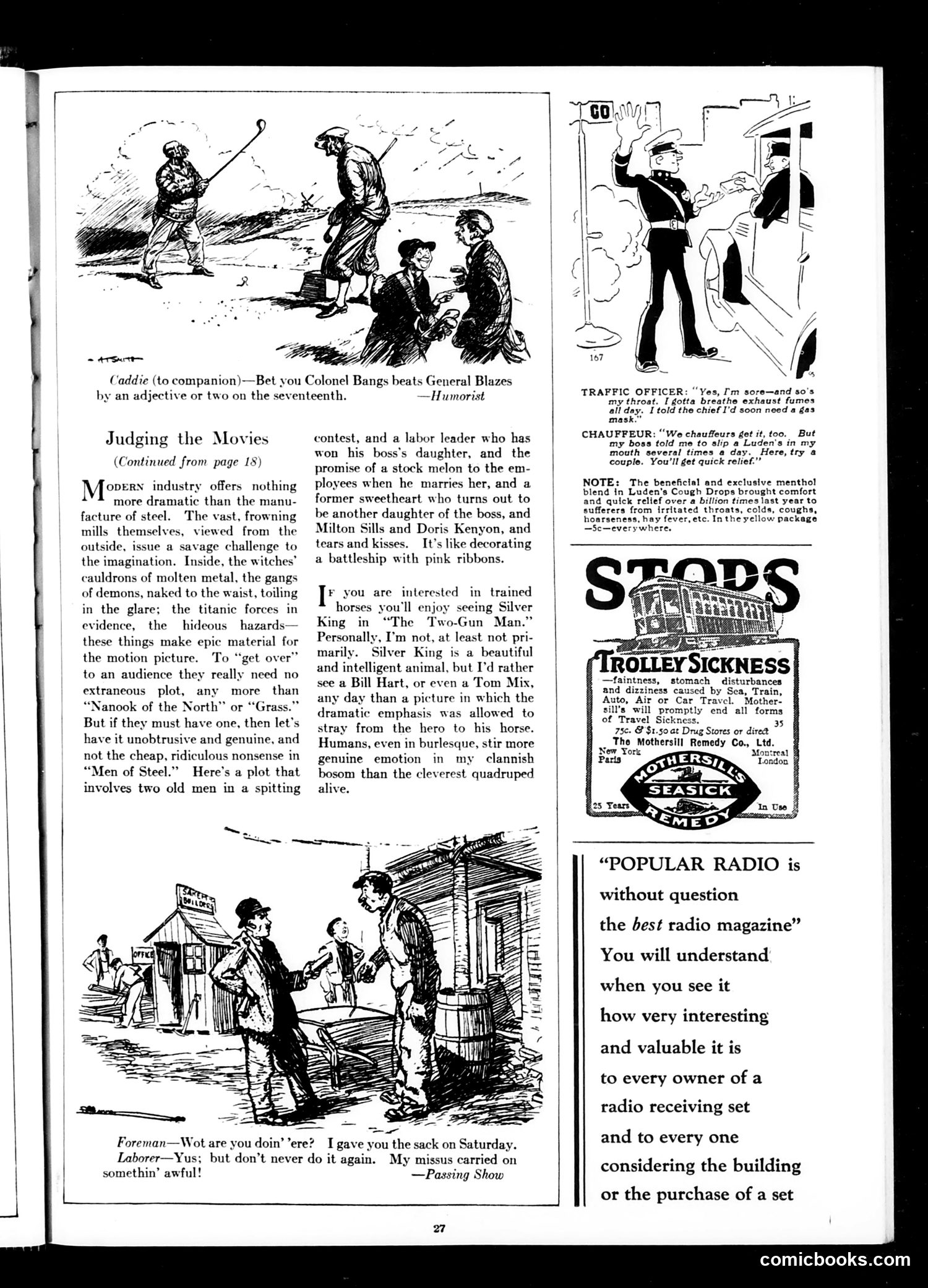
This page from *Judge* magazine contains three distinct elements: **Top cartoon:** Two golfers—"Colonel Bangs" and "General Blazes"—compete on the golf course. The joke plays on their names, suggesting they'll settle the match with colorful language ("adjectives") rather than actual golf skill. This is gentle sports humor about verbose, bombastic personalities. **Middle section:** A film critic reviews steel-industry movies, arguing that dramatic subject matter (molten metal, industrial hazards) needs minimal plot to work. He criticizes "Men of Steel" for cluttering the narrative with melodrama—romance subplots, character coincidences—comparing it absurdly to "decorating a battleship with pink ribbons." He also dismisses "The Two-Gun Man" for focusing on a trained horse instead of human actors like Bill Hart or Tom Mix. **Bottom cartoon:** A traffic officer and chauffeur commiserate about breathing exhaust fumes, leading into an advertisement for Luden's Cough Drops—a period product marketed as relief for irritated throats. The page is primarily **advertising-driven**, with product endorsements for cough drops, seasickness remedy, and radio magazines interspersed with light satirical content.
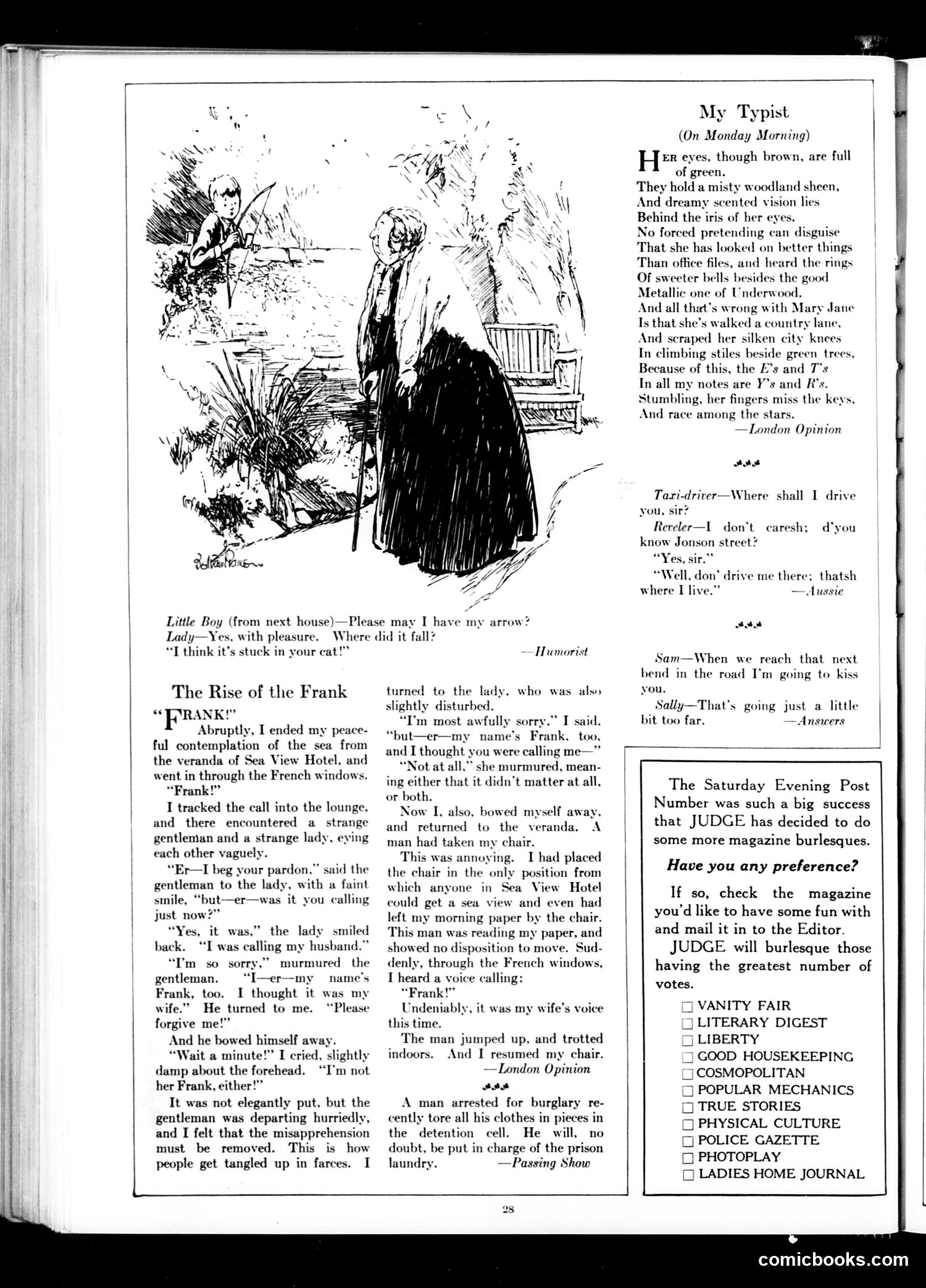
This page contains three humorous short stories typical of early-20th-century Judge magazine's satirical content: **"The Rise of the Frank"** mocks the confusion and awkwardness of mistaken identity. Three men named Frank create comedic chaos at a seaside hotel—a common farce trope. The humor lies in the absurdity of the repeated name-calling and the gentlemen's embarrassed retreats. **"My Typist"** satirizes the romantic distraction of hiring attractive women as office workers. The poem suggests the typist is so beautiful and daydreaming (thinking of countryside romance) that she cannot perform her basic job—her typing is riddled with errors. It mocks both the hiring practice and female employees' perceived incompetence. **The remaining brief jokes** target drunk men, burglary, and courtship—common early-20th-century subjects. The page ends with a reader survey asking which magazine Judge should parody next, showing the publication's interactive engagement with audiences. The content reflects period attitudes toward class, gender, and workplace dynamics.
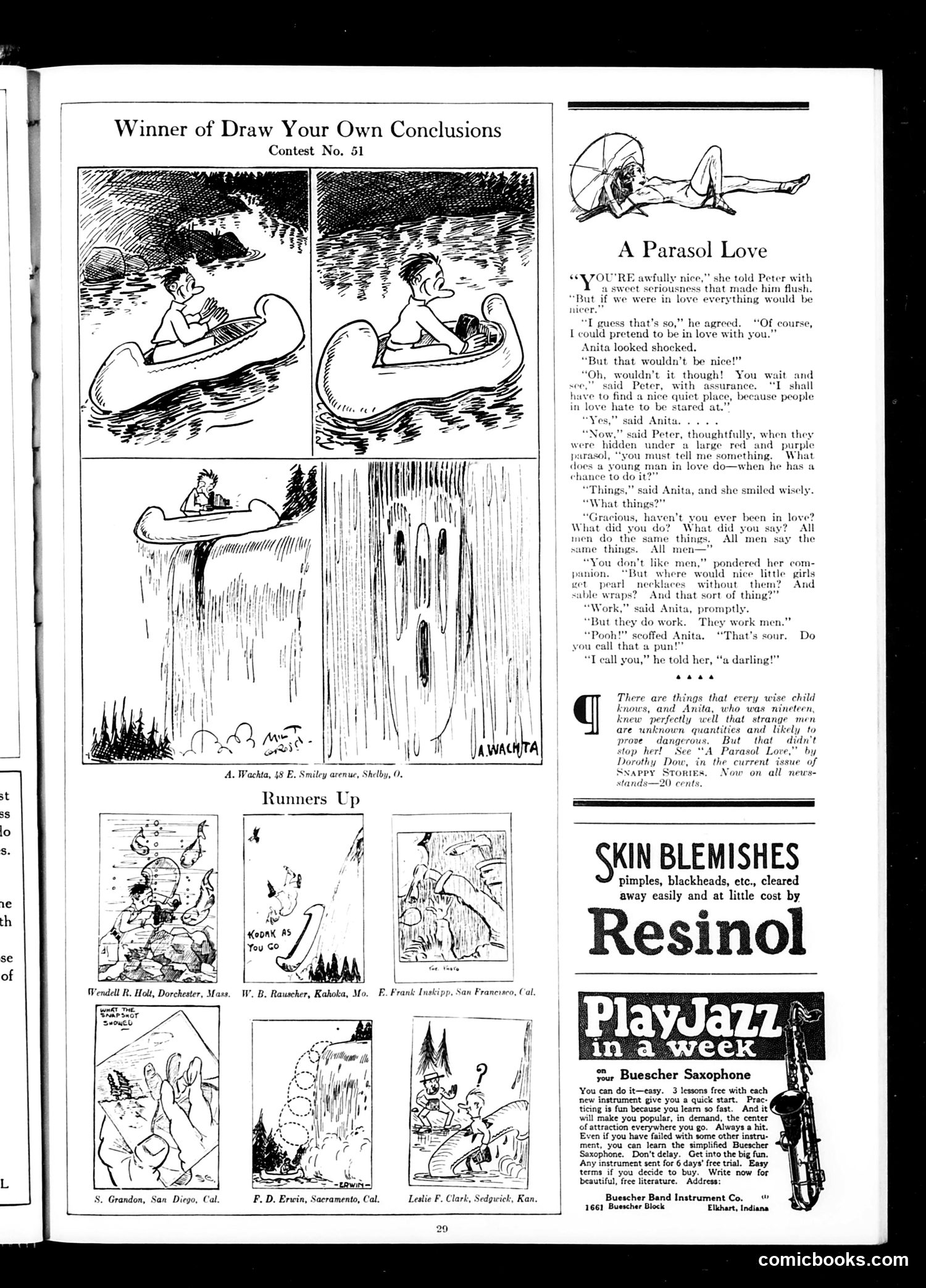
This page features the winning entry in Judge's "Draw Your Own Conclusions" contest, a romantic comic strip about two young people (Peter and Anita) flirting by a river. The three panels show them meeting under a parasol, with dialogue establishing a playful courtship where Peter pretends to teach Anita how young men in love behave. The humor relies on early 20th-century gender dynamics: Anita is portrayed as naive and innocent (though "nineteen"), while Peter represents masculine sophistication. The joke hinges on her shock that he'd "pretend" to be in love, followed by their banter about what men and women do—she insists women should work for luxuries rather than rely on men for "pearl necklaces" and "sable wraps," yet she allows his romantic advances anyway. The accompanying text warns that "strange men are unknown quantities and likely to prove dangerous," suggesting the real satire targets young women's risky romantic behavior despite knowing better. The page also includes runner-up cartoons and period advertisements for skin cream and saxophones.
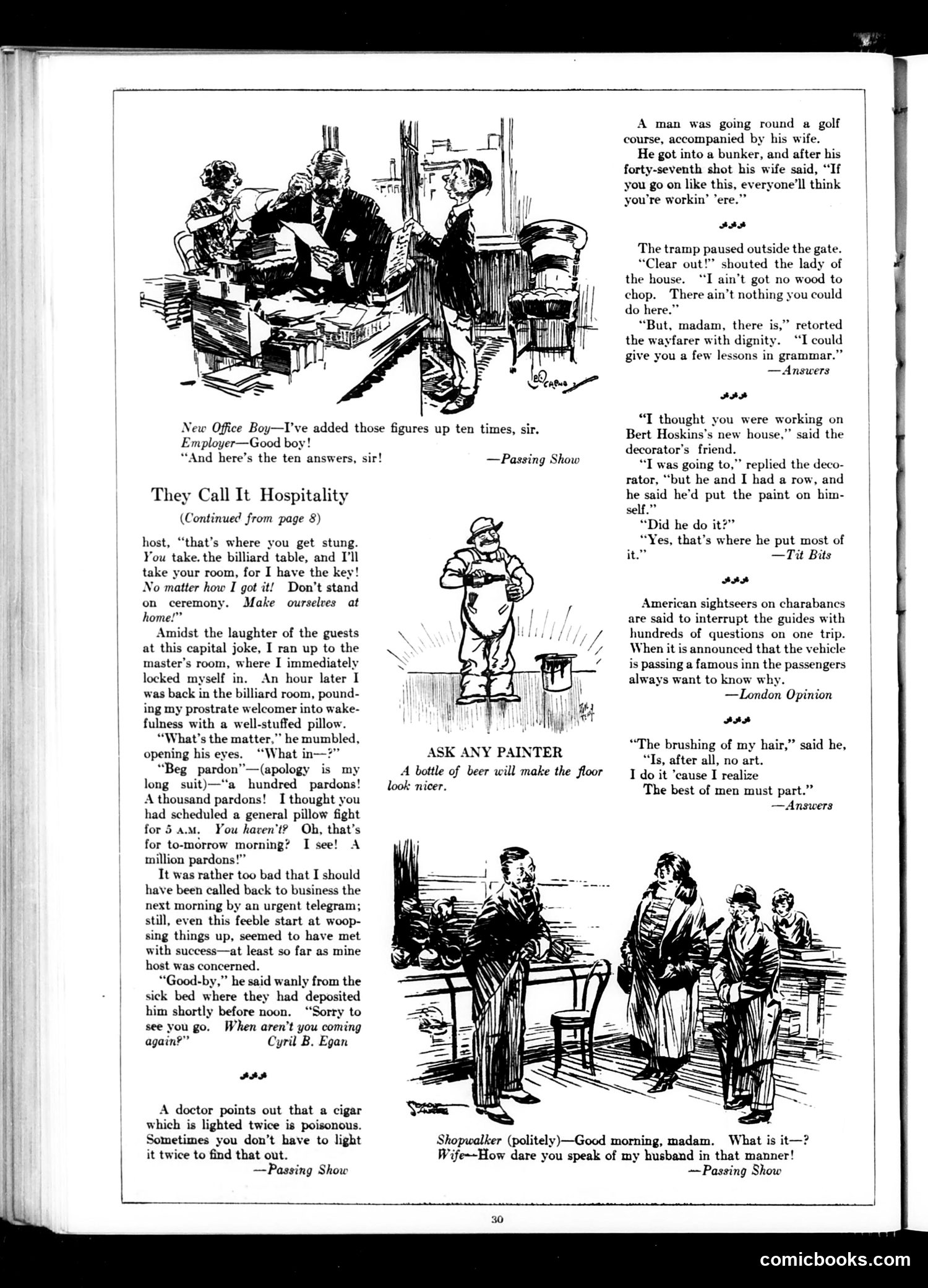
This page from *Judge* contains multiple short humorous pieces typical of early 20th-century satirical magazines: **"They Call It Hospitality"** (main story): A guest's account of visiting a rude host who jokes about stealing the guest's room. The narrator retaliates by attacking the sleeping host with a pillow at 5 a.m., claiming he misunderstood the "pillow fight" schedule. The host ends up bedridden but insists the guest return—satirizing false Southern hospitality and passive-aggressive revenge. **Scattered jokes** mock everyday absurdities: an office boy adding figures multiple ways, painters drinking beer, tramps offering grammar lessons, American tourists asking endless questions, and a wife offended by a shopkeeper's innocent greeting. The humor relies on wordplay, misunderstandings, and exaggerated social situations rather than political commentary. These reflect middle-class anxieties and etiquette violations of the era.
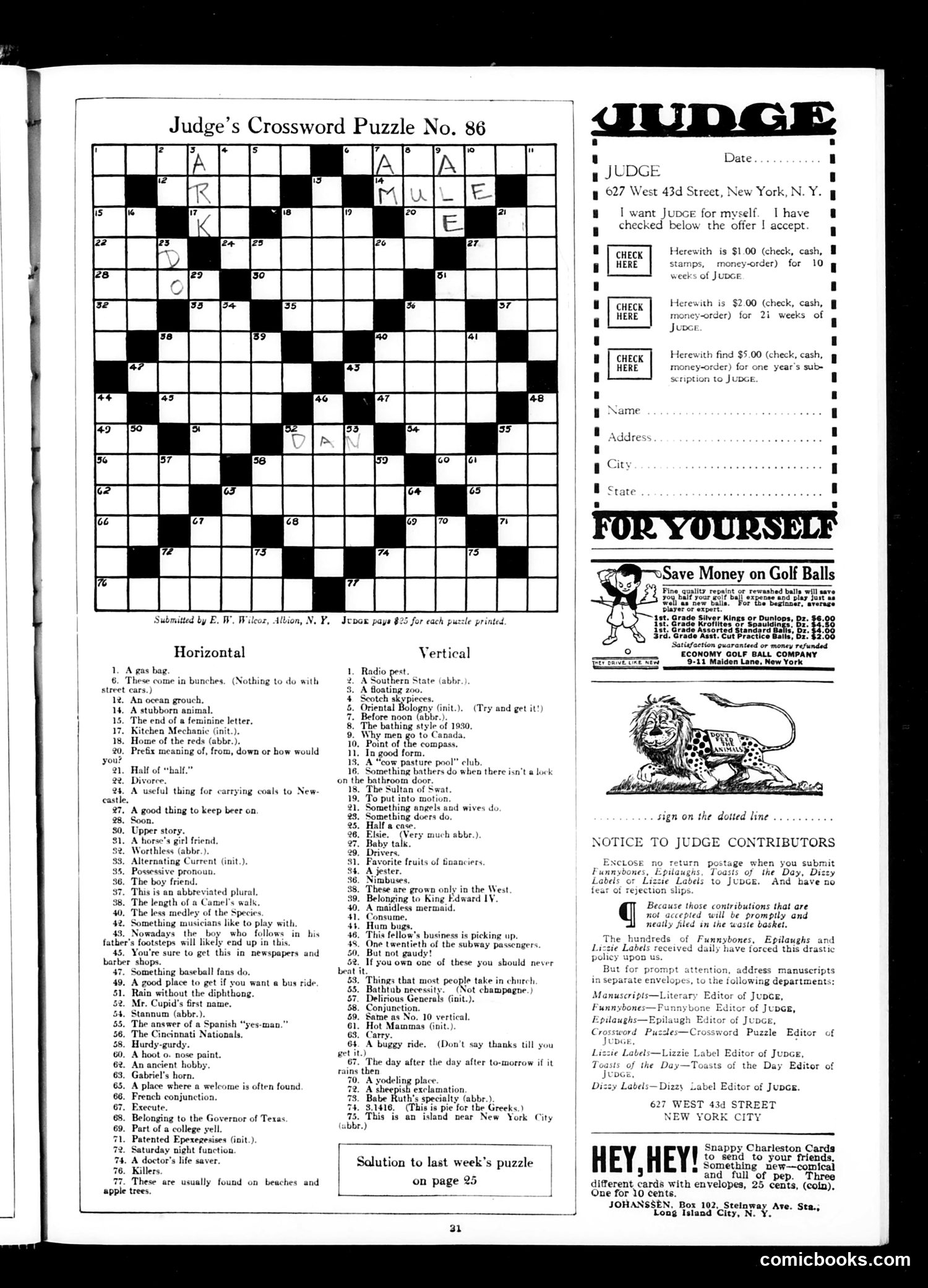
This page is primarily a **crossword puzzle with clues**, not a political cartoon. It's from Judge, a satirical weekly magazine published from the 1880s-1960s known for humor and social commentary. The puzzle itself uses period-appropriate humor in its clues—references include "The Cincinnati Nationals" (baseball), "Babe Ruth's specialty," "The Sultan of Swat" (Ruth's nickname), and contemporary slang like "Hot Mammas." The clues reference 1920s-era cultural touchstones: prohibition ("Why men go to Canada"), bathing fashions, and vaudeville entertainment. The surrounding advertisements (golf balls, subscription offers) and contributor notices indicate this is a standard issue page mixing entertainment with marketing. The cartoon masthead labeled "FOR YOURSELF" appears to be Judge's logo rather than editorial commentary. The page primarily serves as **entertainment and subscription promotion** rather than satire.
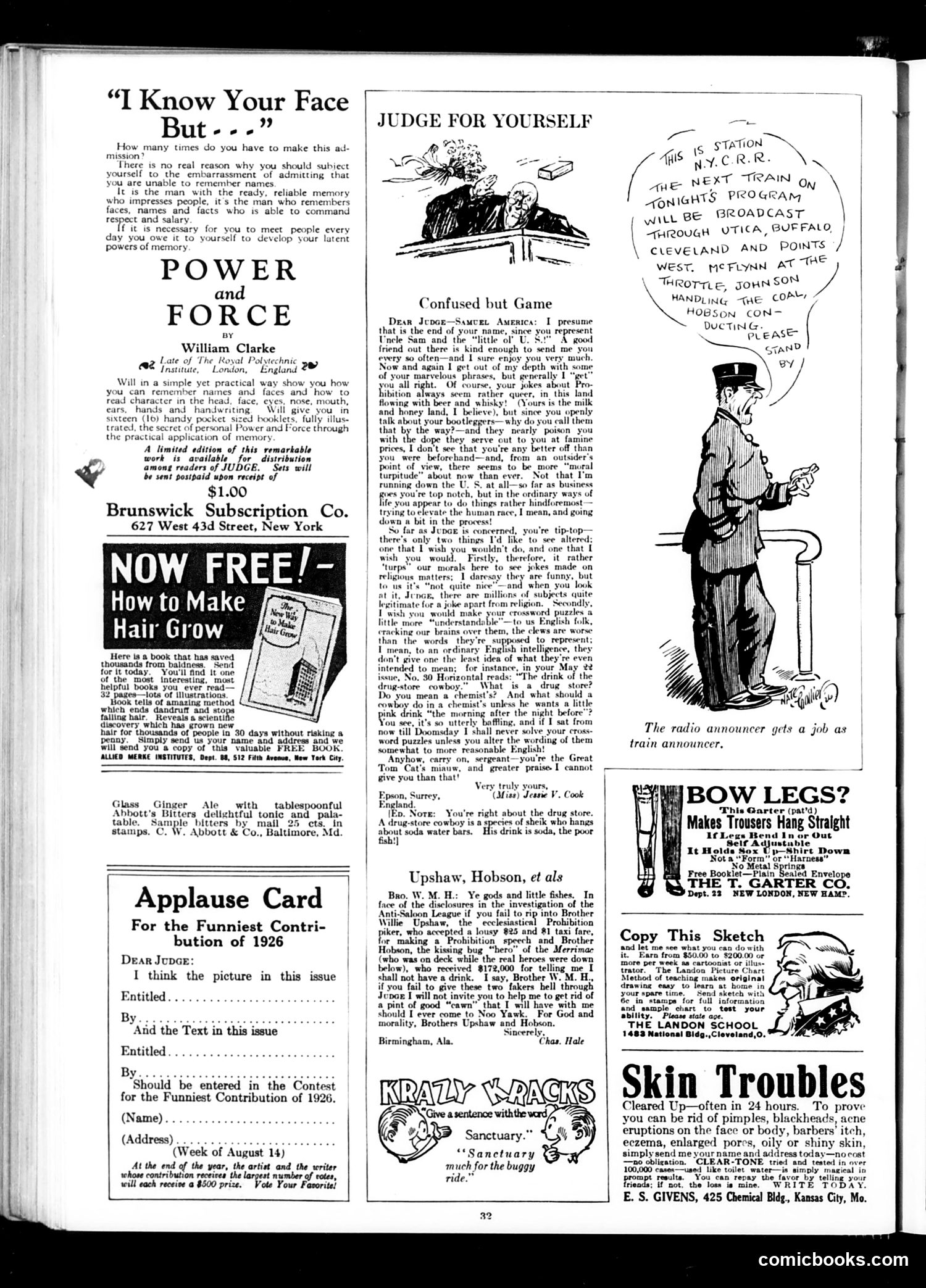
This page from *Judge* magazine contains satirical commentary on American culture circa 1926. **"Judge for Yourself" cartoon**: A reader (identified as "Samuel America") writes to complain about *Judge* magazine's American content. He's confused by American slang and critiques U.S. Prohibition policies as hypocritical—Americans joke about bootleggers while claiming moral superiority. He also objects to religious humor in the magazine, which he finds offensive compared to English standards. **The cartoon illustration** shows a train announcer enthusiastically broadcasting route information, depicting the stereotypical American tendency toward boastful self-promotion and excessive talking. The satire targets American contradictions: preaching morality while flouting Prohibition laws, and exporting cultural values while ignoring hypocrisy. The British correspondent's bewilderment highlights how Americans appeared to outsiders during the Jazz Age. The page also contains period advertisements (hair growth, bow-leg correction) typical of 1920s magazines.
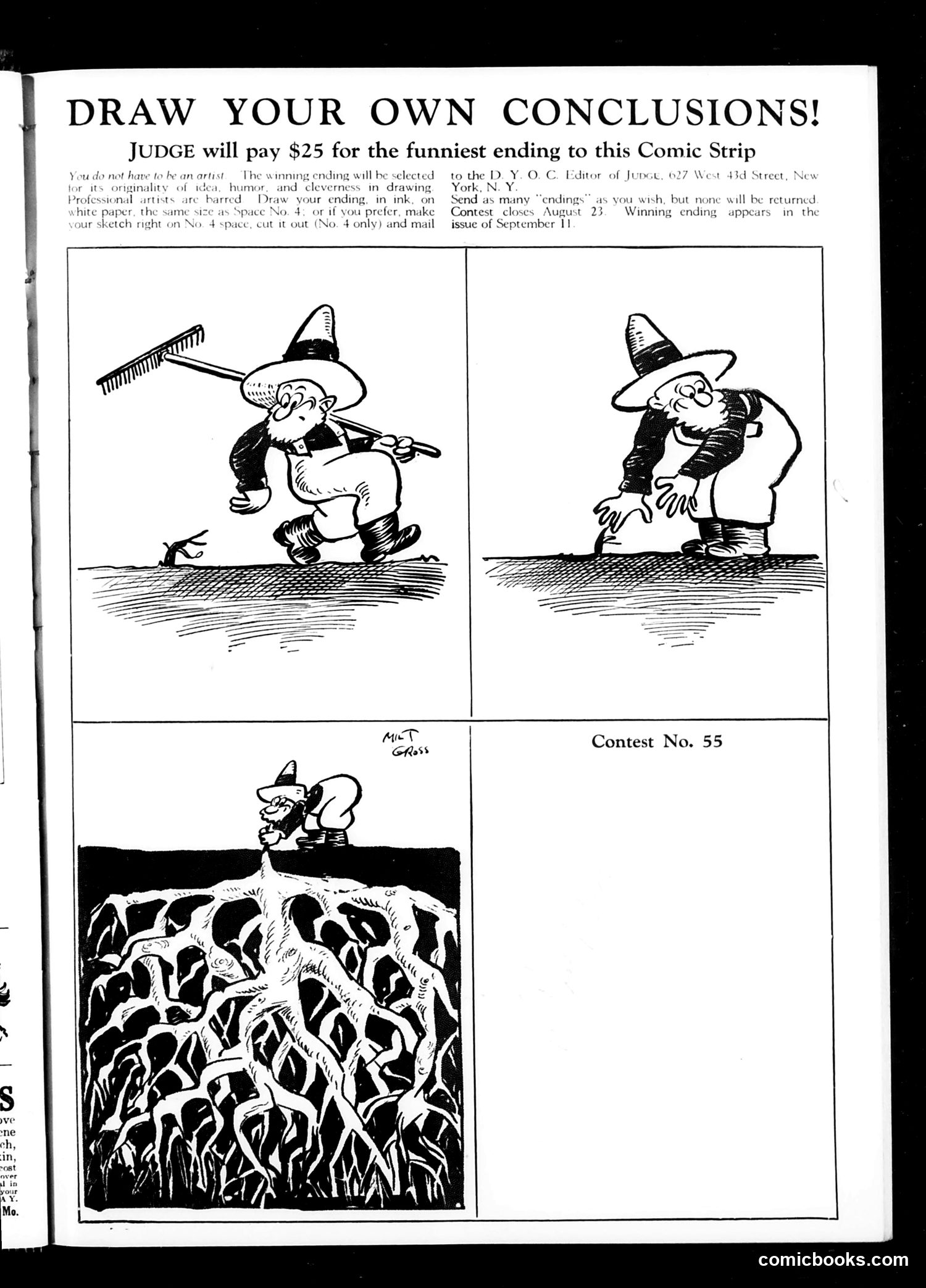
This is a reader-participation contest page from *Judge* magazine. The publication invites readers to complete an unfinished comic strip by drawing their own ending in the blank panel (lower right). The setup shows two panels with a bearded man in a hat holding a rake, and a third panel depicting him standing atop a massive pile of corn stalks or dried vegetation. The joke's punchline is missing—readers must supply it. *Judge* offered $25 to the winner, with submissions due August 23. The winning ending would be published in the September 11 issue. Readers could submit multiple entries, drawn in ink on standard paper, mailed to the magazine's New York office. This illustrates how mid-20th-century magazines engaged audiences through interactive content, turning readers into amateur comedians competing for modest cash prizes.
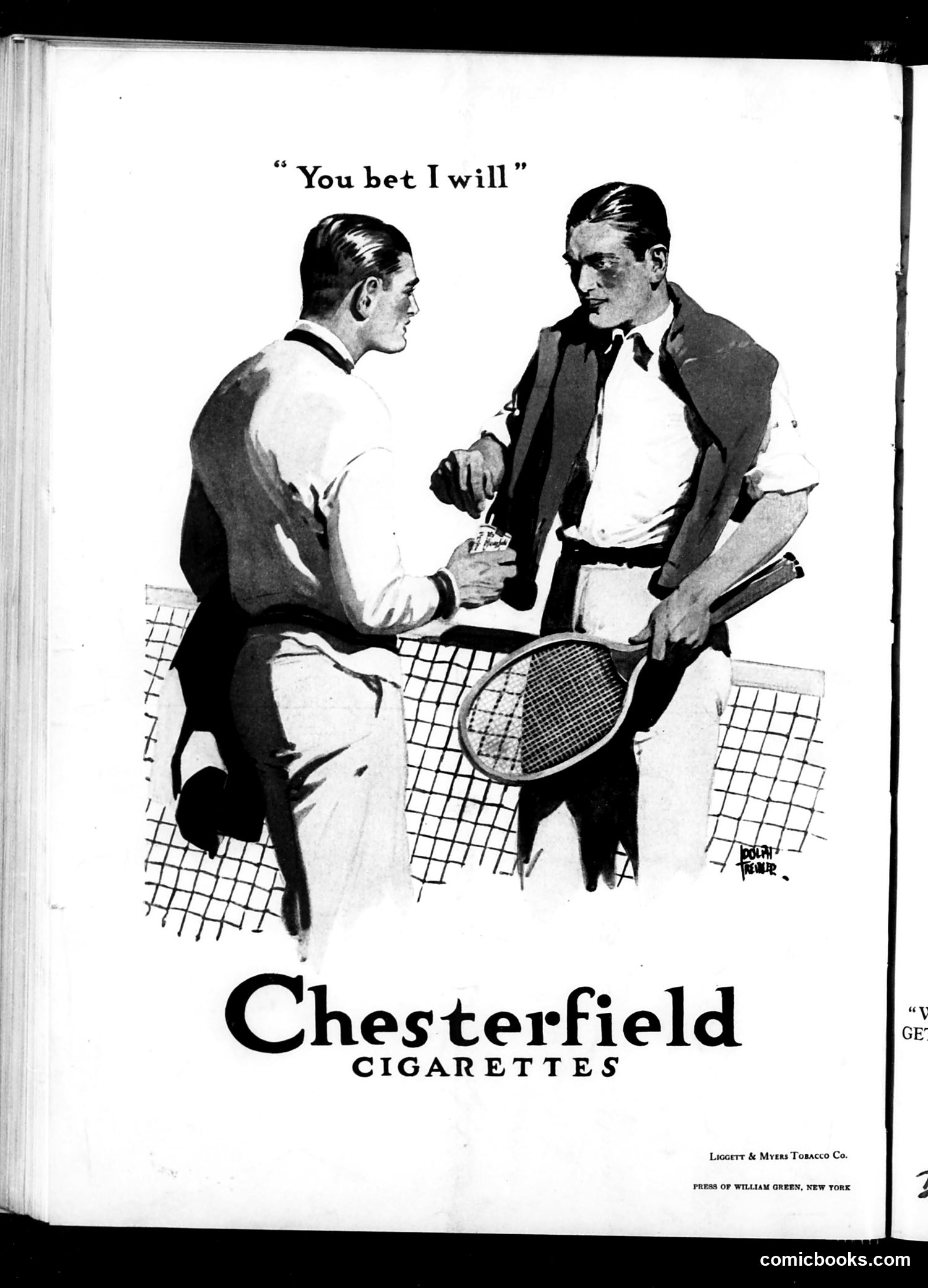
This is a full-page cigarette advertisement rather than political satire. It depicts two men in business attire having a conversation on a tennis court, with one holding a tennis racket. The caption "You bet I will" suggests one man is making a confident claim or acceptance to the other. The ad associates Chesterfield cigarettes with leisure, sports, and masculine confidence—common advertising strategies of the early-to-mid 20th century. The well-dressed businessmen imply smoking enhances social status and casual sophistication. Published by Liggett & Myers Tobacco Co., this represents typical cigarette marketing before health warnings became mandatory. The Judge magazine placement suggests advertising to educated, affluent readers.