
Judge, 1926-08-14 · page 15 of 36
Judge — August 14, 1926 — page 15: what you’re looking at
What you’re looking at
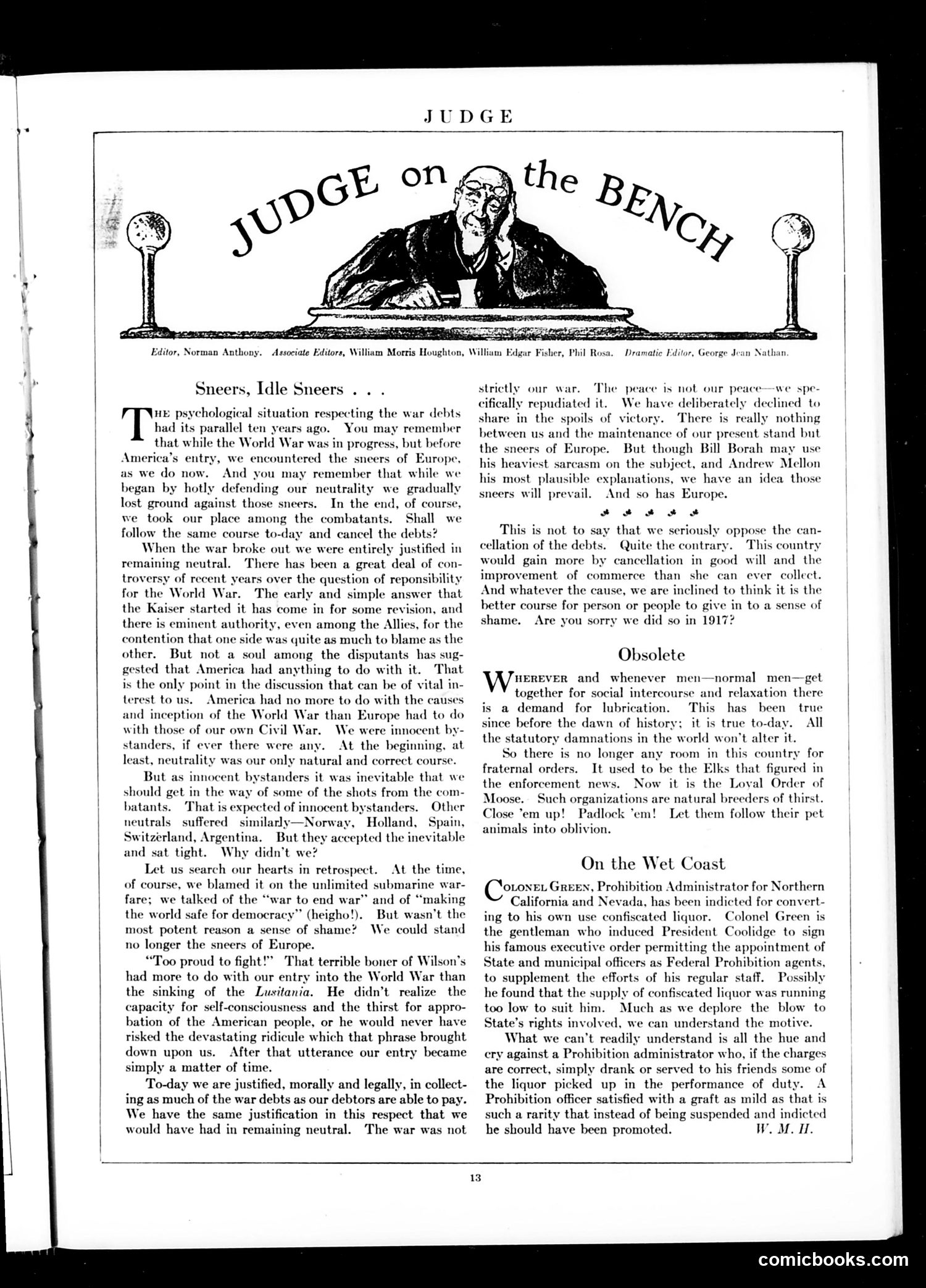
This editorial cartoon critiques American post-WWI debt collection policy. The main illustration shows a stern judge at his bench, symbolizing America's legal but morally questionable position. The text argues that America entered WWI primarily due to European mockery (particularly Wilson's "Too proud to fight" comment) rather than genuine war necessity. Now, the author claims, similar "sneers" will pressure America to cancel war debts owed by European nations—despite America's legal right to collect them. The satirical point: America is about to repeat its mistake. Just as shame pushed us into an unnecessary war, shame will likely force debt forgiveness, even though economically canceling debts would actually benefit America more through improved commerce and goodwill than through collection. The cartoon mocks American susceptibility to European scorn and predicts we'll surrender financial claims rather than endure ridicule—essentially calling out American vanity as a foreign policy driver.
📄 Transcribed text from this page (OCR, searchable)
Machine-transcribed from the original scan — historical spelling and the odd misread are preserved.
JUDGE Editor, Norman Anthony. Sneers, Idle Sneers . . . r I NueE psychological situation respecting the war debts had its parallel ten years ago. You may remember that while the World War was in progress, but before America’s entry, we encountered the sneers of Europe, as we do now. And you may remember that while we began by hotly defending our neutrality we gradually lost ground against those sneers. In the end, of course, we took our place among the combatants. Shall we follow the same course to-day and cancel the debt When the war broke out we were entirely justified in remaining neutral. There has been a great deal of con- troversy of recent years over the question of reponsibility for the World War. The early and simple answer that the Kaiser started it has come in for some revision, and there is eminent authority, even among the Allies, for the contention that one side was quite as much to blame as the other. But not a soul among the disputants has sug- gested that America had anything to do with it. That is the only point in the discussion that can be of vital in- terest to us. America had no more to do with the causes. and inception of the World War than Europe had to do with those of our own Civil War. standers, if We were innocent by- At the beginning, least, neutrality was our only natural and correct course. But as innocent bystanders it was inevitable that we should get in the way of some of the shots from the com- batants. That is expected of innocent bystanders. Other neutrals suffered similarly—Norway, Holland, Spain, Switzerland, Argentina. But they accepted the inevitable and sat tight. Why didn’t we? Let us search our hearts in retrospect. At the time, of course, we blamed it on the unlimited submarine war- fare; we talked of the “war to end war” and of “making the world safe for democracy” (heigho!). But wasn’t the most potent reason a sense of shame? We could stand no longer the sneers of Europe. “Too proud to fight!” That terrible boner of Wilson’s had more to do with our entry into the World War than the sinking of the Lusitania. He didn’t realize the capacity for self-consciousness and the thirst for appro- bation of the American people, or he would never have risked the devastating ridicule which that phrase brought down upon us. After that utterance our entry became ever there were any. a simply a matter of time. To-day we are justified, morally and legally, in collect- ing as much of the war debts as our debtors are able to pay. We have the same justification in this respect that we The war was not would have had in remaining neutral. Associate Editors, William Morris Houghton, William Edgar Fisher, Phil Rosa. Dramatic Editor, George Jean Nathan strictly our war. ‘The peace is not our peace—we spe- ally repudiated it. We have deliberately declined to share in the spoils of victory. There is really nothing between us and the maintenance of our present stand but the sneers of Europe. But though Bill Borah may use his heaviest sarcasm on the subject, and Andrew Mellon his most plausible explanations, we have an idea those sneers will prevail. And so has Europe. een ee This is not to say that we seriously oppose the can- cellation of the debts. Quite the contrary. This country would gain more by cancellation in good will and the improvement of commerce than she can ever collect. And whatever the cause, we are inclined to think it is the better course for person or people to give in to a sense of shame. Are you sorry we did so in 1917? Obsolete HEREVER and whenever men—normal men—get together for social intercourse and relaxation there is a demand for lubrication. This has been true since before the dawn of history; it is true to-day. All the statutory damnations in the world won't alter it. So there is no longer any room in this country for fraternal orders. It used to be the Elks that figured in Now it is the Loval Order of Such organizations are natural breeders of thirst. Padlock ‘em! Let them follow their pet animals into oblivion. the enforcement news. Moose. Close ‘em up! On the Wet Coast OLONEL GREEN, Prohibition Administrator for Northern California and Nevada, has been indicted for convert- ing to his own use confiscated liquor. Colonel Green is the gentleman who induced President Coolidge to sign his famous executive order permitting the appointment of State and municipal officers as Federal Prohibition agents, to supplement the efforts of his regular staff. Possibly he found that the supply of confiscated liquor was running too low to suit him. Much as we deplore the blow to State’s rights involved, we can understand the motive. What we can’t readily understand is all the hue and cry against a Prohibition administrator who, if the charges are correct, simply drank or served to his friends some of the liquor picked up in the performance of duty. A Prohibition officer satisfied with a graft as mild as that is such a rarity that instead of being suspended and indicted he should have been promoted. W. MH. comicbooks.com