
Judge, 1926-08-14 · page 28 of 36
Judge — August 14, 1926 — page 28: what you’re looking at
What you’re looking at
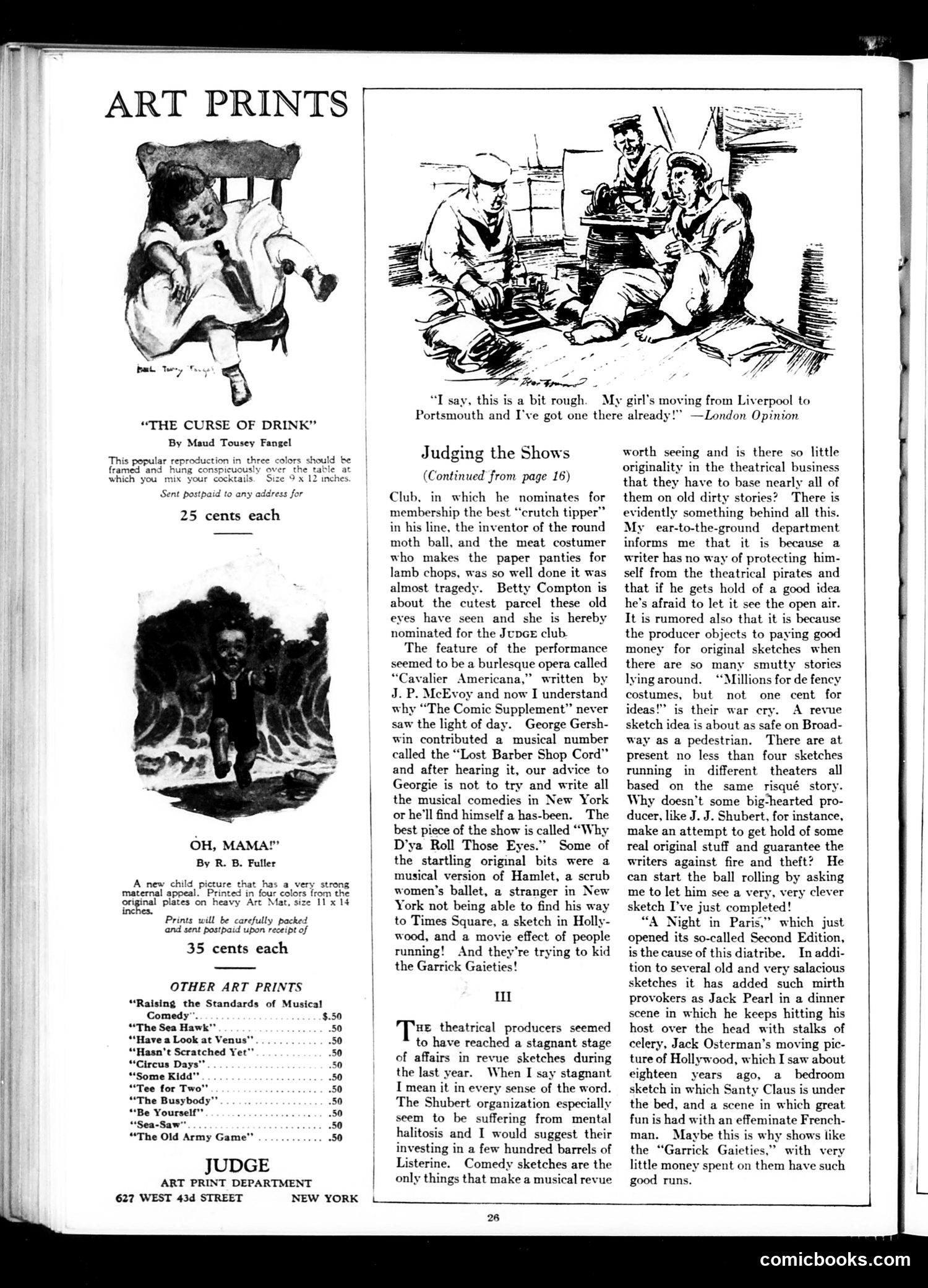
This page is primarily an **art print advertisement section** for Judge's print department, selling reproductions of illustrations and cartoons. The two featured prints are: 1. **"The Curse of Drink"** by Maud Tousey Fangel—a satirical domestic scene showing the effects of alcohol, humorously positioned for display "over the table at which you mix your cocktails" (ironic commentary on Prohibition-era drinking) 2. **"Oh, Mama!"** by R.B. Fuller—described as having "strong maternal appeal," a sentimental child picture The page also includes a theater review column ("Judging the Shows") discussing Broadway revues, particularly criticizing the Shubert organization for lack of originality and recycled risqué material. The cartoonist laments producers' unwillingness to pay for original sketches, fearing theatrical piracy. A small cartoon caption references wartime separation ("Liverpool to Portsmouth"), typical of Judge's topical humor. Overall, this reflects early 20th-century middle-class taste in home decoration and satirical commentary on theater production.
📄 Transcribed text from this page (OCR, searchable)
Machine-transcribed from the original scan — historical spelling and the odd misread are preserved.
ART PRINTS “THE CURSE OF DRINK” By Maud Tousey Fangel This popular reproduction in three colors should be framed and hung conspicuously over the table at which you mix your cocktails x 12 inches. Sent postpaid to any address for 25 cents each OH, MAMA!” By R. B. Fuller A new child picture that has a very strong | maternal appeal. Printed in four colors from the original plates on heavy Art Mat, size Il x l4 inches. Prints will be carefully packed and sent postpaid upon receipt of | 35 cents each | OTHER ART PRINTS “Raising the Standards of Musical Comedy”. $.50 | “The Sea Hawk” 50 “Have a Look at Venus" = 50 “Hasn't Scratched Yet" 50 “Circus Days’ 50 “Some Kidd" -50 “Tee for Two" 50 “The Busybody"” -50 “Be Yourself” . eeccees SO | “Sea-Saw" ‘ 50 | “The Old Army Game” seeee 5O | JUDGE | ART PRINT DEPARTMENT | 627 WEST 43d STREET NEW YORK L “I say, this is a bit rough. My girl's moving from Liverpool to Portsmouth and I've got one there already!” —London Opinion Judging the Shows (Continued from page 16) Club, in which he nominates for membership the best “crutch tipper” in his line, the inventor of the round moth ball, and the meat costumer who makes the paper panties for lamb chops, was so well done it was almost tragedy. Betty Compton is about the cutest parcel these old eyes have seen and she is hereby nominated for the JupcE club. The feature of the performance seemed to be a burlesque opera called “Cavalier Americana,” written by J. P. McEvoy and now I understand why “The Comic Supplement” never saw the light of day. George Gersh- win contributed a musical number called the “Lost Barber Shop Cord” and after hearing it, our advice to Georgie is not to try and write all the musical comedies in New York or he'll find himself a has-been. The best piece of the show is called “Why D’ya Roll Those Eyes.” Some of the startling original bits were a musical version of Hamlet, a scrub women’s ballet, a stranger in New York not being able to find his way to Times Square, a sketch in Holly- wood, and a movie effect of people running! And they're trying to kid the Garrick Gaieties! Il T= theatrical producers seemed to have reached a stagnant stage of affairs in revue sketches during the last year. When I say stagnant I mean it in every sense of the word. The Shubert organization especially seem to be suffering from mental halitosis and I would suggest their investing in a few hundred barrels of Listerine. Comedy sketches are the only things that make a musical revue worth seeing and is there so little originality in the theatrical business that they have to base nearly all of them on old dirty stories? There is evidently something behind all this. My ear-to-the-ground department informs me that it is because a writer has no way of protecting him- self from the theatrical pirates and that if he gets hold of a good idea he’s afraid to let it see the open air. It is rumored also that it is because the producer objects to paying good money for original sketches when there are so many smutty stories lying around. ‘‘Millions for de fency costumes, but not one cent for ideas!” is their war cry. A revue sketch idea is about as safe on Broad- way as a pedestrian. There are at present no less than four sketches running in different theaters all based on the same risqué story. Why doesn’t some big-hearted pro- ducer, like J. J. Shubert, for instance, make an attempt to get hold of some real original stuff and guarantee the writers against fire and theft? He can start the ball rolling by asking me to let him see a very, very clever sketch I’ve just completed! “A Night in Paris,” which just opened its so-called Second Edition, is the cause of this diatribe. In addi- tion to several old and very salacious sketches it has added such mirth provokers as Jack Pearl in a dinner scene in which he keeps hitting his host over the head with stalks of celery, Jack Osterman’s moving pic- ture of Hollywood, which I saw about eighteen years ago, a bedroom sketch in which Santy Claus is under the bed, and a scene in which great fun is had with an effeminate French- man. Maybe this is why shows like the “Garrick Gaietie with very little money spent on them have such good runs. 26 comicbooks.com