
A complete issue · 36 pages · 1926
Judge — July 10, 1926
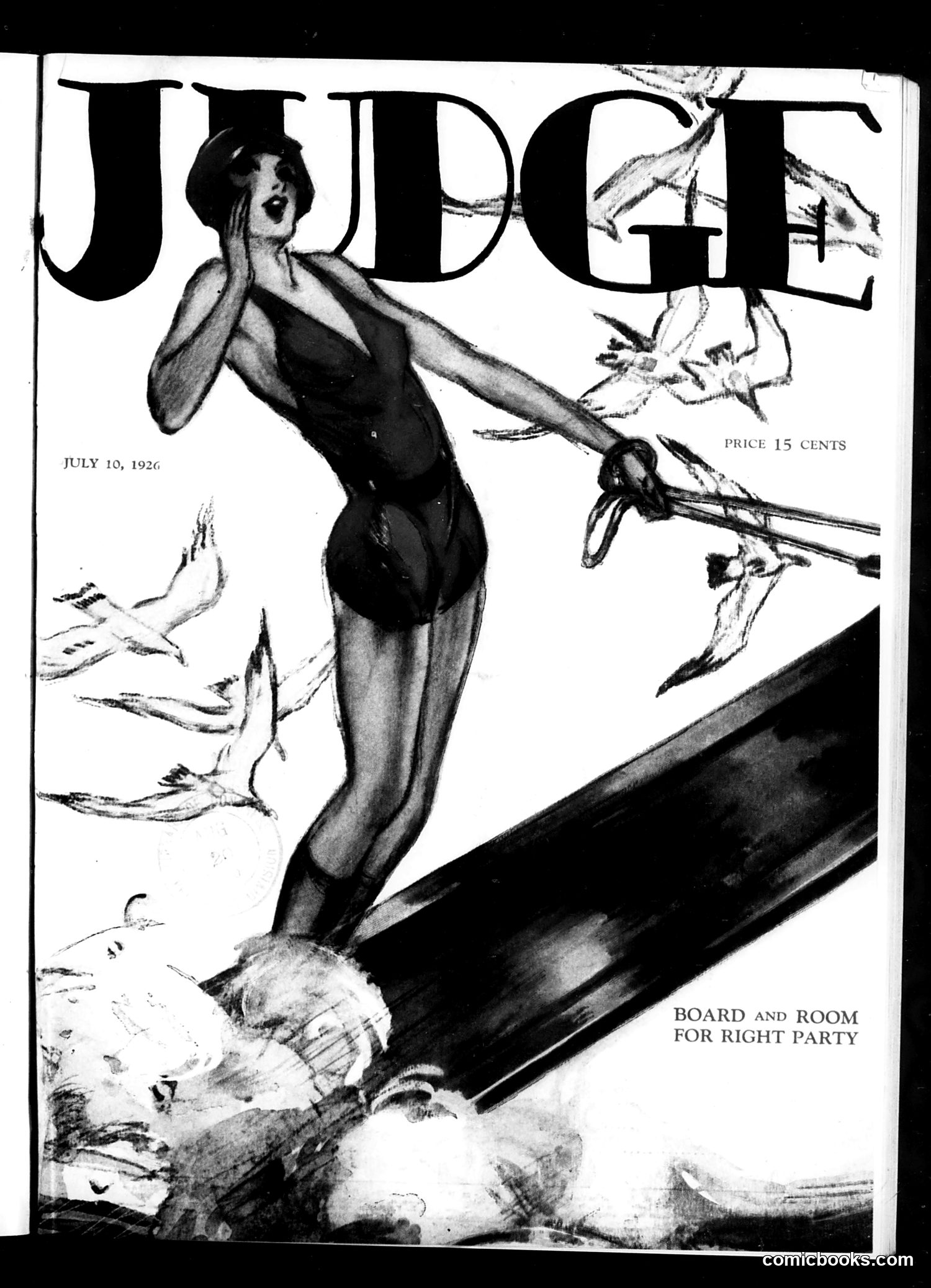
This cover depicts a woman in a bathing suit balancing precariously on a log while juggling fish. The accompanying text reads "Board and Room for Right Party." The satire appears to reference the "roaring twenties" social attitudes toward women. The woman's precarious position and the fish she's juggling likely symbolize the challenges of domestic life or romantic entanglement. "Board and Room for Right Party" suggests the classified advertisement section—possibly mocking housing advertisements of the era or commenting on courtship customs. The bathing suit and active pose reflect 1920s anxieties about changing women's roles and the "modern woman" phenomenon. The cartoon likely uses the unstable balancing act as metaphor for women navigating new social freedoms while managing traditional domestic expectations.
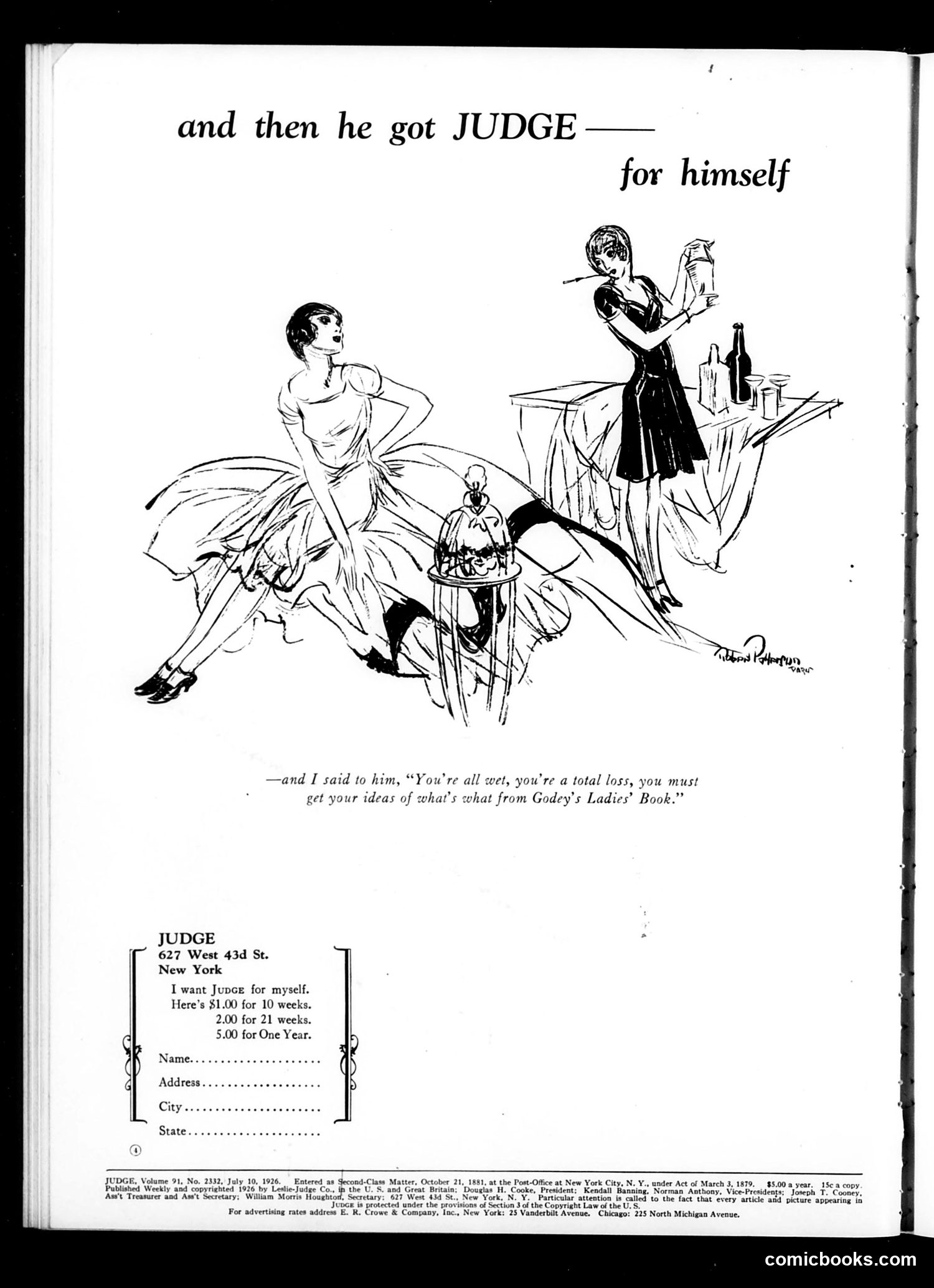
This page satirizes fashionable women's behavior in the 1920s Jazz Age. The cartoon depicts three stylishly dressed women at what appears to be a social gathering, with the headline "and then he got JUDGE—for himself." The joke relies on a double meaning: the man obtained a subscription to *Judge* magazine (the publication itself), but the phrase suggests he "got judge" or judgment/wisdom about women's frivolous behavior. The accompanying caption mocks the women's superficiality, referencing "Godey's Ladies' Book"—a rival women's magazine known for fashion advice. The satire targets the era's modern woman: her drinking (visible bottles), dancing, and devotion to fashion magazines. The cartoon critiques both female consumerism and male exasperation with contemporary women's independence and lifestyle choices.
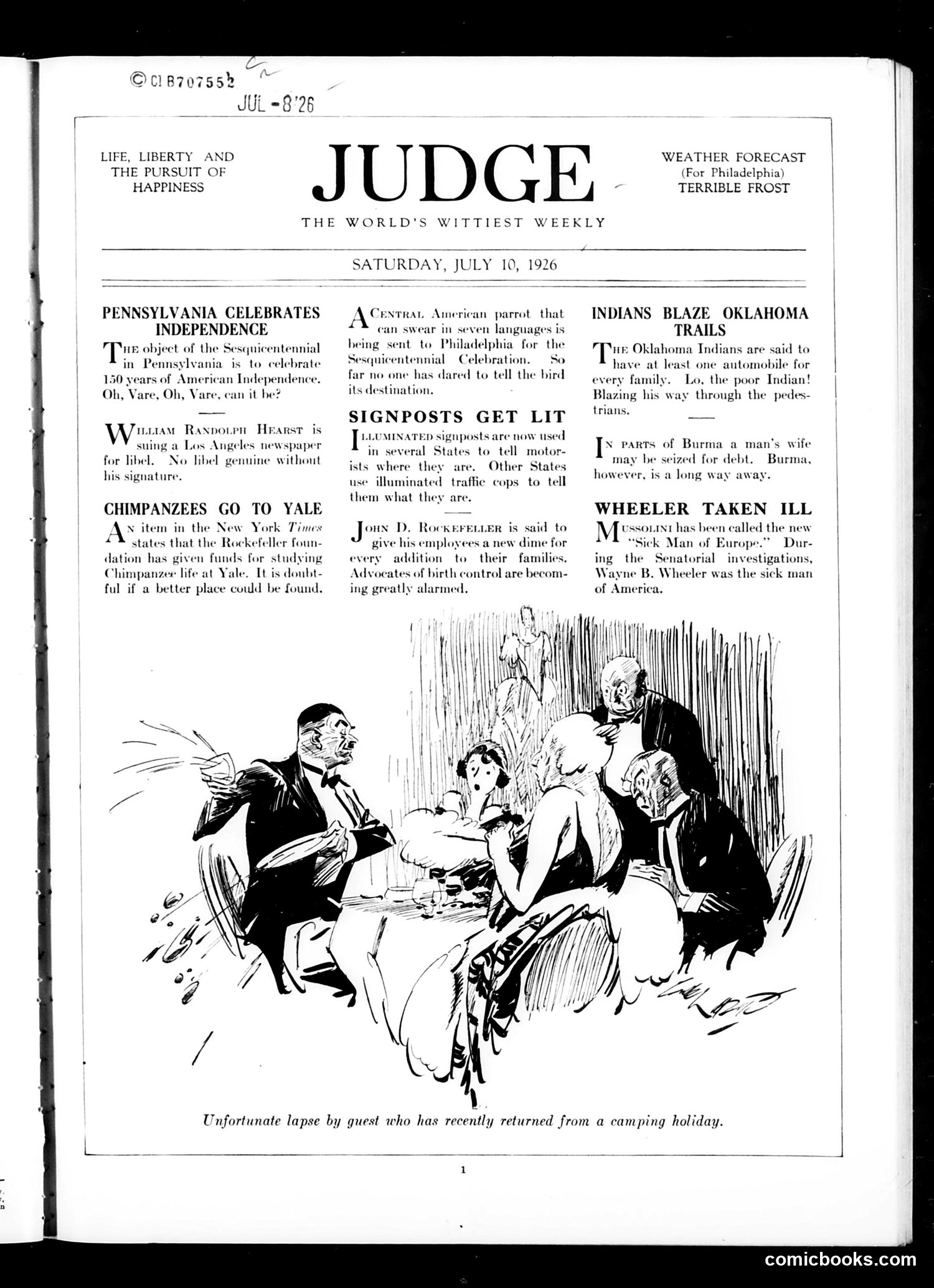
The main cartoon depicts an "Unfortunate lapse by guest who has recently returned from a camping holiday." It shows a woman at a dinner party who has apparently forgotten her manners or etiquette after roughing it outdoors. The well-dressed dinner guests (drawn as caricatured men in formal wear) react with shock and disapproval to her behavior. This satirizes the tension between civilized urban society and outdoor recreation—a growing leisure activity in the 1920s. The joke suggests that camping trips caused people to lose their social refinement. The cartoon mocks both the pretentiousness of formal dinner culture and the "uncivilizing" effects of nature exposure on supposedly sophisticated guests. The surrounding news items cover Pennsylvania's sesquicentennial, Rockefeller's chimpanzee funding, and various social commentary typical of Judge's satirical approach.
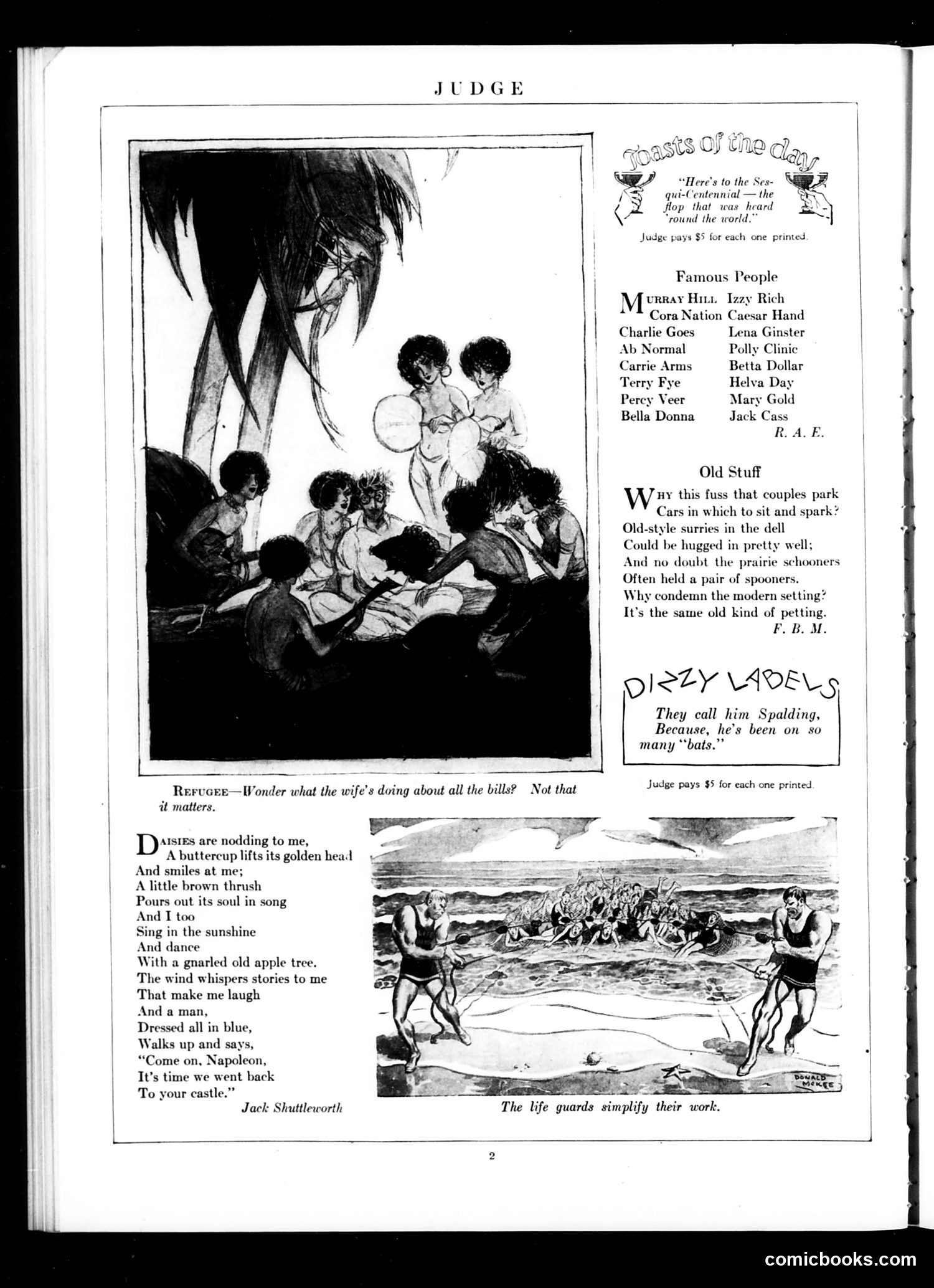
This page contains humor and illustrations typical of early 20th-century Judge magazine. The top cartoon titled "Refugee" depicts a man (likely an immigrant) unconcerned about household bills, making light of financial anxieties during a period of immigration concerns. The "Famous People" section lists celebrities of the era (Murray Hill, Izzy Rich, Cora Nation, etc.), appearing to be a social commentary feature. "Old Stuff" questions why couples park cars to "sit and spark" (court/kiss), noting this behavior isn't new—prairie settlers did similar "petting." It's gentle social satire about modern youth morality being unchanged. "Dizzy Labels" makes a pun about someone named "Spalding" being "on so many 'bats.'" The lower illustrations and Jack Shuttleworth's poem appear unrelated to the political content above.
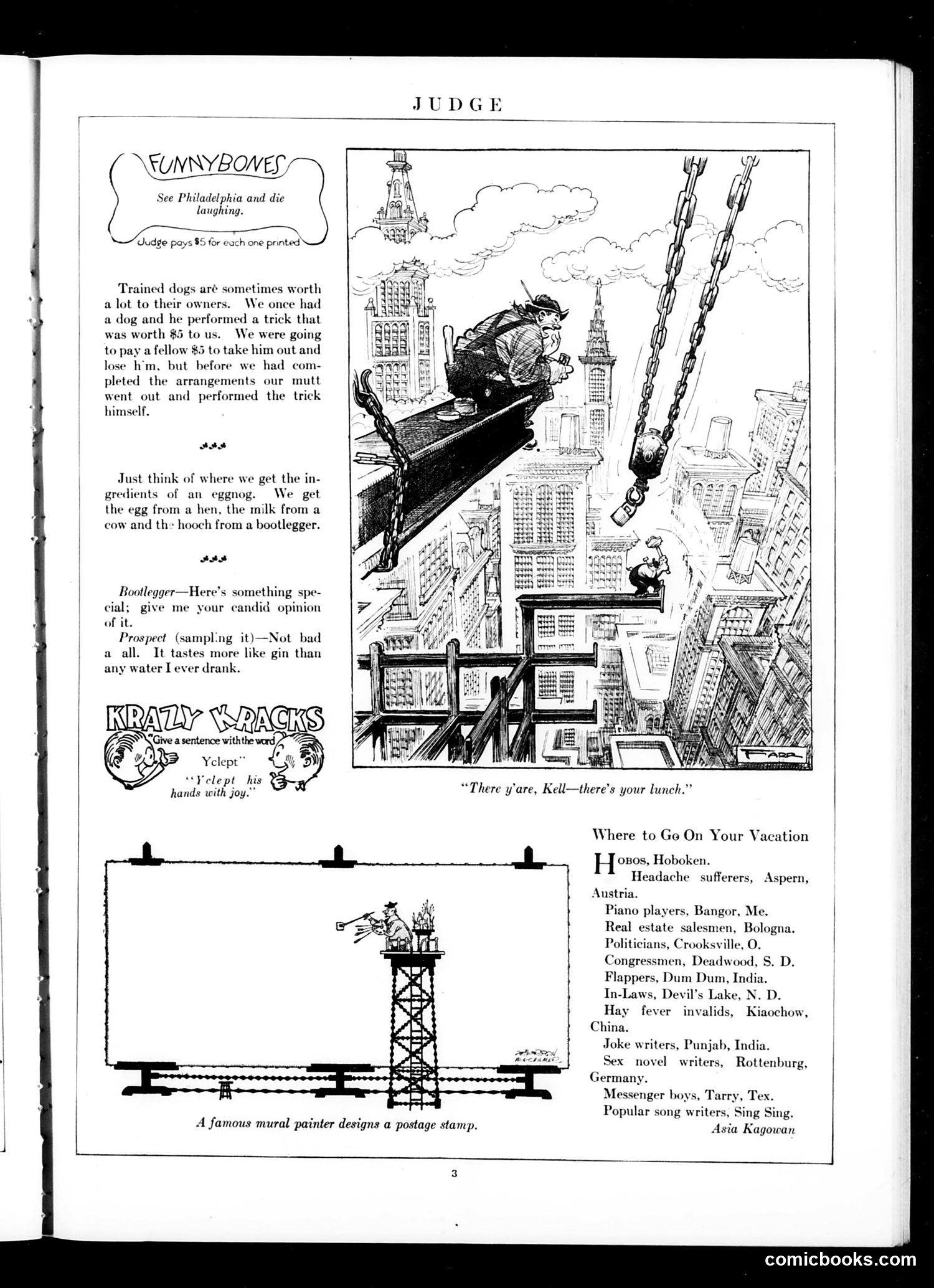
This page contains humor columns and illustrations rather than political cartoons. The "Funny Bones" section offers brief jokes about trained dogs performing tricks and food ingredients (eggs, milk, hooch from bootleggers). The "Krazy Kracks" feature presents wordplay humor. The main illustration depicts someone being launched horizontally above a cityscape via what appears to be a swing or catapult, with the caption "There y'are, Kel—there's your lunch." The joke's meaning is unclear without additional context, though it likely references a contemporary figure or situation unknown today. The bottom section lists humorous vacation destinations paired with types of people (headache sufferers, politicians, real estate salesmen, etc.), a format common to period humor magazines.
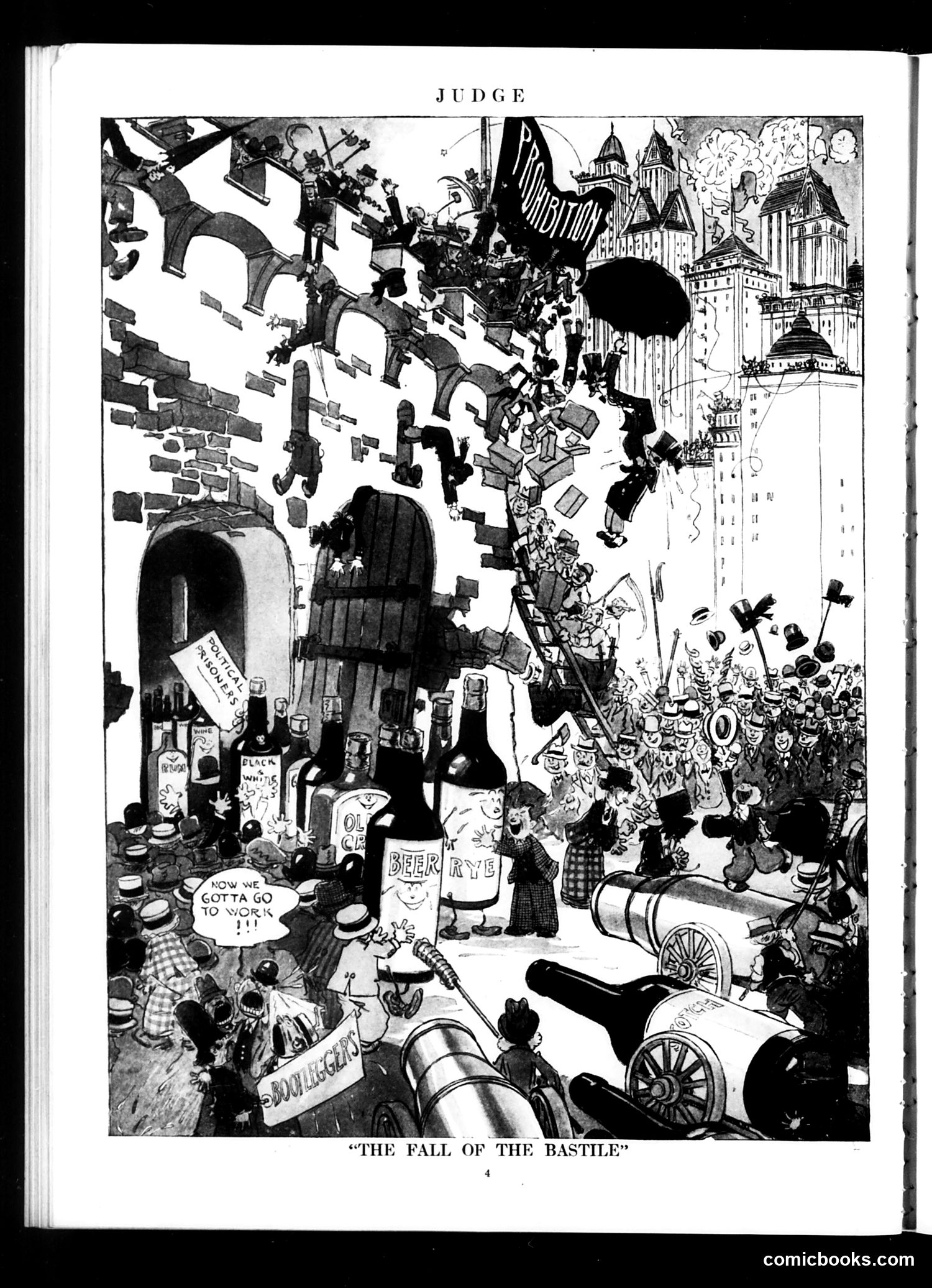
This satirical cartoon depicts Prohibition-era chaos through a metaphorical "fall of the Bastille" (the French Revolution's symbol of tyranny). The image shows a fortress-like structure collapsing under assault from a crowd of revelers, bootleggers, and alcohol consumers. Visible are beer bottles, barrels, and figures in period dress, suggesting the violent overthrow of prohibition enforcement. The satire critiques the failure of Prohibition laws (1920-1933) to suppress alcohol consumption. The "Bastille" represents restrictive alcohol legislation, while the chaotic crowd symbolizes public resistance and the black market that flourished. The cartoon mocks both prohibition's ineffectiveness and the lawlessness it spawned, presenting its collapse as inevitable and almost celebratory—a revolution against governmental control.
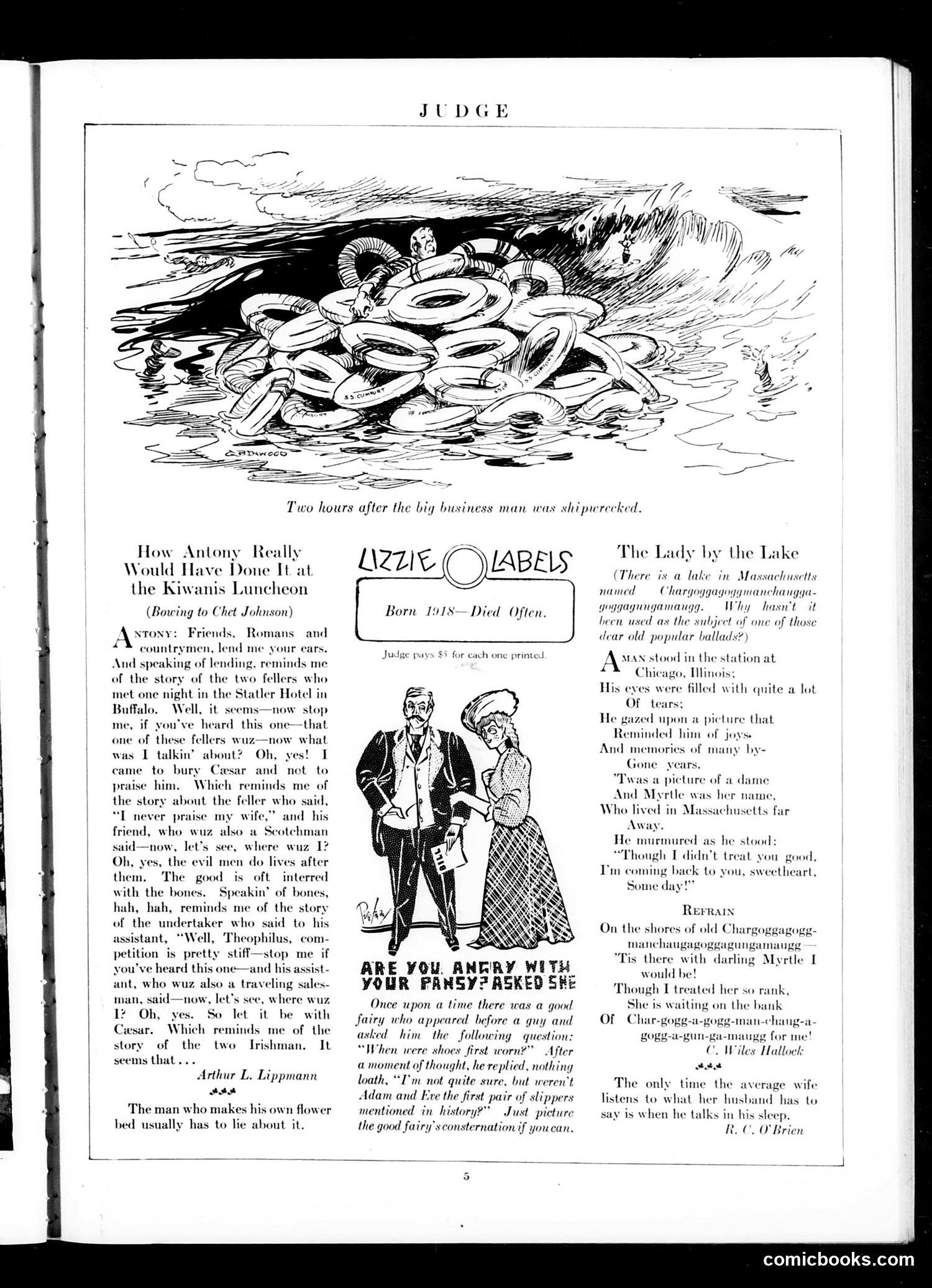
The main cartoon depicts a businessman drowning in a pile of automobile tires, captioned "Two hours after the big business man was shipwrecked." This appears to satirize the automobile industry's rapid expansion and the hazards of over-investment or market instability in early 1900s manufacturing. The page includes humor pieces and poetry, including "Lizzie Labels" (Born 1918—Died Often), seemingly mocking cheaply-made automobiles of that era. "The Lady by the Lake" is sentimental poetry about lost love in Massachusetts. The text section "How Antony Really Would Have Done It at the Kiwanis Luncheon" parodies classical rhetoric applied to modern civic organizations, a typical Judge approach of mixing high culture with contemporary American life for comedic effect.
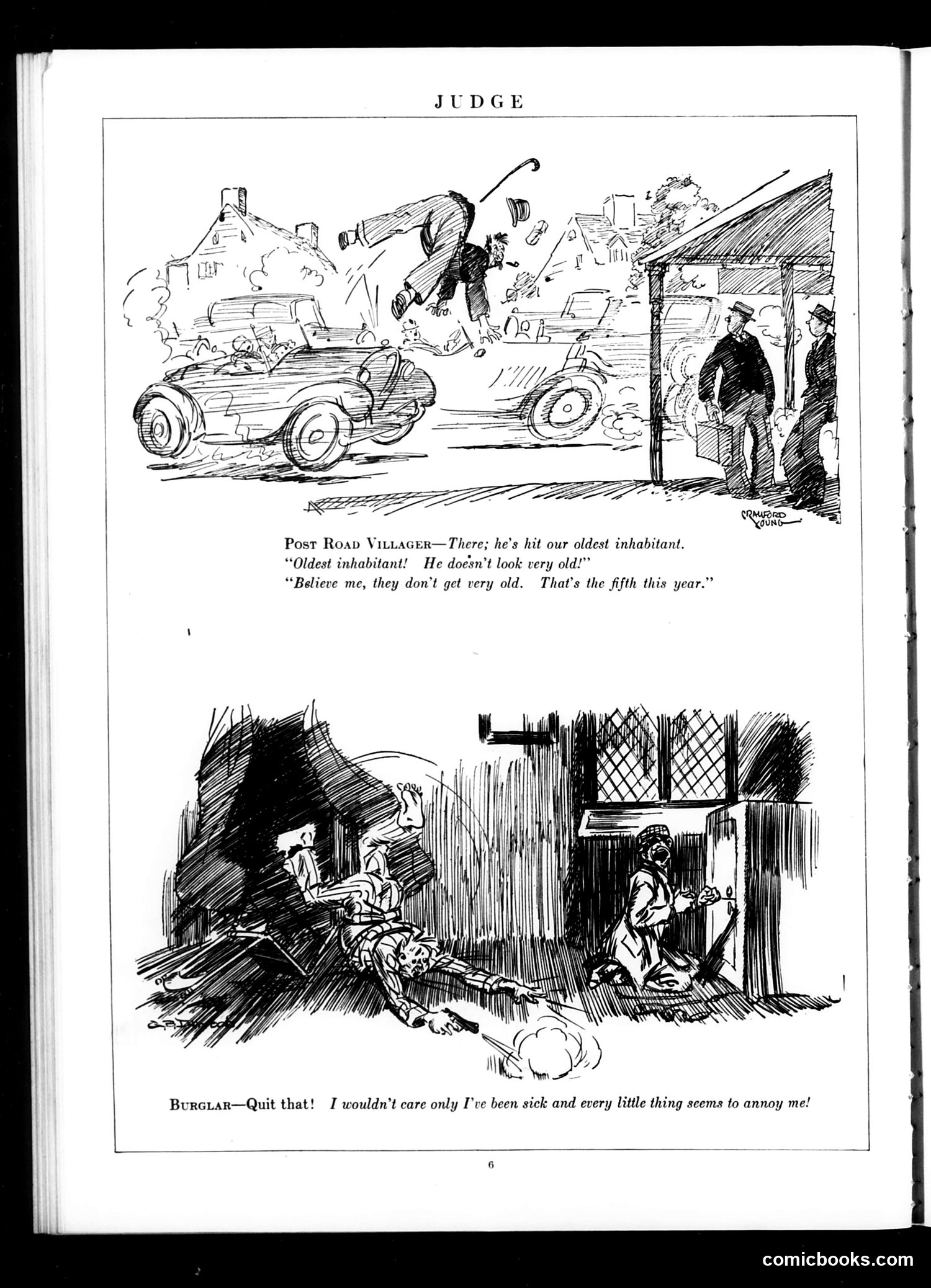
**Top cartoon**: A reckless motorist has hit a pedestrian in a village. The joke satirizes early automobiles' danger to pedestrians—so many village residents have been struck by cars that "the oldest inhabitant" is now someone very young (this being the fifth victim that year). The cartoon mocks both the hazards of early motoring and rural communities' vulnerability to this new technology. **Bottom cartoon**: A burglar confronts someone inside a home. The homeowner complains the burglary is annoying him because he's been ill and irritable. The dark humor suggests the burglar's crime is merely an inconvenience to an already grumpy, sickly person—inverting who should be distressed in this scenario. Both cartoons use absurdist humor typical of Judge's satirical style, with the second notably focusing on an everyman's petty complaint superseding the actual crime occurring.
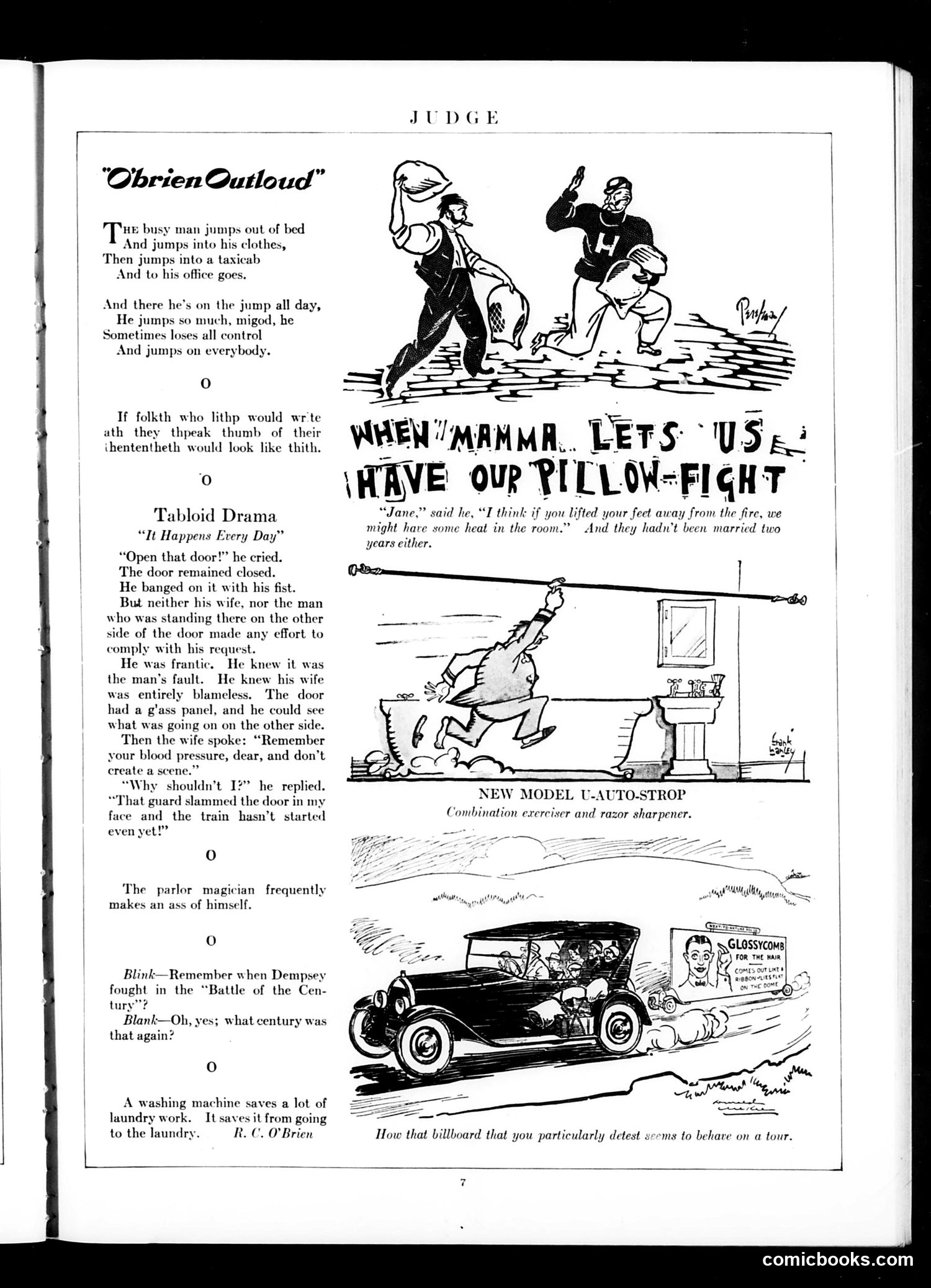
This page from *Judge* contains several short satirical pieces typical of early 20th-century American humor: **"O'Brien Outloud"** mocks the hyperactive "busy man" archetype who frantically rushes through life, jumping from bed to taxi to office, losing self-control in his frenzy—satirizing modern urban hustle culture. **"Tabloid Drama"** parodies sensational newspaper stories with exaggerated domestic conflict: a husband bangs on a door, assumes infidelity, yet blames a train guard instead of his "blameless" wife—mocking both melodramatic tabloid narratives and marital hypocrisy. **"Pillow Fight"** depicts newlyweds' domestic friction: the husband complains his wife blocks the fire with her feet; the caption notes they've "hadn't been married two years"—satirizing how quickly romantic bliss deteriorates. **"U-Auto-Strop"** is an absurdist advertisement mashup claiming a razor can double as exercise equipment—mockingly combining disparate consumer products. The remaining jokes target lisping, magicians, boxing (Dempsey reference), and washing machines. Overall, this reflects *Judge's* focus on urban middle-class anxieties and consumer culture humor.
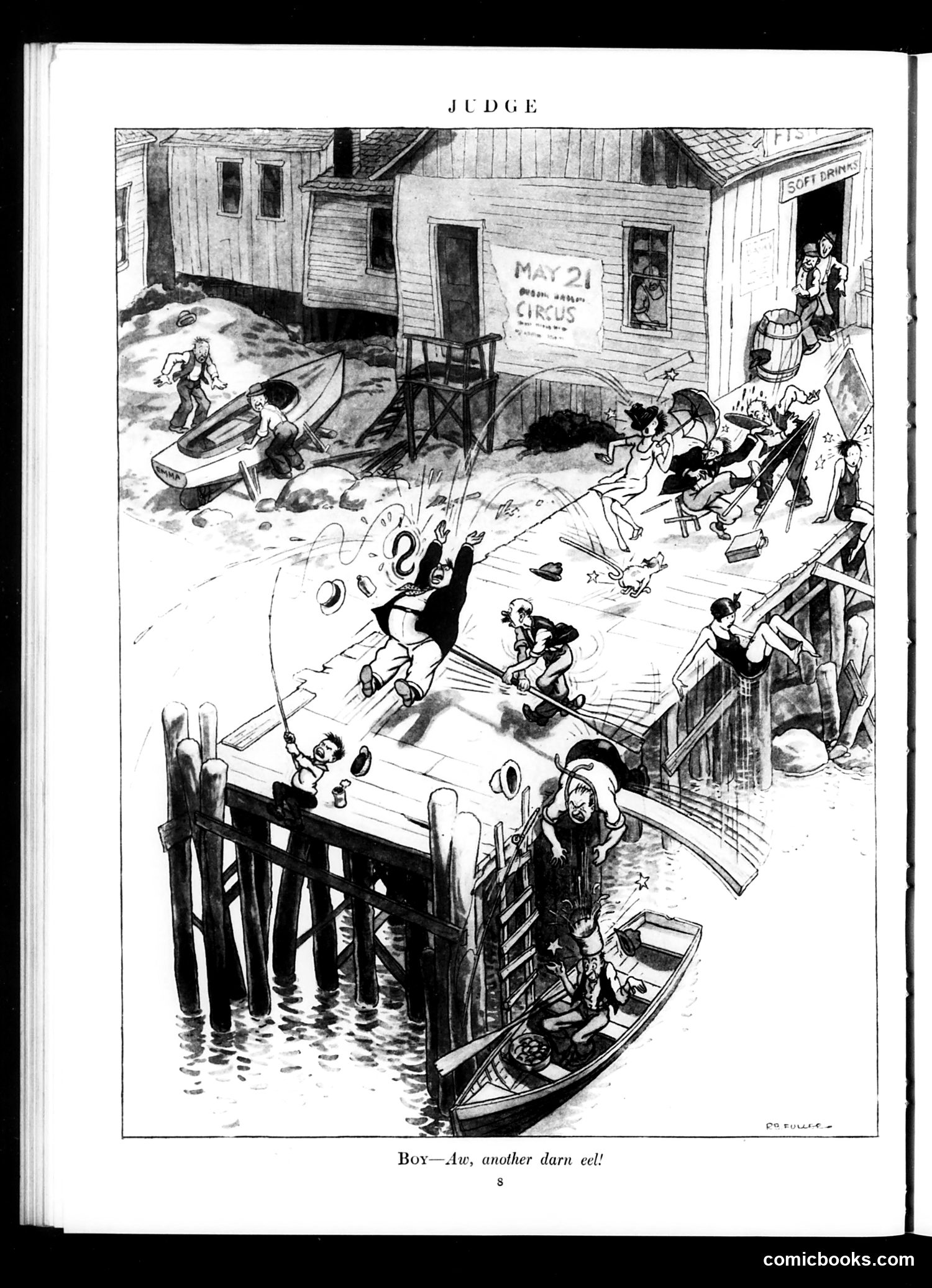
This is a single cartoon titled "Boy—Aw, another darn eel!" The image depicts a chaotic seaside carnival or circus scene (note "MAY 21 CIRCUS" on a building). Children and spectators engage in various activities—boating, acrobatics, juggling—while one boy's exclamation suggests frustration with repeated encounters with eels in the water. The humor appears to be straightforward slapstick: a child repeatedly pulls up eels while fishing or boating, finding them annoying or startling rather than interesting. It's a simple gag about unexpected, unwanted repetition rather than political satire. The page number and magazine context indicate this is from *Judge*, but the cartoon itself contains no identifiable political figures or social commentary—it's purely recreational humor about a carnival mishap.
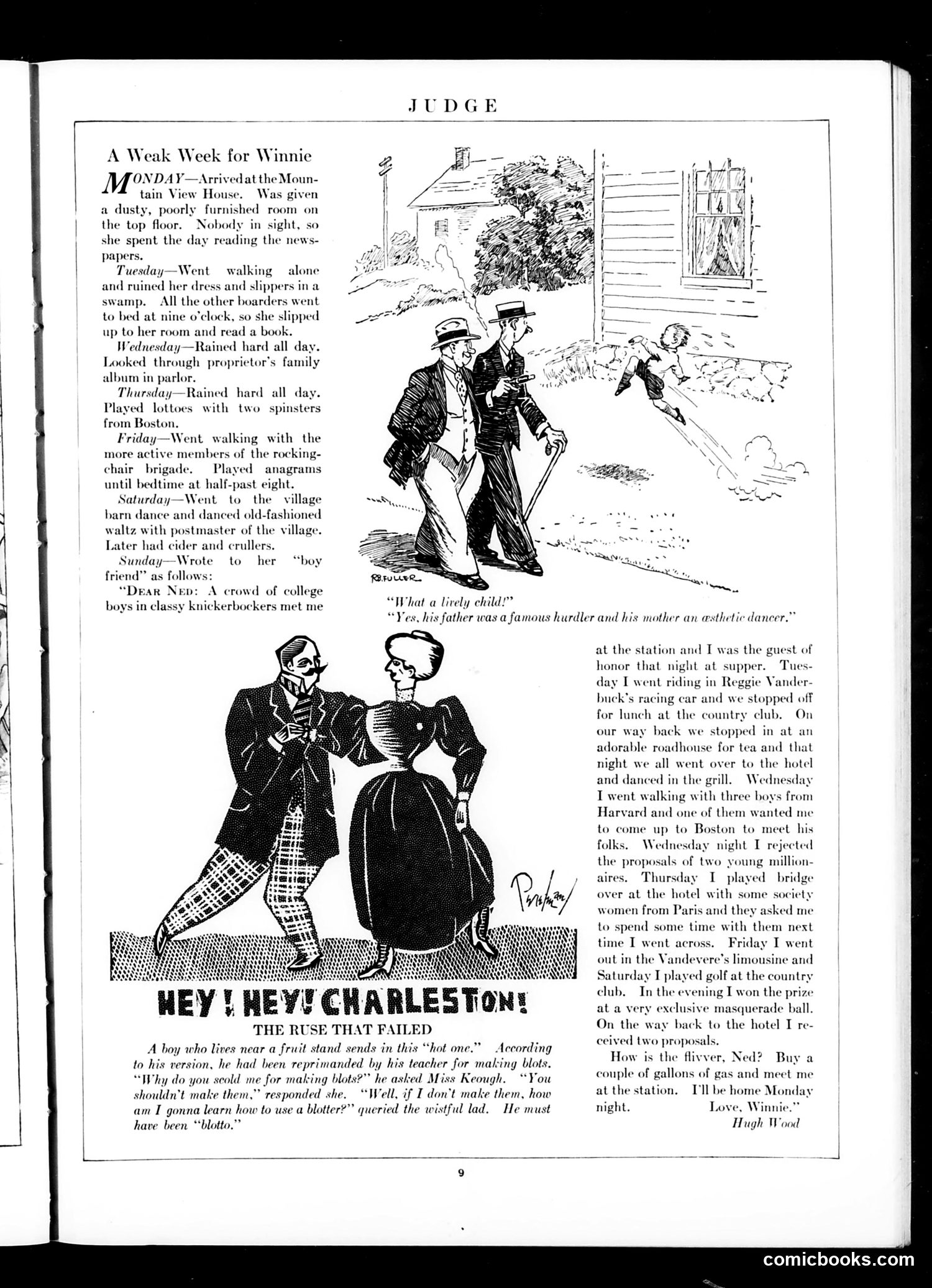
This page from *Judge* contains two satirical pieces mocking early 1920s social pretension. **"A Weak Week for Winnie"** ridicules a woman who embellishes her boring countryside vacation in a letter to her "boy friend." While actually spending days alone reading, in rain, and playing parlor games, she fabricates an elaborate social life involving wealthy suitors (college boys, Harvard men, millionaires), luxury activities (racing cars, country clubs), and multiple marriage proposals. The satire targets the gap between reality and boastful fiction—she's desperate to appear socially important. **"Hey! Hey! Charleston!"** and the accompanying "blotto" joke mock youth slang and behavior. The Charleston reference dates to the 1920s dance craze. The boy's pun on "blotter/blotto" (drunk) suggests youthful irreverence toward authority. Both pieces lampoon 1920s social climbing and the younger generation's casual disregard for propriety—typical *Judge* targets for this period.
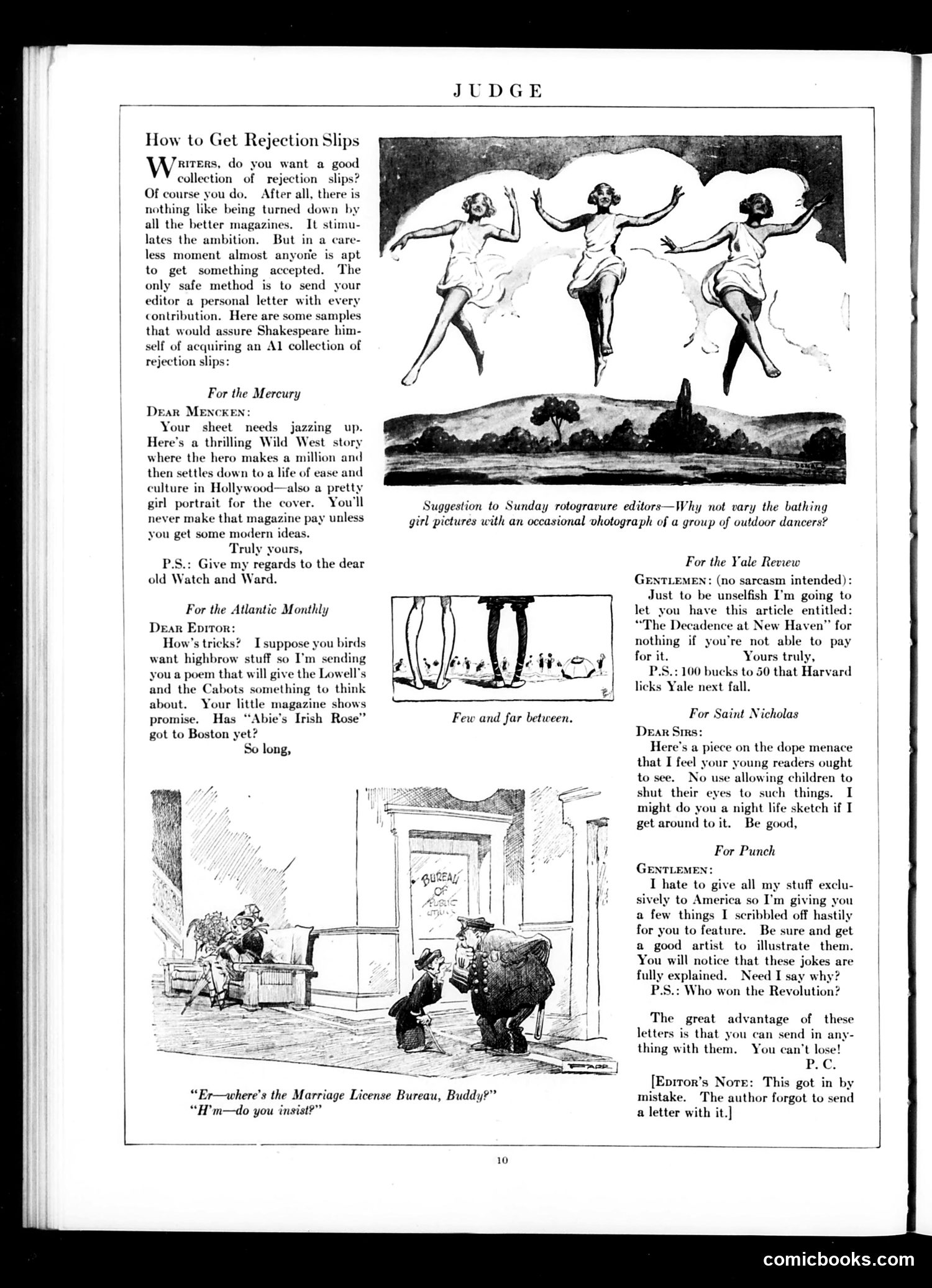
This page satirizes aspiring writers who include presumptuous personal letters with magazine submissions. The "How to Get Rejection Slips" article mocks writers who insult editors while pitching stories. The sample letters parody real magazines and their perceived weaknesses: - **Mercury** (H.L. Mencken's publication): Criticized for being too intellectual; the letter suggests it needs "jazzing up" - **Atlantic Monthly**: Accused of snobbish highbrow tastes; the letter references "Lowell's and Cabots" (Boston Brahmin families) - **Yale Review/Saint Nicholas**: Mocked for being prudish; the letters offer inappropriate content (dope menace article for children's magazine) - **Punch** (British humor magazine): Insulted as needing basic explanations for jokes The joke is that including condescending personal critiques guarantees rejection. The editor's note at bottom—stating an article arrived without an accompanying letter—reinforces this satirical advice by treating it as an editorial mistake, completing the circular joke.
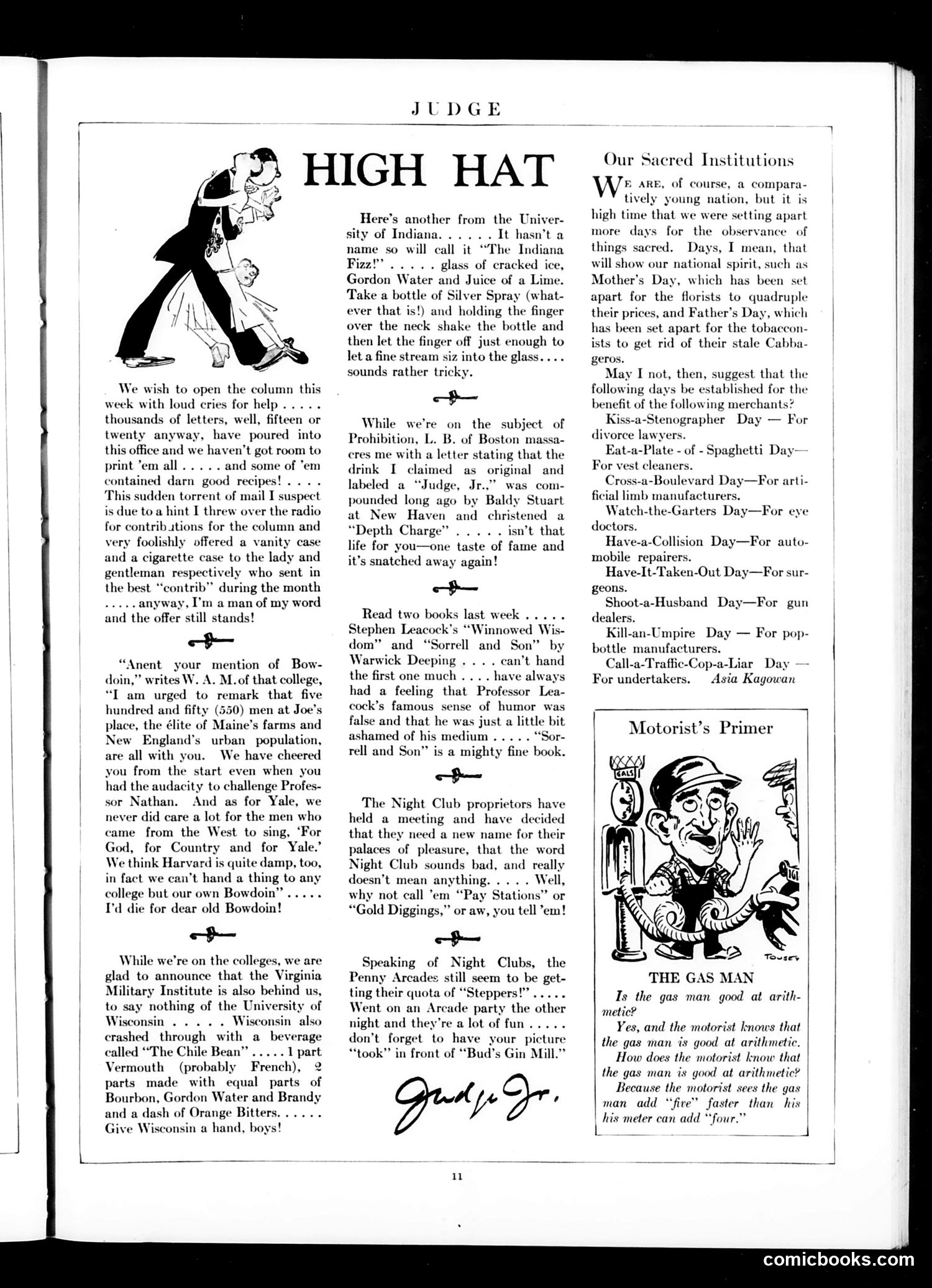
This is a humor column from Judge magazine's "High Hat" section, featuring satirical commentary on 1920s American culture, particularly targeting Prohibition-era drinking culture. **Main Content:** The column mocks creative cocktail recipes readers submitted, naming drinks after colleges (Indiana Fizz, Depth Charge) that circumvent Prohibition laws. The author humorously credits fake inventors and notes how quickly claimed originality gets stolen. **The Cartoon (top left):** Shows a man in formal attire teaching a woman how to make a cocktail—satirizing the widespread illegal drinking and bartending happening despite Prohibition's legal ban on alcohol. **Social References:** - **Prohibition**: The entire column jokes about illegal alcohol consumption - **College culture**: References to Bowdoin, Yale, Virginia Military Institute, and Wisconsin celebrate collegiate drinking traditions - **Night clubs**: Euphemistically called "Pay Stations" or "Gold Diggings," mocking establishments serving illegal liquor **The Satire's Point:** Judge ridicules Prohibition's failure—ordinary Americans openly shared cocktail recipes and frequented speakeasies, making the law appear absurd and unenforceable. The tone suggests widespread public defiance of the ban.
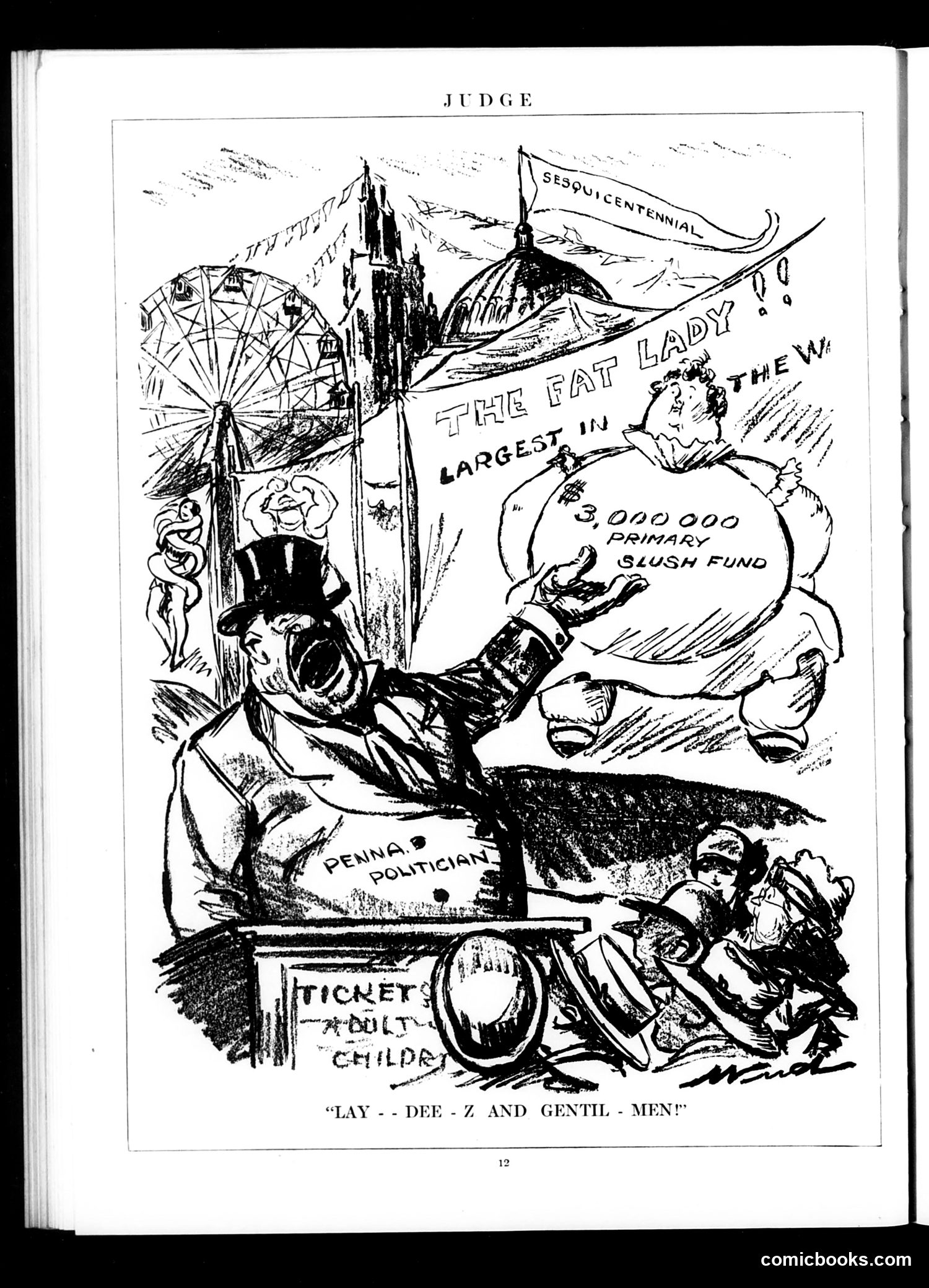
This political cartoon satirizes a "female politician" (labeled as such) depicted as an extremely obese woman. She's shown at what appears to be a fairground or carnival setting, with attractions like a Ferris wheel and castle visible behind her. The cartoon criticizes her management of a "$3,000,000 Primary Slush Fund"—apparently public money allocated for political purposes. The caricature suggests corruption or misuse of funds, with the exaggerated weight serving as visual mockery implying she has "consumed" the money. The caption "Lay-Dee-Z and Gentil-Men!" parodies carnival barker language, treating the politician like a circus attraction. The scattered figures at bottom appear to be children or voters. The satire attacks both the politician's credibility and implies gender-based ridicule typical of early 20th-century political cartooning, where women in politics were frequently mocked through crude physical caricature rather than substantive critique.
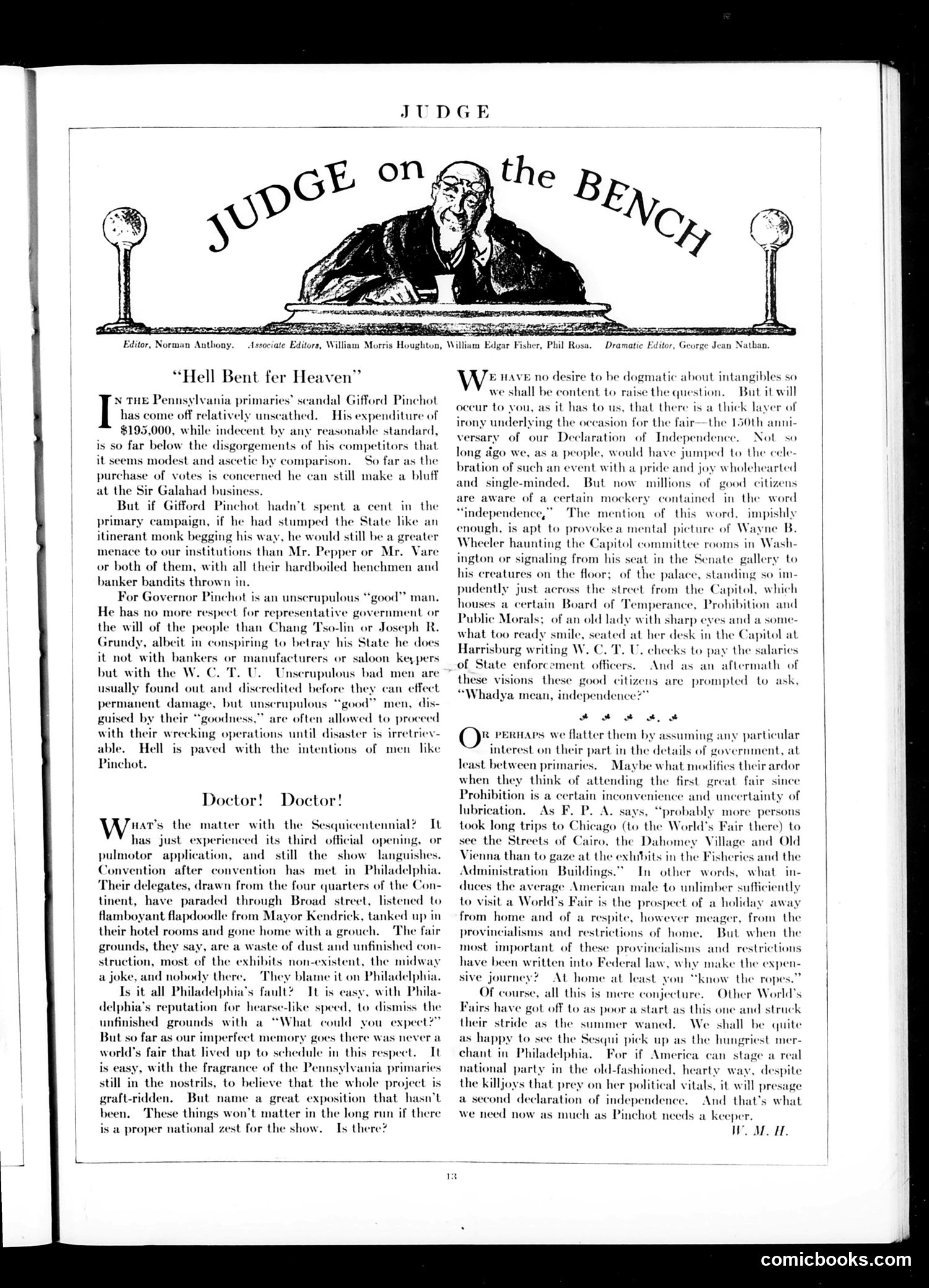
This page critiques **Gifford Pinchot**, a Pennsylvania political figure, through two separate pieces. The first article attacks Pinchot's gubernatorial campaign, acknowledging his primary spending ($195,000) was modest compared to rivals like Pepper and Vare, but argues this misses the real danger: Pinchot is an "unscrupulous 'good' man" who uses moral authority (invoking the W.C.T.U.—Women's Christian Temperance Union, associated with Prohibition) to undermine representative government as ruthlessly as corrupt politicians do. The satire suggests his self-righteousness makes him more dangerous because it provides cover for his ambitions. The second article humorously addresses Philadelphia's struggling Sesquicentennial Exposition (150th anniversary celebration, likely 1926). It notes failed openings, poor attendance, and unfinished construction, while sardonically observing the irony: celebrating American independence while Wayne B. Wheeler (Prohibition's leading advocate) manipulates Congress and a "palace" (likely referencing corrupt interests) operates brazenly across from the Capitol—undercutting the very freedoms being celebrated.
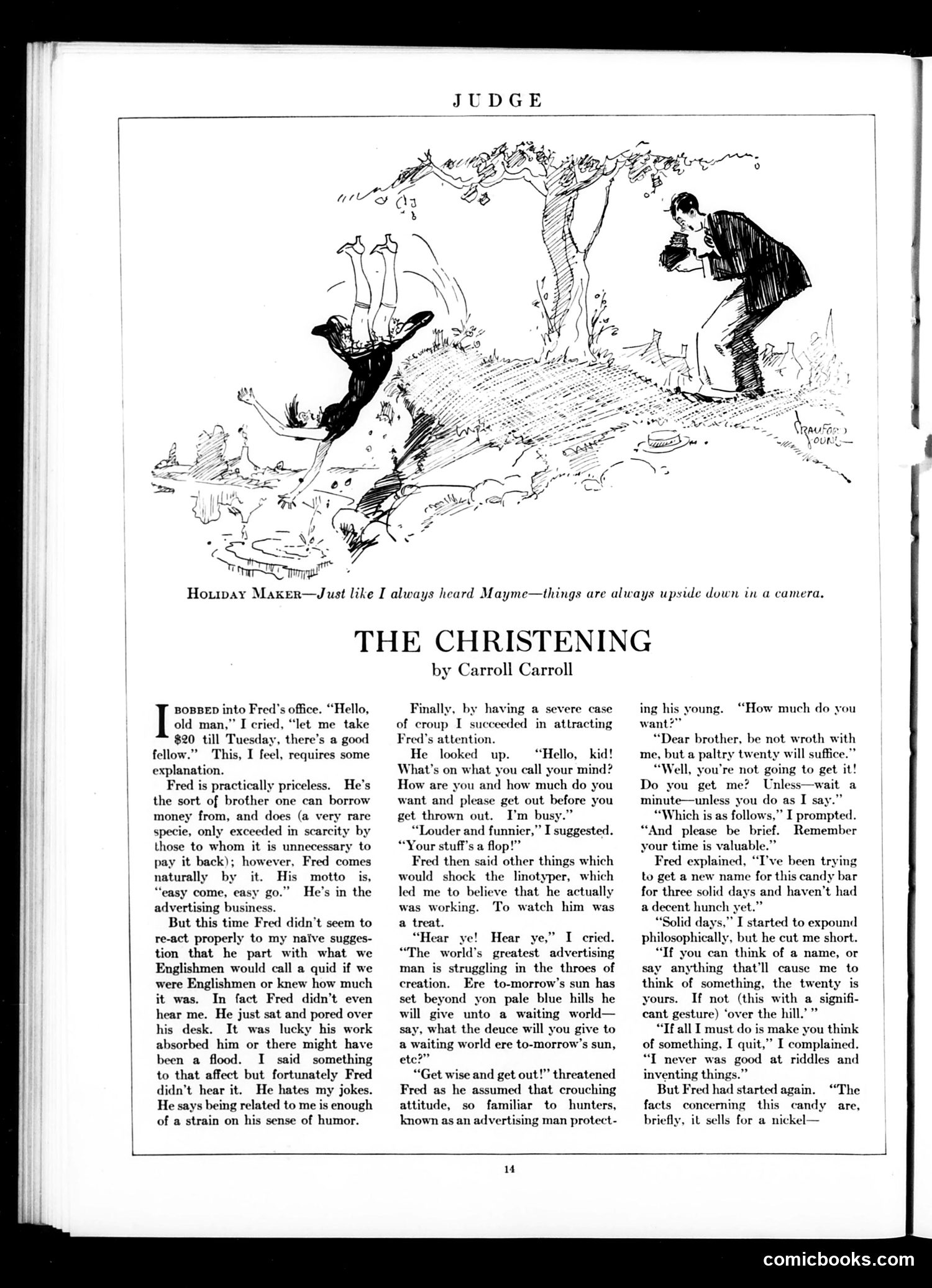
This is a humorous short story rather than a political cartoon. The accompanying illustration shows a man (the narrator) tumbling into a ditch while another man (Fred) photographs him—the "Holiday Maker" caption jokes that cameras reverse reality. The story depicts a comedic interaction between the narrator and his brother Fred, an advertising man. The narrator visits Fred's office seeking to borrow $20, but Fred is absorbed in work creating an advertisement for a candy bar. Fred offers the narrator a deal: if he can suggest a name for the product, he gets the money; if not, Fred will throw him out. The satire targets early 20th-century advertising culture—Fred's intense, self-important approach to the creative process, his dramatic attitude, and the premise that naming a cheap product is treated as profound artistic "creation." The joke relies on the contrast between the narrator's casual borrowing and Fred's commercialized worldview.
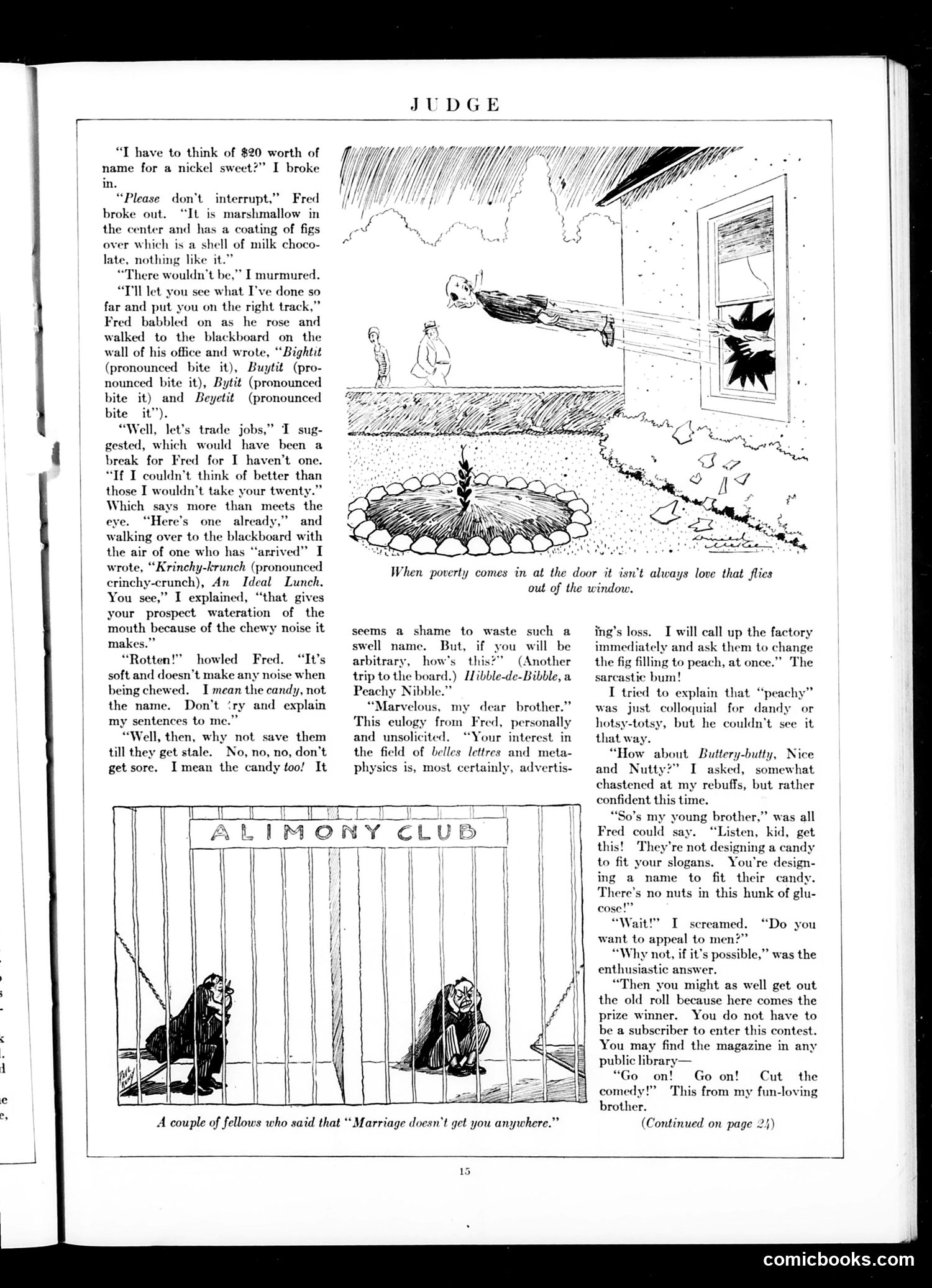
This page satirizes the advertising industry's creative process, specifically candy naming. Two men—Fred and the narrator—compete to devise marketing names for a new chocolate-fig candy. Fred proposes phonetically identical names ("Bightit," "Buytit," "Bytit," "Beyetit") emphasizing the chewing sound, while the narrator counters with "Krinchy-krunch" for similar effect. When Fred rejects "Peachy Nibble" as too literal, the narrator realizes the core problem: copywriters design slogans to sell products, not products to fit catchy phrases. The humor mocks advertising's absurd priorities and jargon. The bottom cartoon of caged figures captioned "Marriage doesn't get you anywhere" and the epigraph about poverty represent tangential satirical commentary typical of Judge's multi-topic format. The piece gently ridicules early 20th-century marketing's obsession with onomatopoeia and forced cleverness in product naming.
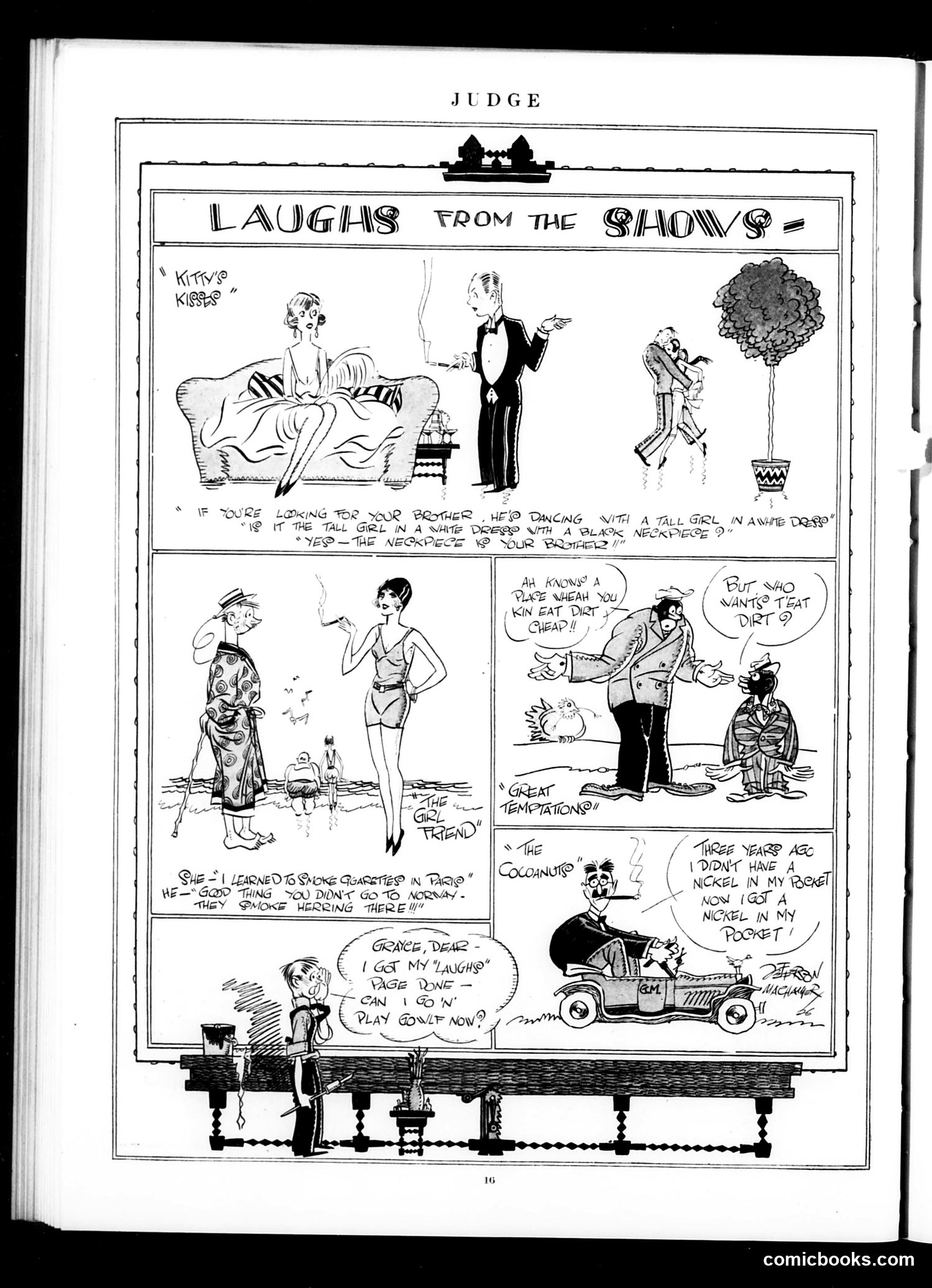
This Judge page collects theatrical humor anecdotes, likely from early 20th-century stage productions. The sketches mock social pretenses and marital dynamics: The top panel satirizes wealthy society—a man seeks his brother who's dancing with a tall girl in white, suspecting she's stolen jewelry (the black necklace) belonging to the brother's wife. Middle panels feature domestic comedy: a woman who learned to smoke and drink in Paris now pretends sophistication; a couple discusses cheap dining; a man complains about his financial struggles (no nickel, now has one). The bottom anecdote humorously depicts a husband asking his wife "Grace" if he can play golf after she's been demanding his attention. The overall satire targets bourgeois hypocrisy, extramarital flirtation, pretentious cosmopolitanism, and the friction between spouses' competing desires—standard vaudeville and theatrical comedy tropes of the era.
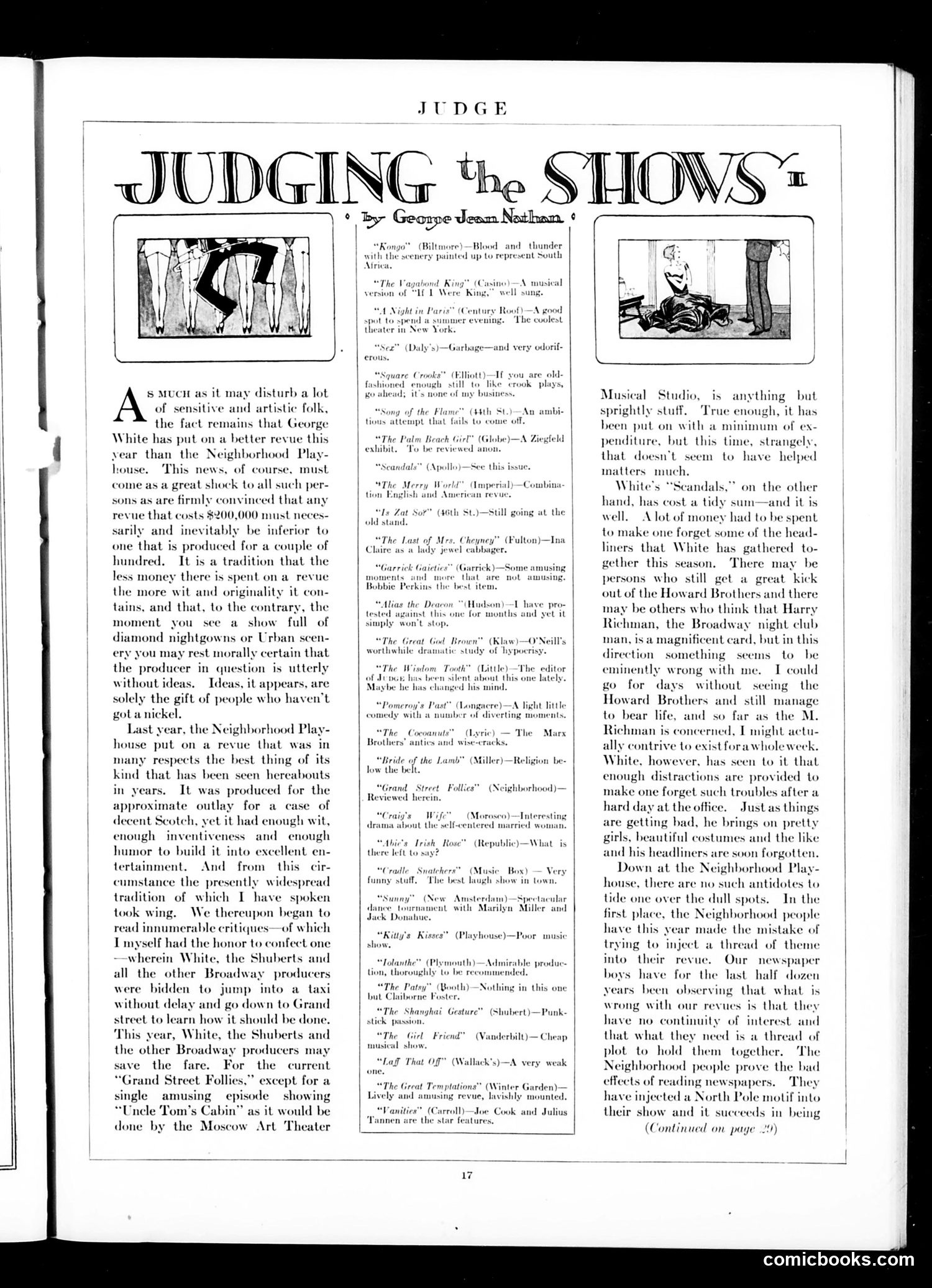
This page contains theater reviews by prominent drama critic George Jean Nathan. The main article argues that George White's expensive revue ($200,000 budget) is superior to the cheaper Neighborhood Playhouse production—contrary to the then-popular assumption that low-budget shows demonstrate more wit and originality than expensive Broadway productions. Nathan satirizes the critical establishment's romantic attachment to poverty-as-artistic-virtue, noting that critics previously praised the Playhouse's inexpensive show and lectured Broadway producers to "learn how it should be done." Now those same producers have apparently taken the lesson too seriously. The bulk of the page lists brief reviews of current Broadway shows with their theaters and Nathan's caustic judgments (mostly negative). The two small photographs appear to show theatrical scenes, though specific productions are unclear from this reproduction.
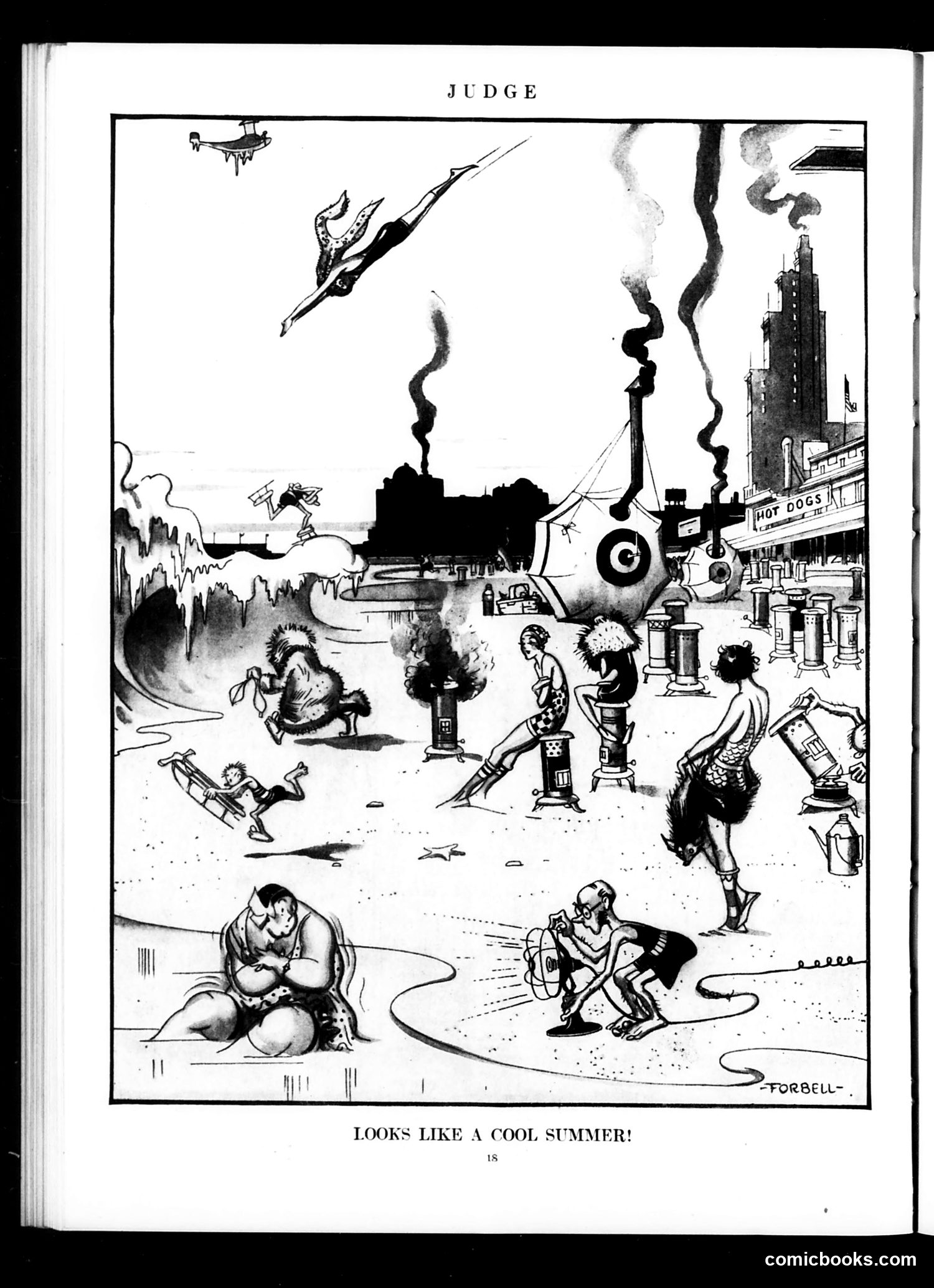
This satirical cartoon depicts a chaotic urban summer scene with multiple disaster scenarios occurring simultaneously: explosions, fires, collapsing buildings, and people fleeing in panic. The imagery includes industrial accidents, what appears to be a hot dog stand amid the destruction, and various figures in distress. The caption's ironic title suggests this represents the magazine's cynical commentary on summer conditions in an American city—likely New York. Rather than celebrating pleasant warm weather, the cartoon satirizes the actual summer experience: oppressive heat creating dangerous conditions, accidents, industrial hazards, and general urban chaos and suffering. The signed artist appears to be "Forbell." This reflects Judge's typical satirical approach, using exaggerated disaster imagery to critique contemporary urban conditions and their human toll.
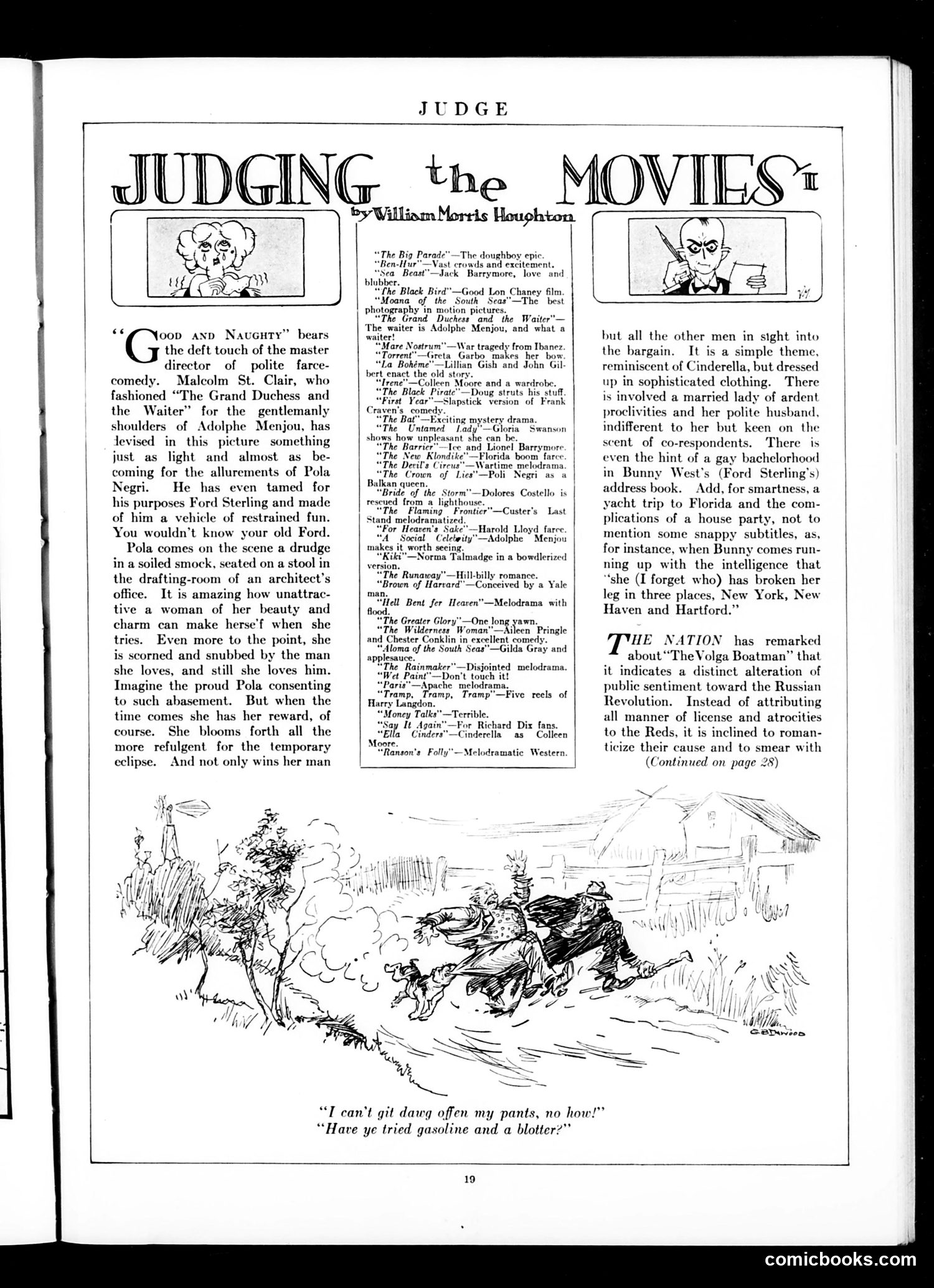
This page combines a film review column with period humor. The main content is **"Judging the Movies"** by William Morris Houghton, critiquing contemporary silent films (1920s releases like "Ben-Hur," "The Big Parade," and "Moana of the South Seas"). The featured review discusses "Good and Naughty," a Pola Negri comedy directed by Malcolm St. Clair. The plot—a mistreated woman in servant's clothing who wins her man's love through perseverance—mirrors Cinderella. The reviewer praises the film's light farce approach. The cartoon below depicts a slapstick scene with dialogue: "I can't git dawg offen my pants, no how!" and "Have ye tried gasoline and a blotter?"—suggesting rustic/comedic problem-solving typical of 1920s humor. A brief editorial note discusses "The Volga Boatman," observing that American audiences now romanticize Russian revolutionary causes rather than condemn them—marking a cultural shift in post-Revolutionary sentiment.
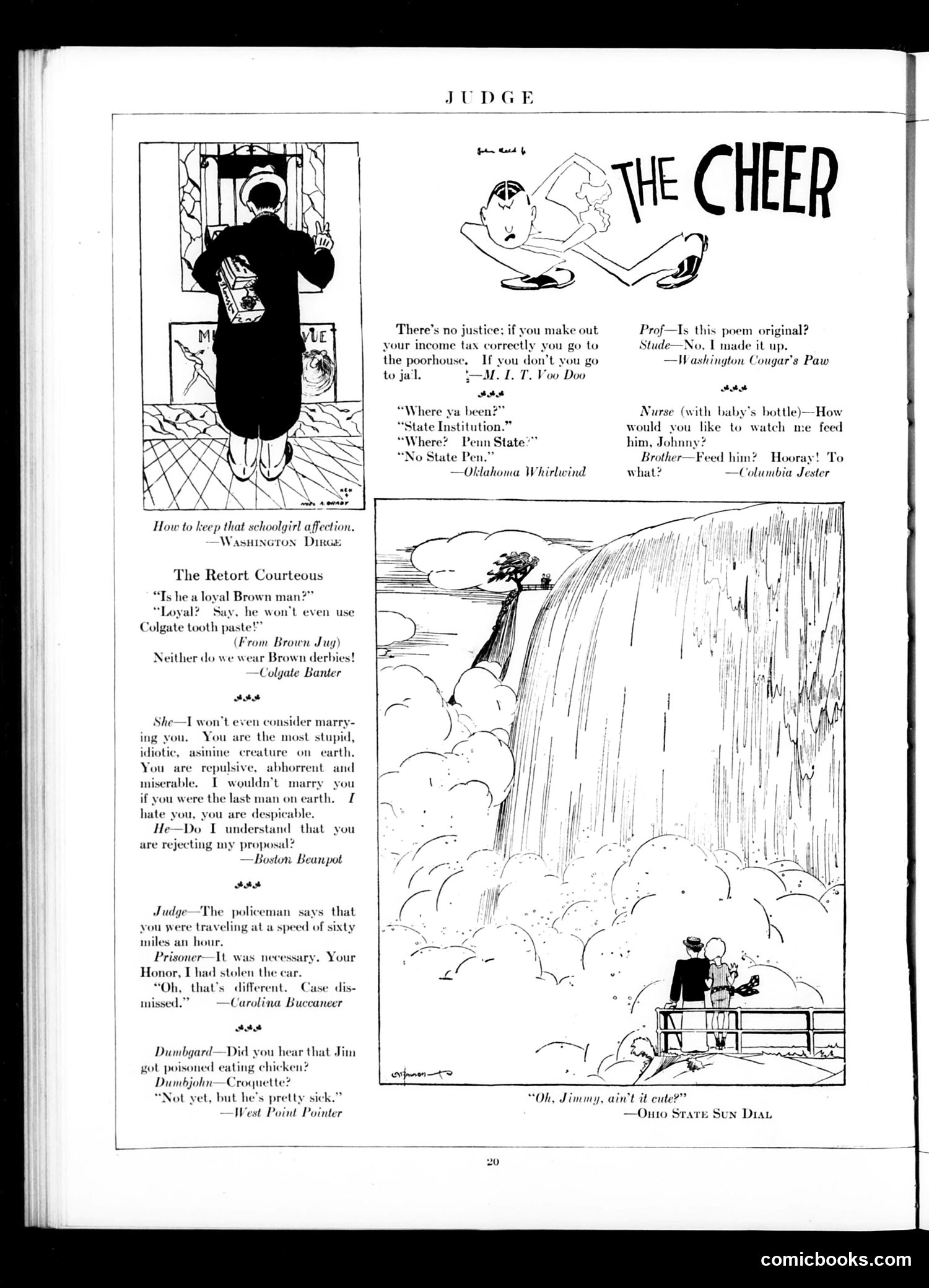
This is a humor page mixing brief satirical jokes and comic strips typical of early 20th-century Judge magazine. The content targets: **Upper left**: A silhouetted figure at a window illustrates a Washington Divas quip about maintaining schoolgirl affection. **"The Retort Courteous"**: A series of one-liners mocking pretense—including ads for Colgate products (via Brown Jug magazine), a woman's harsh marriage rejection, a judge accepting a stolen car explanation, and wordplay on Penn State versus "State Pen" (prison). **Lower right cartoon**: Shows a couple at Niagara Falls with the caption "Oh, Jimmy, ain't it cute?"—likely suggesting the woman is pregnant or commenting on the falls themselves, playing on honeymoon associations. The jokes rely on puns, non-sequiturs, and social absurdities rather than specific current events. Most references (Brown Jug, Washington Divas magazines) appear to be competing publications Judge mocked for comedic effect.
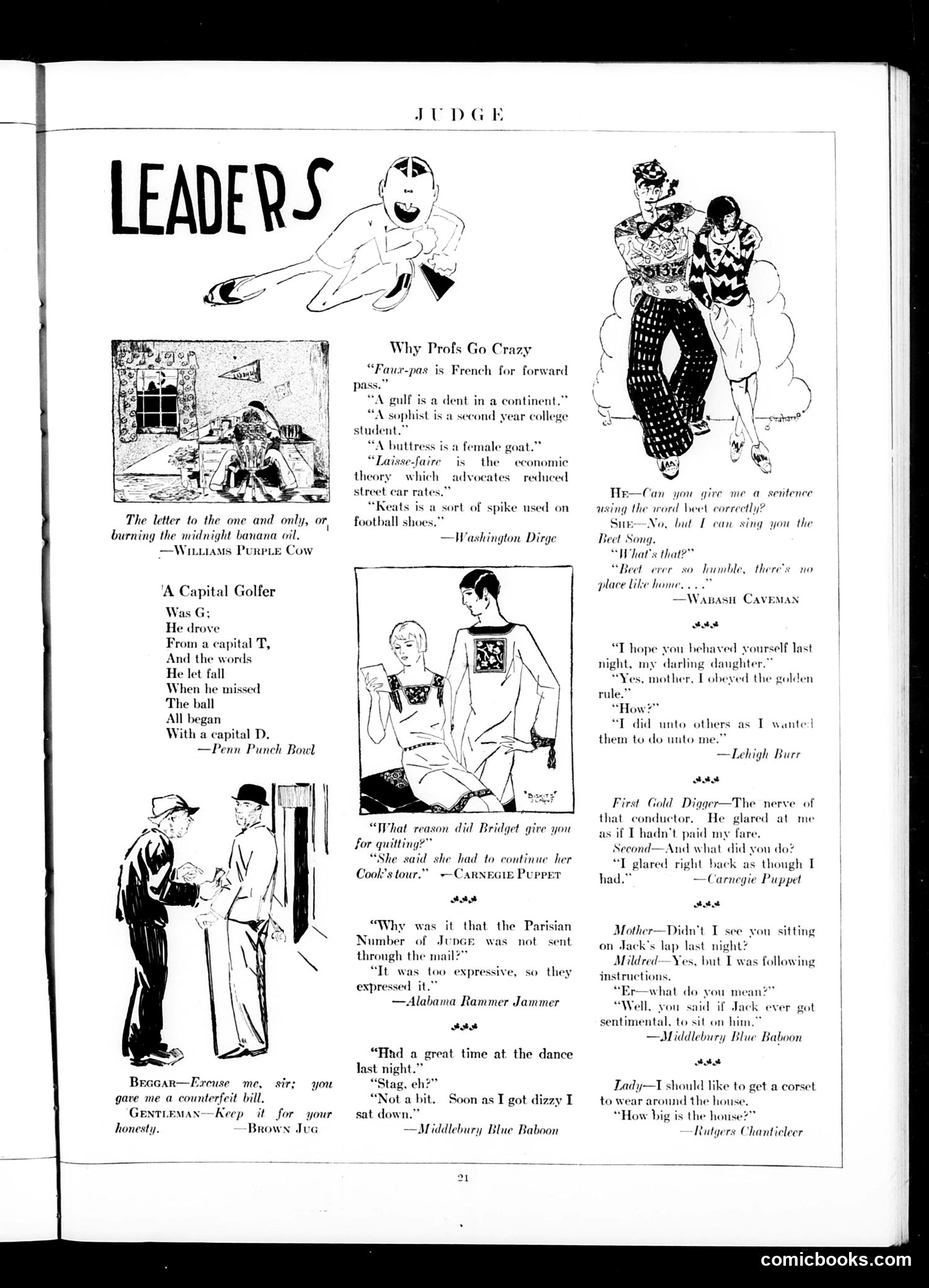
This page collects humorous short jokes and verse—typical "filler" content from early 20th-century satirical magazines. The material targets several recurring subjects: **Academic humor**: "Why Profs Go Crazy" mocks professors' pedantic definitions and malapropisms (confusing "Keats" with football shoe spikes, redefining economic theory). **Class and servant dynamics**: References to "Bridget" (stereotypical Irish maid name) and a "Gold Digger" reflect period anxieties about social hierarchies and women's financial motivations. **Courtship/gender roles**: Several jokes center on young women's behavior with men and parental concern about propriety—reflecting conservative social expectations of the era. **Puns and wordplay**: Heavy reliance on homonyms ("beet"/"beat") typical of Judge's comedic style. The cartoons accompanying these jokes use simple line drawings to visualize scenarios. Overall, the page reflects early 20th-century attitudes: academic pretension, servant stereotypes, and anxieties about female sexuality and class boundaries—presented as lighthearted entertainment for Judge's educated, presumably male readership.
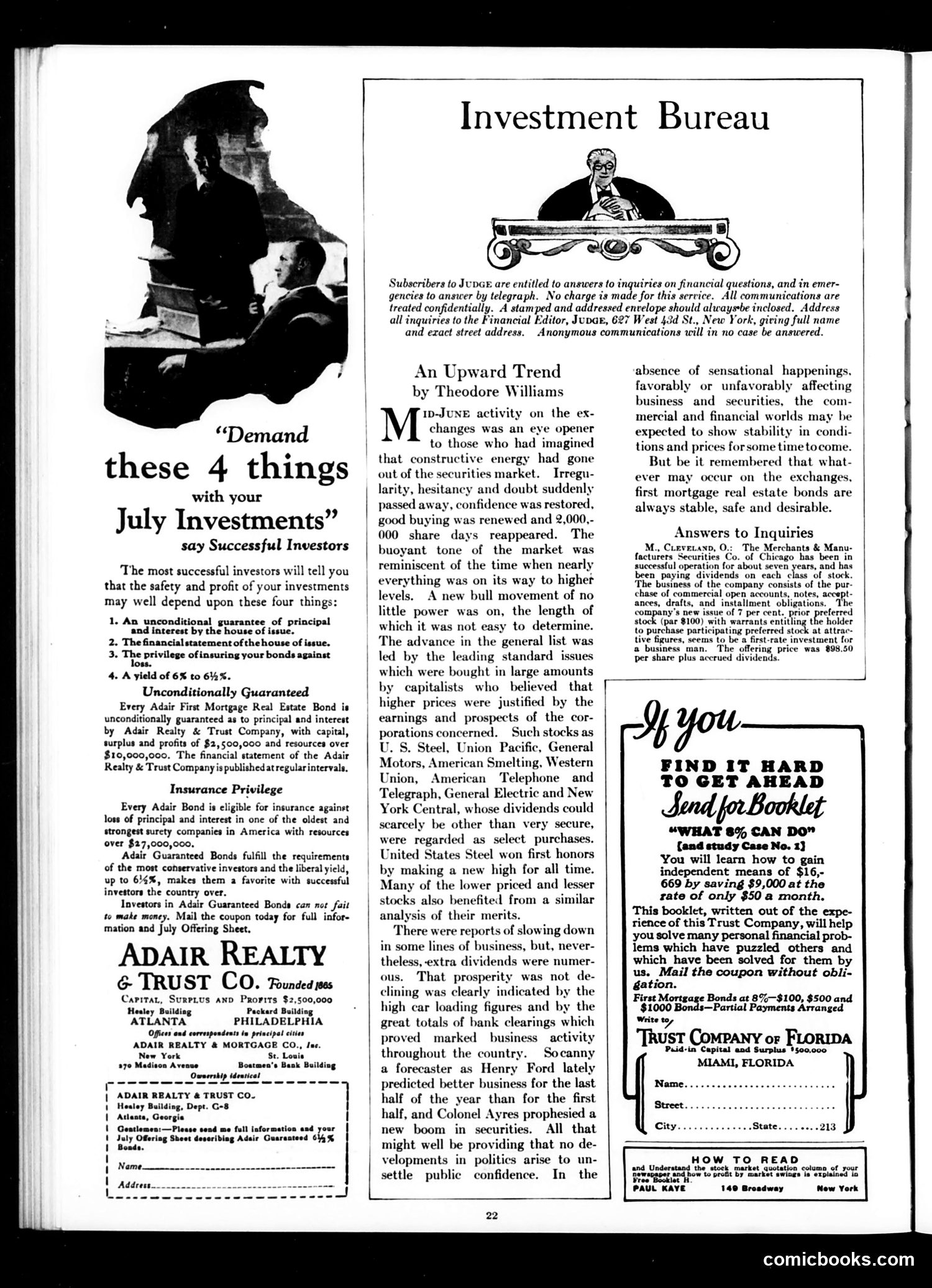
This page is primarily **financial advertising** dressed in editorial content. The left side features a dramatic illustration accompanying investment advice: "Demand these 4 things with your July Investments," attributed to "Successful Investors." The four requirements listed emphasize safety guarantees, financial transparency, insurance protection, and yield rates of 6-6.5%. The main advertisement promotes **Adair Realty & Trust Company**, a real estate bond firm guaranteeing principal and interest. This was a common investment vehicle in the early 20th century. The center column contains Theodore Williams's article "An Upward Trend," discussing optimistic stock market activity in June. It references major corporations (U.S. Steel, Union Pacific, General Motors, AT&T, General Electric) as secure investments, noting their strong dividends and business fundamentals. **Historical context**: This appears to target wealthy investors cautious about market volatility. The repeated emphasis on "unconditional guarantees" and insurance suggests lingering anxiety from earlier market disruptions—likely the 1907 panic or post-WWI uncertainties. The tone reflects 1920s financial optimism before the 1929 crash.
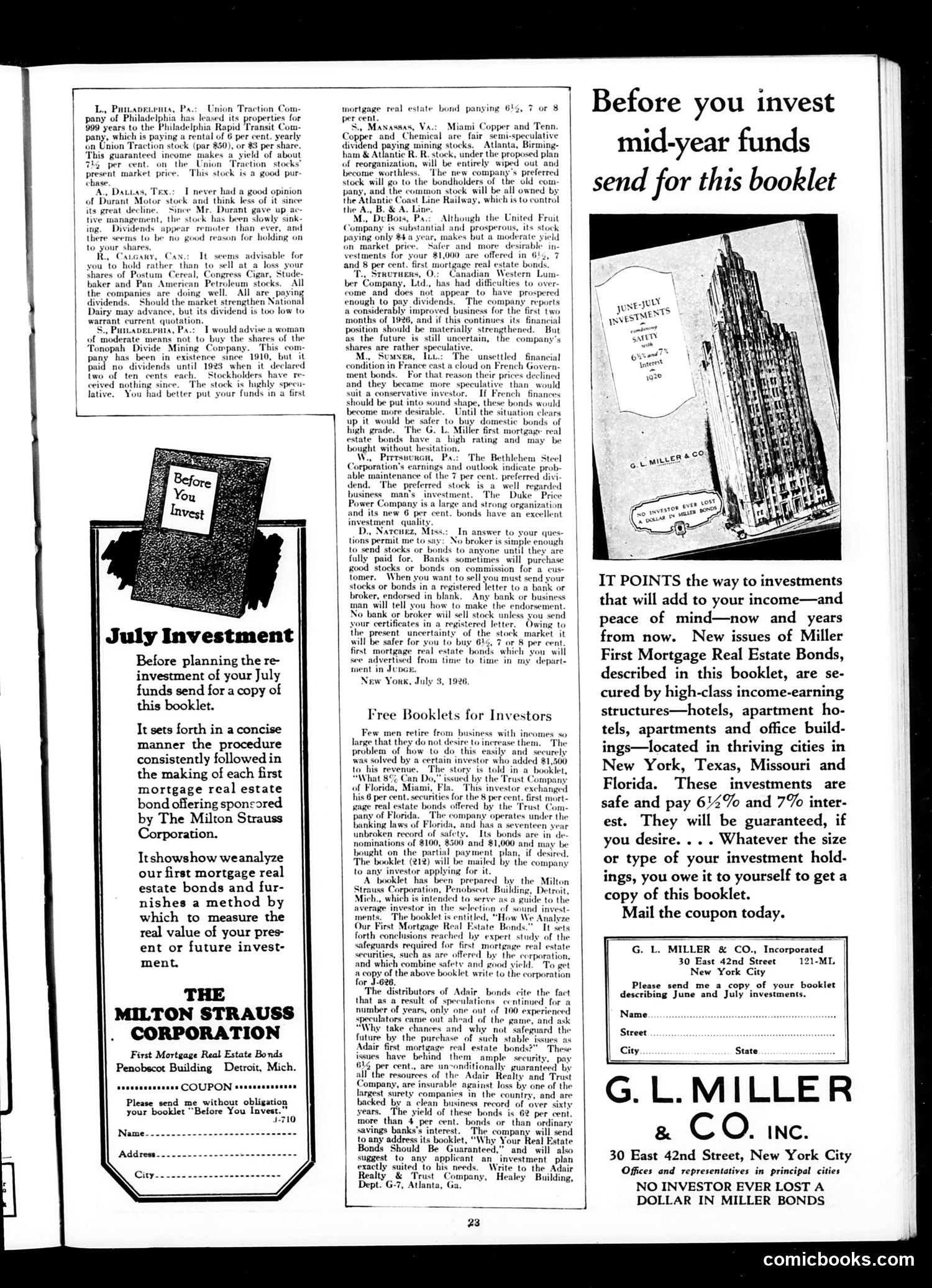
This page is primarily **advertising**, not satire. It consists of investment advice columns and promotional materials for real estate bonds from two companies: The Milton Strauss Corporation and G.L. Miller & Co. The content reflects **1926 financial culture**: readers seeking safe investment advice for "mid-year funds," with recommendations ranging from railroad stocks to mining companies to first mortgage bonds. The tone emphasizes security and income generation. The satirical element is minimal—the left sidebar simply shows a book titled "Before You Invest" as a visual hook to encourage readers to request the Milton Strauss booklet. This is straightforward **product placement**, not political commentary. The historical interest lies in what investments were considered "safe" in 1926—just three years before the stock market crash that would devastate many such portfolios. The emphasis on bonds as "guaranteed" protection appears naive in retrospect, though it reflected pre-Depression investment confidence.
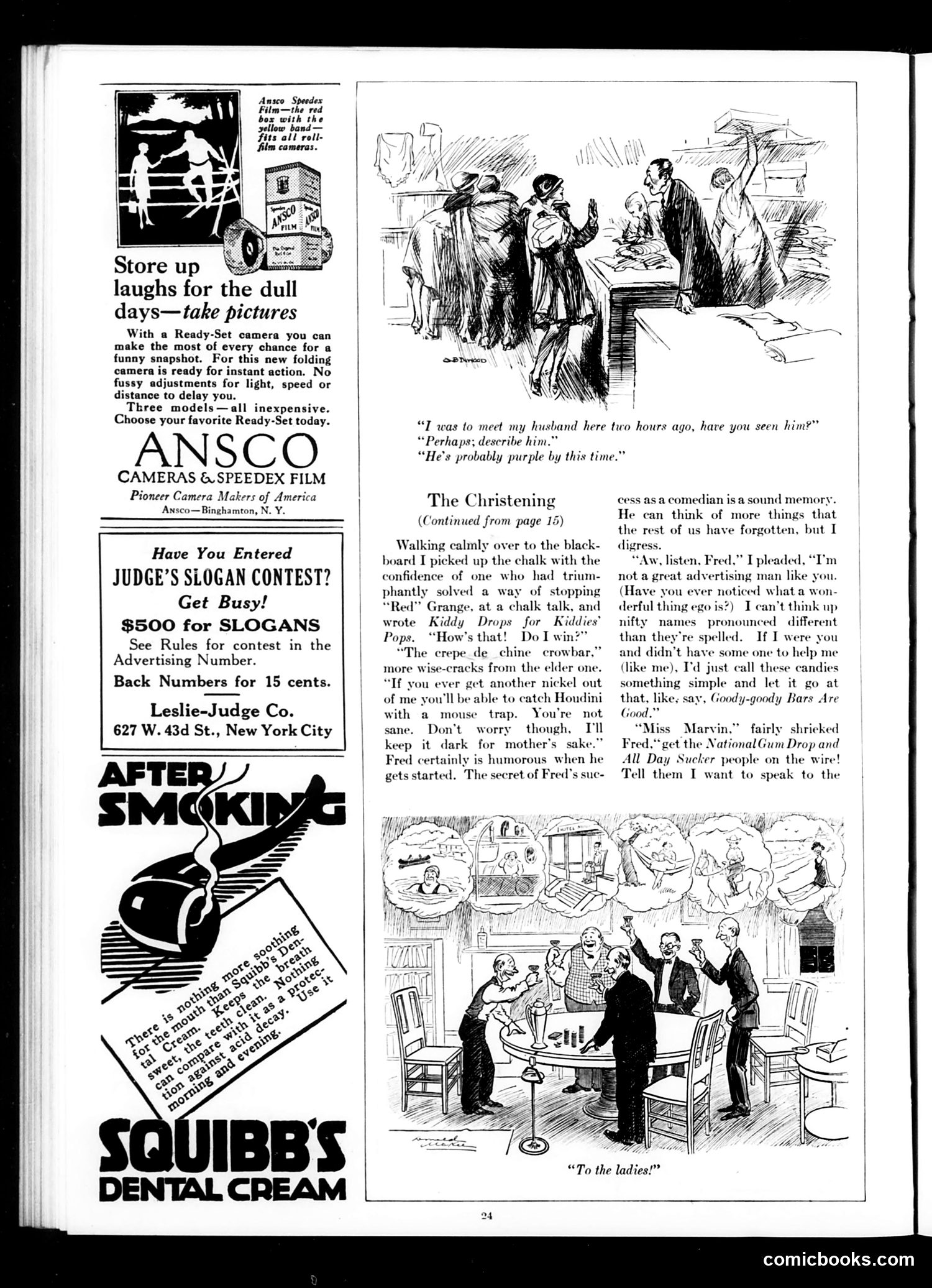
This page contains primarily **advertisements and a serialized story** rather than political satire. The main content is "The Christening" (continued from page 15), a humorous narrative about advertising copywriting. The protagonist describes helping a colleague named Fred create catchy product names for candies—"Kiddy Drops for Kiddies' Pops" and similar wordplay. The story pokes gentle fun at the advertising industry's obsession with clever, memorable product names. The top cartoon depicts a domestic scene where a wife searches for her tardy husband, joking he's "probably purple by this time"—likely a reference to drunkenness or bruising from a brawl, suggesting marital discord played for laughs. The bottom cartoon shows men toasting "To the ladies!" in what appears to be a gentleman's setting, with thought bubbles above suggesting their wandering minds—typical period humor about male distraction. The advertisements (Ansco cameras, Judge's slogan contest, Squibb's dental cream) occupy significant space, indicating this is a commercial publication dependent on advertising revenue.
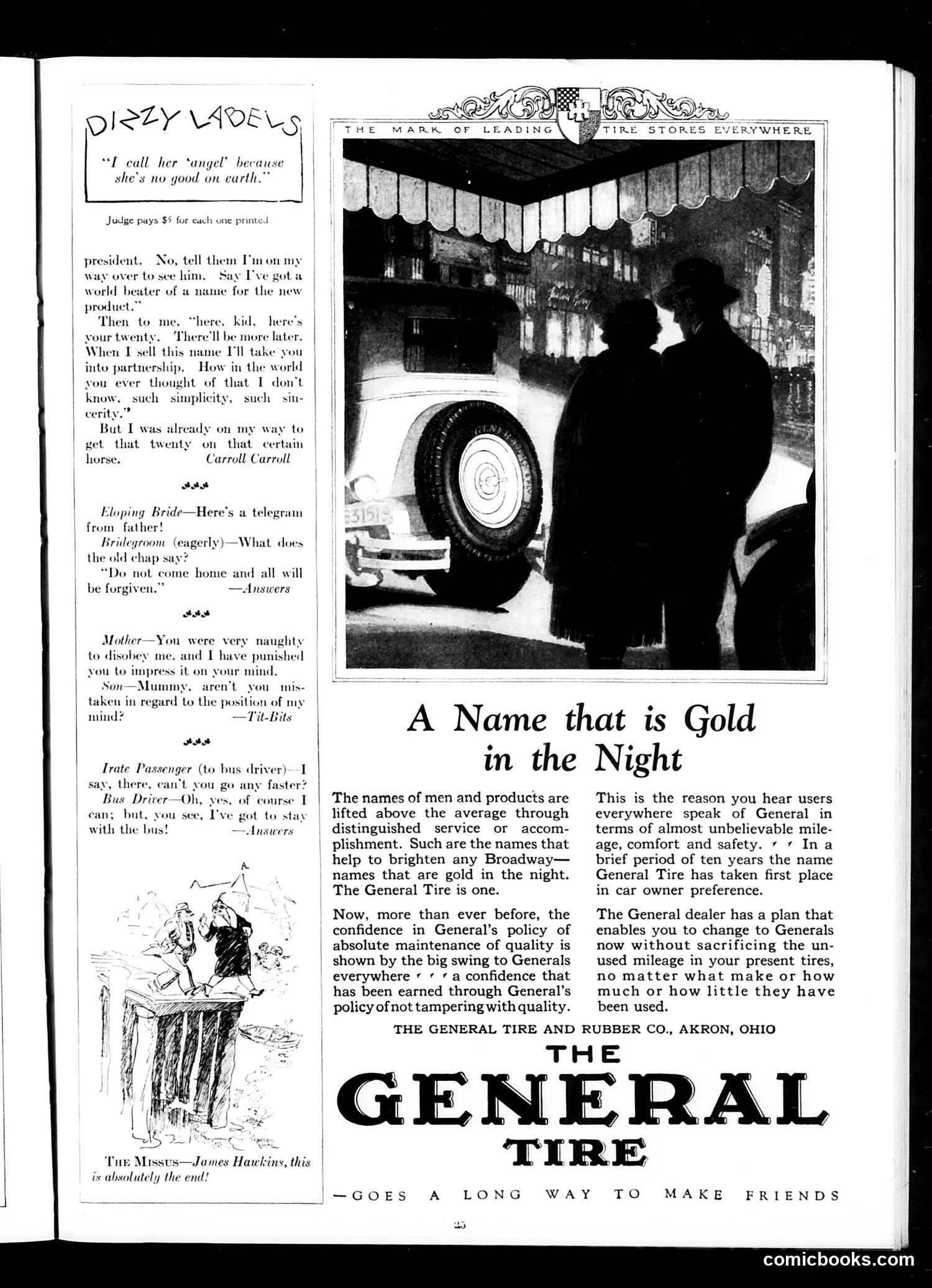
This page contains **short humorous jokes** (the "Dizzy Dames" section) typical of 1920s-30s Judge magazine, plus a **General Tire advertisement**. The jokes mock gender stereotypes: a woman called an "angel" because she's useless; an elopement telegram with patriarchal undertones; a child misunderstanding punishment; an impatient bus passenger. These rely on period attitudes about women, family hierarchy, and social propriety that would be considered offensive today. The advertisement features a photograph of two figures examining a car tire at night, with copy claiming General Tire's reputation for quality and longevity. The tagline "A Name that is Gold in the Night" (meaning reliable, trustworthy) connects tire quality to brand prestige—a common advertising strategy positioning consumer products as markers of status and good judgment. The "Dizzy Dames" section also notes Judge paid $5 per printed joke, indicating reader submissions were encouraged.
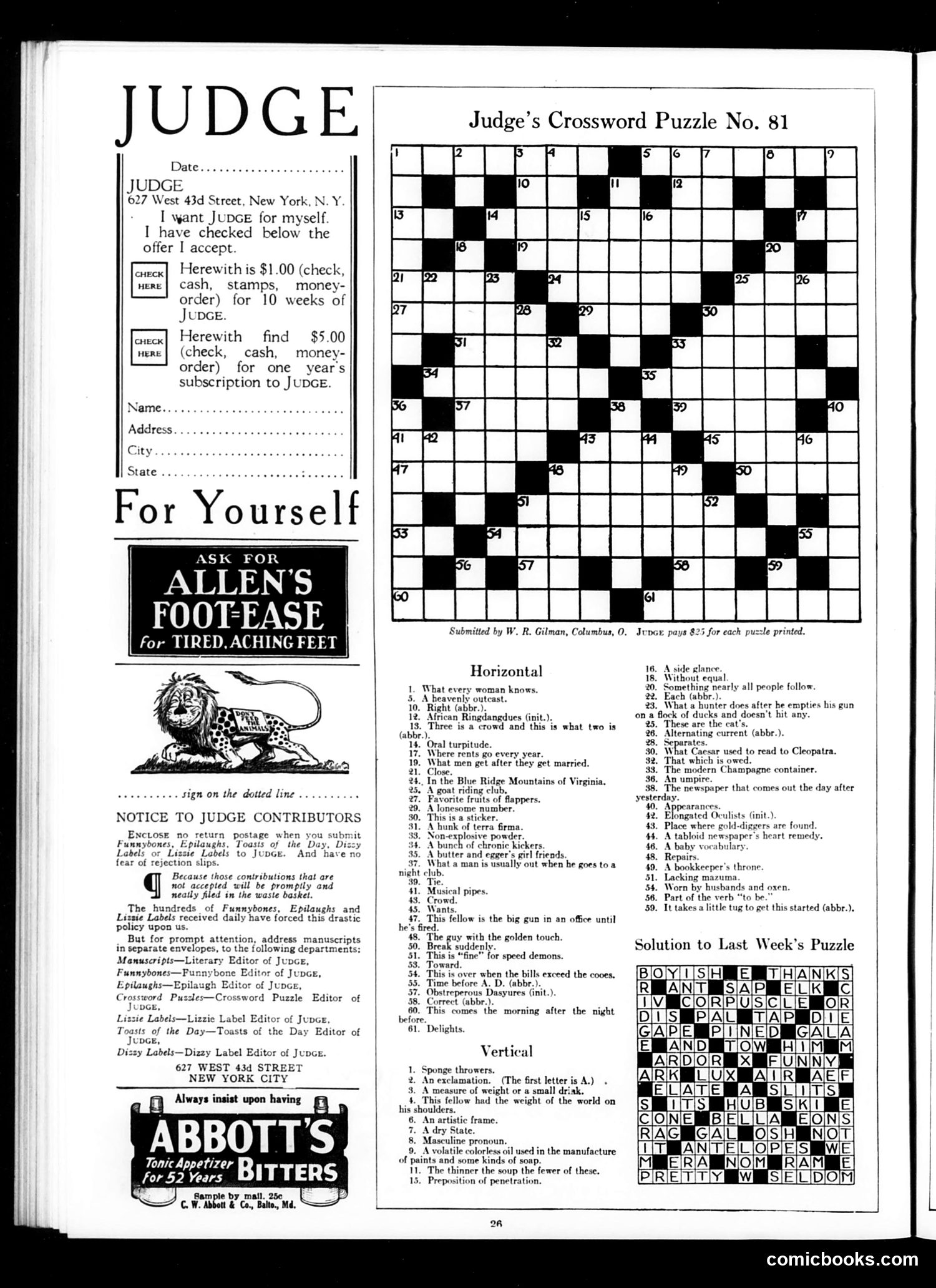
This page is primarily a **subscription solicitation and crossword puzzle**, not a political cartoon. Judge magazine (a satirical weekly) uses this format to recruit subscribers while entertaining readers. The left side contains subscription offers ($1 for 10 weeks, $5 for one year) and contributor guidelines. The main content is "Judge's Crossword Puzzle No. 81"—a standard word puzzle submitted by W.R. Gilman of Columbus, Ohio. The clues are lighthearted, era-appropriate wordplay reflecting 1920s-30s life: references to "flappers' favorite fruits," "gold-diggers" (fortune-seeking women), "speed demons," and social conventions like what "men get after they get married" (presumably nagging). The page includes vintage advertisements for Allen's Foot-Ease and Abbott's Bitters—typical patent medicine ads common in the period. There is **no discernible political satire** on this page; it's primarily a functional, reader-engagement tool used to maintain Judge's circulation.
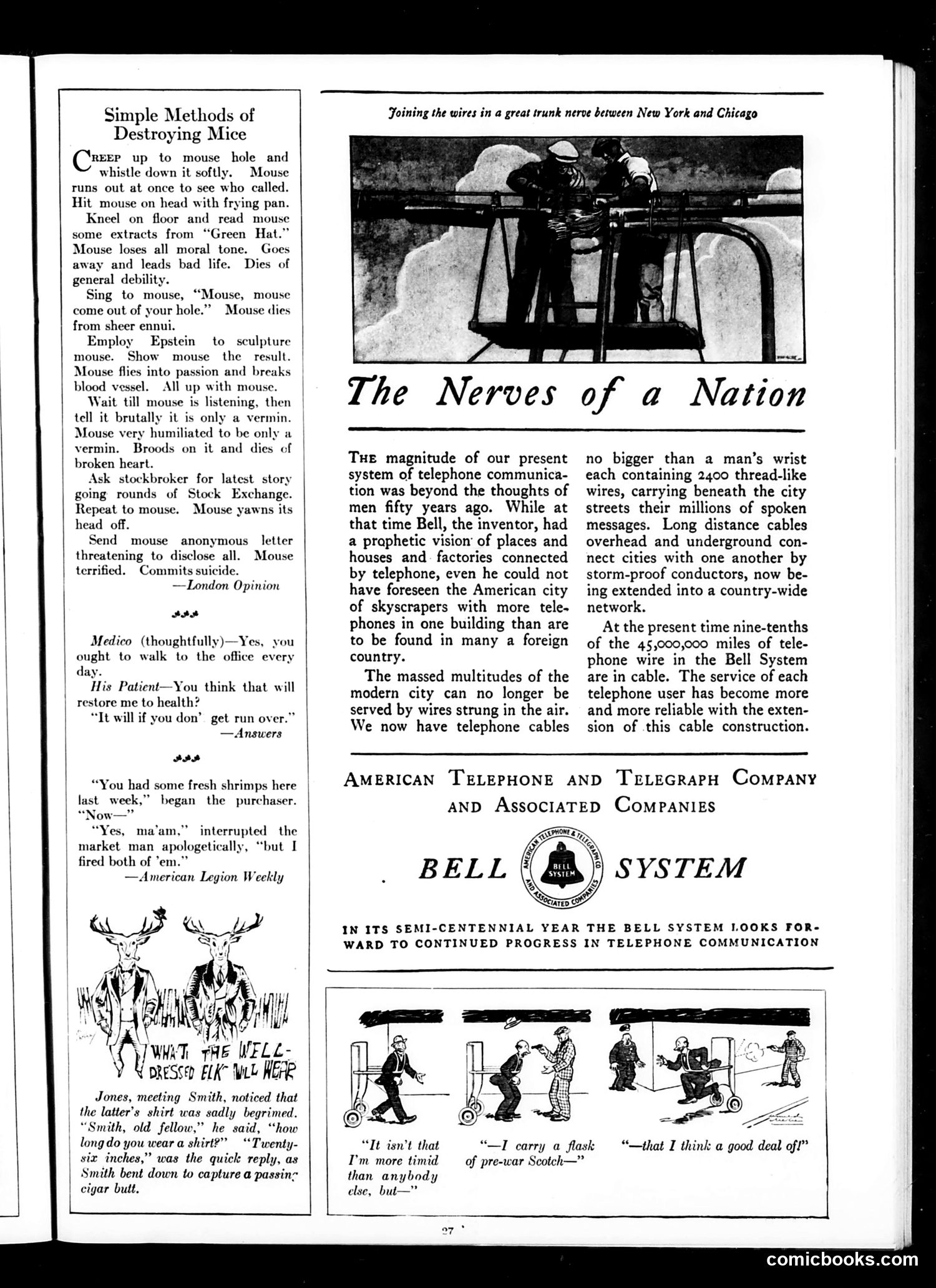
This page mixes humor with advertising. The left column contains absurdist jokes about killing mice—each method more ridiculous than the last (reading "Green Hat," employing sculptor Jacob Epstein, threatening anonymous letters). These target pretentious or modern anxieties: literary snobbery, avant-garde art, stock market speculation. The right half is a Bell System advertisement disguised as editorial content. The photograph shows telephone workers splicing cables between New York and Chicago. The headline "The Nerves of a Nation" uses body metaphor—telephone infrastructure as vital nervous system—emphasizing how modern cities depend on Bell's underground cable networks rather than overhead wires. The small cartoon at bottom shows three men, the last "carrying a flask of pre-war Scotch." This references Prohibition (likely 1920s), joking that men hide liquor as openly as they hide cowardice. The ad celebrates Bell's technological progress while readers smiled at contemporary social anxieties: Prohibition, modern art movements, and urban life dependency.
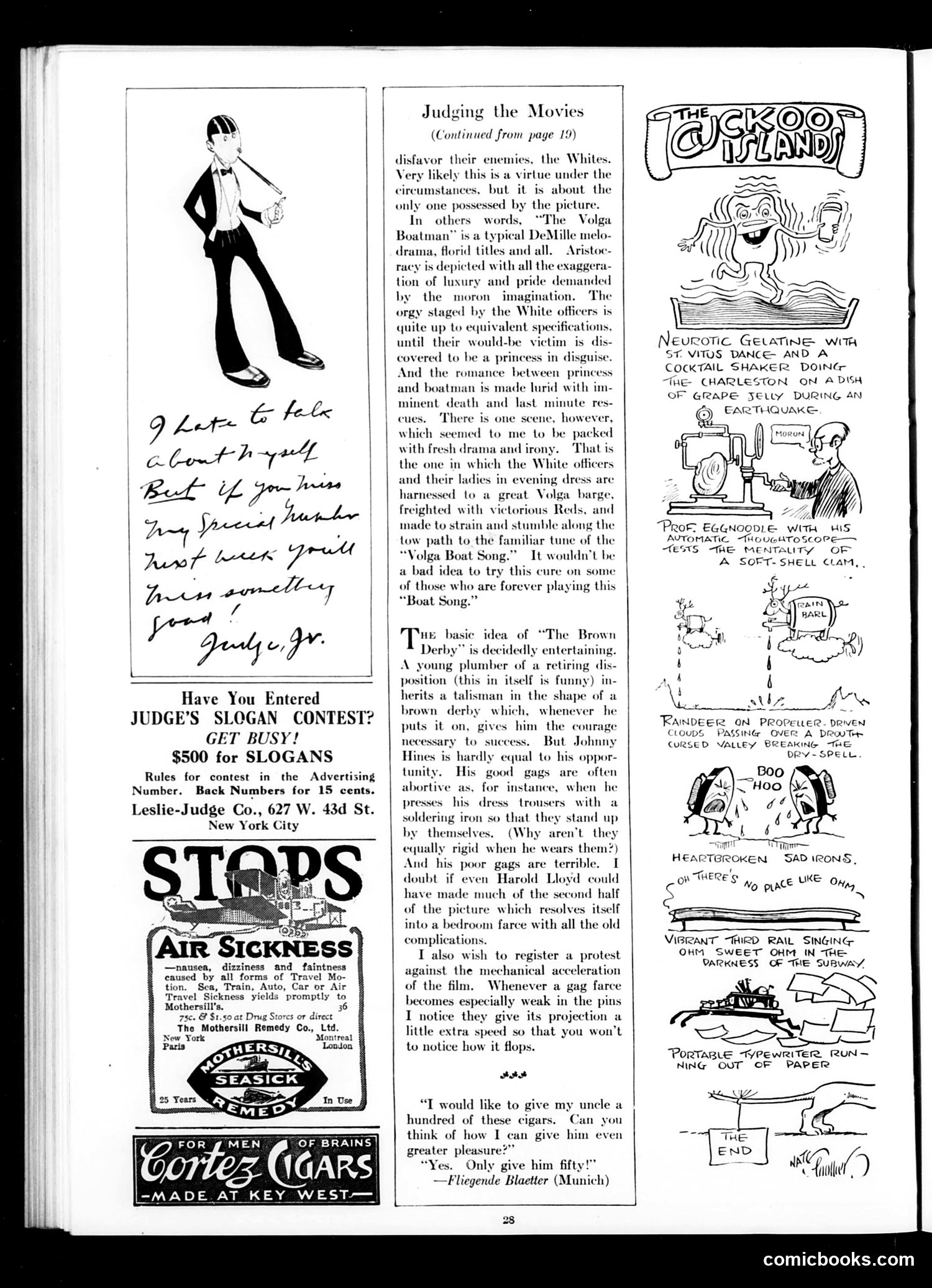
This page mixes film criticism with advertisements and cartoons. The main text reviews DeMille's "The Volga Boatman" (a 1926 silent film depicting Russian Revolution conflict) and "The Brown Derby," a comedy starring Johnny Hines. The critic praises the former's ironic scene of White officers forced to pull a barge like slaves, but calls the latter's humor uneven and resorts to artificial speed-up tricks. "The Cuckoo Island" cartoon series on the right satirizes absurdist, surreal comedy through increasingly nonsensical scenarios—a neurotic gelatin doing the Charleston, an automaton measuring a clam's intelligence, sad irons with emotions. This reflects 1920s avant-garde humor trends. The advertisements (Mothersill's travel sickness remedy, Cortez cigars, the Judge slogan contest) represent typical magazine revenue sources. The Munich humor quote at bottom is a standard editorial feature.
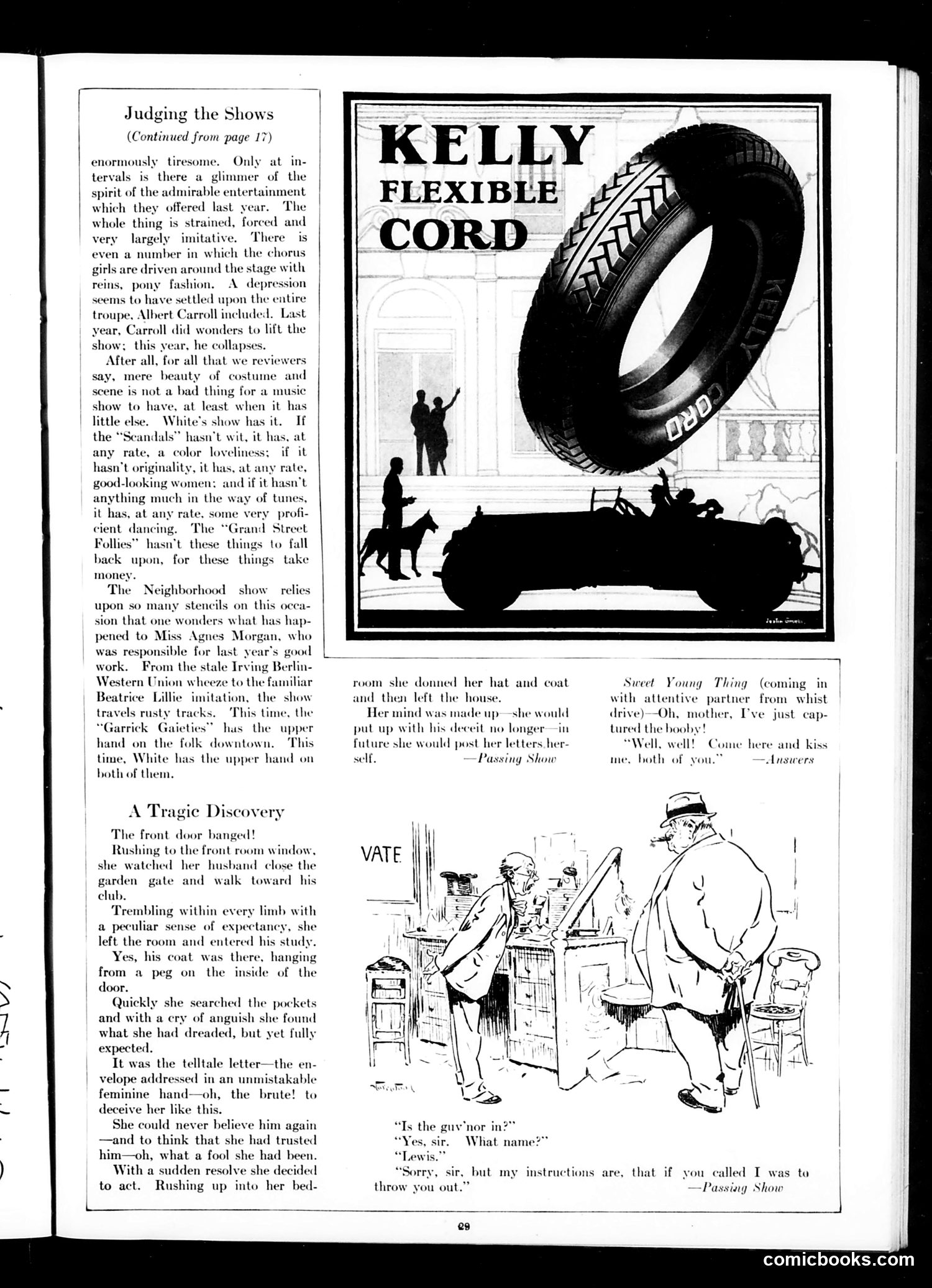
This page contains theatre criticism and two humorous narratives typical of Judge magazine's satirical content. **"Judging the Shows"** critiques contemporary Broadway productions, comparing them unfavorably to previous seasons. The reviewer dismisses shows for relying on visual spectacle (chorus girls "driven around the stage with reins, pony fashion") rather than wit or originality. Albert Carroll, a performer, is criticized for "collapsing" this year versus his strong performance previously. The piece mocks productions like the "Scandals" and "Follies" for substituting beauty and dancing for genuine entertainment value. **"A Tragic Discovery"** is a comedic domestic narrative where a suspicious wife discovers her husband's deception—she finds an incriminating letter in his coat pocket. Her dramatic resolve to "post her letters herself" (rather than him doing so) provides the satirical punchline: her concern wasn't infidelity but mail handling. **The advertisements** include a Kelly Flexible Cord product featuring a tire/automotive imagery. The comic at bottom depicts a doorman interaction—likely satirizing class pretension or authority.
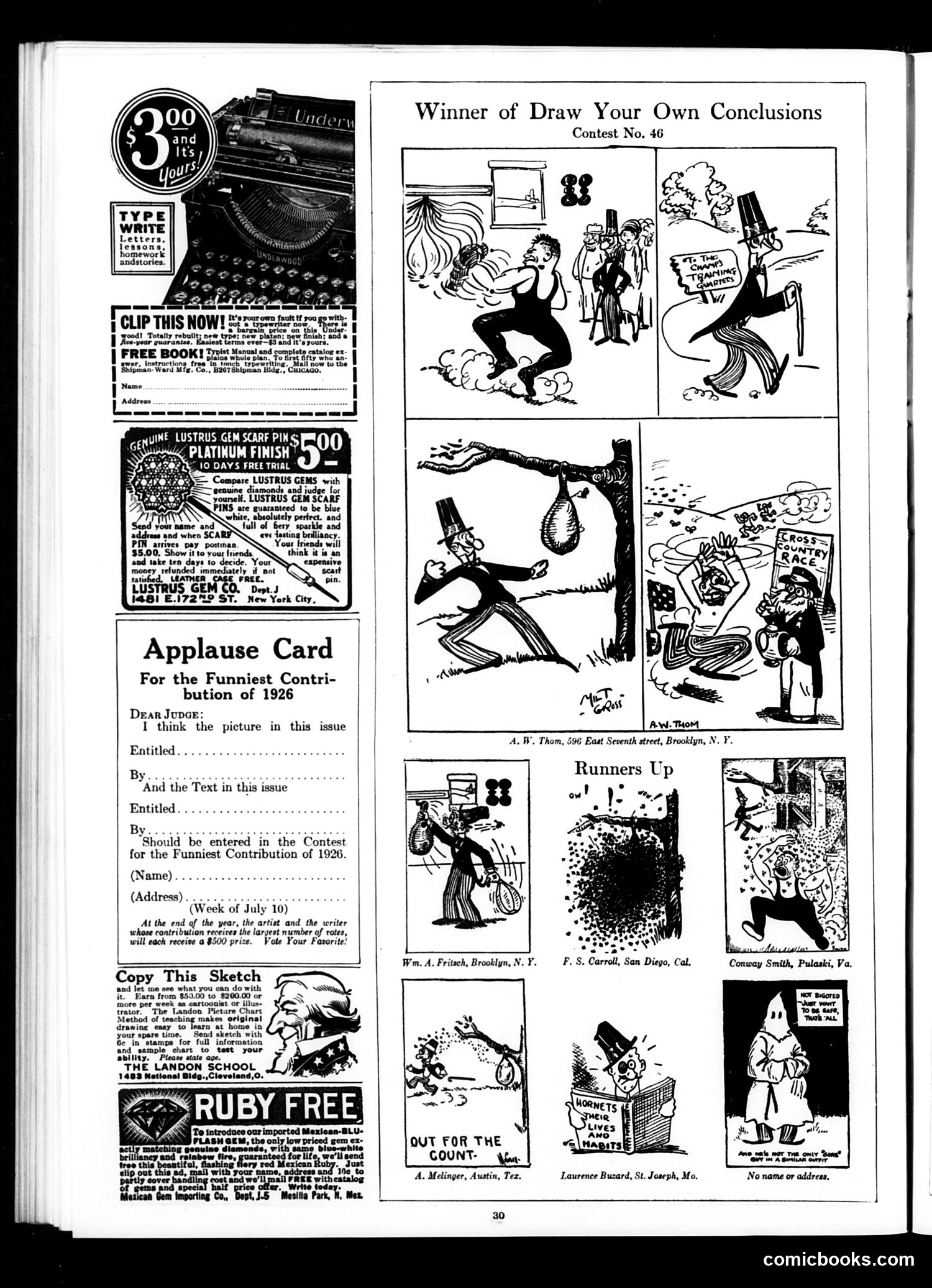
This page from Judge magazine (circa 1926) primarily showcases a **"Draw Your Own Conclusions" cartoon contest** (Contest No. 46), rather than political satire. The winning cartoon and runners-up present visual gags intended for readers to interpret or caption themselves. The winning entry by A. B. Thom depicts **slapstick humor**: a figure in formal wear (top hat and tails) appears to be performing acrobatic stunts or falling, with onlookers reacting in surprise. The humor derives from physical comedy—the contrast between formal dress and undignified physical mishap. The runners-up entries similarly feature **visual wordplay and absurdist situations**: a figure hanging from a tree, a chaotic domestic scene, and other cartoon gags. These are general-audience humor pieces without specific political references. The page also includes **advertising** (typewriter, jewelry pins, art school courses) typical of 1920s magazine content. This represents Judge's entertainment function rather than its satirical editorial mission—it's a participatory humor contest inviting reader submissions.
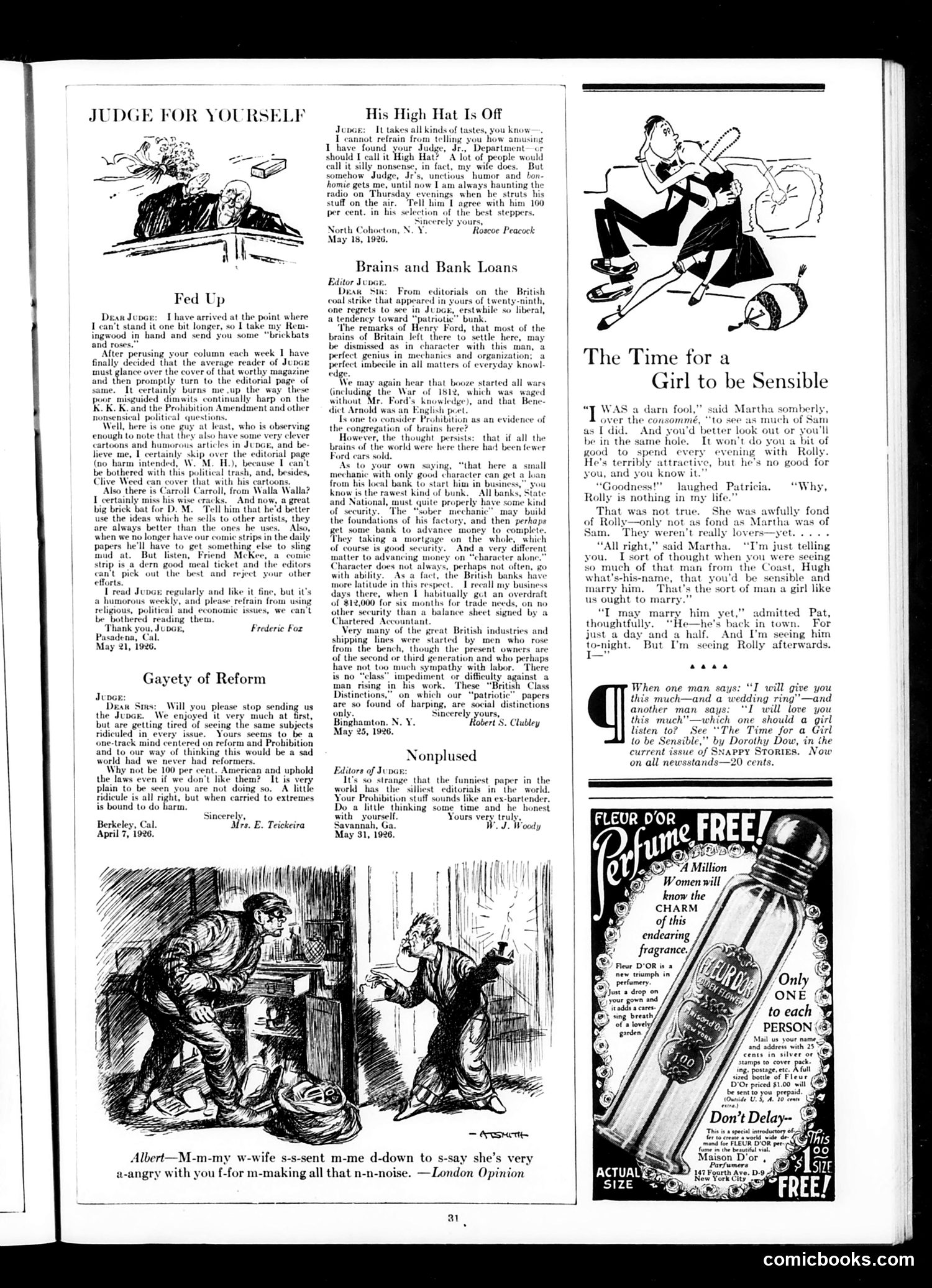
This page is primarily a **letters section** ("Judge for Yourself") where readers respond to previous magazine content. **Key points:** - **"Fed Up"** and **"Gayety of Reform"** are reader complaints about Judge's editorial stance. One reader criticizes Judge's focus on Prohibition and reform issues as repetitive; another defends reformers as necessary. - **"His High Hat Is Off"** is praise for "Judge, Jr." (apparently a radio personality), suggesting Judge magazine had multimedia reach. - **"Brains and Bank Loans"** is a substantive letter criticizing Judge's recent editorials praising Henry Ford and American business lending practices. The writer argues Ford, though mechanically gifted, is ignorant about everyday matters, and disputes claims that American banks readily loan to worthy mechanics—comparing unfavorably to British banking practices. - A **cartoon** at bottom shows domestic discord (labeled "London Opinion"). - **Perfume advertisement** for Fleur d'Or appears on the right. The page reflects 1920s debates over Prohibition, business practices, and American exceptionalism.
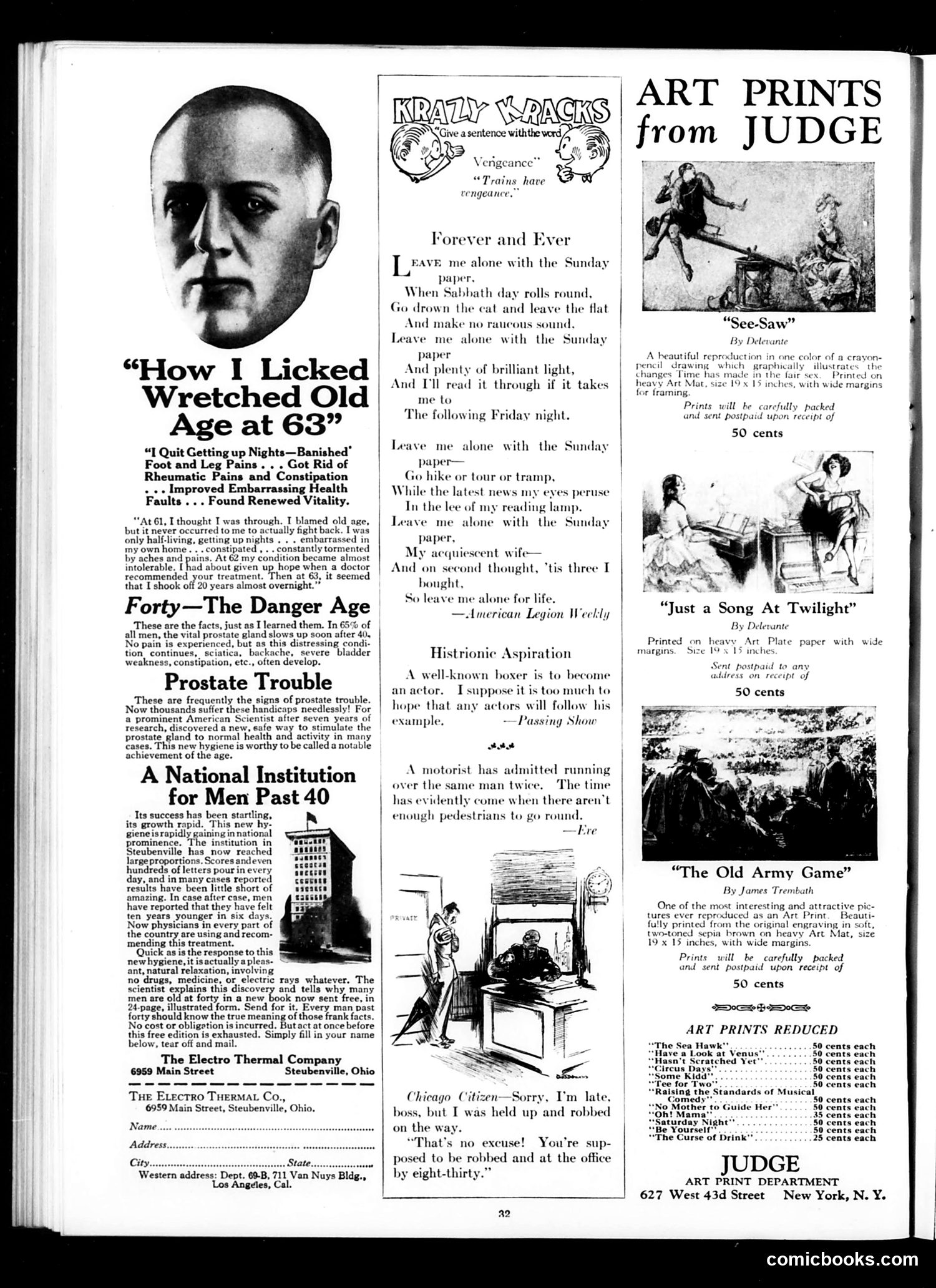
This page is primarily **advertisements and filler content** rather than political satire. The dominant feature is a medical advertisement for the Electro Thermal Company promoting treatment for "prostate trouble" in men over 40—a common early-20th-century pitch combining vague health claims with pseudoscientific authority. The small satirical items include: - **"Forever and Ever"**: A humorous poem about a man's obsession with reading the Sunday newspaper, ultimately preferring solitude to marriage—standard domestic comedy of the era. - **"Histrionic Aspiration"**: A brief joke mocking a boxer's ambition to become an actor, suggesting boxers lack the sophistication for acting. - **"Chicago Citizen"**: A short joke about an employee arriving late claiming robbery—the boss treats it as routine, implying urban crime was so common it was no excuse. The page reflects Judge magazine's mix of medical advertising (targeting aging male readers) and light humor rather than hard political commentary.
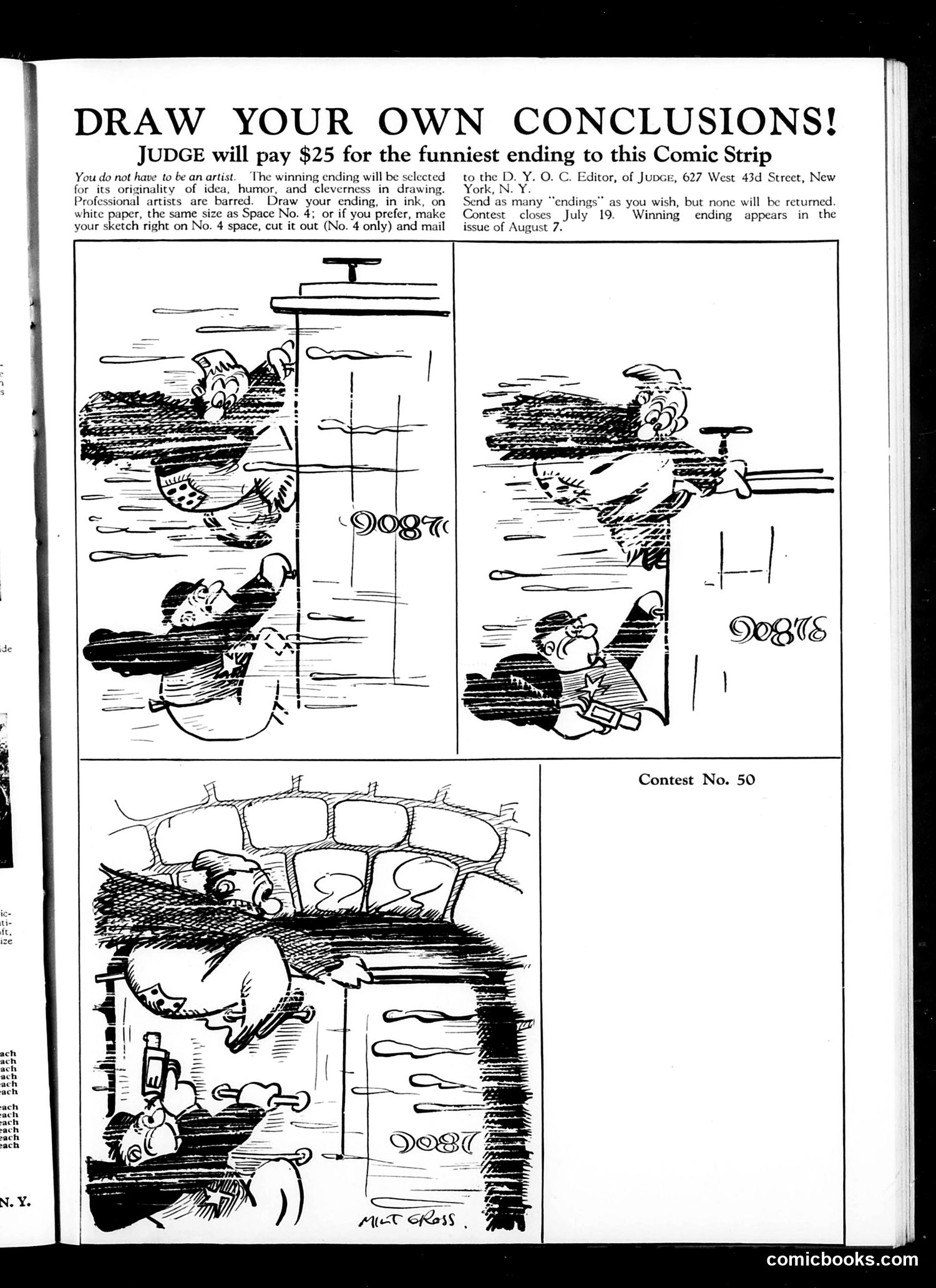
This page presents **Contest No. 50**, a reader participation feature where Judge magazine invited amateur cartoonists to complete comic strip endings for a $25 prize. The three incomplete strips show comedic scenarios involving cartoon characters in physical predicaments—apparently slapstick situations involving water, boats, and collapsing structures. The exact narrative context is unclear from the fragmented panels alone. Judge's editorial policy explicitly barred professional artists, democratizing cartooning by inviting ordinary readers to compete based on "originality of idea, humor, and cleverness." This reflects early 20th-century magazine culture, where reader engagement contests were popular circulation boosters. The prize amount ($25) would have been meaningful during this era. The contest deadline was July 19, with the winning entry published August 7—suggesting this was from a 1920s-era issue, though the exact date isn't specified on this page.
This is a full-page advertisement for Lucky Strike cigarettes, not a political cartoon. The ad features an ornate decorative border framing a circular photograph of cigarette-related items—a cigarette pack labeled "CIGARETTES" and what appears to be smoking accessories. The tagline "It's Toasted" was Lucky Strike's actual advertising slogan, emphasizing their toasting process. The copy claims that smoking Lucky Strikes "for a change" will make smokers choose them permanently. This reflects early 20th-century cigarette marketing, when such claims about product superiority and consumer loyalty were common advertising rhetoric. The ad targets smokers through appeal to quality and habit-formation.