
Judge, 1926-07-10 · page 16 of 36
Judge — July 10, 1926 — page 16: what you’re looking at
What you’re looking at
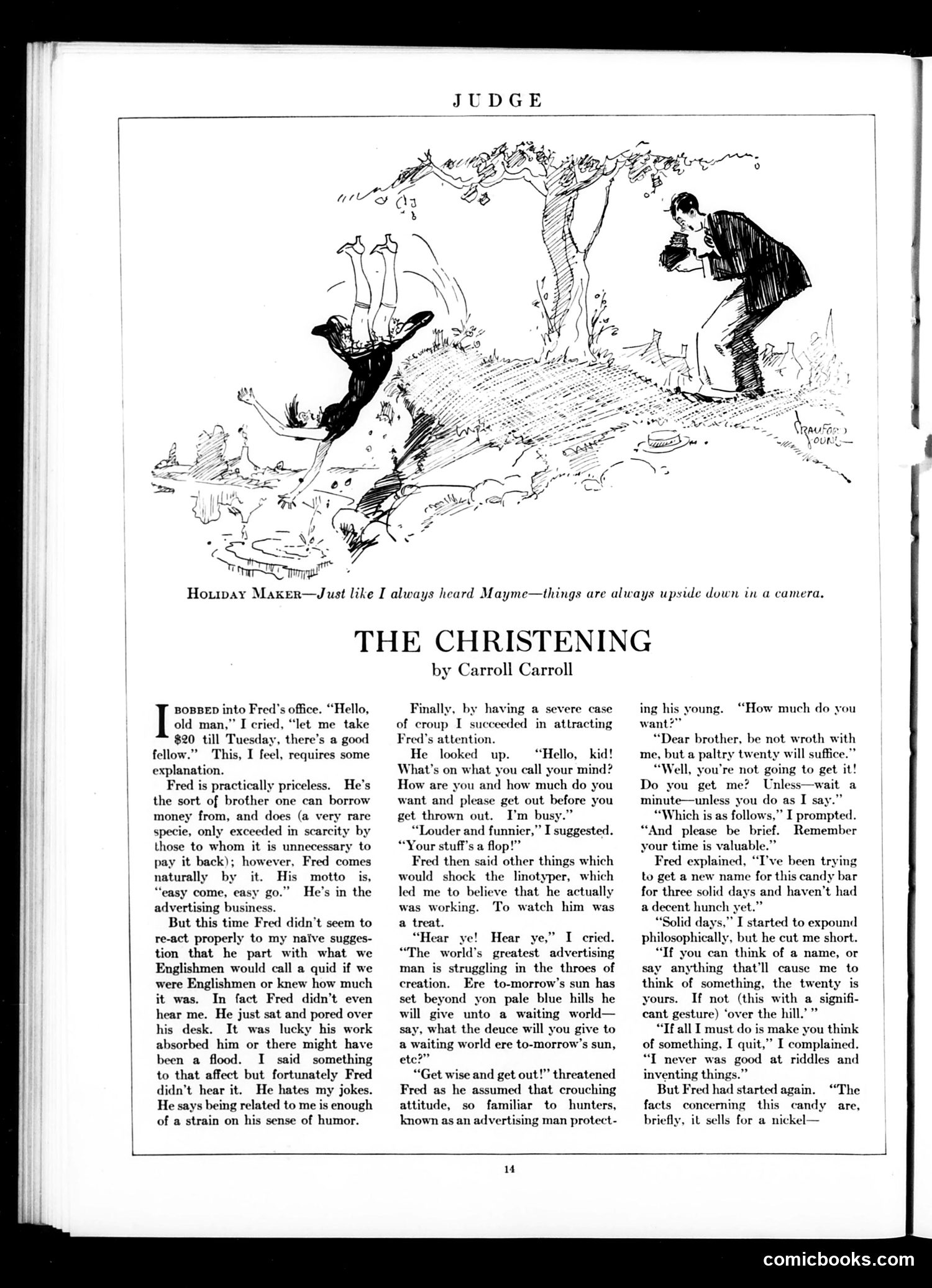
This is a humorous short story rather than a political cartoon. The accompanying illustration shows a man (the narrator) tumbling into a ditch while another man (Fred) photographs him—the "Holiday Maker" caption jokes that cameras reverse reality. The story depicts a comedic interaction between the narrator and his brother Fred, an advertising man. The narrator visits Fred's office seeking to borrow $20, but Fred is absorbed in work creating an advertisement for a candy bar. Fred offers the narrator a deal: if he can suggest a name for the product, he gets the money; if not, Fred will throw him out. The satire targets early 20th-century advertising culture—Fred's intense, self-important approach to the creative process, his dramatic attitude, and the premise that naming a cheap product is treated as profound artistic "creation." The joke relies on the contrast between the narrator's casual borrowing and Fred's commercialized worldview.
📄 Transcribed text from this page (OCR, searchable)
Machine-transcribed from the original scan — historical spelling and the odd misread are preserved.
Houipay Maxer—Just like I always heard Mayme—things are always upside down in a camera. THE CHRISTENING old man,” I cried, “let me take $20 till Tuesday, there’s a good I BOBBED into Fred's office. “Hello, fellow.” This, I feel, requires some explanation. Fred is practically priceless. He's the sort of brother one can borrow money from, and does (a very rare specie, only exceeded in scarcity by those to whom it is unnecessary to pay it back); however, Fred comes naturally by it. His motto is, “easy come, easy go.” He's in the advertising business. But this time Fred didn’t seem to re-act properly to my naive sugges- tion that he part with what we Englishmen would call a quid if we were Englishmen or knew how much it was. In fact Fred didn’t even hear me. He just sat and pored over his desk. It was lucky his work absorbed him or there might have been a flood. I said something to that affect but fortunately Fred didn’t hear it. He hates my jokes. He says being related to me is enough of a strain on his sense of humor. by Carroll Carroll Finally, by having a severe case of croup I succeeded in attracting Fred's attention. He looked up. “Hello, kid! What’s on what you call your mind? How are you and how much do you want and please get out before you get thrown out. I’m busy.” “Louder and funnier,” I suggested. “Your stuff’s a flop!” Fred then said other things which would shock the linotyper, which led me to believe that he actually was working. To watch him was a treat. “Hear ye! Hear ye,” I cried. “The world’s greatest advertising man is struggling in the throes of creation. Ere to-morrow’s sun has set beyond yon pale blue hills he will give unto a waiting world— say, what the deuce will you give to a waiting world ere to-morrow’s sun, etc?” “Get wise and get out!”’ threatened Fred as he assumed that crouching attitude, so familiar to hunters, known as an advertising man protect- “How much do you “Dear brother, be not wroth with me, but a paltry twenty will suffice.” “Well, you're not going to get it! Do you get me? Unless—wait a minute—unless you do as I say.” “Which is as follows,” I prompted. “And please be brief. Remember your time is valuable.” Fred explained, “I’ve been trying to get a new name for this candy bar for three solid days and haven't had a decent hunch yet.” “Solid days,” I started to expound philosophically, but he cut me short. “If you can think of a name, or say anything that'll cause me to think of something, the twenty is yours. If not (this with a signifi- cant gesture) ‘over the hill.’ ” “Tf all I must do is make you think of something, I quit,” I complained. “I never was good at riddles and inventing things.” But Fred had started again. “The facts concerning this candy are, briefly, it sells for a nickel— comicbooks.com