
A complete issue · 36 pages · 1926
Judge — May 22, 1926
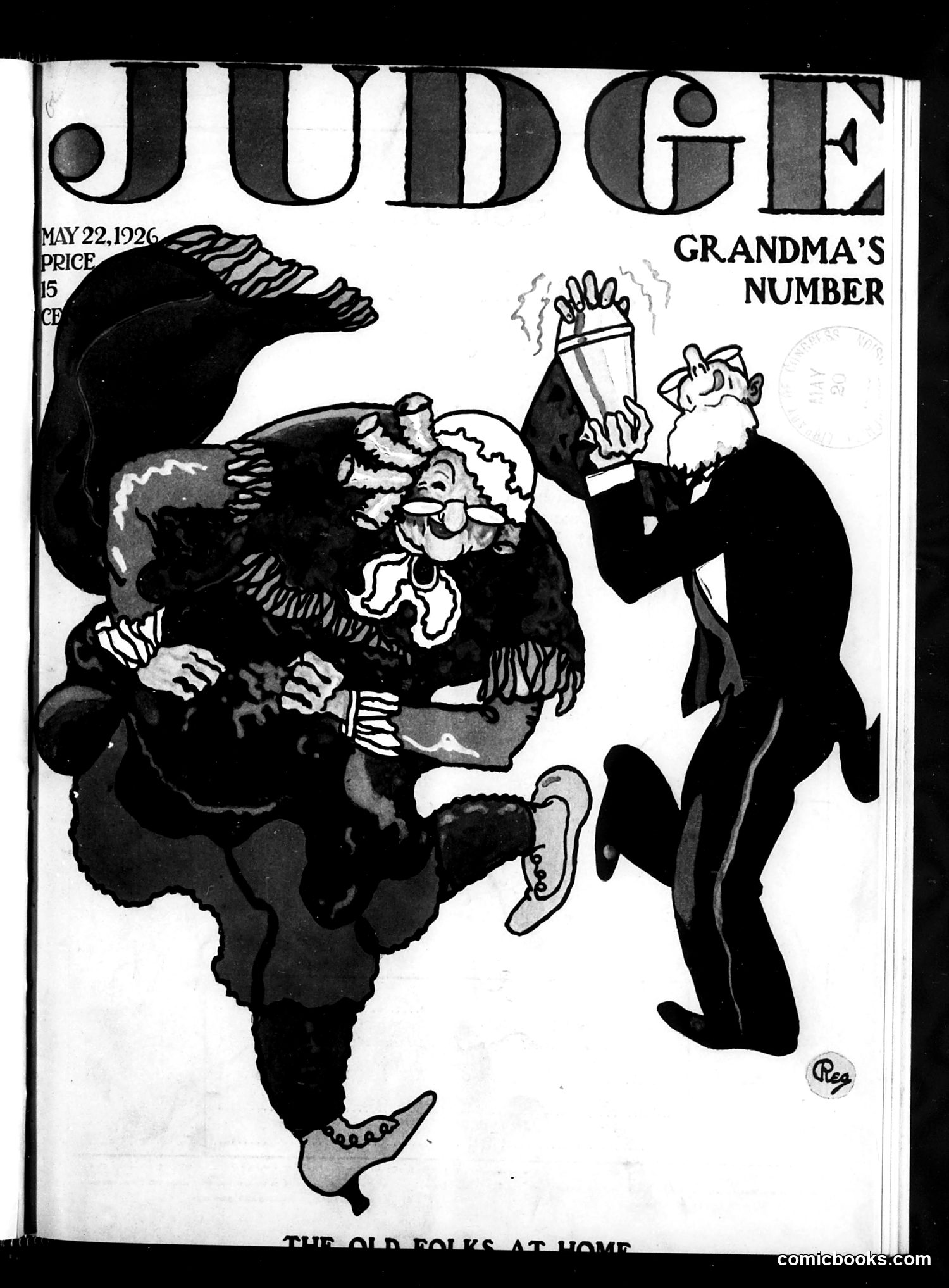
This cover cartoon depicts an elderly woman (representing "Grandma") dancing energetically with a young man, while another figure on the right holds up what appears to be a numbered card or ticket. The subtitle "The Old Folks at Home" suggests commentary on aging and social behavior. The satire likely mocks the 1920s phenomenon of older generations adopting youthful, modern behaviors—particularly dancing and participation in Jazz Age culture. The "number" reference appears to joke about elderly people engaging in activities typically associated with youth, treating it as a novelty or spectacle. This reflects period anxieties about generational shifts and changing social norms during the Roaring Twenties.
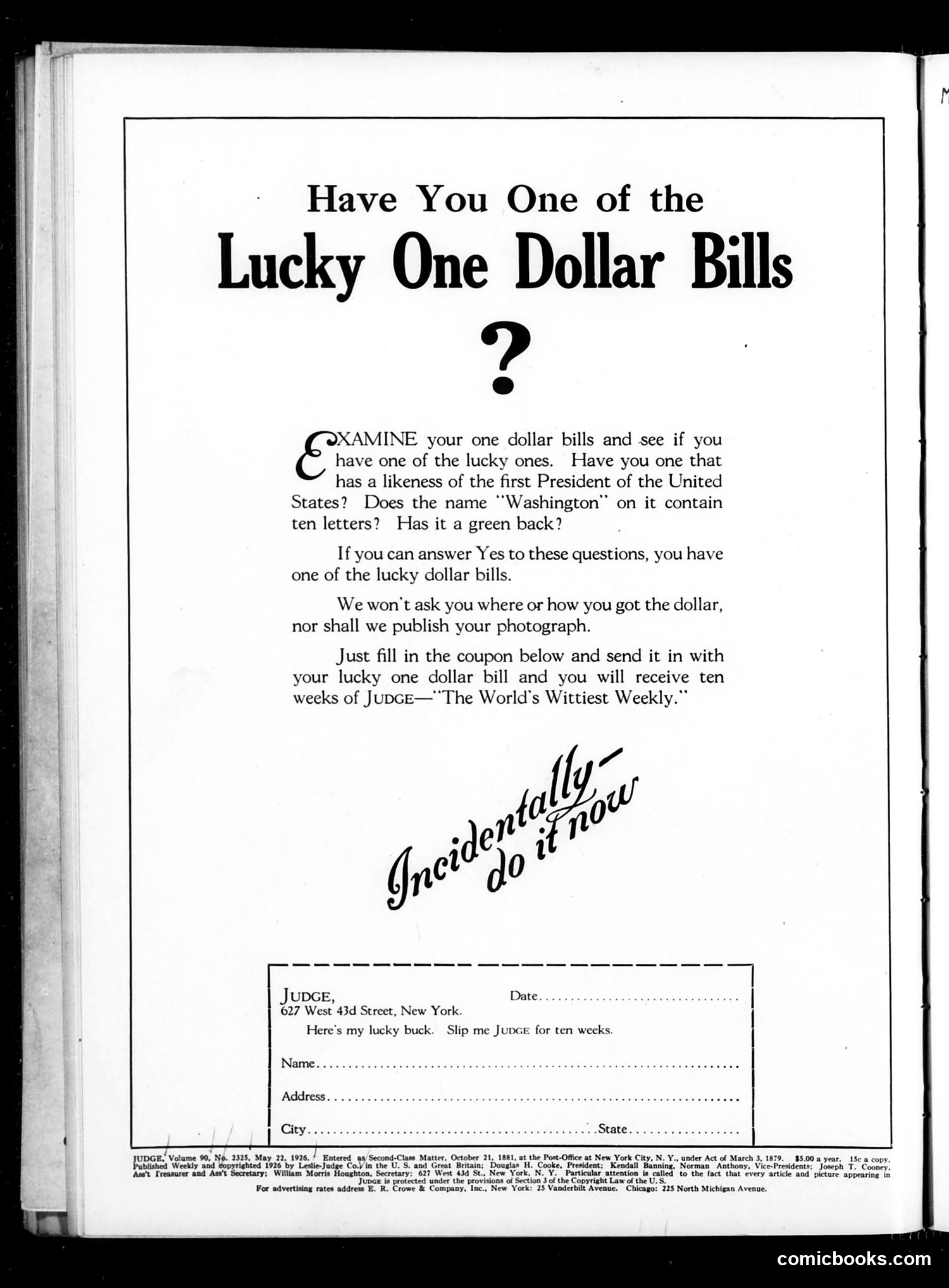
This is a promotional advertisement for *Judge* magazine, not political satire. It's offering readers a contest incentive: send in a "lucky" one-dollar bill—specifically one featuring George Washington with a green back (standard U.S. currency)—and *Judge* will award ten weeks of free subscription to the magazine, described as "The World's Wittiest Weekly." The humor is self-promotional wordplay: the magazine promises not to ask embarrassing questions about the money's origin ("We won't ask you where or how you got the dollar"), suggesting readers might have acquired it through questionable means. The phrase "Incidentally do it now" adds comedic urgency to the pitch.
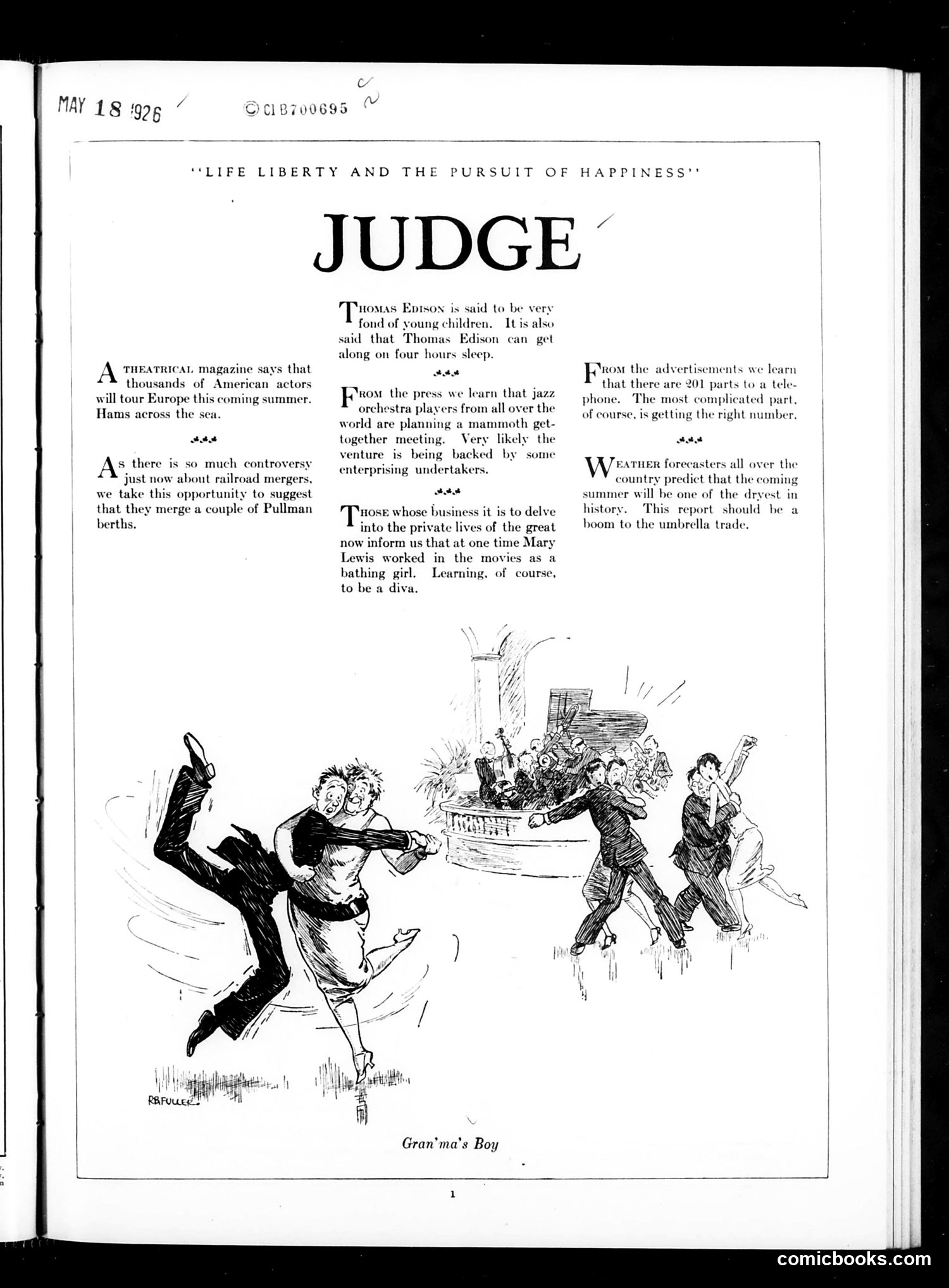
This page contains brief satirical commentary rather than a single cohesive cartoon. The illustration titled "Gran'ma's Boy" shows a young man being chased or propelled away from a boat full of people—likely satirizing the popular Harold Lloyd silent film of that title (1922). The text snippets mock various 1926 topics: Thomas Edison's sleeping habits, jazz orchestras planning international meetings, railroad mergers, celebrity gossip about Mary Lewis's film background, telephone complexity, and weather forecasting. The satire is light and observational rather than pointed political criticism. It captures the magazine's style of gentle ribbing at contemporary cultural trends, celebrity culture, and modern conveniences—typical of Judge's middle-class, humor-focused readership.
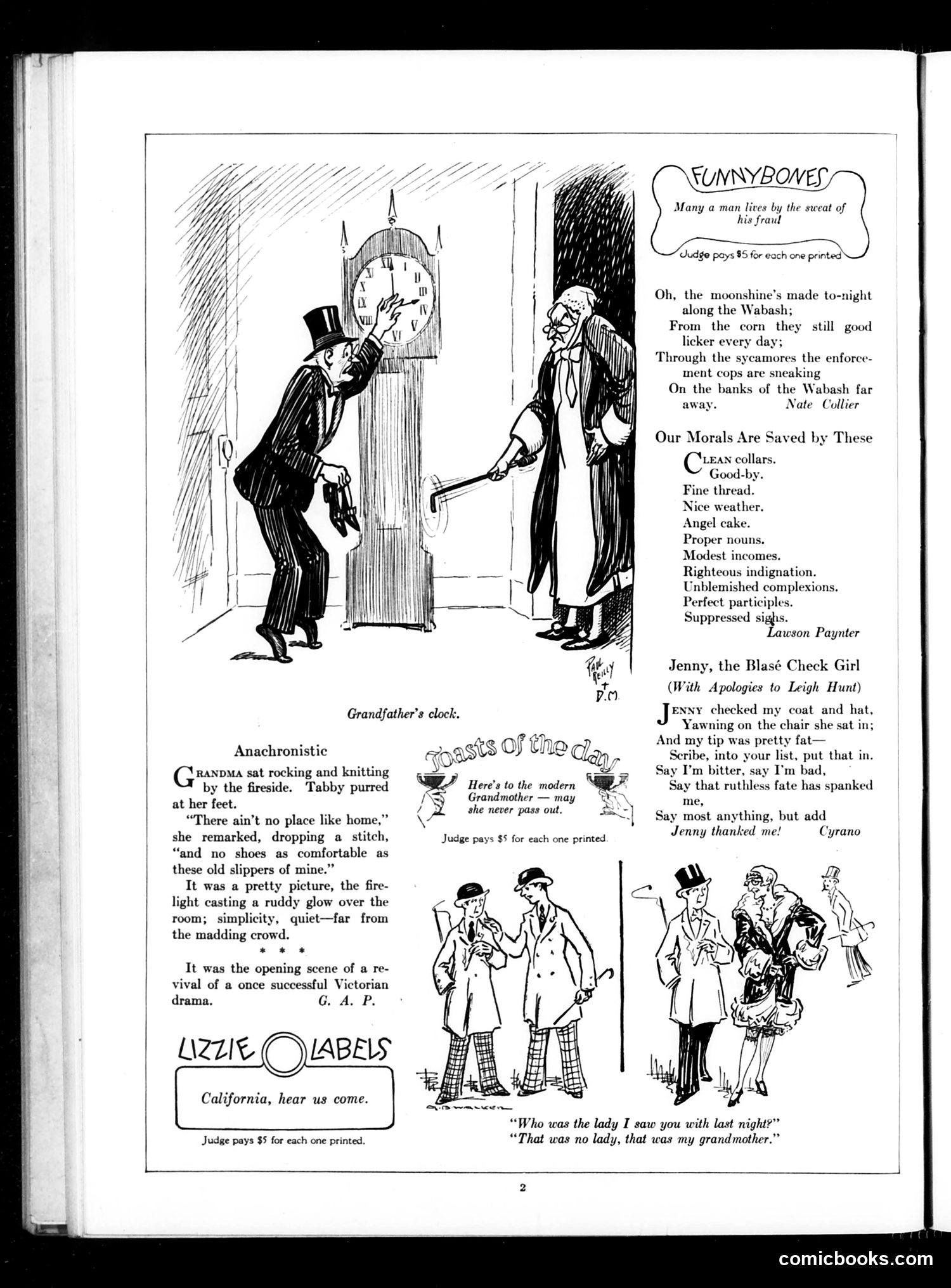
This page contains several standalone humor pieces rather than a unified political cartoon. **"Grandfather's Clock"** shows a man frantically adjusting a large clock—likely satirizing the then-common practice of manually setting clocks, perhaps referencing daylight saving time debates or the chaos of inconsistent timekeeping. **"Anachronistic"** jokes about old-fashioned domestic comfort, with grandmother's slippers representing nostalgia. **"Toasts of the Day"** and **"Funny Bones"** are brief witticisms about modern life and morality. **"Jenny, the Blâsé Check Girl"** satirizes a young working woman's jaded attitude toward romance and social conventions—reflecting Jazz Age anxieties about changing female behavior. The cartoons mock Victorian standards while poking fun at modern manners and generational differences typical of 1920s humor.
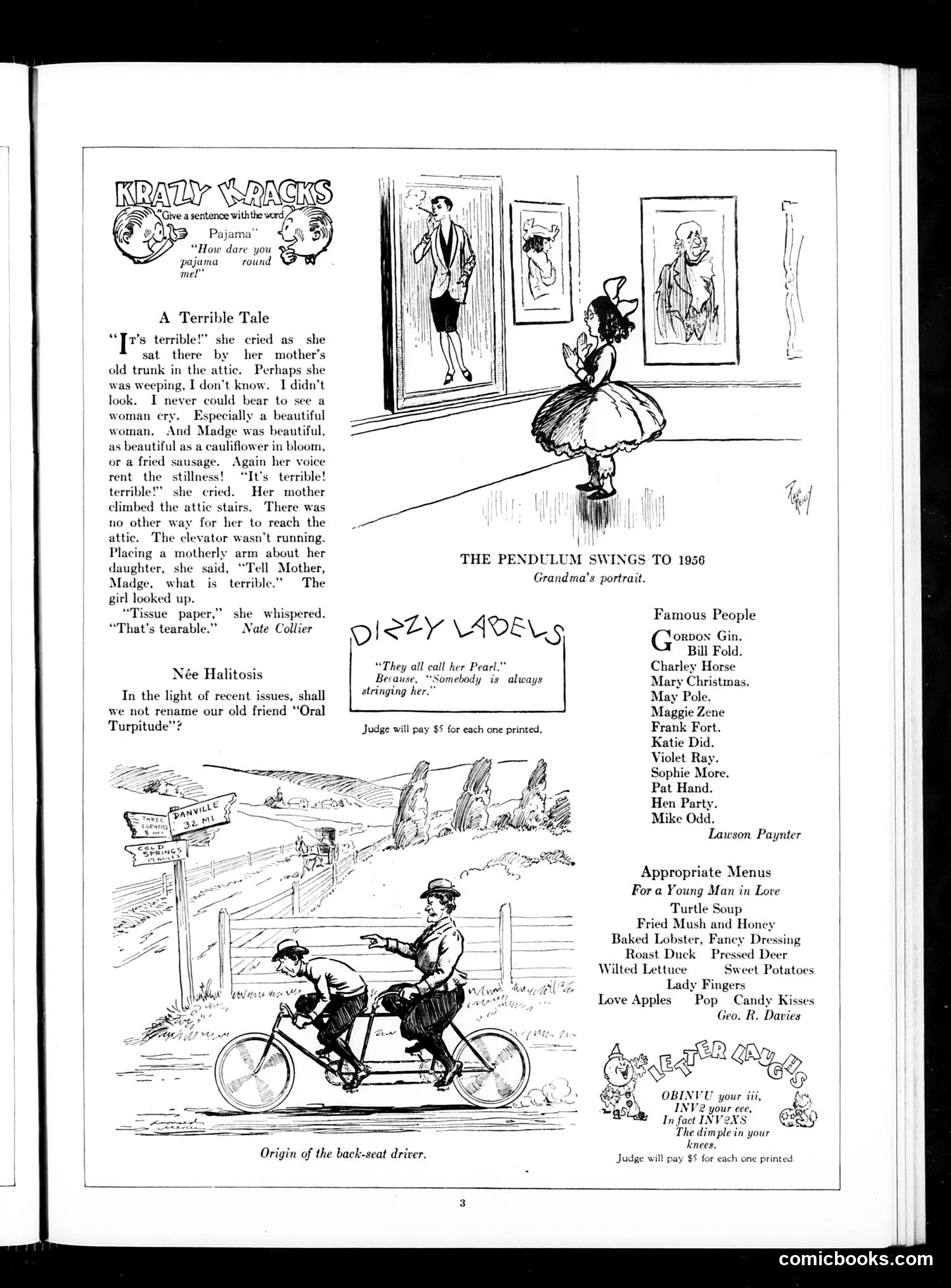
This page contains primarily **humorous social commentary and light satire** rather than political cartoons: - **"A Terrible Tale"** mocks Victorian sentimentality—a woman's overwrought emotional response to discovering an old trunk, with exaggerated language about a beautiful woman named Madge. - **"The Pendulum Swings to 1936"** shows a woman in a full skirt, likely satirizing fashion trends or women's changing roles. - **"Dizzy Labels"** is wordplay humor ("They all call her Pearl / Because 'Somebody is always stringing her'"). - **"Origin of the back-seat driver"** depicts two men on a tandem bicycle, humorously explaining this common relationship dynamic. The page also includes lists of "Famous People," menus for courtship, and other light domestic humor typical of Judge's style—social satire aimed at middle-class readers rather than hard political commentary.
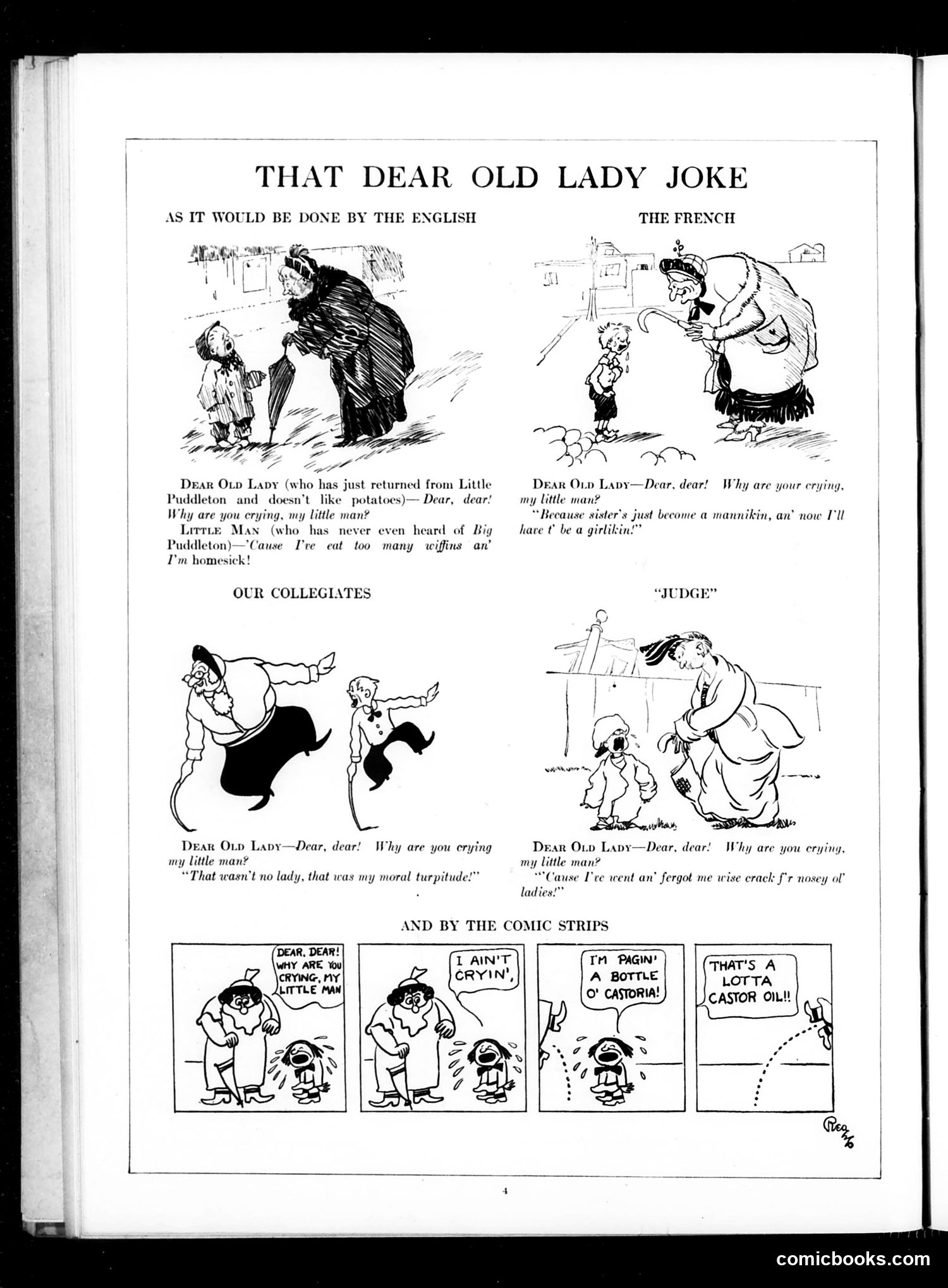
This page satirizes how different cultures and professions tell the same joke about a crying child. The "Dear Old Lady" asks why the boy is crying, and he explains he's homesick or has suffered some misfortune. The cartoon compares how the English, French, American colleagues, and a judge would each version the punchline: - English: emphasizes food (waffles) - French: focuses on romance (becoming a "man") - Colleagues: invoke morality ("turpitude") - Judge: legal consequences ("crack me wise") The comic strip below mocks this further, showing a modern version where the child simply won't stop crying. This appears to be early-20th-century commentary on national stereotypes and how different professions (legal, journalistic) approach humor differently.
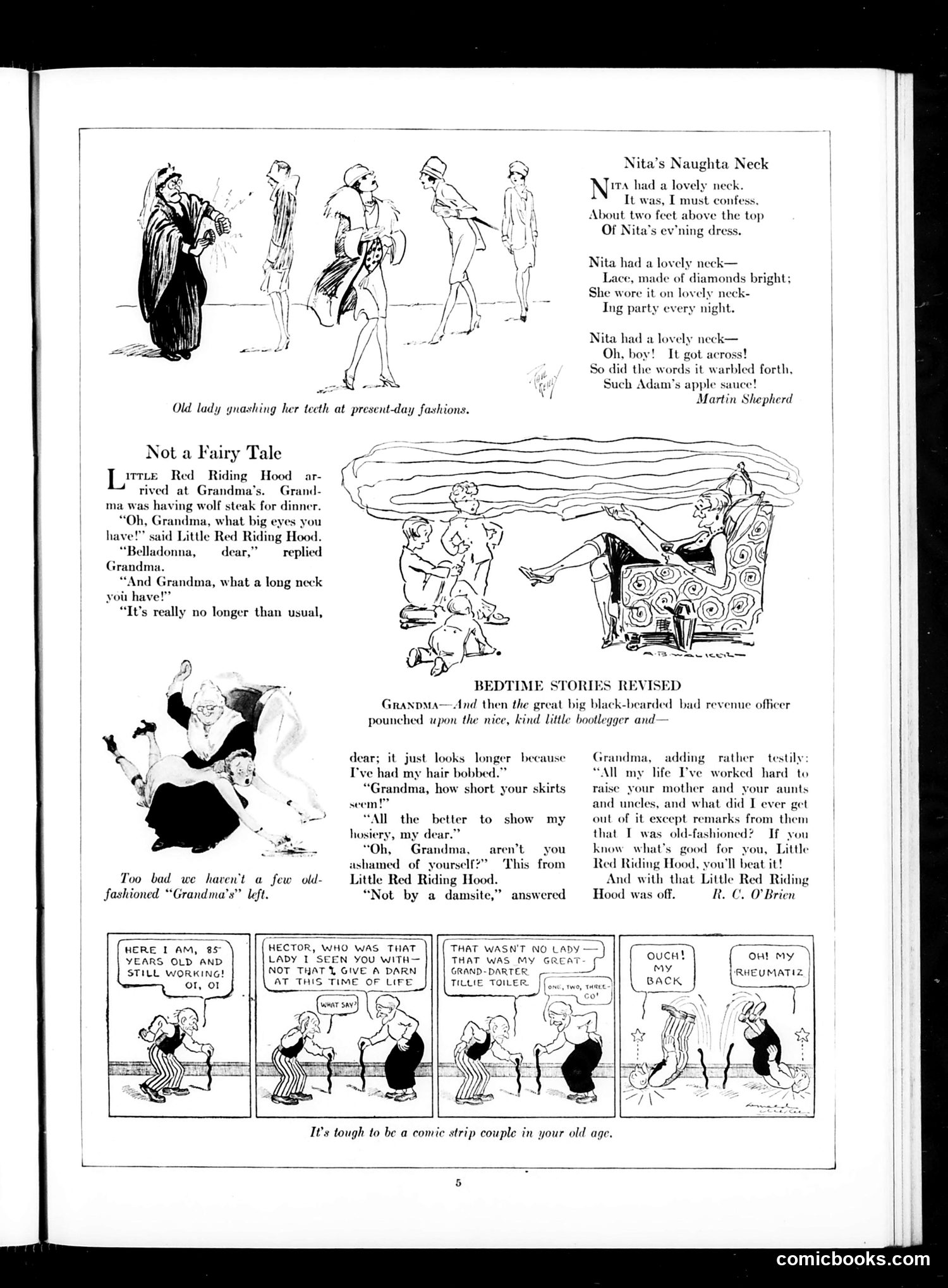
This page contains three distinct satirical pieces: 1. **"Nita's Naughty Neck"** (top): A poem by Martin Shepherd mocking a socialite named Nita whose expensive diamond necklace is her main conversation topic at evening parties—satirizing wealthy women's materialism and shallow vanity. 2. **"Not a Fairy Tale"** (center): A prose piece about Little Red Riding Hood confronting her grandmother about her unusually long neck. The grandmother admits it's because she never cut her hair or shortened her skirts, challenging outdated fashion conventions. This appears to mock conservative attitudes toward women's evolving fashion. 3. **Comic strip** (bottom): An elderly couple's dialogue references "Tillie Toiler," suggesting a long-running relationship. The caption jokes that maintaining a comic-strip romance in old age is difficult. Overall, the page satirizes female vanity, outdated fashion restrictions, and aging.
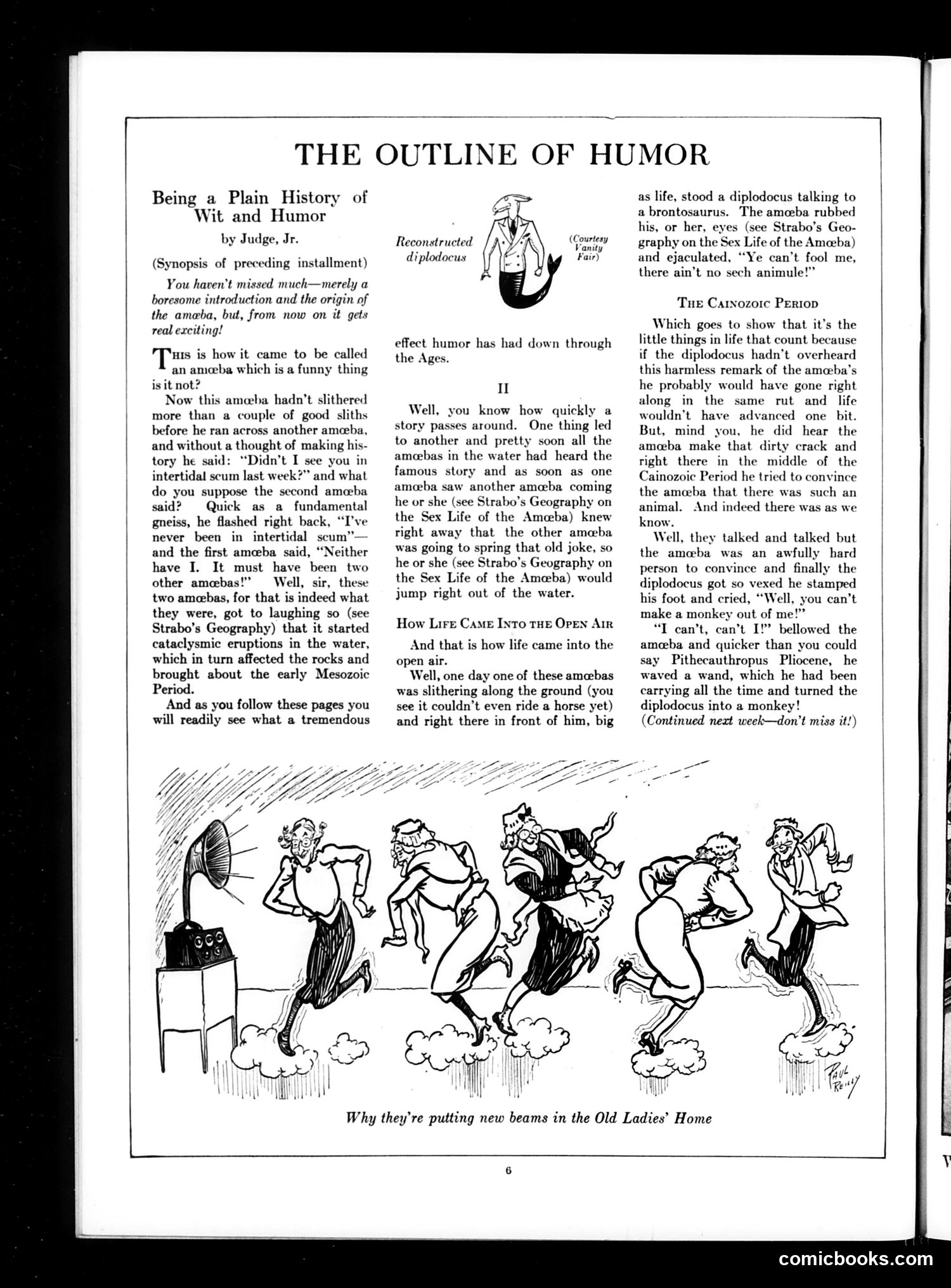
This is a humorous pseudo-educational series tracing humor's evolutionary history. The main cartoon shows elderly women fleeing from a speaker playing music, captioned "Why they're putting new beams in the Old Ladies' Home"—a sight gag implying the women are jumping so hard they're damaging the building's structure. The accompanying text is a satirical origin story: amoebas discover humor when one makes a joke, causing such laughter it triggers geological upheaval. When a diplodocus overhears skepticism about its existence, it becomes so annoyed it magically transforms the amoeba into a monkey using a wand. The satire mocks pseudo-scientific explanations and overwrought educational prose by attributing major evolutionary developments (life emerging from water, ape-human connection) to petty jokes and wounded pride. It's absurdist humor playing with readers' expectations of serious natural history.
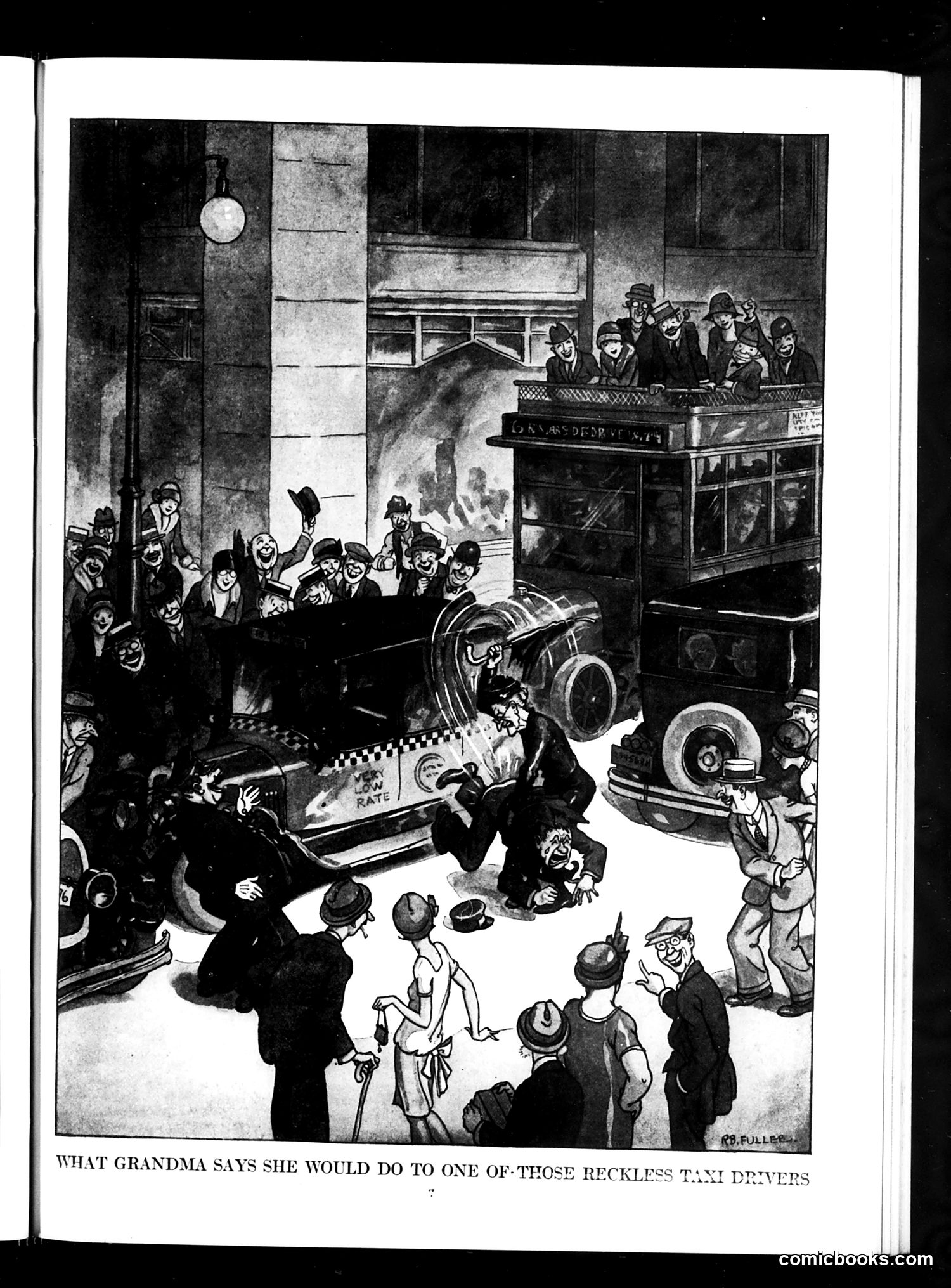
This is a satirical cartoon about dangerous taxi drivers. The image shows a chaotic street scene where an elderly woman (representing "Grandma") physically attacks a reckless taxi driver with what appears to be a large wheel or circular object, while crowds of onlookers watch from the street and building. The joke plays on public frustration with irresponsible cab drivers—a common urban complaint in early 20th-century America. The caption suggests what an angry grandmother fantasizes about doing to such drivers. The humor comes from the exaggerated, violent revenge depicted and the gap between what respectable elderly women would actually do versus what they might *want* to do to endanger the public. The cartoon satirizes both reckless driving and expresses shared public anger about urban traffic safety.
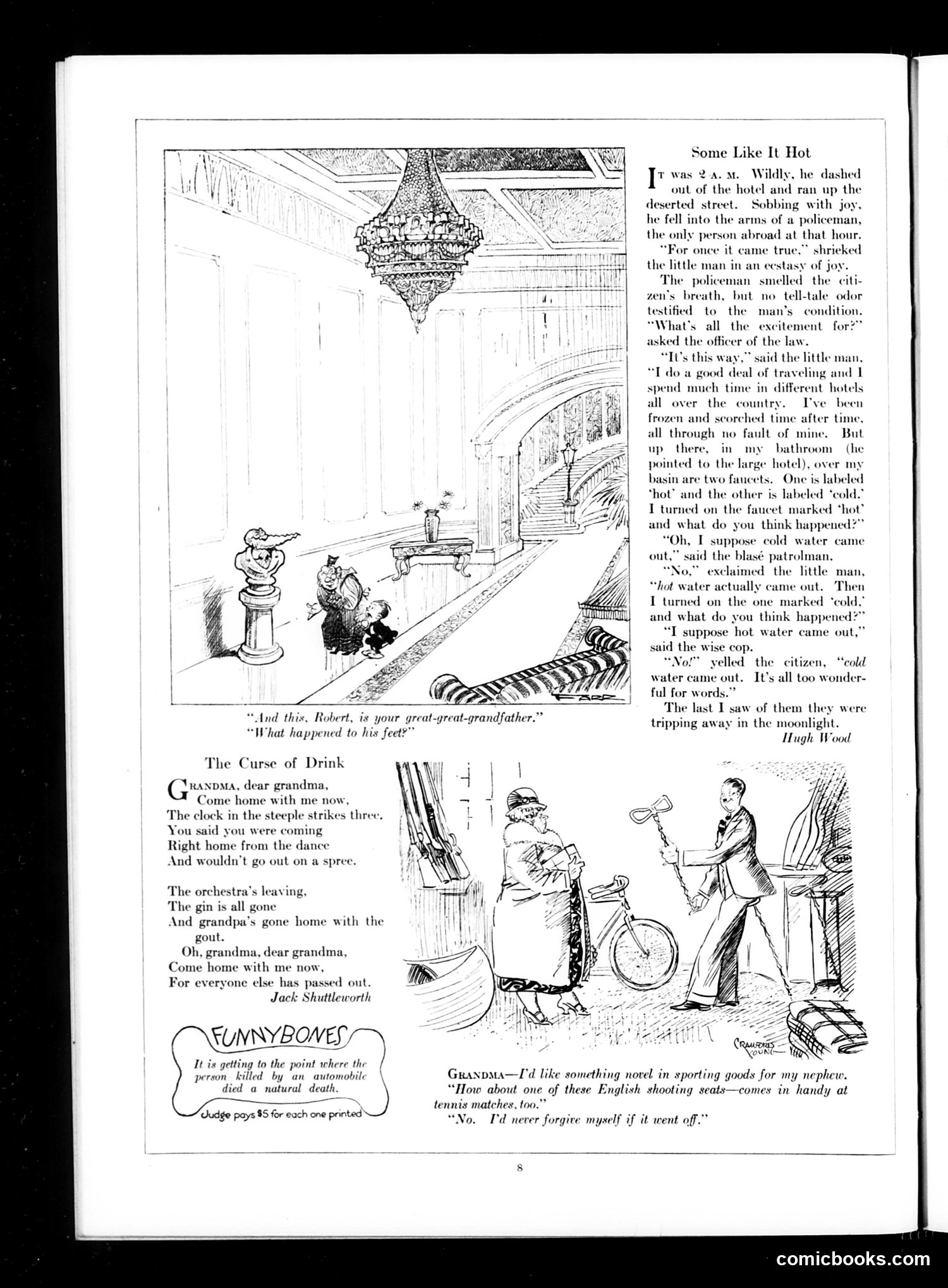
This page contains three satirical pieces reflecting early 20th-century American social concerns: **"The Curse of Drink"** (poem by Jack Shuttleworth): A grandmother has abandoned her family after a dance, drinking gin until passing out. The satire targets alcohol's destructive effects on respectability and family obligations—a common Prohibition-era concern. **"Some Like It Hot"** (by Hugh Wood): A traveling salesman excitedly tells a cop that a hotel's "hot" faucet actually dispensed hot water—apparently a rarity in American hotels. The joke mocks poor hotel infrastructure and infrastructure standards, presenting this basic amenity as shockingly novel. **"Funnybones"**: A brief quip about automobile fatalities becoming so common that deaths qualify as "natural." The cartoon illustration (top) shows a grand hotel lobby, supporting the "Some Like It Hot" narrative about luxury accommodations. These pieces collectively satirize contemporary anxieties: alcohol abuse, inadequate public services, and rising automobile dangers—all markers of modernity's failures.
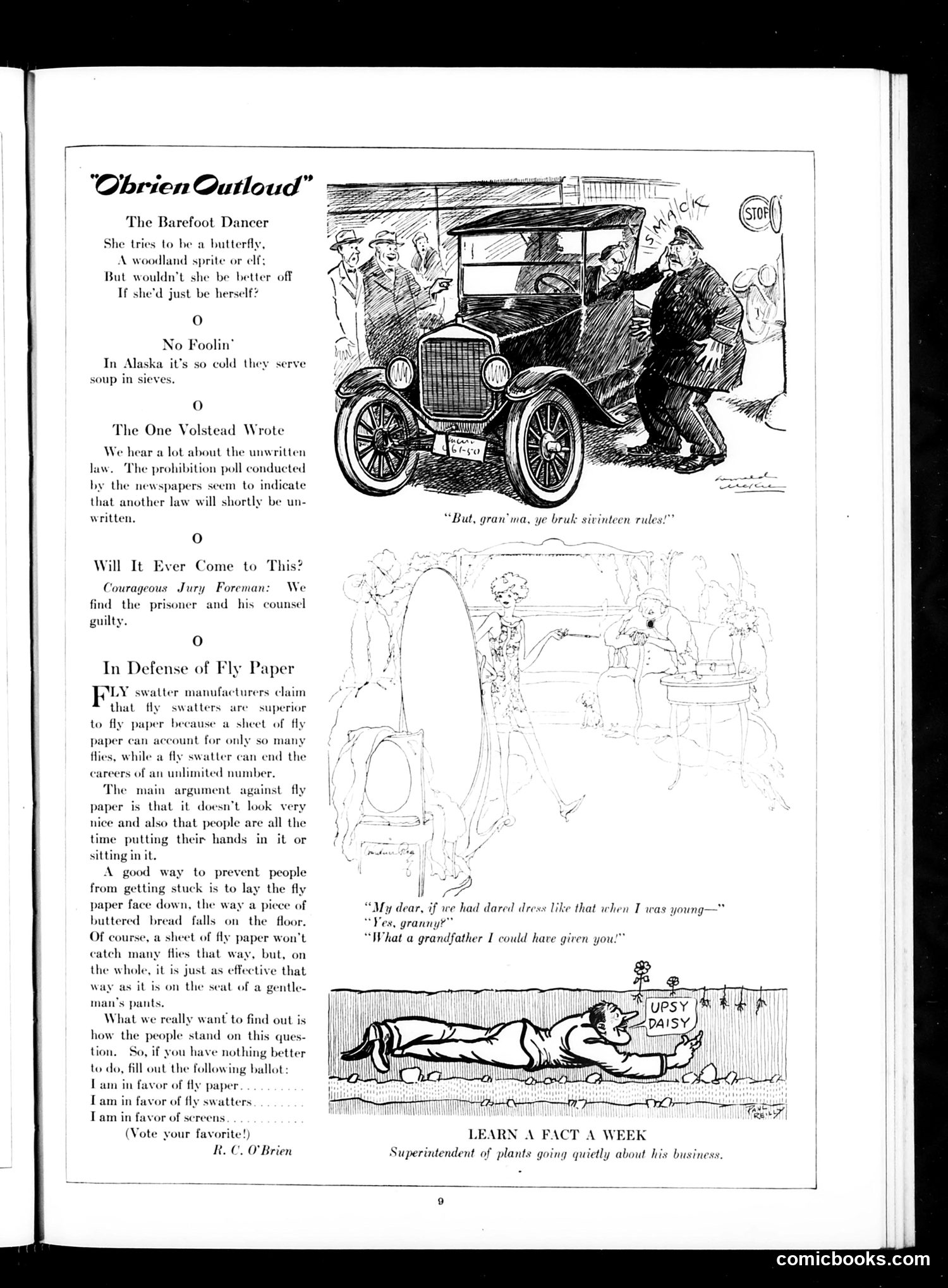
This page collects humorous short pieces and cartoons. Key content: **"The One Volstead Wrote"** references the Volstead Act (Prohibition legislation), joking that newspapers' anti-prohibition polls suggest another law will soon be "unwritten"—satirizing growing public opposition to alcohol ban enforcement. **"Will It Ever Come to This?"** presents an absurd scenario where a jury foreman finds both defendant and counsel guilty, mocking legal incompetence or judicial absurdity. **"In Defense of Fly Paper"** is a tongue-in-cheek essay defending fly paper over fly swatters, with intentionally circular logic—the humor lies in treating a mundane household product debate with mock seriousness, even including a formal ballot. The cartoons are light domestic humor: a grandmother reflecting on changing fashion standards, and a car scene ("But, gran'ma, ye break seventeen rules!") about traffic violations. Overall, this represents Judge's signature style: gentle social commentary mixed with nonsense humor and domestic comedy, without heavy political edge.
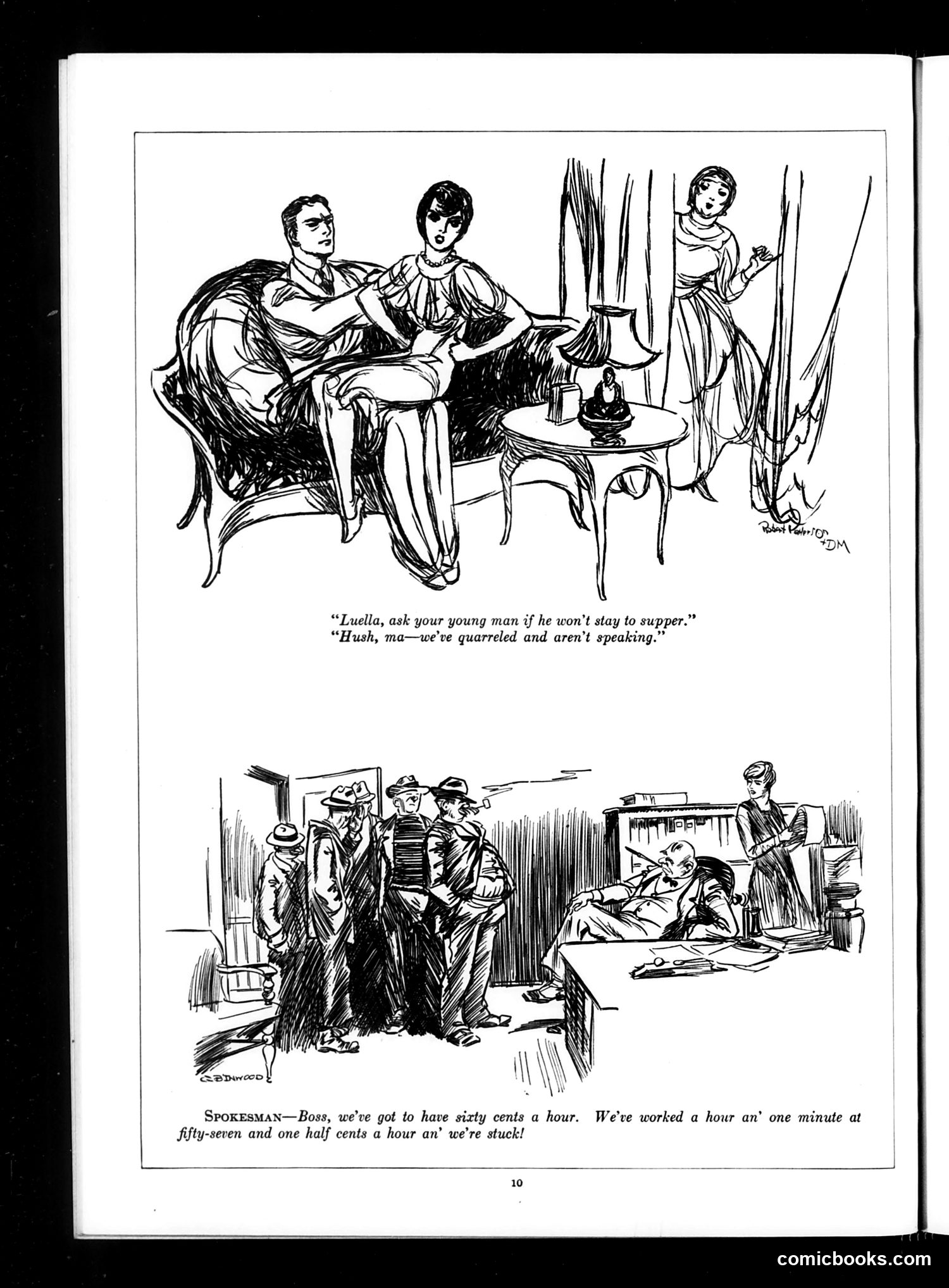
This page contains two distinct satirical cartoons: **Top cartoon**: A domestic humor piece mocking young courting couples. A mother asks her daughter to invite the boyfriend to supper, but the daughter reveals they're in a silent quarrel—poking fun at the dramatic, overwrought nature of romantic disputes. **Bottom cartoon**: Labor satire targeting union wage negotiations. A spokesman demands a wage increase to sixty cents per hour, but his complaint reveals the absurdity of labor demands: they've worked only one hour and one minute, yet already claim to be "stuck" despite having already earned nearly their requested rate. The cartoon mocks worker demands as unreasonable and mathematically nonsensical, reflecting Judge magazine's anti-labor sentiment typical of early 20th-century satirical publications aimed at middle and upper-class readers.
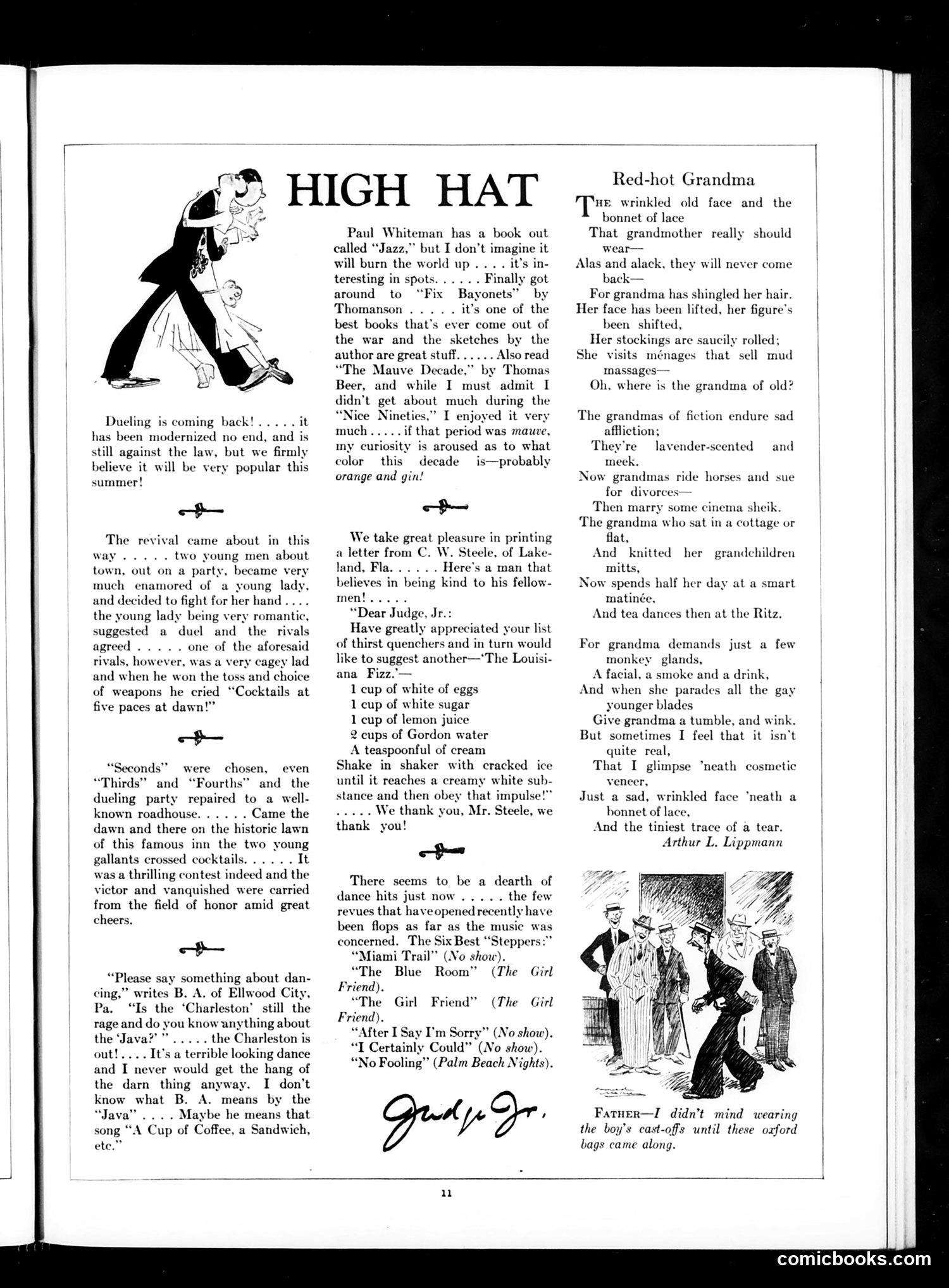
This page satirizes post-WWI American social changes through humor about dueling, dancing, and aging women. The main cartoon depicts a comical "duel revival" where two rivals fight over a woman—but instead of weapons, they "duel" with cocktails at dawn. The joke mocks Prohibition-era drinking culture while playing on romantic notions of honor. The text discusses modern dances (Charleston, Java) with bemusement, reflecting uncertainty about rapidly changing jazz-age dance crazes. References to Paul Whiteman's jazz book and new revue shows date this to the early 1920s. "Red-hot Grandma" poem satirizes elderly women abandoning traditional roles: shingling hair, getting facelifts, visiting spas, riding horses, divorcing, remarrying cinema actors, smoking, drinking, and frequenting tea dances. The satire targets both changing female behavior and society's shock at women rejecting outdated "grandmother" stereotypes. The overall tone is lighthearted mockery of Jazz Age modernization challenging Victorian norms.
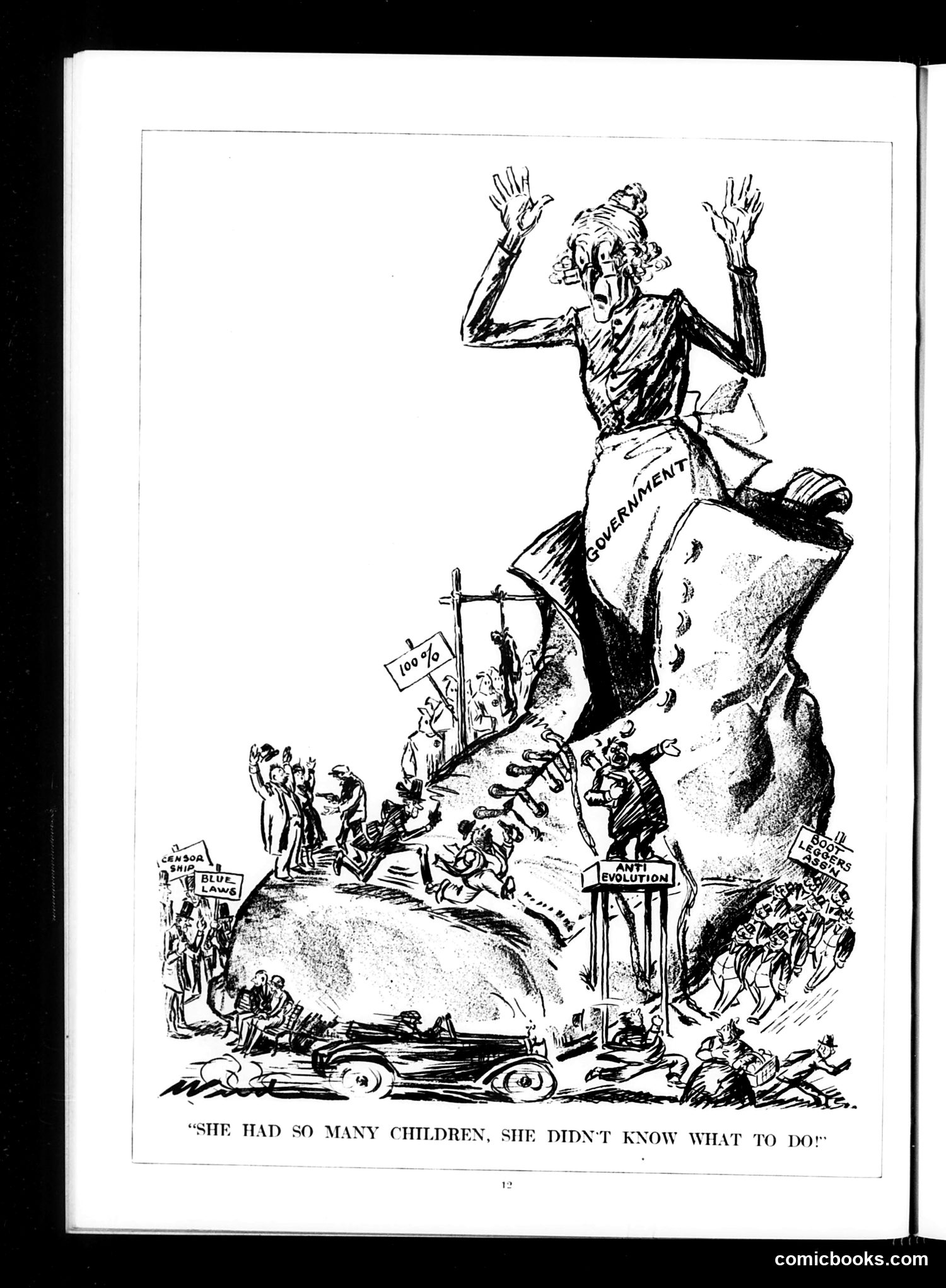
This satirical cartoon uses the nursery rhyme "She Had So Many Children, She Didn't Know What to Do" to critique government overreach and bureaucratic chaos. The central figure is Lady Liberty/Uncle Sam's female personification, overwhelmed atop a mountain of issues. Small figures at the base represent various government departments and social concerns—visible labels include "Government," "Evolution," and what appears to be references to censorship and progressive legislation. The cartoon satirizes the early 20th-century expansion of government programs and regulatory agencies, suggesting that government had grown so large and uncontrolled it couldn't manage its own responsibilities. The metaphor of an overwhelmed mother with too many children represents the concern that government overexpansion would lead to chaos rather than effective administration.
This page contains two distinct editorial pieces: **"Who Serves Best"** celebrates the 1925 Pulitzer Prize awarded to the Columbus (Georgia) *Enquirer-Sun*, edited by Julian Harris, for fighting the Ku Klux Klan, opposing anti-evolution laws, and championing racial justice and anti-lynching efforts. The text emphasizes the personal courage this required—the Harris family faced Klan intimidation and threats of violence. The piece contrasts this principled journalism against profit-driven newspapers, using the Rotary motto sarcastically. **"Why Vote?"** critiques President Calvin Coolidge's recent complaint about voter apathy (turnout dropped from 80% in 1880-1896 to 50% recently). Judge argues Coolidge's concern is hypocritical: voters avoid polls because politicians deliberately avoid substantive issues, instead offering only personality-based choices between candidates offering "meaningless generalities." The satire suggests Coolidge himself exemplifies this evasion of vital issues. Both pieces attack political and institutional dishonesty from a progressive perspective.
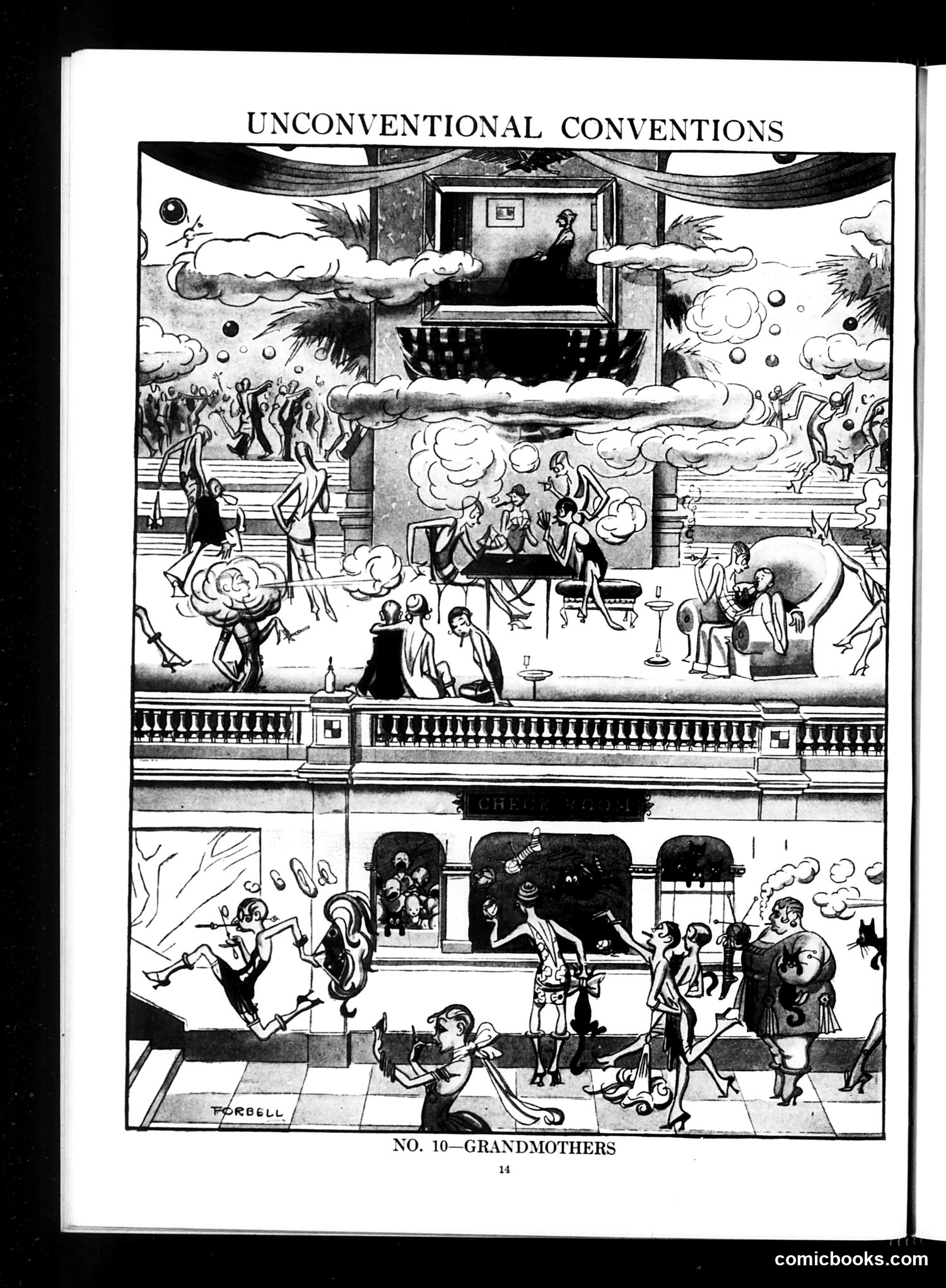
This satirical cartoon depicts a multi-level venue (appearing to be a convention hall or theater) filled with chaotic scenes of grandmothers behaving badly. The upper levels show elderly women dancing, drinking, and carrying on wildly among clouds of smoke, while the lower street level shows them engaged in various unruly activities—fighting, carousing, and generally misbehaving. The satire mocks the "unconventional" behavior of grandmothers who are rejecting traditional expectations of propriety and decorum associated with their age and gender. This likely reflects Jazz Age anxieties about changing social norms in the 1920s, when older generations' authority and respectability were being challenged. The cartoon humorously suggests that even grandmothers are embracing modern, wild behavior rather than maintaining dignified reserve.
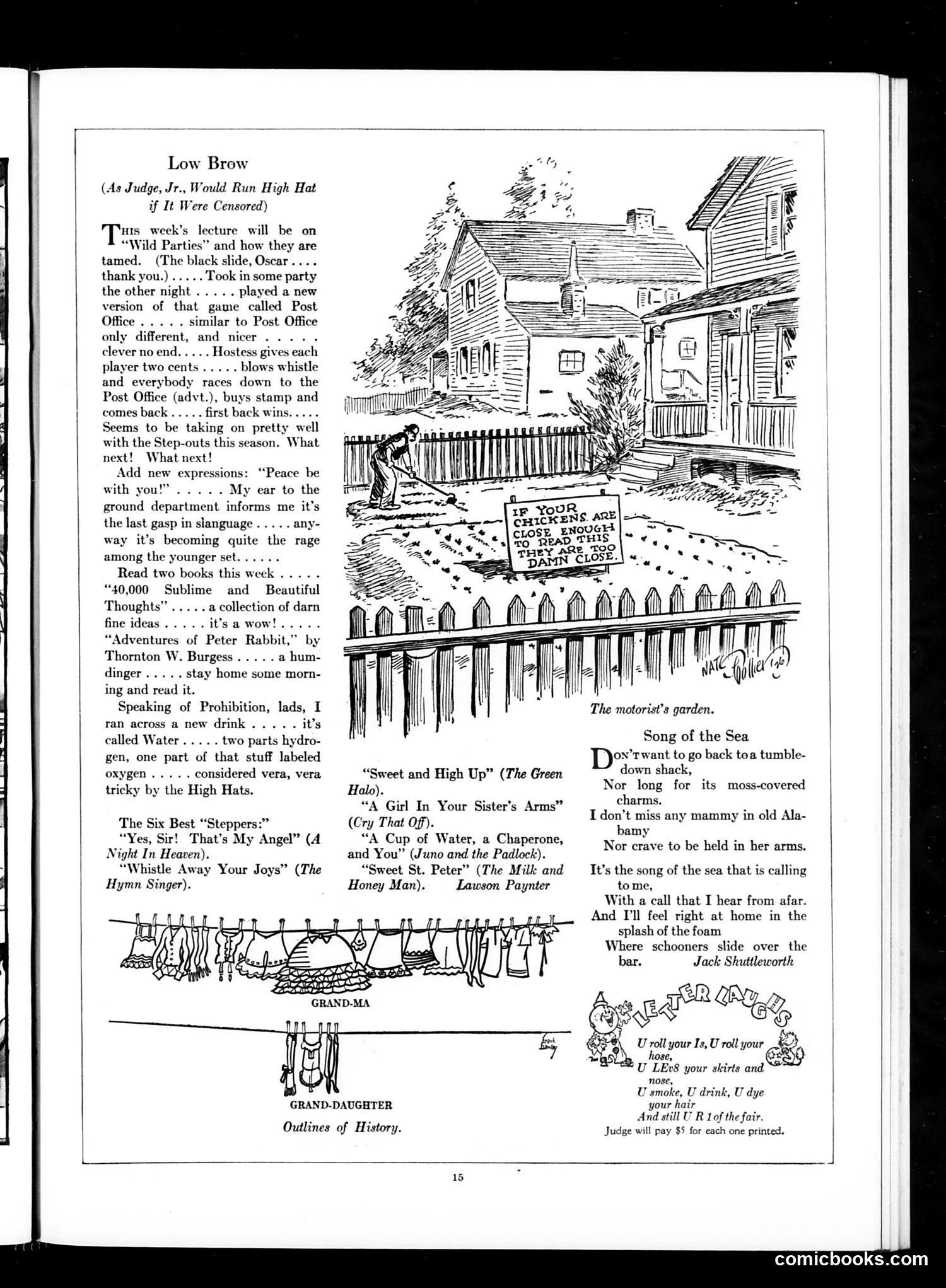
This is a satirical column mocking "high hat" (pretentious) lecture culture through deliberately lowbrow commentary. The author describes attending a lecture on "Wild Parties," then discusses parlor games like "Post Office" (a kissing game), new slang expressions, and books—all presented in deliberately casual, colloquial language as mock-serious social commentary. A key satire targets **Prohibition**: the author jokes about a "new drink called Water," describing it chemically as hydrogen and oxygen, sarcastically calling it "tricky by the High Hats"—mocking prohibition's absurdity and those enforcing it. The page includes song lyrics, a cartoon of "The motorist's garden" (showing someone tending plants amid a fence), and a "Hearings" humor section inviting reader submissions for $5. Overall, it's self-aware satire: Judge magazine ironically adopting "low brow" style to mock both pretentiousness and prohibition-era social restrictions.
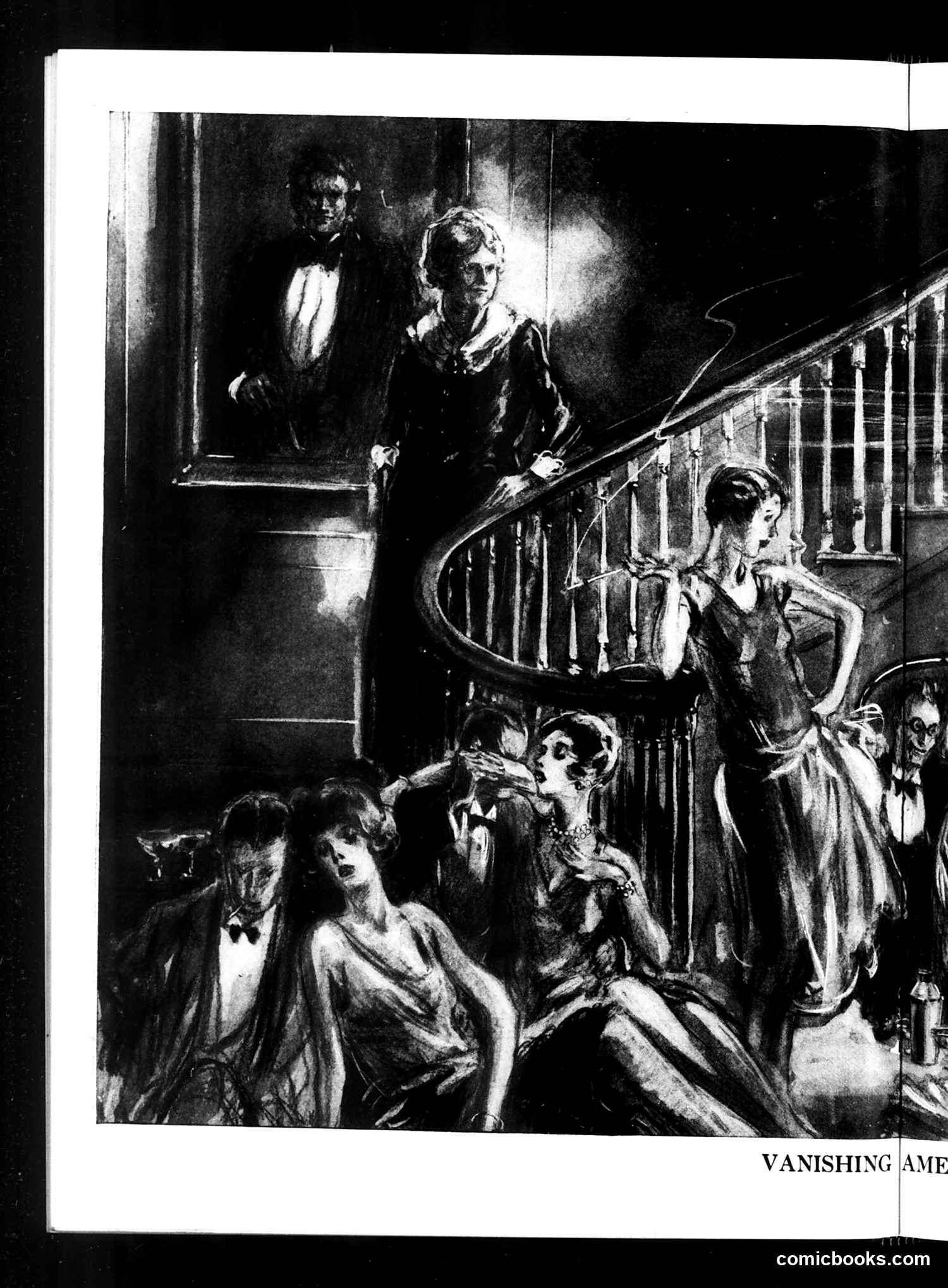
This appears to be a dramatic illustration rather than a political cartoon, depicting what seems to be a formal social scene—possibly a ball or gathering—with well-dressed figures on a staircase. The OCR text is largely unreadable, providing no clear caption or context. Without legible text identifying the scene, figures, or satirical point, I cannot definitively explain what's being referenced or satirized. The image shows period clothing and formal setting suggesting early 20th-century American society, but the specific social commentary or joke remains unclear. The partial text "VANISHING AME" at bottom suggests a title, possibly "Vanishing America" or similar, implying social critique, but this alone is insufficient to explain the cartoon's meaning to a modern reader.
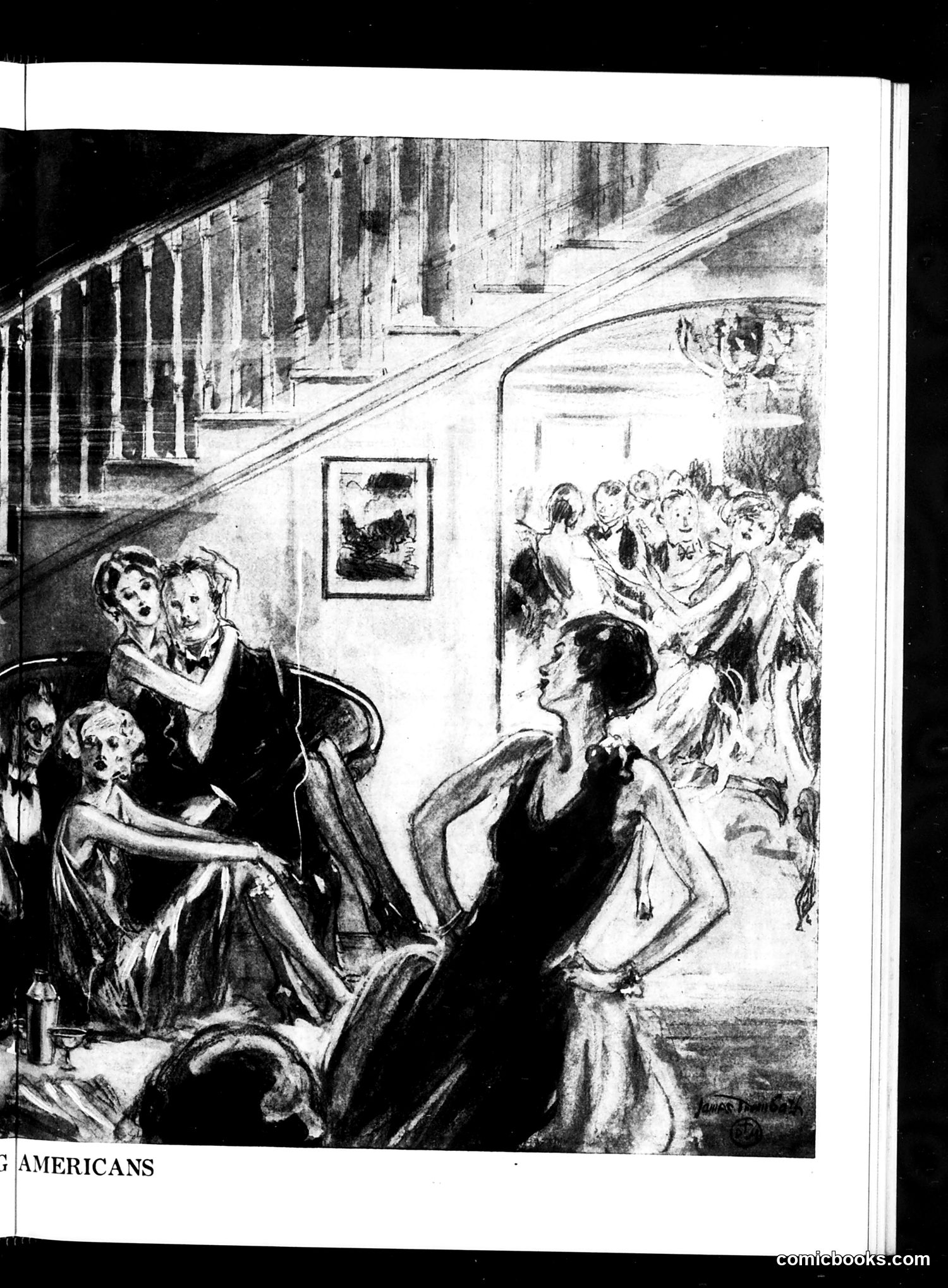
This appears to be a social satire depicting an elegant indoor gathering or party scene. The composition shows well-dressed figures in what looks like a stylish interior space with stairs visible in the background. The sketch style uses strong contrasts of black and white typical of early-to-mid 20th century satirical illustration. The OCR text is too garbled to provide specific context. Without legible text or artist attribution visible in the image, I cannot definitively identify which social or political commentary this cartoon intends. The scene suggests commentary on upper-class gatherings or social pretension, but the specific target of the satire remains unclear from the image alone.
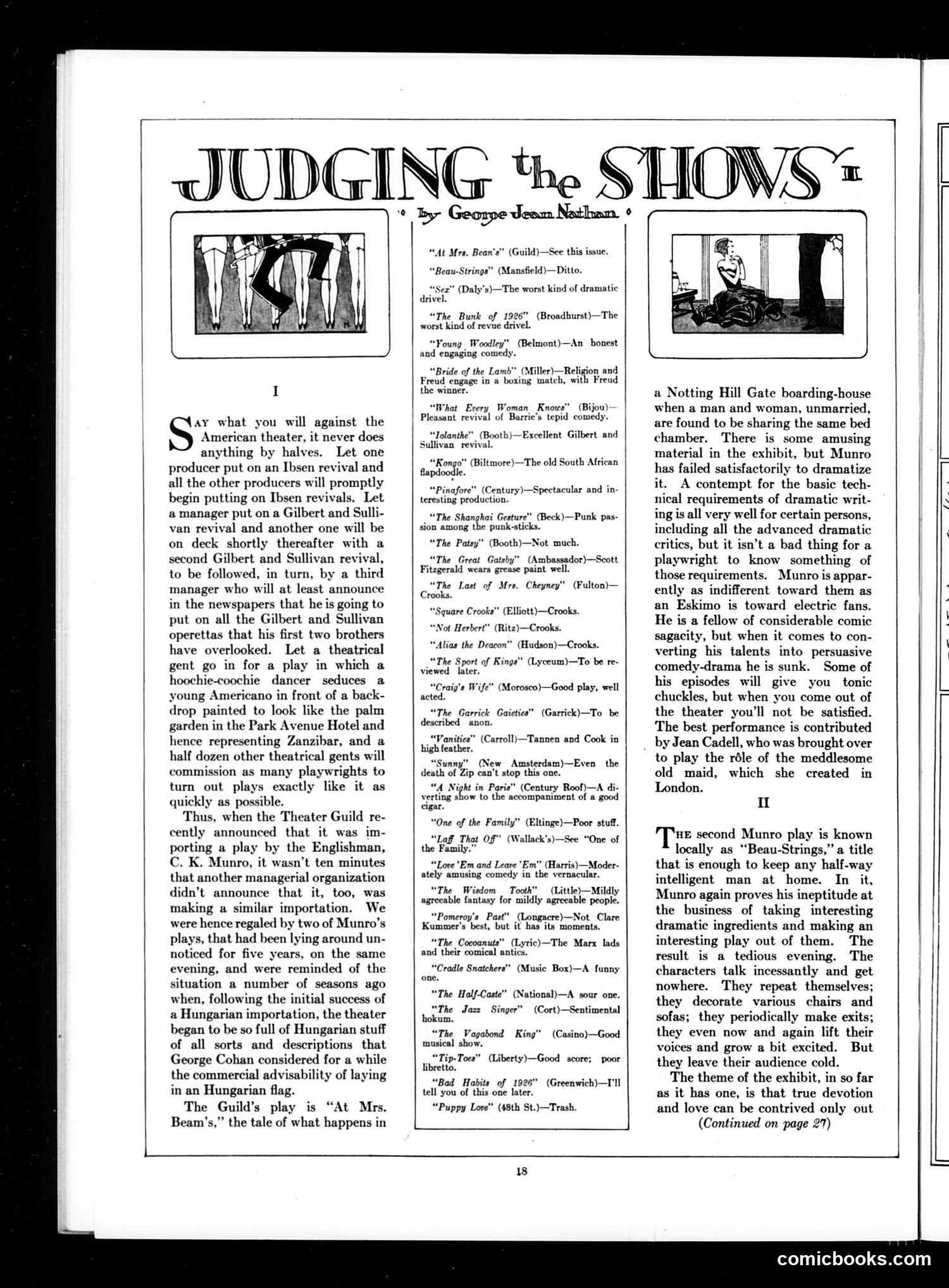
This page features George Jean Nathan's theater column criticizing a specific industry practice: theatrical imitation. Nathan complains that when one producer successfully stages a play or revival (like an Ibsen revival or Gilbert and Sullivan operetta), competitors immediately flood Broadway with similar productions. His example: the Theater Guild imported a play by English playwright C.K. Munro, prompting rival managers to hastily stage two other Munro plays that had languished unnoticed for five years—on the *same evening*. Nathan frames this as part of a recurring cycle of over-production, comparing it to a past Hungarian importation craze that nearly prompted George Cohan to invest in Hungarian flags. The bulk of the page consists of brief, sharp reviews of current Broadway productions, mostly dismissive ("Not much," "Trash," "Poor stuff"), revealing Nathan's curmudgeonly assessment of contemporary theater.
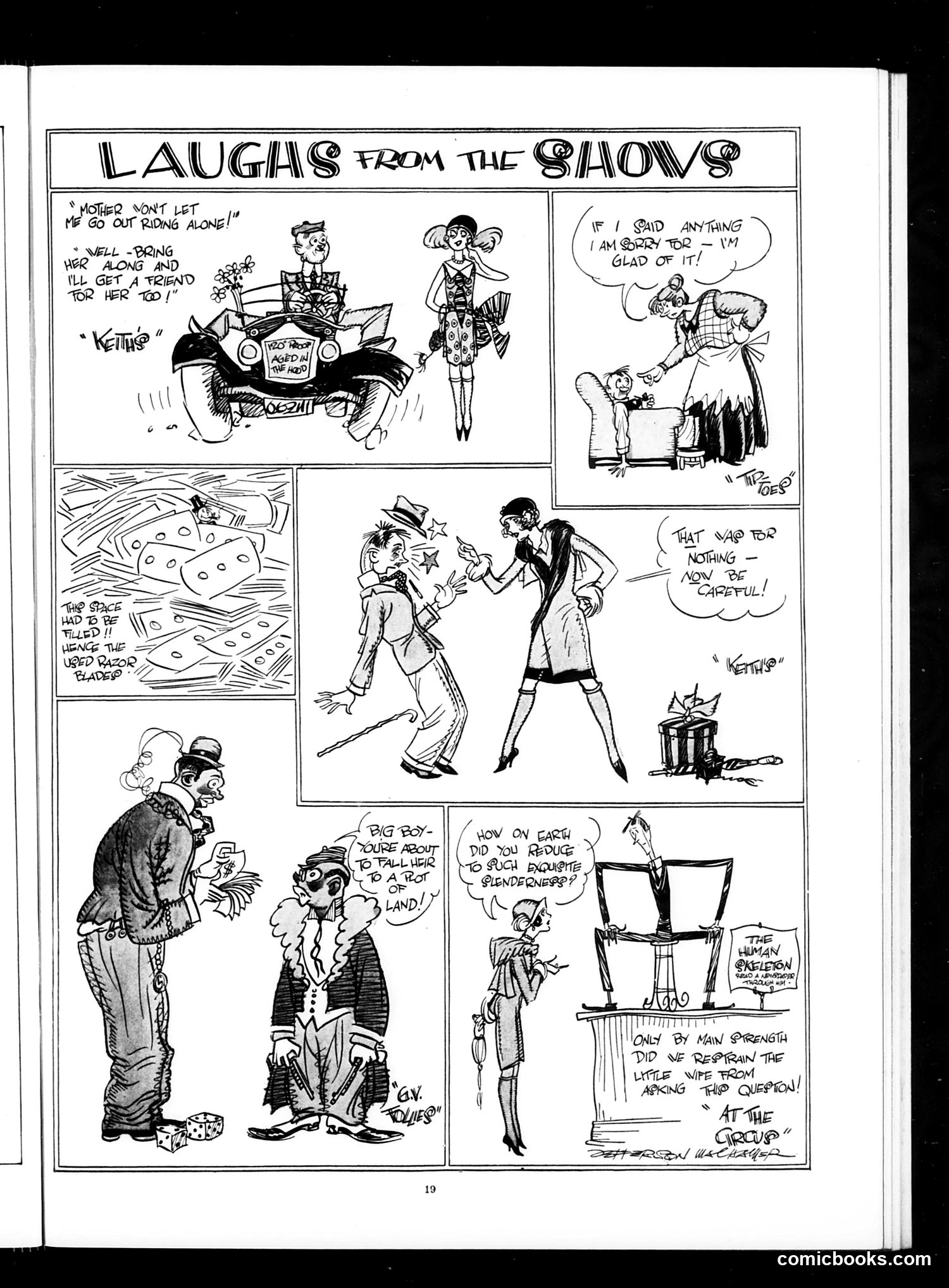
This is a satirical comic page from *Judge* magazine featuring several vignettes mocking theatrical and social situations. The humor centers on domestic and romantic scenarios typical of early 20th-century stage comedy: **Top panels**: A mother insists her daughter bring a chaperone on a motorcycle ride; the daughter cleverly brings an elderly woman, defeating the purpose. **Middle section**: A slapstick scene of two performers in a physical altercation (likely from a stage show). **Bottom panels**: A conversation between what appears to be a showman and a circus performer about reducing "exquisite splendidness" to a "raft of land." The final panel shows a circus strongman holding an apparatus, with text about restraining "the little wife from arsing the question." The satire targets theatrical conventions, gender relations (women needing supervision), and the absurdity of circus spectacle. The crude drawings and exaggerated characters are typical of *Judge's* comedic style, mocking both performers and audiences' expectations of popular entertainment.
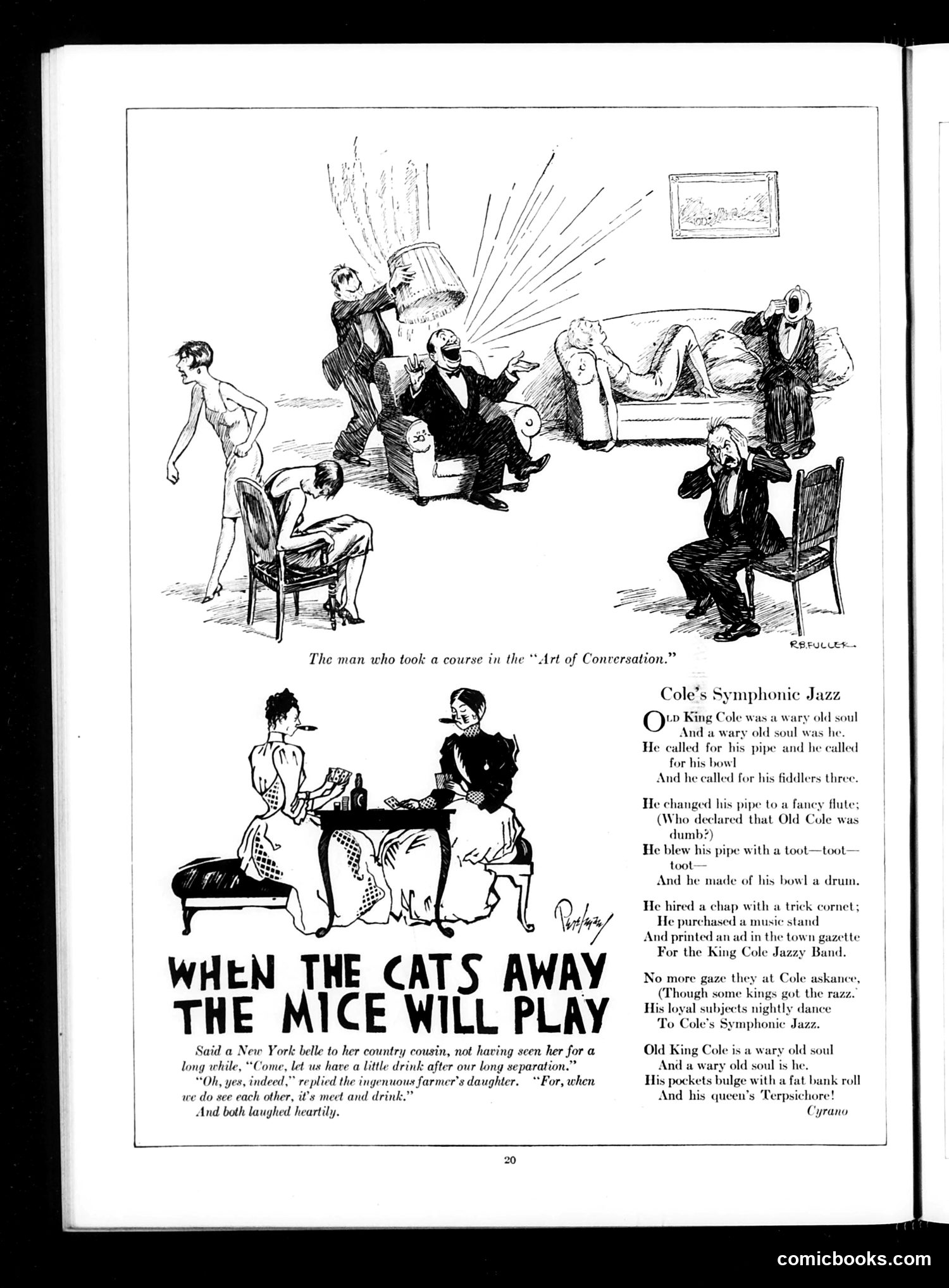
This page contains three distinct pieces of humor: **Top cartoon** ("Art of Conversation"): Shows a man causing chaos at a social gathering—knocking over furniture, upsetting guests—apparently having taken a course that taught him to be too direct or blunt in conversation. The satire mocks self-help courses and social instruction that backfire. **Middle poem** ("Cole's Symphonic Jazz"): A parody of the nursery rhyme "Old King Cole," updated for the Jazz Age. King Cole modernizes his traditional music by switching pipes for a flute, hiring musicians with contemporary instruments (trick cornet), and promoting a "Jazzy Band." It satirizes how quickly older generations abandon tradition for trendy new fads. **Bottom joke** ("When the Cats Away"): A double-entendre pun. A sophisticated New York woman invites her country cousin for "a drink after our long separation." The cousin innocently misunderstands "it's meet and drink" (should be "meet and greet"), thinking she means meeting requires drinking. The humor relies on rural naiveté versus urban sophistication.
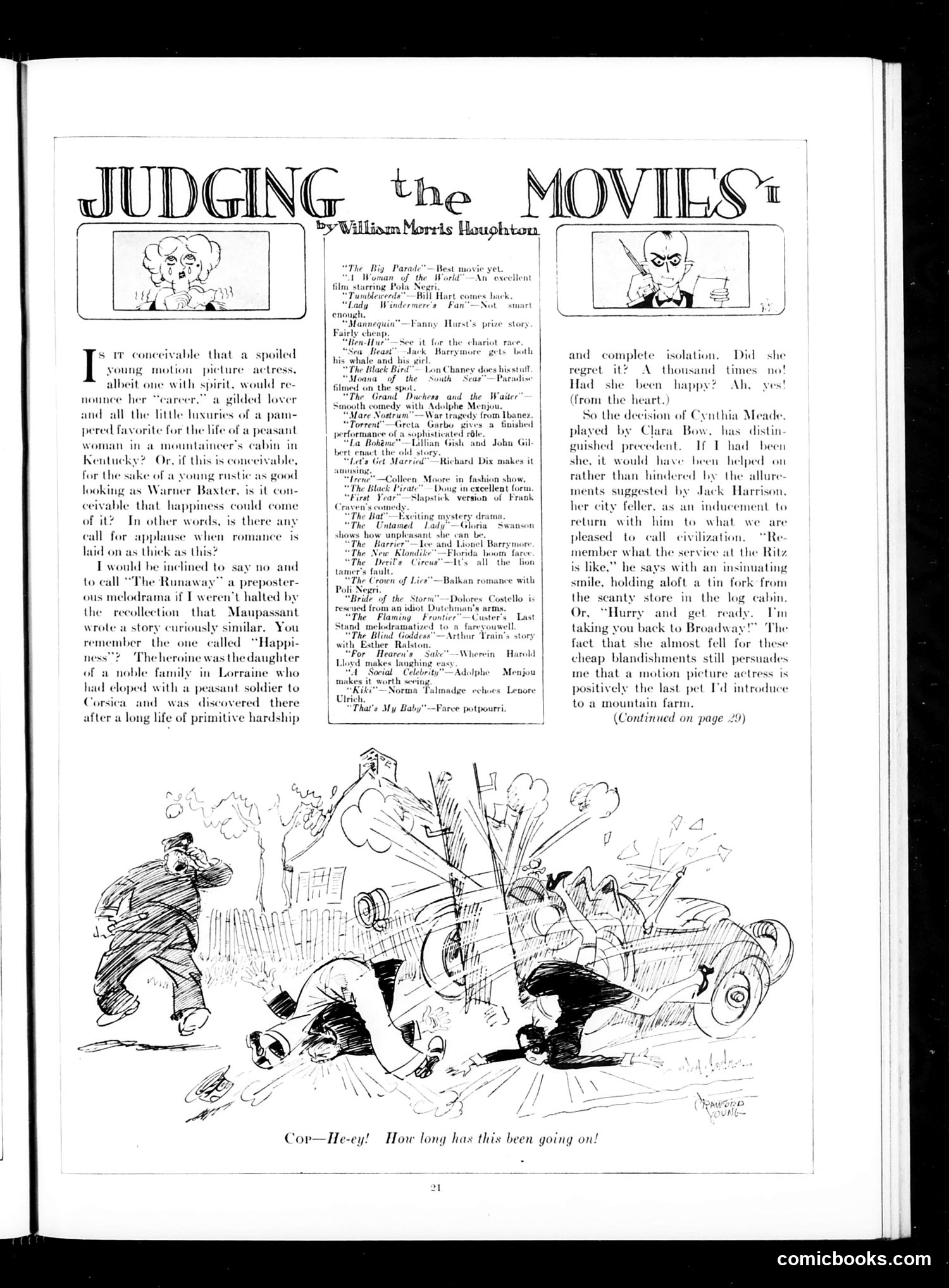
This page reviews current films (circa 1920s based on titles like "Ben-Hur" and "The Big Parade"). William Morris Haughton critiques whether movie actresses should abandon careers for romance and domesticity—a central cultural debate of the era. The main cartoon illustrates a car crash with the caption "Cor—He-ey! How long has this been going on!"—likely satirizing Hollywood's scandal culture and reckless behavior. The text focuses on Clara Bow's character in an unnamed film who chooses a mountain cabin over Broadway luxury. Haughton uses this to argue sarcastically that motion picture actresses are foolish: they abandon sophisticated city life for romance, yet the fact that Bow's character nearly accepts shallow inducements (a fork, promises of Broadway) proves actresses lack judgment. The implicit critique: these women are too easily swayed by both glamour and rustic sentimentality, undermining their credibility. The satire targets both Hollywood's romantic narratives and the actresses themselves as frivolous.
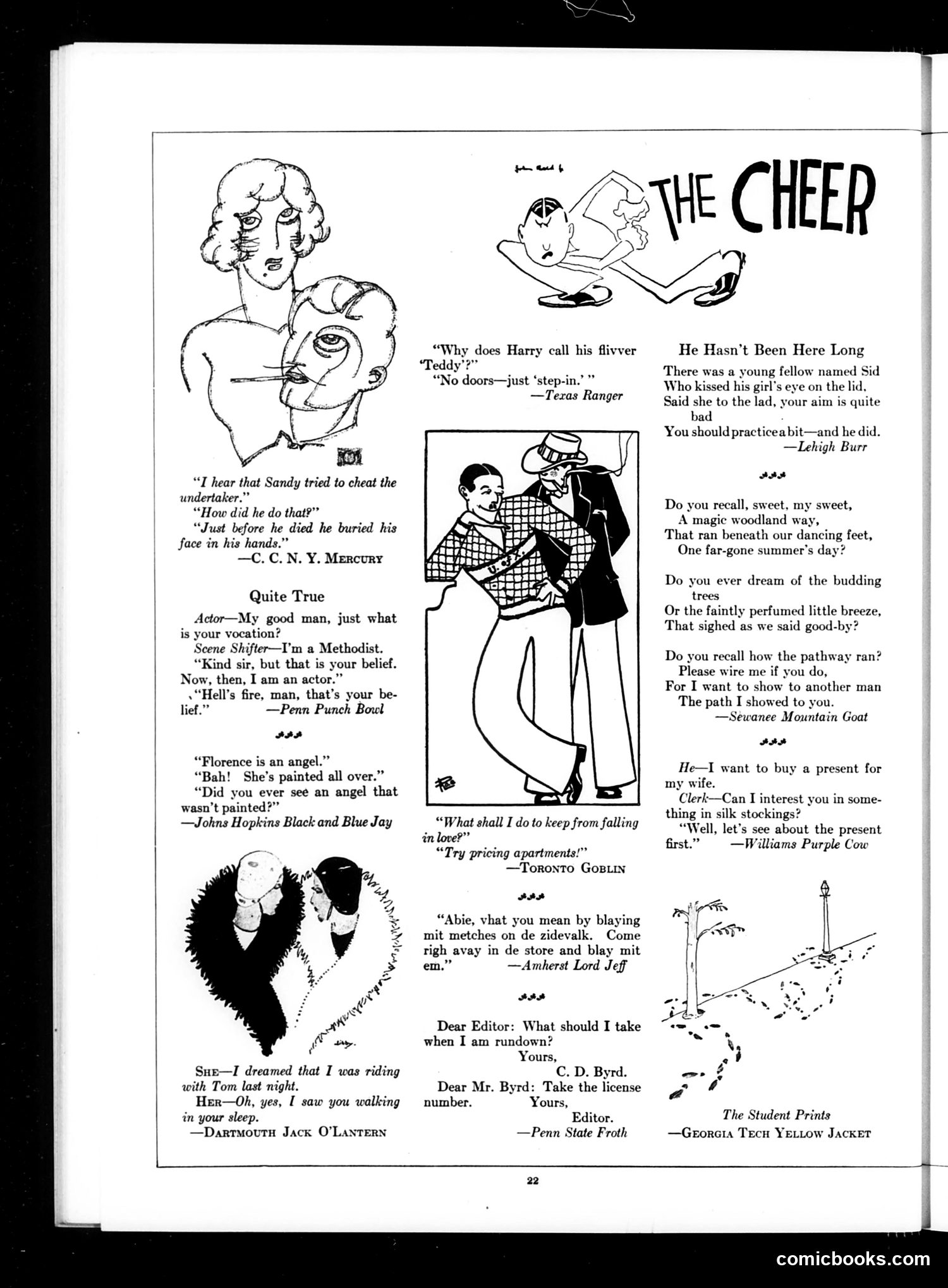
This is a humor compilation page from Judge magazine, primarily containing short jokes and quips from college newspaper humor columns rather than political cartoons. The content reflects early 20th-century college humor: witty one-liners about dating, cars ("flivver"), relationships, and social awkwardness. Notable elements include: - References to a "flivver" (Model T Ford), showing automobile culture - A Yiddish-dialect joke ("Abie") representing immigrant humor common in the era - Romantic/courtship humor typical of college publications - A practical joke about taking a hit-and-run license plate number - Innuendo about silk stockings as a gift The cartoons are simple line drawings accompanying select jokes. The page's satire is mild—poking fun at actors, Methodists, romantic pretense, and modern courtship rather than political targets. This represents the lighter, student-focused humor Judge published alongside its more pointed satirical commentary.
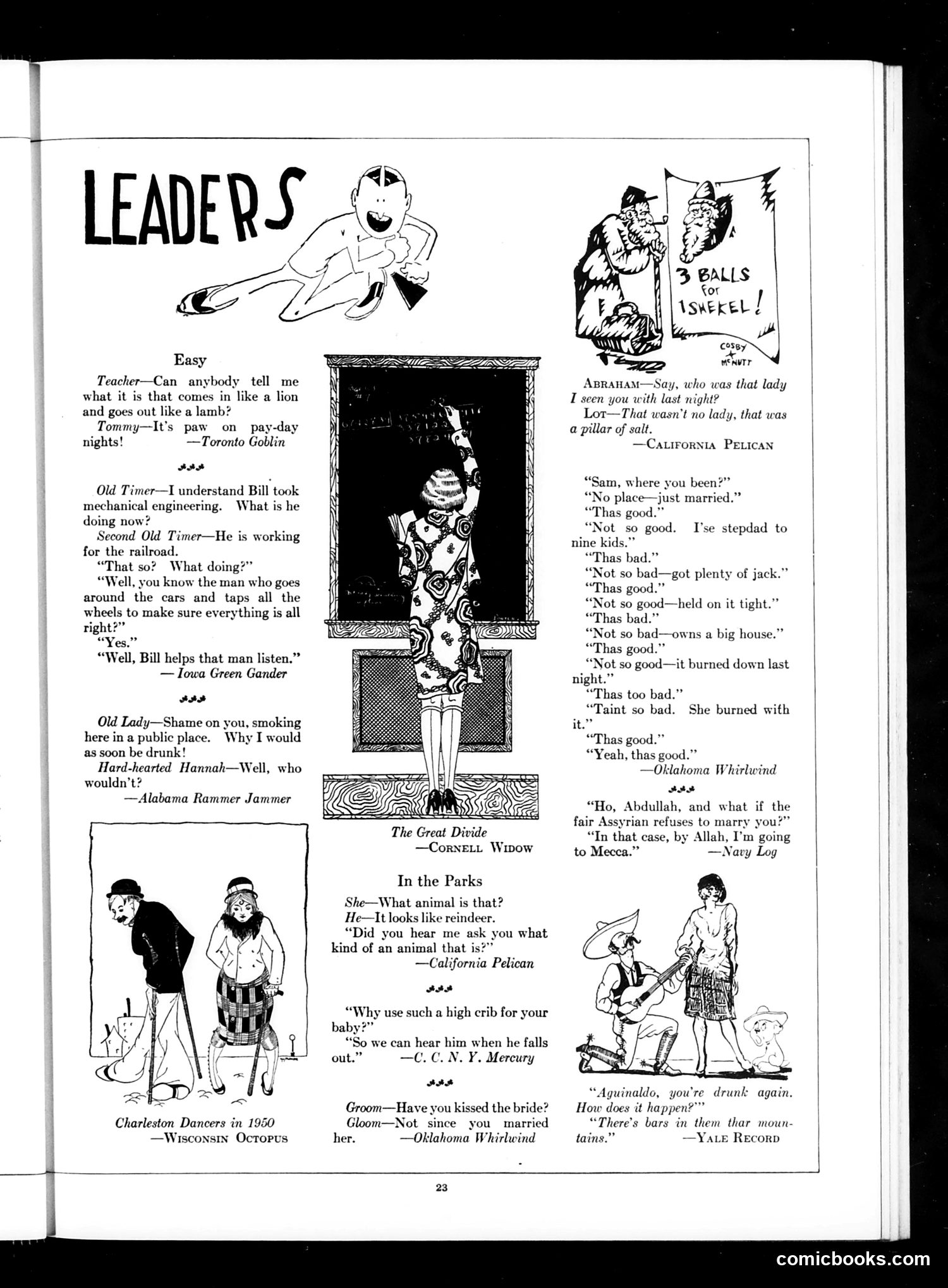
This page collects short jokes and cartoons typical of early 20th-century American humor magazines. The content includes: **"The Great Divide"** cartoon depicts a stylized woman figure—likely representing a society lady or flapper—divided vertically, satirizing the contrast between public appearance and private behavior. **Ethnic and regional humor** dominates the jokes, attributed to various college humor publications (Iowa, California, Oklahoma, etc.). These rely heavily on stereotypes: the "Old Lady" joke plays on drinking taboos; the Abraham/Lot reference makes crude biblical humor; the "Aguinaldo" joke references Filipino insurgency, using an ethnic name for comedic effect. **Social commentary** appears mild—jokes about marriage's disillusionment, railroad worker competence, and child-rearing practices reflect working-class concerns. The **"Charleston Dancers in 1950"** caption appears anachronistic or ironic, since the Charleston was popular in the 1920s. Overall, this reflects early-to-mid 20th century American magazine humor: racially/ethnically insensitive by modern standards, focused on domestic situations, and relying on regional dialect jokes for comedy.
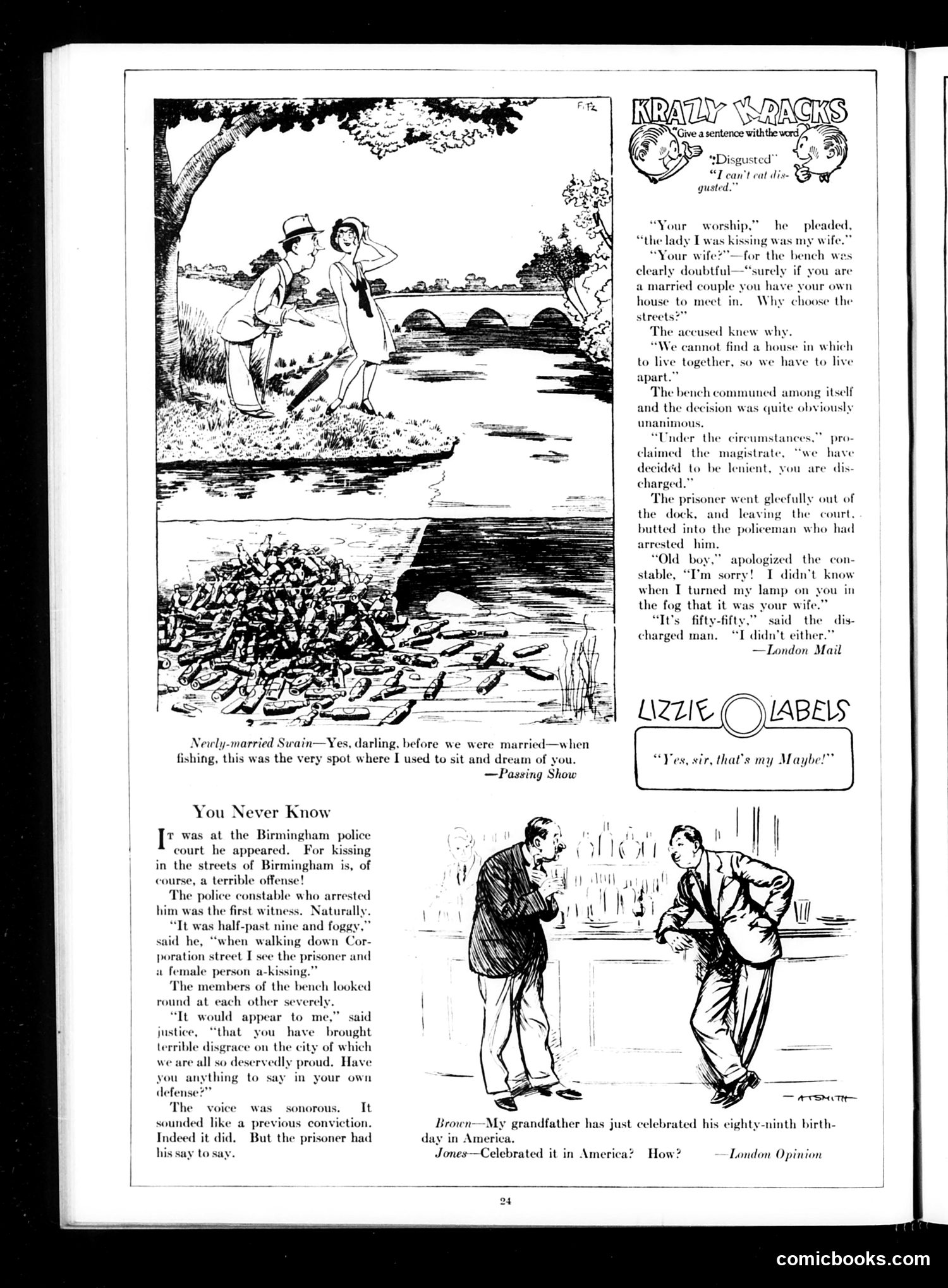
This page contains **three separate humor pieces** satirizing British social hypocrisy around 1920s-era morality laws. **"You Never Know"** (main story): A man is arrested for kissing a woman in Birmingham's streets—deemed illegal. When he reveals she's his wife, the magistrate questions why married couples need public spaces to meet, since they have homes. The man's honest answer—they can't find housing together—makes the bench unanimously discharge him as sympathetic. The irony: the arresting officer later admits he didn't recognize the woman in fog either, making the arrest absurd. **The satire targets**: Rigid public-decency laws that criminalize natural affection, the housing shortage's real impact on married couples, and the bench's arbitrary justice that softens when confronted with economic reality rather than moral principle. **Two shorter jokes** at bottom involve nostalgic romance and celebrating a grandfather's birthday "in America" (implying immigrant displacement). The cartoons mock the disconnect between Victorian prudishness and actual human circumstances.
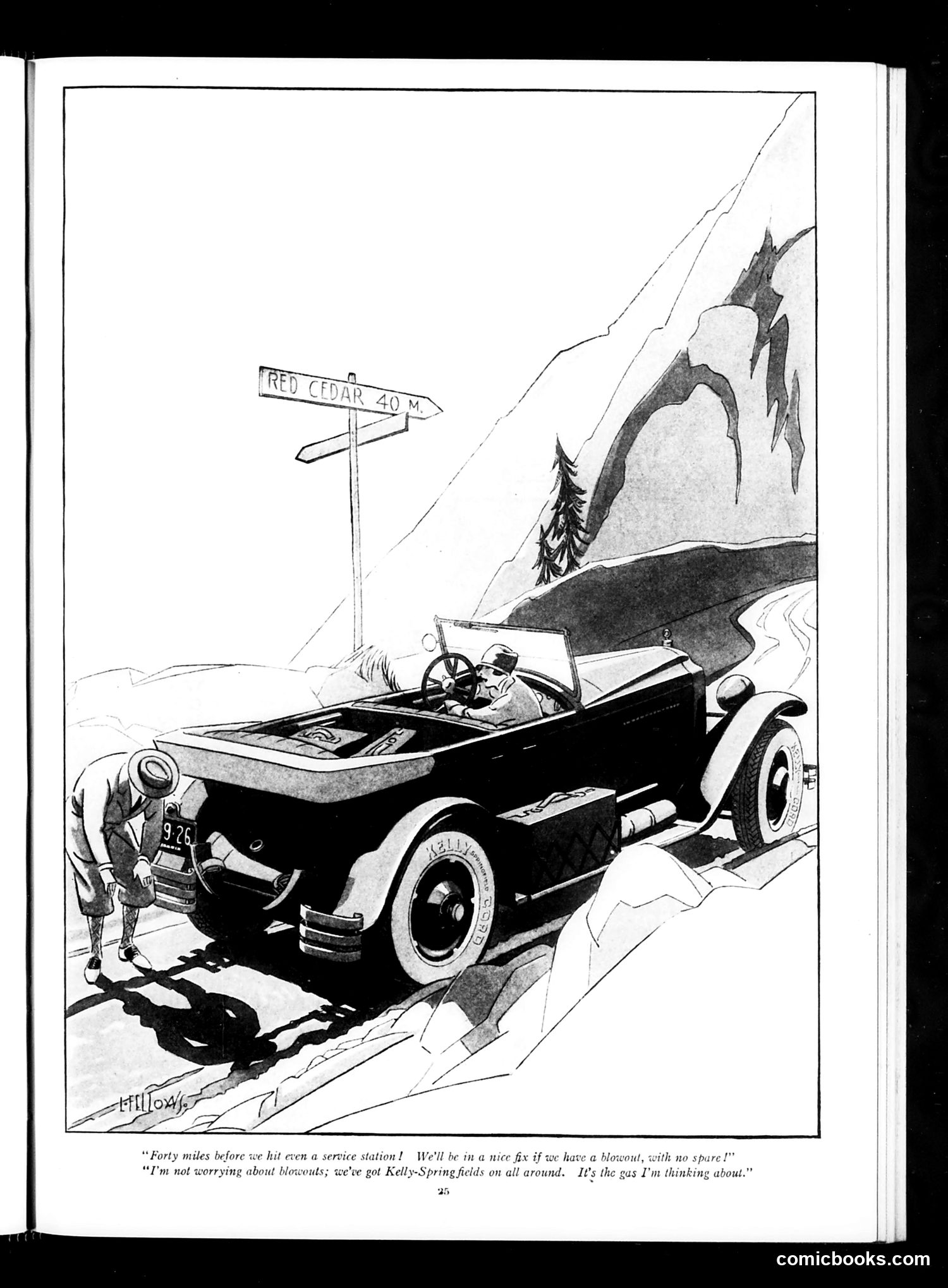
This is an advertisement disguised as a comic dialogue. Two motorists in a 1920s roadster discuss travel anxieties. The driver reassures his passenger about tire safety, referencing "Kelly-Spring fields" (likely Kelly-Springfield tires, a real brand). The passenger's worry shifts to gasoline availability—the punchline. The satire targets early automotive anxieties: remote travel in an era before widespread gas stations and reliable tire technology. The ad positions Kelly-Springfield tires as the solution to one concern while accepting another (fuel scarcity) as inevitable. This reflects 1920s-era infrastructure limitations and consumer anxieties about automotive reliability on long-distance journeys. The humor relies on the contrast between the solved problem (tires) and the unsolved one (gas).
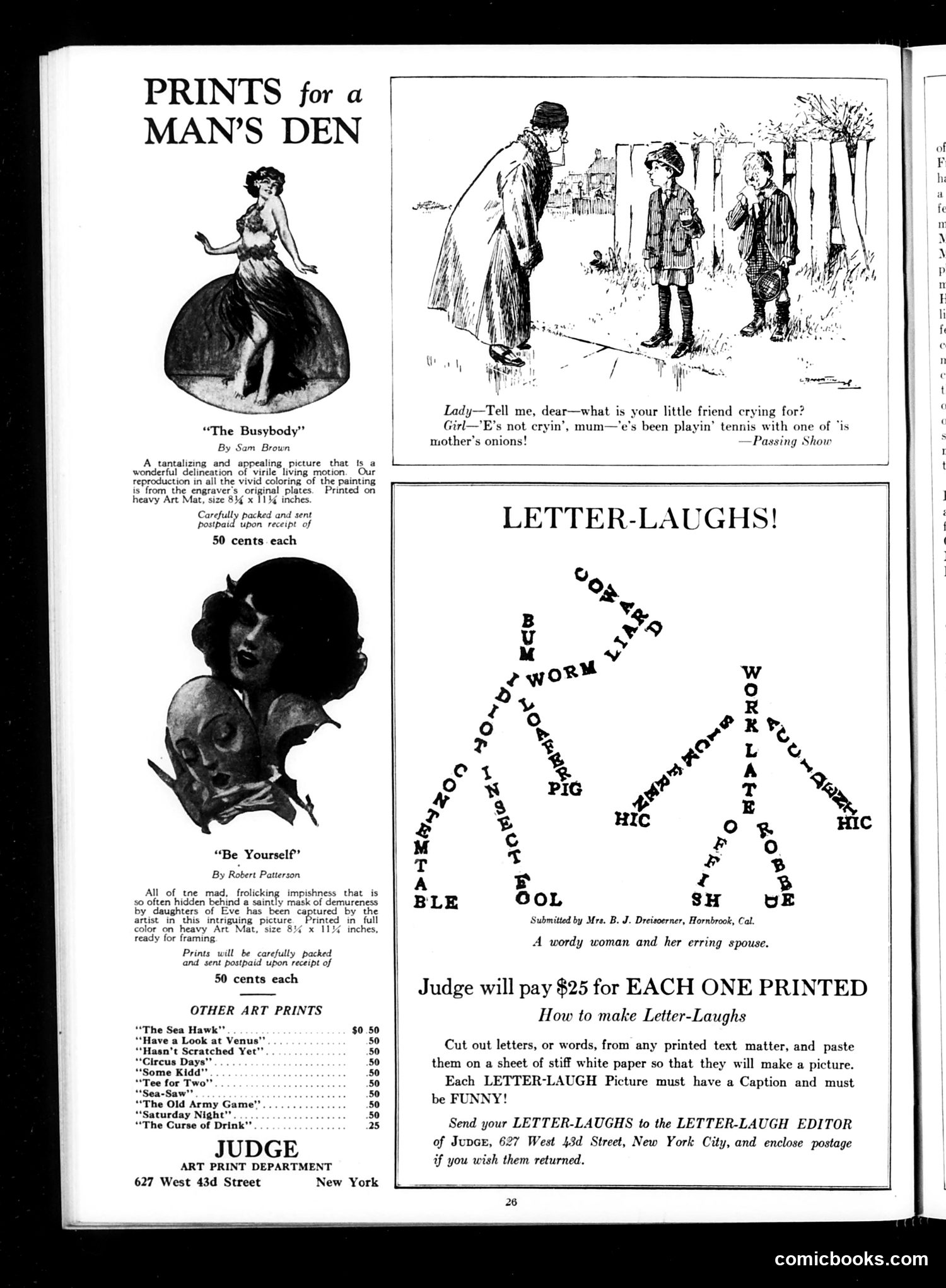
This Judge magazine page combines art advertising with humor content. The left side sells prints for men's dens—"The Busybody" and "Be Yourself"—depicting alluring women in a style appealing to early 20th-century male aesthetics. The cartoon at top right shows a British domestic scene (note "mum" and cockney dialect) where a girl's friend cries after playing tennis with her mother's onions—a pun on the vegetable's tear-inducing properties. The "Letter-Laughs" section is a reader-participation contest. The example shows cut-out letters rearranged to spell "A WORDY WOMAN AND HER ERRING SPOUSE"—a joke about marital discord typical of Judge's era. The puzzle invites readers to create similar visual puns from magazine text, offering $25 prizes. This represents early crowdsourced humor content, predating modern internet memes by decades.
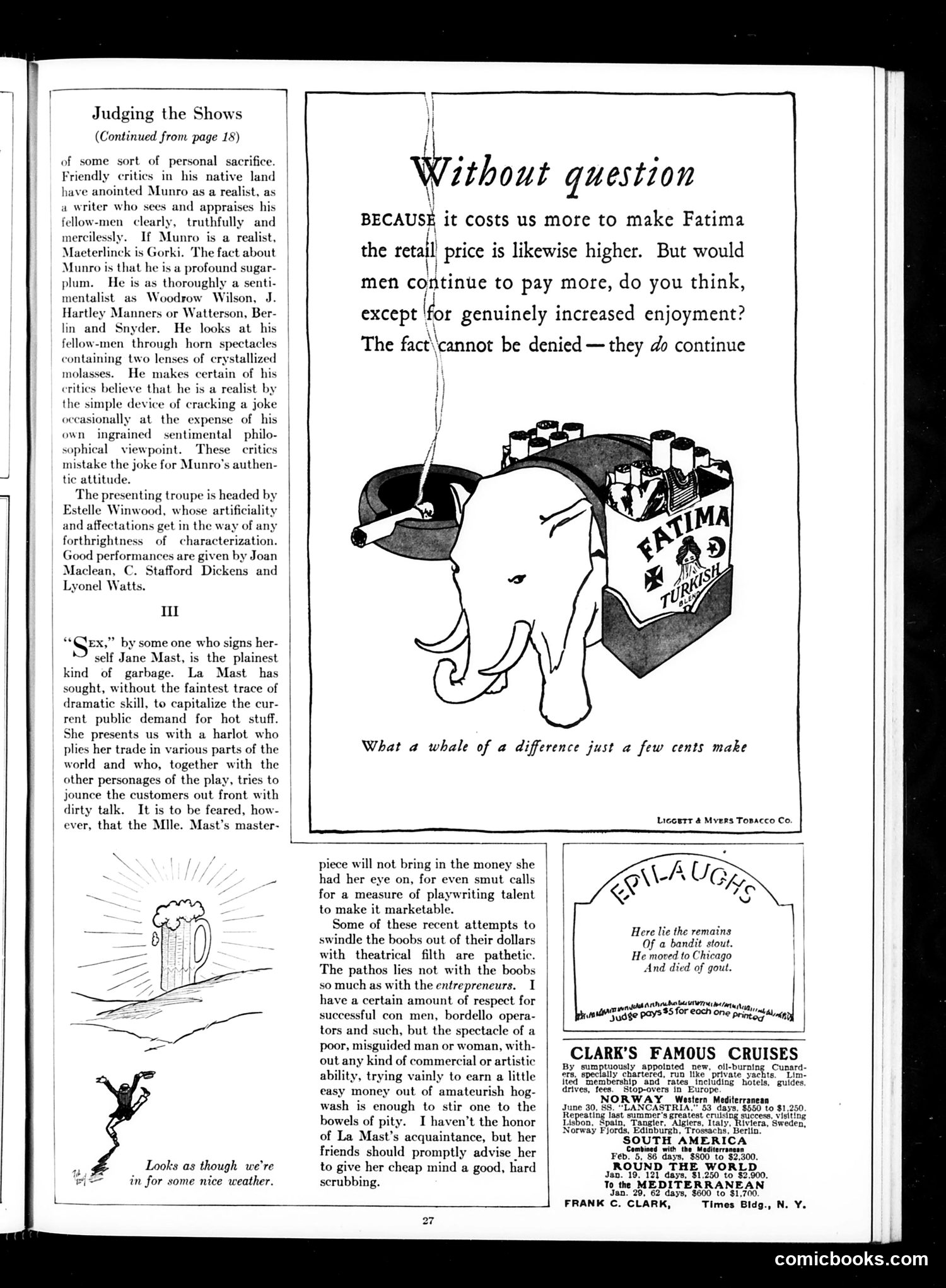
This page contains theater criticism and advertisements rather than political cartoons. The main satirical content critiques recent Broadway productions: **"Judging the Shows"** reviews theatrical works. The critic praises writer Saki (H.H. Munro) as a realist but dismisses a play called "Sex" by Jane Mast as "garbage"—crude attempts to capitalize on public demand for scandalous content. The author sarcastically notes that even smut requires actual playwriting talent, and expresses pity for amateur con artists trying to profit from theatrical filth. **The Fatima cigarette advertisement** features a camel with the tagline "What a whale of a difference just a few cents make"—arguing that higher retail prices for Fatima are justified by increased enjoyment, a common advertising strategy. The page also includes small humorous sketches and cruise ship advertisements. The overall tone is one of cultural criticism condemning lowbrow theatrical attempts to exploit audiences while maintaining respect for skilled entertainers and legitimate con artists.
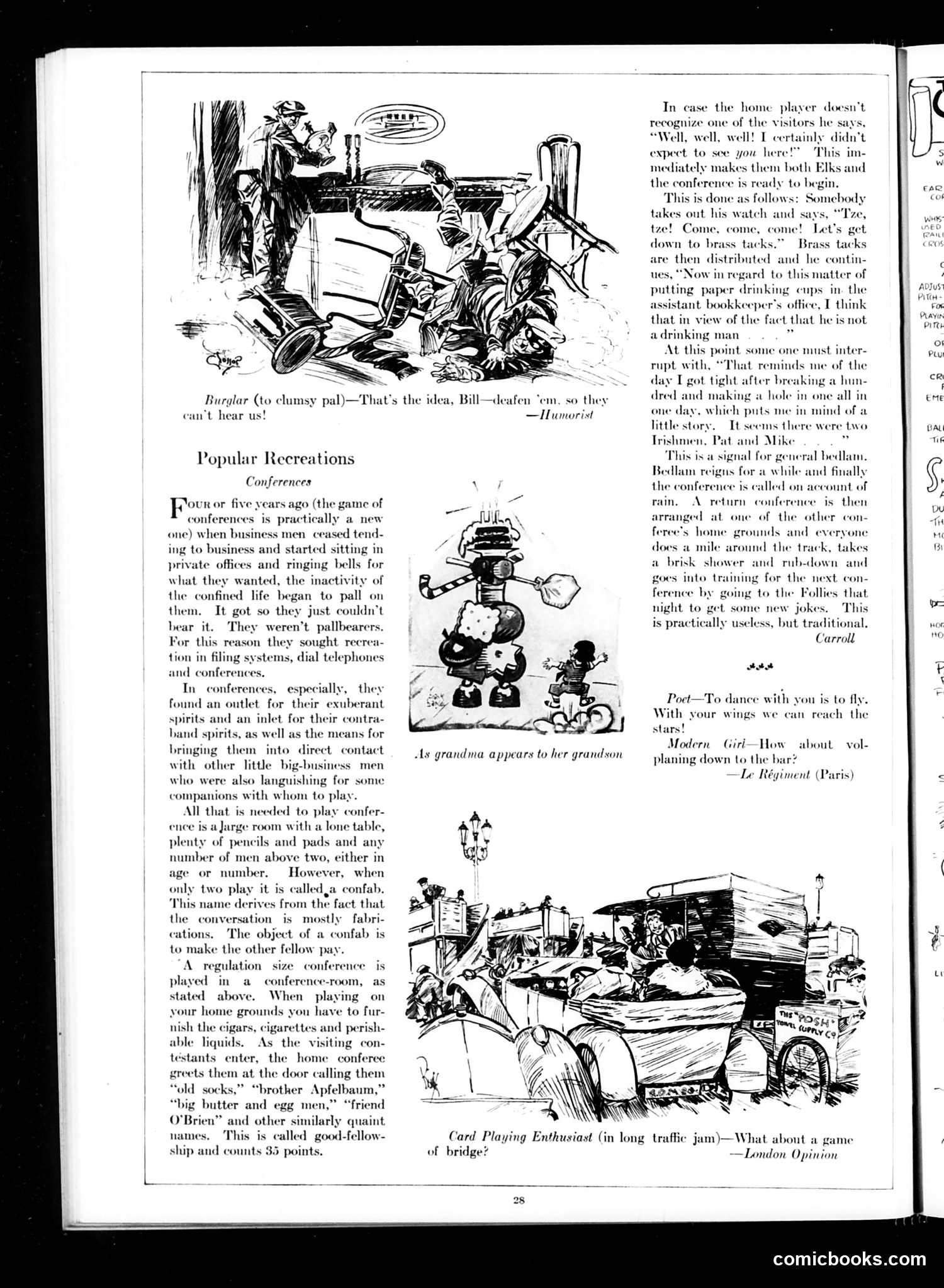
This page from *Judge* satirizes the early 20th-century business culture of "conferences"—meetings that had become fashionable among businessmen as a form of recreation and networking, though largely unproductive. **The Main Satire:** The article mocks how conferences are pretexts for socializing, drinking ("contraband spirits"), and avoiding actual work. They involve ritualistic greetings, manufactured camaraderie, cigars, and alcohol—with the unstated goal of making "the other fellow pay" (picking up the bill). **Key Details:** A "confab" (two people) involves fabrications; larger conferences devolve into bedlam when someone derails discussion with an irrelevant anecdote. The author notes conferences are "practically useless, but traditional." **The Cartoons** show related leisure activities: burglars using noise as cover, a grandmother with grandchildren, and a man proposing bridge during a traffic jam—all depicting how people sought entertainment and escape from mundane life. The satire reflects anxiety about corporate inefficiency and the blurring of business with leisure in modern business culture.
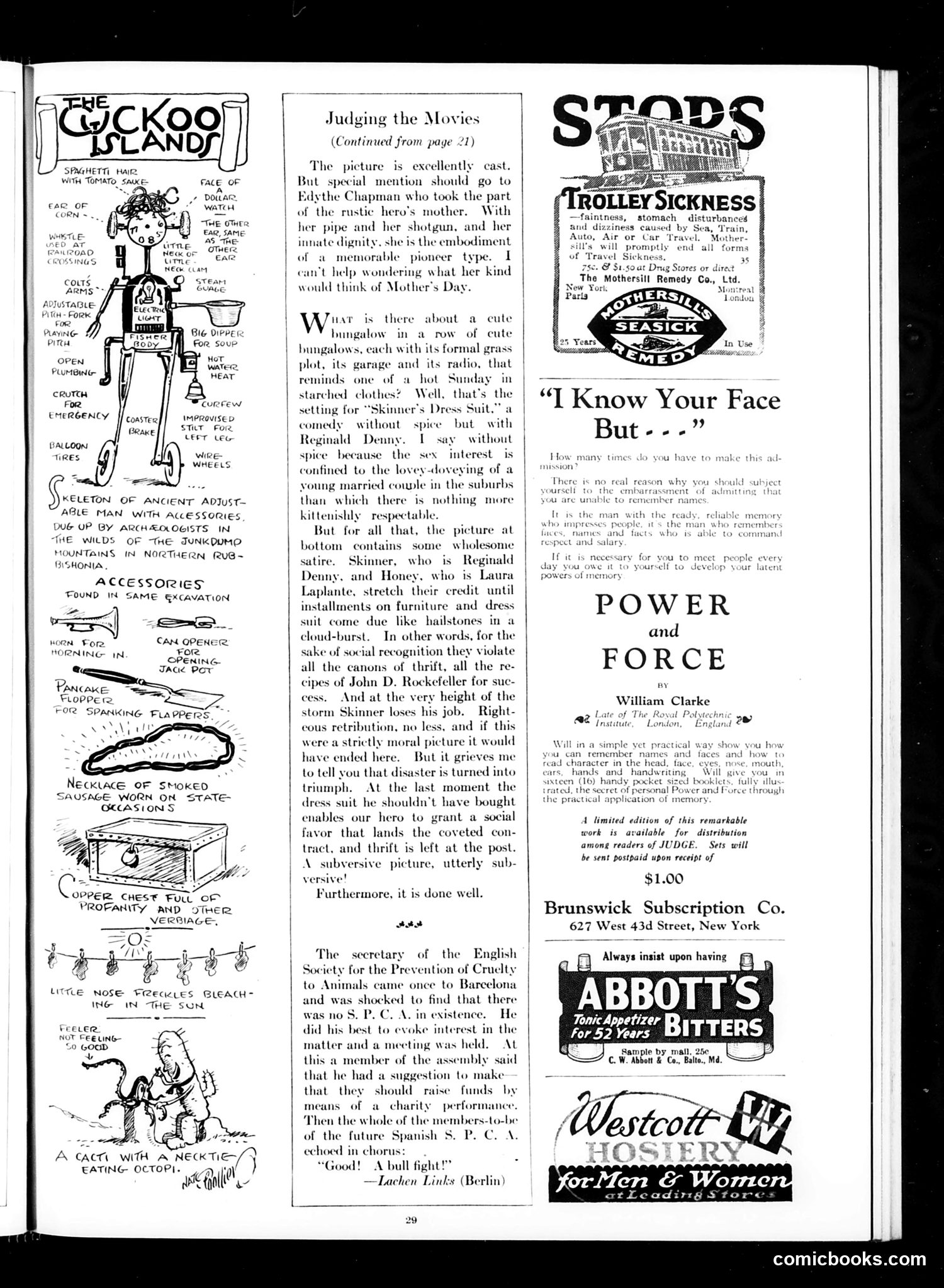
The left side features a whimsical cartoon diagram labeled "The Cuckoo Island"—an absurdist invention showing a fantastical "ancient adjustable man" constructed from domestic objects (spaghetti hair, watch face, wire wheels, sausage necklace). This appears to be pure satirical humor mocking archaeological discoveries and pseudo-scientific reconstructions popular in the 1920s. The center contains film reviews. One critiques *Skinner's Dress Suit*, starring Reginald Denny, satirizing suburban middle-class aspirations. The reviewer notes the film subversively suggests that buying furniture and dress suits on credit—violating "thrift" principles—actually brings social success and profit, contradicting conventional morality. Another review praises *Trolley Sickness* and mentions Edythe Chapman's portrayal of a pioneer mother with "pipe and shotgun," questioning what such women would think of modern Mother's Day sentimentality. The right side is primarily advertisements for patent medicines and consumer goods typical of 1920s *Judge* magazine.
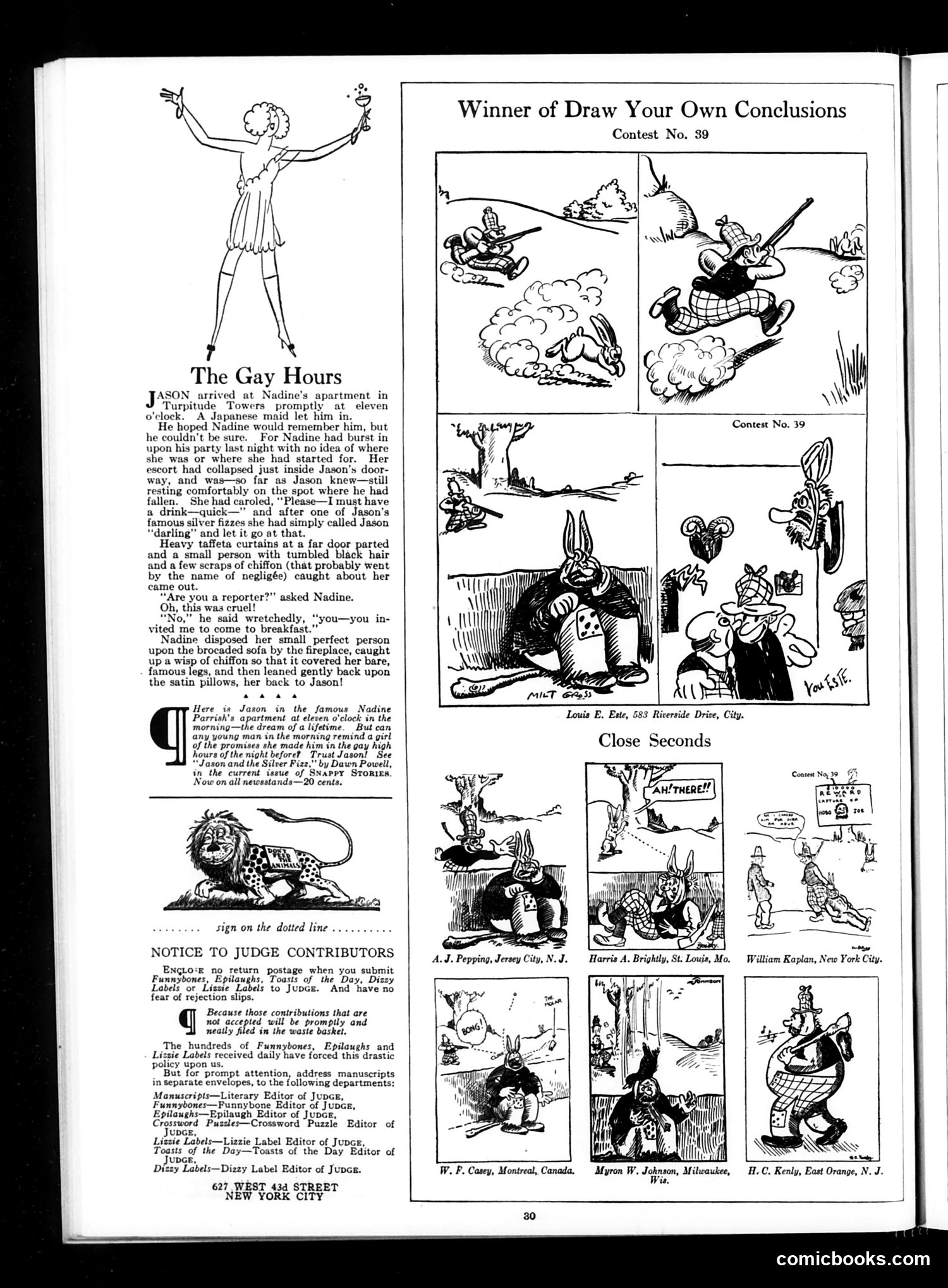
This page features the winning entry from Judge's "Draw Your Own Conclusions" contest, depicting a romantic comedy scenario typical of 1920s-30s magazine fiction. **Main Story ("The Gay Hours"):** Jason arrives at Nadine's apartment hoping she'll remember him from the previous night's party. The joke hinges on Nadine's apparent indifference—she doesn't recognize him and asks if he's a reporter. This plays on Jazz Age tropes: wealthy, sophisticated socialites who party heavily and forget details; men desperate to impress glamorous women; and the awkwardness of morning-after encounters. The accompanying text references a story in *Snappy Stories*, suggesting readers could find the full narrative elsewhere. **"Close Seconds":** The lower section shows comic submissions from contest runners-up, featuring anthropomorphic rabbits and other whimsical characters in various predicaments—typical humor filler for the era. The satire gently mocks romantic misadventures and the pretensions of urban sophistication in the Jazz Age.
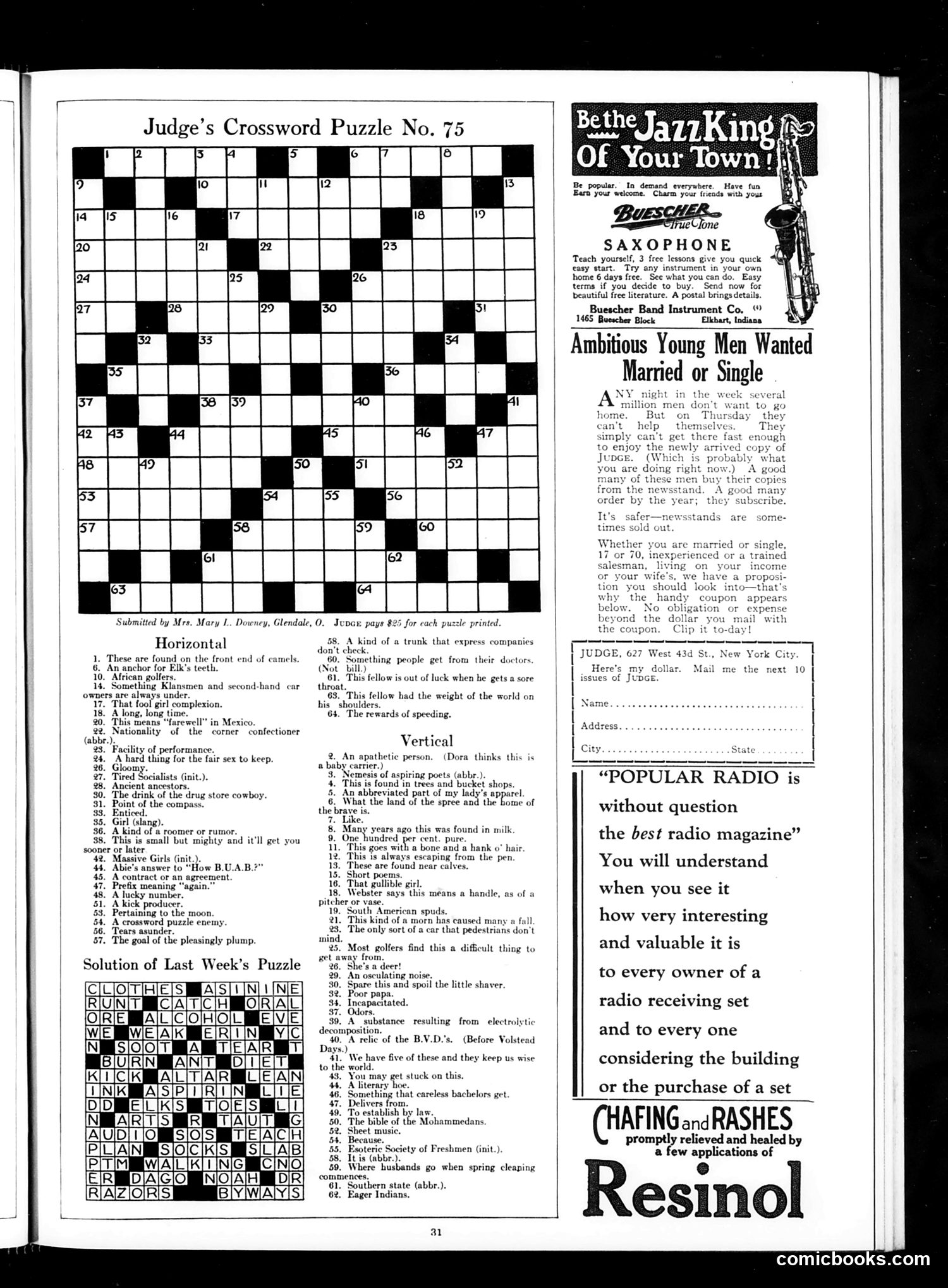
This page is primarily **not a political cartoon** but rather a **crossword puzzle page with advertisements**—typical filler content for Judge magazine. The main content is "Judge's Crossword Puzzle No. 75," a standard crossword with clues submitted by a reader. The clues reveal period-appropriate references: mentions of Klansmen, B.V.D.'s (pre-Prohibition underwear brand), and jazz-age slang ("Girl slang"). One clue oddly references "Klansmen and second-hand car owners," suggesting mild satirical jabs at contemporary figures. **The advertisements** are more revealing of 1920s culture: - A **Buescher saxophone ad** promoting self-taught musicianship and the "Jazz King" lifestyle - A recruitment ad for "Ambitious Young Men" (likely insurance or sales) - **Popular Radio magazine** advertising to the emerging radio-set-owning demographic - A **Resinol ointment ad** for skin conditions Together, these advertisements reflect 1920s consumer capitalism, the jazz age's cultural dominance, and growing mass media (radio). The page documents period concerns rather than delivering satire.
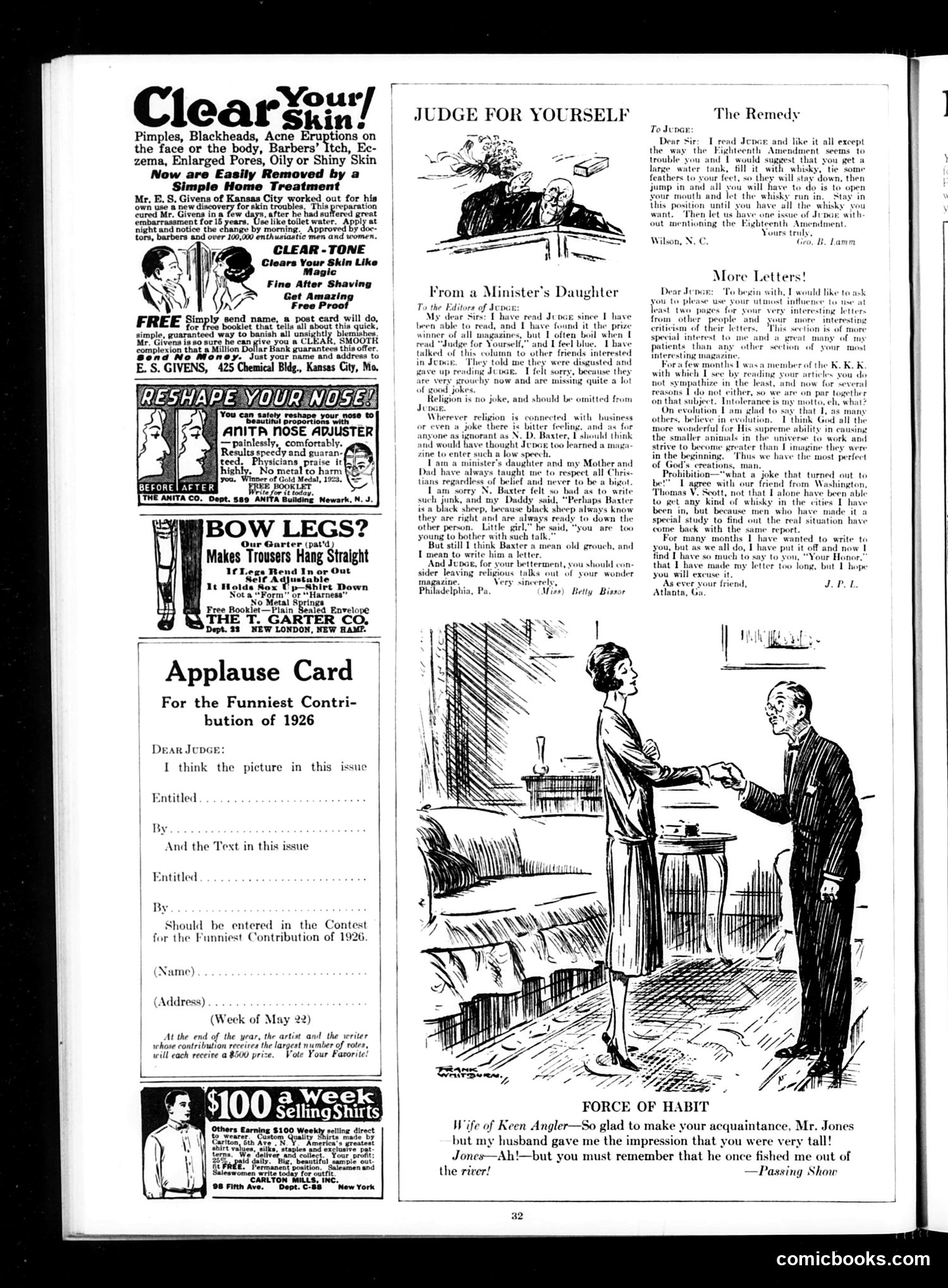
This page contains mostly **advertisements and reader letters**, not political cartoons requiring historical context. The main content includes: **"Force of Habit"** (bottom cartoon): A domestic humor sketch where a man explains to a woman that her husband, a fisherman, once literally pulled him out of a river—making the husband's tall tales about the man seem credible by comparison. It's gentle marital comedy about exaggeration. **Reader Letters Section**: Letters to "Judge" debating the magazine's editorial positions, particularly regarding **Prohibition** (the 18th Amendment). One reader sarcastically suggests filling water tanks with whisky to circumvent alcohol bans—typical anti-Prohibition sentiment of the 1920s. **Advertisements**: The page is dominated by ads for medical products (skin treatments, nose shapers, bow-leg correctors)—typical of 1920s magazines. These are not satirical; they're genuine commercial pitches, often making dubious health claims. The page reflects 1920s popular culture: Prohibition-era frustrations, beauty anxieties, and mail-order remedy culture.
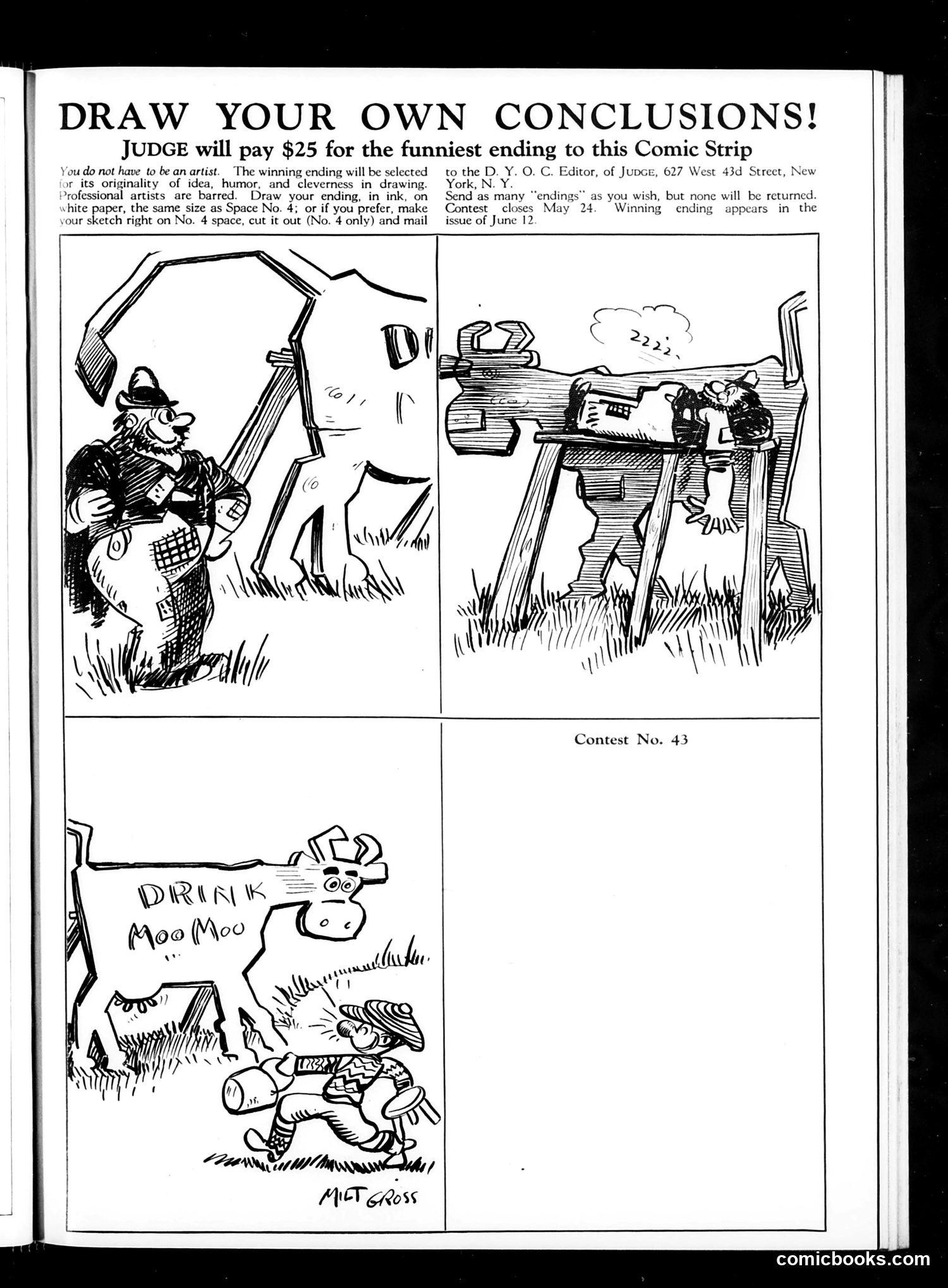
This is a **reader-participation contest**, not a finished cartoon. Judge magazine invited readers to submit funny endings to an incomplete comic strip, offering $25 as a prize—a significant sum in this era. The strip shows three panels: a man with an umbrella stands near a fence; a person sleeps in a bed; below, a cow marked "DRINK Moo Moo" stands near a small figure labeled with what appears to be a vendor or person. The setup is deliberately vague, inviting creative interpretations. The joke format was popular in humor magazines of this period—readers could submit their own punchlines, creating participatory entertainment. The professional ban on artists suggests this was meant for amateur humorists. The contest reflects Judge's business model: engaging readers directly while generating cheap content. The incomplete third panel awaits the reader's comic conclusion, turning the magazine into an interactive publication rather than passive reading material.
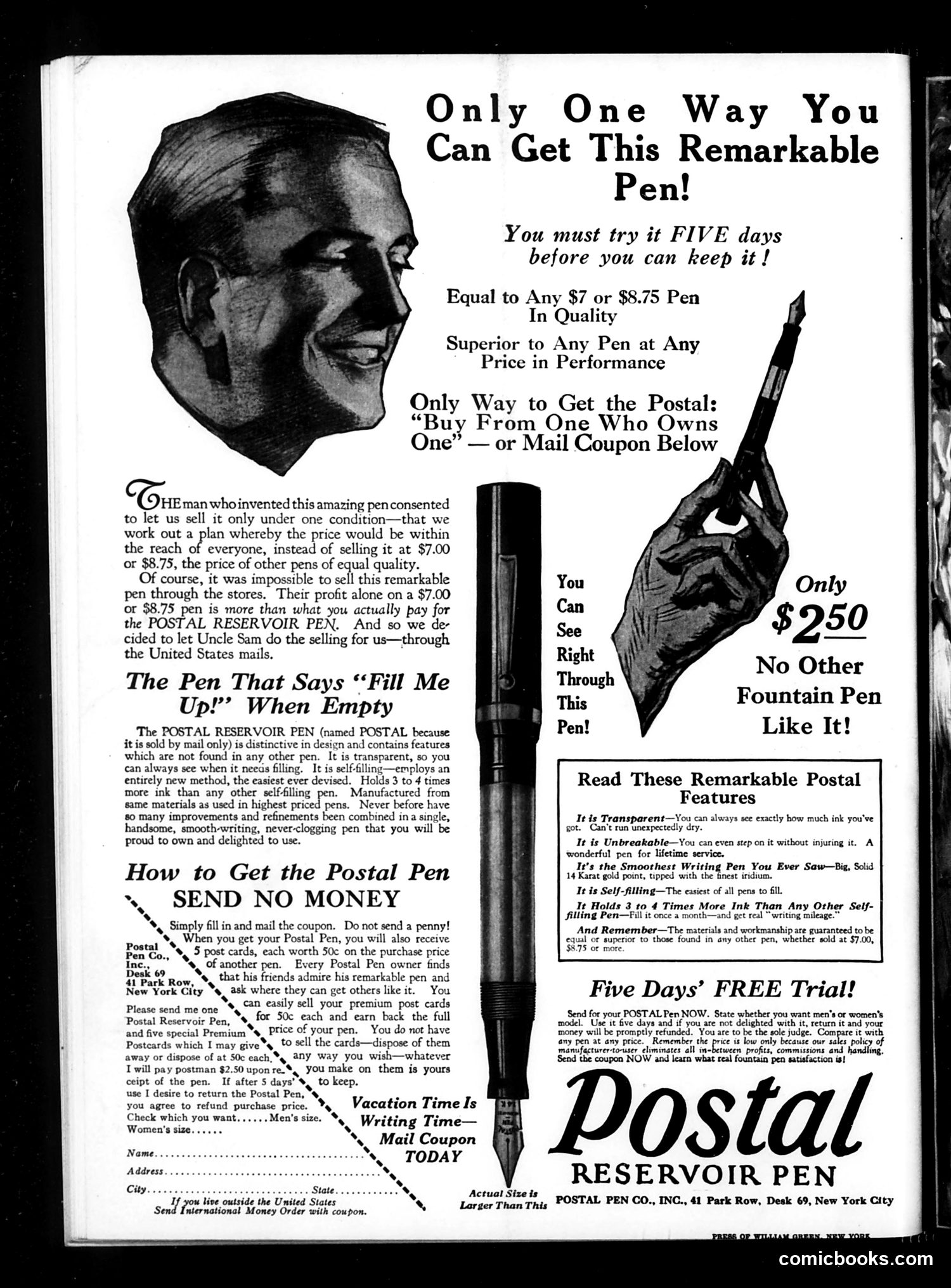
This is primarily a **full-page advertisement**, not a political cartoon. It promotes the "Postal Reservoir Pen," a fountain pen sold exclusively through the U.S. mail. The marketing pitch exploits an unusual business model: the inventor supposedly insisted the pen be sold only by mail to keep prices low (avoiding retail markups). Customers could try the pen for five days free before committing to purchase via mail coupon. The claims are typical of early 20th-century advertising hyperbole—the pen is "transparent" (you can see the ink), "unbreakable," holds more ink than competitors, and costs only $2.50. The prominent male portrait is meant to convey trust and authority, though his identity isn't specified. The satire Judge likely intended is subtle: this is probably mocking the proliferation of mail-order schemes and dubious "revolutionary" product claims that flooded American publications in this era. The breathless language and absurd "only one way to get it" exclusivity would have seemed ridiculous to contemporary readers familiar with such schemes.