
Judge, 1926-05-22 · page 20 of 36
Judge — May 22, 1926 — page 20: what you’re looking at
What you’re looking at
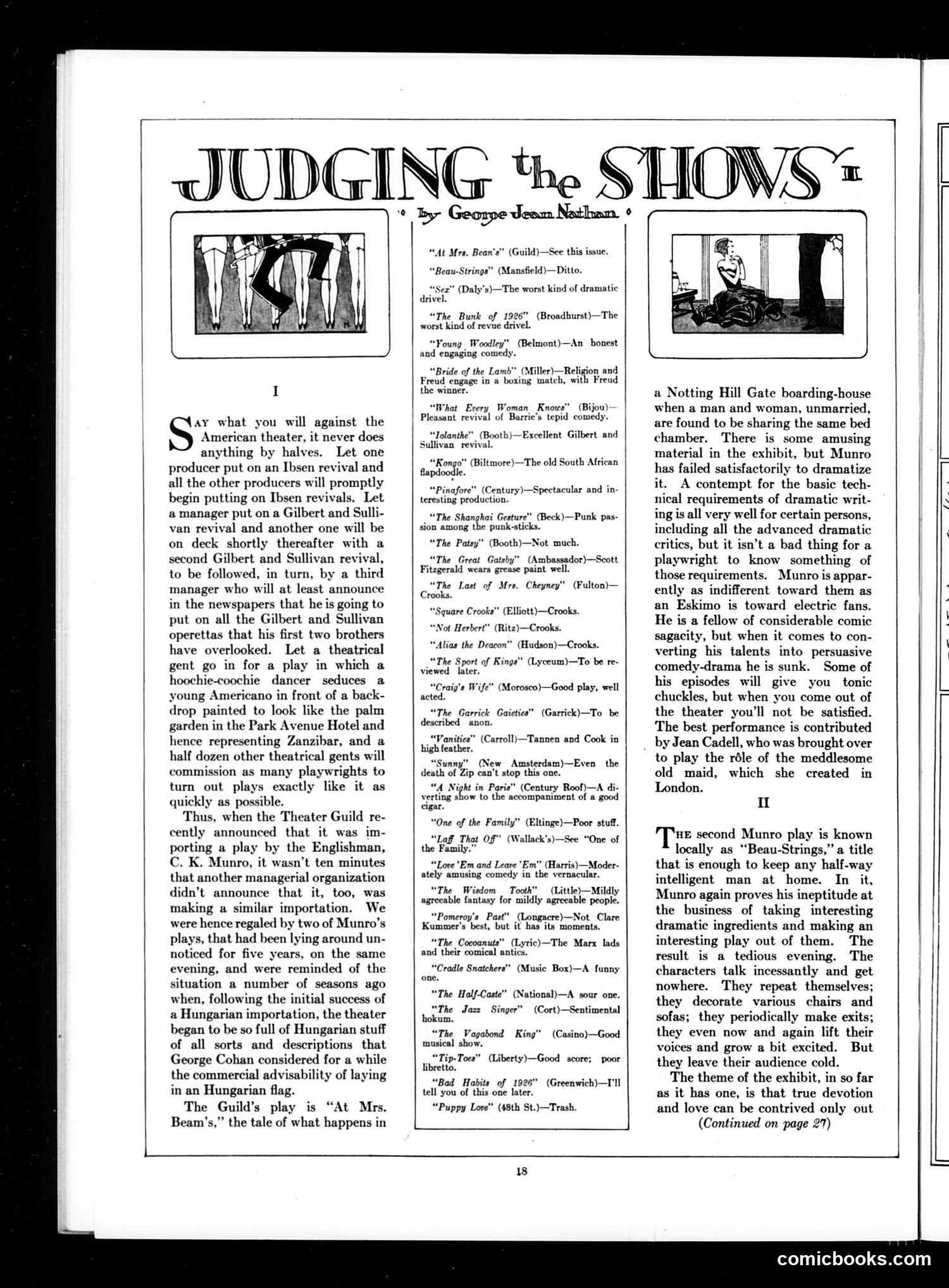
This page features George Jean Nathan's theater column criticizing a specific industry practice: theatrical imitation. Nathan complains that when one producer successfully stages a play or revival (like an Ibsen revival or Gilbert and Sullivan operetta), competitors immediately flood Broadway with similar productions. His example: the Theater Guild imported a play by English playwright C.K. Munro, prompting rival managers to hastily stage two other Munro plays that had languished unnoticed for five years—on the *same evening*. Nathan frames this as part of a recurring cycle of over-production, comparing it to a past Hungarian importation craze that nearly prompted George Cohan to invest in Hungarian flags. The bulk of the page consists of brief, sharp reviews of current Broadway productions, mostly dismissive ("Not much," "Trash," "Poor stuff"), revealing Nathan's curmudgeonly assessment of contemporary theater.
📄 Transcribed text from this page (OCR, searchable)
Machine-transcribed from the original scan — historical spelling and the odd misread are preserved.
Ay what you will against the | S American theater, it never does anything by halves. Let one producer put on an Ibsen revival and all the other producers will promptly begin putting on Ibsen revivals. Let a manager put on a Gilbert and Sulli- van revival and another one will be on deck shortly thereafter with a second Gilbert and Sullivan revival, to be followed, in turn, by a third anager who will at least announce in the newspapers that he is going to put on all the Gilbert and Sullivan operettas that his first two brothers have overlooked. Let a theatrical gent go in for a play in which a hoochie-coochie dancer seduces a young Americano in front of a back- drop painted to look like the palm garden in the Park Avenue Hotel and hence representing Zanzibar, and a half dozen other theatrical gents will commission as many playwrights to turn out plays exactly like it as quickly as possible. Thus, when the Theater Guild re- cently announced that it was im- porting a play by the Englishman, C. K. Munro, it wasn’t ten minutes that another managerial organization didn’t announce that it, too, was making a similar importation. We were hence regaled by two of Munro’s plays, that had been lying around un- noticed for five years, on the same evening, and were reminded of the situation a number of seasons ago when, following the initial success of a Hungarian importation, the theater began to be so full of Hungarian stuff of all sorts and descriptions that George Cohan considered for a while the commercial advisability of laying in an Hungarian flag. The Guild’s play is “At Mrs. Beam’s,” the tale of what happens in @ by Georpe Jeam Nathan. “At Mra. Bean's” (Guild) —See this issue. “Beau-Strings” (Mansfield)—Ditto. “Sez” (Daly's)—The worst kind of dramatic dri “The Bunk of 1926” (Broadhurst)—The worst kind of revue drivel. “Young Woodley” (Belmont)—An honest and engaging comedy. “Bride of the Lamb” (Miller)—Religion and Freud engage in « boxing match, with Freud the winner. “What Ecery Woman Knows" (Bijou) Pleasant revival of Barrie's tepid comedy. “Tolanthe” (Booth)—Excellent Gilbert and Sullivan revival. “Kongo” (Biltmore)—The old South African le. “Pinafore” (Century)—Spectacular and in- teresting production. “The Shanghai Gesture" (Beck)—Punk pas- sion among the punk-sticks. “The Patsy” (Booth)—Not much. “The Great Gatsby” (Ambassadot)—Scott Fitzgerald wears grease paint well. “The Last of Mrs. Cheyney” (Fulton)— Crooks. " (Elliott)—Crooks. “Not Herbert” (Ritz)—Crooks. “Alias the Deacon” (Hudson)—Crooks. “The Sport of Kings" (Lyceum)—To be re- viewed later. “Craig's Wife” (Morosco)—Good play, well acted. “Square Croo "he Garrick Gaieties” (Garrick)—To be described anon. “Vanities” (Carroll) Tannen and Cook in high feather. “Sunny” (New Amsterdam)—Even the death of Zip can't stop this one. “4 Night in Paris” (Century Roof)—A di- ysis show to the accompaniment of @ good “Toke of the Family” (Eltinge)—Poor stuff. “tall That Of" (Wallack’s)—See “One of the Family. *Loce "Em and Leare "Em" (Harris)—Moder- ately amusing comedy in the vernacular. “The Wisdom Tooth” (Little)—Mildly agreeable fantasy for mildly agreeable people. “Pomeroy's Past” (Longacre)—Not Clare Kummer’s best, but it has its moments. “The Cocoanuts” (Lyric)—The Marx lads and their comical antics. “Cradle Snatchers” (Music Box)—A funny one. “The Half-Caste” (National)—A sour one. “The Jazz Singer” (Cort)—Sentimental hokum. “The Vagabond King” (Casino)—Good musical show. Hh leadl (Liberty)—Good score; poor libretto. “Bad Habite of 1926” (Greenwich)—I'll tell you of this one later. “Puppy Love” (48th St.)—Trash. a Notting Hill Gate boarding-house when a man and woman, unmarried, are found to be sharing the same bed chamber. There is some amusing material in the exhibit, but Munro has failed satisfactorily to dramatize it. A contempt for the basic tech- nical requirements of dramatic writ- ing is all very well for certain person: including all the advanced dramatic critics, but it isn’t a bad thing for a playwright to know something of those requirements. Munro is appar- ently as indifferent toward them as an Eskimo is toward electric fans. He is a fellow of considerable comic sagacity, but when it comes to con- verting his talents into persuasive comedy-drama he is sunk. Some of his episodes will give you tonic chuckles, but when you come out of the theater you'll not be satisfied. The best performance is contributed by Jean Cadell, who was brought over to play the réle of the meddlesome old maid, which she created in London. Ir T= second Munro play is known locally as “Beau-Strings,” a title that is enough to keep any half-way intelligent man at home. In it, Munro again proves his ineptitude at the business of taking interesting dramatic ingredients and making an interesting play out of them. The result is a tedious evening. The characters talk incessantly and get nowhere. They repeat themselves; they decorate various chairs and sofas; they periodically make exits; they even now and again lift their voices and grow a bit excited. But they leave their audience cold. The theme of the exhibit, in so far as it has one, is that true devotion and love can be contrived only out (Continued on page 27) — comicbooks.com