
Judge, 1926-05-22 · page 10 of 36
Judge — May 22, 1926 — page 10: what you’re looking at
What you’re looking at
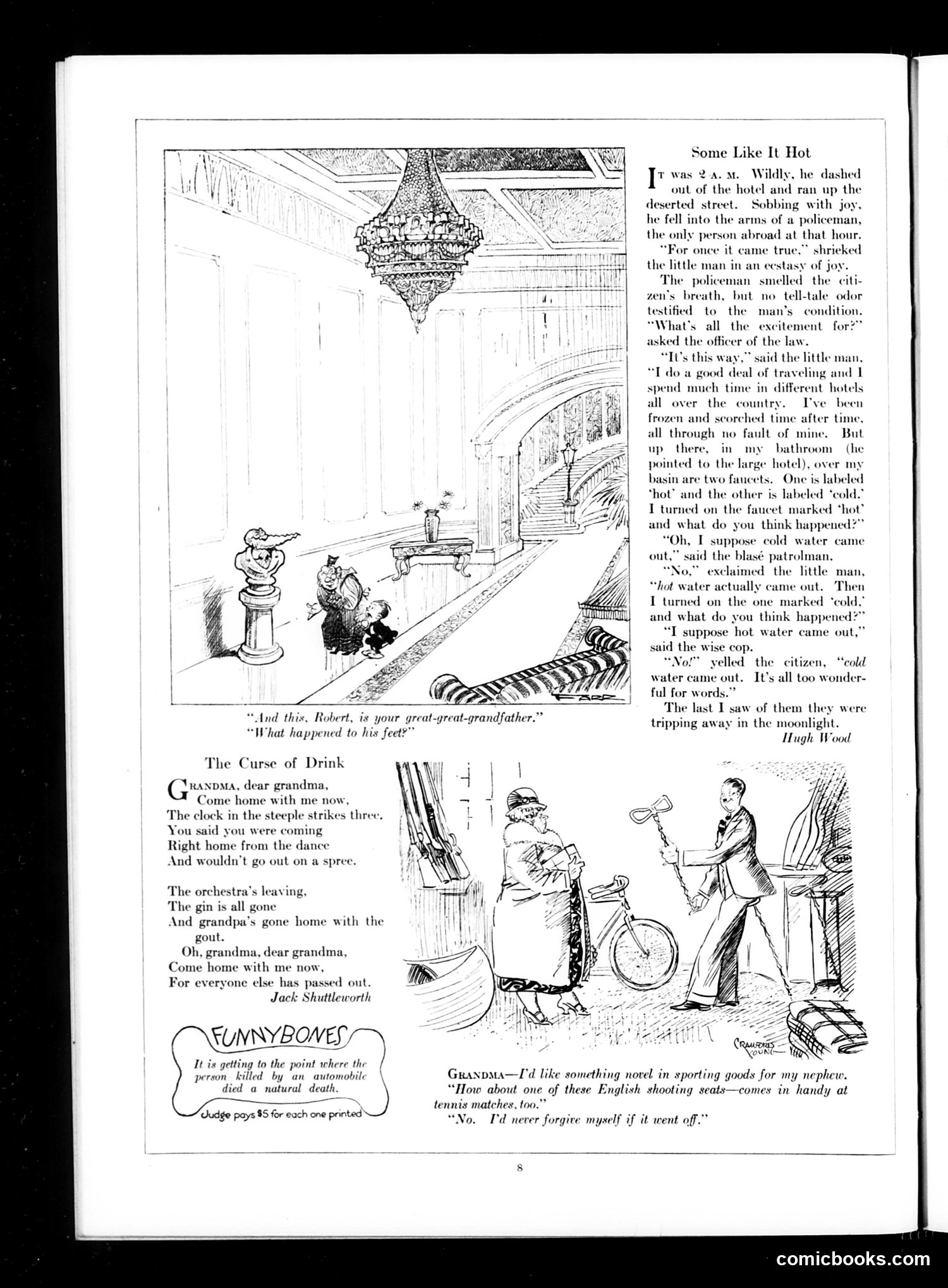
This page contains three satirical pieces reflecting early 20th-century American social concerns: **"The Curse of Drink"** (poem by Jack Shuttleworth): A grandmother has abandoned her family after a dance, drinking gin until passing out. The satire targets alcohol's destructive effects on respectability and family obligations—a common Prohibition-era concern. **"Some Like It Hot"** (by Hugh Wood): A traveling salesman excitedly tells a cop that a hotel's "hot" faucet actually dispensed hot water—apparently a rarity in American hotels. The joke mocks poor hotel infrastructure and infrastructure standards, presenting this basic amenity as shockingly novel. **"Funnybones"**: A brief quip about automobile fatalities becoming so common that deaths qualify as "natural." The cartoon illustration (top) shows a grand hotel lobby, supporting the "Some Like It Hot" narrative about luxury accommodations. These pieces collectively satirize contemporary anxieties: alcohol abuse, inadequate public services, and rising automobile dangers—all markers of modernity's failures.
📄 Transcribed text from this page (OCR, searchable)
Machine-transcribed from the original scan — historical spelling and the odd misread are preserved.
“And this, Robert, is your great-great-grandfather.” “What happened to his feet?” The Curse of Drink zaNDMA, dear grandma, Come home with me now, The clock in the steeple strikes three. You said you were coming Right home from the dance And wouldn’t go out on a spree. The orchestra’s leaving, The gin is all gone And grandpa’s gone home with the gout. Oh, grandma, dear grandma, Come home with me now, For everyone else has passed out. Jack Shuttleworth FUNNYBOWES/ >) It is getting to the point where the person killed by an automobile Some Like It Hot I was 2.4. mM. Wildly, he dashed out of the hotel and ran up the deserted street. Sobbing with joy, he fell into the arms of a policeman, the only person abroad at that hour. ‘or once it came true,” shrieked the little man in an cestasy of joy The policeman smelled the citi- zen’s breath, but no tell-tale odor testified to the man’s conditic “What's all the excitement for?” asked the officer of the law. “Ts this way tid the little man, I do a good deal of traveling and I spend much time in different hotels all over the country. I've been frozen and scorched time after time, all through no fault of mine. But up there, in’ my bathroom (he pointed to the large hotel), over my basin are two faue One is labeled “hot” and the other is labeled ‘cold. I turned on the faucet marked ‘hot’ and what do you think happened?” “Oh, I suppose cold water came out,” said the blasé patrolman. . exclaimed the little ma “hot water act and what do you think happenec “TI suppose hot water came out,” said the wise cop. “No!” yelled the citizen, “cold water came out. It’s all too wonder- ful for words.” The last I saw of them they were tripping away in the moonlight. Hugh Wood GranpMa—I'd like something novel in sporting goody for my nephew. died a natural death. “How about one of these English shooting seats—comes in handy at tennis matches, too.” “No. I'd never forgive myself if it went off.” comicbooks.com