
Judge, 1926-05-22 · page 26 of 36
Judge — May 22, 1926 — page 26: what you’re looking at
What you’re looking at
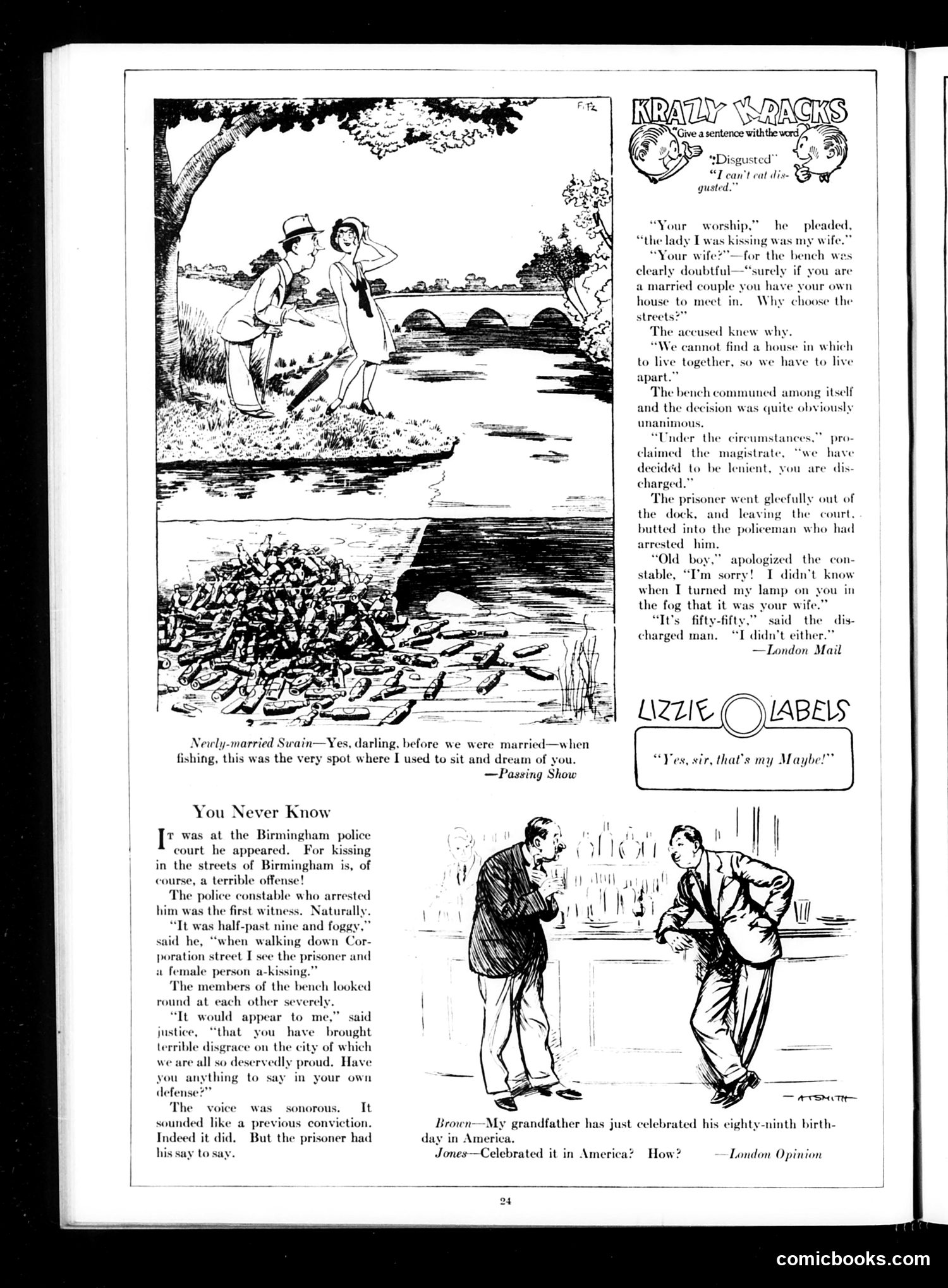
This page contains **three separate humor pieces** satirizing British social hypocrisy around 1920s-era morality laws. **"You Never Know"** (main story): A man is arrested for kissing a woman in Birmingham's streets—deemed illegal. When he reveals she's his wife, the magistrate questions why married couples need public spaces to meet, since they have homes. The man's honest answer—they can't find housing together—makes the bench unanimously discharge him as sympathetic. The irony: the arresting officer later admits he didn't recognize the woman in fog either, making the arrest absurd. **The satire targets**: Rigid public-decency laws that criminalize natural affection, the housing shortage's real impact on married couples, and the bench's arbitrary justice that softens when confronted with economic reality rather than moral principle. **Two shorter jokes** at bottom involve nostalgic romance and celebrating a grandfather's birthday "in America" (implying immigrant displacement). The cartoons mock the disconnect between Victorian prudishness and actual human circumstances.
📄 Transcribed text from this page (OCR, searchable)
Machine-transcribed from the original scan — historical spelling and the odd misread are preserved.
*:Disgusted “T can't vat dis- gusted.” “Your worship.” he — pleaded, “the lady Twas kissing was my wife.” “Your wife?”’—for the bench wes: clearly doubtful—“surely if you are a married couple you have your own house to meet in. Why choose the streets?” The accused knew why. “We cannot find a house in which to live together, so we have to live apart.” The bench communed among itself and the decision was quite obviously unanimous. “Under the circumstances,” pro- claimed the magistrate, “we have decided to be lenient, you are dis- charged.” ‘The prisoner went gleefully out of the dock, and leaving the court, butted into the policeman who had arrested him. “Old boy,” apologized the con- stable, “I’m sorry! I didn't know when T turned my lamp on you in the fog that it was your wife.” “It's fifty-fifty,” said the dis- charged man. “I didn’t either.” —London Mail Newly-married Swain—Yes, darling, before we were married—when fishing, this was the very spot where I used to sit and dream of you. —Passing Show You Never Know y was at the Birmingham police court he appeared. For kissing in the streets of Birmingham is, of course, a terrible offense! The police constable who arrested him was the first witness. Naturally. “Tt half-past nine and foggy,” said he, “when walking down Cor- poration street I see the prisoner and a female person a-kissing.” 1e members of the bench looked round at each other severel) “It would appear to me,” said justice, you have brought on the city of which proud, Have “© was sonorous. It sounded like a previous conviction. Brown—My grandfather has just celebrated his eighty-ninth birth- Indeed it did. But the prisoner had day in America. his say to say. Jones—Celebrated it in America? How? London Opinion comicbooks.com