
Judge, 1926-05-22 · page 15 of 36
Judge — May 22, 1926 — page 15: what you’re looking at
What you’re looking at
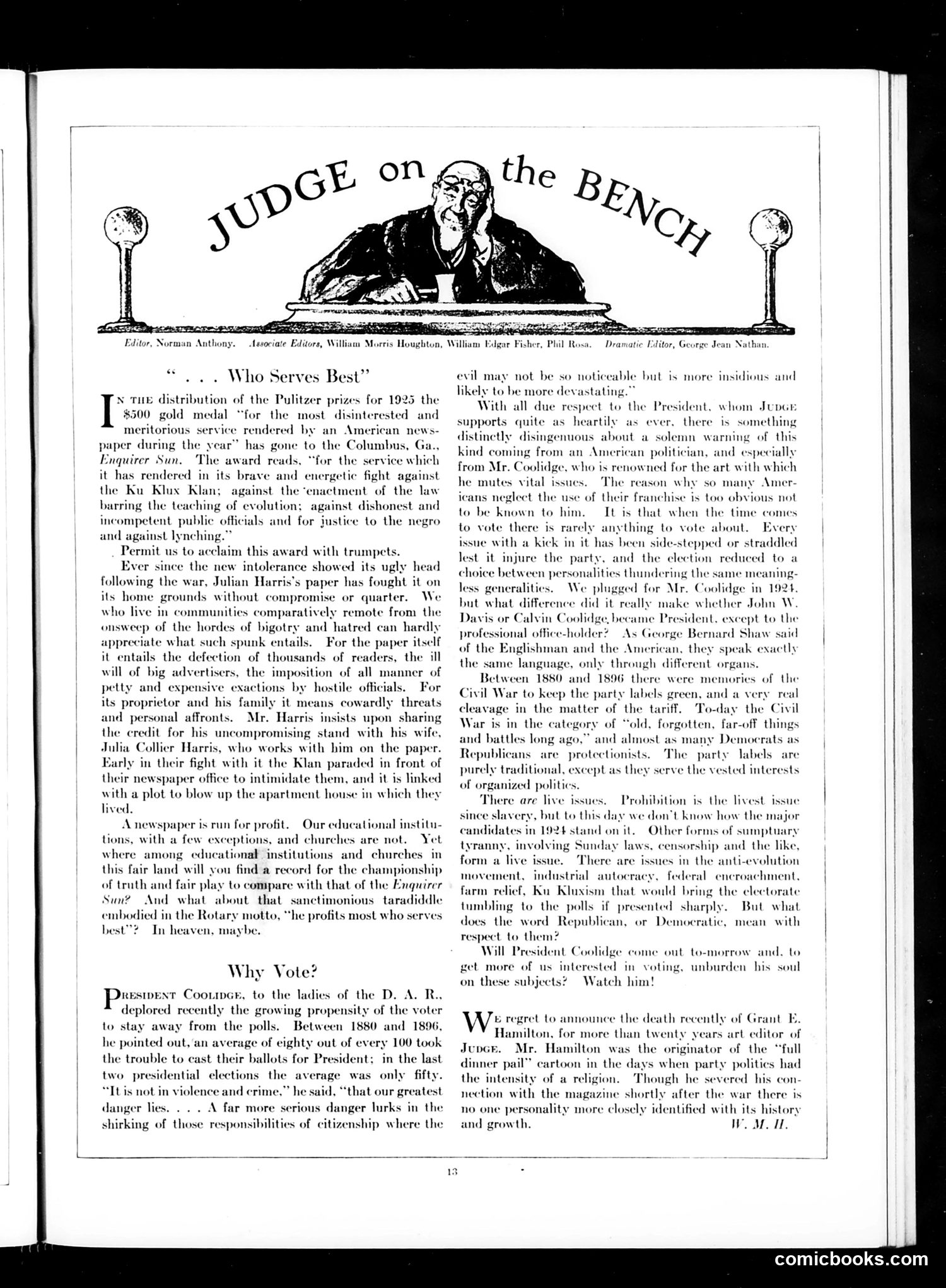
This page contains two distinct editorial pieces: **"Who Serves Best"** celebrates the 1925 Pulitzer Prize awarded to the Columbus (Georgia) *Enquirer-Sun*, edited by Julian Harris, for fighting the Ku Klux Klan, opposing anti-evolution laws, and championing racial justice and anti-lynching efforts. The text emphasizes the personal courage this required—the Harris family faced Klan intimidation and threats of violence. The piece contrasts this principled journalism against profit-driven newspapers, using the Rotary motto sarcastically. **"Why Vote?"** critiques President Calvin Coolidge's recent complaint about voter apathy (turnout dropped from 80% in 1880-1896 to 50% recently). Judge argues Coolidge's concern is hypocritical: voters avoid polls because politicians deliberately avoid substantive issues, instead offering only personality-based choices between candidates offering "meaningless generalities." The satire suggests Coolidge himself exemplifies this evasion of vital issues. Both pieces attack political and institutional dishonesty from a progressive perspective.
📄 Transcribed text from this page (OCR, searchable)
Machine-transcribed from the original scan — historical spelling and the odd misread are preserved.
“. . . Who Serves Best” N THE distribution of the Pulitzer prizes for 1925 the $500 gold medal “for the most disinterested and meritorious service rendered by an American news- paper during the year” has gone to the Columbus, G Enquirer Sun. The award reads, “for the service which it has rendered in its brave and energetic fight a the Ku Klux Klan; against the ‘enactment of the law barring the teaching of evolution; against dishonest and incompetent public officials and for justice to the negro and against lynching.” Permit us to acclaim this award with trumpets. Ever since the new intolerance showed its ugly head following the war, Julian Harris's paper has fought it on its home grounds without compromise or quarter. We who live in communities comparatively remote from the onsweep of the hordes of bigotry and hatred can hardly appreciate what such spunk entails. For the paper itself it entails the defection of thousands of readers, the ill will of big advertisers, the imposition of all manner of petty and expensive exactions by hostile officials. For its proprietor and his family it m cowardly threats and personal affronts. Mr. Harris insists upon sharing the credit for his uncompromising stand with his wife, Julia Collier Harris, who works with him on the paper. Early in their fight with it the Klan paraded in front of their newspaper office to intimidate them, and it is linked with a plot to blow up the apartment house in which they lived. Anev ainst aper is run for profit. Our educ tions, with a few exceptions, and church where among educational institutions and churches in this fair land will you find a record for the championship of truth and fair y to compare with that of the Enquirer Sun? And what mut that sanctimonious taradiddle lied in the Rotary motto, “he profits most who serves In heaven, maybe. Why Vot Prsswesr Cooumce, to the ladies of the D. A. R., deplored recently the growing propensity of the voter to stay away from the 1 1880 and 1896, he pointed out, an average of eighty out of every 100 took the trouble to cast their ballots for President; in the last the average was only fifty. “It is not in violence and crime,” id, “that our greatest nger lurks in the renship where the Between two presidential elections danger lies. \ far more s shirking of those m Edgar Fisher, Phil Rosa. Dramatic Editor, George Jean Nathan evil may not be so noticeable but is more insidious and likely to be more devastating.” With all due respect to the President, whom Jupce supports quite as heartily as ever. there is something distinctly disingenuous about a solemn warning of this kind coming from an American politician, and especially from Mr. Coolidge, who is renowned for the art with which he mutes vital issues, Amer- icans neglect the use of their franchise is too obvious not to be known to him. The reason why so many It is that when the time comes to vote there is rarely anything to vote about. issue witl Every kick in it has been side-stepped or straddled lest it injure the party, and the election reduced to a choice between personalities thundering the same meaning- less generalities. We plugged for Mr. Coolidge in 1924. but what difference did it really make whether John W Davis or Calvin Coolid, pt to the aw said yecame President. exc professional office-holder? As George Bernard SI of the Englishman and the American, they speak exactly the same language, only through different organs. Between 1880 and 1896 there were memories of the Civil War to keep the party labels green, and a very: real cleavage in the matter of the tariff. To-day the Civil War is in the category of “old, forgotten, far-off things and battles long age Republicans and almost as many Democrats as The party labels are purely traditional, except as they serve the vested interests: of organized politics. There are live issues. are protectionists. Prohibition is the livest issue since slavery, but to this day we don't know how the major candidates in 1924 stand on it. tyranny, involving form a live issue. Other forms of sumptuary Sunday laws, censorship and the like, There are issues in the anti-evolution industrial autocracy, federal encroachment, farm relief, Ku Kluxism that would bring the electorate tumbling to the polls if presented sharply. But what does the word Republican, or Democratic, mean with respect to them? movement, Will President Coolidge come out to-morrow and, to get more of us interested in voting, unburden his soul on these subjects? Watch him! Ws regret to announce the death recently of Grant E. Hamilton, for more than twenty years art editor of Jupce. Mr. Hamilton was the originator of the “full dinner pail” cartoon in the days when party polities had the intensity of a religion. Though he severed his con- nection with the magazine shortly after the war there is no one personality more closely identified with its history and growth, Wo M. UM, comicbooks.com