
A complete issue · 36 pages · 1926
Judge — February 13, 1926
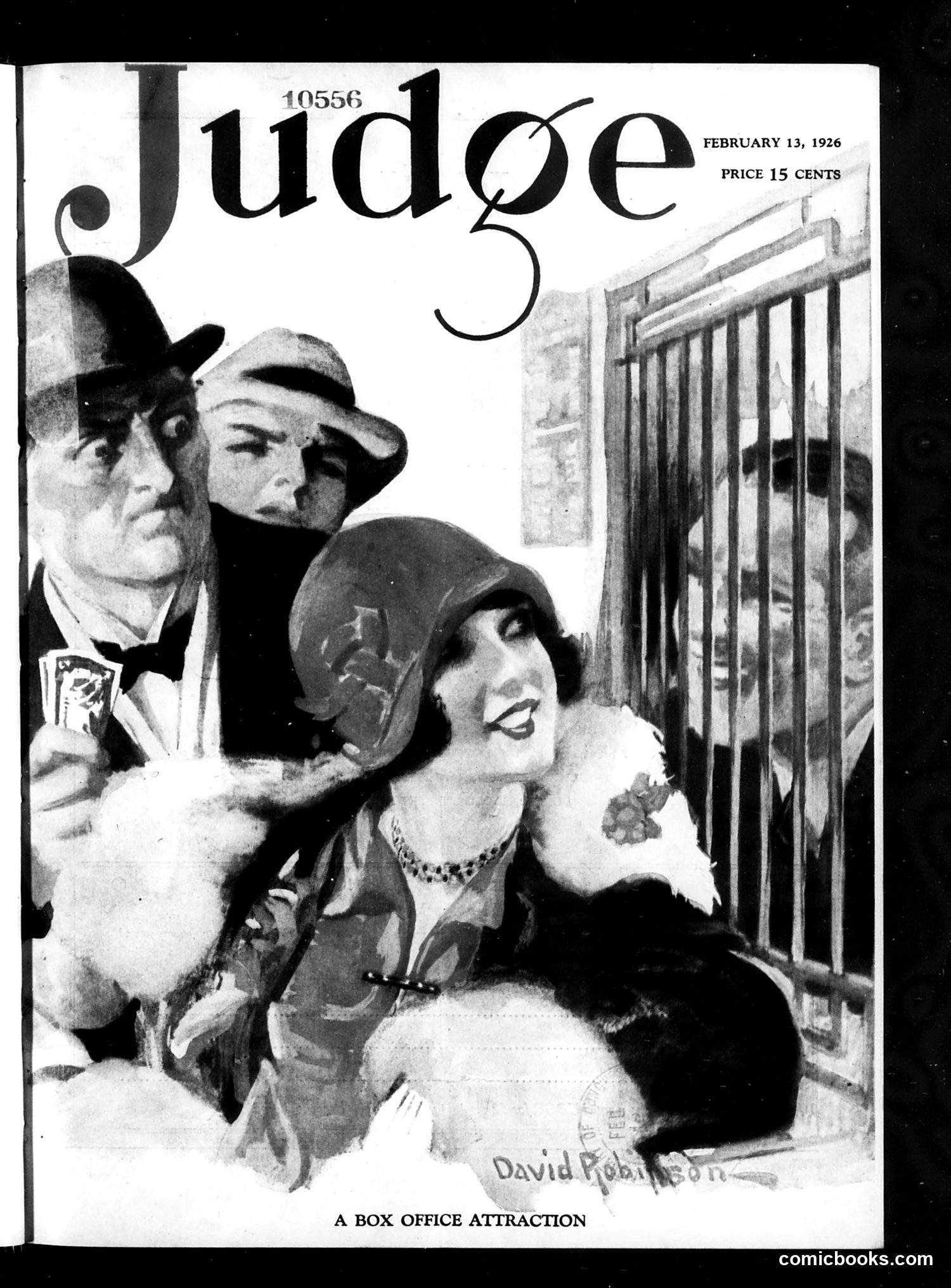
This cover illustrates "A Box Office Attraction," depicting three figures in 1920s attire examining what appears to be a caged lion or large cat behind bars. The satire likely comments on the popularity of wild animal acts in contemporary entertainment—a common circus and vaudeville spectacle of that era. The cartoon suggests audiences were drawn to dangerous animal performances as a novelty. The well-dressed figures' interest in the caged beast may satirize either the public's appetite for sensational entertainment or the exploitation involved in such acts. The specific identity of the figures remains unclear without additional context, though their formal dress suggests they represent typical theater-goers or promoters of the period. The humor derives from treating a dangerous animal as mere commercial spectacle.
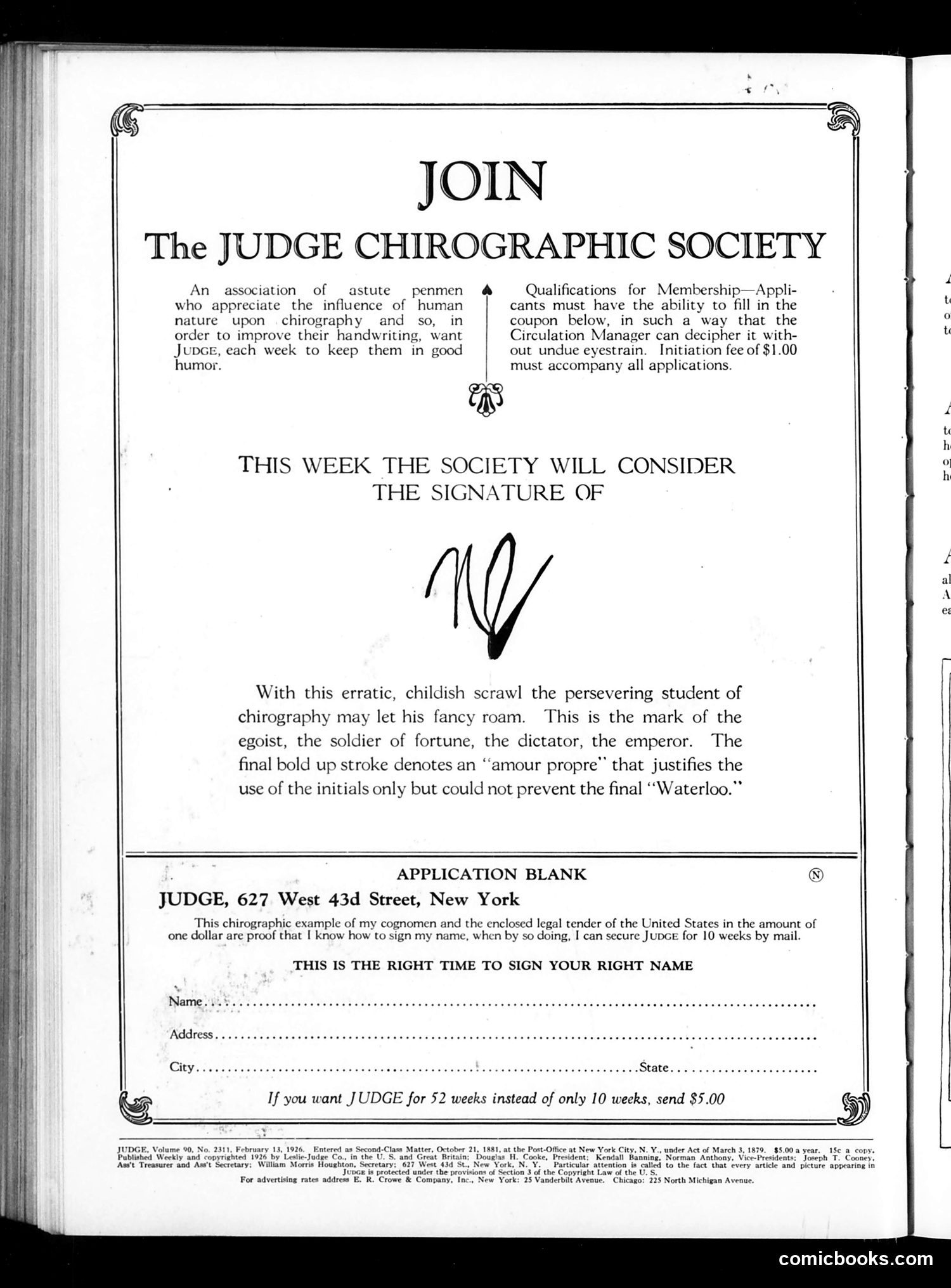
This page is primarily an **advertisement/membership recruitment** for a humorous fictional organization called "The Judge Chirographic Society"—a club for people who want to improve their handwriting through appreciation of penmanship and humor. The satire centers on **a deliberately messy, childish signature** shown as this week's featured example. The accompanying text mocks such signatures as belonging to "the egoist, the soldier of fortune, the dictator, the emperor"—people so self-important they use pretentious initials and erratic flourishes rather than legible writing. The joke targets pompous individuals who adopt ornate, illegible signatures as status symbols. The final line about "Waterloo" suggests their grandiose pretensions inevitably fail. The page includes a membership application blank at the bottom, with initiation fee of $1.00.
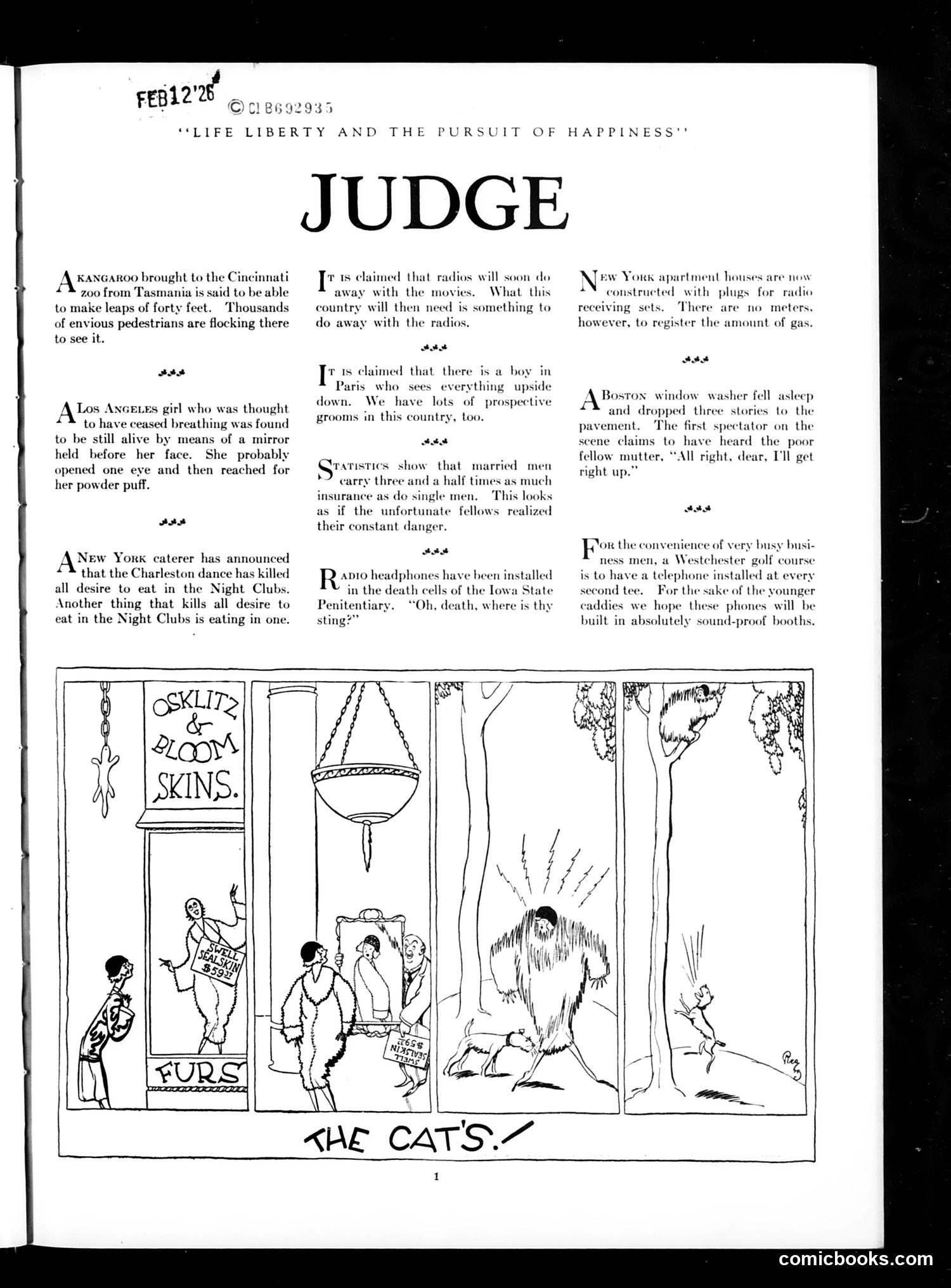
This page from *Judge* magazine combines brief satirical news items with a comic strip titled "The Cat's!" The short items mock contemporary absurdities: a kangaroo's zoo leap, a girl's miraculous recovery, restaurant trends (Charleston dancing killing appetite), and modern conveniences (radios, apartment plugs, window washers, insurance statistics, prison headphones, golf course telephones). The four-panel comic strip satirizes consumerism and fashion excess. Each panel shows people eagerly pursuing luxury goods—fur coats, skin treatments, and fashionable accessories—with exaggerated desperation. The final panel reveals a literal cat causing chaos, suggesting that while humans obsess over material goods and status symbols, nature (or fate) undermines their pretensions. The humor lies in the contrast between human vanity and life's indifference.
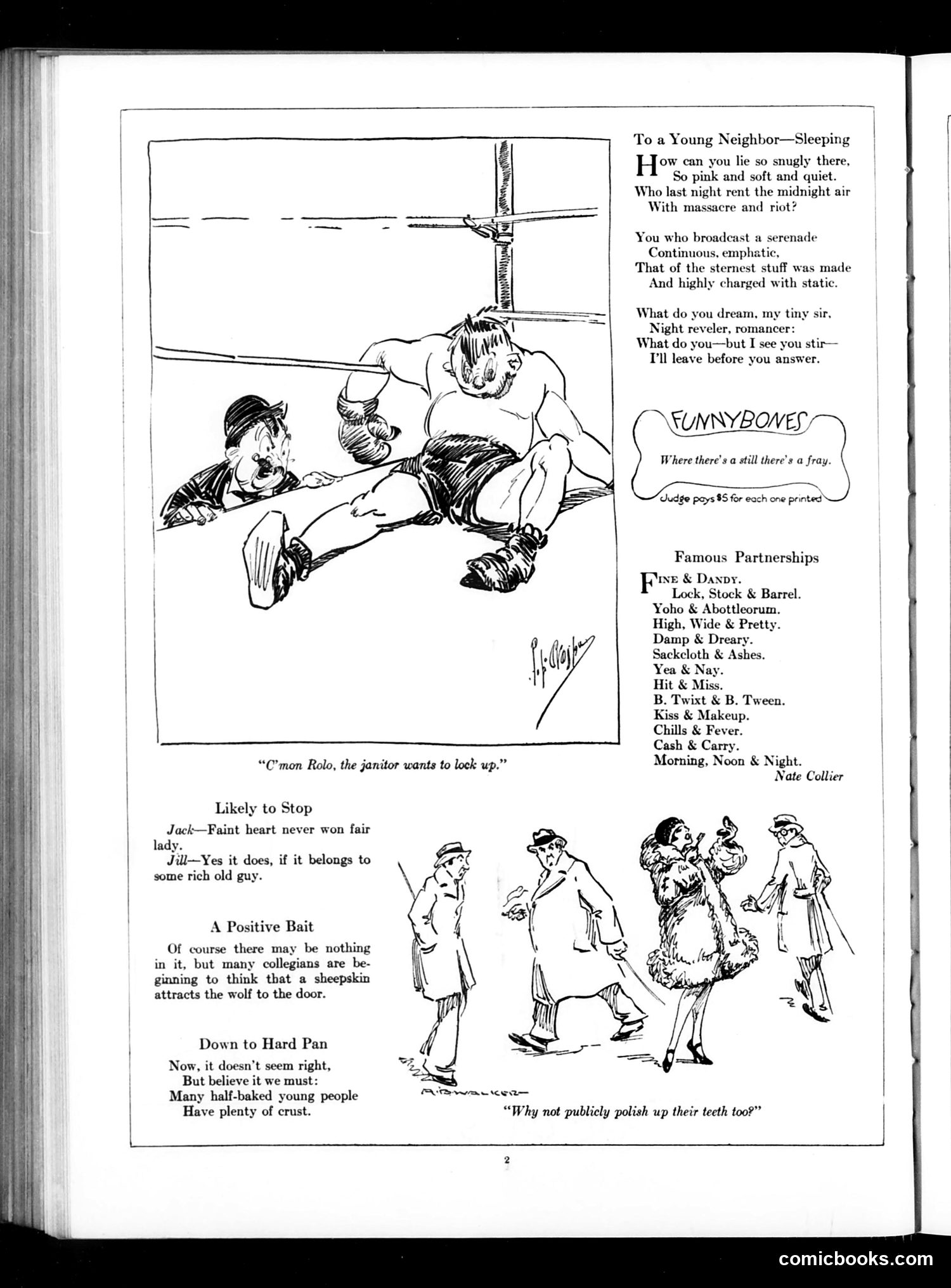
This page contains several humor pieces from Judge magazine. The main cartoon, titled "C'mon Rolo, the janitor wants to look up," shows a sleeping child being awakened—likely satirizing the contrast between innocent childhood sleep and the intrusion of adult responsibilities or domestic workers. The other sections include "Likely to Stop," "A Positive Bait," and "Down to Hard Pan"—brief comedic observations about social behavior. These appear to mock contemporary customs: wealthy pretense ("Positive Bait" references sheepskin attracting wolves), courtship rituals, and dental hygiene among young people. The "Famous Partnerships" section lists well-known entertainment duos of the era. The humor is genteel, focusing on social observation and mild mockery rather than political commentary.
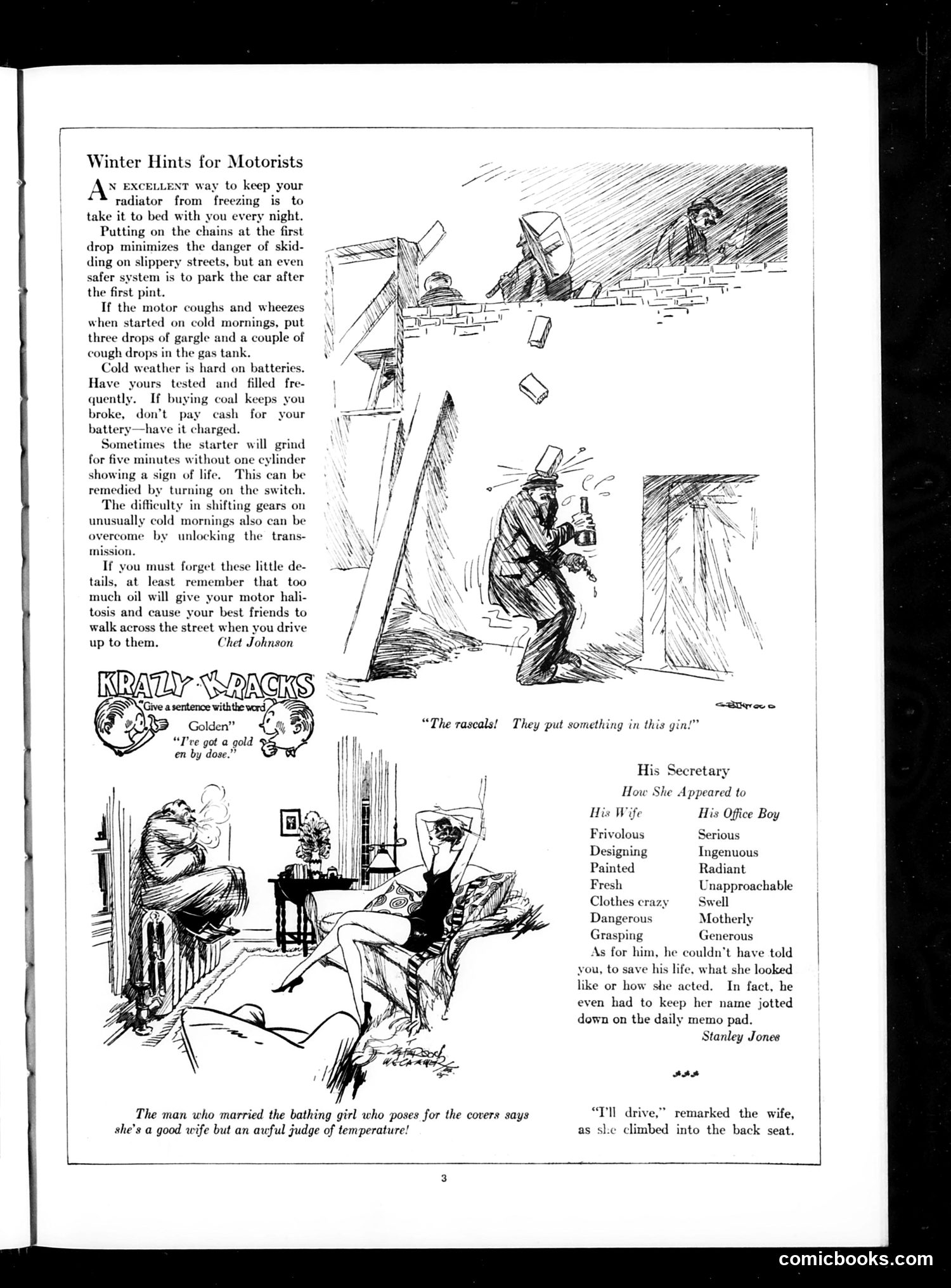
This page contains practical automotive advice ("Winter Hints for Motorists") by Chet Johnson, addressing 1920s-era car maintenance challenges: keeping radiators from freezing, battery issues in cold weather, and starter problems. The cartoons provide humorous commentary on gender roles and marriage. One sketch mocks a man married to a bathing-suit model, suggesting he's a poor judge of character. Another features "His Secretary," presenting her through contrasting descriptors—"Frivolous" to his wife but "Ingenuous" to her boss—satirizing how women were perceived differently depending on their social context and male perspective. The final cartoon depicts a wife taking the wheel, subverting traditional gender expectations about driving, likely reflecting post-WWI shifts in women's independence.
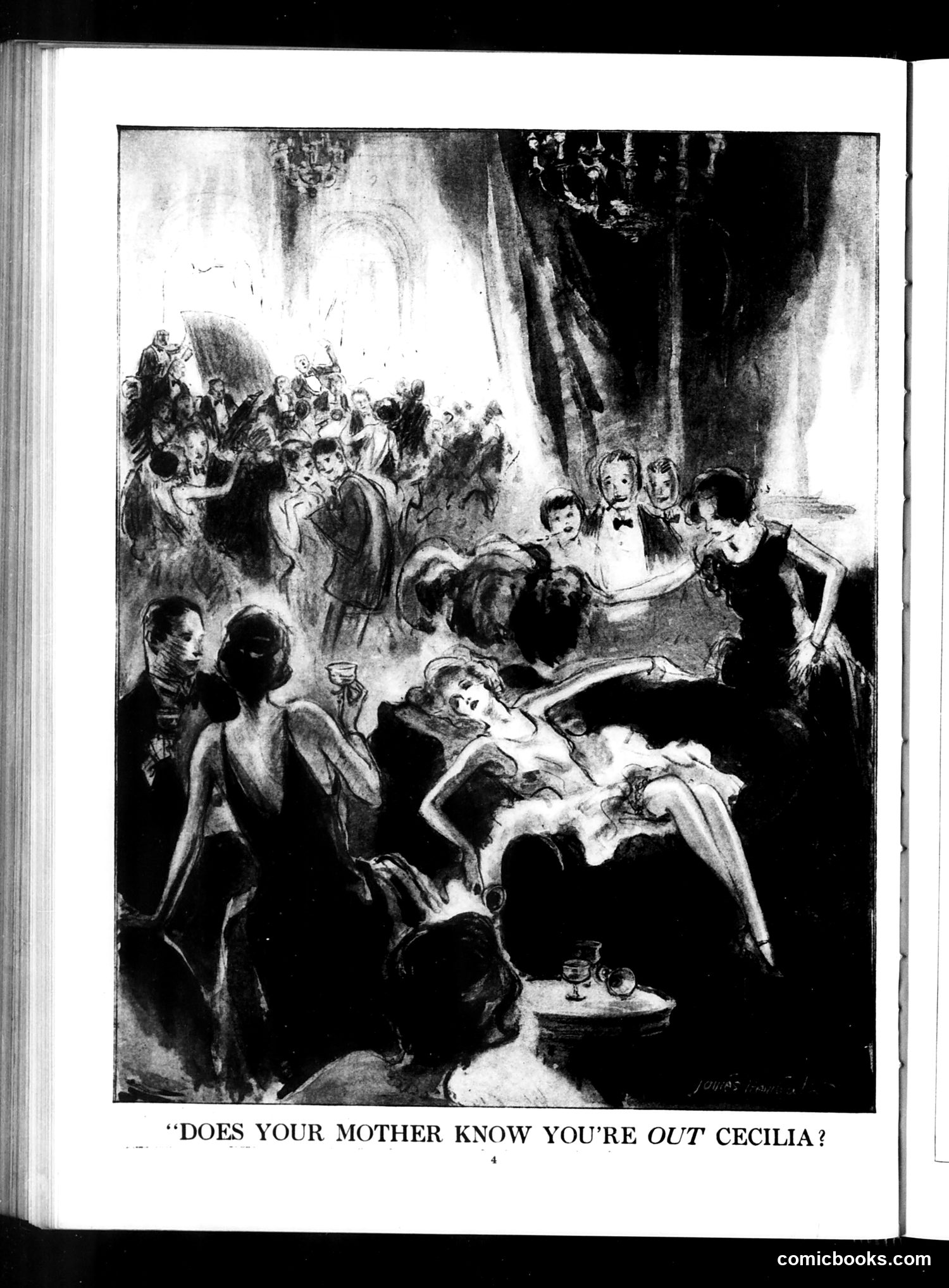
This illustration depicts a nightclub or cabaret scene, likely from the 1920s-1930s based on the artistic style and setting. The caption "DOES YOUR MOTHER KNOW YOU'RE OUT CECILIA?" serves as the joke's punchline. The satire targets the social behavior of young women during this era—specifically the phenomenon of girls sneaking out to illicit nightclubs despite parental disapproval. "Cecilia" appears to be a generic name representing respectable young women engaging in rebellious nightlife activities: drinking, dancing, and socializing unchaperoned in dimly-lit establishments. The humor derives from the contradiction between girls' supposed innocence and their actual behavior—the implication being that mothers would be scandalized if they knew their daughters frequented such venues. This reflects Jazz Age anxieties about changing social morality and generational conflict.
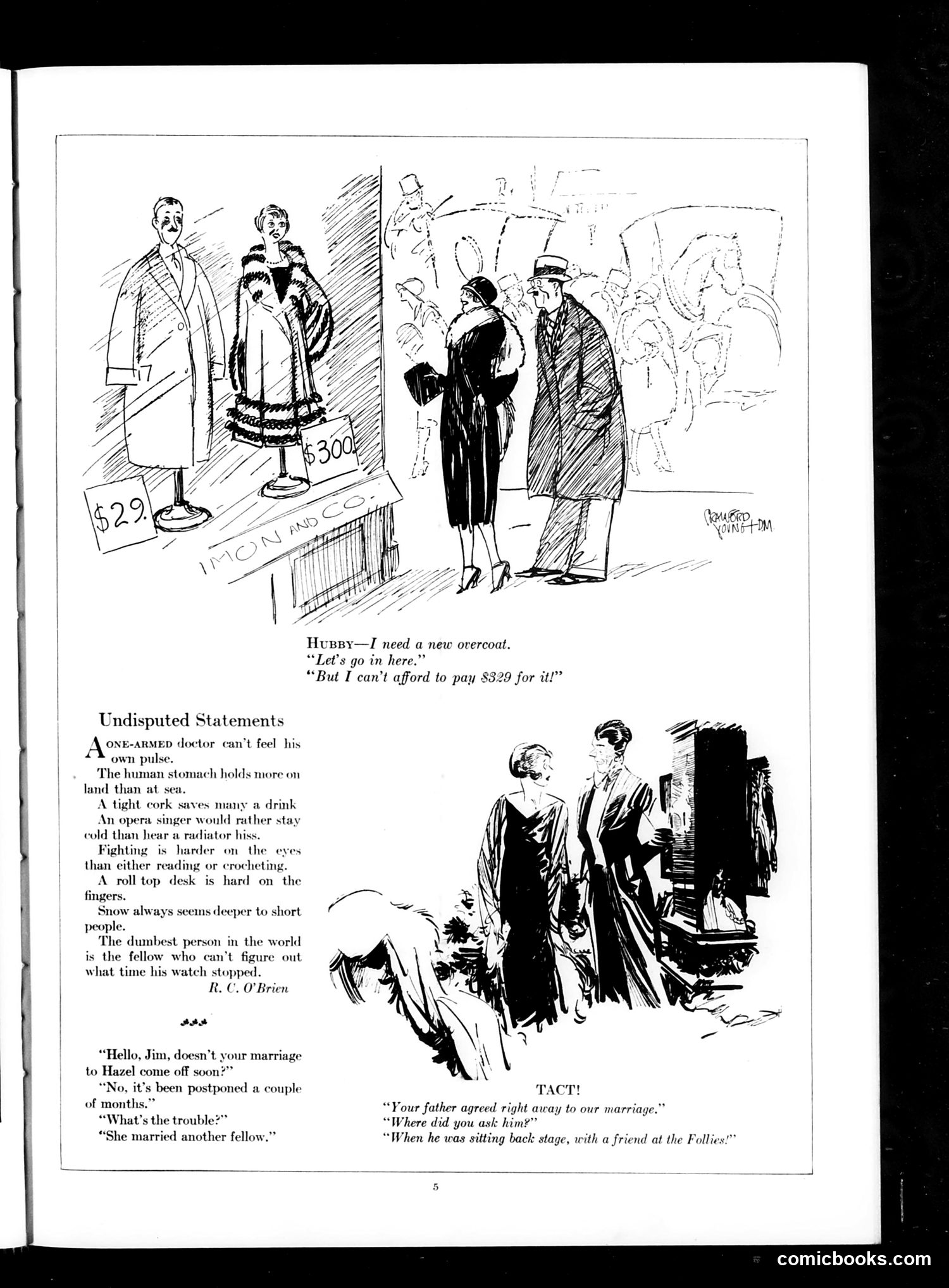
The top cartoon satirizes luxury retail during economic constraint. A couple window-shops at an expensive store displaying coats priced at $29 and $300. The husband wants a new overcoat but "can't afford to pay $329 for it"—apparently the $29 price tag refers to something else entirely, or he's calculating combined costs. The joke mocks the gap between desire and financial reality for middle-class consumers. The lower section contains "Undisputed Statements" (humorous observations) and a separate cartoon about a wedding postponement. The "TACT!" cartoon depicts social awkwardness: someone mentioned the groom was backstage at the Follies with a friend when he agreed to marry—an embarrassing revelation at a wedding. The humor targets class anxieties and social embarrassment.
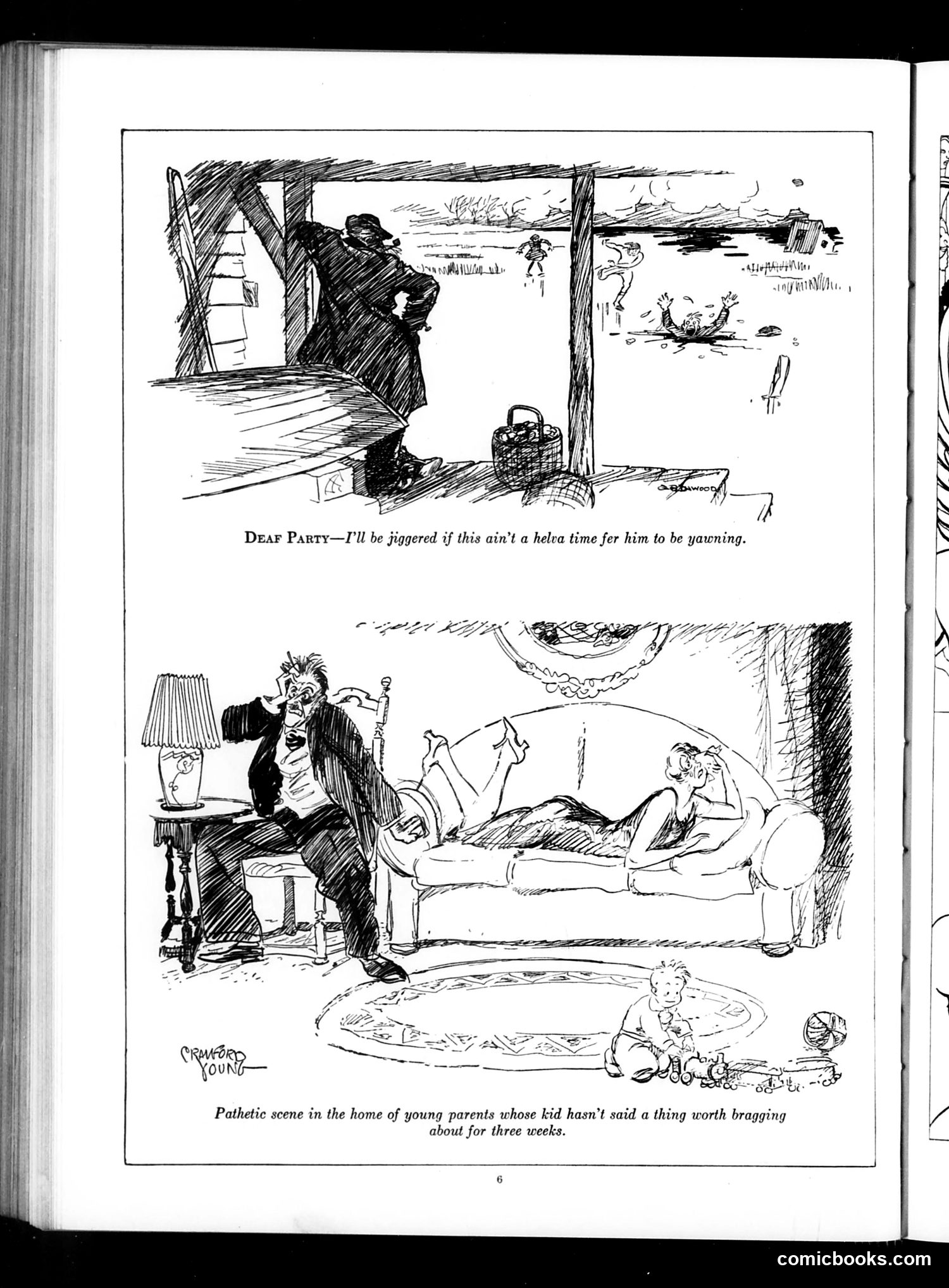
This page contains two cartoons satirizing parental behavior: **Top cartoon**: A figure peers out a window at an outdoor scene, commenting that it's a terrible time for someone to be yawning—apparently during some social gathering or event where attention/engagement matters. **Bottom cartoon** (credited to Crowford Young): Shows exhausted parents slumped on a couch while their young child plays on the floor. The caption mockingly describes the "pathetic scene" of parents whose child hasn't accomplished anything noteworthy to boast about recently. The satire targets parental pride and one-upmanship—the social pressure parents feel to have an accomplished or impressive child to discuss with others. The humor lies in depicting the deflated reality when a child provides nothing worth mentioning, leaving the parents visibly dejected. It's a commentary on vanity and the performative aspects of parenthood in social contexts.
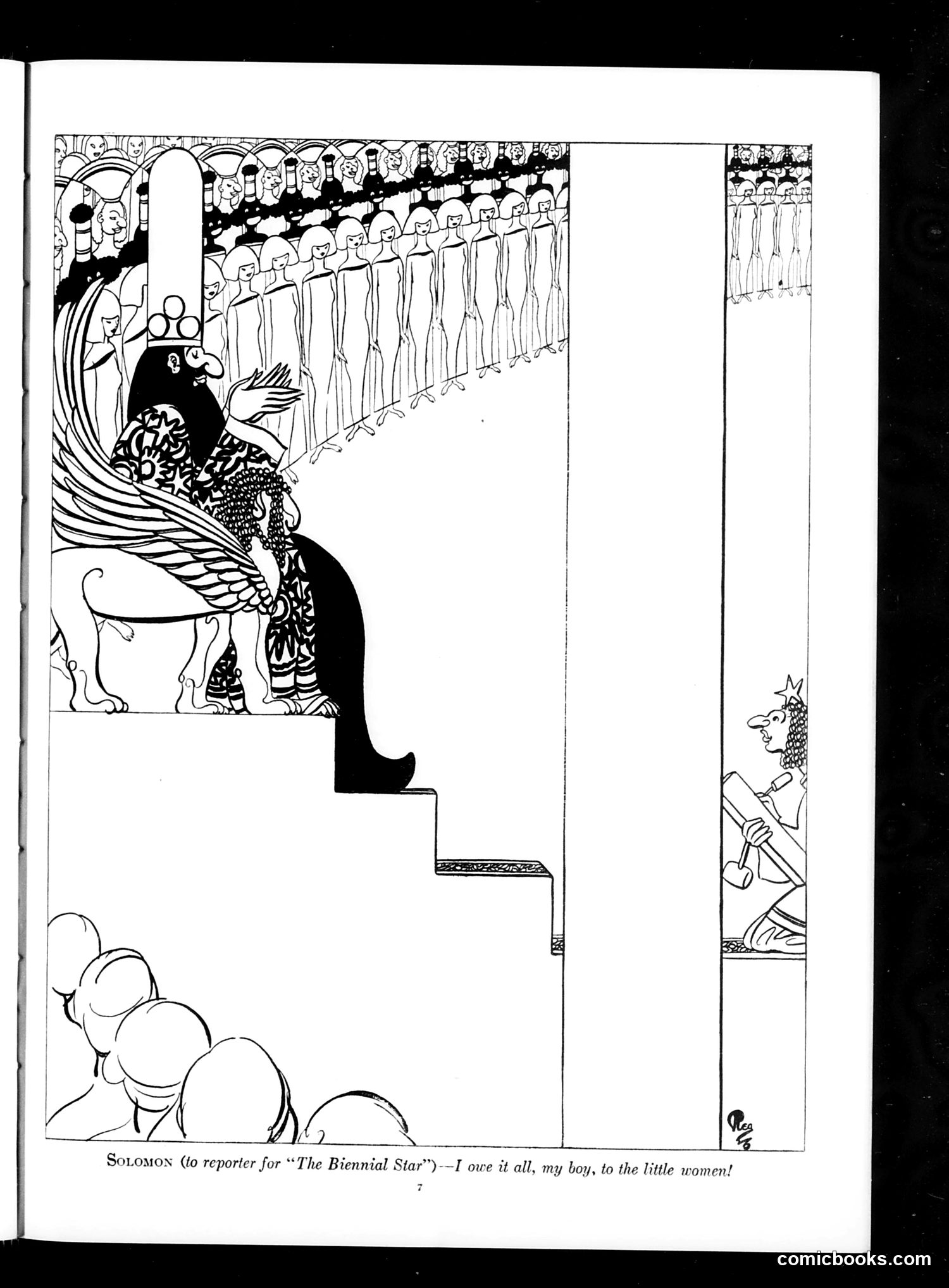
This satirical cartoon depicts **Solomon**, the biblical king famous for his wisdom, addressing a reporter from "The Biennial Star." Solomon credits his success to "the little women"—a humorous reference to his legendary multiple wives (he had hundreds according to biblical accounts). The joke is a pun on the phrase "little women" (evoking Louisa May Alcott's novel) while mocking Solomon's actual historical reputation for maintaining a vast harem. The cartoon satirizes both Solomon's vanity in attributing his wisdom to women and, likely, contemporary attitudes about women's roles and influence. The elaborate architectural setting with hierarchies of figures reinforces themes of power and status, suggesting how Solomon's kingdom—and by extension, male authority—supposedly depended on female support, presented here ironically.
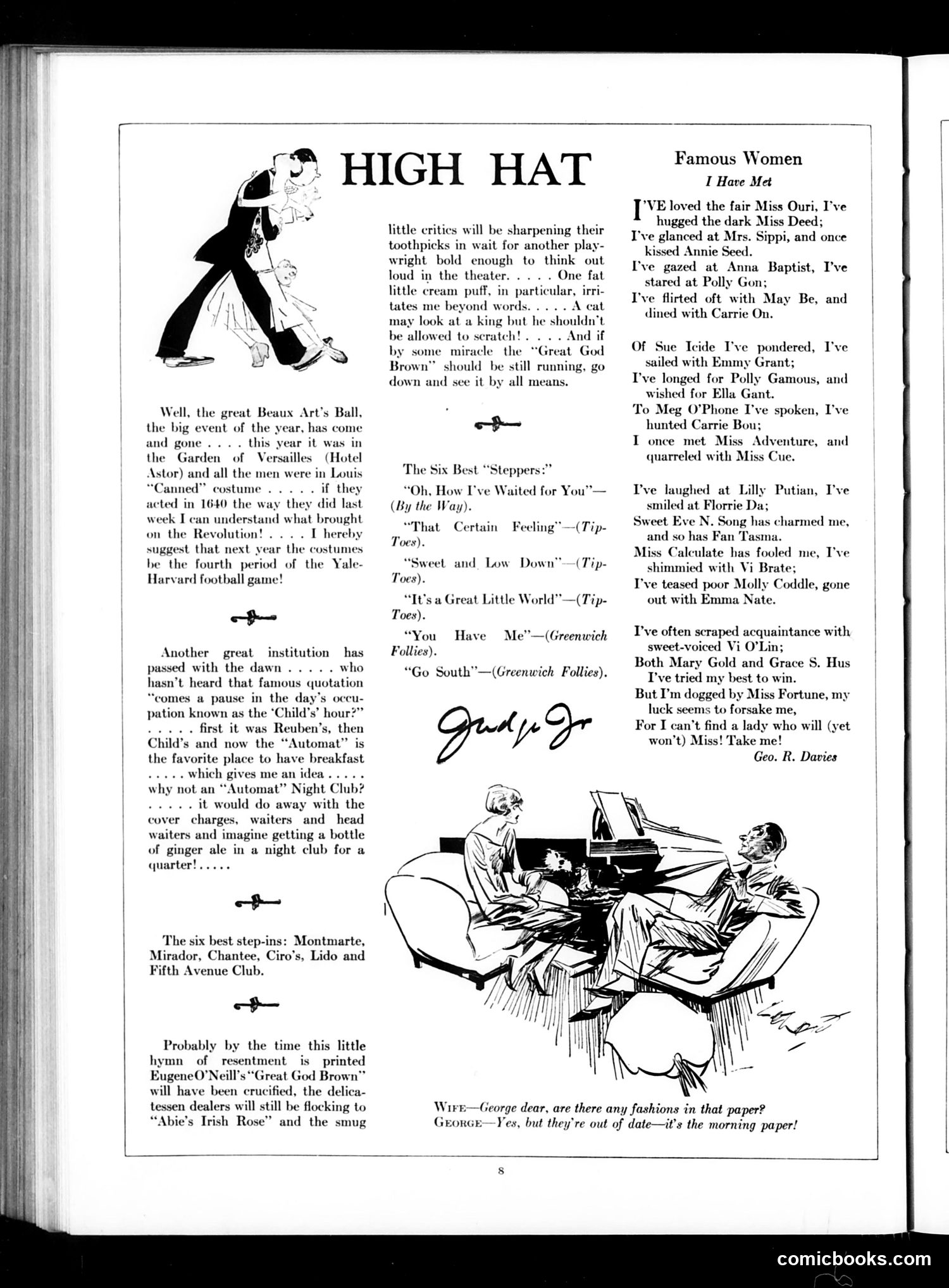
This page from *Judge* contains satirical commentary on 1920s New York nightlife and entertainment, plus a humorous poem. **Main Articles:** The "High Hat" column critiques the Beaux Arts Ball (held at the Hotel Astor in a Versailles theme) and comments on fashionable gathering spots like Reuben's, Child's, and the Automat. The author suggests an "Automat Night Club" to eliminate cover charges and inflated prices—satirizing expensive nightlife. **Theatre References:** The "Six Best Steppers" lists popular Broadway songs, while references to Eugene O'Neill's plays (particularly "Great God Brown") mock both pretentious theater and its critics who treat serious drama harshly. **"Famous Women I Have Met":** A clever poem by Geo. R. Davies uses pun-based female names (Sue Icide, Polly Gamous, Miss Calculate, Vi O'Lin, Emma Nate) to create wordplay humor. The persona laments failing to find a woman willing to marry him despite countless romantic encounters. **Bottom Cartoon:** A domestic joke: a wife asks her husband about fashions in the newspaper; he replies they're outdated because it's the morning edition—implying fashion news moves too quickly for print media to keep current.
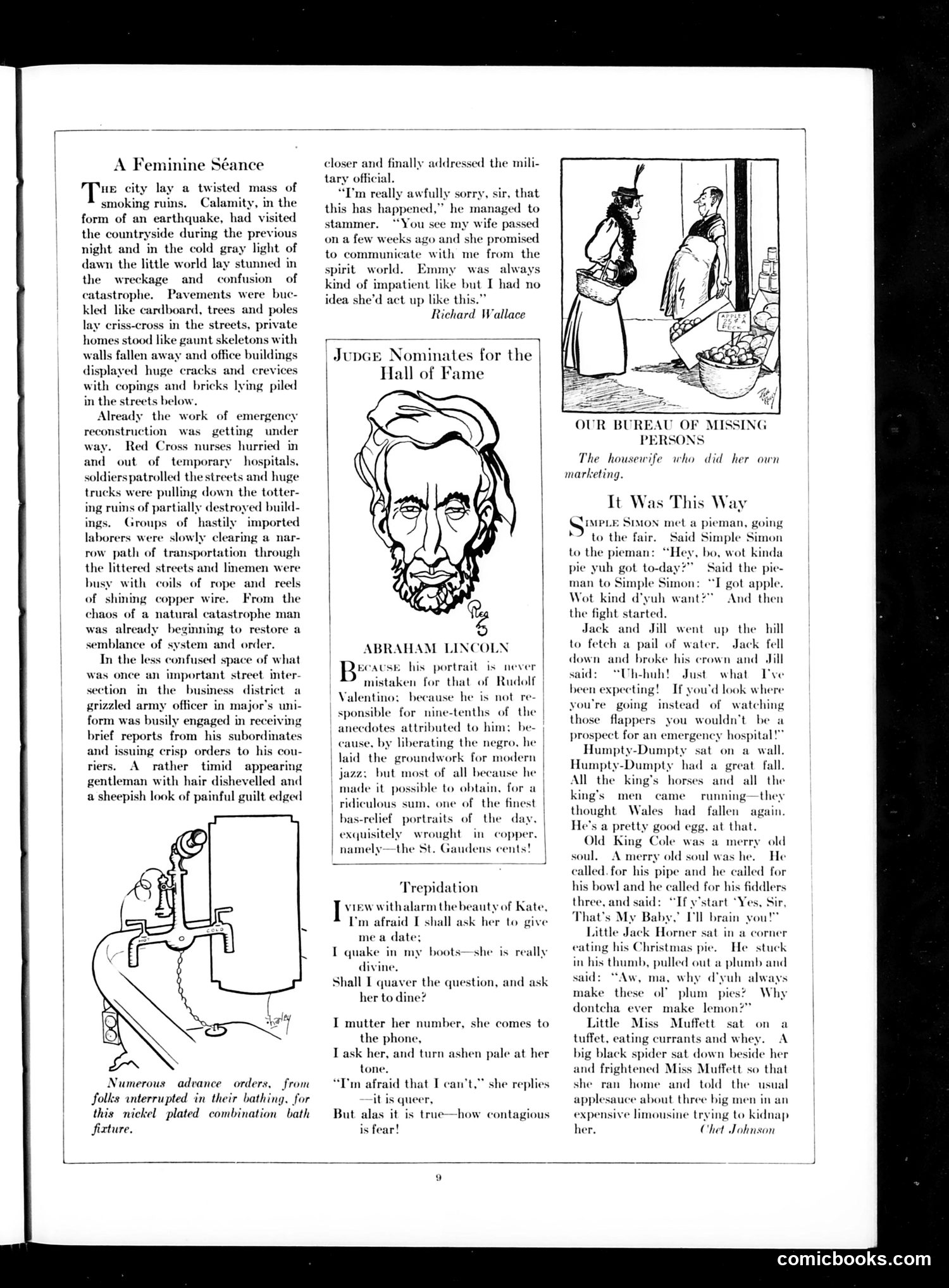
This page contains multiple satirical pieces mocking contemporary concerns: **Main cartoon** ("A Feminine Séance"): A befuddled gentleman apologizes to a military officer for earthquake damage, blaming his deceased wife Emmy—who supposedly promised to contact him from the spirit world but got "impatient" and caused the disaster instead. The joke satirizes both spiritualism fads and hen-pecked husbands, suggesting even death won't stop a nagging wife. **"Judge Nominates for the Hall of Fame"**: A tongue-in-cheek tribute to Lincoln, praising him partly for enabling "modern jazz" through emancipation—likely mocking both jazz criticism and overwrought Lincoln veneration. **Other pieces**: Light humor about dating anxiety, corrupted nursery rhymes with modern commentary (flappers, hospitals), and a missing-persons joke about housewives doing their own marketing—reflecting post-WWI gender anxieties. The overall tone targets spiritualism, changing social mores, and sentimental excess.
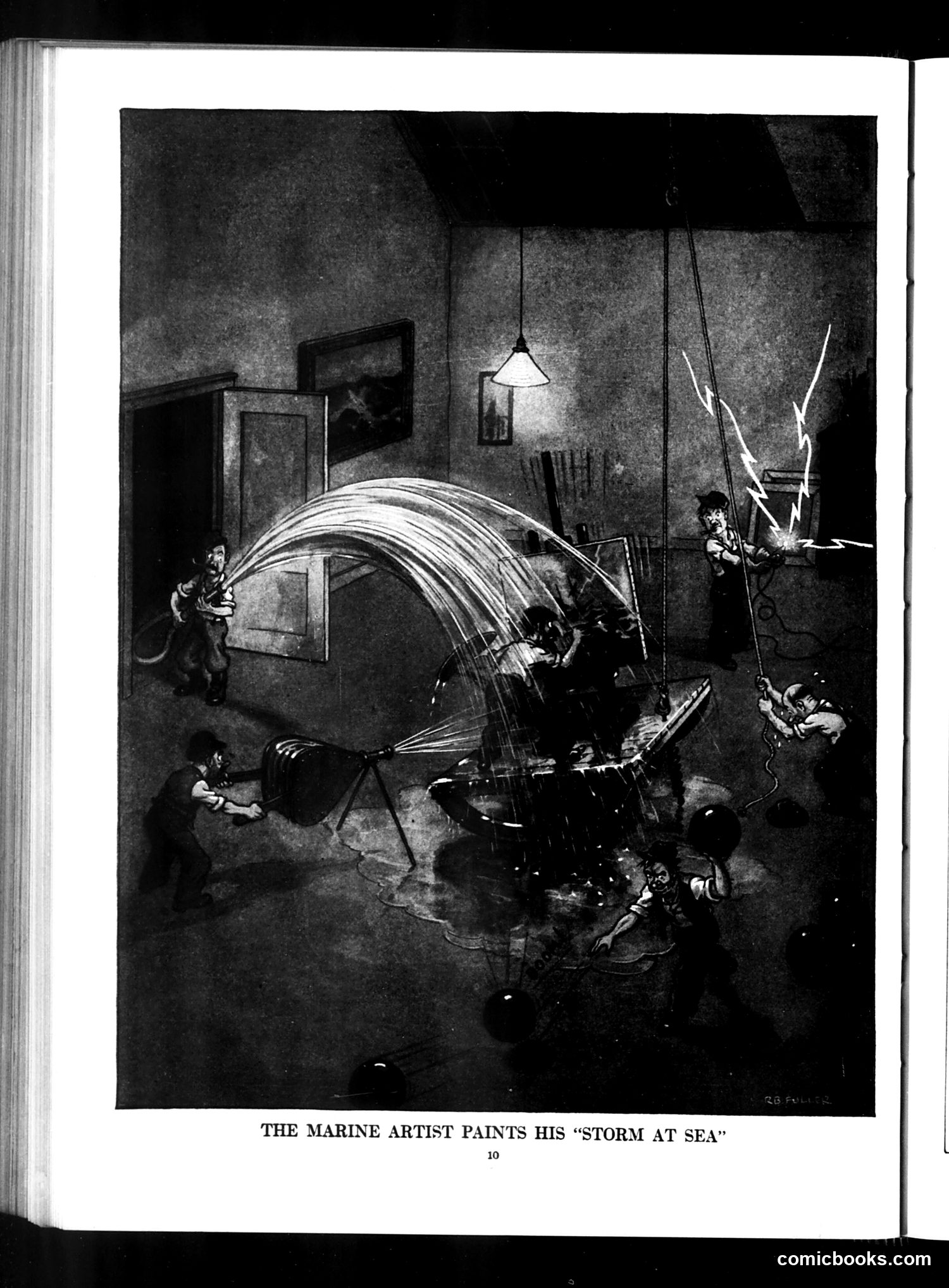
This page shows a theatrical or studio scene titled "THE MARINE ARTIST PAINTS HIS 'STORM AT SEA.'" The image depicts what appears to be a behind-the-scenes satire of how dramatic marine paintings are created. Multiple figures operate mechanical devices that simulate storm conditions—producing wind, water spray, and dramatic lighting effects—while an artist works at an easel in the center, ostensibly painting from this artificial "live" scene. The satire likely mocks either: (1) the artificiality of dramatic romantic art, or (2) the pretension of artists claiming to paint from nature when they actually work from staged recreations. It's a commentary on artistic authenticity or the gap between artistic pretense and actual practice. The OCR text is too corrupted to provide additional context, but the visual joke is clear: the "storm" is an elaborate theatrical production, not genuine nature.
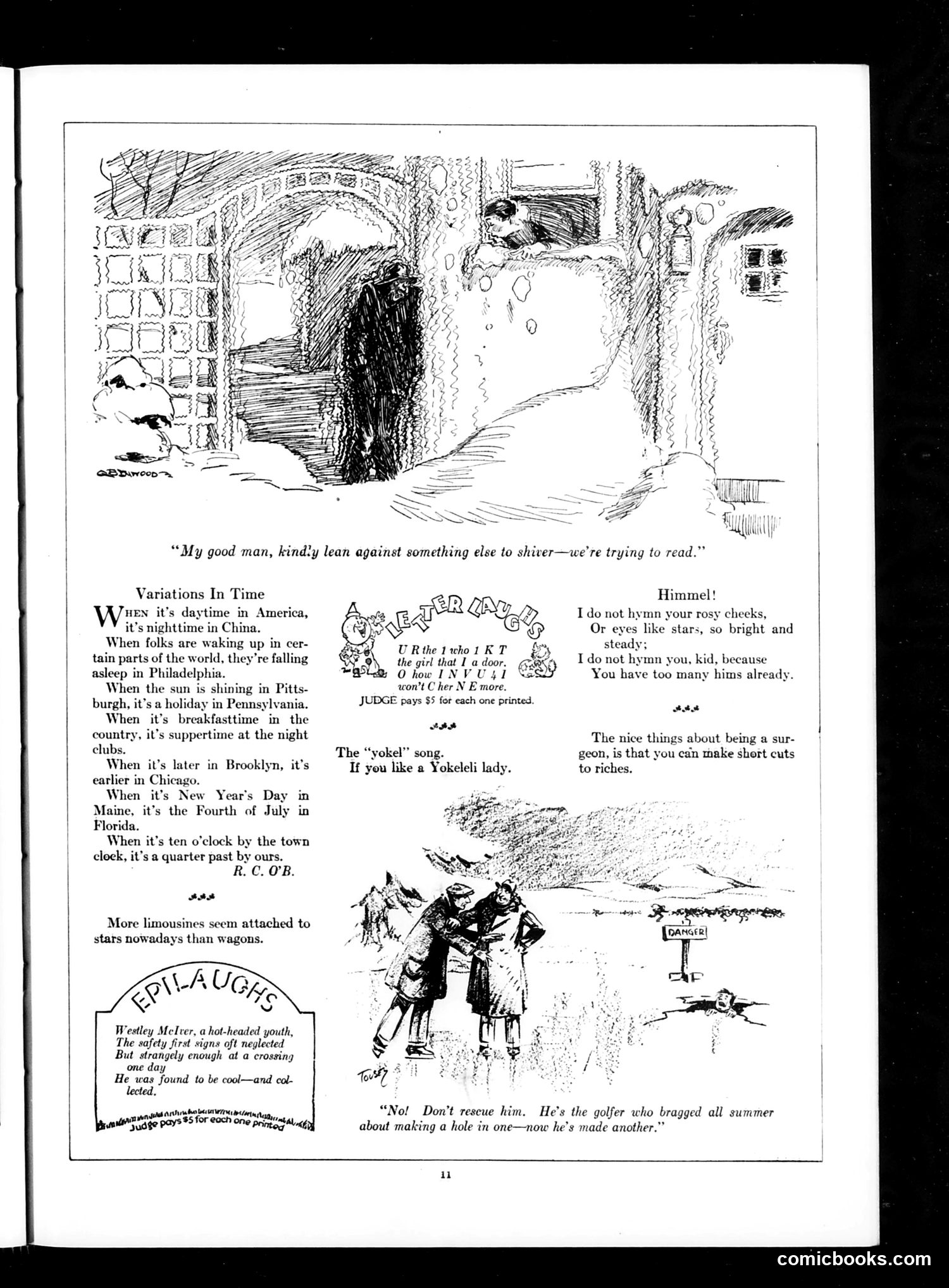
This page contains several brief humorous pieces typical of early-20th-century American satire: **Main cartoon (top):** A shivering person is asked to lean elsewhere so others can read, poking fun at someone's dramatic discomfort interrupting others. **"Variations in Time":** A satirical poem mocking the absurdity of time zones and local variations—how the same moment means different things across locations and contexts. The final line jabs at inaccurate local clocks. **"Epilaughs" section:** Contains a brief, sardonic anecdote about "Westley McIver," a hot-headed youth who ironically remains "cool—and collected" when finally facing real danger at a street crossing. **Bottom cartoon:** Two figures in a dangerous situation (appears to be a mine or quarry marked "DANGER"). One refuses rescue, explaining the man being saved is a braggart golfer who spent all summer boasting about making a hole-in-one; now he's made another—a dark joke about his impending death. The page mixes observational humor with darker comedic sensibilities typical of Judge's satirical style.
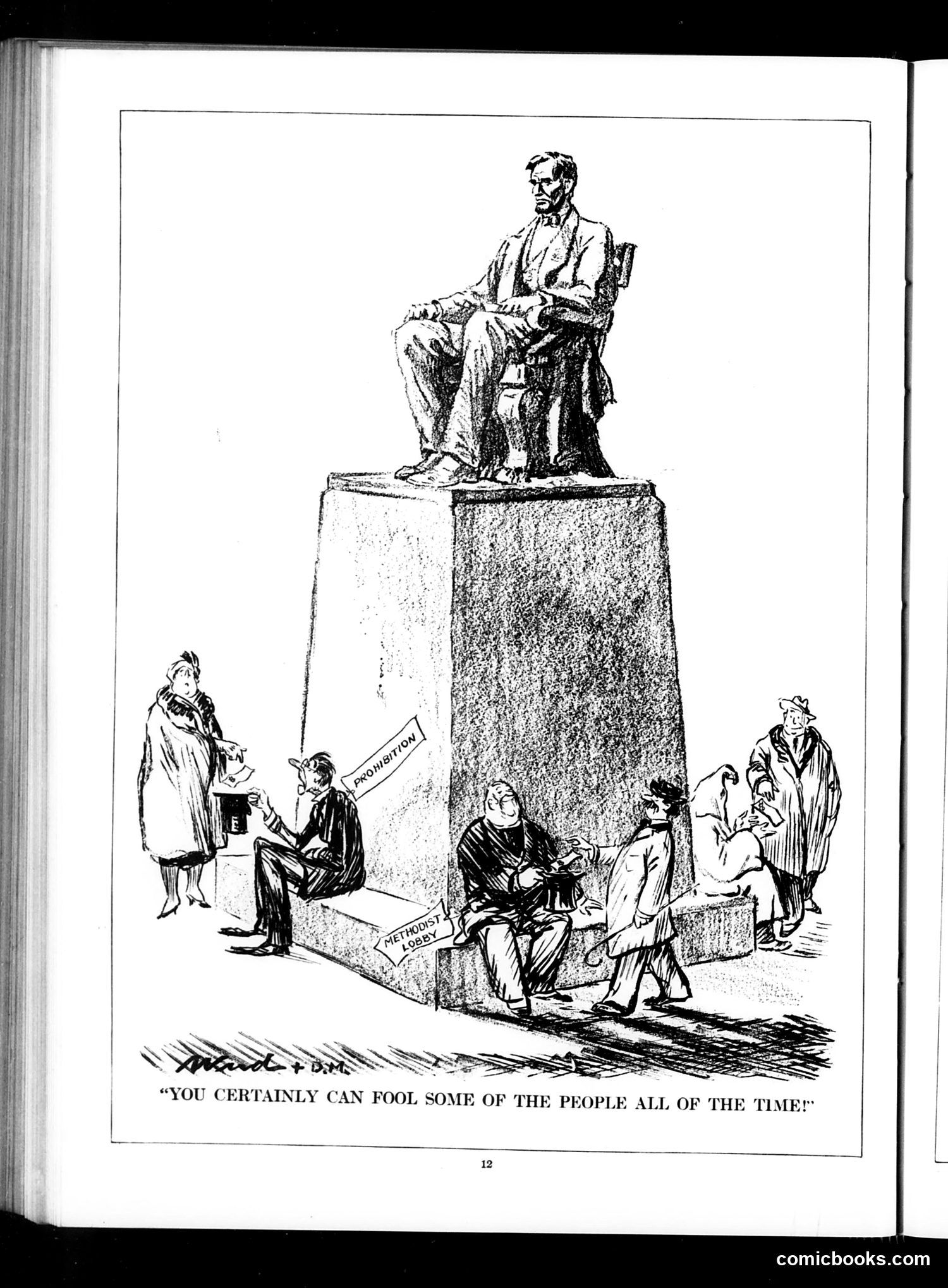
This political cartoon references the famous quote attributed to Abraham Lincoln: "You can fool some of the people all of the time, but you can't fool all of the people all of the time." The cartoon inverts Lincoln's optimistic message into cynical social commentary. A monument-sized statue of what appears to be a public figure sits elevated on a pedestal labeled "PROHIBITION" and "PATRIOTISM." Below, various ordinary citizens—depicted as gullible—appear to revere or accept this monument uncritically. The satire suggests that despite noble ideals (represented by the statue and patriotic labels), the public can be systematically deceived about major policies or figures. The cartoon criticizes how propaganda or public relations can convince citizens to support questionable initiatives, even when those initiatives may not serve their actual interests.
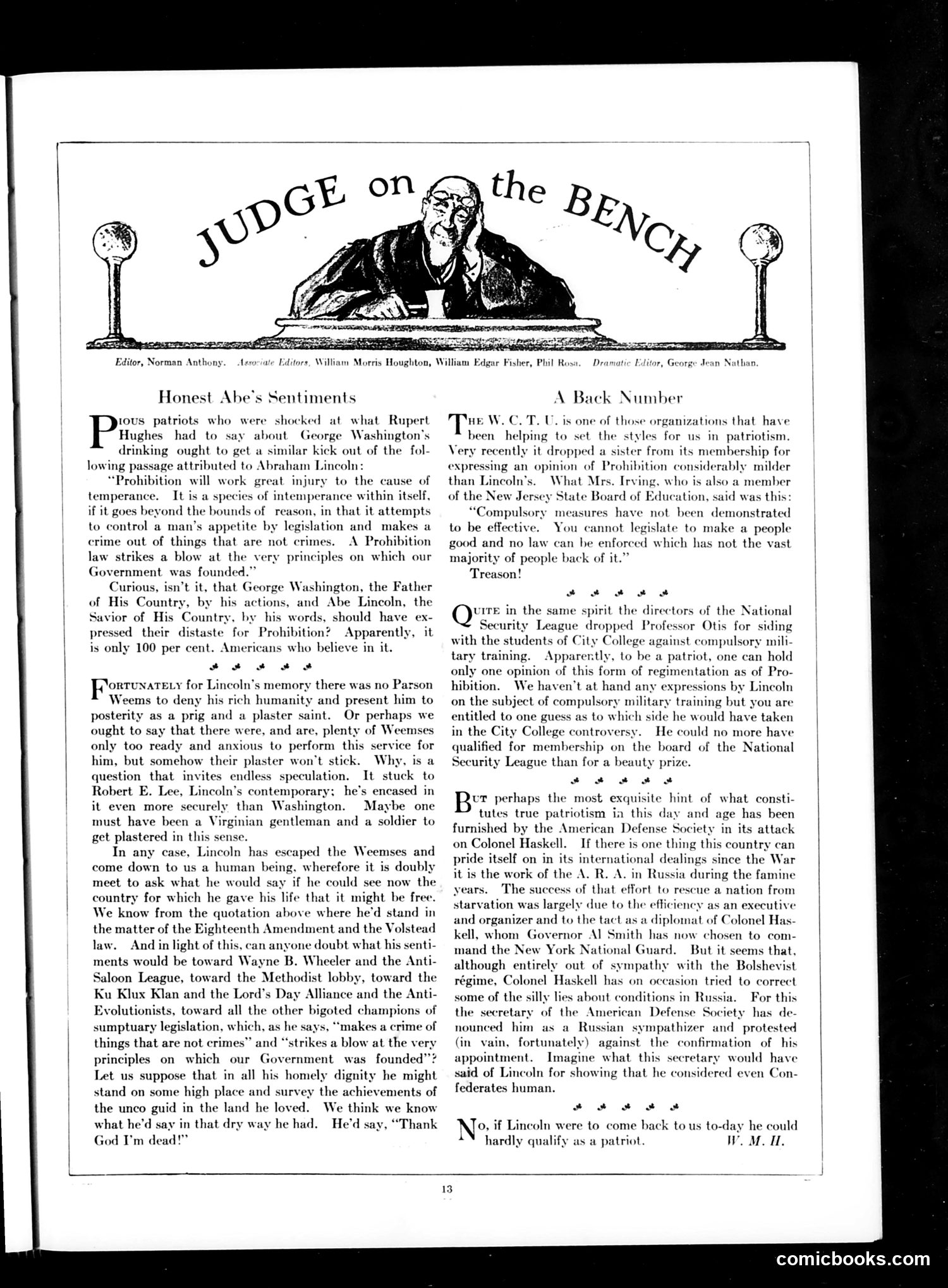
This editorial page attacks what it calls rigid, intolerant patriotic organizations. The masthead shows a stern judge overseeing the content. **"Honest Abe's Sentiments"** attributes an anti-Prohibition quote to Lincoln, arguing that even America's revered founders opposed such moralistic legislation. The author criticizes "Weemses" (referring to Mason Locke Weems, who sanitized George Washington's biography) for creating false, pious versions of historical figures. The piece mocks modern "sumptuary legislation" champions—the Anti-Saloon League, Methodist lobby, Ku Klux Klan, and anti-evolutionists—suggesting Lincoln would despair at their control of the country. **"A Back Number"** criticizes organizations for enforcing ideological conformity. The W.C.T.U. (Women's Christian Temperance Union) expelled a member for mildly questioning Prohibition's effectiveness. Similarly, the National Security League dropped Professor Otis for opposing compulsory military training. The piece argues these groups demand absolute obedience to single opinions, not genuine patriotism. Both pieces attack prohibition-era moral policing and military conscription advocacy as un-American and illiberal.
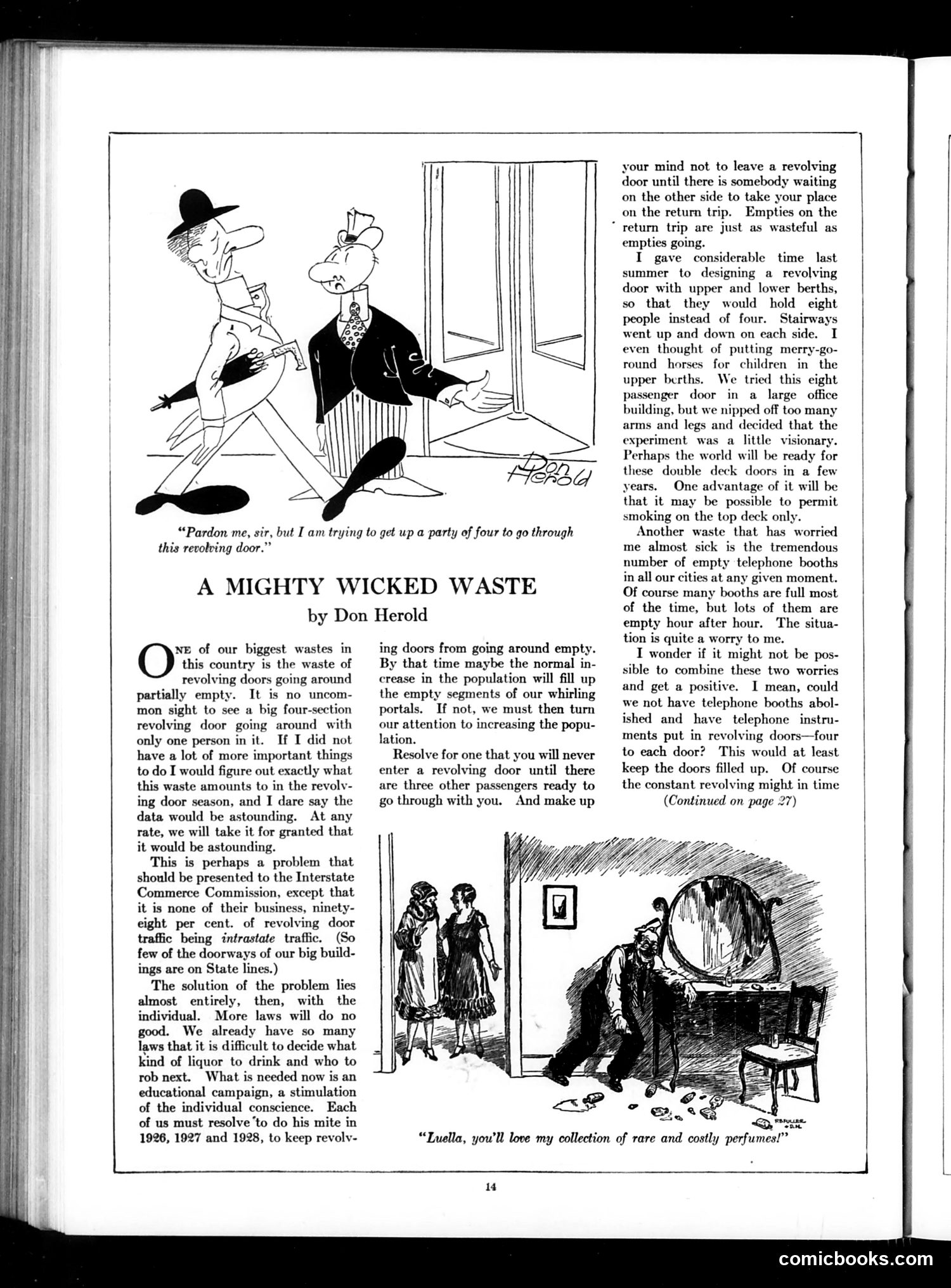
This is a humorous essay-cartoon satirizing American efficiency obsession in the 1920s. The author mock-seriously identifies revolving doors operating with fewer than maximum occupants as a national "waste" requiring an educational campaign and individual conscience-stimulation. The cartoon illustrates the absurdity: a man desperately tries recruiting strangers to fill all four sections of a revolving door before entering—treating the problem as urgent civic duty. Herold extends the satire into increasingly ridiculous proposals: designing double-deck revolving doors with berths and merry-go-round horses for children, combining empty telephone booths with revolving doors to maximize efficiency. The secondary cartoon shows an unrelated scene (possibly about perfume collecting). The satire mocks the era's obsession with eliminating "waste" through rational organization and individual responsibility, treating trivial inefficiencies with overwrought seriousness. This reflects 1920s Progressivism and efficiency movements that attempted to optimize every aspect of modern life.
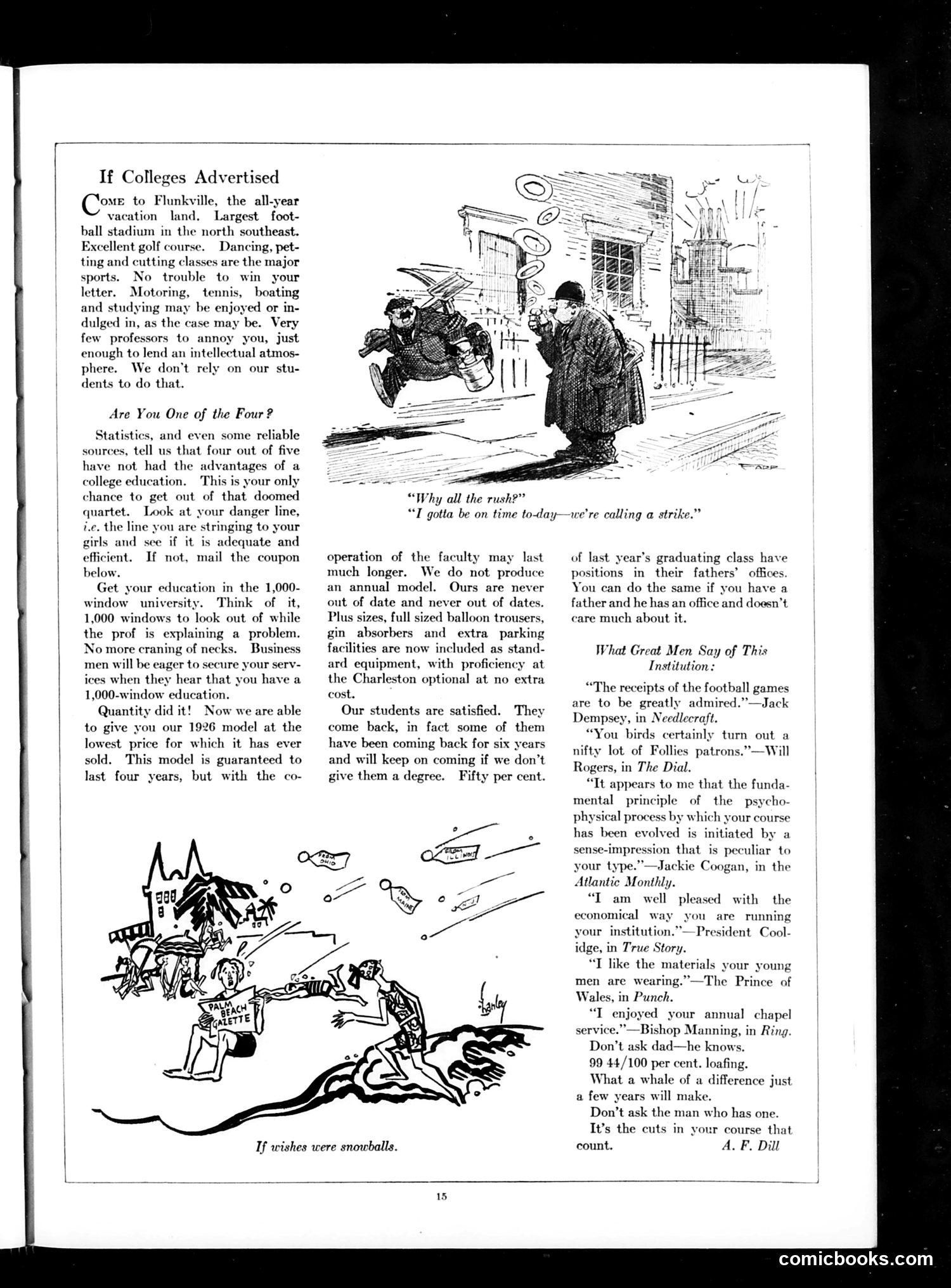
This page satirizes American colleges circa 1926 by imagining how they'd market themselves if they advertised honestly. The fictional "Flunkville" boasts a massive football stadium, golf course, and encourages "petting and cutting classes" as major activities—mocking colleges' actual priorities. The satire targets several contemporary issues: colleges emphasizing athletics and social life over academics; professors as mere window-dressing; the prestige of simply attending a large institution ("1,000-window university"); and the absurdity that graduates often end up in cushy nepotistic jobs in their fathers' offices rather than earning real positions. The bottom cartoon, "If wishes were snowballs," depicts chaos—suggesting colleges are fundamentally chaotic or mismanaged. The fake endorsements from celebrities (Dempsey, Rogers, Coolidge) mock celebrity culture and the gap between public rhetoric and institutional reality. The closing line—"It's the cuts in your course that count"—reinforces that what matters is attendance, not learning.
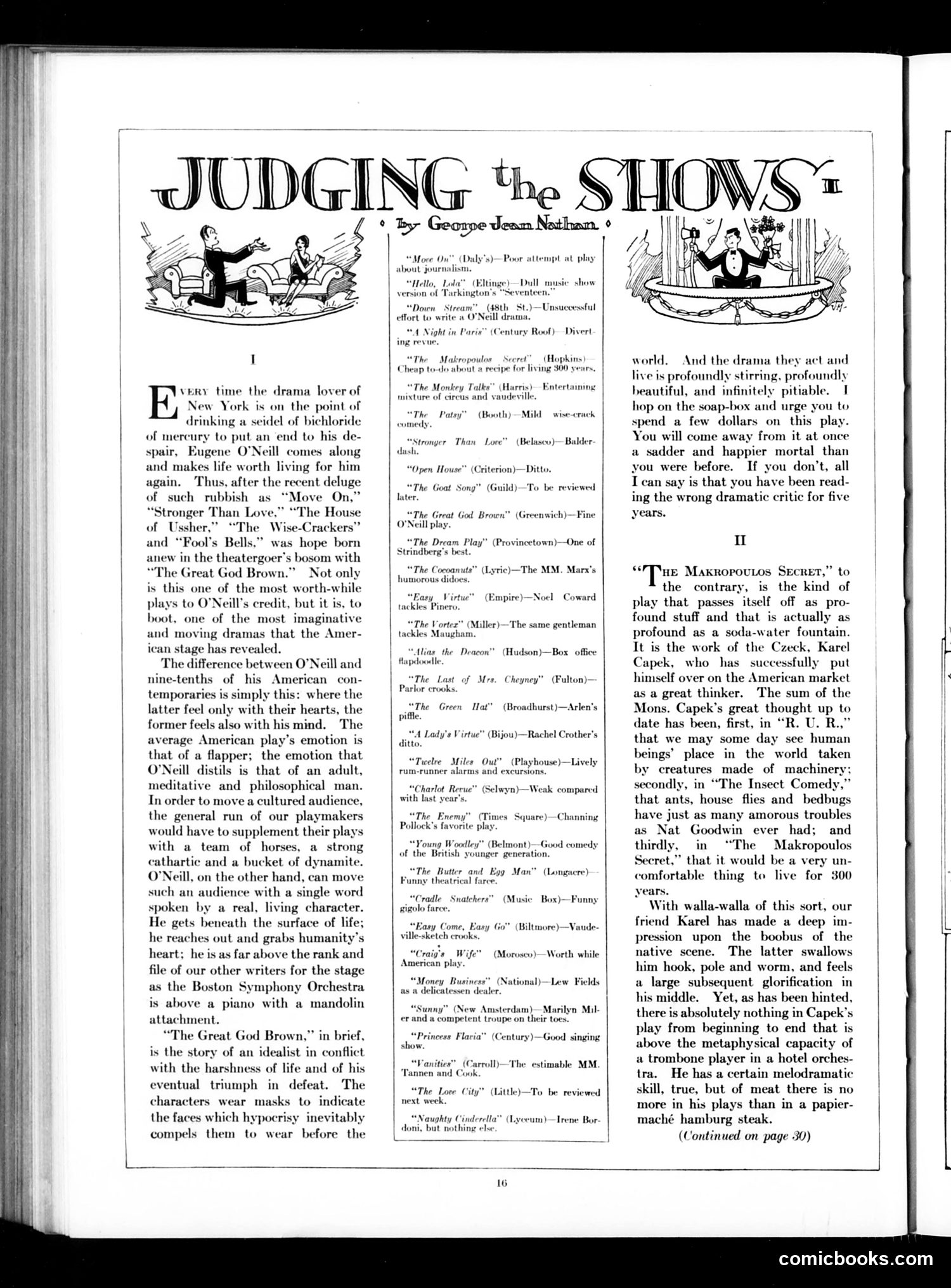
This page is a theater review column by George Jean Nathan, a prominent drama critic of the 1920s. The text praises Eugene O'Neill's *The Great God Brown* as superior to the mediocre plays currently cluttering Broadway. Nathan contrasts O'Neill with his contemporaries: while most American playwrights appeal to audiences emotionally (like "a flapper"), O'Neill engages the intellect of cultured, adult audiences. The satire criticizes the low quality of contemporary theater—most plays require "a team of horses, a strong cathartic and a bucket of dynamite" to move audiences, while O'Neill needs only "a single word spoken by a real, living character." The accompanying list reviews current Broadway productions, dismissing most as "rubbish," "piffle," "flapdoodle," or "dull." This reflects 1920s theater criticism's contempt for commercial entertainment versus serious dramatic art.
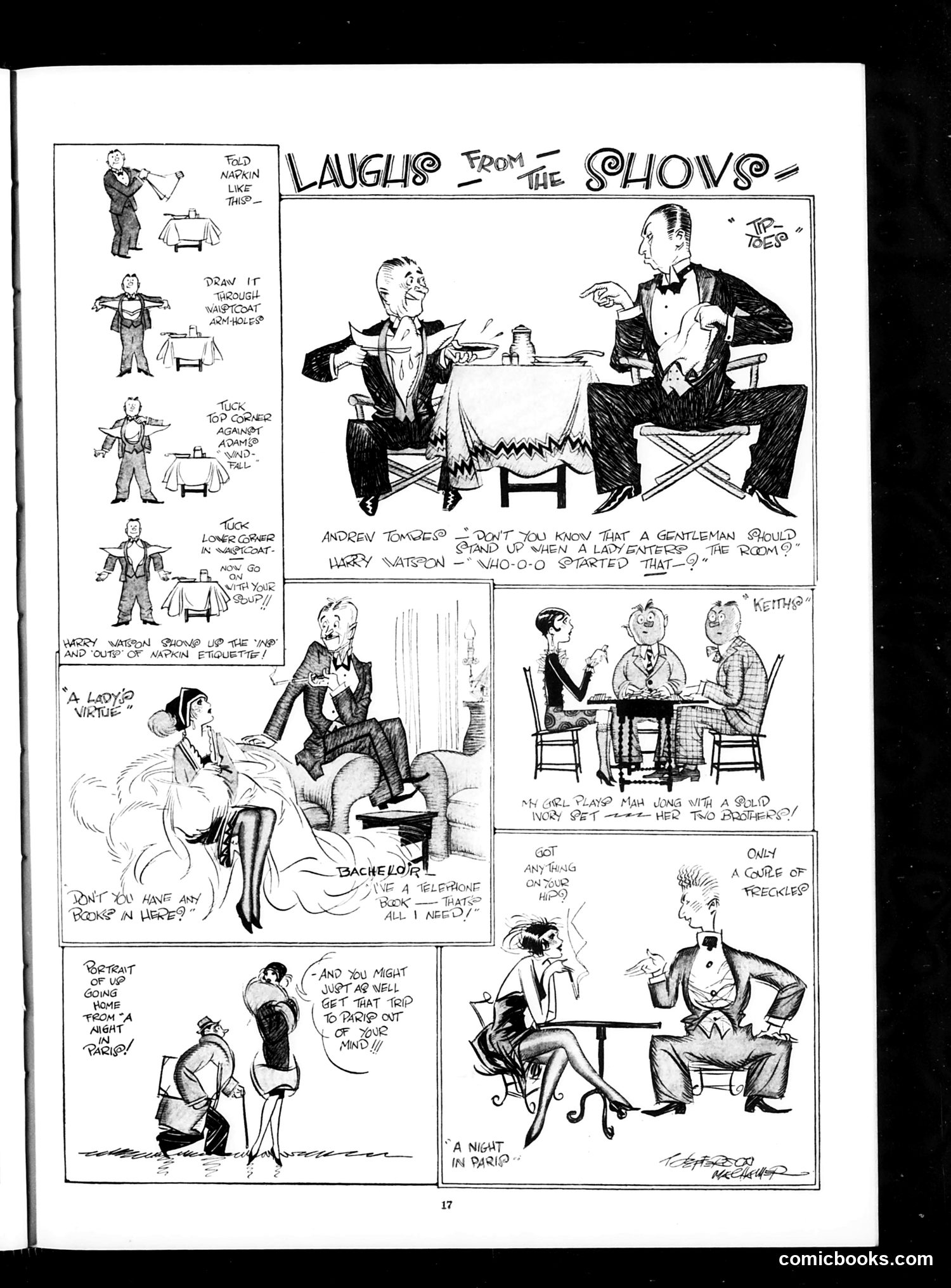
This page collects comedic vignettes satirizing early 20th-century social etiquette and manners, presented as theatrical sketches. The humor centers on violations of proper conduct: **Top section**: A gentleman instructs another on napkin folding and standing when ladies enter—basic etiquette rules. The joke turns on Harry Watson's apparent ignorance ("who started that?"), suggesting even supposedly cultured men don't know basic manners. **Middle panels**: Show various social transgressions—a man in financial desperation seeking a "telephone book" for funds; a woman playing mahjong with "ivory set" and "two brothers" (implying impropriety); and a "night in Paris" scenario suggesting questionable conduct. **Bottom left**: A man begs money from another while disheveled, hoping to avoid "a night in parlor" (domestic strife). The overall satire mocks how rigidly enforced yet poorly understood social conventions were, and how easily "respectable" people could violate them while remaining oblivious—a running Judge magazine theme about class pretension.
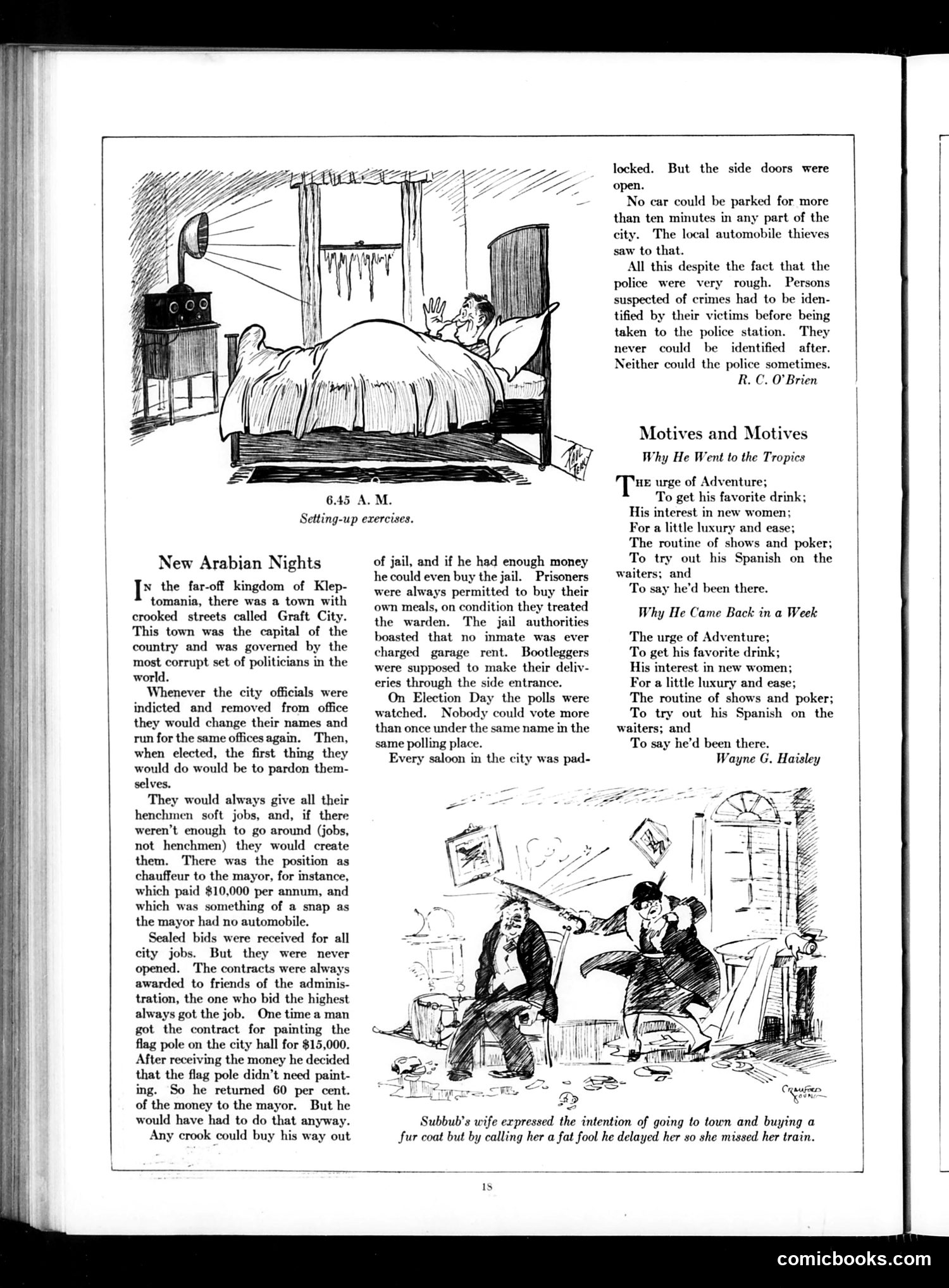
**"New Arabian Nights"** is a satirical story about "Graft City," a fictional corrupt municipality. It mocks American urban political corruption: officials indicted for crimes simply change names and run again; they pardon themselves; create fake high-paying jobs (like a $10,000 chauffeur position for a mayor without a car); award contracts to friends without opening bids; permit prisoners to buy their way out of jail; and allow bootleggers side-door access despite Prohibition-era saloon "padlocking." The humor relies on absurdist exaggeration—automobile thieves enforce parking limits; police are rough yet ineffective—to satirize systemic corruption where everything is for sale. **"Motives and Motives"** is a brief joke contrasting why someone travels to the tropics versus why he quickly returns: identical reasons (adventure, drinking, women, gambling), suggesting tropical getaways are ultimately disappointing. **The bottom cartoon** mocks domestic gender dynamics: a husband delays his wife's shopping trip by insulting her appearance, causing her to miss her train—presented as clever manipulation.
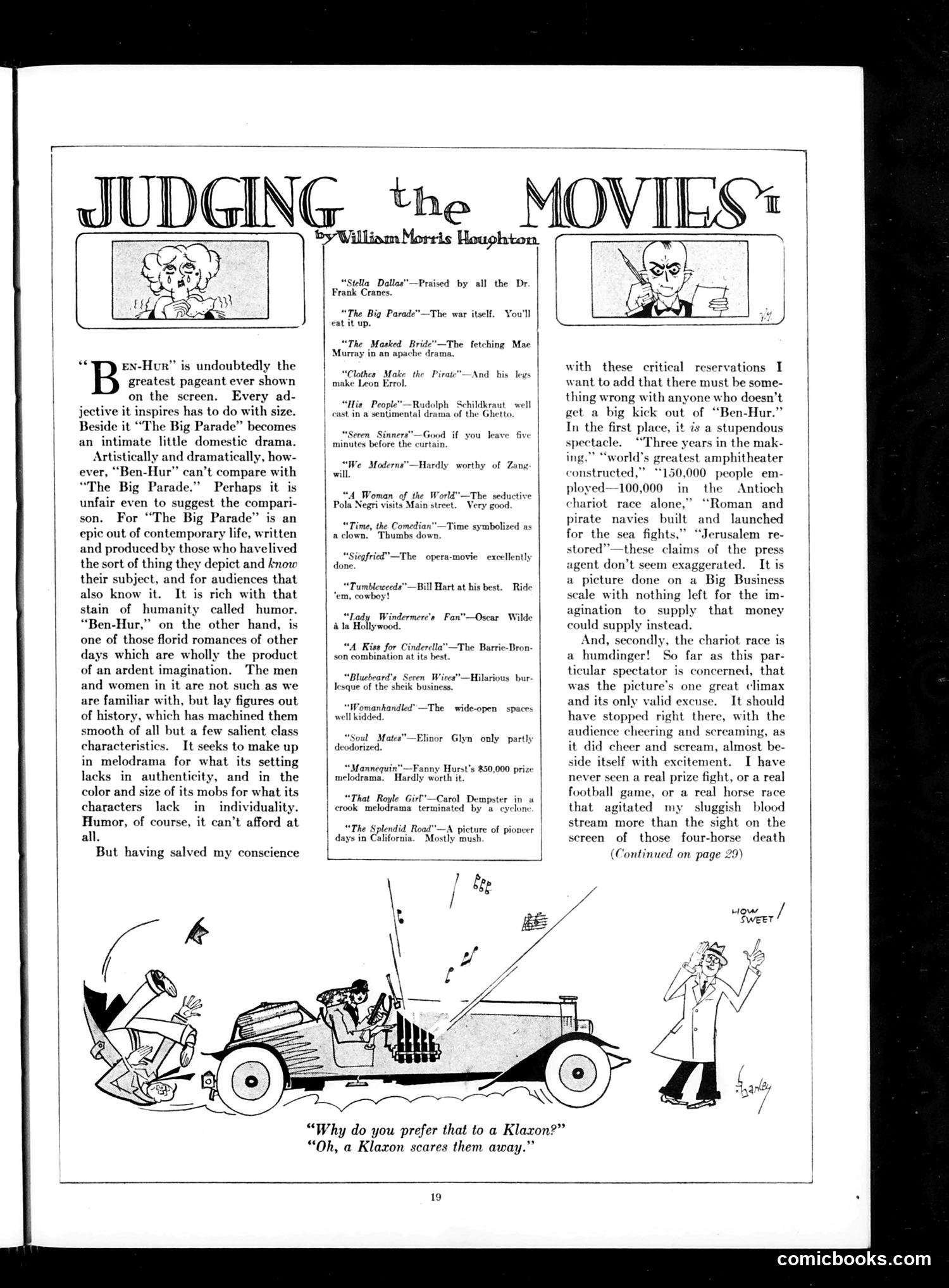
This page reviews contemporary films, comparing the epic "Ben-Hur" (a massive production with 150,000 extras) favorably to "The Big Parade" on spectacle, though praising the latter's artistic merit and human authenticity. The main cartoon jokes about a Klaxon horn (an early automobile alarm device): when asked why someone prefers a Klaxon to something else, they reply "a Klaxon scares them away"—likely mocking the noise pollution and public annoyance caused by these horns, which were becoming common urban nuisances in the 1920s. The film reviews mock various movies with brief, witty judgments: praising some ("The Big Parade"), dismissing others as derivative or overly sentimental ("Stella Dallas," "Mannequin"). The critic acknowledges "Ben-Hur's" stunning chariot race sequence while criticizing the film's lack of humor and authentic characterization compared to contemporary dramas.
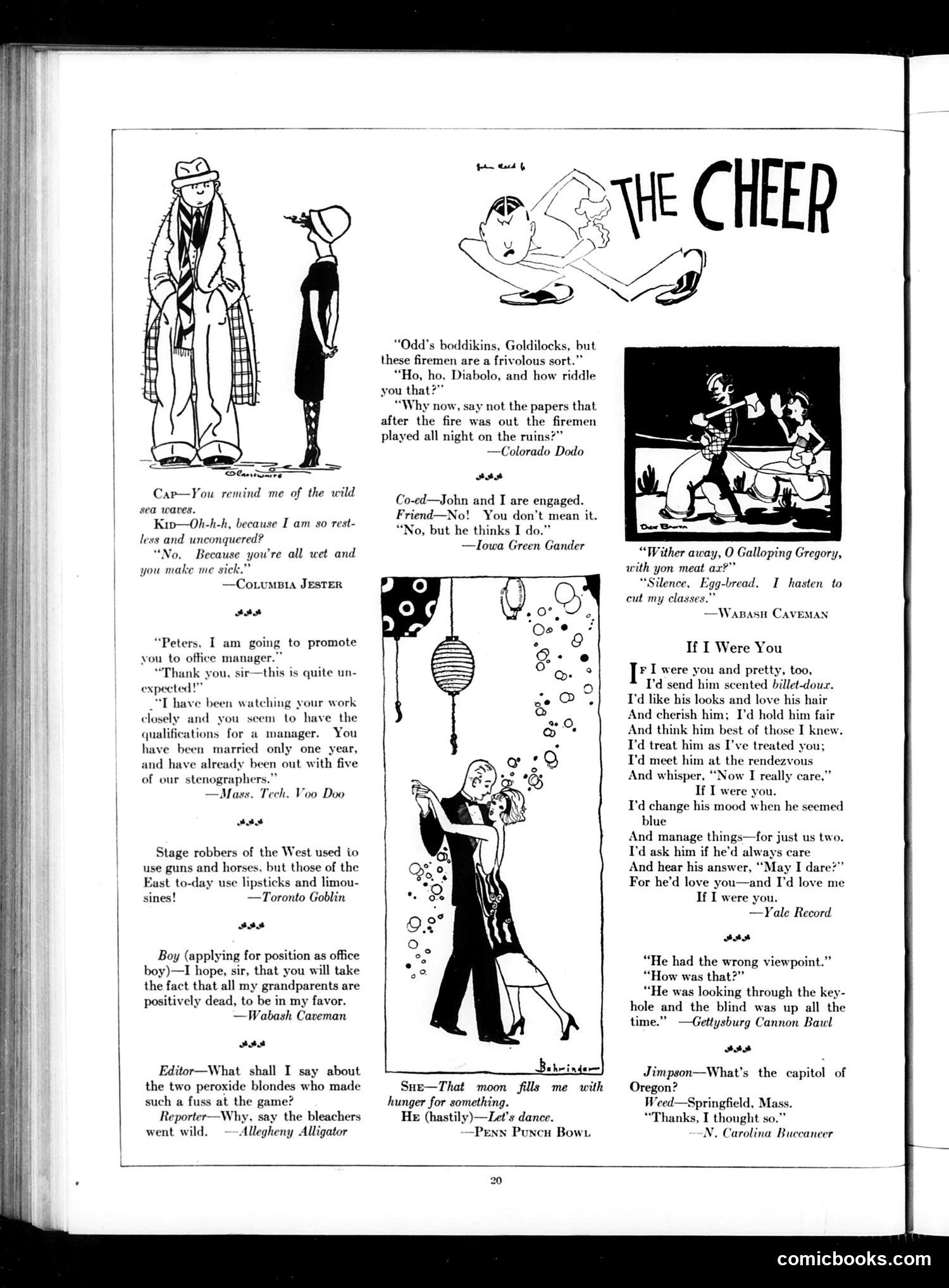
This page compiles humorous short jokes and verses from various college publications, reflecting early 20th-century campus humor. **Key content:** The jokes satirize **office romance and workplace dynamics**: a manager promoting a newly-married man who's already been out with five stenographers (suggesting infidelity); a co-ed claiming engagement when her boyfriend merely thinks they're engaged (female duplicity). **Social commentary** appears in contrasts between old and new crime: Western stage robbers used guns; Eastern criminals now use lipstick and limousines (mocking modern urban sophistication and women's influence). **The featured poem "If I Were You"** explores romantic jealousy—a speaker would seduce another woman's suitor if given the chance, revealing period anxieties about female fidelity and romantic betrayal. Minor jokes mock **blonde women** (peroxide references), **pretentious behavior** (the archaic "Odd's boddikins" dialogue), and typical collegiate absurdities. The overall tone is lighthearted but reflects gender tensions and social anxieties typical of early 1900s college culture.
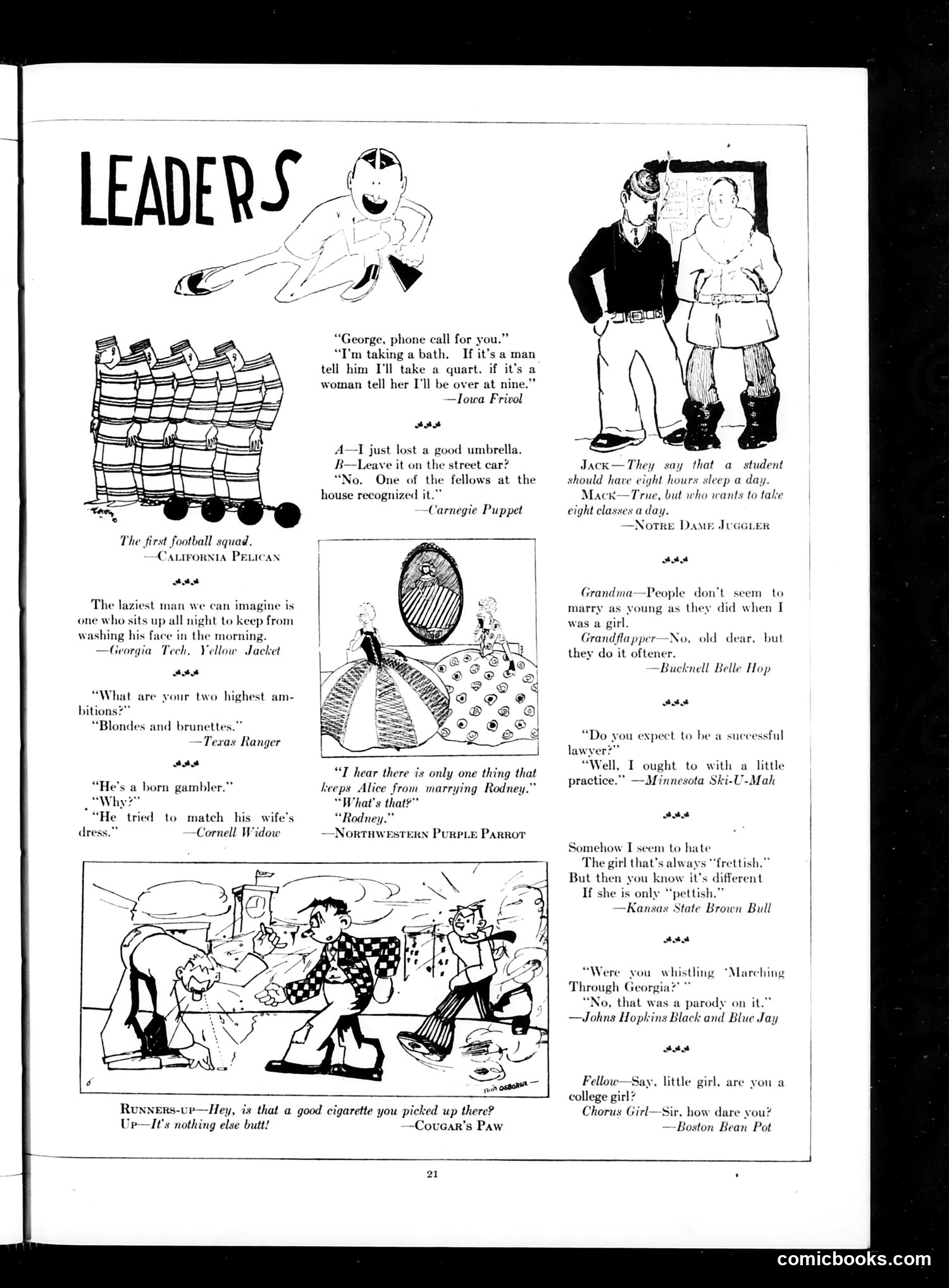
This page collects humorous one-liners and jokes from college humor magazines, attributed to various universities (Iowa, Cornell, Texas, Minnesota, etc.). The satire targets college life and social conventions of the era. Key jokes involve: bathing etiquette, gender dynamics (men wanting liquor vs. women wanting romantic attention), academic complaints (eight classes vs. eight hours sleep), changing courtship customs ("they do it oftener" than marrying young), and generational shifts. The cartoon at bottom depicts a chaotic party scene, mocking collegial excess and bad manners (picking up cigarettes from the floor). The "Leaders" header with football imagery suggests these represent the wit of campus leaders and tastemakers. The humor reflects Jazz Age anxieties: changing sexual mores, the "flapper" phenomenon, and perceived moral decline among youth—presented as amusing rather than genuinely alarming.
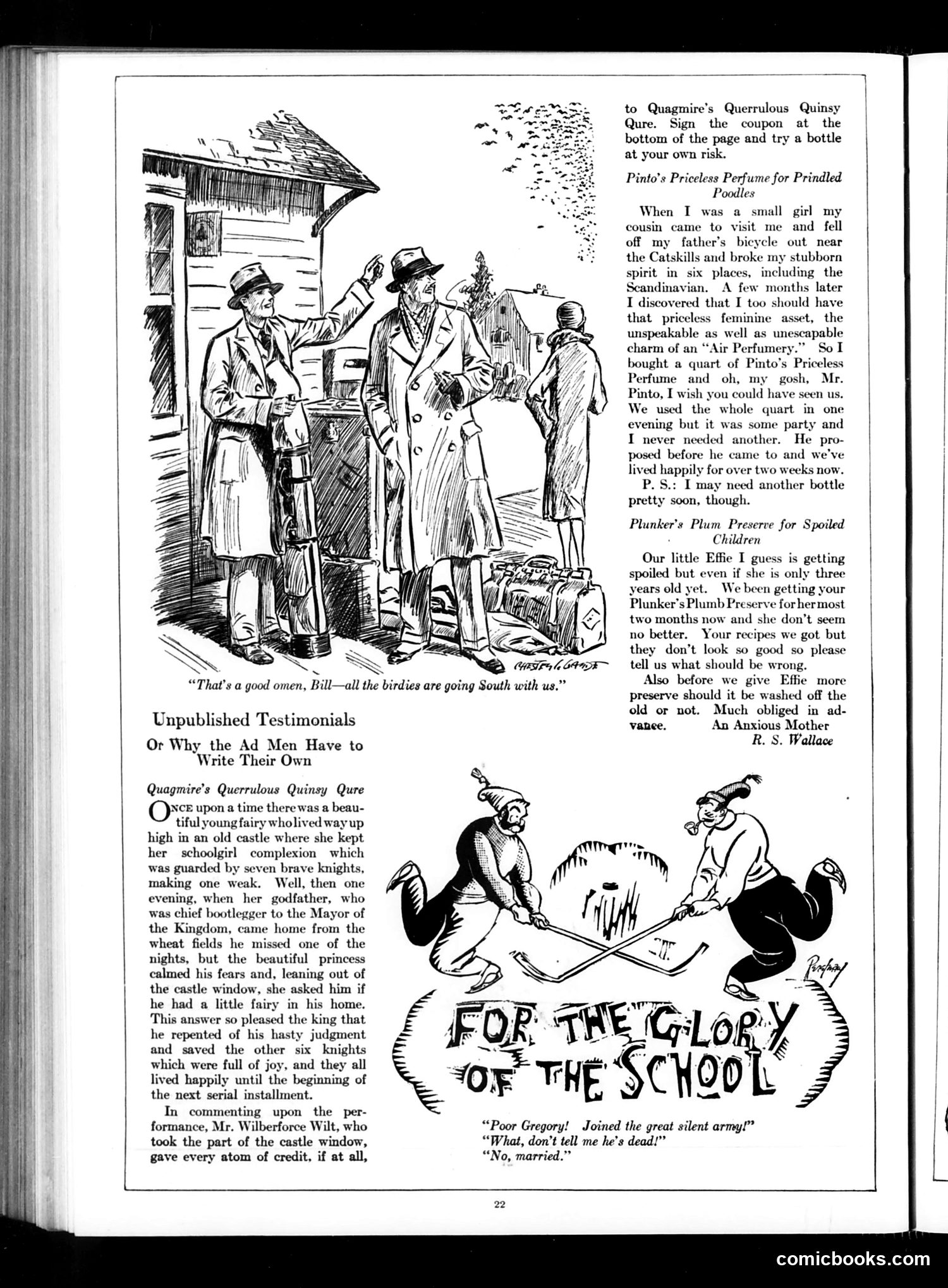
This page satirizes fake product testimonials—a common advertising practice then and now. The main section mocks how advertisers fabricate endorsements by presenting absurdly exaggerated, obviously fictional "customer letters" praising nonsense products like "Pinto's Priceless Perfume for Poodles" and "Plunker's Plum Preserve for Spoiled Children." The fairy-tale parody ("Quagmire's Querrulous Quinsy Qure") ridicules how testimonials use contrived narratives to sell dubious remedies. The misspellings and grammatical errors in the fake letters suggest they're written by ad agencies pretending to be ordinary customers—hence the title explaining why ad men "have to write their own" testimonials. The cartoons above reinforce this: the men discussing departing "birdies" (likely WWI soldiers) and the final joke about marriage as a "great silent army" show typical Judge humor—cynical, wry commentary on contemporary life using visual wit.
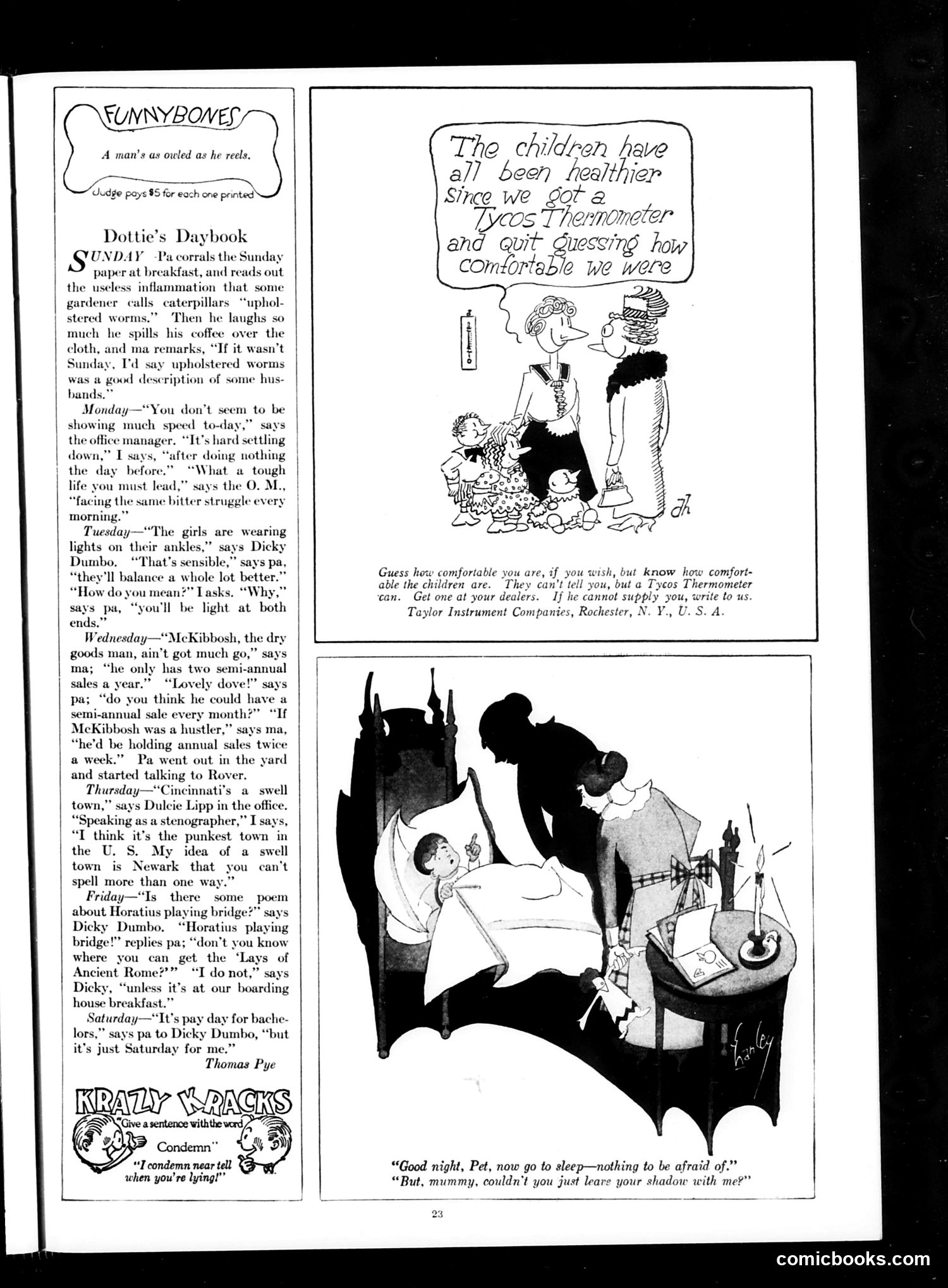
This page contains two distinct elements: **"Dottie's Daybook"** (left): A humorous weekly diary by Thomas Pye recounting domestic observations and puns. The humor relies on wordplay (upholstered worms as a description of lazy husbands) and gentle marital ribbing typical of early 20th-century domestic comedy. **Taylor Instrument Companies Advertisement** (top right): A commercial for Tycos Thermometers featuring a family scene. The ad uses a child's concern about nighttime fears to pitch the thermometer as a practical solution for monitoring children's health, suggesting it provides parental peace of mind. **Cartoon** (bottom): A silhouetted bedtime scene where a child asks his mother to leave her shadow for comfort. It's gentle humor about childhood anxiety and parental reassurance—unrelated to the advertisement above it. The page demonstrates how Judge mixed humor columns, advertisements, and single-panel cartoons to appeal to middle-class readers with relatable domestic scenarios and consumer products.
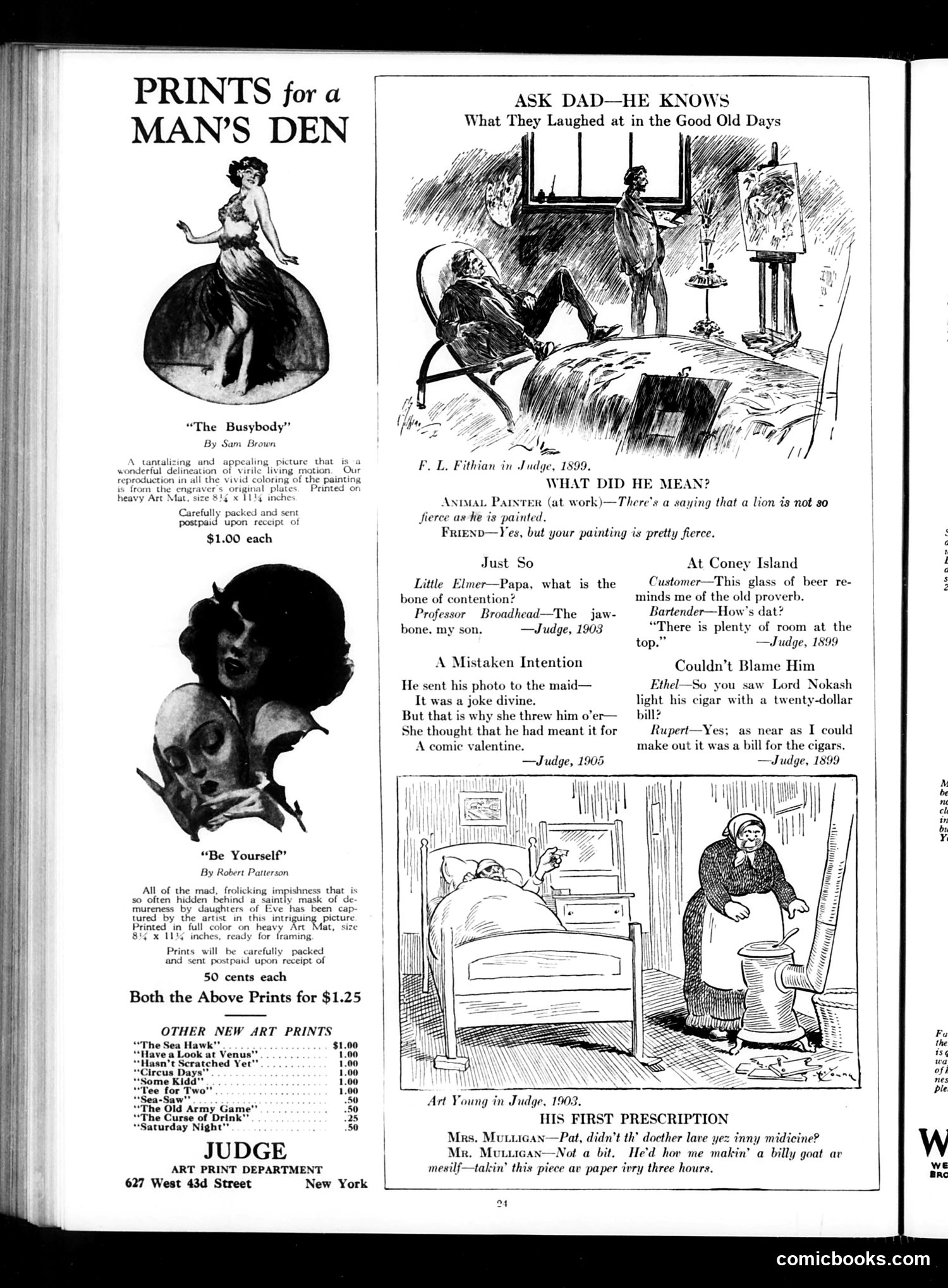
This page from *Judge* magazine showcases humorous cartoons and print advertisements typical of early 1900s American satire. **Main Content:** The centerpiece cartoon "Ask Dad—He Knows" depicts nostalgic humor about "the good old days," a common *Judge* theme. Below are several brief comedic exchanges—"Just So," "A Mistaken Intention," "At Coney Island," and "Couldn't Blame Him"—featuring wordplay and misunderstandings (a father's anatomical joke, a maid misinterpreting a photo, beer proverbs, expensive cigars). **"His First Prescription"** shows an Irish immigrant character (indicated by dialect: "th' docther," "mesilf") receiving a humorous prescription—walking around with a piece of paper three hours at a time instead of taking medicine. This satirizes both folk medicine skepticism and possibly immigrant stereotypes. **Art Prints for Sale:** The left side advertises decorative prints ("The Busybody" and "Be Yourself") for home decoration, typical of the era's commercial art market. The humor relies on puns, class observations (Coney Island, Lord Nokash's wealth), and ethnic caricature—elements that defined *Judge*'s satirical approach.
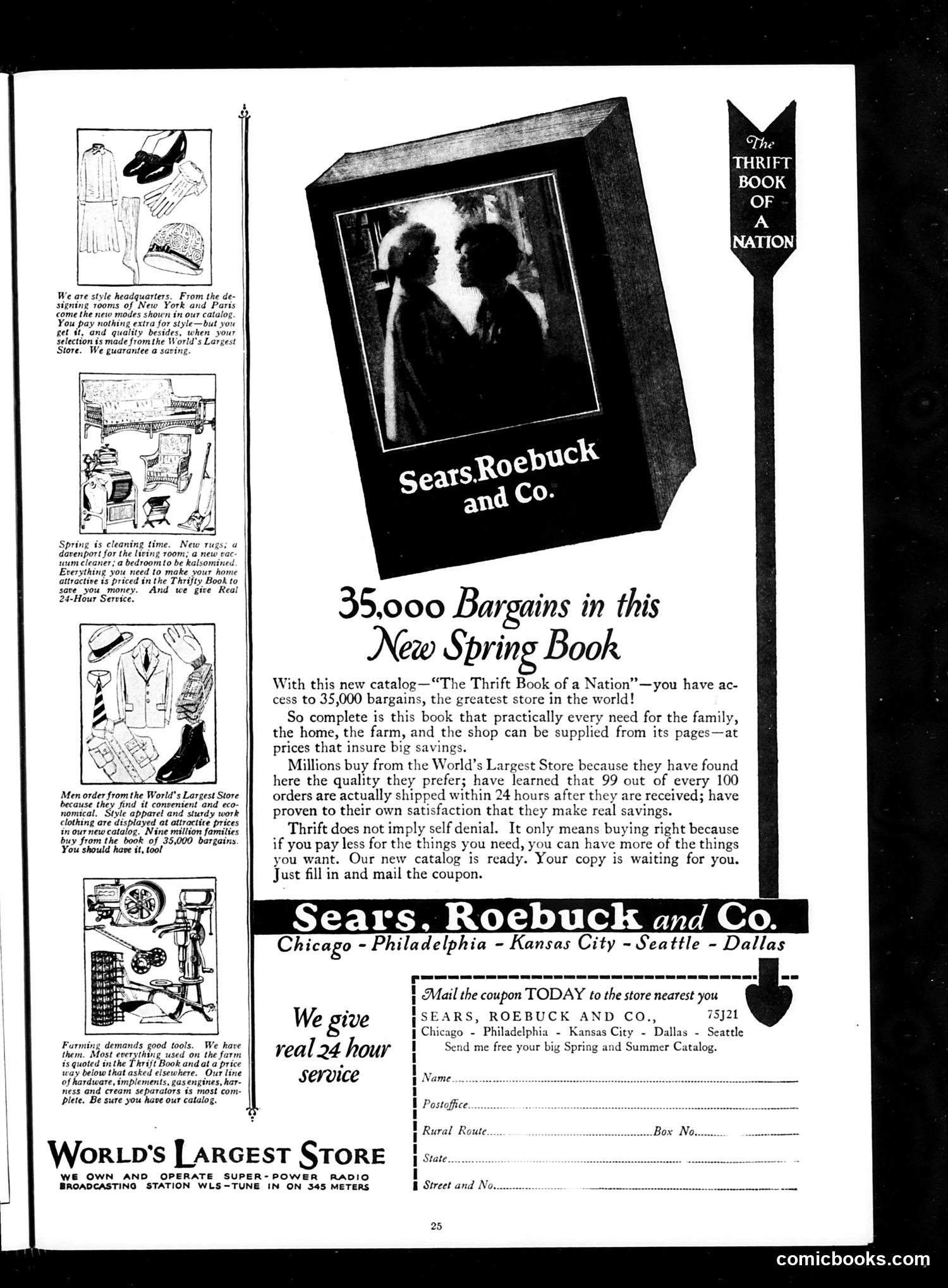
This page is **not a political cartoon or satire**—it's a full-page advertisement for Sears, Roebuck and Co.'s spring catalog, titled "The Thrift Book of a Nation." The ad promotes Sears as the "World's Largest Store," emphasizing: - **35,000 bargains** accessible through their mail-order catalog - **Convenience and savings** for families, farms, and businesses - **Fast service**: orders shipped within 24 hours - **Style and quality** imported from New York and Paris - **Radio broadcasting**: Sears owned station WLS The small illustrations on the left show various consumer goods (clothing, furniture, farm tools, household items) available through the catalog. The central image depicts two silhouetted figures examining merchandise. The "thrift" messaging reflects post-WWI American consumer culture and mail-order retail's democratization of shopping—making urban fashions and goods accessible to rural America. This appears to be from Judge magazine's advertising section rather than its editorial content.
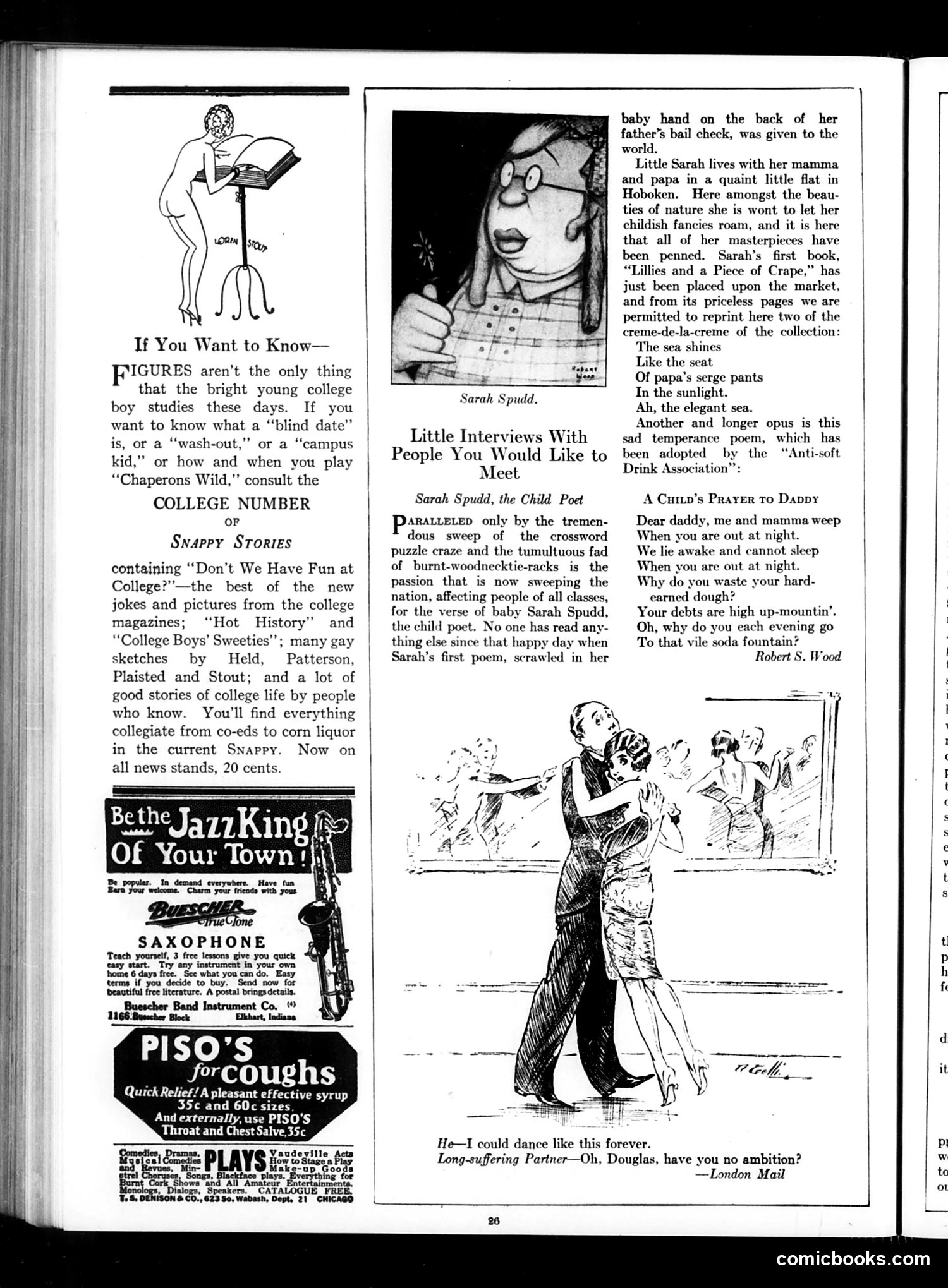
This page satirizes **1920s fads and youth culture** through multiple pieces: **"Sarah Spudd, the Child Poet"** mocks the era's obsession with child prodigies and modernist poetry. Sarah's published verses are deliberately absurd—comparing the sea to "the seat / Of papa's serge pants"—satirizing both pretentious "artistic" work and adults' gullible enthusiasm for mediocre children's writing. The temperance poem about wasting money at soda fountains is equally ridiculous, poking fun at both moral crusades and overwrought sentimentality. The cartoon below shows a couple dancing, with the woman sarcastically asking if the man has "no ambition," mocking the era's obsession with dance crazes and leisure activities while neglecting serious pursuits. The left column advertises *Snappy Stories* magazine, promoting college humor and slang ("blind date," "wash-out"), capturing Judge's audience interest in youth culture. Overall, the page gently ridicules 1920s crazes—child celebrities, poetry fads, crossword puzzles, and the dancing craze—treating them as passing absurdities typical of the era.
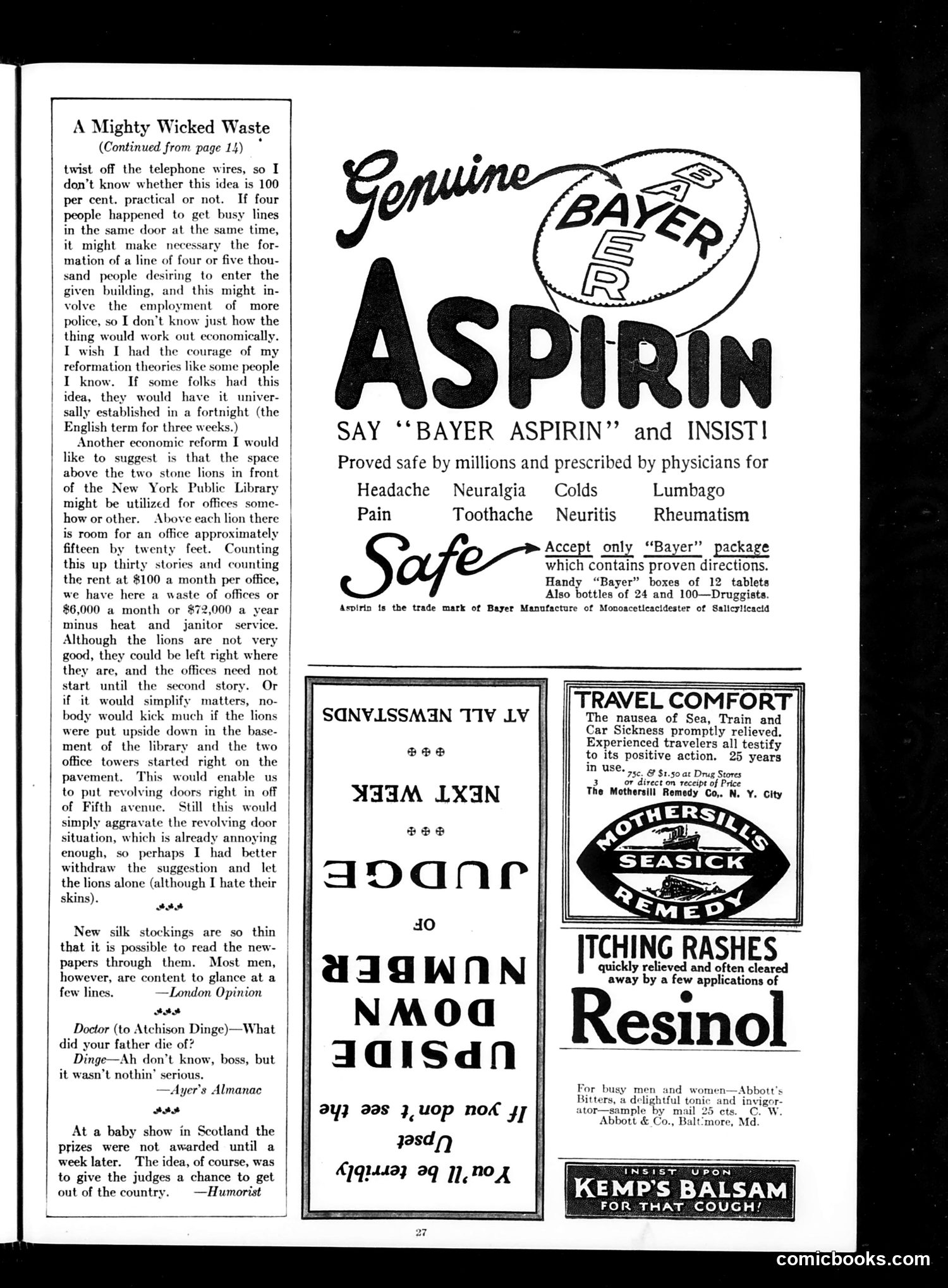
This page is primarily **advertising**, not political satire. The main content is a full-page Bayer Aspirin advertisement emphasizing brand loyalty ("SAY 'BAYER ASPIRIN' and INSIST!"), alongside smaller ads for patent medicines (Travel Comfort for motion sickness, Mothersill's Seasickness Remedy, Resinol for rashes, Kemp's Balsam for coughs). The left column contains a humorous essay titled "A Mighty Wicked Waste," satirizing urban inefficiency. The author proposes absurd reforms: adding office space above the New York Public Library's stone lions and replacing revolving doors with revolving doors—recognizing his own suggestion would worsen the existing problem. The bottom includes brief jokes, including a racist dialect joke about an African American character's father's death. **Context for today**: This reflects early-20th-century America's trust in brand-name pharmaceuticals and acceptance of racist humor in mainstream publications. The advertising dominance shows how commercial interests shaped editorial content in magazines.
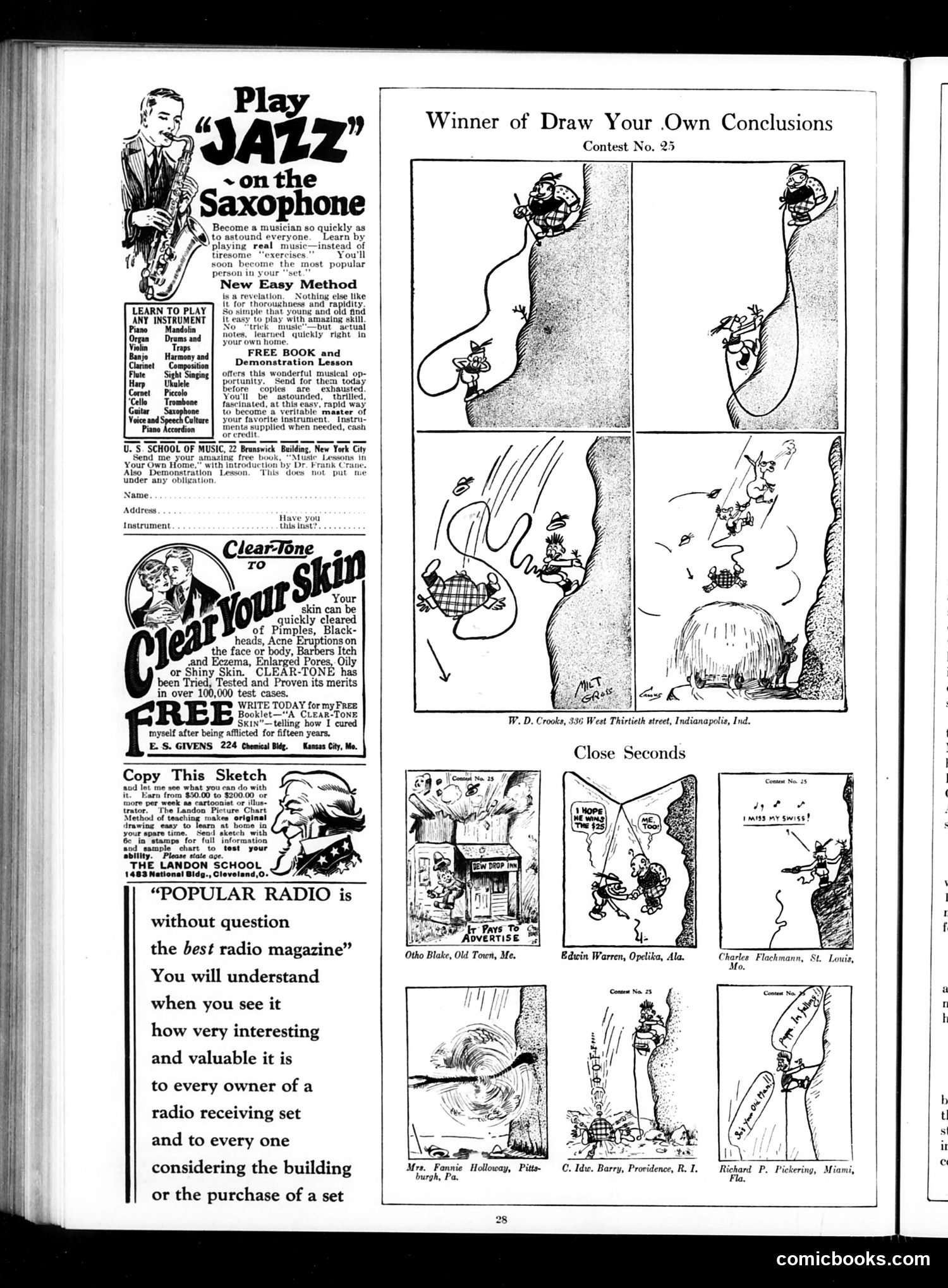
This page features the winning entry from Judge's "Draw Your Own Conclusions" contest, a humor feature where readers submit cartoons with minimal captions and let viewers interpret the joke. The winner, by D. Crooks of Indianapolis, shows a series of cartoon panels depicting figures climbing or struggling along a curved surface. The humor appears to rely on visual ambiguity—viewers must "draw their own conclusions" about what the scene actually depicts. The cartoons below labeled "Close Seconds" are runner-up submissions using the same premise. The surrounding advertisements (saxophone lessons, skin-clearing products, radio magazine) are typical of Judge's commercial content from this era, likely 1920s-1930s, targeting middle-class readers interested in self-improvement and modern consumer goods. The contest format was popular in satirical magazines, encouraging reader participation while filling pages with humorous content.
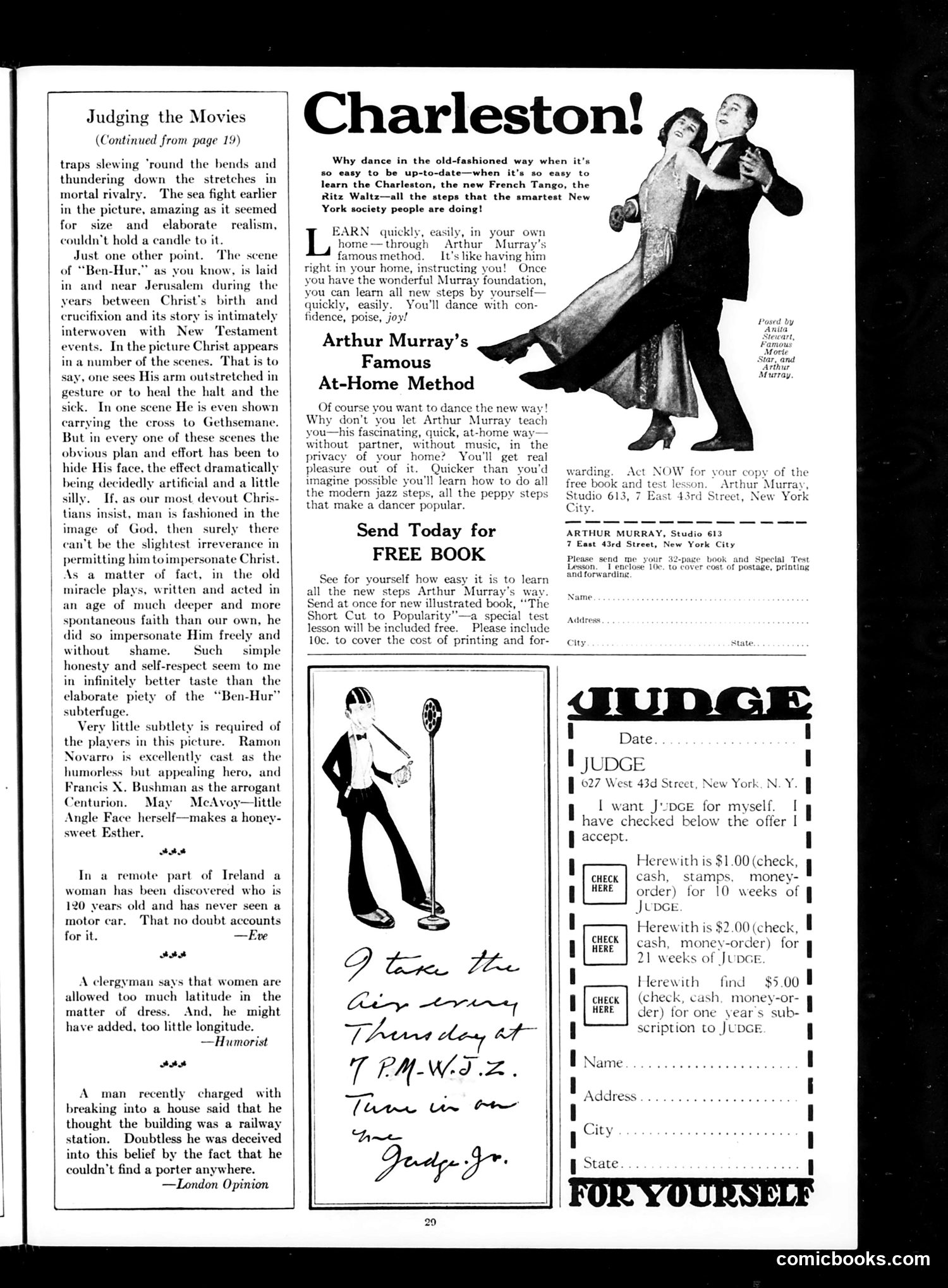
This page combines film criticism with period advertising, reflecting 1920s entertainment culture. **Main Content:** The left column critiques "Ben-Hur," praising its realistic sea battle but criticizing its artificial depiction of Christ—arguing that the film's over-earnest approach to religious scenes is less tasteful than medieval miracle plays' honest simplicity. It also reviews supporting performances by Ramon Novarro, Francis X. Bushman, and May McAvoy. **Primary Advertisement:** The dominant feature promotes Arthur Murray's at-home dance instruction method, capitalizing on the Charleston craze and Jazz Age culture. The advertisement promises readers can quickly learn modern dance steps (Charleston, Ritz Waltz, jazz steps) privately at home without a partner or music—positioning this as more convenient and fashionable than traditional dancing. **The Satire:** The juxtaposition is itself commentary—contrasting serious artistic criticism with commercial hype for a trendy dance fad, reflecting 1920s consumer culture's embrace of quick, convenient self-improvement products marketed to "society people."
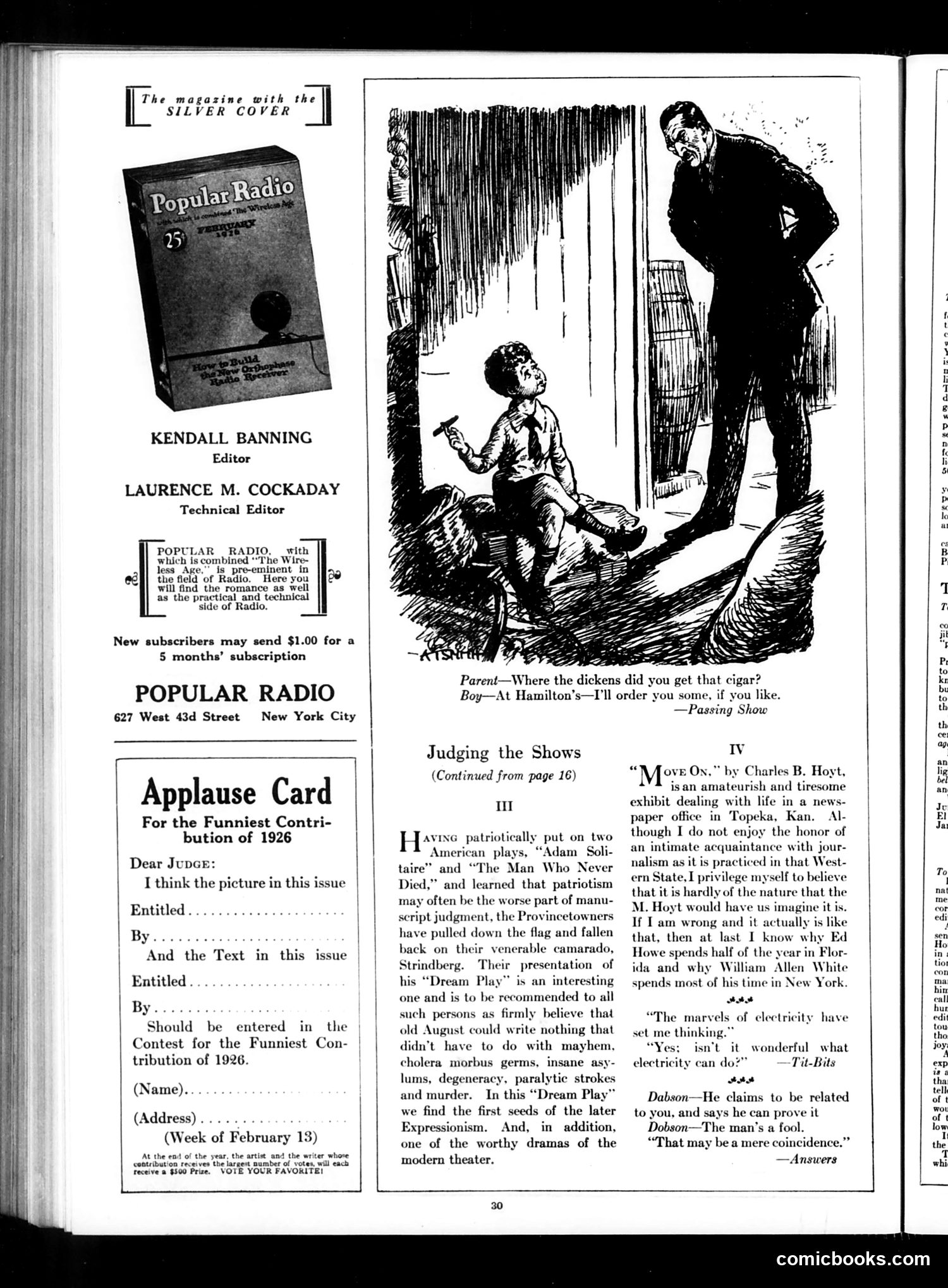
This page is primarily **advertising and editorial masthead** for *Judge* magazine and its sister publication *Popular Radio*. The main cartoon shows a domestic scene: a boy caught smoking a cigar by his parent, claiming he bought it "at Hamilton's"—a likely reference to a real tobacconist—and offering to order more for the father. The joke relies on the boy's innocent shamelessness about his vice and the parent's implied interest in obtaining the same product. Below is a theater review column discussing plays by the Provincetown Players, including Strindberg's "Dream Play," and brief critical notes on other productions. The page includes an "Applause Card" contest inviting readers to vote on the magazine's funniest 1926 contributions, with prizes of $500 for winning artist and writer. The content reflects 1920s magazine culture and theatrical criticism rather than political satire.
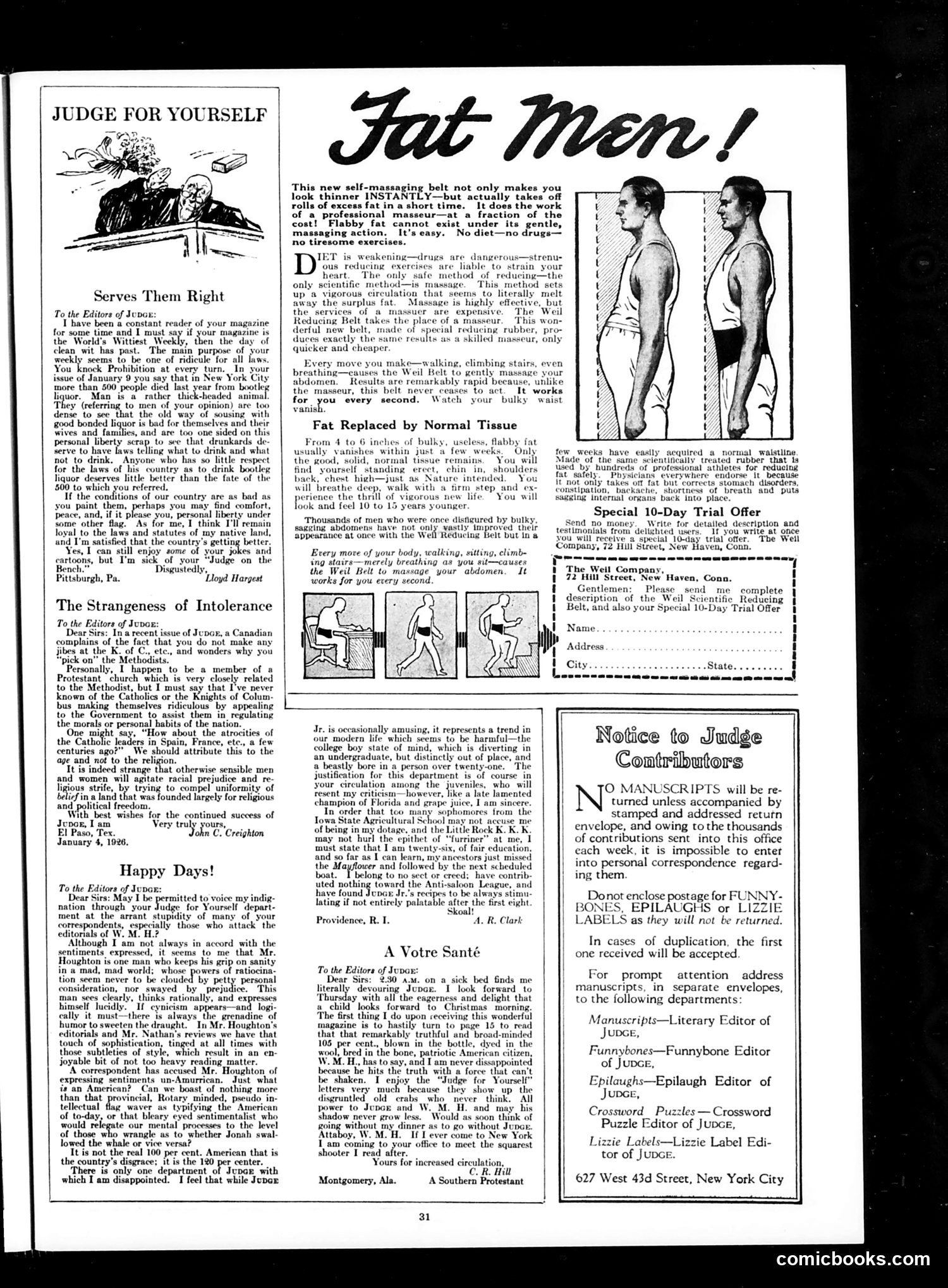
This page from Judge (a satirical American weekly) contains readers' letters and advertisement rather than original cartoons. The "Judge for Yourself" section publishes reader responses to prior issues' content. Key themes visible: **Letters critique Judge's anti-Prohibition stance.** One writer defends Prohibition laws, citing 600 bootleg-liquor deaths in New York City and arguing that those breaking laws "deserve little better than the fate" they suffer—a harsh endorsement of consequences for lawbreakers. **A second letter defends Judge against charges of religious bias.** The Canadian reader protests that the magazine is accused of attacking Methodists while sparing Catholics/Knights of Columbus, calling such complaints evidence of troubling "religious strife" and "intolerance." **A third praises Judge's editor W.M. Houghton** for rational, sophisticated commentary amid America's "mad, mad world." The **"Fat Men" advertisement** (right) promotes a self-massaging belt claiming to reduce excess fat without diet or exercise—typical of dubious weight-loss products of the 1920s era.
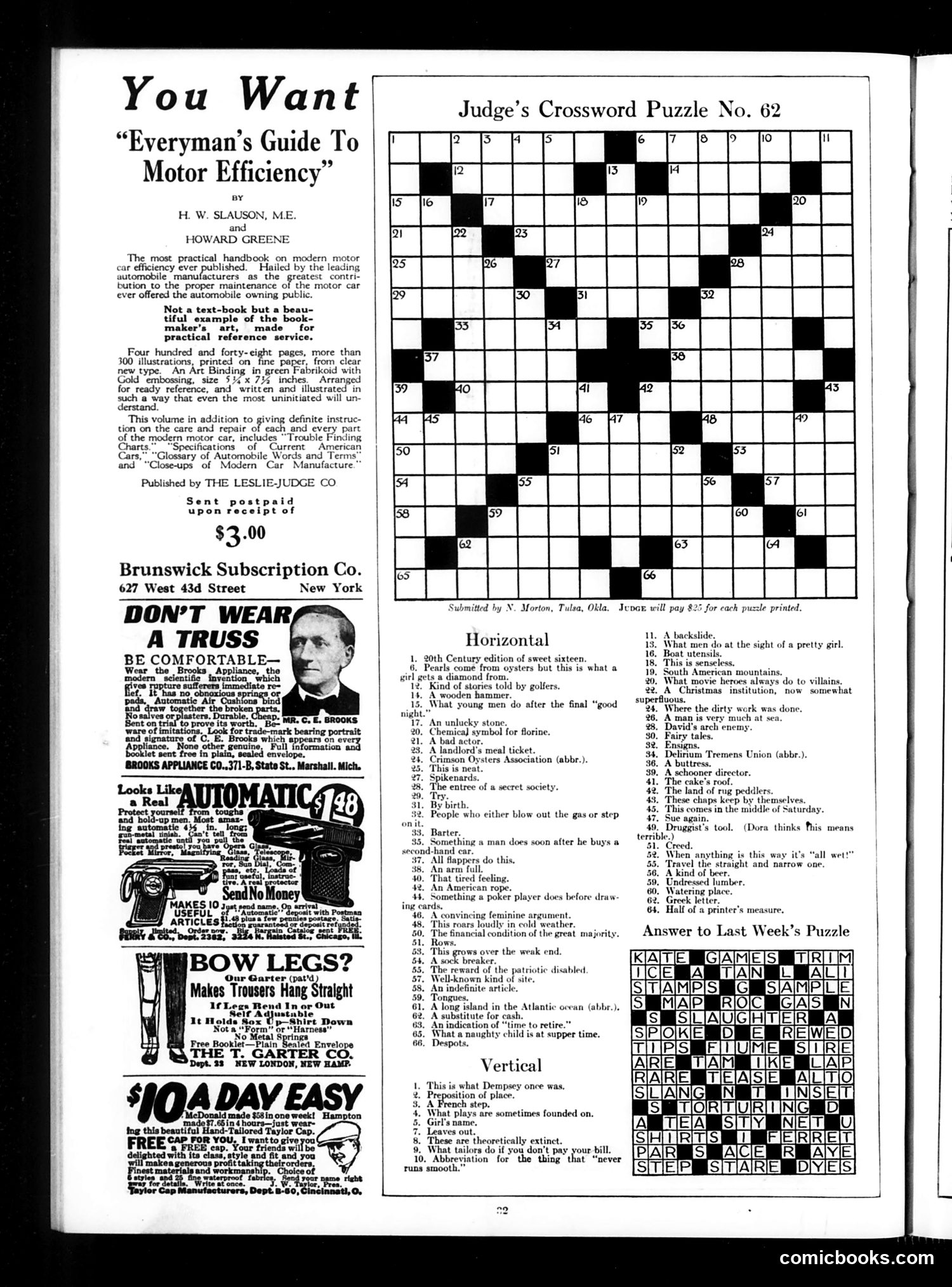
This is primarily an **advertising and puzzle page** rather than satirical content. The page features: **Main Content:** - A crossword puzzle (#62) with motor/automobile-themed clues, reflecting the era's car-culture obsession - Advertisement for "Everyman's Guide to Motor Efficiency," a 1920s automotive maintenance handbook **Period Advertisements:** - "Don't Wear a Truss" - medical device ads (common in early 20th-century magazines) - "Bow Legs?" garter solution - "$10 a Day Easy" income scheme **Historical Context:** These ads reveal what concerned ordinary Americans circa 1920s-1930s: personal appearance corrections, health devices, and get-rich-quick schemes. The automobile guide advertisement reflects the novelty and complexity of motor cars—owners needed detailed instruction manuals for maintenance, indicating cars were still relatively new technology requiring specialized knowledge. The crossword's automotive theme shows how thoroughly automobiles had penetrated American culture and consciousness by this period.
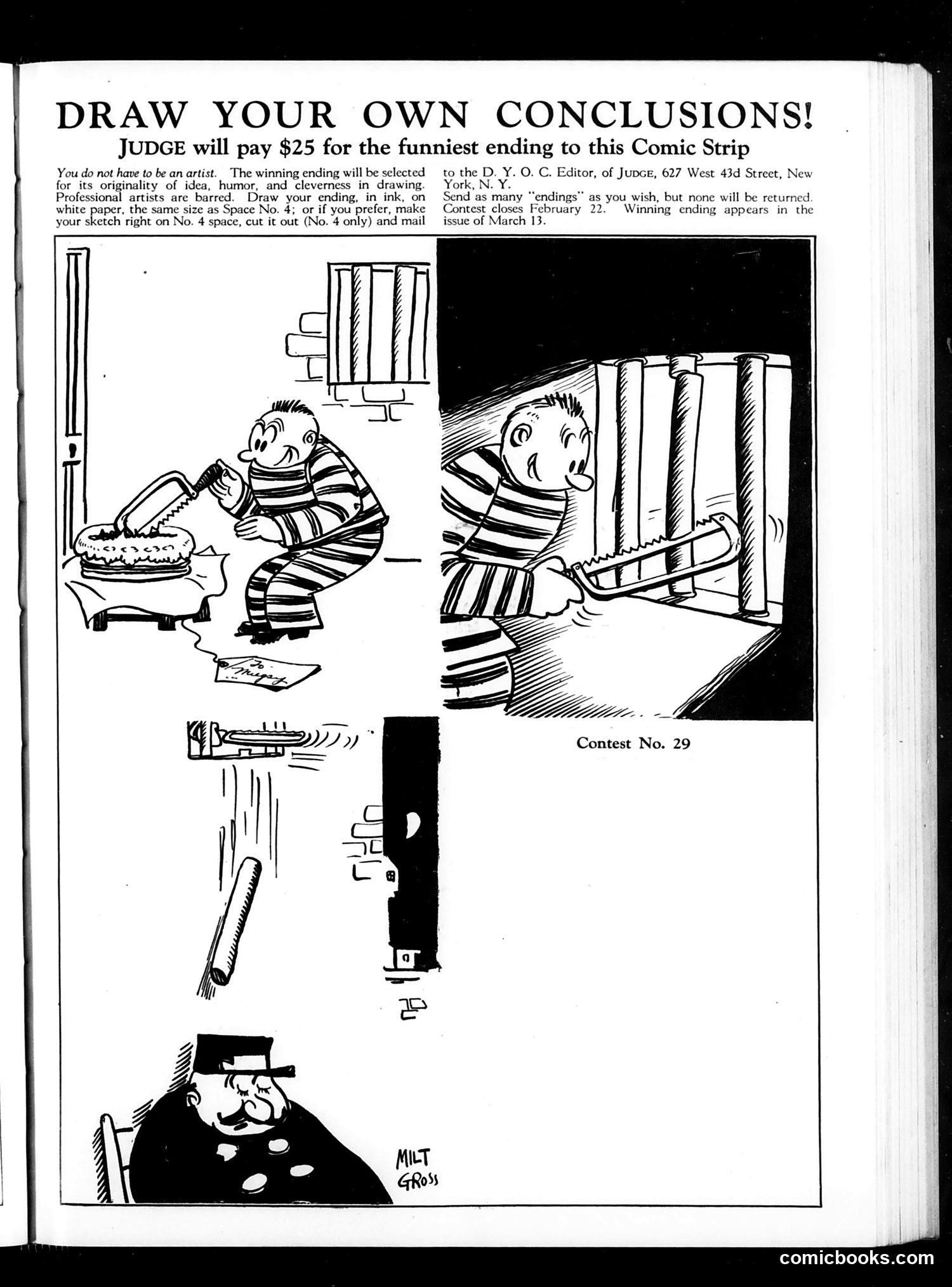
This page presents a reader-participation contest from Judge magazine. The incomplete comic strip (labeled "Contest No. 29") shows a convict in striped prison clothing engaged in suspicious activity—appearing to saw through prison bars while a guard or authority figure is distracted eating. Judge invited readers to submit humorous endings to this escape-themed narrative, offering $25 for the funniest conclusion. The contest emphasizes originality and cleverness rather than artistic skill—professional artists were excluded to level the playing field for amateur contributors. The joke setup is straightforward prison-escape satire typical of early-to-mid 20th century humor. Readers were to imagine what happens next: Does the convict escape? Is he caught? The contest closed February 22, with the winning ending published in the March 13 issue. This represents Judge's interactive engagement with its audience during an era when such reader contests were popular magazine features.
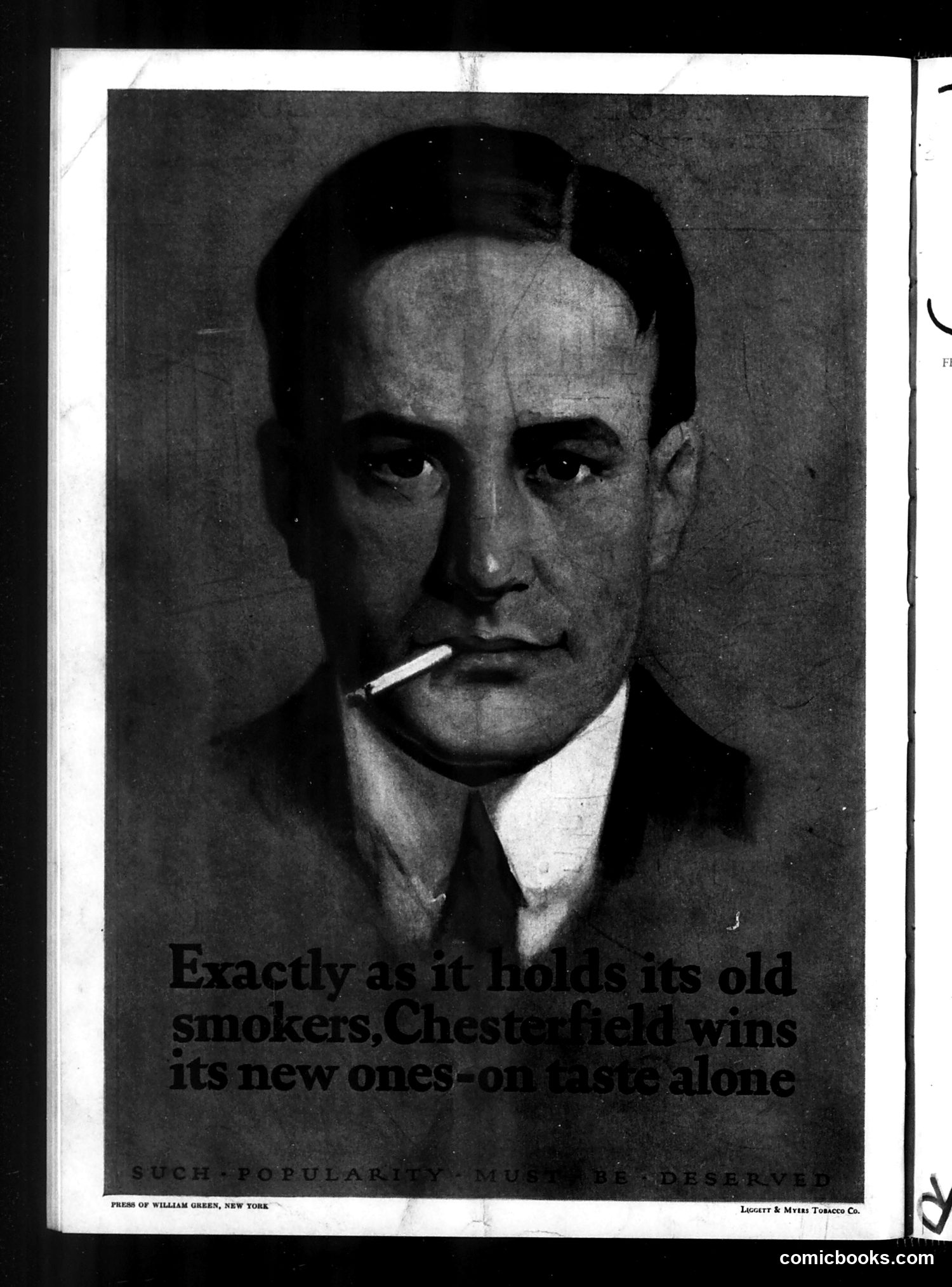
This appears to be a **cigarette advertisement** rather than a political cartoon. The image shows a well-dressed man smoking a cigarette, styled as a formal portrait photograph. The text reads: "Exactly as it holds its old smokers, Chesterfield wins its new ones—on taste alone" with the tagline "SUCH POPULARITY MUST BE DESERVED." This is a vintage **Chesterfield cigarette ad** from Judge magazine, likely early-to-mid 20th century. The advertisement uses the appeal of a distinguished gentleman to market cigarettes, emphasizing brand loyalty and taste quality—common advertising strategies before modern health warnings existed. The page credits indicate it was printed by William Green in New York and published by Liggett & Myers Tobacco Co., Chesterfield's manufacturer.