
Judge, 1926-02-13 · page 18 of 36
Judge — February 13, 1926 — page 18: what you’re looking at
What you’re looking at
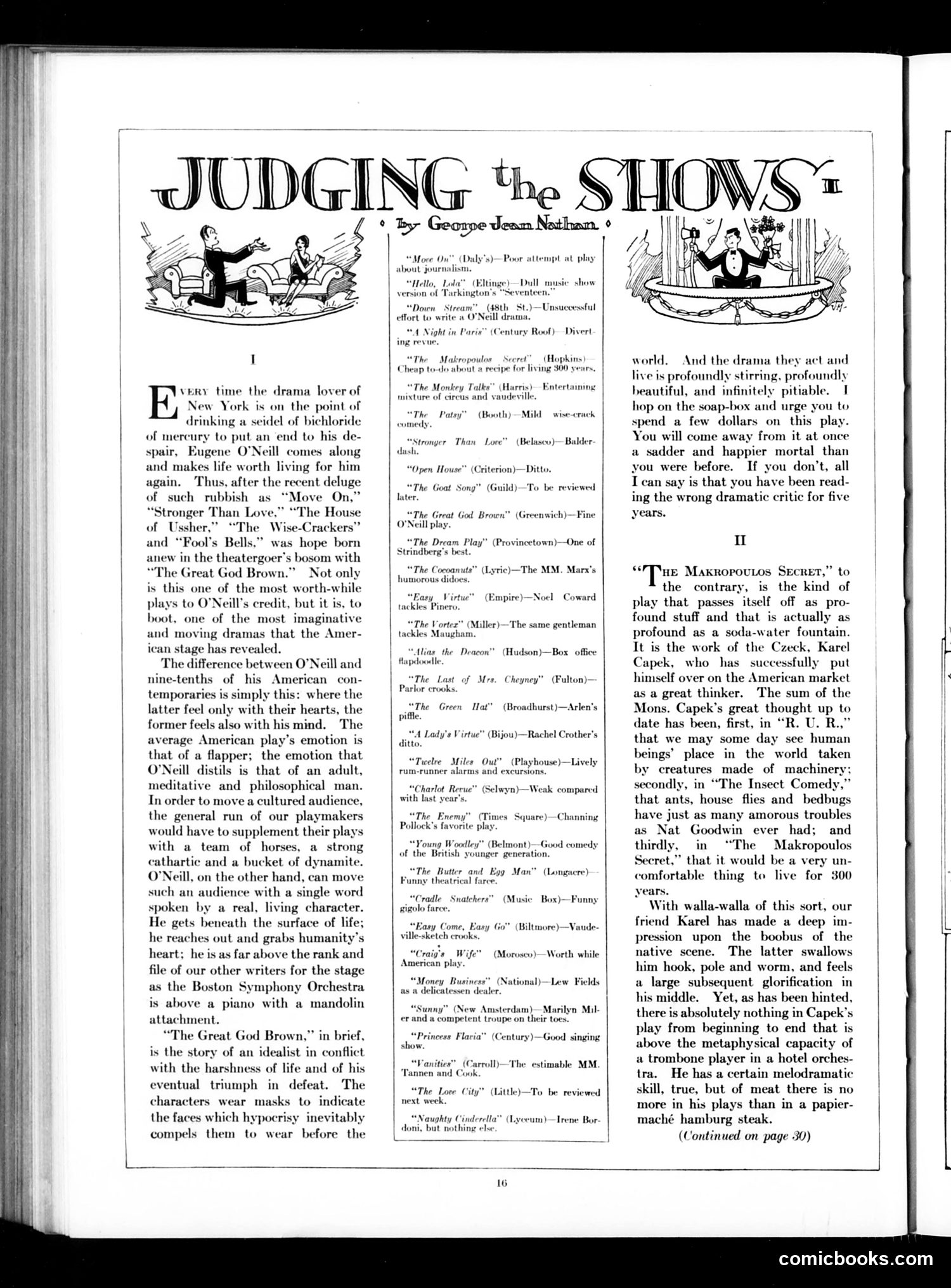
This page is a theater review column by George Jean Nathan, a prominent drama critic of the 1920s. The text praises Eugene O'Neill's *The Great God Brown* as superior to the mediocre plays currently cluttering Broadway. Nathan contrasts O'Neill with his contemporaries: while most American playwrights appeal to audiences emotionally (like "a flapper"), O'Neill engages the intellect of cultured, adult audiences. The satire criticizes the low quality of contemporary theater—most plays require "a team of horses, a strong cathartic and a bucket of dynamite" to move audiences, while O'Neill needs only "a single word spoken by a real, living character." The accompanying list reviews current Broadway productions, dismissing most as "rubbish," "piffle," "flapdoodle," or "dull." This reflects 1920s theater criticism's contempt for commercial entertainment versus serious dramatic art.
📄 Transcribed text from this page (OCR, searchable)
Machine-transcribed from the original scan — historical spelling and the odd misread are preserved.
very time the drama lover of BE New York is on the point of drinking a seidel of bichloride of mercury to put an end to his de- spair, Eugene O'Neill comes along and makes life worth living for him again. Thus, after the recent deluge of such rubbish as “Move On,” “Stronger Than Love,” “The House of Ussher,” “The Wise-Crackers” and “Fool's Bells.” was hope born anew in the theatergoer’s bosom with “The Great God Brown. Not only is this one of the most worth-while plays to O'Neill's credit, but it is, to boot, one of the most imaginative and moving dramas that the Amer- ican stage has revealed. ‘The difference between O'Neill and nine-tenths of his American con- temporaries is simply this: where the latter feel only with their hearts, the former feels also with his mind. The average American play’s emotion is that of a flapper; the emotion that O'Neill distils is that of an adult, meditative and philosophical man. In order to move a cultured audience, the general run of our playmakers would have to supplement their plays. with a team of horses, a strong cathartic and a bucket of dynamite. O'Neill, on the other hand, can move such an audience with a single word spoken by a real, living character. He gets beneath the surface of life; he reaches out and grabs humanity's. heart; he is as far above the rank and file of our other writers for the stage as the Boston Symphony Orchestra is above a piano with a mandolin attachment. “The Great God Brown,” in brief, is the story of an idealist in conflict with the harshness of life and of his eventual triumph in defeat. The characters wear masks to indicate the faces which hypocrisy inevitably compels them to wear before. the NG be SHOWS = by Georpe Jesm Notham. ¢ “More On" (Daly’s)—Poor attempt at play about journalism, Dull music. show of Tarkington's “Seventes “Down Stream’ (48th St.)—Unsuccessful effort to write « O'Neill di “4 Night in Paris” (Century Roof) Divert ing revue. “The Makropoulos Secret” (Hopkins Cheap to-do about a recipe for living 300 years, | “The Monkey Talks” (Harris) Entertaining | mixture of circus and yaudevill Patsy” (Booth) Mild wise-crack Than Lore” (Belascv)—Balder “Open House” (Criterion)—Ditto. “The Goat Song” (Guild)—To be reviewed later. “The Great God Brown" (Greenwich)—Fine O'Neill play. “The Dream Play” (Provincetown)—One of Strindberg's best. “The Cocoanuts” (Lytic)—The MM. Marx's humorous didoes. “Easy Virtue” mpire)—Noel Coward tackles Pinero. “The Vortex” (Miller)—The same gentleman tackles Maugham, “Alias the Deacon’® (Hudson)—Box. office flapdoordle “The Last of Mrs. Cheyney” (Fulton) Parlor crooks. “The Green Hat" (Broadhurst)—Arlen's piffle. “A Lady's Virtue” (Bijou)—Rachel Crother's dite “Twelre Out” (Playhouse)—Lively rum-runner and excursions. “Charlot Recw wyn)—Weak compared with last year's “The Enemy (Times Square)—Channing Pollock's favorite play “Young Woodley” Good comedy of the British youn ation. The Butter and Man" (Longacre) theatrical f “Cradle Snatchers” (Music Box)—Funny gigolo farce. ‘asy Come, Easy Go” (Biltmore)—Vaude- ville-sketch crooks, “Craig's Wife” (Moroseo)—Worth while American play “Money Business” (National)—Lew Fields as a delicatessen dealer. “Sunny (New Amsterdam)—Marilyn Mil er and a competent troupe on their toes. incess Flaria” (Century)—Good singing Vanities” (Carroll)—The estimable MM. ‘Tannen and Cook “The Love City” (Little)—To be reviewed next week. aughty Cinderella” (Lyceum) —Irene Bor- but nothing else world. And the drama they act and live is profoundly stirring, profoundly beautiful, and infinitely pitiable. 1 hop on the soap-box and urge you to spend a few dollars on this pl You will come away from it at on a sadder and happier mortal than you were before. If you don’t, all I can say is that you have been read- ing the wrong dramatic critic for five years. Il Tue Makropoutos SEcRET,” to the contrary, is the kind of play that passes itself off as _pro- found stuff and that is actually as profound as a soda-water fountain. It is the work of the Czeck, Karel Capek, who has successfully put himself over on the American market as a great thinker. The sum of the Mons. Capek’s great thought up to date has been, first, in “R. U. R.,” that we may some day see human beings’ place in the world taken by creatures made of machinery; secondly, in “The Insect Comedy, that ants, house flies and bedbugs have just as many amorous troubles as Nat Goodwin ever had; and thirdly, in “The Makropoulos Secret,” that it would be a very un- comfortable thing to live for 300 years. With walla-walla of this sort, our friend Karel has made a deep im- pression upon the boobus of the native scene. The latter swallows him hook, pole and worm, and feels a large subsequent glorification in his middle. Yet, as has been hinted, there is absolutely nothing in Capek’s play from beginning to end that is above the metaphysical capacity of a trombone player in a hotel orches- tra. He has a certain melodramatic skill, true, but of meat there is no more in his plays than in a papier- maché hamburg steak. (Continued on page 30) comicbooks.com