
Judge, 1926-02-13 · page 20 of 36
Judge — February 13, 1926 — page 20: what you’re looking at
What you’re looking at
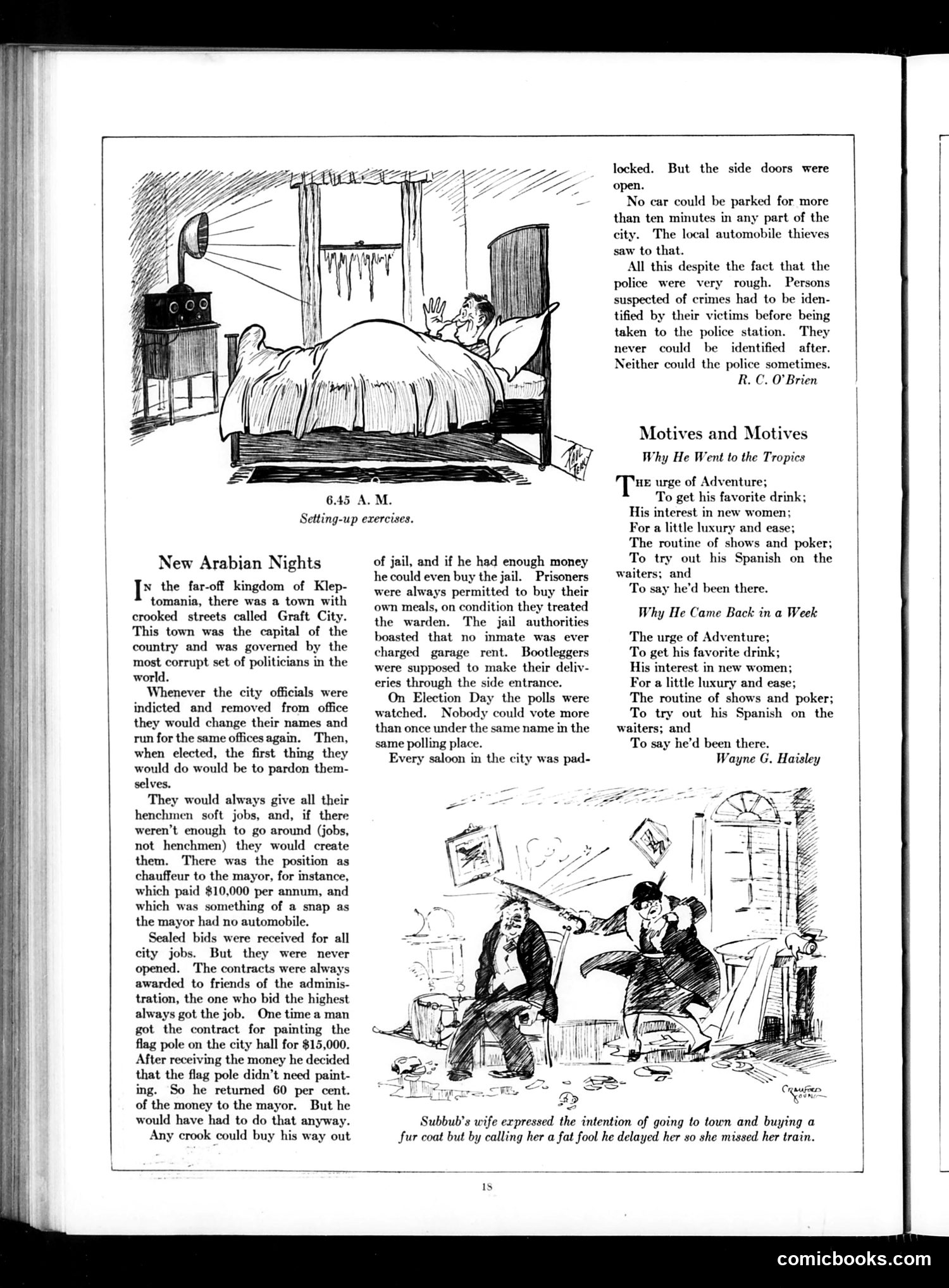
**"New Arabian Nights"** is a satirical story about "Graft City," a fictional corrupt municipality. It mocks American urban political corruption: officials indicted for crimes simply change names and run again; they pardon themselves; create fake high-paying jobs (like a $10,000 chauffeur position for a mayor without a car); award contracts to friends without opening bids; permit prisoners to buy their way out of jail; and allow bootleggers side-door access despite Prohibition-era saloon "padlocking." The humor relies on absurdist exaggeration—automobile thieves enforce parking limits; police are rough yet ineffective—to satirize systemic corruption where everything is for sale. **"Motives and Motives"** is a brief joke contrasting why someone travels to the tropics versus why he quickly returns: identical reasons (adventure, drinking, women, gambling), suggesting tropical getaways are ultimately disappointing. **The bottom cartoon** mocks domestic gender dynamics: a husband delays his wife's shopping trip by insulting her appearance, causing her to miss her train—presented as clever manipulation.
📄 Transcribed text from this page (OCR, searchable)
Machine-transcribed from the original scan — historical spelling and the odd misread are preserved.
6.45 A.M. Setting-up exercises. New Arabian Nights i the far-off kingdom of Klep- tomania, there was a town with crooked streets called Graft City. This town was the capital of the country and was governed by the most corrupt set of politicians in the world. Whenever the city officials were indicted and removed from office they would change their names and run for the same offices again. Then, when elected, the first thing they would do would be to pardon them- selves. They would always give all their henchmen soft jobs, and, if there weren’t enough to go around (jobs, not henchmen) they would create them. There was the position as chauffeur to the mayor, for instance, which paid $10,000 per annum, and which was something of a snap as the mayor had no automobile. Sealed bids were received for all city jobs. But they were never opened. The contracts were alwa: awarded to friends of the admini tration, the one who bid the highes' always got the job. One time a man got the contract for painting the flag pole on the city hall for $15,000. After receiving the money he decided that the flag pole didn’t need paint- ing. So he returned 60 per cent. of the money to the mayor. But he would have had to do that anyway. Any crook could buy his way out of jail, and if he had enough money he could even buy the jail. Prisoners were always permitted to buy their own meals, on condition they treated the warden. The jail authorities boasted that no inmate was ever charged garage rent. Bootleggers were supposed to make their deliv- eries through the side entrance. On Election Day the polls were watched. Nobody could vote more than once under the same name in the same polling place. Every saloon in the city was pad- locked. But the side doors were open. No car could be parked for more than ten minutes in any part of the city. The local automobile thieves saw to that. All this despite the fact that the police were very rough. Persons suspected of crimes had to be iden- tified by their victims before being taken to the police station. They never could be identified after. Neither could the police sometimes. R. C. O’Brien Motives and Motives Why He Went to the Tropics T= urge of Adventure; To get his favorite drink; His interest in new women; For a little luxury and ease; The routine of shows and poker; To try out his Spanish on the waiters; and To say he'd been there. Why He Came Back in a Week The urge of Adventure; To get his favorite drink; His interest in new women; For a little luxury and ease; The routine of shows and poker; To try out his Spanish on the waiters; and To say he’d been there. Wayne G. Haisley Subbub’s wife expressed the intention of going to town and buying a Sur coat but by calling her a fat fool he delayed her so she missed her train. comicbooks.com