
Judge, 1926-02-13 · page 32 of 36
Judge — February 13, 1926 — page 32: what you’re looking at
What you’re looking at
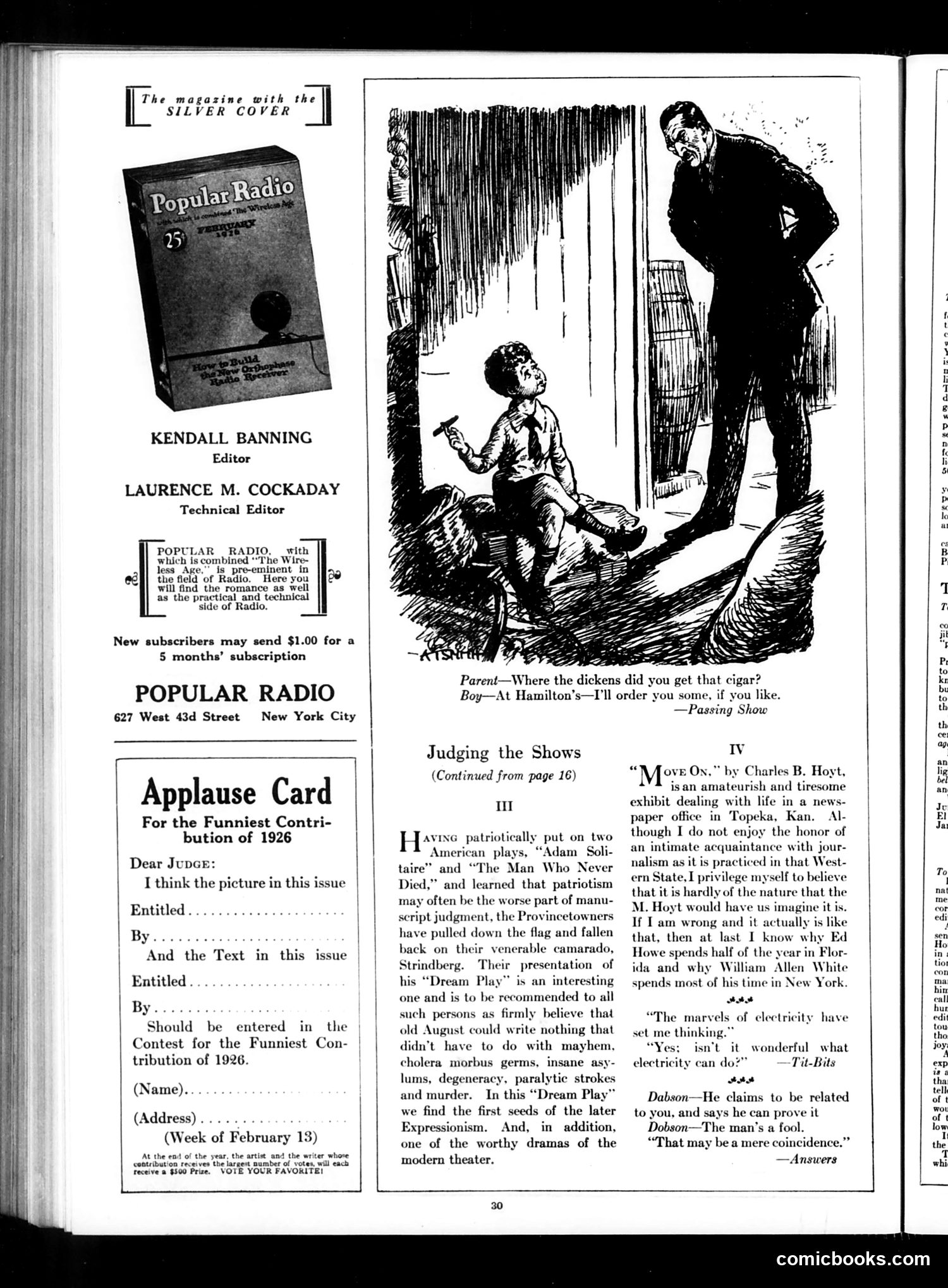
This page is primarily **advertising and editorial masthead** for *Judge* magazine and its sister publication *Popular Radio*. The main cartoon shows a domestic scene: a boy caught smoking a cigar by his parent, claiming he bought it "at Hamilton's"—a likely reference to a real tobacconist—and offering to order more for the father. The joke relies on the boy's innocent shamelessness about his vice and the parent's implied interest in obtaining the same product. Below is a theater review column discussing plays by the Provincetown Players, including Strindberg's "Dream Play," and brief critical notes on other productions. The page includes an "Applause Card" contest inviting readers to vote on the magazine's funniest 1926 contributions, with prizes of $500 for winning artist and writer. The content reflects 1920s magazine culture and theatrical criticism rather than political satire.
📄 Transcribed text from this page (OCR, searchable)
Machine-transcribed from the original scan — historical spelling and the odd misread are preserved.
The magazine with the SILVER COVER KENDALL BANNING Editor LAURENCE M. COCKADAY Technical Editor POPULAR RADIO, with which is combined ‘The Wire- less Age,” is pre-eminent in the field of Radio. Here you will find the romance as well as the practical and technical side of Radio. New subscribers may send $1.00 for a 5 months’ subscription POPULAR RADIO 627 West 43d Street New York City Applause Card | For the Funniest Contri- bution of 1926 Dear JupGeE: I think the picture in this issue Entitled sscsiesiesceways And the Text in this issue Entitled . Should Contest for the Funniest Con- tribution of 1926. (Name). (Address) ........ : (Week of February 13) At the end of the year, the artit and the writer whore contribution receives the iargest number of votes, will each Feceive a $500 Prize. VOTE YOUR FAVORITE! Parent—Where the dickens did you get that cigar? Boy—At Hamilton’s—I'll order you some, if you like. Judging the Shows (Continued from page 16) Il yatriotically put on two plays, “Adam Soli- and “The Man Who Never ”’ and learned that patriotism y often be the worse part of manu- script judgment, the Provincetowners have pulled down the flag and fallen back on their venerable camarado, Strindberg. Their presentation of his “Dream Ple is an interesting one and is to be recommended to all such persons as firmly believe that old August could write nothing that didn’t have to do with mayhem, cholera morbus germs, insane asy- lums, degeneracy, paralytic strokes and murder. In this “Dream Play” we find the first seeds of the later Expressionism. And, in addition, one of the worthy dramas of the modern theater. —Passing Show IV “M ve On,” by Charles B. Hoyt, +YF isan amateurish and tiresome exhibit dealing with life in a news- paper office in Topeka, Kan. Al- though I do not enjoy the honor of an intimate acquaintance with jour- nalism as it is practiced in that We ern State, I privilege myself to believe that it is hardly of the nature that the M. Hoyt would have us imagine it i If I am wrong and it actually i: that, then at last I know why Howe spends half of the year in Flor- ida and why William Allen White spends most of his time in New York. ts “The mar of electricity have set me thir . . 3 it wonderful what electricity can do?” Tit-Bits tae Dabson—He claims to be related to you, and says he can prove it Dobson—The man’s a fool. “That may be a mere coincidence.” —Answers comicbooks.com