
Judge, 1926-02-13 · page 21 of 36
Judge — February 13, 1926 — page 21: what you’re looking at
What you’re looking at
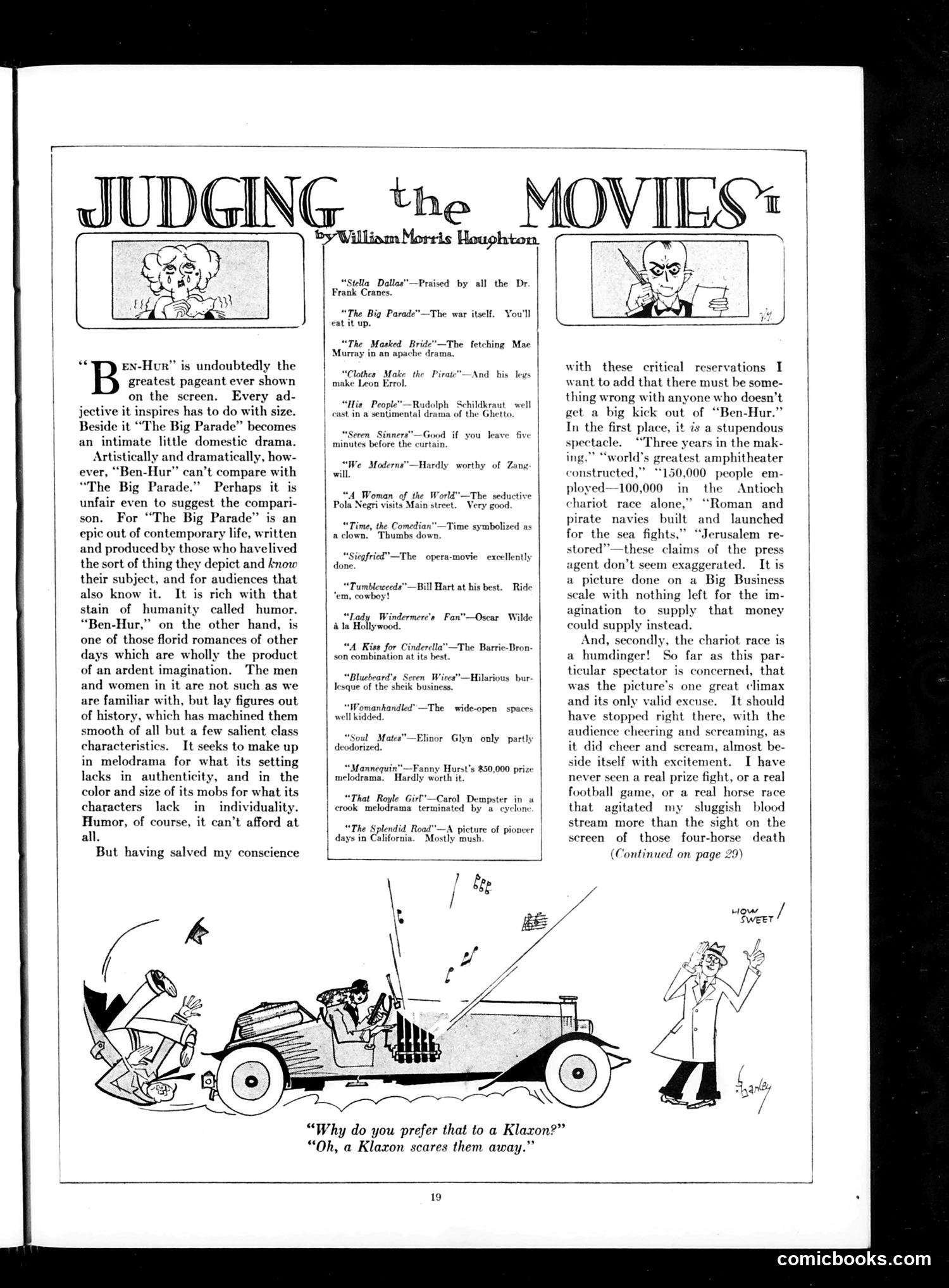
This page reviews contemporary films, comparing the epic "Ben-Hur" (a massive production with 150,000 extras) favorably to "The Big Parade" on spectacle, though praising the latter's artistic merit and human authenticity. The main cartoon jokes about a Klaxon horn (an early automobile alarm device): when asked why someone prefers a Klaxon to something else, they reply "a Klaxon scares them away"—likely mocking the noise pollution and public annoyance caused by these horns, which were becoming common urban nuisances in the 1920s. The film reviews mock various movies with brief, witty judgments: praising some ("The Big Parade"), dismissing others as derivative or overly sentimental ("Stella Dallas," "Mannequin"). The critic acknowledges "Ben-Hur's" stunning chariot race sequence while criticizing the film's lack of humor and authentic characterization compared to contemporary dramas.
📄 Transcribed text from this page (OCR, searchable)
Machine-transcribed from the original scan — historical spelling and the odd misread are preserved.
ss EN-Hur” is undoubtedly the on the screen. Every ad- jective it inspires has to do with size. Beside it “The Big Parade” becomes an intimate little domestic drama. Artistically and dramatically, how- ever, “Ben-Hur” can’t compare with “The Big Parade.” Perhaps it is unfair even to suggest the compari- son. For “The Big Parade” is an epic out of contemporary life, written and produced by those who havelived the sort of thing they depict and know their subject, and for audiences that also know it. It is rich with that stain of humanity called humor. “Ben-Hur,” on the other hand, is one of those florid romances of other days which are wholly the product of an ardent imagination. The men and women in it are not such as we are familiar with, but lay figures out of history, which has machined them smooth of all but a few salient class characteristics. It seeks to make up in melodrama for what its setting lacks in authenticity, and in the color and size of its mobs for what its characters lack in individuality. Humor, of course, it can’t afford at all. But having salved my conscience “Stella Dallas"—Praised by all the Dr. Frank Cranes. “The Big Parade”—The war itself. eat it up. You'll “The Masked Bride"—The fetching Mae Murray in an apache drama. “Clothes Make the Pirate"—And his legs make Leot i “His People"’—Rudolph Schildkraut well cast in a sentimental drama of the Ghetto. “Seren Sinners"—Good if you leave five minutes before the curtain. | ave Moderns"—Hardly worthy of Zang. wil “A Woman of the World’ Pola Negri visits Main street. “Time, the Comedian”—Time symbolized as aclown.’ Thumbs down. joiSieafried” —The opera-movie excellently “Tumbleweeds"—Bill Hart at his best. Ride ‘em, cowboy! “Lady Windermere's Fan"—Oscar Wilde la Hollywood. “A. Kiss for Cinderella” —The Bartie-Bron- son combination at its best “Bluebeard's Seren Wires"—Hilarious bur- esque of the sheik busines “Womanhandled”—The wide-open spaces well kidded. “Soul Mates"—Elinor Glyn only partly deodorized. “Mannequin” —Fanny Hurst's 850,000 prize melodrama, Hardly worth it “That Royle Girl’—Carol Dempster in a crook melodrama terminated by a cyclone “The Splendid Road—A picture of pioneer days in California. Mostly mush. } Wg “Why do you prefer that to a Klaxon?” “Oh, a Klaxon scares them away.” with these critical reservations I want to add that there must be some- thing wrong with anyone who doesn’t get a big kick out of “Ben-Hur.” In the first place, it is a stupendous spectacle. “Three years in the mak- ing.” “world’s greatest amphitheater constructed,” “150,000 people em- ployed—100,000 in the Antioch chariot race alone,” “Roman and pirate navies built and launched for the sea fight “Jerusalem re- stored”—these claims of the press agent don’t seem exaggerated. It is a picture done on a Big Business scale with nothing left for the im- agination to supply that could supply instead. And, secondly, the chariot race is a humdinger! So far as this par- ticular spectator is concerned, that was the picture's one great climax and its only valid excuse. It should have stopped right there, with the audience cheering and screaming, as it did cheer and scream, almost be- side itself with excitement. I have never scen a real prize fight, or a real football game, or a real horse race that agitated my sluggish blood stream more than the sight on the screen of those four-horse death money (Continued on page 29) comicbooks.com